




Abstract
Educators face the challenge of creating classroom environments that are physically, socially, and didactically ‘communication friendly’ for children with diverse communication needs and differences. In this article we propose that (1) communication and the development of agency are bi-directionally linked and, therefore, (2) the promotion of agency through physical and social-didactic strategies will support the establishment of communication friendly classrooms. We draw upon evidence from the developmental and intervention literatures to illustrate the relationship between communication and agency. Further, we provide examples of specific strategies for promoting a child’s agency through physical and social-didactic approaches in the classroom. These strategies are applicable to children with varying communication needs, differences, delays, and/or disorders.
I Introduction
Schools are filled with diverse learners, who vary in learning style, motivation, ability, and cultural and linguistic community membership. Classrooms that promote universal participation and successful communication outcomes for all are essential. The establishment of a ‘communication friendly’ classroom requires careful decisions. How can classrooms be physically structured to promote independence and facilitate communication? What sorts of social and didactic interactions are optimal? The purpose of this article is to recommend ‘agency’ as a construct for unifying and guiding these decisions.
Agency is the understanding of oneself as a causal agent capable of purposefully shaping motives, behavior, and future possibilities (Damon and Hart, 1991). A person with a healthy sense of agency perceives his or her own competence and capacity to make things happen. Agency is active. We manifest agency by acting on our desires, motivations, and goals. Agency is context specific. Individuals may have a more well developed sense of agency in some domains as compared to others (e.g. sports vs. academics; Bandura, 2006). It is the situated nature of agency that makes it critical to establish classroom environments that support agentive behavior. Furthermore, although children are still in the process of developing an adult-like concept of their own agency, their ability to exercise their agentive selves should not be ignored. In a manuscript exploring theories of childhood, James and James (2001) emphasized that ‘children are competent social actors who have a particular perspective on the social world that we, as adults, might find worth listening to’ (p. 35). We posit that a child’s internal development and sense of agency can be supported and fostered through communication partners and external supports to promote effective communication. This thesis is supported by research in a variety of domains (e.g. sociology, child development, speech and language, adult–child interaction, etc). We advocate for using this research as a foundation for constructing communication-friendly classrooms. Research supporting the importance of children’s agency bears on two primary themes: one body of literature illustrates how agency and communication are intertwined within the child, whereas another body illustrates the benefits of adults as communication partners and models considering a child’s agency during communicative interactions.
1 Evidence for the link between agency and communication development
The first theme is well explored in the child development and sociological literatures, which demonstrate how a child’s agency and development (we are mostly concerned with communication development) are linked.
Consider two crucial communicative attainments: the ability to label and to narrate. Learning one’s own name and the names of others, and eventually learning first person and other person pronouns, reinforces the notion of self (Gallagher, 2000). By 18 months children can label pictures of themselves with appropriate self-referents (Lewis and Brooks-Gunn, 1979). By 20 months they can label their intentions before they act (Kagan, 1981); in other words, intentions and actions become more distinct. These are indicators that the child is coming to perceive his or her own agency in the world. Labeling gives way to listing of people, objects, and their actions. Children then begin to include a central theme with characters and actions that connect to related characters or events. Connecting leads to sequencing, which relies on an understanding of temporal and causal relationships. By the time they enter school, many children can produce genuine narratives. To their earlier proto-narratives, they have added a developed plot with evidence of planning to reach goals (Stadler and Ward, 2005). Over the course of the school years, children refine their narratives by including increasingly-nuanced descriptions of characters’ thoughts and feelings, and by developing more sophisticated plots that can involve multiple episodes. These attainments in narrative language scaffold the development of what is variously termed the ‘narrative self’ (Gallagher, 2000) or the ‘life story’ (Habermas and Bluck, 2000). There are strong temporal and causal dimensions to agency. Evaluating the past and planning for the future are integral to a well developed sense of agency and narratives capture these dimensions.
Individual differences in agency have been identified as a source of variance in physical, mental, and behavioral outcomes across the lifespan (Bandura, 2004; DeSocio et al., 2003; Elder et al., 1995). A range of qualitative sociological studies have emphasized how agency is developed and expressed through children’s social interactions with peers and adults. These studies highlight that children are active in their own social development (Corsaro, 1992; James and James, 2001; Kyratzis, 2004; Markstrom and Hallden, 2009). Furthermore, school children with a higher level of agency are more independent learners, who are more effective at applying learning strategies than those with lower agency. They also believe that they determine their own success or failure, as opposed to being externally controlled by teachers or fate (Ehrman et al., 2003), and they are more resilient in the face of failure (Multon et al., 1991).
2 External supports for child agency and the link to communication
The evidence presented above supports the connection between a child’s internal development of agency and their communication skills and abilities. A second body of literature concerns the theme of external support for a child’s agency to facilitate learning and communication. It is important to note that many of the studies described below directly incorporate, describe, and/or promote adult–child interactions that are child-centered but do not necessarily directly address a child’s agency. We suggest one main, important distinction between the two: child-centered approaches encourage adults to consider a child’s preferences or to follow the child’s lead during interactions, but approaches that directly incorporate a child’s agency recognize that the interaction is actively shaped and constructed bi-directionally. In other words, approaches that directly consider a child’s agency are inherently child-centered, but the reverse is not necessarily true. We highlight the need for consideration of a child’s agency and not just child-centeredness in the studies presented below.
A great deal of literature focusing on the importance of adults as communication partners relies heavily on social-interactionist theory, which emphasizes child-directed, responsive, and supportive communication interactions (Warren and Yoder, 1994). Social-interactionist theory can be further extended to help promote and develop a child’s agency. Specifically, concepts like a child’s Zone of Proximal Development (ZPD), defined as ‘the distance between the actual developmental level, as determined by independent problem solving and the level of potential development as determined through problem solving under adult guidance or in collaboration with more capable peers’ (Vygotsky, 1978: 86), are key to fostering agency when theory becomes practice. The application of social-interactionist theory and its offshoots (i.e. models based on the importance of responsive and constructively-directive early language input) can be seen in a variety of observational/developmental early-language input literature (Akhtar et al., 1991; Fewell and Deutscher, 2004; Flynn and Masur, 2007; Masur et al., 2005; McCathren, Yoder, and Warren 1995; Murray and Hornbaker, 1997; Pine, 1992; Raviv et al., 2004; Tamis-LeMonda et al., 2001; Warren et al., 2010; Yoder et al., 2001; Yoder and Warren, 1999) and experimental early-language input literature (Baxendale and Hesketh, 2003; Brady et al., 2009; Buschmann et al., 2008; Girolametto and Pearce, 1996; Kaiser et al. 1996; Peterson et al., 2005).
Speech-language therapists recognize that clients with a positive self-concept (Plexico et al., 2009) and an able self-identity (Kathard, 2006; Wickenden, 2011) will cope more effectively with their communication disorders than those who lack these qualities. This recognition is implicit in interventions that encourage active rather than passive participation from the client. For example, Charlop-Christy et al. (2002) attributed some of the success of the Picture Exchange Communication System (PECS), an intervention widely used with young clients who are nonverbal, to the requirement that the client had to approach his or her communicative partner and initiate an interaction prior to the communicative act (Charlop-Christy et al., 2002: 214).
Fostering intrinsic motivation and ownership can increase active engagement in clinical intervention. For example, Weiss (2004) described a preschooler with a severe phonological disorder whose rate of progress accelerated dramatically after he realized that his baby sister spoke more clearly than he. He thus took more responsibility for change than ever before. Sometimes finding the right way for a given child to become actively engaged is key. For example, Rainio (2007) described an elementary school child who was mute in the classroom (but not at home) for three years. He was given the role of ‘howling ghost’ in a puppet show and he was a great success with the other children. The experience, presumably, was empowering, and he gradually began to communicate in the classroom environment.
These examples demonstrate that there is an implicit understanding of the importance of agency in speech-language intervention. However, it is rare that speech-language interventions explicitly consider and promote agency, especially in children. Two examples of interventions that directly address agency as a part of speech-language intervention in adults are the locus of causality approach to intervention for people who stutter and the life participation approach to intervention for people with aphasia (Lee et al., 2011; Shadden and Hagstrom, 2007).
We maintain that consideration of the physical and social situations is especially essential for interventions that involve children because, inherently, their concept and expression of agency is developing. Environmental scaffolds will be necessary for the child to realize communication and learning goals in an optimal manner. Next we shall consider how the construct of agency can guide decisions about physical and social/didactic environments in classrooms.
II Using agency as a basis for communication-friendly classrooms
1 Physical environments that promote agency and communication
Classroom environments influence children’s learning. Physical aspects of classrooms found to relate to student achievement include lighting, acoustics, color, cleanliness, definition and size of pathways and exits, air quality, and temperature (Cash and Twiford, 2009; Tanner and Lackney, 2006). These factors likely contribute to the mood, comfort, and safety of the learner as well as accessibility to the information being learned. For promoting the learning of communication in particular, one can consider The Communication Supporting Classroom (CsC) Observation Tool (Dockrell et al., 2012), a checklist developed in response to a critical appraisal of the literature on factors that influence communication in K–3 classrooms. One section assesses the physical environment according to 19 criteria:
The classroom is organized to emphasize open space. Learning areas are clearly defined throughout the classroom. Learning areas are clearly labeled with pictures/words throughout the classroom. There is space for privacy or quiet areas where children can retreat to have ‘down time’ or engage in smaller group activities. These areas are less visually distracting. Children’s own work is displayed and labeled appropriately. Some classroom displays include items that invite comments from children. Book specific areas are available. Literacy specific areas are available. Background noise levels are managed consistently throughout the observation, and children and adults are able to hear one another with ease. Transition times are managed effectively, so that noise levels are not excessive and children know what to expect next. There is good light. The majority of learning resources and materials are labeled with pictures/words. Resources that are available for free play are easily reached by the children or easily within their line of vision. An appropriate range of books is available in the book area (for example, traditional stories, bilingual/dual language books and a variety of genres and books related to children’s own experiences). Non-fiction books, books on specific topics or interests of the children are also available in other learning areas. Outdoor play (if available) includes imaginative role play. Good quality toys, small world objects and real/natural resources are available. Musical instruments and noise makers are available, present and used. Role play area is available.
Concern for agency bolsters consideration of these criteria. For example, private space (item 4) enables self-reflection whereas space for small-group interaction enables the exchange of ideas with peers. Both contribute to the development of agency. Display of students’ work (item 5) reinforces learning as it is a visual reminder of a previous lesson or activity and of the child as a causal agent.
Concern for agency also motivates new recommendations. Schools and classrooms can be physically overwhelming for young children and, as such, a threat to their agency. The architect and school principal, Sean O-Donnell (O’Donnell, 2012), uses homes and neighborhoods as a metaphor for designing and arranging schools that ease the transition into the school setting for young learners. Bookshelves and cubbies allow for organization of large classrooms into multiple micro-environments that bring the room to a less threatening scale. The contents of the room can be threatening as well. It is estimated that up to 90% of children use chairs and tables that are the wrong height for their bodies (O’Donnell, 2012). Moveable furniture accommodates many functions; child-scaled, adjustable furniture accommodates many sizes. Keeping materials and displays of children’s work at child-height can also be helpful. Communicative agency and independence can be exercised more easily when physical barriers are removed.
2 Social and didactic environments that promote agency and communication
To determine the feasibility of the CsC Observation Tool, Dockrell et al. (2012) audited 101 K–3 classrooms in the UK. While the physical environments in these classrooms were generally communication friendly, the social and didactic environments were less so. Common weaknesses included few interactive book-reading opportunities and infrequent supports from adults in the form of models, infrequent praise for non-verbal communication, and limited provision of clear language choices, among others. Thus it may be that a given classroom is in greater need of improvement of the social-didactic environment than the physical environment.
For such classrooms, we turn to the literature on second language instruction for inspiration. In 1981 Holec published Autonomy and foreign language learning wherein he emphasized the ability of the student to take charge of his or her own learning as essential to successful outcomes (Holec, 1981), introducing the notion of agency as a primary consideration in foreign language classrooms. Agency and communication are bound for second-language (L2) learners just as they are for first-language learners. Students’ proficiency in their L2 is positively correlated to measures of their learner autonomy (Dafei, 2007; Tok, 2011). The implication is that environmental supports for agency may be particularly essential for the weakest communicators be they children with speech-language impairments or children who need more experience with an L2.
Via a qualitative analysis of students learning experiences, Murray (2011) identified five environmental affordances that support autonomy in the second language learner. Although influenced by the physical environment, these are largely affordances provided by the social and didactic interactions in the classroom environment.
Personalization is the extent to which learners are allowed to adapt materials and activities to their own needs.
Engagement is the extent to which learners could participate in all stages of learning including goal setting, learning strategies, and assessment.
Experimentation is the extent to which the learners were allowed to test new materials and strategies.
Reflection is the extent to which learners were encouraged to evaluate their own learning successes and failures.
Support is the scaffolding provided by teachers, peers, and materials.
Dam (2011) discusses ways of making such affordances available to young school children in a mixed ability foreign language classroom, with particular emphasis on the importance of visual supports. For example, children can learn to self-reflect by referring to a scale of pictured faces with emotions that range from happy to sad. Engagement in the process of learning can be supported visually as well. While older or higher-functioning children might be able to answer open-ended questions like ‘What is the nature of the problem you are having right now? … What are your options?’ (Singer and Bashir, 1999: 269), younger or lower-functioning children might need a visual representation of the path towards a goal. An example of a visual goal map for a child working on initiating communication with peers is presented in Figure 1. Specifically, this child is working on asking other children to play a game with her. The goal map frames each stage of the goal in the child’s language (e.g. ‘Ask someone I know to play a game with me.’) and describes the amount of external support provided at each level (i.e. moving from having teacher support and using scripted language with a familiar peer to eventual independence in asking a new person to play). The arrows on the side of the map illustrate the progression from high to low levels of external support (left to right) and from low to high levels of child independence (top to bottom). This goal map would be constructed in coordination with the child, allowing her to participate in determining how to best reach the desired goal.
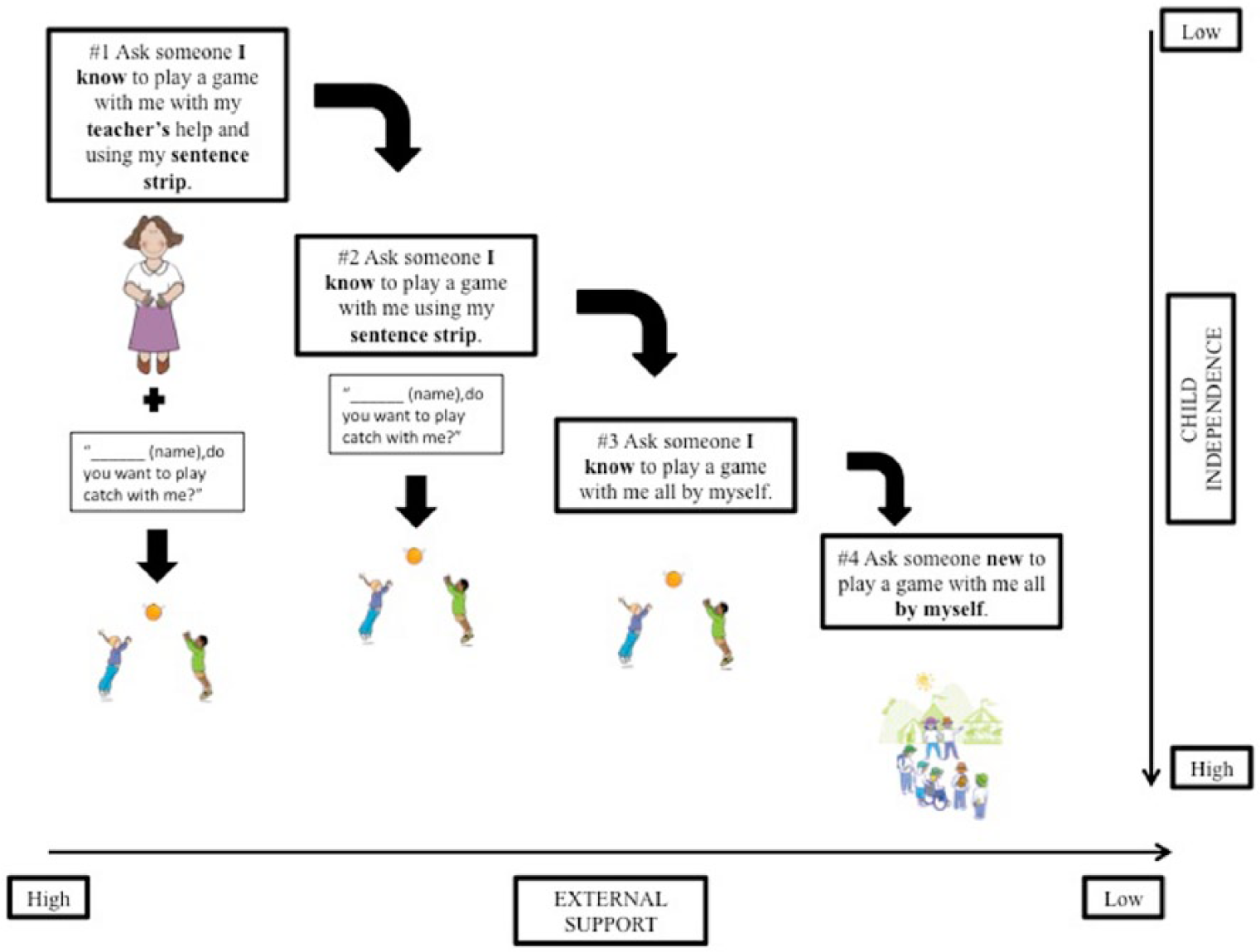
A goal map for a child working on initiating communication with peers.
Crosskey and Vance (2011) used elementary school student questionnaires to evaluate the effectiveness of a teacher training program, which emphasized some of the aforementioned, agency-promoting strategies (e.g. use of visual supports, appropriate scaffolding, etc.) to help promote a ‘communication friendly’ classroom. The survey results revealed that students were aware of their teachers’ increased use of targeted strategies and of some ways to improve their own listening skills. These data support the consideration of agency as a part of selecting didactic approaches to best accommodate a variety of learners.
The pragmatic authenticity of interactions is a cornerstone of the autonomous L2 classroom (Legenhausen, 2011). Here too we can find inspiration for community-friendly classrooms. Interactions that are pragmatically authentic increase motivation and genuine communicative exchange. They can also be excellent opportunities for the child to demonstrate and develop agency. For children, play is the quintessential authentic interaction. Consider the affordances of game play. During I Spy, for example, the child follows a script that demands turn-taking. He or she practices verbal description. And he or she changes positions between spy and guesser. He or she experiences a common stimulus (e.g. ‘I spy with my little eye …’) from two different vantage points: first person or what ‘I see’ and third person or what ‘he or she sees’. Such experiences are thought to be crucial to leading the child to reflect on his or her own actions and thoughts and to compare them to others.
Pretend play also offers opportunities for position exchange. While playing with dolls or figurines, the child takes the position of caregive,and the figurine takes the child’s customary position; thus, like game play, the child experiences himself or herself as distinct from another (Gillespie, 2012). The figurine itself is a prop that can serve to support this exchange in children who are just beginning to pretend.
For older children, dramatic play is a vehicle for position exchange. Dramatic play provides a structure that enables perspective taking not only in relation to other people (e.g. playing the role of ‘teacher’) but also in relation to abstract or remote/hypothetical situations (e.g. acting to solve a medical emergency). Furthermore, dramatic plays offer these opportunities for practice with positional exchange and perspective taking in a low-risk context. For even older children, the writing and staging of a play provides extensive language practice, opportunities for reflection and correction, and a motivating, authentic context for communication. The practice is common in foreign language classrooms that prioritize autonomous learning (Dam, 2011). Dramatic play is a frequent context for speech-language intervention as well (Goldstein et al., 2007).
Finally, we emphasize the role of peers as a critical component of the learner’s social environment. Peers provide good communication models and authentic opportunities to practice speech, language, and social-communicative skills (Ukrainetz, 2006). Given the importance of social context to the development of agency, peer interactions should be encouraged and supported. For younger or lower-functioning children, interactions with peers can serve as an opportunity for a child to observe that others behave, believe, and feel differently than he does. The understanding of self vs. other can be promoted by explicit commentary about differences between the child and his peers (e.g. during dramatic play ‘Ruby likes to play with the food by the stove. You like to play with the vacuum cleaner.’).
Peers can also be paired for peer tutoring experiences. This is a great opportunity for exploiting a given child’s ‘island of competency’ (Brooks, 2001: 16). Every child has strengths and observing success vicariously can contribute to self-efficacy beliefs (Tye-Murray, 2009). If one child has highly intelligible speech, she might be a peer tutor for a boy who is working to modify speaking rate. The children could then switch roles such that the boy helps the girl to retell stories in a coherent order. If such scaffolding is too demanding, the child can tackle nonlinguistic tasks instead. The child who is a good organizer puts away the art supplies, while the child who is physically strong places the recycle bin outside the door. Broadly, opportunities to experience competency will engender a greater sense of agency.
III Conclusions
That the development of agency and the development of communicative skills are tightly linked is recognized in diverse literatures: psychology, early education, second-language instruction, sociology, and speech-language pathology amongst others. We can exploit this link when designing communication friendly classrooms. Physically, such classrooms would be characterized by child-like scale, flexibility of usage, and visual reminders of the children’s agency. The social-didactic environments of these classrooms would be characterized by frequent opportunities for authentic interactions with educators and peers across structured and unstructured (e.g. dramatic play) activities. These environments promote the reciprocal development of agency and communication via personalization of materials, engagement in all aspects of learning, experimentation, goal-setting, self-reflection, and support from teachers, materials, and peers.
Footnotes
Acknowledgements
Dr Amanda Owen Van Horne and Anne Wallace provided helpful feedback on an earlier version.
Declaration of conflicting interests
The author(s) declared no potential conflicts of interest with respect to the research, authorship, and/or publication of this article.
Funding
The author(s) disclosed receipt of the following financial support for the research, authorship, and/or publication of this article: Karla McGregor gratefully acknowledges the support from NIH for award 5 R01 DC011742-02.