



Abstract
Young children need rich learning experiences to maximize their potential. Early childhood educators (ECEs) working in childcare have knowledge of individual children as well as skills and professional knowledge that afford opportunities to provide language-rich environments for learning. To successfully work in partnership with ECEs, speech-language pathologists need to understand what they know about early communication development and how they apply it in their work. This study explored ECEs’ understanding of early communication development in childcare contexts, and how they related this to the education and care they provided. In this exploratory study we conducted three focus groups with 19 ECEs who were employed in eight different childcare centres in low socio-economic areas in metropolitan Adelaide, South Australia. Data were analysed thematically revealing three core themes: ‘Knowing and doing in context’; ‘ECEs’ role’; and ‘ECEs’ challenges’. Participants articulated understanding of early communication development and the importance of strong relationships between ECEs, children and their families. These ECEs’ skills and knowledge of children in their care was the basis from which they provided language-rich learning environments with individually tailored educational programmes to support all children, including those experiencing communication difficulties. They highlighted challenges in delivering this care, including the need for more explicit support from speech-language pathologists. There is potential to further develop interdisciplinary partnerships between ECEs in childcare and other professionals, such as speech-language pathologists, to maximize early developmental opportunities for children attending childcare.
I Background
1 Outcomes for children
To reach their full potential, young children need rich, diverse learning experiences. Mustard (2008) argues that while language and communication skills are central to this, many young children do not have such opportunities for their learning and development prior to commencing formal schooling. Recognizing this as a social justice concern, the UK has recently undertaken major reforms to ensure that all children have access to early years education to establish more equitable foundations for academic achievement upon starting school (Department for Education, 2013; Roulstone et al., 2010).
In Australia, a high proportion of children have also been found to have developmental issues on commencing schooling. The Australian Early Development Census (AEDC) collects data on children’s skills across five developmental domains of physical health and well-being: social competence, emotional maturity, language and cognitive skills, and communication skills and general knowledge. In the 2012 AEDC collection, 22% of children commencing school the year they turned five years were vulnerable in one developmental domain, and 10.8% were vulnerable in two or more domains. Children in areas of high social disadvantage or very remote areas were more likely to be developmentally vulnerable for language and communication domains (AEDC, 2012).
Difficulties with speech, language and/or communication impact in a number of ways. A systematic review of 57 papers that explored outcomes for children with childhood speech impairments found that children experienced long-term difficulties with academic achievement, literacy skills, social relationships and employment (McCormack et al., 2009). Glogowska et al. (2006) found similar results in a large-scale prospective cohort follow-up study. Children identified as having a speech, language or communication impairment prior to three and a half years of age were reassessed at seven to 10 years of age using standardized speech, language and literacy measures. The results showed that 30% of these children did not outgrow their communication difficulties and had resultant long-term difficulties with education, literacy and socialization (Glogowska et al., 2006).
Language and communication are vital to children’s well-being and are critical in the development of positive self-concept. Strong communicative relationships with carers lead to secure attachment and are a good foundation for developing independence and well-being (AEDC, 2012; Albers et al., 2007; Elfer and Page, 2015; Mustard, 2008; Speech Pathology Australia, 2014). Thus, for children at risk developmentally, their speech, language and communication skills need special consideration. Access to quality childcare for these children in the early years could provide an opportunity to maximize development of such skills and improve equity of outcomes (McCartney et al., 2007; Mustard, 2008).
2 Early childhood education and care
In Australia, the number of children attending early childhood education and care facilities has increased. In 2014, approximately 50% of the 3.8 million children aged 0–12 years attended out-of-home care (Australian Bureau of Statistics, 2015). Of these children, a large proportion attended long-day care early childhood education and care facilities (henceforth referred to as ‘childcare’). Children aged 3–4 years were the largest group attending formal childcare (Australian Bureau of Statistics, 2015). Similar increases in attendance in early childhood education and care facilities have been noted around the developed world (Department for Education, 2014; National Centre for Education Statistics, 2014).
Childcare can provide rich learning experiences and support the development of young children’s foundational skills (Gialamas et al., 2015; Gibbard and Smith, 2016; McCartney et al., 2007; Mustard, 2008; Speech Pathology Australia, 2014). It also provides an opportunity for early identification of those at risk or vulnerable in their development, when early intervention can be effective in mitigating long-term consequences (Mroz and Letts, 2008).
However, it appears that many early childhood educators (ECEs) do not feel confident in their skills or knowledge regarding children’s communication development. Mroz (2006) conducted interviews with 25 ECEs on their skills and knowledge regarding communication development. She found that the participants believed they had some skills but required additional training in speech, language and communication development and impairment.
There have been a number of studies that have demonstrated that ECEs can change some aspects of their practice in response to training in facilitating speech, language and communication development. In 2012 Piasta and colleagues explored preschool teachers’ conversational responsivity with children in their classrooms. Forty-nine teachers received 15–20 hours of training on strategies to enhance their modelling and facilitation of language. Participant teachers improved in the use of language stimulation techniques but not in language modelling, and the authors concluded that more training was required (Piasta et al., 2012). In a similar study, McDonald and Proctor (2015) found that the ECEs increased in one communication facilitating strategy but found no change in language modelling behaviours. The authors also concluded that further training was required to support the needs of ECEs in working with young children’s communication skills (McDonald and Proctor, 2015).
High-quality, responsive and secure childcare provides young children with a better chance of developing strong speech and language skills (Albers et al., 2007; Brebner et al., 2015; Burchinal et al., 2010). In their study of the work of ECEs with infants in their care, Brebner and colleagues (2015) interviewed and then video-recorded two ECEs working with four infants. They found that the ECEs explicitly aimed to develop responsive relationships with the infants in order to stimulate and extend their communication development (Brebner et al., 2015).
The strategy of building strong relationships as a platform for provision of education is relatively common in early childhood education and care settings (Brebner et al., 2015; Gibbard and Smith, 2016; McCartney et al., 2007). Whilst there are alternative discourses on ‘attachment’ and its uptake in ECE contexts, in childcare the term ‘attachment’ is used to describe the relationship with a carer who provides safety and protection (Bowlby, 1958). The ‘circle of security’ framework (Hoffman et al., 2006) describes this as providing a ‘secure base’ carer to whom the child can turn if distressed or after exploring the world. Within high-quality early-childhood education and care settings, there is an emphasis on building strong attachment as a platform for providing rich learning experiences in particular with regard to speech, language and communication development (Gibbard and Smith, 2016; McCartney et al., 2007).
Early Childhood Educators:child ratios influence the responsiveness of their interactions and resultant attachment relationships and, therefore, the educator’s capacity to support communication development (De Schipper et al., 2006). Despite the current focus on developing more resources for early childhood services and increasing educator–child ratios, public services in Australia continue to provide limited support to assist ECEs in learning how to facilitate communication and social skill development in children in their care (Productivity Commission, 2011). Consideration of strategies to provide appropriate education, skill development and support for ECEs is critical.
With this current policy focus on promoting early childhood learning and development, and with more young children spending time in non-parental care, it is vital that the speech-language pathology profession consider their role in supporting ECEs to meet the needs of children in their care. This is particularly important as the concepts of relationship/attachment and communication development are often taught minimally, and very differently, across the different training programmes for the different professionals that work in the early childhood sector (Productivity Commission, 2011). Speech-language pathologists need to know what ECEs know and understand in order to effectively work together to support the development of children’s speech, language and communication skills.
3 Research questions
This research aimed to explore ECEs’ understanding of early communication development and how they relate this to the education and care they provide to children enrolled in their childcare centres. The research questions for this study were:
What do ECEs understand about early communication development?
How do ECEs relate their understanding of early communication development to the education and care they provide?
II Method
1 Research design
We conducted three focus groups with a total of 19 ECEs. The participants came from eight different centres offering long-day childcare in metropolitan Adelaide, South Australia. As it is known that poverty increases the risk of communication difficulties (AEDC, 2012), the research targeted centres located in mid–lower socio-economic areas as determined by the Socio-Economic Indexes for Areas (SEIFA) (Australian Bureau for Statistics, 2013) shown in Table 1.
Participating centres’ socio-economic indexes for areas ratings, with lower rankings indicating socio-economic disadvantage relative to other areas in Australia.
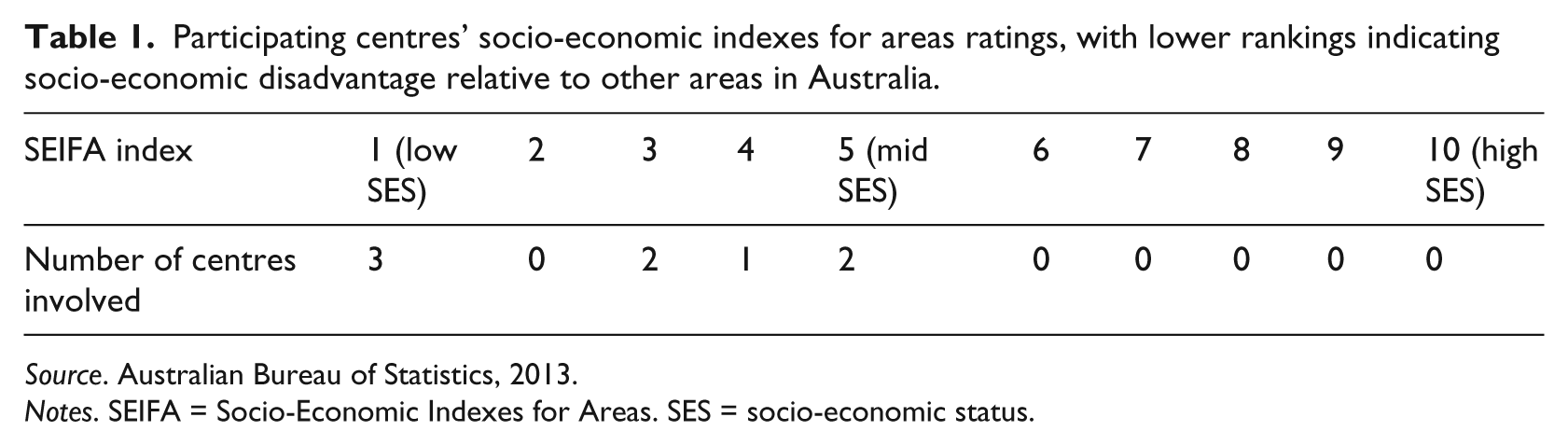
Notes. SEIFA = Socio-Economic Indexes for Areas. SES = socio-economic status.
A focus group method was adopted for this study, as we sought to explore ECEs’ perspectives on children’s early communication development in a non-threatening environment, to maximize contribution and discussion (Wong, 2008). The shared backgrounds of participants facilitated discussion, as they could compare similar experiences.
2 Participants
There were 19 female participants from three areas with similar SEIFA indices. Seven worked in three centres located in the southern suburbs. Seven came from three centres in the western suburbs. Five participants came from two centres in the northern suburbs.
Inclusion criteria were that participants were currently employed as ECEs in childcare working with children aged 0–3 years. Participants were invited to participate through circulation of study information by centre directors. Costs to release ECEs from their regular work duties to participate were covered.
3 Data collection
Each focus group was conducted in a community centre close to the participants’ workplaces. Groups lasted between 91–98 minutes and interviews were recorded for later transcription. A focus group preamble and question guide was developed (for question guide, see Appendix 1), based on the research questions. The facilitator was a recently qualified speech-language pathologist working as a research assistant. She adopted an informal, non-judgemental approach to each group, indicating on commencement that she was not an ECE or an experienced speech-language pathologist.
4 Data analysis
Data were analysed thematically, utilizing an inductive approach to coding (Braun and Clarke, 2006). Investigator triangulation was employed throughout analysis to ensure it was robust and represented participant experiences accurately (Creswell, 2014). Coding was conducted using NVivo 10 (QSR International Pty Ltd, 2012) and commenced with all four investigators coding one transcript collaboratively. This ensured that consistent coding conventions were adopted. Two researchers independently coded each remaining focus group and held a group discussion on completion, to ensure coding consistency. There were few discrepancies, and these were resolved through discussion.
Following coding, data were grouped into categories and then collated into themes. Cross-checking of themes by all researchers occurred, with a high level of agreement. Discrepancies were discussed and consensus reached.
III Results and discussion
Three core themes emerged from data coding pertaining to this study’s foci are reported below: ‘Knowing and doing in context’; ‘ECEs’ role’; and ‘ECEs’ challenges’ (see Figure 1).
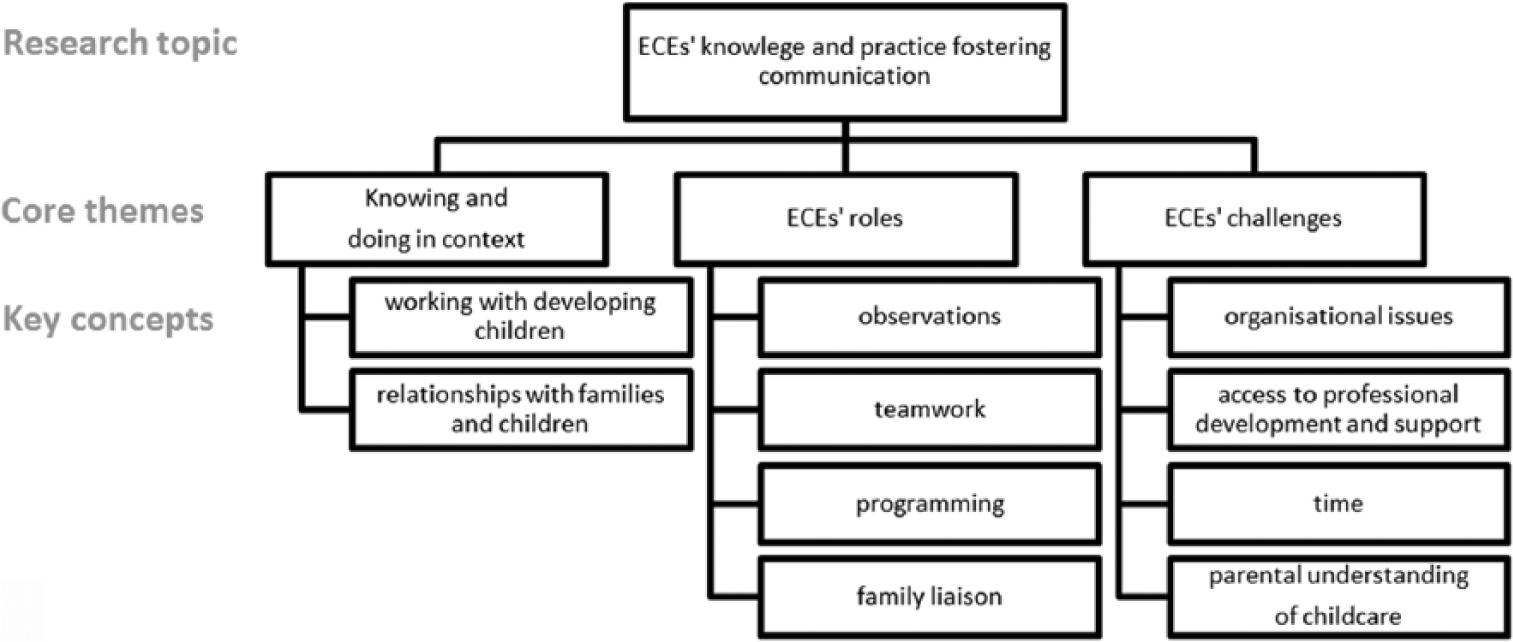
Core themes and categories.
1 Knowing and doing in context
The theme ‘knowing and doing’ emerged from the data as participants articulated their knowledge of, and work with, child development, combined with the need to consider the individual context of each child’s development. Participants demonstrated understanding of children’s typical development, including typical communication development and normal variation in developmental trajectories. They related their knowledge to children in their care, considering each one as an individual with different skills, abilities and challenges. They articulated the way they shifted their expectations according to their knowledge of individual children, contextualized within their understanding of typical communication development.
Participant (Focus group [FG] 2): Because they’re all so different and develop at different rates, not in just communication but with everything. We have children that are walking before they’re one and other children aren’t walking until they’re one-and-a-half. The same thing for language, we can’t just say because they’re one they’re going to be saying this, this and this, because … it’s all different. Participant: They all have individual needs. Participant: When they’re older, obviously there’s more expectation of they should know their letters, or they should know the alphabet …
Whilst participants gave many examples demonstrating an understanding of typical communication development they also reported a lack of sufficient expertise to identify and work with communication issues.
Participant (FG 2): I have two babies now … sometimes it’s so hard to judge if there’s any issue with that child … because when she’s with us always nothing. Every time we have to tell her or physically move her from the table. Okay, lunch is finished you clean, you can go, go play. She’d be just sitting down there and looking at us and other kids and she’s not moving. But when mum comes she talks in her language, she is from different background … So we’re really struggling - why she’s like that with us. I know it could be she’s shy … Participant: Maybe because she feels more comfortable talking in her language and she might not understand everything in the English. Participant: It could be, but we’ve got another one there totally new to Australia, she started this term. She’s new, and she’s so fine. She plays and eats and now she’s started talking. She’s (playing) with her peers and she tells them stop. She’s so good, but the other one she’s still - but it could be this personality, her personality like that, she’s shy.
Overall, these ECEs viewed the children in their care holistically, recognizing that a child’s behaviour in one context may not represent their skills in all contexts. In all focus groups, obtaining information about children’s broader social contexts was considered typical practice and enabled the ECEs to better support children in their care. The importance of considering other factors, such as a sense of security, was also emphasized.
Participant (FG 1): We had one child who would hardly speak, hardly talk, and we … talk to mum and go we haven’t seen any signs of him being able to talk. She’s like, ‘Well, that’s completely different to at home, because he talks a lot, he won’t basically … be quiet.’ But now he’s feeling security in the environment and he’s now actually starting to talk.
Further, participants in all focus groups discussed the importance of contextualizing available developmental information to the individual, and of taking strengths-based approaches focusing on what children can do rather than what they cannot do.
Participant (FG 3): I find with parents with children between birth and three, around that two-year age mark you find that parents start getting quite anxious if their child isn’t communicating to what they might expect. It’s all about those social expectations. Your child’s two. They must have a minimum of 50 clear words in their vocabulary. Well, that’s a nice little … guideline for people to follow – and that’s through theorists and developmentalists that say there’s a 50-word limit for that two-year age group. But it’s definitely not true. Every child is an individual, which we try and get across to parents. It’s about looking, when communicating with the parents about that– about telling them ‘your child can actually do all of these things, and these are the words that they are communicating to us’ – but not focusing on what they can’t do at this stage.
The second key concept to emerge from the data in this theme was the importance of relationships. All participants discussed the need to develop relationships with not only the children but also their families to facilitate successful communication with the children and to ultimately enable them to provide quality education and care.
Participant (FG 1): If you have that relationship with parents, you understand that child more because you know what one cry is to another cry. So I guess, it’s just more about getting that communication going with the parents so then the communication with the child is better.
These ECEs used the ‘attachment’ framework to articulate how they developed relationships with children and their families. They referred to a number of theoretical and practical frameworks, including ‘attachment’ (Bowlby, 1958), ‘circle of security’ (Hoffman et al., 2006) and the ‘Marte Meo’ (Aarts, 2000) approach.
Participant (FG 1): Because really what your goal is, is to create children that feel like they’re trusted, like they trust you and that they feel confident and comfortable … and that they belong. So if you’re doing all of those things, regardless of their age, then you form that attachment enough so that they will go off, and they will just come back when they need you. It might not be as often. We often joke, ‘Oh yeah, that one is a textbook circle of security kid’, because you can see them, as soon as they get that little bit too far away, they cry or they’ll come straight back. Participant (FG 3): To anticipate, I’m leaving the house now. What’s going to happen is Mum’s going to hand me over to this person and I’m going to be spending the day with this other person that I’ve now formed a relationship with. Participant: So it’d be good for the parents to know some Marte Meo too, naming what we’re doing, leaving …
The ECEs also directly related these relationships to children’s communication skills. There was a shared understanding that to develop a relationship or ‘bond’ with a child and/or their family, effective communication, verbal and non-verbal, is essential and vice versa.
Participant (FG 3): Because one child is … openly communicating with you non-verbally, giving you those cues, and the other child is being reluctant. It’s harder to get to know that child and to know how to support them if they’re not giving you that communication, which is obviously really difficult, which brings you back to that circle of trying to develop that circle of security in the bond with them.
In this theme, participants described what they knew about early communication development and how they interpreted this within a holistic, individualized approach in the care they provide. Their discussions also encompassed the way they enacted these understandings in their work and their perceptions of their role.
2 ECEs’ role
Four core categories emerged in this theme: observations, teamwork, programming and family liaison. The participants reported that their work requires them to be able to communicate with children at a developmentally appropriate level. To do this they observe and record the children’s behaviour and development. They described how this enables them to understand the children in their care, and identify children with developmental concerns. They then observe these children more closely, gathering more evidence to support/refute their concern.
Participant (FG 2): We are the ones that do their programmes, so we speak to the parents about what areas they want to look at. We do observations on them ourselves and then we do the programme for them and we also do learning stories, which is their type of observation with photos and with a write-up of what area of development they’re using. Then … some follow up as well from that.
This category linked closely with the next category of teamwork, as participants discussed the way in which they share information about children’s communication in order to ensure that children can always communicate their needs to staff.
Participant (FG 2): We find that too, well, when we speak to our parents we find out like certain keywords, like what does water mean … for Nepalese and … I’d like to know what they’re trying to say. Participant: I guess that’s about communication as well and making sure everyone in the room knows.
Participants’ roles also included programming for children in their room, with whole group activities and a focus on key children in their care. However, some participants described actively changing the programme for children experiencing particular challenges, particularly communication difficulties.
Participant (FG 3): We decided for this child it was a good experience to bring him back into the under twos room, where he had that better relationship … with the other educators that he’d known for longer and because it was a quiet environment. Since that child has come back into that environment, he has become slightly more outgoing in a way … because his cousin is now in that room. So he has that support from a family member.
The participants suggested that they would like more contact with speech-language pathologists in order to explore how their practices support children’s communication development, and thus program for individual children more effectively. They highlighted the need for expert input from other professional disciplines to support this work.
Participant (FG 1): Having professionals like speech pathologists making sure that you’re on the right track. Are you offering the right sort of activities, are we doing the right thing for these kids, or are we doing the wrong thing? Because we don’t - they might come in very occasionally to see a child in the centre, (but) most of the time the parents are going there to see them. So it would be good to have that input.
Regarding the final category in this theme, family liaison, the ECEs believed that their role was to liaise with families about their children’s development and noted the importance of relationships in supporting this liaison.
Participant (FG 3): I think that (it) comes back to having that relationship with the parents, for them to feel comfortable enough to approach you … – or for us to approach them and say ‘Look, we have a concern with your child’s development’.
The participants reported developmental concerns often related to children’s communication skills. There was agreement that it was the family’s responsibility to follow up on referrals and seek additional supports, but ECEs also encouraged and supported families in seeking assistance for their child.
Participant (FG 1): We’ve got a child that’s three and he’s still got no language. We’ve spoken to mum several times about our concerns, but she was like, ‘Well, I know what he means, I understand him’. Once he’s got into our kindy room, we’ve sort of gone for the angle that, ‘Well, he’s not being able to converse with his peers now, and that’s going to set him back because he can’t join in the other children’s play’ … She’s finally getting him some speech therapy and taking him for some assistance.
In this theme, the ECEs talked about their role in working with young children’s communication development. They start by observing the children, they share their knowledge of the children’s skills and challenges with the team to facilitate effective communication, they provide educational programming for the children that targets individual need within group activities, and they liaise with families about the education and care that they provide. They also spoke of the challenges they experienced in their work.
3 ECEs’ challenges
Participants identified three key factors that influenced their ability to form and maintain relationships and successfully facilitate children’s communication development: organizational issues, access to professional development and support, and ‘finding time’.
The impact of broad organizational factors was emphasized by all participants. In particular, they raised issues with the framework for education and care facilities; their isolation because of working within early childhood education centres; and their capacity to provide high-quality education and care with restricted available funding.
Participant (FG 3): Your interactions with children, it’s always affected by how many staff, the funding you have to staff those rooms.
Participants also articulated a need for further professional development.
Participant (FG 3): We want to upskill. We want to refresh what we’ve studied … and we want to bring that back, definitely, and share that with our teams.
In particular they wished for specific, targeted professional development in facilitating children’s communication development.
Participant (FG 2): I think some training (about facilitating communication) would be beneficial to all staff in all of the rooms, because obviously not everyone’s confident in singing and storytelling and that sort of thing, so giving them different ideas and ways to tell a story, instead of just you will sit there and read the book …
However, the participants had several concerns regarding professional development which related to access, time, funding and how and where training might be delivered. Participants reported difficulty in ensuring that all staff could access appropriate events, with challenges in funding events and releasing staff from regular duties to attend.
Participant (FG 3): Everyone goes, ‘Great. This is what they’re offering, this is when. How many staff are available to go to that, because it is a free service, a free function?’ Whereas XXX is another fantastic training organization. You do have to pay to go there and there is a new funding out to help educators upskill. There’s a big amount of money out there which you just have to access, and there’s a lot of paperwork involved to access that money.
‘Finding time’ was a common theme in the discussion of many aspects of the ECEs’ work. They believed that time with children and their families was important in establishing and maintaining strong relationships and successfully communicating with them.
Participant (FG 3): What we’ve done over the past year is call the parents when they’re having a great day, not just when something’s going wrong, so that they know … get everyone to call families, just to say – like they might have dropped [their child] off and something happened, but you ring … before they have a chance to ring you, you’re like ‘Hey, how’re you going … ’. Participant: ‘They’ve really settled.’ Participant: … or email, or whatever form of communication suits them. You know, it worked so well … Obviously, you have to find the time to do that. But even just a phone call to discuss anything that they need to talk to you about, because sometimes they’re not comfortable face to face.
‘Finding time’ also related to settling children into new environments, as well as ECEs finding time to do the required duties associated with providing high-quality educational experiences. Lack of time meant that the participants were not always able to communicate successfully with children and provide them with the learning opportunities that they perceived they needed.
Participant (FG 2): Because sometimes they really do need that one-on-one time … It benefits them so much, because they just [need] someone … to sit there and talk to them one-on-one for periods of time, or play with what they want to play with … because most of the time … they don’t want to play with other children … We get frustrated with that; it’s really sad to watch that. You’re trying to look after six screaming babies at once and you want to go and play with this one and show them that sort of one-on-one attention.
In this theme, while participants demonstrated passion and motivation for their work, they also articulated challenges in providing opportunities to facilitate children’s communication development.
IV General discussion
This research has shown that the participating ECEs had knowledge of individual children in their care as well as skills and professional knowledge that afforded opportunities to provide language-rich environments for learning. Each research question is now considered in turn.
1 What do ECEs understand about early communication development?
The findings of this study are consistent with previous research that has shown that ECEs in childcare contexts have knowledge and skill in their work with young children, providing educational opportunities, not only care of basic needs (Brebner et al., 2015; Elfer and Page, 2015; Mroz and Letts, 2008).The ECEs who participated in this study demonstrated their knowledge and application of early communication development. They articulated an understanding of typical development of communication skills and normal variation within this. They recognized their opportunities to observe children’s behaviour, as well as the need to contextualize these behaviours in the broader context.
However, the participants highlighted that they feel they lack expertise in working with children who are experiencing challenges with communication. These challenges can be related to speech and language impairment, or to speaking another language in the home. The participants expressed uncertainty regarding programming and delivering activities to support children’s communication development, and seemed uncertain about how to respond in-the-moment to those children who were not responsive to their approaches to working with children from non-English-speaking backgrounds. They indicated a desire for more professional development in this area. These findings are consistent with other research in this area that found ECEs feel that they require further training in speech, language and communication development (McDonald and Proctor, 2015; Mroz, 2006; Piasta et al., 2012).
ECEs highlighted the need to establish strong relationships with children and their families and to gather information about the children’s skills and behaviours in other social contexts in order to effectively communicate with the children. These findings are also consistent with the literature, with the importance of considering children as individuals within a broader context of family, relationships and social interactions being critical in the provision of quality care (Albers et al., 2007; Brebner et al., 2015; Elfer and Page, 2015; Mustard, 2008).
2 How do ECEs relate their understanding of early communication development to the education and care they provide?
In keeping with previous research (Albers et al., 2007; Burchinal et al., 2010) our study highlighted that strong relationships between carer and child facilitate outcomes for children and are indicators of quality of care. They used their relationships with children and families as the basis from which to plan and provide appropriate educational opportunities based on their understanding of the skills the child needed to acquire, contextualized with the goals that parents had for their child.
The participants utilized approaches that focused on children’s strengths and not gaps in their skills. Like the managers in Elfer and Page’s (2015) study, the participants in this study also viewed children holistically, considering factors such as home environment and experience, in combination with their observations, to support their decisions about the education and care they provided.
However, these participants articulated challenges in their work with young children’s communication development and a desire for more direct support from speech-language pathologists. They wanted more training in working with children’s communication but wished for it to directly relate to their work. That is, they were seeking specific feedback on their activities and programming to ensure that this facilitated children’s communication development appropriately. The participants highlighted that the professional development available, and the current clinical model of speech pathology service provision in South Australia does not allow for this. At best, speech-language pathologists may occasionally visit the centre to observe a specific child and communicate with staff. More commonly, the parents took children to receive services in a clinic located elsewhere and with minimal communication or collaboration.
3 Broader implications
This study offers new insights into ECEs’ understanding of speech, language and communication development, and how they apply this to their work with young children. The findings offer a basis for collaboration as they outline how these ECEs understand their roles and the knowledge and skills they bring to their early communication development work.
The role of the ECE has been evolving rapidly with recent sector changes (Australian Children’s Education and Care Quality Authority, 2014) and a greater emphasis on frameworks and educational opportunities for both children and ECEs. Through these changes, early education and care is receiving greater recognition as a profession, with newly raised expectations of minimum educational levels for ECEs. Speech-language pathologists need to be aware of these changes and recognize ECEs’ expertise in order to build an appropriate platform to further develop existing partnerships and promote language-rich learning experiences for all children in these settings.
The results of our study provide further support for the concept of ECEs working in partnership with other professionals, as outlined in the submission to the Productivity Commission by Speech Pathology Australia (2014). The ECEs in this study are actively seeking more explicit speech-language pathology input into their educational programming and delivery. Such partnerships are starting to emerge, as seen in the development of some integrated ECE services in South Australia (Wright et al., 2005). These services employed speech-language pathologists and occupational therapists to work within the centres in 2015 (Department of Education and Child Development, 2015).
Speech-language pathologists should rethink the dominant clinical model of service provision by also seeking opportunities to engage in a primary health-care approach to promoting children’s speech, language and communication development (Law et al., 2013; Speech Pathology Australia, 2014). The results of this study suggest that developing collaborative working relationships with ECEs in childcare contexts may be one way in which therapists could do this.
Previous research has shown that ECEs feel the need for more training in speech, language and communication development (McDonald and Proctor, 2015; Mroz, 2006; Piasta et al., 2012). This study suggests that ECEs have knowledge and skill in working with young children’s communication. However, ECEs are seeking specific, explicit strategies in supporting children whose speech, language and communication development is atypical. They are also seeking support in relating their knowledge of speech, language and communication development to the education and care activities that they implement on a daily basis.
Not all children are developing the foundation skills they require to maximize their potential (AEDC, 2012). Current models of professional development for ECEs are not achieving all of their aims (McDonald and Proctor, 2015; Piasta et al., 2012). The ECEs in our study highlighted a number of challenges related to further training. Opportunities currently exist for interdisciplinary practice that could facilitate ECE professional development, in turn maximizing opportunities for early identification of children’s developmental issues, as well as provision of high-quality developmental opportunities from an early age.
This study provides insight into ECEs’ skills, knowledge and roles, and provides an impetus for speech-language pathologists and other professionals to acknowledge ECEs’ skills, knowledge, and how they use the platform of relationships to underpin their work. This may result in more effective collaborative working relationships to help meet the communication needs of young children attending childcare services.
4 Limitations and future directions
While the results of this exploratory study have yielded interesting insights into ECEs’ skills and knowledge of early communication development and their work with young children, the small number of participants from one Australian city limits the transferability of results. The participants in this study self-selected, which allowed a potential for bias related to interest and enthusiasm for the topic. For future studies, the collection of more data (e.g. the ECEs’ training and/or experience) would also assist to contextualize the results.
The results, however, highlight some areas for further research and consideration. There is potential for developing new, or furthering existing, partnerships between ECEs and speech-language pathologists to maximize opportunities for early communication development and identification of children at risk. Further investigation of existing relationships to explore successful strategies and programmes could be useful. Rather than simply providing more training opportunities that may be based on perceived rather than identified knowledge, contexts and needs, further exploration of ECEs’ professional development requirements, and the best manner in which to deliver this development, may facilitate their work with children in childcare contexts. The results of our study suggest that the framework of relationships may be a good starting point for shared discussions about children’s communication skills and challenges.
V Conclusions
To work successfully in partnership with ECEs, speech-language pathologists and other professionals need to understand what ECEs in childcare contexts know and understand about early communication development, and how they relate this to the work that they do. The participants in this study articulated their understanding of early communication development and the importance of strong relationships between ECEs, children and their families. They highlighted some of the challenges that they experience in providing high quality education and care, including sufficient time, access to speech-language pathology support and professional development. These results suggest a possible framework of mutual understanding from which partnerships between ECEs in childcare and speech-language pathologists and other professionals could be further developed to maximize early developmental opportunities for children.
Footnotes
Appendix 1
Acknowledgements
The authors would like to thank the ECEs who participated in this study.
Declaration of conflicting interest
The author(s) declared the following potential conflicts of interest with respect to the research, authorship, and/or publication of this article:The authors alone are responsible for the content and writing of the paper.
Funding
The author(s) disclosed receipt of the following financial support for the research, authorship, and/or publication of this article: Funding for this research was received from a Flinders University Large Research Grant, Faculty of Education, Humanities & Law 2013.