



Abstract
Enhanced Conversational Recast (ECR) is an input-based grammatical intervention approach developed from research on statistical learning. Recent research reported evidence demonstrating the efficacy of ECR on the learning of grammatically obligatory morphemes in English-speaking preschool children with developmental language disorder (DLD). This single-case experimental design study, which adopted a within-participant design with single baseline and control item, investigated the efficacy of ECR in promoting the learning of aspect markers in four Cantonese-speaking typically-developing preschool children. Two children demonstrated positive outcomes with the progressive aspect marker ‘gan2’ given 12 ECR training sessions within a mean dosage of 288. One of these children demonstrated statistically significant gains in the percentage of correct use in the probes. The lack of positive outcomes in the other two children on the earlier developing aspect marker ‘zo2’ and limitations of the study were discussed. With early evidence established in the typically developing children in this study, future research on Cantonese speaking children with DLD can be considered.
Keywords
I Enhanced Conversational Recast and grammar intervention
A majority of the 35 studies included in a recent meta-analysis (Cleave et al., 2015) provided support for the use of conversational recast (Camarata and Nelson, 2006) as a grammar intervention approach with English-speaking children with language disorders. Informed by Gómez’s (2002) and Saffran’s (2003) findings on implicit statistical learning in typically developing infants, Plante et al. (2014) proposed modifications to the original conversational recast. This modified version was subsequently called Enhanced Conversational Recast (ECR). In Gómez (2002), infants were exposed to auditory input that is embedded with sequences such as aXb, where the presence of ‘a’ predicts the occurrence of ‘b’ while the intervening X element is free to vary. The English construction for marking progressive aspect illustrates this aXb pattern (e.g. ‘is X-ing’ as in ‘is running’, ‘is eating’). Infants who heard 24 exemplars of the X element (the high variability group) during several minutes of exposure learned significantly better than those who heard fewer exemplars of X (the low variability group). A subsequent study with adults replicated this finding and further indicated that only learners in the high variability group demonstrated generalization of learning to untrained exemplars of X (Grunow et al., 2006). Subsequent artificial grammar studies replicated this variability effect in other typically developing children and adults (Gómez and Maye, 2005; Torkildsen et al., 2013). In ECR, the target grammatical element remains constant in the adult recast to the child’s platform utterances, while the non-essential elements in the construction are variable. For example, for an English-speaking child to learn the co-occurrence of ‘is . . . +ing’ in the ‘is verb+ing’ construction, the verb is the non-essential element in all instances of the adult recast.
Plante et al. (2014) was the first study that examined the efficacy of ECR as an intervention approach for individuals with specific language impairment (SLI) and individuals with Developmental Language Disorder. The key distinction between SLI (Leonard, 2014) and developmental language disorder (DLD) (Bishop et al., 2016, 2017) lies in the cut-off score used for the nonverbal cognitive criterion, with the former being at least 85 and the latter being above 70. In this article, we will use the term researchers adopted in their original reports. Eighteen 4- to 6-year-old preschool children with SLI participated in the Plante et al. (2014) study. Based on findings from the basic research reported earlier, which show that high variability input improves learning of aXb, aX, and Yb grammatical structures (Gómez, 2002; Grunow et al., 2006; Torkildsen et al., 2013), half of the children heard highly varied recasts and half heard recasts that were less varied, but just as many in number. In this study, regardless of the condition, according to the plan, children would hear a recast of their target construction 24 times (dose or target frequency) in one 30-minute session (dosage rate = 24/30 = .8 per minute) 5 sessions a week for 6 weeks. Target constructions included past tense ‘-ed’, third person singular ‘-s’, auxiliary ‘is’, the subject pronoun ‘she’. Children in the former high variability condition had a higher percentage of end-treatment use and a higher number of unique spontaneous use of the target constructions than those in the low variability condition with an effect size d2 of .71 and .72 respectively. The effects of high variability were ascertained in subsequent studies involving children with SLI (Meyers-Denman and Plante, 2016) and children with DLD (Eidsvåg et al., 2019; Plante et al., 2018, 2019). In these subsequent studies, one treatment parameter (e.g. treatment context in terms of individual versus group; an adjunct component of auditory bombardment) of the basic ECR approach was manipulated.
In all variations of ECR, the speech-language therapist does three things (Plante and Gómez, 2018). First, the speech language therapist (SLT) enhances the salience of the target construction by introducing variability for its non-essential elements in the focused recast. For example, to help the child learn the construction (‘is + verb+ing’), the SLT will provide sentences such as ‘Tom is running’, ‘the dog is barking’, ‘this cat is sleeping’ with many different verbs as input to the child. Second, the SLT introduces high context variability through the use of many different activities and objects within treatment sessions in order to make the meaning of the target grammatical construction transparent. Both of these input manipulation strategies will result in high lexical diversity, making it easier for the child to abstract the underlying representation of the construction. Third, the SLT uses attentional cues (e.g. a light touch) to ensure that the child attends to the recast. As in the original conversational recast, the SLT does not ask, or prompt, the child for an imitation of the recast.
II Aspect marker problems in Cantonese-Chinese speaking children with SLI
So far ECR has primarily been used with English-speaking children with SLI and children with DLD. It remains an empirical question whether ECR is also efficacious for children learning languages with typological properties that are different from English. One such language is Cantonese Chinese. Unlike English, Cantonese Chinese is an analytic language with very few inflectional or derivational morphemes. Gender, case, or number are not marked on nouns, and person, tense or mood are not marked on verbs. There are grammatical morphemes that mark aspect, and they appear after a verb and sometimes an adjective. In addition to aspect markers, Cantonese Chinese has a rich set of verbal particles, indicating notions such as result, direction of actions, and quantity. These particles are comparable to the particles of English phrasal verbs such as ‘up’ in ‘break up’ (Matthews and Yip, 2011). Cantonese Chinese is also a tonal language. Its speakers use pitch height and patterns to contrast meanings of the morphemes; e.g. hoi1 (‘open’) vs. hoi2 (‘sea’). In this article, Cantonese morphemes are presented in romanized forms. Numerals provided with the Cantonese morphemes mark tone values, following the system adopted by the Linguistic Society of Hong Kong (1994).
English-speaking children with SLI have an obvious and persistent problem with inflectional morphemes related to verbs (Leonard, 2014). Cantonese-Chinese speaking preschool children with SLI have problems with verb-related grammatical morphemes as well (Fletcher et al., 2005). These morphemes are not grammatically obligatory (Matthews and Yip, 2011) in the same sense as the English inflectional morphemes, but in many contexts, their absence does make the speaker’s perspective ambiguous, and the meaning of the sentence incomplete. Grammatical morphemes that have been studied most extensively in Cantonese-Chinese children with SLI are aspect markers. Aspect markers are bound forms attached to verbs, and some adjectives, for indicating the temporal perspective (e.g. perfective, continuous, habitual, etc) from which the action or event described in the verb should be taken. The difficulties that children with SLI have with aspect markers are reported in three studies. Compared with younger typically-developing children at the same language level, children with SLI used the same number of the perfective aspect marker ‘zo2’ in their conversation samples (Stokes and Fletcher, 2000), but they used it with a more restricted set of verbs, demonstrating conservative learning. In another study (Stokes and Fletcher, 2003), children in the SLI group were also more restricted than their age peers in the use of aspect markers over a range of verb semantic types. In a third study (Fletcher et al., 2005), children in the SLI group used both the perfective aspect marker ‘zo2’ and the continuous aspect marker ‘gan2’ less often than their typically-developing age peers and the younger language-matched typically-developing children. Results from these three studies suggest that aspect markers are vulnerable for Cantonese-Chinese speaking children with SLI.
III The present study
The ECR is found to be efficacious in five separate studies on English-speaking preschool children with SLI and children with DLD, particularly with verb-related grammatical morphemes as goals. The question to ask is: Is ECR efficacious in preschool children with DLD who are learning a language (Cantonese Chinese) with a markedly different structure than English for which the treatment was originally developed? This is an important question particularly for speech-language therapists who work with children with DLD who speak a language other than English.
In line with Fey and Finestack’s (2009) programmatic approach to evaluating intervention efficacy, it is necessary to conduct feasibility studies to ascertain that ECR is clinically useful for the training of Cantonese-Chinese grammatical morphemes and to demonstrate that ECR has the potential to result in positive learning outcomes, first in Cantonese-Chinese speaking children with typical language development and then in Cantonese-Chinese speaking children with DLD. In this first feasibility study on ECR, Cantonese-Chinese three-year-old children received training on the perfective aspect marker ‘zo2’ or the progressive aspect marker ‘gan2’ with the modal auxiliary ‘wui5’ (‘will’) as the control. Prior research examining naturalistic language samples reported that ‘zo2’ appears earlier in children aged between 21 and 23 months than ‘gan2’, which appears in children between 30 and 39 months (Lee et al., 1996; Leung, 1995). Again, results from naturalistic language sample analyses reported that the modal auxiliary ‘wui5’ (‘will’) appears in children at around two years of age (Wong, 1998: 113–32). Unlike the aspect markers, the modal auxiliary ‘wui5’ (‘will’) appears before the verb and generalization of learning from training on the post-verbal aspect markers is hence unlikely.
We adopted a within-participant design with single baseline and control item (Ebbels, 2017) to address these questions written in the PICO format where applicable:
For the four typically-developing Cantonese-speaking preschool children, did the individualized ECR training lead to a significantly higher percentage of use of the trained aspect marker relative to the control grammatical morpheme in probes?
Did the individualized ECR training lead to an increase in the four typically-developing Cantonese-speaking preschool children’s spontaneous use of the trained aspect marker in non-probe verbs during training activities?
For the four typically-developing Cantonese-speaking preschool children, did the individualized ECR training lead to a significantly higher percentage of use of the untrained aspect marker relative to the control grammatical morpheme in probes?
Did the four typically-developing Cantonese-speaking preschool children show an increase in the use of aspect markers in a naturalistic conversation with the clinician after the ECR training?
This study was designed to meet minimum standards guidelines for designing and reporting single-case experimental studies (Dallery and Raiff, 2014; Kratochwill et al., 2013; Tate et al., 2014). A completed copy of the Single-Case Reporting Guideline in Behavioural Interventions (SCRIBE, Tate et al., 2016) checklist is included as Supplementary Materials.
IV Method
1 Participants
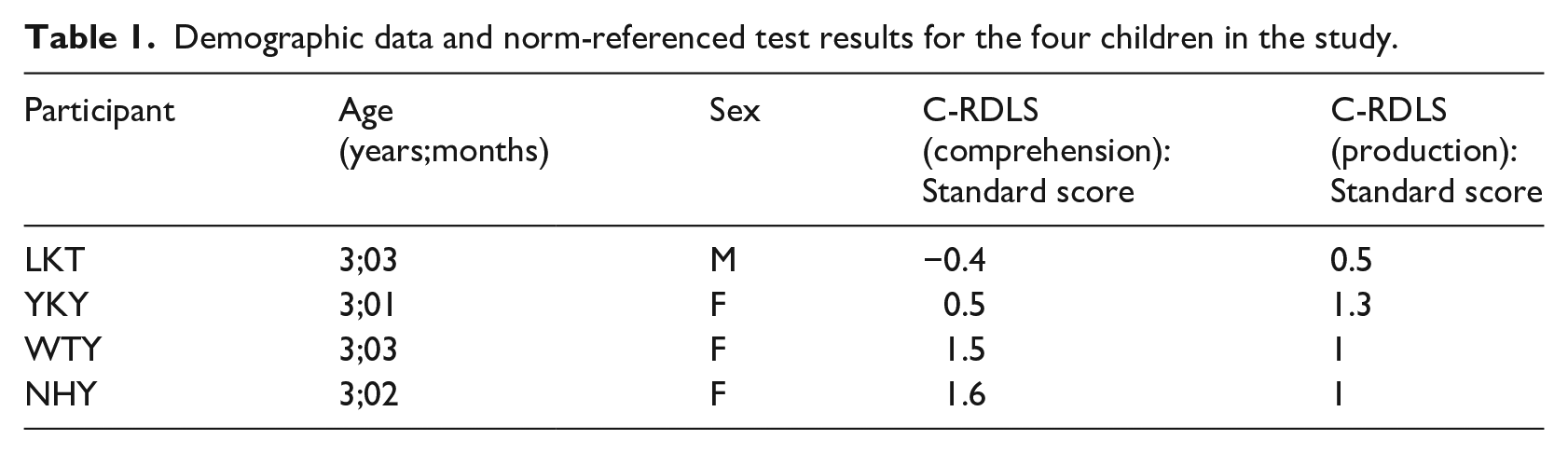
Typically developing children (1 boy, 3 girls) aged between 3;01 (3 years and 1 month) to 3;03 were recruited through an invitation letter to a kindergarten. Four children who met the following inclusion criteria were confirmed as participants: (1) had no previous diagnosis of speech, language, hearing, cognitive or psychosocial impairment; (2) spoke Cantonese Chinese as their first language; (3) produced the two aspect markers and the modal auxiliary ‘wui5’ (‘will’) with an accuracy no higher than 30% across the three baseline probes. In the remainder of this article, we use the plural noun grammatical morphemes when we refer to the two aspect markers and the modal auxiliary as a group. The Cantonese version of the Reynell Developmental Language Scales (C-RDLS; Reynell and Huntley, 1987) was administered, and all children performed at or above −1 standard deviation from the mean for their age, confirming that their language production and comprehension were within normal limits. The RDLS was the only omnibus test for preschool children at the time of the study. Demographic data and test results of the four children are reported in Table 1.
Demographic data and norm-referenced test results for the four children in the study.
2 Study design
There were three phases in this study: the baseline phase (1 week), the training phase (4 to 5 weeks) and the follow-up phase (after 1 week). In each of the three sessions in the baseline phase, the children were given the probes to be described below. At the training phase, the children received the same probes every other session, before the first training activity. One week after the training phase, the children were scheduled to receive the probes three times to test for maintenance effects. In sum, there were three baseline probes, six training probes and three follow-up probes. In the 12 training sessions, the child’s spontaneous use of the trained aspect marker was also recorded. To examine the impact of training of the use of the grammatical morphemes on the children’s conversation in a more naturalistic context, a 10-minute language sample was also collected during free play at the first baseline and the first follow-up session.
This research study was endorsed by the Faculty Research Ethics Committee of the Faculty of Education of the University of Hong Kong. Consent forms were signed by the school principal and the parents, and informed assent was obtained from all children. We report this study following the SCRIBE guidelines 2016 (Tate et al., 2016).
3 Materials and procedures
A pilot was conducted prior to the study proper to see if the training protocol and the probes was optimally conducive to the use of the grammatical morphemes. Ten children aged between 2 and 3 who had no parental concerns in speech and language development were given the probes and a training activity in an individual session. The children used the same general all-purpose verbs to describe some of the actions encoded and produced irrelevant responses to some of the probe items. Their use of the aspect marker ‘gan2’ increased when the clinician provided them with the verbs. The following changes were made in the probes as a result of the pilot: (1) low frequency verbs were replaced by more familiar verbs, (2) the clinician modelled the relevant verb twice in her part of the instruction for each item in the ‘gan2’ probe task to scaffold the child’s production of the aspect marker and (3) two practice trials were added as part of the task explanation for each probe.
a ECR training for Cantonese-Chinese aspect markers
ECR training was administered by the first author, a final year student clinician in speech-language therapy doing this project for her honour’s thesis. The four children were scheduled for individual 30-minute training sessions during the school hour in the preschool they attended. Teachers and parents were blinded to the trained aspect marker for each child. However, blinding of the clinician and fidelity checkers was difficult to achieve because the nature of the ECR training obligated them to be informed the purpose of the study and to monitor whether each recast contained the trained aspect marker. The ECR training provided in this study included 24 teaching episodes per session with a dose frequency of 1 session per day, 3 times per week for 4 weeks. The planned cumulative intervention intensity, calculated on the basis of 24 doses * dose frequency of 3 sessions and total intervention duration of 4 weeks (Warren et al., 2007), was 288.
In the training phase, the ECR protocol described in Plante et al. (2014) was adopted. Each child received 30-minute individual training on his/her trained aspect marker. Each training session involved two to three activities, including book-reading, video viewing and craft-making. Each activity was used once or twice in the entire training phase, and no same set of activities were used in more than one session during training. The clinician created many contexts in each of the activities that made the use of the trained aspect marker highly preferred. In each learning episode, the clinician would model the verb twice, and then asked the child a question to give him/her an opportunity to attempt the aspect marker. The child’s attempt, whether it contained the trained aspect marker or not, would be considered a platform utterance. The clinician would provide a contingent recast of the child’s platform utterance with the inclusion of the trained aspect marker. Attentional cues (e.g. calling the child’s name) were given at the time of the recast to direct the child’s attention to the recast. The child would hear 24 unique verbs, or adjectives where appropriate, with the trained aspect marker from the clinician in the form of a recast in each session.
The training of aspect markers using ECR required a platform utterance with a unique and appropriate verb or adjective from the child. We had a contingency plan when this did not happen. In a learning episode, when the child did not use the unique verb or adjective the clinician modelled, but used another verb or adjective that was appropriate in context, the clinician would provide a recast using the child’s verb or adjective, regardless of whether it was a verb or adjective that was used before or not in the session. This happened in 20 of the 48 training sessions (41%) from all children combined, which resulted in the number of unique verbs and adjectives in the session being lower than 24 as intended. When the child used a contextually inappropriate verb or adjective, the clinician would provide a recast with an appropriate verb or adjective. In situations when the child did not make an attempt to produce a platform utterance after the clinician’s question, the clinician would repeat the question once and wait 5 seconds. If there was still no response from the child, the clinician would give an utterance using the verb or adjective she just modelled with the trained aspect marker. This happened in 4 of the 48 training sessions (8.3%) from all children combined. Although strictly speaking, this was not a recast, it was considered a dose. The clinician would not model the trained aspect marker outside the planned 24 doses in any training sessions. In sum, the intervention procedures were implemented as planned.
b Probes at baseline, training and follow-up
A picture description probe was designed for the perfective aspect marker ‘zo2’, the progressive aspect marker ‘gan2’ and the modal auxiliary ‘wui5’ (‘will’). Each probe was administered once in each of the three 3 days to obtain a baseline. Each probe contained 12 items with each item containing a unique verb or adjective. Verbs or adjectives used in the probe for one grammatical morpheme were not used in the probe for the other morphemes. In each item, a scenario was set up to make the use of the morpheme highly preferred.
As part of task explanations, two practice trials were given for each probe, during which the clinician demonstrated the use of the relevant morpheme in a sentence, without highlighting the morpheme explicitly. All responses were marked as ‘correct’, ‘incorrect’ or ‘no response’ by the clinician on a scoring sheet. It is important to note that the materials, the verbs and adjectives used in the three probes were not used in any of the ECR training sessions. The three probes were presented in an electronic tablet. The same probes given in the baseline phase were also administered in the training and the follow-up phases to document progress in the use of the three grammatical morphemes. At each of the three phases, the order of administration of the probes and the presentation of items in each probe were randomized to reduce practice effect.
c Procedures for eliciting the two aspect markers and the modal auxiliary in probes
In a perfective aspect marker ‘zo2’ probe item, the child was shown two pictures, presented side-by-side, indicating an object that went through a simple change-of-state event. For example, the picture on the left shows a bridge that was nice and sturdy, and the picture on the right shows that the bridge just broke into halves. After the clinician described the object on the left, the child was invited to talk about what happened to the object on the right. The child had to provide a verb or an adjective with ‘zo2’; e.g. ‘tyun5 zo2’ (‘broken into pieces’) as a response.
In the progressive aspect marker ‘gan2’ probe, the child was first introduced to a stuff animal Dale, who was bored and wanted to find someone to play with. In each probe item, the child was shown a picture depicting a character who was busily engaged with a task. As part of the instruction for the item, the clinician would describe the character’s action with a verb. Then the child was required to explain why the character had to turn down Dale’s invitation. The child could use the verb provided in the clinician’s instruction to construct an explanation that involves the use of ‘gan2’. A sample response is Bunny m4 dak1 haan4 wo3, keoi5 waa6 gan2 wa2 (‘Bunny is busy and he is drawing a picture’).
In a modal auxiliary ‘wui5’ (‘will’) probe item, the child was given a hypothetical situation, with was shown in two pictures side by side. The clinician would talk about the situation involving a character on the left, and then ask the child what the character did in the form of a binary-choice question that could be easily answered using everyday knowledge of the world. The clinician’s sentence and binary-choice question in English translation were: ‘Look, it is red light. The boy waits for the green light, or crosses the street straight away?’ After the child’s response, the clinician posed another question and asked what the child would do if he or she encountered a similar situation. Note that the clinician made a point not to use any modal auxiliaries in her sentences or questions. The child could construct a response to this second question using ‘wui5’ and his or her answer to the first binary-choice question. An example is ngo5 wui5 dang2 luk6 dang1 (‘I will wait for the green light’).
d Spontaneous productions of the target aspect marker during training
The child’s spontaneous and correct production of the trained aspect marker during training was recorded live and confirmed via video-review. Recall that the clinician used different activities to create contexts that made the use of the trained aspect marker highly preferred. After modelling the relevant verb or the adjective twice, the clinician asked the child a question or made a comment to give him/her an opportunity to attempt the trained aspect marker. If the child used the trained aspect marker appropriately with a verb or adjective to encode the temporal contour of the activity, s/he would be credited with one instance of spontaneous use. After each session, we calculated the percentage of spontaneous and correct use of the target aspect marker in the 24 verbs and adjectives used in training. These verbs and adjectives, subsequently referred to collectively as non-probe verbs, were not used to examine the use of the three grammatical morphemes in probes. At the end of training, we identified the number of unique non-probe verbs that were used with the trained aspect marker at least once in the sessions.
e Use of the grammatical morphemes in naturalistic conversations
Two short 10-minute conversational samples were collected from each child by the clinician who provided the training to examine his or her use of the three grammatical morphemes during naturalistic conversations. One sample was collected at baseline and one at follow-up. The child engaged in an unstructured play using a car park set and/or a Disney storybook. The clinician followed the child’s lead on the topics of the conversation by using self-talk and parallel talk. The clinician did not avoid using the three grammatical morphemes when the contexts required them, but she did not deliberately probe the child’s use of these morphemes.
f Treatment fidelity and scoring reliability
All probe sessions and training sessions were video-recorded and coded to measure scoring reliability and treatment fidelity. An independent observer who did not provide the training observed 51.1% the probe sessions (23 sessions) and 50% of the training sessions (24 sessions). To examine treatment fidelity, the independent observer was asked to monitor (1) whether 24 doses of recast involving 24 unique verbs and adjectives were delivered in the session, (2) whether attention was obtained from the child prior to the delivery of each recast, (3) whether the clinician avoided using verbs and adjectives that were reserved for the probes. Fidelity was calculated by deducting deviations from the base number of doses (i.e. 24). Treatment fidelity was 93.2% (range = 91.0% - 95.1%). To examine scoring fidelity, all four children’s responses in each of the 12 items in all three probes at each data point at the baseline, treatment and post-treatment phases was scored by the clinician and the observer based either on onsite observation or the video-record. Recall that each response was scored either 0 or 1, so the Cohen’s kappa for rating nominal data was used. The Cohen’s kappa, calculated on 1,620 responses, was 99.6%. The closer the Cohen’s kappa value is to 100%, the less likely that the two scorers may agree by chance.
4 Analysis plan
The primary outcome measure of the current study was the percentage of correct use of each of the three grammatical morphemes in the 3 baseline and the 6 training probes. Following recommendations by Kratochwill et al. (2013), data for each child were presented graphically and analysed visually to see (1) if there were changes in levels (i.e. mean score at the training phase larger than that at the baseline phase), (2) if there was a trend at baseline, and (3) if there was an increasing trend in the training phase. Quantitative analyses were also completed on data for each child using a web-based application of Tau-U (Vannest et al., 2016). Derived after Kendall’s Tau and Mann–Whitney U, Tau-U provides an estimate of effect size in single-case experimental research studies and allows significance testing (Parker et al., 2011a). It can be conceptualized as the percentage of non-overlap for all pairwise data comparisons between the baseline and the training phases that corrects for a positive baseline trend. Tau-U scores range from zero to one. In practice, Tau-U may exceed 1, which, when happens, may be considered one of its limitations (Tarlow, 2017). Given the lack of benchmarks for the interpretation of Tau-U scores, it was proposed that the benchmarks for a comparable index of Non-overlap of All Pairs be adopted (Rakap, 2015). A Tau-U score of 0 to .65 indicates a small effect, .66 to .92 a medium effect, and .93 to 1.00 is a large effect (Parker and Vannest, 2009).
The other three outcome measures were (1) percentage of spontaneous use of the trained aspect marker with non-probe verbs during training, (2) number of unique non-probe verbs that were used with the trained aspect marker at least once during training, and (3) percentage of verb and adjective types that were used with each of the grammatical morphemes in the 10-minute conversational sample at baseline and follow-up.
V Results
1 Selection of an aspect marker for training for each child
In the baseline phase, the children were tested on the two aspect markers and the modal auxiliary ‘wui5’ (‘will’) in three sessions. The modal auxiliary was the control for all four children and all children consistently scored zero in the probes. Instead of random assignment, an a-priori decision was made to have two children trained on one and two trained on the other aspect marker in order to ascertain that ECR has a general training effect across aspect markers. The assignment of children to aspect marker was based on their performance in the baseline probes.
All children performed better on the perfective aspect marker ‘zo2’ than the progressive marker ‘gan2’. The four children’s highest scores for ‘zo2’ ranged from 33.3% to 58.3%. Over the three probes, WTY and NHY received higher average scores (38.9% and 41.7% respectively) than LKT and YKY (33.3% for both) on ‘zo2’. On the other hand, all four children’s highest score and average score for ‘gan2’ were lower than the pre-determined 30% level. It was decided that the two children who scored the lowest in the ‘zo2’ probes, that is LKT and YKY would have ‘zo2’ as the trained aspect marker and the other two children who scored highest in the ‘zo2’ probe, that is WTY and NHY, would have ‘gan2’ as the trained aspect marker.
2 LKT (‘zo2’)
At the baseline phase, LKT scored 33.3% consistently on the trained aspect marker ‘zo2’, at a level higher than the untrained aspect marker and the control grammatical morpheme, which were almost at floor. At the training phase, there were some variabilities but no increasing trend in the percentages for ‘zo2’. There was no difference between the training and baseline mean for ‘zo2’, and the Tau-U value was 0 (p = 1, 90%CI = −.71–.71). In the baseline and the training probes, LKT used ‘zo2’ appropriately and consistently with a small set of verbs and adjectives, including ‘laan6’ (‘broken’), ‘cyun1’ (‘perforate’), ‘se2’ (‘spill’), ‘dit3’ (‘fall down’). There were negligible and zero gains for the control morpheme and the untrained aspect marker, and their Tau-U values were 0 (p = 1, 90%CI = −.71–.71) and .17 (p = .70, 90%CI = −.54–.88) respectively. Figure 1 presents a visual representation of LKT’s performance in the probes at the baseline, the training and the follow-up phases.

LKT’s percentage of correct use of the three grammatical morphemes in probes in the three phases.
LKT’s spontaneous use of ‘zo2’ with non-probe verbs during training was observed (see Figure 2). Given 291 doses of ‘zo2’ involving 133 non-probe verb types in 12 training sessions, LKT used ‘zo2’ occasionally with a percentage (out of 24 attempts) ranging from 0% to 29.2% with no observable increasing trend. He used ‘zo2’ only with 20 non-probe verb types across the training sessions. LKT used 15 verb and 5 adjective types at the baseline conversation sample and 13 verb and 3 adjective types at the follow-up sample. LKT used the trained aspect marker ‘zo2’ once after the clinician’s model in a question in one of the baseline sessions. Other than this isolated instance, LKT did not use any of the three grammatical morphemes in the samples.

LKT’s percentage of spontaneous use of the trained aspect marker ‘zo2’ in the training sessions.
3 YKY (‘zo2’)
At the baseline phase, YKY scored an average of 33.3% on the trained aspect marker zo2 with a decreasing trend, which was better than the untrained aspect marker and the control morpheme. At the training phase, a slight positive trend in the percentages for ‘zo2’ was documented. The mean percentage appeared slightly higher at the training phase than that at baseline and the Tau-U value was .17 (p = .70, 90%CI = −.54–.88). In the baseline probes, YKY used ‘zo2’ mainly with the adjective laan6 (broken), and then gradually in the training probes, YKY used ‘zo2’ with a greater variety of adjectives and verbs including the verbs ‘daap6’ (‘stack’), ‘kau3nau2’ (‘button’) and ‘laai1laai1lin2’ (‘zip’). There were no changes in mean percentages in the control morpheme, and the Tau-U value was 0 (p = 1.00, 90%CI = −.71–.71). The mean percentage of untrained aspect marker at the training phase was not higher than that at baseline and the Tau-U value was −.17 (p = .70, 90%CI = −.88–.54). Figure 3 presents a visual representation of YKY’s performance in the probes at the baseline, the training and the follow-up phases.

YKY’s percentage of correct use of the three grammatical morphemes in probes in the three phases.
YKY’s spontaneous use of ‘zo2’ with non-probe verbs during training was also observed (see Figure 4). Given 287 doses of ‘zo2’ involving 131 non-probe verb types, YKY used ‘zo2’ with a percentage ranging from 0% to 100% with an observable increasing trend. She used ‘zo2’ with 88 non-probe verb types across the 12 training sessions. There was a fluctuation in performance between Session 6 and 8, during which the accuracy of ‘zo2’ plunged to 0% in Session 7 and then bounced back to 60% in Session 8. This fluctuation in performance was likely due to the following factors: (1) the contexts for the use of ‘zo2’ in the training activities was not salient, and/or (2) the verbs or adjectives required were less familiar. YKY used 11 verb and 1 adjective types at the baseline conversation sample and 8 verb and 2 adjective types at the follow-up sample. YKY did not use any of the three grammatical morphemes, including the trained aspect marker ‘zo2’, in the samples.
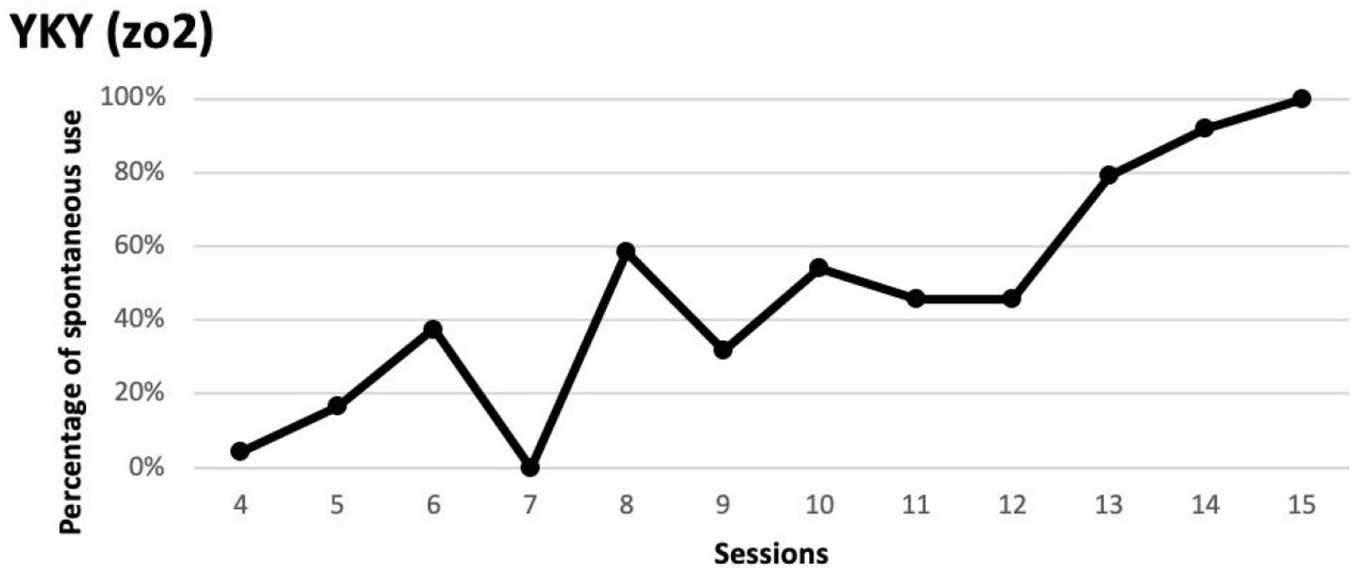
YKY’s percentage of spontaneous use of the trained aspect marker ‘zo2’ in the training sessions.
4 WTY (gan2)
At the baseline phase, WTY scored an average of 5.57% on the trained aspect marker ‘gan2’, which was at a similar level as the control grammatical morpheme and a lower level than the untrained aspect marker. At the training phase, WTY’s percentage of ‘gan2’ use showed an increasing trend in the last three probes, and the mean percentage at the training phase was higher than that at baseline. The Tau-U value of .39, however, was not statistically significant (p = .37, 90% CI = −.32–1.00). In the baseline probes, WTY used ‘gan2’ only with the verb ‘zoek3’ (‘put on’), and at the follow-up probe, she used ‘gan2’ with all 12 probe verbs. There were no changes in the mean percentage in the control morpheme at the baseline and the training phases, and the Tau-U value was 0 (p = 1.00, 90%CI = −.71–.71). The percentage of the untrained aspect marker use increased and then dropped slightly at baseline. Its mean percentage at the training phase was not higher than that at baseline and the Tau-U value was −.11 (p = .80, 90% CI = −.82–.60). Figure 5 presents a visual representation of WTY’s performance in the probes at the baseline, the training and the follow-up phases.

WTY’s percentage of correct use of the three grammatical morphemes in probes in the three phases.
WTY’s spontaneous use of ‘gan2’ with non-probe verbs during training was also observed (see Figure 6). Given 288 doses of ‘gan2’ involving 133 non-probe verb types, WTY used ‘gan2 ‘with a percentage ranging from 0% to 87.5% with 72 non-probe verb types across the 12 training sessions, with an observable increasing trend. WTY used 20 verb and 2 adjective types at the baseline conversation sample and 12 verb and 1 adjective types at the follow-up sample. WTY did not use any of the three grammatical morphemes, including the trained aspect marker ‘gan2’, in the samples.
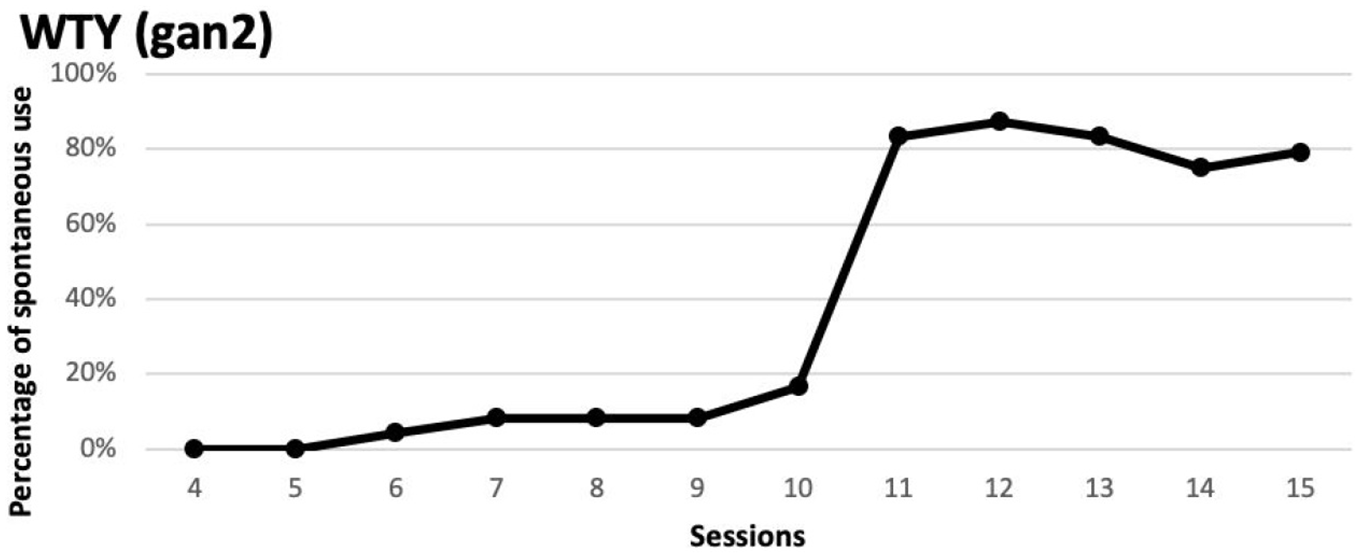
WTY’s percentage of spontaneous use of the trained aspect marker ‘zo2’ in the training sessions.
5 NHY (‘gan2’)
At the baseline phase, NHY scored 8.3% consistently on the trained aspect marker ‘gan2’, which was worse than the untrained aspect marker but better than the control grammatical morpheme. NHY demonstrated an increasing trend in the percentage scores for the trained aspect marker ‘gan2’ and an observable gain in the mean percentage for ‘gan2’ when comparing his performance at baseline and at training. The Tau-U value of 1 (p = .02, 90%CI = .29–1.00), was statistically significant and indicated a large effect size (see Table 2). In the baseline probes, NHY used ‘gan2’ only with the verb ‘caai2’ (‘ride’) and at the end of training, she used ‘gan2’ with all 12 probe verbs. There was no improvement in the control grammatical morpheme, and the Tau-U value was 0 (p = 1.00, 90%CI = −.71–.71). This suggests that NHY’s gain in the trained aspect marker ‘gan2’ was unlikely to be due to practice effect or overall maturation. A positive trend in performance in the baseline probes for the untrained aspect marker was noted. Following Parker et al. (2011b) recommendation for baseline trend correction when the baseline slope was >= .40, the Tau-U value was corrected and reported to be .72 and it was not statistically significant (p = .09, 90%CI = .01–1). Figure 7 presents a visual representation of NHY’s performance in the probes at the baseline, the training and the follow-up phases.
Visual and quantitative analyses of the four children’s use of their respective trained aspect marker and the control modal auxiliary on repeated probes.
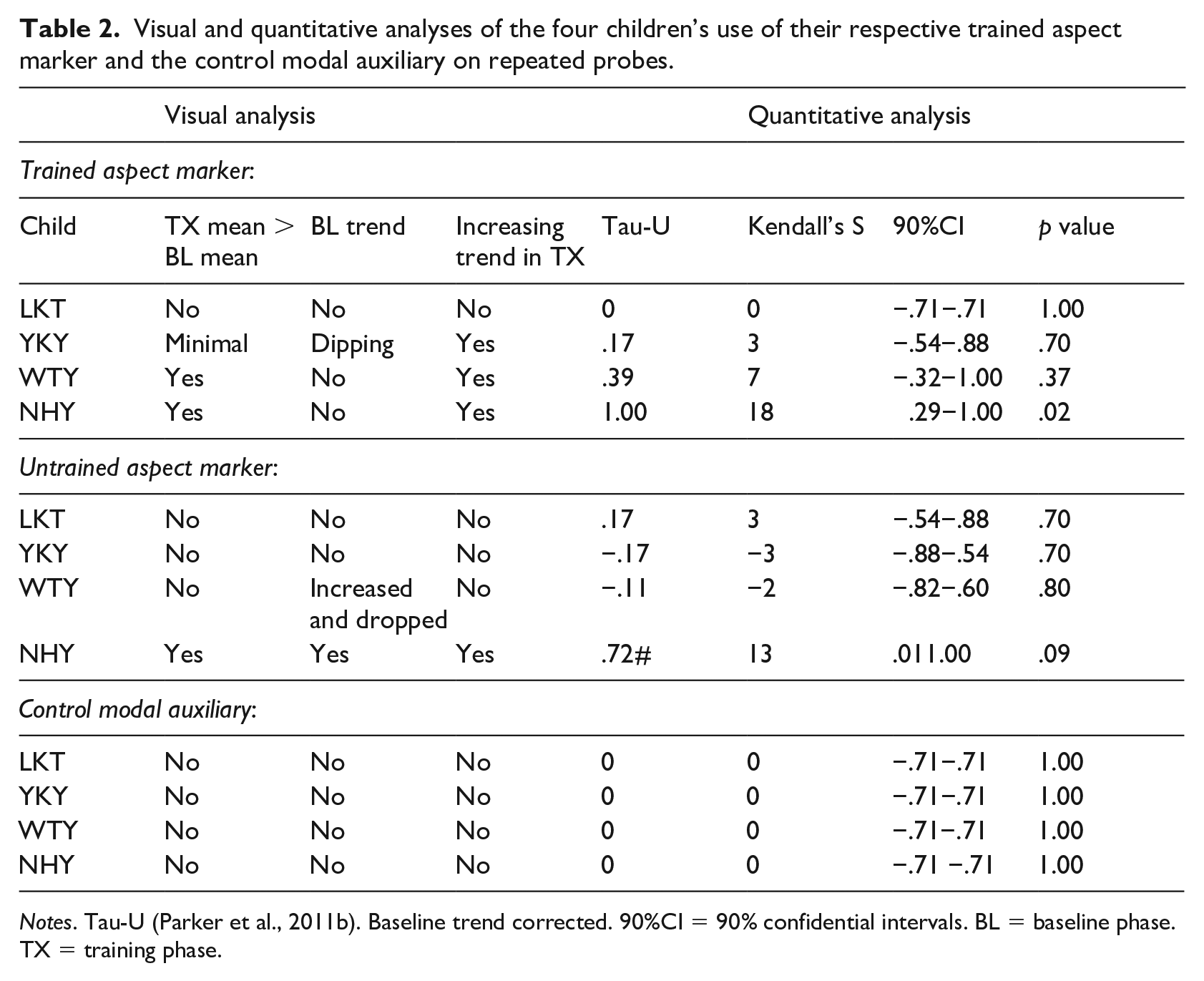
Notes. Tau-U (Parker et al., 2011b). Baseline trend corrected. 90%CI = 90% confidential intervals. BL = baseline phase. TX = training phase.
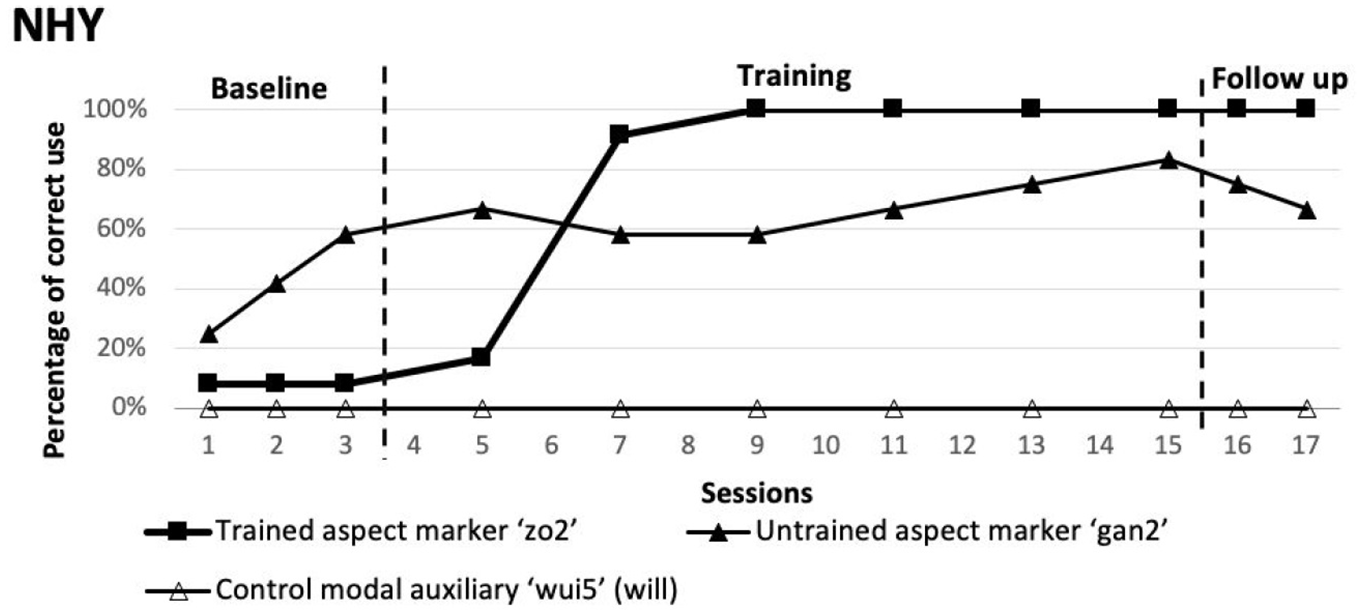
NHY’s percentage of correct use of the three grammatical morphemes in probes in the three phases.
NHY’s spontaneous use of ‘gan2’ with non-probe verbs during training was also observed (see Figure 8). With 287 doses of ‘gan2’ involving 138 non-probe verb types, NHY used ‘gan2’ with a percentage ranging from 0% to 95.8% across the 12 training sessions with an observable increasing trend. Across the 12 sessions, NHY used ‘gan2’ with 115 non-probe verb types. NHY used 10 verb and 2 adjective types at the baseline conversation sample and 9 verb and 3 adjective types at the follow-up sample. NHY did not use any of the three grammatical morphemes, including the trained aspect marker ‘gan2’, in the samples. Table 2 summarizes visual and quantitative analyses of the four children’s use of their respective trained aspect marker and the control modal auxiliary on repeated probes.
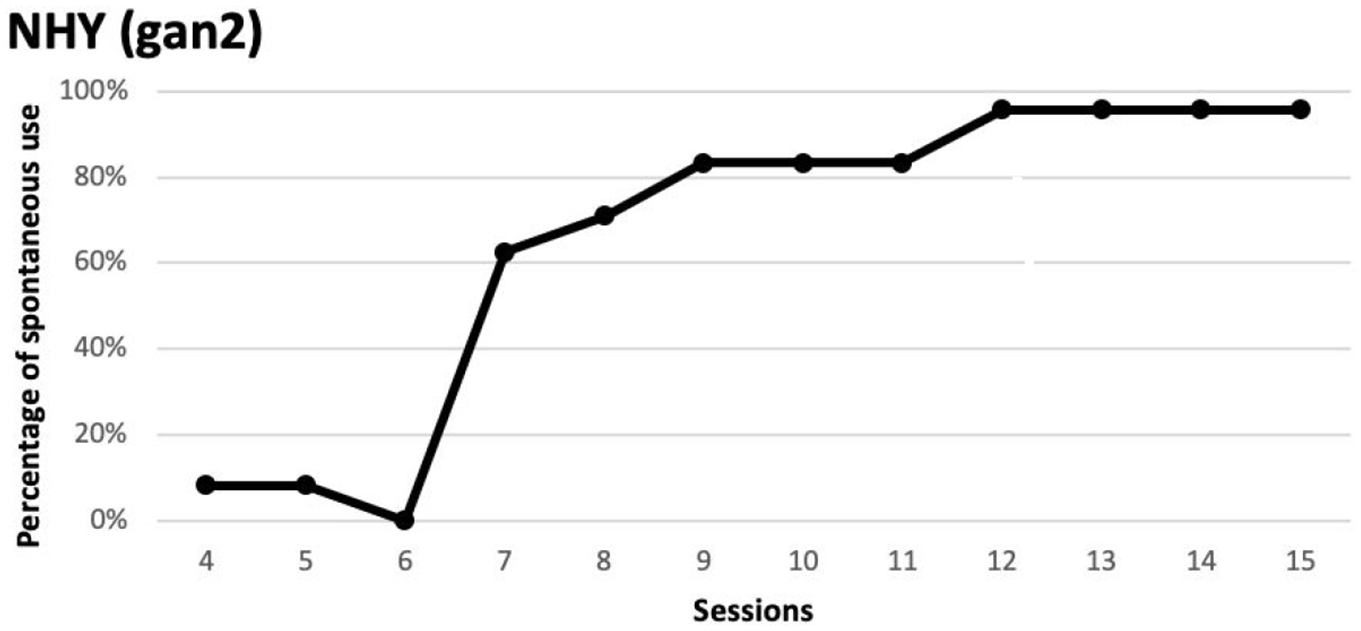
NHY’s percentage of spontaneous use of the trained aspect marker ‘zo2’ in the training sessions.
6 Summary of the results
In this study, four typically-developing Cantonese-Chinese three-year-old children received ECR training on the aspect marker ‘zo2’, or the aspect marker ‘gan2’, with another grammatical morpheme, which is a modal auxiliary ‘wui5’ (‘will’), as the control. Performance on these grammatical morphemes was measured using probes that involve verbs and adjectives not used in training. This was a more stringent measure of learning, as appropriate use of the trained aspect marker had to be generalized to unfamiliar verbs and adjectives. The children’s spontaneous use of the trained aspect marker during the training activities, and in a conversational sample at baseline and at follow-up, was also recorded. In these two contexts, the former was a documentation of use in primed contexts as the trained aspect marker was used in a high density in the clinician’s recasts. The latter was included to provide evidence of learning effects in a more naturalistic context.
LKT was trained on the aspect marker ‘zo2’, and he showed no effect of training in the probes. YKY was the other child trained on the aspect marker ‘zo2’. There was a slight increasing trend in her performance in the probes at the training phase, but the Tau-U value suggested that this trend could not be attributed to training effects. YKY, however, demonstrated productive use of ‘zo2’ during training in primed contexts. WTY was one of the two children who were trained on the aspect marker ‘gan2’. She showed a sharp increase in the percentage of correct use in the last two probes administered at the training phase, but the Tau-U was not statistically significant, suggesting that training effects alone could not explain this change in performance. Note that WTY’s performance maintained at the follow-up probe, and she also demonstrated productive use of ‘gan2’ during training in primed contexts.
NHY was also trained on the aspect marker ‘gan2’. She demonstrated robust learning effects with a level baseline and a sharp increase in the percentage of correct use from the second probe that was administrated at the training phase. She maintained her ceiling performance from the third probe on and also in the probes at follow-up. The Tau-U value was statistically significant and there were no learning effects of the control grammatical morpheme. These two pieces of evidence suggested that there was a causal effect of training on NHY’s improved performance on ‘gan2’. NHY’s showed productive use of ‘gan2’ in the training activities. Of note is that NHY also demonstrated gains in the untrained aspect marker ‘zo2’, but given a sharp positive baseline trend, these gains could not be interpreted as generalization effects from the training.
VI Discussion
In the next few sections, we will discuss findings from this study in relation to the research questions and other issues.
1 Early efficacy of ECR training for typically-developing children
The first research question asked whether the individualized ECR training led to a significantly higher percentage of use of the trained aspect marker relative to the control grammatical morpheme in probes. The answer to this question is supported using an omnibus effect calculation of Tau-U across children across the two trained aspect markers. The four children made gains on their trained aspect marker, and the weighted average Tau-U value was .38 (p = .07, 90%CI = .03–.74). There was no improvement in the control grammatical morpheme across the four children, and the weighted average Tau-U value was 0 (p = 1.00, 90%CI = .35–.35). ECR led to a large and statistically significant effect in one child and positive learning outcomes in the other child who learned the progressive aspect marker ‘gan2’. Both children made no gains in the control grammatical morpheme, suggesting that the gain in ‘gan2’ was likely to be a consequence of ECR training rather than maturation. Changes in performance in the baseline and the training phases were minimal for the two children who learned the perfective aspect marker ‘zo2’. This difference in learning effects for the two aspect markers was plausibly a result of task demands.
In the ‘gan2’ probe task, the relevant verb was provided twice for the child in the clinician’s instruction for each probe item. In the ‘zo2’ probe task, the child had to come up with an appropriate verb or adjective to use with the aspect marker for each probe item. The task demand was therefore higher for the ‘zo2’ than the ‘gan2’ probes. Despite this, all children performed substantially better in the ‘zo2’ than the ‘gan2’ probes at the baseline phase. This is consistent with the fact that ‘zo2’ develops earlier than ‘gan2’ as observed in naturalistic conversations. Of note is that the two children who received training on ‘zo2’, and one child who was probed on ‘zo2’ for measurement of generalization, showed level performance after the baseline phase. This indicated that their performance in the ‘zo2’ probe was likely constrained by their knowledge of verbs and adjectives. This observation can be indirectly supported by two pieces of evidence. One is that despite level performance in the probes, YKY demonstrated a steady increase in the spontaneous use of ‘zo2’ during training, in which the verbs and the adjectives were provided by the clinician in the activities. Another is NHY’s performance patterns on the two aspect markers. She was the only child who demonstrated a significant training effect for the trained aspect marker ‘gan2’. She used it with 12 different verbs scoring 100% from the third probe in the training phase and used it with 115 verb types spontaneously during training. Her strong verb repertoire might have explained her stronger performance in ‘zo2’, the untrained aspect marker, at the baseline and the training probes when compared to the other three children.
2 Spontaneous use during training
The second research question concerned whether the individualized ECR training led to an increase in the four typically-developing Cantonese-speaking preschool children’s spontaneous use of the trained aspect marker in non-probe verbs during training activities. The answer was positive in three children (YKY, WTY and NHY). The training activities were more conducive to the children’s use of the trained aspect marker than the probe task because in each learning episode, the verbs or the adjectives were modelled by the clinician twice. The other reason was that the children had heard the use of the trained aspect marker with many verbs or adjectives in the form of a recast from the clinician in the training sessions. In other words, the spontaneous use of the trained aspect marker with the non-probe verbs could have been primed. The child NHY who showed a statistically significant effect with a large effect size on the trained aspect marker also produced it with the largest number of different non-probe verbs during training.
3 Generalization effects
The third and fourth research question concerned generalization effects from the trained to the untrained aspect marker and from structured probes to naturalistic conversations respectively. Only one child (i.e. NHY) showed gains in the untrained aspect marker ‘zo2’ relative to the control grammatical morpheme. However, the gains were not statistically significant given a positive baseline trend. No children used their trained aspect marker spontaneously without a model in naturalistic conversational contexts during the 10-minute play at the follow-up phase, even for NHY who demonstrated significant learning effects. NHY’s absence of use of the trained aspect marker ‘gan2’ can be a result of a lack of generalization or a lack of opportunities for its use during the 10-minute play. In future studies, we should structure a conversation around some topics that are more conducive for the use of aspect markers.
4 Individual variability
It is worthwhile to note that individual variability in the outcomes of ECR does not only exist in children with SLI or children with DLD (Meyers-Denman and Plante, 2016; Plante et al., 2014, 2018), but also in the population with typical development. There can be three sources of individual variability. One is the baseline use of the grammatical morphemes, especially in naturalistic conversational contexts. Given what we know about the age of emergence of the grammatical morphemes in typically-developing children, the children in the study who were between 3;0 and 3;5 would very likely be using them at least with some verbs in spontaneous speech. Two is breadth and depth of vocabulary knowledge. Regarding vocabulary breadth, some children might know considerably a smaller number of verbs relative to others, putting them at a disadvantage in learning to use the trained aspect marker. Given that vocabulary data were only available from the relatively short language samples and the children were comparable in the proportion of unique verbs and objects in the baseline and the follow-up sample, whether vocabulary breath explained individual variabilities in the gains in training across the four children would need further investigation. Regarding vocabulary depth, some children might not grasp the lexical semantics of many verbs. For instance, LKT restricted his use of the trained aspect marker to verbs in a certain lexical semantics category, suggesting that he could not manipulate grammatical aspect independently of lexical aspect. This restricted collocation pattern of use was commonly observed in the SLI population (Stokes and Fletcher, 2003). While typically-developing children can outgrow this pattern, it persists in children with SLI (Stokes and Fletcher, 2003). Three is dosage. Some children (e.g. LKT) may need more dosage relative to others to acquire a grammatical morpheme, while others (e.g. NHY) could learn quickly and might even generalize to the untrained aspect marker.
5 Maintenance effect
Only two children (i.e. LKT and YKY) completed all three follow-up probes administered approximately one week after training, while the others completed only one to two probes due to scheduling issues and school activities. All children maintained the same level of performance of the trained aspect marker at follow-up. NHY, the only child whose gains in the trained aspect marker could be attributed to ECR, was clearly able to develop a robust representation of the trained aspect marker during training. Her learning was considered robust because probe verbs which the trained aspect marker was tested on was not included in the training sessions.
6 Clinical implications and future studies
This feasibility study was designed to ascertain whether ECR is a clinically viable approach for the training of Cantonese-Chinese grammatical morphemes, specifically aspect markers. The answer was positive. The clinician was able to design a variety of activities that make the use of syntactically optional aspect markers highly preferable, and to provide input that would allow her to increase the salience of the trained aspect marker using many different verbs and adjectives. She was also able to deliver a high dosage of the trained aspect marker, which was closely monitored by a treatment fidelity checker. The children appeared to enjoy both the training activities and probe tasks, and there was no negative feedback from the parents or teachers.
Results from this study are very encouraging. Subsequent studies should take into account the methodological limitations discussed below and re-run the training protocol with another sample of typically-developing children. Once the results are replicated, we will examine the efficacy of ECR with a sample of Cantonese-Chinese speaking children with DLD.
7 Limitations
The first limitation is that the verbs, or adjectives, to be used with the aspect marker ‘zo2’ in the probe were not modelled by the clinician, in the same way as the probes for the other two grammatical morphemes. It was plausible, however, that if they were provided, the children would have been able to perform close to the ceiling level on ‘zo2’ even at baseline. The other limitation is that not all children had completed the three follow-up probes due to their absence from schools and other school events on the scheduled days. It was therefore unclear how gains made on the use of the trained aspect marker could be maintained after the ECR training.
Like other studies using single subject experimental designs, results from this study have low generalizability due to its small sample size. Nevertheless, single subject experimental designs do allow us to test out theoretically-driven intervention approaches before more time- and resource- intensive larger-scale studies are conducted. Like many intervention research studies, this study was conducted in a laboratory setting and hence suffer from several threats to external validity. One way to circumvent this is to develop a single-subject experimental design study in a clinical setting in collaboration with a speech-language therapist.
Supplemental Material
sj-docx-1-clt-10.1177_0265659020967710 – Supplemental material for Does Enhanced Conversational Recast promote the learning of grammatical morphemes in Cantonese-speaking preschool children? Answers from a single-case experimental study
Supplemental material, sj-docx-1-clt-10.1177_0265659020967710 for Does Enhanced Conversational Recast promote the learning of grammatical morphemes in Cantonese-speaking preschool children? Answers from a single-case experimental study by Flora F-W Hau, Anita M-Y Wong and Megan W-Y Ng in Child Language Teaching and Therapy
Footnotes
Acknowledgements
We acknowledge the generous help of Po Leung Kuk Lee Shu Fook Kindergarten in participant recruitment and in providing us the venue for this study. We thank the children and their parents for their time and support.
Declaration of conflicting interests
The author(s) declared no potential conflicts of interest with respect to the research, authorship, and/or publication of this article.
Funding
The author(s) received no financial support for the research, authorship, and/or publication of this article.

Supplemental material
Supplemental material for this article is available online.
References
Supplementary Material
Please find the following supplemental material available below.
For Open Access articles published under a Creative Commons License, all supplemental material carries the same license as the article it is associated with.
For non-Open Access articles published, all supplemental material carries a non-exclusive license, and permission requests for re-use of supplemental material or any part of supplemental material shall be sent directly to the copyright owner as specified in the copyright notice associated with the article.
