



Abstract
The present study aimed to explore the specific components of home literacy resources (HLR) and parental behaviours during shared book reading (SBR) that may contribute to the language development of Chinese-speaking hearing-impaired children. A total of 90 Chinese-speaking hearing-impaired children aged 3 to 6 years, along with their parents, participated in this study. Following the design of previous studies, we required the parents to complete a questionnaire regarding HLR and parental SBR behaviours, and their hearing-impaired children received a standardised language test. The results showed that such HLR components as storybook capacity at home, weekly frequency of SBR, duration per SBR session, starting age of SBR, and the parental SBR behaviour, parent and child discussing opinions with each other, could significantly account for an additional portion of the variance in children's receptive, expressive, and overall language beyond the demographic variables. It is thus recommended that clinicians share this evidence-based information with parents who have hearing-impaired children to help their children develop language to their fullest potential.
Keywords
Introduction
Hearing-impaired children often display difficulties in language development (Friedmann and Szterman, 2011; Golestani et al., 2018; Halliday et al., 2017; Hsuan and Lin, 2002; Lin et al., 2017; Lund, 2016; Takahashi et al., 2016; Vogelzang et al., 2021; Weng, 2019). It has been roughly estimated that about 13.3% of hearing-impaired children begin to display language difficulties as early as 35 months old (Psarommatis et al., 2001) due mainly to their limited access to speech sounds (Schow and Nerbonne, 2007). Effective approaches to language intervention in hearing-impaired children have been identified, one of which is shared book reading (SBR; DesJardin and Eisenberg, 2007; DesJardin et al., 2014, 2017). Previous SBR studies have examined English-speaking hearing-impaired children (DesJardin and Eisenberg, 2007; DesJardin et al., 2014, 2017) to identify the specific parental SBR behaviours (e.g. using recasting techniques and asking open-ended questions) that may promote their language development, but surprisingly, no studies have explored this issue in hearing-impaired children who speak Chinese, the most spoken language worldwide (1.1 billion Chinese speakers vs. 983 million English speakers; Julian, 2020). In addition, English and Chinese parents are known as ‘story-builders’ and ‘story-tellers’, respectively (Rochanavibhata and Marian, 2021). While the ‘story-builder’ style refers to parents encouraging children to cooperate with each other in constructing the story's meaning via various questions, the ‘story-teller’ style refers to parents dominating children in narrating the story, with little interaction (Caspe, 2009; Harkins and Ray, 2004; Melzi and Caspe, 2005; Melzi et al., 2011; Wang et al., 2000).
In addition, some differences exist between English and Chinese storybooks for children (Cheung et al., 2017; Ding et al., 2021; Yew et al., 2002). For example, Yew et al. (2002) noted that while English storybooks use more pronominal expressions (i.e. using pronouns to refer to characters), Chinese storybooks use more elliptical expressions (i.e. omitting pronouns when referring to characters). Cheung et al. (2017) reported that Chinese storybooks provide more descriptions of learning-related beliefs and behaviours (e.g. effort and perseverance) than English storybooks. Ding et al. (2021) observed that English storybooks show a higher tendency to describe positive emotions (e.g. happiness and pride), negative emotions (e.g. anger, jealousy, contempt, and frustration), and supportive responses to negative emotions (e.g. help the child resolve the upsetting issue) than Chinese storybooks. When compared to English storybooks, Chinese storybooks focus more on how interpersonal situations (e.g. being visited by a friend) caused the character's emotions and less on how individual behaviours (e.g. winning a prize or having a cup of tea) did so. In addition, the teaching of knowledge regarding emotions through morals is more characteristic of Chinese storybooks than of English storybooks. The above differences may result in different SBR strategies that can be adopted with children.
Given the differences in parental book reading styles and storybook contents between the English and Chinese cultures, the SBR findings obtained in English society may not necessarily apply to Chinese society. On the other hand, the effect of home literacy resources (HLR; e.g., time-related factors of reading and storybook capacity at home; Puglisi et al., 2017) on language development has been investigated in English – but not Chinese-speaking hearing-impaired children (DesJardin et al., 2014, 2017). Therefore, the aim of the present study was to explore whether there are any specific HLR components and parental SBR behaviours that may contribute to the language development of Chinese-speaking children with hearing impairment.
Language development in hearing-impaired children
Difficulties in language development have been universally detected in children with prelingual hearing impairment, and the widely acknowledged cause is their restricted access to speech sounds because children typically acquire language by hearing and using it in conversations (Tomblin et al., 2015). Research has shown that hearing-impaired children often struggle with language acquisition (Halliday et al., 2017; Lund, 2016; Pittman, 2008). For example, Halliday et al. (2017) noticed that English-speaking hearing-impaired children with hearing aids (HA) showed poorer performance in regard to expressive vocabulary than did children with typical hearing. In a meta-analysis study, Lund (2016) reported that children with cochlear implants (CI) displayed a lower level of both receptive and expressive vocabulary skills than did their hearing peers. In addition, hearing-impaired children also show poorer syntactic development due to their heavy loads in processing sentences (Friedmann and Szterman, 2011; Takahashi et al., 2016; Vogelzang et al., 2021). For example, Takahashi et al. (2016) found that Japanese-speaking hearing-impaired children had more difficulty understanding passive and causative sentences than their hearing counterparts. Golestani et al. (2018) administered a morphosyntax test to Persian-speaking children with CI and found that even children with more than 5 years of experience with CI exhibited an obvious disadvantage in understanding most syntactic categories (e.g. grammatical morphemes, sentence structure, prepositions and conjunctions) when compared to their hearing peers.
For Chinese-speaking children, Hsuan and Lin (2002) noted that hearing-impaired pre-schoolers in Taiwan underperformed relative to their hearing peers in oral language development. A retrospective study on 3-year-old to 12-year-old hearing-impaired children with CI in Taiwan (Weng, 2019) showed that these children's average language scores fell between 25% and 45% of the norm standardised based on hearing children. Lin et al. (2017) found that hearing-impaired children in China lagged behind their hearing peers in receptive, expressive, and overall language development.
In summary, it is apparent that hearing-impaired children generally experience delays in language achievement. Delays in language ability are often associated with poorer academic performance (Daud et al., 2010; Elbeltagy, 2020; Moeller et al., 2007; Qi and Mitchell, 2012) and behavioural problems (Bigler et al., 2019; Hall et al., 2018; Morgan and Meier, 2008). Thus, actions should be taken to avoid compounding these children's language difficulty and to bolster their language learning to prevent academic failure and negative behavioural outcomes. The Home Literacy Model (Sénéchal and LeFevre, 2002) sheds important light on how parents can use storybooks to promote the language development of their hearing-impaired children.
The Home Literacy Model
Under the framework of the Home Literacy Model are two distinct types of experiences parents can provide for their children: informal exposure to storybooks and formal tutoring related to literacy (Sénéchal, 2006; Sénéchal and LeFevre, 2002). The quality and quantity of storybook exposure depend on how parents create a literacy-friendly environment at home through various HLR as well as how they behave during SBR to support children's language acquisition (Puglisi et al., 2017; Sénéchal and LeFevre, 2014). The importance of HLR and parental SBR behaviours in children's language development are described below.
Home literacy resources in language development
HLR includes such examples as the onset of SBR, the number of storybooks at home, and the frequency of and time spent on SBR (Puglisi et al., 2017). HLR has been found in English studies to be significantly related to the development of auditory comprehension and expressive communication in hearing-impaired children (e.g. DesJardin et al., 2014, 2017). For instance, DesJardin et al. (2017) found that the frequency of book reading at 24 months of age in hearing-impaired children positively correlated with their receptive and expressive language performance as evaluated at 36 months of age. This relationship is self-exploratory in that hearing-impaired children often need repeated or highly frequent exposure to diverse linguistic input through HLR to compensate for the missed linguistic messages that could otherwise be noticed through normal hearing (DesJardin et al., 2017).
Despite the positive effect of HLR on English-speaking hearing-impaired children's language development, to date, no studies have examined the same topic in Chinese-speaking hearing-impaired children, and still less is known regarding whether any specific components of HLR (e.g. onset of SBR, frequency of SBR, storybook capacity at home) can facilitate Chinese-speaking hearing-impaired children in developing language skills. This information will better guide parents to support the language acquisition of their hearing-impaired children. Thus, the first motivation and purpose for the current study is to fill the research and clinical gap by exploring which HLR components may contribute to the language development of Chinese-speaking hearing-impaired children.
Shared book reading in language development
SBR is formally defined as the interactive engagement of parents or teachers and children during reading while simultaneously attending to the words, content and pictures in a book (Ezell and Justice, 2005). This approach has been found effective in improving the language skills of children with typical hearing (Neuman and Kaefer, 2018) owing to its provision of enriched linguistic input. For example, in a typical SBR context, parents use numerous language models and elicit children's oral response by applying various strategies, such as expansion, asking open-ended questions, recasting and commenting. These strategies allow children to actively use language to communicate, thereby aiding their language acquisition (Carlo et al., 2004).
For hearing-impaired children, the English studies conducted by DesJardin and Eisenberg (2007), and DesJardin et al. (2014, 2017) have also demonstrated the effectiveness of SBR. For instance, DesJardin and Eisenberg (2007) investigated the effect of specific parental SBR techniques on the oral language skills of children with CI and observed that two high-level facilitative language techniques, recasting and open-ended questions, promoted children's language development. By contrast, the low-level facilitative language techniques, such as imitation and labelling, negatively affected children's language outcomes. DesJardin et al. (2014) reported that such parental SBR behaviours as stopping to solicit questions regarding the book content and requesting a prediction based on the storyline can help hearing-impaired children build expressive language. DesJardin et al. (2017) found that parents’ perception of the ease of SBR and interactive SBR activities utilised in early childhood predicted their hearing-impaired children's later auditory comprehension and expressive communication ability.
Among the Chinese population, a small number of studies have also examined the influence of SBR on the language development of hearing-impaired children, and these studies emphasised that the interactive talk between parents and their children determined the success of SBR. For example, Fung et al. (2005) observed that dialogic reading, a form of SBR that encourages parent–child dialogue, set the stage for the receptive language development of 28 hearing-impaired children in Hong Kong given its interactive nature; however, they did not take expressive language into account. As noted in Clark (1995), both receptive and expressive language should be considered to obtain a complete picture of children's language development. Tsai (2009) also found that the dialogic reading intervention could potentially be beneficial to both receptive and expressive language in 16 hearing-impaired children in Taiwan. Notwithstanding the positive effect of SBR, the small sample size precluded Fung et al. (2005) and Tsai (2009) from drawing definitive conclusions regarding the utility of SBR in the language acquisition of Chinese hearing-impaired children. In addition, the two Chinese studies only examined the role of SBR per se in hearing-impaired children's language development and did not explore the specific parental SBR behaviours that can play such a role. This information may help parents opt for useful SBR strategies while dismissing less effective ones when reading books with their hearing-impaired children. Therefore, the second motivation and purpose for the present study was to explore whether there are certain parental SBR behaviours that contribute significantly to the language development of Chinese hearing-impaired children. The present study investigated which parental SBR behaviours (e.g. parent modifying the SBR strategy according to the child's responses, parent and child discussing opinions with each other, parent requesting that the child concentrate during SBR, parent responding to the child's behaviours; parent following the child's lead, parent correcting the child's errors) facilitate hearing-impaired children's language development.
The present study
The present study extended previous research (Fung et al., 2005; Tsai, 2009) by recruiting a larger sample of hearing-impaired children and by examining the specific HLR components and parental SBR behaviours that may be potentially facilitative to the development of receptive, expressive, and overall language among Chinese-speaking hearing-impaired children. This study would be of practical and clinical importance as it offers several implications. For example, through SBR at home, parents can not only foster their children's language and literacy development (Anderson et al., 2019; Hoyne and Egan, 2019) but also support their children's social, cognitive and emotional development (Hoyne and Egan, 2019; Kohm et al., 2016). Furthermore, the results of the present study can guide Chinese parents as to what can and should be considered (e.g. storybook capacity, onset of SBR, frequency of SBR and duration per SBR session) when creating a literacy-friendly environment at home to assist their hearing-impaired children in acquiring language. Two research questions were addressed:
Which of the HLR components could contribute to the development of the receptive, expressive and overall language of hearing-impaired children? Which of the parental SBR behaviours could contribute to the development of the receptive, expressive and overall language of hearing-impaired children?
Method
Participants
A total of 90 Chinese-speaking kindergartners (42 boys and 48 girls) with congenital sensorineural hearing impairment aged 3 to 6 years and their parents recruited from 4 centres (i.e. Taipei, Taoyuan, Kaohsiung and Yilan) associated with a hearing rehabilitation foundation participated in this study; these centres represented both rural and urban areas of Taiwan. According to the Department of Budget, Accounting, and Statistics (2021), the average annual household incomes in 2020 (when this study was conducted) in Taipei, Taoyuan, Kaohsiung and Yilan were $52,916, $49,104, $42,210 and $39,253 (in US dollars), respectively. The age range of 3 to 6 years was selected because it was still within the emergent literacy stage (i.e. 3 months to 6 years; Wolf, 2008), during which reading activities can pave the way for children's language development (Hidayat and Fitria, 2021). All of the children were mainstreamed in kindergartens. The children's mean chronological and hearing ages (time since the fitting of the auditory amplification) were 4.58 (SD = 0.80) and 3.54 years (SD = 0.89), respectively. They received auditory–verbal therapy (AVT) provided by the foundation but no other types of interventions before this study. This therapy emphasises that hearing-impaired children use residual hearing amplified by hearing devices for verbal communication, and their parents use learned strategies (e.g. acoustic highlighting, audition first; Duncan, 2006) to help them develop language on a daily basis. The children had received the AVT for an average of 3.01 years (SD = 0.86). Their average degree of hearing impairment (as measured by better unaided ear pure tone average at 0.5, 1, 2 and 4 K Hz) was 70.48 dB HL (SD = 24.40). They were all bilaterally fitted with hearing devices, such as HA and/or CI. The average parental education level (measured by years spent receiving formal education and utilised as an index for socioeconomic status (SES) in the study of language development; Hoff, 2013) for these children was 15.79 years (SD = 2.30). Table 1 describes the demographic profiles of the participants. None of the children had any disability other than hearing impairment, such as intellectual disability, autism spectrum disorder, attention deficit hyperactivity disorder and emotional problems. All of the parent–child dyads had had at least 6 months of experience with SBR before participating in the present study based on a prior survey, which required parents to report when they began SBR activity with their children. Parental informed consent was obtained before the current study was conducted.
Demographic profiles of the participants.
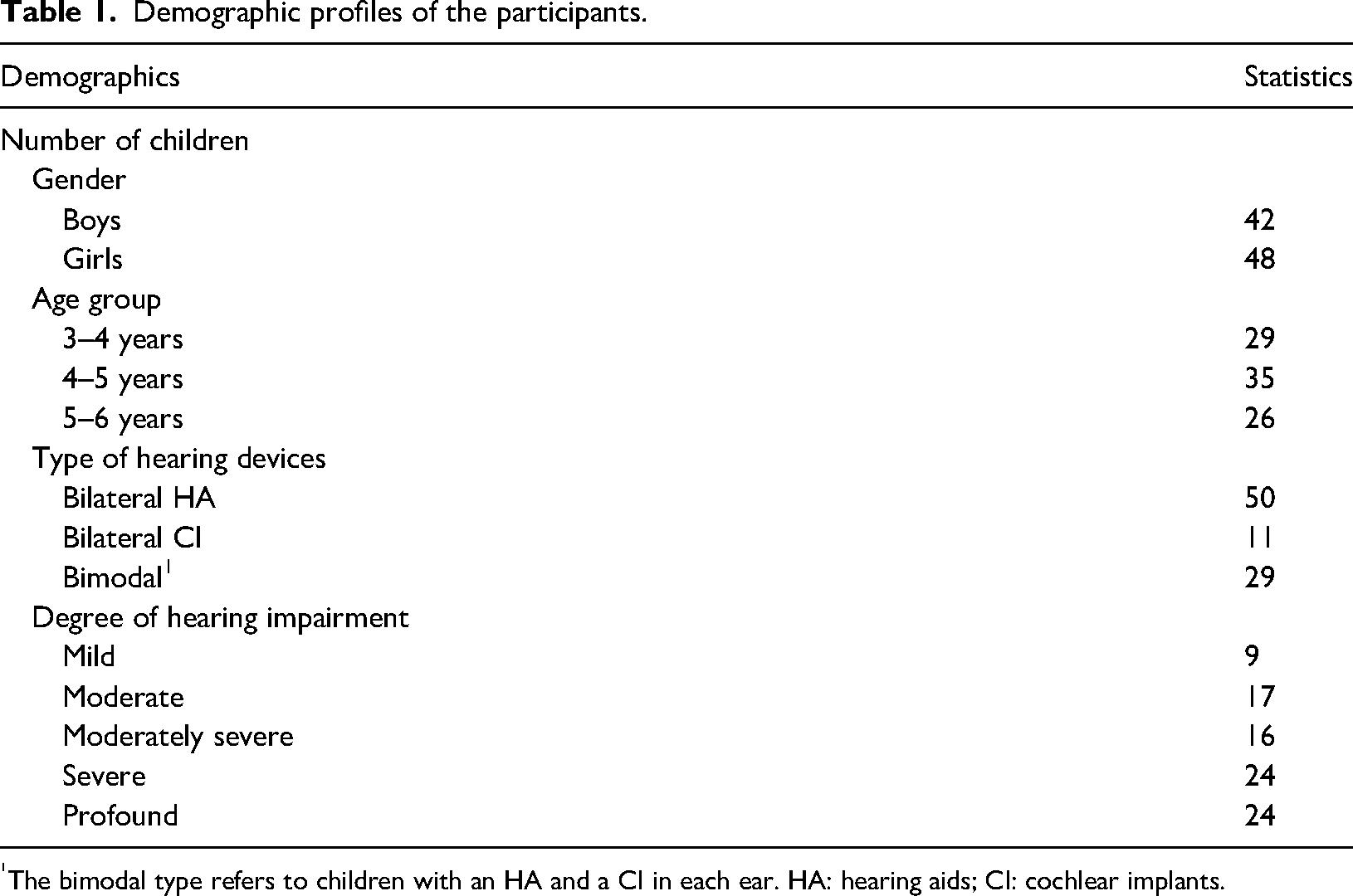
Demographic profiles of the participants.
The bimodal type refers to children with an HA and a CI in each ear. HA: hearing aids; CI: cochlear implants.
Questionnaire on HLR and SBR
Following the experimental design of previous studies on shared book reading (e.g. Cutler, 2020; Ho, 2006; Karrass and Braungart-Rieker, 2005), which adopted parents’ self-reported questionnaires to quantify their SBR behaviours, we also did so to collect data on HLR in addition to parental SBR behaviours. A questionnaire was employed in this study not only because it can facilitate gathering information from a large population, thus resulting in great statistical power (Jones et al., 2013) but also because it can capture parental SBR behaviour that may not be readily detectable in only a single SBR session in observational studies. For instance, parents may not exploit the repetition technique (e.g. repeat after me) in only a single SBR session; however, this technique can be directly addressed using a questionnaire.
For the present study, the questionnaire on HLR and SBR was designed with reference to Ho (2006), who explored the role of SBR in the language development of Chinese-speaking children with typical hearing. The questionnaire consisted of three major sections: demographics, HLR and parental SBR behaviours. In the demographics section, information on parental education level, children's gender, chronological age, hearing age, duration of the AVT enrolment, degree of hearing impairment and types of hearing devices was collected. The components of HLR and parental SBR behaviours were also gathered. In the HLR section, we investigated such variables as storybook capacity at home, weekly frequency of SBR, duration per SBR session, weekly frequency of library visits, and starting age of SBR. In the parental SBR behaviours section, we modified Ho's (2006) questionnaire by adding or deleting items based on the suggestions from four experts – one university professor with expertise in literacy and language development, one certified language-speech pathologist, and two AVTs – to establish content validity. The resulting pool for ‘parental SBR behaviours’ contained 26 items, each of which provided a frequency on a five-point Likert scale, with one denoting ‘never’ and five denoting ‘always’. The questionnaire is provided in the Appendix.
Given that the section on parental SBR behaviours in the questionnaire was newly developed for hearing-impaired children, an exploratory factor analysis (EFA) was conducted to uncover its underlying factor structure. The Kaiser–Meyer–Olkin (KMO) Measure of Sampling Adequacy showed that the sample size of the current study was sufficiently large (KMO = .84) to perform an EFA. Principle component extraction was adopted, and factors with an eigenvalue >1 were retained. Six factors accounting for 67.34% of the total variance were ultimately extracted, comprising a total of 19 items and named according to the commonality of each indicator: (a) parent modifying the SBR strategy according to the child's responses (six items), (b) parent and child discussing opinions with each other (four items), (c) parent requesting that the child concentrate during SBR (three items), (d) parent responding to the child's behaviours (two items), (e) parent following the child's lead (three items) and (f) parent correcting the child's errors (one item). Table 2 presents the factor loading for each of the selected items.
Factor loadings for each selected item.
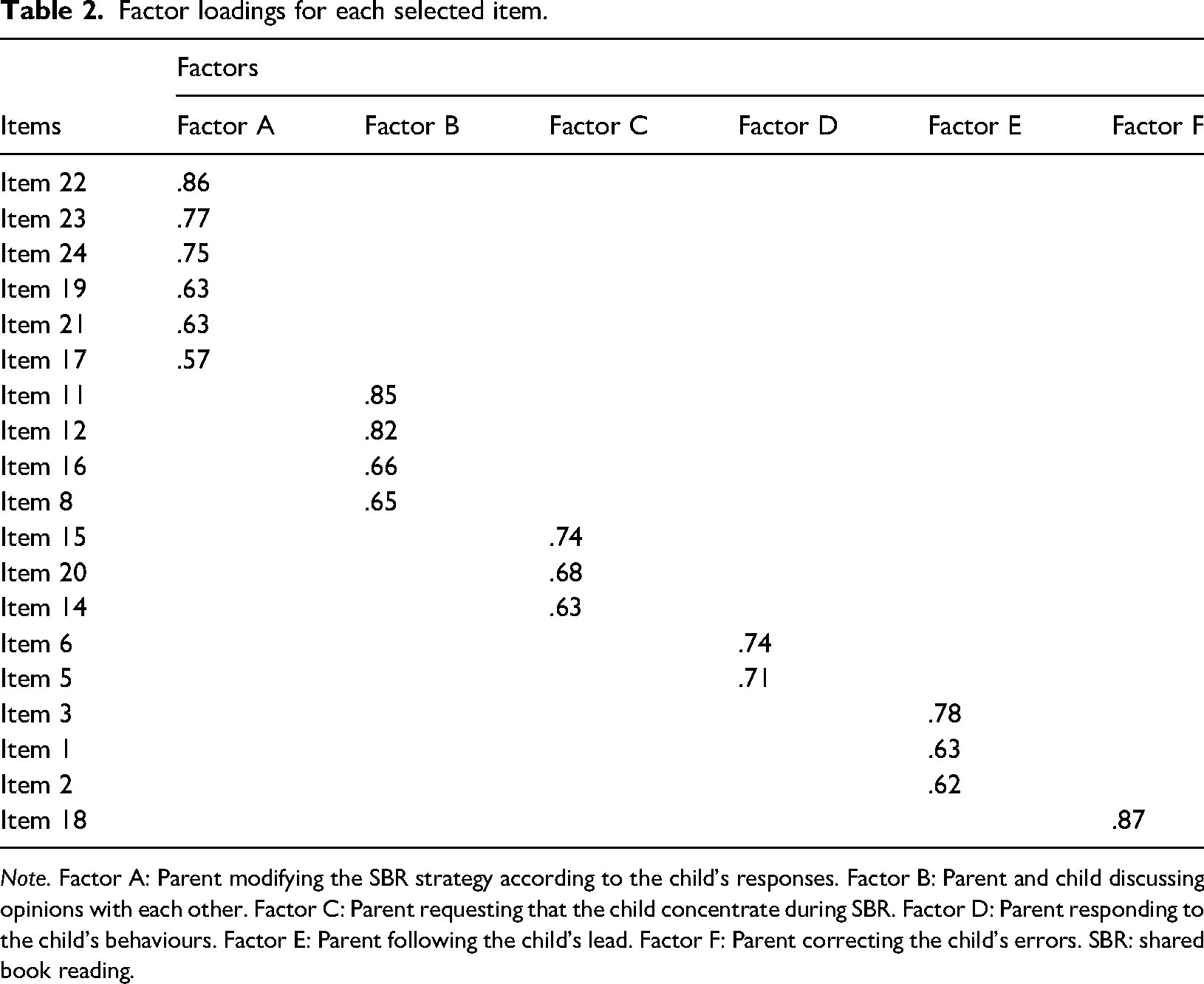
Factor loadings for each selected item.
Note. Factor A: Parent modifying the SBR strategy according to the child's responses. Factor B: Parent and child discussing opinions with each other. Factor C: Parent requesting that the child concentrate during SBR. Factor D: Parent responding to the child's behaviours. Factor E: Parent following the child's lead. Factor F: Parent correcting the child's errors. SBR: shared book reading.
The Cronbach's alpha of the section on parental SBR behaviours, derived from the participants of the current study, was .84.
Children's language skills were measured using the Revised Pre-School Language Assessment (RPLA; Lin et al., 2008), a standardised test that has commonly been used in previous studies on hearing-impaired children in Taiwan (e.g. Chen and Liu, 2019; Lo et al., 2019). This assessment evaluates both vocabulary and syntax in terms of receptive and expressive language domains in children aged 3 to 6 years, and the composite score of the receptive and expressive sections constitutes an index for children's overall language development. The receptive and expressive domains include 37 and 46 items, respectively. This assessment was presented in a question-and-answer format and accompanied by a set of picture plates. Each child was given one point for each item answered correctly. Given the wide age range of the participating children, their T scores (a type of standardised score with a mean of 50 and standard deviation of 10) were reported. The assessment manual states that the Cronbach's alpha of the two separate language domains ranges from .91 to .96, and the test–retest reliability ranges from .92 to .96.
Procedures
Prior to the present study, the author trained his research assistant to administer the questionnaire on HLR and SBR, with a special focus on item explanations and example illustrations. In addition, the research assistant was also trained to conduct the RPLA by following the test manual to assure testing accuracy and reliability. With the assistance of the author and the research assistant, each child's parent completed the questionnaire in a quiet room over the course of approximately 15 to 20 min. The assistance included stating the purpose of the questionnaire, explaining each item, and providing examples if necessary. The child was administered the RPLA in a soundproof room over the course of about 30 to 40 min depending on their performance.
Results
For subsequent analysis of the questionnaire, a parent's total score for each factor in the ‘parental SBR behaviours’ section was calculated by adding the Likert scale value of the selected response. The descriptive statistics for demographics, HLR and parental SBR behaviours are shown in Table 3.
Descriptive statistics of the demographics, HLR, SBR and language measures.
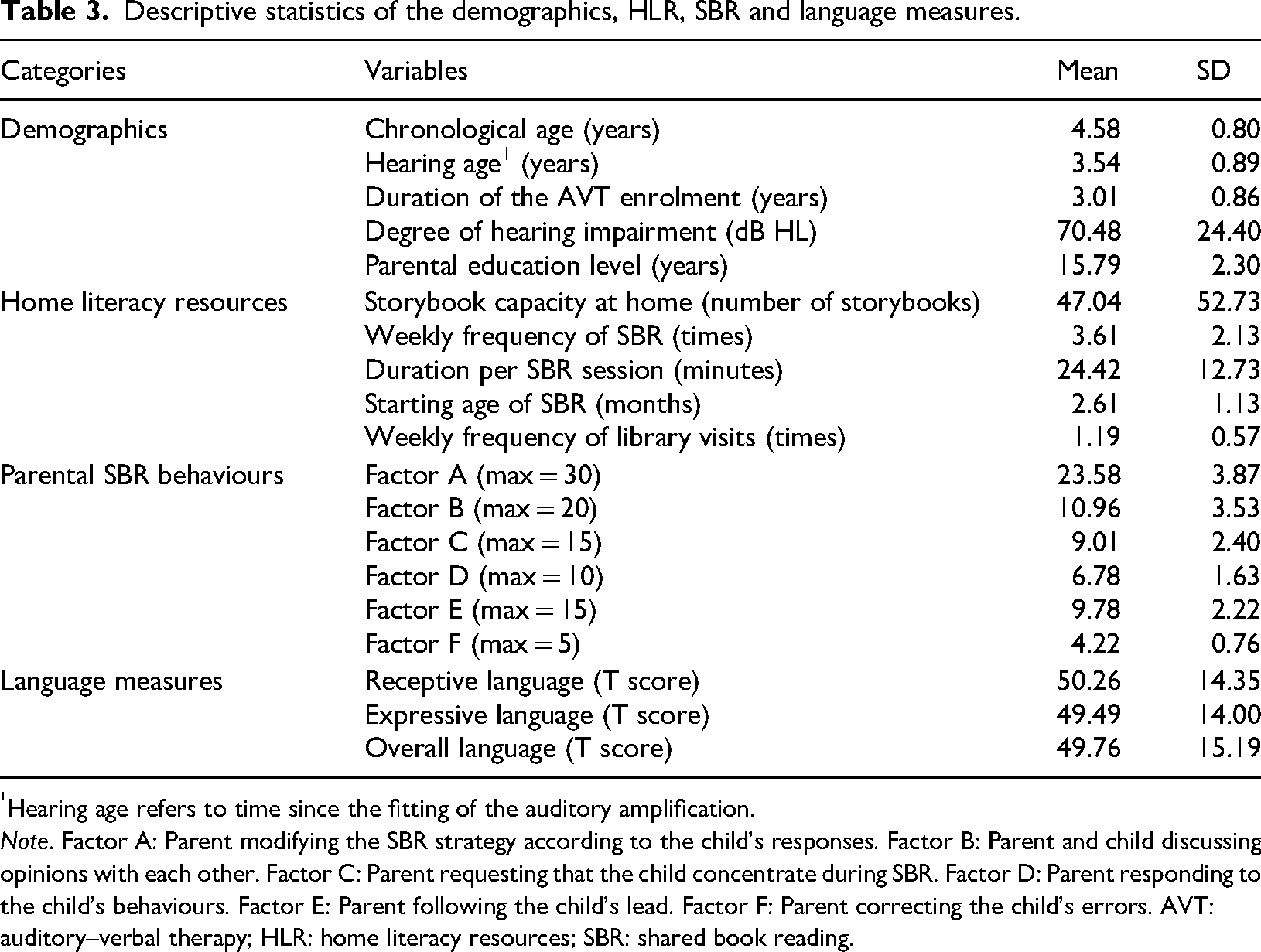
Descriptive statistics of the demographics, HLR, SBR and language measures.
Hearing age refers to time since the fitting of the auditory amplification.
Note. Factor A: Parent modifying the SBR strategy according to the child's responses. Factor B: Parent and child discussing opinions with each other. Factor C: Parent requesting that the child concentrate during SBR. Factor D: Parent responding to the child's behaviours. Factor E: Parent following the child's lead. Factor F: Parent correcting the child's errors. AVT: auditory–verbal therapy; HLR: home literacy resources; SBR: shared book reading.
To examine the intercorrelations among all of the variables, a correlation analysis was performed. The results are presented in Table 4. As indicated in Table 4, two of the demographic variables (namely, chronological age and degree of hearing impairment) were significantly related to the language measures (r = −.33 to .23, all p < .05); thus, they were controlled for in subsequent regression analyses. Although parental education level was not significantly correlated with any of the language measures (r = .14 to .20, all p > .05), it was also treated as a control variable in later regression analyses because previous studies (e.g. Cadime et al., 2018; Marjanovič-Umek et al., 2017; Umek et al., 2008) have revealed that parental education level plays an important role in children's language development. Except for weekly frequency of library visits, the other four HLR variables (i.e. storybook capacity at home, weekly frequency of SBR, duration per SBR session and starting age of SBR) were correlated with the language measures at marginal to significant levels (marginal level: r weekly frequency of SBR–receptive language = .21, p = .05; significant level: r storybook capacity at home–receptive language = .27, r storybook capacity at home–expressive language = .24, r storybook capacity at home–overall language = .25, r weekly frequency of SBR–expressive language = .25, rweekly frequency of SBR–overall language = .22, r duration per SBR session–receptive language = .23, r duration per SBR session–expressive language = .29, r duration per SBR session–overall language = .26, r starting age of SBR–receptive language = −.40, r starting age of SBR–expressive language = −.35, r starting age of SBR–overall language = −.37, all p < .05). For parental SBR behaviours, only Factor B, parent and child discussing opinions with each other, was positively and significantly related to the three language measures (r Factor B−receptive language = .23, r Factor B−expressive language = .27, r Factor B−overall language = .26, all p < .05), suggesting that the more frequently parents employed opinion-oriented strategies, the better the language performance of their hearing-impaired children was.
Intercorrelations among the demographic, HLR, SBR and language variables
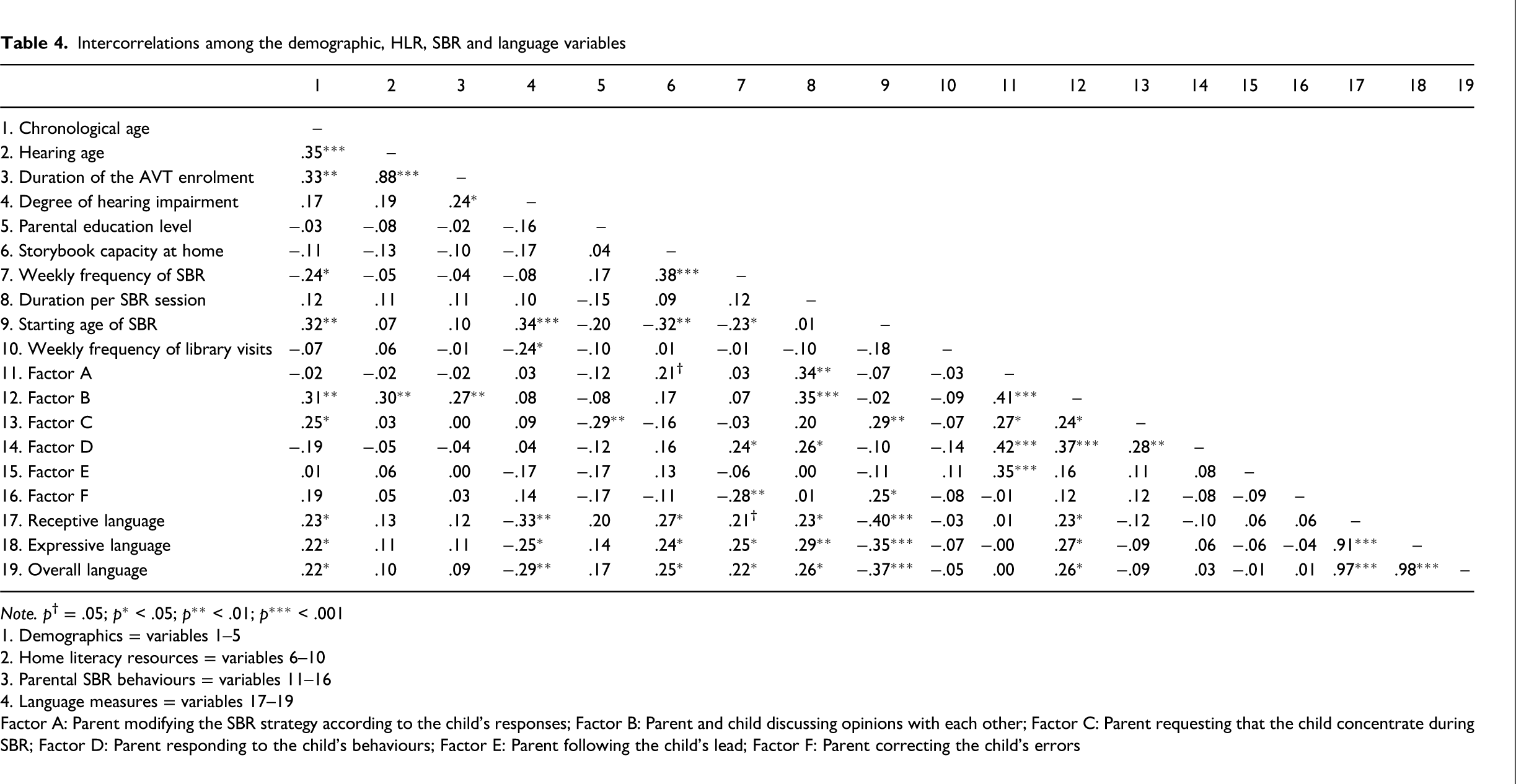
Note. p† = .05; p* < .05; p** < .01; p*** < .001
1. Demographics = variables 1–5
2. Home literacy resources = variables 6–10
3. Parental SBR behaviours = variables 11–16
4. Language measures = variables 17–19
Factor A: Parent modifying the SBR strategy according to the child's responses; Factor B: Parent and child discussing opinions with each other; Factor C: Parent requesting that the child concentrate during SBR; Factor D: Parent responding to the child's behaviours; Factor E: Parent following the child's lead; Factor F: Parent correcting the child's errors
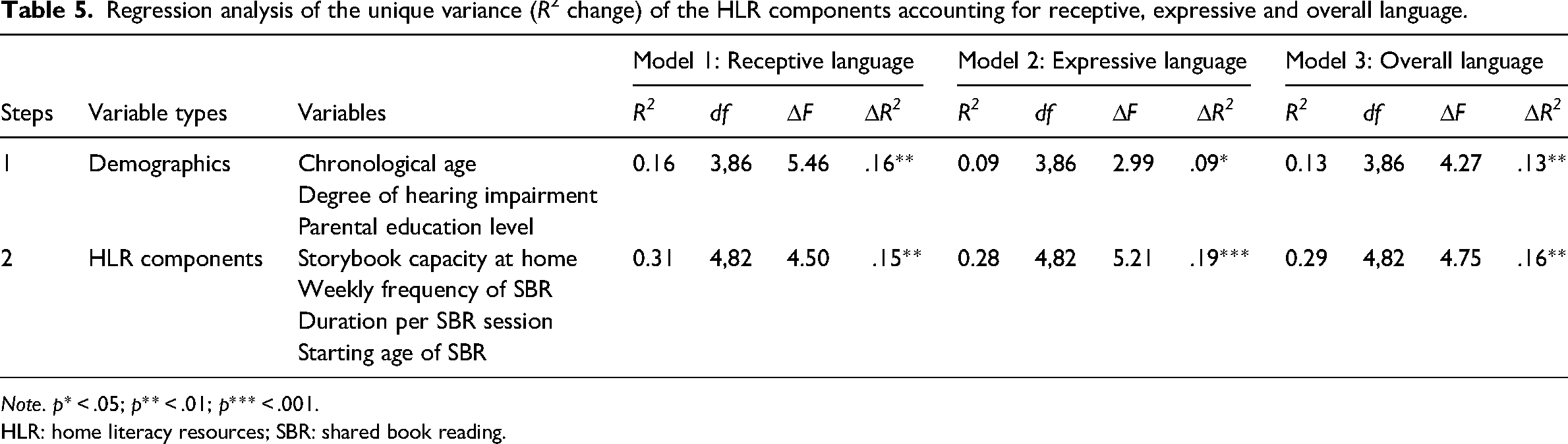
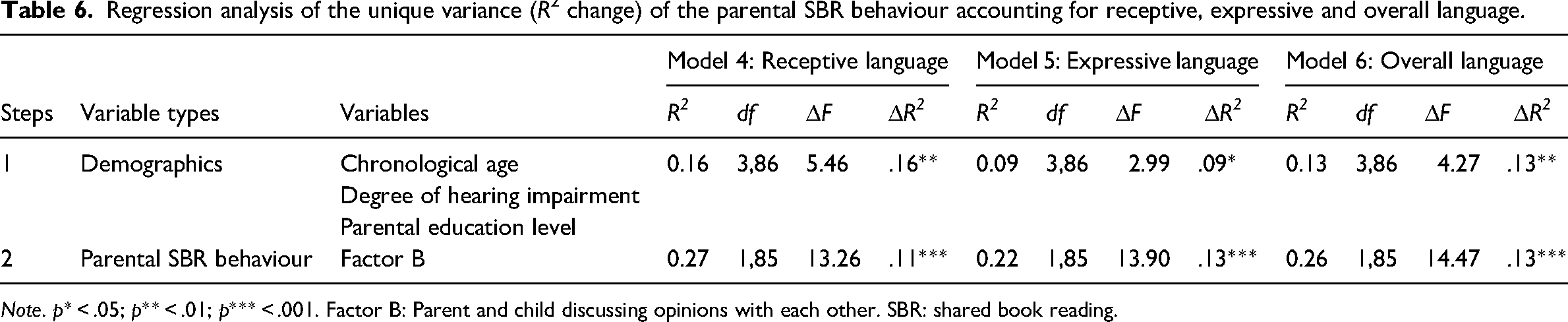
To explore how much the HLR and parental SBR behaviours contributed to each of the three language measures, six hierarchical regression models, with the demographic variables (namely, chronological age, degree of hearing impairment and parental education level) controlled for, were developed using three dependent variables (i.e. receptive, expressive and overall language) times two independent variables correlated to the language assessment shown in Table 4 (i.e. HLR: storybook capacity at home, weekly frequency of SBR, duration per SBR session and starting age of SBR; parental SBR behaviour: parent and child discussing opinions with each other). Specifically, in Model 1, the HLR components were entered at Step 2 after the control/demographic variables (i.e. Step 1) to predict receptive language. In Model 2, the HLR components were entered at Step 2 after the control/demographic variables (i.e. Step 1) to predict expressive language. In Model 3, the HLR components were entered at Step 2 after the control/demographic variables (i.e. Step 1) to predict overall language. In Model 4, the parental SBR behaviour was entered at Step 2 after the control/demographic variables (i.e. Step 1) to predict receptive language. In Model 5, the parental SBR behaviour was entered at Step 2 after the control/demographic variables (i.e. Step 1) to predict expressive language. In Model 6, the parental SBR behaviour was entered at Step 2 after the control/demographic variables (i.e. Step 1) to predict overall language. Details of the six regression models are presented in Tables 5 and 6.
Regression analysis of the unique variance (R2 change) of the HLR components accounting for receptive, expressive and overall language.
Note. p* < .05; p** < .01; p*** < .001.
HLR: home literacy resources; SBR: shared book reading.
Regression analysis of the unique variance (R2 change) of the parental SBR behaviour accounting for receptive, expressive and overall language.
Note. p* < .05; p** < .01; p*** < .001. Factor B: Parent and child discussing opinions with each other. SBR: shared book reading.
As shown in Table 5, all of the demographic variables combined significantly explained each language measure (receptive language: 16%, ΔF(3,86) = 5.46, p < .01; expressive language: 9%, ΔF(3,86) = 2.99, p < .05; overall language: 13%, ΔF(3,86) = 4.27, p < .01). The HLR variables (namely, storybook capacity at home, weekly frequency of SBR, duration per SBR session and starting age of SBR) together significantly accounted for additional 15% (ΔF(4,82) = 4.50, p < .01), 19% (ΔF(4,82) = 5.21, p < .001) and 16% (ΔF(4,82) = 4.75, p < .01) of the variance in receptive, expressive and overall language, respectively, beyond that accounted for by the control/demographic variables. As shown in Table 6, Factor B of the parental SBR behaviours, parent and child discussing opinions with each other, significantly accounted for an additional 11% (ΔF(1,85) = 13.26, p < .001), 13% (ΔF(1,85) = 13.90, p < .001) and 13% (ΔF(1,85) = 14.47, p < .001) of the variance in receptive, expressive and overall language, respectively, beyond that accounted for by the control/demographic variables.
In general, the findings of the present study are in line with the Home Literacy Model (Sénéchal, 2006; Sénéchal and LeFevre, 2002) in revealing that certain HLR components contribute to the language development of Chinese-speaking hearing-impaired children. In addition, the results of this large-sample study add to Fung et al.'s (2005) and Tsai's (2009) small-sample studies in showing that certain specific parental SBR behaviour can be beneficial to the language development of Chinese-speaking hearing-impaired children. Specifically, the present study yielded two major results: (a) the four HLR components, storybook capacity at home, weekly frequency of SBR, duration per SBR session and starting age of SBR, significantly correlated with the three language measures and, when combined, could significantly explain additional variance of the language scores beyond the demographic variables; (b) the parental SBR behaviour, parent and child discussing opinions with each other, was the only factor that exhibited a significant correlation with the three language measures and could significantly explain additional variance of the language scores beyond the demographic variables. The potential roles of the aforementioned HLR and SBR variables in the language development of hearing-impaired children are discussed below.
Home literacy resources
According to the Home Literacy Model (Sénéchal and LeFevre, 2002), HLR constitutes a key factor in children's language development, and storybook capacity serves as a crucial index of HLR (Puglisi et al., 2017). In agreement with this model, this study showed that storybook capacity at home had a significant relationship with the three language measures, suggesting that the number of child books at home does matter in the language development of hearing-impaired children. Research has reported that how many books there are in the home reflects to what degree parents value home literacy education (van Bergen et al., 2017), and early literacy education at home can improve children's language skills at a later age (Dickinson et al., 2012). In addition, a critical factor found to be capable of enhancing children's language acquisition is a variety of linguistic input (Friedmann and Rusou, 2015). From the aforementioned perspectives, it is likely that hearing-impaired children born in a family that values home literacy education may have greater opportunities to be immersed in an enriched linguistic environment, which subsequently nourishes children's language skills.
However, merely exposing children under the age of 6 (i.e. the target children of the present study) to storybooks alone without the adult's assistance may have little effect on their language development as they have little print knowledge. In contrast, parents’ companionship with and scaffolding for children in storybook reading can advance children's language growth (Kaderavek and Sulzby, 1998). Consistent with this proposal, the present study showed that weekly frequency of SBR and duration per SBR session, two indices for parents’ devotion to accompanying their children in reading, were significantly related to their language scores.
Unlike weekly frequency of SBR, which offers an approximate estimate of SBR frequency, duration per SBR session provides more detailed temporal information on the extent to which parents engage with their children in a single SBR session. That is, parents who take part in the SBR activity more often do not necessarily spend more time engaging with their children in each SBR session, as demonstrated by the insignificant relationship between weekly frequency of SBR and duration per SBR session (r = .12, p > .05). For example, a parent who participates in SBR for 10 min 5 times per week (total = 50 min) does not spend more time on SBR in total than a parent who participates in SBR for 30 min twice per week (total = 60 min). The dissociative correlation between the two variables in question indicates that they are conceptually different. Nonetheless, they both emerged as important contributors to children's language outcomes; therefore, neither should be neglected in relation to the language development of hearing-impaired children.
Another time-related factor that also shaped the language development of hearing-impaired children is starting age of SBR. It was found that the earlier parents began SBR, the greater the chance for their hearing-impaired children to acquire better language ability. This result is consistent with previous research findings that early intervention is vital to the language development of hearing-impaired children (Yoshinaga-Itano et al., 2018). Due to the deprivation of the auditory facility, the hearing experience of hearing-impaired children becomes relatively sparser than that of their hearing peers. Thus, hearing-impaired children typically acquire language at a slower rate and a later age. An early SBR intervention not only affords parents extra opportunities to input language to their hearing-impaired children, but it also provides children with vocabulary and syntax that seldom appear in daily conversations via storybooks. This may explain why early implementation of SBR is of great importance in facilitating language acquisition in hearing-impaired children.
Parental SBR behaviours
Regarding parental SBR behaviours, only Factor B, parent and child discussing opinions with each other, could explain a significant portion of the variance of the language measure, including receptive, expressive and overall language, beyond the demographic variables. Relatively speaking, Factor B was more characteristic of ‘information exchange’ than were the other five factors. Moseley (1990) observed that information exchange rarely occurs in a natural conversation between children with language delay and their parents due to these children's limited language ability, resulting in a parallel monologue rather than an interactive dialogue between them. The corollary, similar to the Matthew Effect, is that poorer child–parent interaction leads to poorer language development in children. As shown previously, hearing-impaired children are usually delayed in terms of language development. In this study, it appears that the ‘information exchange’ of Factor B, parent and child discussing opinions with each other, could help parents overcome the Matthew Effect and promote the language development of hearing-impaired children. One possible reason for this is that meaning-sharing in information exchange helps maintain children's joint attention (Moseley, 1990), which further expedites their language development. The other five factors, though commonly used in SBR, were more strategy-oriented, with little talk regarding meaning. When the parent–child talk involves few semantic components, children's language development may be hindered.
In addition, echoing what has been noted by Rochanavibhata and Marian (2021), this study revealed that information-exchange behaviour, similar to the story-builder style, engaged parents and their children in co-constructing the story meaning, while the five strategy-oriented SBR behaviours were more similar to a story-teller style because they seldom involve interactive exercises. The story-builder style has been found to elicit more narrative production from children than does the story-teller style (Rochanavibhata and Marian, 2021). This may further account for why the parental SBR behaviour, which allows information building and exchange (i.e., the variable parent and child expressing opinions with each other in the present study), helps hearing-impaired children develop their language skills.
In summary, the present study not only replicates previous work by Fung et al. (2005) and Tsai (2009) in showing that parental SBR behaviour that involves parent–child interaction (i.e. information exchange), similar to the dialogic reading intervention, can contribute to Chinese-speaking hearing-impaired children's language development, but it also adds that only certain specific components of HLR, such as storybook capacity and the frequency, duration and onset of SBR, could make such a contribution.
Limitations and future directions
Several limitations remain to be addressed in future studies. First, this study employed a questionnaire to collect information on parental SBR behaviours. While questionnaires can be used to collect a large amount of data within a limited amount of time, they may be considered more reflective of subjective than objective views. One better, though time-consuming, solution is to conduct a language-sampling study where SBR sessions are video recorded and transcribed for later analysis.
Second, the present study did not collect information on the participants’ household incomes as an SES index; however, numerous previous studies (e.g. Grieshaber et al., 2012; Hutton et al., 2020; Mistry et al., 2004; Zuilkowski et al., 2019) have demonstrated the association between household incomes (as a measure of SES) and children's language and literacy development. Future studies on a similar topic that include household incomes are thus warranted.
Third, the age range of the participants in this study is considered to be relatively wide. As hearing-impaired children grow older (e.g. from the pre-school to school level) and receive longer speech-language intervention, their parents might alter home literacy practices, which may subsequently affect how they respond to SBR due to their different levels of language skills. For example, an older and more voluble hearing-impaired child may require less scaffolding during SBR than a younger one who only has a few spoken words. Thus, future work should examine the effect of age-related and intervention-length factors on SBR given to hearing-impaired children.
Fourth, whether HLR and parental SBR behaviours contribute equally to the vocabulary and syntax development of hearing-impaired children could not be determined in the present study because the RPLA treats vocabulary and syntax as an integrated index of language development. Distinguishing the potentially different associations of HLR and SBR with the vocabulary and syntax development of hearing-impaired children may be useful for diagnostic and interventional purposes.
Finally, the nature of the present study remains correlational but not causal. Future studies may recruit both the experimental and control groups to obtain a more comprehensive understanding of the cause–effect relation between HLR/SBR and the language development of hearing-impaired children.
Conclusions
Despite these limitations, the present study highlights the importance of certain components of HLR and parental SBR behaviour in the language development of Chinese-speaking hearing-impaired children such that storybook capacity at home, weekly frequency of SBR, duration per SBR session, starting age of SBR and parent and child discussing opinions with each other significantly contribute to hearing-impaired children's acquisition of receptive, expressive and overall language. Therefore, we recommend that clinicians (e.g. speech-language pathologists and education professionals) share this evidence-based information related to home literacy with parents who have hearing-impaired children in a very clear and explicit way to help them establish a home environment favouring the language development of these children. In addition, we also recommend incorporating information-exchange exercises into SBR to help hearing-impaired children acquire language to their fullest potential.
Footnotes
Acknowledgements
The author thanks the parents who gave their informed consent, and the children who participated in the study.
Declaration of conflicting interests
The author declared no potential conflicts of interest with respect to the research, authorship, and/or publication of this article.
Funding
The author disclosed receipt of the following financial support for the research, authorship, and/or publication of this article: This work was supported by the Children’s Hearing Foundation (grant number CHF-2017-019-E-006-a).
