




Abstract
During the War of the Spanish Succession, the duke of Lorraine trod a difficult path in his attempts to maintain the independence of his state. While Louis XIV agreed in principle to respect his neutrality, the French nevertheless imposed significant restrictions on the duke’s sovereignty. The Grand Alliance, meanwhile, viewed Leopold’s neutrality with suspicion and refused to assist him unless he publicly declared for the coalition. The dissonance in views regarding the status of Lorraine reflected a long-term clash of sovereignties in the region, between France, Lorraine and the Holy Roman Empire. It also reflected the evolving status of neutrality in international relations, as well as attendant tensions within the European dynastic system: though the duke’s policy of neutrality may have saved Lorraine from potential devastation in the war, it severely impeded his dynasty’s ambitions.
I
On 25 November 1699, shortly after 3 o’clock in the afternoon, Louis XIV sat awaiting the arrival of his new nephew by marriage, Leopold I, Duke of Lorraine. The king and his assembled courtiers were about to be treated to a spectacle of feudal ceremonial revived specially for the occasion. Arriving at the door to the king’s salon, Leopold’s small entourage found their entry barred. On knocking, the party was asked for their identity, ‘It is my lord the duke of Lorraine’, replied one of the duke’s suite. But the door remained closed. The process was repeated, to no avail. The third time, the response was, ‘It is my lord the duke of Bar’, and the duke was finally admitted. After entering, Leopold was directed to get on his knees before the king, to whom he then swore homage and allegiance. 1 Louis is said to have then reassured the duke that he intended to be ‘a good friend and a good neighbour’. 2
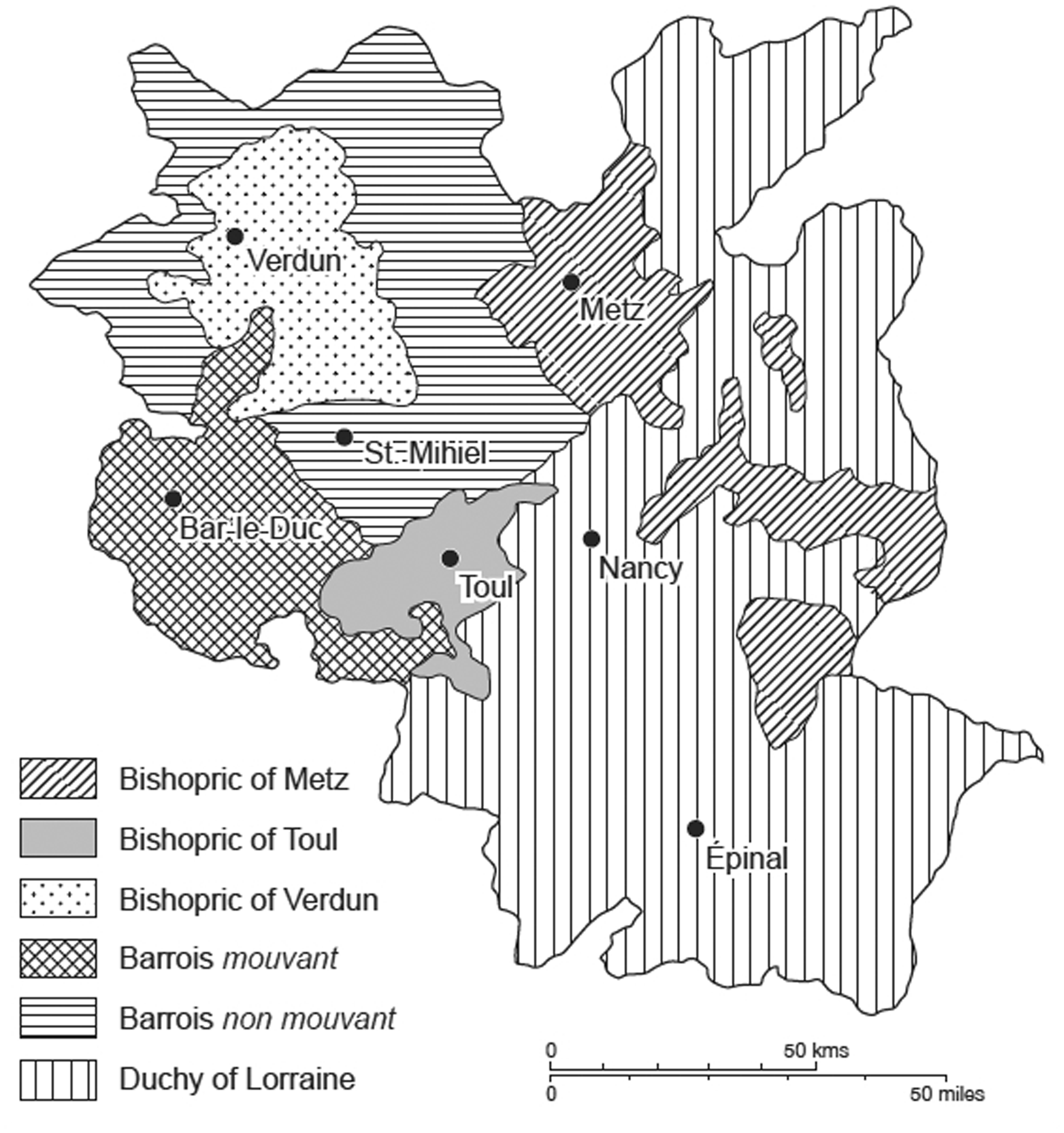
These proceedings captured clearly the position of the newly restored duke of Lorraine. Though an independent and sovereign ruler in his own right, 3 Lorraine’s geopolitical situation imposed significant constraints on the duke’s freedom of action. Among these was the king of France’s suzerainty over part of the duchy of Bar (the duchy constituted roughly a third of Leopold's state – see map), and Louis’ insistence on receiving homage for Bar represented a tangible demonstration of his ability to limit the duke’s authority.
It was a long-held maxim of the French monarchy that Lorraine must be kept weak. Sitting at a strategically vital point on the frontier with the Holy Roman Empire, Lorraine could potentially have provided the Imperials with an easy point of access into the kingdom. French kings from the mid-sixteenth century onwards therefore sought to extend their influence in the region, and the acquisition of the Trois Évêchés (the towns of Metz, Toul and Verdun and their hinterlands) represented a major step forward in this respect. French military power could now be extended throughout Lorraine whenever needs required it, and the duchy was the victim of repeated military intervention in the course of the seventeenth century as the French sought during major conflicts to ‘close’ the frontier. Conquered by Louis XIII in 1633, it was retained by France until 1661, and then reoccupied by Louis XIV from 1670.
4
Like his predecessors, Louis XIV was motivated not by a desire for territorial aggrandizement for its own sake, but by an impulse to secure the kingdom’s borders through the acquisition of buffer zones and more ‘strategic’ frontiers.
5
International pressure forced a French withdrawal in 1697, allowing Leopold, then only 18 years old, to return the following year. In the period following the duke’s restoration, efforts were made to encourage economic reconstruction and the repopulation of the duchies, which had suffered terribly as a result of the French occupations. 6 But the outbreak of the War of the Spanish Succession boded ill for Leopold’s plans for peaceful reconstruction. Throughout the conflict, the duke would find that his fate, as well as that of his dynasty, and that of his state, were directed more than anything else by the will of his powerful uncle and neighbour.
Traditional accounts of the period portray Leopold as a well-meaning appeaser. Voltaire elegized that Leopold was everything that Louis XIV should have been, and hoped that posterity would learn that ‘one of the least grand sovereigns of Europe was also the one who did the best for his people’. 7 Much nineteenth-century scholarship on the topic, such as Haussonville’s Histoire de la réunion de Lorraine à la France, was informed by a mixture of a nostalgic Lorrain patriotism and an étatist belief in inevitability of Lorraine’s incorporation into France. 8 The most detailed treatment can be found in Henri Baumont’s extremely thorough Études sur la règne de Léopold Ier of 1894, but this was based largely on French archival evidence, and so was skewed to the French perspective. To date, no historians of this particular period have made full use of the 3F series of the Archives départementales de Meurthe et Moselle, which comprises the personal correspondence of the duke, retroceded to France from the Austrian Haus-, Hof- und Staatsarchiv in the 1950s. 9 This series casts considerable new light on the duke’s position, and facilitates a reinterpretation of events based on pressures from the Lorrain population, as well as ducal and court politics. 10
That the reign of Leopold was largely ignored by twentieth-century scholars resulted in part from a tendency to read history backwards from the annexation of 1766. But the belief in the inevitability of Lorraine’s loss of statehood was not limited to historical hindsight: even contemporaries such as Saint-Simon saw the reoccupation of Lorraine as a commonplace in times of war, when ‘one does not see any difference between it and a province of the kingdom’. 11 Yet by glossing over this period, historians have considerably underestimated the importance of Lorraine’s continued independence, not least for what this meant for French frontier policy, 12 as well as wider developments in international relations. The long-term French policy of territorial acquisition in the region meant that by the turn of the eighteenth century, Lorraine was surrounded by French territory on three sides, and pierced with French enclaves, depriving it of territorial unity. In modern geo-strategic parlance, Lorraine had become something between a ‘buffer state’, lying between two stronger rival blocs, and a ‘rim state’, lying along the border of, and coming within the defence perimeter of a great power. 13 This hybridity, and the consequent dissonance in views and expectations of Lorraine’s status, were to significantly colour the way the duke and the belligerents engaged with each other between 1702 and 1714.
A further element of the relationship which has never been explored is the neutrality of Lorraine during the War of the Spanish Succession. Neutrality, like military occupation, was a by-product of war whose juridical status gradually became more distinct through the seventeenth and eighteenth centuries. Since ancient times, belligerents had been reluctant to recognize the impartiality of third parties, and usually forced neutrals to take sides in supporting roles. 14 This changed during the Middle Ages, as the legitimacy of neutrals gained wider recognition, so that by the seventeenth century, neutrality was increasingly viewed as a valid juridical stance in international relations. 15 Grotius understood neutrality as the possibility to absent oneself from choosing the side of either belligerent, and he was one of the first to base this in law. He also stressed that it was the duty of the neutral state to support the just belligerent, though he left it to the neutral state to determine who this was. 16
There was, therefore, no binding code to be observed, and early modern manifestations of neutrality still took a broad variety of forms: it could give a major power the right to peaceable passage through another state; or it might involve permission to buy provisions, occupy fortresses, or carry out recruitment in their territory. 17 As such, it became increasingly common for neutral states to introduce bilateral treaties with both belligerent parties stipulating the precise rules by which neutrality was to be observed. 18 In Lorraine during the War of the Spanish Succession, however, the French, the Lorrains and the Grand Alliance never managed to agree on any such terms. In consequence each party observed its own interpretation of neutrality. An investigation of these interpretations should cast new light on how Lorraine’s neutrality was viewed in this period by the different participants in the conflict, as well as how far Louis XIV was willing to observe such developing notions in the international laws of war.
In a broader sense, understanding the attitudes of the rulers and populations of small states has been shown to be key to making sense of how international relations worked in the early modern period, 19 and so a re-analysis of Lorraine’s role in the War of the Spanish Succession is long overdue. Leopold was driven by a clear set of dynastic ambitions, in particular territorial aggrandizement, and also by gaining the traitement royal in the diplomatic sphere. Around 1700, he seemed reasonably well poised to achieve these. Through his mother, Leopold was the closest relative and therefore presumptive heir of Ferdinando-Carlo Gonzaga, Duke of Mantua and Monferrato and Prince of Arches-Charleville (which was close to the north-western border of Lorraine). Furthermore, in the months before the death of Carlos II of Spain in November 1700, there was a serious possibility of Leopold exchanging Lorraine for the duchy of Milan as part of the division of the Spanish inheritance. 20 Though Carlos’ final will scuppered such a plan, it remained a recurring theme in peace negotiations for the next decade or so. And Leopold may well have viewed the acquisition of both the Gonzaga patrimony and Milan as a springboard to the eventual creation of an Italian kingdom.
At this early stage then, the young and inexperienced duke probably believed that a close relationship with Louis XIV, whose support he needed to achieve any of these goals, was very much in his interests. But as he was to discover, Louis was pathologically insensitive to the concerns and aspirations of other rulers, particularly those on the frontiers of the kingdom, whom he believed should show obedience and humility towards him. 21 Indeed, Louis fully intended to make Lorraine into a dependent satellite of France. On the terms by which the duchy was returned to Leopold in 1697, Louis had successfully removed the territory’s ability to pose a military threat, and made it virtually impossible for the duke to fight a war on an opposing side to France. The marriage of Louis’s niece Elisabeth-Charlotte d’Orléans to Leopold in 1698 was intended to reinforce the arrangement, while the swearing of homage for the Barrois 1699 was a public demonstration of the duke’s subservience – Louis had a medal struck to commemorate the ceremony. 22 As time would tell, both men had deeply unrealistic expectations of each other, and were both to be disappointed.
II
Raised at the court of Vienna, Duke Leopold was very much influenced by his uncle and namesake, Emperor Leopold I. The emperor spent much time preparing his nephew for governing Lorraine, and the duke’s choice of aides reflects his closeness to Vienna. The duke’s former governor, Francis Taaffe, Lord Carlingford (an Irish peer who had distinguished himself in Imperial service), headed the Conseil d’État; he was assisted by François Le Bègue, who had been responsible for the duke’s religious instruction, and Claude-François Canon, the Lorrain envoy at Nijmegen and Ryswick. 23 Yet history taught the young duke of Lorraine that his state’s survival necessitated maintaining a policy of equilibrium between the king of France and the emperor. If he sided with the Imperials he would, like his predecessors, be swiftly forced into exile by the French army; on the other hand if he betrayed his upbringing and sided with the French, his states would likely face devastation at the hands of the allies. He had therefore made it clear that in the event of war arising from the Spanish succession, he would remain neutral; and in the partition treaty of 1700, Louis XIV had agreed to this. 24 After the formation of the Grand Alliance in September 1701, Emperor Leopold also agreed to recognize Lorraine’s neutrality in the conflict, but the specifics of the arrangement were left unclear. The French government meanwhile invoked the clauses of the Treaty of Ryswick concerning Lorraine: these allowed its troops to travel through Lorraine and to resupply on route. 25
At the outbreak of war, Leopold was still very much an unknown quantity to Louis XIV and his ministers. As such, the French intendant of the Trois Evêchés, Saint-Contest, was instructed to keep a close eye on the duke’s behaviour; he found nothing concrete to incriminate the duke, but did note that he seemed to be stockpiling grain.
26
By the spring of 1702 Imperial troops appeared on the Rhine, and the situation became more pressing for the French: a letter written by an anonymous resident of Toul to the French foreign minister Torcy seems to encapsulate the anxieties of the French; the letter warned of ‘the dreadful consequences’ with which the Lorrains threatened the people of the Trois Évêchés: It is well known that this nation is very badly intentioned towards France, and awaits an occasion to manifest its hostility by favouring the designs of the House of Austria. While we might believe that the duke of Lorraine conducts himself by other motives, and that the experience of his predecessors should restrain him, his conduct, however deferential to the king it might appear, still gives us just cause to doubt his sincerity.
27
At this stage, various elements within the French government, in particular Marshal Villars and Chamlay, the king’s strategic advisor, began counselling Louis XIV to reoccupy Lorraine out of strategic and logistical necessity. 28 But the king was opposed to the reoccupation of Lorraine. The French had encountered serious resistance from the Lorrain population, including the elites, throughout the previous occupation, and reports from the region in 1701–02 suggested that anti-French feeling was stronger than ever. 29 In light of this, Louis probably wished to spare himself a potentially fraught occupation and the drawn-out and expensive administrative reorganization it would require. Instead, he hoped that by maintaining Lorraine’s independence, the duke could be quietly coerced into channelling Lorraine’s resources into the French war effort.
Lorraine’s neutral status, meanwhile, was still hanging in diplomatic limbo. During the summer of 1702 Leopold sent an envoy to Metz to negotiate precise terms with the French intendant, Saint-Contest. But these were immediately contentious. The French wanted what they called ‘complete’ neutrality – no raiding parties, French or Imperial, would be allowed to cross Lorraine. The neutralization of Italy in the late summer of 1696 seems to have been the preferred French model, not least because ‘complete’ neutralization of an area freed up troops for elsewhere. But Leopold was not prepared to grant such favourable conditions to France: since he was bound by the Treaty of Ryswick to allow French troops to cross his states, he could not with any honour deny the same privilege to the emperor. Meanwhile the duke, along with the Imperials, favoured allowing the parties to pass on the condition that they commit no hostilities on Lorrain territory against any individual whether Lorrain, Imperial or French. 30 This was also the interpretation favoured by legal theorists at the time: according to Grotius, neutral countries were expected to ‘behave themselves alike to both Parties; as in suffering them to pass through their Country, in supplying them with Provisions, and not relieving the Besieged’. 31 But from the French point of view the political geography of the region made this unworkable: given that the villages of the Trois Évêchés were totally mixed up with those of Lorraine, and in some villages sovereignty was shared, they would inevitably be subject to all sorts of incursions unless they were guaranteed completely against enemy raiding parties; and if French troops were attacked in the Évêchés, they would need to be able to pursue the enemy troops into Lorraine.
As negotiations stalled, French communications with the front line were increasingly endangered. Imperial raiding parties regularly interrupted the transport of supplies, and French couriers crossing Lorraine were taken on several occasions. 32 In May, the governor of the Trois Évêchés, the marquis de Varennes, was taken hostage by an Imperial raiding party near Château-Salins on one of the French military routes through Lorraine. 33 Though Leopold offered a full investigation and even offered to pay the ransom if necessary, the French made it clear to him that this, and the subsequent refusal of the Imperials to release Varennes, made neutrality on his preferred terms unacceptable. 34
Meanwhile, French suspicions regarding the duke’s intentions were signalled by a step-up of diplomatic surveillance. Much to Leopold’s understandable chagrin, the king now sent an envoyé extraordinaire, Jean-Baptiste d’Audiffret, to the court of Lorraine to discreetly monitor and report back on the duke’s communications, particularly with the emperor and the king of the Romans. 35 Audiffret’s reports confirmed Louis’ initial judgement that the duke’s birth and education inclined him to support the emperor, but that prudence would lead him to maintain his neutrality. 36 But while Louis believed the duke’s own intentions were good, he did not trust the emperor, and (correctly) doubted the duke’s ability to stop the raiding parties. The king therefore resolved on a limited military solution. Following Villars’ advice, French garrisons were to be installed at several strategic posts in Lorraine, as quickly as possible so as to deny them to the emperor. 37
At the beginning of August, the French envoy, the marquis de Guiscard, informed Leopold that the king had agreed in 1700 to respect his neutrality on the understanding that it would be observed equally by all sides; since this was not the case, he was now compelled to take other measures that were ‘less commodious and more burdensome’. 38 But Leopold was not about to yield. On hearing Guiscard’s announcement, ‘the duke of Lorraine changed colour, and was seized for a moment by an extraordinary sweat’. 39 He then responded that he was still hopeful of obtaining the emperor’s agreement for a complete neutrality to cover Lorraine, and he ‘could not, with honour and propriety, agree to something totally different and which would break the neutrality and expose his country to complete desolation’. 40 But by now the French regarded the negotiations as closed. The emperor refused to agree to the French terms for the neutrality, and provocatively kept Varennes imprisoned for six months, effectively handing Louis XIV the pretext he needed to intervene.
Shortly before noon on 1 December, the seasoned French diplomat François de Callières arrived at the ducal palace in Nancy with an ultimatum: either Leopold should allow the French army to enter the town, or else prepare for a siege. 41 He was given three hours to make his decision. Leopold wrote to the king requesting a suspension of the order that he might once again try to obtain a treaty of neutrality from the emperor. 42 But Callières was under precise orders to obtain an immediate response. The duke and his advisors knew that Nancy could not withstand a siege – its walls being ‘more like those of a park than a town’, 43 and so, reluctantly, Leopold informed the envoy that he would mount no defence. As he put it to the king, ‘Your Majesty is the arbiter of my fate… and can do with me what he pleases. I have neither the desire nor power to resist’. 44 But he refused to enter into any formal treaty and instead made it clear that he would simply offer no resistance when the French troops arrived.
Along with his heavily pregnant wife, Leopold left the following morning for Lunéville, about twenty miles south-east of Nancy. Louis had wanted him to remain in the capital, but the duke realized that this would signal his approval of the French presence and compromise him in the eyes of the emperor. On the 3 December, French troops entered Nancy, and the following began work on rebuilding the town's fortifications. But for Leopold more bad news was to come: the following week he received another unwelcome visit from Callières, who now informed him that he was to hand over control of his fortresses along the Saar to the French army, in order to better strengthen the frontier and prevent incursions from Imperial raiding parties into French territory. Leopold protested that his own troops were just as qualified to defend the frontier, but the French thought otherwise. 45
As the duke saw it, Lorraine was being dragged inexorably into the conflict he so desperately wished to avoid. He feared that the presence of so many French garrisons in Lorraine would motivate the Imperial troops across the Rhine to try to dislodge them, ‘and by consequence my poor states, which are recovering from all the ills of the past, will become the unhappy theatre of a bloody war’. 46 Immediately after being informed of the seizure of his Saar fortresses, Leopold wrote to the emperor urgently explaining his situation. 47 But in further violation of the duke’s neutrality, the emperor responded to the French moves by seizing the duke’s Imperial fiefs, Bitche and Hombourg. Emperor Leopold then declared that he was ready to offer to observe ‘complete’ neutrality, and would withdraw from Bitche and Hombourg, on condition that the French withdrew from Nancy and the Saar. 48 But Louis dismissed the offer, stating that he did not trust the emperor to keep his word, and made it clear that Lorraine’s neutrality was no longer a subject for discussion. Haussonville refers to a ‘tacit convention’ reached at this stage between the French and the Imperials to respect Lorrain territory and to make neither raids nor requisitions, and that this remained in place throughout the war. 49 In fact, no such agreement was reached, and as no formal neutrality treaty was put in place, all sides continued to observe their own, sharply contrasting, visions of neutrality for the duration of the conflict.
III
Other than the French army’s logistical needs and the strategic threat from the allies, the decision to reoccupy Nancy was also taken partly because of French fears of Lorrain hostility, emanating from both the court and the population at large. As Marshal Villars had put it to Chamillart in July 1702, ‘the hostility of the Lorrains in general, and the little court of Lorraine, is at a high point’. 50 French observers at court in Nancy also noted the sympathy shown by the courtiers for everything that happened to the emperor. 51 Lorrain ministerial memoranda of the time exuded anti-French revanchism: shortly after the French army arrived in Nancy one of these referred to the peace of Ryswick having ‘re-established His Royal Highness in the mutilated states which his ancestors possessed fully for many centuries’ and that the duke had been forced to ‘sacrifice a large portion of the country to give the remaining territory the peace and tranquillity which they had been deprived of for nearly 70 years’. 52 Hostility to the French certainly ran deep in Lorrain society, and the court was no exception. But Leopold’s closest advisors, in particular Lord Carlingford and the duke’s Jesuit confessor Père Creitzen, counselled him to uphold his neutrality. 53 And above all, Leopold was determined to avoid going back into exile, which would inevitably have resulted from his entry to the war on the Imperial side: his dynasty’s hard-won, and only recently regained, sovereignty was too precious to him. 54
Under the influence of Creitzen, Leopold also believed that he may have been able to act as mediator in the conflict, in the process advancing his own dynastic ambitions for which he needed the approval of both the king and the emperor. 55 In the early years of the war, however, Louis XIV was confident of success and ignored any such gestures towards mediation. Leopold therefore concentrated on maintaining a strict balance in his treatment of the belligerents as far as they concerned his own states. He frequently pressed Louis to withdraw from Lorraine, something the king always (disingenuously) expressed his desire to do, as soon as the situation allowed it. 56 In reality, Louis was convinced that left to his own devices the duke’s weakness would permit an allied takeover of Lorraine, and the vast reservoir of men and supplies it contained. 57
Despite his relative firmness with Louis XIV, Leopold’s position was the subject of growing criticism from the allies, who became increasingly vocal about the apparent unfairness of the arrangements in Lorraine. This became particularly acute as Marlborough and the allies planned a major offensive along the Moselle in 1705, with the aim of carrying the war into Alsace and Lorraine. 58 The Dutch accused Leopold of supplying the French with whatever they asked for, and in February 1705 threatened to revoke Lorraine’s neutrality unless the French withdrew. The duke could only defend himself by pointing out that he never consented to the French occupation and so it had no bearing on his state’s neutrality. 59 To fend off the Dutch, he also stated that if the allies contravened his neutrality by committing hostilities in Lorraine, he would enter the war on the French side. 60 But he had no real desire to do so: at the same time he repeated his request that the French withdraw from Nancy. 61 Louis, meanwhile, merely saw the Dutch complaints as a ruse to prepare for the allied incursion into Lorraine, and replied that it was absolutely out of the question that he should withdraw his troops. He pointed out that the Imperials were occupying several posts in the Venetian state, in spite of Venice’s neutrality in the war, and the allies therefore had no right to complain about the posts that he was ‘obliged’ to occupy in Lorraine. With more than a little hypocrisy, Louis also advised the duke to be prudent and abide by ‘the laws of war’. 62
Louis XIV’s approach to Lorraine during the War of the Spanish Succession reveals some subtle changes to French diplomacy towards small frontier states after Louvois’ leadership of the war ministry in the 1670s and 80s. 63 Relations between Duke Leopold and the French war minister Michel Chamillart were cordial throughout the latter’s tenure of office (1700--1709); Chamillart’s son even stayed at Lunéville as a guest of the duke for several days in 1707. 64 And the French demonstrated that they had little interest in interfering in the internal politics of Lorraine or the duke’s court: during the course of the year 1704, both Creitzen and Carlingford died, yet Louis XIV told his envoy at Lunéville not to get involved in any intrigues about their successors. 65 Beneath this apparently softer approach, however, the aims and substance of French frontier policy had actually changed very little: in all matters connected with the military and relations with France’s enemies, the French did their utmost to restrict Leopold’s freedom. In particular they frowned upon (though were unable to stop) his practice of sending envoys to the allied powers to ensure their observation of Lorraine’s neutrality. 66 In effect then, the French government was prepared to observe the duke’s independence in domestic matters, while at the same time it attempted to seriously curtail his sovereign functions in the duchy’s external relations.
This policy was not without its attendant problems. Garrisoning Nancy and the Saar fortresses may have strengthened the French frontier and provided logistical support to the army, but as most of the duchy remained outside of French control, security remained a major problem for them for the duration of the war. Imperial raiding parties could slip unnoticed across the frontier into Lorraine and use it as a base to pillage the Franche-Comté, Champagne or the Trois Évêchés. And as the duke explained on many occasions, he could not allow the passage of French troops and not those of the allies, as Lorraine would function as a ‘rampart’ of France, while giving no advantage to the Empire and the allies. 67 As a result, the French could neither receive warning of raiding parties, nor fight them on Lorrain soil. But despite the French government’s frequent complaints about not being able to pursue allied raiders, it seems (according to Lorrain sources) that they frequently did so anyway, under the initiative of squadron commanders. 68 Occasionally, the French war minister ordered out detachments to chase the raiders, though in such cases the king advised the use of ‘all the restraint appropriate when one is obliged to enter the states of a neutral prince’. 69 But in any case, it was only ever a temporary solution as the raiders soon returned. 70
Even more alarming for the French authorities was that Lorrain peasants were serving as guides to the hussars, and providing them with supplies and shelter. 71 This had been one of the chief concerns of the French authorities in the region from the beginning of 1702, and through the course of the war, many Lorrains manifested their hatred of the French by providing assistance to – or even leading – the raiding parties. Marshal Grammont complained in 1705 that Imperial hussars could find shelter in the villages of Lorraine ‘with the same tranquillity as if they were staying with their mothers and fathers’. 72 This made it extremely difficult for the French to chase the raiding parties, as, disguised as peasants, they could hide indefinitely in the woods where local villagers would harbour them. The fragmented political geography of the region made the problem all the more acute. Many villages had mixed French and Lorrain populations; in these places the Lorrains would indicate to the Imperial hussars who was French, and they would then be robbed, while the Lorrains would be left alone. 73
The duke had neither the means nor the inclination to prevent his subjects from doing this. He always maintained that many of the Lorrains who guided the raiding parties were doing so under duress, and there were just as many Frenchmen from the Évêchés who were forced to do likewise. 74 Indeed, contrary to French reports that the hussars only went after French targets, the Lorrains were also victims of raiding, particularly early on in the war. 75 The farmers general of Lorraine reported through the summer of 1702 that raiders had been attacking Lorrain and French guards indiscriminately in the north east of Lorraine, and one of the duke’s own foot soldiers was attacked in Lunéville by a small party of hussars. 76 Though Leopold did eventually bow to French pressure and publish ordonnances against his subjects serving as guides or giving assistance to Imperial raiders, he refused to enforce them except when presented with proof that his subjects had acted voluntarily. 77
The duke’s reluctance to take a firm stand against raiding became a major bone of contention between France and Lorraine throughout the war, and caused the French real difficulties in finding and punishing those Lorrains accused of helping the Imperials. In 1703, for example, Varennes tried to gather evidence against a Lorrain named Masselot, who had been arrested and imprisoned in Metz on suspicion of leading a raiding party. Lacking any reputable witnesses, Varennes tried instead to call forward a Lorrain hermit who had supposedly seen Masselot dressed as a hussar, but was ultimately ordered to desist by the local procureur du roi for lack of evidence. 78
The uncooperative nature of the Lorrains caused various other problems. The French commander in Lorraine complained in 1705 that he did not know how to deal with them, as they refused everything, whether it be food or labour for fortification work. 79 The inhabitants of Nancy complained bitterly about having to accommodate French soldiers and were reported to have spontaneously lit bonfires to celebrate the French defeat at Blenheim in 1704. 80 There were also difficulties in obtaining the hand-over of French deserters who had taken refuge in Lorraine. And the attitude of the population often made the French authorities very nervous when allied armies were in the region. 81
To a large extent, however, the French were dealing with a problem of their own making. Decades of French occupation and almost continual warfare had created a deep and widespread antipathy for the French, reinforced by Imperial hussars engaging in campaigns of intimidation against even passive forms of collaboration. 82 Furthermore, the previous occupations had de-socialized the population of Lorraine by undermining administrative and religious structures, leading to widespread delinquency and lawlessness. 83 The bishop of Toul wrote in 1710 that raiding parties of masked men came to villages in his diocese, burnt the houses and then carried off the stolen furniture and possessions back to Lorrain villages, leaving little room to doubt the complicity of the Lorrain population. He concluded that, ‘This neutrality is infinitely more pernicious here than open warfare’. 84
IV
Despite occasional friction over security issues, relations between Lorraine and the belligerents remained fairly stable up to 1708. But a series of crises, combined with France’s deteriorating position in the war, would alter things significantly. After the French defeat at Blenheim (August 1704) the turn in the tide of the war seemed at first to bode well for Leopold: where Louis had previously spurned the duke’s attempts at acting as mediator, in 1707 and 1708 he requested Leopold act as go-between with the emperor to sound out the possibility of opening preliminary peace negotiations. 85 But these came to nothing, partly because the duke’s relationship with the new emperor, Joseph I, was not as close as it had been with Emperor Leopold. Though Joseph had initially been in favour of recreating a strong Reichsbarriere on the empire’s western frontier, he virtually abandoned Alsace and Lorraine after 1705, in favour of his more pressing dynastic objectives in Italy and Hungary. 86 These cooler relations also reflect Machiavelli’s ‘affinity paradox’, which states that neutrality inevitably works to the detriment of the belligerent traditionally closest in friendship to the neutral party. 87 Indeed, in Vienna some courtiers now accused the duke of having a ‘manifest partiality’ for France, and that the ‘supposed neutrality’ was nothing but a cover to allow France to raise troops there and fill its magazines with Lorraine’s resources. 88
Duke Leopold was also profoundly disappointed in 1708 by Emperor Joseph’s decision to award the confiscated Gonzaga territory of the Monferrato to Victor Amadeus II of Savoy, and keep Mantua for himself. 89 The emperor formally undertook to compensate Leopold, but as with the territorial issues outstanding with France, he would not obtain satisfaction until much later. 90 Adding further insult to injury, the French contested Leopold’s succession to the Gonzaga principality of Arches-Charleville, which had recognized Leopold as its new ruler following Ferdinando-Carlo’s death in July 1708. As usual, Louis XIV refused to entertain the thought of any Lorrain expansion on his own borders; the Parlement of Paris therefore dutifully adjudged the territory instead to the princess of Condé, nullified the oath of allegiance sworn by the principality’s estates to the duke of Lorraine, and unified the territory to the French crown. Leopold was forced to bow to superior French military force and withdraw. 91 This came amid increasing Lorrain frustration that Louis was being deliberately obstructive regarding other territorial claims outstanding from Ryswick, in particular the handover of part of the Trois Évêchés as an equivalent for Longwy. Louis also declined to help in Leopold’s dispute with the pope surrounding the code Léopold (by which the duke had attempted to unilaterally extend his authority in the ecclesiastical sphere), and even used this as a further pretext to refuse to hand over an equivalent for Longwy, claiming to be protecting the three bishops from the controversy. 92
As the French military position worsened, the government became more inclined to limit and undermine the duke’s authority wherever it clashed with their own interests. In early 1709 the French demanded Leopold withdraw the baron de Fournier, who the duke employed as an observer on the Saar frontier, as they claimed to have evidence he had given information on the movement of French troops to the Imperial commander at Landau. The duke refused, saying that as sovereign he had the right to choose his officers; he remarked also that the complaints made against his ministers and officers were often completely unfounded. 93 But the French repeated that Fournier’s removal was imperative, and Leopold bowed to pressure and recalled Fournier in May. 94 Meanwhile the French also started to make use of other means they had at their disposal to bypass the duke’s sovereignty. At the behest of the war ministry, the Parlement of Paris now began to interfere in the duchy of Bar by directly requisitioning grains for the French army. The duke viewed this as an attack on his rights, motivated by a desire of the court of France to annoy him, and as he wrote to his envoy at Versailles, ‘I assure you that they have succeeded’. 95
Leopold grew increasingly frustrated as French infringements on his sovereignty became more blatant, while Louis consistently ignored the duke's requests to deal with his outstanding claims. In these circumstances, it is perhaps unsurprising that Leopold approached the allies to try to further his aims. In the spring of 1709, encouraged by the crises engulfing France, he began an uncharacteristically bold diplomatic manoeuvre, dispatching his brother to Vienna on a secret mission to obtain satisfaction on his territorial claims. As the emperor had previously expressed an intention to create a strong Reichsbarriere on the empire’s frontier with France, Leopold let it be known that he was not averse to the idea of receiving territorial compensation in the form of Alsace, the Trois Évêchés, or even the Franche-Comté. 96 At the same time, Leopold ordered Le Bègue to the peace conference at The Hague to make similar overtures to the British and Dutch. 97 But despite initial assurances from the emperor, differences among the allies meant that the duke’s claims were ignored altogether in their preliminary statement issued on 28 May 1709. 98 Leopold had overplayed his hand. Worse, despite his own care in keeping his diplomatic moves strictly secret, he now realized that the indiscretion of his envoy at The Hague had compromised him and made his intrigues public. 99
The French government was outraged by Leopold’s apparent opportunism. At the peace conference Torcy asked sarcastically whether, since Prince Eugene, Marlborough and Heinsius were pushing the duke of Lorraine’s interests so strongly, Leopold had entered the Grand Alliance without bothering to inform him. 100 Predictably, Louis XIV saw Leopold’s actions as a breach of faith; the very idea of aggrandizement at France’s expense was ‘the most pernicious idea that these little princes can devise’. 101 The king’s reproaches to the Lorrain envoy at Versailles were so severe that plans were drawn up in Lorraine of what to do in case the French tried to seize Lunéville and kidnap the duke. 102 There were also hints at vengeance against the population: Torcy threatened that for every French village burnt by allied raiding parties, a Lorrain village would burn in retribution. Leopold, deeply embarrassed and sensing the danger that both he and his country were in, now tried desperately to repair his relations with the French court by mobilizing the Lorraine cadets at Versailles in a charm offensive. 103
The French archives hold several reports from this period which suggest that Leopold was preparing to join the war on the allied side. But if Leopold did flirt with the idea of providing concrete military support to the allies, the ducal archives themselves give no trace of this. 104 French suspicions regarding his military plans, meanwhile, arose not from any solid evidence, but from him performing relatively normal sovereign functions such as carrying out a census, or having new maps of his territories printed for himself. 105 Corresponding with enemy armies was, as ever, viewed as particularly egregious. 106 Yet far from being a Machiavellian schemer, it seems that Leopold’s diplomatic moves in 1709 were rather the desperate fumbling of a man who had found his ambitions and aspirations thwarted at every turn. Writing to his cousin the prince de Vaudémont later that year, he lamented that he had waited 11 years for an equivalent for Longwy, and despite all the talk of territorial concessions such as Alsace, ‘which may be reasonable’, he only wanted indemnities for the Gonzaga inheritance, and France’s fulfilment of the Treaty of Ryswick. 107
Though he probably had more to gain in the long run from an allied victory in the war, Leopold’s decision to remain neutral meant that he could expect little in the way of diplomatic support from the Grand Alliance. 108 Unlike his counterpart on France’s south-eastern frontier, Victor Amadeus II, who had by now successfully managed to extricate himself from France’s suffocating grip, Leopold was unwilling to gamble his states on his dynasty’s advancement. He was informed more than anything else by the experience of his predecessors if they defied Louis XIV, and eloquently summed up Lorraine’s situation next to France when he wrote to Vaudémont, ‘What would become of a duke of Lorraine if the king, unjustly angry, wanted to use violence against him? A handful of earth in the midst of such a vast kingdom would be crushed in a moment’. 109
In the aftermath of his diplomatic faux-pas of 1709, however, the duke was treated with noticeably less respect by the French, having to deal more directly with the intendant of Metz rather than the ministers at Versailles. The new war minister Daniel Voysin spelled out his feelings when he wrote that the ‘consideration which the king has so far had for this prince only serves to procure more security to our enemies’. 110 Voysin was also far less inclined to grant the duke the graces that had been available from his predecessor Chamillart, who had tried to attenuate the burdens on Lorraine whenever he could. 111 Furthermore, the French generals no longer deferred to Lorraine’s neutrality. Leopold was horrified when, in the autumn of 1709, the commander of the Army of Alsace, Marshal Harcourt, ordered the arrest of all of the duke’s couriers who tried to enter Alsace without a French passport. This was in response to one of Harcourt’s couriers having been captured in Lorraine by Imperial raiders; the marshal also threatened to divert all of the duke’s correspondence to and from Germany via Strasbourg. 112
The situation became ever more rancorous as France’s financial problems had a knock-on effect in Lorraine. The credit crisis meant that payment to Lorrain communities for the passage of troops and winter quarters fell deep into arrears, which in turn meant that those communities could no longer afford to supply the French army. 113 The French government meanwhile attempted to lean on the duke to force his subjects to comply with the army’s demands. But Leopold refused to cooperate, arguing that this would contravene his neutrality and adding that he would prefer ‘all sorts’ of violence than to contribute to the ruin of his own subjects. 114 The duke also warned of the popular resistance and violence that would ensue if the requisitions continued, to which he would only be able to ‘shrug his shoulders’. 115
The French generals meanwhile suggested abandoning the fiction of neutrality altogether: Marshal Bezons wrote to Voysin in August 1710 urging a full occupation of Lorraine, for the support France could take from the duchies as well as to stop the ‘daily abuse’ of the neutrality of Lorraine committed by its inhabitants. 116 He also wrote that many Lorrains passed back and forth across the frontier to communicate with the Imperials, with passports from the duke of Lorraine; this communication had to be stopped, as ‘there is no sort of ill that we do not receive from this frontier of Lorraine’. 117 But again the king refused. The eastern frontier became increasingly volatile in the final years of the war – seen particularly clearly in an attempted uprising in the Franche-Comté in 1710 – and Louis must have considered that upsetting the status quo in Lorraine may well have triggered a revolt. As Marshal Villars put it, ‘the two peoples who are the greatest enemies of France are the Lorrains and the Comtois’. 118
In effect, the French were now using Lorraine as a military entrepôt and supply depot (as they had done for most of the wars of the seventeenth century), with almost complete disregard to the duke’s sovereignty. And the burden on Lorraine, like other frontier provinces, became considerably heavier in the final years of the war. 119 In 1713, the French informed Leopold that they wished to quarter around 38,000 soldiers in his states, prompting him to enquire whether they were quartering any troops at all in the surrounding French provinces. 120 Throughout that year, the duke had to stand by as French dragoons force-marched thousands of his subjects to transport supplies to the front line; even worse, this was at harvest time, threatening the population with famine. 121 This horrendous work was deeply resented by both the people and the duke, who wrote that he would ‘prefer to pay the devil to do it’. 122 Though it was, in theory, paid for by the French, payment was rarely forthcoming; indeed, by the end of the war, the cash-strapped French government owed nearly two million livres for troop consumption, forage and goods transportation. 123 Towards the end of 1713, responding to one of Leopold’s frequent complaints, Louis XIV curtly informed the Lorrain envoy at Versailles that ‘Lorraine has been treated more favourably than any province of my kingdom’, 124 suggesting that the duke should have considered himself grateful that the burden was not greater.
Leopold’s chances of achieving his aims through conference diplomacy, meanwhile, showed little sign of improvement. By the time a congress opened at Utrecht in 1712, he had given up hope of territorial aggrandizement or being transferred to an Italian territory: despite occasional talk at the negotiations of an exchange of Lorraine for the Milanais, 125 Leopold had already confided to the prince de Vaudémont in late 1709 that ‘between you and me, this will never happen’. 126 Yet he was still determined to get what he felt was owed to him. 127 Furthermore, he was hopeful for some form of compensation for the decade of French military presence in his states: one of his first moves at Utrecht was to try to obtain a discharge of the feudal homage for the Barrois – the memory of the humiliating homage ceremony of 1699, it seems, was still clear in his mind. 128
The memorandum drawn up for Leopold’s plenipotentiaries at Utrecht in 1713 offers a frank and revealing insight into the level of resentment felt against France at this time. The source of the current war, it said, was the same as every other war for the past century: the unlimited ambition of France. Louis XIV’s long reign had shown that it was not possible to appease the French through advantageous treaties, because it observed none, ‘and the more one gives, the more it wants’. France may have been exhausted and humbled at the moment, but it was only a matter of time before it became a threat once again; the envoys were therefore to call for a permanent league of allies to guarantee the peace, as well as the reduction of France to its ‘natural frontiers’ [‘ses Bornes naturelles’], turning the clock back to 1624, ‘the time when France began to usurp and extend itself everywhere’. 129
Predictably, Leopold’s envoys reported that they were treated with open hostility by the French, 130 and despite the significant expenses incurred by his plenipotentiaries, he soon realized that the allies were deserting him, one by one. He railed against ‘the liars and ingrates who deceived him until the last moment’. 131 Yet he continued to hope for allied successes, and after receiving news of the French victory at Denain in July 1712 is reported to have remained in a foul mood for days. 132 Notwithstanding this, Leopold still acted as something of a break on the more francophobic members of his administration, whose hostility the French envoy frequently remarked on. 133 The duke never forgot that he needed to remain on amenable terms with the king. Hence, in a final gesture of rapprochement, Leopold agreed to accommodate the ‘Old Pretender’ James Stuart, who Louis XIV was obliged to evict from Saint-Germain as part of his treaty with England.
Despite such gestures, Leopold’s position at the end of the war was much the same as it was at the beginning, as he sought unsuccessfully to play the role of mediator between Louis and the emperor. 134 After the treaty signed at Rastatt in March 1714 finally brought the war to a conclusion, Leopold dispatched a new envoy to Versailles: he was to request the execution of the Treaty of Ryswick, an indemnity for Monferrato and the Charleville affair, as well as perpetual neutrality of his state. 135 That Leopold desired the permanent neutralization of Lorraine clearly demonstrates his renunciation of warfare as a means of achieving his dynastic goals – an unusual commitment for an early-eighteenth-century ruler, but one which reflects a broader opinion emerging at the end of Louis XIV’s reign which was fundamentally critical of war, and which later became a key characteristic of the Enlightenment. 136 But neither Louis nor the emperor had felt that the arrangements during the war had worked to their advantage, and so they refused to sanction this. 137 Louis ignored further requests that he pay indemnities for damages to Lorraine during the war, and agreed to remove his troops from Lorraine only as soon as the Imperials had adhered to the terms of Rastatt. 138 French troops finally evacuated Lorraine in November, but Leopold would have to wait until Louis XIV was long dead before he gained satisfaction on any of his territorial and dynastic claims. 139
V
Lorraine was subject to French occupation for a total of 39 of the 54 years of Louis XIV’s personal rule, as the Sun King tried, by turns, to enforce regime change, réunion, assimilation, and finally military and political ‘protection’ on his unfortunate neighbour. Louis’ decision not to fully reoccupy the duchy during the War of the Spanish Succession (despite much advice to the contrary) suggests a slight softening in his approach to neighbouring small states, in accordance with broader changes in international law. 140 And on one level, his recognition of Lorraine’s neutrality provided certain advantages: most importantly, the region did not become a major theatre of war during the conflict. But neutrality also created a significant problem: the French army was unable to guarantee the security of the Lorraine region, largely because of widespread anti-French feeling there. French politicians and generals therefore found the duke’s vision of his neutrality increasingly unsatisfactory, and chose to ignore elements of it that they found most obstructive or troublesome.
Thus, although the concept of neutrality was becoming increasingly widely recognized in international relations, it was clearly still subject to varying interpretations. The lack of any agreed system for regulating relations between the neutral state and the belligerents meant that, ‘the last say was inevitably left to the militarily superior actor’, which in this case was France. 141 Later in the eighteenth century, jurists such as Vattel would help to define the theoretical boundaries of neutrality, though these would not be universally accepted until much later. 142
Recent studies of neutrality in the early modern period have highlighted its usefulness as a strategy in the international politics of the weak. 143 The example of Lorraine, however, demonstrates that it could also be a handicap to small dynastic states. In early modern Europe it was a legitimate function of a ruler to aggrandize his dynasty by increasing his power and territory. As such, Leopold’s policy of neutrality during the War of the Spanish Succession was conceived as a means of keeping all sides amenable to his various dynastic aspirations after the conflict was concluded. Yet as the war progressed it became increasingly clear that the policy of neutrality impeded the advancement of his dynasty.
Lorraine’s unusual geo-strategic situation added significantly to these difficulties: by the turn of the eighteenth century, France had incorporated Lorraine into its defensive perimeter, and thereby effectively deprived the duke of the option of siding with her enemies. From a strategic point of view, Lorraine had little alternative but to identify itself with France’s cause; clearly, however, the duke’s dynastic background and objectives made such a choice out of the question. The duke of Lorraine was therefore a victim of the inherent friction between the pressure for advancement within the European dynastic system and the evolving geo-political makeup of Europe, which increasingly worked to the disadvantage of small state rulers.
The policy followed by Leopold throughout the War of the Spanish Succession, of equilibrium between France and the Habsburgs, was continued through the rest of his reign with much the same results. Louis XIV’s successors consistently blocked Leopold’s ambitions to increase his international status (despite the Regent Philippe d'Orléans being Leopold’s brother-in-law). 144 Essentially this resulted from there being two competing sovereignties in the Lorraine/Trois Évêchés region, with mutually contradictory aims. The duchy’s geo-strategic situation made its continued independence neither desirable nor tenable, for France or for the Lorraine dynasty. After a further French occupation of Nancy in the 1730s, the House of Lorraine bowed to the inevitable, relinquishing its claims on Lorraine in exchange for Tuscany; Leopold’s son and successor, Duke Francis Stephen, later became Holy Roman Emperor as Francis I in 1745. In 1766 Lorraine was finally annexed to France and disappeared as an independent state from the political map of Europe. Yet the region would remain a major fault line in European international relations for centuries to come.