



Abstract
Hunger and dependence on aid among broad sections of the population are often used as a symbol of Belgium’s suffering during World War I. However, to view food consumption and politics from the perspective of victimization does not do justice to the complexity of this history. The reductionist nature of such an approach can be demonstrated by an analysis of the many protests in occupied and liberated Belgium to defend claims to food. Far from resignedly accepting the deprivations of war, various groups within the Belgian population repeatedly attempted to defend their claims to food and thus influenced food politics. In the course of these protests, there was a more pronounced return to a seemingly archaic repertoire of actions than was the case in other countries during the war, an indication that Charles Tilly’s unequivocal thesis of modernization and nationalization of social protest is far too linear. Apparently obsolete forms appeared to function again within the specific context of the occupation, in which a number of structural long-term developments were temporarily reversed.
Introduction
Belgium in World War I evokes powerful pictures of victimhood. During the war, the image of innocent and neutral ‘poor little Belgium’ suffering from the German invasion and occupation was a suitable hook for Allied propaganda. However, even in contemporary historiography a perspective of victimization is still predominant: it is significant that the most recent English-language survey of Belgium during World War I is entitled The Rape of Belgium. 1 To be sure, this image of victimhood reflects a certain reality: the consequences of German atrocities during the invasion, the harsh occupation regime and the social and economic exploitation of broad sections of the Belgian population are well documented. But focusing on the population’s suffering also entails methodological risks. By reducing the Belgians to mere victims of the war, the strategies and agency of that population recede into the background. Likewise, by emphasizing the shared suffering of the Belgians, internal social tensions also risk being overlooked.
If there is one field in which such a perspective of victimization of Belgium during World War I dominates, it is that of food politics. Hunger and dependence on aid among broad sections of the population are often used as a symbol of Belgium’s suffering, as on the dust-jacket of The Rape of Belgium, which depicts ashen women with soup canisters. War turned food into an urgent political problem and the subject of far-reaching social and political arrangements; ostensibly the Belgian population could not do much else but submit in resignation to the food policy formulated from on high. In the international study of food politics a broader perspective has begun to challenge the previous top-down approach, in which the rulers seemed to shape their food policy in a sovereign way. Now a more complex and simultaneously broader definition is suggested: food politics as a negotiation process between various authorities, private structures and social groups on reconciling claims to food. 2 Non-elite groups are no longer considered as passive objects of food policy but as co-producers of that policy. Inspired by this broadening of perspective, this article seeks to investigate the input from below into food politics in Belgium during World War I. Here the focus is on the role of collective actions by various groups of consumers who lent force to their claims to food. These protests were long ignored and are highly revealing of social contrasts as well as the degree of agency of social groups during the occupation.
Even before the Germans invaded the country on 4 August 1914, the fear of food shortages led to protests, and in the larger cities collective actions were directed against traders and farmers accused of hoarding to raise prices. 3 The anger of the first few days was mitigated to some extent by the announcement of maximum prices for basic foods by local authorities, an intervention that was made possible by a special act of 4 August 1914. Then the negotiation procedures started on reconciling different claims to food that were to last until after the Armistice. The way in which those negotiations were conducted was apparently at variance with the social relationships in Belgium at the beginning of the twentieth century and evoked memories of older practices. In fact, were the food riots of 1850 not the ‘last’ in Belgian history? 4 Had free trade not been the corner stone of the Belgian political economy for decades? 5
Historians generally link food protests to processes that – at least in Western Europe – were settled before 1850: the development of capitalism and the rise of the centralized nation state. Capitalist expansion and state formation resulted in major long-term shifts in the structure of food provision. From this perspective, food riots are forms of resistance against attacks on existing pre-modern privileges. E. P. Thompson was the first to put this vision into words. 6 In his eyes the food riot is not an automatic ‘visceral’ reaction to particular economic stimuli, namely a lack of food. He argues that participants in food riots operated from the assumption that they were defending traditional rights and could count on the consensus of the local community. This consensus consisted of notions of legitimate and illegitimate practices around the production, distribution and consumption of food. Those who did not respect the rules of this so-called ‘moral economy’ (by increasing prices in times of shortage for example) could count on actions by the population to respect those standards. These ethical codes of behaviour are at least equally important as a cause of food riots as actual food shortages. There was a complex relationship between the protesting population and the local authorities, one which involved mutual rights and obligations. In exchange for submission and respect, the people expected the local authorities to guarantee proper food provision. According to Thompson, food riots therefore appealed to the paternalist duties of the elites. Thompson’s vision was heavily criticized by historians like John Bohstedt who argue a more pragmatic approach to food riots. 7 In their view, there was no opposition to the rise of capitalism or free trade, nor an underlying paternalistic economic model; food riots are believed to be responses to specific abuses, aimed at emergency measures.
Charles Tilly for his part stated that under the influence of the processes quoted above food riots gradually disappeared in Western Europe in the course of the nineteenth century. The triumph of the centralized nation state, characterized by a powerful national government (although local authorities continued to play an important part in social politics) and a unified national market caused a relative shift of focus from the local to the national level. 8 Local shortages could be combated more efficiently with the improved transport infrastructure. Agricultural productivity increased and workers’ wages started to rise after the depression of the 1880s. In contrast to the old paternalist land-owning elite, the new class of capitalist industrialists successfully insisted on cheaper food prices for their workers. This was facilitated by the drastic decrease in food prices on the international markets at the end of the nineteenth century. Workers aimed collective actions against employers instead of profiteers. The demand for lower food prices or market controls was exchanged for the fight for better wages to secure more and better food (or an improved standard of living in general). From then on, workers’ interests were defended by new class-based organizations which developed a ‘new’ repertoire of collective action (strikes and demonstrations for example). The new repertoire was not only distinct from the ‘old’ because of its national rather than local scope (although actions connected with labour relations mainly continued to be settled at a company level), but also because it was autonomous in nature instead of appealing to paternalist obligations. From 1850 on, as collective action was transformed, food riots in Belgium too gradually gave way to demonstrations and strikes. 9 At the same time there was a change in the authorities’ action from paternalist aid to free trade and social legislation.
However, the transformation of collective action was not total or irreversible. 10 World War I led to food riots in large parts of Europe which were primarily animated by women on the home front. 11 As regards Germany, Belinda Davis argues that such protest redefined the relationship between the state and the citizens, and eventually even contributed to the collapse of the regime in 1918. 12 Elsewhere too ‘old’ forms of action were combined with topical political demands, as the role of women demonstrating for coal and bread in the collapse of the tsarist regime shows. The distorting perspective of victimhood has meant that little is known of food protests in Belgium during 1914–1918. 13 Did environmental factors in the occupied country lead to specific patterns of protest? As in the major belligerent powers (France, Great Britain, Germany, Austria-Hungary and Russia) in 1914–1918, do forms of action indicate a combination of ‘traditional’ and ‘modern’ elements, of predominantly ‘female’ (food riots) and ‘masculine’ (strikes)? There are no national archival sources on protest in occupied Belgium as a result of the state disorganization at the time, and in order to offer an exploratory analysis on a national scale, sources with a local/regional scope have to suffice. In this article three main types are used: war chronicles, the (censored) press, and police archives. 14 Since the focus of this article is on internal Belgian tensions and the agency of Belgian citizens, sources with a Belgian perspective are privileged.
A Society Under Stress
What were the changes in Belgian society in wartime that resulted in food becoming the motivation for collective actions? From the beginning of the war the food problem was so pressing that conflicts about wages were forced into the background once more. 15 Food supplies were completely disrupted by the German invasion and occupation. Apart from the German army claiming foodstuffs and the distribution problems during the invasion, food supplies were influenced by structural problems under the occupation. Great Britain imposed an economic blockade on Germany and on the occupied territories. Autarkic food supply was impossible in the country with the highest population density in Europe. Before the war Belgium had imported three-quarters of the wheat it needed. The absence from the workforce of refugees, soldiers and workers who had been deported to Germany meant that labour shortages were acute, and in the course of the war a proportion of the cultivable land became exhausted. Shortages became even more acute because of the inadequate distribution system that the occupier imposed. Finally, the occupier requisitioned Belgian agricultural and fertilizer production for the German market. Prices escalated as a result, and the main part of workers’ incomes was of necessity spent on food. Prices instead of wages once again became the major point at issue. This is not very surprising in a context in which many were unemployed and/or dependent on aid (as much as 40 per cent of the population used the soup kitchens).
Peter Scholliers has calculated how, after decades of growth, purchasing power fell by some fifty index points during the war in Belgium in comparison with the years 1900–1914. 16 Employers were not held responsible for the rapid decline in the standard of living, but speculators were thought to benefit from high prices. Class differences were overshadowed by hatred of the racketeer. 17 In the eyes of many city dwellers, farmers were the pre-eminent profiteers. They blamed them for making money without any effort on the back of the starving population thanks to rising food prices. This image was able to flourish against the background of the sharp social contrast between city and countryside, which only increased during the occupation. In general the population in urban and industrial areas was far worse off than the population in rural areas.
The war put an end to the dominance of the principle of free trade in Belgian political economy. Confronted with an urgent crisis, the authorities resorted to ‘traditional’ supply measures and curbed the operation of the market. The emergency law of 4 August 1914 prohibited the export of food and made it possible to impose maximum prices and organize enforced sales. On the basis of this act, King Albert imposed maximum prices for six basic products. 18 For the others it was mainly local authorities (in particular municipal administrations) who acted as regulators in the first few months of the war by establishing maximum prices, quality stipulations or requisitions. Not only was the market held in check; as early as the autumn of 1914 a group of important financers and industrialists founded a National Committee for Aid and Food that distributed food among those in need. With the eventual consent of the British this food was shipped to Belgium by an international, predominantly American aid organization, the Commission for Relief in Belgium. Self-interest explains the preparedness of the Belgian elites to intervene. They feared that a food crisis would lead to disruption of public and therefore also social order. 19 In autumn 1914 this awareness of the potential risk of social disintegration was also present among the American initiators of the Commission for Relief in Belgium. 20
Up to the highest political level there was great awareness of the close bond between food provision and possible instability. The government in exile realized that its legitimacy would be lost in case of famine, even if it was not directly responsible. To a certain extent the elites acknowledged that protests by the needy population were legitimate. The elites defined their role in the area of food provision in paternalist terms. The composition of the sections of the National Committee indicates that local dignitaries considered the responsibility to be theirs now that the state authority had largely fallen away. The co-option of local socialist activists shows that they felt the need to broaden the composition of the Committee to enhance its legitimacy.
For the occupier, too, supplies were a question of great importance because of the implications for public order. From the winter of 1914 until the Armistice the spectre of food riots behind the front line repeatedly emerged in the occupation administration. 21 The fact that the Germans initially tolerated the National Committee (which was not under their control) was probably linked to the fear of riots in case of a real hunger crisis. However, they soon largely appropriated the regulation of food provision (for example by announcing maximum prices). 22 Because the records of the major occupation administrations have been destroyed it is not known what margins the occupier left for social protest. 23
An ‘Old’ Action Repertoire
Interventions from on high were not enough to contain the unrest around food. The historian Peter Scholliers’ claim that in the first two years of the occupation there was no unrest is incorrect. 24 Before the hungry winter of 1916–1917 there were already collective actions in connection with the food issue. No mechanical link between the chronology of social unrest and the extent of the scarcity (as a result of the subsequent disruptions in food imports in 1917 and 1918) is involved here either. The population did not just resign itself to the arrangements imposed from above, but used various collective strategies to defend its claims to food. The ‘old’ action repertoire was employed more widely in Belgium during the war than in the larger belligerent states. While elsewhere both food riots and strikes were used and often combined to defend entitlements to food, the particular setting of occupied Belgium limited the scope for the ‘new’ action repertoire. Although the occupation regime diverged between the army rear area (Etappengebiet) and the General Governorate that encompassed most of occupied Belgium, these developments seem to have taken place indiscriminately in the different occupation zones.
As for scale, protest with a local focus became prevalent again in occupied Belgium. There was simply no scope for national actions. The curbing of the freedom of movement of Belgians made it physically impossible. However, the absence of the national state authority and the disruption of the national market were even more fundamental. In the absence of the central government, the only Belgian authorities in the occupied country that protest could target were the local administrations. In this context it is not surprising that a vocabulary was brought back that in the past precisely exploited the relationship with local authorities to enforce government intervention in food provision. The disruption of the national market resulted in food production, distribution and consumption largely taking place in a regional or local context. These markets became more significant again. Therefore, protest emerged in this setting. Moreover, massive unemployment among workers meant that the company as a platform for collective action (strikes) lost much of its significance. As a result, locally oriented neighbourhood or village networks with their informal regulation mechanisms gained in importance.
As regards the modus operandi, the fact that the socialist workers’ movement kept to the patriotic truce played an important part. 25 In addition, the occupier issued a ban on assembly, which reduced trade union life to mostly clandestine meetings and organizing aid. 26 Now the priority was to steer the structures of the socialist workers’ movement through the occupation, while the Christian workers’ movement in its turn came to an almost complete stand-still. The discontent of the lower social groups expressed itself far less through the structures of the workers’ movement. People were obliged to fall back on the old action repertoire, which pre-dated the rise of the workers’ movement.
That protest was aimed at local authorities is apparent from the hunger marches. These mainly urban actions called on local authorities to improve the food situation. Women were usually the pacesetters and participants in the hunger marches. By consciously displaying notions of women as guardians and nurturers of children and the family they put great pressure on local authorities. For the administrators it was extremely difficult to argue against the legitimacy of the complaints of mothers who could not feed their offspring. Neighbourhood networks were used to mobilize participants. A good example is the hunger march of women from the North-Antwerp workers’ districts in the autumn of 1916. 27 On 23 September, 500 to 600 participants went to the town hall ‘in order to obtain from the city council more bread and potatoes for the needy’. The children walked in front, behind them the women and finally a number of men. A delegation of six women was received by the mayor who had to tell them that it was not within his power to improve the situation, but in the following days he still took a number of symbolically important measures. 28
It is not surprising that the hunger marches were generally targeted at municipal administrators, the most visible manifestation of what remained of Belgian authority. Since the participants, as in the past, appealed to local government bodies, they simultaneously reinforced the legitimacy of their authority. In most cases the hunger marches were not aimed at the German authorities. This may be explained by the aversion of many Belgians towards the occupying forces. Yet some caution should be exercised here. Shortages might force considerations of a patriotic nature into the background. In 1915 thousands of hungry miners’ wives from the Centre region of Hainaut went to the Château of Mariemont, where the local Kommandantur was situated. 29 They submitted a request addressed to governor general Von Bissing with the message: ‘We are hungry!’ The hunger march of Ghent women in 1916 also apparently visited the Kommandantur. 30
The other ‘old’ form of action, the food riot, was used to the full again. All three types of food riot that Charles Tilly distinguished (retaliation, price riot and blockade) occurred in occupied Belgium. 31 Price riots (taxation populaire) generally took place in markets, where customers objecting to high prices themselves dictated prices to the sellers. During World War I, price riots in Belgium were mainly aimed at forcing vendors to respect maximum prices, and it is noteworthy that those maximum prices had generally been imposed by the German authorities. To a certain extent these price riots therefore also implied recognition of the occupier’s authority.
The revolt at the Antwerp fruit markets on 18 June 1917 is a good example of a price riot. 32 In order to curtail the extortionate prices in the markets, on 13 June the German authorities imposed fixed prices on various types of fruit sold by farmers at the Antwerp markets. As a result a few thousand Antwerp people had risen early to buy fruit at the Saturday market at prices lower than they had been for a long while. When it turned out that the farmers were ignoring the maximum prices, the spark of protest was ignited. Angry consumers overturned baskets and crushed the fruit. Others started to steal. The police could no longer control the situation and ordered the farmers to leave the market, which they did. As a result of the price riots the farmers avoided the city thereafter.
Smaller towns such as Turnhout also experienced price riots. 33 As early as August 1915 riots over the price of potatoes took place. Growers refused to sell their potatoes for the set price on the market, which enraged consumers. The police and the German army had to be called in to calm the masses. To guarantee the supply of potatoes it was announced that market gardeners who did not bring potatoes to the market would be refused access. Later on in the occupation a definitive breach occurred in Turnhout as well. During a period of scarcity there was trouble at the Grote Markt for several days, and fruit and vegetables were destroyed or stolen. Here too, the growers used these events as an excuse to stay away from the market for good. The price riot proved an inefficient weapon against profiteering farmers on urban markets. It benefited them, since they could refuse to return to the towns and then sell all their produce to travelling buyers at high prices.
Price riots were a typically urban form of action, since inhabitants of towns were heavily dependent on the market for their food supply. 34 However, there is evidence that price riots also spread to farms directly. The events during the ‘butter strike’ in the winter of 1915–1916 demonstrate combined action in both the towns and the countryside. 35 By November 1915 the butter price had increased so much that it provoked riots in a number of towns in and around the Walloon industrial axis. Furious women forced vendors to sell the available butter at reasonable prices. If the vendor refused to comply, his display was destroyed and his wares trampled underfoot or he was beaten up. The riots, combined with maximum prices imposed by the governor general on 30 November 1915, resulted in a cessation of the butter supply to the cities. Butter was passed on to the black market where farmers could sell it at much higher prices. Workers, in particular miners from the Liège basin, did not leave it at that. They formed gangs and went into the countryside to force the farmers on site to sell their stock at the fixed price. The workers searched farmhouses, confiscated hidden stocks and paid the set price. Sometimes they obliged farmers to sign a declaration in which they promised to respect maximum prices. People who were found on the way with a packet of butter were asked how much they paid. If the price was found to be too high, the workers accompanied the person in question to the farmer who had sold the butter and forced him to pay back the difference with the maximum price.
In other cases the activists demanded immediate compliance with their wishes in kind. Thus as early as February 1915 the shortages in the Liège basin led to raids in the fields of Condroz and in Hesbaye. 36 Groups of workers threatened farmers and landowners there in order to get food. In the same month, similar actions were held in the highly industrialized Centre of Hainaut. 37 Wholesalers and farmers were forced to reveal hidden stocks. In particular in rural areas, in the neighbourhood of the Walloon industrial basins, such actions remained routine practice throughout the occupation. This is not surprising, since the food situation was extremely bad there. In addition, in the Walloon basins there was the memory of miners’ raids into the countryside in previous times of crisis. 38 For example, during the 1886 strikes hungry workers practised violent begging and pillage marches in the Liège and Hainaut rural areas. It is not known whether the practice disappeared or not after that year because of the emergence of the organized workers’ movement.
Food riots could also take on the form of retaliation against ‘profiteers’. This involved informal social sanctions, which used a varied repertoire to punish or warn people who infringed moral standards. 39 Harvests, stocks, fences and agricultural machines were destroyed. Groups of the discontented crushed crops in the field or killed and mutilated cattle in the meadow. 40 It seems strange that in periods of shortage food was destroyed, but it was often thought to be more important to put the profiteer in his place than to immediately collect the booty. In this way the participants sent a strong signal of moral superiority to their targets. By not starting a pillage the moral difference was made clear between the profiteer, who was guilty of ‘theft’ in the view of the people, and the hungry population which only wanted to end illegitimate practices.
Arson was an alternative sanction. This method was generally used as a warning to farmers who were accused of being too greedy. Because the farmers were virtually powerless against fire, the threat with its destructive impact instilled great fear. Threats of arson or small intimidating fires were an extremely effective tactic of social pressure. The most widely used method was setting fire to haystacks. 41 Another favoured target was agricultural machinery. 42 Owners of woods who took insufficient account of the population’s needs were also targeted by arsonists. 43
Sometimes the arsonists went further and reduced entire buildings to ashes. In such cases it clearly involved retaliation against greedy farmers. In August 1915, near Zottegem two beggars, enraged by the refusal of farmer G.’s 15-year-old daughter to give them any food, set fire to the farmer’s hay-loft. 44 Whereas arson is generally seen as a weapon of the rural poor, it was also used in occupied Belgium by the hungry urban and industrial population. Groups of beggars scoured the countryside and blackmailed farmers for food by threatening them with arson. The situation was particularly tense in the Walloon industrial basins from which miners’ raids to the surrounding countryside occurred. It is noteworthy that in Hainaut farmers’ houses were also set on fire. 45 The only acts of arson reported in the (censored) press were aimed at farmers and not, for example middlemen or shopkeepers. This may be connected not only with the lack of security in rural areas, but also with the significance of a farmhouse as a symbol of a farmer’s identity. Smearing facades with waste, faeces or saliva was a highly stigmatizing act of revenge. Activists also painted intimidating slogans, crosses or drawings on walls. In this way the victims were punished publicly in order to isolate them socially; another aim was to make an example of them to scare other potential offenders. In rural areas, farmhouses were daubed with black crosses to intimidate profiteering farmers. 46
In the towns and cities, profiteering traders or farmers at markets were the targets of retaliatory actions. Not only extortionate prices, but also other trade practices perceived as ‘unfair’, could ignite public fury. When bakeries in Brussels and Molenbeek had to close their doors in October 1914 because of a lack of flour, they were besmirched by discontented people who suspected the farmers of hiding stocks from regular customers. 47 It was also considered illegitimate for scarce foodstuffs to be used to make luxury products that had become completely unaffordable for most of the population. For example, as early as the autumn of 1914 the displaying of currant bread, rusks and pistolets in bakers’ shop windows in the Brussels suburb Sint-Joost-ten-Node led to indignant protests. 48 In order to calm things down the city council imposed a maximum price per kilogram for all types of bread. The sole result was that luxury bread disappeared from the shelves and could only be obtained on the black market. When the hungry population felt that local authorities had fallen short in their paternalist duty, this sometimes resulted in retaliatory action towards them as well. Thus women besmeared the town hall of the Brussels’ municipality of Sint-Jans-Molenbeek during a potato shortage. 49
Blockade (entrave), a type of food riot to prevent the export of foodstuffs to other markets, was used in occupied Belgium. Undoubtedly the most controversial transfer was the export of foodstuffs to Germany. Food was channelled to Germany by way of the so-called Warenzentralen, which from 1915 officially ensured food distribution within Belgium. Even after exports of Belgian foodstuffs to Germany were stopped under British pressure in April 1916, in practice the trade continued on the grounds that certain products were already exported before the war. Smugglers transported Belgian goods to Germany. In the occupied country the export of food to the occupier gave rise to great indignation. The general perception was that the already insufficient food production belonged to ‘the Belgians’ alone. 50 The population regularly resorted to blockades to stop exports. Such a blockade took place on the Brussels wholesale morning markets in June 1918. 51 The bone of contention was the export to Germany of vegetables originating from Brabantine rural areas. The affronted people turned against the buyers. Stalls were attacked, vegetables trampled under foot and the police were forced to search houses for hidden stocks. The vegetables found were confiscated and sold by the police at the maximum price on site.
The main impact of the blockades was, of course, felt in the eastern provinces on the border with Germany. During the butter shortage of 1916 in the Liège basin, the miners blamed the illicit trade with Germany for the high prices. 52 As a reaction, warehouses of suspect wholesalers in Liège and Verviers were damaged and large amounts of butter were thrown into the street and thus rendered unfit for consumption. In March 1917, in the neighbourhood of the Liège train stations and pig markets, wagons loaded with pork intended for export to Germany were attacked and plundered. 53 Along the major roads to Germany in the Herve region there were also attempts to counter illicit traders. Along the entire frontier, illicit trade in cattle and horses to Germany gave rise to tensions. 54 Inhabitants of border villages attacked smugglers in the woods and fens to stop the convoys. For example, in June 1915 popular fury around Spa was vented on Belgian smugglers who earned large profits from the illicit traffic of horses and cattle to Germany. 55
Domestic transfers of food could also breed bad blood. It was thought unacceptable that traders or farmers should be able to export food from their own region to obtain higher prices elsewhere. Thus in Huy in June 1917 the Ligue contre les accapareurs [League against hoarders] set up blockades to fight the illicit trade in butter. 56 Anyone caught transporting more than 1 kilogram of butter was obliged to relinquish the surplus. Such actions show that food protests in occupied Belgium were primarily local in scope. To protect their own food supplies many communes forbade their farmers to transport their wares outside the municipal boundaries or banned people from outside the municipality from selling on local markets. Such measures always came about under pressure from a restive population. 57
The study of food riots has shown that specific foodstuffs had particular importance in different contexts. The symbolic value of bread and of potatoes respectively in the French and German cases are clear examples in this regard. In Belgium during the First World War there was apparently no particular foodstuff that monopolized public concern, since very different types of consumables (bread, fat, potatoes and vegetables) were at stake during food riots. This was perhaps due to the fact that Belgians used to eat both bread- and potato-based meals, supplemented with vegetables and fat. 58
Strikes
Food protests in occupied Belgium were mainly but not exclusively organized on the basis of the ‘old’ action repertoire. So-called ‘new’ forms of action such as strikes were also used to press claims for food. At the beginning of the twentieth century, striking was an established form of action, and the strike statistics of the belle époque clearly indicate the importance of striking in labour relations in various – mainly industrial – sectors. 59 After that, there is a gap in the strike statistics from the beginning of the war until 1919. This gap is due to the fact that the Arbeidsblad, published by the Ministry of Labour with overviews of strike activities, did not appear during the occupation. Uncritical users have assumed from the gap in strike statistics that there were no or hardly any strikes during the occupation, and in post-war reflections they attracted little comment. 60 For the most part, only so-called patriotic strikes, inspired by the refusal of workers in strategically sensitive sectors such as the railways or machine construction to work for the enemy, have received any attention. Far less notice has been paid to the deployment of the strike weapon in social-economic conflicts between Belgians. For example, according to a post-war analysis in the Arbeidsblad there was only talk of ‘quelques grèvelettes… insignifiantes’ [some small insignificant strikes] among miners in the Borinage. 61 In his overview of Belgium in wartime the historian Henri Pirenne made the same assessment: ‘S’il y eut ça et là quelques grèves, comme celle que le manque de pommes de terres fit éclater dans le Borinage, elle ne durèrent pas et ne présentèrent aucune gravité’ [If there were some strikes here and there, like the one the potato shortage generated in the Borinage, they did not last and were not very serious]. 62 The question is whether these post-war assessments are realistic or coloured by the tendency to minimize conflicts between Belgians against the dramatic background of the history of the war. Since systematic data are lacking, it is not easy to offer a definitive answer to this question.
Mining was the main sector in which the strike weapon was deployed. This can be ascribed to two factors. Firstly, there was a strong sense of class among miners and an explicit tradition of organized social action. Secondly, employment in mining, unlike in other industrial sectors during the occupation, remained intact. As early as the autumn of 1914, production was started up again, and because of the strategic importance of Belgian coal production the occupier was very anxious to keep the mines working. The regional nature of production meant that the mining sector naturally suffered far less than other sectors from German requisitioning of equipment. Because of their ongoing employment and the strategic importance of their industry for the occupier, miners were able to continue to use strikes to exert pressure. 63
Strikes in the West-Hainaut mining basins of the Borinage and the Centre.
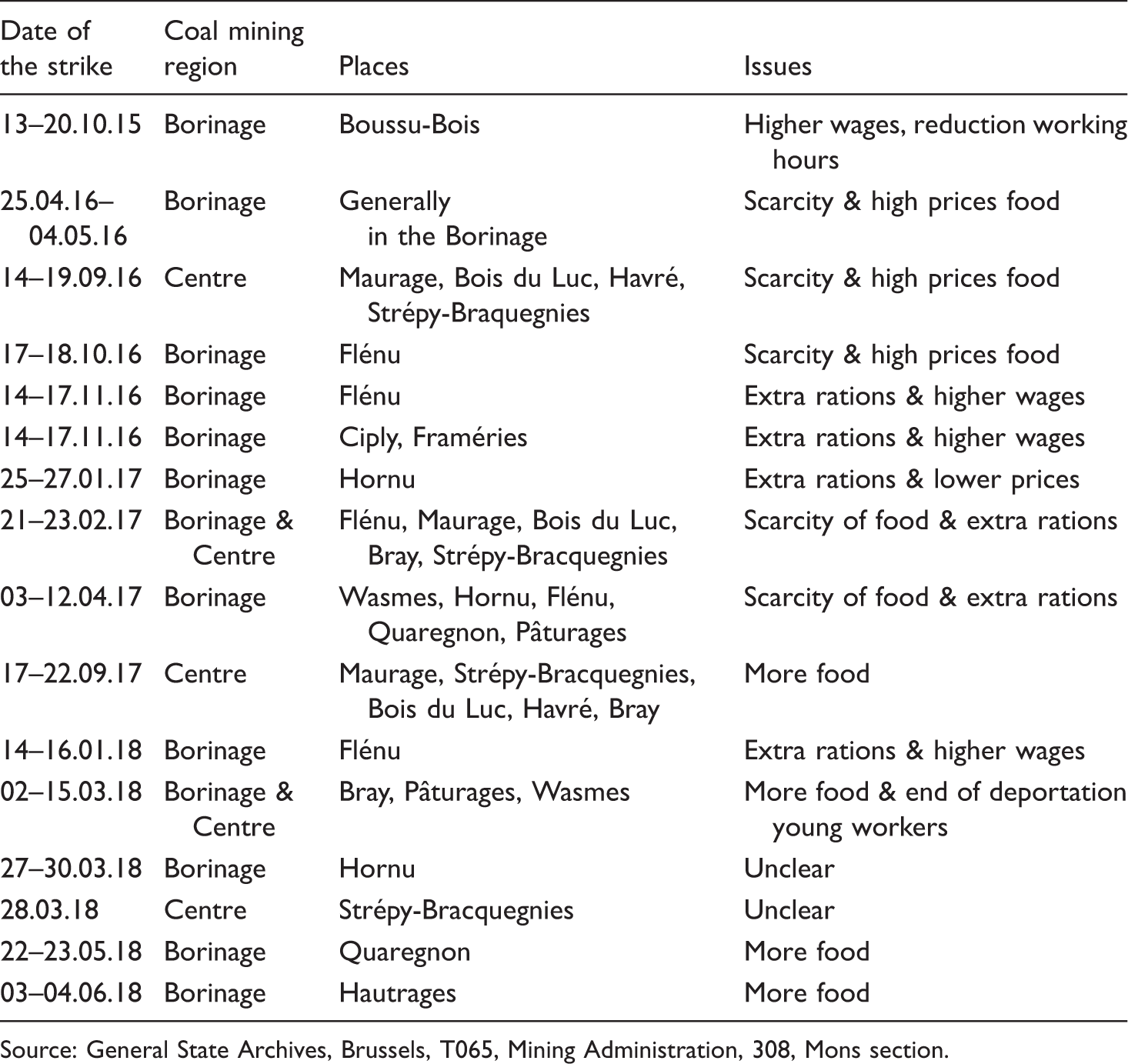
Source: General State Archives, Brussels, T065, Mining Administration, 308, Mons section.
The background of most strikes is clear: the declining standard of living. The 1915 actions focused on wages and employment conditions: the miners wanted to reverse the 25 per cent reduction in wages and the concessions in the field of working time they had accepted on the restart of the mines, now that coal production had returned to pre-war levels. As the shortage grew worse, the emphasis of the actions shifted to the ‘insuffisance de pain et de nourriture pour pouvoir travailler’ [insufficient bread and food to be able to work]. 66 As the focus shifted to the consequences of shortage and high food prices in a broader sense, the actions gained a scope which went beyond the relationship between employers and employees: ‘… la grève était surtout une manifestation du mécontentement de la classe ouvrière en égard de l’insuffisance des moyens d’alimentation, et n’a pas revêtu le caractère d’un conflit entre patrons et ouvriers’ [the strike was mainly a manifestation of discontent of the working class about insufficient food resources, and did not assume the nature of a conflict between employers and employees]. 67
The position of miners was comparatively strong, so that much more than other groups they were able to press their claims to food. The mining companies introduced allowances on top of wages and company shops where food could be bought at low prices. The Germans were very anxious to keep the coal mines open and productive. Additional rations for miners fitted in with that policy and moreover miners were exempted from deprivations such as the requisition of mattresses. 68 Paradoxically, both in Liège and the Borinage, the relatively privileged group of miners formed the driving force of the protest. 69
It is not known how the majority of the population that depended on aid reacted to the granting of special rights to certain categories of workers like miners, but it is unlikely that it was publicly applauded. 70 The ambiguous and not very convincing protest against this practice voiced by the Belgian Labour Party in 1916 indicates that it feared dissension among workers: ‘… pouvons-nous ne pas protester contre le fait de placer nos concitoyens dans l’alternative ou de mourir de faim, ou de travailler pour l’occupant. Les ouvriers mineurs eux-mêmes s’élèvent contre ce régime de faveur’ [should we not protest against giving our fellow citizens the alternative of dying of hunger or working for the occupier. The miners themselves rise up against this preferential system]. 71
Workers at gas works, power stations and water distribution companies, sectors that also continued operating, were in a similar position. 72 This offered leverage for collective action. For example, in October 1917 the workers of the gas works in La Louvière stopped work to demand higher wages and more food. The impact of this strike was felt all over the Centre. 73 Because of the strategic importance of these companies, the occupier was very keen to maintain production at the same level. For example, when workers went on strike during the first half of 1918, a special office of the General Governor immediately intervened so that the work stoppages remained limited to a few hours. 74 As with workers in other industries that were important for the war effort, the occupier provided additional food rations.
Massive unemployment meant that the strike weapon could hardly be used in other industrial sectors to press claims to food. The censored newspapers analysed did not report any strike in those sectors until the winter of 1917–1918, although there was occasional strike activity related to suppliers and subcontractors of the public administration and the National Committee. In view of their permanent activity they did have the possibility of striking. In February and December 1916, ship masters in Charleroi stopped work to enforce freedom of freight and destination; they turned against the increasing grip of the National Committee on their activities. 75 Protest against curbing the free market occurred much more frequently in occupied Belgium: food producers, processors and traders regularly refused to comply with their obligations to aid organizations or authorities and sometimes called this refusal a ‘strike’.
From the winter of 1917–1918 this picture started to change. The strike weapon was no longer exclusively deployed by miners and suppliers to authorities or aid organizations. There are the first clear signs that there were strikes by employees in public administration, aid organizations, trade and the recreational sector. The reasons for the lack of social protest among such professional groups during the first three years of occupation, in contrast to miners in particular, might be that they were more open to the argument that they should not complain because they still had a job and an income. They may have been more sensitive to the notion that in their position it was ‘not patriotic’ to make social claims while there was such high unemployment. The fact that these professional categories, which generally belonged to the middle classes, had a far less-developed tradition of militancy than for example miners, and that for a long time considerations of respectability kept them from proceeding to public action, may also have played a part. Finally these groups, unlike unskilled workers for example, had savings that could be drawn upon in times of need. However, high food prices during the second half of the occupation meant that impoverishment increasingly affected the middle classes. As their needs grew, the power of the patriotic argument started to erode in these circles too, especially during the powerful German spring offensive of 1918. It is probably no coincidence that virtually all strikes reported in the press in this category occurred during the spring and summer of 1918. The principal issue at stake in these actions was daily bread: strikers demanded an increase in wages or rations in kind. Working hours also led to discontent; the fact that they had been extended in many sectors because of the shortage of labour became more difficult to bear.
The wave of strikes in the spring and summer of 1918 extended across many sectors. In April the Liège municipal tram drivers and firemen succeeded in enforcing a wage increase and additional allowances for each family. On the tramlines in and around Brussels too the vie chère [expensive living] led to unrest. 76 In the distribution sector, the strike of employees of the Brussels department store Grand Bazar, which lasted for more than a month in April and May, caused a particularly great stir. In May 1918 the Ghent socialist cooperative Vooruit faced strikes: bakers at the cooperative bakery stopped work to enforce better employment conditions. 77 The musicians’ strike attained a supra-local scope: initiated in Brussels at the beginning of the summer by the Syndicat des artistes musiciens de Bruxelles [Musical Artists of Brussels Trade Union] it also spread to Liège and Ghent in the course of July.
Even professional groups for which before 1914 striking was absolutely taboo reached for the strike weapon in the circumstances of war. The May 1918 strike by the Brussels police, a corps with a military culture and no trade-union tradition, was the most explicit example. 78 Dissatisfaction over insufficient food supplies and the suspension of all leave since 1914 led to an open conflict between police officers and the administration of the city of Brussels. Here it is remarkable that the striking policemen and the city administration involved the German occupier in this labour conflict, which clearly shows that the argument of patriotic solidarity was becoming fragile. 79 In other Brussels communes such as Sint-Joost-ten-Node and Schaarbeek strikes among police personnel took place in the spring of 1918. 80 In February and April 1918 in the Hainaut Centre physicians in the service of the welfare offices and the National Committee stopped work to demand higher wages. 81
Although it may be clear that Pirenne incorrectly minimized the importance of strikes, there was evidently much less strike activity in occupied Belgium than there had been in the pre-war years. Strikes were limited to the few industrial sectors that were not discontinued, although from the spring of 1918 an expansion to other sectors can be observed – a cautious trend that was interrupted by the turning tides of war.
Between Old and New
As in the rest of Europe, a mixture of modern and traditional forms of action occurred. These mixed forms were limited to the Walloon basin, where there were still categories of workers (such as miners) that could deploy the strike weapon. In particular in and around Liège ‘old’ and ‘new’ forms of action, food riots and strikes, were simultaneously deployed during successive waves of protest. In May 1915 the combination of high food prices and wage decreases resulted in large-scale actions among the Liège workers. 82 The focal point of this so-called grève du pain [bread strike] was the miners. On 17 May a strike broke out in the Sainte-Marguerite mine which gained a grip on the entire Liège basin within a few days. Groups of young people forced factories in the vicinity to close. In Hollogne miners organized a hunger march to the town hall. In the area around Liège mainly bakeries and butchers were destroyed and pillaged for profiteering. Gangs of workers travelled to the Condroz and Hesbaye to blackmail the farmers. The focus of the workers’ discontent was the soaring price of bread, since bread was the basic part of their diet. The meagre ration of 300 grams of bread a day was not enough for people performing heavy physical labour. The protest was also aimed at the authorities who were considered to be doing little about speculation. The German authorities promptly responded by imposing new maximum prices for basic food on 18 May. Industrialists for their part gained permission from the city administration to import Dutch bread and to sell it to their employees at a favourable price. Finally German soldiers were used to end the raids in rural areas. The local leadership of the socialist party also contributed to pacification by calling on people to resume work again.
A year later, in the Liège region again, food protest of a mixed nature broke out which spread to virtually the entire province. 83 This time high dairy prices angered workers, which was unusual for food riots. Although shortage of products such as meat, eggs, milk and butter may have triggered other twentieth-century food riots in the western world, this had almost never been the case in the heyday of the food riot. 84 Lynne Taylor ascribes this evolution to the redefinition of the notion of ‘basic needs’ by blue-collar workers over time. What had previously been unattainable luxury goods later came to be seen as just as vital as wheat or potatoes. In Belgium too the share of pork, bacon, fat and dairy products in the worker’s diet had grown over the decades preceding the war. 85 During the occupation the importance of butter for workers had risen even further, which explains the fierceness of the Liège response to the dairy shortage. Alternative foods containing fat (such as meat, bacon and margarine) were scarce and unaffordable. In addition, fat had a special position within workers’ eating culture. 86 Food had to be ‘hearty’ for the worker to be able to sustain physical effort.
From this point of view it is not surprising that it was not the numerous unemployed, but the miners who took the lead in actions over the butter shortage. On 30 June 1916 it was the last straw for the Liège miners. They employed a cunning strategy to achieve reasonable prices. Along the approach roads to the city, groups of about twenty men took up positions and stopped traders and farmers with the message that nobody would be allowed in as long as people could not buy butter at three francs a kilogram and milk at ten cents a litre. Some traders refused to go along with the demands, at which point the workers overturned their carts, threw their contents on to the street and attacked the traders with sticks. In stations and on trams, travelling salesmen were also stopped and a milk transport by train was halted and emptied. No dairy products at all were available in Liège for a few days. Nevertheless, the population supported the actions in the hope of lower prices. German military patrols were needed to restore order so that dairy products could be brought to the city again. The Belgian and German authorities in Liège wanted to regain control of the food situation by establishing municipal warehouses. This succeeded only in part, since the higher prices on the black market remained irresistible to many farmers and traders.
However, the rebellion was not limited to the Liège conurbation. Its repercussions were felt throughout the eastern half of the province. Liège miners went to the markets of Aubel and Battice where stalls were destroyed. Farms in the Herve region were also visited. Here and there a farmhouse was reduced to ashes, but usually the presence of a group of miners sufficed to enforce price restraint. On 3 July 1916 around one hundred miners travelled to Herve after the mayor had called on farmers to observe the maximum prices for butter and milk. All farmers were obliged to sign a declaration to that effect. To restore order again, local administrations started discussions with the farmers, who, fearful of possible actions against them, were then prepared to sell a large part of their dairy produce to the National Committee at set prices.
The workers wanted not only to punish profiteering, but also the illicit trade with nearby Germany. 87 Mainly in the east of the province, many traders and farmers were involved in smuggling food to Germany. One of the focal points of the actions was the textile city of Verviers which had already been entwined economically with the Rhineland before the war. In the evening of 3 July 1916 in Soumagne, Fléron and Micheroux (miners’ communes to the east of Liège) a convoy was formed and started on the night trip to Verviers. The undertaking was well prepared. One word of command started off the action. By the morning of 4 July the parade, which had swollen to around 1,000 men and a considerably smaller number of women, reached the city of Verviers. Local inhabitants joined them. On arrival at the central place du Martyr tasks were allocated according to plan. Different groups – each headed by a chief – undertook action. Milkmen were stopped, after which the milk was poured into the gutters and the butter was trampled underfoot. Later that day in and around the city the target was the dairy traders who were suspected of trading with the occupier. Eggs and butter were thrown into the street or against walls. Household goods were thrown out of windows and smashed. These actions were not aimed at stealing from the traders. Rather, they were more like a kangaroo court. The participants considered themselves as justiciers [upholders of the law] or délégués du peuple [people’s delegates] who in the name of the people imposed punishments on traders. The next day the actions continued, but were now concentrated on traders asking extortionate prices. These people were attacked less fiercely than those who traded with the enemy. Actions were generally limited to meetings in front of the house of the shopkeeper in question, while lower prices were demanded loudly. After brief negotiations the traders usually agreed to the demands. Terror had really struck by then. However, there was still wrecking at the premises of two reluctant traders. In this case the actions really bore fruit. The dairies made their stocks available to the city. The price of butter and eggs went down to an acceptable level, so that the population of Verviers could stock up relatively well until the next winter.
Men and Women
Men as well as women and children were involved in food protests in varying proportions. In the light of the ‘masculinization of the protest’ 88 that had occurred in the course of the nineteenth century, the dominant position of women in food riots all over Europe during World War I was even more striking. Women were able to regain their own place in the street, which they had been denied in nineteenth-century society. This was partly because protests had to be organized without using political or trade-union structures, in which women only occupied a marginal place. The support structures behind the protest during the occupation were often neighbourhood networks, in which women played a prominent part. 89
While food riots were a mixed affair in the ancien régime, in the twentieth century they were to become an exclusively female means of action as a result of the increasing division of labour in the household and marginalization of women in public life. 90 In Belgian food riots during World War I both men and women were involved, which suggests a closer connection to the pattern of the traditional mixed revolt than with the image of the twentieth-century exclusively female food riot. 91 It can be explained from the specific material and political context of the occupation. The food shortage meant that all members of the family had to be involved in the time-consuming business of food provision. It was no longer the exclusive task of women (in so far as this had ever completely been the case), but was also one of the major daily preoccupations of men. In addition, because of the limitation of political and trade-union life during the occupation, for men too there were fewer alternatives to the food riot for expressing protest. Finally, massive unemployment resulted in many men withdrawing by necessity to the family sphere.
Some actions were exclusively or mostly male, while in others women were the driving force. When there was a real risk of violent confrontation, the men predominated. In contrast, hunger marches generally were explicitly female in nature. But the dividing lines cannot always be drawn so tightly. There are examples of women taking part in the wrecking and hunger marches by miners. Food protest often also consisted of different subsequent stages that were not necessarily performed by the same groups. The varying combination of diverse groups rather frequently involved an implicit division of roles according to gender. For example, women often took the lead and laid the foundation for a food riot by capitalizing on neighbourhood networks. In a next stage they were reinforced by men, after which women and men together went to the location of the protest. On site the tasks were often separated again. Then the men, for example, undertook the destruction of shop windows of profiteering traders, while the women encouraged them and verbally expressed the discontent of the community.
Striking to press claims to food was mainly a men’s affair; the focal point of strikes during the war lay in mainly male sectors such as mining. As the scope of the strikes broadened in the last year of war, the participation of women increased: in the Grand Bazar strike probably the majority of the striking shop staff were women.
After the Armistice
Four years of deprivation were followed by the settling of scores with various groups of infringers of standards (German immigrants, collaborators and profiteers) on the streets in November 1918. They became the target of collective sanctions that took the form of charivari and were aimed at purging the community. The people’s rage was mainly directed against ‘profiteers’. For the hungry population it was particularly this category of ‘anti-patriots’ who had made their lives difficult through their dishonourable practices, and now deserved punishment. As regards form as well as content, those informal sanctions were related to the food riots during the occupation. In the city, sanctions were mainly used against butchers, cattle dealers, or bakers who were suspected of extortion or trading with the Germans. In rural areas they were mainly retaliatory actions against farmers. According to the Liège Gendarmerie the background to it was clear: ‘Le ressentiment de la population à l’égard des fermiers et des cultivateurs est très grand. Ceux-ci sont incrimés d’avoir exploité leurs compatriots’ [The resentment of the people towards farmers and growers is very high. They are accused of having exploited their compatriots]. 92 Disapproval of ‘profiteering’ also lay behind the actions against other categories of infringers of standards. The population in the liberated country was mesmerized by the better food situation that political collaborators, such as the Flemish nationalists, had been able to enjoy during the war. 93
The Armistice did not mean an end to the food riots, but the ‘new’ action repertoire gradually became dominant again with the resumption of national political and trade-union life. Workers’ discontent about the difficult social situation was expressed in a whole series of demonstrations and strikes in the first few months after the Armistice. 94 After the deprivations of the occupation there was a widespread feeling among workers that they were entitled to major concessions. According to the Belgian elites, the food problem was the greatest potential source of unrest, more than the supposed revolutionary aspirations of the (extreme) left. Therefore it is no coincidence that one of the main concessions made to the workers’ movement in the autumn of 1918 to defuse the explosive social climate was the introduction of a price policy on a national scale. 95 Aware that high prices and food shortages were the major breeding ground for workers’ discontent, the authorities chose to develop further the price control system implemented in August 1914 and to stimulate the import of foodstuffs as long as the risk of social instability was present. This was not simply another twentieth-century innovation, where the authorities intervened in areas they previously left alone – it also followed a well-known strategy of pouring oil on troubled waters. 96
Conclusion
To view the history of Belgium during World War I merely in terms of victimhood does not do justice to the complexity of the story. The reductionist nature of such an approach is clear from the analysis of the often turbulent protests in occupied and liberated Belgium to press claims to food. This protest shows that not everybody accepted the material deprivations caused by the war with resignation. Various social groups repeatedly attempted to defend their own claims to food and thus influence food politics. These collective actions indicate that some social groups could carry more weight than others. As in other contexts of scarcity, it was not necessarily the worst affected groups that took the lead in collective actions. On the contrary, relatively privileged groups such as miners had much more scope for pressing their claims to food. Therefore their voice sounded much louder in the negotiation procedures than that of the numerous unemployed people who were largely dependent on aid.
The divergent abilities of various social groups to influence food politics shows that the Belgian population was far from being one single category of unambiguous victims. Moreover, the protest in the occupied and liberated country indicates the pronounced social tension that was generated by the demand for food. In the long run this social tension even eroded the patriotic reluctance to engage with the occupying forces, as various protests show. That may be one of the reasons why the importance of the collective actions during the war was minimized in the post-war nationalist climate.
More than in other belligerent states, food protest in Belgium during World War I showed a pronounced return to a seemingly archaic repertoire of actions, which suggests that Charles Tilly’s thesis of modernization and nationalization of social protest is far too linear. Apparently obsolete forms were revived as a number of long-term structural developments were temporarily reversed. The capitalist single market was profoundly disrupted. The first and most industrialized country on the European continent was de-industrialized and agriculture again became the basis of the economy. The authority of the national state was largely suspended. The activities of party-political and trade-union structures were put on the back burner. To a large extent, life was lived in a local context again. Informal horizontal bonds between neighbours and vertical power relationships between local elites and the inhabitants of villages, towns and cities regained their importance. The language used in the food protest was anything but neutral. It was framed in the expectation that those in power would guarantee the population’s claims to food. It may be worth exploring whether similar conditions in other occupied areas like Northern France, Poland, Lithuania and the Ukraine during the war, or in the collapsing empires of central and eastern Europe at the end of the war, also led to a revival of apparently obsolete protest forms.
That leaves the question of the impact of the protests. Going by the direct results, at first glance, some caution is called for. Strikes were only effective for the limited groups that could still use that weapon. The picture is even more mixed in the case of food riots. Sometimes the punishment of profiteers really did have a (short-lived) positive effect on prices. In other cases imposing maximum prices actually stimulated the black market or led to boycotts by the producers. However, if food provision had been completely left to the market, large sections of the population would have been denied access to food with even more far-reaching consequences. From the beginning of the war the Belgian elites felt obliged to abandon laissez-faire liberalism on food supply and to intervene in the market. Fear of revolt played an important part in their decision to pursue an interventionist policy. The success of their food provision policy was of course constrained by the imposed autarky and weakening of the state authority, which limited how far they could enforce measures. The biggest obstacle to a successful provision policy was, however, the German occupation forces, who prevented the implementation of such a policy by siphoning off food from Belgium in all kinds of ways.
On the political level, the process of negotiation around food produced effects that outlasted the occupation. The interventionist policy of the elites in food provision, through the National Committee and the municipal administrations helped ensure that the legitimacy of (local) authorities was not badly affected during the war. Administrators retained their authority precisely because they took their paternalist obligations seriously. Unlike in Germany or in Russia, during the negotiation processes around claims to food there was no irreparable breach between those in power and the lower social groups. The inclusion of representatives of the workers’ movement in the National Committee indicates that more than simply paternalist strategies were employed. Consequently, after the Armistice there was still room for compromise in Belgium, resulting in the Loppem Agreement, which introduced measures of political and social democratization.
Footnotes
Acknowledgements
I thank Stefan Goebel for his critical remarks on an earlier draft of this article. This article is a result of the IAP P7/22 ‘Justice & Populations: The Belgian Experience in International Perspective, 1795–2015’.