




Abstract
How important was it for merchants, artisans, inn-keepers and painters to have brothers and to work with them? By cross-referencing different sources (states of souls, testaments, inventories, court papers, compilations of legal and notary deeds), this article seeks to answer the question by taking some crucial aspects into consideration: daily life in the family home and other forms of cohabitation, the transmission of work tools and of vocations, the training of new generations and the support provided to family members in trouble. Seventeenth-century Rome is an interesting vantage point from which to investigate the importance of brothers' companies. The presence of the Papal Roman court extended employment opportunities, not only for courtiers, artists and servants who moved from one embassy to another and from one cardinal's court to another, but also for all those men (more men than women) on the margins who were able to earn some money from the conspicuous consumption of the upper classes. The flexibility of the labour market and the widespread phenomenon of male cohabitation could undermine the strength of family companies.
Business Brothers in Baroque Rome
The past thirty years of historiography has seen a fruitful marriage of family and economics, resulting in, among other topics, the study of business brothers. Coming from the same house (and more often living together) was an essential requirement of partners in many commercial companies in early modern Europe. 1 Florentine wool workers, Flemish merchants and rich Lyonnais bankers, as well as humble butchers and bakers in seventeenth-century Rome preferred to rely on brothers, uncles, cousins and brothers-in-law, especially when they could live in the family house or in the workshop, learn a trade and join a guild, when their debts were guaranteed by the family patrimony, and more generally when the family name conferred direct advantages on them or on their descendants in the short term. 2 These companies were made more solid by women. In Italy wives, mothers and sisters played a very important part: importantly with their dowries, but sometimes also by working alongside their male relatives. 3
But why was it better for brothers to continue to live together under the same roof and work together? According to Italian legal experts of the time, when merchants’ or artisans’ volumes of business grew, they needed more capital as well as a network of colleagues able to operate while ‘taking good care of their own business’ (in diligentia propriae rei). In theory, both of these requirements could be found within a single family. Capital required as start-up or to expand the volume of trade might come from a paternal inheritance and it was sometimes the same family house that made its space and personnel available for commercial activities. 4 The kind of company that was founded in these cases was ‘natural’ and its origins were to be found in brothers living together after their father had died. It was, in other words, a silent partnership, but one that was different from modern silent partners, who are limited and have less exposure to liability because they do not participate in the day-to-day operations of the business but provide capital to the company when needed and as they are able, and whose losses are limited to the amount they have invested. Brothers, on the other hand, could be full partners simply by virtue of being born in a merchant's house. What the legal experts were referring to was a space – the house – and to two activities full of meaning for the members of a company of brothers: eating at the same table and performing work that was, in the broader sense, related to the family's shared aims. 5 In Italy the collections of laws in the late Middle Ages contained many legal opinions concerning brothers’ companies. 6 In 1647 the jurist Biagio Micalori, judge in the Rota Tribunal of Urbino, and then auditor of the Grand Duke of Tuscany, 7 compiled the doctrine and case-law on these companies in a treatise that included Court decisions of the Roman Tribunal of the Sacra Rota. 8
In the pages that follow, I will be looking at how brothers and sisters in Roman businesses went about their daily affairs. My aim is to examine how they reacted to the spaces for action that were imposed on them by the rules of inheritance, by the constraints of the labour and goods markets and by the rules of an emerging commercial law which intervened to regulate controversial situations. My ultimate aim is to try to understand what it meant to be a business brother and how blood ties influenced decisions in matters of work, investments, and short-term and long-term management. The approach I am about to undertake is by no means easy as direct testimonies of what merchants really thought about their partners are rare and hard to come by; even more difficult is to find out what a craftsman, a vintner, a wine merchant thought about his own brothers and sisters whom he worked with and whether relatives were really preferable to friends and colleagues. 9
I have chosen several strategic vantage points. I will examine the material factors that made it possible to create ‘brotherhoods of workmen’ and the ideas that were shared as regards these brotherhoods. I shall first look at the house which could be the headquarters of the business and the location of the tools needed to pass on the trade to younger generations, and I will focus in particular on the legal protections that existed to safeguard patrimony and support family members in trouble. I shall then concentrate on the ways in which job vocations were cultivated. In the final part I will look at the advantages (and disadvantages) of bearing a family name and the schemes enacted by those without blood ties and family names in order to consolidate a work relationship.
Rome is a particularly interesting vantage point from which to study work activities in domestic environments. From the end of the fifteenth century the city's population grew steadily and significantly, at the same time as the bureaucracy of the Curia was becoming established. Migratory phenomena played an essential role in this growth. 10 Moving into the city were not only papal officials who drew their earnings from the Curia, but also a host of merchants, craftsmen who purveyed and produced goods for the Pope's Court and for his staff, but not only for them. 11 Servants and artists, who worked for the ecclesiastic courts in baroque Rome, joined artisans, merchants and papal officials already there or who were ready to move. 12
In 1638, the brothers Giovanni and Francesco Rotigni, the heirs of Giovanni Andrea, signed an agreement with their uncle Giovanni Maria Rotigni to share profits and losses from the financial activity they pursued in Rome.
13
This business was something akin to that of an exchange counter, as bankers in the seventeenth and eighteenth centuries did not just deal in money.
14
But it was not only bankers who preferred to work with their brothers. In mid-seventeenth-century Rome a large number of sibling co-workers could be found among vineyard workers, inn-keepers, farm workers, blacksmiths, and so on. In 1649 in the territory of the parish of San Lazzaro fuori Porta Angelica two brothers and one sister – Baldo, Giovanni Paolo and Lucia – tended the garden of Don Pietro Oriotti, where they also happened to live (Figure 1).
15
At the same time in the centre of the city (on the street behind the church of San Silvestro) two brothers who were blacksmiths – Fidenzio and Dionisio Bonanni – were sharing their house with their mother, the wife of one of them and three children (Figure 2). In 1648 Domenico Colombi, who the year before had been running a wine store (presumably also an inn) on the Strada Ferratina, near Via del Corso, with two workers (garzone), began a partnership with his brother Bernardo. Business was good and in 1649 another brother, Prospero Colombi, moved to Rome to join them (Figure 2).
16
Giovanni Battista Nolli, Nuova Topografia di Roma (1748): Parish of San Lazzaro fuori Porta Angelica area Giovanni Battista Nolli, Nuova Topografia di Roma (1748): Parish of San Lorenzo in Lucina area

Brothers might share the house even when they were not working together on the same business at the same time. At the beginning of the eighteenth century Francesco Trevisani, a painter long in the service of Pietro Ottoboni, was living with him in the palazzo della Cancelleria, but when he first arrived in Rome in 1678, he stayed with his brother who was also a painter.
17
In 1649, the painter Niccolò Stanchi went to live with his brother Giovanni Stanchi, who was also a painter and who later came to be known as Giovanni Stanchi Dei Fiori for his famous still-lives. In their house on the Strada Paolina also lived Angelo, another brother painter, their sister Anna, a widow, and two children (Figure 2).
18
There is therefore every reason to believe that this apartment also served as a workshop. Many artists in Rome lived with their brothers – Gianlorenzo Bernini, at the height of his career, occupied a block of houses with his mother and brother near via della Mercede (Figure 2)
19
– though most preferred to live with their own wives and children, as was, in fact, the case for Trevisani himself when he was engaged full-time by Pietro Ottoboni at the Palazzo della Cancelleria (Figure 3).
20
Giovanni Battista Nolli, Nuova Topografia di Roma (1748)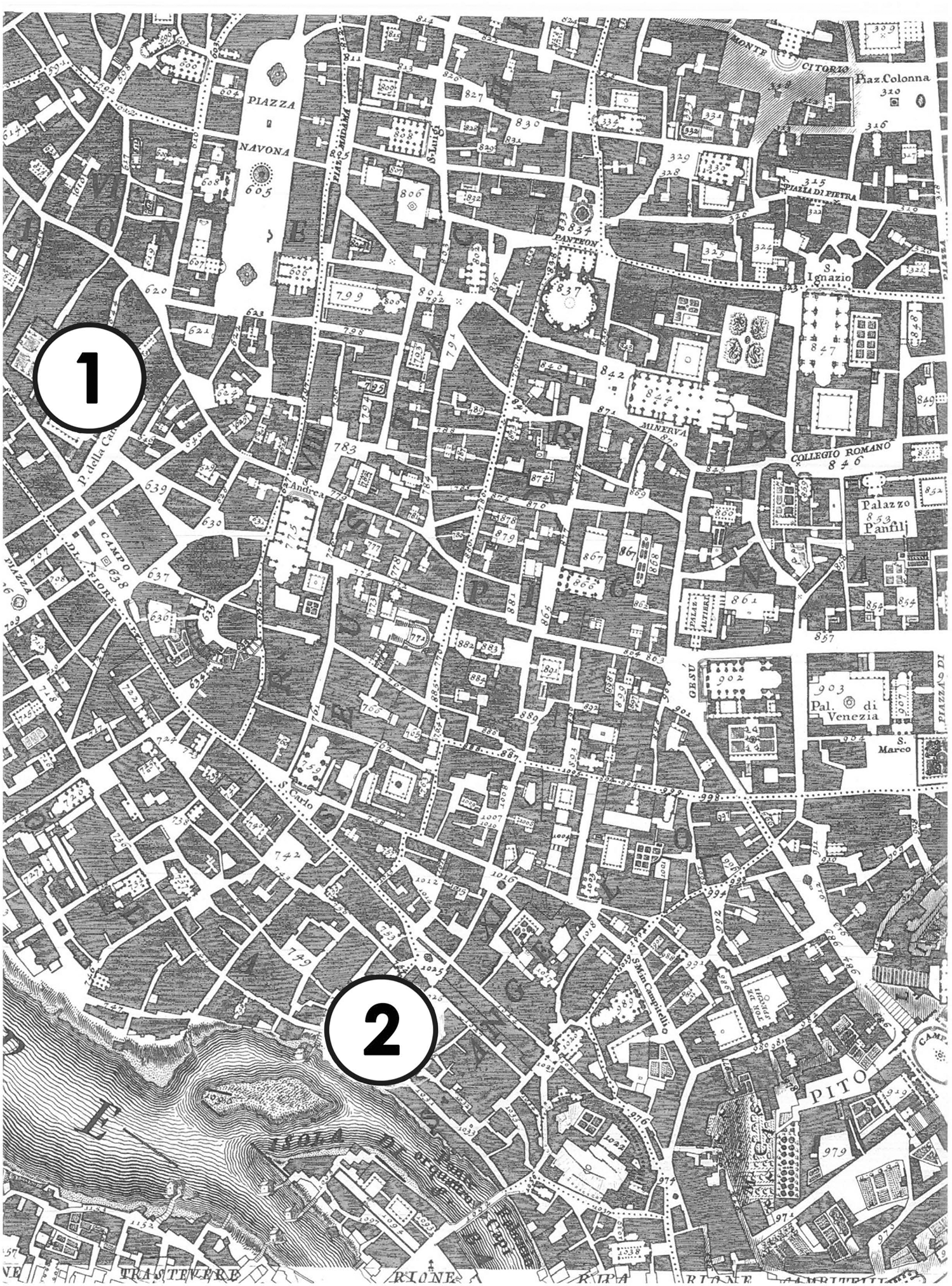
For immigrants sharing a home and work space with their real brothers or with companions with whom they had a fraternal relationship undoubtedly helped them overcome the difficulties in getting settled in a new city. As we have seen, the two Colombi brothers who came from Liguria immediately found lodging and work with their brother who owned an inn.
But it was not only immigrants who relied on brothers and familial colleagues to help them along in their activities. Staying and working in the family meant enjoying the security of access to a slice of the family patrimony, of living in the house where one had grown up and using the inherited capital of knowledge (and sometimes tools of a trade) that the boys had accumulated from the time they were children. This, of course, always assumes that there was a common patrimony to be shared.
It was easier for trade secrets to be passed on via male channels inside families, and in Rome one more frequently comes across forms of cohabitation that are exclusively male than female: 21 brothers, as we have said, master and apprentice, uncle and nephew, seasonal workers, colleagues, partners in a company… the demands of work reinforced social ties between adults and between adults and children in accordance with precise channels of gender. 22
In the Same Space: The Company Headquarters
The house and, more generally speaking, the shared dwelling space, played a crucial role in consolidating relationships among those who lived within its walls, especially when these were brothers and sisters or age peers. 23 Simply sharing a dwelling place might lead to legal presumptions of brotherhood, as we shall see.
After the creation of the ghettoes in the sixteenth century, cohabitation among Jewish brothers was very common. The very limited area of available living space resulting from segregation meant that brothers were often at very close quarters, a situation that was sometimes the source of arguments and which in reality also could occur outside the ghetto. But non-Jewish brothers could always find another living arrangement farther way from the family house, 24 a possibility denied to Jews. Nearly two centuries after the creation of the Roman ghetto – in 1731 – Samuelle, Pelligrino and David Ascarelli, who until then ‘had been living in the same household, as partners of their company’ (vissuto in comunione e in compagnia del loro negozio), proceeded to divide up the assets they had inherited from their relatives. The Ascarelli were a well-to-do family in the Roman ghetto who could afford a large house. They lived on piazza Giudia in a space that spread over five floors with various apartments and workshops. Here different households lived, including families that were related to the Ascarelli (Figure 3). 25
The brotherly love that lay behind the running of a business might not last forever, as happened in the home of the wealthy Roman merchants the Rotigni. Like other bankers, inside their house stood the ‘collections desk’ where records of accounts were kept. 26 As mentioned above, in 1638 Giovanni, together with his brother Francesco and his uncle Giovanni Maria, had signed a contract to set up a company in Rome, which was renewed two years later, as we shall see. 27 In order to manage these economic activities, the family's collateral channels were often used in preference to vertical ones; brothers, cousins, in-laws (who might be age peers) were chosen over fathers and sons in the day-to-day running of the business. 28 The family house was also a headquarters and the centre of this system of affairs. Of such importance was the dwelling place that for legal experts, acts that had been signed inside the brothers’ house could lead to the presumption that a silent partnership existed among them. 29 It was this question of the day-to-day running of the business going on inside the house that lay at the heart of the dispute between the brothers and their uncle. Francesco's creditors, who wanted to be repaid with the money of the company, even after it had been dissolved, argued before the court that Francesco's uncle, Giovanni Maria Rotigni, continued to open letters delivered to the front door of the shared house that were addressed to all the partners. 30 He therefore shared a responsibility to repay creditors along with his nephews. According to the creditors’ lawyers (and more generally speaking, according to seventeenth-century company law) there existed the concept of an inside, understood as the space where a family's commercial and financial activities took place with burdens and benefits for third parties, and an outside, in which legal acts under company law did not apply. 31
Thus, the fact of a shared home, or rather of cohabitating in the company headquarters, was enforceable against third parties; but the family home also had another role: professional training for family members. In merchants' residences, but also in the homes of artisans and even peasants and servants, young people from the time they were children were initiated into a trade, which, once they reached adulthood, they were perfectly qualified to ply because of their early education.
Francesco Rotigni, less financially stable than his uncle and perhaps also less expert, had learned how to be a banker at home. Intensive education provided in youth, the mutual trust among family members, the certainty (or at least the hope) that it was in every family member's interest to safeguard the common patrimony, and much more importantly, the merchant family's good reputation which was crucial to obtaining credit, all legitimized the decisions of each of the partners. Among the lower classes, family training was a prerequisite for admission into guilds and for access to an income deemed suitable for one's activity, as one study on young female weavers in eighteenth-century Turin has shown. 32
Training but also the care and protection of the members of one's own household were also justified by affectio, or fraternal or family affection. 33 Of course, it little mattered if this was authentic – that is if the brother-partners really loved each other – but it was this presumed existence of an emotional bond that engendered the obligation to share out profits and come to the aid of any individual or part of the family group that was in trouble.
Limits of Solidarity
In family businesses, more so than in other companies, relationships among members were inspired by ideas of reciprocity or ‘charity’ as Old Regime sources defined it.
34
The family was by very definition the space of gratitude, at least in theory.
35
Family members in trouble were given aid not just because of an emotional tie but as a matter of a legal obligation that had existed since the days of Roman law.
36
Gifts of money, legacies and endowments for apprentices, pupils and orphans all attest to bonds of affection with the testator during his lifetime,
37
but it was brothers, in the absence of their father, who were expected to be the first to come to the aid of other brothers. Bartolomeo Franzilli, a Roman stucco master lived with his wife in a house at the foot of Trinità dei Monti but also with his 60-year old sister Cecilia who was labelled ‘mad’ by the parish priest who had drawn up a State of Souls in 1648. As such she was probably incapable of contributing to the family household (Figure 4).
38
Giovanni Battista Nolli, Nuova Topografia di Roma (1748): Parish of San Lorenzo in Lucina area.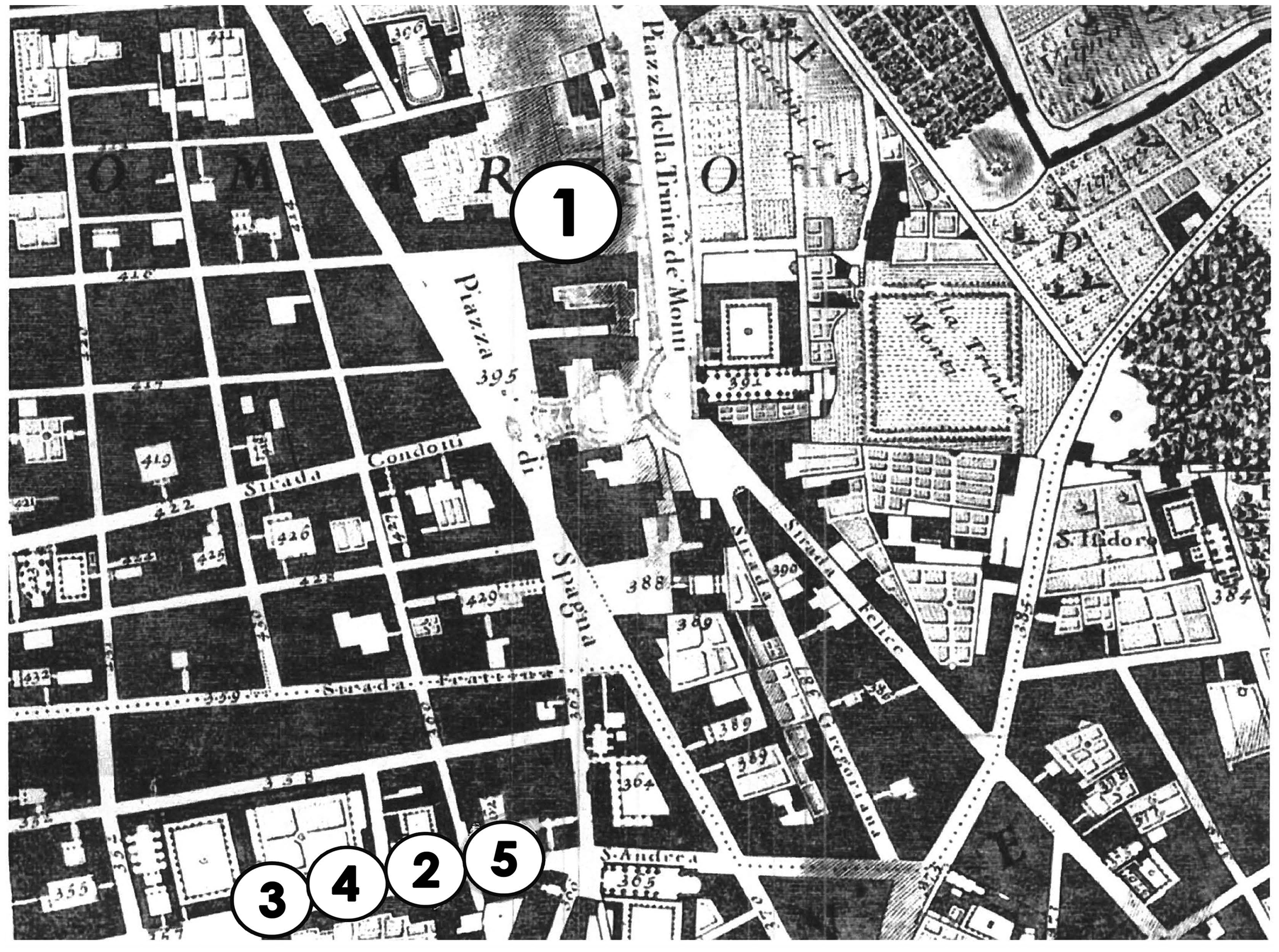
How exactly were brothers expected to behave when one of them was facing hardship? Requests for help and resistance to providing it are a good illustration of how solidarity was a concept that was defined after lengthy negotiations. Matters were further complicated when brothers or other family members, through their labours, contributed to increasing the value of the collective patrimony, of which one might claim a share, as we just saw in the Rotigni house, when the uncle was reluctant to pay his nephew's debts. In the house of the Orilia family it seemed clear that solidarity with other family members was not free and unconditional.
Felice Orilia was a Roman widow whose family had never paid her entire dowry. When her husband died she continued to live in Naples ‘with every comfort, servants and maid’ (comodissime vivere cum servis et famula) until the 1680s. More than twenty years after her marriage she sued her brothers and nephews for support, arguing that she had been deprived of her entire dowry. 39 Her request should have been granted without much trouble since it was in fact an obligation of solidarity recognized both by Old Regime charity and by Roman Law. But the Roman courts of the Auditor Camerae and the Sacra Rota twice denied that Felice had a right to be paid by her brothers. Having left the family abode, she had ceased to belong to the productive community, while others in the family had struggled to manage the common business and finance the studies of its youngest members. Ignazio, the eldest brother, had worked in the family shop and had been compensated for his pains by inheriting it. Carlo and Domenico had been able to enter the legal profession because their studies had been financed by the family's activities. Felice who was in Naples, had contributed nothing, either in the shop or to her brothers while they were studying.
Fraternal solidarity was not unconditional, but took into consideration a series of factors that were the basis for the functioning of the family company. If one did nothing for the community, it was unlikely that the community would compensate. But even when there was no productive community one still had to show that one was ready to engage personally in overcoming difficulties. 40 Fraternal support and family charity could not last forever.
One of the Campagnano brothers learned this lesson the hard way, after twice requesting and obtaining financial aid from his brothers Vitale and Domenico. Unlike his rescuers, Giuseppe the brother who was asking for help, had not tried hard to find a job that would lift him and his family out of the poverty they had fallen into after his father's death in 1782. Vitale and Domenico had obtained work in the shops of richer families in the ghetto while Giuseppe had gone off to Livorno where he had not managed to achieve anything. The legal solution was an act drawn up by a notary which declared that the two had already come to the aid their brother when he was in trouble. They did not wish to leave him to his fate ‘as long as he changed his behaviour’. 41 It seems almost as if the two generous brothers intended to obtain a certificate of reciprocity inside the family. As long as the lazy brother did not start going to work diligently, the system of reciprocal exchanges would not begin to function. Micalori clearly developed this point in the third part of his book when he explained that one brother was not required to support another brother if the latter was in a position to provide for himself with his own labour (ex eius artifitio). 42
In order for children and young people to grow up as future colleagues and so that, should the need arise, they would support each other (without one exploiting the labour of the other), it was necessary to begin early and cultivate in them the wish to continue what their ancestors had begun. This was another way to avoid scattering the family fortune and loosening the ties between that patrimony and the family name.
Vocations
The moment of handing over control of a commercial activity was extremely delicate because it called into question the reason for founding the company and the equilibriums that had formed among partners, and it also concerned the deepest wishes of the person who was about to give up his place. 43
In 1629, in Rome the tanner Lutio Vacante made out his will, leaving his workshop to his three sons as well as extremely precise instructions on how the business was to be run in the five years following his death. The heirs were enjoined to continue to work together: the firstborn Domenico was expected to administer the shop; the second, Pompeo, to take care of supplies, and the last, Giuseppe was to help in the tanning. We do not know if the three were happy with this arrangement that had been imposed on them, but the rigid conditions were the only ones that would allow them to take possession of a part of the paternal patrimony. 44 Many other artisans in seventeenth-century Rome left their shops either to sons or sons-in-law whom they had worked with; if there were no sons the shop was passed on to nephews and brothers. 45
But not everybody remained loyal to the family activity. A shop might be sold once its owner had made his fortune and no longer wished to devote himself to the business. Besides cases of upward social mobility, in the wills of Roman artisans there are many traces of betrayals that were in fact authorized by parents; in 1621, the son of a cattleman was apprenticed to a lace maker (trinarolo). 46 The world of Roman trades offered a variety of alternative occupations. People would hold on to a trade if it was lucrative and when fathers, sons and brothers had built up a reputation as experts in that field. As we have seen, Fidenzio Bonanni, a blacksmith, lived and worked with his brother Domenico in a street behind the church of San Silvestro. In that street there were two other blacksmith's shops and a turner (tornitore) (Figure 4). 47
A recent interesting study has looked at a sample of wills made by artisans and merchants in Rome between 1559 and 1650 and drawn attention to the importance of bequests left to individuals who were not family members. These bequests were justified by ‘love and benevolence’ (amore et benevolentia), concepts that were very much akin to the affection upon which, according to legal experts, brothers’ companies were supposed to be based. Networks of godparenthood, of friendship, of neighbourhood, of geographical origin (the vast majority of wills were made by immigrants) and business overlapped, and the reasons for naming an heir often cited all these relationships together. Some women left their patrimonies to girl apprentices or just to motherless children whom they had cherished. 48 As with brothers, living in the same house and caring for each other served to consolidate relationships, even when there was no blood tie.
In some of these wills apprentices benefited from bequests made to them so that they should continue the activity they had pursued with the testator. Pietro Locatelli, a knife maker from Bergamo, left 10 and 22 scudi to his two apprentices Carlino and Cesare. He also instructed that if Cesare wanted to continue the business (and perhaps Pietro was hoping for this) he would have to contribute a capital of 78 scudi. Profits from the shop, which would be run by Cesare with the skills Pietro had taught him, would have to be shared with Pietro's widow who was named universal heir. 49
Expectations entertained by heirs, how vocations within the family were cultivated among sons and nephews, or in the shop with apprentices who were often treated like sons, 50 as well as expectations about the business's future are all matters that are difficult to reconstruct when studying merchants, artisans and painters, as they rarely left handwritten documents. Detailed instructions in wills can tell us a lot, but they need to be cross-referenced against the demographic source of the states of souls which reveal how many years an apprentice lived in the house or if children stayed with their parent and continued the family trade. An apprentice lodging with his master, besides influencing the type of relationship between the two, also significantly affected the wages that were paid. 51
I cross-referenced these data from wills and Roman states of souls with the results of a large-scale study on family-run vineyards in the region of Cognac in France in the past 20 years and I identified a series of dynamics at play the moment the management of the business was passed on. These proved to be enlightening in terms of better understanding what brothers, cousins and nephews must have thought in baroque Rome about the person who was taking charge of the family business. 52 Whoever bequeaths an activity, as we have seen, passes on to his heirs the capacity to exercise a trade (with all of its secrets), the company's productive patrimony but also the wish that his heir should continue the work. All this emotional capital of expectations emerges both from the interviews collected in France, and, as we have seen, the instructions left in the wills of seventeenth-century entrepreneur-fathers.
Clearly, whoever is (or was) about to bequeath the family business prefers to leave it in the hands of someone who has shown talent or interest in learning how to carry it on. Besides instructions left in wills, there are also material levers that make it possible to construct a vocation, and in seventeenth-century Rome whoever wanted his heirs to continue the business was quite adept at using them. In the French vineyards of Cognac in the twenty-first century children are taken out into the fields when they are very young (sometimes on tractors) at key times during the season to encourage them to participate and to kindle a passion in them. Italian artisans in the fifteenth and sixteenth centuries transmitted the objects of their trade, which, besides being indispensable (we saw this with Lutio Vacante's tanning equipment and the knife maker Pietro Locatelli's tools), were also the mark of investiture in a precise profession that determined social status. 53
Once the fact of inheriting the tools of the trade and the other objects had reassured young workers (children, nephews, cousins or apprentices) that they now belonged to the family enterprise, what was their involvement with business? How did they express this? In some cases the heirs demonstrated a real attachment to the family business, as the two brothers Antonio and Maurizio de Marchi showed for their cloth shop in Tor Sanguigna, which they had inherited from their uncle in 1684. Though burdened by debt, the shop had the advantage of its location in one of the busiest commercial centres of Rome, it had been running for some time and must have had a good clientele. The inventory drawn up on 10 October 1684 shows the presence of valuable cloths on the premises. 54 Its designation as belonging to an urban space known as ‘merchants of Rome’ (mercatores de Urbe), in the language of the court papers, as well as the value of merchandise inside the shop helped Antonio and Maurizio de Marchi fend off the attacks of their creditors in two trials. 55
In the Name of the Family: Trying to be Brothers, Proving to Be or Just Living as Brothers
What the brothers were trying to do was to keep alive the company's good name, which was a guarantee for anyone who wanted to do business with that family. 56 Though they may not have had the ambition of creating a dynasty of wealthy bankers like the Rotigni, people who plied the same trade sought to organize themselves in ‘pseudo family’ forms. This also happened among sixteenth-century Italian artists. Giorgio Vasari, in his The Lives of the Most Excellent Painters, Sculptors, and Architects (1550) noticed that many apprentices took their master's name, another consequence of the father–son-type relationship between them. 57
But there were some who initiated lawsuits in order to be recognized as a brother. More often these were natural sons who demanded to be legitimized by their own fathers, but it could also happen that half-brothers sued their legitimate siblings. In the third part of his book, Micalori does not omit to examine these kinds of lawsuits and the proofs that had to be submitted. Key to winning a trial for paternal recognition was the question of treatment – the fact of being called son, of having been fed, helped and even carried to the baptismal font by the person from whom one was demanding support – but these proofs did not have the same efficacy when it came to fraternal recognition. 58 In principle, treatment still applied to brothers, but it had to be backed up by undeniable facts: for example, when their father had died, did the legitimate brother decide to take his half-brother into his home, to share his table with him, or even pay for his education? Of course, much of this may very well not have happened even in the homes of legitimate siblings, as we have seen in the case of the Orilia.
Once these clear and incontrovertible acts had been established, fraternity was not automatically proven. It continued to be an assumption, but only now the burden of proof was on whoever argued to the contrary. 59 It was not enough to refer to each other affectionately as brothers: what was required were everyday gestures like eating at the same table, finding rest and shelter. This led to the near presumption of fraternity. 60 While the learned jurist made no mention of it, the term fraternity was also used in the world of trades, with their corporations and group rituals which encouraged the idea of brotherhood among members. In any case, the fact of living in the same place and being recognized as its stable occupants played a crucial role in the outcome of trials.
And what about when the cohabitants had no blood ties, as was often the case among artisans? In sixteenth-century southern France, one legal expert used the term ‘brotherment’ (affrairement in Old French) to refer to the fact of practising the same trade while living under the same roof: two parties, signed a legal contract to form one household, all of whose goods usually became the joint property of both parties and each brother commonly becoming the other's legal heir. These contracts, known as the società di fratelli in Italy, frèreche or brotherhood in France, referred to the mutual affection the brothers felt for each other and their commitment to living together and sharing the same bread and wine (vivere ad unum panem et vinum). Most likely, the decision to enter an ‘affairement’ was prompted by a relationship of friendship, usually among co-workers, as well as the need to share each other's goods. The opportunity to pool goods, which was possible but not compulsory in a family company, as already seen in Rotigni's case, seemed to be the crucial motive. Assigning some or all an affréré’s property to the ‘brotherment’ group affected each member's ability to bequeath property to his own heirs. Sometimes affection seemed to overlap into loving same-sex relationships, but the traces in the documents are too weak to lead to the conclusion that every ‘brotherment’ was aimed at formalizing a homosexual relationship. 61
Male cohabitations (not necessarily called affratellamento) were very common in seventeenth-century Rome, which was a city characterized by intense migration and a high male sex ratio (100 men to every 70 women). The Pope, the cardinals' courts and the extensive bureaucratic machinery, on which the Papal States relied, turned Rome into a city full of workshops, artisans, servants and all the other personnel (bakers, grocers …) needed to feed this huge population. Rome was also the Head of Christianity, and pilgrims and clergy from the whole world arrived during the Holy Years and at other times as well. Houses and apartments for rent were in great demand and the city's supply could not always keep up. 62 A recent large-scale study has shown how common it was for men to live together in Rome. Most of them were migrant co-workers with no kinship bonds who shared a room or an apartment for few years. They might be married back home but they lived as bachelors in Rome. In some neighbourhoods (such as Trastevere and Monti) the presence of male agricultural co-workers living in the same household was most significant. 63
In the states of souls (Stati delle anime) they referred to themselves as ‘partners’ (compagni), but the way they lived in the new city, their sharing of domestic space and of food was totally comparable to the merchants’ or artisans’ ‘company of brothers’ (società di fratelli). Furthermore, it was not uncommon for two or more immigrants to come to Rome and live in these male households. Even if nobody claimed the legal recognition of brotherhood, to which Biagio Micalori referred in his book, or signed a contract of affratellamento, they behaved to all intents and purposes like brothers, as we have seen in their testaments and inventories.
Brotherly Ways of Working
So, did brothers and sisters really make the best business partners? How durable and harmonious were siblings' cohabitations? We have just seen how in papal Rome people relied on support networks that were not necessarily based on blood. What made a brother preferable as a partner? To answer this question, let us take another look at the homes of Roman artisans and merchants.
The story of the Colombi is one of peaceful and prosperous cohabitation. In 1647, Domenico Colombi arrived in Rome by himself from Liguria and opened a wine shop which he ran with an apprentice named Lorenzo. By 1649 Lorenzo was no longer residing (and probably no longer working) with Domenico and the reason for that is the arrival of family labour reinforcements: within a year Bernardo and Prospero Colombi had moved to Rome and were living in their brother's house. Along with the Colombi brothers, two apprentices were counted in the census: Michele di Bartolomeo Scateni and Antonio Papa who was from Genoa. A year later Antonio told the parish priest that he was Domenico Colombi's nephew. In 1651, Domenico got married but his two brothers continued to live in the shop and run it with him. His wife, Bernardina, was the daughter of Alessandro Roscetti, a butcher who was living and working not far from the Colombi's wine shop, behind the church of San Carlo al Corso. All the witnesses at the wedding, which was celebrated in the church of San Lorenzo di Lucina on 18 December 1650, lived in the same parish (Figure 2). 64 The brothers' harmonious cohabitation was the prelude for a warm welcome in the neighbourhood.
Things did not always work out this way for every inn-keeper. In 1649 Giovanni Antonio Guglielmi left his brother Francesco and went to run the Inn of Monte Mario with only one helper (Figure 1). 65 Just as unstable are the stories of workers in the Osteria dell'Aquila. In 1648 Giovanni Lazani o de Rossi, originally from Riviera d'Orta in Piedmont, was living and working with his brother Pietro and two other men who were perhaps apprentices, named Carlo Matemi and Giovanni Michele d'Errigo, Giovanni's brother-in-law. A year later Pietro was no longer a member of the household and his absence was made up for by the arrival of two workers, Lorenzo Giuliani and Cristoforo Ferrari, and when Pietro returned in 1650, they left the house. That year the staff consisted of the two Lazani brothers, one of whom was a cook, the brother-in-law Giovanni Michele, and an apprentice Carlo Magistrini. The departure of the brother-in-law in 1651 was cushioned by the hiring of three new apprentices, while the two Lazani brothers appeared to be constant fixtures in the inn. 66
There were also some painters who chose to live and work together with their brothers, though most of the numerous artists who defined themselves as painters lived with their wives and children and sometimes with an apprentice. At the beginning of the eighteenth century, Francesco Trevisani took his wife and children and his shop boys with him when he moved to the house of Pietro Ottoboni, at least for a period (Figure 3). 67
In baroque Rome, the art market offered lucrative opportunities for artists but the price of housing was very high, even if it was in line with what they could expect to earn from their commissions in the city. That is why painters, especially newcomers, shared rooms with colleagues or with their brothers, even when the latter were not painters. As we have seen, Trevisani himself lived with a brother when he first came to Rome. But there were other reasons why brothers might continue to live together after their careers were already underway.
In 1649, Angelo and Niccolò Stanchi moved in with their brother, the painter Giovanni Stanchi, in the house of their widowed sister, as we have seen. Giovanni had already been living in the Strada Paolina with his sister, his nephews and brother-in-law – Claudio Piornieri – before the latter's death (Figure 2). 68 Giovanni, who was born in 1608, had probably been trained in the shop of Agostino Verrocchio in the 1630s or 1640s, and in 1648, he called for his two much younger brothers to join him; Niccolò was 15 years younger than Giovanni and Angelo 18 years younger. The relationship that arose between the three was more like that of a master and apprentices than a partnership between colleagues. In any case, what they achieved was no means negligible; the three worked jointly on producing a series of still-lives that enjoyed considerable success on the Roman market. Still-lives by the Stanchi found their way into the Flavio Chigi collection, at least the oldest core of the collection, before the cardinal turned to Pietro da Cortona and other more famous artists. 69
Antonio and Enrico della Cornia also reaped the benefits of a family collaboration in the art market. In 1648 and 1649 we find them living in the same house in via dell'Olmo, in the parish of San Nicola in Arcione. 70 Antonio was born in Milan at the end of the sixteenth century, but he was already in Rome by 1625. He worked for the Barberini and the fame he acquired brought him into contact with cardinal Mazzarino for whom he painted in the 1630s. From 1632 until 1639 he lived with his brother Enrico and the painter Angelo Pancrazio da Terni in a house in the Vicolo degli Otto Cantoni, where the three accumulated a small fortune's worth of paintings and silverware. 71 In the 1640s after Antonio's marriage with the young Angela Adobata, from which two children were born, the two brothers moved to the house in the via dell'Olmo (Figure 2). As in the case of Trevisani at the beginning of the eighteenth century, marriage and children represented the culmination of an artistic career and international fame that he had constructed together with his brother Enrico.
For both the Stanchi brothers and the two Mariani della Cornia, fame became a sort of social identity card, a guarantee for the quality of their products. For merchants, their family's good name also served as a kind of warranty against debts, as we saw in the case of the dissolution of the Rotigni business. For other more humble brothers, name and reputation were identified with recognition of the family business in a street or neighbourhood, as with the Bonanni, the blacksmiths who lived behind the church of San Silvestro in Rome or the de Marchi brothers and their debt-laden shop at Tor Sanguigna. But when business was not doing too well, as in the case of the inn-keepers in Monte Mario, or even when there was no shared business, brotherhoods disintegrated and it was not easy to obtain aid and support, as one of the Campagnano brothers learnt. The glue that held brothers together was the patrimony, understood as an activity that could produce revenue. People lived under the same roof and worked together when there was some expectation of sharing profits. If it was not economically worth their while, or if there was little or nothing to share, they went elsewhere to seek their fortune.
The case of Rome as presented is particularly suited to supporting the following hypothesis: the papal court, male and collegial, generated increasing opportunities for employment at the ecclesiastical courts and the market was flexible enough to adapt to these increases in demand, though not always promptly. Artisans, merchants, painters and servants in Rome, if they were willing and able to change – for Jews it was prohibited – abandoned the trades of their brothers and tried new activities.
The needs of the market, the demand for goods and labour and flows of migrants meant that a part of these activities was performed by more or less large groups composed exclusively of men. Even the two painter brothers Mariani della Cornia, at a certain point in their lives, shared a home and business with another painter. In reality, these groups of men belonged to the lower classes of society. Their dwelling place, gestures and their sharing of the tools of their trade transformed these colleagues (compagni, as they were known in seventeenth-century Rome) into artificial brothers, sometimes more fraternal and affectionate than real brothers. 72 Those who had laboured for the common good may not have been blood kin, but they were members of a ‘practical’ family, to use Weber's term, and brothers to all intents and purposes. The sister of the Orilia who had estranged herself from the life of the family, according to the judge, had no right to its shared patrimony.
It might happen that in order to claim a stake in a patrimony, to technical skills, artistic abilities or even only to work tools, ideals of affection and brotherhood were evoked, as seen with apprentices. But this kind of brotherhood was an empty box filled more often by those without blood ties. Men who were not brothers forged family bonds that were more charged with emotion than those existing between simple business partners, while many blood brothers, who really had these ties, were eager to shake them off.
Jurists accumulated legal opinions, sentences and decisions for the purpose of adjudicating difficulties that might arise among brothers expected to share a common patrimony. This was the main motivation that led Micalori to write his treatise, which opened with a situation that was in fact difficult to manage, at least within the family: sharing. To move beyond this deadlock, Micalori and other jurists conceived of an artificial figure of the ideal brother whose affection prompted him to act as guardian of the patrimony. But the natural family company was, in reality, just as artificial as the ideal of harmonious cohabitation which in early modern Rome could be found very frequently outside the confines of brothers' companies.