



Abstract
Initiated by Queen Elizabeth I upon sending the Ottoman Sultan Mehmed III an organ, Anglo-Ottoman music-historical relations date back to the sixteenth century. Such interactions continued during the Nizam-ı Cedid (New Order) period of the eighteenth century and became more frequent in the nineteenth century, during the modernization movement of the Ottomans. After the establishment of the Muzıka-yı Hümâyûn (The Imperial Music School), the Ottoman Empire began to import many European musical instruments, including pianos, to Ottoman lands. To this end, some English piano manufacturers became the main piano suppliers of the Ottoman Empire. Among them was Kastner & Co. Ltd. According to two archival files identified in the Turkish Prime Ministry Ottoman Archives in Istanbul, an autopiano was bought for Sultan Abdulhamid II from Kastner & Co. of London in 1907. The files include the receipt of the shipped equipment, its description, and a user’s manual, as well as diplomatic manuscripts about the event. This article summarizes the history of Anglo-Ottoman musical interactions up until this historical trade and analyses these archival files within their historical and cultural contexts.
Keywords
Introduction
Musical interactions between the English and the Ottomans began in the sixteenth century and increased in frequency during the nineteenth century’s Tanzimat (Reforms) era of the Ottoman Empire, an era which witnessed administrative reforms enacted by a repositioning and restructuring towards modernization. The seeds of this movement began during the eighteenth century’s Nizam-ı Cedid 1 (New Order) period of Sultan Selim III, but Sultan Mahmud II initiated more deep-seated modernization, beginning with the renewal of the military system, as well as of other aspects of social, political and economic life. Justification for the movement began with the Ottoman government’s accusation that the Ottoman army had begun to lose its power and was both undisciplined and rebellious. Moreover, the Ottomans began to question their ability to keep up with the European advances in science and technology.
One of the most attractive aspects of the Tanzimat was the issue of technological superiority: in order to become sophisticated, civilized and victorious, it was necessary to adapt to advanced Western technological advancements. As an initial step in this direction, European officers, including British officers, were hired to transform the Ottoman military into one more European in style. 2 It was during these efforts that the Mehterhane-yi Hümâyûn, where janissary music training was provided, was abolished and replaced with the Muzıka-yı Hümâyûn, established in 1827. The new training facility was designed to create a new band for a new army that would teach Western music. Although its musical approach and training were first inspired by military-band music, the Muzıka-yı Hümâyûn became the first imperial conservatory, and later, after many military and civil musical studies conducted there, became the head organization for the ‘Ottoman Western Music Training and Performing Movement’, which spread throughout Turkish lands.
With the establishment of a new European-style music system and the beginnings of Ottoman Western music, musical interactions between the Ottoman Empire and European countries became more frequent. An influx of European music teachers and performing artists began, alongside the introduction of European Turkish-themed compositions and the training of Turkish music students who were sent to Europe. Students also found placements with European music publishers and suppliers of instruments to the Ottomans. In short, the Westernization movement of the nineteenth century can be regarded as a turning point in Ottoman interactions with Europe in terms of multidimensional contact. The modernizing reforms brought an openness to change that led to a passionate receptiveness to Western industrial and cultural novelty.
Studies in Anglo-Ottoman relations have mostly focused on economic, political or diplomatic issues, while historical studies focusing on music and Anglo-Ottoman relations are limited in number and content. Musicological literature about nineteenth-century Ottoman music discusses the issue of Europeanization in music, either in the context of biographies of leading Ottoman and European musicians of the era, or in terms of the era’s venues and histories of musical institutions. A few existing recordings give partial information, limited to the musicians and their works. Additionally, many of the Turkish publications are repetitions of the existing literature and do not add novelty through archival research. None of the publications study the musical interactions of the Ottoman Empire and England, and none concern the English instrument suppliers to the Ottomans. Kastner & Co. Ltd.’s service to the Ottoman court and the autopiano’s existence on Ottoman lands is an unexplored subject in the international academic world. Moreover, studies focusing on diplomatic, political or economic relations between the Ottoman Empire and England do not provide an in-depth analysis of the historical context and effects of their musical interactions.
This article examines the historical background of Anglo-Ottoman musical interactions by supplementing the literature in this area with additional findings. It also discusses archival findings in line with historical, social and political developments of the era. In its interpretation of the archival documents, this paper examines the music-historical developments of the nineteenth-century Ottoman Empire, the ideologies of the Tanzimat, the context of the 1907 moment (the eve of the 1908 revolution), and the issue of Orientalism. As such, this paper interprets the historical value of archival documents through an interdisciplinary approach which considers the music, diplomacy, political and cultural histories that brought these two countries together.
Historical Background of Anglo-Ottoman Music Relations
The musical interactions between England and the Ottoman Empire were commercial, cultural, political and diplomatic in nature. The earliest musical contact, a commercial exchange, dates back to the sixteenth century. This exchange took place in 1599, when Queen Elizabeth I of England gave a self-playing organ to Sultan Mehmed III. In 1598, Levant merchants of the City of London ordered the famous English musician and organ builder Thomas Dallam to build this spectacular and elaborate organ. Elizabeth aspired with the gift to curry favour and win trading rights with the powerful Ottoman Empire – as England, unlike its European rivals, was a latecomer to Ottoman trade. 3 We learn from a letter of 31 January 1599 found in the Queen’s state papers that she hoped to obtain ‘a prominent position in the eyes of the Ottoman government’. In the letter Elizabeth described the organ’s shipment with excitement: ‘Here, a great and curious present is going to the Great Turk, which no doubt will be talked of and will be very scandalous among other nations, especially Germans’. 4
The organ could play four- and five-part songs, uninterruptedly, for six hours. Moreover, it featured a speaking clock and moving figures such as miniature statues, trumpets and singing birds, all contained in a huge, jewel-encrusted body. 5 After a voyage of six adventurous months, Thomas Dallam, accompanied by four English craftsmen, brought the organ from London to Istanbul, at which point he not only installed it in the Topkapı Palace, but also performed in front of the Sultan. 6 Thomas Dallam’s diary, which he kept throughout the journey, has been translated into modern English by many researchers; 7 among them is Stanley Mayes’ ‘An Organ for the Sultan’, translated into Turkish by Halim Spatar. The original diary is preserved in the British Library Archives and Manuscripts Collection. 8
Unfortunately, the organ did not survive long on Ottoman lands, as after the death of Sultan Mehmed III, Sultan Ahmed I (Sultan Mehmed III’s son), who was more religiously minded than his father, believed that the organ did not comply with Islamic beliefs and therefore personally destroyed it. 9 This organ is identified in Anglo-Ottoman music history as the first English auto-keyboard instrument of the Ottoman Court, the ancestor of the autopiano. Both could be played by hand like a regular keyboard instrument, as well as automatically.
Beginning in the eighteenth century, Ottoman-European musical interactions grew more frequent, and intensified during the nineteenth-century Ottoman Westernization movement. Western music was first introduced to the Ottoman army during the Nizam-ı Cedid period of Sultan Selim III. This introduction began when a brass ensemble was formed under the supervision of French military officers in 1794. The Imperial Western Music Institution, Muzıka-yı Hümâyûn, was founded in 1826. Its first teachers were the working military band musicians, specifically Vaybelim Ahmet Ağa and the snare drummer Ahmet Usta, both of whom received training in the brass ensemble. After a short period of service, however, their positions changed, and French musician Monsieur Manguel, who already resided in Istanbul, was assigned as the new instructor of Muzıka-yı Hümâyûn. Manguel was released from his position when it was realized that he was not capable of forming a new band from scratch. In need of a capable musician able to train Ottoman band musicians in the European style, the Ottoman Court sought advice from the Sardinian embassy. To this end, Giuseppe Donizetti, the older brother of the famous Italian opera composer Gaetano Donizetti, was assigned to be the head of the institution and was given the title ‘Grandmaster of the Imperial Music Schools of the Ottomans, the Muzıka-yı Hümâyûn’.
British naval officer Sir Adolphus Slade, who came to Istanbul in 1829 during the Ottoman-Russian war, described the strides taken by the newly-formed Ottoman military band in his travel book as follows: Presently, the songs of a party of Greek boatmen, which had enlivened our dessert, gave way to the strains of a military band, and, unexpected treat to me on the banks of the Bosphorus, we heard Rossini’s music, executed in a manner very creditable to Professor Signor Donizetti of Piemonte. We rose and went down to the palace quay, on which the band was playing. I was surprised at the youth of the performers, and their great talent in playing western instruments, and still more surprised on finding that they were the royal pages, thus instructed for the Sultan’s amusement. Their aptitude in learning, which Donizetti told me, was incredibly high and remarkable. This showed that the Turks are naturally musical.
10
I have mentioned hearing, shortly after my arrival, a band of the tactico regiments practicing a piece of Rossini’s music, but these were not common sounds in Constantinople, and the band of the imperial guard could already play several little things in a very respectable manner. It was agreeably striking to stand alone in the midst of these Turks, and to listen to well-known strains, that recalled Italy, and many pleasant scenes and dear friends; but this was nothing to the delightfully melancholy sensations I experienced one morning, when the band of the guards struck up an old English air I had not heard for many years, but which I immediately recognized … it brought before my eyes … the faint, dubious reflex of many a scene in Scotland and England. … The Turks preferred the English march that so much touched me.
11
J. W Hobbs & William Henry Bellamy & Allan & Wigley (1855), ‘The Queen’s Letter’, cover page.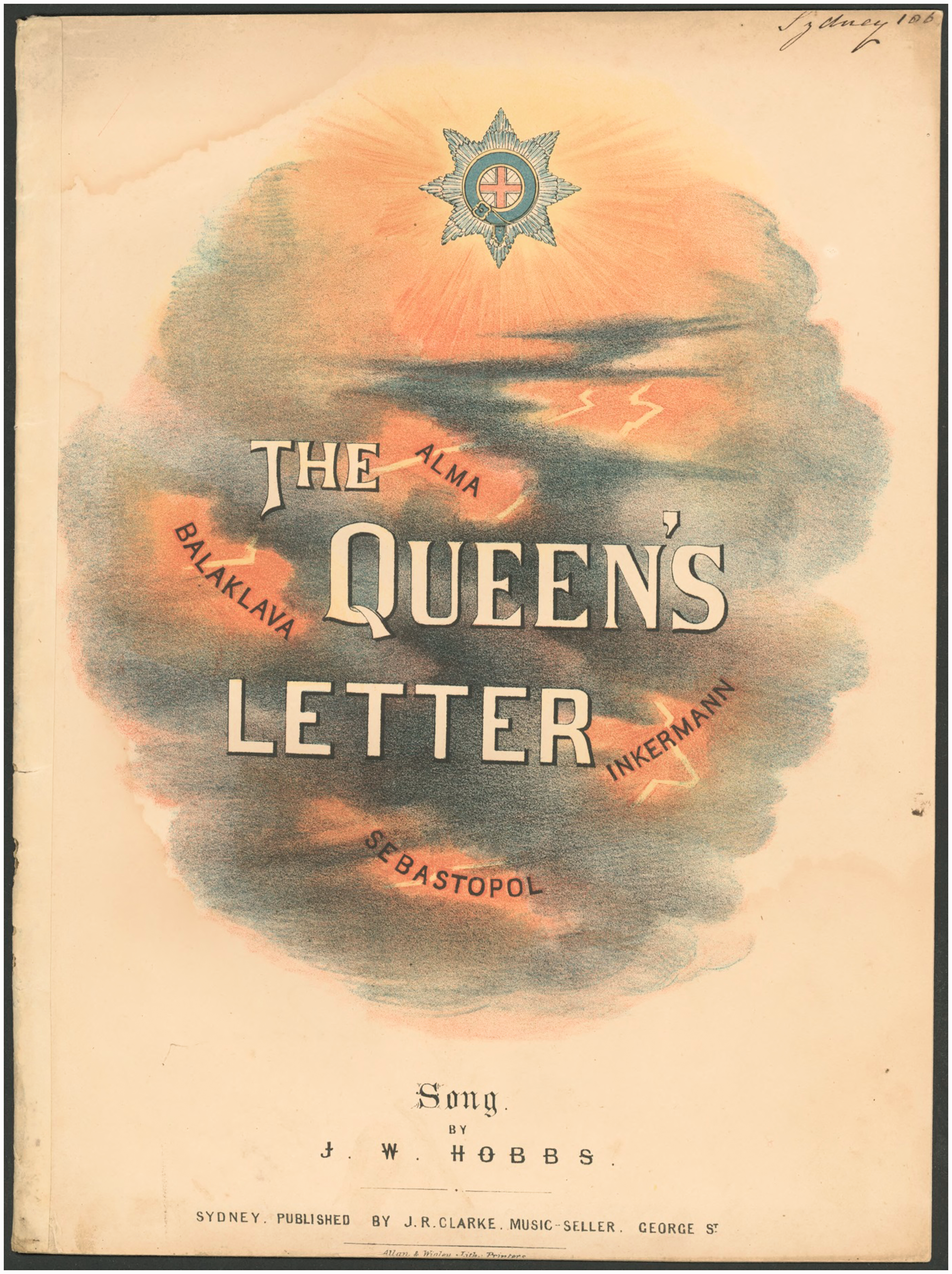
‘The Queen’s Letter’ is based on Queen Victoria’s letter dated 6 December 1854, a letter intended to be transmitted to Florence Nightingale in Istanbul. An extract from that hand-signed letter, signed ‘Victorially’, appears on the second page of the sheet music. In the original letter, the Queen describes her feelings and thoughts regarding the British officers’ conditions in the Crimean war, as well as her affection for her army (Figure 2). The song inspired by the letter is titled ‘The Battle of Inkerman’, or ‘There Came a Tale to England’, and appeared in full form in the Illustrated London News.
12
The Queen’s letter.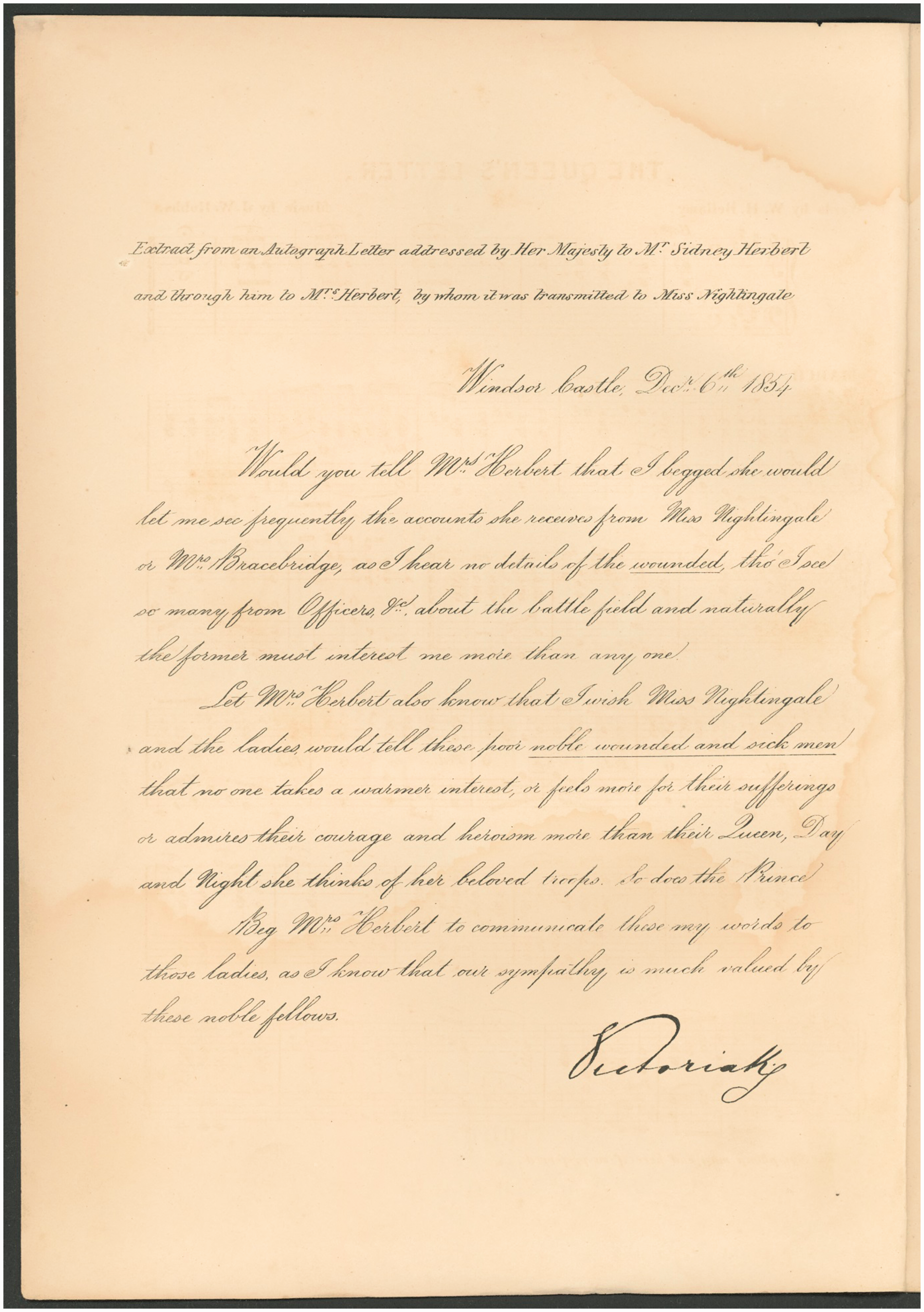
The song also includes a solo piano section of the English national anthem ‘God Save the Queen’, which appears on the third page of the piece and lasts for five measures, beginning with the 46th measure (Figure 3).
‘God Save the Queen’ section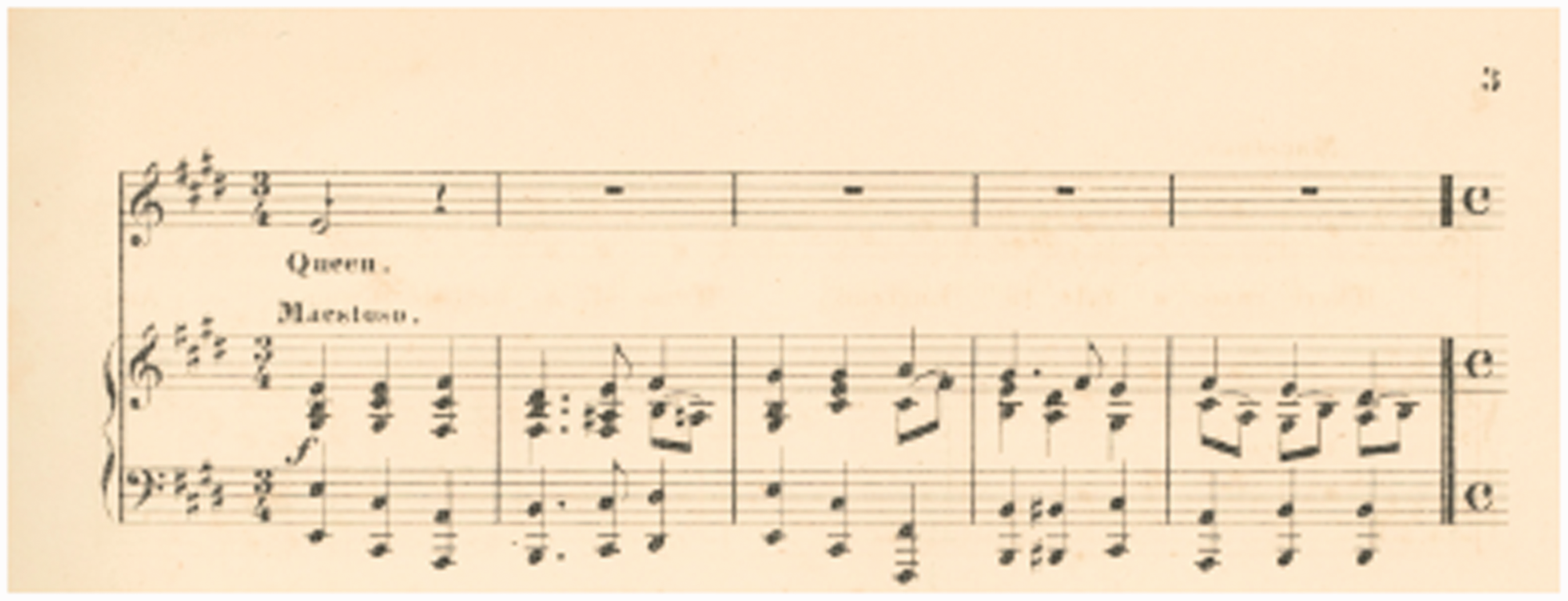
Another significant musical interaction event between England and the Ottoman Empire occurred upon the diplomatic visit of Sultan Abdulaziz to London in the summer of 1867. Sultan Abdulaziz was the first and only Ottoman ruler to visit England. Accompanied by Ottoman governmental officers, as well as by members of the dynastic family (including his succeeding sultans, Murad V and Abdulhamid II),
13
his aim was to strengthen the cultural and political relations between the two countries. Abdulaziz, as Queen Victoria’s royal guest, was hosted at a concert at the Crystal Palace in London, during which a British chorus of 1600 singers sang Italian Luigi Arditi’s (1822–1903) ‘Inno Turco’ (the Turkish Ode), sung in Ottoman Turkish in honour of the sultan. In August of 1867, The Musical Times reported the event as follows: Whether the words, which reached the Sultan’s ears sounded to him a bit like Turkish, we have no means of ascertaining: but as music is a universal language, we have little doubt that the notes at least found their way to his heart, and must have convinced him that his welcome to this country was not a mere matter of conventional form.
14
In addition to Luigi Arditi, musician Paul Cervati (1815?–1897) also appeared on Istanbul’s music scene. Cervati was a British tenor, pianist and composer-musician who worked as a music teacher at the Royal court in Vienna, giving concerts with celebrities like Pasta, Ungher and Rubini before settling in Galata, Istanbul.
16
His family was among the publishers of the Indicateur Constantinopolitain, the commercial guide of the Ottomans, and his name appears in all the yearbooks between 1868 and 1897 as a professor of chant under the ‘Music Professors’ column (Figure 4).
L’ Indicateur Constantinopolitain: Guide commercial 1868, Professors de Musique
Among his surviving Istanbul works is a triumphal march titled ‘La Palme Orientale/Marche Turque Triomphate’ (Figure 5). The Ottoman-Turkish heading on the cover page reads: ‘This victory march by Paul Cervati is dedicated to our precious grand master Sultan Abdulhamid II’. There is no date on the score, but as he composed the march for a victory in the name of Sultan Abdulhamid II, it must have been composed on the occasion of the Greco-Ottoman War, the Ottoman’s only victory during Abdulhamid’s reign.
17
Paul Cervati: cover of ‘La Palme Orientale/Marche Turque Triomphate’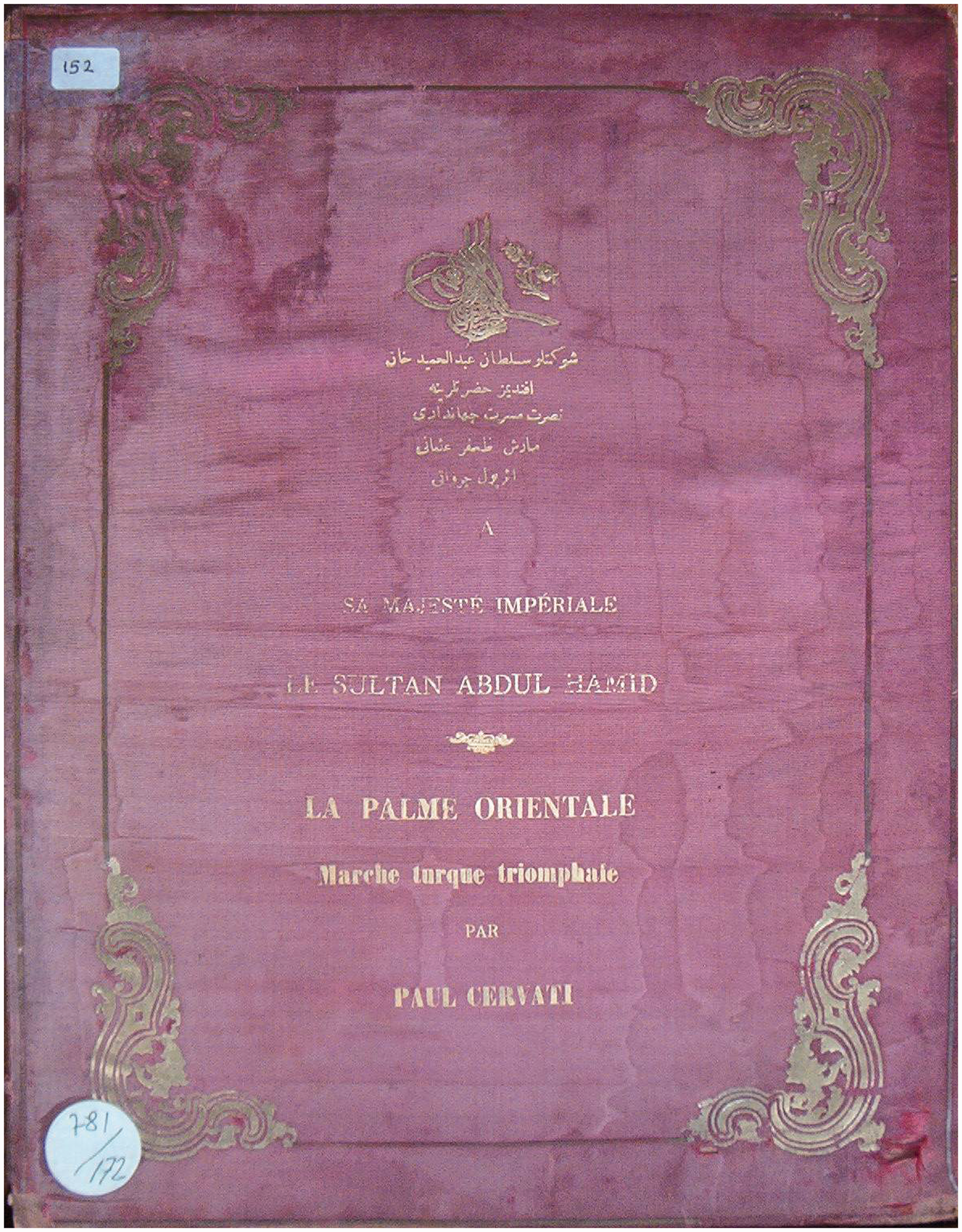
Other than British musicians residing in Istanbul, the Westernization movement of the nineteenth century also attracted the attention of world-renowned composers and virtuosos, who added Ottoman cities as stopping points along their concert tours. One of these well-known virtuosos, invited by Count Boutinoff, the Russian ambassador in Constantinople during the reign of Mahmud II, was the British composer-harpist Elias Parish Alvars (1808–1849). Alvars visited Istanbul in the spring of 1832 and remained in the city for about three months. His ‘Travel of a Harpist in the Orient Op. 62’ is a reminiscence of this visit. 18
A General Look at the Piano in the Ottoman Court, Social Life During the Reign of Sultan Abdulhamid II, and the Autopiano in Europe
The Ottomans had been interested in keyboard instruments for centuries, but the official and permanent employment of the piano in the Ottoman court or daily Ottoman life began with the nineteenth-century modernization movement. During this period, the piano became the central musical instrument of Ottoman interest. Its popularity as a solo instrument was also on the rise during the same century in Europe, where technical advancements in the development of the instrument were flourishing.
The piano initially found an interest at the Ottoman court and its circles, as well as among Ottoman citizens of European origin and high-ranking, well-educated Ottoman Muslim families. Beginning with Sultan Abdulmedjid, who played the piano, Western music and the piano acquired a permanent place in the education of the sultans and dynastic family members. Many European piano professors and performers travelled to Ottoman lands. In addition, many young Ottomans from socioeconomically and culturally well-to-do families travelled to Europe to receive formal piano training. Francesco Della Sudda Bey was one of these students. Sudda journeyed to Pest to study piano with the famous Hungarian pianist-composer Franz Liszt, who gave a concert in the summer of 1847 in Sultan Abdulmedjid’s (the father of Sultan Abdulhamid II) court. 19 Such students often returned to their homeland in order to train Turkish students. Towards the end of the nineteenth century, piano education became institutionalized through official and private initiatives, entering the formal curriculum. Thus, interest in the piano, which began with high-level bureaucrats and some scholars of Muslim Ottoman subjects, spread to the wider Muslim population due to the formation of mass culture and the mass market.
In addition to seeking formal piano training opportunities offered in governmental institutions, the public also sought informal training through freelance piano teachers, who often gave private lessons. As a result, amateur piano performances became one of the period’s dominant Western cultural codes. An article appearing in the Ottoman newspaper İkdam described the limited levels attained by such amateur pianists: As for the European [alla franca] music, without doubt, the melodies performed on the piano at homes are nothing less than the most vulgar polkas and quadrilles, and most of our pianophiles are instructed only enough to play the French and Italian operas and operettas and some very simple melodies; and it is hardly possible to find, if any, music lovers who are able to play technically difficult pieces composed by the masters such as Chopin, Beethoven, Mendelssohn, Rubinstein, and Liszt. Therefore, one would have to admit that the current state of European music instruction among our families is still in its infancy.
20
During the years when the piano functioned as an integral part of the music scene in Ottoman lands, Europe witnessed technological innovations in piano manufacturing, resulting in the production of the mechanical piano. A standard organological term for this technological instrument does not exist, but widely used terms for the mechanical piano include the autopiano, the player piano, the self-playing piano, and, later, the pianola. Due to technological developments, these mechanical instruments varied in terms of physical design, mechanism of sound production, cost, and the role and engagement of the user in regards to changes in tempo, dynamics and expression. The instrument acquired a self-playing pneumatic mechanism and an interface of pedals, levers and music rolls, which were controllable by the user. In the international piano market, an autopiano was positioned as a modern pianoforte with the added advantage that ‘even those who possess no technical ability over the keyboard at all can play the masterpieces’ of leading European composers, with the promise of ‘playing, replaying, studying, and lingering over’ them. The autopiano was of interest to professional pianists, too, because it could ‘also be played by hand’ and allowed its user to put his/her ‘own individuality into the composition’. 22
Unlike that of the conventional piano, the history of the autopiano among the Ottoman public is not well documented. Commercial sources documenting mass sales of the instrument reveal no data. Considering the relationship of the autopiano with the history of sound recording technologies, it is possible to argue that the phonograph (introduced to Istanbul by Sigmund Weinberg in 1895) was sold in limited numbers. To date, only six Istanbul stores which sold the phonograph pre-1910 have been identified. 23 Among other factors, technological constraints on the production and reproduction of phonograph records during Sultan Abdulhamid’s reign prevented the phonograph from becoming a powerful mass vehicle. Moreover, sales of the phonograph were tightly controlled, due to its potential of becoming a propaganda tool. Though even basic historical literature on Ottoman Western Music is limited, the history of the autopiano in the Ottoman Empire and the sound recording technologies which must have followed are research topics in their own right.
The English Autopiano of the Ottoman Court
Anglo-Ottoman musical interactions extended beyond England’s more recognized musical contributions. Among these was the involvement of English piano dealers at the Ottoman court. Two folders from the Turkish Prime Ministry Ottoman archives shed light on this issue. The first folder, dated 5 March 1907, contains 19 pages and is titled ‘Sultan Abdülhamid için Londra’dan Satın Alınan Otopiyanonun Gönderiliş Şekli, Özellikleri, Fiyatı ve Kullanılış Talimatı’ [‘The Shipment and Price Information, Features, and a User’s Manual of the Autopiano Bought from London for Sultan Abdulhamid II’]. It is catalogued as BOA Y.PRK.EŞA 50/18. 24 The second folder, dated 1 May 1907, consists of five pages and is titled ‘Londra’dan İki Piyano Satın Alınacağı’ [‘Two Pianos Will Be Bought from London’]. It is catalogued as BOA Y.MTV.298/3. 25
The first folder, BOA Y.PRK.EŞA 50/18, includes two receipts for an autogrand by Kastner & Co. Ltd. that was shipped to Istanbul on 4 March 1907: one covering information about the shipment expenses, and the other providing details of the shipped equipment. The paperwork includes three pages of directions regarding the unpacking and nine-step construction of the piano; a two-page repertoire list; one page containing the addresses of both the head office of Kastner & Co. Ltd. and the city branch at Salisbury House, London Wall; and three printed pages most probably gleaned from a publication. Of the last three pages, two of them covered ‘A few simple instructions for the correct playing of the autopiano’, and the third (titled ‘Miniature Dictionary of Musical Terms’) provided definitions of basic musical terms regarding tempo and dynamics. The instructions indicate that the basic musical terms provided relate to the main controllable elements of the autoplayer. In addition, the folder includes an informative, one-page diplomatic petition written in Ottoman-Turkish (Figure 6). All of the documents in this folder (other than the one-page petition), as originally sent by Kastner & Co. Ltd., are in English.
The manuscript petition in Ottoman-Turkish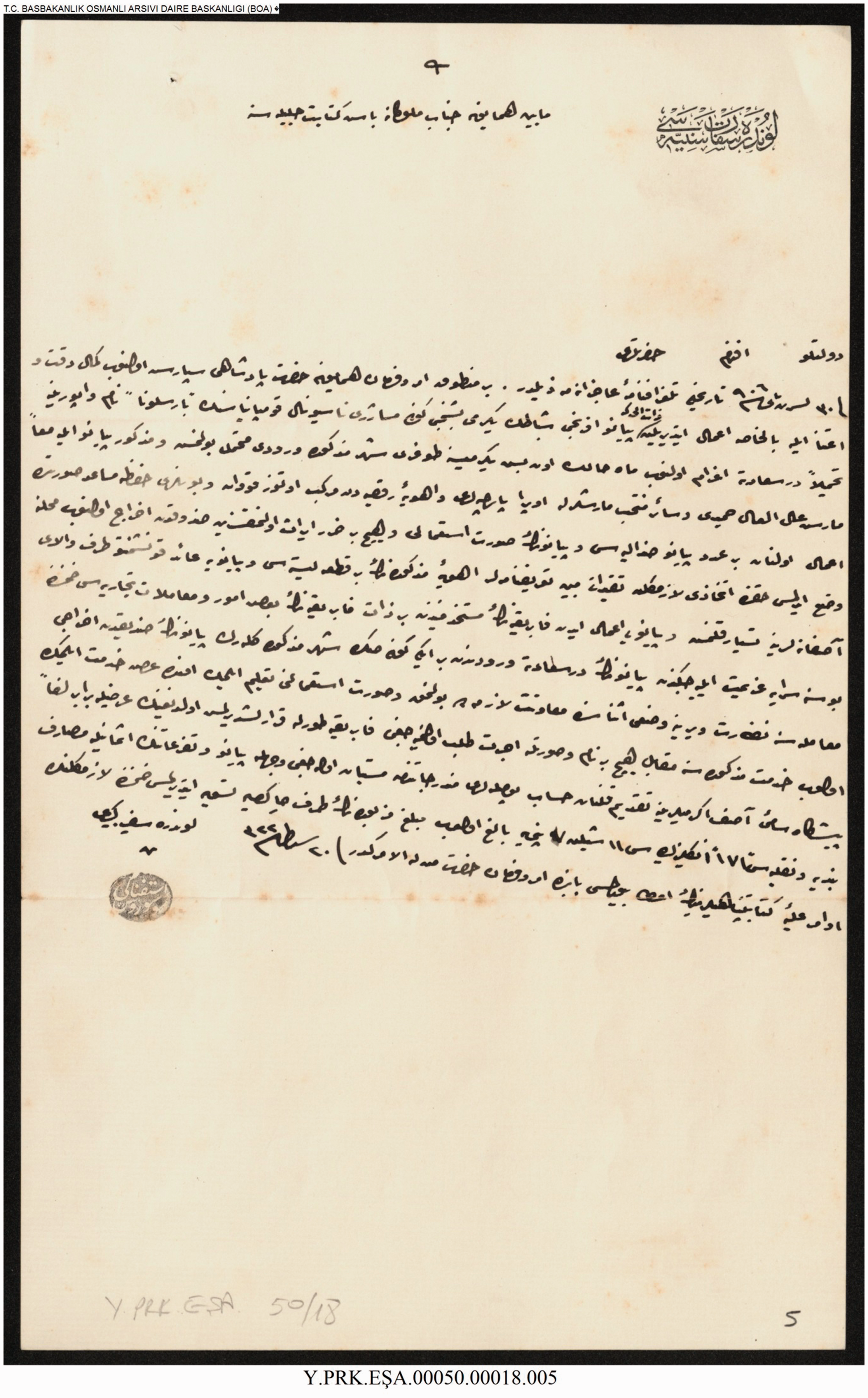
The one-page petition, dated 2 March 1907, is written to the principal clerk of the Ottoman Court, addressed to the Sultan and signed ‘Stefanaki’ by the Ottoman ambassador to London. It is titled ‘the supplement of the telegraph dated November 30th, 1906’. Without providing the name of the sending firm, it describes the order and shipment process of ‘a piano’: The piano built with special care and attention to the orders of Sultan, loaded on the Barcelona ship on February 25th, is on its way to Istanbul and is expected to arrive around 15th–20th of this month. Accompanying the piano, 30 trunks containing the Hamidie march and other distinguished marches, as well as European pieces; a piano bench able to house them; a piano cover; a user’s manual describing the transportation and usage of the piano; and the receipt of the piano are presented. Because one of the manufacturing firm’s employees has decided to visit the court this year to give information about the firm’s commercial matters, he will come to deal with the transportation and setup of the piano, two days after its arrival, without charge, as agreed with the manufacturing factory. It is on the orders of the Excellency to have the receipt of the manufacturing of the piano and its supplies, and its transportation that totals to 171 English Sterling, 11 Shillings, and 7 pence, to be paid.
26
The receipt of the shipment entries of the autogrand by Kastner & Co. Ltd. to Istanbul
Kastner & Co. Ltd. was established by Macarius Maximilian Kaestner, a German émigré to London, and was among the leading autopiano dealers of England selling the ‘Triumph’ piano, as seen on the receipt. Kastner (1876–1926) was also the inventor of the Autopiano expression system called the ‘Kastonome’, for which the firm filed a patent application on 20 November 1908, and received a patent on November 14, 1911. 27 All Kastanome-action pianos predate 1914, as the company was later restructured. After 1917, the company became Triumph-Auto before later amalgamating with Barrett & Robinson, the producer of the very last player made in England before World War I. 28
Kastner & Co. Ltd.’s autogrand made on the orders of Sultan Abdulhamid II may be the world’s second autogrand pianoforte that incorporated player action. In a letter dated 31 July 1907, sent to the Music Trade Review by Kastner, the firm mentions that the first sale was made in June 1906 and that they sold one to the Sultan of Turkey, for which he afterwards honoured their company’s secretary with the Order of the Medjidieh. 29 The earliest document regarding the sultan’s order was a telegraph dated 30 November 1906. This telegraph was included in the title of the first folder’s petitions. In their letter, the company identifies ‘one sale in June 1906’ and ‘one autogrand sold to the Sultan’, highlighting their unique position in the autogrand manufacturing business. As no Ottoman document before 30 November exists, and the firm only mentions two sales, we conclude that Sultan Abdulhamid’s piano was the second such piano made in the world, suggesting a close relationship between the Ottoman Court and Western music/technology.
On June 1, 1907, news of the new autopiano appeared in the Music Trade Review, in an article titled ‘Autopiano for the Turkish Court’. The article notes that Kastner & Co. Ltd.’s secretary travelled to Istanbul as the firm’s representative to explain the workings of the new autopiano designed for the sultan of Turkey. The article also mentions that, as a gesture of appreciation, the sultan bestowed the company’s secretary with the Order of the Medjidieh. 30 The petition does not identify the secretary’s name, but the article reveals that the firm’s representative at the time was D. Miller Wilson.
The shipment information mentioned in the Ottoman-Turkish diplomatic petition is also confirmed by the receipt. The left-hand side of the receipt identifies the ship as ‘Barcelona’, and the cost entities of the shipment to Constantinople (Istanbul) are listed as: ‘freight from London to port of landing, cartage to docks, wharfage, bills of landing, insurance, and customs formalities and clearance’. The receipt was billed to ‘His Excellency Musurus Pasha’ at ‘69 Portland Place, London W’. The identity of the Musurus Pasha can be confirmed by foreign diplomacy politics of the Ottoman Empire, as the above billing address is that of the Ottoman embassy in London. 31
The Ottoman embassy in London was established, in part, because of the Nizam-ı Cedid movement of Sultan Selim III, which precipitated changes in an understanding of foreign diplomacy regarding the establishment of a permanent embassy system in major European cities. This permanent embassy system extended the modern Westernization movement to align Ottoman and European practice. By that point, the Ottomans did not wish to establish embassies in Europe. Opening in 1793, the first Ottoman embassy in London appointed Yusuf Agah Efendi as its first ambassador on 23 July of the same year. He served there until 1797. 32 Adopting the ideology of the Nizam-ı Cedid movement, Ottoman embassies in central European cities functioned as diplomacy and information exchange venues. One of the aims of permanent residences was to observe European civilizations in order to follow administrative, financial, military and sociocultural advances, including those in music. Ottoman embassies in Europe also acted as venues for cultural interaction and exchange. 33 An early musical example of such exchange is ‘The Turkish Ambassador’s Grand March’ of 1794, composed by the famous British composer William Peter Richard Cope (1770–1812) and dedicated to the first Turkish ambassador in London, Yusuf Agah Efendi. 34 The composition’s purpose may have been to celebrate and show appreciation to the earliest foreign appointment of the Ottoman court.
Names appearing in London’s Ottoman diplomatic history identify the embassy charged with the autopiano order. London’s Ottoman embassy history reveals two Ottoman ambassadors with the last name ‘Musurus’ – Kostaki Musurus (1807–1891), who served between 1851 and 1885, and Stefanaki Musurus (1841–1907), who served between 1903 and 1907.
35
Kostaki Musurus was an Ottoman diplomat of Greek origin who married the daughter of Stefanaki Vogoridi – one of the most prominent and powerful statesmen of the Ottoman government and therefore an important influence in Kostaki Musurus’ career. From this marriage, Kostaki Musurus fathered six children – two boys and four girls. Especially interesting is his son Stefanaki (named after his father-in-law), who also became a diplomat (specifically, the later Ottoman ambassador to London) and whose name appears on the autopiano bills. Also of interest is his daughter Rachel (Ralou) (1847–1923), who became a famous pianist and was even introduced to Sultan Abdulaziz (r. 1861–1876) by her father, after which she performed several concerts for the sultan. Rachel Musurus married the Romanian Prince Gregoire Brancoveanu in London on 28 May 1874, and continued her music career there.
36
An interesting musical connection to Rachel Musurus is the famous Polish pianist, conductor and composer, Ignacy Jan Paderewski (1860–1941), who was among the frequent visitors to the Brancoveanu family home.
37
After the death of Prince Brancoveanu, Princess Rachel (Musurus) Brancoveanu, described by many as passionate and intriguing, had a love affair with Paderewski.
38
Paderewski dedicated many of his compositions to Rachel, including his ‘Op. 19 Polish Fantasy on Original Themes for Piano and Orchestra’, composed in 1893 and published by Bote & Bock, Berlin, in 1895 (Figure 8).
I. J. Paderewski, ‘Polish Fantasy on Original Themes for Piano and Orchestra Op. 19’, Bote & Bock, Berlin (1895)
In a memoir written by her 12-year-old daughter, Anna de Noailles, Rachel Brancoveanu’s appearances in musical arenas with Paderewski are described as ‘The Golden Aura in Great Receptions’. The memoir describes Rachel’s musical and Oriental background and points, through Chopin, to a ‘Polish’ connection between Rachel Musurus and Padarewski: After his performance on 3rd March, 1888 in the Erard concert hall, Paris was enthralled by Paderewski, as it had been by Chopin half a century earlier. His arrival chez Princess Rachel de Brancovan – whose roots reach all the way to the gates of the Orient – caused quite a stir. ‘Crowned in light, his eyes attuned to the stars, a magus appeared before us, and we loved him’ wrote Anna de Noailles, daughter of the great aristocrat, then twelve years of age. Rachel de Brancovan had studied with Camille Dubois, Chopin’s last student. Generous and refined, she was perhaps his most faithful muse. She would regularly invite him to Amphion, near Evian, where she owned a sumptuous mansion. She later facilitated his Riond-Bosson acquisition, across the lake.
39
The Ottoman-Turkish diplomatic petition of the second folder (Y.MTV.298/3), dated 1 May 1907, clearly shows Stefanaki Musurus’ signature (Figure 9). A translation of this document reads: To the principal clerk of the Ottoman Court
The manuscript petition in Ottoman-Turkish I would like to submit that Kastner & Co, the manufacturer of the autopiano made on the orders of the Sultan, is kindly asking for the payment of the two receipts, one of which shows the manufacturing cost of the autopiano, as well as the cost of its track, and trunk, and the other indicating their shipment cost as a total of 171 English Sterling, 11 Shillings, and 7 Pennies. May, 1, 1907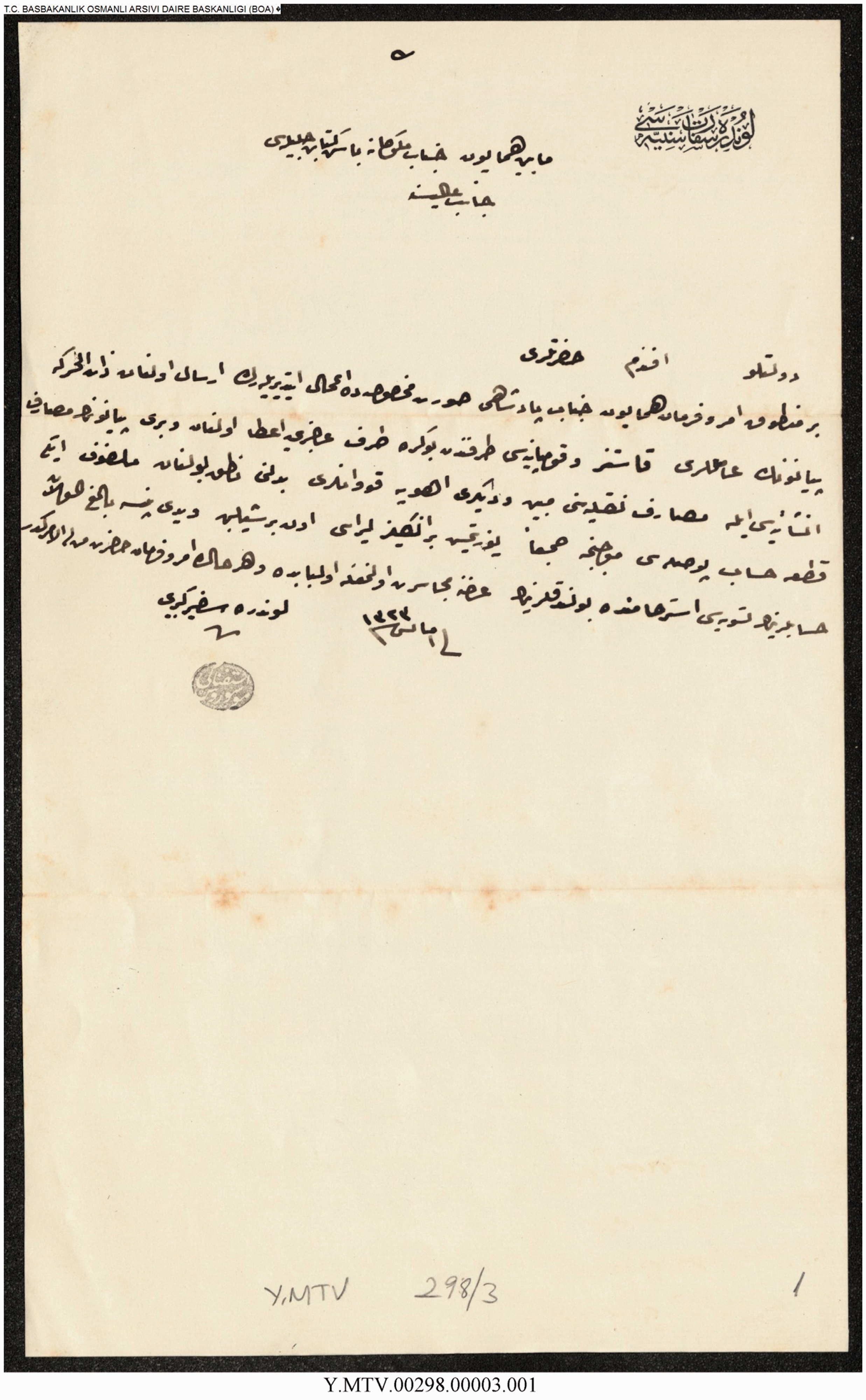
As mentioned in the petition, the payment was not made by 1 May 1907, even though the receipt accompanying the petition shows that the autopiano had arrived at the Ottoman court by 30 April. Therefore, Kastner & Co. Ltd. must have later resent the receipt to the Ottoman embassy in London.
Compared to the one in the first folder, receipts nos 2 and 3 from the second folder contain more detailed information concerning the date(s) of the manufactured items, including the rolls (Figures 10 and 11). Because the petition in the first folder reads ‘the supplement of the telegraph dated November 30th, 1906’, the orders to manufacture an autopiano for Sultan Abdulhamid must have been initiated at that time. In addition, the first folder’s documents indicate that the piano was shipped on 25 February 1907. As indicated in the last receipt of the second folder, the ‘Rosewood’ autopiano (numbered 10834), in addition to one Ottoman stool, were finished and ready to be sent on January 22 (Figure 11). However, the music rolls that were ordered by demand of the sultan were ready on 22 February. Therefore, the entire order must have been packed and shipped on 25 February and must have been ready for freight and cartage on 4 March 1907.
The receipt of the rolls The receipt of the autopiano and its transportation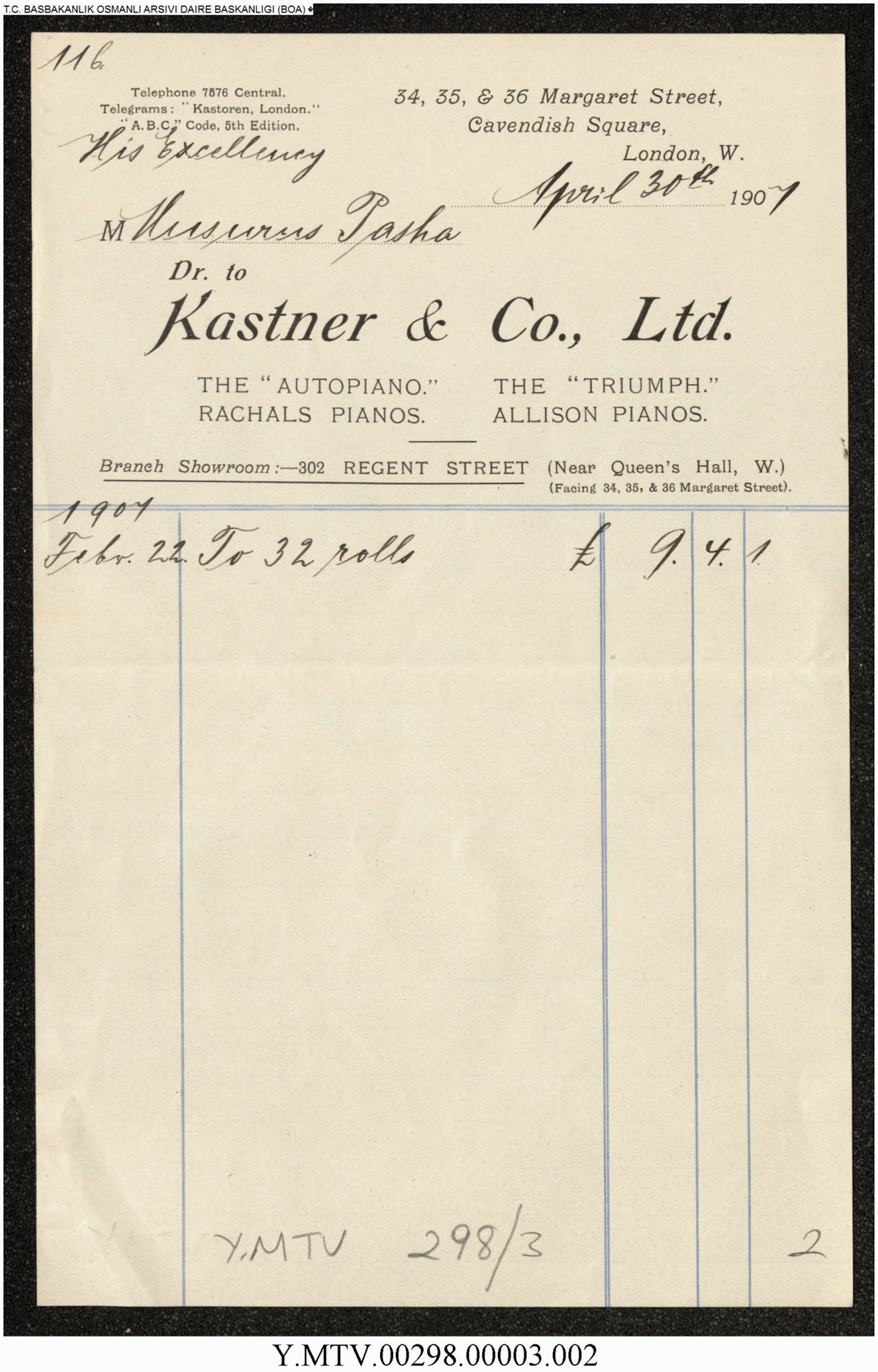

Evaluation of the Purchase of the Autopiano from England
Sultan Abdulhamid’s purchase of an autopiano from England can be evaluated in four different contexts: (1) its appropriateness to his own musical taste, cultivation, and interest; (2) its appropriateness to Tanzimat ideologies and modernization; (3) its service to the ‘contemporary Ottoman’ image in subverting patterns of orientalism; and (4) its function of maintaining good political relations between the Ottoman Empire and Britain. The following sections discuss each of these contexts in more detail.
(1) The Sultan’s Interest in Music
Prompted by the encouragement of his father, Sultan Abdulmedjid, a student of Donizetti and lover of Italian operas and operettas, Sultan Abdulhamid II began taking piano lessons when he was a young boy. Sultan Abdulhamid II’s music teacher, court musician Paul Dussap (1840–1922), expressed his opinions about the sultan’s musical taste and interests in a news article from the Timaru Herald, dated 4 June 1877. In the article, he states, ‘The sultan likes the piano with stringed quatuor. After playing a few pieces thus arranged, he generally asks me to sing and talks of music’. 43 Dussap had composed a march for the sultan, which, at his request, was very similar to his father’s own march. During the interview for the article, Dussap played the march on the piano and spoke of Sultan Abdulhamid II’s musical expertise. He mentioned that ‘the sultan had made several little changes’ to the march before authorizing him to have it scored for a full orchestra. Unless the sultan was very busy, there was always music in the evenings. 44 The same article, written by a correspondent of a London newspaper, appeared in The New York Times on 2 April 1877, under the title ‘A Sultan’s Fondness for Music’. In the article, the writer mentions that the sultan had inherited his father’s (Sultan Abdulmedjid) fondness for music 45 and that ‘he had a turn into mechanics’. 46
Another insight into Sultan Abdulhamid’s musical politics appeared in an article of the local newspaper La Turquie. Written by Bartolomeo Pisani, a contemporary Ottoman musician of Italian origin who once served as the master of the Imperial Conservatory Muzıka-yı Hümâyûn, the article sheds light on the role of Western music in the Ottoman Empire during the nineteenth century. An excerpt from the article appears below: A prejudice has long reigned in Europe. Fortunately, this prejudice tends to fade away, but not yet entirely. The prejudice in question is as follows: It is believed that the art of music in Constantinople is still in an embryonic state, the Orientals have very little or no artistic intelligence, we [Ottomans] accept everything imported from foreign countries as they are, we value them and admire them above anything, and we cannot distinguish between either the better among the mediocre or mediocre among the bad. This is indeed a serious mistake. First to speak of our Glorious Sultan [Abdulhamid II], Our Sultan admires music and Oriental music in particular. His Majesty is clever enough to invite and attract to his Imperial Court anyone with a true gift. A famous artist does not pass through the city without being invited to the Imperial Court, where His Majesty listens to him with the attention of an expert and then honours him with his unique generosity and grace. We have many distinguished concertists, pianists, violinists, cellists, etc. who long ago chose to reside in Constantinople. These famous artists and teachers honour this sublime art, and represent it with great dignity and glory. We also have amateur [dilettante] ladies who could perfectly replace piano virtuosos. There are extraordinarily beautiful voices, young ladies and young people in the high society and among the middle class (here in Pera) who are ardently and enthusiastically studying the art of singing under the guidance of masters and there is no need to mention their names as they are already well-known. This is a fact evidenced by the spectacular concerts of last winter [1888] performed by all such locals. In considering all parts of the society, one should not hesitate to say that Constantinople can well match any European city in the field of music. B. Pisani
47
Sultan Abdulhamid’s interest in piano music and Italian operas can be traced back to his daughter Sultan Ayş e Osmanoğlu’s memoir in which she quotes her father’s words: My greatest fun is to listen to music. I don’t feel my tiredness if I am busy with it … When I was young, I was interested in playing the piano. My father brought pianos from Europe for all of his children. We had Italian and French music teachers in our court. I studied for a long time. Although I loved music a lot, a hectic life didn’t allow me to put the necessary time into it.
49
In his article titled ‘The Last Days of Sultan Abdulhamid II’, Ziya Şakir speaks of the sultan’s musical knowledge by quoting the sultan, himself: ‘I love and know music. First let me say that I have a good knowledge of musical notation. Moreover, I play the piano pretty well. I also play some violin … I especially like operas and operettas’. 51
The era of Sultan Abdulhamid witnessed advances which fostered the development of Western music in Ottoman lands; one such advance was the establishment of the first private conservatory in Istanbul. Located in Beyoglu Pera, on Ensiz Street, the school was opened as a Western music conservatory which adhered to regulations parallel to its counterparts in Germany. It was managed by Paul Lange, the German instructor of Muzıka-yı Hümâyûn. 52 It was during Sultan Abdulhamid’s era that the Stravolo family, an Italian opera ensemble, was permanently appointed to the court theatre – the first permanent appointment of the time. The Sultan invited many European troupes to perform famous European operas and operettas at his Yildiz Palace Theatre. He also hired Turkish musicians to compose indigenous operas, watching their performances with admiration. In his court theatre, concerts, operas and operettas were regularly performed on Friday, Sunday and Wednesday evenings; sometimes, performances were held every evening of the week. He especially enjoyed watching operas such as Rigoletto, Il Travatore, La Traviata, Mignon, Norma, Carmen, Faust and La Mascot. 53
Unfortunately, Sultan Abdulhamid II’s music collection was destroyed after he was banished to Selanik and the Yildiz Court was plundered. His autopiano bought from Kastner & Co. did not survive, and no images of the instrument were found in the archives. In her memoir, the sultan’s daughter, Ayş e Osmanoğlu, speaks of her curiosity concerning the ends of the music collection, which consisted of hundreds of pieces for piano and orchestra. 54
Tracks (ordered as listed in the original document), their genres, composers and represented nationalities
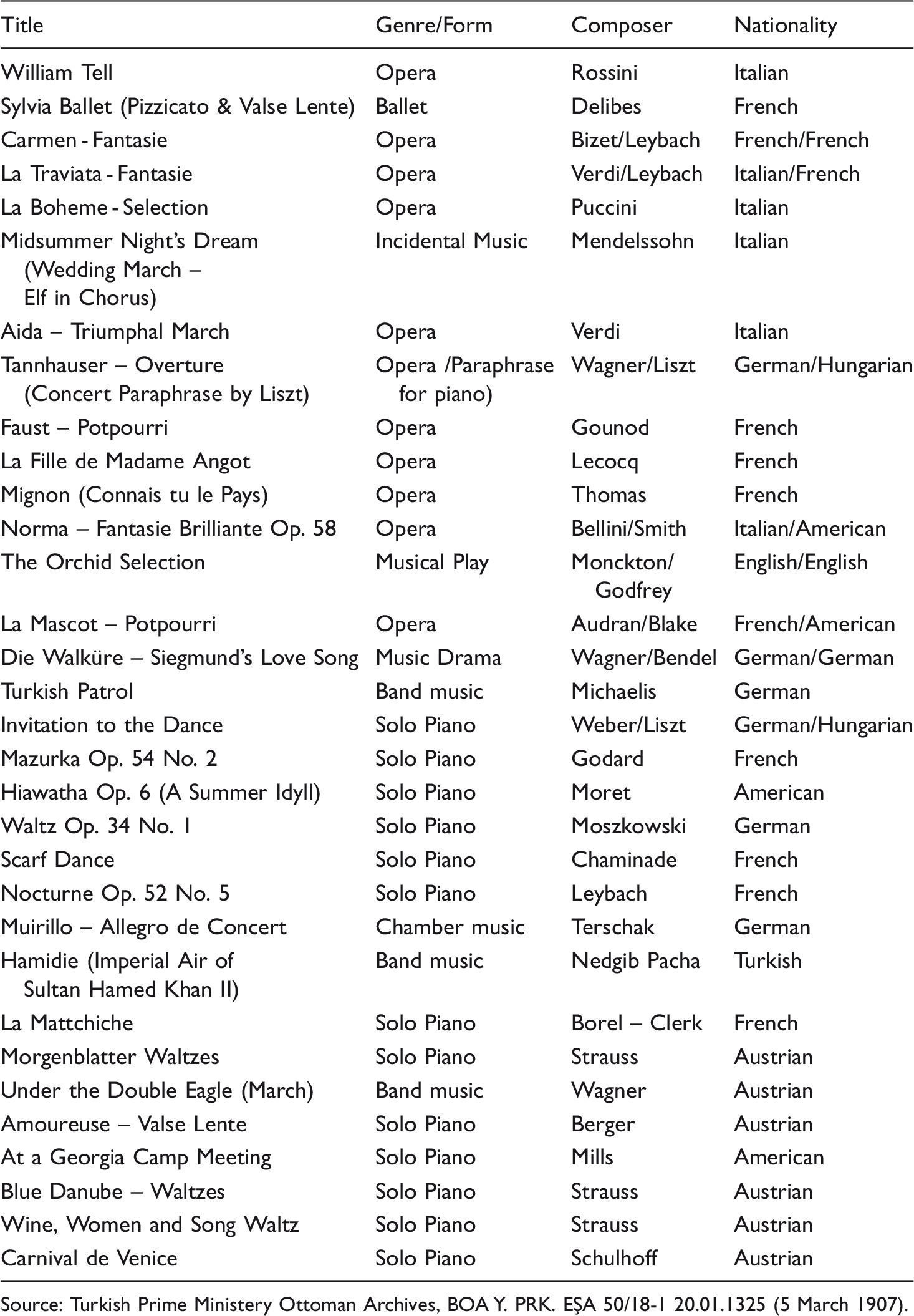
Source: Turkish Prime Ministery Ottoman Archives, BOA Y. PRK. EŞA 50/18-1 20.01.1325 (5 March 1907).
The sultan’s list of tracks consists of 32 pieces, 55 most of which are popular salon musical compositions and lighter pieces of the era. These include genres such as waltzes, potpourris, selections, mazurkas and dances by composers such as Leybach, Weber-Liszt, Godard, Strauss, Chaminade, Moszkowski and Moret. The list also includes selections from famous Italian operas and ballets, such as overtures, fantasies, arias and works by composers including Rossini, Delibes, Wagner and Verdi. Keeping in mind that the sultan grew up in his father Sultan Abdulmedjid’s palace, admiring Italian opera, the choices of tracks showcase the sultan’s musical taste and culture, as well as the national schools that introduced Western music culture to the Ottoman Empire. The tracks also represent countries such as England, the United States, Austria and Hungary, all of which had a considerable impact on music during the Ottoman Empire.
Ottoman Western music was founded with the Italian school in the Ottoman Empire; this was followed by the French school during the mid century and the German school towards the end of the century. Among the pieces in the sultan’s track list, two reflect Ottoman identity. The first of these ‘trademark’ Ottoman pieces is the ‘Hamidie March’ (also described in the list as the ‘Imperial Air of Sultan Hamed Khan II), composed by Nedjib Pasha, a student of Giuseppe Donizetti. This piece was the official governmental march of the Ottoman Empire and served as the national anthem during the reign of Sultan Abdulhamid II. The tradition of composing a governmental march in European form began in 1828, when Giuseppe Donizetti was appointed director of Muzıka-yı Hümâyûn. The first march written in such a context was the ‘Mahmudie March’, composed by Donizetti for Sultan Mahmud II, who set in motion the era of modernization. The tradition continued throughout the history of the Ottoman Empire.
The second Turkish-inspired piece – Michaelis’ ‘Turkish Patrol’, also known as ‘Die Türkische Schaarwache’ – must have been quite popular at the time, as it is among the pieces that symbolized Ottoman identity, just as the ‘Hamidie’ did during Sultan Abdulhamid II’s reign over Turkish lands. The ‘Turkish Patrol’ was performed by the military band in a concert in Bosnia on the first evening of music and drama by the Society of Islamic Youth (Udruženje islamske omladine). The performance was held in the Sarajevo Association House on 11 April 1908, and was meant to ‘offer a case in point for the musical symbolism the organizers utilized’. According to Pennanen, ‘Ottoman marches and many Orientalist compositions were instrumental in symbolizing the Bosnian Muslim identity and demonstrating the hope of the Muslim and Serb anti-Habsburg opposition for the resurgence of Ottoman authority’. 56
Also included in the sultan’s track list are two pieces which are British in origin or inspiration, both of which underline the sultan’s musical taste, cultivation and interests, as well as his musical consubstantiality associated with the West. The first of these pieces, ‘The Orchid Selection’, was composed by Ivan Caryll (1851–1921) and Lionel Monckton (1861–1924) and arranged for piano by Dan Godfrey. It was also an Edwardian musical comedy in two acts and was the first show performed at the Gaiety Theatre in London on 26 October 1903. 57 The second piece is Mendelssohn’s ‘A Midsummer Night’s Dream’, based on the Shakespearean comedy. Sultan Abdulhamid II had a deep interest in Shakespeare’s works, especially his tragedies and comedies. He even hosted famous Shakespearean actors Italian Ernesto Rossi and Ermete Novelli in the Yildiz Court Theatre in 1899. Due to censorship, they were not permitted to perform Macbeth, Hamlet or King Lear, but, according to Rossi’s memoir, the sultan had tears in his eyes when Desdemonia was killed and Othello committed suicide in the performance’s fifth act of Othello. 58
(2) Tanzimat Ideology
In addition to musical innovations and an appreciation of Western music and its instruments, technology was highly regarded by the Tanzimat. In fact, Tanzimat ideology embraced anything ‘new’ with great enthusiasm. According to Dinçkal, ‘In a world that was increasingly influenced by European powers and Western culture, the strategy of the Ottoman Empire was to preserve the empire’s integrity by adapting Western science, technology and organizational structure. The ‘progress of civilizations’ should be brought to the Ottoman capital, at least to its wealthy quarters’. 59 Accordingly, the arrival of musical invention to the Ottoman court was supported by Tanzimat-era ideologies, both technologically and artistically. But Sultan Abdulhamid’s understanding of modernization had its limits: progress did not directly epitomize Westernization. The sultan’s interpretation of modernization overlaps with Jacques Berque’s analysis of Lévi Strauss’ theory, one which describes ‘the existence of a civilization of every social group, the existence of a multitude of cultures all around the world, and the existence of potential equality for development among these cultures’. According to this analysis, any culture can find strategic opportunities for entering the industrial world without self-alienation. As such, every culture is able to reconfigure/recycle its identity without becoming a stranger to itself. All societies must be technological – not Western – or die. 60 Sultan Abdulhamid’s foreign music policy was based on the principal that Western music and its elements should be learned from Europe, while at the same time developing local practices. In addition to his efforts to develop Ottoman Western music (as mentioned above, Ottoman artists were ordered to compose Western music works and their productivity was supported by hosting their performance in the court theatre), his support of expressing/rearranging traditional, monophonic Ottoman music works with Western tools, along with his support of local piano manufacturing, are reflections of this understanding.
The sultan’s support of the carpenter Mehmed of Kastamonu is one example of how local piano manufacturing was encouraged during his reign. When Kastamonu’s governor bought one of Mehmed’s pianos and sent it to Sultan Abdulhamid as a gift, the sultan, who was highly impressed, took Mehmed and his family to Yildiz Palace and commissioned him to work in his joiner’s house. One of the pianos produced by Mehmed during the sultan’s five-year reign between 1904 and 1909was perhaps the most interesting among the sultan’s numerous gifts to German Emperor Wilhelm II. When Sultan Abdulhamid II was deposed from the throne after the declaration of the Constitution, Mehmed’s duty in the Yildiz Palace joiner’s house ended, and he returned to Kastamonu. 61
According to Berque’s concept of ‘recycling’, countries on the receiving end of scientific technology should make creative attempts to learn from and adapt to the science and technologies they receive from ‘science transmitter countries’. The ‘science receivers’ can also invite the transmitters to their country for a more hands-on experience. In keeping with this idea, the sultan’s autopiano purchase from the prominent English autopiano manufacturer of the era, along with his royal acceptance of a visit from the firm’s representative, reflect the sultan’s interest and curiosity in the technological advancements of Europeans and the processes behind them.
(3) Orientalism and the Ottoman image
Edward Said defines latent orientalism as the unintentional and unquestionable acceptance of the West. Manifest orientalism, on the other hand, refers to the dependency on direct, concrete definitions of Western discourse. 62 To this end, the association of Western music with wisdom, universality and civilization can be interpreted as latent orientalism. According to this view, in an age when the new and the modern were given a premium, the criteria for distinguishing between ‘old’ and ‘new’ music was the degree of its relationship to Western music. Sultan Abdulhamid II’s music policy adopted the principle of avoiding both latent and manifest orientalism – that is during the era’s Ottoman Westernization, the state did not force all aspects of society to become fully Westernized. While introducing the necessary framework for the learning and spreading of Western music, the state also supported traditional culture and identity, allowing both the West and the East to function alongside each other. 63 Palace practices also reflect this attitude.
The imperial music institution Muzıka-yı Hümâyûn supported an education in both Ottoman Western music and in traditional branches of Ottoman music. 64 While supporting Westernization, the Ottomans avoided latent orientalism by maintaining their own musical identity. They also made efforts to challenge the prejudices of ‘already existing’ latent orientalism from the West. 65 Haruta identifies the player piano as a symbol of upward social mobility. Participating in the consumption of an autopiano, therefore, indicated high social standing and wealth, 66 implying economic power, contemporaneousness and cultural compatibility with such social groups. In this sense, imperial expenditure was strategically functional. The social implications of purchasing an autopiano were meant to overturn latent orientalist prejudices and a view of the West as ‘other’. It was also meant to position both the sultan and the Ottoman Empire as equals among other European rulers and countries.
Manifest orientalism, on the other hand, determined that the piano, even the state-of-the-art autopiano, was not and could not be a part of Ottoman music culture. According to a Western understanding of Ottoman musical taste, Ottomans’ distance from European music can also be considered manifest orientalism. 67 In this context, the purpose of the autopiano’s purchase, as well as its use, might be considered an effort to demolish such assumptions. Containing famous European pieces by contemporary European composers, the documented track list would prove that the Ottomans had a similar, even equal, musical taste with Europeans. The existence of the polyphonic ‘Hamidie’ march, the Ottoman governmental march, showed that the Ottomans were representing their national identity with European tools, rather than with the monophonic structures of ‘old’ traditional Ottoman music. Thus, if Western music and its components were identified with a universal sense of civilization and progress, then the Ottoman Empire was a part of this civilization.
(4) The Political Relationship between Britain and the Ottoman Empire
The purchase of the autopiano from England in 1907, on the eve of the 1908 revolution, was also an effort to position the sultan and the Ottoman Empire alongside England in domestic and foreign matters. The Ottoman bureaucracy of the nineteenth century modernization period followed polices that favoured England against the Russian threat as they did during the Crimean War. Ottoman statesman Fuad Pasha, who played a prominent role during the renovation processes, describes the politics of the Ottoman court at the time: Among our foreign allies, the most important one is England. Her foreign politics and friendship, as well as her political institutions, are strong. Since England has helped and served us tremendously, we cannot renounce her. Whatever happens, England, the most patient and solid nation of the world, will be our most prominent ally.
68
Young Turks admired British institutions, ideals, and the British public, and were saying that they were inspired by England. They often showed their feelings towards us with sincerity; at that time we had a place more important than anyone in the heart of the Turks.
71
Conclusion
In short, although the purchase of the autopiano may seem to be a primarily music-related one, it also reflects the historical, social and political issues and dynamics of the last years of Sultan Abdulhamid II’s reign, as the date on which the piano was ordered falls at a significant turning point in Ottoman history. This purchase symbolizes the struggle of the Ottoman Empire – embodied in Sultan Abdulhamid II – for survival against aggressive external and internal political pressure and the Orientalist prejudices of the West. It also represents the Ottoman Empire’s efforts to create a contemporary Ottoman image through the sultan’s own interpretation of Tanzimat ideologies.