




Abstract
Gaining and sustaining support for novel ventures is a vital yet difficult entrepreneurial process. Previous research on this topic has generally focused on the social competence and social capital of those creating new ventures, and their ability to align their ventures, with collective norms of novel ventures as sensible, acceptable and legitimate. We suggest that sensegiving – the ability to communicate a meaningful course for a venture – to investors and employees may also play a direct role in achieving support for a venture. Based upon a micro-ethnographic study of two individuals who were in the process of creating new ventures, we demonstrate how they give sense, to others in real time that involve not just their speech but also their gestures. Overall, we find evidence that in the early stages of the commercialization of a venture, metaphors in both speech and gesture are consistently used to emphasize agency and control and the predictability and taken-for-grantedness of a novel venture.
Introduction
How do individuals seeking to create novel ventures gain and sustain support? How do they convince others of the feasibility of any new venture in the absence of a proven track record, obvious asset value and profitability? Previous efforts to answer these important questions have considered the social capital and competence of these individuals (social competence) (Baron and Markman, 2003), their ability to draw attention to symbols and symbolic actions that align the venture with commonly held cultural understanding and norms (symbolic impression management) (Zott and Huy, 2007) and their use of canonical narratives that refer to ventures as following a predictable trajectory set in space and time (entrepreneurial narratives) (Martens et al., 2007). Here, we suggest that another aspect of behaviour – the ability to actively create and give sense when communicating to others, in real time, through speech and gestures – may also influence success in gaining and, sustaining support for new ventures. The basis of our argument is as follows: while social and cultural capital (as based on reputation, social networks, awards and so on) are important in sustaining support, they emphasize the use of symbols, impression management techniques, and canonical narratives that align with the already existing configuration of the social context and what are perceived to be common, institutionalized understandings and norms of whether and how ventures are sensible, acceptable and legitimate (Aldrich and Fiol, 1994; Lounsbury and Glynn, 2001). In other words, these traditions emphasize a sociolinguistic conception of entrepreneurial communication and impression management where the symbols and language (for example, canonical narratives) that individuals use are seen as an outgrowth of social categories and social processes of disseminating and sharing information (Putnam and Fairhurst, 2001). The main challenge for the new venture creator is to make symbolic associations and evoke cultural frames that ‘encode’ the criteria for legitimacy by tapping into the already existing collective consciousness on ventures and relevant industries (Aldrich and Fiol, 1994; Rao, 1994). The main limitation of this emphasis, therefore, is that it tends to equate acts of symbolic impression management with outcomes (for example, resource acquisition) and thus implies a bias towards specific, particularly later stages of commercializing a venture. A further limitation is that these traditions focus on socially shared symbolic or linguistic repertoires (Putnam and Fairhurst, 2001) and there is thus less focus on how individuals are able to make sense of and give sense to novel ventures in natural contexts of interaction (Baron and Brush, 1999; Baron and Markman, 2003). When widely shared institutional frames are absent because of the novelty or dynamism of the industry in which the venture will be based, those creating new ventures have to rely upon their own speech and visual presentation (Baron and Brush, 1999), including their gestures, to naturalize their venture and to provide a compelling and convincing rationale that accounts for its existence and appeals to others for their support. We refer to this as sensegiving, broadly defined as the deliberate attempt to shape the interpretations of others (Gioia and Chittipeddi, 1991) when communicating in a natural context. Sensegiving in entrepreneurial contexts consists primarily of the use of speech and gestures in face-to-face communication that convey meanings to others and help explain, rationalize and promote the support for a new venture (Hill and Levenhagen, 1995; Lounsbury and Glynn, 2001). Such sensegiving makes the venture intelligible to others and, in the absence of a performance trajectory or established industry benchmarks, is likely to consist of inductive metaphorical reasoning (Hill and Levenhagen, 1995) that generates an understanding of the novel venture. Lounsbury and Glynn (2001: 549) emphasize that in the early stages of commercializing a venture individuals have ‘to make the unfamiliar familiar by framing the new venture (often through metaphor and analogy) in terms that are understandable and thus legitimate’. In this article, we build on Hill and Levenhagen (1995) and Lounsbury and Glynn (2001) and develop theory on how, in contexts of natural interaction, metaphors in speech and gestures are used to compress the often uncertain and complex development of novel ventures into familiar categories or scenes and how, in doing so, individuals attempt to emphasize to others the predictability and taken-for-grantedness of a novel venture and their own agency and control. The context for our theorizing involves the development of independent new ventures that are not sheltered by sponsoring organizations (for example, a spin-off). By definition, such ventures are associated with high levels of uncertainty which force individuals to give sense and make their enterprise comprehensible and meaningful to key constituencies, in an effort to confront low levels of legitimacy that arise from a lack of performance history and business referents. In these circumstances, using metaphors (figurative language that represents one thing in terms of another) to attribute known characteristics to new ventures increases the ability of constituents to make sense of a new venture, reduces uncertainty associated with the venture and increases others’ confidence in the abilities of the creator of the new venture (Hill and Levenhagen, 1995).
We conducted micro-ethnographic studies of two individuals who were in the early stages of commercializing ventures in novel, emerging industries, which allowed us to systematically examine the use of metaphors in their speech and gestures. A detailed focus on the language and gestures through which individuals give sense to new ventures is unique in entrepreneurship research and provides the foundation for two contributions. First, we make a distinctive substantive and methodological contribution in studying gestures alongside speech in contexts of natural interaction. Gestures are an important, although often neglected, part of the communication of individuals seeking to create a new venture (Baron and Brush, 1999) and involve a different modality of expression than speech. Gestures can also be metaphorical and hence where they are co-produced with metaphoric speech, offer converging evidence, along with the language, of the cognitive metaphorical processing of two domains. Second, we build an understanding of how new venture creators use metaphors to filter their own experiences and construct meaning for themselves and others by compressing the development of novel ventures into familiar categories or scenes. We demonstrate how metaphors in speech and gestures are systematically used in acts of sensegiving and how they may serve important cognitive functions in reducing uncertainty about the predictability and control of the new venture and in naturalizing the existence of the venture. These functions suggest that the use of metaphors, when used systematically, may help those creating new ventures to address directly the high levels of uncertainty and low levels of legitimacy that typically exist when novel ventures are launched (Aldrich and Fiol, 1994).
Sensemaking and sensegiving in entrepreneurial contexts
We conceptualize sensemaking and sensegiving in an entrepreneurial context as a cognitive linguistic process through which individuals make sense of markets and rationalize to themselves and others opportunities for commercial exploitation (Hill and Levenhagen, 1995). Such an approach leads us to focus on how language patterns in sensemaking arise from, and reveal, cognitive processes of categorization and framing (Kaplan, 2008; Weick et al., 2005). Here, ‘sense’ is conceived of as a cognitive process by which creators of new ventures draw parallels between domains of knowledge, expand their current knowledge and familiarize themselves and others with new, previously unrecognized possibilities (Cardon et al., 2005; Cornelissen, 2005). When individuals make or give sense about novel ventures to others, their use of metaphors, far from being simply a figure of speech or embellishment of spoken or written language, function as organizing principles of thought and experience. They may draw upon conventional domains of knowledge or may creatively combine or string metaphors together to produce an emergent meaning for themselves and others (Cornelissen, 2005).
Individuals who are creating new ventures ‘operate at the edge of what they do not know’ (Hill and Levenhagen, 1995: 1057) and as such they must seek to make equivocal events non-equivocal by constructing a new vision or mental model of the business environment (Gartner et al., 1992) and communicate this vision to others in order to gain their support (Lounsbury and Glynn, 2001). When they ‘make sense’ of their ideas they simultaneously construct accounts that help ‘give sense’ and justify a new venture to potential constituencies (Aldrich and Fiol, 1994; Lounsbury and Glynn, 2001; Martens et al., 2007; O’Connor, 2004; Porac et al., 2002). Pointing to this connection between thought and language, Hill and Levenhagen (1995) proposed that because new venture creators need to make their ideas public their sensemaking and sensegiving are intimately connected. We also do not draw too sharp a distinction between the private thought (sensemaking) and public posturing (sensegiving), as communication to others in context (what we label as sensegiving) integrates social pressures for justification with linguistic and cognitive processes of sensemaking.
In this process of sensegiving, metaphors are crucial to how individuals make sense of their own ideas, transfer these ideas to the public domain and help relevant others to build their own understandings of the novel venture in order to achieve ‘shared cognition’ (Aldrich and Fiol, 1994; Hill and Levenhagen, 1995; Lounsbury and Glynn, 2001). Despite this recognition, however, there has been very little direct research on how metaphors are used in natural contexts of interaction where individuals are trying to give sense and direct the interpretations of others regarding a new venture. Most prior research on metaphors in entrepreneurial contexts has focused on how venture creators, or other informants, may use metaphors to describe the general phenomenon of entrepreneurship or to what extent they felt that it could be aptly described with cultural metaphors such as journey, parenting, theatre or warfare (Anderson, 2005; Cardon et al., 2005; Down and Warren, 2008; Hyrsky, 1999; Koiranen, 1995; Mason and Harrison, 2000; Nicholson and Anderson, 2005). Down and Warren (2008) have criticized the use of such hyperbolic metaphors to characterize entrepreneurial activities and point out that this stream of research is not specifically focused on venture creators’ own speech in natural contexts of communication. It also tends to ‘de-contextualize’ metaphors in that the focus is on identifying metaphors that are used across speakers (for example, media journalists, individuals who have previously created new ventures, lay people) and contexts of language use and on abstracting cognitive meanings that are shared across such contexts. In fact, most claims about the existence of particular conceptual metaphors of entrepreneurship have been based on lists of de-contextualized sentences, all supposedly realizing the same underlying mappings in the minds of the speakers involved (Semino et al., 2004). For example, both Nicholson and Anderson (2005) and Dodd (2002) analysed the metaphorical depiction of entrepreneurs in the genre of media reports and business publications, de-contextualizing the use of particular metaphors (at the level of a specific utterance in context) within individual articles by bringing them together in coherent categories of conceptual or cognitive meaning. A similar approach exists in Pitt (1998) in whose work idiomatic expressions and words in narratives of entrepreneurial activities are judged to be metaphorical and categorized into coherent role models for those seeking to create new ventures. Doubts, however, have often been expressed when researchers extrapolate too readily from identified metaphors in a text, to suggestions of systematicity in metaphor use or of cognitive structure, particularly when different individuals and contexts (for example, media reporting, interviews and so on) are involved (Cornelissen et al., 2008). The danger of course is that when researchers make such leaps, the gains in generality (abstraction within and across texts and contexts) are offset by losses in accuracy (a close fit with the data in context). Oswick et al. (2004: 121) articulate this danger as follows: ‘researchers often develop a laundry list of metaphors, ones that are detached from their constitutive context and their dynamic relationships’ within speech or a produced text. Besides such inferential leaps, researchers often also do not provide criteria for specifying what is, and what is not, metaphorical in the context of their study. This is problematic as intuitions about language use have been found to be variable and not at all a good guide to motivations and cognitions behind recorded uses of language (Sinclair, 1991).
In general, then, the research that exists on metaphors in entrepreneurial contexts has not focused on how individuals creating new ventures, in actual contexts of natural interaction, use metaphors as part of their sensegiving to others. In turn, research on sensegiving in entrepreneurial contexts has at times unwittingly recorded metaphors – for example, Martens et al. (2007: 1118) recorded metaphors of embodied movement and the physical manipulation of markets and economic relationships as if they were objects in initial public offering (IPO) prospectuses – but has neglected to theorize about their role in gaining support from relevant constituencies (Lounsbury and Glynn, 2001). For these reasons, we decided to systematically examine the use of metaphors in natural contexts where individuals who are creating new ventures are speaking to, and trying to persuade, constituencies.
Metaphors in gestures alongside speech
Besides metaphors in speech, an often neglected but powerful source of metaphorical data is the gestural track that is habitually co-produced with spoken language. Gesture not only accompanies language but is seen as an intrinsic part of cognitive processing. As McNeill (1985: 351) notes: ‘the whole of gesture and speech can be encompassed in a unified conception, with gesture as a part of the psychology of speaking, along with, and not fundamentally different from, speech itself’. Gestures are defined here as idiosyncratic spontaneous movements of the body (particularly the hands and arms) that accompany speech and offer unique access to some of the less conscious aspects of the cognitive processes underlying language (McNeill, 2000, 2005). In addition, gestures, like words, can represent metaphoric mappings between domains. Gestures may be considered metaphoric when they refer to abstract notions in terms of a physical form or movement (Calbris, 1990; Cienki, 1998; Cienki and Müller, 2008a, 2008b; McNeill, 1992; Mittelberg, 2006; Núñez and Sweetser, 2006; Sweetser, 1998; Webb, 1996). As the previous research in cognitive linguistics shows, metaphoric gestures may or may not be accompanied by metaphoric speech. Therefore, where individuals co-produce metaphoric gestures and words, the gestures offer converging evidence, along with the words uttered, of the cognitive metaphorical processing of two domains. A significant implication of these observations for this study is that where indeed metaphoric gestures parallel metaphoric speech they provide strong confirmation of the active use of a particular metaphor in an individual’s language and thought. Gesture, therefore, provides another window into understanding how those creating ventures structure their understandings, and how they use those structures when constructing accounts for others.
In addition, gestures can also illustrate the metaphoric content of highly conventionalized verbal metaphors which are often identified as ‘dead’ metaphors as they are deemed to no longer have a metaphorical use. Hence, gestures which enact the source of a conventionalized verbal metaphor can provide evidence that individuals are employing conceptual metaphorical categories when using these conventionalized metaphors (Müller, 2004a/2008). Without an understanding of metaphoric gestures such linguistic metaphors may be dismissed as being of little importance in the cognitive processing and sensegiving of individuals when creating new ventures. The fact that metaphors may be realized in gestures alongside or independent of speech adds support to the assumption that the creation of metaphors is based on a general cognitive principle rather than being the property of language alone (Cienki, 1998; Lakoff and Johnson, 1980, 1999; Johnson, 1987; Müller, 2004a/2008). Hence, metaphors may best be understood as cognitive images that are embodied in the multiple modalities of speech and gestures. A joint focus on gestures and speech also avoids the criticism of circularity levelled against cognitive linguistic approaches to metaphor (Cienki, 1998; Cornelissen et al., 2008). As Gibbs and Colston (1995: 354) note: ‘psychologists often contend that cognitive linguistic research suffers from circular reasoning in that it starts with an analysis of language to infer something about the mind and body which in turn motivates different aspects of linguistic structure and behavior’. In response, Cienki (1998: 190) argues that
the study of spontaneous gesture (as well as dreams, non-verbal arts and other cultural practices) is important for metaphor theory because it breaks the vicious cycle of saying that verbal metaphoric expressions are evidence of conceptual metaphors, and then saying that we know that because we see conceptual metaphors expressed in language. Gesture, and other non-verbal means of expression, can serve as independent sources of evidence of the psychological reality of conceptual metaphors.
Examining venture creators’ gestures is not only useful in terms of identifying conceptual metaphors in the cognitions behind their language use but is also consistent with our focus on natural contexts of interaction where gesture is ‘an integral part of an individual’s communicative effort … [and] has a direct role to play in this process’ (Kendon, 1983: 27). It, therefore, may also offer insights into how individuals seeking to create new ventures convince others of the efficacy of their activities. In contexts of communication, gestures may convey certain meanings more directly or more strongly than the metaphors in the accompanying speech in that they present schematic, imagistic representations of scenarios, which can be comprehended holistically, rather than in a possibly more analytic or linear way when expressed in speech. McNeill (1992) emphasizes the holistic, analogue nature of gestural representation in contrast to the digital nature of symbolization via words. Gesture and speech therefore appear to share the burden of conveying information, with at times information given gesturally having a higher impact and being better remembered than information given only verbally (Beattie, 2003; Beattie and Shovelton, 2001). This suggests that metaphoric mappings embodied gesturally may also be understood as metaphors by others and hence are useful in formal presentations and other face-to-face communication to relevant constituencies such as prospective and current employees, customers and investors (Baron and Brush, 1999; Mason and Harrison 2000). In the present study, we consider metaphoric speech and gesture jointly and in doing so aim to obtain a more comprehensive and detailed insight into the use of metaphors in the sensegiving of individuals creating new ventures than could otherwise be obtained.
Method
Theoretical sampling
We conducted a micro-ethnographic study of two individuals in the early stages of venture commercialization, as it provides a clear sensegiving imperative (Corley and Gioia, 2004) in the absence of a proven track record. We selected two individuals who varied in terms of their experiences of creating novel ventures and in their experience of the new industry they were entering. The first individual (representing Coupland Technologies, and who is referred to throughout as CT) had previously set up two highly successful wire manufacturing companies, which supplied fire resistant and specialty wires for large contracting companies and was in the process of commercializing a new venture that specialized in the development of aerospace products. In terms of his understanding of the aerospace industry he had some insight into these technologies through his previous experience in wire manufacturing. The second individual had no prior experience of venture creation (from XYZ Software, and so referred to throughout as XYZ) and was in the process of developing and commercializing a range of products that bring television and recording facilities through the internet on multi-resident sites. These products were based on a novel technology and XYZ had no previous experience in commercializing these types of products. His previous experience was that of an in-house software developer. This variation was seen as important because of the potential significance of an individual’s prior experiences and prior knowledge of an industry in legitimating the feasibility of the new venture to themselves and others (Rao, 1994; Zott and Huy, 2007). Finally, the two individuals that we selected were both located in the North of the UK. We focused on a confined geographical area to minimize sample variation beyond the mentioned variance in experience of new venture creation and industry-specific experience.
Data and interpretive procedures
Speech and gestural data were collected through videotaped micro-ethnographies of the two venture creators (Streeck and Mehus, 2005). A micro-ethnographic approach consists of studying and recording behaviour ‘in the wild’. Each individual was videotaped in his own natural setting and while he was engaged in interactions that would have happened whether or not a video camera was present. Within this approach, data analysis focuses on the micro activities of speakers; the significance of how and why their words and actions take place within a given context and for what purposes in relation to interactants (Goodwin, 2000, 2003). In our study, the ‘micro’ part of the analysis consisted of a detailed examination of the metaphors in speech and gestures within interactions with constituencies.
One of the authors spent one month as an observer in each company, shadowing each individual in his interactions with employees, customers and financiers. These interactions were all recorded on videotape, with the exception of a few sensitive instances where it was requested that the video camera be left behind. Both venture creators were also interviewed on at least five separate occasions, where in the presence of the observer they reflected upon particular incidents that had happened that day or reflected more generally upon their own role as creators of novel ventures, upon the venture itself and upon the involvement of employees and external constituencies. These interviews lasted between 50–90 minutes and were not structured: the individuals themselves selected the topic and direction of the interviews and only when there was a noticeable silence or end to their talking did the observer step in and ask them a further question about the topic or trigger a further elaboration through summative feedback. The intention behind the unstructured interview format was to capture uninterrupted and online sensegiving in speech and gestures where frequent breaks through questioning could have led to turns in the sensemaking or rhetorical moves such as summarizing and contrast. The series of interviews were completed within the month spent at each site. Approximately 60 hours of raw videotaped interviews and interactions were obtained, and later digitized and captured for audio and video analysis. We began the micro-analysis (Erickson, 1995) by parsing the data into topic-relevant turns to facilitate and focus the analysis. Specifically, we focused on turns in the speech related to the topics of the development and commercialization of a new venture. Table 1 provides a brief description of these individuals and their ventures and details on the data collected in each company.
Cases, Videotaped Interactions and Interviews per Case
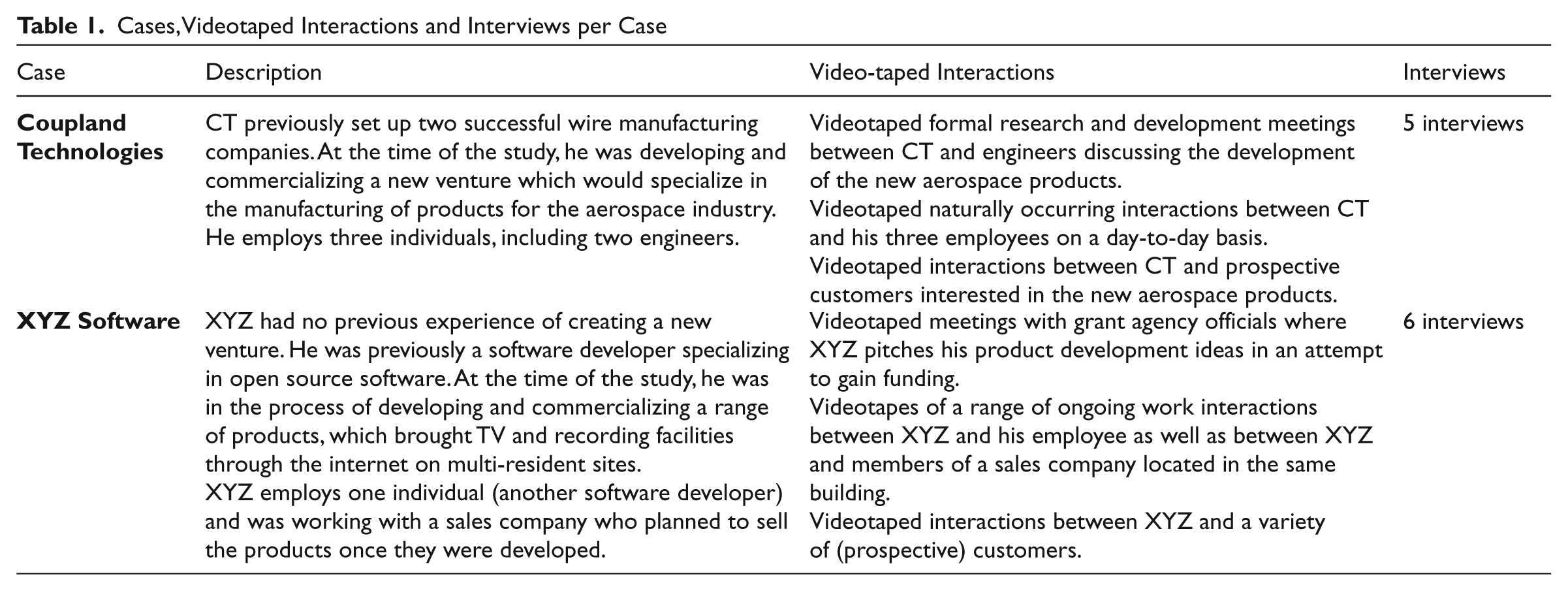
The metaphors in speech and in gestures were independently identified and interpreted by the three authors. These two separate analyses were then brought together to reveal patterns in metaphorical language and gestures (separately) and to identify parallel use within these modalities. We compared the two analyses and in an iterative fashion travelled back and forth between the combined data sets and an emerging structure of theoretical interpretations. Specifically, our analysis consisted of two main steps: (1) the independent identification and coding of metaphoric language and gestures; and (2) a systematic comparison of identified metaphorical words and expressions and gestures. Once we had compared the metaphors in speech and gestures, we integrated our observations and delimited our theoretical interpretations.
Identification and coding of metaphors in topic-relevant speech and gestures
Two of the authors independently identified novel and conventional metaphors in the topic-relevant turns in speech. Both these authors are trained metaphor analysts with a working knowledge of the academic entrepreneurship literature. In the context of speech, a metaphor was defined as the use of a word or expression (as single lexical units) that does not literally apply to the topic that was spoken about in the context of the speech. This often involves words and expressions that have a contextual meaning that is different from their basic and most conventional meaning (Pragglejaz, 2007). Using this definition, both coders identified all words and expressions that could potentially be metaphorical, including classical idioms, delexicalized verbs (for example, make, have and get) and prototypical prepositions (for example, in, on, into). Many such words and phrases may be labelled as ‘dead’ or idiomatic metaphors (Bowdle and Gentner, 2005), but our concern was with metaphorical potential and not to decide at the outset whether actual instances of production and interpretation involved active metaphorical processing by individuals. In fact, as we have argued, natural language data alone only seldom offer evidence that would allow the analyst to infer active metaphorizing. The two coders then discussed the identified metaphorical foci, and in relation to 23 cases of initial disagreement (metaphorical foci that were not identified by one of the two coders) consulted a dictionary (in line with the Pragglejaz [2007] procedure to reach agreement). Both coders subsequently identified an associated source domain for each metaphorical word or expression to interpret the underlying metaphor and to document the frequency with which a particular source domain was used within the speech. For example, when the serial creator of new ventures (CT) talks about the venture having ‘to
The gesture coding and analysis was performed by the third author with the most experience in this area, and was done without consulting which words had been coded as metaphorically used in the procedure described above. Transcripts which showed the marked sections on the topic-relevant turns in the interviews and naturally occurring interactions (and not any coding of metaphorically used words) were used to guide the viewing of the topic-relevant parts of the videos for gesture coding. The focus was on individual gesture strokes, the phase of gestural movement which displays the most distinct exertion of effort (as opposed to the preparation leading up to it or the retraction of the hand after it) (Kendon, 1980, 2004). The stroke phase also provides the most information for determining a gesture’s likely primary function (its ‘meaning’) (McNeill, 1992: 375–376). Looking at the stroke phase, a functional system of coding gestures was used to classify them (as in Cienki [2005], adapted from Müller [1998]) which focused on the distinction as to whether gestures could be identified as making reference (to some person, physical thing, quality, relation or movement) or not. Those gestures not in this category may be serving pragmatic or discourse-structuring functions, such as making emphasis or distinguishing one point in the co-occurring speech a different from one made previously; in this categorization scheme the primary function of such gestures is not judged to be referential. The referential gestures, however, are subdivided into two types as to whether the image in the gesture relates to a physical, concrete referent based on the content of the speech, or whether the image is being used in a metaphoric way to refer to an idea, thus an abstraction (see Kendon [2004: 170] on this distinction). The latter category, abstract referential gestures, which are inherently metaphoric, were the focus of the coding here.
The next step was to identify what the images in the abstract referential gestures refer to, since in many cases these can be taken as the source domains of the metaphors being used. However, there is a challenge in using words to characterize what gestures are interpreted to represent, given that their essence is embodied shapes and movements. One way of making the process more systematic and valid is by focusing first on describing the forms and movements in a given gesture and then interpreting what that form or movement might represent (Müller, 2004b). The gesture’s form can be described in terms of parameters which are increasingly common in the gesture literature, drawing on research on signed languages, namely: which hand (left, right or both) is involved, the hand shape/finger configuration, the orientation of the palm of the hand and the location of the gesture in space relative to the speaker (McNeill, 1992; Mittelberg, 2007). Following this, the forms and movements of the gestures were interpreted in light of the speakers’ words, focusing on the utterances closest in time to the gesture, but not limited to those. Metaphoric gestures sometimes occur with metaphorically used words, but also sometimes with non-metaphoric language (Cienki, 1998). Given the schematic nature of most gestures’ form, the referents (the source domains of the metaphoric gestures) were characterized most of the time in schematic terms as well (for example,
Comparison of identified metaphorical words, expressions and gestures
After the coding and categorization of verbal metaphors and metaphoric gestures as above, the two annotated datasets were brought together and compared. First of all, the two coders for the verbal metaphors did a close reading of the gesture annotation and the gesture coder did the same for the verbal annotation. We then collectively discussed each individual as a separate case, and drew on common observations and fragments from the verbal and gesture annotations to interpret acts of sensegiving and to form provisional categories of metaphor usage across the videotapes. We began by identifying parallel use in metaphorical language and gesture (where the two are more or less co-timed) and then drew on the annotation of verbal metaphors and metaphoric gestures that appeared separately to form broad categories of metaphor usage. First of all, we identified three general categories of how metaphors were used which we define as the form of metaphor use. Besides (1) the use of isolated metaphorical words, expressions or gestures, we identified systematic uses of metaphors in the form of (2) metaphor clusters (the elaboration or reiteration of the same underlying metaphor within multiple metaphorical expressions and gestures across an account) and (3) metaphorical combinations (defined as the elaboration of multiple metaphors in a coherent combination of metaphorically used words and gestures across an account). The category of isolated metaphors often involved metaphors or idiomatic expressions that were used for pragmatic or discourse-structuring purposes. In contrast, the active clustering or combination of metaphors suggested a cognitive purpose in formulating and expressing an idea (about the venture) to others. These clusters or combinations are not a random assortment of words or phrases that venture creators are pulling together, but ones which cohere in their entailments. This lends support to the argument that creators of new ventures are not only aware of the source domains (such as
Results
Coupland Technologies
The individual (CT) in the first ethnography had previously set up two successful companies which specialized in the manufacturing of a range of fire resistant and specialty wires for large contracting and building companies. At the time of the study he was in the process of commercializing a new company which focused on designing products for the aerospace manufacturing industry. In particular, the novel venture was focused on the design of products for military defence and other governmental work, including the production of component parts for aircraft, missiles and space vehicles. Given his background in wire frame manufacturing, he was familiar with the aerospace industry and had previously worked with other companies pursuing similar technologies. At this stage of development, the company had some products ready to bring to market. However, they were still largely in the process of researching and prototyping a number of aerospace products. Against this background, our intent was to document the different metaphorical representations, or constructions, of the venture formation process across the interviews and naturally occurring interactions between CT and his employees and (prospective) investors. A standard repertoire of metaphors in both speech and gestures surfaced during the analysis and was consistently found in his everyday language. Table 2 lists the dominant metaphors that were systematically used by CT in his sensegiving about the novel venture. All of these metaphors were marked in simultaneous gesticulation. Figure 1 illustrates the gesticulation for one of these metaphors.
Coupland Technologies: Repertoire of Metaphorical Representations of the Venture

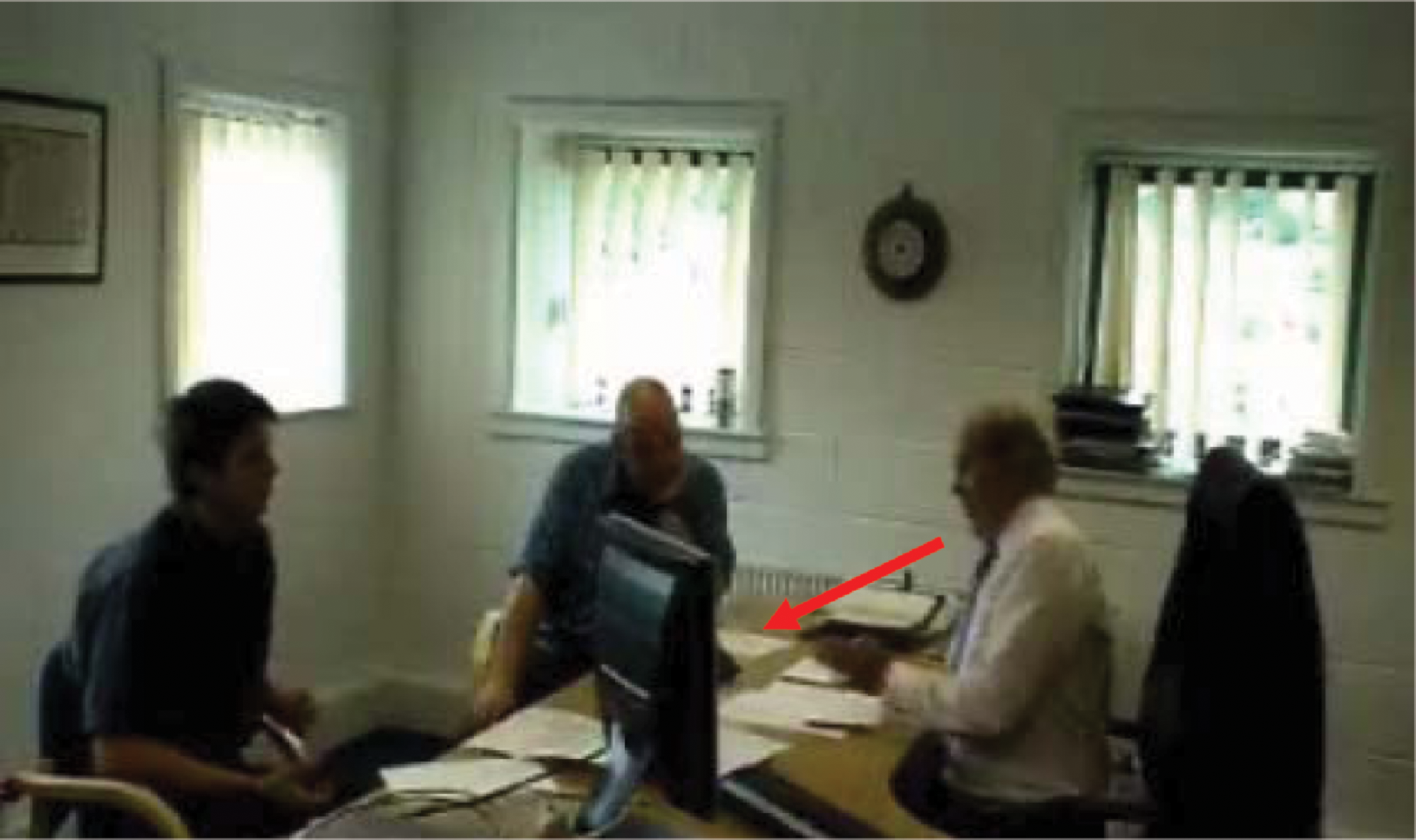
Development of Technology as Movement (see Table 2)
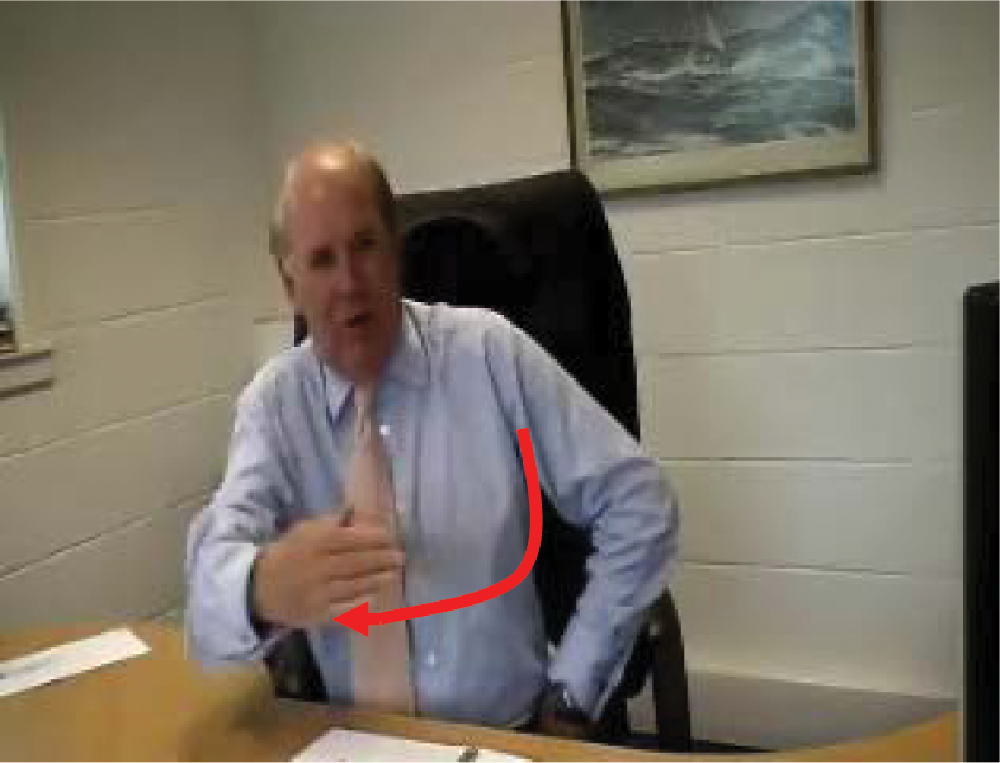
Knowledge Trail (gesture 1d)
While CT came from a scientific background (he was previously a meteorologist) he was not a trained engineer but sought to guide his engineering staff in the design of aerospace technology and help them to bring products to market within a limited time span. In the extract below he explains his sensegiving about the novel venture to employees. Metaphorically used words and expressions are underlined with the related source domains in capitals. Metaphoric gestures are numbered and visually represented in Figures 3 and 4.

Cycle of Opportunity Identification and Exploitation (gesture 1h)
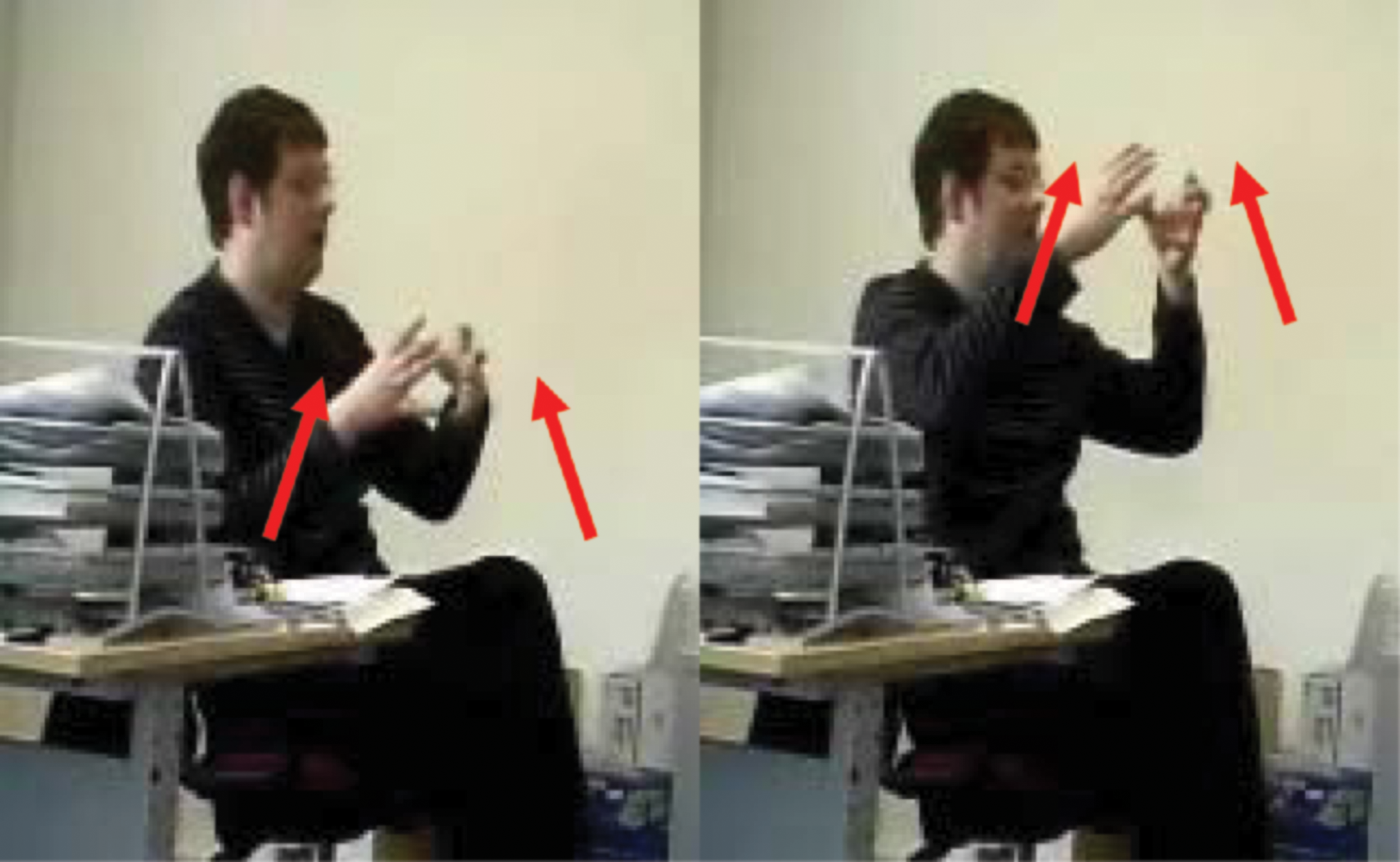
Technology Development Process (gesture 2e)
An engineer in my mind is someone who makes sure it’s 100% correct before you (1a) actually put pen to paper, I think you can you’re much better off (1b) … what you’re trying to achieve is to (1c) get feedback because something you thought maybe (1d) (1e) you should because you’re probably at (1f) got (1g) we’d all I’m just simply saying I think of it in terms of products, opportunities, invoices, cash, (1h) products, opportunities, invoices, cash … they [engineers] never (1i) they never
CT systematically uses metaphors in his speech which relate to embodied movement in a particular direction. These metaphors are not only marked by but, as we will discuss below, also extended in and through his gestures. For example, in gesture (1a) his right hand with the palm down is placed in the centre of the body and then moves to the right which expresses movement. The metaphor of movement is further continued through the section which culminates in a gesture (1b) where the right hand palm down sweeps left to right, the metaphoric meaning suggesting the beginning of an activity as movement. Gesture (1d) involves CT’s right hand held flat with the palm towards himself and with a marked movement from the self outward. This gesture visually describes knowledge accumulation as a trail and hence a movement forward. He expresses this as pushing his right hand forward and showing the visible differences between point A and point B. The idiom of starting the ball rolling is metaphorically activated with a gesture (1e) where the right hand palm sweeps down from himself and suggests a movement forward. The movement metaphor of ‘the roundabout’ imagery is also accompanied by a gesture (1f) where the right hand finger points toward self then outward in a marked movement. In this gesture the space in front of his body is metaphorically presented as the product development process which is explained in terms of a journey into town; he therefore uses this space to express movement from one point to another. In gesture 1g the right hand thumb points to the space behind the right hand side of the body which represents the canal bank as another potential route towards the commercialization of the venture.
CT’s speech and gestures elaborate the same metaphorical idea of the development and commercialization of technological products as a journey. We define this as a ‘metaphor cluster’ with multiple metaphorically used words and gestures reiterating or elaborating the same underlying metaphor (Cameron and Stelma, 2004). Metaphor clusters are bursts of metaphor use ‘characterised by a coherent metaphor that is then elaborated by an interrelated network of ideas and images’ around the same metaphorical source domain (Corts and Pollio, 1999: 26). CT elaborated this general image whenever he communicated to his employees in order to instil a sense of confidence and a shared commitment to the venture. His intent was to convince employees that the venture would be successful and that they had to start commercializing technologies despite the fact that many of these products were still being prototyped. The systematic elaboration of the metaphor also encodes opportunities and actions for employees (Grady, 1997, 2005). For example, when a process of product development is described as the physical movement of employees in a particular direction it primes employees to take action. Through his metaphorical description, CT not only allows employees to envision possibilities and to account for actions to bring those possibilities about, but they also achieve some ability to comprehend and account for the consequences of their actions by metaphorically imagining how things are likely to evolve. In other words, the description compresses the uncertain and complex nature of the process of developing and commercializing technologies into a familiar scene that primes and rationalizes the need for action (Morris et al., 2007).
Another significant metaphor in the above extract involves the ‘cycle’ of opportunity identification and exploitation. This is a single metaphor that we observed CT reiterating in his sensegiving to internal and external stakeholder groups to explain his general model for realizing novel ventures. The metaphor is also marked with a gesture (1h) with the left hand claw-shaped palm toward the centre moving around in a circle, with real rotation on ‘cash’. The gesture is repeated in (1i) with the right hand index finger making the circle vertically in front of himself. In this metaphor, each element (products, opportunities, invoices, cash) of the sequence is metaphorically seen as an integral part of a circular, organic movement which represents the idea that all of his businesses are firmly rooted in an ongoing, tightly connected cycle of opportunity identification and exploitation. The actual mention of the word cycle in the above abstract follows the initial symbolization of the idea in an earlier gesture (1h). Significantly, the gesture precedes speech in the articulation of the circular model of opportunity identification and exploitation. Gestures may slightly precede the words that they are affiliated with, and this can be an indication that the idea unit (and the image) which the speaker is drawing upon is already in place in his mind before it receives expression, first in gestures and then in words (McNeill, 1992).
The use of this metaphorical model is again meant to enhance the predictability of the novel venture and to address any uncertainty about the probability of success of the venture and/or uncertainty stemming from a lack of information about cause–effect relationships. His use of a circular model conventionalizes and naturalizes a particular understanding of how ventures are developed, which can convince constituencies that the novel venture is developed with a particular opportunity in mind and that it will be successful as invoices are raised and cash is acquired. In doing so, the metaphor enhances the predictability of the novel venture in presenting a logical cycle that suggests an ongoing, directed process that predicts and guarantees a sufficient turnover. In this process, CT refers to products as preceding the identification and exploitation of opportunities, which may suggest that he defines entrepreneurship as a process of exploring existing and latent markets in which there is potential demand for the application of new technologies (Sarasvathy et al., 2003).
Our observations of CT’s speech and gestures in acts of sensegiving suggest that he particularly uses metaphors to address uncertainty about the predictability of the novel venture. His metaphors centre on the process of commercializing a venture in general rather than on his own abilities or past accomplishments in creating new ventures. In other words, his sensegiving consists of elaborating metaphors into plausible scenarios of linear or circular movements that detail cause–effect relationships and prescribe a course of action or trajectory for the venture. Because these metaphors are grounded in familiar embodied experiences (that is, embodied and circular movement) they are also intimately familiar and thus likely to be understood and accepted by constituencies. They cue a family resemblance that casts the novel venture, as the target, in terms of a familiar and taken-for-granted source domain of movement, which may have the effect of increasing the legitimacy for the new venture by virtue of its strong correlation with other common understandings of the way the world works (Davis et al., 1994; Douglas, 1986). Finally, and as already mentioned, we observed that gestures played a crucial role in acts of sensegiving. In many instances, CT’s use of gestures amplified or activated the metaphorical images that were co-present in his speech. The gestures around the journey metaphor, for example, depict a schematic, imagistic representation of a scenario for the venture which perhaps because of the idiomatic nature of this metaphor was less pronounced in his speech. These gestures often also added further information that could not directly gleaned from his speech alone. In Figures 1 and 2, for example, the gestures show that the development of technology, and the knowledge required for it, is movement forward. The direction of the movement is not specifically stated in words and, theoretically speaking, could go in basically any horizontal direction. However, the gestures convey information suggesting a metaphorical image of forward movement that is conventionally associated in Anglo-Saxon culture (and many, if not most, Western cultures) with development and (positive) progress. The gesture conveys and reflects this idiomatic understanding (for example, ‘moving ahead’ versus ‘lagging behind’).
XYZ Software
The second individual (XYZ) had no previous experience of creating a new venture and started a venture around the development of support tools for open software applications. He had also started to work with another company in a novel venture that had started to develop a technology that brought television and recording facilities through the Internet on multi-resident sites, such as student halls of residence or business parks. At the time of this study, he was unaware of any other companies in the market pursuing this kind of technology and the technology was still being developed. XYZ needed to secure funding to further develop the technology and to obtain the marketing support to bring the technology as a product to market. Against this background, we set out to document the different metaphorical representations that XYZ used to characterize the venture formation process across the interviews and naturally occurring interactions with his employees and (prospective) investors. As in the first case, a standard repertoire of metaphors in both speech and gestures surfaced and was consistently found in the everyday language of XYZ. Table 3 lists this repertoire of metaphors in speech and gesticulation.
XYZ Software: Repertoire of Metaphorical Representations of the Venture
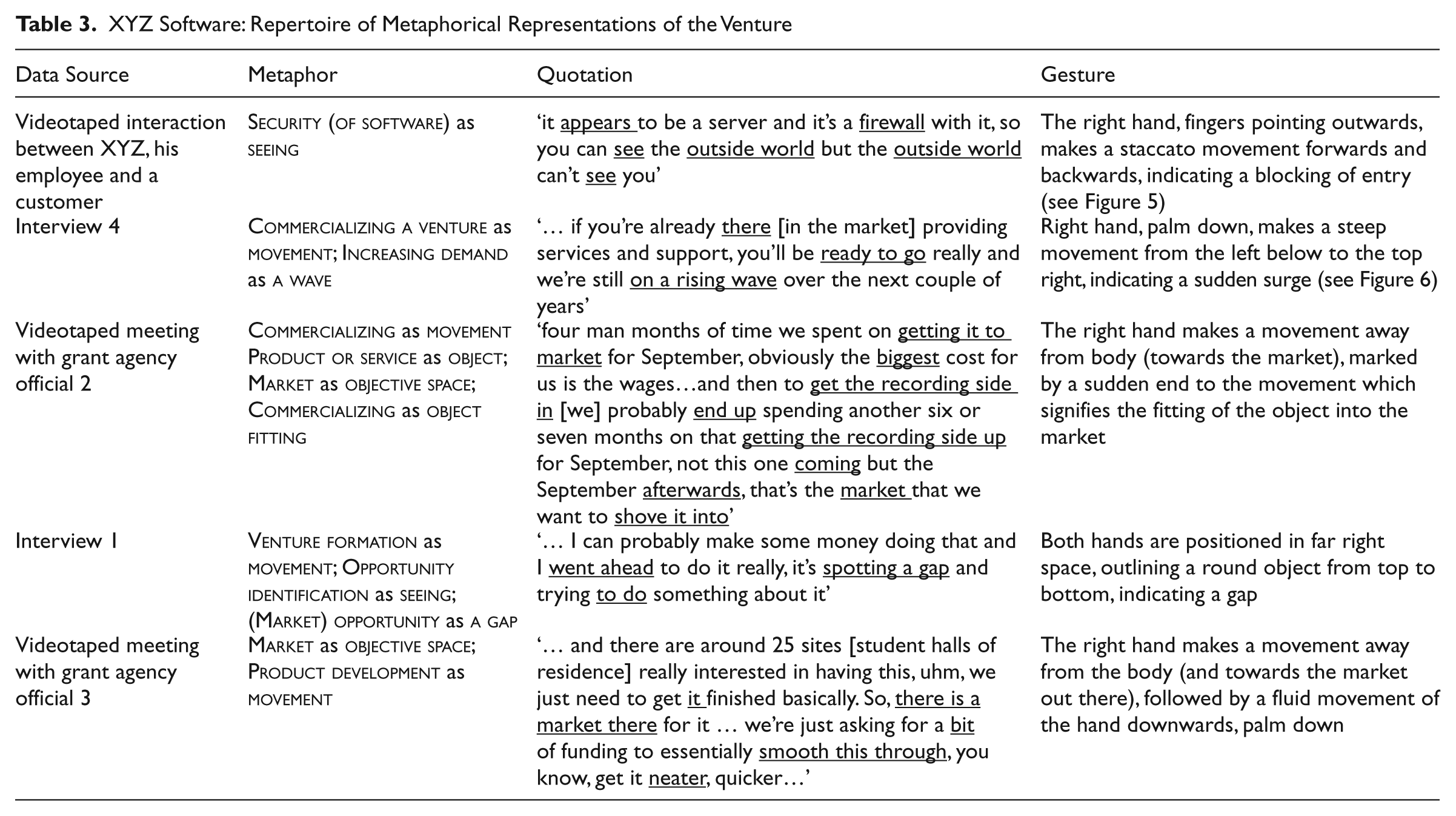
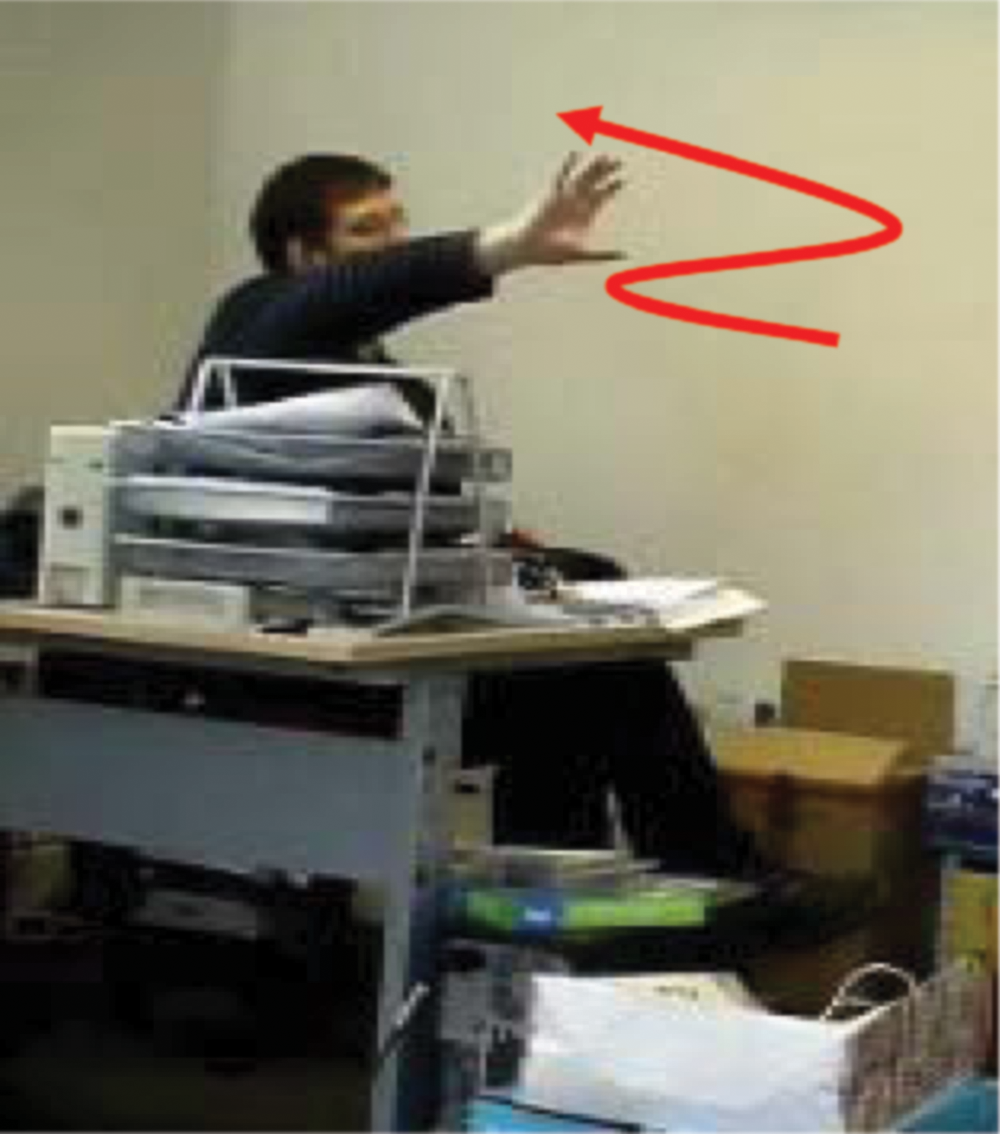
In the month which one of the authors spent on site, XYZ met with many representatives from funding agencies and prospective investors. The extracts below involve a videotaped interaction between XYZ and an official from the regional development agency from whom he was seeking funding for his new venture. The first extract involves the way in which XYZ attempts to create an understanding of the set-up of the venture. Again, metaphorically used words and expressions are underlined with the related source domains in capitals. Metaphoric gestures are numbered and visually represented in Figures 4 and 5.
Fit of the Product with Market Expectations (gesture 3c)
We’re a (2a) businesses (2b) there’s us Open Source Technologies (2c) and there’s Ask4 next door and (2d) a (2e) using and
XYZ uses a set of spatial metaphors to explain the set-up of the company as the context for the development of the new technology. These metaphors are also marked in his gestures starting with a gesture (2a) where his left hand points down to the right side and then makes a circle showing the totality of the two businesses and the space in which they are located together. He also reifies his own company through the second gesture (2b) which involves his left hand making a claw-shape palm downwards, signifying an ontological metaphor which reifies ‘us’. He subsequently tries to articulate the technology development process, which involves a collaborative effort between the two companies, represented with the metaphorical space between the two companies and a gesture (2c) where the two hands palm down mark this space ‘in between’ the two companies. It is within this metaphorical space that the capabilities of the two companies are brought together to develop the technology. His gesture (2d) of two hands, palms cupped and coming together, signifies the ‘coming together’ or creation of the joint technology followed by a movement of the left hand, held loosely, which rises up and moves to the right to reify ‘stuff’. The final gesture (2e) in this extract involves both hands pointing in parallel to reify ‘stuff’ while also pointing to his own computer to reify ‘us’, then finishing with a movement with both hands cupped in a centre space where ‘stuff’ is ‘being put together’. The coming together of the two hands involves a reiteration of the ‘middle space’ and ‘coming together’ images in earlier gestures.
XYZ uses a set of spatial, object and physical manipulation metaphors to give a sense of the venture and the product development process. Significantly his gestures do not only mark the metaphors in his speech but also offer further evidence of his attempt to ‘objectify’ and naturalize the set-up of the venture and the joint contributions of the two separate companies in the development of the technology. With a few metaphorical strokes, he attempts to brush aside any possible ambiguities or concerns about the set-up of the venture and about the reasons for collaborating with the other company. The metaphors in his speech and gestures also objectify the technology (‘stuff’) and the way in which it is developed (‘a whole bunch’, ‘putting it together’), which is meant to reduce any uncertainty about the technology by suggesting that it is a physical, and therefore real and concrete object. As the following extract shows, when the technology is cast as an object, it can in the words of XYZ be ‘productized’ and ‘brought to the market’. In this extract, XYZ tries to explain how the technology is directly applicable to student halls of residence, but could also be sold to companies with multiple office sites spread out over the country.
In our system you give them a voucher, it’s got a code on it, they [students] (3a) at the moment and the idea is to productize that there’s a (3b) know it’s got a (3c) but also you know it’s quite (3d) their work… (3e) it’s not that flexible you can’t say well actually I want to work this way to productize it we’d have to
In this extract, XYZ elaborates the idea of two sides in the market (that is, student and business), marked by a gesture (3a) that demarks an upper and higher space. This spatial delineation may also suggest differences in expectations between students (lower) and executives (higher), as he goes on to explain that the technology could be ‘productized’ for a business market but still has a ‘few rough edges’, presumably set against the expectations of executives for a finished (smooth) product. The gesture (3b) where his hand moves as if touching the rough edges metaphorically activates this conventional idiomatic expression. This idea is further elaborated as he goes on to say that despite the rough edges of the product it is ‘well-shaped’ to the demands of business executives, a point that is marked by a gesture (3c) with his right hand making a movement away from himself (and towards the market ‘out there’), followed by a fluid waving back and forth (see Figure 4). The following gesture (3d) with both hands palm up, open and spreading apart signifies the ‘approach’ of typical business executives, movement in this case standing in for the way in which business executives work and what they would expect from the technology. Gesture (3e) involves both hands in far right space, outlining a round object from top to bottom. The gesture precedes the mention of a metaphorical object in speech and may also activate the use of ‘productize’ as a metaphorical process of turning technology into an object (that is, product). The final gesture in this extract (3f) involves both hands moving from right to left and down with beats, which reiterates the metaphorical idea of product development as the physical manipulation of objects that is similarly articulated in speech.
The observations of XYZ’s speech and gestures in acts of sensegiving suggest that he particularly uses metaphors to address uncertainty about the control and predictability of the novel venture in relation to its designated market. His use of metaphors objectifies, and hence rationalizes, the process by which the two partners work together in developing the new technology. In the first extract, he blends metaphors of
XYZ also systematically uses metaphors that are grounded in embodied experiences including
Discussion
Metaphor and sensegiving in entrepreneurial contexts
In these two ethnographic studies, individuals in the process of creating new ventures systematically used metaphors in both speech and gestures when communicating to employees and (prospective) investors about their newly launched ventures. Both venture creators used the same range of metaphors across their sensegiving (Tables 2 and 3). These metaphors were either elaborated or reiterated into a cluster of metaphorically related expressions and gestures (the first extract) or combined and blended to form an extended metaphorical scene (the second extract). In both ethnographic studies, the gestures at times conveyed the metaphorical images and scenes more directly or more strongly than just the metaphors articulated through speech.
Noticeable is that both individuals used metaphors in their speech and gestures that activate domains of knowledge related to their embodied experiences (that is, human motor actions in the sense of bodily movements, the bodily manipulation of physical objects and the felt experience of bodily engagement with objects). The advantage of using these metaphors is that they depict scenes essential to human experience which provides their use with ‘human scale’ and a ‘direct and experiential basis’ (Gibbs, 2006: 117) and on that basis can be easily understood by others (Grady, 1997, 2005; Lakoff and Johnson, 1999). In both of the above extracts, for example, the ventures’ creators articulated and depicted simple scenes with their own movements or (embodied) actions metaphorically creating, or effectuating, outcomes for their ventures. As a result, when individuals construct such scenes with themselves as instigators of the action, it points to an ego-centric bias (Sarasvathy, 2004; Sarasvathy and Dew, 2008) and a suggestion of control (Simon and Houghton, 2002) that they convey to others. Besides these specific purposes, embodied metaphors are also highly conventional in the English language in general (Goldberg, 1995; Lakoff and Johnson, 1980, 1999), which may also explain their systematic use in sensemaking and sensegiving (Sarasvathy, 2004) in an entrepreneurial context over and beyond more abstract cultural metaphors, such as warfare, theatre or parenting.
Across the two ethnographic studies, we found specific cognitive functions of metaphors in situations where individuals speak to constituents and attempt to persuade them into supporting their ventures. These functions may help creators of ventures relay a (metaphorical) scenario for their ventures that compresses the complex and uncertain process of commercializing the venture into a concrete scene (compression) that truncates cause–effect relationships (predictability), attributes agency and control to the individual (control) and cues familiarity because of its grounding in well understood and taken-for-granted source domains (taken-for-grantedness). As a result, metaphors may help directly address the high levels of uncertainty and low levels of legitimacy surrounding the commercialization of newly launched ventures. In both cases the (metaphorical) scenarios of the speakers filtered their experience and vision of the development of novel ventures through the lens of familiar scenes (travel along a route or manipulation of objects that can be held in the hand). These scenes take bigger, rather abstract and complex processes of commercializing a venture and compress them into an everyday human scale. This reduction of the large and complex down to human-scale imagery is a process that greatly facilitates our ability to reason and draw inferences (Fauconnier and Turner, 2002). Metaphor is one device we use to achieve this, by framing the abstract in terms of that which is more concrete and manipulable. The creation of such human-scale metaphorical scenes, and the employment of gesture in their articulation, can also support the individuals’ communicative goals. The arguments each entrepreneur was making are not words on a page; they are ‘pitches’, which are presented in real time, and real space, and involve not just the modality of the spoken words, but also the visual elements of the speaker, including his gestures. By virtue of the gesticulation of the scenarios presented, it is the entrepreneur himself who is physically embodying the action spoken of, tracing the path or holding the products – even if they are commercialization processes or technology solutions, which are often theoretical rather than physical items.
In other words, the benefits that may be gained in entrepreneurial situations from compressing the commercialization process into a simple scene is that it allows them, first of all, to address any uncertainty that may exist about the probability of success of the new venture and/or uncertainty stemming from a lack of information about cause–effects relationships in a particular industry (predictability). Within CT, for example, uncertainty existed about the probability of success of the novel venture given that the aerospace industry was uncharted territory. We observed that constituencies appeared to be unsure about the applicability of CT’s prior experiences and track record because of the novelty of the industry in which the venture was based. In response, CT characterized the process of developing and commercializing the new set of products as a journey, one that is directed (towards a destination) but with the strategy and the specific development of products still emerging. He also assured constituencies that the venture was set up on the basis of a ‘cycle’ of opportunity identification and exploitation, meaning that it was set up with a particular opportunity in mind and that it will be successful as the logic of the cycle suggests that invoices are raised and cash is acquired as a continuous, ongoing concern. A further benefit is that such scenes attribute agency and control to the individual (control). The need to demonstrate control may be particularly strong for those who have no previous experience of creating new ventures (Martens et al., 2007) and for those creating ventures in industries that are a break from their past experience and/or industries that are dynamic or volatile environments in which investments are risky (Brush et al., 2001). In the case of XYZ Software, for example, XYZ wrote himself into the metaphorical scenes that he narrated. Specifically, he highlighted his own market-creating ability in physically manipulating and developing the technology into a product and in subsequently bringing it into a shape that is congruent with the demands of the market. In doing so, he attempted to convey the idea that he is in control of the venture and can carry it through to success, despite the fact that he had no previous experience of creating a new venture.
A final benefit of (metaphorical) scenes in sensegiving in an entrepreneurial context lies in the fact that, in the absence of an institutionalized frame of reference (Aldrich and Fiol, 1994), they may achieve comprehension and taken-for-grantedness (cognitive legitimacy) for a novel venture. Without a known precedent or common, established industry frame of reference, as in both of our cases (Coupland Technologies and XYZ Software), new ventures may not gain the necessary acceptance and legitimacy to gain resources to survive. The absence of rival entrepreneurial ventures with similar innovations or rival firms operating in the same industry, for example, means that there are no references that can legitimate a new venture. In such circumstances, metaphorical reasoning and the construction of familiar metaphorical scenes facilitates, as already mentioned, the comprehension of a novel venture. Metaphors may also help in gaining social acceptance of a new venture as they naturalize the new situation by drawing upon source domains that are already well understood and taken-for-granted (Davis et al., 1994; Douglas, 1986; Suchman, 1995). Both individuals in our study developed ventures for novel, relatively unknown markets, and hence may have felt a need to ‘naturalize’ their novel ventures by casting them in metaphorical terms, specifically embodied metaphors. They objectified their products and technologies as well as the market demand for them. In this way, they could aim to acquire legitimacy for their ventures through the taken-for-granted nature of the specific metaphorical source domains (of embodied movement and of the physical manipulation of objects) which, by association, justifies the reasonableness and potential of their undertaking. Because it parallels other aspects and common understandings, the metaphor ‘naturalizes’ the novelty of the venture and the market demand for it (Douglas, 1986). The source of this legitimacy is what Douglas referred to as a ‘naturalizing analogy’; a parallel cognitive structure that sustains the novel convention by demonstrating its fit with the natural or conventional order of things. When the metaphor points to strong parallels with relations ‘found in the physical world, or in the supernatural world, or in eternity, anywhere, so long as it is not seen as a socially contrived arrangement’ (Douglas, 1986: 48) it may acquire acceptance and legitimacy for a new venture by virtue of its strong correlation with other common understandings of the way the world works (see also Davis et al., 1994).
In summary, we have attempted to demonstrate the significance and functions of metaphors in the speech and gestures of individuals while they are communicating to, and attempting to convince, relevant others about a recently launched venture. Gaining support for a newly launched venture is a critical challenge facing any venture creator and one that has been largely unaddressed in the literature (Hill and Levenhagen, 1995; Martens et al., 2007). Most research focuses on later stages of the venture creation and commercialization process. Over time, when an industry grows, knowledge about ventures and what is needed to succeed in an industry will spread (Aldrich and Fiol, 1994). However, before new venture creators find themselves in such circumstances, they have to use their own sensegiving (through speech and gestures) to provide a rationale for key constituencies to invest in and support the venture, enabling it to thrive and persist. In the early stages, a venture, as a material opportunity, is made sensible and legitimate to the extent that it is supported by a compelling and convincing (metaphorical) rationale that accounts for its existence and garners the support from relevant constituencies. Before a novel venture can institutionalize and persist, the venture must make sense. The sensegiving of individuals, particularly in early stages of the creation and commercialization of ventures, helps define what a venture means and why investment in the venture by others is both sensible and appropriate.
Limitations and future research
As with all attempts to build and elaborate theory from an ethnographic study and limited sample, one must be careful when attempting to generalize these findings. The focus in the present research has been on the sensegiving of two individuals in their interactions with important constituencies. However, although the present research lacks statistical generalizability, we do feel that it can be used for ‘naturalistic generalization’, whereby one recognizes similarities between the findings of the research and that of other similar ‘cases’ without making any statistical inference (Stake, 1995). For example, we have elaborated on processes and functions of sensegiving about newly launched ventures in two specific industries, which offer fairly easy-to-see parallels with those creating new ventures in similar circumstances but in different industries (Aldrich and Fiol, 1994; Lounsbury and Glynn, 2001).
Despite the limitations around the study sample, this study has significant implications for further research on sensegiving in entrepreneurial contexts, particularly in the early stage of commercializing a venture. One important point we emphasized is the ability of individuals to use their speech and gestures to construct a (metaphorical) scenario for a venture that helps achieve ‘shared cognition’ and convinces relevant others to give their support (Hill and Levenhagen, 1995; Lounsbury and Glynn, 2001). These abilities are crucial, we argue, in early stages of commercializing a venture in the absence of a performance history and a lack of a common frame of reference about the venture and its role within an industry (Aldrich and Fiol, 1994; Hill and Levenhagen, 1995). In time, when further information about a venture or industry becomes publicly available or when a venture has achieved a certain performance trajectory, the value of sensegiving, and the use of metaphors, may decay and venture creators may instead refer to, for example, preliminary or interim achievements that their ventures have realized (Martens et al., 2007; Rao, 1994; Zott and Huy, 2007). Based on this argument, we believe that there is merit in further detailed studies of the speech and gestures of individuals in acts of sensegiving, particularly in the early stages of the venture creation process. When such studies focus on metaphors in speech and gestures, they may benefit from the procedures for metaphor identification and analysis that we have introduced and demonstrated in the article. One significant benefit of these procedures is that they enable scholars to identify actual interpretive and communicative acts of individuals and to stay ‘close’ to the actual data and to local instances of meaning production. In addition, these procedures allow researchers to move in a systematic and grounded way from the identification of metaphors to interpretations of the use of those metaphors and thereby place their claims about the significance and use of metaphorical language, gestures and thought in sensegiving on a firm and explicit empirical footing. Future research may benefit from applying these procedures in replicating or extending our findings on the role of metaphors within sensegiving about newly launched ventures.
Footnotes
Acknowledgements
We wish to thank the three anonymous reviewers for their helpful comments. In addition, we would like to thank the ESRC for their support in this project. The third author also gratefully acknowledges the Netherlands Institute for Advanced Study for fellowship support during the final stage of this project.