




Abstract
This study responds to the call in recent research for comparative studies examining whether student entrepreneurs are different to other kinds of entrepreneurs. Based on institutional theory, the specific question we ask in this study is whether student entrepreneurs who start up their firms in close relation to the university have a different resource logic compared to entrepreneurs who start their firms outside the university context. We define resource logic as the individual’s set of ideas for how to secure and use resources, and we link this concept to theories of effectual reasoning and bootstrapping to develop our argument. Moreover, we identify two different viewpoints about the effects of the university milieu on the resource logic of student entrepreneurs and we develop hypotheses to test the different viewpoints. The findings give overall support for the view that student entrepreneurs have developed a resource logic that favours both effectual reasoning and the use of bootstrapping methods.
Keywords
Introduction
Universities are nowadays expected to take an active role not only as a human capital provider but increasingly as a partner in the commercialization of university knowledge and as a seed bed for new knowledge-intensive firms. Many universities across the world have met this challenge to become a more ‘entrepreneurial university’ by building up university-centred innovation systems in the local and regional economy where they are located (Etzkowitz, Webster, Gebhardt and Terra, 2000; Rasmussen, Moen and Gulbrandsen, 2006). In other words, besides the traditional focus on education and research, universities are nowadays expected to promote regional development and economic growth (Rothaermel, Agung and Jiang, 2007). Examples of such promotion activities include offering entrepreneurship education to aspiring student entrepreneurs (Klofsten, 2000; Rasmussen and Sørheim, 2006) and providing incubator facilities that offer specialist support and R&D services to start-ups originating from the university (Hughes, Ireland and Morgan, 2007; Lindholm Dahlstrand and Klofsten, 2002). As a result, there is an increasing group of entrepreneurs that have been educated and fostered within the university milieu and who often continue to develop their new firms in close interaction with the university.
It is widely acknowledged in literature and research that the university milieu can provide a significant influence on the attitudes and behaviour of students (e.g., Dey, 1996, 1997; Elchardus and Spruyt, 2009; Guimond, Begin and Palmer 1989; Hastie, 2007; Weidman, 1989). Such influence comes from various sources, such as their interactions with peers and faculty, the general presuppositions, disciplinary paradigms, and cognitive convictions of their discipline, as well as the normative contexts of college campuses. In this process of socialization, students can be argued to acquire ‘the norms and standards, the values and attitudes, as well as the knowledge, skills, and behavior patterns associated with particular statuses and roles’ (Zuckerman, 1977: 123). The influence from the university milieu thus operates by means of socializing students into a group, whose norms and culture they internalize.
However, although we can expect that students are influenced by the university milieu there is still limited knowledge about the extent to which student entrepreneurs are socialized into a certain way of thinking and behaving in relation to their start-up processes (Berggren, 2009). Based on this observation the focus of this article is to find out whether student entrepreneurs have a different ‘resource logic’ compared to entrepreneurs that start up their firms independently of the university milieu and its innovation system. We define resource logic 1 as a set of ideas for how to secure and use resources in the process of starting up and managing a new firm. Theoretically, we base our arguments on institutional theory (DiMaggio and Powell, 1983; Meyer and Rowan, 1977) which posits that the external environment has a strong influence on the creation and development of organizations (e.g., Aldrich, 1999). One such strong influence emphasized in institutional theory is external pressures towards institutional isomorphism (DiMaggio and Powell, 1983), which is a process that constrains the ability of organizations to deviate from the established norm. This institutional process thus makes one unit in a population resemble other units as they are exposed to the same set of environmental characteristics (DiMaggio and Powell, 1983:149). In line with this theoretical point of departure we assume that the creation of a firm is very much shaped by the context in which the entrepreneur is and has been active. In this vein, student entrepreneurs can over time be expected to develop similarities in the way they think and behave when acquiring and using resources for setting up their firm.
We believe our study contributes to contemporary literature and research on entrepreneurship in four important ways. First, we develop the concept ‘resource logic’ and relate this concept to streams of research that deal with the way entrepreneurs are reasoning in relation to the acquisition and use of resources (i.e. effectuation and bootstrapping). Our approach is thus both novel and useful for understanding the mindset of student entrepreneurs that are in the process of starting up and managing their new firms. Second, we provide empirical evidence suggesting that student entrepreneurs have a distinct way of reasoning in relation to their acquisition and use of resources in the start-up process compared with entrepreneurs that start up their firms independently of the university context. In this way the article responds to recent research (see for example Pittaway and Cope, 2007) stating that comparative studies are needed if we are to be able to understand if and how student entrepreneurs are different. Third, the major part of earlier studies on entrepreneurship in academic environments has focused on faculty members’ involvement in entrepreneurial activities (see, for example, Allen, Link and Rosenbaum, 2007; Bercovitz and Feldman, 2008; Chrisman, Hynes and Fraser, 1995; Meyer, 2006; Mosey and Wright, 2007). At the same time, the involvement of faculty members in entrepreneurship is a relatively marginal phenomenon in comparison with the large number of student entrepreneurs who are educated and fostered in the university context, and who often continue to develop their new firm in interaction with the university after graduation. In this study we therefore explicitly focus on student entrepreneurs. Fourth, we identify two different and highly competing viewpoints that can be derived from literature that deals with the effects of the university milieu on the resource logic of student entrepreneurs. One viewpoint (e.g., Honig, 2004; Karlsson, 2005) is that student entrepreneurs are exposed to pressures to apply a planning approach on the start-up process and thus develop a preference for predetermined and specific goals, relatively great use of formal business planning and a focus on securing complementary resources to reach these specific goals. An alternative viewpoint is that the university milieu presents opportunities for networking, knowledge sharing and creativity, which in turn stimulates cognitive processes that contribute to emergent strategy characterized by preferences for flexible goals, relatively little use of formal business planning and creative ways of acquiring resources needed (in line with Baron, 2006). Rather than favouring one of these arguments we develop hypotheses to test the two different and largely competing viewpoints.
The rest of the article is structured as follows. The next section presents our theoretical framework and hypotheses development. Then follows our method section where we describe the sample and variables used in the empirical study. Thereafter we present a section with results and analysis. The article ends with a discussion of the findings and their implications for research and practice.
Literature review
Academic entrepreneurship and student entrepreneurs
Universities are today increasingly acknowledged in the public debate as powerful drivers of innovation, job creation and economic growth. The European Commission, for example, states that the knowledge society depends for its growth on the production of new knowledge and the transmission of this knowledge through education and training, and on the use of the new knowledge through new industrial processes and services, pointing out that universities are at the heart of these processes as they take part in all of them (European Commission, 2003: 4). This statement reflects the growing accumulation of scholarly knowledge regarding the role of universities not only as providers of human capital but also as contributors to innovation and technical change through university–industry collaborations and new knowledge-intensive start-ups (Etzkowitz and Leyesdorf, 1997; Feldman, 2000; Florida and Cohen, 1999). The successful communication of this scholarly knowledge to politicians and policy makers has, among other things, resulted in major efforts to improve the infrastructural support for promoting entrepreneurship in many European universities.
Two of the most common efforts for promoting entrepreneurship have been increasing the supply of entrepreneurship programmes and courses (Finkle and Deeds, 2001; Jack and Anderson, 1999; Pittaway and Cope, 2007) and creating business incubators for entrepreneurs who decide to start up new firms in relation to the university and its surrounding innovation system (Cooper and Park, 2008; Lindholm Dahlstrand, and Klofsten, 2002; McAdam and McAdam, 2006). A consequence of this boom in education and infrastructural support for entrepreneurship within universities is a growing number of student entrepreneurs who are educated and nurtured in and around the context of the university and who after graduation continue to develop their new firms in close interaction with this highly knowledge-intensive milieu.
However, although there seems to be little doubt that the number of student entrepreneurs in the economy is growing (Kolvereid and Åmo, 2007; Scott and Twomey, 1988) there has been limited empirical investigations about whether their close connection to the university has any significant influence on their activities and behaviours in the start-up process. Instead, most prior studies have focused on students’ motivation, perceptions and awareness of entrepreneurship as a career choice (Henderson and Robertson, 1999; Kolvereid and Åmo, 2007; Pittaway and Cope, 2007; Turnbull, Williams, Paddison and Fahad, 2001). In a recent systematic literature review of different themes within studies of entrepreneurship education Pittaway and Cope (2007) conclude that this kind of education has had an impact on student propensity and intentionality, but that it is unclear whether it enables graduates to become more effective entrepreneurs. Hence, despite burgeoning interest in understanding student entrepreneurs there is little known about their entrepreneurial activities and behaviours once they start to develop an entrepreneurial career. In the next section, we will focus on this very aspect by examining their ideas for how to secure and use resources in the process of starting up and managing a new firm.
Resources and resource logic
Resources can be defined as all tangible and intangible assets that are committed to or available for the discovery and exploitation of a new venture idea (Davidsson, 2005: 115). Indeed, empirical evidence suggests that new firms with a larger pool of initial resources are more likely to survive, grow and become profitable as they have a buffer of valuable resources that makes them able to withstand unfavourable shocks and take corrective actions (Brush, Green and Hart, 2001; Chrisman, Bauerschmidt and Hofer, 1998). However, literature and research also point out that this does not mean that budding entrepreneurs must seek complete ownership control of all resources they need (Bhide, 1994). Rather, they should develop behaviours that enhance their ability to use and extract value from resources in the new venture creation process regardless of the ownership of the resource at hand. Entrepreneurial behaviour can, in this respect be conceptualized as the process by which individuals pursue opportunities without regard to resources they currently control (Brown, Davidsson and Wiklund, 2001; Stevenson and Gumpert, 1985; Stevensson and Jarillo, 1990).
The successful pursuit and exploitation of new business opportunities requires successful acquisition and use of resources. Relying on the general definition of logic provided in Sarasvathy (2008) we specifically define resource logic as the set of ideas for how to secure and use resources in the process of starting up and managing a new firm. From this definition, an entrepreneur’s resource logic can be expected to have a profound impact on decisions and strategies in the process of new firm creation as well as the emerging structures, culture and systems of the new firm that is created. With this in mind, we argue that the concept ‘resource logic’ is useful for the purpose of this study as theories in the field of entrepreneurship often build up their arguments around the issue of how to think about and use resources in the new venture creation process (see for example Brush et al, 2001; Sarasvathy, 2001; Stevensson and Gumpert, 1985).
Based on a review of literature in the entrepreneurship field we conclude that two streams of research, in particular, are relevant to consider to theorize about differences in resource logics among entrepreneurs; effectuation theory and bootstrapping. 2 These two streams of research will be described below.
Effectuation is a theory of entrepreneurial decision-making that addresses the issue of how entrepreneurs perceive, process and use information relating to the creation of new firms and markets (Sarasvathy, 2001). The underlying assumption in the theory is that people have different perceptions of the future as predictable and controllable and this is manifested in two alternative approaches that entrepreneurs can use in the new venture creation process – effectuation and causation (Sarasvathy, 2001). Causation is consistent with planned strategy approaches, including such activities as fulfillment of predetermined and specific goals, business plan development and a focus on securing complementary resources to reach specific goals. The choice of means is driven by the knowledge of possible means and the characteristics of the effects that the entrepreneur wants to create. Effectuation is on the other hand consistent with emergent strategy approaches characterized by flexible goals, relatively little use of formal business planning and departing from the resources at hand. In this more emergent decision-model the focus is on the question of what can be done given possible means and imagined ends (Sarasvathy, 2001; Sarasvathy and Dew, 2005). In sum, effectuation theory centres around an alternative logic of decision-making under uncertainty that contrasts with mainstream decision models based on a causal logic.
Bootstrapping refers to methods for securing the use of resources at relatively low or no cost (see for example Winborg, 2000; 2009). When compared with the traditional way of handling resource acquisition it represents an opposite way of handling need for resources (Winborg, 2000; 2007). In the traditional way, it is assumed that resource acquisition is handled using internally generated or externally attracted financial means by paying the market price (Winborg, 2000). Moreover, the traditional perspective implies that all resources are legally owned and controlled. In contrast, in bootstrapping the important thing is to be able to secure and use resources that are needed but not necessarily to own all of them (Winborg, 2009; Winborg and Landström, 2001). On the basis of this discussion, bootstrapping involves for example securing equipment and competence at below market price. On the other hand, sharing equipment and splitting the total cost does not qualify as bootstrapping unless the total cost of the resources is below market price. In this respect, bootstrapping is very close to how resource acquisition is discussed in relation to entrepreneurial behaviour (see for example discussion in Stevenson and Gumpert, 1985).
Student entrepreneurship and pressures from the institutional environment
Entrepreneurship scholars have recently showed an increasing interest in understanding how new firms deal with pressures from their institutional environment (e.g., Cliff, Jennings and Greenwood, 2006; Davidsson, Hunter and Klofsten, 2006; Karlsson and Honig, 2009; Shane and Cable, 2002; Zimmerman and Zeitz, 2002). These studies draw on arguments from institutional theory (i.e., DiMaggio and Powell, 1983; Meyer and Rowan, 1977), which seeks to explain why there is such homogeneity of organizational forms and practices. The theory assumes that organizations and individuals adopt mindsets and behaviours that reflect the ‘dominant template’ in their institutional environment (DiMaggio and Powell, 1991: 28). According to Meyer and Rowan (1977) the dominant template consists of normatively sanctioned ideas about the appropriate means for accomplishing business activities. These social norms are moreover to a large extent taken-for-granted as they have become established as authoritative guidelines for social behaviour (Zucker, 1977).
When organizations in the same environment lose their distinctive features and come to resemble one another, this is called ‘institutional isomorphism’ (DiMaggio and Powell, 1983). Institutional isomorphism is driven by a process of homogenization, where organizations become increasingly alike as they accept and follow the prevailing practices within an industry. Institutional isomorphism moreover occurs through three forces; coercive, mimetic and normative (DiMaggio and Powell, 1983). Coercive forces come from the pressures from other organizations on which the focal organization is dependent, due to them exerting authority or political pressure. Mimetic forces reside in the fact that one organization may decide to mimic or model another organization as a way of handling uncertainty about best practices. Normative forces come from professionalization, referring to the collective work of members of an occupation to formulate the content of this occupation. The development of formal titles, such as accountant and medical doctor, is an example of normative isomorphism. Even if the three forces are analytically distinct, however, they are empirically intertwined and hard to study separately (DiMaggio and Powell, 1983).
Inspired by institutional theory, we assume that the creation of a new firm is very much shaped by the context in which the entrepreneur has been active. The principal research question we ask is are student entrepreneurs socialized into a certain way of thinking and behaving when it comes to resource acquisition in the start-up process? We believe this is a question that has both theoretical and practical relevance. It pinpoints the fundamental issue of whether the professional and social environment that student entrepreneurs are exposed to, has any impact on their decisions and behaviours when organizing and managing new firms.
Hypotheses development
In the rest of this section we will develop hypotheses about how student entrepreneurs can be expected to have a different resource logic compared to entrepreneurs who start their firms outside the university context. Interestingly, there exist different viewpoints about the potential institutionalized effects of being exposed to the university milieu when it comes to how student entrepreneurs secure and use resources in the process of starting up and managing a new firm. Thus, we will contrast the different viewpoints against each other in order to develop competing hypotheses that can be subsequently tested in our study.
One argument that can be derived from prior literature and research is that student entrepreneurs, through their exposure to the university milieu, develop a resource logic characterized by a preference for predetermined and specific goals, involving a relatively greater use of formal business planning and a focus on securing complementary resources to reach these goals. Many textbooks on entrepreneurship are for example built around business planning models (e.g., Kuratko and Hodgetts, 2004; Timmons and Spinelli, 2004). Past studies (e.g., Honig, 2004; Karlsson, 2005) have in this respect suggested that entrepreneurship programs and incubator milieus make budding entrepreneurs conform to a largely predictive decision rationality through the institutionalized standard of writing a business plan. Such practices, in turn, could be expected to influence the way student entrepreneurs think and behave – such as generating and selecting means to create intended effects, seeking external capital, and relying on goal-oriented relationships to control resources in the new venture creation process (Dew, Read, Sarasvathy and Wiltbank, 2009).
According to Karlsson (2005) new businesses that have been developed in a university context are very much influenced to produce a written business plan. The business plan in turn can be seen as a tool used to convince external financiers (such as banks and venture capitalists) to provide financial capital. In other words, the focus on business planning can be assumed to foster an underlying logic among student entrepreneurs that focuses on traditional resource acquisition. Although empirical research on the effectiveness of business plans has been mixed (Honig and Karlsson, 2004; Liao and Gartner, 2006), the business plan with its step-by-step rational process is thus a central component in many university entrepreneurship programs (Honig, 2004; Souitaris, Zerbinati and Al-Laham, 2007). Furthermore, the findings in Roininen (2006) show that academic start-ups relied much more on formal business planning in comparison with start-ups not originating within the academic context. The business plan and its popularity in both entrepreneurship practice and pedagogy can in this respect be seen as an illustration of institutional conformity. In sum, we formulate the following two hypotheses: H1: Student entrepreneurs have a resource logic that favours more causal reasoning compared to non-student entrepreneurs. H2: Student entrepreneurs have a resource logic that favours a higher traditional resource acquisition orientation compared to non-student entrepreneurs.
However, another counter-argument that can be derived from literature and research is that the university milieu stimulates cognitive processes that contribute to a resource logic that favours more flexible goals, relatively little use of formal business planning and creative ways of acquiring resources needed. Research for example suggests that many entrepreneurship educations are multi-disciplinary, seeking to develop various skills (Fiet, 2001; Wilburn, Goodin and Aniello, 2005). Being exposed to a diverse set of disciplinary areas can stimulate cognitive processes that foster a creative way of thinking (Baron, 2006). This in turn can be assumed to make student entrepreneurs more open-minded when it comes to finding alternative ways of securing resources. Furthermore, earlier studies (see for example Druilhe and Garnsey, 2004; Souitaris et al., 2007) claim that entrepreneurs who start up new firms in a university context often are confronted with many possibilities to use resources within this context at low or no cost, such as free access to locations and equipment. This in turn implies that the formal possibilities to apply a more open and flexible approach in their resource acquisition are relatively great as compared with the start-up outside this context.
Adding to this, Karlsson and Honig (2009) show that although entrepreneurs in general respond to external demands by writing business plans this is part of a symbolic act to gain legitimacy for their actions. They consequently identify a discrepancy between the practice of writing a business plan and the actual strategy pursued by entrepreneurs. In line with these findings, it can also be argued that even if student entrepreneurs are likely to be exposed to planning approaches that emphasize a predictive rationality in the start-up process, when they follow entrepreneurship programs or operate in incubator milieus (Karlsson, 2005) other factors in the university context might be more influencing. In line with this we argue that entrepreneurship educations and incubator milieus expose entrepreneurs to a broad array of different topical areas and diverse social contacts (see for example Fiet, 2001; Wilburn et al., 2005). This, in turn, may make student entrepreneurs more likely to seek alternatives to capital-intensive strategies and instead look for more episodic use or rent of required resources in the new venture creation process. In sum, based on these arguments we formulate the following two alternative hypotheses: H3: Student entrepreneurs have a resource logic that favours more effectual reasoning compared to non-student entrepreneurs. H4: Student entrepreneurs have a resource logic that favours a higher bootstrapping orientation compared to non-student entrepreneurs.
Method: Sample and variables
Questionnaire design
We designed a questionnaire survey to test the hypotheses developed in the article. The measures used in the questionnaire were derived from a careful review of previous theoretical and empirical literature and research on entrepreneurship and small business. The questions were pilot tested on a smaller group of entrepreneurs, that was currently located in an incubator, in order to ensure quality and stringency among the questions included in the questionnaire. In addition, we also consulted a group of scholars working in the field of entrepreneurship and small business management. We used this valuable feedback to hone and clarify the questions in the final research instrument.
Sample
Our collection of empirical data was made in two major steps. First, we aimed to build a sample matching the criteria of student entrepreneurs involved in the process of starting up and managing a new firm. In line with previous studies we considered a firm to be new if it had existed up to five years (e.g., Chandler and Hanks, 1998). The finalized questionnaire was sent out to two subsamples of entrepreneurs that can be considered as student entrepreneurs. The first group consisted of individuals who have followed a university entrepreneurship program and then started up their own independent firms (i.e. ‘graduate entrepreneurs’). In line with Souitaris et al. (2007: 568) we use ‘entrepreneurship program’ as a concept broader than a course and including a portfolio of complementary activities. The second group consists of entrepreneurs who are or recently have been located in a university incubator, i.e. ‘incubator entrepreneurs’. Both groups were identified from three universities located in western Sweden: Chalmers University of Technology, Gothenburg University and Halmstad University. The first group, graduate entrepreneurs, consists of 591 graduated students where 24 per cent originates from Chalmers University of Technology, 14 per cent from Gothenburg University, and 62 per cent from Halmstad University. Following the mail survey and two reminders distributed during spring/summer 2006, 294 questionnaires were received which corresponds to a valid response rate of 49.7 per cent. Of these, 68 respondents were involved in starting up or managing a new firm, thus matching our selection criteria. However, we excluded three cases as they were included in both subsamples (i.e., graduate entrepreneurs who were located in a university incubator, see below). In all, this procedure resulted in 65 usable responses of graduate entrepreneurs. Of the graduate entrepreneurs, 48 per cent (n=31) originate from Chalmers University of Technology, 26 per cent (n=17) from Gothenburg University, and 26 per cent (n=17) from Halmstad University.
The second group consists of 120 entrepreneurs that are, or have recently been, located in a university incubator for a period of at least 3 months (i.e., ‘incubator entrepreneurs’). Of these, 36.7 per cent originates from Chalmers University of Technology, 37.5 per cent from Gothenburg University, and 25.8 per cent from Halmstad University. Following the mail survey and two reminders distributed in spring 2006, 91 questionnaires were returned which corresponds to a valid response rate of 75.8 per cent. Of these, five were excluded as their firms were older than five years thus resulting in 86 usable responses of incubator entrepreneurs. A closer examination of the background of the incubator entrepreneurs showed that almost 30 per cent of them have followed a university entrepreneurship program before entering the incubator. For the analysis, we merged the two groups into a total sample of 151 student entrepreneurs. To compare the two subsamples we conducted statistical analyses to confirm that no significant differences exist between the groups with respect to the dependent variables (see below). No significant differences could be found, thus suggesting a homogenous sample of student entrepreneurs with respect to their ideas for how to secure and use resources in the process of starting up and managing a new firm.
In the second step, we aimed to build a sample representing non-student entrepreneurs, for comparison. To do this we contacted Statistics Sweden to identify a random sample of 1000 new privately held firms registered in 2004. A similar questionnaire, including the same questions, was sent to entrepreneurs in spring 2006 addressed to the executive manager or CEO of the firm. After the first send-out we received 23 returned envelopes due to various reasons that had to do with difficulties of finding the individual entrepreneur (unknown address, ownership changes, liquidation, etc). This reduced the total number of entrepreneurs to 977. Following the mail survey and one postal follow up, 236 questionnaires were returned. This corresponds to a valid response rate of approximately 24.1 per cent, which compares favourably to other recent studies of behavioural characteristics of entrepreneurs reported in international academic journals (Westhead, Ucbasaran and Wright, 2005). To match our selection criteria, we excluded 35 responses as they were involved in firms that were older than five years. We then excluded the responses from five individuals who had no experience of starting up the firm in question (most of them being employed CEOs). Finally, to keep the two groups of entrepreneurs distinct from each other we also excluded 22 cases where the responding entrepreneur had experience from following an entrepreneurship education at a university. In all, this led to a sample of 174 non-student entrepreneurs. No response bias was detected between respondents and non-respondents with regard to the sales of their current firm. On this parameter, we conclude that a representative sample has been collected.
Dependent variables
In this study we examine the potential influence from the university environment on the resource logic of student entrepreneurs. As presented in the hypotheses we examine four dependent variables referring to resource logic, namely effectuation, causation, bootstrapping and traditional resource acquisition.
Entrepreneurs’ preference for effectuation was examined using three items derived directly from the previous theoretical work by Sarasvathy (2001). To gauge this variable respondents were asked to rate the extent (1 = very low extent, 5 = very high extent) they agreed with the following three statements: A) I prefer to have flexible goals and be able to change directions in the firm depending on the resources I have, or will have, at my disposal; B) I prefer to use informal methods when investigating the need for or interest in my product/service (for example by asking people of my acquaintance, making my own observations, etc.); and C) When I am to realize a business opportunity I only invest as much as I can afford to lose. However, including all three items generated a very low Cronbach’s alpha (.23). Excluding the last item (statement C) Cronbach’s alpha increased to .42. We therefore continued the analysis with the first two items (statements A and B). As Cronbach’s alpha can be a relatively weak indicator of the internal consistency when including only few items we also checked item-to-total correlations applying the rule-of-thumb procedure suggested in Hair, Anderson, Tatham and Black (1998). The item-to-total correlations were r = .79 and r = .80 respectively, which was well above the suggested limit of above .50 in Hair et al. (1998). Moreover, an exploratory factor analysis showed that both items loaded strongly on a single factor explaining 63 per cent of the variance and with an eigenvalue of 1.26.
In the same way as for effectuation we developed items for causation based on the theoretical work by Sarasvathy (2001). In this vein, the respondents were asked to rate the extent (1 = very low extent, 5 = very high extent) they agreed with the following three statements: A) I prefer to formulate decisive goals and to strive for the results of these goals; B) I prefer to use well-planned and calculated market research tools when investigating the need for and interest in my product/service; and C) The most important for me is to choose optimal strategies which maximize the outcome of the business opportunity that I realize. Cronbach’s alpha for the three items was .52. We also checked item-to-total correlations which show that the correlations are .71, .73, and .70 respectively. A factor analysis moreover showed that all three items loaded on one factor explaining 51 per cent of the variance and with an eigenvalue of 1.54. Based on the results from the factor analysis and Cronbach’s alpha it was decided to use all three items for measuring causation in the analysis.
As discussed in Winborg (2000; 2007) bootstrapping represents an opposite way of handling need for resources as compared with the traditional way discussed in for example finance literature. Winborg (2007) refers to the typologies presented in Starr and MacMillan (1990) to demonstrate the differences between the two modes of handling need for resources. One of the two typologies in Starr and MacMillan (1990) is called the administrative manager, who seeks full ownership of all resources needed and pays full market price for these. On the other hand, they also identify the so-called relationship-oriented manager who seeks to secure the use of resources at no or low cost using also resources owned and possessed by others. In line with Winborg (2000; 2007) we argue that the administrative manager represents the traditional way of handling resource acquisition whereas the relationship-oriented manager well describes the way the bootstrapper thinks and acts. Based on this distinction, Winborg (2007) developed items measuring bootstrapping orientation and traditional resource acquisition orientation respectively. In this article we use the same items. Bootstrapping orientation was gauged by asking the respondents to rate the extent (1 = very low extent, 5 = very high extent) they agreed with the following two statements: A) The most important for me is that I have the possibility to use the resources needed rather than my firm owning them; B) The need for resources can be solved without any costs, for example by using resources that others control. Cronbach’s alpha for this construct was .40, and the item-to-total correlations were r = .75 and r = .83 respectively. We also conducted an exploratory factor analysis for this scale, which indicated that both items loaded strongly on a single factor explaining 63 per cent of the variance and with an eigenvalue of 1.25.
Relying on the work of Winborg (2007) we measure traditional resource acquisition behaviour using two items. Using a 5-point scale the respondents were asked to rate the extent (1 = very low extent, 5 = very high extent) they agreed with the following statements: A) It is important to me that the business owns all resources needed in its operations; and B) To handle the need for resources in the business will always imply a cost to the business (i.e. payment of money). The factor analysis shows that both items loaded on one factor explaining 63 per cent of the variance and with an eigenvalue of 1.26. Cronbach’s alpha was .41 and the item-to-total correlations were .80 and .78 respectively.
Control variables
In the analyses we have included some control variables as they may have a potential influence on our dependent variables. First, we have included three control variables reflecting the age, start-up experience and industry experience of the responding entrepreneurs, as these can be expected to influence his or her personal resource base which could be effectively leveraged and used in the new firm (Cooper, Gimeno-Gascon and Woo, 1994; Politis, 2005; Sarasvathy, 2001). Start-up experience was measured by the total number of new firms that the respondent has been involved in. The variable was transformed using a logarithmic transformation due to a skewed distribution within the data. Industry experience was measured as the entrepreneurs’ total number of years in the industry in which the firm operated.
Second, we have included variables controlling for the age (one measure) and size (two measures) of the firm. These variables were included as previous research has suggested that younger and smaller firms are expected to have more severe problems with securing resources critical for its survival, so called liabilities of newness and smallness (e.g., Aldrich, 1999). Firm age was measured as the number of years since the firm was founded. Firm size was measured by two separate variables, A) sales turnover, and B) the total number of employees. The variable ‘sales turnover’ was transformed using a logarithmic transformation due to a skewed distribution within the data.
Third, we included a binary variable reflecting the level of novelty in the new firm’s product/service offer. Inspired by the work of Amason, Shrader and Tompson (2006), this variable was measured by a question asking respondents to categorize whether their firm were A) offering products or services which were materially the same as products or services previously offered by other firms; B) offering products or services which represented advances in existing technologies, so called ’next generation’ products or services; or C) offering products or services that had never before been sold and that might spawn a new industry or change the nature of an existing industry. The variable was coded zero (0) for those who responded in category A, and one (1) for those who responded in category B or C.
Fourth, we included a variable reflecting the growth orientation of the entrepreneur as previous research has suggested that growth-oriented entrepreneurs tend to have a more structured approach to organizing their firm, which in turn may influence their preferred way of securing and using resources when starting up and managing their new firms (Davidsson, 1989; Gundry and Welsch, 2001). This variable was measured by a two-item 5-point scale, where respondents were asked to rate the extent (1 = very low extent, 5 = very high extent) they agreed with the following two statements: A) It is important for me that my firm grows in sales; B) It is important for me that the profit increases in my firm. An exploratory factor analysis indicated that both items loaded strongly on a single factor explaining 82.5 per cent of the variance and with an eigenvalue of 1.65. Cronbach’s alpha for this construct was .79, and the item-to-total correlations were r = .92 and r = .90 respectively.
Finally, we included a variable to test for the potential influence from the primary industry of the business as we know from earlier research that this can influence the access to external finance (see for example Hughes, 1996). Businesses in manufacturing industries are for example often assumed to have an easier task, all things equal, to obtain long-term loans from banks as compared with businesses in the service industry (Hughes, 1996; Scherr, Sugrue and Ward, 1993). In this vein, we used a categorical variable coded zero (0) for the non-service industry and one (1) for the service industry.
Sample description
In total we have 325 responding entrepreneurs in our final sample, of which 151 are student entrepreneurs (46.5 %) and 174 are non-student entrepreneurs (53.5 %). The mean age of the entrepreneurs in the sample is 37.8 years (min=21, max=64) and the average percentage of male entrepreneurs is 79 per cent. The average number of start-ups among the respondents was 2.22 (min=1, max=15). In this figure the present firm is included which means that respondents have on average experience from one firm before this one. The firms were on average 2.14 years old. In total, 44.6 per cent were offering novelty products/services (‘next generation’ products/services). Table 1 presents a more detailed overview of the characteristics of the entrepreneurs.
Descriptive Characteristics of the Entrepreneurs
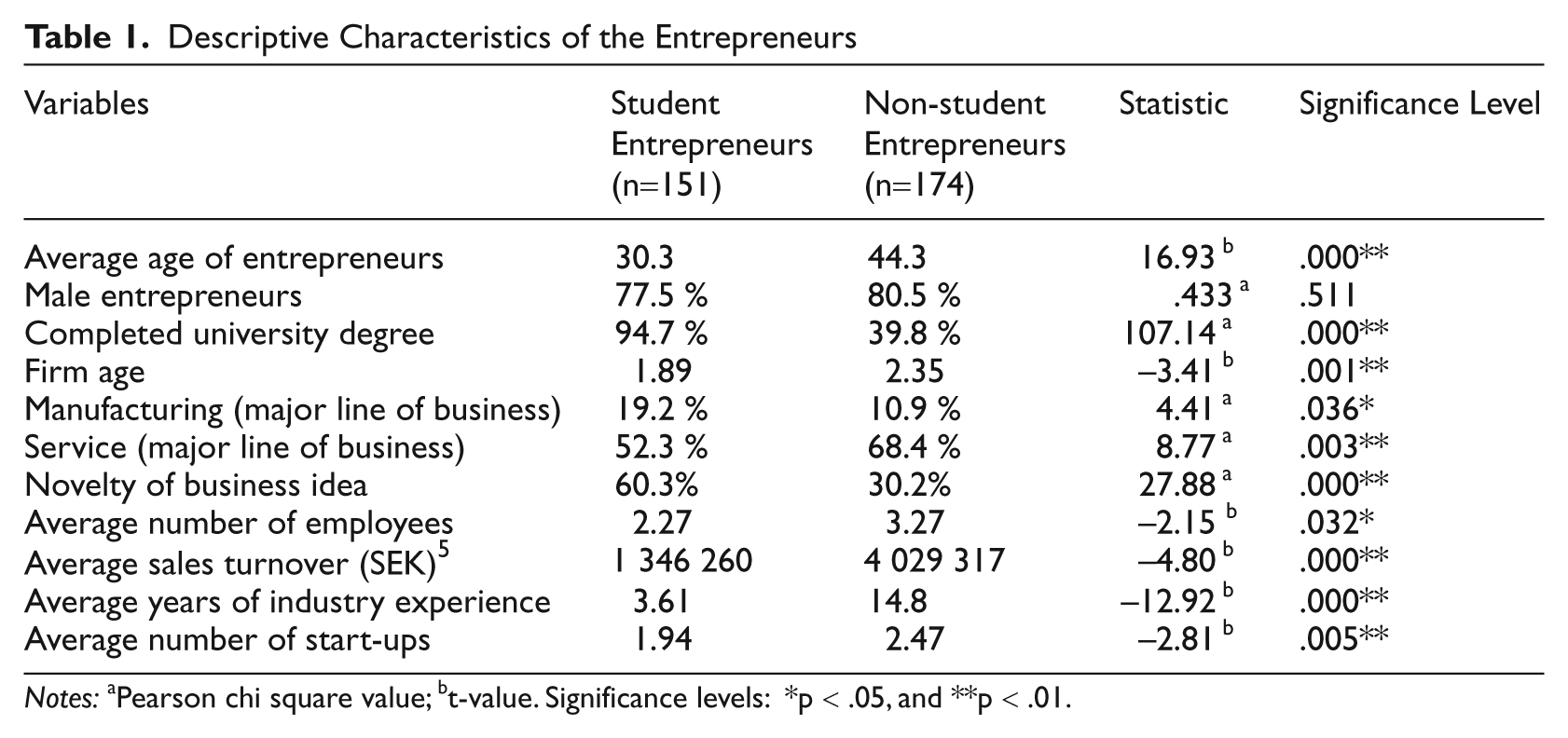
Notes: aPearson chi square value; bt-value. Significance levels: *p < .05, and **p < .01.
Table 1 presents further descriptive characteristics of the student and non-student entrepreneurs and their businesses. First, we can see that there is a significant difference in age between the two groups (.01-level), where non-student entrepreneurs on average are 14 years older than the student entrepreneurs. Non-student entrepreneurs have also more industry experience (.01-level) and a higher number of prior start-ups (.01-level). With respect to their firms, we can see that firms managed by non-student entrepreneurs are significantly older (.01-level). We can also notice that non-student entrepreneurs have firms that employ more people (.05-level) and they perform better in terms of sales turnover (.01-level). Moreover, 60.3 per cent of the student entrepreneurs stated that they were offering ‘next generation’ products/services compared to non-student entrepreneurs where only 30.2 per cent matched this criteria. Interestingly, these results seem to support our expectation that non-student entrepreneurs are, on average, managing firms in more mature markets compared to student entrepreneurs. There is also as expected a significant difference in the percentage of entrepreneurs who have a university degree in each group. Of the responding student entrepreneurs 94.7 per cent have obtained their university degree. A closer look reveals that 62.9 per cent of these entrepreneurs have a degree in engineering, 35 per cent in business and economics, and 7 per cent in science. 3 For the responding non-student entrepreneurs 39.8 per cent have earned a university degree. Of these, 20.6 per cent have a degree in engineering, 41.2 per cent in business and economics, and 14.7 per cent in science. We can also see that non-student entrepreneurs to a larger extent are running a firm in the service industry, compared with student entrepreneurs (0.1-level). Hence, in total it seems fair to argue that student entrepreneurs and non-student entrepreneurs are different from each other with respect to several descriptive variables.
Analysis and results
This section will present the results of our statistical tests. In order to test whether our sample of student entrepreneurs can be considered a homogenous group with respect to their exposure to socialization processes, we first tested whether there were variations between our two subgroups ‘graduate entrepreneurs’ and ‘incubator entrepreneurs’ based on the number of years they have studied at the university and the length of their entrepreneurship studies. This test did not reveal any significant differences within the group of student entrepreneurs with respect to these variables. Thus, it seems fair to argue that the expected socialization effects are linked to their exposure to milieus within the university where entrepreneurship is encouraged, rather than the time they have been studying at the university.
In order to test our hypotheses, we have run t-tests and multiple regression analyses. The regression analyses were performed in two steps. First, we included only the control variables described in the method section. Thereafter we included also the student entrepreneur variable. The student entrepreneur variable was in the regression analyses measured as a categorical variable coded zero (0) for non-student entrepreneurs and one (1) for student entrepreneurs. We present a description of all the variables used in the analysis (correlations, means and standard deviations) in Table 2 below.
Correlations, Means and Standard Deviations of the Variables Used in the Analysis
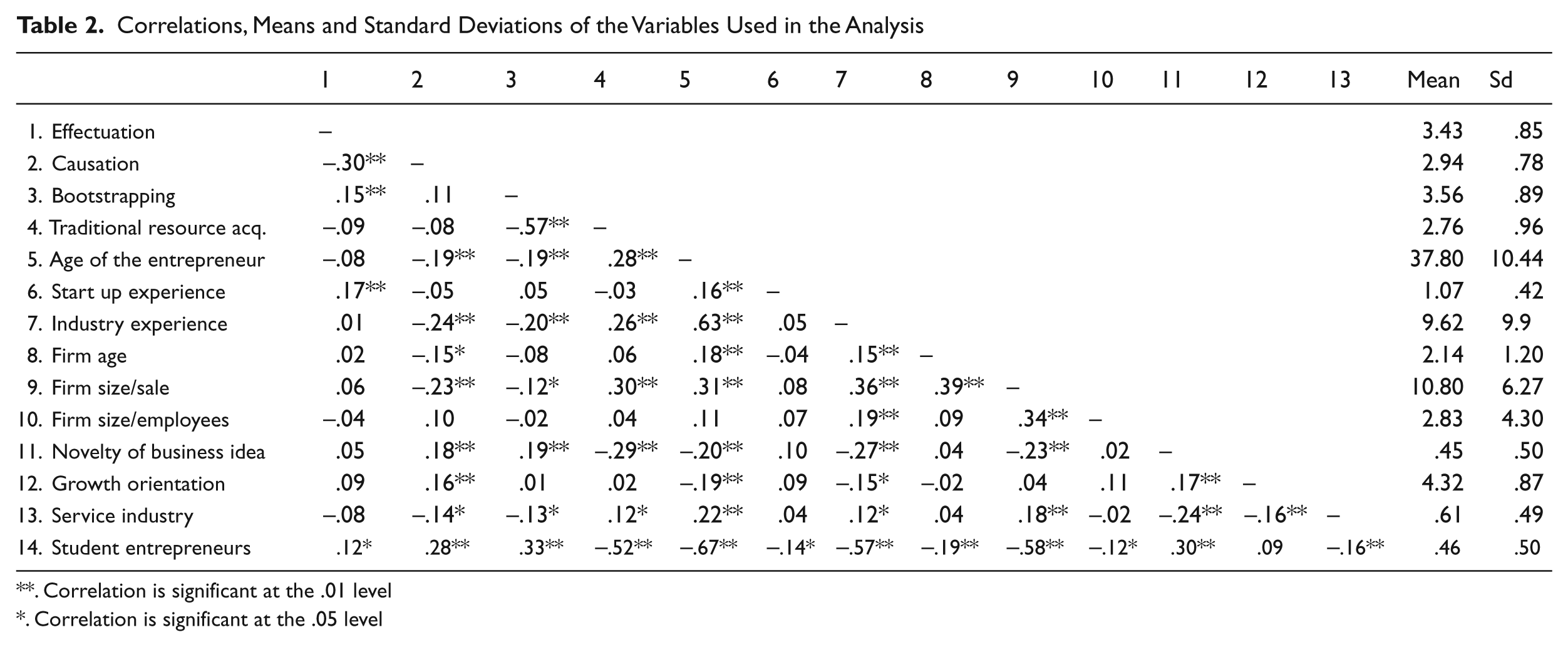
Correlation is significant at the .01 level
Correlation is significant at the .05 level
Table 2 shows that some variables are close to the r = .70 threshold of high correlation suggested by Nunnally (1978). For this reason we checked the Variance Inflation Factors (VIFs) for each independent variable in the various regression analyses. However, all VIFs were between 1.10 and 2.73, which indicates that no problems of multicollinearity seem to exist in our data set.
Entrepreneurs’ preference for causation – H1
Hypothesis 1 suggested that student entrepreneurs have a resource logic that favours a preference for causation as compared with non-student entrepreneurs. The T-test presented in Table 3 shows that student entrepreneurs score significantly higher than non-student entrepreneurs.
Preference for Causation by Type of Entrepreneur

Note: Significance levels: *p < .05, and **p < .01.
In order to test the hypothesis we run two regression models as described before. The first model only includes control variables whereas the second also includes the student entrepreneur variable. From Table 4 can be seen that both regression models are significant. However, focusing on the second model we can see that the student entrepreneur variable does not contribute to the explanatory power of the model. This can be seen by the fact that the F-value is even lower in this second model and hence the student entrepreneur variable is not significant. Therefore H1 is rejected. This means that there are other variables explaining the propensity to favour a way of working in line with causation. In Table 4 it is shown that firm size in terms of number of employees and industry experience are the strongest variables. Hence, the larger the business and the less experience the entrepreneur possesses the stronger focus on causation.
Preference for Causation Logic
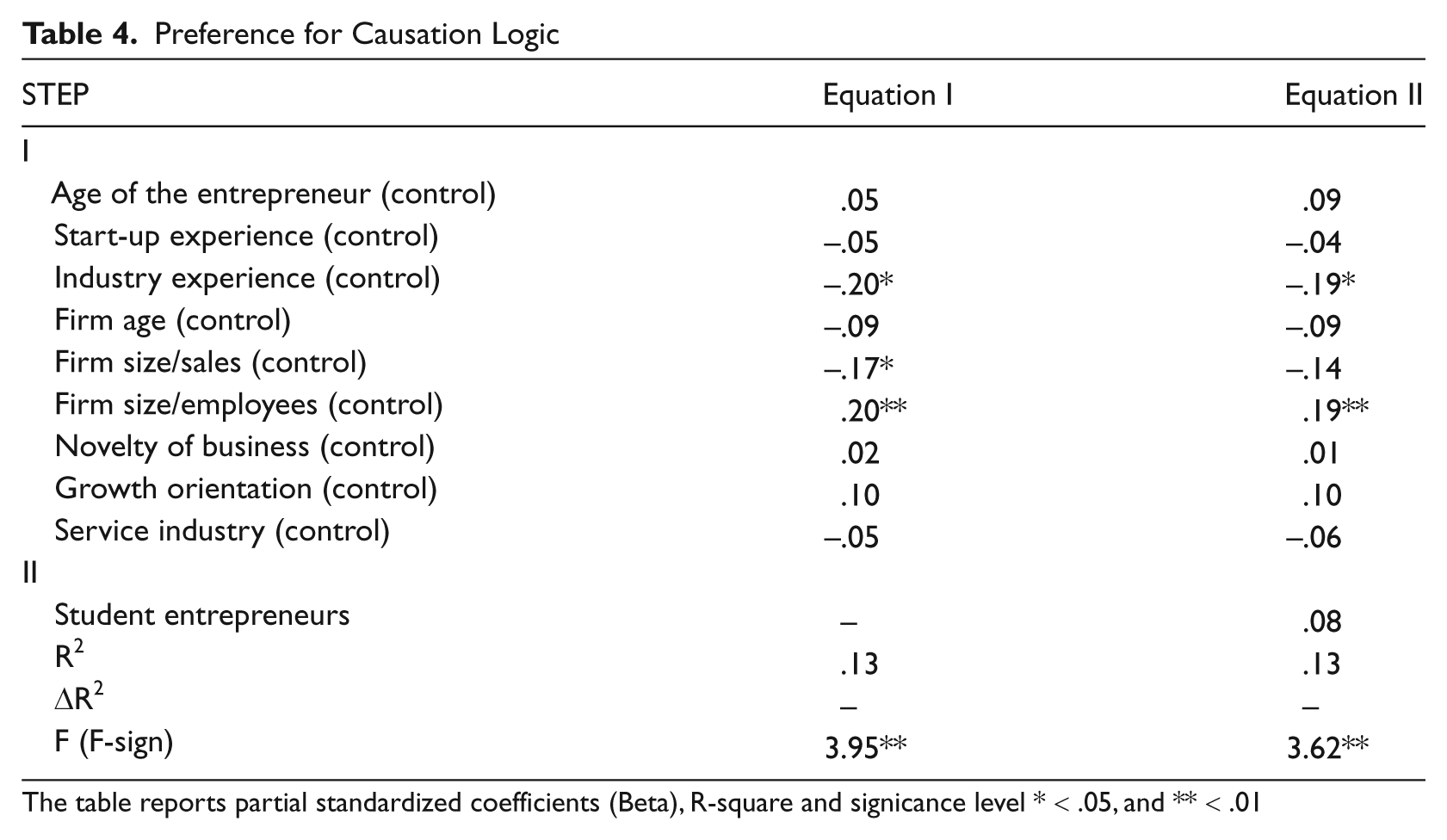
The table reports partial standardized coefficients (Beta), R-square and signicance level * < .05, and ** < .01
Entrepreneurs’ preference for traditional resource acquisition – H2
In Table 5, we present the results of the T-test undertaken. This test shows a significant difference between student entrepreneurs and non-student entrepreneurs. However, contrary to the hypothesis the findings show that non-student entrepreneurs are significantly more oriented towards traditional resource acquisition as compared with student entrepreneurs.
Preference for Traditional Resource Acquisition by Type of Entrepreneur
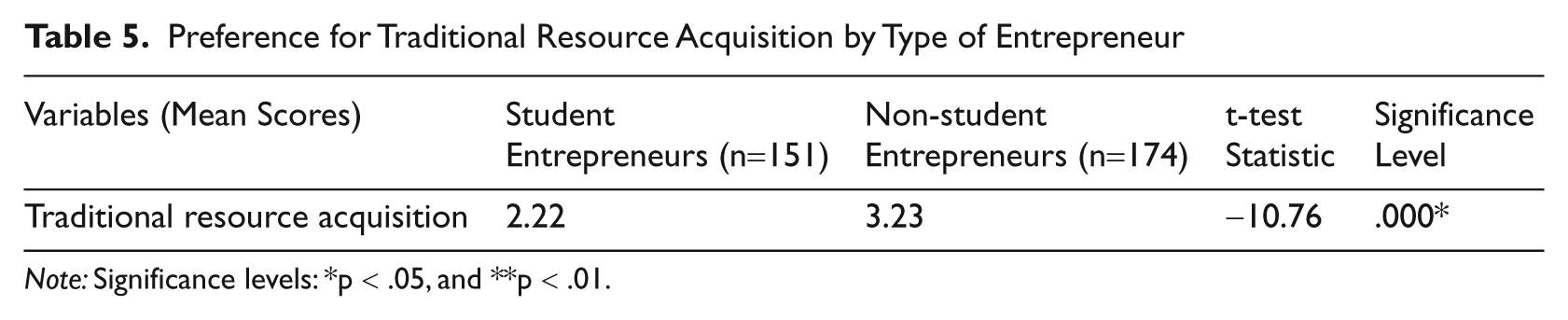
Note: Significance levels: *p < .05, and **p < .01.
In order to test the second hypothesis we run two regression models. As can be seen in Table 6, both models are very strong and significant. From the second model we can see that the contribution of including the student entrepreneur variable is clearly significant. Moreover, we can see that R2 increases dramatically by including this variable. The table also shows that the student entrepreneur variable is clearly the strongest predictor of all variables included. In line with the T-test the sign of the beta for this variable is negative implying a negative relation between being a student entrepreneur and a preference for using traditional resource acquisition. Besides this we can see that the variables novelty of business, start-up experience, and growth orientation are all significant. On the basis of the findings H2 is rejected.
Preference for Traditional Resource Acquisition Logic

The table reports partial standardized coefficients (Beta), R-square and signicance level * < .05, and ** < .01
Entrepreneurs’ preference for effectuation – H3
In Table 7 we present the results as regards differences between the two groups of entrepreneurs in terms of relative preference for effectuation. As seen in the table student entrepreneurs score significantly higher on the measure for effectuation compared to non-student entrepreneurs.
Preference for Effectuation by Type of Entrepreneur

Note: Significance levels: *p < .05, and **p < .01.
As for the other hypotheses regression analyses were undertaken to control for the potential influence of the control variables. From Table 8 it is shown that both regression models are significant. From the table we can see that the student entrepreneur variable is a strong predictor for effectuation logic in that the explanatory power of the model increases significantly by including this variable as shown in the second model. Besides this finding, Table 10 also shows a significant influence from start-up experience and firm size. Taken together, the analysis shows that student entrepreneurs have a significantly higher preference for effectuation logic as compared to non-student entrepreneurs, thus supporting H3.
Preference for Effectuation Logic

The table reports partial standardized coefficients (Beta), R-square and signicance level * < .05, and ** < .01
Entrepreneurs’ preference for bootstrapping – H4
In Table 9 we present the results of the T-test for potential differences in relative bootstrapping orientation between student entrepreneurs and non-student entrepreneurs. From the table can be seen that student entrepreneurs report a significantly higher preference for bootstrapping.
Preference for Bootstrapping by Type of Entrepreneur

Note: Significance levels: *p < .05, and **p < .01.
In line with the procedure described earlier, we ran two regression models to test H4 suggesting that student entrepreneurs have a higher bootstrapping orientation. As seen in Table 10 both regression models are significant. Comparing regression model one and two we can see that the explanatory power of the model increases significantly by including the student entrepreneur variable. The table clearly demonstrates that this variable includes the strongest explanatory value of all variables included in the model. Besides this finding the table also shows a significant influence from start-up experience, novelty of business idea, and industry. To sum up, we can conclude that student entrepreneurs have a significantly higher preference for bootstrapping compared to non-student entrepreneurs, thus supporting H4.
Preference for Bootstrapping Logic
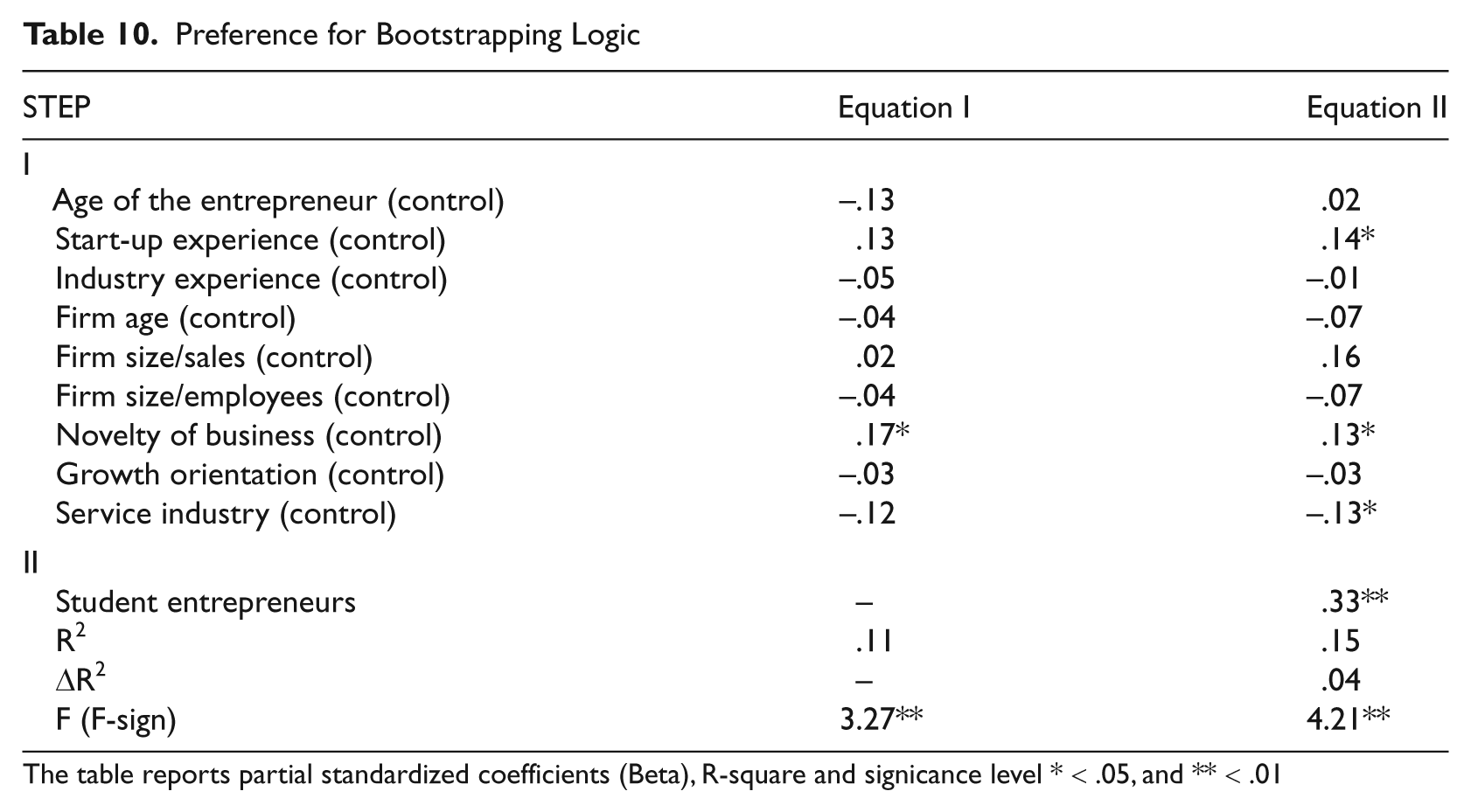
The table reports partial standardized coefficients (Beta), R-square and signicance level * < .05, and ** < .01
Discussion and implications
Discussion
It is widely acknowledged that universities play an important role as promoters of knowledge-intensive entrepreneurship in regionally embedded innovation systems (Feldman, 2000; Florida and Cohen, 1999). However, up to date we know very little about whether close connections and interactions with a university may have any influence on the resource logic of student entrepreneurs. On the basis of our findings we can conclude that student entrepreneurs have a distinct way of reasoning in relation to their acquisition and use of resources as compared to entrepreneurs starting firms outside the university context. This conclusion confirms the prediction by institutional theory saying that the context very much shapes behaviour in a way that makes individuals who operate in the same environment lose their distinctive features and come to resemble one another (DiMaggio and Powell, 1983). In this vein, our findings suggest that student entrepreneurs who have followed entrepreneurship programs and/or been exposed to incubator facilities become socialized into a certain way of thinking and behaving in relation to their preferences for how to secure and use resources in the process of starting up and managing a new firm.
As discussed in the development of the hypotheses we assumed that the university context can influence the resource logic of student entrepreneurs in two possible and opposite ways. On the one hand, it could be argued that the university context would foster a logic characterized by formal business planning and application for external finance in line with causation and the traditional way of handling resource acquisition. On the other hand, it could be assumed that the university context would foster a logic characterized by creativity and little use of formal business planning in line with effectuation and bootstrapping.
In the analysis we find significant differences between student entrepreneurs and non-student entrepreneurs for three of our four hypotheses. When it comes to causation our analysis shows no significant effect, and hence Hypothesis 1 is rejected. Moreover, also Hypothesis 2, which suggested that student entrepreneurs have a mindset that favours a higher traditional resource acquisition orientation compared to non-student entrepreneurs, was rejected. Even though we find a significant association it is opposite to what was assumed in the hypothesis. Hence, instead it seems that non-student entrepreneurs have a significantly higher preference for traditional resource acquisition compared to student entrepreneurs. On the other hand, both Hypothesis 3 and 4 are confirmed as the findings show that student entrepreneurs have a significantly higher preference for effectuation as well as bootstrapping as compared with non-student entrepreneurs. Taken together, we can conclude that establishing a firm within a university context will influence the resource logic of the entrepreneur towards effectuation and bootstrapping.
Our findings largely support our expectation that exposure to entrepreneurship support in university milieus can stimulate students to come up with alternative solutions to traditional capital-intensive strategies. Entrepreneurship programs may in this respect promote both networking skills and ‘thinking outside the box’ which in turn may stimulate preferences for resource-lean and less costly start-up practices. Besides, the idea of business incubators is to support the tenants with resources on very favourable terms, such as locations, equipment and mentoring/consulting. This means that many student entrepreneurs are active in a milieu in which the formal possibilities for engaging in creative and flexible ways of acquiring resources needed are relatively great as compared with the conditions facing entrepreneurs outside this milieu.
Our findings also show that the experience of the entrepreneur has a significant influence on his or her resource acquisition orientation. The regression model for effectuation shows that entrepreneurs with more start-up experience tend to favour this logic, whereas the regression model for causation in fact shows that entrepreneurs with less industry experience favour causation. These findings suggest that both start-up experience and industry experience are important building blocks in the development of a logic which favours flexible and less costly ways of securing and using resources in the new venture creation process, which is in line with arguments in Sarasvathy (2008). We can also see a difference in terms of the influence from experience on bootstrapping vs. traditional resource acquisition behaviour. The regression model for bootstrapping shows that entrepreneurs with more start-up experience are significantly more inclined to apply a bootstrapping logic. On the other hand, the regression model for traditional resource acquisition shows that entrepreneurs with less start-up experience favour a more traditional mode of handling need for resources. In sum, these findings emphasize the critical role of experience for explaining the resource acquisition behaviour of entrepreneurs (see also Winborg, 2009).
Another observation from our data is the positive and significant influence of the level of novelty in the new firm’s product/service offer on entrepreneurs’ preference for bootstrapping. Universities are often argued to be in the forefront of innovation and new product ideas (Etzkowitz, 2003). Our data support this expectation, showing that a majority of student entrepreneurs are active in firms that offer so-called ‘next generation’ products or services whereas the major part of non-student entrepreneurs are not. In other words, relatively many new firms managed by student entrepreneurs are active in immature markets. According to Lorenzoni and Ornati (1988) it takes (all things equal) longer time to arrive at the stage when a product or service can be offered on the market for new firms active in immature markets as compared with the situation for new firms in more mature markets. While the level of novelty in the product/service offer has little influence on the preference for effectuation, it has a strong and significant effect on the preference for bootstrapping. In line with the findings presented in Andries and Debackere (2007), it can be argued that adaptation and flexibility in the methods for securing the use of resources is more beneficial in immature as compared with mature and stable sectors. Therefore, given the relatively higher level of novelty in the new firm’s product/service offer among student entrepreneurs their preference for bootstrapping seems logical.
Implications for theory and research
We believe our findings in this study contribute novel insights and understandings to contemporary theory and research on entrepreneurship in academic environments. There has recently been an increasing interest in exploring the characteristics and features of new firms originating from universities. These studies have primarily focused on the activities of faculty members in relation to their involvement in entrepreneurial activities and commercialization of research results (Allen et al., 2007; Bercovitz and Feldman, 2008; Meyer, 2006; Mosey and Wright, 2007). However, the involvement of faculty members in entrepreneurship is a relatively marginal phenomenon compared to the much larger number of entrepreneurs who every year are educated and fostered in the university context, and who often continue to develop their new firms in close interaction with the university after graduation. Seen in this light, an important contribution of this study is that we provide empirical evidence showing that student entrepreneurs can be seen as a distinct group of entrepreneurs who have a different way of reasoning in relation to their acquisition and use of resources compared to entrepreneurs who start up their firms independently of the university context. Thus, entrepreneurship support in universities not only influences the amount of entrepreneurship (i.e. start-up rates) in the regional economy but also the resource logic of these student entrepreneurs.
The ability to turn a new firm into a profit-generating firm is often seen as dependent on entrepreneurs’ resource base (Brush et al., 2001). Following this line of thinking, another contribution of this study is that we develop and theoretically anchor the concept of ‘resource logic’. We relate this concept to two distinct streams of research that deal with the way entrepreneurs are reasoning in relation to the acquisition and use of resources in the new venture creation process, namely effectuation and bootstrapping. Although originating from different disciplines and intellectual traditions these two streams of research seem to have some commonalities (Davidsson, 2006). One obvious link between the two streams of research is the focus on flexibility. Research on effectuation stresses the importance of flexibility in terms of the goals and outcomes of the new firm, whereas one advantage of bootstrapping is the flexibility gained by not legally owning the resources used (Winborg, 2009). Thus, there may be potential gains in relating these two streams of research closer to each other in the future.
Limitations and suggestions for future research
We acknowledge that there are some potential limitations in our study. For example, we have relied on a survey-based research design where we have asked for respondents’ behavioural preferences in relation to their acquisition and use of resources. Although behavioural preferences are likely to correlate with actual behaviour, some caution is warranted with respect to whether our results are merely capturing a different line of reasoning (i.e., intentionality) among student entrepreneurs or whether they really apply a different kind of resource logic also in their daily work. The difference between respondents’ expressed intention and their actual behaviour is a potential problem that often haunts survey-based research within the entrepreneurship field, but nevertheless some caution is warranted with respect to the findings in this study.
Moreover, our dependent variables are related to theoretical constructs that are multi-dimensional in the sense that they are supposed to reflect a range of different ideas intended to form a clear basis for action when acquiring and using resources in the process of new venture creation. Effectuation for example includes a range of principles, such as means-driven action, affordable loss, negotiating with any and all stakeholders who make actual commitment, and leveraging surprises. In the same way causation includes different dimensions such as action focused on effect or outcome, maximizing expected return etc. 4 Likewise, bootstrapping includes principles such as using resources rather than owning them, securing resources at low or no cost, using underutilized resources, and exploiting differences in the perceived value of resources, whereas the opposite goes for traditional resource acquisition (Winborg, 2007). For exploratory reasons, the items employed in this study reflect only some of these multiple dimensions and thus there is a bias in our study with respect to the particular dimensions chosen.
However, the above-mentioned potential limitations also provide several opportunities for future research. To meet these concerns we encourage future research in this area to collect longitudinal data of the actual start-up behaviour of student entrepreneurs. Such approaches can be inspired by the PSED project (e.g., Gartner, Shaver, Carter and Reynolds, 2004) which through chronological studies of representative samples of new firms has contributed (and still contributes) to our understanding of the entrepreneurial process. Moreover, with respect to our employed measures of effectuation and bootstrapping in this study we believe there is a need to extend the list of items to better capture these multi-dimensional constructs. Such attempts would greatly contribute to our scholarly knowledge of how entrepreneurs secure and use resources in the process of starting up and managing a new firm.
As discussed earlier, we agree with Davidsson (2006) who argues that effectuation and bootstrapping have commonalities. The analysis undertaken in this article supports this stance as the results shows a significant and positive correlation between the two concepts. However, our data did not allow us to test how effectuation and bootstrapping relate to each other, for example if there is a sequential order between the practices associated with each of the two or if practices are carried out in parallel. In this case, it could be conjectured that effectuation, representing an idea forming a basis for action, is followed by the use of bootstrapping methods in the new venture creation process. Another competing conjecture could be that bootstrapping methods lead to more effectual reasoning. Given the scarcity of empirical studies that deal with how entrepreneurs secure and use resources when starting up and managing their firms we see a closer examination of this issue as a highly interesting avenue for future research.
Finally, we acknowledge that our study is based on responses from entrepreneurs in Sweden. Entrepreneurial attitudes may vary between countries (e.g., Mueller and Thomas, 2000) and may thus limit the generalizability of our findings to other countries. Therefore, we suggest additional studies in different countries to test the robustness of our results across contexts.
Implications for practice
Finally, we believe our study has some implications for practice. In all, the findings suggest that universities can play a significant role in influencing the resource logic of entrepreneurs who develop their new firms in close interaction with the university. More specifically this influence is in favour of flexible and resource-lean alternatives to capital-intensive strategies. Such flexible and resource-lean alternatives can reduce the likelihood of undesirable lock-in effects in the early stages of new venture development and hence increase the likelihood that entrepreneurs in case of a closure can continue their entrepreneurial career in a new project without too much personal loss. Among other things, this means that aspiring entrepreneurs may benefit from close contacts with universities as this context may support them in finding creative ways of acquiring resources needed. Moreover, given that closure rates are high among new firms our findings suggest that there may be sound reasons for policy makers to continue to support entrepreneurship in the university context.
Footnotes
Acknowledgements
We are indebted to the valuable comments from two anonymous reviewers. We are also grateful for the feedback from Jonas Gabrielsson in the course of developing this work.
Funding
This research has been funded by the Swedish Knowledge Foundation (KK-stiftelsen).
Notes
Diamanto Politis is Assistant Professor in Entrepreneurship at Halmstad University, Sweden. She is member of KEEN and CIEL at Halmstad University. Her research interests include entrepreneurial learning; academic entrepreneurship and the value-adding role of business angels in new firms.
Joakim Winborg is Assistant Professor and Lecturer in Entrepreneurship and Finance at Halmstad University. His research interests are new and small business finance, financial bootstrapping and academic entrepreneurship.
Åsa Lindholm Dahlstrand is Professor in Business Administration, specializing in Entrepreneurship, at Halmstad University, Sweden. She is member of KEEN and CIEL at Halmstad University. From 2006 to 2010 she was also Visiting Professor (in Technology-Based Entrepreneurship) and Director of the research center RIDE ‘R&D, Innovation and Dynamics of Economies’, at Chalmers University, Gothenburg, Sweden. The overriding theme in her research is technology-based entrepreneurship and industrial dynamics. She is very interested in both innovation policy and entrepreneurship policy. Her specific research interest includes studying new and small technology-based firms and the role of entrepreneurs in the development of companies and economies. Apart from several reports and books, she has published papers in e.g.: Regional Studies, Research Policy, European Planning Studies, The Scandinavian Journal of Management, Venture Capital, Frontiers of Entrepreneurship, European Business Review, Entrepreneurship and Innovation, Small Business Economics, and Technovation.