



Abstract
This study analyses the additionality effects of R&D subsidies on innovation activity: specifically, the allocation of in-house R&D expenditures and economic returns from the innovation process. The magnitude of these effects has been established in the context of a common variable informing the design of innovation policies: firm size. The study reveals that regardless of firm size, public funding stimulates investment within the firm’s technological domain (applied research and technological development), but did not expand the technological knowledge frontier (basic research). The findings also show that R&D subsidies have different additionality effects upon economic returns derived from the innovation process. Although subsidies increased private R&D effort quite significantly in small firms, this only prompted an expansion in the sale of products new for the firm. However, large subsidized firms which only increased investment in technological development improved the sale of products new to the market.
Introduction
Following the seminal work by Schumpeter (1942), there has been some debate regarding the differences and complimentary qualities of small and large firms in relation to innovation activity and technological change. Schumpeter suggested that large firms have advantages when undertaking innovation; since then, this hypothesis has been reviewed in empirical studies with few definitive conclusions reached (Ahuja et al., 2008; Cohen and Klepper, 1996; Gray and Mabey, 2005). It appears that both large and small firms differ not only in R&D investment but also in the management and productivity of innovation activity. Although conventionally large firms have been regarded as the main actors in processes of technological change and economic development, smaller firms are now viewed also as agents of change, creating employment and technological diversity which stimulates the growth and evolution of industry (De Jong and Vermeulen, 2006; McAdam et al., 2010; Spencer et al., 2008). Accordingly, new innovation policies have emerged which recognize firm size as a key aspect in maintaining technological diversity and industrial dynamics. Nevertheless, the design of such initiatives does not always recognize the relationship between the variables of firm size and innovation policy.
Following the traditional approach of innovation policy evaluation (see David et al., 2000), a small group of studies have analysed how certain measures of public funding (generally R&D subsidies) impinge on variables which influence innovation activities (generally private R&D expenditure), (see Table 1). The extant literature described within Table 1 confirms the hypothesis that public funding has differing effects on levels of private R&D expenditure in both small and large firms; it is not clear to what extent advantage is gained from such public incentives. Estimating the effect of subsidies on the net amount of R&D expenditure does not sufficiently capture the effect of public funding on the innovation process itself. Despite the economic justification for innovation policies supporting the production of technological knowledge, and decreased market failures which reduce incentives to innovation (Teubal, 2002), the literature provides little information with regard to the effect of public funding on creating technology knowledge or the economic returns stemming from such knowledge (Cohendet and Meyer-Krahmer, 2001).
Studies regarding the innovation policy effect according to firm size
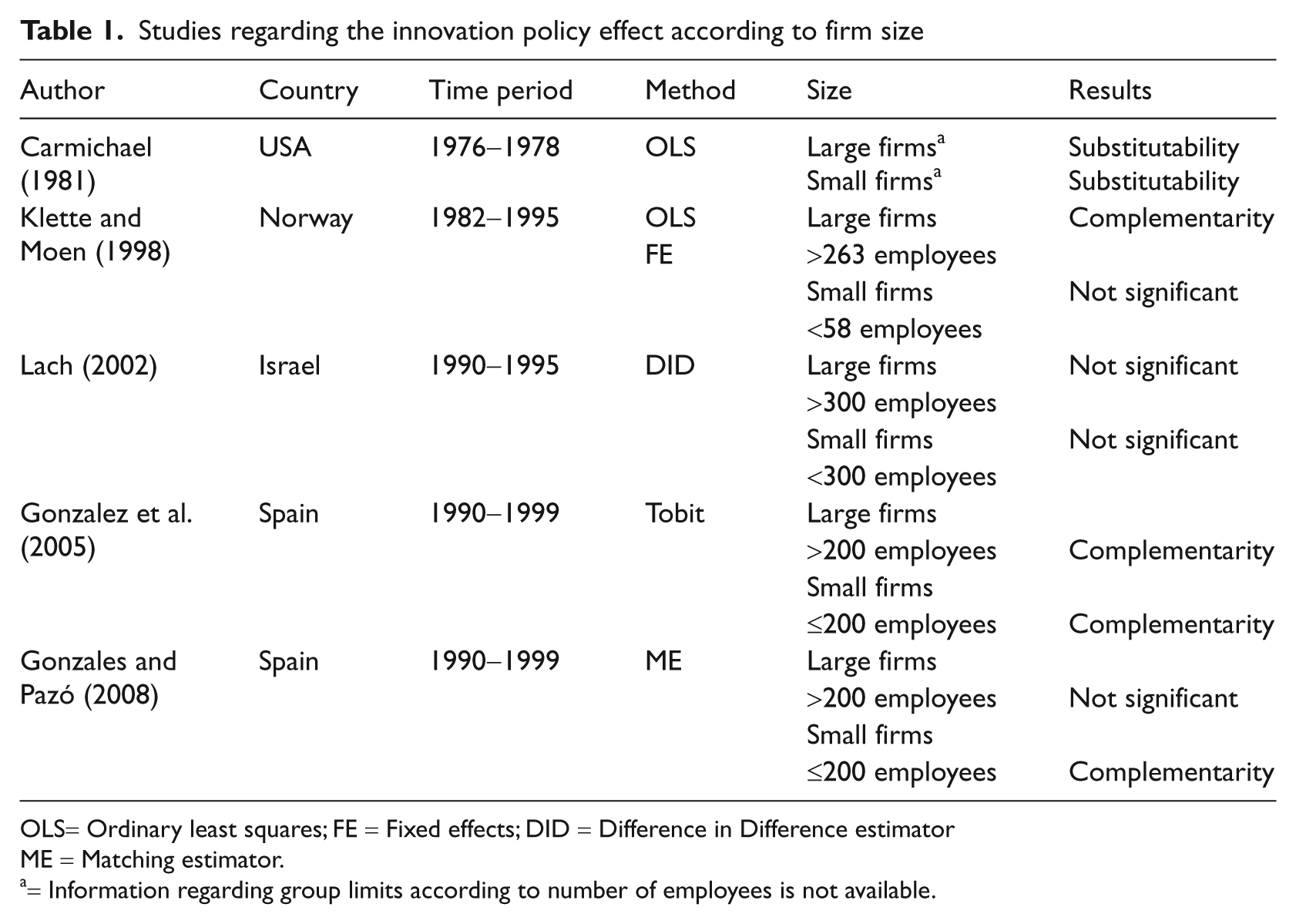
OLS= Ordinary least squares; FE = Fixed effects; DID = Difference in Difference estimator
ME = Matching estimator.
=Information regarding group limits according to number of employees is not available.
Accordingly, this study analyses the additionality effects that R&D subsidies have on innovation activity within the case of large, medium and small-sized firms. Estimating additionality effects entails answering the following research question:
RQ1: Does the receipt of subsidies make a difference to the level of firm innovation activity?
In addressing this question, our key contribution lies in exploring the differences in aspects of innovation activity which have not been previously analysed within the literature. First, we analyse how R&D subsidies shape the allocation of R&D expenditure upon basic research, applied research and technological development activities: these are used as proxy measure for inputs to the innovation process. Several authors have shown that R&D activities provide knowledge with differing strategic values, and that firm size influences such activities (Cassiman et al., 2002; Coccia and Rolfo, 2008; Henard and McFadyen, 2005, 2006; Roper et al., 2004). R&D subsidies might promote investments geared to extending the frontier of technological knowledge (basic and applied research), and/or delving more deeply into the technological knowledge that firms already possess (technological development).
Second, we analyse whether R&D subsidies have any influence on the sale of innovative products, using this as a proxy measure for economic returns and outputs of the innovation process. Although recent studies have found that R&D subsidies have some effect on intermediate results of this process such as patents (Czarnitzki and Licht 2006) or on firm performance (Archibald and Finifter, 2003; Lerner, 1999; Wallsten, 2000), there is still considerable uncertainty in establishing whether subsidized firms achieve higher economic returns from their innovation activity than non-subsidized ones (Norrman and Bager-Sjögren, 2010). In fact, there are factors such as innovative capacity, business strategy or the market which directly impinge on these economic returns. Nonetheless, R&D subsidies are economic resources requested by firms in the framework of their R&D strategy, and their effects upon economic indicators are not to be underestimated. In the analysis we use the dichotomy between ‘sale of products new for the firm’ and ‘sale of products new to the market’ in order to take account of the novelty of innovation. The degree of novelty is one of the forces driving economic growth and could reform the base of competition in an industry, or create new ones (Audretsch and Aldridge, 2008; Tellis and Golder, 1996).
This article is structured as follows. First, the theoretical arguments are presented and the hypotheses tested. Next, details are given of the methodology used, and the data and variables are described. The findings of the empirical analysis are then discussed and, finally, conclusions are presented.
Firm size and innovation policy
In general terms, innovation policies are defined as a group of activities geared to increasing the quantity and intensity of innovation activities, which include creating, adapting and adopting new or improved products, processes and services (Lundvall and Borrás, 2005). Additionality is defined by Buisseret et al. (1995) as that which would not have been achieved without public policy support: this notion has been used to identify the impact of such policies (Autio et al., 2008; Clarysse et al., 2009; Falk, 2007; Hall and Maffioli, 2008; Hewitt-Dundas and Roper, 2010; Hsu et al., 2009). It has been argued that originally, the rationale for additionality is based upon the neoclassical justification of market failure, according to which firms have no incentives to invest in this activity at the optimum levels, and therefore public agencies should intervene to address this problem (Georghiou, 2002; Georghiou and Roessner, 2000; Luukkonen, 2000; Metcalfe and Georghiou, 1998). Consequently, the additionality effect is expected to measure the difference between the assumed under-investment of firms in innovation, and real publicly-led investment (Luukkonen, 1998). Estimating this effect involves comparing the situation of subsidized firms with that where there is a dearth of such policies in order to establish whether this effect is really an ‘additional’ one (Klette et al., 2000). Recent studies have shown that there are additionality effects if the innovative activity being analysed is greater than that obtained by firms not receiving public support, but which were more inclined to obtain it (Almus and Czarnitzki, 2003; Czarnitzki and Fier, 2002; Herrera and Nieto, 2008). This idea can be applied to all the possible impacts of a given aid programme, in such a manner that additionality effects have been found in the inputs and outputs of the innovation process (quantitative studies), and also in the behaviour and cognitive capacity of firms (qualitative studies) (see Buisseret et al., 1995; Clarysse et al., 2009).
Taking into account firm size, empirical evidence has focused on analysing the input additionality effects within the context of R&D investments, and has found that public funding might complement or substitute private R&D expenditure (see Table 1). Carmichael (1981) was one of the first authors to conclude that public funding had a greater effect on R&D expenditure in large firms than in small ones. This finding is similar to that obtained by Klette and Moen (1998), who found a complementary effect between public funding and private funding in the business units of large firms. The study by Lach (2002) analysed the effect of subsidies with no significant short-term results. However, he found that a year after obtaining public funding, small firms showed a significant increase in R&D expenditure. Conversely, González et al. (2005) found a complementary effect which was greater in small Spanish firms than in large ones. Unlike previous studies, these authors identified a minimum level of subsidies needed to take on R&D activities. The latter study concluded that this level was smaller in large firms and greater in small ones (10% and 40% of their R&D expenditure, respectively). Finally, González and Pazó (2008) established that the effect of subsidies on private R&D intensity in a sample of innovative firms was higher in firms with fewer than 200 employees. This effect was also significant and positive in a second sample including innovative and non-innovative firms, with the comparative study of these two samples concluding that for small firms, public funding has an important role in the decision to take part in R&D activities.
As can be seen in Table 1, the studies are not directly comparable and results are not conclusive: they differ in their findings, the support programmes analysed, the period of time evaluated, the methodologies and in the criteria used to subdivide the sample by size. Contemporary knowledge of the relationship between firm size and innovation policy is insufficient for policymakers to make informed decisions on other aspects such as policy design, resource distribution and stimulation of certain technologies or accumulation knowledge, among others. The traditional approach of evaluating the effect on the net amount of R&D expenditure does not adequately record the impact of public funding on strategic aspects such as the process of generating technological knowledge, neither does it enable us to determine whether subsidized firms gain economic returns from the innovation process.
In the case of technological knowledge generation (input additionality), Lichtenberg (1984) argued that the final impact of innovation policy on technological progress and productive growth will depend upon how public funding impacts on the way that firms distribute their R&D investments. Despite the importance of this topic, we have only detected the work by Link (1992), which shows that availability of public funding prompts firms to alter the profile of their in-house R&D expenditure, and thus their knowledge acquisition strategy. Basic and applied research and technological development activities provide firms with knowledge of different strategic value (Coccia and Rolfo, 2008). Such activities are developed in the early stages of the innovation process, where firms run the highest risk and make decisions on their technological knowledge frontier. Contemporary understanding of the innovation process suggests that these activities do not take place in a linear fashion, since the appearance of a technology may stimulate the creation of new technological knowledge and vice versa (Aschhoff and Sofka, 2009; Pavitt, 2005). Basic research activities enable firms to produce knowledge without a particular market objective. Applied research generates knowledge with a specific practical aim in mind, and technological development is concerned with transforming this knowledge into products and services (Beesley, 2003). On the one hand, investment in basic research, in general, is long term and helps to make the firm aware of the latest technological advances in the field where they provide the basis for applied research (Henard and McFadyen, 2006). On the other hand, applied research and technological development activities generate knowledge that is closer to the firm’s technological domain and its market (Roper et al., 2004). These activities are in general short-term ones and enable firms to distance themselves from their competitors (Henard and McFadyen, 2006).
Recent studies indicate differences in the choices made by large and small firms when they invest in these three types of R&D activities (Henard and McFadyen, 2005, 2006). Large firms endeavour to develop a broad knowledge base to enable them to maintain their competitive advantage, invest more in in-house R&D activities (Cohendet and Meyer-Krahmer, 2001; Veugelers, 1997), and draw upon basic and applied research activities to increase their scientific knowledge base in the long term (Rafferty, 2003). Conversely, a characteristic of small firms is a narrow knowledge base due to limited resources (Gopalakrishnan and Bierly, 2006). Small firms are more focused upon activities providing immediate solutions to critical problems and those affecting the core areas of the business, so they may be more interested in technological development activities (Corsten, 1987; Santoro and Chakrabarti, 2002).
Analysing the effect of public funding on how firms allocate their R&D expenditure would make it possible to determine whether firms take advantage of public funding to expand their technological knowledge base or to exploit existing knowledge. In order to grow and survive, firms have to make decisions regarding their technological frontier and reshaping their resource base. Productive growth is achieved not only by adapting existing technologies, but also by creating new ones. In-house R&D activities are a challenge for firms and policymakers, since these activities are expensive and risky (Raymond and St Pierre, 2010; Stam and Wenuberg, 2009). Thus, in this study the following hypothesis is proposed:
H1: Subsidized and non-subsidized firms show a different distribution of their in-house R&D expenditure on basic research, applied research and technological development activities, and the magnitude of this difference changes according to firm size.
In the case of economic returns (output additionality), empirical studies have estimated the effect of subsidies on private R&D expenditure without taking into consideration the influence of large and small firms’ innovation processes on economic returns (see Table 1). The commercial success of subsidized projects has been analysed in studies evaluating aid programmes for small firms, such as the Small Business Innovation Research Program, an initiative in the USA that subsidizes R&D activities (Archibald and Finifter, 2003; Lerner, 1999; Wallsten, 2000). Although it is demonstrated that such subsidies have an effect on sales and employment, there is no definitive conclusion on the scale of this effect. Nonetheless, Archibald and Finifter (2003) clearly show that subsidies simultaneously affected the inputs and outputs of the innovation process, and that in this relationship the firm’s orientation towards commercial success is influential. It is concluded that the quest for commercial success was achieved at the expense of investments in basic research and the technical competence of the firm. In our study we estimate output additionality effects by using the sale of innovative products as a proxy measure for economic returns and the output of the innovation process. Unlike other studies, we used the dichotomy ‘sale of products new for the firm’ and ‘sale of products new for the market’ to take into account the degree of novelty of innovation.
There is support for this classification categorizing the innovative approach of small and large firms (Mosey, 2005; Oke et al., 2007; Paulson et al., 2007; Simon et al., 2002). In accordance with Kaufmann and Tödtling (2001), the ‘new for the firm’ category is generally associated with incremental innovations. If successful, these could improve the firm’s competitive position in the same market. The ‘new for the market’ category is associated with radical innovations requiring more than incremental development, and having no competitor in the market. Keizer and Halman (2007) argue that when firms focus on obtaining incremental innovations, they are concerned about the impact that these might have on profit levels, whereas in the case of radical innovations, firms are more focused on the value of the firm and the impact of the technology on the market. Radical innovations are obtained by firms with a strong emphasis on technology and innovation, since these have a longer, more unpredictable life cycle and are more context-dependent (Herrmann et al., 2006). Whereas incremental innovations are linear, involve few resources and can include simple collaborative relationships (Keizer and Halman, 2007), they are also low-cost and can be made operative more quickly than radical innovations (Bhaskaran, 2006).
Analyses of firm size and the degree of novelty of innovation are scarce and inconclusive (see Bhaskaran, 2006; Oke et al., 2007; Paulson et al., 2007; Simon et al., 2002). Analyses of innovation outputs have focused upon larger rather than smaller firms (Henderson, 1993; Oke et al., 2007; Stringer, 2000); in the case of incremental innovations, it is argued that large firms have the advantage of established capacities and knowledge (Henderson, 1993; Oke et al., 2007; Stringer, 2000). However, others (Bhaskaran, 2006; Paulson et al., 2007; Simon et al., 2002) point out that given flexibility and speed when introducing innovations, small firms gain advantages from incremental innovations in highly competitive markets. In the case of radical innovations, it has been argued that the potential for financial return is greater in large firms, given their market reach (Paulson et al., 2007). Alternatively, it can be argued that this is not necessarily the case, as many smaller firms are based entirely upon the notion of a radical idea (Kanter, 1985; Simon et al., 2002; Stringer, 2000).
In general, the literature has not dealt with analysing how innovation policy impinges on economic returns and the degree of novelty of subsidized products and, consequently, its contribution to economic growth is uncertain. Estimating additionality effects could provide important information for policymakers in developing support measures that enable firms to gear their activity and anticipate the direction and time of entry for their innovations (Dahlin and Behrens, 2005). As a result, in this study the following hypothesis is formulated:
H2: Subsidized and non-subsidized firms show a different level of economic returns and the magnitude of this difference changes according to firm size.
Method
A matching estimator was used to analyse the additionality effects of R&D subsidies (S i ) on firms’ innovation activity (Y i ). The method specifically compares the inputs and outputs of the innovation process of firms receiving subsidies (Y i,s = 1 (1) or factual state), with the results that they would have obtained if they had not received them (Y i,s = 1 (0) or counterfactual state). Because a firm i cannot be observed simultaneously when receiving and not receiving subsidies, the counterfactual state becomes a fundamental problem for evaluation. The matching estimator estimates the counterfactual state with information stemming from a control group made up of firms that did not receive subsidies but had a strong propensity to receive them (Y i,s = 0 (0)). To obtain this control group the method has to estimate, for each firm, the conditional propensity of receiving R&D subsidies (or propensity score) given a group of individual characteristics (X i ). In this study, we used a Probit model to estimate this propensity and analysed which conditional variables X i influence the likelihood of obtaining subsidies.
The use of matching estimators has gained popularity in evaluation exercises, as it enables the issue of distribution of aid to be borne in mind. In the present case, the distribution of subsidies is not a random process because firms request subsidies and often compete for them (Busom, 2000). As a consequence, at the end of this process, subsidized firms differ from those that do not attain support. This produces sample selection bias which could skew estimates of causal effect, since subsidized firms are not comparable with any other firm in the economy. The estimator reduces this bias through a process of matching between comparable units, and for this purpose uses a proximity criterion. In this way, each subsidized firm has a firm in the control group which is as similar as possible in terms of its propensity for obtaining subsidies. We have used the bias-corrected matching estimator proposed in Abadie and Imbens (2006) to make the matching process and obtain a net figure of the effect. In addition, we have followed the recommendations in the work by González and Pazó (2008), which shows that the effect of subsidies may be overestimated if previous R&D experience (lagged outcome) and past success in application for public funding are not taken into account. As a result, in the present study, the selection process of similar observations was made from within the group of firms complying with the following conditions:
they had a similar propensity to obtain subsidies;
they belonged to the same sector of activity;
were in the same situation with regard to previous R&D expenditure and with regard to having received subsidies or not in the previous period.
Once the matching process was concluded, subsequently the bias-corrected matching indicator obtains the causal effect as the difference between the average value of a variable of interest Y i in the group of subsidized firms Yi, s = 1 (1) and the value of this same variable in the control group Yi, s = 0(0). Subsidies have a positive effect if the figure for this difference is significantly higher than 0. The bias-corrected matching estimator can be represented thus:

Dehejia and Wahba (2002) and Abadie and Imbens (2006) carry out a thorough review of these estimators, and Almus and Czarnitzki (2003) describe how they are applied to the case of innovation policy evaluation.
Data
The data used to carry out the research come from the Panel of Technological Innovation. This panel was created with information from Spanish firms recorded by the Survey of Technological Innovation and R&D drawn up by the Instituto Nacional de Estadística in Spain. Since 2003 the panel has recorded information from more than 7200 firms belonging to two sub-populations. The first consists of firms with more than 200 employees, and the second consists of firms which declare in-house R&D activities. The representative nature of the first sub-population is 73 percent of Spanish firms and 60 percent in the second case. The data used in this paper cover the period between 2003 and 2007. In this study a time dependence data structure was used. In the case of input additionality (H1), we estimated the effect in the year in which the firm received the subsidies (2004) and the following year (2005), while in the case of output additionality (H2) we estimated the effect for 2006 and 2007. This is because in the survey, the proxy for outputs measured the sales of innovative products introduced in the last three years over total sales (%). As a result, the variable in 2006 records the percentage of sales stemming from innovations in goods and services introduced in the period 2004–2006, and its value in 2007 records the period 2005–2007. The variable S i , that is, whether the firm received subsidies or not in 2004, acquires its determination from lagged explanatory variables X i , in other words the values in 2003, thereby reducing endogeneity problems and improving the quality of matching. 1
The final sample of firms used in the study was 4713 firms which replied to the survey during the seven-year period. Of these firms, 1218 received R&D subsidies from central and regional governments. We compared the hypotheses in the total sample of firms and in three subsamples by size: large firms (more than 250 employees), medium-sized firms (50–249 employees) and small firms (1–49 employees), which contain 1971, 1543 and 1190 firms, respectively. This classification was made according to the European Union’s (EU) recommendation to facilitate comparison among countries and adjust to the reality of the Spanish production sector. Traditionally, the literature has classified firms by two groups: firms with more than 200 employees, and firms with fewer than 200 employees, which does not properly reflect the composition of Spanish industry. Around 70 percent of employment in Spain is provided by small firms with fewer than 49 employees, in comparison with an average of 50 percent in the EU and 36 percent in the USA (Organisation for Economic Co-operation and Development (OECD), 2007).
Variables
The covariables vector X i was used to estimate the propensity to obtain subsidies and includes variables which, in accordance with the literature, influence this trend (see Acosta and Modrego, 2001; Almus and Czarnitzki, 2003; Blanes and Busom, 2004; Busom, 2000; Czarnitzki and Fier, 2002; González and Pazó, 2008). First, we included variables representative of the firm’s structural characteristics. Size (the log of number of employees) and age (a dummy variable indicates whether the firm is newly created or not) have been considered as indicators of experience and capacity for obtaining resources. We also included a dummy variable which indicated whether the firm is private without foreign capital, as certain support programmes exclude foreign firms. Second, we included indicators of geographical location and the competitive environment. The work by Herrera and Nieto (2008) indicates that the final result of subsidies changes in accordance with firm location. A dummy variable took the value of 1 if the firm was located in a central region of the Spanish Innovation System (that is, the Basque Country, Catalonia, Madrid and Navarre, regions accounting for 70 percent of the country’s R&D activity), and zero in the opposite case. In this group of variables, we also included propensity to export (the ratio between exports and sales multiplied by 100) and the sector of activity. In the latter case, we included three dummy variables that indicate whether the firm belongs to a hi-tech manufacturing sector, a medium-tech manufacturing sector or a hi-tech service sector. In addition, as studies have showed that indicators of previous R&D experience and receipt of public funding in the past have had a strong influence on obtaining subsidies, we included a dummy variable that took the value of 1 if the firm carried out continuous R&D activities during the three years prior to receiving the subsidies, and zero in the opposite case, together with another dummy variable that took the value of 1 if the firm obtained subsidies in the previous period, and zero in the opposite case.
In order to estimate the additionality effects on innovation activity (Y i ) of subsidized firms, expenditure on basic research, applied research and technological development was defined as the percentage of total private R&D expenditure, while economic returns were defined as the ratio between the sales obtained from new products and the total sales of the firm multiplied by 100. Finally, the study included the private R&D intensity (the ratio between private R&D expenditure and firm turnover, multiplied by 100) to compare the results with those obtained by previous studies.
Results and discussion
Table 2 shows the findings of the Probit model and the marginal effects estimated to analyse the propensity to obtain R&D subsidies. In the four models, the dependent variable took the value of 1 if the firm received subsidies, and zero in the opposite case. In the general sample, the findings indicate that recently established firms belonging to hi-tech service sectors, with previous R&D experience and which have obtained public funding in the past, had the highest probability of obtaining R&D subsidies. The estimation of the marginal effects shows that the variables with the greatest impact on this propensity belonged to hi-tech service sectors and obtaining public funding in the past. A change in these variables, ceteris paribus, would increase this propensity by 20 and 57 percentage points, respectively. These findings reflect the present situation of the Spanish productive system and innovation policy. On the one hand, most R&D growth in Spain has been driven by service sector expansion, where there has been an annual 16 percent increase, compared with 7.9 percent in the industrial sector (OECD, 2007). Consequently, an interpretation can be made that a relationship exists between present R&D growth and the public funding received in this sector. On the other hand, there are recent studies which have detected that it is normal for Spanish firms to receive subsidies from more than one public funding source (Herrera, 2008), and that obtaining subsidies in the past has a positive influence on obtaining public funding in the future (González and Pazó, 2008).
Results of the Probit model estimations and marginal effects
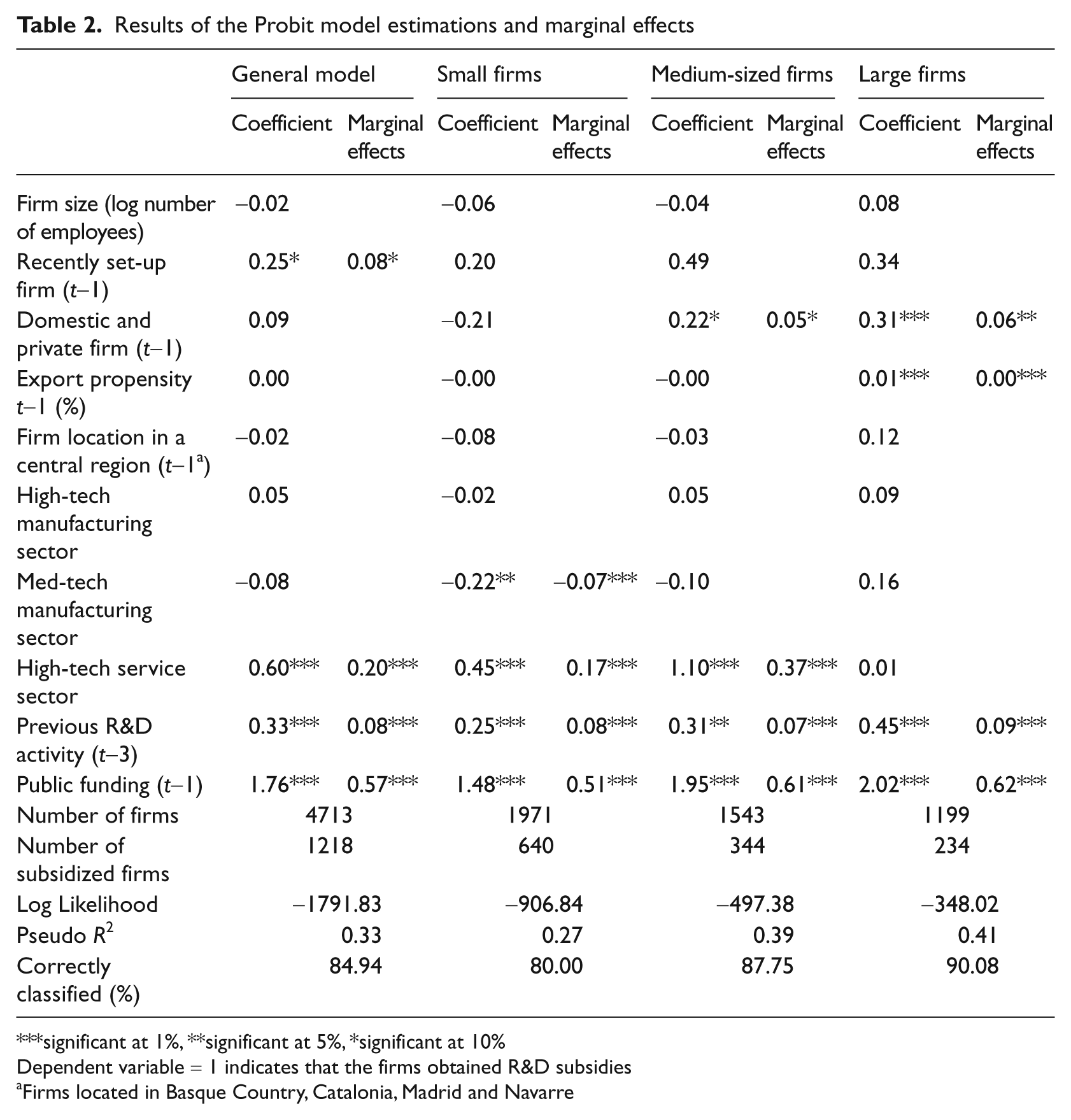
significant at 1%, **significant at 5%, *significant at 10%
Dependent variable = 1 indicates that the firms obtained R&D subsidies
Firms located in Basque Country, Catalonia, Madrid and Navarre
The comparative analysis by size shows that three variables produce differences in the profile of subsidized firms: ownership, propensity to export and sector of activity. Unlike small firms, large and medium-sized ones are more likely to obtain subsidies if they are private firms without foreign capital. The literature evaluating the distribution of R&D subsidies shows that public agencies tend to exclude firms with foreign capital not just in Spain (Busom, 2000), but also in other countries (Almus and Czarnitzki, 2003). Subsidiaries of foreign firms could benefit from the R&D activities obtained in another country because there is a greater degree of centralization of R&D activities within multinational corporations (Veugelers, 1997). The study also shows that the propensity to export significantly increases the likelihood of obtaining subsidies in the group of large firms. In Spain, these firms are more likely to undertake internationalization: it has been found that they have an interest in obtaining public funding, as entering international markets gives rise to gains which reinforce the innovation process and strengthen their competitive market position (Czarnitzki and Licht, 2006; González et al., 2005; Heijs, 2005). Finally, the study detected differences with regard to the sector of activity. Small and medium-sized firms are more likely to obtain subsidies for R&D if they belong to the hi-tech service sector and this propensity grows, ceteris paribus, by 17 and 37 percentage points, respectively. In the case of small firms this propensity is significantly reduced if the firm belongs to the high-to-medium-tech manufacturing sector. In accordance with an OECD (2007) report, the design of innovation policy in Spain is determined to a great extent by the country’s industrial structure, principally made up of small and medium-sized enterprises (SMEs) in traditional sectors, with a small number of firms specializing in high technology. Thus, one of the main challenges for policymakers is to favour the expansion of hi-tech sectors and especially to support the vast majority of small firms that see no need to carry out innovation activities, or have insufficient organizing capacity to take on research and development activities.
Table 3 shows the findings of a means t-test carried out to compare the variables used in the matching process before and after the paring, and to ensure the matching quality and robustness of the findings. As to be expected, before matching, the analysis shows significant differences between the group of subsidized firms and the group receiving no subsidies. After the matching, these differences between the group of subsidized firms and the control group disappear.
Means comparisons between subsidized firms and non-subsidized firms (before matching) and between subsidized firms and control group (after matching)
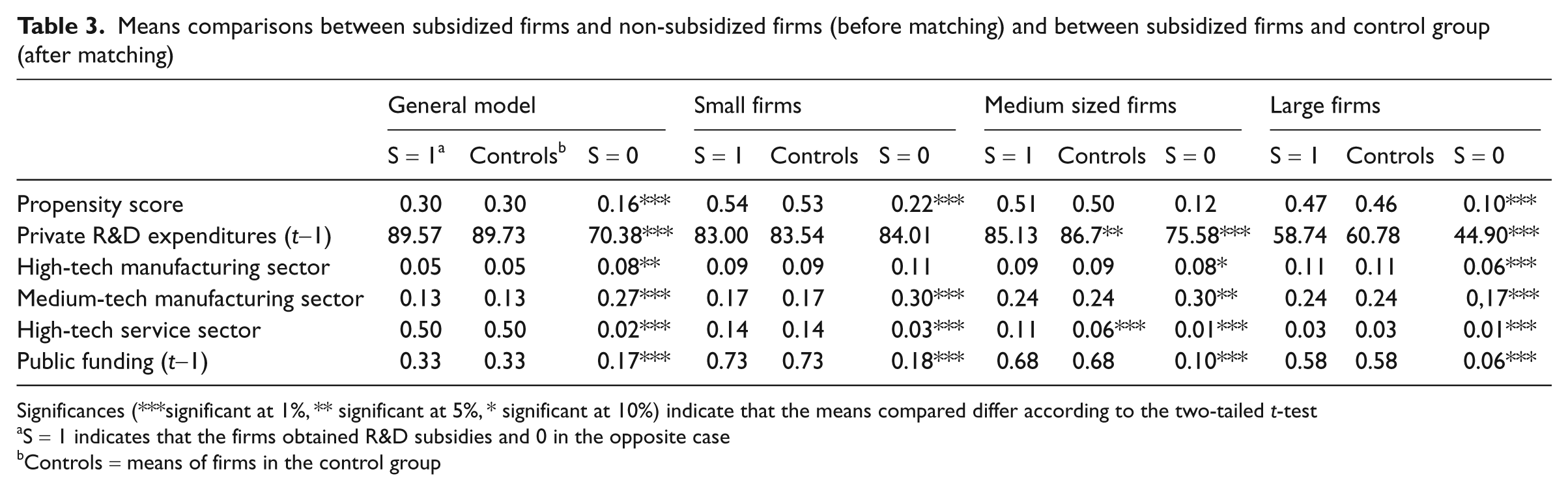
Significances (***significant at 1%, ** significant at 5%, * significant at 10%) indicate that the means compared differ according to the two-tailed t-test
S = 1 indicates that the firms obtained R&D subsidies and 0 in the opposite case
Controls = means of firms in the control group
Table 4 shows the estimation of additionality effects. In the general model it can be seen that subsidized firms increased their private R&D intensity compared to firms in the control group by 0.26 percentage points in the year when they received their subsidies, and by 0.43 percentage points the year after. Although the magnitude of the effect is a modest one (German studies place it around 4 percentage points, see Almus and Czarnitzki, 2003), Spanish firms are not replacing private funds by public ones. There is a positive balance if we bear in mind that the variable under analysis is constructed with the R&D expenditure financed by the firm with its own funds and excluding other sources of finance. These findings coincide with previous studies in the Spanish case (see Busom, 2000; Callejón and García-Quevedo, 2005; González and Pazó, 2008; González et al., 2005; Herrera and Nieto, 2008). This study also shows that subsidies had additionality effects on how firms distribute their in-house R&D expenditure. In the year when firms received public funding they reduced their investment in basic research by a significant amount (−2.90 percentage points) and increased investment in applied research (3.51 percentage points) and technological development (5.01 percentage points). A year later, subsidized firms increased investment only in technological development (4.95 percentage points). In general, these results indicate that subsidized firms reduced their effort devoted to extending the frontier of technological knowledge (outside the technological core domain) and increased investment aimed at the generation of knowledge that provides immediate solutions to critical problems and those affecting the core area of business. The analysis also shows that subsidized firms increased the economic returns from the sale of products new to the firm in the period after they received the subsidies.
Average effect of R&D subsidies on the firm’s innovation activity
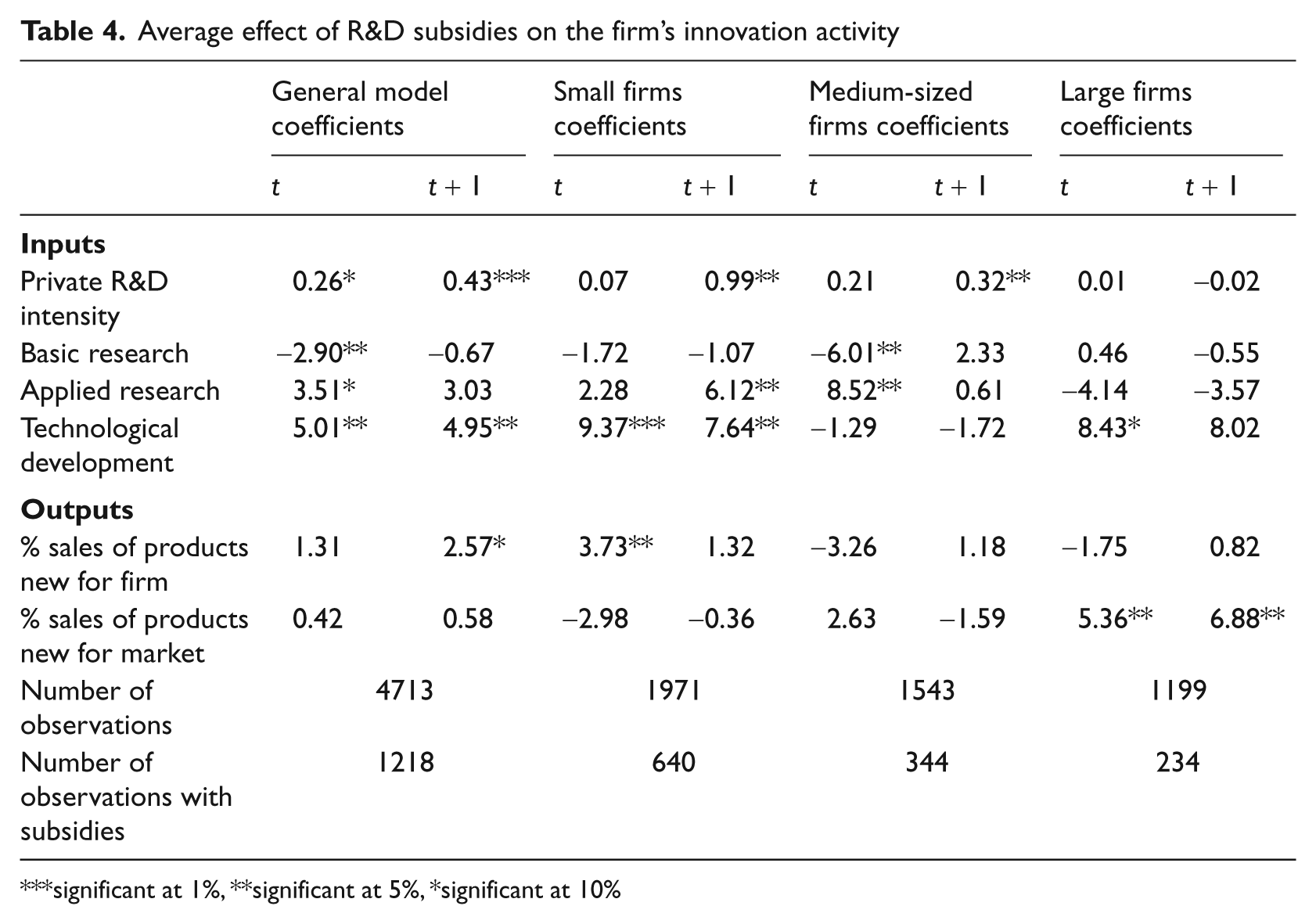
significant at 1%, **significant at 5%, *significant at 10%
We also detect differences in the additionality effects produced by subsidies according to firm size. The year in which firms received public funding saw no significant effect on private R&D intensity. Nevertheless, a year later, this variable rose significantly only in the case of small and medium-sized firms (0.99 and 0.32 percentage points, respectively). This study used a means t-test to discover whether the effect was noticeably greater in one group of firms or another. The test indicates that there are no significant differences in the magnitude of these effects.
The results of the study confirm H1. Subsidies have input additionality effects on the allocation that firms made in their R&D expenditure, and the impact changes with firm size. In relation to investment in basic research, the study shows that the effect of subsidies was negative and significant only for medium-sized firms (−6.01 percentage points). In no case of the present analysis did subsidized firms increase investment geared towards extending the frontier of technological knowledge, which would have allowed them to diversify risk and combine related technologies in a complex manner to create a sustainable competitive advantage in the future. Nonetheless, the subsidies policy made it possible for small and medium-sized firms to increase their investment in applied research, the aim of which is to extend the knowledge base in the firm’s technological domain. In the year in which the subsidies were received these investments showed a significant rise in the case of medium-sized firms (8.52 percentage points), and a year later for small firms (6.12 percentage points). As can be observed, there is a substitution effect for investments in the case of medium-sized firms, reducing their investment in basic research and increasing it in applied research. According to Rafferty (2003), R&D activities are related to the firm’s business cycle and growth. For example, during expansion processes firms cut investment in basic research and increase investment in applied research and technological development, so that substitution effects might arise between different types of R&D, since these activities compete for resources (Henard and McFadyen, 2006). The study also shows that investment in technological development experienced a significant rise in small and large firms (9.37 percentage points and 8.43 percentage points, respectively), although there are no significant differences in the magnitude of the effect. A year later only small firms were still investing in this activity.
Table 4 shows significant differences between economic returns and the degree of novelty of innovations of subsidized compared to non-subsidized firms in the control group, so H2 is proved correct. Small firms showed an increase of 3.73 percentage points in the sale of products new for the firm during the period 2004–2006, even though their R&D effort was significantly higher than that of large firms. Small subsidized firms managed to materialize technological knowledge generated in incremental innovations which could guarantee success for them in the short term, but not enable them to keep up their competitive advantage in the future. However, large firms were able to increase the sale of products new for the market, as a result, among other factors, of making a significant increase in technological development investments. The increase showed was 5.36 and 6.88 respectively in the two periods analysed.
Conclusion
This paper has analysed the additionality effects of R&D subsidies with regard to how firms allocate their in-house R&D expenditure on basic research, applied research and technological development activities, plus the economic returns from the innovation process. These effects were estimated by comparing the innovative activity of firms receiving R&D subsidies, and those which did not receive them but which were more inclined to obtain them (control group). The paper included a comparative analysis of these effects according to firm size. In order to obtain a clearer estimation of additionality effects, the first part of the analysis obliged us to bear in mind the allocation of R&D subsidies. In this previous analysis, we have found that there are differences in the profile of subsidized firms regarding their size. For example, large firms are more likely to be subsidized if they are private firms without foreign capital and with a propensity to export, whereas in the case of small firms, the determining aspect is placement within the hi-tech service sector. Although the literature has provided an explanation for some of these findings, we found that a priori these differences might not be enough to explain disparities in the magnitude of the effect of subsidies on these groups of firms. The above can be deduced from the results obtained in the study which, regardless of size, show that firms which are more likely to be subsidized are those with previous R&D experience which had obtained public funding in the past. The importance of these variables increases with firm size, and reaches very high levels. For example, all things being equal, obtaining public funding in the past could increase the likelihood of obtaining subsidies by more than 50 percentage points. Thus, it is worthwhile considering that this approach in distribution reflects a distancing from the specific needs and problems that firms suffer as a result of their size. Moreover, continuous support for innovative firms would contribute to improving funding of R&D activities only in the case of firms which have shown their innovation capacity in the past, to the detriment of firms that wish to set in motion innovative projects for the first time.
In the second part of the analysis directed to estimating the additionality effects, we found three differences between subsidized firms compared to non-subsidized firms in the control group. We found that R&D subsidies were most effective in stimulating the private R&D intensity of small and medium-sized firms (input additionality). In general, these firms have more financial difficulties than large firms when taking on innovation activities, and public funding has a positive complementary effect on private funding. In addition, the study showed that subsidies have effects on the way in which firms distribute their R&D expenditure on basic research, applied research and technological development activities. All of these activities are geared to increasing the firm’s stock of technological knowledge. On the one hand we found, for all analysed cases, that subsidies did not encourage activities geared towards expanding the technological knowledge frontier (i.e. basic research), but managed to increase investments geared to extending the knowledge base in the firm’s technological domain (i.e. applied research and technological development). On the other hand, investments in applied research and technological development would enable firms to put distance between themselves and their competitors in the short term. In this study we also found a particular substitution effect on investment in the case of medium-sized firms. These firms reduced investment in basic research and increased it in applied research. The findings of this study reveal that large, medium-sized and small firms have different aims in their R&D activities when they request subsidies, but also that the policy of subsidies may have an influence on how wide and how deep the firm’s stock of technological knowledge is.
In the third part of the analysis, we found that the difference between subsidized and non-subsidized firms occurs in the economic returns of the innovation process (output additionality). The study found that only large and small subsidized firms increased their economic returns compared to firms receiving no subsidy. Nonetheless, the study shows that there is a different result if we take into account the degree of novelty of product innovations. In the case of small firms, even though they increased their private R&D effort and investment in applied research and technological development, they only succeeded in increasing the sale of products new for the firm. This could be interpreted as showing that these firms are receiving subsidies to extend their technological knowledge base, merely managing to materialize knowledge in an incremental innovation which may bear fruit in the short term, but which will hinder them in maintaining a future competitive advantage. Subsidized SMEs, which provide the greatest economic value for the Spanish economy, are not developing new innovative products for the market. Fernández-Ribas and Catalán (2010) have pointed out already that this effect can become a limiting factor for medium-term development, since the springing up of new industries based on destructive innovations is restricted. Thus, research will have to continue and managers and policymakers will have to work on the early detection of innovations which can potentially initiate a radical change in the industry. Policies could be created based on a deeper knowledge of how such innovations occur, and thus support the early stages of its development. In the case of large firms, these obtained economic returns from innovations new for the market. The study shows that these firms only invested in technological development activities, rather than those geared to extending the frontier of knowledge beyond the firm’s technological domain. Consequently, large firms may have asked for public funding to support the process of transforming their stock of knowledge into new products and services for the market, since this is a critical phase of their innovation process.
The results of this study may have implications for policymakers, if we take into account that granting aid in the past has a significant determination on obtaining public funding in the future. As a consequence of these decisions, policymakers should reflect on the role of innovation policy in the technological change process and the configuration of industry. We should not forget that the process involving the distribution of public funding implies, in turn, that public agencies take decisions about what aspects of innovation activity and technological change are to be stimulated to the detriment of others. As in the case of small firms, the present subsidy distribution approach could allow the continuation of a certain strategic behaviour which specializes in leading the firm towards a quest for immediate results, rather than constructing a sustainable competitive advantage.
Limitations of the study
It must be pointed out that this study contains a series of limitations. For example, the survey only indicates where the subsidies come from (regional or national agencies) without giving details of the support programme. As a result, the evaluation presented in this article is general and the findings have to be interpreted by taking into account the characteristics of the data used and the case study. Another limitation relates to the method, which does not enable a longitudinal analysis to be made: consequently, the effects that are not detected on the time horizon of our research might underestimate the impact of public incentives. Most likely, in some cases a more extensive time period may be needed for the effects of these subsidies to become visible in some of the variables or groups of firms. In addition, we are not able to control the time lag from the initiation of the innovation process up to the point that results become visible. Finally, future research will find it necessary to increase the number of variables of interest in order to analyse the impact of these R&D subsidies on other aspects of firms’ strategic behaviour, such as acquiring outside technology, contracting human resources and organizational behaviour.
Footnotes
Acknowledgements
We are grateful to the editor and anonymous reviewers of this journal for their helpful comments.
Funding
The Spanish Ministry of Science and Innovation financed the Project ECO2009-09283 and the Board of Education of Autonomous Region of Castilla y León financed the Project LE011A08, from which this article derives.