



Abstract
This study investigates how a business owner’s human and social capital affects start-up absorptive capacity under different environmental conditions. From an analysis of a sample of 199 Flemish start-ups, the study observes that the owners’ start-up experience and bridging social capital are positively and significantly related to the new venture’s ability to acquire, assimilate and exploit external information. In addition, the findings reveal a positive but decreasing effect of owner-specific human capital as a function of environmental turbulence. Furthermore, the study finds that management experience significantly stimulates start-up absorptive capacity within highly dynamic environments, whereas it hinders it within stable environments. Finally, implications of the study and opportunities for future research are provided.
Keywords
Introduction
With the emergence of the knowledge-based economy, organisations increasingly rely on knowledge and scarce information to enhance their performance (Ireland et al., 2002; Zahra et al., 2000). Prior work has provided proof of the strategic importance of adequate external information processing and the centrality of knowledge to a firm (Sapienza et al., 2005). As such a firm’s absorptive capacity, which is defined as its ability to identify, assimilate and exploit new external information, could represent a major source of competitive advantage (Zahra and George, 2002).
Processing information efficiently is important for all firms, but absorptive capacity is of particular importance for start-ups. Young firms suffer from liability of newness, which increases their propensity to fail compared to more established enterprises (Aldrich and Auster, 1986; Unger et al., 2011). Owners of young firms face many different and potentially unfamiliar tasks: they have to respond to new situations requiring immediate decisions and actions. However, their coping methods and strategies continue to be developed (Bantel, 1998; Unger et al., 2011). As many firms confront difficulties in absorbing knowledge and information from the external environment (Escribano et al., 2009), developing absorptive capacity is one option to overcome such difficulties (Kostopoulos et al., 2011; Yu et al., 2011). As start-ups are less fettered by bureaucracy, and arguably can adapt quickly to a changing environment, their efforts to acquire, assimilate and exploit external information could represent a means by which to get ahead of established competitors (Liao et al., 2003). An important precondition to yielding a competitive advantage from new knowledge is the speed with which information is processed (Zahra and George, 2002). A more developed absorptive capacity is expected to strengthen a start-up’s fragile competitive position, while simultaneously adding to the venture’s survival prospects (Coeurderoy et al. 2012; Keh et al., 2007; Sapienza et al., 2006; West and Noel, 2009). Start-ups often possess a narrow organisational and technological repertoire, resulting in a lopsided knowledge base, few capabilities and a limited capacity to cultivate the necessary competencies (Zahra and Filatotchev, 2004). Therefore, in order to address operational challenges fully, young firms have to acquire a range of skills and competencies; clearly, the absorptive capacity of a firm and its managerial team is critical in this process. Not only does start-up absorptive capacity allow a firm to better appreciate and understand the significance of external signals, it also assists in avoiding competence and failure traps (Ahuja and Lampert, 2001; Levinthal and March, 1993). Enhanced absorptive capacity can alert a managerial team to atypical information that challenges the organisation’s cognitive schemas. It might reduce the risk of incessantly refining existing knowledge (the familiarity trap), unilaterally aspiring to predictable outcomes (the maturity trap) and precluding the exploration of novel knowledge areas (the propinquity trap). Therefore, absorptive capacity enhances new product development in young firms, facilitates the identification of new product opportunities and contributes to much-needed sales (Fernhaber and Patel, 2012).
Despite the fact that individual cognition is recognised as a powerful internal driver of absorptive capacity (Cohen and Levinthal, 1990; Lane et al., 2006), little empirical evidence exists on the significance of the individual’s knowledge base as a mainstay of organisational absorptive capacity. Empirically disregarding the individual in absorptive capacity research relegates the construct to a mere mathematical heuristic, whereby a certain amount of external information (input) produces an expected increase in an organisation’s knowledge base (output) (Lane et al., 2006). In particular, start-ups are especially dependent on the knowledge resources provided by entrepreneurs or business owners (Brush et al., 2001; Thorpe et al., 2005). Therefore, in order to address the above research deficit, this study aims to find empirical evidence of a business owner’s direct contribution to their start-up’s ability to acquire, assimilate and exploit new information. In doing so, it adopts a human and social capital lens; however, note that although we recognise the central role of business owners as their firms’ strategic decision-makers, who affect organisational absorptive capacity indirectly through the articulation of strategy, allocation of resources, definition of tasks and empowerment of employees, the present research emphasis is on their direct contributions. By narrowing the scope in this way, the present study aims to reemphasise and empirically confirm Cohen and Levinthal’s (1990) assumption of individual knowledge as the mainstay of the absorptive capacity construct.
Previous work proposes a significant role for environmental turbulence in shaping the ability to harvest external information (Jansen et al., 2006; Lichtenthaler, 2009). For example, firms operating in a turbulent environment characterised by abundant and constantly evolving knowledge have been found to engage in more external knowledge processing, in order to develop or maintain their organisation–environment fit (Becherer and Maurer, 1997; Liao et al., 2003; Miller and Friesen, 1983; Nicholls-Nixon et al., 2000). Still, we know very little of the importance of environmental turbulence regarding the relationship between individual cognition and organisational absorptive capacity. Accordingly, we introduce environmental turbulence into our modelling framework, and examine its impact on an owner’s direct absorptive capacity contribution.
This study contributes to the absorptive capacity and entrepreneurship literature in several ways. First, it sheds light on the mechanisms by which individual human and social capital can improve a start-up’s ability to accumulate and absorb external information effectively. As such, this study provides empirical evidence on one of the absorptive capacity construct’s fundamental premises: that an organisation’s absorptive capacity builds on the accumulated knowledge base of its constituents (Cohen and Levinthal, 1990). Thus, it responds to the criticism of Lane et al. (2006), that earlier empirical research has largely ignored firms’ individual members as responsible for uniquely creating organisational value from new knowledge. Many studies have related human capital to firm performance (e.g. profitability and growth), yet they have failed to detect the mechanisms through which performance may be affected (see for example, Crook et al., 2011 and Unger et al., 2011 for a meta-analytical overview). Absorptive capacity may be such an explanatory, learning-oriented mechanism; therefore, it is the focus of this study. Second, while reemphasising individual mental models and one’s personal knowledge base as essential internal drivers of a firm’s external information processing, this study abandons the traditional (and rather one-sided) assumption that ‘more accumulated capital is better’. Instead, it posits and empirically tests positive and negative relationships between human and social capital of owners and start-up absorptive capacity. It also considers the effects of human and social capital to be a function of the particular environment in which a start-up operates. Finally, and building on the preceding points, it exposes the human and social capital of owners as potential absorptive capacity antecedents, thereby empirically confirming that powerful actors within firms possess the ability to influence knowledge processes (Todorova and Durisin, 2007).
This article commences by exploring the concept of organisational absorptive capacity, and reviewing previous research on human and social capital. It then captures the notion of environmental turbulence and discusses its anticipated impact on the model, moving onto identifying gaps in existing research and defining several hypotheses to be tested. Next, it describes the research methodology, with a special focus on sampling procedures, measures and model tests. Finally, it presents and discusses the findings, concluding by highlighting several caveats and opportunities for future research.
Theoretical background
Absorptive capacity research regards firms as systems that encompass the processes of noticing, interpreting and using information from their environment (Cohen and Levinthal, 1990; Lane et al., 2006; McAdam et al., 2011). In their seminal contribution, Cohen and Levinthal (1990) refer to absorptive capacity as one of the core processes of firms that designate their ability to identify, assimilate and exploit external information. What is central to Cohen and Levinthal’s (1990) assumptions and propositions regarding the absorptive capacity construct is that individuals, similar to organisations, are assumed to acquire information and put new knowledge into memory. Afterwards, they can recall and use this knowledge to generate new insights. Upon transferring this individual-level understanding to the organisational level, Cohen and Levinthal (1990) posit that organisational knowledge processing de facto builds on the corresponding individual capabilities of each of a firm’s constituents. Specifically, they argue that for external knowledge to evolve into an organisational competitive advantage, individuals are required to acquire, interpret, communicate and combine information creatively and uniquely.
Although we recognise that organisational absorptive capacity and its underlying processes capitalise on the existing personal knowledge base of each of a firm’s constituents (Cohen and Levinthal, 1990; Escribano et al., 2009), we perceive owners as the primus inter pares of start-ups. Two arguments support this view. First, owners have a hand in practically every aspect of their new business, which causes the evolutionary path of such new ventures to be intertwined with owner vision, conviction and knowledge (Jansen et al., 2011; West and Noel, 2009; Wiklund and Shepherd, 2003; Zhang et al., 2006). Second, start-up owners often act as gatekeepers or interface between new firms and their environment, and/or between sub-units of the firms (Smeltzer et al., 1988). These gatekeepers scan the environment for important information, bring new knowledge into organisations and communicate this knowledge across unit boundaries (Cohen and Levinthal, 1990). This study focuses on two knowledge bases of owners as determinants of absorptive capacity: human capital and social capital.
Previous research has focused on the link between human capital and opportunity recognition and pursuit (Bhagavatula et al., 2010; Ucbasaran et al., 2008); yet the link with other firm practices, such as information search intensity and absorptive capacity (measured outside of the typical R&D domain), remains largely unexplored (Camisón and Forés, 2011; Robson et al., 2012; Ucbasaran et al., 2008). From a human capital perspective, individuals can accrue additional knowledge by investing in general and/or specific human capital (Becker, 1993; Bosma et al., 2004; Debrulle et al., 2012; Gimeno et al., 1997). General human capital refers to skills that are useful and transferable across a wide range of situations (e.g. occupational alternatives, economic settings), whereas specific human capital is related to a specific setting and has a much narrower scope of applicability. As a core organisational member, the owner of a start-up is perceived to be an important reservoir of knowledge through their human capital (Smith et al., 2005).
General human capital, which emerges largely from prior formal education and management experience (Bates, 1990; Gimeno et al., 1997), is considered a source of generic abilities, intelligence and skills. It generates a wider individual knowledge base and improves general cognitive reasoning, cognitive processing and problem-solving skills (Bierly et al., 2009; Chandler and Lyon, 2009). Furthermore, it reflects a motivational need for achievement (Hatch and Dyer, 2004), and increases the commitment and effort devoted to further knowledge searching, acquisition and interpretation (Autio et al., 2000; De Clercq et al., 2005). In addition, people with higher levels of formal education are expected to be more receptive to new ideas and change (Boeker, 1997). Given that education and management experience foster individual knowledge-creating capabilities, and that an organisation’s absorptive capacity capitalises on the knowledge accumulated by its constituents such as its business owner, we posit our first hypothesis: H1: The general human capital of business owners is positively associated with start-up absorptive capacity. This will be reflected by the positive effects of: (a) formal education; and (b) management experience.
Apart from the anticipated positive effect of general human capital on absorptive capacity, recent contributions increasingly recognise individual knowledge and knowledge processing as the outcomes of a situated understanding about what works, when and where (Thorpe et al., 2005; West and Noel, 2009). According to this literature, knowledge needs to be venture-related if it is to produce organisational benefits. Given their less transferable nature and focused relevance to specific occupations or contexts, industry and start-up experience entail knowledge of particular customers, suppliers, products and services. Both forms of experience create value in a specific industry setting, and relate to a limited scope of occupational alternatives (Gimeno et al., 1997). Moreover, both deliver procedural knowledge on how to perform particular tasks, the pitfalls that may lie ahead and steps that should (or should not) be taken (West and Noel, 2009). In addition, these types of specific human capital (Gimeno et al., 1997; Ucbasaran et al., 2008) influence perception because they focus attention on issues related to already accumulated experience, and stimulate further knowledge accumulation with regard to those issues (Fiet, 1996; Ocasio, 1997). Although this might imply that industry and start-up experience inhibit some forms of radical change, we expect owner-specific human capital to direct start-ups on where to look for information and how to effectively acquire, assimilate and exploit it. In other words, we believe that owners’ specific human capital not only stimulates their personal information processing capability but also that of their new ventures, which leads to our second hypothesis: H2: The specific human capital of business owners is positively associated with start-up absorptive capacity. This will be reflected by the positive effects of: (a) industry experience; and (b) start-up experience.
Individuals also build knowledge by investing in social capital. Taken as a whole, social capital refers to the ability of actors, both individuals and organisations (Nahapiet and Ghoshal, 1998), to profit from their social structures, networks and community-based relationships (Davidsson and Honig, 2003; Lin et al., 1981; Portes, 1998). In a general sense, social capital affects absorptive capacity in various ways. For example, it provides privileged access to information and opportunities (Bhagavatula et al., 2010; Yli-Renko et al., 2001), which may have a goal-directing and motivating effect on further knowledge accumulation. Additionally, it influences cognition (De Carolis et al., 2009) and might institutionalise acquisition, assimilation and/or exploitation mechanisms for more effective and efficient future information processing (Bierly et al., 2009). Moreover, social capital can decrease the probability of opportunism in the knowledge exchange process, and therefore reduce its transaction costs (Nahapiet and Ghoshal, 1998). This increases the expected return and makes investing in external information all the more attractive. Finally, social capital affects the fundamental conditions that stimulate knowledge exchange. Specifically, the exchange of knowledge is founded commonly on trust (Hayton, 2005), which is also key to the development of social capital (Granovetter, 1983).
Previous work has indicated that within new ventures, an organisation’s need for social capital is satisfied initially by borrowing from an individual’s social capital (Arrègle et al., 2007). Furthermore, the significance of individual social capital for new ventures has been demonstrated by its effect on the availability, timing, relevance and quality of tangible and/or intangible business resources (Adler and Kwon, 2002; De Carolis et al., 2009; Thorpe et al., 2005).
Similar to Davidsson and Honig (2003), we distinguish between an owner’s bridging and bonding social capital. Bridging social capital or loose network relationships with, for example, other professionals (weak ties), predominantly functions as an interface for the exchange of otherwise unavailable information and scarce resources. Bonding social capital or associations with family and close friends (strong ties) is rooted in interpersonal trust, and can equip an owner with permanent access to a limited amount of specific resources (e.g. advice or aid; Davidsson and Honig, 2003; Granovetter, 1983). Previous research has argued that tie strength affects the benefits that can be distilled from a specific relationship. For example, Zahra and George (2002) mainly advocate for the importance of strong ties or bonding social capital. Conversely, Todorova and Durisin (2007) accentuate the significance of weak ties or bridging social capital, especially with respect to accessing novel information.
Closeness, long duration, frequent interaction and more evident or generalised trust are characteristics of bonding social capital (or strong ties) (Smith et al., 2005). Thus, a suitable premise would be to assume that bonding social capital improves information exchange and cooperation, which increases a business owner’s knowledge base and, in so doing, fosters organisational absorptive capacity. However, it has been suggested that strong ties might not be that effective or useful when acquiring and exploiting ambiguous information, such as market and customer information (Nahapiet and Ghoshal, 1998). Consequently, an owner’s bonding social capital actually could have a negative influence on start-up absorptive capacity. More specifically, due to the aforementioned characteristics, a group or network within which strong ties are present generally displays a distinct identity with strong norms and shared meanings. Prior work has revealed that a group with such an identity might focus selectively on a limited scope of information, thereby constituting a significant barrier to new knowledge acquisition and creation (De Carolis et al., 2009; Nahapiet and Ghoshal, 1998; Simon and Davies, 1996). The level of generalised trust associated with bonding social capital has been argued to be fairly unconducive to the development of the additional knowledge sources necessary for information acquisition (Kang et al., 2007). Besides, as bonding social capital generates a more collective understanding among all the parties involved, comparable lower effort will be devoted to the processing of any newly-acquired information within such a network (Bierly et al., 2009). This leads to our third hypothesis: H3: The bonding social capital of business owners is negatively associated with start-up absorptive capacity.
In contrast with strong ties, weak ties (or bridging social capital) require a smaller investment of time and resources (Smith et al., 2005). Contacts are scarcer, involve more dyadic trust and build on experience in specific interactions between two parties (Kang et al., 2007). In view of this lower degree of trust and collective understanding, an acceptable premise would be that an owner’s bridging social capital slows down any valuable information exchange and cooperation which, in turn, hinders the expansion of their personal knowledge base. Consequently, an owner’s bridging social capital, as a keystone of their start-up’s bridging social capital, equally would impede organisational absorptive capacity. Yet we expect that as the dyadic type of trust governing bridging social capital restricts the exchange of in-depth knowledge (Leana and Van Buren, 1999), a firm will be pushed to acquire, assimilate and interpret additional external information to obtain the full knowledge base needed or wanted.
Thus, weak ties can improve the efficiency of capturing information, because they require less effort to build and maintain and have lower coordination costs (Kang et al., 2007; Smith et al., 2005). As such, we believe that an owner’s weak ties represent an effective and efficient means of obtaining such ad hoc information and knowledge. In addition, bridging social capital generates more diverse information than bonding social capital (Nahapiet and Ghoshal, 1998). However, being immersed in a network that draws on diverse mental models of the world around them may trigger firms to become less confident about their undertakings (De Carolis et al., 2009). A successful way to cope with this is to acquire, assimilate and interpret even more knowledge and information, which leads to our fourth hypothesis: H4: The bridging social capital of business owners is positively associated with start-up absorptive capacity.
Previous research has emphasised that contextual factors might affect the relationship between an organisation’s absorptive capacity and its drivers. For example, Smith et al. (2005) suggested that strong ties are critical when the knowledge context is ambiguous and uncertain. Generally speaking, absorptive capacity logic requires the presence of external information for a firm to create value (Cohen and Levinthal, 1990; Zahra and George, 2002). Such information often results from a change in the firm’s environment (Yli-Renko et al., 2001), so the more turbulent the environment, the stronger the presence of various kinds of external information. and the more the conditions for absorptive capacity to generate a competitive advantage are satisfied (Chandler and Lyon, 2009; Liao et al., 2003; Zhang et al., 2006). Although many start-ups may not be operating within turbulent environments as such, by definition their respective surroundings are expected to display varying degrees of turbulence (Chandler and Lyon, 2009). This, together with the finding that different environments require different levels of dynamic capabilities (Eisenhardt and Martin, 2000), leads us to argue that the contribution of particular forms of owners’ human and social capital to absorptive capacity may be strengthened when environmental turbulence increases, whereas that of other forms could be weakened.
When environments become more turbulent, firms are faced with increasingly diverse, ambiguous and uncertain information (Lichtenthaler, 2009). In turn, this ambiguity and uncertainty makes the absorptive capacity success determinants of recognising and assimilating external knowledge considerably more challenging (Zahra and George, 2002). In this case, decision-makers require a broad mindset containing a diverse set of issues and answers, together with a lower degree of automatic attentional processing (Ocasio, 1997). In other words, under turbulent conditions, start-up business owners should benefit from human and social capital that offers them more cognitive flexibility and sensitivity. Specifically, those types of human and social capital that provide business owners with a broader view of the world around them may prove to be more useful in a turbulent setting, whereas the efficacy of more selective or environment-tailored capital will be progressively impeded. With regard to the present research, we believe that general human capital and bridging social capital are examples of less selective capital. They represent more general, transferable cognition and more loosely shared meanings. On the contrary, we assume specific human capital and bonding social capital to be more context-coloured, which leads to our final hypotheses: H5: Environmental turbulence acts as a positive moderator of the relationship between a business owner’s more transferable and flexible capital and start-up absorptive capacity. This will be reflected in a positive moderation of the effect of: (a) general human capital; and (b) bridging social capital. H6: Environmental turbulence acts as a negative moderator of the relationship between a business owner’s less transferable and flexible capital and start-up absorptive capacity. This will be reflected in a negative moderation of the effect of: (a) specific human capital; and (b) bonding social capital.
Method
Sample
This study builds on START 2009, an extensive cross-sectional survey on start-ups located in Flanders, Belgium. This is a biennial population survey of Flemish incorporated companies that have been in business for one to three years, are active within various economic sectors, and had a minimum of one and a maximum of 49 employees in 2009. START 2009 combines a company questionnaire and semi-structured interviews with each of the start-up’s current business owners.
The total research population of Flemish start-ups as defined above consisted of 3183 firms in 2009. Due to obsolete company data, 259 of these start-ups could not be reached. Out of the 2924 remaining start-ups, 453 company questionnaires and 490 owner interviews were obtained. Because data on both the start-up companies and their owners were required for this study, 68 companies (due to a lack of data on the owners) and 13 owners (due to a lack of data on the start-ups) had to be removed from this response group. In order to demarcate clearly business owners’ direct contributions to start-up absorptive capacity, the sample was limited further to starting ventures in which only one owner took responsibility for daily management (Dimov, 2010). Additionally, only those start-ups in which the current owner was the initial firm founder were considered. In so doing, we made sure that it was the current owner of each start-up who spotted the opportunity, raised sufficient finance, requested counsel and assistance from friends and colleagues and converted the initial business idea into an actual business. As a result of these conditions, the sample of this study was reduced to 262 companies which, due to the use of listwise exclusion during the statistical procedures, resulted in a final sample of 199 start-ups. Tests between respondent and non-respondent firms revealed no significant difference in terms of the organisations’ age or size (number of employees, total assets and equity). Moreover, using chi-square difference and t-tests, no differences were detected regarding industry, size and age between the firms used in the analyses, and those that were eligible but excluded due to missing values on one or more of the variables.
Measures
Absorptive capacity
Estimations of absorptive capacity have been subject to much controversy. In the past, researchers have operationalised absorptive capacity by means of R&D investments, patents and organisational age and size (Mowery et al., 1996; Muscio, 2007; Tsai, 2001). Not only do these proxies reify the absorptive capacity construct (Lane et al., 2006), but they also fail to capture its underlying complex nature (Liao et al., 2003). Therefore, this study measured absorptive capacity using a construct representing: (1) the acquisition of external information; (2) the assimilation of acquired information throughout a business; and (3) its successful exploitation and application in commercial actions (Lane et al., 2006; Liao et al., 2003). Similar to Jansen et al. (2005), Liao et al. (2003) and Maes and Sels (forthcoming), a market-oriented approach was selected to measure absorptive capacity as the acquisition, assimilation and exploitation of information from customers and markets. Start-ups are compelled to be market-oriented when they want to gain access to external information before their established competitors (Liao et al., 2003). After all, their limited resources prevent them from executing customer preference analyses or wide-scale market scanning. As a result, start-ups frequently have to rely on market intelligence stemming from direct contact with their customers and/or organisational networks to obtain external information (Keh et al., 2007). In addition to shedding light on current customer demands, such market intelligence also adds to a company’s understanding of future customer needs (Verhees and Meulenberg, 2004). The scale items used to measure market-oriented absorptive capacity are adopted from Kohli et al. (1993). Respondents were asked to rate five statements regarding market and customer external information processing on a five-point Likert scale (Cronbach’s alpha = .841). In view of employing market intelligence as a measure for absorptive capacity, all items were set up to capture the intensity with which market information is absorbed (see Appendix, Panel A).
Human capital
In accordance with prior research (Bates, 1990; Gimeno et al., 1997), business owners’ highest level of formal education and their number of years of management experience were used as measures of their general human capital (possible answers on the education scale ranged from 1 = no education to 9 = university degree). We consider management experience a proxy of work experience, which is commonly measured as the number of years of employment. However, as Bates (1990) suggested, management experience can be perceived as a level of achievement reached in employment, thereby giving it added value over the use of years of employment as an experience measure. In order to examine specific human capital, business owners were interviewed about their number of years of industry experience and the number of times that they had actively participated already in the process of starting up a business (Davidsson and Honig, 2003; Robson et al., 2012).
Bonding social capital
Owners’ social capital was operationalised by identifying each individual’s network structure and by assessing the quality of the connections constituting this network (Arrègle et al., 2007; Nahapiet and Ghoshal, 1998). Considering bonding social capital, each owner was presented with a list of several possible strong ties (e.g. parents, siblings, partners and friends). For each of these relationships, which are rooted in reciprocity and trust (Davidsson and Honig, 2003), each owner was asked to indicate whether they had ever received venture-related (non-financial) aid or assistance from it. If the response was affirmative, they were asked for the kind of aid or assistance that this strong tie had provided. Possible answers included general advice, administrative, technical and executive aid and guidance in financial matters (five categories). Based on this information, a bonding social capital index for each business owner was established by calculating the kind of assistance that each of the specified strong ties had provided.
Bridging social capital
Similar to bonding social capital, each owner was presented with a list of possible weak ties (e.g. professional contacts, employer organisations and loose relationships with industrial unions), and was invited to indicate whether a specific weak tie had ever provided valuable venture-related information, and what the quality of that information was (1 = very low quality; 5 = extremely high quality). In addition, all professional associations in which owners actively participated were noted (e.g. service clubs and professional societies). On a five-point Likert scale (where 1 = not influential to 5 = extremely influential), each owner was asked to indicate the significance of each of these associations in terms of their start-up’s development and sustainability. A bridging social capital index was then developed by calculating the specified levels of quality or importance of the accumulated weak ties.
(Perceived) environmental turbulence
The turbulent nature of the environment was determined using an environmental dynamism factor based on Zahra (1993) (Cronbach’s alpha = .894). Respondents were asked to rate seven environmental statements on a five-point Likert scale (where possible answers varied from 1= entirely disagree to 5 = entirely agree). The items and factor loadings are listed in Appendix, Panel B.
Control variables
In order to isolate the hypotheses from possible rival explanations, and to minimise extraneous variation, the owners’ age and gender, firm size, age of business activities and start-up continuation were included as control variables. Liao et al. (2003) argue that size has a major influence on firm behaviour. Organisational size was measured in terms of the number of full-time equivalent employees working in each firm. Although all start-ups in the sample were between one and three years of (legal) age, not all of them were ‘de novo’ start-ups. This implies that business activities could have been carried out before the current organisations were established. Therefore, the actual age of business activities and start-up continuation were controlled for; the latter being done using a dummy variable (start-up continuation) indicating whether a start-up’s business activities were already operational before the current organisation was legally established. Since prior studies have argued that performance differences exist between female- and male-owned firms (see for example, Klapper and Parker, 2011 and Robb and Watson, 2012 for an overview), the present study uses gender as a control variable to isolate any differences in absorptive capacity that could underpin performance variations.
Finally, because the start-ups in the sample belong to various industries, a series of dummy variables was developed to control for industry specificities. First, the NACE code of each of the sampled start-ups was looked up in Bel-first, a government-owned financial database holding information on the company accounts of all firms incorporated under Belgian law. As the European standard, the NACE hierarchical industry structure provides a generally accepted classification of economic activities. Because the classification in this study is based on the first level of the NACE code (the industry section), it corresponds with the world standard for classifying enterprises, ISIC, from which NACE is derived. In all, six industries were identified:
agriculture (NACE-A);
manufacturing (NACE-C);
construction (NACE-F);
transportation (NACE-H);
banking and insurance (NACE-K); and
professional services (NACE-M and S).
Using the manufacturing industry as a reference category, five dummies were included in the analyses.
Statistical procedures
Hierarchical regression analyses were used as the statistical procedure to test the hypotheses. The hierarchical approach permits groups of variables to be added to the model step-by-step, starting with the control variables. This approach is particularly appropriate when analysing potentially correlated independent variables, and/or when investigating multiplicative terms (Cohen and Cohen, 1983). All variables were mean-centred before the interaction terms involving environmental turbulence were created. The highest variance inflation factor (VIF) statistic encountered is 2.567, which is well below the recommended maximum value of 5 (Kleinbaum et al., 1998; Moreno and Casillas, 2008). This demonstrates the likely absence of multicollinearity. To exclude concerns of common-method variance, and to examine the construct, convergent and discriminant validity of the social capital, environmental turbulence and absorptive capacity measures, Harman’s single factor test as well as confirmatory factor analysis were used (see notes to the Appendix).
Results
Table 1 presents the means, standard deviations and bivariate correlations of this study’s variables. All correlations are well below .80 in absolute value, which is another indication that multicollinearity is unlikely (Hair et al., 1998). The results of the hierarchical regression analyses are listed in Table 2.
Descriptive statistics and correlations.
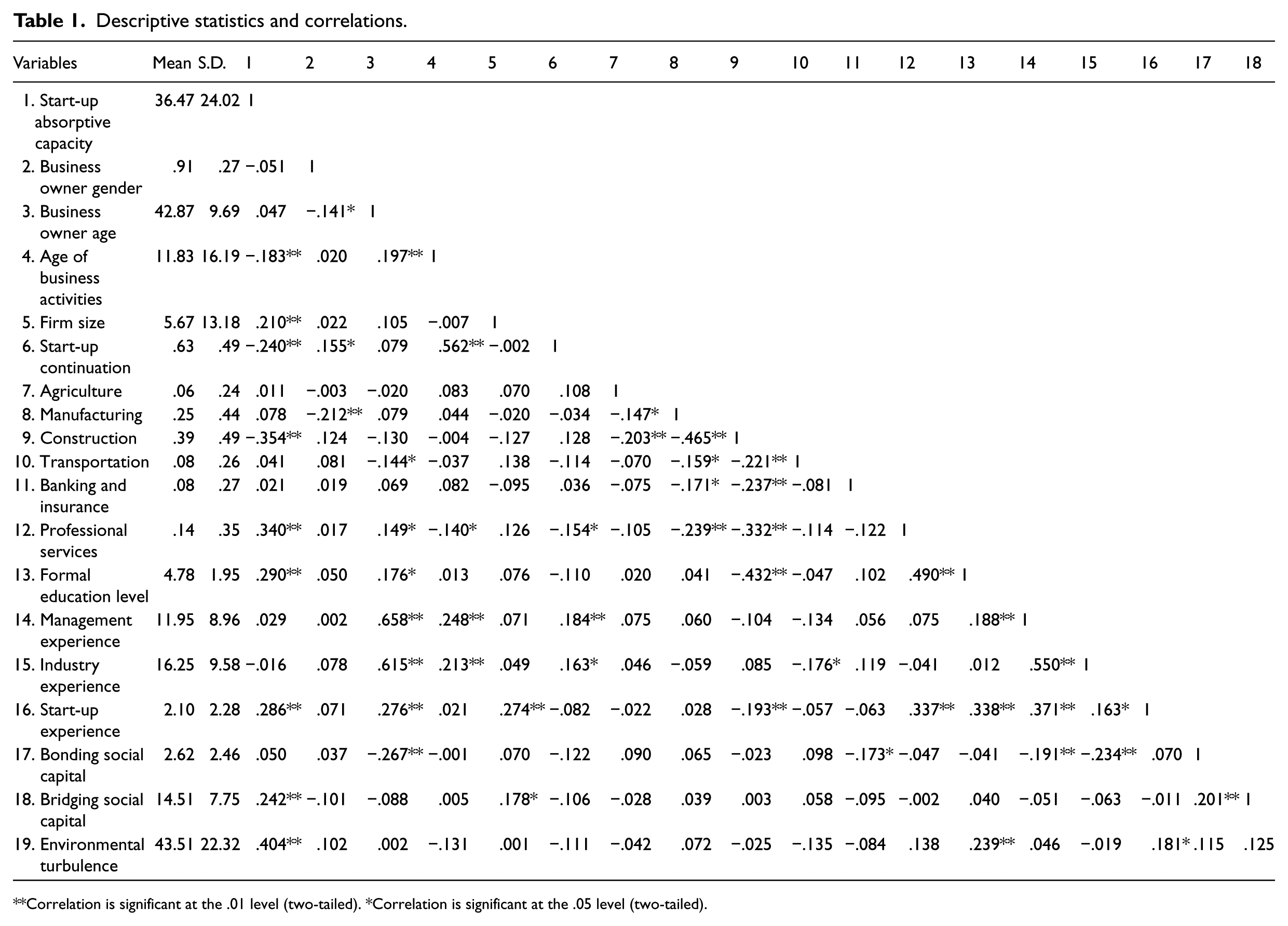
Correlation is significant at the .01 level (two-tailed). *Correlation is significant at the .05 level (two-tailed).
Results of hierarchical regression models of start-up absorptive capacity.
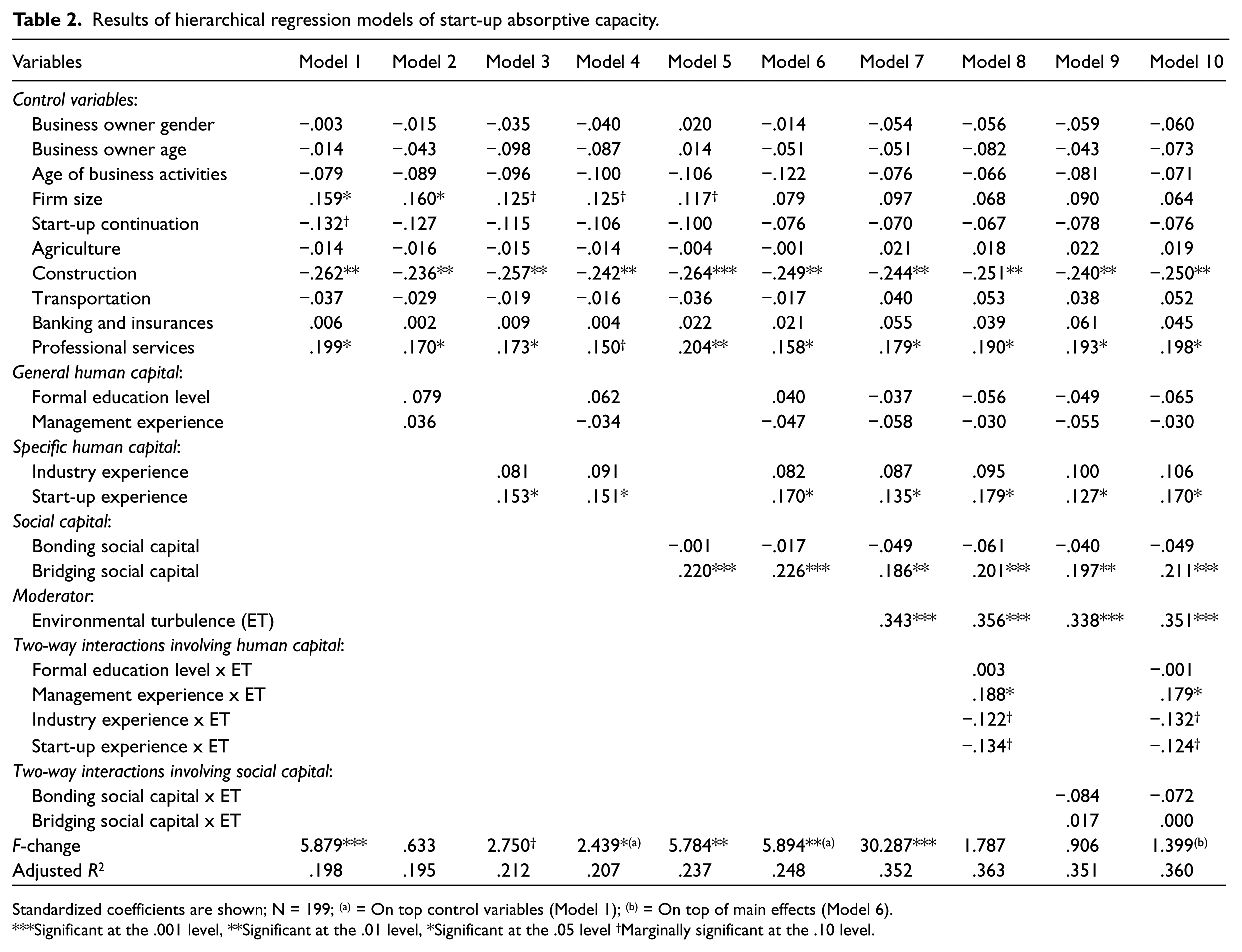
Standardized coefficients are shown; N = 199; (a) = On top control variables (Model 1); (b) = On top of main effects (Model 6).
Significant at the .001 level, **Significant at the .01 level, *Significant at the .05 level †Marginally significant at the .10 level.
H1 suggested that the general human capital of business owners is positively associated with start-up absorptive capacity, as did H2 for specific human capital. Model 2 of Table 2 indicates that the relationship between start-up absorptive capacity and either formal education or management experience is insignificant (β = .079; β = .036; p > .10). Therefore, H1a and H1b are not supported. In the case of start-up experience (β = .153), we learn from Model 3 of Table 2 that its relationship with absorptive capacity is significant and positive. However, the industry experience of owners appears to be insignificantly related to start-up absorptive capacity (β = .081; p > .10). Thus the findings offer support for H2b, but not for H2a.
H3 proposed a negative relationship between the bonding social capital of business owners and start-up absorptive capacity. H4 stated that the bridging social capital of business owners is positively associated with start-up absorptive capacity. As shown in Model 5 of Table 2, the relationship between bonding social capital and start-up absorptive capacity appears insignificant (β = -.001; p > .10), therefore, the results do not support H3. Conversely, the relationship between bridging social capital and start-up absorptive capacity (as shown in Models 5 and 6) is positive and significant (β = .220). As such, H4 is corroborated by the results.
H5 proposed that environmental turbulence acts as a positive moderator of the relationship between an owner’s more transferable or flexible capital, such as general human capital and bridging social capital, and start-up absorptive capacity. This relationship is expected to be stronger within highly volatile environments than within more stable environments. Model 8 of Table 2 demonstrates that the cross-product of management experience and environmental turbulence is positive and significant (β = .188). Yet, the interactions of environmental turbulence with formal education (β = .003; Model 8) and with bridging social capital (β = .017; Model 9) appear to be insignificant. The positive impact of bridging social capital on absorptive capacity seems unaffected by the environmental conditions under which a start-up operates. Thus, H5a (general human capital) only receives partial support, while H5b (bridging social capital) receives no support. In addition, the graphical representation of the interaction between management experience and environmental turbulence (Figure 1) depicts the relationship between management experience and absorptive capacity as indeed positive when environmental turbulence is high. This relationship weakens considerably when environmental turbulence decreases.
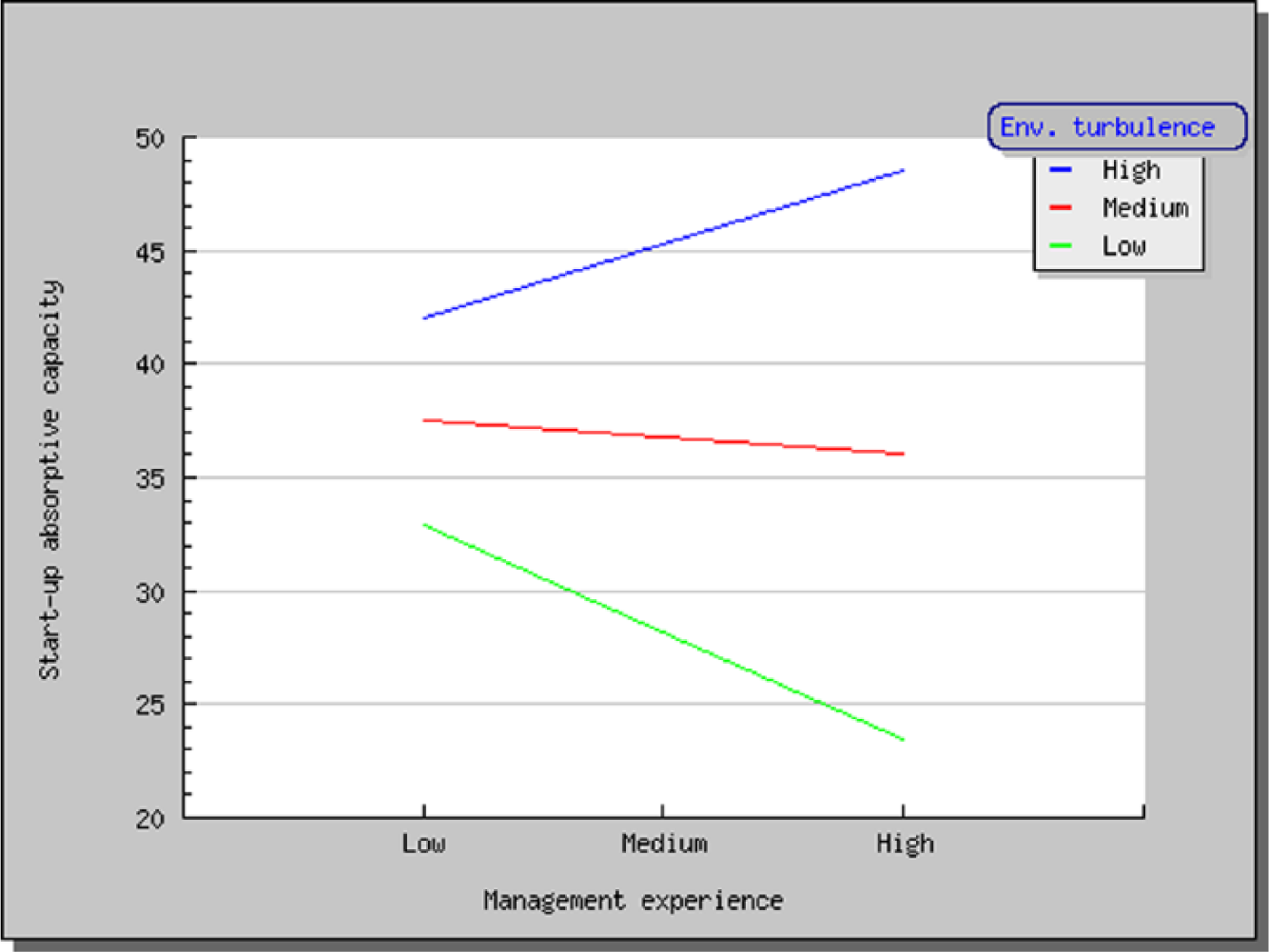
Interaction effect of owner management experience and environmental turbulence on start-up absorptive capacity.
H6 suggested that environmental turbulence is a negative moderator of the relationship between a business owner’s less transferable and flexible capital, such as specific human capital and bonding social capital, and start-up absorptive capacity. This relationship is expected to be weaker within highly volatile environments than within more stable environments. With respect to the specific human capital of owners, a marginally significant negative relationship holds for the cross-products involving industry experience (β = -.122) and start-up experience (β = -.134) (Model 8). The graphical representation of both interactions (Figures 2 and 3) indicates that the relationship of owners’ specific human capital with start-up absorptive capacity is indeed less positive for start-ups operating in a turbulent environment, than for those in a less turbulent environment. We learn from Model 9 of Table 2 that the cross-product of bonding social capital and environmental turbulence is negative yet insignificant (β = -.084). As such, the findings only corroborate H6a (specific human capital), and not H6b (bonding social capital).
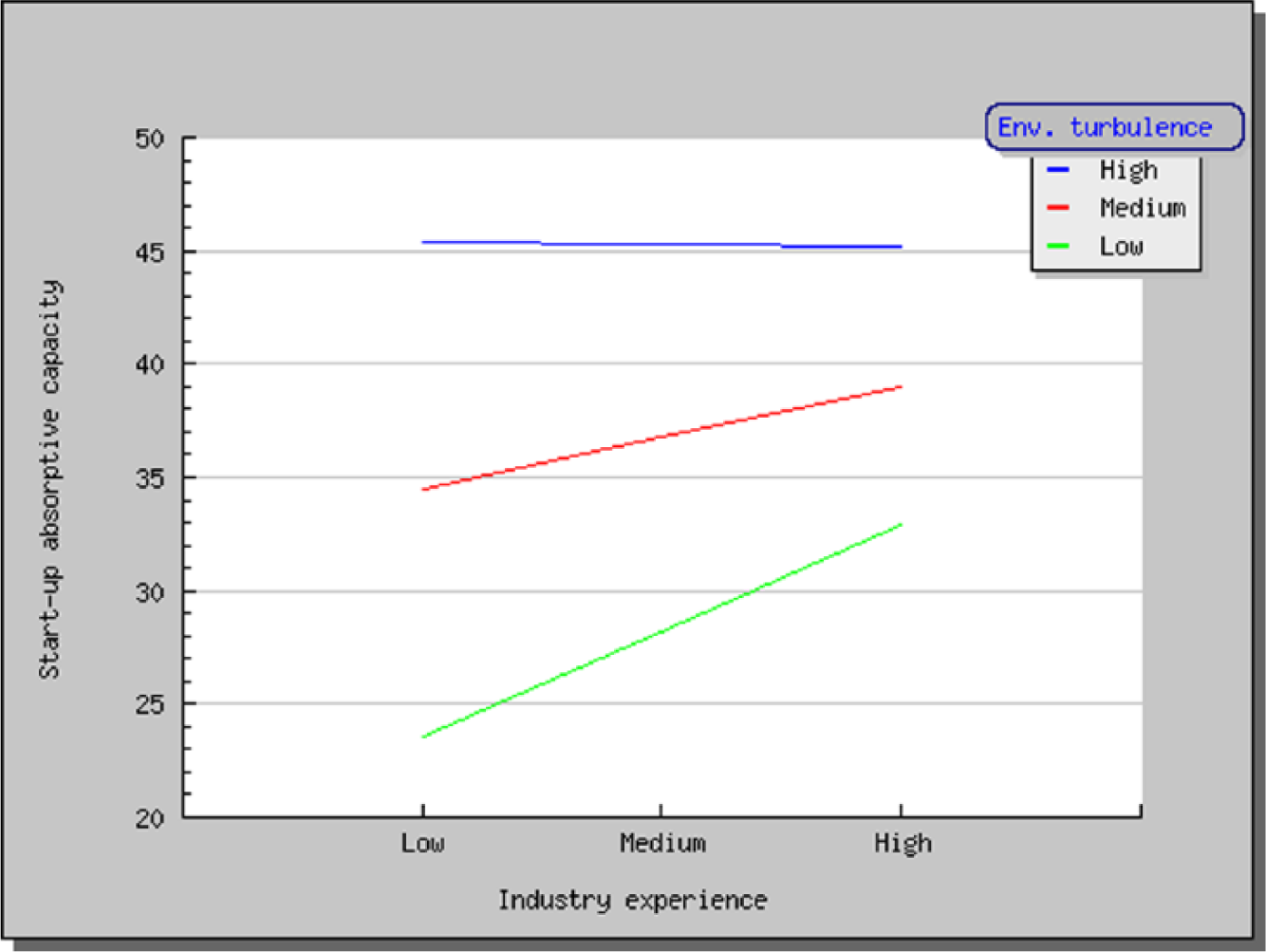
Interaction effect of owner industry experience and environmental turbulence on start-up absorptive capacity.
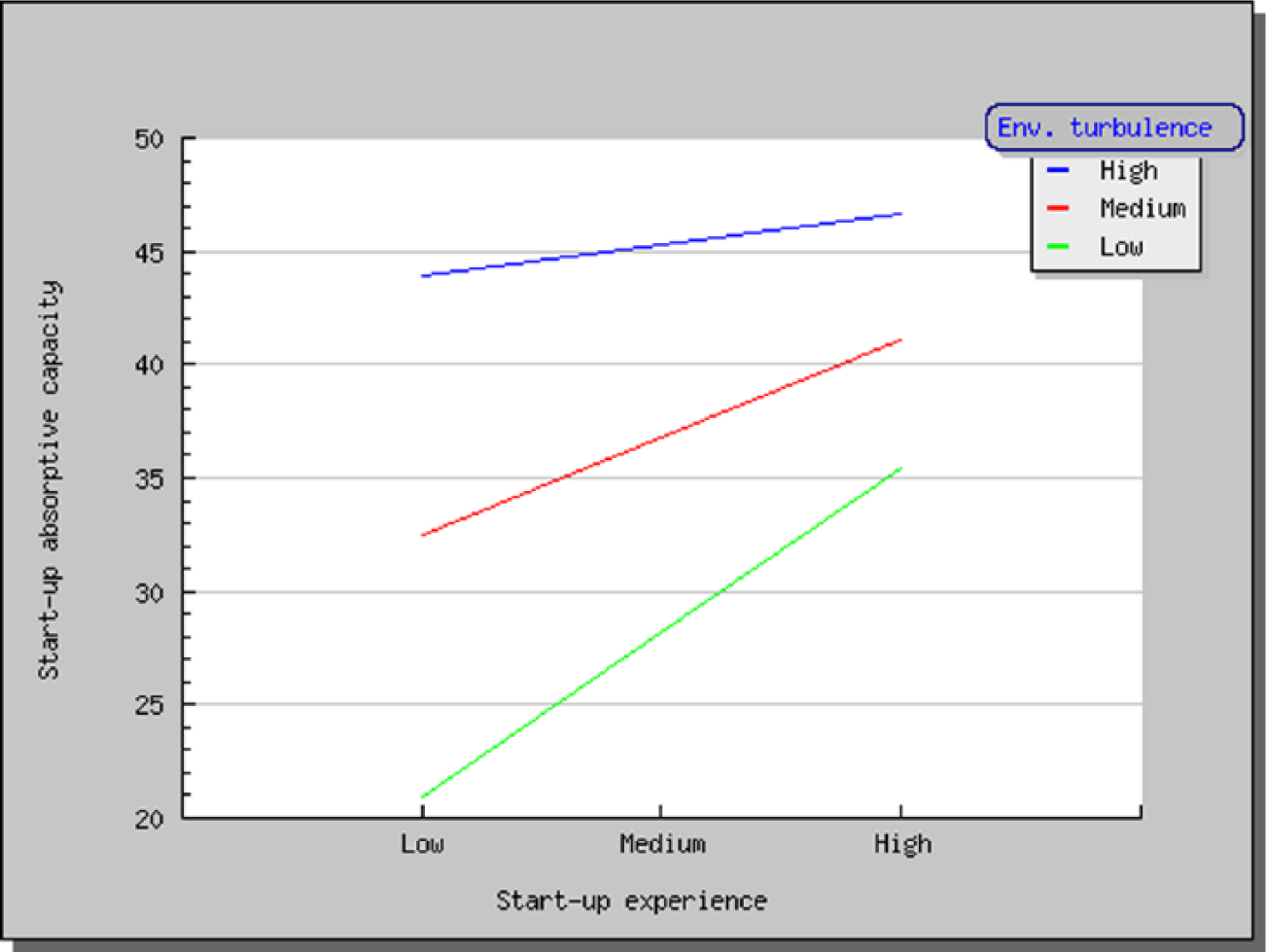
Interaction effect of owner start-up experience and environmental turbulence on start-up absorptive capacity.
Discussion
The objective of this paper was to examine empirically the direct impact of business owners’ human and social capital on the absorptive capacity of start-ups. Subsequently, general and specific human capital and bridging and bonding social capital were tested, as well as their relationships with environmental turbulence as antecedents of start-up absorptive capacity. Six main hypotheses were developed and tested.
General and specific human capital
Focusing on the human capital of business owners, a significant and positive effect of owner start-up experience on the absorptive capacity of their start-ups was found. After introducing environmental turbulence into the model, the results also revealed a significant and positive decreasing impact of owners’ specific human capital (industry and start-up experience), which was inversely correlated with the turbulence of the start-ups’ environment. The relationship between an owner’s management experience and start-up absorptive capacity varied; it was negative within stable environments and positive in volatile environments, as indicated in Figure 1. As far as the business owner’s formal education is concerned, no hypothesised effect on absorptive capacity was corroborated by the results. Furthermore, no evidence emerged to indicate a possible relationship between gender and absorptive capacity. Therefore, the findings appear to be consistent with the proposition that female- and male-controlled firms perform equally well and that both genders gain from networking (cf. Table 2) (Watson, 2012).
A plausible explanation for the effect of formal education is suggested in the resource-based view of the firm (Barney, 1991). According to this approach, a firm is able to build a competitive advantage based on valuable, rare, inimitable and non-substitutable resources. Consequently, for knowledge to constitute a competitive advantage driver, it must comply with these conditions (Autio et al., 2000; Eriksson et al., 1997; Zahra et al., 2000). Formal education mainly assists in the development of explicit knowledge (Davidsson and Honig, 2003) which, by definition, refers to facts and data that can be codified into written documents (Polanyi, 1967). As such, this type of knowledge hardly meets competitive advantage requirements. Therefore, it could be that the processes underlying organisational absorptive capacity, which may enable a venture to harvest a competitive advantage, profit little from the explicit knowledge accumulated by its owner. Similarly, Thorpe et al. (2005) summarised that what makes knowledge important for start-ups is its experiential origin. Future research could investigate further whether any differences in owners’ direct contributions to their start-ups’ absorptive capacity exist based on specific types of formal education (e.g. economics versus technical education). Additionally, the possible indirect effects of formal education could be explored by investigating its impact on the magnitude and type of experiential knowledge, such as management experience.
The management experience of owners did not have its hypothesised effect of generally increasing start-up absorptive capacity. Instead, its effect on absorptive capacity is dependent on the degree of perceived turbulence in the start-up environment. If turbulence is high, then an owner’s management experience makes a firm more prone to put in effort to acquire and make use of information from its customer network. If turbulence is low, moderation evidence proposes that more management experience decreases start-up absorptive capacity. These findings seem to suggest that there is little point in investigating the relationship between management experience and organisational absorptive capacity without considering interactions with environmental turbulence. The situated relevance of this general human capital measure is in line with the basic premises of social cognitive theory (Bandura, 1986; Hmieleski and Baron, 2009).
Other than the above general human capital effects, the present findings also revealed two specific human capital contributions. With respect to start-up experience, the results indicated that prior active participation in the process of starting up new ventures facilitates an owner’s direct contribution to the absorptive capacity of their start-up. The findings also confirmed that this contribution is weaker within highly volatile environments than within more stable environments. Reaching back to the work of Shane and Venkataraman (2000) and Ucbasaran et al. (2001) on the activities underlying new venture creation, the present study finds that an individual’s involvement in the emergence of a start-up, and their participation in its information processing, pose similar challenges. First, involvement in both processes requires subjective discovery and recognition of lucrative external knowledge through scanning the environment. Second, a person’s prior accumulated knowledge and cognitive aptitudes assist them in evaluating information potential in either process (Lane et al., 2006; Shane and Venkataraman, 2000; Ucbasaran et al., 2001). Finally, both venture emergence and start-up absorptive capacity introduce an individual to resource acquisition and gestation activities that contribute to successful knowledge exploitation. As a result of their involvement in starting a new venture, a start-up owner can become familiar with the processes of acquiring, dispersing and interpreting information from the customer network. Hence, the more start-up experience that an owner has accumulated, the better they are prepared for the challenges intrinsic to absorptive capacity. However, we also believe that as external knowledge is subject to ageing (Choudhury and Sampler, 1997), so is an owner’s level of preparation for organisational absorptive capacity that stems from their prior start-up experience. This ageing process is driven by environmental changes. Because of this, we believe that the usefulness of an owner’s preparation for start-up absorptive capacity, and with it the value of their accumulated start-up experience, decrease with environmental turbulence – which is in line with the present study’s findings.
Regarding the last dimension of (specific) human capital, industry experience, evidence emerged that an increase in environmental turbulence corresponds with a decrease in the impact of an owner’s industry experience on start-up absorptive capacity. More specifically, the part of an owner’s direct contribution to absorptive capacity that originates from their industry experience goes from being quite strong within stable environments, to being virtually non-existent within highly dynamic environments (Figure 2). A probable explanation might be that the effect of industry experience arises from an owner’s ability to read the market and understand its specific rules and regulations. That is, knowledge of the industry’s dominant players and their preferred strategies, the sector’s technology and customer preferences (Gimeno et al., 1997; Shane and Stuart, 2002) may enable an owner to assist their start-up in scanning the environment for notable knowledge, interpreting that knowledge and distinguishing its finest applications. However, for industry experience to remain valuable to organisational information processing, an owner needs to keep their industry-related knowledge up-to-date (Cohen and Levinthal, 1990). In other words, industry experience will only preserve its value if it continues to enable organisations to achieve their goal of acquiring, assimilating and/or exploiting external knowledge (Lane et al., 2006).
To establish this in the face of a changing environment, owners will have to invest in their industry knowledge to maintain an awareness of its players, understand its inherent technology and comprehend customers’ preferences. Again, the pace of these investments, as well as the effort and resources that they demand, are positively correlated with environmental turbulence (Cohen and Levinthal, 1990; Lichtenthaler, 2009). However, as individual efforts and resources are limited, owners operating in a progressively dynamic environment will find it increasingly difficult to acquire these absorptive capacity (investment) requirements. A point may be reached where they can no longer keep up, causing their (industry experience-induced) contributions to the absorptive capacity of the start-up to decline. As Figure 2 indicates, this process ultimately leads to a situation in which an owner’s direct contributions to absorptive capacity from their industry experience becomes marginal.
Bridging and bonding social capital
The analysis distinguished a consistent, significant and positive main effect of bridging social capital on start-up absorptive capacity. In contrast, no evidence of any bonding social capital effect emerged. These results are consistent with those of earlier research on the entrepreneurial contributions of social capital. For example, in their longitudinal study on nascent entrepreneurs, Davidsson and Honig (2003) noticed that the importance of bridging social capital increased, relative to that of bonding social capital, during the business developmental process. Fairlie and Robb (2007) concluded that the success of business owners, as opposed to self-employment entry, is only weakly correlated with having an entrepreneurial family member. Moreover, while encouragement and aid from partners, friends, family members and acquaintances speed up the pace of founding a business, their impact on firm functioning and business outcomes remain unclear (Baucus and Human, 1994; Jennings and McDougald, 2007; Moore and Mueller, 2002). This paper sheds some additional light on this issue by demonstrating that even in the context of start-up absorptive capacity, owners’ bonding social capital appears to exert no significant influence, irrespective of the environmental conditions under which the start-up operates.
As to the mechanisms that govern this social capital outcome, this paper’s findings seem to suggest that start-up absorptive capacity requires deployment of a kind of specialised ‘knowing-who’, which is less common than the assistance offered by a business owner’s strong ties. We know that during a venture’s gestation phase, bonding social capital is highly important both in terms of resources and support (Davidsson and Honig, 2003). It generates a firm’s initial network structure which, in turn, influences the development of broader networks of weak ties (Arrègle et al., 2007). Therefore, bridging social capital is more ‘developed’ or venture-tailored (i.e. firm-specific) than bonding social capital. It is likely to be tied more strongly to a firm’s activities and environment, thereby facilitating its knowledge-processing role. Additionally, while we recognise that an organisation’s absorptive capacity is not only a function of its gatekeeper’s expertise (Cohen and Levinthal, 1990) – with ‘gatekeeper’ being a role often embodied by start-up business owners – we do believe that it is mainly a gatekeeper’s network of weak ties that acts as an interface between their firm and its environment. Specifically, an owner is commonly the face of a company, and the person that people turn to when they want to discuss important business matters. As a result, their weak ties constitute an excellent means to gather external information and introduce it into the start-up, to gain the resources needed for the assimilation of external information, and to point out where the application of market knowledge might be most profitable. In sum, although aid from partners, friends, family members and other strong ties is positively associated with one’s decision to become self-employed (Dunn and Holtz-Eakin, 2000; Fairlie and Robb, 2007; Lentz and Laband, 1990), it does not appear to provide the assistance or access to resources required for organisational absorptive capacity, which is a task well-covered by the business owner’s network of loose relationships.
Conclusion
Limitations of the study
When interpreting the above findings, several caveats should be considered. First, the data may have a social desirability bias, since the company questionnaire may have been completed by the interview respondent, i.e. the start-up business owner. However, the threat of common method variance was weakened through the use of a bipartite approach (a questionnaire and interviews), together with mixed types of questions and measures (both factual and verifiable behaviours and events) (Chandler and Lyon, 2009; Podsakoff et al., 2003). Second, it is difficult to establish causality from a cross-sectional research design. Therefore, in order to validate the posited relationships, a longitudinal research design should be set up to replicate the findings. Third, although the measure of absorptive capacity as a market-oriented construct is a step up compared to purely R&D-related measures, future studies would benefit from a further refinement of the construct. For example, the development of a multi-item index of absorptive capacity, which includes both market-related and non-market-related items (ideally, both objective and judgemental ones), could prove its worth. Finally, within the sample, environmental turbulence was identified based on the perception of business owners. Actual environmental dynamism and uncertainty may deviate from this subjective perception.
Suggestions for future research
Through this study’s model and the findings reported in this paper, several opportunities are identified for future research. First, individual abilities that contribute to a firm’s absorptive capacity need to be uncovered and investigated further. Examples of additional indicators of human and social capital are the nature of the owner’s education, the number of organisations that they have worked for and motivational factors. Second, previous research has suggested that human and social capital build upon each other (Coleman, 1990; Nahapiet and Ghoshal, 1998). Weak ties, in particular, have been identified as critical gateways for the exchange of otherwise scarce information, and assimilating this information adds to the accumulation of insights and experience (human capital). The reverse also might be true: human capital might amplify social capital. For example, knowing the rules of the game could assist business owners in building up a network of contacts. Therefore, further research should investigate how human and social capital interact in their relationship with absorptive capacity. Third, apart from the research emphasis in this study on the direct contribution of start-up business owners, we expect their human and social capital also to affect absorptive capacity indirectly through the implementation and gestation of managerial practices (e.g. the definition of organisational tasks and the allocation of resources). Fourth, a new venture’s capacity to acquire, assimilate and exploit external information not only depends on its owner’s direct or indirect contributions, but also on the knowledge accumulated by its employees. Although they are often ignored in the absorptive capacity literature, employees constitute a critical pillar of a firm’s knowledge base (Muscio, 2007). As such, exploring employees’ human and social capital, and the management practices directed at developing and maintaining it, equally may advance our understanding of absorptive capacity.
Footnotes
Appendix
Factor loadings, cross loadings and Cronbach’s alphas
| Panel A: Absorptive capacity items (N = 199) | Absorptive capacity | Environmental turbulence |
|---|---|---|
| We have business meetings at least once every quarter to discuss market trends and developments |
|
.275 |
| In this business, we meet with customers at least once a year to find out what products or services they will need in the future |
|
.216 |
| In this business, we do a lot of in-house market research |
|
.396 |
| We periodically review our product development efforts to ensure that they are in line with what customers want |
|
.383 |
| We get together periodically to plan a response to changes taking place in our business environment |
|
.240 |
|
|
|
|
| Panel B: Environmental turbulence items (N = 199) | Absorptive capacity | Environmental turbulence |
| Our industry offers a lot of interesting possibilities for future growth | .190 |
|
| Within our industry a lot of opportunities for new products and/or new services exist | .265 |
|
| Within our industry customer demand for new products and/or new services is increasing | .263 |
|
| Within our industry the need for a new technology is growing | .402 |
|
| Within our industry the market for new products and/or new services is expanding | .294 |
|
| Within our industry possibilities for venture growth are numerous | .366 |
|
| Within our industry continuous business investments in R&D are required in order not to fall behind | .449 |
|
|
|
|
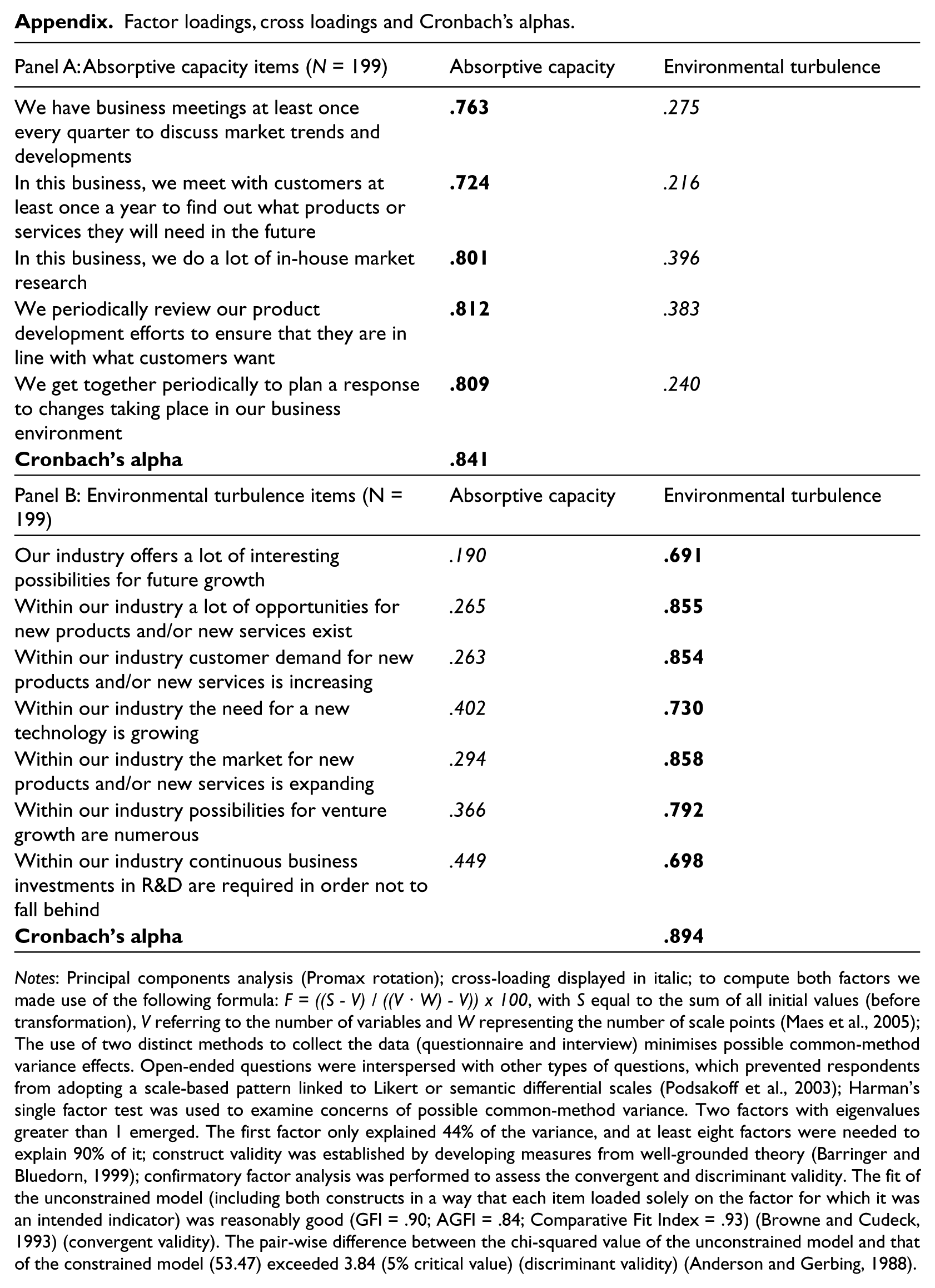
Notes: Principal components analysis (Promax rotation); cross-loading displayed in italic; to compute both factors we made use of the following formula: F = ((S - V) / ((V · W) - V)) × 100, with S equal to the sum of all initial values (before transformation), V referring to the number of variables and W representing the number of scale points (Maes et al., 2005); The use of two distinct methods to collect the data (questionnaire and interview) minimises possible common-method variance effects. Open-ended questions were interspersed with other types of questions, which prevented respondents from adopting a scale-based pattern linked to Likert or semantic differential scales (Podsakoff et al., 2003); Harman’s single factor test was used to examine concerns of possible common-method variance. Two factors with eigenvalues greater than 1 emerged. The first factor only explained 44% of the variance, and at least eight factors were needed to explain 90% of it; construct validity was established by developing measures from well-grounded theory (Barringer and Bluedorn, 1999); confirmatory factor analysis was performed to assess the convergent and discriminant validity. The fit of the unconstrained model (including both constructs in a way that each item loaded solely on the factor for which it was an intended indicator) was reasonably good (GFI = .90; AGFI = .84; Comparative Fit Index = .93) (Browne and Cudeck, 1993) (convergent validity). The pair-wise difference between the chi-squared value of the unconstrained model and that of the constrained model (53.47) exceeded 3.84 (5% critical value) (discriminant validity) (Anderson and Gerbing, 1988).
Acknowledgements
The authors gratefully acknowledge the support provided by VIVES (‘Vlaams Instituut voor Economie en Samenleving’) and the Research Centre for Organisation Studies, University of Leuven, and the Australian Centre for Entrepreneurship Research, Queensland University of Technology. This article benefited from a presentation at the 7th AGSE International Entrepreneurship Research Exchange, and from seminars at University of Leuven and the Australian Centre for Entrepreneurship Research, Queensland University of Technology.
Funding
The authors thank the Flemish Policy Research Centre for Entrepreneurship and International Entrepreneurship for providing them with the means to execute the biennial START population survey on Flemish incorporated start-ups.