



Abstract
This article examines the extent to which combinations of intellectual resources and product innovation capability, and reputational resources and marketing capability, influence the ability of small and medium-sized enterprises (SME) to meet or exceed performance goals. Empirical results drawn from 171 SMEs suggest that when the combination of intellectual resources and product innovation capability in addition to the combination of reputational resources and marketing capability are high, SME growth is enhanced. However, a high level of intellectual resources combined with a low level of product innovation capability as well as a combination of a high level of reputational resources with a low level of marketing capability (and vice versa) are not significantly related to growth. These results imply that a high level of resources cannot compensate for a low level of capabilities (and vice versa).
Introduction
According to the extant literature increasing the competitive position of businesses, particularly small and medium-sized enterprises (SMEs), is an important driver for the development and renewal of national economies (West et al., 2008; Barbero et al., 2011; Wolf et al., 2012). At present, although SMEs are recognised as important contributors to modern economies (e.g. Cope et al., 2007) our understanding of how they withstand an increasingly competitive environment and achieve growth is limited - particularly why some SMEs grow and others do not (Anderson and Eshima, 2013; Hansen and Hamilton, 2011; Storey, 2011).
To achieve growth in competitive business environments, an SME’s ability to innovate and market products is critical (see also O’Dwyer et al., 2009; Rosenbusch et al., 2011; Sanzo et al., 2012; Wolf et al., 2012); neglecting emphasis on either product innovation or marketing can result in diminished outcomes (Moller and Anttila, 1987). Capabilities in areas such as innovation and marketing are crucial determinants of growth; whilst such capabilities are an important managerial concern, Makadok (2001) and Sanzo et al. (2012) argue that they will remain static if no appropriate or complementary resources are leveraged. Resources and capabilities are effective only when deployed in combination (e.g. Amit and Schomaker, 1993; Gruber et al., 2010; Newbert, 2008; Penrose, 1959); the key for SMEs, then, is to develop and acquire resources which can be combined with their product innovation and marketing capabilities.
This article focuses on the combined roles played by intellectual resources and product innovation capability plus, reputational resources and marketing capability, in achieving firm growth. Our first objective is to ascertain whether SMEs need to possess a superior combination of high levels of both intellectual resources and product innovation capability, and high levels of both reputational resources and marketing capability, to achieve growth over and above their objectives.
Given the nature of resource capability scarcity within SMEs (Terziovski, 2010), and that innovation and marketing are resource capability-intensive functions (Junkunc, 2007; Sethi and Sethi, 2009), competing on the basis of innovation and marketing offers significant challenges in relation to using intellectual and reputational resources and marketing and innovation capabilities. In this context, we explore the role of social ties in enabling SMEs to overcome resource capability scarcity and improve their growth. In a general sense, as resource capability-poor entities, SMEs do not operate in a vacuum. According to Partanen et al. (2011), they can gain access to necessary external resources and capabilities through their network relationships. Thus, our second objective is to explore whether SMEs can enhance the effect of their existing resource capability combinations (the intellectual resources–product innovation capability combination and reputational resources–marketing capability combination) to enhance growth through strong social ties.
In light of the above discussion, the contributions of this article are twofold. First, it ascertains the extent to which both intellectual resources and reputational resources and innovation and marketing capabilities support growth in SMEs. The results provide a greater understanding of resource capability combinations, specifically marketing and product innovation. Second, given that SMEs face an operational paradox of limited resources and capabilities, but face expanding competition, this study explores how social ties are utilised to overcome this problem.The following sections of this article describe the contextualisation of growth in SMEs and the conceptual model, followed by an explanation of the methods used to examine the hypotheses. The findings are then presented and discussed. The study concludes by outlining limitations and suggestions for further research.
Contextualising the exploration of growth in small and medium-sized enterprises
The positive impact of firm growth is undeniable; it promotes job creation and innovation and so enhances overall economic performance. (Bamiatzi and Kirchmaier, 2014) as well as mitigates recessionary pressure (Storey and Greene, 2010). Importantly, past growth is self-reinforcing and therefore, creates future growth (Bamiatzi and Kirchmaier, 2014). Consequently, a significant level of attention has been devoted to investigating firm growth (Anderson and Eshima, 2013; Wright and Stigliani, 2013). According to Anderson and Eshima (2013), the focus on growth may have significant managerial salience as growing firms generally exhibit better cash flow and higher profitability. Growth is defined in this study as meeting or exceeding performance goals in the form of growth in financial (sales revenue, growth in profitability and financial goals) and non-financial (increasing customer satisfaction) terms. The centrality of growth to economic progress alongside the current competitive environment adds urgency to the desire to understand the drivers of SME growth; we focus on the role of resources, capabilities and social ties in enhancing such growth.
Theoretical development
Much of the resource-based view (RBV) literature adopts a definition of resources as including all the assets, capabilities and organisational processes, firm attributes, information, knowledge, etc. controlled by a firm that enable it to conceive and implement strategies that improve efficiency and effectiveness (Barney, 1991), and ultimately drive performance. This definition is broad and all-inclusive (Priem and Butler, 2001) yet, if its all-inclusive nature is accepted, there may be nothing strategically useful associated with the firm that is not a resource (Kraaijenbrink et al., 2010).
Such a definition is problematic; it does not acknowledge the differences between resources that are inputs and the capabilities that enable the deployment of such inputs (Kraaijenbrink et al., 2010). Further, adopting such a definition sees scholars attempting to explain different outcomes between firms, blending or combining the conceptualisation and operationalisation of resources and capabilities as being one and the same. For example, Barney (1991) treats what Ketchen et al. (2007) term capabilities as resources. Within the context of SMEs, Edelman et al. (2005) and Wu et al. (2008) define resources as including both assets and capabilities, implying that resources and capabilities are the same. This discrepancy has been raised by Newbert (2007) and Srivastava et al. (2001), who argue that the resource concept remains ill-defined. Accordingly, this article contends that to understand the contribution of resources and capabilities in achieving growth in SMEs, a clearer demarcation between the two is needed.
We argue that resources are different to capabilities (Woldesenbet et al., 2012), in that the former are accumulated tangible assets which can be felt, quantified, valued and traded, and intangible assets are embedded in the firm’s culture or protected by legal property rights (such as reputation or patents; see also Langerak, 2003; Leonard-Barton, 1992). Conversely, capabilities, are bundles of interrelated routines that firms use to carry out specific activities (e.g. Day, 1994; Woldesenbet et al., 2012).
It has been suggested that while resources have a potential value in achieving superiority in the marketplace, this will remain latent until they are deployed via a complementary capability (Penrose, 1959). In this sense, resources and capabilities are inextricably bound together in the attainment of superior outcomes. Penrose argues that ‘neither resources nor capabilities … are of much use by themselves; any efficient use for them is always viewed in terms of possible combinations’ (1959: 86). Similarly, subsequent studies suggest that while resources are critical to enhance a firm’s superiority, they are insufficient in themselves; rather, superior performance is a function of the interaction between resources and capabilities, which in turn increases the complexity and ambiguity of the firm’s actions (Amit and Schoemaker, 1993; Gruber et al., 2010; Newbert, 2008).
At present, research leaves the potential combination of resources and capabilities as a black box. While a resource may have potential value, this can be realised only when it is combined with a corresponding capability. Similarly, while a capability may have potential value, this can be realised only when it is combined with a corresponding resource (Newbert, 2008). Drawing from this theoretical foundation, we contend that resources and capabilities are essentially unproductive in isolation. It is not simply the exploitation of either resources or capabilities alone, but rather the exploitation of resource capability combinations which can help firms achieve growth. Importantly, according to Gruber et al. (2010), in order to understand fully the role of resources and capabilities in any functional area (e.g. sales and distribution, marketing, product innovation), it is imperative to identify those resources and capabilities that are the key in those functional areas. In other words, resources and capabilities must complement each other.
In this study, product innovation-related resources are complementary to the firms’ product innovation capability, while marketing-related resources are complementary to its marketing capability. Product innovation-related resources are varied and consist of both tangible (i.e. machinery, buildings) and intangible (i.e. intellectual resources: trade marks, patents and licences). Similarly, marketing related-resources are varied and consist of tangible (i.e. billboards) and intangible (i.e. reputational resources: product reputation, firm reputation and customer service reputation). According to Galbreath (2005), these resources possess different value; Conner (1991) and Fahy (2002) suggest that differences in the level of success between firms are contingent to the resource position barriers, or barriers to duplication. In this sense, it is important to recognise resources that are intangible in nature (Amit and Schoemaker, 1993; Hsu and Wang, 2012); focusing such resources also has inherent scholarly value and is of greater managerial importance to some extent, as intangible resources are more likely to form the basis for competitive advantage and growth (Anderson and Eshima, 2013).
Instead of focusing on overall product innovation-related resources, we focus on intellectual resources. According to scholars such as Hall (1992, 1993), one of the best ways in which such resources can be protected from competitive imitation is through legal property rights. Intellectual resources such as licences, trade marks and patents are all afforded legal protection through property rights making it difficult for competitors to duplicate them (Galbreath, 2005). Similarly, instead of focusing on overall marketing-related resources, we focus on reputational resources. Product reputation, firm reputation and customer service reputation are specific elements of reputational resources that are built, not bought; this creates a barrier to competitive duplication (Walsh et al., 2009). Our approach to conceptualise the intellectual resources–product innovation capability combination and reputational resources–marketing capability combination is consistent with the principle suggested by Gruber et al. (2010).
Hypotheses
The combinations between intellectual resources and product innovation capability as well as the combinations between reputational resources and marketing capability are operationalised as independent variables. Intellectual resources include intangible assets such as licences, trade marks and patents held by the firm. Similarly, reputational resources include intangible assets such as firm reputation, product reputation and customer service reputation. Product innovation capability is defined as bundles of interrelated routines used to undertake specified product innovation-related activities in areas such as developing new products and improving existing product quality. Marketing capability is defined as bundles of interrelated routines used to engage in specified marketing-related activities in areas such as sales, distribution and pricing.
Undoubtedly, competitive success and particularly, success in innovation can have an element of luck; nevertheless, for SMEs to achieve and maintain growth, luck alone is insufficient (Bamiatzi and Kirchmaier, 2014). Hence, the ability to develop new products is increasingly important for SME success (Boso et al., 2013; De Jong and Vermeulen, 2006; Lechner and Gudmundsson, 2014; Rosenbusch et al., 2011; Wolf et al., 2012), especially in efforts to achieve growth. We take the view that product innovation enables SMEs to compete by developing new products to meet customer demand and to do so, firms must possess high levels of both intellectual resources and product innovation capability simultaneously in their efforts to pursue growth. 1 This contention is underpinned by two key premises. First, Amit and Schoemaker (1993) and Makadok (2001) point out that a firm may achieve growth, not because it possesses superior resources than its rivals, but because it exploits those resources more effectively via superior capabilities. Similarly, no matter how strong a firm’s capability it will not achieve superiority if it fails to acquire resources whose value can be enhanced via its capabilities.
Intellectual resources serve as the basis to facilitate the product innovation process, providing opportunities for achieving growth. SMEs may have processes in place and the superior abilities to exploit their intellectual resources (a high level of product innovation capability); however, if they have poor intellectual resources to be leveraged or deployed, growth may be impacted. In this context, a high level of product innovation capability cannot compensate for a low level of intellectual resources. Similarly, SMEs that possess a high level of intellectual resources but do not have the superior capability to deploy and leverage them, may find growth constrained. In this context, a high level of intellectual resources cannot compensate for a low level of product innovation capability. Therefore: H1a: The combination of a high level of intellectual resources and a high level of product innovation capability has a significant positive relationship with SME growth.
In an increasingly competitive environment markets are global and technologically sophisticated, competition is more intense and customers more demanding. In this domain, better customer service, pricing, marketing communication are becoming increasingly important assets underpinning the success of SMEs (e.g. Romano and Ratnatunga, 1995). Marketing plays an important role in providing links with customers, enabling firms to compete by predicting changes in customer preferences as well as creating and managing durable relationships with various stakeholders (Song et al., 2005). We take the view that a key role of marketing is to introduce products successfully, and in order to do so, firms must simultaneously possess high levels of both reputational resources and marketing capability. Reputational resources serve as the basis to facilitate marketing processes such as promotion, pricing, distribution et cetera which results in specific outcomes. SMEs may possess a high level of marketing capability but if the product itself has a poor reputation, or the firm itself has a poor customer service reputation (a low level of reputational resources), it is unlikely to achieve growth. As Berry (2000) argues, the reputation of the product, the firm itself and its customer service often act as drivers of customer choice. In this context, a high level of marketing capability cannot compensate for a low level of reputational resources. Similarly, SMEs may have a high level of reputational resources; however, even with such endowments, if they have a low level of marketing capability they will not be effective and unlikely to achieve growth. As such, a high level of reputational resources cannot compensate for a low level of marketing capability. Therefore: H1b: The combination of a high level of reputational resources and a high level of marketing capability has a significant positive relationship with SME growth.
The notion of social ties underpins the significance of externalities, including the resources and capabilities available to firms through their networks (Gao et al., 2013; Katila and Wahlbeck, 2012; Wincent et al., 2013). The importance of social capital is acknowledged (Anderson et al., 2007; Gao et al., 2013; Lee and Jones, 2008; Ramos-Rodriguez et al., 2010; Totterman and Sten, 2005; Wincent et al., 2013). Social capital theory takes the view that social ties enable firms not only to utilise their own resources and capabilities better, but also to access partner resources and capabilities (Li et al., 2009). Reflecting the approach of Acquaah (2007) we focus on social capital as the extent of relationships that are developed by owners and managers through personal relationships with external entities such as suppliers, customers, competitors, distributors and government officials.
H1a and H1b suggest that growth can be achieved via the combination of high levels of both endowed resources and capabilities. Here, the contention is that in order to achieve higher growth, SMEs need to access resources and capabilities available beyond their firm’s boundary to supplement the existing levels of endowed resources and capabilities (e.g. Lavie, 2006) through social ties. Social ties play an important role in developing innovations (Afuah, 2000), as most innovations are rooted not exclusively within firms, but instead occur at the intersections with actors outside the firm, including competitors, customers, suppliers, distributors (Pisano, 1990) and government (Peng and Luo, 2000).
Furthermore, customers can cooperate with firms in an effort to understand customer needs by playing the role as lead users, or acting as beta sites before the larger customer base decides to adopt (Afuah, 2000), thereby reducing development cycle time (Sherman et al., 2000). In addition, strong social ties with competitors may lead to information sharing on how to reduce operational costs (von Hippel, 1988), all of which are deemed significant to supplement product innovation capability. We contend that strong social ties with business partners (i.e. suppliers, distributors, customers) can lead to sharing in-house technologies which can be leveraged to supplement endowed intellectual resources. As such, it is argued that social ties enable SMEs to enhance their endowed intellectual resources–product innovation capability combination to achieve higher growth. Therefore: H2a: Strong social ties positively moderate the relationship between the combination of a high level of intellectual resources, and a high level of product innovation capability and SME growth.
SMEs which possess strong social ties with government officials are likely to gain access to unpublished market intelligence controlled by government agencies. Such intelligence can be leveraged to facilitate a firm’s marketing capability (i.e. implementing key marketing activities) to achieve high level of customer satisfaction and trust (Luo et al., 2008). Furthermore, strong social ties with government officials also mean fewer bureaucratic delays, enabling firms to respond to customer needs faster, serve customers better and have protection from external threats to their creditability in the marketplace (see also Acquaah, 2007) thus, enabling them to enhance product reputation and customer service (reputational resources). It is contended that all these factors are necessary to be leveraged to supplement endowed reputational resources and marketing capability and so, enabling the firm to enhance marketing to achieve higher growth.
SMEs with strong social ties with channel members such as suppliers, customers, competitors and distributors have been found to have greater access to more diverse market intelligence and resources (Li et al., 2009). This makes it easier to generate, disseminate and respond to market intelligence thus, enhancing their ability to satisfy customer needs (i.e. enhancing endowed marketing capability). Through social ties, SMEs have the potential to reduce their total distribution costs, improve customer relationship management and better coordinate logistical efforts (Morgan and Hunt, 1994). These benefits obtained from social ties can pay for costly marketing programs and are likely to make firms more efficient in attracting and retaining committed customers with enhanced returns on trust (Luo et al., 2008). For example, by having strong social ties with customers, SMEs have the potential to create both customer and brand loyalty (i.e. enhancing endowed reputational resources) and increase sales (see also Park and Luo, 2001).
It is contended that strong social ties with business partners (i.e. suppliers, distributors, customers) can not only lead to sharing market information which can be leveraged to supplement endowed marketing capability, but also that business partners can help promote the firm (including their product and customer service), which in turn will enhance endowed reputational resources. As such, it is argued that social ties enable SMEs to enhance their endowed reputational resources–marketing capability combination in order to achieve higher growth. Therefore: H2b: Strong social ties positively moderate the relationship between the combination of a high level of reputation resources, and a high level of marketing capability and SME growth.
Method
Research context
Cambodia has transformed itself from a centrally planned to a market-oriented economy; it has adopted a range of reforms to ensure that trade policies and practices are fair and non-discriminatory, transparent and predictable, in order to improve the investment climate (Chhun et al., 2012). Policy reforms, along with the end of civil conflict and political stability, have fostered dramatic economic growth, accounting for roughly 10 percent before the global financial crisis occurred in the 2008–2009 financial year, making Cambodia second in terms of growth after China. Further, growth achieved 6 percent in 2010, followed by 7.1 percent in 2011, and is projected to increase further at 7 percent in 2012 and 2013. According to the Ministry of Economic and Finance of Cambodia, per capita gross domestic product (GDP) has steadily increased since 1998. The Economic Institute of Cambodia projected per capita GDP to reach US$945 in 2012 and US$1,024 in 2013. In addition, according to the Council for the Development of Cambodia, the foreign direct investment ratio between 1994 and 2005 was approximately 71 % the ratio dropped to approximately 36 percent in 2009 amid global financial crisis, but increased to 85 percent in 2010.
In addition, Cambodia is located in one of the fastest growing regions in the world, the South-East Asian region, which plans to establish an ASEAN Economic Community by 2015. By the time that the Community is established, the region will become a single market, with the combined GDP of roughly US$1.8 trillion, making the South-East Asian region the ninth largest economy in the world (Association of Southeast Asian Nations, 2011). With the advent of the Community, Cambodia represents a suitable study context, as it possesses a great economic prospect that will drive stronger competition within the market, and serves as a real-life laboratory for management scholars interested in examining how innovation, marketing and social ties in emerging economies enable SMEs to achieve growth. In addition, due to the importance of the marketing, innovation and social ties in high-growth economies that are occurring currently in many parts of Asia, as well as the increasing attention from businesses to invest in Asia, understanding the overarching roles of these factors, and the growth of SMEs in an emerging Asian economy context such as Cambodia, is worth investigating.
Sample and data collection
One thousand firms were selected randomly from the list of all manufacturing SMEs held by the Cambodian Ministry of Industry, Mining and Energy. This list contains information about the size of firms and the industry to which they belong. According to the Ministry, firms with total employees of fewer than 50 are small-sized enterprises, while firms with total employees of between 51 and 100 are medium-sized enterprises. Of the 1000 SMEs contacted by telephone prior to the research, 350 agreed to participate.
A personally administered survey was employed by means of the drop-and-collect technique, which is deemed appropriate in countries such as Cambodia where personal interaction is crucial for information exchange (Hofstede, 1980). This technique also helps increase the response rate (Ibeh et al., 2004). Of the sample, 171 completed questionnaires were obtained: a response rate of 17.1 percent. The study population is 141 small (83%) and 30 medium-(17%) sized manufacturing firms across four key industries: agricultural products, food and drink, furniture and decoration (home decoration and furnishing). The respondent was the most senior manager within each firm with questionnaire developed first in English, and then translated into Cambodian (Khmer), following the procedure outlined by Sok and O’Cass (2011).
Non-response bias effect
Based on the list of firms obtained from the Ministry, which contained the number of employees of each firm, the firms which completed and returned the questionnaires (171) were compared with non-respondents (179); also, firms which agreed to participate (350) were compared with those which did not (650) in terms of size, in order to examine non-response bias. The result shows no significant difference in terms of firm size among the four groups, showing that non-response was not a serious threat.
Measures
To measure the proposed constructs, existing items with minor modifications in wording were adopted to increase their applicability to the Cambodian context and the purposes of the study. The content validity of items was assessed by using expert judgement assessment with six scholars from management and marketing disciplines.
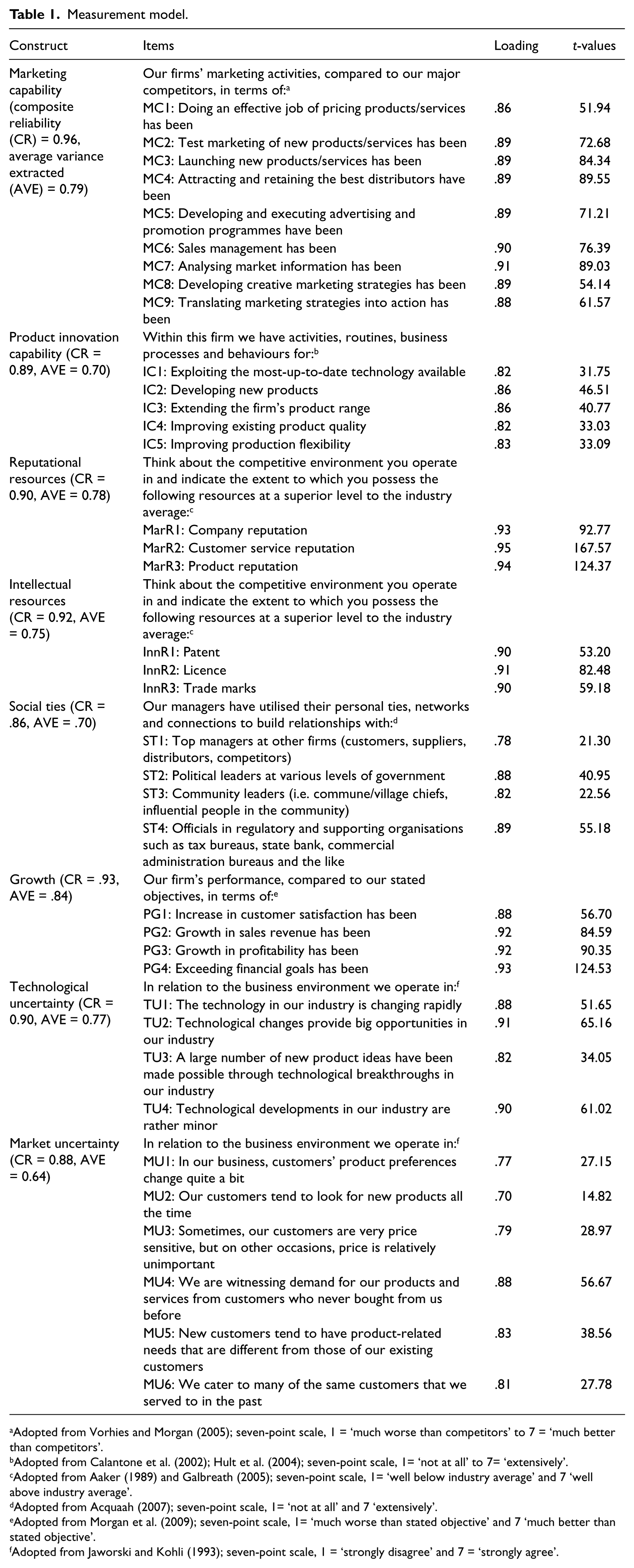
As shown in Table 1, intellectual resources were measured via a three-item scale adapted from Aaker (1989) and Galbreath (2005), on a seven-point scale (where 1 = ‘well below industry average’ to 7 = ‘well above industry average’). Reputational resources were measured via the three-item scale adapted from Aaker (1989) and Galbreath (2005), on a seven-point scale (where 1 = ‘well below industry average’ to 7 = ‘well above industry average’). Innovation capability was measured via a five-item scale adapted from the works of Calantone et al. (2002) and Hult et al. (2004), on a seven-point scale (where 1 = ‘not at all’ to 7 = ‘extensively’). Marketing capability was measured via a nine-item scale adapted from Vorhies and Morgan (2005), on a seven-point scale (where 1 = ‘much worse than competitors’ to 7 = ‘much better than competitors’). Social ties were measured via a four-item scale adapted from Acquaah (2007), on a seven-point scale (where 1 = ‘not at all’ to 7 = ‘extensively’).
Measurement model.
Adopted from Vorhies and Morgan (2005); seven-point scale, 1 = ‘much worse than competitors’ to 7 = ‘much better than competitors’.
Adopted from Calantone et al. (2002); Hult et al. (2004); seven-point scale, 1= ‘not at all’ to 7= ‘extensively’.
Adopted from Aaker (1989) and Galbreath (2005); seven-point scale, 1= ‘well below industry average’ and 7 ‘well above industry average’.
Adopted from Acquaah (2007); seven-point scale, 1= ‘not at all’ and 7 ‘extensively’.
Adopted from Morgan et al. (2009); seven-point scale, 1= ‘much worse than stated objective’ and 7 ‘much better than stated objective’.
Adopted from Jaworski and Kohli (1993); seven-point scale, 1 = ‘strongly disagree’ and 7 = ‘strongly agree’.
Reflecting our theoretical argument that high levels of complementary resources and capability combinations augment and enhance growth opportunities, the resource capability combination of high levels of intellectual resources and product innovation capability was operationalised by multiplying the scores of intellectual resources and product innovation capability. Similarly, in order to operationalise the resource capability combination of high levels of reputational resources and marketing capability, the scores of reputational resources and marketing capability were multiplied. This operational approach is similar to that used in other research domains, such as that by Cao et al. (2009) and He and Wong (2004), assessing the combinations of high levels of innovation exploration and innovation exploitation.
Further, given the argument that high levels of resources cannot compensate for low levels of capabilities (and vice versa) in achieving SME growth, the resource capability combination between high levels of intellectual resources and low levels product innovation capability (and vice versa) were operationalised; in addition, the absolute difference between intellectual resources and product innovation capability were computed. To operationalise the resource capability combination between a high level of reputational resources and a low level of marketing capability (and vice versa), the absolute difference between reputational resources and marketing capability was computed. This operational approach has been used by Cao et al. (2009) and He and Wong (2004), assessing the combination between a high level of innovation exploration and a low level of innovation exploitation (and vice versa).
SME growth was measured via a four-item scale adapted from Morgan et al. (2009). As identified in Table 1, a firm’s achievement level was assessed against goals set by management in relation to specified performance indicators, including sales growth, growth in profit, increases in customer satisfaction and financial growth, (e.g. Alpkan et al., 2007; Bamiatzi and Kirchmaier, 2014; Boso et al., 2013; Lechner and Gudmundsson, 2014; Morgan et al., 2009) on a seven-point scale (where 1 = ‘much worse than stated objective’ to 7 = ‘much better than stated objectives’).
The use of subjective performance measures has been extensively used in studies of management (e.g. Anderson and Eshima, 2013). In the context of SMEs, the most senior manager or owner’s perceptions of success or failure is argued to yield reliable responses (Anderson and Eshima, 2013), and is argued to be consistent with how their firms actually perform, as indicated by objective measures (Poon et al., 2006). Importantly, the majority of the Cambodian-based SMEs are private firms and not subject to performance disclosure requirements.
The survey required respondents to think about the resources and capabilities of their firms in the previous year. Subsequently, they were asked to rate their growth (financial and non-financial terms) in the period covered by the survey. This procedure helps control for the potential of common method bias and the delay of resources and capabilities working through the system in impacting performance in subsequent periods.
Firm age, firm size, industry type and technological and market uncertainty were included as the control variables in testing the model. Firm age was measured with the logarithm of the numbers of years in operation, while firm size was measured with the logarithm of the number of employees in order to prevent skewness. Firms were coded by the industry types (four dummies) that they represent (agricultural products industry was selected as the reference industry, as it is the largest sample among the four industries). Further, given the potential differences in the growth aspiration levels between senior managers we included the education level of the respondents. Education level was measured with the logarithm of the number coded to represent the degree that the senior manager holds (1 = vocational training, 2 = secondary school, 3 = undergraduate, 4 = postgraduate and 5 = other). Technological uncertainty was measured via a four-item scale, while market uncertainty was measured via a six-item scale adopted from Jaworski and Kohli (1993), using a seven-point scale (where 1 = ‘strongly disagree’ to 7 = ‘strongly agree’).
Results
Reliability and construct validity
As shown in Table 1, all factor loadings were relatively high and significant, providing strong support for convergent validity (Bagozzi and Yi, 1988). In addition, convergent validity was evaluated using average variance extracted (AVE). The AVE scores of all the constructs exceed the recommended level of .50 thus, supporting convergent validity (Fornell and Larcker, 1981). In addition, the composite reliabilities score of all the constructs exceed the recommended level of .70 (Nunnally, 1978), indicating the measures were reliable.
Next, the discriminant validity of the constructs were evaluated in two ways. First, as shown in Table 2, the square roots of the AVE values are consistently greater than the off-diagonal correlations, thus providing evidence for discriminant validity (Fornell and Larcker, 1981). Second, no individual correlations were higher than their respective reliabilities providing evidence for discriminant validity (O’Cass and Ngo, 2011). Therefore, on the basis of the results of reliability, convergent and discriminant validity tests, it was concluded that the theoretical constructs exhibited good psychometric properties.
Descriptive statistics and construct intercorrelations.
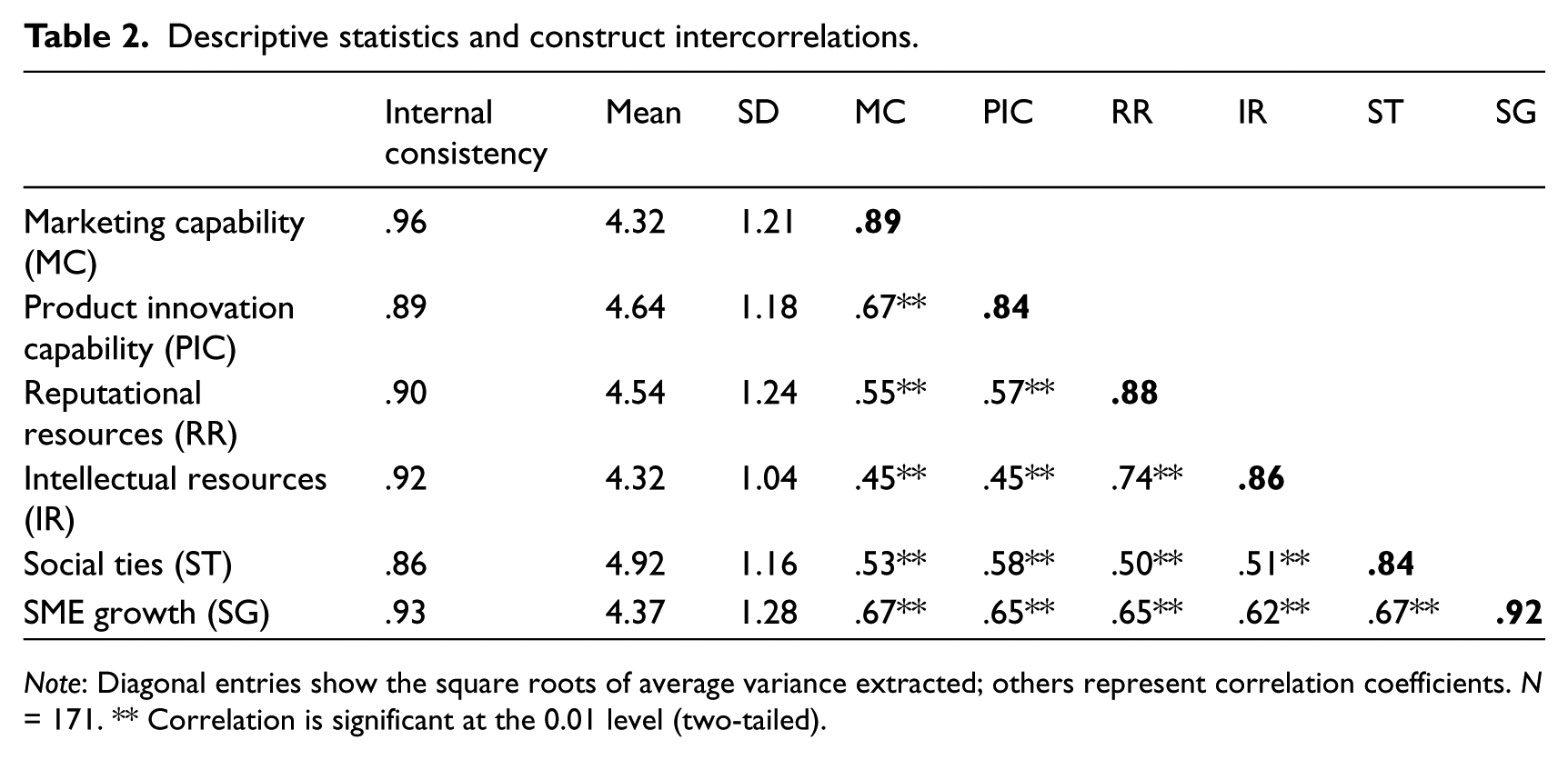
Note: Diagonal entries show the square roots of average variance extracted; others represent correlation coefficients. N = 171. ** Correlation is significant at the 0.01 level (two-tailed).
Two steps were taken to address common method bias. First, a Harman’s single factor test was conducted, followed by the marker variable test. The Harman’s single factor test indicated that no single factor was apparent in the unrotated factor structure. Four factors were derived from the analysis of all items, with the first factor explaining less than 27 percent of the variability in the data; this demonstrated that there was no common method variance problem. With regard to the marker variable test, a procedure recommended by Lindell and Whitney (2001) was undertaken; they suggest that a variable that has a small correlation with the endogenous construct is identified as a marker variable. This correlation is used to partial out the effect from other correlations to test the degree of any existing common method bias. A sensitivity analysis at 95 percent and 99 percent levels of confidence was conducted for the correlations of the marker variable. Satisfaction with life was used as the marker variable; this measure had a non-significant correlation of 0.02 with SME growth. Table 3 provides the results of the partialled-out procedure and sensitivity analysis, and shows that the partial correlations between the four key constructs are high and significant, indicating no evidence of common method bias.
Common method bias analysis.
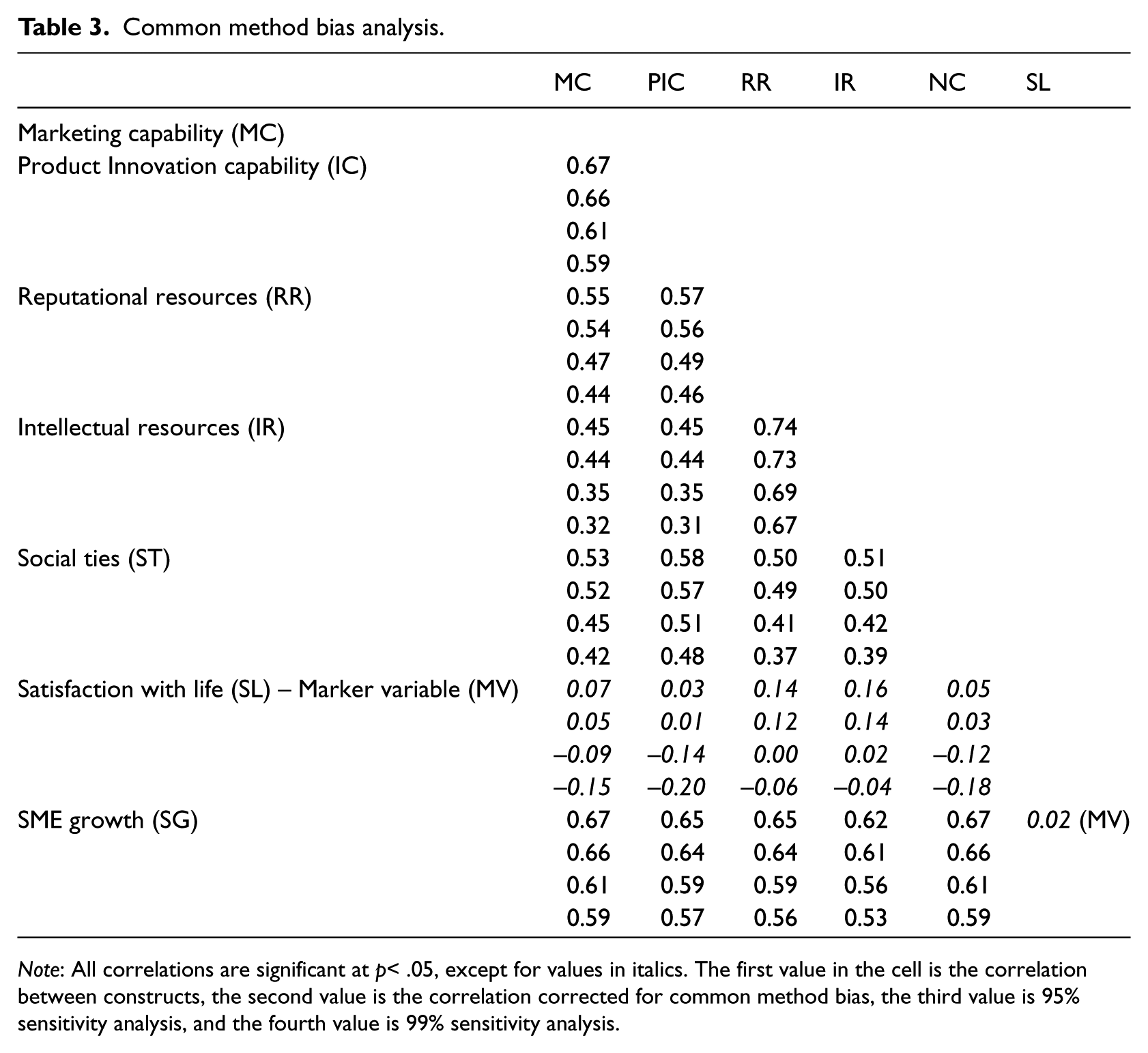
Note: All correlations are significant at p< .05, except for values in italics. The first value in the cell is the correlation between constructs, the second value is the correlation corrected for common method bias, the third value is 95% sensitivity analysis, and the fourth value is 99% sensitivity analysis.
Test of hypotheses
In order to test the hypotheses, hierarchical moderated regression was used. The predictor and moderator variables were mean-centred to mitigate potential multicollinearity (Aiken and West, 1991). The variance inflation factor (VIF) of all constructs was well below 6 (ranging between 1.76 and 2.63), the figure suggested by Hair et al. (1998) indicative of harmful multicollinearity. According to Newbert (2008), the correlations of all constructs will not confound the results of any subsequent statistical tests.
The results presented in Table 4 show that the combination of a high level of intellectual resources and product innovation capability is significantly related to SME growth (b = .13, p<.01) supporting H1a. 2 Figure 1 contains the plot of the interaction effect. The plot indicates that the effect of a high level of intellectual resources is enhanced significantly by high levels of product innovation capability. There appears to be a synergistic effect on SME growth from combining high levels of both intellectual resources and product innovation capability supporting H1a.
Hierarchical moderated regression results.
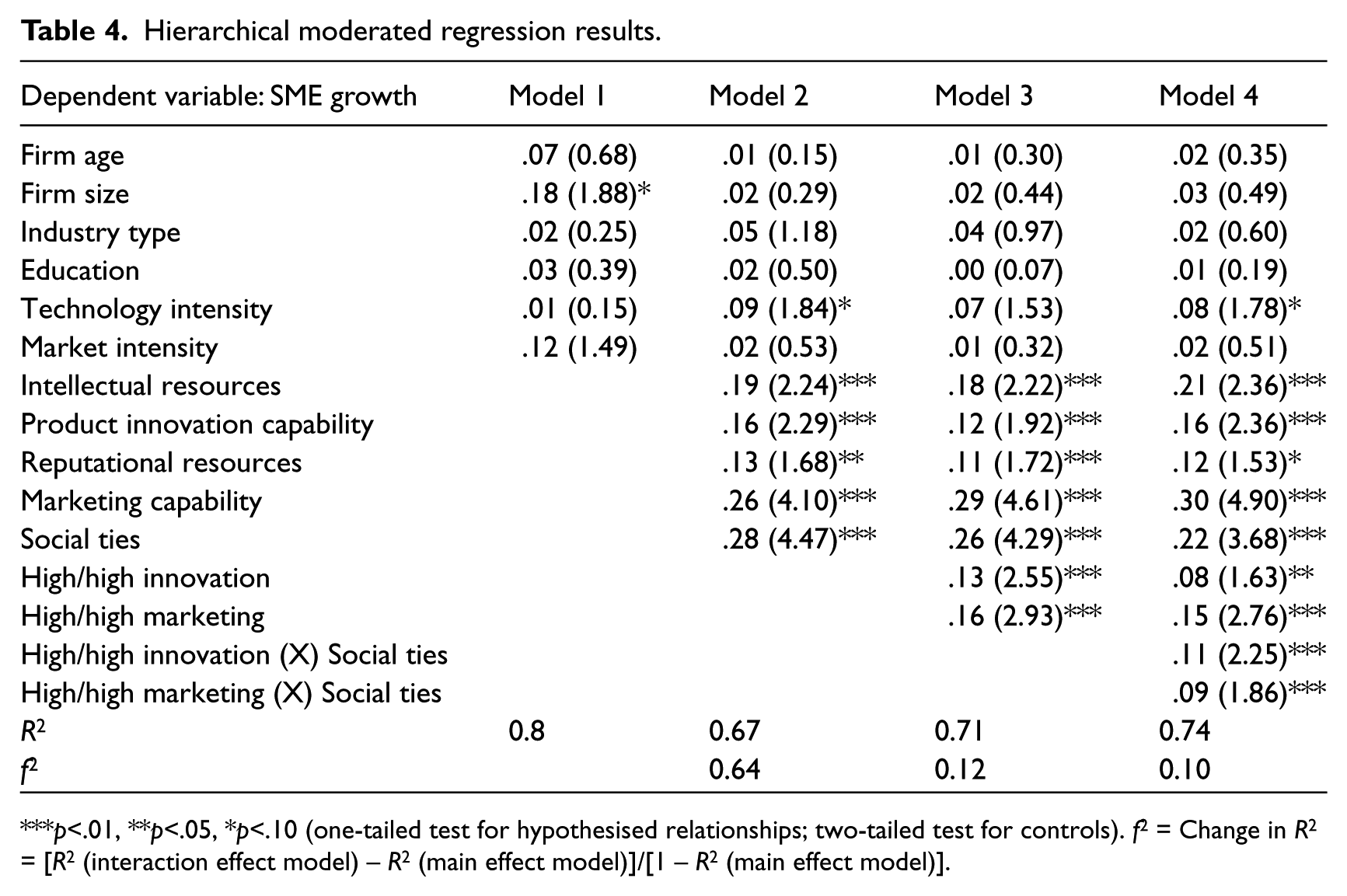
p<.01, **p<.05, *p<.10 (one-tailed test for hypothesised relationships; two-tailed test for controls). f2 = Change in R2 = [R2 (interaction effect model) – R2 (main effect model)]/[1 – R2 (main effect model)].
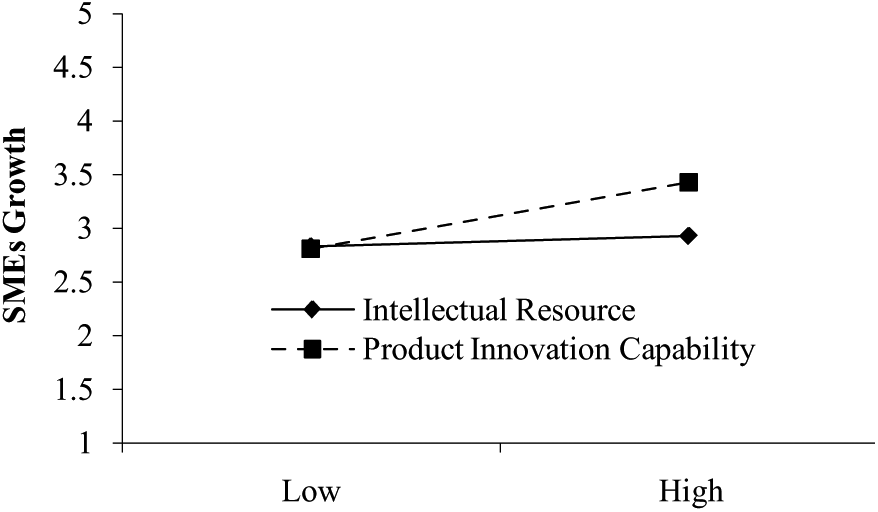
Interaction between intellectual resources and product innovation capability.
Table 4 also shows that the high level of reputational resources and marketing capability combination is significantly related to SME growth (b = .16, p<.01) supporting H1b. 3 Figure 2 contains the plot of the interaction effect. The plot indicates that the effect of a high level of reputational resources is enhanced significantly by a high level of marketing capability. There appears to be a synergistic effect on SME growth from combining high levels of both reputational resources and marketing capability supporting H1b.
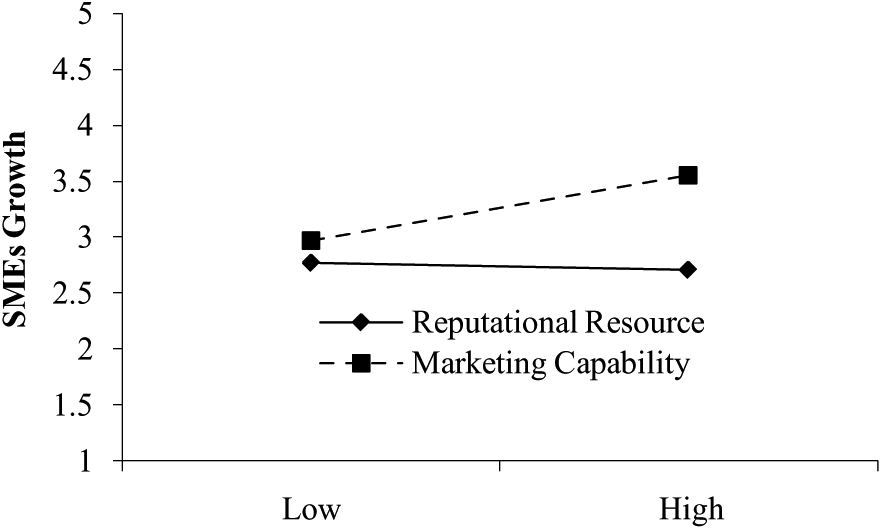
Interaction between reputational resources and marketing capability.
In addition, Table 4 shows a significant moderation effect of social ties on the relationship between the high level of intellectual resources and product innovation capability combination and SME growth (b = .14, p< 01). This proposed moderation effect is supported also with the incremental change of R2 (f2 = 0.06) for the interaction terms supporting H2a. The plot in Figure 3 indicates that when the level of social ties is high, the positive relationship between the high level of intellectual resources and product innovation capability combination and SME growth is stronger than when the level of social ties is low supporting H2a.
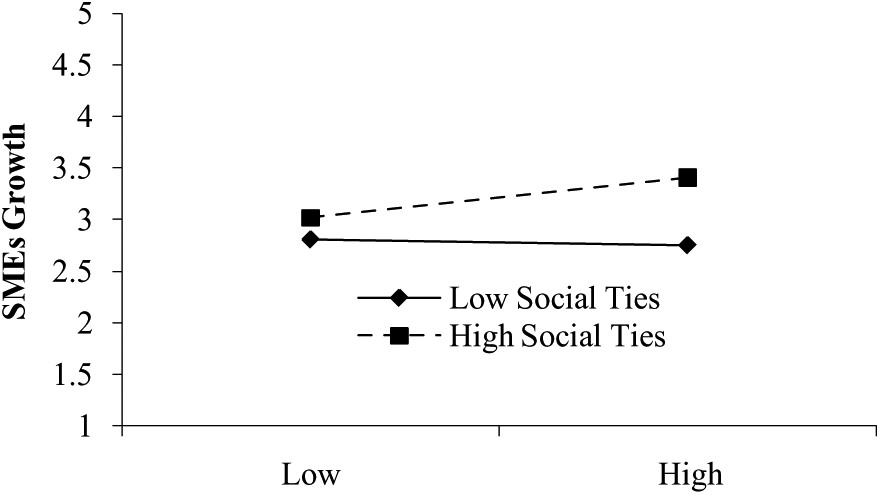
Moderating effect of social ties on high level of intellectual resources–high level of product innovation capability combination.
Table 4 shows a significant moderation effect of social ties on the relationship between the high level of reputational resources and marketing capability combination and SME growth (b = .11, p<.01). This proposed moderation effect is also supported with the incremental change of R2 (f2 = 0.06) for the interaction terms; thus supporting H2b. The plot in Figure 4 indicates that when the level of social ties is high, the positive relationship between the high level of reputational resources and marketing capability combination and SME growth is stronger than when the level of social ties is low, thus supporting H2b.
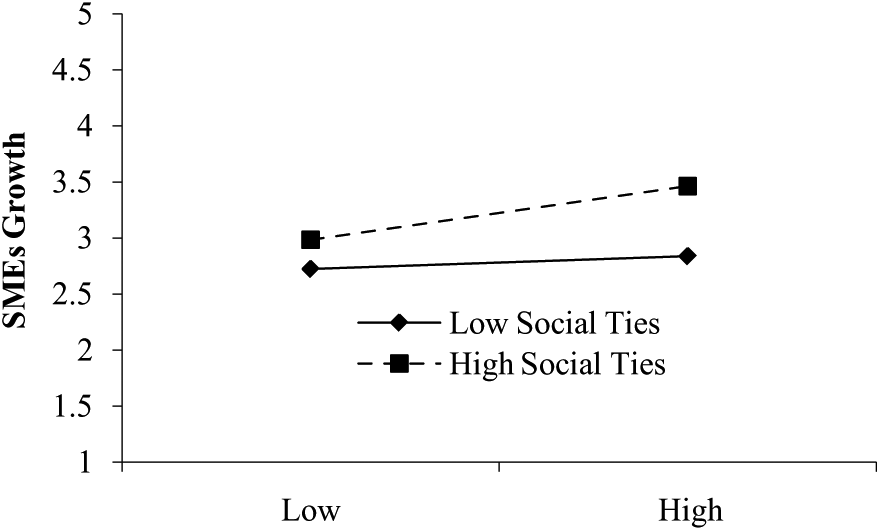
Moderating effect of social ties on high level of marketing resources–high level of marketing capability combination.
Discussion
Drawing on RBV theory, the intervening relationships between resources and capabilities in achieving SME growth were examined. As SMEs are resource capability-scarce entities (Terziovski, 2010), this study drew on social capital theory to examine the role of social ties in enabling SMEs to achieve higher growth. The findings highlight that to achieve growth, SMEs must possess high levels of the intellectual resources and product innovation capability combination and of the reputational resources and marketing capability combination. A high level of, for example, intellectual resources cannot compensate for low-level product innovation capabilities (and vice versa) in the pursuit of growth. The same is true for reputational resources and marketing capability. SMEs that possess a high level of resources which allow them to compete on their chosen position in the market also must possess a high level of capability to deploy such resources (and vice versa). Further, in relation to the specific resource capability combinations in this study, the analysis sheds further light on how SMEs can achieve higher growth through the possession of strong social ties. Therefore, this study makes several important theoretical contributions to the literature.
First, it enriches RBV theory by demarcating the differences between resources and capabilities, as called for by Kraaijenbrink et al. (2010). Further, it advances knowledge on the linkage between resource capability combinations and growth, as called for by both Kraaijenbrink et al. (2010) and Newbert (2007, 2008). This study has focused in particular on the intellectual resources–product innovation capability combination, and reputational resources–marketing capability combination. Previous studies on RBV suggest that intellectual and reputational resources (Galbreath, 2005; Roberts and Dowling, 2002) or product innovation and marketing capabilities (O’Dwyer et al., 2009; Rosenbusch et al., 2011; Sanzo et al., 2012; Wolf et al., 2012) in isolation enable firms to achieve rents. This implies that if the exploitation of intellectual and marketing resources have not resulted in superior performance, then these endowed resources are not valuable. Similarly, if the exploitation of product innovation and marketing capabilities do not result in enhanced performance, the possession of such capabilities is not valuable.
The theoretical development and empirical findings of this study suggest that indeed, intellectual and reputational resources may possess potential value, but that firms must possess product innovation and marketing capabilities to deploy or leverage these resources respectively. Similarly, product innovation and marketing capabilities may possess potential value, but intellectual and marketing resources must exist to be deployed or leveraged respectively in order to acheive growth. Hence, we reason that by focusing on intellectual and reputational resources at the expense of product innovation and marketing capabilities, or on product innovation and marketing capabilities at the expense of intellectual and reputational resources, RBV has advanced a framework that is an incomplete model of growth. In particular, this study’s findings have implications for resource and capability-based theory in general. The findings can be extended and taken into account when theorising about firms as bundles of both resources and capabilities. In this sense, theory that focuses on one (e.g. resources or vice versa) and not the other (e.g. capabilities or vice versa) neglects the fundamental nature of the firm (Sok and O’Cass, 2011). The theory presented in this study and our empirical findings can be extended. They show the possibility that researchers need to conceptually integrate resources and capabilities in order to fully explain growth within a broader framework, and to explicate the role of resources and capabilities in explaining SME growth. By doing so, it is possible to address, at least partially, some of the criticisms of RBV (Foss et al., 2008).
Second, this study enriches RBV by reasoning that growth in SMEs is achieved via simultaneously possessing high levels of intellectual resources–product innovation capability combinations and reputational resources–marketing capability combinations. The results confirm this proposition and lend theoretical and empirical support to understanding why the majority of firms, which lack intellectual and reputational resources as well as product innovation and marketing capabilities due to newness, fail in attempts to achieve growth. Significantly, the findings can be extended to take into account the general view of resources and capabilities. Changes in markets and competition require firms to maximise the acquisition of high levels of both resources and capabilities, in order to compete successfully and achieve growth. This is because globalisation has increased competition as firms not only seek to expand their foreign market opportunities, but also face growing competition with foreign firms entering home markets.
The results demonstrate that more of a particular resource combined with more of a specific capability is associated with higher growth, and this is a key underpinning of RBV theory. It also clearly indicates that a high level of resources cannot compensate for a low level of capability and vice versa, a point as yet untested in the RBV theory context. While this finding is somewhat similar to that of Gruber et al. (2010) (high levels of resources and capabilities), this study contributes beyond that of Gruber et al. in several aspects. First, Gruber et al. adopted a configuration approach, which allows the investigation of one functional area at a time (resources and capabilities within the sales and distribution functional area, which they classified as one functional area) and suggest that resources and capabilities must be relevant to each other (i.e. within the same functional area) for their full potential to be realised. Hence, if one attempts to investigate resources and capabilities within two different areas (e.g. reputational resources, intellectual resources, marketing capability, product innovation capability), the configuration approach may produce potential clusters of reputational resources and marketing capability, reputational resources and product innovation capability, intellectual resources and marketing capability and intellectual resources and product innovation capability. Therefore, in this context, the clusters of reputational resources and product innovation capability as well as intellectual resources and marketing capability are not consistent with Gruber et al.’s principle as the resources and capabilities within these clusters are not relevant to each other. Conversely, our approach allows for investigation of the combinations of resources and capabilities in more than one area. Furthermore, while Gruber et al. focus on sales and distribution only, we focus on marketing and product innovation and, according to Moller and Anttila (1987), neglecting either of these areas leads to diminished growth.
Third, this study further enriches the RBV by recognising the role of social ties. In this context, SMEs with strong social ties may have access to resources through their partners thus, achieving higher growth. While some scholars see them as antecedents to resources (e.g. Elfring and Hulsink, 2003), others see them as antecedents to performance (e.g. Wu et al., 2008). However, we reason that every firm already has certain endowed levels of resources (intellectual and reputational) and capabilities (product innovation and marketing) to compete and survive; and social ties act as the catalyst to acquire supportive external resources and capabilities that have an impact on its ability to deploy its own endowed resources and capabilities. In this regard, the purpose for firms to develop strong social ties is not to survive, but to achieve higher growth than is possible with their existing endowed resources and capabilities.
Conclusion
Implications of the study for managers and owners
This study has several implications for managers and owners as well as prospective investors in SMEs in emerging economies, particularly Cambodia and other countries such as the Philippines, Vietnam, etc. where such firms play a significant role in economic development and competition is intensifying. Because of increasing global competition and rapid economic development, there are few differences between SMEs operating in emerging economies, such as Cambodia, and those operating in other emerging or developed economies which are confronted with major challenges. SMEs that seek to gain increases in profit and sales revenue, exceed their financial goals and increase customer satisfaction relative to their stated objectives, should possess high levels of both intellectual and reputational resources and product innovation and marketing capabilities. As noted, a high level of intellectual and reputational resources cannot compensate for a low level of product innovation and marketing capabilities (and vice versa) in achieving growth; importantly, SME owners and managers should be mindful that personal relationships and social ties play a key role in helping their firms to achieve their goals when doing business in South-East Asian countries (Hamilton, 1996). As such, the ability to establish and maintain good relationships with executives of other firms (e.g. suppliers, competitors, customers and distributors) and government officials is pivotal.
Limitations of the study and suggestions for future research
The findings of this study should be considered in the light of specific limitations. First, cross-sectional research design does not offer the same insight as a longitudinal design into the dynamics of the resource capability combinations, social ties and growth of a firm. Therefore, adopting longitudinal study in future research may help to assess the time sequence of these relationships. Second, given the narrow perspective adapted to measure resources (intellectual and reputational), future research may consider adopting a more comprehensive measurement approach which taps a wider array of resources within the firms. Moreover, the sample is limited to SMEs in Cambodia. Although emerging economies share some common features in their markets, they vary remarkably in the stages of their economic development. Hence, future research on SMEs in context of other emerging economies or developed economies should be conducted to help prove the validity of the model being studied. In addition, George (2005) suggests that more resources may be better, but too many are harmful. Hence, future studies may consider investigating the potential curvilinear effects of the relationship between resources and growth. Furthermore, while this study focuses on the within-area resource–capability combination (product innovation and marketing), future studies may consider investigating the between-area resource–capability combination of product innovation and marketing. Moreover, management practice is a key area for growth, and in this sense future research could focus on the education and experience of senior managers of SMEs as contingency factors for developing and managing complementary resources and capabilities in an effort to achieve growth. Finally, this study is limited as it adopted the single view of the most senior managers in measuring SME growth. Future research could measure these performance indicators by incorporating objective data, if possible, in areas such as profit and total sales.
Footnotes
Acknowledgements
We thank Mark Morrison and Lester Johnson for their comments on earlier version of this article. Both authors contributed equally to this article.
Funding
This research received no specific grant from any funding agency in the public, commercial or not-for-profit sectors.