




Abstract
Using unique survey data, this study investigates the impact of the learning of returnee entrepreneurs on firm performance. The findings indicate that returnee entrepreneur experiential and vicarious learning boosts firm performance. However, firm age significantly weakens the impact of learning on firm performance. The results extend the existing literature by explicitly examining the impact of the interrelationship between two forms of learning and firm age.
Introduction
International human mobility has become an increasing trend. In particular, the reverse flows of highly skilled migrants from Organisation for Economic Co-operation and Development (OECD) countries to emerging economies, such as China and India, recently have increased significantly and become an important phenomenon. For example, according to the Ministry of Education in China, 1.62m Chinese people went abroad to study from 1978 to 2009, and by the end of 2009, 497,000 of them had returned to China. Among those returnees, 5,000 have set up more than 2,000 new high-tech firms in Zhongguancun Science Park (ZSP), commonly known as China’s Silicon Valley (Zhongguancun Science Park, 2009). Returnee entrepreneurs are defined here as scientists and engineers or students who studied or worked in OECD countries for at least two years, and returned to their native countries to become entrepreneurs by setting up new ventures.
The rise of returnee entrepreneurs poses important research questions with regard to their impact on organizations, yet our understanding remains very limited, as few studies have examined this phenomenon systematically (Choudhury, 2010; Drori et al., 2009; Filatotchev et al., 2011; Saxenian, 2002; Wright et al., 2008). Prior research has tended to focus on the shared common features of returnee entrepreneurs, such as simultaneous embeddedness in two distinctive knowledge contexts (i.e. in the country where they studied or worked and in their home country), and the possession of advanced technology and know-how. However, analysis of the heterogeneity of returnee entrepreneurs is lacking. Returnee entrepreneurs are heterogeneous in terms of their skills, experience and abilities, as well as in the amount of time that has passed since they returned to their home countries. Lack of attention to these aspects represents an important omission since variations in experiential learning capability and vicarious learning capability through knowledge transfer across international boundaries may result in different levels of firm performance and contribution of returnee entrepreneurs to emerging economies. Experiential learning is defined as entrepreneur’s past experience of conducting business activities (Argote, 1999; Hilmersson, 2012; Ucbasaran et al., 2008, 2009); whereas vicarious learning refers to learning by observing, whereby entrepreneurs learn from other firms’ business experience, best practice and advanced technology, and obtain external knowledge within their industry and across national borders (Agarwal et al., 2007; Martin and Salomon, 2003; Tsang, 2002).
Further, the performance benefits from returnee entrepreneur overseas experience may decay over time, as home country experience becomes more dominant and home country conditions change. As a result, existing knowledge about the effects of returnee entrepreneurs may have led to insights for research and policy that are too general and insufficiently nuanced. Hence, there is a need to understand better the importance of entrepreneurial learning in the performance of firms owned by returnee entrepreneurs. This article aims to fill this research gap by investigating how variations in returnee entrepreneurs’ experiential learning and vicarious learning affect their firm performance. In doing so, we are able to assess whether different types of learning are crucial for venture success, and how firm age moderates the impact of learning capability on firm performance.
China represents an exciting laboratory for examining these issues. Since the late 1970s, the Chinese government has sent a large number of students and scholars abroad in the hope that they will be able to enhance China’s scientific and technological development when they return. In addition, the Chinese government has sought to attract Chinese overseas talent as an effective way of catching up with the West, and has implemented various preferential policies to encourage returnees (Wang, 2007). Among these returnees, some have set up companies in science parks where government support is available. Hence, science parks in China provide an excellent setting to study the returnee entrepreneur phenomenon (Tan, 2006; Wright et al., 2008).
This study takes a first step toward examining the impact of the returnee entrepreneur’s learning capability on firm performance, and whether such an impact is weakened over time when entrepreneurial firms become more established. It contributes to the existing literature in several ways. First, its findings contribute by unpicking the processes by which overseas experience influences firm performance. Prior literature on repeat entrepreneurs indicates that individuals with past business experience are more able to identify business opportunities and exploit them than those without experience, yet has generated mixed evidence on the performance effects (Fiet et al., 2012; Thorngren and Wincent, 2013; Ucbasaran et al., 2008, 2009; Westhead et al., 2005). This study contributes to resolving this puzzle by building on this prior research to consider the mobility of entrepreneurs across national borders. Second, it provides new insights into how the specific features of returnee entrepreneurs affect the success of high-tech small and medium-sized enterprises (SMEs), and advances our understanding of the importance of the learning experience of returnee entrepreneurs. Third, not only does the study differentiate the characteristics of returnee entrepreneurs, in terms of their direct experience abroad, and their ability to obtain knowledge through vicarious learning by observing businesses abroad it also examines whether such learning benefits have a short life. Thus, it contributes to filling a general research gap in the existing entrepreneurship literature, where the potential impact of the temporal dimension of firm age on the relationship between the learning capability of entrepreneurs and firm performance has been under-explored. A notable exception is research by Autio et al. (2000), but it does not address the returnee context. As such, the present study contributes to understanding of the moderating effect of firm age on entrepreneurial behaviour and performance (Welter, 2011; Wiklund et al., 2011; Zahra and Wright, 2011). The findings from the study help to provide new insights into the interrelationship between learning benefits and firm age within ventures set up by returnee entrepreneurs.
The article is organized as follows. The next section discusses the theoretical background and hypotheses. It then describes the sample and variables used in the study, while the empirical results are presented in the subsequent section. Finally, it discusses the findings and their implications, followed by conclusions.
Theory and hypotheses
The study adopted a learning perspective to examine the relationship between the learning capability of returnee entrepreneurs and firm performance. The learning perspective focuses on the importance of experiential learning and vicarious learning in creating sustainable competitive advantages (Martin and Salomon, 2003; Shane and Khurana, 2003).
A key aspect of learning theory is knowledge acquisition, which includes gaining understanding from experience or observation and environmental scanning (Uhlenbruck et al., 2003). Specifically, two forms of learning affect firm performance (Huber, 1991; Salomon and Martin, 2008). The first is experiential learning, which accrues as entrepreneurs learn from their past experience of conducting business activities (Argote, 1999; Hilmersson, 2012; Ucbasaran et al., 2008, 2009). What entrepreneurs have learned from past experience may help them become more capable business owners (Rae and Carswell, 2001). This implies that learning from past experience serves as the basis for expertise and knowledge in the entrepreneurial context (Shook et al., 2003). The second form is vicarious learning, which occurs through learning by observing or knowledge spillovers, whereby entrepreneurs learn from others in terms of business experience, best practice and advanced technology, and obtaining external knowledge within their industry and across national borders (Martin and Salomon, 2003; Tsang, 2002; Agarwal et al., 2007).
The learning perspective has important implications for entrepreneurial firms because it focuses on experience and capability to obtain external knowledge and resources. The characteristics of returnee entrepreneurs associated with their experiential and vicarious learning will be reflected in firm performance, as these two forms of learning help entrepreneurs identify and pursue business opportunities (Bakhru, 2004; Wright et al., 1997). Past business experience and the ability to obtain advanced technology and commercial knowledge are essential tools for the successful development of technology-based firms in emerging economies (Saxenian, 2006). Hence, this study posits that the performance of returnee entrepreneurial firms will be affected by the founder’s past business experience and ability to acquire knowledge externally through vicarious learning. The study’s focus on learning theory emphasizes the role of past experience and international knowledge acquisition embodied in entrepreneurs, and enables us to examine the extent to which different forms of learning are crucial to firm performance.
In addition, the study considers the moderating impact of firm age on the relationship between the two forms of learning and firm performance, and how firm age interacts with experiential learning and vicarious learning and jointly affects firm performance. Firm age has been linked to firm performance in prior studies, and is included most frequently as a statistical control variable (Rauch et al., 2009; Zahra et al., 2000). However, a few recent studies have emphasized the role of age in innovation and export performance, and have highlighted that firm age should be treated as more than just a control variable (Anderson and Eshima, 2013; Shinkle and Kriauciunas, 2010). For example, Autio et al. (2000) argue that the venture’s age is an important contingency factor that affects the interrelationship between learning and the extent of the venture’s internationalization. Extending this line of work, the present study examines the moderating effect of firm age on learning, and posits that the impact of experiential and vicarious learning on firm performance may decay with firm age. In particular, the impact of initial vicarious learning may decline with firm age or have a short life. Building on the learning perspective, a number of testable hypotheses are derived in the following sections.
Experiential learning and firm performance
Experiential learning through prior engagement in business activities may affect firm performance in a number of ways (Madhok, 1997; Reuber and Fischer, 1997). First, past experience helps entrepreneurs identify business opportunities more accurately and provides individuals with information which is important to recognize and act on, such as information on finance, sales, technology, logistics, marketing and organization (Dimov, 2010; Romanelli and Schoonhoven, 2001; Shepherd et al., 2000; Ucbasaran et al., 2008). Experiences may shape the cognitive structures through which entrepreneurs see the world, and these cognitive structures (or mental models) enable entrepreneurs to filter business opportunities, as well as to interpret and construct meanings out of them, in order to cope with fast changing external environments and to make appropriate strategic responses (Huff, 1990; Miller, 1993; Ucbasaran et al., 2009). In other words, individuals with past business experience are more able to identify business opportunities and exploit them than those without experience. Past experience helps entrepreneurs to evaluate the risks associated with the opportunities, and enhances their confidence to pursue the identified opportunities (Shane, 2001).
However, evidence is mixed regarding the impact of past experience on firm performance. Some studies have found that prior business experience had a significant and positive relationship with firm performance (Dyke et al., 1992; Gimeno et al., 1997), thus supporting the experiential learning argument. It is argued that much of the necessary information about exploiting opportunities and coping with the liabilities of newness only can be learned by doing (Cope, 2005; Shane and Khurana, 2003). On the one hand, for example, how to run a business may be learned only by creating organizations and developing organizational routines (Bruderl et al., 1992; Shepherd et al., 2000). Following the same logic, how to collect the right information and make effective decisions about the identified opportunities can be understood only by undertaking those activities (Dimov, 2010; Duchesneau and Gartner, 1990; Ronstadt, 1988). On the other hand, some studies have indicated that past experience does not necessarily lead to future entrepreneurial success (Kahneman and Tversky, 2000; Westhead and Wright, 1998). Entrepreneurs who largely rely on past experience may find it harder to recognize industry or technological changes, and thus modify the heuristics that worked in the past (March, 1991). In addition, past experience may make entrepreneurs overconfident: they may overestimate the likelihood of events, and draw conclusions based on small samples of experience (Denrell, 2003; Shepherd et al., 2003).
Second, experience can assist in the accumulation of new knowledge and social capital, enabling individuals to adapt to new situations (Davidson and Honig, 2003) and become more productive (Parker, 2004). Previous experience provides valuable episodic knowledge such as managerial experience, enhanced reputation, access to financial institutions and broader social and business networks (Kenny and Fahy, 2011; Shane and Khurana, 2003; Stam and Elfring, 2008), which can be leveraged to create new ventures.
In the context of returnee entrepreneurs, prior episodic knowledge from developed commercial markets enables returnee entrepreneurs to transfer the relationships and processes of technological entrepreneurship to a new institutional context, and to build partnerships with distant customers (Saxenian, 2006). Returnee entrepreneurs who bring expertise relating to commercialization, as well as knowledge about products, technology and new business ideas, may boost firm performance in a context where previously there has been an entrepreneurial deficit. In this sense, the past experience of returnee entrepreneurs represents an important organizational resource which underpins firm performance (Escriba-Esteve et al., 2009; Reid, 1981). Based on the discussion above and the existing evidence, we expect that the prior business experience of returnee entrepreneurs will have a positive impact on firm performance. This leads to the following hypothesis: H1: Past business experience gained by returnee entrepreneurs through experiential learning is positively associated with firm performance.
Vicarious learning and firm performance
It is widely recognized that external knowledge is an increasingly important source of firm performance. Acquiring external knowledge through vicarious learning is a critical and necessary condition for organizations to sustain competitive advantage (Matusik and Heeley, 2002; Tzabbar, 2009). Thus, entrepreneurs need to be engaged in vicarious learning. Academics and practitioners have become increasingly interested in understanding mechanisms and channels for the international transfer of vicarious knowledge, since a knowledge gap across different countries may create entrepreneurial opportunities (Audretsch and Lehmann, 2005). This is particularly valuable for SMEs because entrepreneurs can learn from the business success and failure of other firms in order to overcome their lack of resources and experience (Bandura, 1977). Vicarious learning can lead to intense business-related exchanges of information and knowledge spillovers (Salomon and Martin, 2008), and enables entrepreneurs to acquire knowledge and ideas externally, thus enhancing their ability to identify and exploit business opportunities (Brown and Duguid, 2000; Dimov, 2010; Ghoshal and Moran, 1996).
More specifically, returnee entrepreneurs who are embedded in two distinctive knowledge contexts (i.e. in the country where they studied or worked, and in their home country) may help to facilitate the flow of advanced technology and new ideas across national borders. Entrepreneurial mobility has at least two important implications. One is that the knowledge possessed by individuals can be transferred and applied to a new context; the other is that vicarious learning can take place which can be instrumental both in generating innovative ideas and in finding solutions to existing problems (Acs and Audretsch, 1989; Shane, 2001). Vicarious learning occurs when returnees extract new knowledge though observing how firms operate abroad and the business actions that they take. For example, some returnee entrepreneurs may bring not only the latest technology and patents with them when they return to their home country, but also draw on new ideas that they observe from firms in the country in which they studied or worked. Specifically, returnee entrepreneurs were exposed to a different environment when staying abroad, and such an environment acted as a source of new knowledge which enabled them to engage in vicarious learning. They were able to obtain a variety of knowledge such as new technological ideas, marketing knowledge, financial knowledge and new business models. Such vicarious learning may help returnee entrepreneurs identify new market opportunities, enable them to imitate competitive advantage-seeking actions observed abroad and adopt best practice to compete in both domestic and international markets (Audretsch and Keilbach, 2004), thus enhancing firm performance. Hence, the following is hypothesized: H2: New knowledge obtained by returnee entrepreneurs through vicarious learning is positively associated with firm performance.
The moderating effect of firm age
Although much of the literature seems to suggest that both experiential learning and vicarious learning will benefit all firms, it is likely that the learning effect will differ between young and old firms. This study posits that younger firms may benefit more from founder past experience and knowledge acquired through vicarious learning. The reason is that at the early stage of venture development, the learning benefits derived from the experiential and vicarious learning of entrepreneurs may substitute for a lack of firm-specific experience of running new business activities, and significantly influence the design and implementation of firm strategy (Bruneel et al., 2010). In other words, the learning advantages of newness compensate, and even outweigh, some of the disadvantages of scant resources and lack of industry experience. However, as the firm grows, experiential learning may have a diminishing effect on firm performance, given that entrepreneurs may gain more confidence and accumulate more direct knowledge through their current activities. This implies that younger firms are better positioned to capture more benefits from founders’ experiential learning than older ones thus, enhancing performance.
Returnee entrepreneurs can learn from their experiences and potentially improve their overall performance (Zahra et al., 2000). Consistent with the learning perspective, experiential learning enables returnee entrepreneurs to identify or adopt successful competitive recipes, and enables them to operate successfully. Returnee entrepreneurs with past business experience can leverage their capabilities and successfully transfer international knowledge to their new firms. These returnee entrepreneurs can quickly develop new capabilities and use them in their operational and strategic activities. However, when firms become well established, the impact of experiential learning and vicarious learning may diminish, as they may develop new capabilities.
Following the same logic, new firms with limited resources may be better than established firms at using vicarious learning to compensate for lack of resources. Learning from other firms and assimilating advanced technology into a venture’s activities may be instrumental in enhancing firm performance (Gilbert et al., 2008). They can utilize the external knowledge gained through vicarious learning to leverage and configure their resources into capabilities that lead to business success (Autio et al., 2000). However, the benefits from vicarious learning may diminish when firm age increases, as initial international knowledge transfer from overseas experience may have a short life and only be effective for a limited period of time. Hence, the learning benefits from external sources may be weakened when returnee entrepreneurial firms become more established. This leads to the following hypotheses: H3a: Firm age weakens the association between experiential learning and firm performance. H3b: Firm age weakens the association between vicarious learning and firm performance.
Method
Sample
The outlined hypotheses were tested based on data collected through a questionnaire survey in 2005–2006. The sample firms were selected from the largest science park in China, ZSP, which has attracted a large number of returnee entrepreneurs. All firms in the sample are from high-tech industries, following the definition of the Ministry of Finance and National Bureau of Statistics of China, comprising electronics and information technology, bio-engineering and new medical technology, new materials and applied techniques, advanced manufacturing technology, aviation and space technology, modern agricultural technology, new energy and high power conservation technology, environmental protection technology, marine engineering technology and nuclear-applied technology. Since returnee-owned firms have been a relatively recent phenomenon in China since the late 1990s, the sample was limited to SMEs. According to the State Planning Commission, Ministry of Finance and National Bureau of Statistics of China, a SME is defined as a company that has fewer than 300 employees, or with total sales below RMB5m (Zhongguancun Science Park, 2006). By applying these criteria for SMEs, a population of 1003 returnee-owned firms was identified from a list obtained from the management committee of ZSP. Willingness to participate in the survey was indicated by 857 firms which were owned by returnees only, representing 85.4 percent of the population. The key informant at firm level was the returnee founder, owner or entrepreneur.
The questionnaire 1 was translated from English into Mandarin Chinese, then it was back-translated by three Chinese professors in Beijing to ensure its validity. A pilot study was carried out in ZSP, where two workshops were organized involving groups of six and eight returnee entrepreneurs not involved in the final sample, who completed an initial version of the questionnaire and were asked to identify any unclear questions. The questionnaire was modified according to feedback received from the workshops. The researchers distributed 857 questionnaires by mail to returnee-owned firms. Two full-time research assistants were employed in Beijing, who followed this up with telephone calls and visits to 84 sample firms in order to increase the response rate. A total of 353 useable questionnaires were returned, providing a 35 percent response rate. The possibility of non-response bias was checked by comparing the respondents’ characteristics with those of the original population sample. The calculated t-statistics for employee growth and ownership are all statistically insignificant, indicating that there are no significant differences between the respondent and non-respondent firms.
Dependent variable
Newer high-tech firms in particular may be loss-making or have little revenue, since they are in the early stages of developing a market presence. Therefore, financial performance measures may not provide a reliable indicator of firm performance. Satisfaction is a fundamental measure of performance for the individual entrepreneur, and may bear on decisions about whether to continue or close a business (Cooper and Artz, 1995). Satisfaction with performance measures have been shown to possess strong internal consistency and reliability (Chandler and Hanks, 1993). It should be noted that the impact of prior experience on increasing individuals’ confidence about their ability as entrepreneurs (their self-efficacy) (Hmieleski and Baron, 2008; Zhao et al., 2005), and associated satisfaction and performance, is debatable. On the one hand, it may lead to improved satisfaction and performance (Bradley and Roberts, 2004; Baum and Locke, 2004). On the other hand, under some circumstances such as environmental dynamism and high optimism, it may reduce satisfaction and performance (Hmieleski and Baron, 2008). The study used performance perception together with exploratory factor analysis to measure the extent to which returnee entrepreneurs were satisfied with firm performance in terms of market share, sales growth and pre-tax profitability of their sales in both Chinese and international markets (Cooper and Artz, 1995). The items were measured on a Likert-type seven-point scale. The results show that these four items – sales growth in local markets, sales growth in international markets, pre-tax profitability in local markets and pre-tax profitability in international markets – loaded on a single factor, with a reliability coefficient of Cronbach’s alpha being 0.827.
The study also used an alternative measure, employment growth, for firm performance. For new technology-based ventures, employment is likely to grow before any sales occur, as the firm builds its product base (Brush et al., 2001; Delmar et al., 2003). This growth in employment indicates an increase in the firm’s resources, and an employment-based measure provides a suitable indicator of firm growth (Kogut and Zander, 1992). Therefore, the second performance measure selected was a non-financial performance indicator, employment growth, which is measured as the percentage change in the number of employees since the firms were founded (Brush et al., 2001; Delmar et al., 2003).
Independent variables
Experiential learning was measured by the past business experiences of returnee entrepreneurs. A dummy variable was created for those returnees who spent their time in business when they stayed abroad, including start-up experience (Lee and Tsang, 2002; Stuart and Abetti, 1990). Vicarious learning was measured on the basis of four questions that focus on various knowledge returnee entrepreneurs obtained from observing businesses abroad (Inkpen and Wang, 2006; Saxenian, 2002): (1) new technological ideas; (2) new business ideas; (3) new marketing knowledge, and (4) new financial knowledge. Factor analysis also confirmed that these seven-point Likert-type questions loaded on to one factor (eigenvalue exceeding 1.0, Cronbach’s alpha = 0.928). Firm age is measured as years since founding (Shinkle and Kriauciunas, 2010).
Control variables
The sample firms mainly fall into four sub-sectors in high-tech industries, including electronics and information technology, bio-engineering and new medical technology, new materials and applied techniques, new energy and high-power conservation technology, and others. Therefore, the study included industry dummy variables in the estimation equation to capture the impact of industrial sectors on firm performance. Firm size (the logarithm of total sales) and the length of time that returnees spent abroad also were controlled for (King et al., 2003). In addition, the study further controlled for the impact of formal education on firm performance by creating a dummy variable that equals 1 if returnees gained a PhD in overseas institutes.
The study also controlled for the impact of global networks. The global networks of returnee entrepreneurs may have an important impact on firm performance (Hitt et al., 2006; Zhou et al., 2007). Global networks may compensate for the lack of local connections in the early stage of venture development, as returnees exited local networks when they were away from their home country (Li et al., 2012). A global networks variable was constructed using three questions in the questionnaire. These seven-point Likert-type questions focused on three types of networks: (1) networks established in foreign markets; (2) contacts maintained with people in foreign markets; and (3) membership of different associations abroad. Factor analysis confirmed that these three questions all loaded on one factor (eigenvalue exceeding 1.0, Cronbach’s alpha = 0.846). Finally, the study controlled for the impact of technological capability on firm performance which was measured by number of patents owned by the sample firms.
In order to minimize the effect of common method variance, the following steps were taken. First, multiple item constructs were used in the survey. Response biases are more likely to occur at the item level than at the construct level. In addition, the main hypothesis tests involve interaction effects. It is observed that complex relationships between the dependent and independent variables are not part of the respondents’ theory-in-use (Chang et al., 2010). This may help reduce the risks of common method variance. Finally, common method bias was tested by performing the single factor test proposed by Podsakoff and Organ (1986) against a four-factor solution. The confirmatory factor analysis for the four-factor model provided a good overall fit with the data (χ2 = 156.97, p<0.01; Comparative Fix Index (CFI) = 0.94; Root Mean Square Error of Approximation (RMSEA) = 0.06; Standardized Root Mean Square Residual (SRMR) = 0.06), whereas the single factor analysis indicated a poor overall fit (χ2 = 398.72; CFI = 0.61; RMSEA = 0.18; SRMR = 0.14). These tests show that common method bias is not a serious threat in the study.
Results
Table 1 reports the descriptive statistics for the variables used in the analysis, and the matrix of correlation coefficients. The data show that the average number of years that returnee entrepreneurs stayed abroad was seven. The majority of returnees had business experience while pursuing higher education abroad. More than 45 percent of returnee entrepreneurs held a PhD from overseas institutes. The average age of the firms is almost five years. The study also checked multicollinearity using variance inflation factors (VIFs) which are well below 10, showing that multicollinearity is not a concern in the regressions.
Correlation matrix and descriptive statistics.
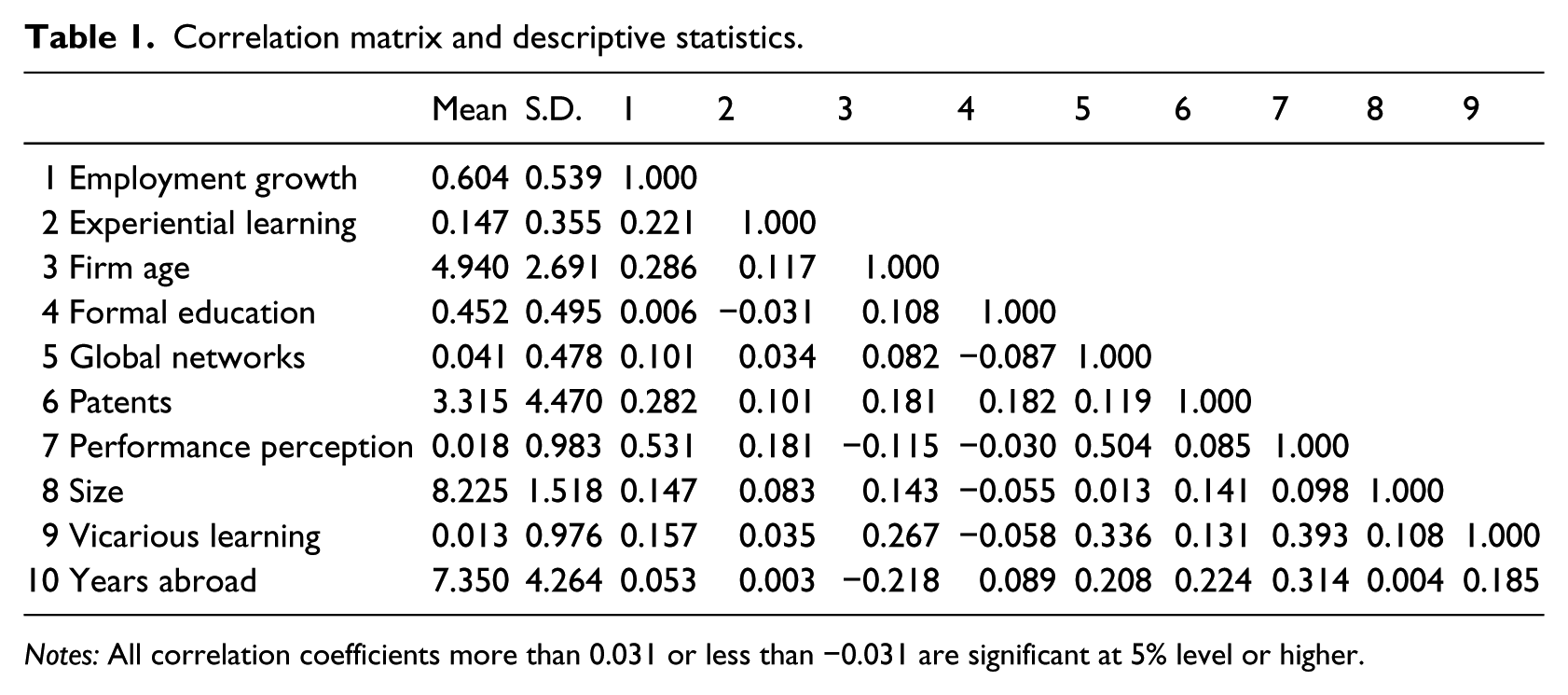
Notes: All correlation coefficients more than 0.031 or less than −0.031 are significant at 5% level or higher.
Table 2 summarizes the results where the perceptual measure for performance was the dependent variable. The results based on the baseline model (Model 1) show that the variable of global networks is positive and significant, indicating that global networks established by returnee entrepreneurs significantly affect the business outlook of their firms.
Learning and firm performance: entrepreneurs’ perception.

Notes: ***, **, * and † represent the 0.1%, 1%, 5% and 10% significance levels.
However, other control variables such as formal education, firm size, patents and length that returnees stayed abroad, are not significant, indicating that the performance perception of the sample firms is not size-driven and not affected by the academic qualification of returnee entrepreneurs and patented-related advantage, as well as the length of staying abroad. Firm age has differing direct impacts on perceptual performance and employment growth. Returnee entrepreneurs in younger firms tend to be more optimistic and confident about firm performance, whereas more established firms have higher employment growth. The results show that the explanatory variables of direct learning and vicarious learning significantly affect returnee entrepreneurs’ satisfaction with their firm performance. Hence H1 and H2, which propose a positive association between direct learning and various learning and firm performance, are supported. The interaction terms between the variables of direct learning, vicarious learning and firm age are included in Models 2–4. The results show that the interaction term between experiential learning and firm age is negative and significant, indicating that firm age weakens the impact of experiential learning on firm performance, thus supporting H3a. However, the interaction term between the variables of vicarious learning and firm age is insignificant, although the sign of the coefficient is negative. Hence, the evidence obtained does not support H3b, that states a negative moderating effect of firm age on vicarious learning when performance perception was used as the dependent variable.
The results presented in Table 3 show the importance of vicarious learning and the moderating effect of age on vicarious learning when performance is measured in terms of employment growth, providing support for both H2 and H3b. In particular, the age variable significantly reduces the impact of vicarious learning on employment growth, suggesting that the impact of vicarious learning may diminish with the passing of time. However, in contrast with the results for perceptual measures of performance, the variable of experiential learning is insignificant, although it has a positive sign with respect to firm growth. Thus H1 is not supported. The interaction of experiential learning with firm age (H3a) is insignificant.
Learning and firm performance: employment growth.

Notes: ***, **, * and † represent the 0.1%, 1%, 5% and 10% significance levels.
Finally, Figures 1 and 2 show graphically the interaction effect between experiential learning, vicarious learning and firm age. Figure 1 depicts that as one goes from mean -1 standard deviation (S.D.) to mean +1 S.D. of experiential learning, performance perception increases with experiential learning for newer firms with a low value of firm age, but decreases for firms with a high value of firm age. Similarly, Figure 2 also indicates that the impact of vicarious learning on employment growth is contingent on firm age. Employment growth increases with vicarious learning for newer firms with a low value of firm age. This implies that the impact of vicarious learning is weakened for established firms. These plots are consistent with H3a and H3b, when perceptual performance and employment growth are used as the dependent variable, respectively.
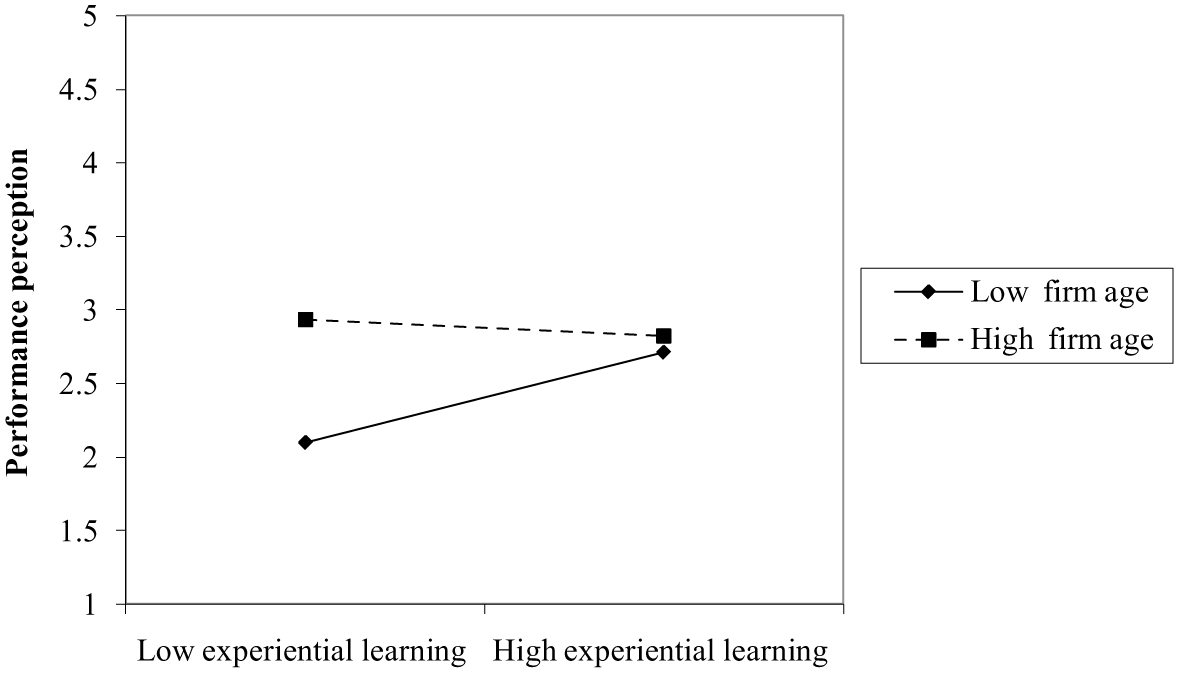
Plot of the interaction effect between experiential learning and firm age.
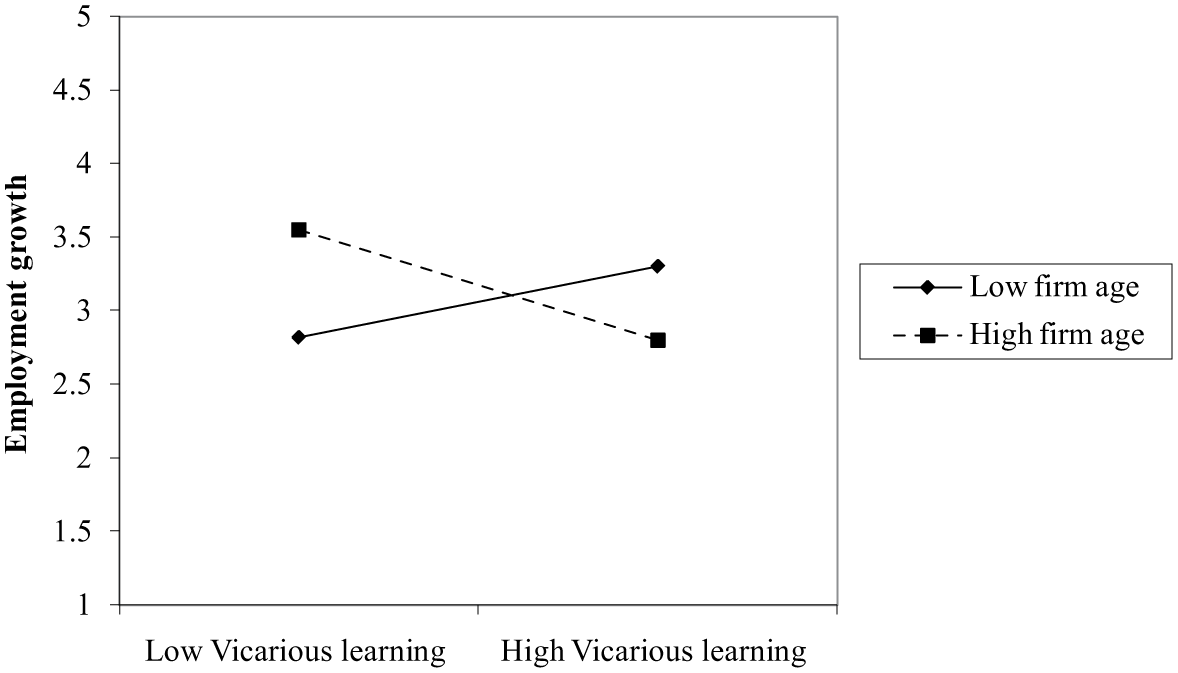
Plot of the interaction effect between various learning and firm age.
Discussion
Using novel survey data collected from firms in ZSP and adopting the learning perspective, this study focuses on the relationship between the learning experience of returnee entrepreneurs and firm performance. The learning perspective is highly relevant to returnee entrepreneurs who are embedded in different knowledge contexts: i.e. where they studied or worked and their home country. Such embeddedness provides returnee entrepreneurs with opportunities to benefit from their experiential and vicarious learning through knowledge transfer across national borders. The different learning capabilities of returnee entrepreneurs should result in different firm performance. Hence, adopting the learning perspective helps to capture the impact of the special features of returnee entrepreneurs on firm performance. The findings suggest that vicarious learning through knowledge transfer is positively associated with both perceptual and objective performance measures. Thus, this result indicates that returnee entrepreneurs who are able to acquire new ideas and knowledge internationally are rewarded with a positive performance outcome and high employment growth. The findings imply that acquiring new ideas and advanced technology help to boost entrepreneurs’ confidence and employment growth. The findings also show that firms do not operate in isolation, and hence vicarious learning serves as an important channel for external knowledge acquisition. This result suggests that returnee entrepreneurs are able to benefit from international knowledge transfer through vicarious learning due to their embeddedness in two different knowledge contexts. Such embeddedness equips returnees with distinctive advantages derived from vicarious learning which are crucial to firm performance.
The analysis found that experiential learning is positively associated with perceptual performance. This supports the view that past experience helps returnee entrepreneurs recognize business opportunities and develop their own businesses in China. This also indicates that returnee entrepreneurs with business experience are more likely to be realistically optimistic and confident about their firm performance (Landier and Thesmar, 2009). Prior business experience may lead entrepreneurs to set more realistic objectives, and hence to be less over-optimistic (Fraser and Green, 2006). Alternatively, cognitive biases may impede learning from prior experience (Tversky and Kahneman, 1974). Empirical evidence is mixed on the relationship between prior entrepreneurial experience and satisfaction with performance (Fraser and Greene, 2006; Landier and Thesmar, 2009). However, the effect may depend on boundary conditions relating to the nature of prior experience. For example, Ucbasaran et al. (2009, 2010) show that adjustment to more realistic objectives depends on whether prior experience involved portfolio versus serial entrepreneurs, and whether prior experience was successful or not. The present study adds to this prior work by providing evidence on the impact of the nature of prior experience – in this case, from a different institutional context.
However, past experience is insignificant when an alternative measure for firm performance, employment growth, was used as the dependent variable. This insignificant result indicates that past experience has a limited impact on an objective measure of firm performance. On the one hand, this may imply that past experience obtained in diferent contexts may be context-specific, and requires returnee entrepreneurs to realign their past experience with the local Chinese context. On the other hand, the contrast of this finding with that for vicarious learning may imply that it is the acquisition of more specific knowledge, relating to technological ideas, business opportunities, market knowledge and finance knowledge observed abroad, that is the most transferable to help returnee firms grow beyond start-up. The other possible explanation is that experienced entrepreneurs may achieve firm performance by utilising fewer resources, including human resources (Dew et al., 2009). In other words, prior business experience may provide entrepreneurs with insights into how to allocate existing resources more efficiently (Winborg and Landström, 2001).
The study further investigated how firm age interacts with two forms of learning, and found interesting results regarding the moderating role of firm age in the entrepreneur’s learning capability. Specifically, firm age has a negative moderating impact on experiential learning, thus implying that firm age weakens the impact of experiential learning on firm performance: younger firms benefit more from direct experiential learning especially; whereas the impact of experiential learning decreases when firms become older. Firm age also weakens the impact of vicarious learning on employment growth, but with no such effect on perceptual performance. The results may suggest that returnee entrepreneurs with vicarious learning capabilities are more likely to be optimistic and confident about their firm performance. They may perceive that international knowledge transfer may have a long-lasting effect on firm performance. However, the impact of vicarious learning on employment growth declines with firm age. The results implicitly suggest that the competitive advantages derived from vicarious learning is more important for new start-ups. Hence, the presence of a significant negative coefficient in relation to vicarious learning and age in terms of employment growth may be a reflection of returnee entrepreneurs having difficulty continuing to obtain benefits of vicarious learning. The results also may imply that direct or vicarious learning may substitute for firm-specific knowledge and skills for younger firms which are likely to suffer from resource and knowledge constraints. This finding reveals that the impact of learning on firm performance is not universal, but subject to firm age.
The findings imply that global networks are an important factor affecting performance perception and employment growth. Returnee entrepreneurs with well-established global networks are more optimistic. As such, overseas networks are critical to the business outlook of their firms. The findings also indicate that returnee entrepreneurs with well-developed global networks are more likely to access valuable information and external resources. Such network-related advantages may compensate for a lack of local connections, given that returnees exit local networks when they are away from their home country (Li et al., 2012).
Contributions of the study
This article offers several contributions. First, it extends research on the mobility of entrepreneurs across country borders, beyond traditional attention to immigrant entrepreneurs, to incorporate examination of those entrepreneurs that return to their home country. While this research has been developing, its principal focus has been to compare returnees with non-returnee local entrepreneurs, and has given only limited attention to the heterogeneity of the benefits that returnee entrepreneurs may have gained from spending time abroad. Generally, prior research has neglected the relationships between this heterogeneity and firm performance. More specifically, this study adopted a learning perspective and examined whether both experiential and vicarious learning contribute to firm performance. This investigation contributes to the learning perspective by revealing the links between direct learning and external knowledge acquisition and different measures of firm performance. Hence, the findings provide evidence that emphasizes the need for more fine-grained consideration of the differential effects of experiential learning and vicarious learning on firm performance, in the context of entrepreneur mobility across national borders. Second, the study further investigated how firm age moderates the impact of the experiential learning and vicarious learning of returnee entrepreneurs on firm performance. The findings provide new insight into the interrelationship between learning benefits and firm age, as they show that learning benefits are contingent on firm age. This represents an important extension of previous studies, which often treat firm age as a control variable when examining the impact of learning on firm performance (Lee and Tsang, 2002; Marin and Bell, 2006; Stuart and Abetti, 1990). The impact of learning capabilities appears to be age-dependent, and in particular the present study shows that the effect of learning from exposure to business activities abroad deteriorates with the number of years since the entrepreneur returned to their home country. Third, and more generally, the study makes a contribution in responding to calls for further understanding of the influence of context on entrepreneurial behaviour (Zahra and Wright, 2011), both in examining returnee entrepreneurs in an emerging economy context, and in investigating the temporal dimension of context.
Implications of the study
The findings of this study have some important managerial and policy implications. First, the evidence on the role of experiential learning and vicarious learning suggests that entrepreneurs need to be aware of the importance of both forms of learning, and to be proactive in exploiting the advantages of learning. In particular, cross-border knowledge acquisition represents a viable way to access external knowledge which is unavailable internally. Second, managers and entrepreneurs need to avoid the ‘age trap’ whereby as firms grow, their experiential learning through past experience may become less relevant, and the impact of initial international knowledge transfer becomes less valuable. While it may be difficult for returnee entrepreneurs to maintain overseas experiential learning once they have returned to their home country, finding ways to sustain vicarious learning from their overseas experience subsequent to returning home may be beneficial. Third, for local entrepreneurs, returnee migrants in general and returnee entrepreneurs in particular may represent a new source of international knowledge. Hence, local firms should build links with returnee entrepreneurial firms to maximize the benefits from vicarious learning.
Finally, policymakers should consider designing an appropriate policy to take advantage of human mobility across national borders. Attracting returnees from developed countries may be an effective way of catching up with technological leaders in developed countries. Thus, the government should continue to provide incentives to encourage overseas Chinese students and scientists to return to China. Meanwhile, policymakers may need to design incentives to retain the expertise of returnees. However, the present analysis shows that knowledge resources developed abroad have a limited life-span, and perhaps a separate set of incentives is needed to encourage returnee entrepreneurs to hone their learning capabilities as their ventures mature.
Limitations of the study and recommendations for future research
There are some limitations which suggest further research possibilities. First, with respect to performance, the study was constrained by the lack of published information, and well-known sensitivity on the part of respondents in emerging economies to report details on levels of profitability (e.g. Hoskisson et al., 2000). As emerging markets such as China develop, more reliable performance information on private companies may become available. The study adopted a perceptual satisfaction with performance measure that has been shown to have high internal reliability (Chandler and Hanks, 1993). Further, while there is some debate about the correlation between subjective and objective measures of entrepreneurial firm performance, and recommendations are to use a combination of both types of measures (Naman and Slevin, 1993), the present study found a correlation of 0.53 between its two measures of performance. Individual entrepreneurs may have different thresholds of performance for their ventures which relate to their perception of satisfaction with the performance of the business (Gimeno et al., 1997). Given the challenges in transferring experience from a developed economy to an emerging economy, an entrepreneur’s satisfaction with performance may be an important measure of how well they believe they are doing – notwithstanding the actual financial performance which they are reluctant to disclose.
Second, the study was restricted to a single science park in the Chinese context, notwithstanding that this is the largest science park in China and one that has attracted a large number of returning Chinese people from overseas. Recent attention has been drawn to the need to understand the effects of context on entrepreneurial behaviour and performance (Welter, 2011; Zahra and Wright, 2011), and of the emerging economy context in particular (Bruton et al., 2008). Although the study focused on returnee entrepreneurs in China, they also may play an important role in other emerging market contexts such as India, Russia and African countries. Future studies should examine whether the findings identified here on the nature of learning by returnee entrepreneurs holds in institutional contexts.
Third, although the study extended research on learning experience to the returnee context, it focused mainly on their overseas learning experience on firm performance without examining the domestic learning experience of returnee entrepreneurs. It was outside the scope of this study to incorporate measures of the nature, extent and outcome from prior entrepreneurial experience, and their links to the cognitive processes of individual entrepreneurs (Ucbasaran et al., 2008, 2009, 2010). Additional studies are needed which delve more deeply into these individual cognitive aspects of prior entrepreneurial experience by returnees, as well as their prior entrepreneurial experience in their home country before going abroad.
Fourth, the study was based on a cross-sectional survey, and hence was unable to address questions relating to the process of learning itself. Further research using longitudinal data may be able to look deeper into this issue. Fifth, the study’s focus on returnee entrepreneurs only may involve something of a selection effect, as only the most able would-be entrepreneurs may seek experience in OECD countries. As such, the generalizability of the findings to other types of entrepreneurs may be limited.
Finally, while studying the relationship between the heterogeneity of returnee entrepreneurs and firm performance has yielded new insights into the effect of learning, the data were collected in 2005–2006. Although there have been no significant changes in government policy regarding returnees at both the national level and the level of management of ZSP, future studies should utilise more timely data to examine whether returnees’ local experience compensates for the impact of experiential and vicarious learning.
Conclusion
By adopting the learning perspective, this article has investigated the impact of the learning capabilities of returnee entrepreneurs on firm performance, using hand-collected survey data from ZSP in Beijing. In the context of an emerging economy, the findings show that experiential and vicarious learning help boost perceptual performance, whereas vicarious learning is positively associated with employment growth. The analysis also found that firm age weakens the impact of experiential learning, especially on perceptual performance, and reduces the impact of vicarious learning on employment growth. By examining the interrelationship between returnee entrepreneur learning capabilities and firm age, the article highlights that the impact of entrepreneurial learning is contingent on firm age.
Footnotes
Acknowledgements
The authors thank the editor and three anonymous reviewers for their constructive comments.
Funding
The authors thank the British Academy for research support (grant no. LRG-39371).