



Abstract
This article explores the growth aspirations of owners and managers of young firms in a post-conflict economy by focusing on social capital. It treats social capital as a multidimensional, multilevel phenomenon, studying the effects of discussion network characteristics, trust in institutions, generalised trust in people and local ethnic pluralism. We argue that in a post-conflict country, ethnic pluralism is indicative of local norms of tolerance towards experimentation and risk taking which support growth aspirations. It also distinguishes between the aspirations of hired managers and owners-managers. The empirical counterpart and hypotheses testing rely on survey evidence drawn from young businesses in Bosnia and Herzegovina.
Introduction
This article focuses on the effects of various determinants of social capital on the growth aspirations of owners and managers of young businesses in a post-conflict country: Bosnia and Herzegovina. Post-conflict environments are fragile yet, may also offer opportunities for economic revival and therefore, call for particular attention (Collier, 2008). The interest here is in the micro foundations of the process of economic recovery. In particular, we ask: what factors affect the growth aspirations of young firms? Consistent with Penrose (2009[1959]), we argue that growth strategies of firms need to be primarily attributed to managerial capital; moreover, it is in the early stage of business activity that growth dynamism is particularly constrained by managerial competencies. Penrose’s (2009[1959]) stress on management is consistent with the view of entrepreneurship as, ‘about people in their roles as identifiers of opportunities and the exploiters of opportunities’ (Acs, 2006: 195). Enterprise is as much about growth as the emergence of new firms (Penrose, 2009[1959]) Yet, unlike some open and stable economies, in a post-conflict environment growth aspirations can be easily damaged. In particular, where much of social capital has been destroyed during the conflict, it becomes the key limiting factor affecting aspirations. It is in this context that this article considers the micro-, meso- and macro-level aspects of social capital that affect the managerial growth aspirations of young firms. It is argued that these lessons apply to other post-conflict environments; moreover, we agree with Light and Dana (2013), who stress that the general boundaries of social capital might become more evident in settings other than those considered conventional.
Social capital is treated as a multidimensional and multilevel phenomenon, considering social links at micro and meso level, with the macro level treated as the context. In particular, the effect of owner/manager discussion networks on growth aspirations, as well as facets of meso-level social relations that support entrepreneurship - such as trust - in institutions and people. It is argued that in a country with weak institutions, there is a wider meso-level variation compared with those with strong institutions, where the institutional environment is more homogenous. In addition, in a post-conflict, multi-ethnic country such as Bosnia and Herzegovina, the presence of ethnic pluralism is an indicator of local social norms of tolerance that facilitate experimentation, competition, enterprise and growth aspirations.
With the exception of Kwon and Arenius (2010) and Estrin et al. (2013a), the social determinants of growth aspirations have not yet attracted the attention they deserve (e.g. Autio and Acs, 2010; Levie and Autio, 2011). While there is ‘increased appreciation for the importance of social relationships in entrepreneurship’ (Gedajlovic et al., 2013: 455), the influence of these factors on enterprise development remains under-investigated (Thornton et al., 2011). Yet, negative social and cultural influences may eradicate high growth aspirations of entrepreneurship (Van Stel and Storey, 2004) thus, affecting entrepreneurial performance. This becomes clearer once we move away from a standard context such as that of local settings of a mainstream developed economy, and consider alternative social environments (Light and Dana, 2013).
Thus, by widening our perspective and considering a post-conflict environment deficient in social capital, we enhance general understanding of the social phenomena supporting entrepreneurial aspirations. Seen within this wider context, the focus on social capital follows Granovetter’s (1985) call to avoid both ‘oversocialised’ and ‘undersocialised’ theories; the former puts stress entirely on macro-level social structures (e.g. Marxist-type social class analysis), while the latter model considers individuals as atomised, abstracting from any social features (see also Estrin et al., 2013a). Accordingly, this article focuses on the links between entrepreneurship and social dimensions in a post-conflict context. It is in such a case that social capital may be most fragile and most needed. The article examines the case of Bosnia and Herzegovina that is emerging from a recent conflict (1992–1995) yet, the analysis offers lessons that may be applicable to other similar environments.
The article is organised as follows. The introductory section discusses the context: the ethnically complex post-conflict environment and current state of entrepreneurship in Bosnia and Herzegovina. Next, the research framework and hypotheses are introduced. Subsequently, the data and model specification respectively are discussed, before the key empirical findings are reported. Finally, the article offers conclusions.
Context: entrepreneurship in Bosnia and Herzegovina
In the late 1980s and early 1990s, the former Yugoslavia (including Bosnia and Herzegovina as a former Yugoslav republic) was overwhelmed with unresolved internal political and economic issues. Inconsistent transition reforms started during this period,which were supposed to strengthen internal cohesion and promote economic improvement, but in practice contributed to the disintegration of the former Yugoslavia (Hadziahmetovic, 2011). A four-year war began in Bosnia and Herzegovina which achieved independence in 1992 but brought about massive destruction. The Dayton Peace Accord ended the war in 1995 yet, at that time Bosnia and Herzegovina had lost around one-quarter of its population and three-quarters of its economic potential compared to 1991. Estimated gross domestic product (GDP) per capita fell from $1,900 to around $500 by 1995 (World Bank, 1997).
Bosnia and Herzegovina is a middle-income country where, similar to other Central and East European nations making the transition from a planned to a market economy, entrepreneurial growth aspirations are limited. Autio defines high-aspiration early-stage entrepreneurs as owners-mangers of businesses that are less than 42 months old, who ‘expect to employ twenty or more individuals within five years’ time’ (2011: 259). The prevalence rate of high-aspiration entrepreneurs in Bosnia and Herzegovina among the adult population is low at 0.5 percent, similar to neighbouring Croatia and Serbia, affected by the same conflict in the 1990s. This contrasts with several Latin American and South-East Asian economies, where entrepreneurial dynamism is significantly higher: between 2 and 2.5 percent in China, South Korea, Peru and about 3.5 percent in Columbia.
Data on high-aspiration start-ups are consistent with figures on the numbers of micro, small and medium-sized enterprises that are also low for transition economies (Estrin and Mickiewicz, 2011a); similarly, levels of nascent entrepreneurship and new business ownership are below average. In 2010, from the transition countries surveyed, an estimated 7.6 percent 1 of their population aged 18–64 was involved in starting a new business or running a business which was less than a year old (this figure is 7.7 percent for Bosnia and Herzegovina), compared to 11.7 percent for all middle-income economies surveyed in 2010 (Kelley et al., 2010).
When part of the former Yugoslavia (1945–1992), Bosnia and Herzegovina was a multi-ethnic republic with a high level of ethnic tolerance (Dyrstad, 2012; Hodson et al., 1994). Unfortunately, the Bosnian war caused a structural collapse of ethnic tolerance (Dyrstad, 2012) with ethnic divisions largely institutionalised within the constitution (Bieber, 2006). The multi-ethnic environment and associated pluralism was eroded in all but a few areas of the country (Armakolas, 2011); subsequent economic consequences of artificially created new ethnic divisions remain unexplored.
Accordingly, an investigation of the role of trust, networks and ethnic pluralism in relation to business development is particularly interesting in the context of Bosnia and Herzegovina due to its ethnic and institutional structure. Three major ethnic groups make up its population: Bosniaks, Serbs and Croats (these ethnicities largely correspond to Muslim, Orthodox and Catholic religious traditions respectively). The war in the 1990s caused large population movements both outside and within Bosnia and Herzegovina, leaving the population concentrated in more ethnically homogenous territories. Yet, ethnic minorities remain within areas dominated by Bosniak, Serb or Croat majority populations. Moreover, some areas avoided ethnic cleansing, preserving pluralism (Armakolas, 2011). Cultural differences are smaller than in other divided societies, as the three groups speak virtually the same language and share similar traditions which typically facilitate post-conflict reintegration (Collier, 2008). However, the Dayton Peace Accord which ended the war brought in a complex constitution which has institutionalised ethnic divisions (Bieber, 2006). Each of the three main ethnic groups has substantial autonomy and control over its own ethno-territorial units, which predominate over state-level institutions (Bieber, 2010). Consequently, and rather uniquely, there are some parts of Bosnia and Herzegovina where each group remains an ethnic minority, and other parts where it is the ethnic majority. Although there are no official indicators (the last census was in 2013, but with no data available yet at time of writing; the previous one was before the war in 1991), there is casual evidence that ethnic pluralism is more present in regions which were less affected by war activities and therefore, preserved social linkages dating to the pre-war period (Armakolas, 2011). All this makes Bosnia and Herzegovina a relevant context for studying the impact of social capital and ethnic pluralism on entrepreneurial aspiration.
Theoretical framework
Entrepreneurial growth aspirations
This study follows Penrose in treating enterprise: as a psychological predisposition on the part of [the] individual to take a chance in a hope of gain … The decision on the part of a firm to investigate the prospective profitability of expansion is an enterprising decision, in the sense that whenever expansion is neither pressing nor particularly obvious, a firm has the choice of continuing in its existing course or of expanding and committing resources to the investigation of whether there are further opportunities of which it is not yet aware. This is a decision which depends on the ‘enterprise’ of the firm. (2009[1959]: 30)
Penrose emphasises that in such a decision, it is not resource constraints but managerial predisposition that is the limiting factor. It is within such a perspective that this article turns its attention from a production function approach that would investigate resource constraints towards considering the managerial attitudes, predispositions and strategies adopted to acquire new knowledge. In this theoretical perspective, the question about growth aspirations becomes important.
While Penrose (2009[1959]) analysed growth decisions as dependent on managerial predispositions and their entrepreneurial character, one may argue that these decisions play a special role in the phase of entrepreneurial process when firms have survived the initial period of incubation, and next decide if, and how quickly, to expand (Messersmith and Wales, 2011). We follow Estrin et al. (2013a), who pay particular attention to the growth aspirations of owners and managers of young companies, and more generally it builds on the wider framework of those who see entrepreneurship as a process that includes several stages, not just a one-off transformation that creates a firm (e.g. Casson and Della Giusta, 2007; Wright and Marlow, 2011). The ‘spirit of enterprise’ (Penrose, 2009[1959]) is best captured by those companies that aspire to grow, in contrast with those which remain satisfied with their original size achieved during the start up period.
Accordingly, the present study is located within a recent strand in the entrepreneurship literature focusing on the individual and contextual determinants of growth aspirations (Autio and Acs, 2010; Bowen and De Clerq, 2008; Estrin et al., 2013a; Levie and Autio, 2011). However, even if one is not interested in the entrepreneurial process, focusing only on achieved growth, there is a substantial body of research confirming the positive relationship between an entrepreneur’s business aspirations and subsequent firm performance (Baum et al., 1998, 2001; Delmar and Wiklund, 2008; Kolvereid and Bullvag, 1996; Wiklund and Shepherd, 2003). Thus, growth aspirations are also important as they are significantly associated with the subsequent expansion of firms; managerial objectives shape actual outcomes. In turn, dynamic new enterprises are drivers of economic growth (Henrekson and Johansson, 2010; Wong et al., 2005).
Based on the literature above, we have some understanding of what shapes entrepreneurial growth aspirations. However, to the best of our knowledge, the issue has not been analysed with respect to a post-conflict environment. This matters for two reasons. First, from a theoretical perspective, non-standard contexts help us to understand if mechanisms considered normative are indeed generalisable (Light and Dana, 2013). Second, from a policy perspective, post-conflict environments deserve attention as they offer both opportunities for economic resurgence and face high risks of lapsing back into violence (Collier, 2008). The opportunities relate dismantling existing social and political structures that might+- inhibit economic dynamism of the past (Acemoglu and Robinson, 2012; Olson, 1982). The threats relate to the risk that initial weak economic dynamism may lead to social frustration, feed into extremism and cause a return of violence. It is in this context that it is important to understand the micro foundations of growth.
Social capital
The influence of sociocultural determinants on entrepreneurship development remains an under-studied concept (Thornton et al., 2011). The present analysis is framed by utilising the concept of social capital (Nooteboom, 2007). At the core of this concept is the idea that goodwill stemming from social relations is a resource for facilitating action (Adler and Kwon, 2002), and that social linkages formed in one social sphere may be appropriable with another: ‘Appropriability legitimates a conceptual strategy of bringing under the one notion … informal organisation, trust, culture, social support, social exchange, social resources, embeddedness, relational contracts, social networks and inter-firm networks’ (Adler and Kwon, 2002: 18).
A key division in the social capital literature is based on level of analysis (Halpern, 2005). For some, social capital is a macro-level phenomenon in the sense of characteristics shared nationwide (Putnam, 2000), whereas others understand social capital as specific to the micro level and particular to individuals (Bourdieu, 1986; Sobel, 2002). This division has influenced two major conceptualisations of social capital: one focusing on societal relations, and the other on personal relations. The societal relations stream defines social capital as widely shared, cooperative social norms such as trust and reciprocity (Fukuyama, 1995; Putnam, 2000; Rothstein and Stolle, 2008). The personal relations stream focuses on the micro structural element of social relations, such as the properties of social networks that individuals can use to secure benefits (Bourdieu, 1986; Burt, 2000; Sobel, 2002).
More generally, business-appropriable social capital depends not only on the network structure of an individual’s social relations, but also on the cognitive and normative structures that enable people to act collectively, such as generalised and institutional trust. In this context, the meso level becomes important. The latter relates to intergroup contacts (Pettigrew, 1998), where social groups are wider than strictly personal networks but narrower than the macro level. Distinguishing between the macro and meso levels is also in the spirit of Granovetter’s (1985) call to avoid ‘oversocialised’ theories; Estrin et al. (2013a) build on Granovetter’s insights, applying his approach to the determinants of entrepreneurial aspiration.
The distinction between the meso and macro level becomes critical in societies characterised by weak institutions. High-quality institutions create homogenous expectations based on formal rules that generate shared understanding, and are applied consistently. In contrast, internal conflict undermines the rule of law and formal authority, replacing it with local informal structures of power such as paramilitary or criminal groups (Armakolas, 2011). This is likely to leave a legacy after the conflict has ceased.
Thus, in analysing the relationship between social capital and aspirations, the present study follows suggestions by Wright and Stigliani (2012), and examines multiple dimensions of social capital, attributing it to different societal levels (see Figure 1). First, it examines how owners and managers relate to macro- and meso-level societal groupings. It argues that societal relations affect micro-level outcomes such as business aspirations and analyses the impact of ethnic pluralism, institutional trust and generalised trust on growth aspirations. Second, it turns to personal relations, analysing the impact of discussion network composition on growth aspirations.

Theoretical framework.
Trust
Trust is seen as a key dimension of social capital (Kwon and Arenius, 2010; Westlund and Adam, 2010). It indicates the presence of cooperative norms in society that enable the use of social relations to access resources (Paldam, 2000). Furthermore, it is seen as crucial component in the institutional structure of a market economy, facilitating transactions (Arrow, 1974). However, not all trust is considered equally beneficial. A key distinction in the literature is made between ‘particularised trust’ (Rothstein, 2003) and ‘extended’ trust (Raiser, 1999). Particularised trust is that which emerges between two or more individuals, such as family members and friends (Rothstein, 2003). It is based on knowledge of the individual, or the fact that they belong to a particular group; for example, the same ethnicity. Extended trust, in contrast, is more abstract, enabling transactions to take place with only limited information about the counterpart’s specific attributes (Raiser, 1999). In this context, Estrin et al. (2013b) and Fukuyama (2001) contrast ‘radius of trust’ with ‘radius of distrust’; the social capital built within one group may have a negative effect on relations with other groups.
There are two main forms of extended trust: institutional trust (trust in institutions) and generalised trust (trust in unknown individuals). Institutional trust is trust in the functioning of the institutional framework including formal rules, organisations and enforcement mechanisms (World Bank, 2002). If institutional systems are strong, institutional trust will be high and supportive of entrepreneurship development and business growth (Welter, 2012). Parallel to this, generalised trust is trust in unknown individuals (Rothstein and Stolle, 2008), and as such, is a reflection of confidence in wide social norms; that is, the expectation of accepted behaviour of individuals in society in general.
Raiser (1999) and Fukuyama (1995) argue that ‘extended trust’ is crucial to a modern market economy. Extended trust, unlike particularised trust, enables individuals to engage in transactions beyond closed circles of family or well-known business contacts; such links are necessary for any complex division of labour. Extended trust offers enhanced cooperation and access to new opportunities (Rus and Iglič, 2005). In contrast, low-trust environments are thought to hinder entrepreneurship because businesses have to rely on particularised trust through personal networks, which increases transaction costs (Hohmann and Welter, 2002); we argue that this is particularly damaging to entrepreneurial growth aspirations. Growth is associated with increased complexity of transactions and increased risks; it is here that low trust and the low institutional quality environment becomes a binding constraint. Relying on particularised trust, individuals may successfully launch new businesses. However, they will be kept low-scale when the perceived risks associated with expansion are too high (Aidis and Mickiewicz, 2006; Estrin et al., 2013a).
Moreover, transition economies are often characterised as low-trust societies due to their communist legacy (Estrin and Mickiewicz, 2011a; Fukuyama, 1995; Raiser, 1999). Trust in Bosnia and Herzegovina has been further undermined by recent conflict (United Nations Development Programme (UNDP), 2009) which has seriously damaged the rule of law, confidence in formal institutions, perceptions of equality under law and due judicial process. War brought ‘the radical redefinition of power relations, the blurring of distinctions between legal and illegal, state and non-state’ (Armakolas, 2011: 231). An associated shift of perceptions is persistent and slow to reverse, since ‘the manner through which the rule of law is or is not upheld in wartime profoundly influences the legitimacy of the state and the authority it commands among the population’ (2011: 231).
However, both Armakolas (2011) and Welter and Smallbone (2006) point out that trust differs across regions and sectors. Norms of trust and perceptions of formal institutions can be diversified and localised. In addition, the manner in which individual entrepreneurs relate to the macro environment via institutional and generalised trust may vary due to their individual characteristics, experiences and social status. De Soto (2001) argues that although nearly all former communist countries have universal property rights, in practice only some citizens (elites) can have these rights enforced. In some countries, entrepreneurs coming from a poorer background and with fewer connections may feel less secure about their property rights or access to the legal system than those who have stronger connections and greater wealth (Aidis et al., 2008; Glaeser et al., 2003). Those who feel less secure are likely to scale down growth aspirations due to a threat of expropriation either by corrupt agents representing formal institutions, or by business partners outside their radius of particularised trust; the growing size of the business venture would extend it beyond the radius of trust into the social space of distrust. Accordingly, it is hypothesised that the trust that an individual expresses in relation to institutions (institutional trust) and to people (generalised trust) affects entrepreneurial growth aspirations positively. Combining the discussion above, it is posited that: H1: The greater entrepreneurs’ trust in institutions, the higher their growth aspirations. H2: The greater entrepreneurs’ generalised trust, the higher their growth aspirations.
Local ethnic pluralism
According to the existing literature, ethnic diversity may have both positive and negative effects on economic outcomes, but is still under-investigated in empirical research (Ram et al., 2011). On one hand, where ethnic diversity is associated with fragmentation and conflict, it is likely to impact negatively on economic performance, leading to poor economic choices and policies (Easterly and Levine, 1997). Putnam (2007) also argues that in the short run, an increase in ethnic diversity is associated with less social capital and solidarity, although in the long run this effect may change. On the other hand, a diverse ethnic mix may bring various abilities, different experiences and ways of thinking as well as a variety of cultures and traditions, which may lead businesses towards innovation, creativity and better economic performance (Alesina and La Ferrara, 2005; Florida, 2004, 2005; Lee et al., 2004; Smallbone et al., 2010). Such conditions are conducive both to a larger and more diversified pool ‘of underexploited knowledge useful for commercialisation of new ideas’ (Marino et al., 2012), and to low communication barriers that make access to this knowledge and its utilisation relatively easy, creating an environment for entrepreneurial dynamism. Consequently, ‘ethnic pluralism’ 2 (in contrast to ‘ethnic fragmentation’) is a potential source of competitive advantage affecting entrepreneurial entry positively (Audretsch et al., 2010; Lee et al., 2004; Marino et al., 2012; Smallbone et al., 2010).
It is argued that at the meso level, ethnic pluralism in the social environment is advantageous to entrepreneurial growth aspirations. In Bosnia and Herzegovina, relations between ethnic groups vary considerably; not just between regions, but also at the individual level. Thus, how individuals situate themselves in their ethnic environment is an important facet of social capital. It is likely that those entrepreneurs working in a more ethnically mixed area are able to advantage of the opportunities that come from a heterogeneous, but not fragmented, environment.
In a post-conflict environment, local ethnic pluralism becomes an indicator of the relatively stronger local climate of tolerance. During conflict, this climate slowed down the eruption of ethnic hatred, which in turn prevented ethnic cleansing and preserved pluralism in the social fabric (Armakolas, 2011). More generally, experience of ethnic pluralism via frequent face-to-face contact may diminish prejudice and ‘lead to a less provincial view of outgroups in general’ (Pettigrew, 1998: 72). The next step in this process is ‘generalisation from the immediate outgroup to other outgroups’; that is, participation in intergroup links that results in ‘greater acceptance of minorities of many types’ (Pettigrew, 1998: 75). Therefore, experience of pluralism is associated with social norms that approve non-standard behaviour, including experimentation with new ways of doing things. Stephan and Uhlaner (2010) emphasise that the presence of such supportive social norms facilitates entrepreneurial behaviour of which growth aspirations are a crucial aspect, as discussed above.
Growth aspirations are also enhanced by wider access to resources that come with ethnic heterogeneity. Both Aldrich and Kim (2007) and Light and Dana (2013) emphasise that typically, start-up teams are formed by relying on a close-knit social neighbourhood. It is only in the expansion phase that entrepreneurs face a need to recruit, reaching out for competences that may be available only in wider and more mixed communities (Light and Dana, 2013; Zain and Ng, 2006). Thus, richer social links make scaling up entrepreneurial projects easier and therefore, affects entrepreneurial aspiration positively. Furthermore, working in a more ethnically mixed area implies that the entrepreneur has a more diverse ‘infrastructure’ available for the exchange of ideas, experiences and cooperation. Hence, based on these opportunities to increase competence and knowledge, we expect ethnic pluralism to be positively related to aspirations for business expansion. In contrast, individuals belonging to a homogenous ethnic majority or minority neighbourhood, in an ethnically fragmented environment, face a relatively narrow knowledge base; this is likely to affect the entrepreneur’s growth ambitions negatively. Finally, it is likely that ethnically mixed areas create more competitive pressure; motivation to grow may result not only from opportunity recognition, but also from necessity. In some sectors, some firms may wish to expand in order to survive competitive pressure. Obviously, all these elements are not mutually exclusive. 3
Hence, relating ethnic pluralism to supportive social norms, the availability of resources (wider recruitment base in particular), knowledge and competitive pressure to grow, leads to the third hypothesis: H3: Entrepreneurs in an ethnically mixed neighbourhood (characterised by ethnic pluralism) have higher growth aspirations.
Business discussion networks as social capital
Entrepreneurs are embedded in personal networks which may facilitate their actions (Casson and Della Giusta, 2007; Hansen, 1995; Jack et al., 2010). Personal networks enable individuals to obtain knowledge and information, such as contacts for new customers or new business opportunities (Greve and Salaff, 2003; Hoang and Antoncic, 2003; Jack, 2010; Witt, 2004), and this is likely to feed into entrepreneurial growth aspirations. In addition, networks can provide access to different types of resources that either would not be otherwise available, or would be more expensive to obtain via the market. Relying on networks may be a useful strategy to overcome constraints to growth such as accessing finance, finding appropriately qualified human resources, and dealing with institutional and regulatory obstacles such as customs regulations or obtaining commercial licences. This latter aspect suggests why business networks may become a substituting strategy in environments characterised by weak institutions and weak trust, enhancing growth aspirations (Estrin et al., 2013a).
Moreover, the composition of individual networks affects the ability to obtain a variety of information and resources (Jack et al., 2010; Raiser et al., 2007; Watson, 2011; Zang, 2011). A central debate in the literature on network structure concerns whether strong or weak ties bring more benefits to individuals (Granovetter, 1973; Greve and Salaff, 2003; Krackhardt, 1992; Wang and Altinay, 2012). While close ties (especially family-based) may provide the entrepreneur with emotional and motivational support, weak ties may result in access to non-redundant knowledge and information. However, it is argued that in order to understand the impact of network structure, it is necessary to distinguish further between acquaintances and friends (e.g. Greve and Salaff, 2003; Krackhardt and Stern, 1988). While indeed more valuable knowledge may be found when reaching out beyond the family circle, the extent to which it can be effectively acquired relies on the attitudes of outside contacts and the degree of trust between the individuals in the network. Obtaining valuable knowledge and resources from weak ties may be particularly difficult in the post-conflict environment, where the social fabric has been damaged, the level of trust is low and people are unwilling to share knowledge with strangers or mere acquaintances. In such environments, in order to be able to benefit from business contacts, strong personal links need to be built on top of these. Accordingly, it is hypothesised that: H4: Growth aspirations are enhanced by a larger proportion of ties that are family- or friends-based (in contrast with acquaintances).
Hired managers versus owners-managers
In a recent paper that discusses research agenda on the entrepreneurial process, Wright and Marlow notice that ‘different ownership profiles critically influence entrepreneurial ambitions and activities. Consequently, future work needs to recognise how ownership structures profoundly affect the development of the venture’ (2011: 112). This implies a call to incorporate some corporate governance insights into entrepreneurship research. Broadly speaking, these insights relate both to relations between owners and relations between owners and managers; these two aspects correspond to horizontal and vertical corporate governance (e.g. Roe, 2008). Considering the latter, sound institutional contexts may compensate for strong incentives that come with ownership control in alleviating agency problems. In contrast, where institutional contexts are weak, such as in a post-conflict environment, separation of ownership and control may have a particularly negative influence on the way that the firm is managed and on its objectives, including growth ambitions.
Thus, in a post-conflict weak institutional environment, the agency costs of separation of ownership and control may be higher, and managers may be less likely to realise owner objectives if the latter imply adopting high growth aspirations. Managers may find it easier to rely on informational asymmetry and realise their own benefits of control instead of taking risks that come with growth. This leads to the final hypothesis: H5: Growth aspirations of owners-managers are higher than those of hired managers.
Method
Data and descriptive statistics
This research uses data on young businesses obtained through a specially designed cross-sectional survey implemented in the period from June to August 2011. The data were gathered from the owners or managers from six different regions covering the two entities constituting the state of Bosnia and Herzegovina: the Republic of Srpska and the Federation of Bosnia and Herzegovina. The survey was administered through face-to-face meetings with firms formed between July 2005 and December 2008 to ensure a more homogenised sample as the business environment for start-ups changed dramatically when the economic crisis hit Bosnia and Herzegovina in 2009. By ending the sample period in 2008, the study avoided confusing pre-crisis firms with those started during the crisis. To achieve greater homogeneity, the sample does not include firms in agriculture, forestry, fishing, or craft workshops. The sample was stratified based on six economic regions, with an average of 40 companies surveyed in each. In addition, the multi-ethnic division of Bosnia and Herzegovina between three nationalities is represented as each of the three dominant nationalities (Bosniaks, Serbs and Croats) is in the majority in two of the six regions. On the basis of public records, 734 companies that met the criteria were identified for the survey. No size limit was applied. The final sample constituted 244 firms with a response rate of 33 percent. Of the 490 firms that did not contribute, approximately 15 percent did not exist at the time of the survey, 10 percent were not at the listed address, and the remaining 75 percent did not respond for differ reasons. There might possibly be a selection bias related to the fact that some firms closed soon after start-up but as in other studies, finding them would not be easy. Since this study used survey data the sample was checked for missing values which might produce biased estimates, distort statistical assumptions and lead to erroneous conclusions (Horton and Lispitz, 2001). The sample has few missing observations, and no observations are missing for the dependent variable. Model 1 is estimated with 227 observations. However, the variables for network composition contain more missing values, so models 2 and 3 are estimated with 166 observations. The list of questions designed to obtain data for the key variables of interest is presented in Table 1, and summary statistics for all the variables used in the econometric analysis are reported in Table 2.
Questions used to obtain data for key variables.

Descriptive statistics.
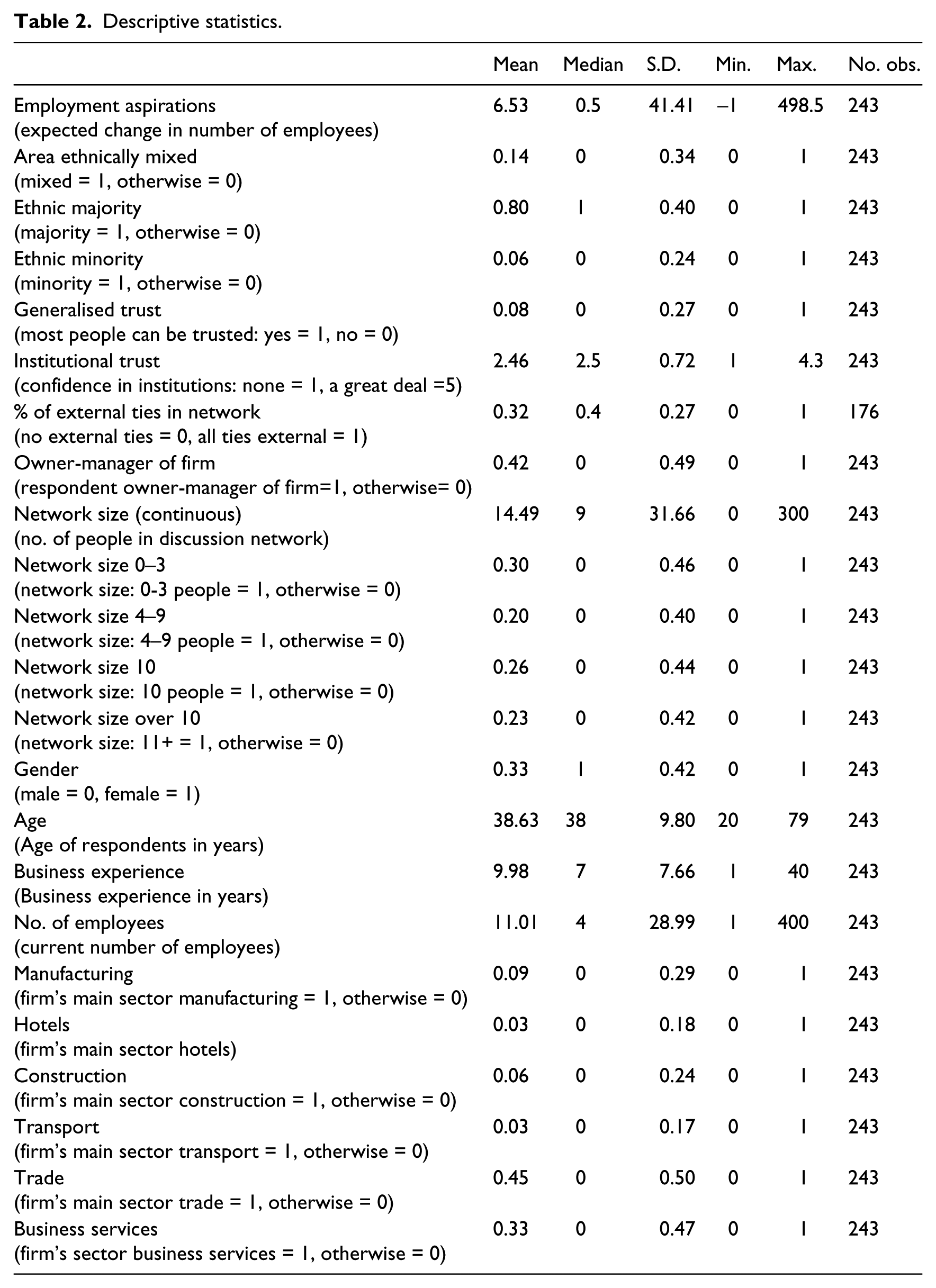
The dependent variable Employment aspirations utilises the two questions presented in the first row of Table 1 based on the Global Entrepreneurship Monitor methodology (Reynolds et al., 2005). Combining answers, the study produces a continuous variable, capturing the expectedpercentage change in the number of employees five years into the future in comparison to the current situation; this design is based on Estrin et al. (2013a). Following these authors, this research focuses on percentage change in employment instead of expected level in five year, as the percentage change better captures the relative magnitude of aspirations. More specifically, the dependent variable is created as the difference between the firm’s employment aspirations in five years and its current number of employees divided by the current number of employees. The distribution of dependent variable was left skewed, with 12 observations identified as severe outliers (outside the outer fence, using interquartile range). These outliers had unrealistic values in the range of 400–4980 percent and consequently, were excluded (following Autio and Acs, 2010; Estrin et al., 2013a).
The respondent’s perception of the ethnic pluralism in the neighbourhood where they work was measured by the variable Area ethnically mixed. Based on the question presented in Table 1, this variable was constructed to take:
a value of 1 when the respondent perceives that either: (a) the area is ethnically mixed; or (b) the area contains a balance of two or three major ethnic groups;
a value of 0 when the respondent perceives their ethnicity either to be: (c) in the majority; or (d) minority in their work neighbourhood.
The conceptualisation that perception of belonging to an ethnically mixed neighbourhood, rather than being in a majority or minority, indicates less polarised ethnic relationships seems to be supported by correspondence between the data and what we know about the ethnic composition of Bosnia and Herzegovina. For example, Mostar is a city where different ethnic groups (Croats and Bosniaks) live separately (in the western and eastern parts respectively). The present sample has a balance between the two ethnicities. However, perceptions of the ethnic composition of their neighbourhood fall almost unanimously into the ethnic majority category. In contrast, in areas such as Tuzla, where there is also a mix of ethnicities but not a stark spatial division, this mix is associated with individuals perceiving themselves as living in an ethnically mixed area rather than in the majority or minority, which is entirely consistent with Armakolas (2011). This is illustrated by Figure 2.

Ethnicity and perceptions of neighbourhood ethnic diversity.
This study’s measure for Generalised trust is based on the World Values Survey (WVS) question as presented in Table 1. The response is dichotomous, with 0 representing the answer ‘need to be very careful’ in dealing with people, and 1 representing the response ‘most people can be trusted’. From the sample, only 8.2 percent of respondents indicated that they possess generalised trust, certainly reflecting both the post-conflict and post-communist legacy (Estrin and Mickiewicz, 2011a). Data from WVS, which samples the general population rather than focusing on business owners and managers (like this article), can provide a point of comparison. In the 1999–2001 wave of the WVS (the most recent WVS including Bosnia and Herzegovina), 28.3 percent of respondents from all the countries sampled, but only 22.2 percent in a group of post-communist countries, indicated that they possessed generalised trust. 4 Interestingly, at 8.2 percent, the share of managers indicating generalised trust in the present sample is lower than found in the WVS of the general Bosnia and Herzegovina population in 2001, where the share was 15.8 prcent (WVS, 2013).
Institutional trust is a scale formed from respondent answers to questions on their confidence in key institutions in Bosnia and Herzegovina (following Efendic et al., 2011), as listed in Table 1 (with answers measured on a scale of 1 = ‘no confidence at all’ to 5 = ‘a great deal of confidence’). Cronbach’s Alpha (0.86) and factor analysis indicate that these items can be combined to form a scale. Accordingly, these individual scores were added together and divided by six to form a scale ranging from 1 to 5.
In gathering data on networks, a subjective approach was taken with data obtained from respondents regarding their personal networks. As an individual’s personal network covers all facets of their lives, personal as well as business, and obtaining data on a whole network is time-consuming and costly, we only consider a subset of an entrepreneur’s network - their discussion network, following Greve and Salaff (2003). This is composed of ‘people that entrepreneurs turn to when they discuss aspects of establishing and running a business’ (Greve and Salaff, 2003: 3).
The strength (composition) of ties in respondent networks was measured by asking for details on the strength of the tie for five members of the discussion network. It would be better to have information on all ties, but respondent fatigue makes such data collection very difficult. In examining the role of kin relations in entrepreneurship, Greve and Salaff (2003) argue that restricting the survey to five ties is adequate.
Ties were defined as strong if the network contact is indicated as a family member or close friend and as weak if the contact is classified as an acquaintance. Following Greve and Salaff’s (2003) measure for kin in network, the variable % of external ties in network was created. This was formed from counting the number of acquaintances named in the five most important ties in the network, and dividing by five. As the variable is not continuous, as an alternative it was split into four categories: no external ties within the first five contacts (49 respondents), one external tie (34 respondents), two external ties (48 respondents), and three to five external ties (45 respondents). Then, the study explicitly distinguished between the share of ties with family (Family/Total ties), close friends (Friends/Total ties) and acquaintances (Acquaintances/Total ties). For each of these categories the percentage of ties was calculatedm and the share of acquaintances taken as the benchmark omitted category.
Owner-manager status (Owner-manager) is a dichotomous variable, where 1 indicates that the individual is both the owner and manager of the firm (102 respondents), and 0 indicates all other positions. Apart from managing directors (74 respondents) and owners without any management position (15 respondents), other people interviewed include deputy directors, deputy managers and similar key management positions in the company strictly delegated either by the owner or manager of the company (53 respondents).
The remaining variables are controls; these include respondent and firm characteristics. For firm characteristics, the study controlled for the current number of employees as a proxy for firm size (No. of employees) and sector (six sectors reported in Table 2). For respondent characteristics, controls were included for gender (Female), age (Age) and years of business experience (Business experience).
The study also controlled for discussion network size. Larger networks might be supportive of creating more ambitious business plans through the provision of information and resources (Witt, 2004) and have been found to impact positively on business success, although the evidence is not consistent (Jenssen and Greve, 2002; Witt, 2004; Witt et al., 2008). In order to establish network size, respondents were asked to approximate the number of people from outside their firm with whom they discussed aspects of business management (see Table 1). Network size ranges from 0 to 300, with 90 percent of the sample falling in the range 1 to 30. The size of the network does not have a continuous distribution above the value of eight. There are a few high peaks in distribution, starting with 10; clearly, these were taken by the respondents as approximations. Accordingly, the variable was categorised, using cut-off points that partition the empirical distribution into four roughly equal parts. This lead to size of discussion networks categories at 0–3, 4–9, 10 and above 10.
Model specification
The benchmark specification which should capture the factors affecting business aspirations of Bosnia and Herzegovina’s young businesses has the following form (corresponding to Model 1 below):

where indices ‘i’ represent companies 1–244,
Summary of hypotheses.

The study controlled for network size, respondent characteristics (gender, age, business experience) and firm characteristics (firm size and sector). Network size was included to account for the possibility that the share of external ties would mask the effect of larger size when the latter was omitted from the model. Larger size (No. of employees) would be expected have a positive effect on the level of growth aspirations of young firms, consistent with empirical evidence that suggests persistence in growth (Wagner, 1992). We expect male gender (Male) to have a positive effect on aspirations (Estrin and Mickiewicz, 2011b) but do not have a clear prediction on the effect of age of the respondent (Age) on growth aspirations, as the literature is mixed (Parker, 2009). A conventional view might be that more experience could be associated with higher aspirations (Business experience), indicating a positive sign. In addition, the model controls for different business sectors. Finally, the variables introduced to represent education were statistically insignificant and/or proved to be incompatible with model diagnostics. Hence, these influences are not included in the final model. Table 4 reports the correlations between the main variables of interest.
Correlations.

p<0.001 **p<0.01, *p<0.05, †p<0.10.
Results
The specifications are estimated by OLS regression in Stata 13 and reported in Table 5.
OLS regression: dependent variable – employment growth aspirations.

Notes: Robust standard errors in parentheses. ***p<0.001 **p<0.01, *p<0.05, †p<0.10.
The econometric model was tested to ensure correct functional form and robust standard errors were used to mitigate problems with heteroskedasticity. Furthermore, no indication of serious multicollinearity was found in the specifications: the variance inflation factor (VIF) ranges between 2.52 and 3.92 for the variables. While a conventional threshold of VIF = 10 may be considered too high (Cohen et al., 2003), the VIFs in the present models are far below this. In taking both dependent and independent variables from a cross-sectional survey, endogeneity is always a matter of concern. In this study, network size and growth aspirations may be considered particularly problematic, as they may be simultaneously defined: individuals with higher growth aspirations may decide to grow their networks in order to meet their aspirations, as well as network size having an effect on growth aspirations. However, the variables are constructed so that growth aspirations are forward-looking (the study asked about employment growth aspirations for the next five years), and network size is backward-looking (the study asked about the networks in the last six months). Furthermore, networks are built and developed slowly over time, particularly in a low-trust environment, and the current network size includes the whole history of network of any particular person. Thus, we believe that simultaneity between network size and aspirations is not a serious problem.
Discussing the results reported in Table 5, Institutional trust, capturing (formal) institutional environment, is statistically significant in all reported models, at the 1 percent level in Model 1 based on a larger sample, and between 1 percent and 5 percent level in Models 2–4 based on smaller samples. It correlates positively with growth aspirations in every model reported, supporting H1. Thus, those individuals who have greater confidence in formal institutions report higher growth aspirations. In contrast, no evidence is found to support H2: the degree of generalised trust is not statistically significant in any of the models. This may be due in part to the lack of variability in the measure of generalised trust, which is only a dichotomous variable.
Next, ethnically mixed areas are characterised by systematically greater growth aspirations in comparison to more homogenous areas, clearly supporting H3, at the 1‰ level in Model 1 (larger sample) and at 1 percent in Models 2–4 (smaller sample). To verify if the results are indeed related to ethnic pluralism and not enforced by categorisation, and by combining the answer categories, also applied alternative specifications (unreported, but available on request) distinguishing between majority and minority perceptions using separate Ethnic majority and Ethnic minority variables. However, according to the Wald test, the difference between the coefficients for Ethnic majority and Ethnic minority is statistically insignificant. Consequently, Area ethnically mixed was used in the final models.
In order to investigate the relationship between the composition of networks and aspirations (H4), first the External/Total ties variable was applied (Model 2), defining the strength of the network ties in terms of external weak ties versus internal strong ties, as discussed previously. A highly significant effect (at 1‰) was found, suggesting that the proportion of strong ties rather than weak ties is positively related to business aspirations. Next, in Model 3 this measure was replaced with categorisation of the external ties indicator. The significance of the effect increases with the share of external contacts. Remarkably, the aspirations are lowered by half, for the respondents whose business discussion networks are dominated by acquaintances (three or more of five contacts), compared with the respondents whose five first business discussion partners consist entirely of family or friends. To further test the robustness of the result on network composition, in Model 4, the study distinguished between family-based strong ties (Family/Total ties), friends-based strong ties (Friends/Total ties) and ties with acquaintances. While it appears that the proportion of friends-based strong ties has a stronger effect on business aspirations compared with the family-based strong ties; when the Wald test was performed on the difference between these coefficients, it emerged as insignificant. It is not the difference between family and others, but the difference between family and friends versus others that matters.
With respect to the distinction between owners-managers and hired managers, support was found for H5: that is, owners-managers exhibit higher growth aspirations. Consistent with Model 1, owners-manager are characterised by 20 percent higher growth aspirations compared with hired managers. The result is significant at the conventional 5 percent level, but weaker once the sample becomes smaller in Models 2–4 (significant at 10%).
With respect to the controls, it was found that a large network size (more than 10 people in a business discussion network) is significant at 5 percent, and positively associated with higher aspirations in Model 1, but again the significance level is at 10 percent when the size of the sample becomes smaller and the composition variables are added. In particular, being a female has a positive and significant effect in the model, suggesting that women have systematically higher growth aspirations than males. This result goes against conventional findings (see for example, Estrin and Mickiewicz, 2011b) and is rather surprising, as Bosnia and Herzegovina’s society still might be considered as rather patriarchal society in which women are less engaged in the social, political and economic aspects of life compared to men (Somun-Krupalija, 2011). It may be that these results are driven by self-selection: in such a climate, where the obstacles to female entrepreneurship are higher, only the most ambitious women succeed in becoming entrepreneurs.
Discussion and conclusion
This study dealt with the influence of multiple dimensions of social capital on entrepreneurial growth aspirations in a post-conflict context. It developed hypotheses that relate to the aspirations of the managers of young businesses. Following Penrose (2009[1959]) we take managers seriously, as we do not see companies as black boxes where different input combinations produce alternative outcomes. Growth results from entrepreneurial ambitions, and the latter belong to entrepreneurs. However, what makes the question particularly interesting is a non-standard context where entrepreneur ambition may be seriously affected by social linkages and perceptions, as they operate in an environment hostile to business expansion.
Consistent with this, we considered the social dimensions of ethnic pluralism, institutional and generalised trust and business network composition in the post-conflict context, which implies that social capital is fragile yet, is of considerable importance. In addition, in this challenging institutional environment, the difference in aspirations between owners-managers and hired managers may become particularly important.
The study found that the institutional trust exhibited by a manager is associated with stronger business aspirations. Considerable variation in the individual level of institutional trust suggests that aspects of social capital that have been attributed to the nationwide level (Fukuyama, 1995) have more localised character, and this applies in particular to societies emerging from internal conflicts. This relates to an observation by De Soto (2001), who analyses how much institutional perceptions in the same country differ among business people located in different environments. Thus, we argue that a micro perspective on formal institutions is valuable, as in a post-conflict weak institutional context there is significant variance in individual experience of institutions, and postive experiences are associated with greater entrepreneurial dynamism. Thus, from the policy perspective, these findings suggest that much can be achieved by emulating already existing best local practice. In addition, the latter policy approach will come with lower risks related to ‘institutional transplants’ from other locations. (Mamadouh et al., 2002).
We argue next that in a context where ethnic tension is a salient issue, local ethnic pluralism is an important factor affecting employment growth aspirations via norms of tolerance supporting experimentation, a broader knowledge base and wider access to resources, human capital in particular. The study found that managers in local areas that are ethnically mixed, rather than fragmented, and polarised into majority and minority groups have higher growth aspirations. These results are important when seen in the context of the cross-country economic literature, as the latter suggests that ethnic fractionalisation may be associated with negative economic outcomes. This conclusion may be correct to the extent the fractionalisation is associated with likelihood of internal conflicts. However, Collier (2008) argues that ethnic diversity in the post-conflict context is associated with lower risks where some basic democratic institutions are in place, as in the case of this study.
While the strength of business ties in the literature is recognised as a potential determinant of business aspirations, the empirical results are ambiguous (Greve and Salaff, 2003). We offer a suggestion as to where this ambiguity might arise: while strong ties provide young businesses with limited new knowledge, networks based on external weak ties may offer more valuable resources. Yet in a weak trust environment, these will not be utilised effectively unless external ties are strengthened. This is captured by the difference between acquaintances and friends. In the latter case, the trust resulting from transforming external ties into stronger ones enables managers of young businesses to access more valuable knowledge. Moreover, we can amalgamate our evidence on network composition and institutional trust and contrast it with insignificant results on generalised trust. What this may suggest is that managers of young firms may rely on local discussion networks to compensate for lack of (generalised) trust in strangers. However, it is more difficult to compensate for obstacles created by formal institutions; it may be this difficulty in finding alternative managerial strategies that explains why the local perception of formal institutions plays such a significant role. These results echo those of Aidis and Mickiewicz (2006), who found that while experience of weak institutions (as exemplified by corruption) was not prevalent among businesses in a transition country (Lithuania), it did affect growth expectations; the businesses that encountered corruption in the local environment reduced growth aspirations significantly.
Finally, in weak institutional contexts, ownership matters. Owners-managers of young firms exhibit higher growth aspirations than hired managers. It was argued that in such a context, alignment of objectives is more difficult between owners and hired managers. We expected to find this positive divergence, but note that there are counter-arguments. Owners may be more entrepreneurial than managers, but it also may be that they are less willing to take on the risks associated with growth as they have more at stake; moreover, they may be driven by an independence motive, which suggests less risk-taking and less debt-taking; the latter typically associated with expansion (Penrose 1959[2009]). It emerged that in the context considered here, that owners-managers are indeed, more entrepreneurial than hired managers, as documented by their growth aspirations. This has clear practical implications for entrepreneurs as founders should be aware of the trade-offs involved.
While this study is based on one country, our framework is applicable to other post-conflict environments which have suffered from ethnic hatred and violence, and are in a process of reconstruction. This also suggests lines of future research. A clear limitation is that we cannot be sure if our conclusions would be supported if extrapolated to other locations with different cultural contexts, formal institutions and ethnic compositions. It would be useful to have a similar comparator country with no history of conflict and ethnic divisions. Another valuable extension would be to consider the decision to start a firm and subsequent growth aspirations jointly, based on a longitudinal design.
The findings highlight the importance of different social determinants for policies aimed at supporting young business development, and have particular resonance for post-conflict areas. Both entrepreneur trust in institutions and stronger social ties beyond the family circle are associated with higher business growth aspirations. Equally importantly, ethnic pluralism is an opportunity, not a threat; in the regions where ethnic pluralism is preserved, business aspirations are stronger.
Footnotes
Acknowledgements
We are indebted to the editor of this journal and its reviewers. We also thank the reviewers and participants of the Academy of Management conference in Orlando, BCERC in Lyon, ISBE in Cardiff, ICES in Sarajevo and seminars at Aston University and Staffordshire University in the UK for their useful comments and criticism.
Funding
This research was supported by a grant from the CERGE-EI Foundation under a Global Development Network programme. All the opinions expressed are those of the authors, and have not been endorsed by CERGE-EI or the Global Development Network. In its initial stage the research was supported also by the ‘Prizma’ Sarajevo microcredit foundation.