



Abstract
This article examines the dark side of the entrepreneurial orientation–market orientation interplay, and introduces consumer learning to the research stream. In a sample of 206 mid-sized manufacturing firms, the study shows that entrepreneurial orientation has a positive impact on new product development performance, but the effects are reduced when firms simultaneously implement a market orientation philosophy. While having both an entrepreneurial orientation and market orientation philosophy may hinder new product development performance, the article examines how a high market orientation may help reduce consumer learning and enhance the adoption of radical new products.
Keywords
Introduction
The interplay of entrepreneurial orientation (EO) and market orientation (MO) has received substantial attention across the fields of entrepreneurship (e.g. Boso et al., 2013; Miles and Arnold, 1991), management (e.g. Atuahene-Gima and Ko, 2001; Li et al., 2008a), and marketing (e.g. Cadogan, 2012; Matsuno et al., 2002). Research suggests that the combinatory effects of EO and MO are primarily beneficial to firms. Empirical studies explicating the EO–MO interplay have found that implementing the two orientations simultaneously enhances firm performance (Baker and Sinkula, 2009; Boso et al., 2013; Li et al., 2008b), export performance (Boso et al., 2012), and new product development (NPD) performance (Atuahene-Gima and Ko, 2001). As such, firms with a combination of the two orientations are expected to outperform those who do not.
While the current state of EO–MO interplay research has shown primarily positive outcomes, there is a dearth of research on the dark side of NPD efforts for firms utilizing both EO and MO. Although the simultaneous implementation of both strategic orientations may be beneficial in certain situations, this may not always be the case. Following Chandy and Tellis (2000), firms that move away from being entrepreneurially oriented may achieve less success developing new products to commercialisation. High entrepreneurially oriented firms seek to enhance NPD and innovativeness efforts from an internal standpoint, whereas high market-oriented firms utilize intelligence generated externally to the firm (e.g. customers). If other firms in the industry also are implementing an MO philosophy, it creates an impediment to achieving a sustainable competitive advantage. In addition, EO has been shown to be resource-intensive (Wiklund and Shepherd, 2011). Deploying resources to alternative activities may lessen EO’s impact on developing successful new products. As such, this article suggests and empirically tests the notion that the EO–MO interplay may have disadvantageous effects when simultaneously implemented due to its underlying characteristics. The primary goal of this study is to examine the ‘dark side’ of implementing EO and MO simultaneously in the context of NPD performance, understood as the extent to which management perceives new products to meet their market share, sales and customer use, sales growth and profit objectives (Atuahene-Gima and Ko, 2001; Frishammar and Hörte, 2007; Gatignon and Xuereb, 1997).
This research contributes to the literature in two important ways. First, it is one of the first analyses of the dark side of the interplay between these two orientations on NPD performance. Due to the potential drawbacks of information overload, competitor ability to generate similar external information and EO being resource-intensive, the negative aspects of the EO–MO interplay need to be examined. Second, this study introduces consumer learning to the EO–MO interplay context. Due to the innovativeness of new products developed by entrepreneurially oriented firms, the degree of consumer learning will increase. Consumers may associate radical new products with risk, which subsequently may affect adoption rates (Gatignon and Robertson, 1985; Gatignon and Xuereb, 1997). Having an MO philosophy may help reduce consumer perceptions of the riskiness of trial, due to market-oriented firms generating insights from consumers during the NPD process. As such, this article argues that the EO–MO interplay can be detrimental in some regards (i.e. providing successful new products to the marketplace), but beneficial in others (i.e. reducing the degree of consumer learning).
The remainder of the article is structured as follows. The next section provides the conceptual framework and develops testable hypotheses. Following this, the methodological approach is discussed and the results of the analysis described. Finally, the theoretical and managerial implications of the study are discussed, while its limitations are addressed and suggestions for future research developed.
Theoretical background
In order to ease interpretation of the theoretical framework and research hypotheses, a model specifying the variables and relationships in the framework is presented in Figure 1.
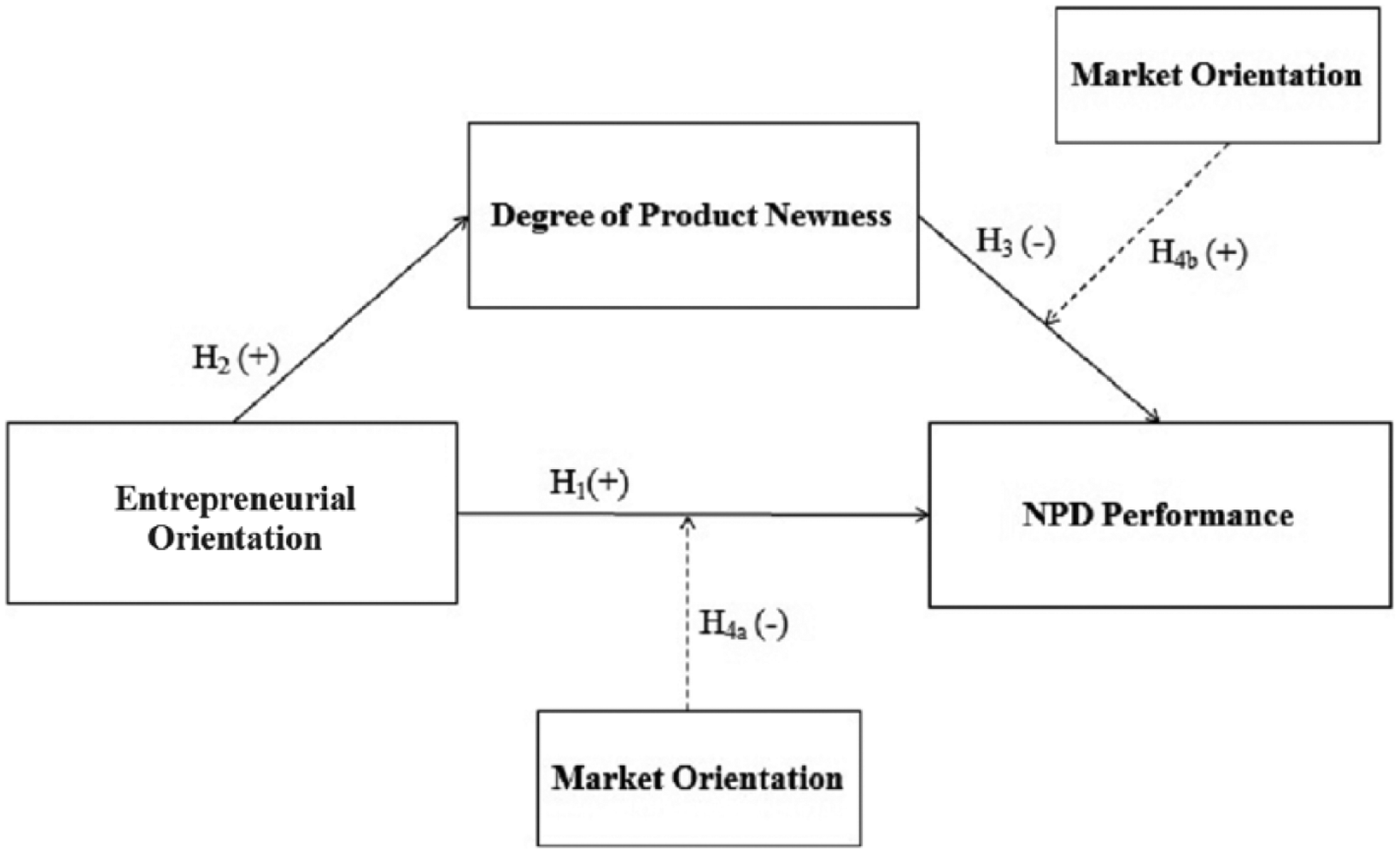
Conceptual framework and hypotheses.
NPD is essential in intense markets, as it contributes to the competitiveness and growth of firms (Acur et al., 2012; Cousins et al., 2011). Due to dynamic business environments, firms must implement changes to speed products through development and improve process efficiency and overall NPD effectiveness (Bstieler, 2011; Sheng et al., 2012). NPD has been shown to enhance external visibility and legitimacy, gain early market presence and increase the likelihood of survival (Chen, 2009; Deeds and Hill, 1996). Additional advantages are that NPD allows for first-mover advantage leading to market pre-emption, a higher reputation within the market and a greater learning experience (Lieberman and Montgomery, 1988; Wiklund and Shepherd, 2003). Past research has shown that in technology-driven industries, NPD has contributed to more than 40 percent of profit (Zirger and Maidique, 1990), compared to 30 percent two decades earlier (Hamilton, 1968), thus indicating that the importance of NPD has grown over time. As such, it provides a firm with a competitive advantage in the marketplace, and may allow long-term growth and financial independence if the firm is able to have high NPD performance.
A key to implementing a successful NPD strategy is through resource deployments such as strategic orientation (Gatignon and Xuereb, 1997; Zhou and Li, 2010; Zhou et al., 2009). EO and MO are two dimensions of strategic orientation that ensure that highly successful new products remain competitive within the marketplace (Miles and Arnold, 1991). EO refers to the processes, practices and decision-making activities that lead to entry into new markets yet to be explored (Lumpkin and Dess, 1996; Rauch et al., 2009; Stam and Elfring, 2008; Wales et al., 2011). It consists of the innovativeness, proactiveness and risk-taking of the firm (Bhuian et al., 2005; Wiklund, 1999; Wiklund and Shepherd, 2003). A firm’s EO is indicative of its internal culture that encourages creativity and allows the firm to introduce and reap the rewards of successful innovations (Madsen et al., 2007; Zahra, 2005). Extant research has shown that firms with an entrepreneurial culture are less likely to be overly bureaucratic, or hampered by technological inertia impeding the implementation of NPD ideas (Chandy and Tellis, 2000). EO has been shown to impact on NPD performance positively (Danneels and Kleinschmidt, 2001; Li et al., 2008a) by developing products that precede the needs of customers, and so changing consumer behaviour (Berthon et al., 1999). Essentially, entrepreneurially oriented firms pre-empt consumer needs by developing innovative new products and shaping the competitive landscape. Extant research has shown primarily positive benefits for the EO–NPD performance relationship; however, Renko et al. (2009) discovered a null effect on an entrepreneurially oriented firm’s ability to create innovative products that are beneficial to the marketplace. Frishammar and Hörte (2007) only found statistical support for the innovativeness dimension of EO affecting NPD performance. Moreover, EO is a resource-intensive (Wiklund and Shepherd, 2011) philosophy: risk-taking endeavors of the firm may suffer, along with the ability to successfully innovate and develop new markets when resources are distributed among alternative activities inside the firm.
Alternatively, MO refers to the implementation of the marketing concept and consists of intelligence generation, intelligence dissemination and organization-wide responsiveness (Jaworski and Kohli, 1993). MO focuses on external idea generation, and delivering products and services valued by customers through monitoring marketing conditions and intelligence gathering (Alpkan et al., 2007). The extant research is mixed on MO’s ability to impact innovation in a positive manner (Berthon et al., 1999). On the plus side, research has shown a positive relationship between MO and NPD performance (Atuahene-Gima, 1995). On the negative side, the meta-analysis conducted by Henard and Szymanski (2001) indicated that MO is not a primary driver of NPD performance; while other research has shown the same results regarding the effect on NPD performance (e.g. Frishammar and Hörte, 2007; Renko et al., 2009). Others still suggest that the MO effect may be contingent on other factors such as market turbulence (Gatignon and Xuereb, 1997), or the presence of an innovative culture internal to the firm (Hurley and Hult, 1998). As such, MO by itself may not be effective unless other variables are present; the level of EO may be one such contingency.
Founded on mixed results from the separate streams of research, the EO–MO interplay may help to explain why some firms succeed and others fail in their NPD efforts. The extant research suggests that collectively, the two orientations complement each other due to the internal culture of EO and the external information-gathering process of MO. The literature has shown the positive benefits of developing new products and their subsequent performance when firms combine internal and external efforts in the NPD process (Atuahene-Gima and Ko, 2001; Boso et al., 2012, 2013; De Jong and Vermeulen, 2006; Mu and Di Benedetto, 2011). Yet, while the two orientations may be complementary in some regards, there are several reasons to suggest that having a combination of the two orientations may harm NPD efforts.
First, due to the competing nature of idea-generation processes, conflicts of information may result and the NPD performance of the firm may suffer. With a high level of information being generated from both internal and external sources, complex and perhaps ambiguous information could result in information overload (Huber and Daft, 1987; Moorman, 1995). If the information is in excess of what is needed or necessary, the time and resources to sort through and utilize it may become problematic. In addition, due to potential overload, firms may not have the necessary ability to gauge the appropriateness of the information that they receive (Chandy et al., 2006). Moreover, consumers do not always know what they want (Cooper, 1993; Covin, 1991; Slater and Narver, 1995).
Second, if other firms are implementing similar processes in terms of generating information from customers and competitors, the resulting ideas will not provide a sustainable competitive advantage for the firm. The idea-generating process utilizing external sources will be limited to an incestuous pool of ideas for firms competing for the same customers. Having too great a customer focus may ensure the loss of leadership positions when firms listen too carefully to their customers (Berthon et al., 1999). This relationship may be the impetus behind recent research, which suggests that being too market-oriented may be detrimental to performance (Cadogan, 2012; Cadogan et al., 2009). As such, if the internal culture of the firm is entrepreneurially oriented, then a high MO may reduce effectiveness on NPD performance. This is not to suggest that firms should disregard scanning and collecting information from the external environment, but that this may compete with the internal culture of the firm, and so negatively impact on the firm’s NPD efforts and subsequent performance.
Third, firms are limited in the resources they possess, but EO is resource-intensive (Wales et al., 2012; Wiklund and Shepherd, 2011). As such, if firms move away from utilizing resources in-house and become more market-oriented, then the proactive and innovative nature of EO, and subsequently NPD performance, will suffer. Research has shown that the success of a firm’s innovative efforts may be tied to its resource base and how it deploys those resources (Sorescu et al., 2003). Since MO is essentially ‘finding out what the customer needs, wants and values and then delivering this as expeditiously and economically as possible’ (Berthon et al., 1999: 39), this may impede the development of breakthrough ideas that require a substantial amount of risk. When firms listen to customers at an engaging level, the risk of the innovations may be minimal because it then adheres to ‘me-too’ NPD efforts (Berthon et al., 1999). Moreover, the available resources spread into MO activities will reduce the research and development (R&D) expenditure required to build breakthrough innovations and subsequent product market development.
However, it should be noted that while we believe that the interplay of EO and MO may constrain firm performance in terms of NPD radicalness, the acceptance of new products developed by firms – no matter how radical – might be greater if the firm has a high MO. If firms are able to develop radical new products that induce a high level of consumer learning, then an MO philosophy may reduce the riskiness of trial by consumers. MO places priority on profitable creation and maintaining superior customer value (Narver and Slater, 1990; Zhou et al., 2005). If a firm develops radical new products but has a high MO, then the market and customer research that was generated, disseminated and implemented could be the driving force behind product newness. In other words, if a firm focuses on having a high MO, it will decrease its risk by providing consumers with the products they seek (Frishammar and Hörte, 2007), by disseminating and responding to market intelligence from consumers (Jaworski and Kohli, 1993). As such, firms with a MO philosophy may be able to mitigate the effects of consumer learning problems and subsequent rejection of radical new products, leading to greater NPD performance.
In this respect, there are reasons to believe that firms should be cautious when implementing both orientations simultaneously, but also to understand that they may benefit in some situations. The next section develops the logic for the relationships between the variables of interest described in Figure 1.
Hypotheses
Entrepreneurial orientation and new product development performance
While a firm that possesses a MO may understand the needs of the market better than the one that does not, those with an entrepreneurial culture may not be impeded by bureaucratic inertia and resistance when seeking approval for new product development ideas (Chandy and Tellis, 2000). Essentially, EO is important to ensure a proactive and aggressive focus on innovative new products that benefit upcoming and unarticulated customer needs (Atuahene-Gima and Ko, 2001; Covin, 1991; Slater and Narver, 1995). Without such focus, innovative new products may be rather limited and new markets may develop more slowly.
Innovativeness refers to a firm’s inclination to engage in and support new ideas, creative processes and experimentation that may result in new products, services or technological processes (Lumpkin and Dess, 1996; Wiklund and Shepherd, 2005). Innovativeness can pertain either to technology which can help the development of advanced manufacturing processes (Lumpkin and Dess, 1996) or, to product–market innovativeness (Miller, 1987). Firms need to nurture and sustain their EO by actively participating in developing and forming a continuous flow of innovative ideas (Husted and Vintergaard, 2004; Madsen et al., 2007). Internal idea generation may be a key to developing new products because often, customers do not know exactly what they want or cannot ascertain their future needs (Atuahene-Gima and Ko, 2001). An innovative culture allows the firm to cultivate new ideas and depart from existing practices which, in turn, can be meaningful to NPD performance (Frishammar and Hörte, 2007; Lumpkin and Dess, 1996). Moreover, it helps firms to satisfy the needs and preferences of consumers while avoiding competing in markets where competitors have greater strengths (Boso et al., 2012). Prior research has shown that the absence of innovativeness is a partial explanation for new product failure (Cooper, 1993) – a fact that further underscores its importance.
The EO dimension ‘risk-taking’ refers to a willingness to take bold action by venturing into the unknown, and to make large and uncertain resource commitments that may be costly in terms of failure (Miller and Friesen, 1978; Rauch et al., 2009). Firms must commit resources continually to R&D when opportunities are present, without knowing the outcome (Frishammar and Hörte, 2007). For example, a low-risk project would be for the firm to increase production to meet an out-of-stock problem at a retailer, whereas a high degree of risk would be launching a new product in a new market (Frishammar and Hörte, 2007). In order to launch an extension of a product line or develop a new product for commercialization, the firm must take on the associated risk; if they do not, new extensions or products will not be created, therefore leading to stagnant sales within highly competitive environments.
Finally, the EO dimension ‘proactiveness’ refers to being involved in forward-looking, first-mover, advantage-seeking efforts to shape the environment, in order to beat competitors in introducing new products, services or technologies to the market (Lyon et al., 2000; Zahra and Covin, 1995). It refers to how a firm relates to market opportunities in the process of new entry, whereas competitive aggressiveness refers to responses to trends and market demand that already exist (Lumpkin and Dess, 1996). Proactive firms can be considered first-movers within markets if they are implementing their innovative capabilities: they remain ahead of the competition in developing new ideas and launching new products (Luo et al., 2005; Wiklund and Shepherd, 2003). The first-mover advantage demonstrates that firms are able to extract high profits and have high-speed NPD (Frishammar and Hörte, 2007; Lumpkin and Dess, 1996; Lyon et al., 2000). An additional advantage of proactiveness is the establishment of brand recognition, generating brand loyalty to the first to develop the market (Lumpkin and Dess, 1996).
Each dimension of EO has its own unique benefits that may provide the firm with capabilities to enhance NPD performance. The ability to take risks, be more innovative and initiate change sets firms apart from low-EO firms (Zhou et al., 2005) in terms of NPD performance. Proactiveness toward new opportunities enables the creation of products ahead of competitors, and in advance of consumer wants and needs (Zhou et al., 2005). Although a firm may be innovative and proactive, it still needs to take on the associated risk in order to take advantage of opportunities in the marketplace. Thus, the EO of a firm allows it to capitalize on emerging opportunities, and subsequently is an important driver of new products and organizational growth (Bhuian et al., 2005; Grinstein, 2008; Luo et al., 2005). Moreover, high-EO firms are able to target premium market segments, charge higher prices, dominate distribution channels and establish innovative products as the industry standard (Zahra and Covin, 1995). This leads to the first hypothesis: H1: Entrepreneurial orientation is positively related to NPD performance.
Entrepreneurial orientation and degree of product newness
Due to EO firms seeking breakthrough innovations to develop new markets, a high EO may have a positive effect on the degree of product newness – ‘the extent to which the new product is compatible with the experiences and consumption patterns of potential customers’ (Atuahene-Gima, 1995: 278) – as successful innovations manifest when organizations direct resources toward filling the gap between what the market needs, and what is currently offered (Slater and Narver, 1995). Atuahene-Gima and Ko (2001) suggest that an EO is a philosophy to which firms engage in aggressive initiatives, in order to alter the competitive landscape in their favor. Reflecting Chandy and Tellis (2000), firms low on EO are suppressed by bureaucratic inertia, maintain the status quo and have limited new product development. Firms with high EO have a strong focus on major innovations for which a market may not currently exist, and so must be created for product diffusion to occur and success to ensue. Without such risks, grand innovations may not take place. As such, risk-taking, innovative and proactive behaviors allow the development of a higher degree of product newness. This leads to the second hypothesis: H2: Entrepreneurial orientation is positively related to the degree of product newness.
Degree of product newness and new product development performance
Although a firm may possess a high degree of EO, the degree of product newness may affect NPD performance adversely. In this sense, EO may allow the firm to develop products from an incremental (i.e. minor changes in technology) or radical (i.e. new products utilizing new technologies) consumer perspective, depending on the place on the EO continuum that the firm occupies. Firms may have a high EO but may wish to hedge the marketplace with a safer, more incremental portfolio of new products. This may enhance new product adoption due to a lower degree of consumer learning (Lawton and Parasuraman, 1980; Sheng et al., 2012). Conversely, firms may wish to develop radically new products in order to commercialize and enter new markets thus, leading to a higher degree of behavioral change or learning effort by consumers (Atuahene-Gima, 1995; Lawton and Parasuraman, 1980). Consumers may be unaware of the utility they may receive, which subsequently may lead to resistance, as they avoid the behavioral changes associated with learning effort and attaining potential benefits (Alexander et al., 2008; Hoeffler, 2003).
If a firm becomes too radical in its innovations, the products may not realize success at the time of commercialization; as such, consumers in existing markets may associate radicalness to riskiness of trial that subsequently affects adoption (Gatignon and Robertson, 1985; Gatignon and Xuereb, 1997). When the costs of purchase, trial and overcoming information asymmetry outweigh current usage of products, then the consumer may forgo the purchase and stick to familiarity (Alexander et al., 2008). In addition, a product launch for new markets may not be compatible, as inexperience within the market may provide further challenges to the firm. As such, firms may need to focus on incremental performance in terms of NPD, in order to reduce the level of risk associated with product launches in new markets. This leads to the third hypothesis: H3: Degree of product newness is negatively related to NPD performance.
Entrepreneurial orientation and market orientation interplay
A market orientation may provide benefits to the firm in some situations, when in conjunction with EO, but it also may hurt the firm in other regards. If the focus on MO is widely accepted within a firm’s industry, it could lead to a plethora of substitution possibilities due to competitors implementing the same philosophy (Frishammar and Hörte, 2007). According to Bennett and Cooper (1979), highly successful product innovations are usually the result of a technology push strategy by the firm; they argue that in order to create a truly innovative product, firms must rely on scientific discovery, rather than having customers describe what they want or need. A firm that possesses an MO philosophy may be too reliant on gathering information for new product ideas from consumers, which leads to more imitative rather than innovative products (Lawton and Parasuraman, 1980). It is believed that the primary reason that firms lose industry leadership positions is that they pay too much attention to customers, which impedes the possible strategies that they might pursue (Chandy and Tellis, 2000; Christensen and Bower, 1996). Firms that use MO as a driver of NPD may find less success in the marketplace, since they are reducing emphasis on R&D and product innovation and focusing on more short-sighted profitability (Day and Wensley, 1983). Firms with an MO philosophy may be more risk-averse due to consumers being unable to articulate their needs (Narver and Slater, 1990), and being competitor oriented (Kohli and Jaworski, 1990), which leads to imitation strategies and incremental innovations. If a firm is focused on MO and allows the consumer drive product development, then the positive effect of a firm’s EO on NPD performance will be less pronounced.
Prior research has explored MO effects on NPD performance (e.g. Atuahene-Gima and Ko, 2001; Zhou et al., 2005), yet the meta-analysis conducted by Henard and Szymanski (2001) indicates that MO effects on NPD performance cannot be generalized across research studies. Moreover, Hurley and Hult (1998) and Han et al. (1998) show that by itself, MO may not be sufficient to enhance NPD efforts and firm performance. The present study suggests that when firms become entrenched in the product–market in which they operate, they suffer from innovation resistance (Chandy and Tellis, 1998, 2000) and technological inertia (Ghemawat, 1991) due to losing focus on breakthrough innovations that may develop new markets, lead to competitive advantage and enhance NPD performance. Radical innovations are costly to develop, and firms must tolerate the risk associated with them. As such, if signs from the market or consumers are not visible, the market-oriented firm may steer clear from these types of innovations and associated risks. This leads to the fourth hypothesis: H4a: Market orientation negatively affects the relationship between entrepreneurial orientation and NPD performance.
While MO may be harmful in terms of new product development and its subsequent performance, it may work positively in conjunction with EO in other regards. MO may lead to a competitive advantage by assessing the needs of consumers and implementing a strategy to fulfill those needs. MO places priority on profitable creation and maintaining superior customer value (Narver and Slater, 1990; Zhou et al., 2005). If a firm develops radical new products but has a high MO, then the market and customer research that was generated, disseminated and implemented could be the driving force behind product newness. In other words, if a firm focuses on having a high MO, it will decrease its risk by providing consumers with the products that they seek (Boso et al., 2013; Frishammar and Hörte, 2007) by disseminating and responding to market intelligence from consumers (Jaworski and Kohli, 1993).
High MO firms that focus on developing radical new products may benefit the most by reducing the degree of learning required by consumers. As aforementioned, if innovations are too radical, NPD performance may not be realized when the product is commercialized and brought to market. Consumers may find radical products risky, which may adversely affect their adoption rate (Gatignon and Robertson, 1985; Gatignon and Xuereb, 1997). As mentioned previously, firms operating a MO philosophy may be able to mitigate the effects of consumer learning problems and rejection of radical new products, leading to greater NPD performance. Although adoption rates still could be limited by the degree of product newness, the diffusion of radical product innovations may be more prevalent with the high MO firms, thus increasing NPD performance. Furthermore, by reducing the degree of learning and perceived risk, the innovative new product may play a primary role in terms of firm performance, survival and market presence (Atuahene-Gima and Ko, 2001). This leads to the final hypothesis: H4b: Market orientation positively affects the relationship between the degree of product newness and NPD performance.
Method
Data collection
The data for this study were obtained from 224 Swedish mid-sized manufacturing firms and collected via a mail survey over a total period of four months. The questionnaire was pilot-tested first with five executives and five academicians, due to the questionnaire first being developed in English, then subsequently translated into Swedish (see Brislin, 1976; Richins and Verhage, 1987; Sechrest et al., 1972).
The data were collected from the Affärsdata database for an initial sample of 848 firms, which was the universe of Swedish mid-sized manufacturing firms with 50–250 employees. A random sample of 400 firms was taken from the frame due to time and financial constraints. The average firm had 98 employees and annual sales of approximately €20m; the sample spans across several industries representing 210 SIC codes. Twelve of the firms were dropped due to being subcontractors, lacking their own product development or exiting the market through bankruptcy. A total of 224 completed questionnaires were received (a response rate of 57.7 percent). The questionnaires were completed by CEOs (93%) and R&D or financial managers (7%) (see Appendix). After reviewing the dataset, there were a total of 18 questionnaires that did not have all of the questions completed; these were deleted from the sampling frame. The final sample used for the study was 206 manufacturing firms.
Measures
New product development performance. The dependent variable for this study is NPD performance: the extent to which management perceives new products to meet their market share, sales and customer use, sales growth and profit objectives (Atuahene-Gima and Ko, 2001; Frishammar and Hörte, 2007; Gatignon and Xuereb, 1997). This was measured using four items on a seven-point scale (ranging from 1 = ‘strongly disagree’ to 7 = ‘strongly agree’). The items were measured at the firm level instead of the business unit level. This is acceptable for three reasons:
the firms in the study are mid-sized firms, and it is believed that NPD performance among different units should not exist due to the relevant size;
smaller firms undertake fewer NPD projects than large ones, so there is a higher likelihood of less variation; and
an NPD project conducted by a business unit may not be representative of the firm as a whole – all of the items for NPD performance loaded onto its corresponding latent variable.
Entrepreneurial orientation. EO was measured based on three different sets of questions pertaining to innovativeness, risk taking and proactiveness (see Appendix). The scale was grounded in the work of Covin and Slevin (1989), who borrowed from Miller (1983). Previous use of this scale in EO research has had satisfactory results (e.g. Atuahene-Gima and Ko, 2001; Covin and Slevin, 1989; Frishammar and Hörte, 2007). Each dimension of EO had three items, although one item was dropped from proactiveness due to reliability concerns (α<.70). Consistent with the extant literature, EO was examined as being unidimensional, due to the high intercorrelations between the measures (e.g. Covin and Slevin, 1989; Rauch et al., 2009).
Degree of product newness. This can be seen as the degree of incremental versus radical innovation. The scale for this variable was adopted from Atuahene-Gima and Ko (2001), but used for the firm level instead of the product level for which it was originally developed, as suggested by Frishammar and Hörte (2007). That is, the modified scale for measuring product newness to customers was employed to fit the firm level. The degree of product newness to customers scale had a total of six items (from 1 = ‘strongly disagree’ to 7 = ‘strongly agree’).
Market orientation. This scale was adopted from Deshpande and Farley’s (1998) meta-analysis, which was developed by integrating and validating three previously used scales of marketing orientation: Kohli et al.’s (1993) MARKOR scale, Narver and Slater’s (1990) scale and additional items added by Deshpande and Farley (1998). Previous tests of the integrated scale show that it possesses a universal characteristic, and should be valid in different research settings (Deshpande and Farley, 1998).
Analysis
This research involves studying associations among latent and directly observed constructs: a structural equation modeling technique was utilized that allowed for estimation of both the measurement and structural models simultaneously in order to test the hypotheses. The major benefit of SEM with respect to this research is the ability to incorporate confirmatory factor analysis (CFA) with path analysis. As a result, an overall good fit of the model to the data was obtained.
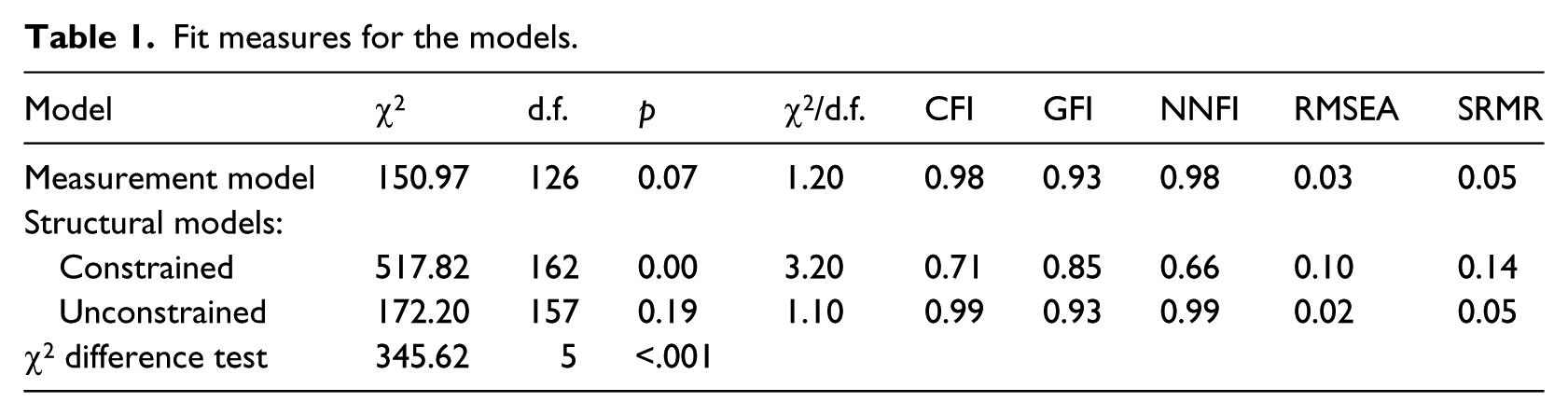
Measurement model. The CFA showed a good fit to the data (χ2 = 150.974, χ2/d.f. = 1.197, p = 0.065). Even though the model is insignificant, the additional fit indices were examined to demonstrate goodness of fit (CFI = 0.979, RMSEA = 0.031). The detailed summary of model fit statistics is presented in the Table 1.
Fit measures for the models.
Since the hypotheses involve moderation effects, multiplicative interaction terms were constructed for the variables of interest. Single scores were calculated for EO, MO and degree of product newness by averaging the items associated with each of the constructs (e.g. four measures of MO, seven of EO and three for degree of product newness). Finally, the average scores were orthogonized in order to avoid any issues with multicollinearity. In order to test the moderation hypotheses, multiplicative interactions were created by multiplying the average scores of EO with MO, and MO with degree of product newness.
The discriminant validity of the measurement model was assessed by comparing the square root of average variance extracted (AVE) scores, shown in the diagonal of Table 2, to the off-diagonal numbers: the diagonal values are much greater than the off-diagonal values, showing support for discriminant validity. Composite reliability scores are greater than 0.755 and show significant factor loadings (p<0.001).
Construct descriptive statistics.
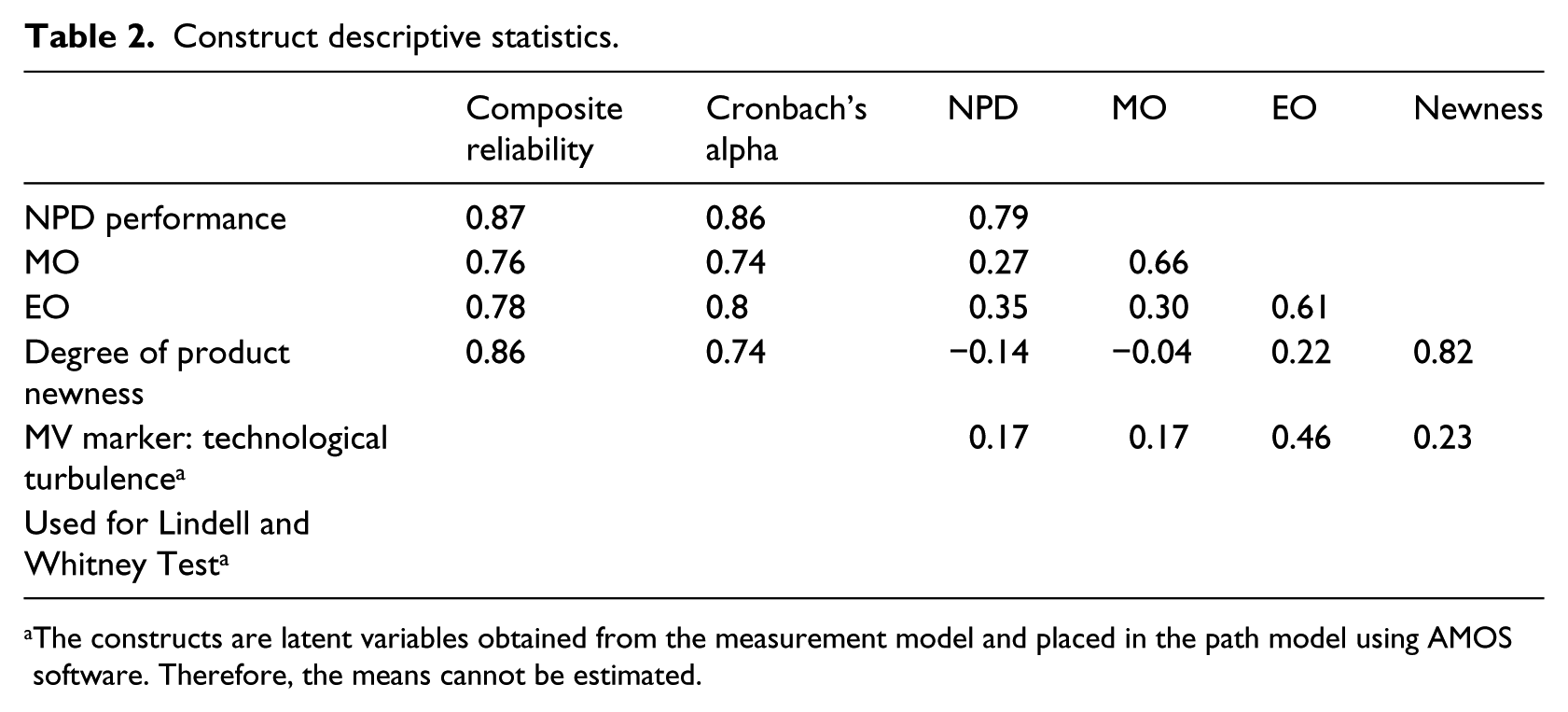
The constructs are latent variables obtained from the measurement model and placed in the path model using AMOS software. Therefore, the means cannot be estimated.
Since all data came from the same questionnaires, three analyses were conducted to estimate the impact of common method bias: common latent factor, Harmon One-Factor and Lindell and Whitney Test. The common latent factor method identified insignificant estimates (β = 0.277, p = 0.128), indicating an insignificant common method bias of 7.6 percent of variance. The Harmon One-Factor method showed that 28.49 percent of overall variance is explained by a single factor. Since there is no single rule of thumb for these tests, it was concluded that common method bias was low and the model trustworthy, since the numbers indicated by both tests are less than 0.5 (Podsakoff et al., 2003). Finally, the correlation marker technique was utilized, as suggested by Lindell and Whitney (2001). The analysis suggests that there was no need for correction due to the low probability of common method variance (the results of the Lindell and Whitney test are reported in Table 2). In sum, all three methodologies for estimating common method bias provided congruent results identifying no significant impact of common method bias on the measures.
Results
Structural model estimation. The hypotheses were tested using structural equation modeling in AMOS 21.0. First, a χ2 difference test was conducted to assess the significance of the model. The constrained model was compared to the unconstrained model. The summary statistics presented in Table 1 clearly indicate superiority of the unconstrained model. Therefore, the unconstrained model was utilized to test the hypotheses. An excellent fit to the data was obtained (χ2 = 172.203, d.f. = 157, p = 0.192, χ2/d.f. = 1.097, CFI = 0.926, GFI = 0.987, NNFI = 0.985, RMSEA = 0.022, SRMR = 0.0468).
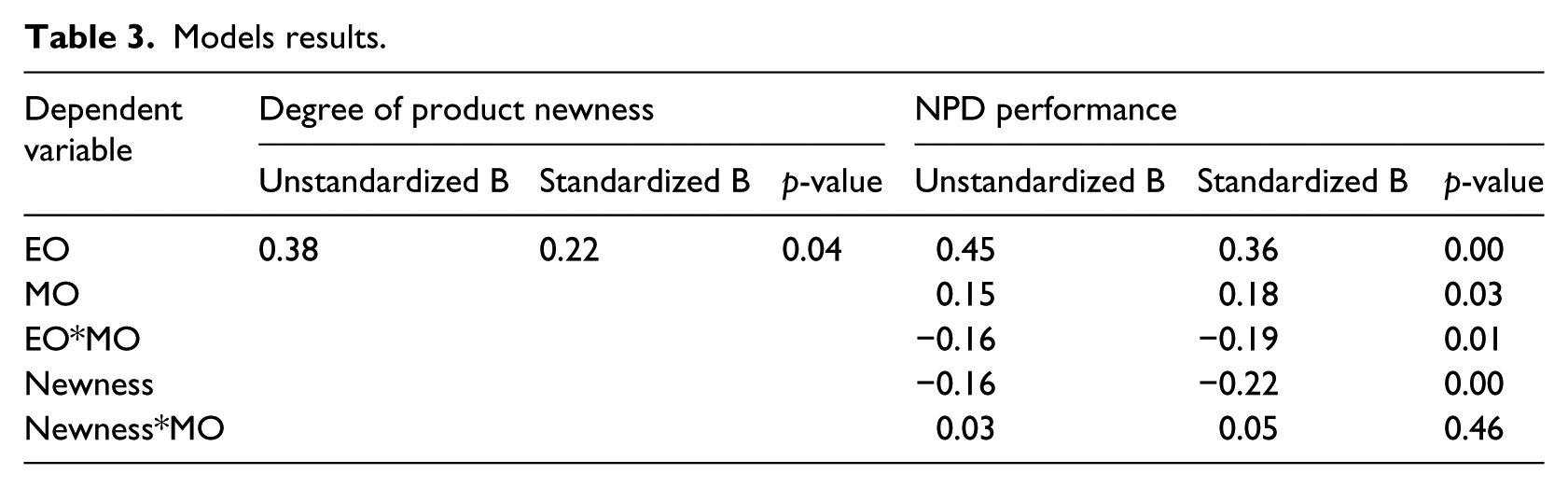
H1 predicted a positive relationship between the EO of the firm and NPD performance. The model showed a positive regression coefficient (β = 0.45, p<0.01), indicating that EO is a significant predictor of NPD performance, thus providing support for H1. The analysis showed that EO is also a significant predictor of degree of product newness (β = 0.38, p<0.05), supporting H2. H3 predicted a negative relationship between degree of product newness and NPD performance, and the model provides support for the relationship and directionality (β = −0.16, p<0.01), thus providing support for H3. H4a claims that MO negatively moderates the relationship between EO and NPD performance. The coefficient of the multiplicative term, β = -0.16 (p<0.01), provides support for H4a. H4b was not supported, since the coefficient of the multiplicative term of MO and degree of product newness is insignificant (β = 0.03, p<0.464). The models summary can be seen in Table 3.
Models results.
Robustness check. To ensure the robustness of the results, alternative models also were considered for analyzing the interaction effects of EO and MO. First, several steps were utilized to indicate the appropriateness of the study’s usage of dimensionality of construct. Following previous research, which suggests the appropriateness of one latent factor for EO (e.g. Rauch et al., 2009), the EO items did load onto one factor, except for the aforementioned proactiveness item (loadings >.5 and α = .799). The study then examined each dimension of EO separately, and all items (except for one proactiveness item) loaded onto their corresponding EO dimension. The factor scores of the three dimensions were predicted, and then subsequently tested in a second-step factor analysis: all three dimensions loaded onto one factor (loadings >.75). This factor was then tested for correlation significance with the originating single dimension EO factor. The correlation proved to be positive and significant (r = .993, p<.001), thus confirming the use of the single EO dimension constructed from the three individual dimensions.
The study then conducted a multi-group analysis between high- and low-MO groups utilizing a mean split. After items were removed due to reliability concerns, 1 MO was dichotomized using a mean split in order to test for moderation in the second model (mean value for the remaining MO items was 3.818). A value below 3.818 would indicate that the company has a low MO, whereas a value above 3.818 would indicate a high MO. Based on the split, the sample of firms in the low MO condition is 110 (M = 3.33). The sample in the high MO condition is 96 (M = 4.38). Similar results were obtained, as per the previous analysis. Based on the analysis described above, it is possible to conclude that EO and MO are competing orientations because:
the path coefficient of EO to NPD performance for the high-MO group is significantly lower than for the low-MO group;
the interaction term between EO and MO has a negative and significant effect on NPD performance; and
after including MO in the structural equation modeling models, the direct effects of EO on NPD performance diminish, while the indirect effects become insignificant. We clearly observe that the impact and significance of EO goes down as MO increases.
Discussion
This article aimed to explore the interrelation between EO and MO, and the contrasts in a firm’s strategic orientation. To our knowledge, prior literature advocates the complementary nature of the effects of EO and MO (e.g. Atuahene-Gima and Ko, 2001; Boso et al., 2013; Li et al., 2008b), thus implying that they strengthen each other to build synergy and establish a competitive advantage in the marketplace. The goal of our study was twofold: to examine the dark side of the EO–MO interplay; and to introduce the degree of consumer learning into the EO–MO research stream. While there may be complementarities to the two underlying philosophies of the strategic orientations, the extant research has not examined the downside to implementing the two orientations simultaneously. The results of this study confirm that EO is positively associated with NPD performance and degree of product newness. However, it also demonstrates that companies should be wary of developing products that are too radical, as this has a significant negative effect on the performance of NPD. A high degree of product newness may limit the performance of new products due to the riskiness of trial, where consumers will forgo trial and adoption.
In explicating the dark side of the EO–MO interplay, and in contrast to the existing literature, the study found that MO damages a firm’s efforts on NPD performance, indicating competing dimensions on strategic orientation. When firms have an EO philosophy they must be aware of the potential impact of MO, which can decrease NPD performance when implemented simultaneously with EO philosophy. Organizational and technological inertias may decrease the EO effect on NPD performance when a firm has a high MO philosophy and allows consumers to dictate the products being developed, rather than being innovative and taking risks proactively. Although the study did not find support for its hypothesized relationship of MO helping the degree of learning for consumers, firms may want to consider how to reduce the negative impact of creating radical new products that may induce a risk of trial perception by consumers. While the final hypothesis (H4b) was not supported, future research should explore the notion of MO moderating such relationships and other interactions of strategic orientations. Research has shown that MO may be a help or hindrance to firms that implement the strategy (e.g. Gatignon and Xuereb, 1997), but further studies may benefit from investigating the relationship between MO and NPD performance.
Managers need to be concerned with the impact of implementing different dimensions of a firm’s strategic orientation simultaneously. As they seek to gain competitive advantage in terms of NPD performance and commercializing new innovations, they need to understand the differing impacts of each orientation that the firm may implement. The underlying philosophies of each orientation may be competing in some regards, while being complementary in others. The results of this study have provided only statistical support for the dark side of the EO–MO interplay, but past research has shown that they can be complementary (e.g. Atuahene-Gima and Ko, 2001; Boso et al., 2012, 2013). While each orientation may have its own unique benefits and may contribute to NPD and overall firm performance, managers may be better served to understand how each orientation may serve the firm’s goals to develop more innovative products. Firms can benefit by being proactive and risky while developing innovative new products, but as emphasised in this article, managers need to understand that too much radicalness may deter consumers from adopting such products. Managers that implement an MO philosophy can help the firm understand the wants and needs of the market to enhance product diffusion, but if the goal of the firm is to develop radical new products, then it should limit the resources committed to MO activities. As such, managers should not allow MO to be the impetus or driving force behind radical NPD efforts.
Conclusion
This article has sought to contribute to the EO–MO interplay literature in two important ways. First, although previous research has suggested primarily positive outcomes when the two orientations are implemented simultaneously, this study has identified that there is a dark side to the EO–MO interplay. The extant research on both EO and MO have had mixed results on each orientation’s ability to impact NPD performance positively (e.g. Frishammar and Hörte, 2007; Hurley and Hult, 1998; Renko et al., 2009). Founded on the mixed results from the separate streams of literature, the EO–MO interplay may help explain why some firms are successful, whereas others are not in terms of NPD performance. Although the two orientations may be complementary in some regards, the underlying characteristics of the orientations may be a cause for concern. Due to the conflicting idea-generating processes of EO and MO, firms may suffer from information overload and have a difficult time sorting through this conflicting information. This may hamper a firm’s ability to deem effectively the appropriateness of such information, from which NPD performance may suffer. Moreover, competitors may implement simultaneously the external idea-generating processes of MO; as such, firms will suffer from an inability to build a sustainable competitive advantage when it comes to their NPD efforts. Another potential cause for concern is that EO demands considerable resources (Wiklund and Shepherd, 2011). If the resource deployments of firms are directed into alternative strategic activities (e.g. market orientation philosophy), the impact of EO on NPD performance will suffer. Firms will be less able to develop new products and markets that require a substantial amount of risk.
Second, this study has introduced consumer learning to the EO–MO interplay research stream. Although it has identified important negative aspects of implementing both orientations simultaneously, it theoretically identified that an EO–MO philosophy may be beneficial in terms of the adoption rate of radical new products. While this study did not find empirical support for the final hypothesis, there is reason to believe that EO firms may still benefit in some regard when simultaneously implementing an MO philosophy. The results suggest that consumer learning of radical new products adversely impacts the NPD performance of firms in this study. Firms that implement an EO philosophy need to seek ways to address consumer learning issues and the adoption rate of new products, so as to enhance NPD performance further.
Limitations of the study and directions for future research
Substantively, future research is warranted to explore the dark side of the EO–MO interplay as well as the combinatory effects of strategic orientations that firms may pursue simultaneously. In addition, further research is needed on the processes by which strategic orientations and outcome variables are mediated. Furthermore, because both EO and MO are philosophical natures of the firm in which organizational learning occurs, how do the resource base and overall goals of the firm affect what types of philosophy the firm adopts? In terms of degree of product newness, it may provide the firm with novelty effects and greater differentiation benefits; this may enable firms to benefit from price premiums and accelerated sales volume. Future research should explore these effects. 2 Finally, the majority of research examines supply-side factors when examining the interplay of strategic orientations. This study has introduced a demand-side factor (i.e. consumer learning), but more research is warranted in this regard. Switching costs, network externalities and preference stability are all areas to which researchers can bring further understanding, regarding how the underlying orientation of the firm combined with demand-side factors can enhance NPD efforts and firm performance.
Although the study found support for all but one of the hypotheses, the results need to be interpreted in light of limitations. The sample for this study consisted of mid-sized manufacturing firms, which may have influenced the results. The measures for the variables may be slightly skewed to the right, given the firm’s propensity to enhance its favorability. Parts of the questionnaire, such as degree of product newness, would be better answered by the customer rather than the firm, since the implications for the firm lie within consumer perceptions and learning. Customer perceptions in regard to this variable would seem to matter more than what the firm is providing to the marketplace. While a firm may not perceive a radical degree of change in product newness, the customer may feel that what is offered by the firm is in fact a radical change. Another possible limitation is that NPD performance is perceptual rather than empirical: NPD performance is the extent to which new products are perceived to meet their market share, sales and customer use, sales growth and profit objectives. Future research should explore the notion of measuring these variables directly, rather than using a perceptual measure by the firm.
Footnotes
Appendix: Operational measures 3
Entrepreneurial orientation (adopted from Covin and Slevin, 1989).
Funding
This research received no specific grant from any funding agency in the public, commercial, or not-for-profit sectors.