




Abstract
This article explores effectual processes within home-based, online businesses. Our empirical evidence provides a number of refinements to the concept of effectuation in this specific domain. First, the ubiquity of non-proprietary online trading platforms encourages the adoption of effectual approaches and removes the importance of forming proprietary strategic alliances and pre-commitments. Second, the notion of affordable loss – a central tenet of effectuation – should be extended beyond the notion of economic to social affordable loss, including loss of status and reputation, and finally, home-based online businesses allow effectuation to be associated with low levels of entrepreneurial self-efficacy and experience.
Introduction
Businesses operated in the home, or from the home, of the founding entrepreneur represent a significant and growing proportion of firms; in the United Kingdom, for example, they represent between 50% and 70% of the business population (Mason et al., 2011; UK Government Department for Business, Innovation and Skills, 2012). Despite their prevalence and growth, however, home-based businesses have been afforded relatively little research attention when compared to other forms of business ownership and operation (Felstead and Jewson, 2000; Mason, 2009/2010; Vorley and Rodgers, 2012).
In this article, we draw upon Salazar’s (2001) definition of home-based business entrepreneurs as those who are both self-employed and self-managed; this helpfully distinguishes between those who work from home but are employed (e.g. teleworking) and self-employment without self-management (e.g. contracting). Axiomatically, home-based entrepreneurs are a heterogeneous group (Felstead et al., 2001) but increasingly across the sector, it is notable that the Internet has become far more influential with many home-based businesses now deriving the majority of revenues from selling goods and services online (Betts and Huzey, 2009). Such online businesses, which form the focus of this study, are the fastest growing type of home-based business (Chalmers, 2008; Gelderen et al., 2008).
There are many approaches to theorising entrepreneurial activity; existing theories offer various conceptual lenses through which to explore home-based online businesses (Fisher, 2012). Much of the extant research on entrepreneurial approaches assumes that ‘the task of the entrepreneur is to discover opportunities and exploit them’ (Read et al., 2009: 573). In contrast, theories such as effectuation (Sarasvathy, 2001) and bricolage (Baker and Nelson, 2005; Baker et al., 2003; Senyard et al., 2009, 2013) suggest that the entrepreneurial role creates opportunities through experimentation and exploiting available or obtainable means. In this article, we develop arguments to demonstrate that effectuation is an apposite theoretical lens to contribute to contemporary analyses, and understanding, of home-based online entrepreneurship.
Aims of research and contribution
The aims of the article are: first, to extend knowledge in the home-based business domain by exploring whether and how effectual processes manifest in home-based online businesses, and second, to contribute to the development of the literature on effectuation by demonstrating how this is evident in the context of online home-based businesses.
The first aim seeks to address the limited research on home-based businesses. Recognising that such businesses are highly heterogeneous (Mason et al., 2011), we focus on one specific context: home-based online businesses. This approach is consistent with Shaker et al.’s (2014) assertion that the explicit recognition and study of context is important for the advancement of entrepreneurship research. Relating to the second aim, Whetten (1989) observes that contextual studies are required to develop theory since these ‘set the boundaries of generalizability and as such constitute the range of the theory’ (p.492). However, he observes that studies exploring the boundaries of theory should also seek to provide explanations of such rather than simply, ‘point out limitations in current conceptions’ (p.493). This study finds three novel boundary conditions to effectuation in the context studied and develops associated explanations. Previous research suggests effectuation is associated with the formation of strategic alliances and pre-commitments (Chandler et al., 2011; Perry et al., 2012; Sarasvathy, 2001), that it is concerned with low economic affordable loss (Sarasvathy, 2001, 2004) and is associated with high levels of self-perceived entrepreneurial self-efficacy (Goel and Karri, 2006; Perry et al., 2012). In contrast, in the context of home-based online businesses, we find the following: first, the ubiquity of non-proprietary online trading platforms encourages adoption of effectual approaches, removing the importance of forming proprietary strategic alliances and pre-commitments; second, the notion of affordable loss should be extended beyond the notion of economic affordable loss to include loss of status and reputation; and third, home-based online businesses allow effectuation to be associated with low levels of entrepreneurial self-efficacy and experience.
In the following sections, we review the literature addressing home-based, online businesses, contrast entrepreneurial theories relevant to micro-business formation and justify our adoption of effectuation as an appropriate theoretical lens. Our inductive methodology, based on interviews with key participants (Kumar et al., 1993) and our data analysis methods are then presented. Our empirical findings follow, framed both by the four heuristic principles of effectuation and the themes that emerged from reflexive consideration of our data. We then discuss our findings, present our conclusions, note implications for theory and practice and identify opportunities for further research.
Home-based online businesses
Characterisation of home-based online businesses
While studies of home-based businesses remain relatively scarce in comparison to those of other types of firms, an increasing body of literature has emerged over recent years. A growing subset of this literature focuses on online home-based businesses (e.g. Clark and Douglas, 2009/2010; Kim et al., 2002; Laegran, 2008; Sulaiman et al., 2009, 2010). Gelderen et al. (2008) developed the acronym SMILES to describe the characteristics of home-based online businesses: Speed, Multiple-income, Inexpensive, LEan, and Smart. ‘Speed’ describes such businesses as being formed quickly and operating in short rapid cycles. ‘Multiple-income’ describes how some online home-based businesses owners are involved in more than one form of income generation. While such multiple-income streams could mean that the entrepreneurs are not serious about their online ventures, Gelderen et al. (2008) consider these other income sources as allowing the entrepreneur to pursue their ventures ‘without the pressures of immediate financial reward’ (p.166), which fosters trial-and-error learning and experimentation. ‘Inexpensive’ describes the low cost to establish and operate such businesses, a common feature of most home-based business types (Phillips, 2002). In the case of the purchase of information technology (IT) equipment, software and web-hosting, these costs have continued to decrease, while functionality has improved and services have increased (Pflugheoft et al., 2003; Yang, 2012). Such businesses are considered ‘LEan’ due to their being small and virtual. This is often enabled by the significant use of subcontracting and networking with other small or home-based businesses (Clark and Douglas, 2011), resulting in the growth of such businesses being associated with jobless growth (Mason et al., 2011). Finally, the authors characterise online home-based businesses as ‘Smart’ in terms of finding creative ways of achieving their objectives.
Operationalisation of home-based online businesses
Within this article, Salazar’s (2001) classification of home-working is utilised to define self-employed, self-managed home-workers (see Table 1). This distinguishes such entrepreneurs from those working from home, employed by non-home-based businesses (Jaakson and Kallaste, 2010; Martin and MacDonnell, 2012; Maruyama and Tietze, 2012; Pérez et al., 2002). We also differentiate between businesses operated from home and those operated in the home (Mason et al., 2011; Walker and Webster, 2004). Those operating mainly online (i.e. deriving the majority of revenue from online activities) are then differentiated from those such as childcare and hospitality (Di Domenico, 2008; Duberley and Carrigan, 2013; Vorley and Rodgers, 2012).
Online home-based business classification and operationalisation.
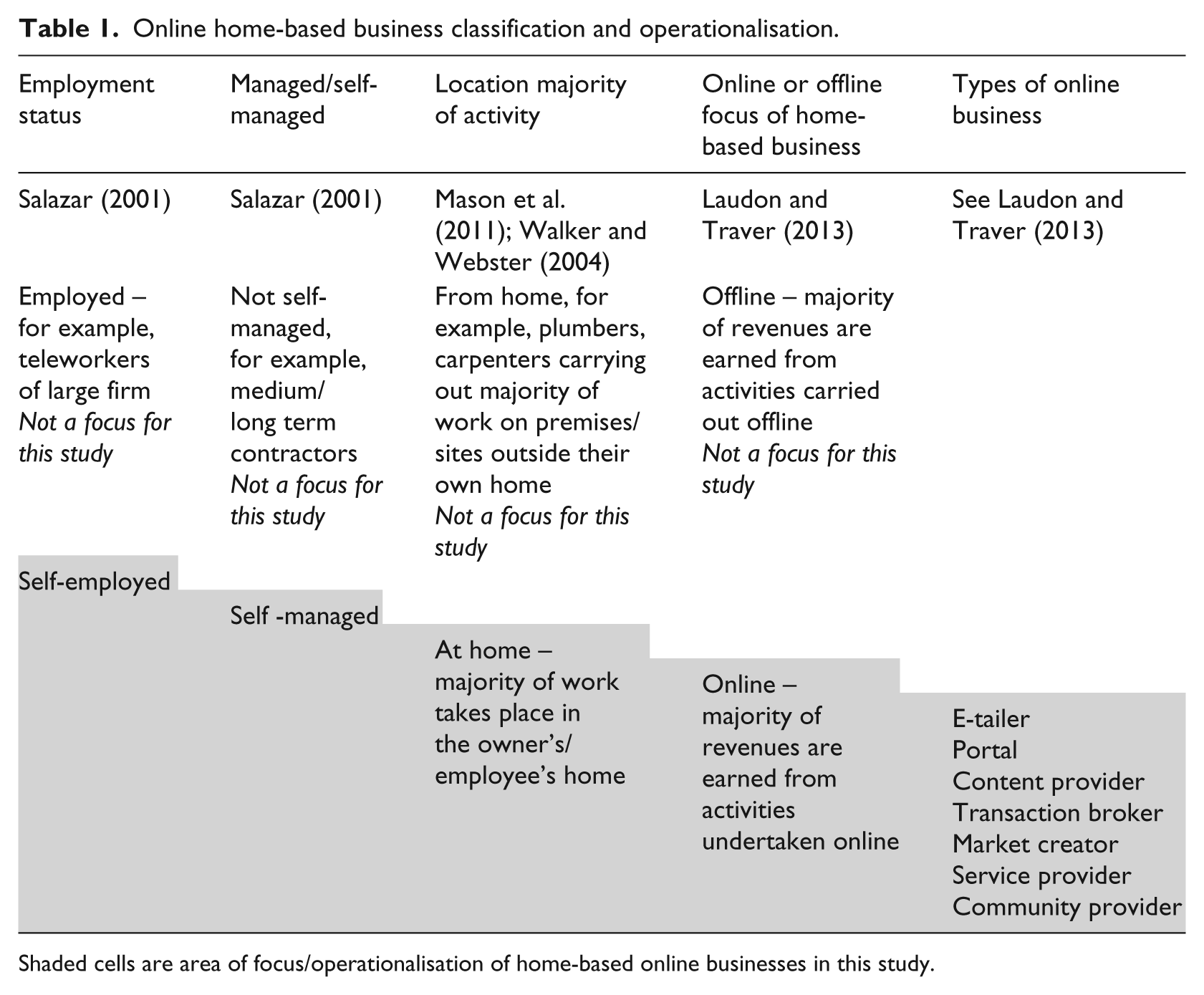
Shaded cells are area of focus/operationalisation of home-based online businesses in this study.
As the extant studies of home-based online businesses do not address different types of online businesses, we explored taxonomies developed in the broader online or e-business literature (e.g. Rappa, 2013; Tapscott et al., 2000; Timmers, 1998; Weill and Vitale, 2001), before adopting Laudon and Traver’s (2013) taxonomy comprising classifications consistent with how entrepreneurs describe their own ventures.
Exploring the reach and efficacy of effectuation theory
The following section compares a number of entrepreneurial theories that have been applied to the creation and operation of micro-ventures. These include causation (Wiltbank et al., 2006, 2009), bootstrapping (e.g. Ebben and Johnson, 2006; Salimath and Jones, 2011; Winborg and Landstrom, 2001), bricolage (e.g. Baker and Nelson, 2005; Di Domenico et al., 2010) and effectuation (Sarasvathy, 2001, 2004). While there is considerable overlap between these theories (e.g. Fisher, 2012), each has a different emphasis. These distinctions can be understood by considering two key aspects: the identification of objectives or ends and the acquisition and utilisation of means by the venture.
Considering first the identification of objectives or ends, causal approaches for new ventures assume that opportunities exist exogenously. The entrepreneur’s role is to discover those opportunities and determine how to exploit them (Wiltbank et al., 2006, 2009). The emphasis in such approaches is on prediction of the existence of the desired outcome and how the means available will yield the exogenous outcome. While entrepreneurs adopting causal approaches may need to acquire additional means, they will only seek those means needed to achieve their predetermined outcome.
Bootstrapping (Ebben, 2009; Winborg and Landstrom, 2001), like causative approaches, is also theorised as focusing on the achievement of exogenous objectives. However, in contrast to causative approaches, the emphasis in bootstrapping is on the accumulation of resources in order to achieve the predetermined outcomes (Salimath and Jones, 2011). Although the concept is often used colloquially in a broader sense (Godin, 1998), bootstrapping refers to entrepreneurs who seek to avoid external investor–sourced finance (Bhidé, 1992; Greene et al., 1999; Servon, 1999; Van Auken, 2005).
In contrast to the identification of exogenous opportunities, bricolage and effectuation theorise the entrepreneur’s role as creating endogenous opportunities. With bricolage, the theoretical focus is on creatively ‘making do’ in resource-constrained environments (Baker et al., 2003; Di Domenico et al., 2010; Senyard et al., 2009, 2013). ‘Making do’ may include re-purposing pre-existing resources, improvising and accumulating additional resources (Vanevenhoven et al., 2011). Pre-existing resources can include networks providing access to information and further resources (Aldrich and Zimmer, 1986; Birley, 1985; Johannisson, 2000). Social resourcing (Starr and MacMillan, 1990) and social contracting (Peterson, 1995), involving social and personal links, are significant for such resource acquisition.
Bricolage is not confined to environments with low levels of available knowledge and underutilised resources. It can also be found in technological entrepreneurial activities (Garud and Karnoe, 2003). ‘Resource hijacking’ (Stritar, 2012) can be adopted by entrepreneurs who develop enterprises using resources others control, such as the Internet, allowing considerable cost reduction. Bricolage approaches can also mobilise resources across different internal conditions and external environments when ventures need to balance different priorities, such as social, financial or other goals (Desa and Basu, 2013).
Similar to bricolage, the concept of effectuation suggests that the role of the entrepreneur is to create, rather than to discover, opportunities (Sarasvathy, 2001, 2004). However, in contrast to bricolage, the emphasis in effectual approaches is largely on the exploitation of existing resources (Politis et al., 2012; Venkataraman et al., 2012). This leveraging of existing resources results in effectual approaches being linked to flexible opportunity creation via the exploitation of contingencies, either in the external environment or from the leveraging of their existing resources (Chandler et al., 2011; Sarasvathy, 2001). Consistent with the notion of opportunity creation, effectuators prefer opportunities with future options to those maximising current returns (Goel and Karri, 2006). Similarly, since effectuators seek to leverage their accumulated resources, this places emphasis on experimentation, as they seek to identify possible endogenous opportunities from the means they have available (Bhowmick, 2011; Chandler et al., 2011; Perry et al., 2012). While effectual approaches are flexible, they differ from adaptive approaches (e.g. Chaffee, 1985; Mintzberg, 1978), which generally view the entrepreneur as aiming to respond, albeit rapidly, to changing exogenous conditions, rather than trying to transform or create endogenous opportunities.
We would stress that the foregoing discussion is presented in order to highlight the differences between the entrepreneurial theories considered in order to clarify our focus on effectuation. As already noted, there is a high degree of overlap between these theories. For example, Fisher (2012) finds that both effectuators and bricoleurs make use of the existing resources they have available and that both entrepreneurial approaches are associated with ‘an action orientation, community engagement and resource constraints as a catalyst for creativity’ (p.1040). Thus, opportunity creation as expressed in effectuation theory is not in opposition to bricolage theory. Rather, the two theories should be considered as different faces of a broader multifaceted entrepreneurial prism that represents the entrepreneurial situation whereby entrepreneurs may show a combination of entrepreneurial approaches. For example, Read and Sarasvathy (2005) note that the dichotomy between causation and effectuation is a theoretical artifice to aid understanding. Thus, while Fisher (2012) found that the majority of fast-growing online businesses showed only effectual behaviours, some used a mixture of effectual and causal approaches. Similarly, previous studies have associated effectual approaches with greater self-efficacy (Goel and Karri, 2006; Perry et al., 2012) and experience, with effectuation being a learned process (Read and Sarasvathy, 2005) in that novice entrepreneurs can demonstrate causation or effectuation or both, but a preference for an effectual approach tends to increase with entrepreneurial experience.
Effectuation as a theoretical lens for home-based online businesses
As discussed, extant studies of home-based online businesses find that they have certain highly salient characteristics that, in combination, make these businesses distinct (e.g. Gelderen et al., 2008). So, for instance, most have low start-up costs, partly due to use of the home and their ease of experimentation in the online environment, where ideas can be tried online, feedback can be received and modifications can be done quickly at a relatively low cost. This allows entrepreneurs to launch such businesses and create endogenous opportunities, rather than pre-identify or pre-specify exogenous opportunities. Additionally, the open nature and scalability of the online environment render resource scarcity less pressing than in other environments. The association of home-based online businesses with low investment, experimentation and opportunity creation and the lack of direct emphasis on resource accumulation are highly consistent with effectual approaches; hence, effectuation is an apposite theoretical lens for our study of such businesses.
Accordingly, the empirical investigation of home-based online businesses through an effectual lens will contribute to the understanding of the formation and development of this ubiquitous and rapidly growing sector of small and micro-businesses. It will also make a valuable contribution to the refinement of the theory of effectuation by providing examples and explanations of how and why its general principles are manifested in the study context. Hence, through developing effectuation’s theoretical constructs in this way, we are able both to shed new light upon an oft-ignored research site while increasing the conceptual insights provided by this theory in order to advance its analytical reach and usefulness. In the following section, we consider four heuristic principles that characterise effectuation and which we utilise to inform this study.
Four heuristic principles of effectuation
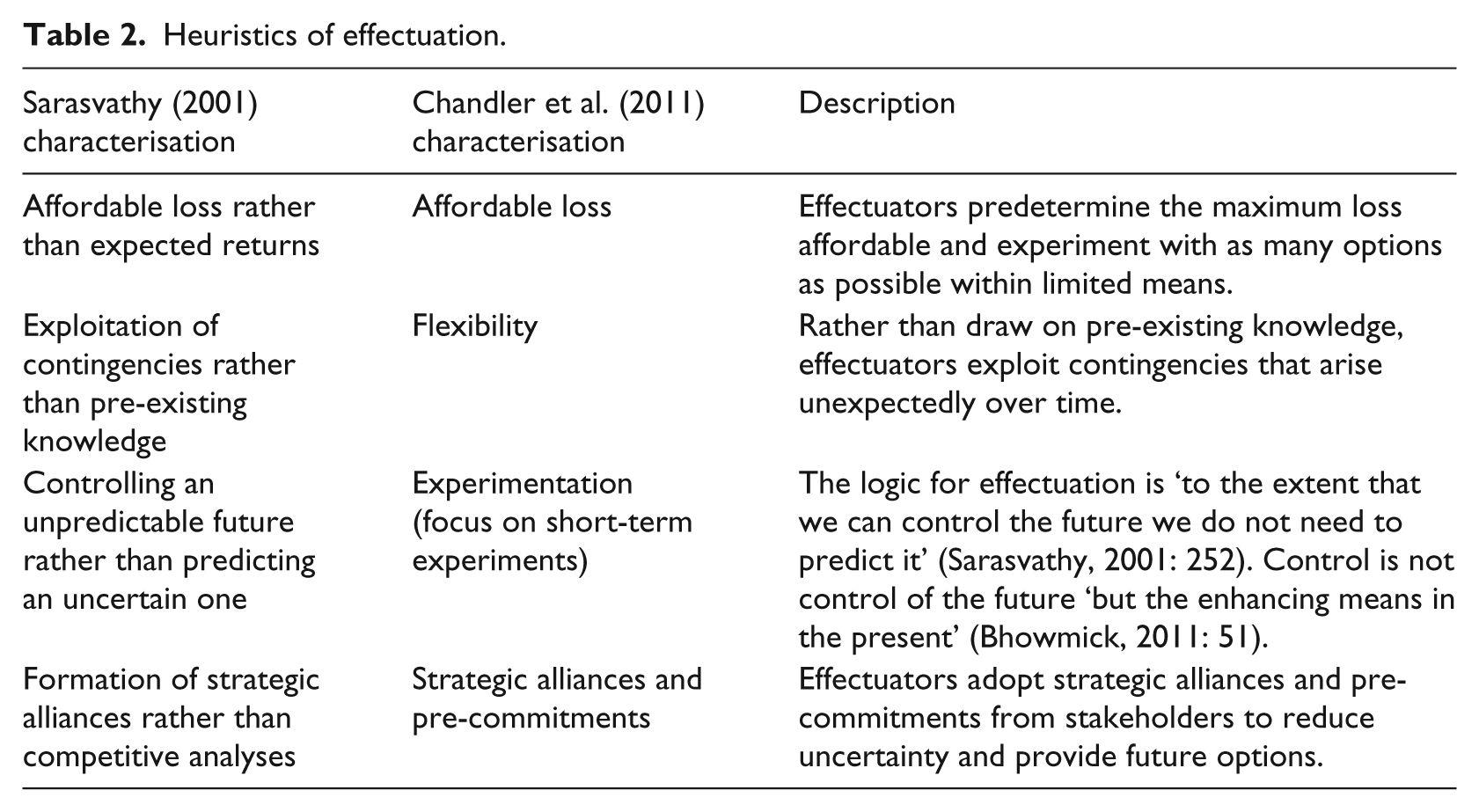
Although dynamic and contingent, effectuation does not rely on ad hoc decision-making (Wiltbank et al., 2009). Rather, it is characterised as a set of four heuristic principles (Chandler et al., 2011; Sarasvathy, 2001). First, rather than focusing on returns from a new venture, and their maximisation, effectuators consider maximum affordable loss. They ‘embrace strategies that are affordable rather than optimal’ (Wiltbank et al., 2009: 120). The second principle of effectuation, consistent with dynamic goal redefinition and an emergent construction of opportunities, suggests effectuators make use of contingencies rather than relying on extant knowledge or other existing resources. Research has characterised this as remaining flexible to take advantage of emergent opportunities (Chandler et al., 2011; Read et al., 2009). The third principle associates effectuation with experimentation (Chandler et al., 2011). Rather than trying to predict an uncertain future to meet a set of predefined goals, effectuators focus on elements they can either control, considering the means at their disposal or can access, and how they can use these to create endogenous opportunities (Bhowmick, 2011). This suggests that rather than be concerned if a market for a product or service exists independent of the entrepreneur, effectuators try to create the market by their actions, including bringing a sufficient number of stakeholders together to sustain the new venture. As such, prior research has linked effectuation with uncertain contexts (Goel and Karri, 2006).
Finally, effectuators strive to develop strategic alliances with, and secure pre-commitments from, key stakeholders, such as suppliers and customers (Karri and Goel, 2008; Read and Sarasvathy, 2005; Wiltbank et al., 2009). Formation of such alliances and pre-commitments enables the entrepreneur to share risk with these stakeholders thus, reducing the level of affordable loss, and also to construct new opportunities. Chandler et al. (2011) suggest that strategic alliances contribute to both approaches, rather than being unique to effectuation. A key difference is that for causation, goals are set before alliance partners are sought and appropriate partners determined. In contrast, for effectuators, strategic alliance partners precede and shape the future of the venture (Sarasvathy and Dew, 2008). Table 2 provides a summary of the four elements of effectuation.
Heuristics of effectuation.
Research method
As this study addresses an under-researched domain, we adopt an inductive method, based on key respondent interviews. This represents a well-accepted exploratory method (Kumar et al., 1993) that enables researchers to access the knowledge and experiences of a wide range of respondents (Dibbern et al., 2008). It also allows for a progressive, iterative and reflexive approach to data gathering and theorising critical to exploratory studies (Alvesson, 2003).
Key respondent enrolment
The respondents who contributed to this study were entrepreneurs who had formed, or operated, online businesses at home. This included those who had commenced their business at home, but had subsequently moved to commercial premises as the business expanded (Respondents 1, 15 and 16) and one (Respondent 14) who had moved to home after initially operating from commercial premises. Drawing on extant definitions (Deschamps et al., 1998; Gelderen et al., 2008; Mason et al., 2011), we defined online businesses as those in which a significant proportion of activities were undertaken online, such as the promotion of goods and services, provision of services and collection of revenues. These included online retailing, web designing and revenue-generating community portals. We placed no restrictions on the types of goods or services provided.
We used three approaches to identify and recruit possible respondents. First, we adopted a purposive sampling strategy (Easterby-Smith et al., 2008) in which the researchers identified five suitable respondents who agreed to participate in the study. Second, we adopted a snowballing approach (Bryman, 2004) by asking these respondents to identify others matching the requirements of the study. Seven additional entrepreneurs were identified through this approach. Third, we used social media (Twitter and LinkedIn), highly congruent with the population of interest. A total of 11 entrepreneurs matching the study requirements were identified, resulting in a total of 23 respondents.
Table 3 summarises the characteristics of the respondents, the nature of the businesses, year of founding, number of founders, interviewee’s life-stage and status of the business. Although not a prerequisite, all were novice entrepreneurs and each business was active and viable when the interviews took place; however, we did not set limits on how long they had been in operation. Of the respondents, 15 were women and 8 men. As our iterative approach to analysis progressed, we found consistent patterns in the data, suggesting that data saturation (Silverman, 2006) was achieved.
Characteristics of key respondents.

Data collection
Data collection was guided by a semi-structured interview schedule (Punch, 2005). The schedule design followed the ideas of narrative interviewing in which respondents are encouraged to tell their story relating to the study subject (Bryman, 2004; Hamilton, 2006; Larty and Hamilton, 2011). We used questions such as ‘tell me the story of your business – why you started it and how you started it’ to encourage respondents to describe their perspective on such aspects as temporal developments, the influence of context, their role in unfolding events and the connections they make between these. All are characteristic of narrative interviewing (Riessman, 2004b). Since our interest was in the connections between the formation (temporal component) of home-based businesses (context) and the approach of the entrepreneurs involved (their role and the connections they made) this approach was apposite. In addition to the field notes taken from the interviews, the data were supplemented with other sources (Denzin and Lincoln, 1998), such as examination of the business web sites and press coverage. All respondents were assured of anonymity as part of the research protocol to encourage candid participation.
Data analysis
The majority of the interviews (21) were recorded. In cases in which the respondents did not give permission for recording, contemporaneous notes were taken. The interviews were largely conducted by at least two interviewers, allowing field note comparison to aid understanding and internal validity of the study. The researchers followed an iterative approach to data collection (Strauss and Corbin, 1990), reflecting on each interview before undertaking the next. We thematically coded transcripts and notes using NVivo software. We adopted a narrative approach to the thematic coding (Riessman, 2004a) that included recognising aspects of temporality, context, the role of the entrepreneur and connections between these aspects. The initial stage involved open or inductive coding (Dey, 1993; Miles and Huberman, 1994), in which we identified emergent themes reflecting how and why the entrepreneurs set up their home-based online businesses and how they developed them over time. The top-level codes identified are listed in Table 4 in Appendix 1.
Following this open stage of coding, we compared the codes to the key characteristics of the entrepreneurial theories discussed earlier and summarised in Table 4 (Appendix 1). This was included to ensure that, while we argued earlier in the literature review that effectuation is a useful theoretical lens to explore home-based online businesses, we did not want to constrain our analysis if it did not prove to be a good fit. Consistent with our recognition that there is overlap between theories, there is fit between the themes inductively identified and the characteristics of all theories except causation, where we found no support. However, as shown in the summary table, consistent with our conceptual arguments, effectuation provided the best fit with our data. We subsequently compared our detailed inductive codes with the four heuristic principles of effectuation. This enabled us to identify the possibility for unique aspects of the four heuristics. For example, the inductive approach led us to identify several distinct approaches adopted by the respondents to control an unpredictable future, including learning by doing and copying from others.
All stages of coding were open and unconstrained. In the first stage, there was opportunity for codes unrelated to an effectual approach to arise, such as formation of business plans or forecasts (causation), allowing for matching with theories other than effectuation. Similarly, once we focused on effectuation, matching was not assumed a priori or forced between the themes identified and the four effectuation heuristics. Rather, the themes and heuristics were only related when there appeared to be a strong relationship. Our inductive and unforced matching is an important part of our aim to explore the boundary conditions of theory, since constrained matching pre-supposes an unquestioning adoption of the theory under study.
Findings
Following our inductive approach, we present themes identified in our data organised according to the four principles of effectuation. We also present emergent findings that relate to key aspects of entrepreneurship and home-based businesses discussed in extant literature and which provide further insight and support for our exploration of effectuation.
Focus on affordable loss rather than expected returns
All respondents agreed that they had started a home-based business, and particularly an online business, because of the low start-up costs which contributed to a perception of low risk and, thus, an affordable loss if the business failed or ceased operating. For example, Respondent 10 described how she had first considered opening a traditional shop: I suppose, the thing with online is you can do it a bit more gradually and dip your toe in, sort of thing, whereas if you do a bricks and mortar, you’ve got to have a massive outlay to buy all your stock, to do your shop-fitting, you commit to the rent and the lease.
Similarly, Respondent 3 described how having low overheads was an important part of her decision to form an online business: Our overheads are minimal when you compare us to a normal letting agent or any other business. If we don’t take a penny in a month, which we’ve been hard-pressed to do; our only commitment really is to RightMove advertising. I haven’t got to pay rent. I haven’t got to pay rates, insurance, gas, electric.
Although most entrepreneurs try to reduce the risks of a new venture, such risks are usually balanced against the expected returns. In our sample, the interviewees stressed the low risks involved in online businesses at the start of their ventures; but, while they expected the businesses to be profitable, their descriptions of expectations of revenues were relatively vague, unquantified and, in some cases, imbued with modesty. For example, Respondent 1, whose business was bought by a publishing house, described the approach of one of the other co-founders at the start of the venture when ‘She said I’ve got this idea … I don’t know how it’s going to make any money’. However, consistent with the effectual notions of leveraging opportunities, with the help of her other two co-founders the three women identified how they could succeed and turned her idea into a profitable venture.
Prior studies of effectuation have identified affordable economic loss (Chandler et al., 2011; Fisher, 2012; Sarasvathy, 2001). Some respondents mentioned that operating a home-based online business reduced the possibility of loss of status. For example, Respondent 10, describing why she preferred to run her online business at home to operating from retail premises, emphasised social and psychological aspects of both presenting and closing-down an offline business: It’s a public thing; you’re putting yourself out there to show everybody … I love seeing what new shops have opened or, equally, what’s closed, and that always makes me sad, I think, ‘Oh, that’s someone’s dream shut down’.
The concept of ‘affordable loss’ may be extended beyond economic loss to include minimising risk in relation to loss of ‘public’ status and loss of personal goals and ambitions. Thus, affordable loss not only involves preventing feelings of possible humiliation in front of other people if the venture should fail, but also involves acceptable loss to one’s sense of self.
Exploitation of contingencies rather than pre-existing knowledge
In addition to the lack of clarity about the size of anticipated revenue, the majority of interviewees lacked certainty about the sources or means of generating revenues. While the respondents were decisive about the amount and type of risks they were prepared to accept, the source of revenue generation was highly emergent and contingent rather than planned. For example, Respondent 2 described how the development of her venture followed an evolutionary, rather than a pre-planned, path: I was growing things on [my allotment] and working out recipes and stuff like that and then I decided that I could write a book … and then I needed a way to promote my book so I decided to put it on eBay and … create other products to go around it … and I came up with a variety of different products related to gardening, like packs of seeds and things like that … and also I was making our own jams and chutneys … but in the process of putting labels on jars, I worked out how to print all-circular labels, which a lot of people can’t do … I made up some stickers which were rewards for potty-training and behaviour … and it gradually built up from there really.
One area in which the majority of interviewees did not have pre-existing knowledge or skill was in IT. The only cases in which interviewees had such skills were businesses that offered web site–development services. All the other interviewees emphasised their lack of IT skills, demonstrating the contingent nature of their decision to base their business online and in contrast with a resources-and-capabilities view of venture formation (Grant, 1996; Teece et al., 1997).
Even entrepreneurs offering IT-based services were candid about the skills they possessed when they started their businesses: I’ve got a background in art, architecture and design … In 1999 a friend said, ‘Why don’t you look at this software and do web design?’ … I had an interest in computers, but I didn’t know anything about web design until 1999 when I started. (Respondent 19)
Controlling an unpredictable future rather than predicting an uncertain one
As noted previously, an emergent and contingent approach to the development of the business was common among the interviewees. In a cyclic effect, this emergent approach both resulted from and caused little future planning. Since interviewees recognised that they had not predetermined how their businesses would develop, they felt no need to develop plans. Similarly, this lack of planning and evaluating possible markets resulted in no predefined direction or outcomes for their businesses. This absence of organisational planning and determining market size and share confirms the very poor fit with causative approaches, as discussed earlier.
Extant literature links effectuation to uncertainty about products or markets (Sarasvathy, 2001; Sarasvathy and Dew, 2008). Interviewees’ responses suggest uncertainty about their capabilities rather than their products, services or markets. Thus, Respondent 1, when asked whether she and her co-founders had an agreed-on strategy, was critical about their abilities to develop plans saying that ‘It was never planned. I don’t think we are actually very good at planning things in advance’.
Control of an unpredictable future is associated with experimentation (Chandler et al., 2011). Interviewees demonstrated this by both learning by doing and copying from others. Thus, they regularly look at sites of other businesses to gain ideas they could then implement themselves: I like to look at what’s going on in America as well because they seem for whatever reason to always be slightly ahead of us. So it’s quite interesting to look at what big companies like RE/MAX are doing in America and pick out the best ideas. So we’ve, sort of, picked a couple of things off there. (Respondent 3)
The online environment makes the ability to copy others highly feasible; information on competitors’ services, products and prices is readily available on the web and can often be easily imitated, both rapidly and at low cost. Some interviewees noted that they also suffered from this ease of imitation, with their own ideas being quickly replicated by competitors.
Formation of strategic alliances rather than competitive analyses
We failed to identify themes relating to the type of strategic alliance described in much of the literature on effectuation. That is, the interviewees did not describe developing unique relationships or collaborations. Instead, most made extensive use of openly available online platforms. Those used included general trading platforms, such as eBay and PayPal, and social networking services, such as Facebook. Respondents noted that such services required little prior knowledge or experience. Potential customers were aware of these services, so this reduced the need for promotional costs. These factors contributed to the low affordable loss the respondents were seeking to achieve for their businesses.
Some respondents used more specialised platforms that were relevant to a particular market served, but again, these were open to all online businesses and not proprietary or unique. Respondent 14, who sold specialist books, described how she and her partner made use of a service that helped online booksellers: At that time, there was an organization called AbeBooks, an umbrella organization for second-hand booksellers … booksellers pay them a sort of rental to upload books to their site. You pay them a commission. So that’s how we started out, by doing that, and then, eventually, [we] had our own website built. And so we run both now.
Sarasvathy (2001) suggests that effectuators establish pre-commitments from stakeholders, such as customers and suppliers, as another way to reduce risk and increase available resources. In addition to the lack of evidence of strategic alliances, we found no support for the development of pre-commitments from stakeholders among respondents. Only one business received a small amount of funding from an angel investor, who was also a friend, but the interviewee was clear that this funding had not been solicited and was not material to the start-up or development of the venture. Thus, reflecting the findings from other studies of home-based online businesses, it was rare for founders to utilise external funding for start-up purposes (Gelderen et al., 2008).
Effectuation and the home-based online business context
This section discusses emergent themes identified from our narrative approach to data collection, inductive data analysis and reflexive consideration of our findings. In particular, our reflexive approach includes considering how contextual factors may influence our findings and provides further insights into effectuation and home-based online businesses. Accordingly, we discuss the contextual issues of external funding and growth orientation, entrepreneurial self-efficacy, push/pull motivations for venture creation and evolution of entrepreneurial approaches. We are aware that other factors may influence our findings and we discuss these more fully in the final section of this article.
Prior studies associate home-based businesses with low start-up investment (Loscocco and Smith-Hunter, 2004). Our findings support this association. None of our respondents had sought external financing. Instead, they preferred to maintain the lowest possible cost base for their business, consistent with our earlier findings of the importance of the effectual concept of low affordable loss. It reflects our findings relating to the other effectual heuristics, ‘not seeking to predict an uncertain future’ and ‘exploitation of contingencies’. External funders require explicit plans to ensure their returns and acceptable risk levels. Our respondents did not develop such plans, largely because they were pursuing experimental approaches that by their uncertain nature could not be extrapolated or quantified. While the direction of influence between external funding, growth and planning can vary in different contexts, the emphasis placed on maintaining low affordable loss by our respondents suggests that the wish to avoid using external funding was a common starting point. The wish to avoid the financial risks associated with funding limited start-up financial resources and initial growth potential and removed the requirement to formulate plans.
As discussed, the extant literature suggests that entrepreneurs have high levels of self-efficacy (e.g. Arora et al., 2013; Tumasjan and Braun, 2012) positively associated with effectuation (Goel and Karri, 2006). In contrast, our respondents were self-critical about their own capabilities, giving examples of their limited IT experience and business knowledge in marketing and planning. We explore this contradiction in more detail in the ‘Discussion’ section.
Consistent with previous studies (Kirkwood, 2009; Tlaiss, 2013), most respondents indicated a combination of pull and push motivations driving the formation of their businesses, rather than a single dominant motivation. For example, Respondent 6 had been made redundant before starting her business (push), but did not seek other work as she believed she could exploit her existing contacts to create a successful professional network (pull). This duality, rather than the dichotomy of motivations reflects research which identifies the importance of life incidents in the formation of home-based businesses (Vorley and Rodgers, 2012) and life course stage (Jayawarna et al., 2013). Our analysis extends these studies of entrepreneurial motivation by demonstrating that effectual approaches are not associated solely with either pull or push motivations. Both push and pull motivations accord with the effectual heuristics. The characteristics of online businesses of very low affordable loss, ease of experimentation and our finding of association with low self-efficacy, accord with notions of necessity (push). The ‘always open’ nature of online businesses (Nansen et al., 2010; Wynarczyk and Graham, 2013), involving being able to attend to the business ‘after hours’, and the ability to serve special-interest niche markets accord with notions of attractiveness (pull).
Read and Sarasvathy (2005) observe that as businesses grow, they tend to move from effectual to more causative approaches. The business of one of our respondents grew significantly (Respondent 1) and demonstrated this transition. The business was set up by female founders who came together with a shared interest in setting up a business to provide advice and community support specifically targeted at parents. Based on our narrative data, effectual processes did indeed orient the start and development of the business. However, these slowly gave way to more causal processes when the growth of the business began to exceed the entrepreneurs’ ability to retain direct control and management and, hence, required more delegation and formal control.
Discussion
The inductive, thematic analysis of our empirical material yielded a strong match with the principles of effectuation, suggesting our respondents had adopted a primarily effectual approach to the development of their home-based online business. As would be expected, they also demonstrated approaches reflective of other theories of entrepreneurship, for example, the rejection of external capital is consistent with notions of bootstrapping (Ebben, 2009; Salimath and Jones, 2011). However, our focus on the concept of effectuation allowed us to both consider what this theory highlights as highly salient about home-based online businesses, and what this particular context suggests for developing the theory of effectuation.
Our findings indicate that the respondents considered the combination of being based in the home and operating an online business offers a unique opportunity for low affordable loss. Such businesses also offered an opportunity for a contingent, or evolutionary approach to business development and, most of all, enabled experimentation through learning-by-doing and also copying from other online businesses. This suggests an additional facet to the notion of affordable loss to move beyond economic loss to recognise social and psychological loss, such as loss of reputation and social status.
We also found little support for the formation of strategic alliances and pre-commitments (Bhowmick, 2011). The availability of non-proprietary platforms and services that allow entrepreneurs to promote and operate their businesses precludes the need to form more traditional, proprietary alliances. For example, several respondents described how the use of eBay, Facebook and other services (e.g. RightMove. AbeBooks) was central to the formation and ongoing operation of their businesses. Sarasvathy and Dew (2008) state that ‘the only way that anyone can become a stakeholder in the effectual process is by making a real commitment i.e. by actually staking something’ (p.729). Services such as eBay, though ultimately dependent on users, do not have a stake in individual businesses and cannot be considered either strategic alliances or pre-commitments from stakeholders. However, our findings show that though they do not fit the notions of strategic alliances or pre-commitments from stakeholders, non-proprietary, open services and trading platforms contribute positively to an effectual approach to online business formation. This finding suggests that entrepreneurs involved in such ventures do not need to spend time and other resources identifying, agreeing with and nurturing proprietary alliances, contributing further to the very low affordable loss witnessed in this context.
None of the respondents actively applied for external funding; this both causes and reinforces limited initial growth aspirations (Dutta and Thornhill, 2008; Loscocco and Smith-Hunter, 2004). We suggest that the lack of external funding has a similar reinforcing effect on the adoption and pursuit of an effectual approach and the ability to avoid the development of business plans and forecasts associated with causative approaches. Rather than seek external funding, an alternative approach to growth could be the sharing of resources with other entrepreneurs or organisations, as described by resource dependence theory (Pfeffer and Salancik, 1978). While such approaches might be relatively informal and, hence, reduce the need for formal business plans and other elements of a causative approach, their formation would have characteristics similar to the formation of strategic alliances and pre-commitments for which we did not find support, such as investment of time and resources in developing and maintaining resource-sharing arrangements. We would suggest that further research be undertaken into how effectual approaches could incorporate resource-sharing arrangements and how these may differ from the strategic alliances and pre-commitments that have characterised previous studies of effectuation (Sarasvathy, 2001, 2004).
Effectuation is frequently linked to product and market uncertainty (Chandler et al., 2011). However, we found little concern for such aspects. Rather, frequent references were made to perceived lack of knowledge and experience. These limitations pertained to both business matters and use of IT, except for the businesses based on web development. Our findings, therefore, differ from studies that associate entrepreneurship with high levels of self-efficacy (e.g. Arora et al., 2013; Tumasjan and Braun, 2012) and those that associate high levels of self-efficacy with effectuation (e.g. Goel and Karri, 2006). This difference might arise from two particular features of the home-based online business context: the ability to set affordable losses at lower levels than other types of start-up ventures, and the potential opportunity offered by the online environment for experimentation, encouraging start-up despite low levels of self-efficacy. This association is supported in that all respondents were novice entrepreneurs without prior experience. Previous studies associate effectual approaches with more experienced entrepreneurs (Read and Sarasvathy, 2005), but these findings suggest that the lower level of self-efficacy required by home-based online business entrepreneurs undermines this association between experience and effectual approaches.
Conclusion
In this article, we have presented empirical evidence of how effectual processes are manifest in the case of home-based online businesses – an emerging and significant market sector. Such businesses offer a unique setting in which to explore effectual processes. A virtuous cycle can be established, with the low investment associated with a home-based business combined with the ability to undertake small and rapid experiments offered by the online environment. The need for limited initial and ongoing investment obviates the need to depend upon external investors and other forms of strategic alliances, which, in turn, mitigates pressure to undertake more predictive approaches to venture development.
Gathering empirical evidence is a recognised means of developing extant theory (Hambrick, 2007; Robey et al., 2008; Weick, 2007). Our empirical evidence suggests three refinements of effectuation theory within this particular context. First, the ubiquity of non-proprietary online trading platforms encourages the adoption of effectual approaches and removes the importance of forming proprietary strategic alliances and pre-commitments; second, the notion of affordable loss that forms a central tenet of effectuation should be extended beyond the notion of economic affordable loss to include social and psychological loss; and third, certain business contexts, such as home-based online businesses, that offer very low affordable loss and an opportunity to undertake rapid experimentation allow effectuation to be associated with low levels of entrepreneurial self-efficacy and experience.
We note that effectuation has been characterised as a set of heuristics, rather than a monolithic theory, and thus, we do not believe our findings in this specific domain undermine or lessen the validity of this theory. Rather, consistent with Sarasvathy’s (2001), we suggest that our findings offer a refinement to the ideas of effectuation by providing a ‘special theory of effectuation’ (p.244) of greater relevance for the home-based online business context.
Implications for practice
This article provides valuable insights for putative entrepreneurs and those who support and educate entrepreneurs. To date, much of the education and support for entrepreneurs has emphasised a causal or predictive approach (Sarasvathy and Venkataraman, 2011).
This analysis not only highlights the under-represented effectual approach but also demonstrates that the particular case of home-based, online businesses may be particularly suited to entrepreneurs who do not conform to popular ideas about entrepreneurship. They include those who cannot articulate their goals, want to avoid risks, doubt their abilities or lack experience in key areas and those who are concerned about loss of status. When judged through a causal mindset, such individuals would not appear to be suitable entrepreneurs. This study suggests that effectual approaches to online businesses may be helpful in the start-up and development of successful entrepreneurial ventures that may later adopt more causal approaches.
The findings should also be of interest to more established entrepreneurs. As Chandler et al. (2011) note, consideration of an effectual approach may also provide an ‘expanded repertoire’ for entrepreneurs who have previously adopted a causal approach (p.388). This could bring a range of benefits, including the ability to take advantage of unexpected circumstances and to work with colleagues and other ventures that adopt a more effectual approach.
Research limitations and further research
Although we sought a diversity of entrepreneurs and home-based online businesses, our sample did not include ventures perceived initially as high growth by their founders. Findings might differ for high-growth ventures requiring high initial investment and external funding. These conditions are likely to encourage greater planning and high levels of self-efficacy and would be facilitated by strategic alliances. Further research could attempt to identify high-growth home-based businesses and determine the extent to which an effectual approach can be adopted and whether and how the principles of effectuation play out in this particular context.
The entrepreneurs in our study adopted a largely effectual approach. However, the direction of causality is not clear. Are effectual entrepreneurs more likely to start home-based online businesses? Or do home-based online businesses encourage entrepreneurs to become effectuators? A longitudinal research design may help to tease out the interplay between the traits and entrepreneurial approach of entrepreneurs and the development of their new ventures (see, for example, Chetty et al., 2013). Interestingly, an effectual approach appears to cut across the four types of micro-business owners identified by Jaouen and Lasch (2013), suggesting that such typologies could be extended to incorporate recognised entrepreneurial approaches.
Previous studies have also shown that gender is important when considering home-based businesses, although findings are often contradictory. For example, Cooper (2013) and Thompson et al. (2009) suggest women are more likely to start such businesses due to push factors, such as lack of work options; Kirkwood (2009) and Verheul et al. (2005) find men and women motivated by similar pull and push factors, while Hughes (2003) and Breen (2009/2010) find pull factors such as the desire to undertake particular meaningful work as the dominant motivation for women to start home-based businesses. A more recent study by Tlaiss (2013) finds that rather than either push or pull motivational factors, women entrepreneurs demonstrate a complex interplay of both types of motivation. Other gendered aspects include lifestyle strategies for balancing work and home-life (Breen, 2009/2010; Duberley and Carrigan, 2013; Philipps, 2008), feelings of isolation (Greenhaus et al., 2003; Thompson et al., 2009), attitudes to IT (Ndubisi, 2008) and attitudes to growth (Breen and Karanasios, 2010; Ehlers and Main, 1998; Redmond and Walker, 2009/2010). We suggest that many of the contradictions of gendered aspects arise from the confounding of different types of home-based business, and would encourage researchers to focus on particular business types, such as our focus on home-based online businesses and the development of the detailed typology shown in Table 1. We are also unaware of studies that consider gendered aspects of effectuation and would suggest that such studies would provide additional refinement.
We also suggest that the ease of experimentation offered by the online environment provides an explanation for the low levels of self-efficacy identified. The links between the opportunity for experimentation and levels of self-efficacy should be further explored, with consideration given to the personal, social and ethical implications of individuals with lower self-efficacy being afforded the opportunity to start their own home-based online business.
Footnotes
Appendix 1
Funding
The author(s) received no financial support for the research, authorship, and/or publication of this article.