



Abstract
Environmental entrepreneurship has emerged as a significant sub-domain of entrepreneurship research. Drawing from Bourdieu’s work on the notion of habitus, we theorise on the emergence of UK environmental entrepreneurs. Based on evidence from a focus group and a series of in-depth interviews with twenty social and commercial environmental entrepreneurs, we provide insights on past experiences which culturally shaped the participants’ environmental and entrepreneurial dispositions. Specifically, we illustrate how education and the environmental movement in the form of role models, environmental literature and philosophy became influential elements of the interviewees’ cultural legacy. We also depict how parenthood and travel experiences, especially to places of significant environmental degradation, profoundly affected the formation of the environmental and entrepreneurial habitus of our interviewed environmental entrepreneurs. Contributing to the emerging theory of practice studies in entrepreneurship research, we provide a systematic habitus approach to the environmental entrepreneurial mindset.
Introduction
The debate on corporate governance in the 1980s and the establishment of the triple bottom-line framework for economic, social and environmental sustainability in the 1990s guided research and policymaking on organisational greening and eco-efficiency. Environmental crises and a new generation of consumers have fostered the emergence of environmental entrepreneurs (Dean and McMullen, 2007; Hall et al., 2010). While environmental entrepreneurial activity itself is not a new phenomenon (Holt, 2011; Kyro, 2001), as a field of research it is still considered to be in an early stage, where further theory development (Belz and Binder, 2015) and contextualisation (Zahra, 2007) are needed.
The increased importance attributed to sustainable, and specifically environmental, entrepreneurial activity is reflected in the interest which key entrepreneurship journals have taken to include studies focusing on environmental entrepreneurship (Dean and McMullen, 2007; Hockerts and Wüstenhagen, 2010; Kuckertz and Wagner, 2010; O’Neil and Ucbasaran, 2016; Shepherd and Patzelt, 2011; Vickers and Lyon, 2014). However, despite this acknowledgement, empirical research on the conditions surrounding the emergence of environmental entrepreneurs has been scarce. Only recently has research started to analyse the manner in which environmental entrepreneurs differ from conventional entrepreneurs and the general population (Thompson et al., 2011; York et al., 2016). Lenox and York (2011) and Battisti and Perry (2011) specifically encourage further research upon the manner in which beliefs and the environmental orientation of individuals influence their recognition and pursuit of entrepreneurial activities.
The aim of our article is to examine the way environmental entrepreneurs start to form their distinctive way of thinking, the way they start to develop their environmental entrepreneurial mindset. Existing explanations fail to clarify their theoretical origins. This is despite Hockerts (2015) emphasising the relevance of an individual’s mindset when reflecting on mental models and the case for sustainability within business contexts and the importance attributed to contextualised theory development (Welter, 2011; Zahra, 2007). Reflecting recent trends in entrepreneurship research and increased attention to Bourdieu’s theory of practice (De Clercq and Voronov, 2009b; Gartner et al., 2016; Light and Dana, 2013) we contribute to this debate by offering a habitus perspective on the formation of the environmental entrepreneurial mindset. Research efforts are seen to benefit from a stronger practice perspective within entrepreneurship research (Chalmers and Shaw, 2017; Gartner et al., 2016; Johannisson, 2011). In a recent call for more research integrating theory of practice into entrepreneurship studies, Gartner et al. (2016) identify promising applications of the ‘theory of practice’ (De Clercq and Voronov, 2009b; Gross et al., 2014; Keating et al., 2014). They argue that ‘entrepreneurship practices are habitually, socially situated and organized human activities for which entrepreneurship practitioners use specific skills and tools’ (Gartner et al., 2016: 813, referring to earlier works by Bourdieu, 1990, and Schatzki, 2001).
There is no general consensus as to whether sustainable entrepreneurship is different (Thompson et al., 2011) or inclusive of environmental and social entrepreneurship (Dean and McMullen, 2007). We adopt Dean and McMullen’s (2007: 58) definition of environmental entrepreneurship as ‘the process of discovering, evaluating, and exploiting economic opportunities that are present in environmentally relevant market failures’. However, opportunities in the environmental contexts are difficult to evaluate and exploit and pose additional challenges to the entrepreneur. This raises questions about why environmental entrepreneurial activity takes place and explanations for practice are required. Through a two-stage data collection process including a preliminary focus group interview and twenty semi-structured in-depth interviews with UK environmental entrepreneurs, we analyse experiences which culturally influence the formation of the environmental entrepreneurial mindset and propose a habitus perspective. We follow Bourdieu’s (1990: 53) argument that ‘conditionings associated with a particular class of conditions of existence produce habitus’. We argue that cultural legacy, as reflected in past experiences of the social and commercial environmental entrepreneurs in our sample, influences the formation of environmental and entrepreneurial dispositions constituting habitus.
In the remainder of this article, we review and evaluate the development of existing knowledge on environmental entrepreneurs and identify a need to expand our knowledge in the development of the environmental entrepreneurial mindset. Subsequently, we introduce our Bourdieusian approach and explain our social constructivist perspective and the rationale of our empirical study’s qualitative research design. Our analysis then focuses on cultural legacy as we theorise on the connection between education, environmental movements, parenthood and travel experiences to environmental entrepreneurial habitus. This article contributes to the emerging entrepreneurship-as-practice debate by expanding our current knowledge on the formation of the environmental entrepreneurial mindset.
Research on the emergence of environmental entrepreneurs
The emergence of environmental entrepreneurship is a contemporary and growing phenomenon. While Kyro (2001) traces the historical roots of contemporary environmental entrepreneurs back to 18th-century France and the rise of the physiocrats, research on environmental entrepreneurs remains at an early stage. Inspired by early studies by Blue (1990), who introduced the term and concept of ecopreneur, Berle (1991), who used the term green entrepreneur, Bennett (1991) and Bohlen et al. (1993) who examined the entrepreneurial opportunities of environmental businesses, research started to focus on environmental entrepreneurship in the late 1990s. The dominant viewpoint of environmental entrepreneurs was shaped by Schumpeterian approaches in entrepreneurship research. Environmental entrepreneurs were portrayed as agents of profound change beyond the degree induced by corporate social (including environmental) responsibility (CSR) (Anderson, 1998; Hart and Milstein, 1999; Isaak, 1998).
Keogh and Polonsky’s (1990) organisational perspective identified types of commitment in addressing environmental degradation through business (emotionally, social/environmental cost and responsibility driven). Isaak’s (1998) seminal work on green logic is a first analysis of the process (i.e. collective learning, social schemata, role of myths and social norms) of developing a distinctive sustainable thinking, an antecedent for the emergence of environmental entrepreneurs, the change agents for a sustainable society. Isaak’s work relates to Manheim’s (1936) conclusion that the sociocultural context influences the type of emerging entrepreneurs. An early attempt to define the drivers of environmental entrepreneurial activity, ‘green logic’ became the nexus between philosophy, sustainability, entrepreneurship and innovation.
While these efforts on explaining the emergence of an environmental mindset do not yet explicitly apply a Bourdieusian lens, some works already hint at the potential of a practice perspective. A prominent example here is Pastakia’s (1998) work exploring triggers and barriers in the emergence of agriculture environmental entrepreneurs in India. The findings highlight sector-specific, policy-related, bureaucratic hurdles as a major barrier, while it showed how participants with academic backgrounds used their knowledge resources such as research findings, to develop environmental alternatives for their field. Pastakia (1998) found environmental movements, environmental ethics and the commitment to future generations as a common motive among participants.
More recently, literature has emphasised a conflict between the intention to exploit economic opportunities while maintaining sustainable values in entrepreneurship (Lans et al., 2014). Shepherd et al. (2013) suggest approaching this dilemma by investigating the role of personal agency and by discussing the circumstances which initiate moral disengagement and environmentally harmful opportunities that compromise the initial environmental entrepreneurial intentions. The acknowledgement of this cognitive dilemma is our motivation to theorise on the relationship between agent and structure for the case of environmental entrepreneurs. We respond by clarifying our conceptual understanding of the entrepreneurial mindset and develop a clearer understanding through contributions from the sustainable and environmental entrepreneurship literature. We then introduce a habitus perspective based on recent debates on Bourdieu’s theory in an entrepreneurial context.
Entrepreneurial mindset
The notion that entrepreneurs are a unique group of the general population has guided research on entrepreneurial traits. Entrepreneurial mindset research stems from research findings by early studies such as those from Busenitz and Barney (1997), Baron (1998), McGrath and MacMillan (2000), later by Haynie et al. (2010) and Earley (2010) and more recently from Neck et al. (2017). They support the notion that entrepreneurs think differently compared to the non-entrepreneurial part of a population, and that they are guided by a distinctive entrepreneurial mindset. Gupta and Govindarajan (2002) conceptualise mindset as the cognitive filters human beings develop and through which they selectively absorb and subjectively interpret information from the environment. Mindset, then, is ultimately an outcome of an individual’s past, subject to alterations by new information and experiences. Mindset denotes intuitive skills and the use of heuristics and cognitive experience–based mechanisms in decision-making (Shane and Venkatamaran, 2000).
An entrepreneurial mindset constitutes a cognitive antecedent for entrepreneurial practice; it is defined by Ireland et al. (2003: 968) as a ‘growth-oriented perspective through which individuals promote flexibility, creativity, continuous innovation and renewal’. Their discussion on mindset refers to McGrath and Macmillan’s reader in which an entrepreneurial mindset allows ‘melding the best of what older models have to tell us with the ability to rapidly sense, act, and mobilize, even under highly uncertain conditions’ (McGrath and MacMillan, 2000: xv). Haynie et al. (2010: 218) suggest ‘that the origins of an entrepreneurial mindset are, at least in part, cognitive in nature’.
Early research investigating entrepreneurial mindset identified its major components in the ability to recognise entrepreneurial opportunities, entrepreneurial alertness, real options logic and entrepreneurial frameworks (Ireland et al., 2003; McGrath and MacMillan, 2000). Entrepreneurial mindset research has expanded in subfields of entrepreneurship research and has significantly contributed to knowledge on strategic and transnational entrepreneurship. Terjesen and Elam (2009: 1105) argue ‘that modern transnational entrepreneurs hold distinct mindsets (i.e., habituated dispositions, or habitus)’. The same argument might be applied to environmental entrepreneurs defined and discussed below.
Environmental entrepreneurs and entrepreneurial mindset
Extant research suggests that the role of the individual entrepreneur in environmental entrepreneurship has a special meaning (York et al., 2016). Schick et al. (2002: 59) conclude that ‘the comparison of ecologically oriented start-ups with conventional start-ups showed that the most crucial factor for environmental considerations in the start-up process is the entrepreneur him or herself’. Our knowledge of environmental entrepreneurs has grown, but to date the factors which lead to environmental entrepreneurial activity remain under-researched. In addition, with the increased scholarly interest in environmental and sustainable entrepreneurship, a diverse set of definitions of the environmental entrepreneur has emerged.
Environmental entrepreneurs could be seen as among those ‘who proactively facilitate latent demands for sustainable development’ (Lans et al., 2014: 37), ideally contributing to a wider ‘sustainability-as-flourishing’ (Schaefer et al., 2015). Thompson et al. (2011) argue that in addition to conventional economic motives, noneconomic motives could be used for a first distinction between environmental entrepreneurs and traditional entrepreneurs. We concur with Hall et al.’s (2010) suggestion that although tempting, the existence of a simple categorisation for sustainable, including environmental, versus conventional entrepreneurs would be overly simplistic. Schaefer et al. (2015) provide a more systematic approach, distinguishing between social, sustainable and environmental entrepreneurs. Environmental entrepreneurship is referred to as ‘a unique type of entrepreneurship due to its focus on solving environmentally relevant market failures and examination of opportunities that produce both economic and ecological benefits’ (Schaefer et al., 2015: 396).
Schaefer et al. (2015) argue that the environmental mission of such enterprises (Pastakia, 1998) is seen as less or equally important to economic value creation, also supporting the dilemma of moral disengagement discussed above. Typological studies with the goal of explaining and classifying the population under study provide additional conceptual clarification. For instance, Parker et al. (2009) look at the company level to distinguish four small and medium-sized enterprise (SME) types according to their degrees of business performance commitment (high/low) and environmental performance commitment (high/low). Schaltegger (2005) proposes a matrix based on two dimensions, the degree of sustainability of the firm’s goal and the overall success on the market.
Ridley-Duff and Southcombe (2012) suggest that the influence of the individual entrepreneur on the type of sustainable enterprise remains crucial. Typologies offer an insight on the variety of motives. Taylor and Walley (2004) propose an exploratory typology associated with motives of and influences on environmental entrepreneurs. Linnanen (2010) developed a typology of environmental entrepreneurs from drivers of eco-business sectors (desire to change the world; desire to make money). Schaltegger and Wagner (2011) suggest that the degree of sustainable innovation should be the underpinning measure in classifying enterprises and entrepreneurs as bioneers, ecopreneurs, social entrepreneurs and sustainable entrepreneurs. In general, typologies in SME research should be used with caution for positive bias, for categories developed arbitrarily and which can be subject to overlap and for categories which may be similar in name but hide fundamental differences (Hadjimanolis and Dickson, 2000; Woo et al., 1991).
Traditionally, typologies reflect on diversity and focus on classification (Woo et al., 1991) while we focus on the habitus which distinguishes environmental entrepreneurs from the rest of the population. Despite the conceptual importance of typologies, knowledge of the profile and emergence of environmental entrepreneurs remains fragmented (Schaper, 2010; Thompson et al., 2011; York et al., 2016). Research investigating the motivation of nascent entrepreneurs has evolved into concepts such as the entrepreneurial mindset. In contrast, research on environmental entrepreneurs had no similar advancement.
The analysis of the formation of an environmental entrepreneurial mindset denotes the assumption that individuals enter a mental process of forming cognitive filters, which interpret information and lead them to the formation of a new venture with environmental objectives. Koe and Majid (2014) discuss the idea of intention as a predictor of sustainable entrepreneurial behaviour, developing a model which theorises on situational, cultural and personal factors and perceptions of desirability and feasibility affecting the intention towards sustainable entrepreneurial activity. Within the frame of a new business, an individual carries a habitus shaped by previous fields and circumstances to the organisation (Emirbayer and Johnson, 2008). This view could accordingly be applied to environmental entrepreneurs. We argue that an environmental entrepreneurial intention could be explained through the concept of habitus, a more focused concept compared to the notion of mindset, often used vaguely in entrepreneurship research.
Taking a habitus perspective
While knowledge on how environmental entrepreneurs form their distinctive mode of thinking is limited, research on human cognition has been subject to criticism for its inability to reflect on the interplay between individual cognition and the social and environmental milieu (Haynie et al., 2010; Schwarz, 1998). Bourdieu’s (1977, 1990, 1998) theory of practice, explaining strategy or practice through a complex interplay of the three main concepts field, capital and habitus, is a framework which combines theory on environment (field), the individual (habitus) and resources (capital) (Drori et al., 2009). Practice theory perspectives reached conclusions to similar research questions for other entrepreneurship subsets (De Clercq and Voronov, 2009b, 2011; Light and Dana, 2013; Patel and Conklin, 2009; Terjesen and Elam, 2009); while the concept of habitus is argued to have cognitive origins (Lizardo, 2004), it exceeds the limits of cognition.
Anderson et al. (2010: 123) propose habitus as an effective concept to analyse entrepreneurial activity, which provides us with ‘a conceptual basis for understanding how agential interactions work and explains why they work and presents us with the cognitive space in which they work […] a cognitive space formed by and from subjective interactions between individuals’. A key benefit from employing a habitus perspective of the mindset is that it allows us to frame our findings on cognition (mindset) and analyse them through the lens of a theoretical framework (theory of practice) which combines theory on environment (field), the individual (habitus) and resources (capital) (Drori et al., 2009). This interplay offers a better insight into the implications for theory and for the practice of stakeholders, entrepreneurs, educators and policymakers. We follow Crossley (1999: 655) who states that ‘a habitus is formed through the inculcation of specific schemas of perception, action and discourse which, in turn, generate practice’.
Another major advantage of using a practice approach is that it allows analysis to go beyond the dichotomy of agency and structure, which has branded research on entrepreneurs (De Clercq and Voronov, 2011; Elam, 2008; Terjesen and Elam, 2009). Crossing this dichotomy permits the development of a richer view of the emergence of environmental entrepreneurs with significant implications for theory and practice. The chosen framework helps expanding knowledge on the forms, contribution and interplay of non-economic dimensions of entrepreneurship, such as cultural, social and symbolic forms of capital associated with the emergence of environmental entrepreneurs. Empirical research on the accumulation of cultural experiences and capital is particularly relevant for a population group such as environmental entrepreneurs, for whom there is already a strong indication (Schaltegger and Wagner, 2008) that cultural factors such as the environmental movement inspire their emergence.
Bourdieu conceptualised the manner in which agents compete in a subjective social space for divergent forms of capital which influences their habitus and their practice. Previous practice perspectives on entrepreneurship (Terjesen and Elam, 2009) have drawn upon the basic forms of capital analysed by Bourdieu (1986), mainly economic, cultural and social capital. In The Logic of Practice, habitus is defined as ‘systems of durable, transposable dispositions, structured structures predisposed to function as structuring structures, that is, as principles which generate and organize practices and representations that can be objectively adapted to their outcomes without presupposing a conscious aiming at ends or an express mastery of the operations necessary in order to attain them’ (Bourdieu, 1990: 53).
Applying a Bourdieusian lens on the emergence of environmental entrepreneurs, we argue that in a habitus-oriented definition, an environmental entrepreneur is an agent with a lasting system of a set of both environmental and entrepreneurial dispositions. The environmental dispositions are focused around the preservation and regeneration of the natural environment (Schaefer et al., 2015), while the entrepreneurial dispositions are oriented towards seeking growth, venturing, exploitation of opportunities and other dispositions associated with theories of the entrepreneur. Assuming a role of past experiences (Bourdieu, 1977) in the formation of these dispositions, the following study will provide an in-depth look at past experiences of UK environmental entrepreneurs.
Method
Our study is discovery-oriented, localised within the naturalistic paradigm, and involves a qualitative research strategy including a focus group and a series of personal interviews. We offer a social constructivist perspective on the environmental entrepreneurial mindset. Our participants were selected from the Dun & Bradstreet Business Register and the Financial Analysis Made Easy (FAME) databases. We employed maximum variation sampling (MVS) strategy to analyse emerging common patterns and differences (Miller and Crabtree, 1999). MVS confers a conditional representativeness which is important for the relatively small samples of most qualitative designs (Guba and Lincoln, 1981, 1989; Patton, 1980).
Our sample is formed by employing two dimensions of variation and is divided into four groups of entrepreneurs (see Table 1). Corresponding to Pastakia (1998), the first dimension is type, social and commercial, also responding to Schaper’s (2010) call for social entrepreneurs to be evaluated together with their commercial counterparts. We use gender as the second dimension as it has been identified as a source of variation in entrepreneurship research (Carter and Rosa, 1998; Eastwood, 2004). Participants were identified among founders of small-medium environmental enterprises in the United Kingdom.
Matrix of participants.
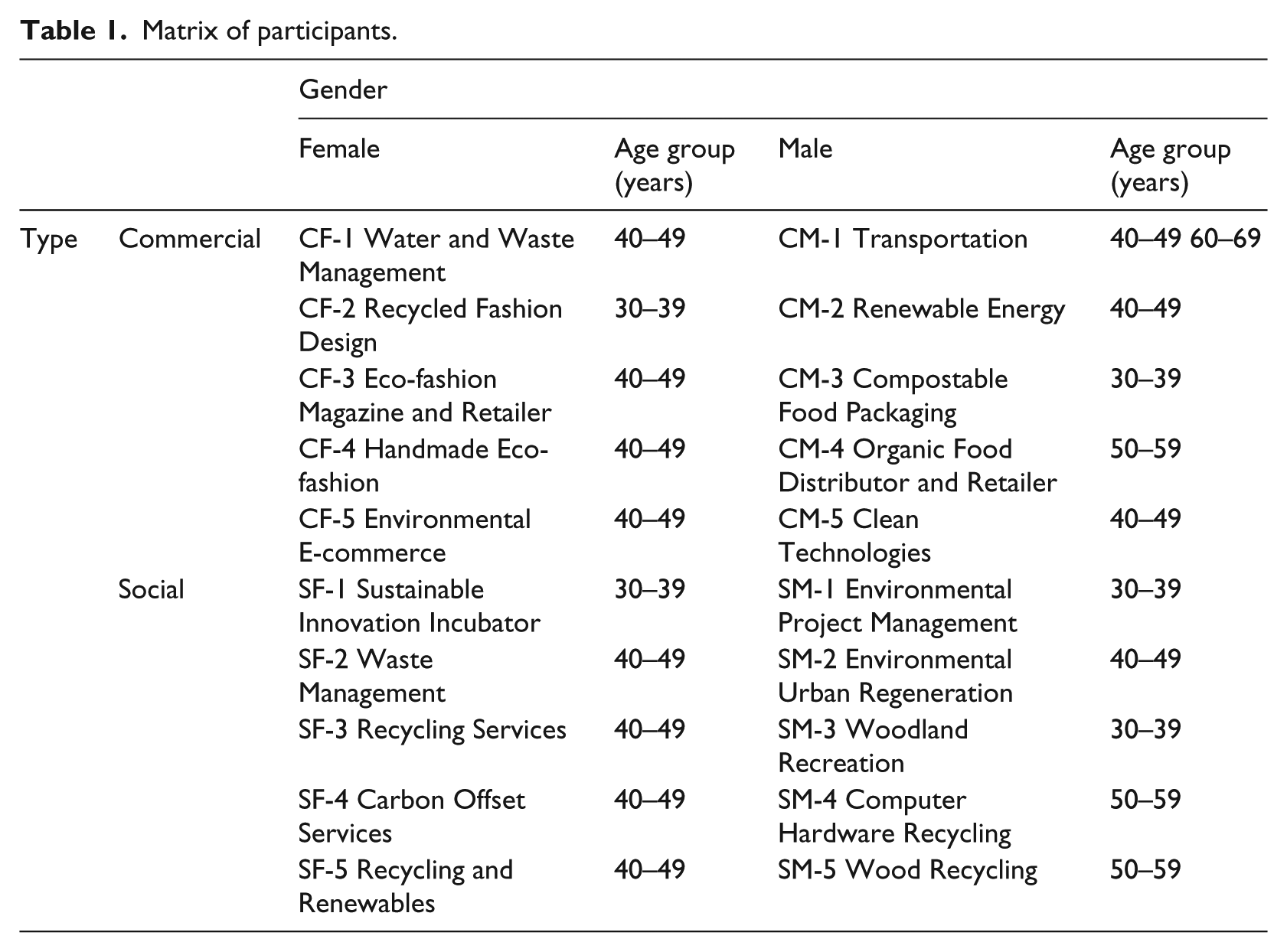
The first stage of our data collection included a preliminary focus group, a method rarely used in small business research, yet very effective in research of motivation, experiences and worldviews (Blackburn and Stokes, 2000). We followed the guidelines proposed by Krueger and Casey (2000), and a two-hour session was held with four environmental entrepreneurs, one from each of the four quadrants, a moderator and an additional discussant. The focus group setting was previously simulated and the full interview was video-recorded using a stationary method of recording (Heath et al., 2010). Analysis of the main discussion was transcription-based using tapes, notes and memory (Krueger, 1998). Thematic analysis was used to analyse the focus group interview with a scope to identify emerging themes. Key themes and observations from the focus group were used to develop the in-depth interview questions. Two focus group participants were also interviewed during the second stage of in-depth interviews.
In the second stage, 20 semi-structured individual interviews with environmental entrepreneurs were carried out in sequence across the four quadrants of the type/gender matrix, with five interviewees for each of the four quadrants. The goal was to achieve data saturation, the stage where no new themes emerge from any additional interviews. For similar approaches, previous research suggests 12–20 interviewees (McCracken, 1988; Mason, 2010; Patton, 1980). On average, the interviews lasted approximately one hour and were recorded, transcribed and then analysed with qualitative content analysis (see Mayring, 2000) on NVivo. Qualitative content analysis maintains the advantages of conventional quantitative content analysis while also allowing for more in-depth analysis (Spannagel et al., 2005). A coding agenda was developed and findings were categorised accordingly.
The rigour, or trustworthiness, of our qualitative approach has been established according to perspectives by Morse et al. (2002), Mason (2002) and Guba and Lincoln (1989). The two dominant approaches for a rigorous qualitative research are conceptualised differently as alternative criteria such as credibility, transferability, dependability and confirmability of trustworthiness by Guba and Lincoln (1989) and as the application of traditional criteria with alternative meaning and with an emphasis on validity and reliability by Morse et al. (2002) and Mason (2002). Nonetheless, the strategies they employ to fulfil the respective criteria are similar, for example data saturation, member checks, multiple methods and computer-assisted data analysis and they were used in this study. The following section analyses findings on the way divergent forms of cultural legacy shaped the formation of the environmental entrepreneurial habitus.
Habitus and cultural legacy: insights from environmental entrepreneurs
We introduced habitus in the previous sections as dispositions guiding the environmental entrepreneur’s practice. These dispositions are considered a product of history, that is, past experiences, ‘a present past that tends to perpetuate itself into the future’ (Bourdieu, 1990:54). The focus on legacy guides our qualitative content analysis of interviews, illustrating how participants formed their environmental and entrepreneurial mindsets, which constitutes their environmental entrepreneurial habitus. The analysis focuses on four types of cultural legacy emerging from our interview data, which becomes part of the cultural repertoire of the possessors (environmental entrepreneurs). Our insights on past experiences associated with environmental and entrepreneurial dispositions relate to (a) education, (b) environmental movements, (c) parenthood and (d) travel experiences.
Education
Education remains a traditional theme in entrepreneurship research found to influence entrepreneurial choice and performance (Block et al., 2011; Robinson and Sexton, 1994). According to Webb et al. (2002), education constitutes an ‘academic market’ of knowledge, recognised by Bourdieu (1986) as a means to accumulate cultural and social capital. Our interviews portrayed education as an underlying source of, primarily, environmental and, secondarily, entrepreneurial cultural enrichment. Participants were reluctant to directly acknowledge the role of education and remained critical of its importance. Nonetheless, our analysis of their experiences suggests that education played a significant role in their development. A distinctive example is the founder of a Bioenergy enterprise, who reflected on the extent to which education, and specifically his degree in Philosophy, contributed to the development of his business thinking:
It has helped me phenomenally in a weird way. I went to really good schools. The things that I apply from philosophy to my business world they are settled and you see them. A huge part of who I am and how I think is education. (CM-2)
The contribution of education is not always directly evident or acknowledged, and other participants were less appreciative of its role, especially in their development as entrepreneurs. One interviewee elaborated on what several other participants also reflected, the gap between formal education and entrepreneurial mindset:
I speak as someone who works with a lot of schools and watched children growing up in them. I think education has got a huge tendency to reward for behaving well and for conforming […] I think education can and is almost designed to knock stuff out of people […] I certainly kind of fought against it (the education system). I fought against it but I carried on with it. (SM-1)
Nevertheless, several respondents highlighted the significance of education as a field for accumulating institutionalised forms of cultural capital, for example, the value of an academic degree, as well as the development of networks (social capital). Others found inspirational role models. The founder of an eco-friendly fashion firm dedicated exclusively to female customers reflected on the importance of feminist influences during her school years:
I went to all girls schools, because I’m actually a quite strong feminist and I believe I became a feminist from the Quaker school. It was an environment where women were in charge. It just showed to you that there are no boundaries. (FC-3)
A testimony of the complex role of education in cultural enrichment, this reflective account highlights the empowering effect of female role models from the educational environment on future female environmental entrepreneurs. From a religious standpoint (Quakerism), this experience also relates to research on the foundations of environmental and entrepreneurial ethics (Dana, 2010). Reflecting back on the most influential moments in her life, one participant reflected how experiences in higher education influenced the development of her environmental mindset:
I kind of always felt passionate about the environment and about wanting to do a job that I believed in. For example at university I was the environmental officer, so as long as I can remember I cared about this sort of stuff, I don’t think there was a specific moment, like a big realisation. (SF-4)
We found several participants with experiences in similar positions during their university years. These experiences in positions of responsibility act as a preparatory stage and hold a particular significance in shaping an environmental and an entrepreneurial mindset. An Edinburgh-based social entrepreneur revealed that during her postgraduate degree she became familiar with and regularly studied ‘deep ecology’ philosophy and drew inspiration from work by environmentalist Joanna Mecy:
I also did an MSc in Human Ecology and that was utterly depressing. Why was it depressing? Because it was all of the things that were wrong with the world, on a plate, from, ‘We’ve only got forty-eight hours to save the Earth’. It did influence me. It influenced profoundly, the way I think, and what I did later. (SF-1)
Another social entrepreneur stressed the need for a more thorough inclusion of vocational skills in enterprise education – an argument supported by previous literature for practical skills that would foster the emergence and enhance the performance of entrepreneurs (Carter and Collinson, 1999). He recollects how his university degree influenced his environmental mindset:
The University of the Highlands and Islands, it was a Bachelor of Science in Rural Development Studies. The points that probably inspired me, flicked my switches as such, the environmental side of it which was more specifically aimed at going out and looking at projects. […] The whole package, the whole degree seemed to tie in very nicely with my passion. (SM-2)
Our findings suggest that education is a major and versatile source of diverse cultural influences. Despite initial dismissal by some of our participants when directly questioned, their accounts of influence and inspiration clearly highlight the role of education, which appears to have profoundly shaped the entrepreneurial mindset of our participants. Our analysis emphasised both formal and informal education as an important source of influence for the cultural formation of the environmental entrepreneurial disposition. In spite of some variation, our results support Mars (2009) on the role of educational institutions as a field for engagement and interaction with various social movements.
Environmental movements
Two key contributors in sustainable entrepreneurship, Schaltegger and Wagner (2008: 36) argue that ‘the environmental movement of the 1970s and 1980s has created structures which in some cases have survived for three decades, and which have provided the background for many sustainable entrepreneurs who have entered market niches more recently’. The influence of environmental movements on and connection with environmental entrepreneurs were supported by Pastakia (1998), who argued that as environmental movements grow stronger, more emerging environmental entrepreneurs would realise, and act upon, the unique long-term value and benefits of creating an environmental enterprise. This important finding, and specifically the way the environmental movement influenced the emergence of contemporary environmental entrepreneurs, has not yet been fully examined.
Our interviews include a plethora of reflective accounts on experiences with permaculture communities and the Deep Ecology movement in general, emersion in environmental writing, inspiration by environmental role models and involvement in green politics. Relevant stories were shared by interviewees in support of the notion that various forms of the environmental movement played an influential role in starting to ‘think environmentally’ and as one key antecedent in their decision to set up an environmental enterprise. One participant explains the level of influence of the synergy between Deep Ecology philosophy and first-hand experiences from travelling and cross-cultural interactions outside everyday life:
Reading about Deep Ecology, travelling, seeing parts and places and people in the world, all these things influence your worldview. Our experiences make up our perceptions of what is possible and what is probable and what is needed. (SF-1)
Another social environmental entrepreneur highlighted how the social movements occurring in educational settings influenced her and others during the 1970s:
If you look to see some of the bigger influences that were going on at that period or at University and who I was interacting with, there was the women’s movement and the peace movement and the like. And there were a few environmental issues but it was very much on the fringes of society. (SF-5)
Other respondents reflected on the inspiring effect of environmental literature, such as Mollison’s (1988) work on permaculture, anarchist writing and classic reflective literature (e.g. Thoreau’s Walden). Our interviewees frequently reflected on the importance of environmental writings:
I remember reading books like Small is Beautiful, my father probably led me. I read a book called Setting Up a Green Business or Your Ethical Business, by Paul Allan I think […] In terms of spiritual influences, I think nature poetry if anything, but I’m not sure I can refer to an exact poem. (CF-5)
Another female entrepreneur, founder of a social waste management enterprise, cites similar influences from environmental literature and movements:
I did read Schumacher’s Small is Beautiful early on and that certainly influenced me. I read a lot of environmental literature, like Rachel’s Carson’s Silent Spring. Rachel Carson would continue to be a great inspiration to me because I’ve read all her books. It is interesting she’s a female environmentalist and influenced me; from then on just the green movement, Green Peace, Friends of the Earth, really all of them. (SF-8)
The extension of the environmental movement in politics, such as the UK Green Party, did not appear to have a positive influence on the mindsets of our interviewees. Conversely, negative comments we have documented suggest that green politics may have had a counter-effect on our interviewees and other potential environmental entrepreneurs. One participant and former green party representative found that his entrepreneurial mindset clashed with the nature of politics and recalls how he felt disconnected from green politics:
Some of it (inspiration) came from Rudolf Steiner. Some of it would have come from reading a lot of books on ecology movements, anarchist movements, […] later I became a Green Party representative for the local council; eventually I got disenchanted with the Green Party. I just said: I’m not interested in party politics full stop. So I have not been involved in politics since 1990 really. (CM-4)
The above passage highlights the influence of the individualist version of anarchist writing in the life and development of a commercial entrepreneur. Our interviewee’s account supports the notion of a link between anarchist theory and the environmental movement (Eckersley, 1992). Several respondents recognised inspirational role models who influenced their worldviews and their ways of thinking in prominent members of the environmental movement. Indicatively, a participant recalls:
In terms of environmental issues, I first really got interested in that back in my teens, although David Attenborough is one of my biggest heroes […] If your world view is expanded beyond your street, or your town, or your city, to people and contexts and environments that are out of your own, you have an expanded worldview and I think I do, to an extent. So, I kind of got involved in some environmental issues when I was in my teens and progressed that. (SF-3)
Overall, our interviews highlight the significant role the environmental movement played in the development of their environmental entrepreneurial dispositions. Influences were predominately manifested in three forms: philosophy, environmental literature and role models engaging with environmental action. We found environmental movement influences among both social and commercial environmental entrepreneurs.
Parenthood
Among cultural influences from the family milieu, parenthood emerged as a transformational life event with a profound and proactive effect on the mindsets (both environmental and entrepreneurial) of our participants. Our findings support studies identifying the significant role of family in developing entrepreneurial activities (Aldrich and Cliff, 2003; Greene et al., 2013; Jennings and McDougald, 2007) and correspond to the recommendation by Hörisch et al. (2016) for qualitative analysis on how parenthood influences the emergence of environmental entrepreneurs. We found parenthood to be a catalyst in creating the environmental entrepreneurial disposition of our respondents. A commercial environmental entrepreneur recollects how fatherhood influenced his decision to found the United Kingdom’s first organic frozen foods company:
What triggered me into getting more involved was when my first child was born. That is when I first changed considerably. I became vegetarian and started to be more concerned about what you are eating. Actually when my wife was pregnant, this is when I started looking more deeply into it. (CM-4)
Another commercial entrepreneur, founder of an e-commerce firm trading only eco-friendly clothes, also admits that motherhood has been the most powerful experience which shaped and inspired her environmental entrepreneurial disposition. She suggests that becoming a mother not only guided her towards an entrepreneurial activity as a means to generate income, but also shaped her environmental thinking:
Having children, because you have this creature to look after, then you start thinking about pollution, pesticides and also about the future […] I think parenthood and wanting a better future for my children influenced also the type of products that I wanted to sell […] I think it influenced the direction in which my company went in and also the direction I went. (CF-5)
These insights on the role of parenthood in the development of entrepreneurial and environmental mindsets indicate ongoing commitment to future generations (Pastakia, 1998) and offer empirical evidence from the entrepreneurship field to previous research by Davidson and Freudenburg (1996) on gender, environmental concerns and the role of parenthood. Findings also contribute to the academic debate on environmental conscience and attitudes triggered by parenthood on individual practice (Fieldhouse, 2005). Participants identified fatherhood as a meaningful experience which guided later environmental entrepreneurial practice:
Νοw I’m a father and it’s all about your kids. They don’t have a voice when they’re under five years old. They don’t have a voice when they’re under ten years old. So you are their voice and if you don’t do anything and you just carry on regardless, and if everyone has that attitude, what is the point? So, it’s about the future of your own children and certainly, future generations. (CM-5) Having children gave me possibly a more frugal approach to life, looking at the sustainable options. I’ll do everything I can, I’ve devoted lots of my time and I now devote all of my life to this. I want my children to grow up in a better place and I know that it will be. (SM-9)
The analysed passages indicate that parenthood has strongly influenced the interviewees’ perceptions of entrepreneurship and the environment. Our study adds insights on the influence of parenthood on entrepreneurs to existing research (Aidis and Wetzels, 2007), rendering the launch of an environmental enterprise as a strong statement of environmental responsibility. This could be interpreted as a drive for immortality through one’s children, discussed in the psychology literature (Veevers, 1973), with parents unconsciously empathising with their dependents and connecting to their own childhood experiences. Insights from the interviews could also be viewed through the lens of attachment theory which focuses on dynamics involving issues such as protection, care and felt security ‘with much of the action occurring within individuals’ (Rothbaum et al., 2002: 329), thus offering a potential parallel to our discussion on dispositions associated with habitus. It should be noted that our findings relate to actual parenthood and should not be confused with the parenthood metaphor, used to describe the complex relationship between entrepreneurs and their new ventures (Cardon et al., 2005).
Travel experiences
In travel experiences we identify a source for the cultural enrichment of our interviewees and a novel theme in environmental entrepreneurship research. Travel experiences emerged during both stages of our data collection as a form of the embodied state of cultural capital assimilated in the environmental entrepreneurial habitus of our respondents. While exploring themes which influenced the entrepreneurs participating in the focus group, it appeared that to a significant extent travels have shaped the environmental and entrepreneurial mindsets of participants. Consequently, this theme was analysed further during in-depth interviews.
A commercial environmental entrepreneur, founder of an environmental services organisation, identified inspiring and career-changing experiences in educational fieldtrips, ecotourism and other forms of travelling. Initial fieldwork in the wetland areas near Lake Ontario in the United States enabled the respondent to discover environmental problems, or opportunities, outside the classroom and in the actual settings those exist. Later travelling to the former USSR as an environmental clean-up specialist, she experienced extensive environmental degradation. This specific journey motivated her undertaking larger clean-up projects and expanding her scientific skills at an entrepreneurial level. Reflecting on the travel experience and her exposure to the environmental degradation surrounding a Soviet ‘closed city’, she recalls,
Aluminium factories that stretched a mile, with dead forests as far as you could see […] Some places looked like Dante’s Inferno, you know the image, and kids had to breathe down in salt mines every weekend […] In Russia it was just such a big scale. We were the first ones (Westerners) in the secret city of Sverdlovsk. We said you can do something about it, this is not right. (CF-1)
Another interviewee highlighted the role of experiencing different cultures and developing her worldview through travelling. Her experience generated similar feelings with those expressed by the respondent above, the state of shock when witnessing the destruction of old growth forests in Tasmania for paper. For social environmental entrepreneurs, the role of travels has been equally important in their development:
Back in the 80s it was about the Amazon being cut down and I did travel and I have seen quite horrendous destruction. When I was about fifteen we went to Nepal. Beautiful people and I just remember being unable to understand why you could buy a bottle of Coke in the middle of nowhere for 7p. That is linked to environmental issues because it’s all about money and the economy and trading systems and who’s got what amount of money and how people live. (SF-1)
Although witnessing environmental degradation was an important moment of realisation and reflection for this interviewee (SF-1), visiting Nepal and witnessing the social externalities of the global trading system seemed equally significant in forming her dispositions. While she links observations with the environmental aspects, her response also reflects a critical thinking developed at an early age, expressed through questioning the current system of international trade. Those travel experiences hold significant meaning and appear to have played a key role in her development as a social entrepreneur. Another social environmental entrepreneur offers a powerful account of the effect of a travel experience on his environmental and entrepreneurial mindset when describing a visit to a place of environmental significance:
One day we went out on a trip for a weekend and we went past a town called Monchegorsk, which has a nickel smelter with very little pollution control. The tundra for miles around was completely destroyed by the acid rain resulting from this nickel smelter. Absolutely incredible to look at and I realised two things; one, I really wanted to do something about it and secondly I realised the source of the problem was actually an engineering problem. It’s was not an ecology problem it was an engineering design problem. (SM-1)
An explanation for the impact of travel experiences on interviewee dispositions towards environmental entrepreneurship can be seen in Miller’s (2005) observation that contemporary, urban cultures estranged from the natural environment find it difficult to fully comprehend the consequences of human activity on the planet. Exposure to different natural environments and cultures can be incongruent with one’s own world and mundane life. The notion of incongruence in travel experiences is illustrated by an interviewee who reflected on his travels in Denmark when surrounded by functioning eco-projects:
You go walk around Denmark and you just see it all the time and I think there’s also a kind of a work ethic and there is a sense of doing the right thing. Do the thing that’s right for me, but also do the thing that’s right for the state, for the community, for the town, the city, the neighbourhood, because that makes it good for me. (SM-6)
While our findings on the role of travel experiences appear novel in the context of studies on environmental entrepreneurship, they appear well embedded in a traditional perspective. The concept of ‘liminality’ developed by Van Gennep (1960) and Turner (1969) on the passage through the stages of life before, during and after an event, such as travel, deepened understanding of the meaning and impact of the process on the traveller (Burns, 1999). Interviewees who reported influential travel experiences seemed to have gone through the stages described by Van Gennep (1960): separation from the field, the liminality and incorporation of cultural elements obtained during the travel, and the re-aggregation to the field of origin. The incorporation and re-integration back to the field include the assimilation of cultural elements, which relate to the development of the environmental entrepreneurial habitus.
Key insights and conclusion
Bourdieu’s notion of habitus is understood ‘as a historical and cultural reproduction of individual practices’ (Webb et al., 2002: 15). In this article, we offer a practice lens on the role experience played upon UK environmental entrepreneurs when developing their environmental entrepreneurial disposition (habitus), which guided their decision to launch environmental ventures. With the use of mind-mapping software, we have developed an illustration of the environmental entrepreneurial habitus (Figure 1), which serves as a reflection of our findings and less as a theorisation or argument of causality for future generalisations.
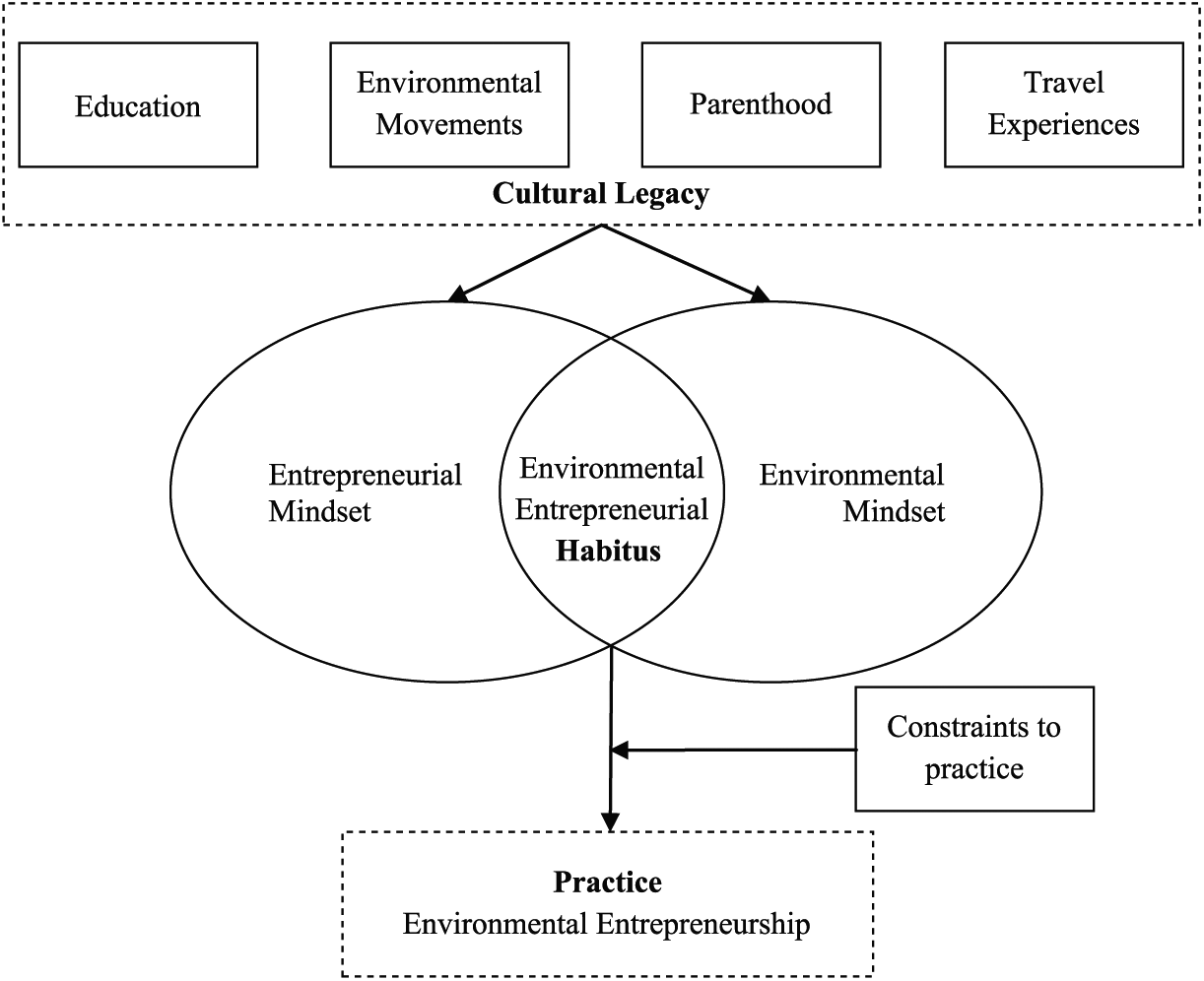
A practice theory view on the emergence of UK environmental entrepreneurs.
We expand on the work of Isaak (1998, 2010) and Schaltegger and Wagner (2008) who reflect upon environmental entrepreneurs driven by a distinct way of thinking and provide the basis for a systematic approach to defining the environmental entrepreneur through environmental and entrepreneurial dispositions. The habitus of environmental entrepreneurs constitutes an overlap of environmental and entrepreneurial mindsets. Our insights render the emergence of environmental entrepreneurs as a contextualised, cultural phenomenon.
Our analysis reflects education as a key field of cultural influence in the process of forming an environmental mindset. The experiences of our interviewees with education, however, were portrayed in a less optimistic and more complex manner than anticipated. Influential elements forming entrepreneurial disposition were identified in exposure to the environmental literature, educational fieldtrips and voluntary work within environmental student associations. These forms of exposure to environmental themes overlap with our insights on the role of environmental movements, confirming Schaltegger and Wagner’s (2008) suggestion that environmental movements contributed to the emergence of contemporary environmental entrepreneurs.
Our findings illustrate parenthood as a further antecedent of environmental entrepreneurial habitus. Evidence suggests that parenthood is perceived as a life-changing event in relation to which our respondents identified entrepreneurship as a meaningful way to tackle environmental issues. Finally, travel experiences constitute a novel theme in environmental entrepreneurship research. Being exposed to different natural environments during travels has shown to have a profound effect on the development of an environmental entrepreneurial habitus among our respondents.
Contribution to theory
Previous research on environmental entrepreneurs has been dominated by conceptual and quantitative approaches based on general assumptions about motivations. Our article corresponds to recent calls for further qualitative research which allows for the depiction of individual stories and experiences of environmental entrepreneurs (Hörisch et al., 2016). Our qualitative findings on cultural legacy and the environmental entrepreneurial habitus contribute primarily to our knowledge of the motivations, backgrounds, worldviews, value-systems and non-economic dimensions of environmental entrepreneurs.
Our core theoretical contribution is the introduction of theory of practice to environmental entrepreneurship research and the habitus approach to inform research about the environmental entrepreneurial mindset. Our approach enables us to comprehend how environmental entrepreneurs interpret their realities, form their distinctive way of thinking and highlight particular experiences which have culturally influenced this process. The focus on habitus expands our knowledge about the interaction between individual cognition (mindset), resources (forms of capital) and context (field of practice). Our findings contribute to emerging debates on the role of cultural capital in entrepreneurship research (Lee and Shaw, 2016; Pret et al., 2015), a previously under-researched form of capital (De Clercq and Voronov, 2009a).
We complement research on the role of education; shown in our study to not only influence the entrepreneurial mindset of our interviewees but also their environmental mindset. We argue that education influences not only the development of entrepreneurs, but also the type of entrepreneurs. Extant research documents how social and environmental movements shape a proactive framework for environmental entrepreneurship (Pacheco et al., 2010; Sine and Lee, 2009; Weber et al., 2008) by influencing key stakeholders such as policymakers and consumers and by inducing institutional change. Beyond that, our findings offer an insight into the forms through which the environmental movement has directly influenced the disposition of environmental entrepreneurs. Our article complements research by Mars (2009) on environmental movements at US universities by filling a regional gap and offering findings regarding experiences and influences of UK environmental entrepreneurs. We also identify the role of parenthood as an important disposition, providing additional insights as called for by Hörisch et al. (2016). The identification of travel experiences is a novel theme in entrepreneurship research, which contributes to our knowledge of the emergence of environmental entrepreneurs.
Implications for practice
For existing entrepreneurs, our study’s findings could complement a process of reflection and personal development. In addition, the diversity of our cases amplifies the significance of the field of practice in shaping environmental entrepreneurial dispositions. With the scope to foster the emergence of environmental entrepreneurs, the themes of education, environmental movements and travel experiences indicated that when combined, they can culturally shape the mindset of students. Therefore, policymaking agendas aiming for an increased supply of environmental entrepreneurs could embed opportunities for relevant experiences in school and university curricula.
Our findings support the importance of integration and synergy between academic departments in higher education. The versatility of academic backgrounds of our sample suggests that potential environmental entrepreneurs are not limited to business students but expand to students of disciplines with the skills to provide innovative solutions to environmental problems. To encourage the emergence of environmental entrepreneurs and entrepreneurial teams, business schools could explore ways to increase their collaboration with science faculties, offering knowledge and scientific skills which are potentially helpful for environmental entrepreneurial practice, as well as explore avenues to strengthen vocational skills across all disciplines.
Limitations and future research
As findings of naturalistic studies are time and context bound (Guba and Lincoln, 1989; Patton, 1980), our research is no exception and limitations apply in generalising the findings outside its context. Likewise, Bourdieu points at the prominent role of field in the theory of practice (Bourdieu, 1998; De Clercq and Voronov, 2009b). Nevertheless, the implemented MVS strategy reduces the impact of the uniqueness of our cases and establishes a degree of what Patton (1980) describes as ‘under conditions’ representativeness. While our sample did not aim to distinguish between different types of environmental entrepreneurs, future research could examine gender and type (social/commercial) specific differences among environmental entrepreneurs.
In our study, based on empirical findings we analyse four aspects of cultural legacy – education, environmental movements, parenthood and travel experience – which shape dispositions and habitus, guiding environmental entrepreneur’s practice. Future research could focus on the contribution of other forms of cultural legacy, on social capital, the constraints for practice and the characteristics of the field of practice. Although our findings are limited to cultural legacy, dispositions and habitus of environmental entrepreneurs, we encourage further research on the interplay of capital, the field and subfields – industry branches according to Bourdieu – of environmental entrepreneurial practice and the constraints environmental entrepreneurs face within their field. When identifying field-specific constraints to environmental entrepreneurial practice, future work could also attempt to systematically identify and discuss solutions to these constraints, for example, introducing institutions such as the Green Investment Bank in the United Kingdom to respond to limited availability of economic capital to environmental entrepreneurs. Bourdieu’s notion of social capital appears to have already generated substantial interest in the entrepreneurship literature (Chell, 2007; Lester and Cannella, 2006; Pearson et al., 2008). A stronger link between future research and other forms of capital might offer additional insights on the complex relationship with the environmental entrepreneurial habitus and enhance our understanding on how environmental entrepreneurs emerge and grow in their field of practice.
Footnotes
Funding
The author(s) received no financial support for the research, authorship, and/or publication of this article.