




Abstract
This editorial introduces the special issue on marginalisation and entrepreneurship. While entrepreneurship research has long examined the impact of economic deprivation and structural barriers, far less attention has been given to sociocultural elements of outsidership – such as status incongruence, class-based identity conflict or cultural misalignment, among other related facets. We bring these dynamics to the fore, offering a conceptually rich yet ideologically neutral lens through which to understand how outsider dynamics can shape entrepreneurial cognition, legitimacy and venture development. Further, by synthesising emerging work across fragmented literatures, we propose a research agenda that explores sociocultural outsidership not only as a source of constraint, but also as a potential source of creativity and differentiated value creation. In doing so, this issue expands the boundaries of entrepreneurship theory and invites new inquiry into the diverse experiences and approaches of entrepreneurial actors.
Keywords
Being an outsider is the one thing we all have in common – Alice Hoffman
Introduction
Entrepreneurship research has long embraced the archetype of the entrepreneur as an outsider looking in – those willing to step into the arena, create opportunity amidst uncertainty and push boundaries others take for granted (Bort and Totterman, 2023; Miller and Le Breton-Miller, 2017). Outsidership can take many forms, with the marginalisation that often stems from this creating particular hurdles. As the opening quote pithily hints, we are all outsiders in some sense, at some point or other in our journeys. Not all outsiders however, are cast from the same mould, and not all forms of marginalisation are equally well understood. To date, entrepreneurship research has tended to disproportionately emphasise overcoming economic marginalisation – involving poverty, resource deprivation or income inequality – as a core analytic lens through which outsider dynamics in entrepreneurship are studied (Bruton et al., 2013; Sutter et al., 2019). While vital, this has left other dimensions, particularly social and cultural forms of marginalisation, comparatively underexplored. Despite the widespread relevance for both theory development and practical insights surrounding how people overcome or leverage facets of their outsidership for entrepreneurial pursuits (Chowdhury et al., 2024), the body of knowledge remains fragmented.
Sociocultural marginalisation refers to the experience of outsidership stemming not from resource scarcity or access per se, but from a misalignment or perceived exclusion from dominant cultural norms, social identities or status-based expectations of mainstream society (Pidduck and Clark, 2021). For instance, this may include working-class entrepreneurs entering white-collar sectors, immigrants whose cultural schemas deviate from host-nation norms or religious, linguistic or regional minorities whose ways of being are considered peripheral to the majority norms. In the entrepreneurial context, such individuals are not necessarily financially struggling, but often operate in a state of symbolic, cognitive or affective ‘otherness’ in relation to mainstream entrepreneurial ecosystems or support networks. So, advancing understanding on how such processes and mechanisms made manifest, and navigated, adds some much-needed granularity to entrepreneurship theory and exposes blind spots in our legacy frameworks that tend to downplay the ‘soft’, i.e. sociocultural influences for aspiring entrepreneurs and over-emphasise the ‘hard’, i.e. economic/financial. Put differently, this special issue is not primarily interested in examining what one has, or who one knows, but rather how one navigates sociocultural marginalisation in ways that sheds light on entrepreneurial action more broadly.
We believe this is an overlooked tension in the literature that is important to address for several reasons. First, sociocultural marginalisation provides a distinct explanatory logic for understanding entrepreneurial behaviour. Whereas poverty-based research has developed useful framing tools and explanatory constructs such as necessity-driven entrepreneurship and resource bricolage (Baker and Nelson, 2005; O’Donnell et al., 2024), the sociocultural facets of outsidership, while appearing ostensibly similar in some superficial respects, includes a fundamentally distinct set of issues such as identity or role incongruence, interpersonal and political savvy, cultural intelligence, impression management, and the emotional strains of stereotype threats (Navis and Glynn, 2011; Pidduck, 2025; Simarasl et al., 2022), among others. It also opens up analysis of how cultural friction – between the entrepreneur’s background and prevailing norms – can shape opportunity recognition, legitimacy-seeking behaviour and strategic decision-making (Pidduck and Tucker, 2022). These nuances are simply not well captured in existing research and perspectives rooted in resource deficiency logics alone.
Second, by focusing on the forms of marginalisation relating to outsidership as we have defined it, we provide a generalisable lens for entrepreneurship researchers moving forward for studying such issues; in a way that sidesteps the over-politicisation that has plagued some of the recent discourse in both academia and the popular business press in recent years. Discussions of marginalisation in academia have, in some cases, become ideologically fraught – particularly when tied to group-identity politics or redistributive justice debates (Doyle, 2022). 1 Yet, sociocultural marginalisation as we conceive of it here is not aligned with any particular ideological programme nor restricted by one school of thought’s dogma or terminology policing. Instead, it invites analytic inquiry into how deviation from cultural centrality – whether by class, accent, education, religion, upbringing, values, or social norms – helps us to explain or predict entrepreneurial pathways and the ways in which new ventures are developed: for better or for worse. Indeed, we believe this is a much-needed endeavour at a time when academic debate and exploration of potentially sensitive topics demands both renewed scholarly neutrality and logical rigour (see Pidduck et al., 2025 for an extended discussion).
This editorial and special issue, therefore, aims to introduce sociocultural outsidership as a generative construct, one that holds theoretical utility for understanding important entrepreneurial processes and outcomes writ large, independent of any normative claims. Our interest lies, then, not in adjudicating what counts, or does not count, as marginalised according to preordained checklists, but in investigating how sociocultural misalignment manifests in entrepreneurial cognition, motivation, resource access or venture formation processes. In light of this framing, interesting questions arise, such as what novel competencies emerge from these outsider identities or experiences? How do such entrepreneurs adapt to – or resist – dominant norms in commercially constructive or novel ways? How do their experiences reshape the boundaries of what is considered legitimate or innovative within their entrepreneurial milieu? We invited submissions that sought to draw attention to the nuanced ways entrepreneurial actors can be positioned as outsiders – often invisible in wealth-based or demographic metrics alone. We hope this reframing enables entrepreneurship research to incorporate those whose values perhaps diverge from the dominant entrepreneurial mythos; not because they are marginalised in an activist. or moralised sense of the term, but because their vantage point reveals unexamined contours of the field itself.
Theoretical tensions and opportunities in studying sociocultural marginalisation
The concept of marginalisation has long served as a critical device in social science for identifying the mechanisms through which individuals and groups are excluded from dominant institutions, norms or resource flows (Bourdieu, 1984; Sen, 1999). Within entrepreneurship research, however, marginalisation has often been flattened into primarily economic terms – poverty, unemployment, lack of capital, etc., – rendering many of the sociocultural processes that can meaningfully permeate and shape entrepreneurial activity unseen, or at best, poorly understood. Yet, entrepreneurs do not operate in economic vacuums; they act within socially embedded contexts shaped by cultural meanings, status hierarchies and symbolic forms of inclusion and exclusion (Aldrich and Cliff, 2003; Granovetter, 1983), whether perceived or ascribed. A sociocultural lens allows scholars to probe how such factors – for example, class identities, cultural capital, speech codes, religious affiliation – filter not only access to resources but also the interpretation of opportunities themselves.
A growing literature on entrepreneurial identity and legitimacy construction has shown that conformity to dominant entrepreneurial archetypes – for example, the charismatic tech founder, the elite-networked innovator – is often crucial for resource acquisition, stakeholder buy-in and venture credibility (Fisher et al., 2017; Navis and Glynn, 2011). Entrepreneurs whose sociocultural backgrounds deviate from these norms must often engage in strategic self-presentation or narrative reframing to navigate these expectations successfully. This reveals a central theoretical tension: while entrepreneurship is valorised as a space for individual autonomy and disruption, it is simultaneously governed by culturally coded expectations that reward conformity to unspoken majority norms. Studying sociocultural marginalisation, then, enables scholars to uncover and theorise these paradoxes in ways that help us to understand new venture development in general. Moreover, sociocultural marginalisation highlights the symbolic boundaries of entrepreneurial ecosystems or support networks – those invisible lines that delineate who is perceived as credible, capable or even visionary (Lamont and Molnár, 2002). These boundaries are often maintained through subtle social cues, aesthetic markers or network gatekeeping rather than formal exclusion per se. For instance, first-generation college graduates or working-class professionals may possess the technical skills for entrepreneurship but simply lack the institutional habitus (Bourdieu, 1990) to fluently navigate the desirable entry-points to founding a venture, such as through elite accelerators or incubators, pitch competitions or angel investor communities. These dynamics are theoretically distinct from economic resource scarcity alone and require frameworks that centre cultural distance, not necessarily in the common cross-national sense of the term, and status incongruence as potentially valuable explanatory variables for predicting venture outcomes over time (Kim et al., 2015).
One promising avenue of theorising concerns the psychological and cognitive implications of sociocultural outsidership. Marginalised entrepreneurs often develop what psychology studies broadly term frame-switching or bicultural competencies – the ability to interpret social cues and operate across multiple cultural domains (Benet-Martínez et al., 2002; Morris et al., 2015). This may foster enhanced opportunity recognition in overlooked markets, novel problem framing or higher empathic accuracy – cognitive assets that can be characteristically entrepreneurial in nature (Pidduck and Clark, 2021). Theorising marginalisation as not merely a liability but a generative constraint aligns with emerging interest in paradoxical tensions within entrepreneurship (Ramoglou, 2021) and management more broadly (Smith and Lewis, 2011; Waldman et al., 2019) inviting models that account for both constraint and creativity within and across outsider identities. Importantly, the sociocultural approach resists binary classifications of entrepreneurs as either advantaged or disadvantaged. Many individuals navigate intermediate positions on complex social spectrums that can also be fluid and thus, malleable. For instance, they may have high educational credentials but face cultural or class background-based stigma, or economic privilege and stability but encounter religious or ideological outsidership. This calls for more granular theorising that captures how individuals simultaneously experience inclusion in some domains yet, exclusion in others. Entrepreneurship research would benefit from conceptual models that embrace this complexity, particularly in light of increasing societal mobility and diversification within entrepreneurial communities (Brändle et al., 2025), or those who see self-employment as a viable – or the only – path to prosperity.
Finally, the framing of sociocultural marginalisation can also contribute to revisiting and refining core, or what might perhaps be thought of as legacy, entrepreneurship constructs in reinvigorated ways. For instance, what does ‘entrepreneurial opportunity’ mean to someone whose cultural upbringing did not valorise risk-taking or individualistic self-promotion? Similarly, how do traditional constructs such as ‘self-efficacy’ or ‘entrepreneurial orientation’ manifest among individuals who have internalised social scripts of deference to tradition, humility or interdependence? (see Lumpkin and Pidduck, 2021 for an extended discussion). Further, and perhaps a more fundamental question, is what does individual competitiveness central to entrepreneurial proclivities look like when one is operating in a civilisation not steeped in adversarial institutional traditions? Specifically, success in politics, science and commerce in Western civilisation, by design, demands individual actors to rigorously engage with those they disagree with as a filtering mechanism for testing their ideas. In more collectivistic or honour-based civilisations, these deeply ingrained assumptions are simply not the same (Li, 2022). As such, the field of entrepreneurship has tended to overlook the much deeper foundational assumptions, rooted in culture, about what ‘being entrepreneurial’ means when stripped from the civilisational assumptions the term was conceived and popularised within. These questions are not simply demographic, but epistemological too, calling into question the universality of constructs developed within culturally narrow largely Western contexts. As such, sociocultural marginalisation is not merely an empirical variable to explain away or control for, but a theoretical provocation – one that can prompt entrepreneurship scholars to re-examine foundational assumptions and expand the field’s explanatory reach.
The articles in this special issue
We received many excellent submissions to the special issue in response to our call and appreciate the efforts of all author teams. However, while many of these manuscripts tackled interesting problems and helped advance knowledge in ways our call envisioned and tried to stimulate, we could ultimately only accept the few articles that probed the sociocultural marginalisation phenomena in the most theoretically and empirically rigorous of ways. We provide a brief discussion of these much-valued contributions below, before moving onto a more generalised reflection by the guest special issue team in the subsequent section, including some ideas for future research agenda that we deem to have the greatest potential in the coming years.
The first article, by O’Donnell et al. (2025) entitled ‘Informal Entrepreneurship and the Insidership-Outsidership Duality’ provides a theoretically rich and ethnographically grounded examination of how entrepreneurs in Nairobi’s Mukuru informal settlement navigate the paradoxical interplay between insidership and outsidership. Drawing on over four months of immersive fieldwork, the authors offer a compelling critique of the common binary framing of social inclusion and marginalisation by reconceptualising these categories as a duality – drawing on Giddens’s structuration theory to argue that insidership and outsidership are structurally inseparable and mutually constitutive. In doing so, the authors highlight how collective outsidership fosters forms of embedded solidarity that are vital to informal entrepreneurship. Specifically, the heterogeneity of embeddedness within marginalised communities is illuminated by exploring ethnic, gendered and generational substructures, helping to illustrate the limits and exclusions of solidarity, including how some entrepreneurs remain outsiders even within already peripheral contexts. O’Donnell et al. make a highly relevant and distinctive contribution to the special issue by focusing on the lived experience of marginalised entrepreneurs in a deeply deprived urban setting. This not only sheds light on the material realities of sociocultural exclusion processes in general but also probes how community dynamics can serve to both mitigate and reproduce facets of marginality. Overall, the article deepens our understanding of marginalisation not merely as an individual status but also as a relational and collective phenomenon, challenging the field to consider the nuanced ways in which marginalisation is experienced, resisted and even reproduced within ostensibly cohesive communities. Its reconceptualisation of marginality as a dynamic duality of insider–outsider positions adds some thought-provoking theoretical depth to the special issue’s aims, helping to move scholarship beyond static notions of entrepreneurial disadvantage towards a more processual and situated understanding of sociocultural embeddedness in peripheral contexts.
The article by Lazos and Shneor (2026), ‘Is Having Immigrants in Entrepreneurial Teams Good for Equity Crowdfunding Success and Long-term Venture Survival?’, presents a quantitative analysis of how sociocultural diversity affects venture performance. Drawing on a large dataset of 1171 UK-based crowdfunding campaigns, the authors examine the relationship between team composition, fundraising and survival. They find a non-linear, inverted U-shaped relationship where teams with either very high or very low immigrant representation tend to underperform in fundraising revealing that a higher share of immigrants correlates with lower long-term venture survival, an outcome the authors link to a tendency towards under-capitalisation. This study adds a precise, data-driven perspective to discussions of financial democratisation. Rather than treating immigrant entrepreneurship as a single category, the authors disaggregate the effects of team composition to show tangible and sometimes contradictory outcomes. Their findings complicate the narrative that crowdfunding inherently levels the playing field, showing how a team’s collective risk-attitude and social capital shape strategic choices, which in turn mediate crowdfunding outcomes. This article provides an impressive empirical account of what this special issue has dubbed the double-edged role of marginalisation, where the very makeup of a team can both unlock resources and constrain long-term success.
The article entitled ‘The Effect of Social Exclusion and Aggregation on Firm Performance: Empirical Evidence From Entrepreneurial Teams Managed by Minority Italian Entrepreneurs’ by Matricano and Muldoon (2026) analyses the under-studied question of how direct-tie social exclusion – i.e., absence of links to the dominant group- versus aggregation – i.e., alliances within one’s own marginalised group, shape the performance of minority-led start-ups. Anchoring its hypotheses in network theory’s distinction between direct and indirect ties and the idea that identity-based trust governs resource flows, the study tests seven propositions across women, young and ethnic founders using a micro-level panel of 11,985 Italian innovative start-ups. It applies stochastic frontier analysis to disentangle technical from random inefficiency, modelling performance as capital-turnover efficiency conditional on R&D spending, specialised researchers and patents. The findings show that social exclusion depresses returns to R&D inputs, whereas varying degrees of intra-group aggregation can restore or even amplify them – though the mechanisms differ by demographic profile. By demonstrating that aggregation’s benefits hinge on patenting, researcher intensity and ownership concentration, the article reframes social exclusion as a relational rather than purely structural constraint and positions aggregation as an endogenous entrepreneurial strategy, thereby extending network-embeddedness and marginalised entrepreneurship perspectives into the efficiency domain. Through this study, the authors offer a large-scale, statistical analysis complement to the predominantly qualitative, agency-oriented work in this domain. Its cross-group comparison clarifies when aggregation is a boon such as in instances of strong ownership among women or young teams, and when it risks reinforcing enclave lock-in where there is, for example, exclusive ethnic ownership thus, nuancing the issue’s central theme that marginalisation is not monolithic but dynamically negotiated through network choices. Moreover, the insight that trust and reciprocity simultaneously boost efficiency yet may heighten outsider distrust invites scholars to probe second-order consequences of solidarity strategies, while its policy implications – support aggregation without crowding out intergroup bridges – speak directly to the special issue’s translational ambitions.
The article ‘Barriers, Constraints, and Entrepreneurial Action: The Case of Nascent African American Entrepreneurs’ by Sirivar and Warhuus (2026) is a qualitative study, based on interviews with 41 nascent African American entrepreneurs that examines the concrete actions these founders take in response to systemic barriers. The authors find that in their sample of minority entrepreneurs severe resource constraints often compel specific strategies. Instead of scaling a single venture, they strategically create and manage multiple small businesses to achieve financial stability and navigate a difficult institutional environment. Sirivar and Warhurst challenge linear, universal models of venture development; their work illustrates how the distinct positionality of African American entrepreneurs may foster a non-traditional approach to value creation and survival, expanding the conceptual boundaries of entrepreneurial action itself.
The article entitled ‘Layers of Marginalisation: Transition from Hardship to Entrepreneurship’ by Irwin et al. (2026) examines how an underserved group navigates the compounded hardships of gender bias, disability and financial struggles. Specifically, Irwin et al. investigate the intersectional nature of outsidership with a qualitative study of women veteran entrepreneurs. Applying Schlossberg’s 4S (situation, self, support and strategies) transition model, the authors argue against viewing hardship as a singular event, conceptualising it instead as a dynamic and multi-layered process. Their findings suggest that a successful transition hinges on a complex interplay of personal history, available support and the strategic use of prior experiences and self-care. This work provides a fine-grained, process-oriented account of navigating multiple, overlapping forms of marginalisation. Irwin and colleagues move beyond simply identifying a disadvantaged group to analysing the nuanced process of their transition. Their study details the resilience and adaptive strategies that enable entrepreneurial emergence amidst compounded adversity. They also highlight the importance – moving forward in this research area – for entrepreneurship scholars to meet entrepreneurs in such contexts where they are in life; and as such, to learn from studying them as individuals too, not solely as business owners engaged in some form of commercial activity alone.
Finally, in Suseno et al. (2026), ‘I Am a Migrant Entrepreneur and I Can Make it: Enabling Identities to Overcome Marginalisation’ addresses the persistent yet under-explored question of how migrant entrepreneurs actively use identity work to counter the structural, relational and sociocultural barriers that marginalise them in host-country markets. Grounded in the identity-work perspective and re-categorisation theory, the authors develop a three-part typology – identity construction, mobilisation and recategorisation – that explains how entrepreneurs strategically shift, combine and re-signal their multiple identities to gain legitimacy and resources. Empirically, their study relies on an interpretive, qualitative design comprising semi-structured interviews with 38 foreign-born owner–managers operating across Australia; purposive and snowball sampling secured diversity, and Gioia-style coding generated first- and second-order themes leading to the proposed model. The core contributions are to migrant entrepreneurship theory, by reconceptualising marginalisation as multidimensional; reframing migrant founders as agentic actors capable of leveraging identity fluidity; and by introducing re-categorisation as a mechanism that extends identity-work scholarship beyond construction towards dynamic re-grouping processes. Their article offers an insightful exemplar of agency-focused theorising by mapping the interplay between three distinct forms of marginalisation and three corresponding modes of identity work, it provides a clear heuristic other authors can mobilise to probe different contexts, populations and levels of analysis. Its Australian setting broadens geographic coverage, while the recategorisation lens opens a fresh agenda for examining how entrepreneurs re-draw in-group/out-group boundaries – an insight that resonates across the issue’s themes of stigma, othering and resistance. Consequently, this study not only deepens our understanding of the lived experiences of migrant entrepreneurs, but it also advances the special issue’s overarching goal of moving the field beyond deficit narratives towards nuanced accounts of how marginalised actors actively reshape the venture creation landscape.
Reflections and promising future research agendas
The contributions included in this special issue collectively demonstrate that sociocultural marginalisation is not a mere backdrop, but is a constitutive condition that shapes how entrepreneurs perceive opportunities and mobilise resources to develop legitimacy and thrive as business owners. The broader goal of our guest editorial team, though, was also to draw what we consider to be much-needed scholarly attention to the social and cultural facets of marginalisation discussions in entrepreneurship research – to lay a foundation for what we trust will be an ongoing and evolving conversation. Amidst the insights developed over the years focusing on understanding poverty, institutional and resource gaps and structural disadvantages grounded in group identity – for example, race, gender etc., the social and cultural elements undergirding outsidership that we have tried to shed light on in this editorial have historically tended to be overlooked. Notwithstanding, the contribution of these articles, there remains many other fruitful avenues in this area that we believe warrant some discussion and thought-provocation. Specifically, several ongoing and embryonic streams of entrepreneurship research provide particularly helpful lenses from which to learn more about sociocultural outsidership, but in ways that speak to deeper unresolved research questions in the field. For example, the recent growth in interest surrounding social class in entrepreneurship (Brändle and Kuckertz, 2023; Brändle et al., 2025); cross-cultural psychology (Stephan, 2020; Vandor and Franke, 2016), religion and entrepreneurship ( Smith et al., 2021, 2023) and the heuristic and biases within entrepreneurial cognition (Busenitz and Barney, 1997; Zhang et al., 2021) all remain currently disconnected from studies focused on outsidership and marginalisation; they are however, well-placed to generate constructive insights. In the following sections, we introduce and distil where we believe some of the most intellectually generative potential now lies and discuss the kinds of questions, designs and theoretical approach that will push scholarship in this domain forward. These are by no means intended to be exhaustive, or definitive, but rather illustrative for scholars in this general area.
Social class
Social class research suggests there is great utility in studying class backgrounds and statuses as lived habitus rather than a static demographic label. Classed dispositions – speech codes, tastes, non-verbal cues – mediate entry into and navigation of elite entrepreneurial arenas (Bourdieu, 1984, 1990; Fisher et al., 2017). Future research could generate considerable insight by tracing ‘class travel’ across the entrepreneurial life course, mapping how upward or downward mobility might realign the risk thresholds of founders, pivot timing or narrative strategies (Brändle et al., 2025). Ethnographic and audit studies are helpful in this regard for uncovering, for instance, the subtle gatekeeping of pitch days and incubators, where accents or sartorial cues trigger differential scrutiny (Kim et al., 2015; Lamont and Molnár, 2002). Most would accept that such interpersonally tacit phenomena clearly matter, invarying degrees, to the successful navigation of most workplaces; yet, entrepreneurship research has overlooked the manifestation and influence of these subtle processes almost entirely. For instance, in the British context, Friedman and colleagues found that the concept of ‘polish’ – i.e. perceived presentability and professionalism of potential employees – in the professions tended to amount to what are essentially traditional British middle-class learned informalities which alienate potentially talented employees who were not socialised into such tacit expectations 2 (Friedman and Laurison, 2020) – while startups were not included in their data, one could deduce that the same dynamics are likely to apply to those seeking employment in entrepreneurial contexts too. In one sense, these are clearly disadvantages, but in other ways, they could provide novel competitive advantages too. Entrepreneurship scholars could probe these overlooked yet influential microprocesses, for instance, by specifying when working-class frugality and improvisation might translate into more substantive or enduring strategic advantages – and the degree to which these dynamics might reach a point in which they start to inhibit such constructive outcomes. By theorising class incongruence and status shock, we gain insights into how founders reconcile potentially conflicting evaluative standards such as snobbery, for instance, and how policies or training interventions actually reduce interpersonal tensions without erasing potentially distinctive value propositions (Navis and Glynn, 2011; Simarasl et al., 2022).
Cross-cultural psychology
Cross-cultural psychology offers an equally powerful micro-foundation for understanding marginalisation. Classic national culture accounts (Hayton et al., 2002; Stephan and Pathak, 2016) can oftentimes run the risk of obscuring salient within-country heterogeneity that many marginalised entrepreneurs navigate daily. Constructs such as bicultural identity integration, cultural frame switching, and cultural tightness–looseness (Benet-Martínez et al., 2002; Gelfand et al., 2006; Morris et al., 2015) let us model how entrepreneurs from a very distinct cultural milieu can leverage potential translation tensions as a cognitive capability (Clark et al., 2022). Moving forward, entrepreneurship researchers would gain such insights by measuring explicitly how frame-switching breadth or comfort with intercultural dissonance predicts creative recombination, new venture ideation, or even fundraising outcomes (Pidduck et al., 2024). Experimental priming and diary methods might reveal whether activating different cultural schemas changes risk judgements or moral evaluations of opportunity pursuit, and whether intercultural tension buffers stereotype threat or simply heightens impression-management fatigue. Team-level studies can also unpack how founding groups decide which cultural scripts to foreground in high-stakes moments, and what performance penalties arise from misalignment. In treating cultural frame-switching as an entrepreneurial capability rather than a demographic or general individual difference issue to ameliorate, we sharpen explanations for why some outsiders excel at boundary spanning – and generate entrepreneurial value – while others burn out.
Religion and entrepreneurship
The role of religion and faith in entrepreneurship likewise warrants theorising as both a source of potential resources and constraints (Tucker and Croom, 2021). In recent years, a burgeoning subfield has emerged around what Smith et al. (2023) coined ‘a theological turn in entrepreneurship’, that is, recognition by scholars that despite a largely secular academe, the vast majority of the global population (80%) adheres to, or is at least nominally affiliated with, a religion of some sort. Smith et al. (2023) suggest that while individuals in our entrepreneurship studies and samples may not be overtly religious, nor do the focal variables explicitly ask about anything religious, we simply cannot overlook the deeply permeating role religion plays in shaping the institutions, culture, ethics and assumptions within which all entrepreneurs operate. While many streams within this subfield are promising for advancing work on marginalisation and outsidership in entrepreneurship, some notable themes include community-based structures among founders. For instance, congregations or faith-based networks provide moral legitimacy, foster dense trust ties and sometimes financing help; overt religious signalling however, may also run the risk of alienating secular investors or appear to clash with dominant market logics (Balog et al., 2014; Gümüsay, 2015). Thus, scholars could unpack these issues by delineating which religious resources – rituals, sacred narratives of calling, stewardship doctrines, etc., – map onto which entrepreneurial outcomes – such as: opportunity identification, resilience, ethical decision-making etc., and under what institutional conditions (Chowdhury et al., 2024; Sutter et al., 2019). Multilevel designs, for instance, can help to link community religiosity to regional venture formation, while qualitative case approaches are more effective at capturing lived theology in action and how entrepreneurs claim they draw on elements of their faith to succeed. Moreover, investor-facing experiments may also clarify how ‘sacred versus secular’ ethical framings affect legitimacy attributions or perceived pro-socialness. The identity-work literature on legitimate distinctiveness (Navis and Glynn, 2011) provides a platform in this regard for examining how founders curate faith signals across heterogeneous, or even hostile, audiences. Finally, religious practices themselves – for example, Sabbath-keeping, fasting, tithing – merit investigation in entrepreneurial contexts as temporal or financial heuristics that discipline spending, pacing and goal-setting. Such work can help move us beyond romantic or dismissive treatments of faith towards a precise account of how faith and market logics are braided in marginal entrepreneurial practice.
Entrepreneurial decision-making and heuristics
Decision-making heuristics and dispositions are undoubtedly influenced by the socialisation experiences of founders (Neff et al., 2025). Decades of behavioural economics and psychology studies have catalogued the prominent biases that shape commercial activity (Thaler, 2018; Tversky and Kahneman, 1974), along with distinctly entrepreneurial biases too such as overconfidence and over-representativeness (Busenitz and Barney, 1997). Yet, knowledge remains limited to date that helps specify how aspects of sociocultural marginalisation might imprint ‘fast and frugal’ decision-making heuristics – or indeed any that are fundamental to being entrepreneurial . For example, building on Gigerenzer’s adaptive toolbox view (Gigerenzer and Gaissmaier, 2011) and integrating effectuation and bricolage perspectives (Baker and Nelson, 2005; Sarasvathy, 2001), a promising angle for future research would be to identify outsider-specific heuristics – for instance, assumptions relating to the need to diversify income streams, a distrust of formal finance or personal career or financial precarity – and then test when they enhance venture robustness versus impede performance. Process-tracing methods, for example, think-aloud protocols, eye tracking, cognitive maps (schema) and agent-based simulations allow fine-grained comparisons between outsider and mainstream decision architectures (Shepherd et al., 2015; Waldman et al., 2019). Paradox theory (Smith and Lewis, 2011) is also again helpful here as it can provide a frame to understand how marginalised founders learn to live with enduring tensions – authenticity versus conformity, prudence versus boldness, etc., – without collapsing into inhibiting either-or solutions. A natural implication of such research would then be how entrepreneurial training or interventions deserve re-visited scrutiny; raising questions such as: which pedagogies recalibrate maladaptive heuristics while preserving the speed advantages of intuition?
Moreover, another noteworthy aspect of applying heuristics and biases lenses to better understand outsider entrepreneurs lies in harnessing the predictive utility such experimental approaches provide us with. The explanatory utility of our theories and research on entrepreneurship is of course important (i.e. aiming to understand why entrepreneurs do what they do) and qualitative research is apt to deliver on this, but arguably the most under-utilised element in the behavioural economics movements in recent decades is that entrepreneurship scholars could help to identify cognitive nudge interventions which influence entrepreneurial behaviour on a mass scale. Indeed, Thaler’s (2015) pioneering work, not only led to a Nobel prize, but was also enthusiastically taken up by governments around the world. Britain, for instance, established a ‘nudge unit’ under David Cameron’s leadership (in 2010) and was intended to explicitly draw on heuristics and biases research to incentivise economic activity in cost-effective ways. While this was applied to things such as getting people to pay taxes on time, or reducing employee turnover by preventing burnout, applications to entrepreneurship were (curiously) missing. In nations with stagnating economies, low-productivity and declining real term wages, drawing on such research may help us to better understand the psychological ways governments can ‘nudge’ capable people into entrepreneurial pursuits. With comparable metrics at the turn of the century, Britain and the United States have since diverged economically, with many perplexed as to how such culturally close countries, with shared institutional values, can differ so greatly in terms of entrepreneurial vitality. Is trying one’s luck at entrepreneurship baked into the American psyche such that it is believed that ‘anyone’ can try this? Is there a ‘know-your-place’ cultural hangover in Britain that fundamentally dampens perceptions of ‘who’ can and should pursue entrepreneurial careers? Viewed through this lens, it may be the case that heuristics related to population differences in risk-taking or fear of failure could explain some of this gap – and most critically, provide entrepreneurship scholars with an important real-world application to figure out how to ‘nudge’ people into productive entrepreneurial paths.
Moving forward
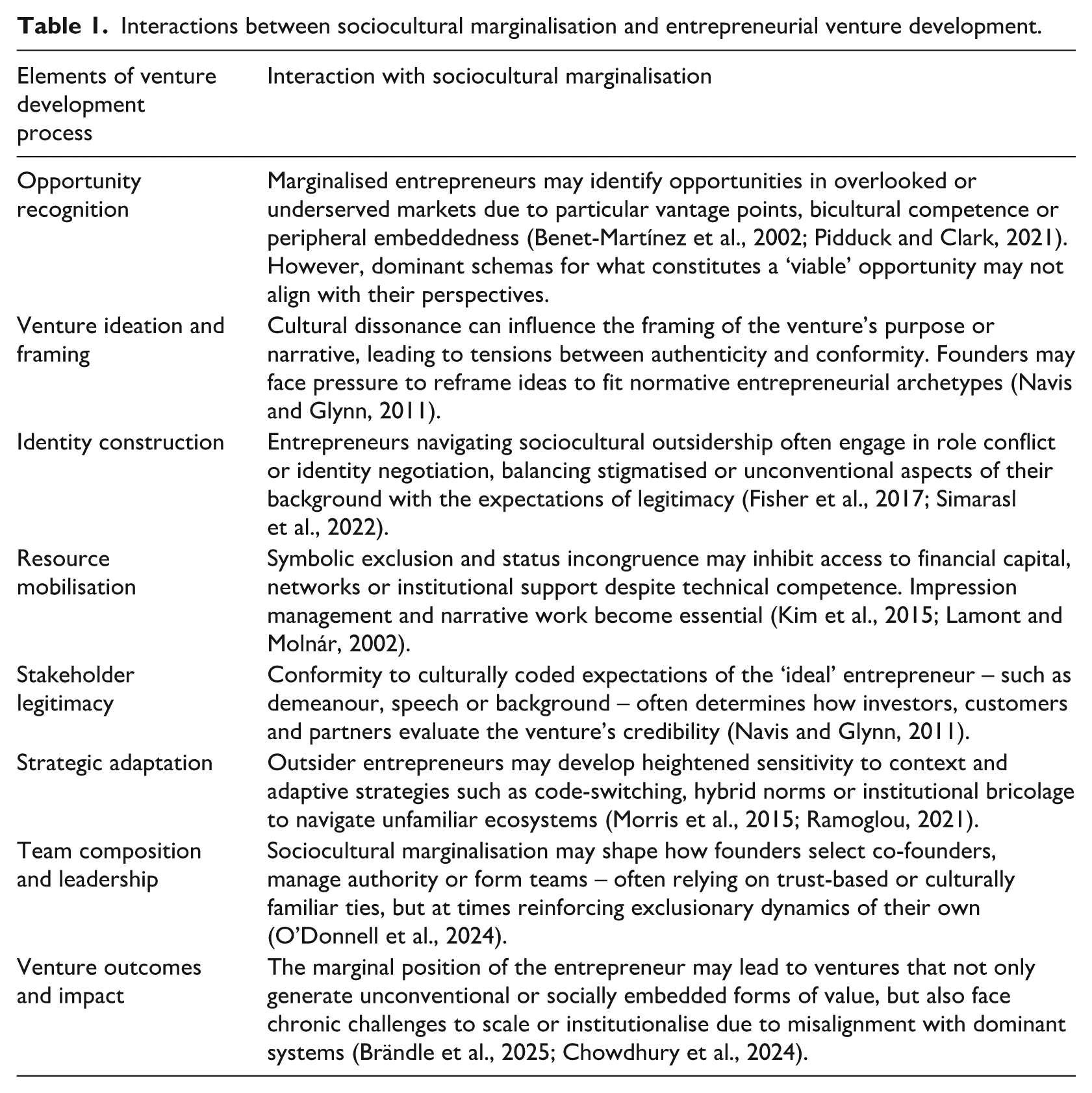
We provided what we deem to be four pertinent areas of research currently aiding entrepreneurship researchers to better understand the contexts that shape how people think, feel, and behave, and by extension, how these have implications for new venture development. Again, while there are many other streams and subfields that, combined with a focus on sociocultural outsidership, enrich our understanding of when marginalisation helps or hinders entrepreneurship, we simply provide these as especially illuminating suggestions. There are of course many other promising lenses or adjacent research disciplines to draw on, too. Indeed, moving forward, we encourage readers of this special issue who are interested in advancing the agenda to first take stock of the facets of the new venture development process that are likely influenced by forms of marginalisation. In Table 1, we illustrate some examples and believe that reflecting on specific parts of venture development is a fruitful launch-point for designing studies that advance knowledge on the nitty-gritty of these processes.
Interactions between sociocultural marginalisation and entrepreneurial venture development.
Conclusion
The contributions in this special issue collectively highlight the need to move beyond reductionist accounts of marginalisation that treat it solely as a matter of economic or resource deprivation. Instead, they reveal the textured ways in which sociocultural misalignment manifests itself across entrepreneurial journeys, shaping not only access to all forms of capital – for instance, social, financial, and cultural, but also patterns of aspiration, identity navigation, and legitimacy construction. The featured articles do more than identify who is marginalised – they question how marginalisation operates in context, how it is experienced differently across institutional or cultural settings, and how it can sometimes become a wellspring of strategic agency or embedded solidarity (O’Donnell et al., 2026). By taking seriously the symbolic, emotional, and performative aspects of entrepreneurial life, these articles make visible a terrain that has long remained under-theorised within entrepreneurship research. As such, they contribute to the reframing of sociocultural outsidership as an analytically generative construct – one that reveals not only the constraints of deviation from dominant norms but also the novel ways such deviation can be leveraged for venture creation and identity work (Navis and Glynn, 2011; Pidduck, 2025).
We hope this special issue catalyses a deeper and more theoretically ambitious conversation about what it means to be an outsider in the entrepreneurial domain. Future research might take up this challenge, in many fruitful ways as discussed above, but especially by developing longitudinal studies of identity adaptation, behavioural economics or psychological experiments, or even ethnographies that trace how marginality is enacted, negotiated, or subverted in daily entrepreneurial practice (Lamont and Molnár, 2002; Simarasl et al., 2022). Perhaps the most immediate ‘low-hanging fruit’ for scholars in the coming years lies in revisiting long-standing constructs – such as opportunity recognition, hustle, alertness, entrepreneurial orientation, or institutional fit, among many others – in light of how they are refracted through the lived experiences of those navigating cultural distance or symbolic exclusion. Ultimately, our aim is not to reify marginalisation as a fixed status category, but to encourage scholars to investigate the layered and sometimes contradictory positionalities entrepreneurs inhabit. In doing so, we believe the field can move towards more context-sensitive theory and a richer understanding of how entrepreneurial agency unfolds at the intersection of culture, identity, and structure.
Footnotes
Funding
The authors received no financial support for the research, authorship, and/or publication of this article.
