




Abstract
This editorial introduces the Special Issue on the darker dimensions of digital entrepreneurship. While digitalization has been widely associated with opportunity, empowerment, and innovation, the contributions in this issue demonstrate how it simultaneously produces constraints, asymmetries, and unintended consequences that complicate these optimistic narratives. Taken together, the five articles explore paradoxes within digital business models, consider the social and economic dimensions of platform-based work, and reflect on the evolving futures shaped by emerging technologies in entrepreneurial ecosystems. This highlights the need for more developed theoretical perspectives capable of capturing both the opportunities and the constraints inherent in digital entrepreneurship. Although the extent to which these darker dimensions are explicitly addressed varies across the articles, each offers important insights into the frictions and contradictions that characterise digitally mediated entrepreneurial activity. In bringing these perspectives together, this Special Issue advances a more critical understanding of digital entrepreneurship, moving beyond celebratory accounts to engage with its socio-technical complexities. The editorial situates the Special Issue within the broader literature, introduces the individual contributions, and outlines a future research agenda.
Introduction
Digital entrepreneurship has undergone a profound evolution over the past decade, transforming the ways in which entrepreneurial actors identify opportunities, mobilise resources, and orchestrate value creation in technology-mediated contexts (Audretsch et al., 2023; Nambisan, 2017). The expanding pervasiveness of digital technologies has not only reconfigured entrepreneurial processes but has also enabled novel modes of venture emergence (Sitaridis and Kitsios, 2024). Prior scholarship demonstrates that digital technologies significantly compress the temporal and cognitive burdens associated with opportunity ideation and evaluation (Elia et al., 2020), while simultaneously fostering new venture forms characterised by distributed agency, non-linear organisation, and increasingly permeable socio-technical boundaries (Autio et al., 2018). Digital entrepreneurship has been heralded as a new frontier of entrepreneurial activity, notably reducing traditional barriers such as limited access to resources and gender discrimination, while also enabling platforms that support free expression for community builders and influencers (Castelló et al., 2026; Troise et al., 2022a). Influential digital ventures have profoundly reshaped society, reconfiguring individual behaviors, organisational practices, and broader patterns of social interaction (Nambisan, 2017). The evident pervasiveness of GAFAM 1 firms should not obscure the significance of smaller yet, still highly influential digital enterprises, which either use them as enablers (e.g., influencer-entrepreneurs and app creators) or have been integrated into their ecosystems through acquisition (e.g., YouTube by Google and Instagram by Meta; Cutolo and Kenney, 2021; Nambisan and Baron, 2021). At the same time, entrepreneurial activity within established organisations is increasingly through digitalization processes, aimed at enhancing operational efficiency, improving employee wellbeing and work-life balance, and strengthening overall organisational performance (Abubakre et al., 2021; Kallmuenzer et al., 2025; Ladeira et al., 2019). Collectively, these developments have fundamentally reconfigured the ways in which individuals work and live.
However, emerging research has begun to complicate early assumptions regarding the inherently democratizing effects of digitalization (Berger et al., 2021). Rather than uniformly reducing barriers to entrepreneurial participation, recent studies highlight the persistence and in some cases amplification of structural inequalities, algorithmic forms of bias, and dependencies on platform-governed infrastructures (Heizmann and Liu, 2022; Martinez Dy et al., 2017; Nambisan, 2017). The increasing reliance of digital entrepreneurship on the extraction and mobilisation of user data has prompted policymakers to develop regulatory frameworks governing data use, most notably the European Union’s General Data Protection Regulation, alongside comparable initiatives in the United States. Individual interactions within and across organisations have been profoundly reconfigured by digitalization, frequently displacing direct human engagement with technologically mediated forms of communication (Mazmanian et al., 2013). Although social networks have transformed communication in many positive ways, their more problematic dimensions, particularly those related to surveillance, addiction, and data exploitation, are increasingly visible through contemporary media representations. Documentaries, such as The Social Dilemma, The Social Trap: 5 Women vs the Big 5, and Kidfluencer, alongside the growing visibility of litigation concerning the addictive properties of certain platforms, have brought these issues to the forefront. At the same time, several dimensions of digital entrepreneurship remain underexplored, including the ethical implications of big data and the reproduction of existing social inequalities (Cutolo and Kenney, 2021). These insights demonstrate that digital entrepreneurship unfolds within socio-technical ecosystems that redistribute agency in uneven ways, particularly along gendered and structural lines (Kelly and McAdam, 2025; Nambisan, 2017), raising critical questions about who is empowered, who is excluded, and under what conditions. More broadly, this highlights the relative neglect of the societal implications of digital entrepreneurship, particularly in a context where businesses are increasingly expected to contribute to the public good (Randerson, 2023; Witesman et al., 2023).
Hence, while prior research has enriched theoretical understandings of digitally enabled entrepreneurship (Cutolo and Kenney, 2021; Nambisan, 2017), it simultaneously reveals persistent tensions associated with dispersed agency, platform dependency, and the erosion of conventional organisational boundaries. Taken together, these strands of work point to a growing misalignment between the rapid evolution of digital technologies and their adoption and the conceptual frameworks available to analyse them. As such, there is a need for more robust theorisation that can account for both the generative and the problematic dimensions of digital entrepreneurship. The contributions within this Special Issue respond directly to this imperative. The articles interrogate the tensions embedded within digital business models, unpack the social ramifications of platform-based labor and venture formation, and speculate on future trajectories shaped by emergent technologies. Through this collective scholarly engagement, the Special Issue seeks to advance a more reflexive and theoretically generative understanding of digital entrepreneurship, one that attends not only to its innovative potential but also to the socio-technical frictions, contradictions, and dilemmas that accompany contemporary digital transformation.
Aim of editorial
As digital technologies increasingly disrupt established business configurations, it is critical to analyse their wider impacts on individuals, economies, and societies (Randerson and Estrada-Robles, 2023). As Corvello et al. (2022) and Troise et al. (2022b) observe, the digital revolution continues to fundamentally transform entrepreneurial activity, accelerating opportunity creation while simultaneously intensifying uncertainties and ethical dilemmas. While these developments offer exciting possibilities, they also raise questions linked to power asymmetries, governance, and precarity in digital environments. It is these questions that this Special Issue sought to address by offering the opportunity to stimulate scholarly conversations around the multifaceted challenges that may arise in the digital entrepreneurship realm.
Topic overview and rationale for the special issue
This Special Issue offers a curated collection of articles that together reveal that digitalization, while often positioned as a catalyst for opportunity, also generates new layers of complexity that fundamentally challenge established understandings of entrepreneurship. What unites the perspectives offered in this Special Issue is a commitment to expanding the boundaries of entrepreneurship scholarship by highlighting dimensions of the digital landscape that remain insufficiently explored. Their insights invite the field to adopt a more critical lens, one capable of capturing the tensions, contradictions, and systemic consequences that accompany the rapid digital transformation of entrepreneurial activity. This Special Issue aims to serve as both a reflection on current developments and a foundation for continued research into the multifaceted and, at times, problematic realities of digital entrepreneurship. The contributions engage with several of the topics proposed in the Call for Papers, including paradoxes of digital entrepreneurship, the dark side of digital entrepreneurship, unintended consequences, and the specific challenges associated with social media entrepreneurship. Taken together, these topics may be conceptually positioned into three overarching themes that provide the analytical structure for our discussion: Ecosystems and Platforms as Shapers of Entrepreneurial Conditions and Dependencies (Theme 1); Digitalization as a Transformative Process Involving Identity and Relational Negotiation (Theme 2); and Enablement and Precarity as Two Sides of the Same Digital Coin (Theme 3). Some topics from the original Call for Papers, such as ethical dilemmas, work-life balance, and digital divide and social inequality, remain largely unaddressed in the selected articles and are therefore, included in the future research agenda.
Presentation of the articles
Below we present each of the articles included in this Special Issue, highlighting their main contributions and, for each, key insights from the research. The articles cover a range of geographical locations, methods, and theoretical frameworks (see Table 1 for an overview).
Key features of articles in the special issue.
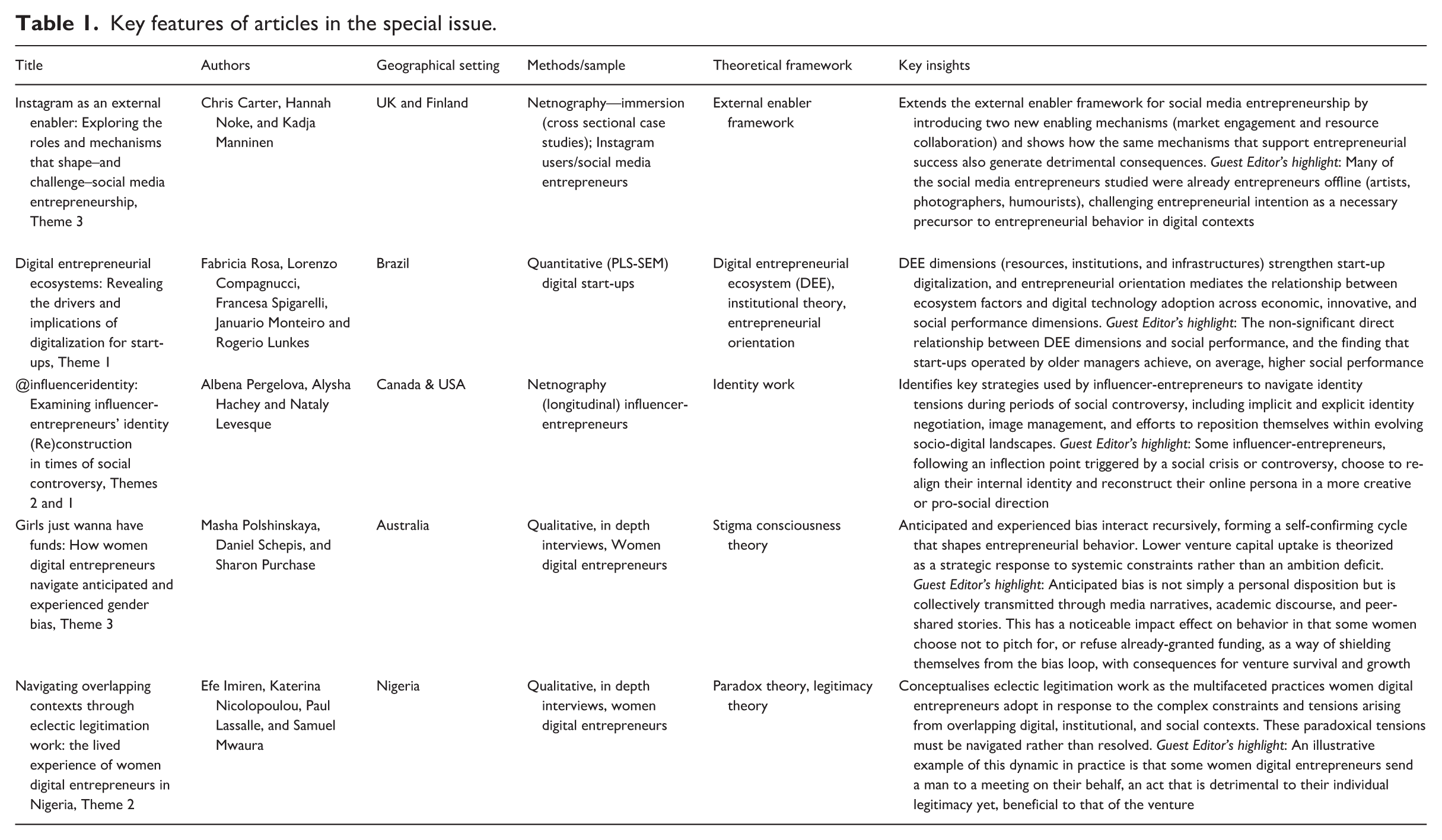
We open with the article that probably most directly captures the paradox at the heart of this Special Issue: that the very forces enabling digital entrepreneurship are inextricably intertwined with its detrimental consequences. Carter et al. examine Instagram as an external enabler of social media entrepreneurship, adopting a process-oriented lens to explore how and when enabling mechanisms are activated by social media entrepreneurs through their use of Instagram, and how and when detrimental effects of entrepreneurial activity on Instagram relate to these enabling mechanisms. Drawing on 15 case studies, the authors show that many entrepreneurial ventures arise unintentionally and serendipitously, questioning prevailing assumptions about deliberate opportunity identification. They offer a valuable extension of the external enabler framework for social media entrepreneurship, showing that compression and conservation mechanisms were subdued or absent in the data, while expansion and combination mechanisms were prevalent, and introducing two new enabling mechanisms, market engagement and resource collaboration, which influence how entrepreneurs develop products, engage resources, and interact with audiences. The context of social media entrepreneurship offers specific forms of enhanced outcomes, including core marketing, brand partnerships, and commissions. These same mechanisms however, also intensify emotional demands, relational pressures, integrity concerns, and anxieties over losing control of the venture, in particular as a consequence of a change in the algorithm or user policy by the hosting platform. By uncovering these tensions, the article extends the external enabler framework and highlights the inseparability of Instagram’s enabling forces from the dark side of social media entrepreneurship. It thus, offers a process-oriented contribution to this Special Issue by illustrating how the very mechanisms that support entrepreneurial success can also generate detrimental consequences. We draw particular attention to a finding that challenges a foundational assumption of entrepreneurship research: many of the social media entrepreneurs studied were already entrepreneurs offline (artists, photographers, humorists) whose activity on Instagram emerged alongside, rather than in place of, their existing ventures. This insight challenges the role of entrepreneurial intention as a necessary precursor to entrepreneurial behaviour in digital contexts. Furthermore, the extended external enabler framework provides a valuable lens through which educators can understand both the enabling and the detrimental dimensions of social media entrepreneurship. The authors demonstrate that what makes Instagram enabling is precisely what makes it precarious: entrepreneurial agency is real, but it is co-constructed with a platform that can shift its mechanisms without warning. This raises the question of what ecosystem conditions can sustain start-up digitalization, and how far their reach extends.
Rosa et al. contribute to this Special Issue by examining the drivers of start-up digitalization and their effects on economic, innovative, and social performance. Integrating the Digital Entrepreneurial Ecosystem (DEE) framework with institutional perspectives on ecosystems, the authors employ structural equation modeling to test their hypotheses using data from 206 Brazilian start-ups. Their findings show that DEE dimensions, namely resources, institutions, and infrastructures, significantly enhance the digitalization of products, services, and internal processes, although the relevance of these effects may vary across contexts. The article also extends the entrepreneurial orientation concept by revealing its mediating role: innovation, proactivity, and risk-taking strengthen the influence of ecosystem factors on the adoption of digital technologies, and as digital tools are adopted and entrepreneurial orientation internalised, positive effects can also be observed in the social domain. Overall, this article enriches current debates by framing digitalization not merely as a technological upgrade but as an outcome shaped by the dynamic interaction between ecosystem conditions and entrepreneurial behavior. An unexpected aspect of this article is the non-significant relationship between DEE dimensions and social performance. At a time when sustainability and stakeholder engagement are increasingly embedded in digital businesses as drivers of societal transition (Randerson and Estrada-Robles, 2023), this finding is surprising and warrants further attention. An additional noteworthy finding is that start-ups operated by older managers achieve, on average, higher social performance. Rosa and colleagues show that ecosystem resources, institutions, and infrastructures reliably support the digitalization of start-ups, and that entrepreneurial orientation amplifies this effect. The model, by design, however, captures structural configurations rather than the experience of operating within platform-dependent ventures. Pergelova et al. build on this by revealing what that lived experience actually looks like for a specific and rapidly growing class of digital entrepreneurs: influencer-entrepreneurs whose economic performance is directly tied to their online identity, and for whom the platform does not merely enable their venture but continuously co-authors such identities.
Pergelova et al. examine the processes through which influencer-entrepreneurs (re)construct and reposition their identities during periods of social controversy. Drawing on longitudinal research that combines five years of netnographic observation with in-depth interviews, the authors identify key strategies used to navigate these tensions, including implicit and explicit identity negotiation, image management, and efforts to reposition themselves within evolving socio-digital landscapes. The richness of the longitudinal data allows us to follow influencer-entrepreneurs through moments of vulnerability, self-doubt, and inflection, tracking the perpetual tension between their internal identity and values and their online identity and its monetization. This article contributes to the Special Issue by illuminating the complexities, vulnerabilities, and ongoing negotiations that characterise identity construction in digital spaces. A noteworthy finding is that influencer-entrepreneurs who, following an inflection point, choose to reconstruct their online identities in a more creative or pro-social direction, following a re-alignment of their internal identity triggered by a social crisis or controversy. This finding speaks to the possibility of genuine identity transformation in digital entrepreneurship, rather than mere strategic repositioning. Pergelova and colleagues also reveal that managing the gap between internal identity and public perception is not an occasional challenge but a continuous activity, one that becomes acute when social controversy forces an active choice about who to be. In the following article, Polshinskaya et al. show that for women digital entrepreneurs, this gap is not necessarily triggered by a public crisis but is structurally produced before the first investor interaction: anticipated bias operates as a pre-emptive filter that shapes how women interpret and respond to the DEE long before they have experienced it directly.
Polshinskaya et al. investigate how women digital entrepreneurs navigate both the anticipation of, and experiences of gender bias, within venture capital and digital entrepreneurship ecosystems. Rather than focusing solely on discriminatory practices by evaluators, the authors introduce the construct of anticipated bias: a cognitive filter shaped by media narratives, peer stories, and academic discourse that leads women to expect unequal treatment before it even occurs. Drawing on 31 in-depth interviews with women digital entrepreneurs in Australia, the article shows how anticipated and experienced bias mutually reinforce one another, forming a self-confirming cycle that shapes how women interpret interactions with investors and ecosystem actors and ultimately influences their strategic decisions. Applying stigma consciousness theory, the authors argue that women’s lower engagement with venture capital reflects a pragmatic response to systemic constraints rather than an ambition deficit. Their insights challenge overly optimistic narratives that frame digitalization as automatically levelling the playing field, and in so doing, expose how male-normed expectations, entrenched assumptions, and subtle practices of othering continue to position women as outsiders in digital entrepreneurial spaces. A notable finding is that anticipated bias is not simply a personal disposition. It is collectively transmitted through media narratives, academic discourse, and peer-shared stories, making it a socially produced filter rather than an individual psychological response. This collective dimension shapes behaviour in striking ways: some women digital entrepreneurs choose not to pitch for funding, or refuse already-granted funding, as a way of shielding themselves from the bias loop. While bootstrapping allows entrepreneurs to maintain control over the venture, it is not without consequences for venture survival and growth. By theorising lower venture capital uptake as a rational strategic response rather than an ambition deficit, Polshinskaya and colleagues reveal that control over the venture’s resource base can itself become a form of resistance to systemic constraint. But resource decisions do not exhaust the challenge of control in digital entrepreneurial spaces. As Imiren et al., argue, for women digital entrepreneurs in Nigeria, legitimacy cannot be built within the digital context alone: it must be constructed simultaneously across overlapping digital, social, and institutional registers that are paradoxical by design.
Imiren et al., examine how women digital entrepreneurs in Nigeria build legitimacy while navigating the co-presence of social and digital contexts, drawing on qualitative analysis of 21 in-depth interviews. Far from reducing gendered structural barriers, the digital context intersects with the social context to produce paradoxical tensions and persistent constraints. Through the omnibus approach to context (Welter, 2011), the article shows how digital, institutional, and social contexts are intertwined and overlapping, producing multiple persistent tensions that cannot be resolved but must only be navigated. It extends cyberfeminist scholarship by applying Paradox Theory to reframe the experience of women digital entrepreneurs as inherently paradoxical, shaped by contradictions that coexist simultaneously across these overlapping contexts. In so doing, it illuminates the under-examined dimension of legitimacy building, revealing the varied forms of eclectic legitimation work and the distinct sets of responses employed by women digital entrepreneurs. This article is particularly insightful in showing how this can play out in practice: some women digital entrepreneurs send a man to a meeting on their behalf, an act that is detrimental to their individual legitimacy but beneficial to that of the venture. The article closes this Special Issue by exposing the shadowed and often overlooked burdens (i.e. emotional labour) associated with navigating legitimacy in digital spaces, revealing how digital entrepreneurship can reproduce and, in some conditions, intensify the structural and social barriers that entrepreneurs face.
Discussion: Intersections of enablement and exposure in digital entrepreneurship
Although the articles engage with different empirical settings, they collectively reveal how the forces that enable digital entrepreneurship are inseparable from the vulnerabilities, pressures, and contradictions that accompany it. The following three themes capture these insights, moving from the conditions that shape digital entrepreneurship, through the identity and relational work it demands, to the paradoxical entanglement of enablement and precarity that run through all five contributions.
Ecosystems and platforms as shapers of entrepreneurial conditions and dependencies
Across the articles, entrepreneurship emerges as deeply shaped by the ecosystems, platforms, and infrastructural environments within which it unfolds, consistent with recent calls to theorise entrepreneurship through context rather than through an exclusively agent-centric lens (Ben-Hafaïedh et al., 2024b). The opportunities available to digital entrepreneurs such as opportunity recognition, resource access, identity visibility, and market engagement, are not determined by individual agency alone but are shaped by the conditions that digital ecosystems and platforms enable, reward, or constrain (Srinivasan and Venkatraman, 2018). Rather than serving as neutral backdrops to entrepreneurial action, these infrastructures co-produce the conditions under which ventures emerge, develop, and are sustained, governing what resources can be mobilised, what audiences can be reached, and on what terms entrepreneurial activity is acknowledged and rewarded (Autio et al., 2018; Nambisan, 2017). Crucially, this co-production generates dependencies that the entrepreneur cannot simply choose to exit. Platform rules, algorithmic logics, and ecosystem structures set the terms of participation and can be revised without the entrepreneur’s consent, exposing ventures to structural risks that are not incidental but inherent to digitally mediated entrepreneurship (Cutolo and Kenney, 2021). Taken together, these insights invite entrepreneurship scholarship to move beyond agent-centric frameworks and attend to the structuring power of digital infrastructures, including both the conditions they make possible and the vulnerabilities they impose (Ben-Hafaïedh et al., 2024a, 2024b).
Digitalization as a transformative process involving identity and relational negotiation
Beyond reshaping how ventures are built or how markets are accessed, digitalization transforms how entrepreneurs construct and sustain their sense of self and their standing in relation to others. In digital contexts, entrepreneurial identity is not simply expressed through the venture but is continuously produced through the interaction between the entrepreneur’s internal values, the expectations of public audiences, and the logics of the platforms on which visibility and legitimacy depend (McAdam and Fenlon, 2026). This resonates with the understanding of entrepreneurial identity as a socially negotiated, ongoing accomplishment rather than a fixed property (Radu-Lefebvre et al., 2021), but extends it. In digital contexts such negotiation is never fully private, it is performed before audiences, shaped by platform dynamics, and conducted simultaneously across overlapping social, institutional, and digital registers. The demands this places on entrepreneurs are not occasional or crisis-driven but structural: identity and legitimacy must be constructed and maintained across these overlapping registers under conditions of social controversy, gender bias, and persistent tensions that cannot be resolved but must be navigated (Kelly and McAdam, 2025). These demands are distributed unevenly, falling disproportionately on those whose identities are already marked as different from prevailing norms, and in doing so reproducing and in some conditions intensifying the inequalities that digitalization was assumed to dissolve (Martinez Dy et al., 2017).
Enablement and precarity as two sides of the same digital coin
Digital entrepreneurs are typically portrayed in an overwhelmingly positive light, suggesting that self-improvement, reinvention, and personal fulfillment are attainable through sustained effort. However, such optimistic representations tend to obscure the tensions and contradictions inherent in operating in digital contexts (Kelly and McAdam, 2025). The emotional and relational demands, integrity pressures, and fears of losing control to platform algorithms or ecosystem constraints that emerge across the contributions are not incidental to digital entrepreneurial activity but structurally produced by it: the same forces that enable market access, resource mobilization, and identity visibility simultaneously generate instability, dependency, and strain (Cutolo and Kenney, 2021; Nambisan and Baron, 2021). This entanglement operates across levels, from the mechanisms through which individual platforms enable and constrain, to the ecosystem norms that promise opportunity while reproducing structural exclusion. Enablement and precarity are, in this sense, two sides of the same digital coin rather than separable dimensions that can be managed through entrepreneurial skill or resilience.
Future research: Questions and agenda
While the contributions in this special issue provide important insights into the tensions and contradictions shaping contemporary digital entrepreneurship, significant gaps in existing scholarship remain. These include, among others, questions of platform governance, entrepreneurial identity, psychosocial wellbeing, ethical responsibility, digital inequality, and the broader societal consequences of digitally mediated entrepreneurial activity, all of which warrant further theoretical and empirical attention. Table 2 outlines a future research agenda around seven interrelated dimensions, identifying questions that current frameworks have yet to adequately address.
Future research agenda on the darker dimensions of digital entrepreneurship.
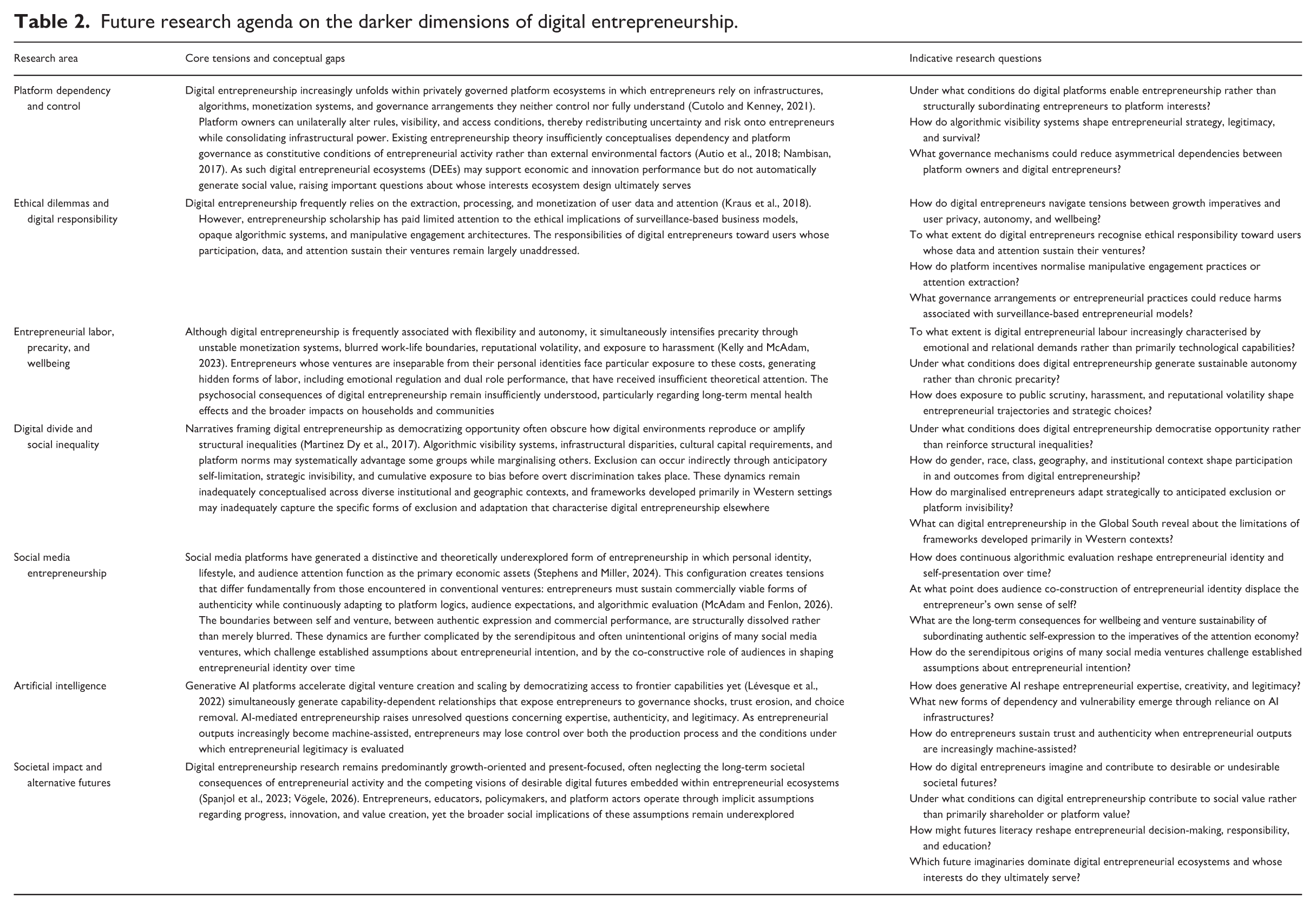
Taken together, these research directions point toward the need for a more critical, contextualised, and societally attentive understanding of digital entrepreneurship. As entrepreneurial activity becomes increasingly embedded within platform ecosystems and algorithmically mediated environments, future research must move beyond predominantly celebratory accounts of digitalization and develop frameworks capable of addressing the vulnerabilities, asymmetries, and unintended consequences that increasingly accompany digitally enabled entrepreneurial activity.
Conclusion
This Special Issue advances a more critical and nuanced understanding of digital entrepreneurship by demonstrating that digitalization, while generative of opportunity, simultaneously produces constraints, asymmetries, and unintended consequences that existing scholarship has only begun to address. The five contributions collectively reveal that the darker dimensions of digital entrepreneurship are not peripheral or exceptional but structurally embedded in the very conditions that enable digital venturing, with significant human and societal costs that the field can no longer overlook. As digital technologies continue to evolve, we hope this Special Issue will serve as a foundation for the critical, contextualised, and empirically grounded inquiry that this landscape demands. Finally, the insights emerging from this Special Issue also offer valuable contributions to mainstream entrepreneurship research, challenging conventional assumptions and enriching existing theoretical frameworks by illustrating the role of platform dependency, emotional labour, structural inequality, and ethical responsibility as constitutive dimensions of entrepreneurial activity.
Footnotes
Acknowledgements
The Guest Editors would like to thank ISBJ for accepting this Special Issue. We are especially grateful to Professor Simon Raby and Professor Susan Marlow for their guidance and to Valerie Thorne for supporting us through the process. We are also grateful to the many anonymous reviewers who provided detailed and constructive feedback on the manuscripts that ultimately helped us decide on the final selection. Finally, we thank the authors of the five articles that make up this Special Issue for choosing to share their valuable and insightful research work with us.

Funding
The authors received no financial support for the research, authorship, and/or publication of this article.
Declaration of conflicting interests
The authors declared no potential conflicts of interest with respect to the research, authorship, and/or publication of this article.