



Abstract
This article examines whether online managerial training can strengthen informal approaches to workplace conflict resolution in small and micro businesses. Current government policy seeks to boost the performance of small firms by promoting structured people management and dispute resolution practices. However, employment relations in small firms are typically personal and informal, highlighting the need to improve the quality of everyday managerial interactions. We analyse two linked evaluations of a training intervention promoting proactive, collaborative responses to workplace problems: a before-and-after study in 38 micro and small firms, and a parallel cluster randomised controlled trial in 24 larger organisations. Findings show positive shifts in conflict management styles and improved staff experience indicators, especially those directly related to workplace conflict. Effects were strongest in smaller organisations. Overall, the results underline the importance of aligning management interventions with the culture and relational dynamics of smaller firms. The study highlights practical implications for policy and training design in small business contexts.
Introduction
A central theme of government policy in relation to small and medium-sized enterprises (SMEs), has been a perceived need to develop leadership capability (Colvile and Staniforth, 2023). Consequently, over the last 20 years there has been a succession of interventions such as Train to Gain (2006–2010), the Growth Accelerator (2012–2015), the Small Business Leadership Programme (2020–2021) and, most recently, Help to Grow (2021–2025). This reflects arguments that a lack of managerial quality is a key factor in the ‘long tail’ of low productivity UK firms, dominated by smaller and family-owned businesses (Haldane, 2020; Productivity Institute, 2023). At the same time, the relatively low take-up of formal management and HR practices is widely seen as limiting firm performance (Forth and Bryson, 2019; Sheehan and Garavan, 2022). This is echoed in the UK government’s ‘plan for small and medium-sized business’ (Department for Business and Trade, 2025), which argues that ‘strong leadership and the use of structured management practices . . . are key drivers of SME productivity and growth’.
However, existing evaluations of programmes designed to boost productivity have generated mixed results and comparatively limited robust evidence of sustained impacts (Mole, 2023; National Audit Office, 2020). In particular, while the association between management practices and performance is well established (Bloom and Van Reenen, 2007; Bloom et al., 2017) the applicability of formalised management approaches to small business contexts is contested. SMEs are not scaled-down versions of large organisations; instead, they are characterised by flatter structures, limited HR capacity, resource constraints and a reliance on informal and personal approaches to people management (Nadin and Cassell, 2007; Ram and Edwards, 2003). As a result, formal policies and procedures may be difficult to implement, culturally misaligned, or even counterproductive (Kitching and Marlow, 2013). This raises important questions about how managerial capability can be developed in ways that reflect, rather than undermine, the organisational realities of SMEs.
These questions are particularly relevant to the effective management of workplace conflict and disputes, identified in the government’s SME strategy as a ‘key enabler to driving firm-level productivity’ (Department for Business and Trade, 2025). Conflict at work is a growing problem – in 2025, 44% of surveyed employees reported experiencing workplace conflict, the highest figure yet recorded (Acas, 2025). Moreover, conflict is estimated to cost UK business £28.5bn per annum, largely due to staff turnover, absence, presenteeism and litigation (Saundry and Urwin, 2021). Crucially, SMEs are disproportionately exposed to the negative impacts of conflict due to a lack of experience, confidence and/or dedicated HR support (Craig et al., 2022; Department for Business and Trade, 2025). This can lead to SME managers avoiding having difficult conversations with their staff (Saundry et al., 2016), while formal policies and procedures arguably run counter to the personalised nature of employment relationships (Gibbons, 2007; Harris, 2000). While we have some clarity on the nature of the challenge however, there is a lack of empirical evidence of the impact of interventions to manage workplace conflict. Consequently, this article examines whether targeted managerial training can strengthen the capacity of SME managers to address workplace conflict early and informally, thereby improving organisational outcomes. Drawing on a low-burden, online training intervention designed to build confidence and skill in informal conflict resolution, the study analyses data from 982 managers across 38 small and micro businesses, alongside comparative evidence from a parallel cluster randomised controlled trial (RCT) in 24 larger organisations. The analysis addresses three research questions:
What is the conflict style of small business managers and how does this compare to those in larger organisations?
Can online, low-burden training generate conflict management styles that are more conducive to early and informal resolution?
To what extent are changes in style associated with improved employee engagement in small business settings?
This begins to fill the gap in evaluation evidence needed to inform development of interventions to tackle workplace conflict. The main contribution of this article is to the literature on managerial capability development in SMEs. Drawing on research on informality in small firm employment relations, the sociology of face-to-face interactions and experiential learning, we develop a theoretical framework that explains how low burden training can strengthen informal conflict resolution capability, not by imposing formalised HR structures, but by aligning with the relational and conversational nature of small firm management (Goffman, 1967; Kolb, 2015; Ram and Edwards, 2003). The management of workplace conflict provides the empirical setting for testing this framework, while the research is motivated by the need to design support for small businesses that will help them navigate the challenges of a changing employment landscape. In doing so, the article responds to calls to consider not only managerial practice, but also how managers themselves enact people management in everyday interactions (Metcalfe et al., 2023). Furthermore, it provides key insights for policy and practice pointing towards the use of online training to scale access to skills interventions at low cost.
The small business context – Performance, practice and informality
The role of SMEs in explaining the UK’s problem of persistently low productivity has been the subject of significant academic and policy attention. Evidence consistently points to a highly skewed distribution of productivity across firms, with a substantial proportion of workers employed in organisations with below average productivity (Office for National Statistics, 2024). This ‘long tail’ of low-productivity firms is more pronounced in the United Kingdom than in many comparable economies and is heavily concentrated among SMEs and family-owned businesses (House of Commons Business, Energy and Industrial Strategy Committee, 2018; Owalla et al., 2022). A dominant explanation for this pattern centres on differences in management quality. Research drawing on large-scale datasets, including the World Management Survey, has demonstrated a strong association between the adoption of structured management practices and improved productivity outcomes (Bloom and Van Reenen, 2007; Bloom et al., 2017). These practices typically include operations management, performance monitoring, target setting and people management, including recruitment, performance appraisal and the handling of underperformance. From this perspective, the relative absence of formal management practices in SMEs is viewed as a key constraint on productivity growth (Forth and Bryson, 2019).
Crucially this argument is influential in shaping government policy and support for SMEs. In late 2025, the UK government published ‘Backing Your Business: Our plan for small and medium-sized businesses’ which outlined ‘a long-term direction for the government’s support for smaller firms’ (Department for Business and Trade, 2025). The plan argued that: . . . strong leadership and the use of structured management practices such as setting targets, using KPIs, and strategic financial planning, are key drivers of SME productivity and growth. Yet UK SMEs are less likely than larger firms to adopt these approaches . . . smaller businesses often lack access to the talent and resources available in larger firms, but initiatives that enable SMEs to tap into this expertise could help build capability.
This approach implicitly treats SMEs as ‘deficient’ versions of large firms. In reality the relationship between formal management practices and performance varies by organisational size and context, with stronger effects observed in medium-sized firms and those employing professional managers or in-house HR specialists (Sheehan and Garavan, 2022). As Metcalfe et al. (2023) argue, the existence of firm-level practices may be less important than how individual managers enact management in practice, particularly in small organisations where owner-managers exert substantial influence over people management.
Informality is a defining feature of small business employment relations. Rather than relying on codified policies and procedures, SMEs typically manage people through direct interaction, tacit expectations and personalised relationships (Ram, 1999; Ram et al., 2001). Informality in this sense does not simply reflect the absence of formal HR systems but constitutes a distinct mode of organising work and regulating employment relationships (Nadin and Cassell, 2007). Early accounts of small firm employment relations often equated informality with poor practice and unfair treatment (Rainnie, 1989). However, more recent research has challenged this view, highlighting the diversity and complexity of informal arrangements and questioning simplistic associations between formality and fairness (Kitching and Marlow, 2013; Ram and Edwards, 2003). For example, informality can provide scope for flexibility, autonomy and responsiveness, particularly where close working relationships foster trust (Bryson and White, 2019). Yet, At the same time, informality creates vulnerabilities. The absence of HR skills and guidance can leave managers uncertain about handling sensitive issues, such as poor performance, misconduct or interpersonal conflict (Harris et al., 2012). This can be exacerbated by the personalised nature of employment relationships in small firms, as proximity and familiarity blur the boundaries between professional and personal roles (Nadin and Cassell, 2007).
Importantly, the growth of formal procedures in SMEs has often been driven not by strategic intent, but by fear of employment litigation (Wood et al., 2017). This creates a paradox in which small firms retain a cultural preference for informality while at the same time relying on the rigid application of procedure as a form of legal protection (Craig et al., 2022). Rather than supporting early resolution, such approaches may entrench adversarial dynamics and inhibit constructive dialogue. These tensions highlight the limitations of framing debates around a simple binary between formality and informality. As Ram (1999) argues, employment relations in small firms are characterised by hybrid arrangements in which formal and informal practices coexist and interact in complex ways. The challenge, therefore, is not whether SMEs should be more formal or more informal, but how managerial capability can be developed to enable the effective and appropriate use of informal practices.
Workplace conflict and small businesses
Workplace conflict provides a particularly useful lens through which to examine these issues. For the purposes of this analysis, we follow the definition of conflict developed by Dix et al. (2009) which is ‘discontent arising from a perceived clash of interests’ (p. 177). This broad conceptualisation includes not only visible manifestations of conflict, such as grievances, disciplinary action and litigation, but also covert and informal expressions of conflict such as quitting, absence and disengagement. Conflict is widely recognised as a significant source of organisational cost, contributing to absence, presenteeism, turnover and reduced engagement (Saundry and Urwin, 2021). In labour-intensive, service-oriented sectors, where many SMEs are concentrated, employee engagement and performance are critical, amplifying the consequences of unresolved conflict (Harney et al., 2022). In addition, small businesses are disproportionately vulnerable to the negative effects of conflict. This is now being recognised by government. Its plan for small and medium sized businesses (see above) argues that ‘effective dispute management’ is key to improving performance but also notes that ‘many SMEs lack experience, confidence, or dedicated HR support to handle workplace conflict, which can be particularly damaging in smaller teams’ (Department for Business and Trade, 2025).
Evidence consistently shows that SMEs are more likely to be subject to employment tribunal claims than larger organisations, particularly in relation to unfair dismissal (Lai et al., 2016; Saridakis et al., 2008). Moreover, when claims proceed to hearing, SMEs are less likely to succeed, often due to procedural deficiencies and perceptions of unfairness (Latreille, 2017). Analysis of tribunal data indicates that workplaces with fewer than 25 employees account for a disproportionately large share of claims, despite employing a smaller proportion of the workforce overall (HM Government, 2018). At the same time, SMEs tend to report lower levels of formal conflict, such as grievances, disciplinary sanctions and dismissals, than larger organisations (Wood et al., 2017). This contradiction reflects both a preference for informality and a reluctance to formalise disputes, as well as the close and personalised nature of employment relationships in small firms. While proximity can facilitate early resolution, it can also make addressing issues more challenging, particularly where managers lack confidence or fear damaging relationships (Forth et al., 2006; Mallett and Wapshott, 2014).
Line managers occupy a pivotal position in these dynamics. They are typically best placed to identify emerging issues and intervene early, but they are also frequently identified as sources of conflict themselves (Saundry et al., 2016; Saundry and Urwin, 2021). In SMEs, where managerial roles are often combined with operational responsibilities, supervisors may lack both the time and the training needed to address conflict effectively. This can result in avoidant behaviour, inconsistent responses or taking formal action prematurely, all of which increase the likelihood of conflict escalation (Kitching, 2016).
Early and informal resolution: Promise and limitations
A substantial body of research highlights the potential benefits of early and informal approaches to conflict resolution. Interest-based and problem-solving models emphasise dialogue, mutual understanding and the exploration of underlying concerns, rather than the arbitrary use of managerial authority, the imposition of solutions or procedural compliance (Lewicki et al., 2015). Early intervention is widely viewed as critical to preventing conflict escalation and reducing organisational costs (Glasl, 1999; Lipsky et al., 2016). In principle, SMEs appear well suited to early and informal resolution. Small firm employment relations are characterised by proximity, direct communication and ongoing negotiation, all of which should facilitate timely intervention (Mallett and Wapshott, 2014; Ram, 1994). However, empirical evidence suggests that informal resolution in SMEs is often used inconsistently or ineffectively. While managers may prefer informal approaches, they frequently lack the skills, confidence or judgement required to use them constructively (Craig et al., 2022).
This tension is exacerbated by fear of litigation and regulatory change. SMEs are often acutely aware of their legal vulnerability, and this can encourage defensive reliance on formal procedures or external advice, even where such approaches sit uneasily with organisational culture (Craig et al., 2022; Harris, 2000). The extension of unfair dismissal rights under the Employment Rights Act 2025 has heightened these concerns, reinforcing perceptions of regulatory risk among small business owners and managers (Federation of Small Businesses, 2025). As a result, early and informal resolution represents both an opportunity and a challenge for SMEs: while informality provides the structural conditions for early intervention, its effective use depends on managerial capability, particularly in relation to conversational competence, emotional intelligence and judgement. Moreover, it can be argued that the way that managers handle issues at work, such as poor performance or problem behaviours can develop, deepen and extend perceptions of organisational justice (De Dreu and Beersma, 2005; Saundry et al., 2016). This in turn underpins trust (Boxall and Purcell, 2016) and consequently, improved employee engagement (Albrecht et al., 2015; Truss et al., 2015). Indeed, if one sees disengagement as a form of conflict (Purcell, 2012) then effective conflict management is a precondition for engaging staff and boosting performance.
Interaction, face-to-face relations and informal conflict resolution
A defining feature of employment relations in small businesses is the predominance of face-to-face interaction. Unlike larger organisations, where HR systems, written procedures and specialist roles mediate many employment issues, managers in SMEs typically enact authority, resolve problems and negotiate performance directly through everyday interpersonal encounters (Nadin and Cassell, 2007; Ram and Edwards, 2003). As a result, the management of conflict in small firms is inherently interactional, relying heavily on conversational competence, sensitivity to relational cues and the ability to manage tension in real time. Sociological work on face-to-face interaction provides important insight into these processes. Goffman’s (1967) concept of the interaction order highlights how social encounters are governed by tacit rules concerning face, respect and appropriate conduct. In workplace settings, conflict often emerges not simply from substantive disagreements, but from perceived threats to face, status or identity, particularly in close-knit environments where professional and personal relationships overlap. Managing conflict informally therefore, requires skill in repairing interactional breaches and framing difficult messages in ways that preserve working relationships.
This perspective is particularly salient in SMEs, where proximity intensifies the emotional and relational dimensions of conflict. Close working relationships can facilitate early and informal resolution, but they also raise the stakes of interpersonal failure, making managers more likely to avoid difficult conversations or to rely defensively on formal procedures when tensions arise (Martínez-Corts et al., 2011). In such contexts, the ability to engage constructively in face-to-face interaction becomes a central component of managerial capability. Despite its relevance, this interactional dimension of conflict management is often underdeveloped in SME and HRM research, which tends to focus on structures, policies and outcomes rather than on the micro-processes through which managers actually handle conflict in practice. However, studies of workplace communication and conflict resolution suggest that conversational skill, emotional awareness and the capacity to navigate situations which may threaten or undermine ‘face’ are critical to successful informal resolution (Holmes and Stubbe, 2003; Saundry et al., 2016; Tracy and Robles, 2008). This highlights the importance of developing interactional competence as a core element of managerial capability in small business settings.
Managerial learning, training and capability
The development of managerial capability in SMEs has long been recognised as a policy and practice challenge. Small firms are typically reluctant to invest in formal training due to time pressures, financial constraints and scepticism about the relevance of generic management development programmes (Jones et al., 2013; Kitching and Blackburn, 2002). These barriers are particularly pronounced for owner-managers and supervisors with significant operational responsibilities, for whom time away from the business represents a direct cost (Garavan et al., 2015).
External training programmes often assume organisational infrastructures and learning cultures more typical of large firms, including dedicated HR functions and formal performance management systems (Kitching and Blackburn, 2002). As a result, such interventions may lack relevance or credibility in SME contexts, leading to low uptake and limited impact. While recent initiatives such as Help to Grow have sought to address managerial skill gaps, they have tended to focus on leadership and strategy rather than the everyday interpersonal challenges that dominate SME people management (Vitali, 2023). However, if informal conflict resolution in SMEs is fundamentally interactional, a further question concerns how managers acquire the skills and judgement required to effectively manage such encounters. Research on managerial learning in small firms emphasises the importance of experiential and informal learning processes. Rather than acquiring capability through formal instruction or codified rules, managers typically learn through practice, reflection and engagement with concrete situations (Cope, 2005; Devins et al., 2005).
Experiential learning theory provides a useful lens through which to understand this process. Kolb (2015) conceptualises learning as a cyclical process involving concrete experience, reflective observation, abstract conceptualisation and active experimentation. From this perspective, managerial capability develops not through the transmission of explicit knowledge alone, but through opportunities to reflect on experience and to test new approaches in practice. This resonates strongly with the realities of SME management, where learning is embedded in everyday problem-solving rather than separated from operational activity. Relatedly, theories of situated learning and communities of practice emphasise that learning is inherently social and dependent on context (Lave and Wenger, 1991; Wenger, 1998).
Managers develop competence by participating in the practices of their organisation and by gradually acquiring tacit understanding of what constitutes appropriate behaviour in specific contexts. In SMEs, where formal training infrastructure is limited and managerial roles are highly embedded, this form of learning is particularly important. However, while experiential learning aligns well with SME realities, it also presents challenges. Informal learning may be uneven, reactive and shaped by existing habits, potentially reinforcing avoidant or ineffective approaches to conflict (Kitching, 2016). Without structured opportunities for reflection, managers may struggle to develop the confidence and judgement required for early and informal intervention. This suggests a role for training interventions that are formally designed but oriented towards developing informal practice, by simulating realistic scenarios, encouraging reflection and supporting experimentation rather than prescribing rigid procedures. From this perspective, training interventions need to move away from trying to impose or reinforce formal HR systems, procedures and approaches and instead attempt to shape informal managerial practice through experiential learning processes. By engaging managers with realistic conflict scenarios and encouraging reflection on interactional dynamics, training can enhance capability in ways that are both effective and congruent with small business contexts.
Conceptual framework: Informal conflict resolution and organisational fit in SMEs
Drawing these strands together, this article develops a conceptual framework that explains how a training intervention can strengthen informal conflict resolution capability in SMEs by aligning with existing organisational norms and managerial practices. Rather than conceptualising informality as a problem to be corrected through formalisation, the framework treats informality as a defining organisational characteristic of small businesses and a potential source of managerial capability. The framework (Figure 1) proposes that the impact of low-burden training interventions in SMEs operates through four interrelated mechanisms. First, the intervention develops interactional competence, understood as the ability of managers to use listening and questioning skills to manage face-to-face encounters constructively and, where necessary engage in difficult conversations (Goffman, 1967). In small business contexts, where employment relationships are highly personalised and managerial authority is enacted through everyday interaction, such competence is central to effective conflict management and maintaining positive relationships.

Conceptual framework.
Second, the framework highlights the role of experiential and situated learning in managerial capability development. Although the intervention examined here was formally structured and provided externally, it was designed to support reflection, judgement and learning through encouraging learners to engage in realistic scenarios rather than through prescriptive rules or formal procedures (Kolb, 1984; Lave and Wenger, 1991). This form of learning aligns closely with how managers in small firms acquire and apply knowledge in practice.
Third, the framework emphasises early intervention and collaborative approaches to conflict management as a core behavioural outcome of enhanced managerial capability. By increasing confidence and skill in informal engagement, the intervention seeks to reduce avoidant behaviour and encourage timely, problem-solving responses to emerging issues, thereby limiting conflict escalation and reliance on formal procedures (Glasl, 1999; Lipsky et al., 2016).
Finally, the framework reflects the importance of ensuring organisational fit with the informality found in small business contexts. The training intervention is deliberately low burden, flexible and focused on informal resolution, reflecting the structural and cultural conditions of small and micro enterprises. This alignment helps to explain why the intervention seems to produce particularly strong effects in smaller organisations: it works with existing informal practices rather than attempting to replace them with large-firm models of HR formalisation (Harney and Dundon, 2006). Together, these mechanisms explain how low-burden training can generate meaningful changes in managerial behaviour and employee experience in SMEs. The framework provides a basis for analysing the empirical findings that follow and for understanding why shifts in conflict management style and employee engagement seem especially pronounced in small and micro business contexts.
Method and data
The findings reported in this article draw on analysis of data that combines information from two studies. An Acas-funded trial of the Skilled Managers intervention in small and micro businesses (Study B), which was developed from a larger project involving medium-sized and large organisations funded by the Economic and Social Research Council, ESRC (Study A). For the purposes of this study, small and micro businesses are defined as those with fewer than 50 employees. Ethical approval for the studies was granted by the University of Westminster as administered by Westminster Business School. The following discussion provides detail of the methodologies adopted in the two studies and describes the approach taken to the analysis of the combined dataset.
Development of the online training intervention for managers
The online training intervention used in Study A and Study B was hosted on the aNewSpring virtual learning environment. The intervention was developed to cater for managers who had little time to engage with conventional training and comprised four main modules: (i) Effective communication; (ii) Feedback and difficult conversations; (iii) Managing conflict; and (iv) Conflict resolution. The intervention was specifically focused on developing the skills to conduct constructive and high-quality face-to-face conversations and prevent, contain and resolve conflict. It was pilot-tested over 18 months with five 5 organisations and 150 managers (Neves et al., 2023). This process highlighted the need to reduce the time burden on managers and, consequently, the content was refined to allow completion in two to four hours depending on the depth of engagement. Key features of the training included:
A diagnostic questionnaire that allowed the team to categorise a manager’s conflict management style (CMS, based on the Rahim Organizational Conflict Inventory-II (ROCI-II)), completed by each manager prior to (i) and again after completion of (iv).
Core content was delivered via short videos and text, and links provided to podcasts and other content that users might find of interest. Learners also had access to downloadable material and templates.
Within each module, there were tests of practical people skills using quizzes (providing feedback).
Simulations within each module took learners through a variety of scenarios and at each stage gave a range of possible options for action.
At the end of each module, learners were provided with key learning points and given opportunities for reflection.
On completing the training learners were finally provided with access to a ‘toolkit’ in order to embed learning in everyday practice.
Therefore, while the training intervention was formal in design, its delivery was flexible. Moreover, its content was squarely aimed at helping managers develop effective informal practice, improving interactions with their reports, facilitating early resolution of workplace problems and driving employee engagement. As noted above, when managers completed the training they were given access to a toolkit which essentially allows all content to be accessed in a way that supports the retention of skills learned. For instance, a manager who completed the training may have little time to plan for a difficult conversation but may wish to remind themselves of key pointers. The toolkit allowed them to quickly access relevant advice and guidance.
Methodology Study A and Study B
Figure 2 provides an overview of the design of Study A. Working from the left, the diagram describes the process of recruitment of organisations, via webinars and other engagement activities supported by our partners, the Advisory, Conciliation and Arbitration Service (Acas). This provided a pipeline of organisations who expressed an interest ‘in principle’ in taking part in the research, each of whom completed a detailed questionnaire eliciting the reasons for their interest and basic company information, with companies also supplying an organogram.

Overview of the cluster RCT design.
The project team then established whether the organisation was appropriate for the research (i.e. having a management/report structure that allowed clustering by department/branch/unit) and whether the organisation was willing to adhere to the terms of the evaluation. Qualifying organisations then signed a Participation Agreement, agreed the structure of clustering and a start date. The organogram and meetings provided the information needed for stratification and creation of distinct units/clusters to be randomised to treatment and control. This cluster RCT approach has a number of key strengths, such as better ensuring that attrition in control companies does not hamper comparison (Bakhshi et al., 2015). Twenty-four organisations started in ‘batches’ between October 2022 and April 2023. This involved 362 units (e.g. ‘departments’ or ‘branches’) containing 6199 employees (not all of whom were ‘in scope’). More details are set out (including power calculations) in the protocol submitted prior to trial commencement. 1
A 10-question benchmark Pulse Survey was administered in each organisation at a point at least two weeks prior to treatment start with the Pulse Survey link/QR code sent out to all staff across treatment and control units. The research team provided the organisation with text for communication and discussed the best way to secure responses – for instance, posters were made available to the organisation with QR codes, and these could be put up in staff break rooms. A second pulse survey was then administered to the same individuals at a point 22 weeks from treatment start date. The survey instrument (Table A7) draws from a combination of the Acas People Survey; CIPD Workplace Conflict Survey; NHS England People Survey; and Workplace Employment Relations Survey (WERS). These are based on standard approaches to the creation of People Surveys and allow us to capture a variety of indicators of job satisfaction and staff engagement.
The protocol for Study A registered in October 2022 explains the need for a minimum organisational size with, ‘sufficient distinct units of operation to allow at least two treatment and two control units within the same organisation’. As a result, Study A targeted organisations with 50 or more employees. In an existing report (Urwin et al., 2024), we detail statistically significant impacts arising from this online intervention, when considering findings from the cluster RCT design of Study A. Those findings provided some indication that much of the efficacy of the intervention was apparent in smaller organisations subject to treatment. This gave rise to Study B, which has a less robust identification strategy but is able to shed light on the suggestion that this light touch intervention may be a better fit to the small firm environment. Consequently, Study B was commissioned by Acas, with organisations starting in ‘batches’ from January 2023, using the same research tools but focusing on micro and small businesses.
Working with Acas colleagues, the project team delivered a webinar in January 2023 describing the micro and small business project, promoted to organisations with fewer than 50 employees on the Acas e-connect list. Fully 490 tickets were taken up in less than two hours and 172 organisations applied to be part of the research during the webinar. Places were offered on a first-come, first-served basis to a larger number of organisations than would be needed to secure engagement from the target of 200 managers (to allow for some amount of drop-out), with the only stipulation being that organisations must have between three and 50 employees.
Managers and employees in each recruited organisation went through three stages:
1. The research team administered the benchmark Pulse Survey used in Study A across all employees and managers in the participating organisation. This provided a ‘baseline’ indicator in each organisation on the state of employment relations prior to intervention. Some 44 organisations took part in this first stage, with a total of 872 employees, including 257 managers. Forty of these organisations secured Pulse Survey 1 responses from employees.
2. Thirty-eight organisations achieved Pulse 1 response rates qualifying them for access to the Skilled Managers training. 2 Each manager in the organisation then undertook the training over a period of 1 month.
3. As in Study A, all managers completed a diagnostic questionnaire before and after the training to categorise a manager’s conflict management style (based on the ROCI-II instrument; see Rahim, 2003).
4. At a point three to six months from the first Pulse Survey responses, responses were secured from employees and managers using a second wave of the same Pulse Survey. Thirty-eight organisations sent out the second Pulse Survey to employees (two organisations dropped out during the training stage).
In contrast to Study A, the design of Study B does not create a randomised control, and this limits any causal interpretation of findings when considering impacts captured in the Pulse Survey. However, the focus here is on the differential responses and experiences of 982 managers before, during and after they underwent the training; there were 2064 employees who provided baseline Pulse Survey responses prior to training and 1628 who responded to the same survey three to six months after the training, across 62 organisations of differing sizes. Overall project details for both studies are outlined in Table 1.
Skilled managers research programme project details.
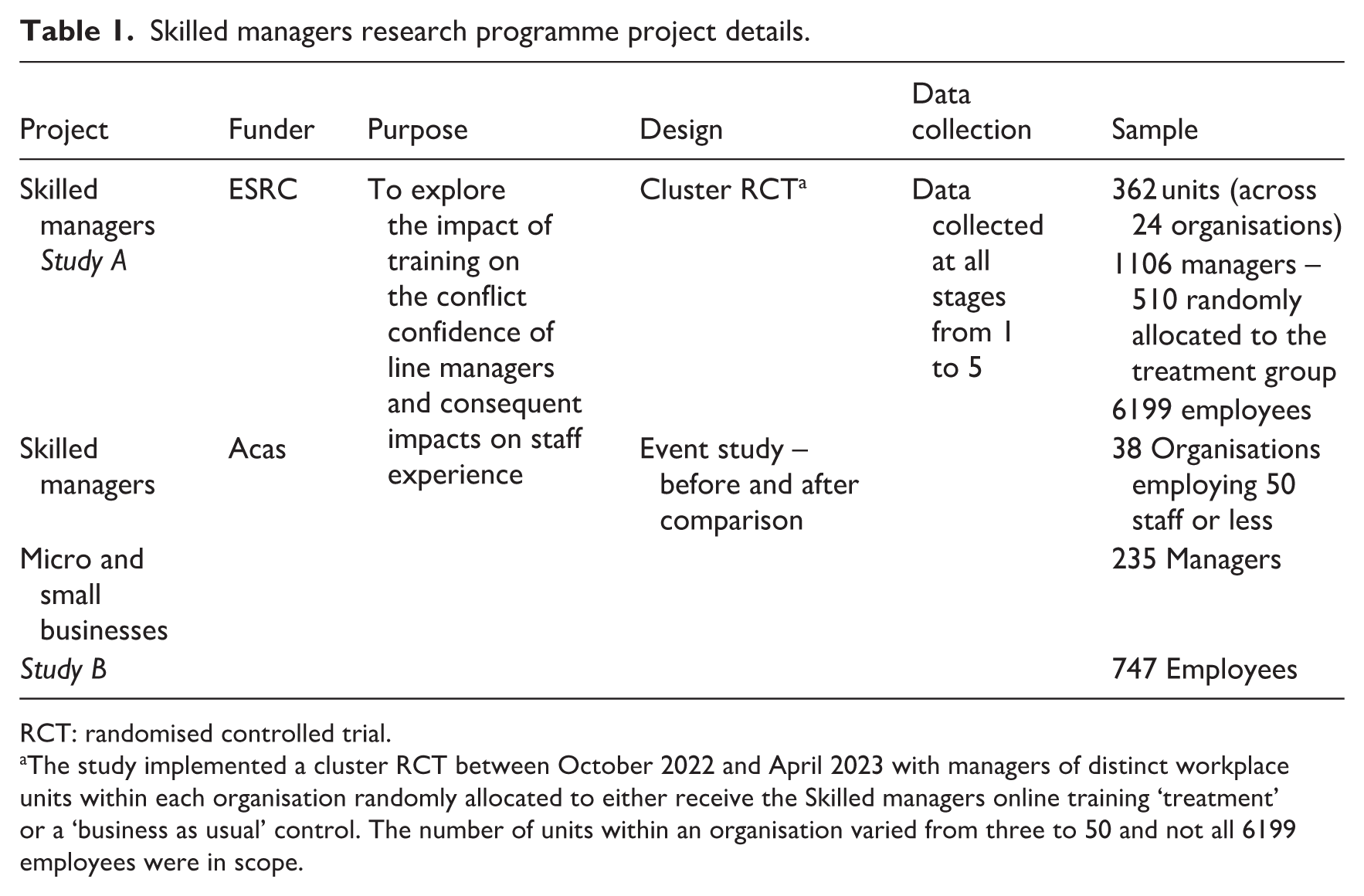
RCT: randomised controlled trial.
The study implemented a cluster RCT between October 2022 and April 2023 with managers of distinct workplace units within each organisation randomly allocated to either receive the Skilled managers online training ‘treatment’ or a ‘business as usual’ control. The number of units within an organisation varied from three to 50 and not all 6199 employees were in scope.
Whilst this creates a valuable data resource, it is important to note a key limitation regarding the insights it can provide. Securing engagement in research over many months in 62 organisations provides a unique resource, but as existing studies note (Bakhshi et al., 2015) various issues, such as attrition at various stages of the research, impact representativeness. Figure 3 suggests that our sample of organisations under-represents organisations with fewer than 10 employees (which make up 82% of organisations with between 2 and 49 employees, according to Business Population Estimates, 2024). Securing micro business engagement is a common challenge across research studies (National Enterprise Network, 2025). We have a high number of companies with between 10 and 19 employees, which share similar operational characteristics, resource constraints and regulatory burdens, and this is the basis for our use of an expanded category of micro businesses in Tables A1 through to A4. Even with this adjustment, sector controls used are highly collinear with micro and small variables in these manager-based equations and we have to discount some findings.

Organisation size distribution, Study B.
To our knowledge, there is no other employer trial that is able to track the experiences of managers and employees for up to one year, across 62 separate organisations, covering a range of organisational size bands. The organisations are all working in dynamic, competitive environments and many of the managers (particularly in Hospitality, Retail and Social Care) do not have individual company email addresses, many of their staff are temporary, and they work long and irregular hours. These are not subjects that feature in many research investigations and the insights they provide are essential to inform government SME policy.
We are able to control for a variety of variables using linear regression, testing whether any apparent relationships are statistically significant. Table 2 provides detail on the controls used and in addition to the tables presented in the Appendix, models were estimated using Fixed Effects and Random Effects. For brevity, the results presented in the Appendix focus on the main findings of interest, but all results are available on demand from the authors.
Descriptive statistics.

Results
What is the conflict style of small business managers and how does this compare to those in larger organisations?
Table 3 describes the conflict management styles of all managers across both studies before they undertook the Skilled Managers training. These profiles have some positive aspects, namely highest scores for ‘problem-solving’ and lower scores for ‘dominating’ and ‘avoiding’. However, ‘avoiding’ scores are relatively high and seem to suggest lower levels of initial conflict competence in small and micro-organisations (Study B), prior to training. Managers in Study B also have slightly lower ‘problem-solving’ scores, and higher ‘obliging’ and ‘dominating’ scores. Whilst we note that the achieved samples for both studies are not necessarily representative of the wider business populations, this finding is consistent with concerns over management capability in smaller organisations. Furthermore, in an accompanying principal component analysis (available on request) on the five CMS themes (using explanatory variables set out in Table 3) we confirm that size of organisation has a significant effect on baseline CMS score, alongside gender and managerial experience.
Conflict management styles.

Source: Skilled Managers Rahim Inventory data, 703 manager responses Study A and 171 Study B; scores range between 1 and 5, higher scores indicating greater use of a style.
In Tables A1 and A2 of the Appendix, we examine the relationship between organisational size and two core dimensions of conflict management style – ‘avoiding’ and ‘problem solving’. Table A1 (column 4) finds that managers in micro enterprises (in this case, fewer than 20 employees) have significantly higher average ‘avoiding’ inventory scores compared to managers in large organisations (at the 0.1% level); the same is true (but not so pronounced) for small organisations, with 20 to <50 employees. This pattern of findings is the same as that secured when utilising a more traditional split (of 10 employees between small and micro), but findings for micros are then not statistically significant, due to small sample size. Managers in micro enterprises and small organisations both have higher than average avoiding scores when compared to those in both medium and large organisations. Any concern in Table A1 that managers in smaller organisations may adopt less effective approaches to conflict resolution on average, is supported to some extent in the findings of A2. Here, we observe a slight tendency for managers in medium-sized organisations to have higher than average problem-solving scores (although this is only significant at the 5% level). Whilst the figures for micro and small organisations are not statistically significant, they are consistently negative, further suggesting that management capability in small organisations may be where intervention is particularly needed.
Can online, low-burden training generate conflict management styles that are more conducive to early and informal resolution?
All managers who completed the training were again asked to complete the conflict management style questionnaire. If the training had the intended effect, we would hope to see an increase in collaborating scores and a decrease in avoiding scores – reflecting more proactive and integrative approaches to conflict and increased conflict confidence. Table 4 shows the average scores of the manager’s conflict management styles before and after training. The results clearly demonstrate that there were positive changes across each dimension and each of these changes is statistically significant at the 1% level. There were significant increases in ‘problem-solving’ and ‘compromising’ scores and reductions in ‘obliging’, ‘dominating’ and ‘avoiding’ styles. Importantly, the largest change was the reduction in ‘avoiding’ scores (by 17% for the main sample and by 22% for managers in the micro/small-business sample).
Changing conflict management styles.
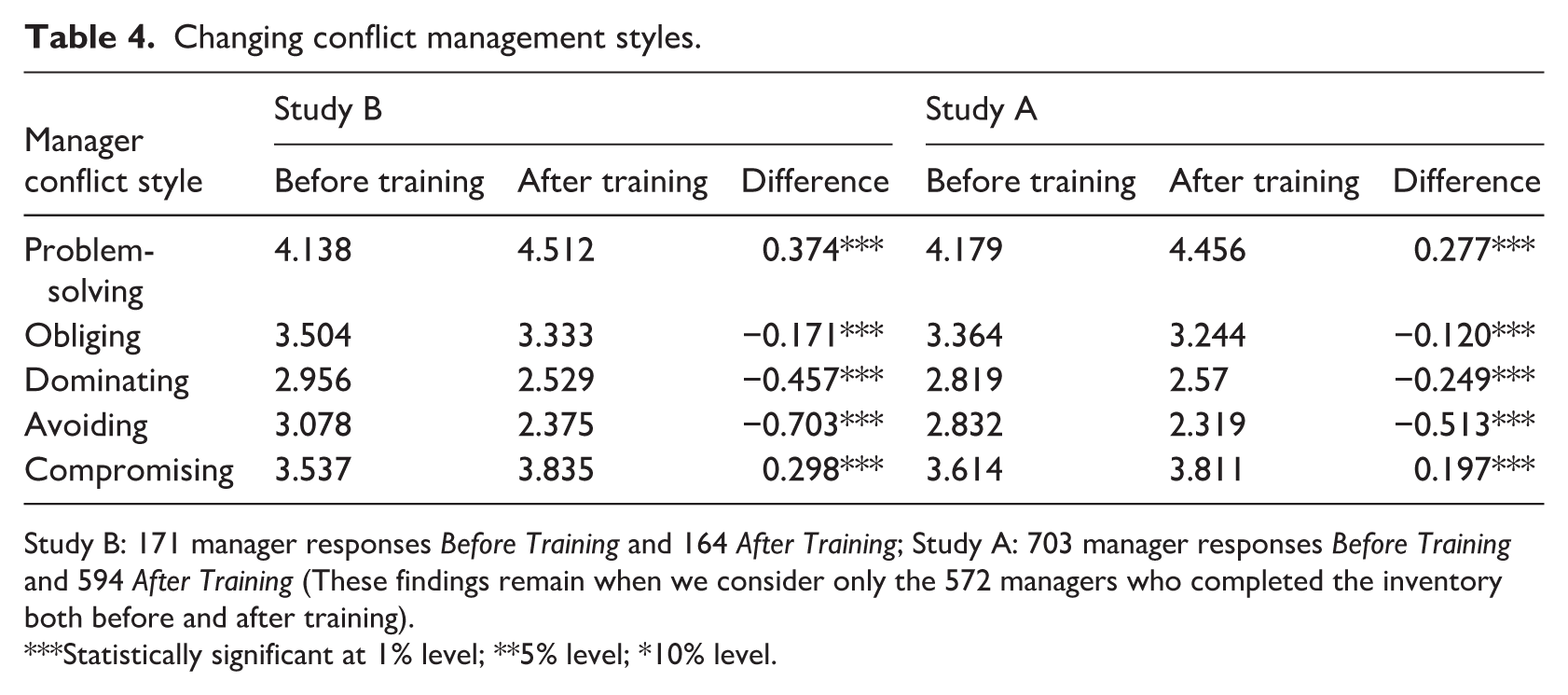
Study B: 171 manager responses Before Training and 164 After Training; Study A: 703 manager responses Before Training and 594 After Training (These findings remain when we consider only the 572 managers who completed the inventory both before and after training).
Statistically significant at 1% level; **5% level; *10% level.
Therefore, we observe a change in approach that emphasises early intervention and collaboration, suggesting that the intervention positively impacted conflict confidence and competence. Across all items, the scale of change in average scores was larger for managers in Study B than for organisations in Study A. Regression analysis on a combined sample across both projects captures the extent to which findings persist and allows insight into the extent to which change is apparent in organisations of different sizes. The results presented in Table A3 suggest that much of the move towards a focus on ‘problem-solving’ amongst managers as a result of the training, is driven by a change in approach amongst managers in small organisations. This finding in Table A3 is based on the ‘20 to less than 50’ grouping for small organisations (and holds if we also use the ‘10 to less than 50 grouping’), but even expanding the micros category to fewer than 20 employees, the positive coefficient on the micro variable is not statistically significant.
In Table A4, which captures changes in ‘avoiding’, the results suggest that the training significantly improves the practice of managers in these small and micro organisations. In medium-sized enterprises, there is no statistically significant change, but the sign is in the desired direction. More specifically, in column 4 of Table A4, the parameter estimates of −0.215 for managers in micro-organisations and −0.273 in small businesses, are significant with a 99.9% and 99% level of confidence respectively. When considering these findings next to those of Table A1, we have evidence that managers in small and micro organisations are much more likely to register an ‘avoidant’ approach to conflict prior to training; but having carried out the training, their approach is significantly more likely to move away from avoidance than is the case for managers in large organisations (managers in medium-sized firms have a negative sign on the parameter, which suggests a similar direction of travel but this is not significantly different to the change seen in large organisations).
It is possible that when answering the questions used to create the Rahim scores, managers have some awareness of the hypothesis being tested, gain such insight as a result of the training and/or are subject to social desirability bias (Mercado, 2025). However, the issue here is whether such an effect would be expected to differ systematically across managers in organisations of different sizes and confound our findings? Our inclusion of a control for manager experience provides very useful insight in this respect – in Tables A1 and A2, we have clear evidence that more experienced managers register lower on avoidance and higher on problem solving. We may expect these managers to get the least from training and this seems to be supported – in fact, if anything they are on average more avoidant in their approaches after the training is completed. Amongst managers with extensive experience (including of management training interventions), there may be some understanding of what is expected in responses to questions that make up the Rahim inventory. However, our ability to control for this and still uncover this evidence on initial starting positions and change over time, suggests this is not driving our findings. Having said that, these are all self-reported approaches to management – to what extent do we see talk translate into action?
To what extent are changes in management style translated into more positive experience for employees within small businesses?
Staff in each of the businesses in Study B and Study A completed the ten-item online Pulse Survey before their managers were trained and after the training was completed. Tables A5 and A6 present results of simple linear regressions exploring the extent to which managerial characteristics and style may shape employee experiences, on the combined sample from Study B and Study A, before and after the training has taken place, respectively. For instance, Table A5 suggests that across many Pulse Survey responses, female respondents are statistically more likely to provide less favourable responses (reflected in negative parameter coefficients). This is particularly true for Q1, the net promoter score (−0.321) and Q7, which captures employee views of manager effectiveness in the early resolution of conflict (−0.191), which are both significant at the 99.9% level of confidence. In contrast to the management-level regressions of Tables A1 to A4, we have many more observations underpinning our results here, so do not suffer from potential collinearity between sector and organisational size variables.
As suggested in Method, our sample is not necessarily representative of the wider employer size population. Given this, it is very encouraging to note that our secured sample reflects very similar patterns of self-reported employee satisfaction and managerial capability seen in historical surveys that were able to secure more representative samples. Specifically, data presented in Table A5 suggests that the employees of these managers have much higher levels of satisfaction than their peers in larger organisations (Forth and Bryson, 2019). Overall, the responses of employees in micro-organisations prior to their managers being trained were significantly more favourable across a range of metrics, with a 99.9% level of confidence. Staff in small organisations were also significantly more likely to report favourable views towards their managers and the company when compared to large organisations, though this is not as pronounced as the findings for micros. Moving on to consider the findings of Table A6, we need to note that fewer responses are included in this table due to attrition, but the level of this is much less pronounced than in comparable studies (Bakhshi et al., 2015). We mitigate concern over the slightly different group that could be answering in the second wave, after training has been undertaken, by controlling for a variety of observed factors in both regressions. 3
In Table A6, we still see a more positive set of responses from employees in micro enterprises across the range of Pulse Survey questions asked after training has been completed by managers. Some drop in the number of employees responding in the second wave may reduce levels of statistical significance in parts, and with this in mind, it is of particular note that we observe a strengthening of the positive views towards managers for Q7 where the parameter of 0.373 is significant with a 99.9% level of confidence and 0.288 for the parameter on Q8 (sig with a 99% level of confidence).
The same pattern is evident amongst the responses of employees in small organisations, where the initial relatively positive views of these employees prior to training in Table A5 are further enhanced on these metrics, after their managers have been trained – in Table A6, we observe parameter estimates of 0.664 and 0.561 for Q7 and Q8, respectively. These are both significant with a 99.9% level of confidence, in contrast to Table A5 where the responses were not significantly different to those in large organisations. To summarise, the views of employees in micro and small organisations are on average more positive towards the organisation and the evidence suggests that online training to enhance conflict competence amongst managers further widens the gap on these specific dimensions (Q7 and Q8) of management competence.
Discussion and conclusion
Fundamentally, this article addresses a central tension in contemporary SME policy and research: the assumption that small firms will improve performance through the adoption of more formalised management practices, despite long-standing evidence that SMEs operate through informal, relationship-based modes of organising work (Kitching and Marlow, 2013; Nadin and Cassell, 2007; Ram, 1999; Ram and Edwards, 2003). A substantial body of evidence links structured management practices to productivity outcomes (Bloom and Van Reenen, 2007; Bloom et al., 2017; Forth and Bryson, 2019), and this underpins UK policy towards small business performance and growth (Department for Business and Trade, 2025). However, such approaches risk treating SMEs as scaled-down versions of larger firms, overlooking the organisational realities of informality, proximity and limited HR capacity (Metcalfe et al., 2023; Sheehan and Garavan, 2022).
This tension is particularly apparent in the context of workplace conflict, identified by the UK government as a key constraint on small business performance (Department for Business and Trade, 2024). SMEs are disproportionately vulnerable to the costs and risks associated with conflict, both in terms of the disruption caused to day-to-day operation and the risk of employment litigation (Latreille, 2017; Saridakis et al., 2008; Saundry and Urwin, 2021). However, the literature shows that while small firms often prefer informal resolution, managers frequently lack the confidence and capability to intervene early, leading either to avoidance or the rigid application of procedure (Craig et al., 2022; Gibbons, 2007; Harris, 2000).
This complex problem is captured in our first research question: What is the conflict style of small business managers and how does this compare to those in larger organisations? The findings indicate that managers across large and small organisations had similar orientations to problem-solving, a key attribute in effective conflict management. However, evidence suggests the initial conflict management style of managers in smaller business contexts was more avoidant. This points to a reluctance to initiate difficult conversations, and that the perceived relational and procedural risks of ‘getting it wrong’, may be a critical constraint in smaller firms. Moreover, it suggests that the proximity and personalised nature of small firm employment relationships can both facilitate and inhibit early intervention (Forth et al., 2006; Mallett and Wapshott, 2014).
The intervention examined in this research was explicitly designed to align with SME organisational conditions and address this tension. Although it was formal in design and provided externally, the intervention was stripped back to reduce the burden for time-poor managers, with content entirely focused on building skills to help managers navigate face-to-face interactions with their staff (Goffman, 1967). The training also used simulations and scenarios to embed and situate the learning in the reality of organisational life (Kolb, 1984; Lave and Wenger, 1991). The conceptual framework set out earlier in this article proposed that this approach could help develop more proactive and collaborative approaches to workplace problems, thereby preventing containing and resolving conflict.
The findings in relation to the second research question (Can online, low-burden training generate conflict management styles that are more conducive to early and informal resolution?) support this argument. Across both studies, there were statistically significant shifts away from avoiding, dominating and obliging styles, and towards more problem-solving and collaborative approaches. Importantly, reductions in avoidance were strongest in micro and small firms, which reinforces the proposition underpinning the importance of organisational fit, a central component within our conceptual framework.
The third research question asked whether these positive shifts in conflict management style were translated into more positive employee experiences. The evidence is encouraging in two respects. First, before training, employees in the smallest organisations were more likely to report positive assessments across a number of pulse items relative to employees in larger organisations, consistent with the literature’s emphasis on the potential engagement benefits of informality. Second, after training, there were improvements across a number of engagement measures. Importantly, these effects were particularly strong in relation to indicators closely connected to conflict handling and managerial competence, for example ‘If there is conflict in the team, my line manager helps resolve this quickly’. This suggests a link between changes in management style and employee perceptions of everyday management practice. In addition, the impacts were greater for micro and small organisations. This aligns with research connecting early, problem-solving approaches to improved engagement and reduced conflict escalation (Glasl, 1999; Lipsky et al., 2016; Saundry and Urwin, 2021).
Overall, these results contribute to existing debates in three important respects. First, they reinforce arguments that informality should not be treated as a problem to be corrected through structure, process and formality. Instead, informality should be recognised as a source of improved performance, as long as managers are provided the necessary skills, pace and support. Second, they suggest that policy should not only focus on the presence of management practices but on how managers enact people management in everyday interactions with their staff (Metcalfe et al., 2023). In particular, strengthening conversational and relational competence can reshape how conflict is handled in practice. Third, the stronger effects observed in smaller organisations provide empirical support for the importance of aligning training design with organisational context and culture (Harney and Dundon, 2006; Kitching and Blackburn, 2002).
Nonetheless, there are a number of limitations. Study B is a before-and-after evaluation without a randomised control group, so causal attribution for employee outcomes must be made cautiously. Conflict management style measures rely on an inventory based on self-report questionnaires. This may be influenced by social desirability or by participants’ awareness of the intervention’s intent. In addition, employee Pulse Survey follow-up is affected by attrition, and the achieved samples are not necessarily representative by sector, size band or baseline practice. Future research should test conflict management styles in practice, examine whether learning translates into sustained behavioural change over longer periods, and strengthen causal identification in micro and small firms using feasible experimental or quasi-experimental designs.
For practice and policy, the implication is not that SMEs should abandon formal procedures or structured management practices, but that support initiatives should not treat these as the default solution to improving people management. Instead, there needs to be a renewed emphasis on the informal and relational skills needed to enact practices such as the management of performance. Capability-building interventions can be designed to strengthen the quality, consistency and legitimacy of informal management by developing managers’ confidence and skill in early intervention, collaborative problem-solving and difficult conversations. Moreover, there is a case for a renewed focus on what are often seen as the basics of effective communication – the listening and questioning skills required to surface problems and to give workers the space to voice their experiences, concerns and perspectives.
Low-burden design is also important: flexible digital learning is more likely to be adopted by managers facing acute time pressures and scepticism about generic, externally delivered training. There is also no reason why the same principle cannot be applied in other areas of skills development. In addition, because smaller firms can train their whole management group in a short period, such interventions may have the capacity to shift conflict-handling norms across the organisation. This provides a compelling, cost-effective and scalable policy option which stands in stark contrast to programmes of leadership development which can be cumbersome and have often dominated attempts by government to support small businesses. Overall, the findings suggest that capability-building interventions can be effective in small and micro businesses when they are aimed at strengthening informal practice, offering a constructive alternative to one-size-fits-all calls for HR formalisation.
Footnotes
Appendix
10 question Pulse Survey.

| 1. On a scale of 1 to 10, with 10 being most likely, how likely is it that you would recommend this company to a friend or family member? 2. To what extent do you agree with the statement, ‘I think that my organisation respects individual differences (e.g. cultures, working styles, backgrounds etc)’. 3. To what extent do you agree with the statement, ‘It’s easy for me to get feedback on my performance’. 4. To what extent do you agree with the statement, ‘Good performance in my team is recognised’. 5. To what extent do you agree with the statement, ‘Poor performance in my team is tackled effectively’. 6. To what extent do you agree with the statement, ‘I often experience work-related stress that impacts my health and job performance’. 7. To what extent do you agree with the statement, ‘If there is conflict in the team, my line manager helps resolve this quickly’. 8. To what extent do you agree with the statement, ‘Talking to my line manager helps me improve my performance’. 9. To what extent do you agree with the statement, ‘I have a good relationship with my line manager’. 10. To what extent do you agree with the statement, ‘I am happy in my role and am not thinking of leaving’. |
Author’s Note
Alex Bowyer is now affiliated to Department for Education, London, England, UK.

Ethical considerations
Both studies received ethical approval from the University of Westminster as administered by Westminster Business School – Study A ref. ETH2122-0475 and Study B ref. ETH2223-0880.
Consent to participate
All participants were provided with information about the project and gave informed consent online by clicking the appropriate statement at the start of the training (managers) or surveys (all employees).
Funding
The authors disclosed receipt of the following financial support for the research, authorship and/or publication of this article: This work was supported by the Advisory, Conciliation & Arbitration Service (Acas) and by the Economic and Social Research Council [grant number ES/S012796/1].
Declaration of conflicting interests
The authors declared no potential conflicts of interest with respect to the research, authorship and/or publication of this article.