




Abstract
Knowledge management (KM) is recognized as an important means for attaining competitive advantage and improving organizational performance. The evaluation of KM performance has become increasingly vital, as it provides the direction for organizations to enhance their performance and competitiveness. A survey was carried out to test the applicability of 14 constructs based on knowledge resources, KM processes, and KM factors in measuring the KM performance for small and medium enterprises (SMEs) in Malaysia. This article intends to further explore the effects of company size (micro, small, and medium) and KM maturity on knowledge management performance measurement (KMPM). Two-way analysis of variance results indicate that company size and KM maturity do affect some aspects of KMPM in SMEs.
Introduction
In this fast-paced knowledge-driven economic era, knowledge itself has outshined other traditional resources such as capital, labor, equipment, and physical commodity. Knowledge has been transformed from a resource to a commodity that offers a sustainable competitive advantage. Organizations that possess the newest knowledge in their field will often flourish while companies that do not may struggle in the shadows. In this competitive era, it is crucial that organizations continuously enhance their organizational capabilities, boosting internal performance and external competitiveness to stay competitive. One of the ways to achieve this is through knowledge management (KM) and its performance measurement.
The size of an organization affects its behavior and structure (Edvardsson, 2006; Rutherford et al., 2001), and it also influences the adoption and implementation of KM in a company (Zaied et al., 2012). Studies on KM have generally been split into two main streams, selecting either large organizations or small and medium enterprises (SMEs) as their research target. Many studies have been conducted to show that KM in large organizations and SMEs differs in many ways. But a new question has emerged: what about SMEs? SMEs are the grouping of micro-, small-, and medium-sized enterprises. They are generally perceived as one homogenized group, and research that classifies them into separate groups is rare. Nevertheless, Alvarez et al. (2015) and Uhlaner et al. (2007) concluded that company size does affect KM, even within the grouping of SMEs itself. Similar to the findings of OECD (2003), firms manage their knowledge differently depending upon their size with little regard for industrial classification.
This article intends to further explore this area by providing insights on the effects of company size and KM maturity on the aspects of knowledge management performance measurement (KMPM) within the grouping of SMEs itself. Not much effort has been made to investigate this domain as to date, papers that address this issue are scarce. In addition, this article also intends to identify the benefits that SMEs gained from implementing KM and the barriers that they faced in KMPM. To explore the issues mentioned above, an empirical study comprising a survey and statistical analysis was conducted, involving a sample of 101 SMEs in Malaysia.
The article is organized as follows: The second section presents a brief review on SMEs in Malaysia. The third section summarizes the work of previous researchers on the effects of size on KM within the grouping of SMEs, followed by the research methodology and data collection in the fourth section. The fifth section shows the data analysis and discussion of the results. Finally, this article concludes with a summary of the findings and managerial implications.
SMEs in Malaysia
For Malaysia to achieve ‘Vision 2020’ (bin Mohammed, 1991) to be a self-sufficient industrialized nation, the heavy responsibility seems to rest upon the shoulder of SMEs (Omar et al., 2009). SMEs play a vital role in the development of Malaysia’s economy, as they are the important traders and service providers to primary industries. Due to their sheer number, size, and nature of operations, the role of SMEs in promoting endogenous sources of growth and strengthening the infrastructure for accelerated economic expansion and development in Malaysia is well recognized (Aris, 2007; Razak, 2011; Smolarski and Kut, 2011). SMEs offer employment opportunities, initiate improvements, and support big companies (Hashim and Wafa, 2002).
In most countries, SMEs are the largest provider of employment, especially new jobs. They also contribute extensively in technological innovation and development of new products (Oke et al., 2007). Their existence is essential for a competitive and efficient market, and they play a critical role in poverty reduction (Beck et al., 2005). As such, this essentially explains the reason why policy makers and governments have given high priorities to the development of SMEs.
In Malaysia, SMEs account for up to 98.5 percent of the total number of business establishments, contribute up to 33.1 percent of the country’s gross domestic product (GDP) and employ 57.5 percent of its total workforce (SME Corporation Malaysia, 2014). It is clear that SMEs play a major role in Malaysia. Therefore, sustaining the number of SMEs in Malaysia is vital to ensure their continuous contribution to the country’s economic development, employment rate, and GDP. Through the adoption of KM, SMEs can further improve and survive in this competitive era.
The definition of SMEs is different for every country. In Malaysia, SMEs can be grouped into three categories: micro, small, or medium. These groupings are decided based on either one of the two specified qualifying criteria, namely number of full-time employees or sales turnover, whichever is lower
Categories of SMEs based on the number of full-time employees.

SME: small and medium-sized enterprises
Source: SME Corporation Malaysia, 2013.
Categories of SMEs based on annual sales turnover.
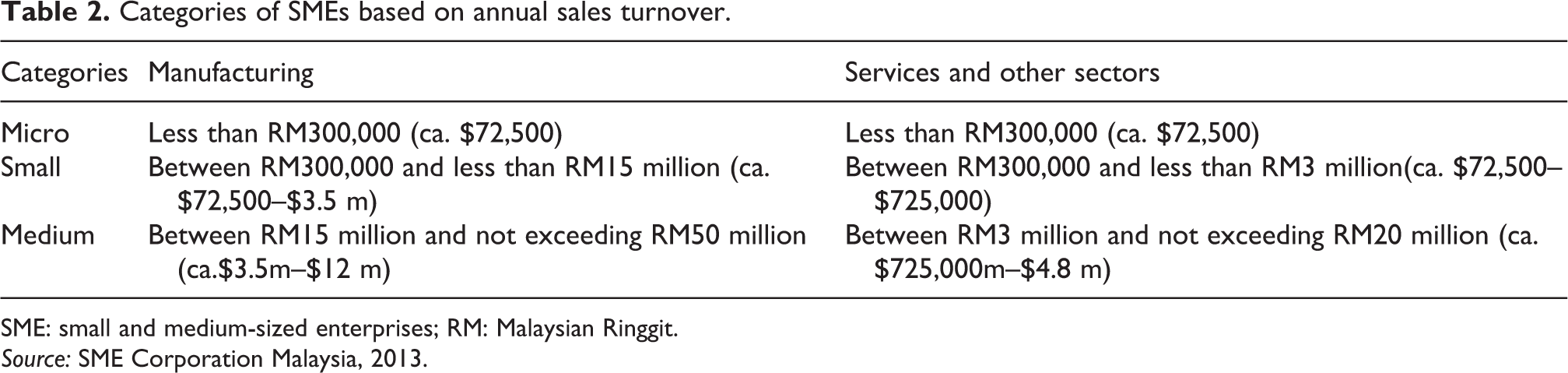
SME: small and medium-sized enterprises; RM: Malaysian Ringgit.
Source: SME Corporation Malaysia, 2013.
Effects of company size on KM
A company’s characteristics such as formalization, specialization, and standardization increase in accordance with size, where large organizations tend to be highly structured in their activities. On the other hand, as a company’s size decreases, its characteristics tend to become less formal, non-bureaucratic, having a flat structure and an organic free-floating management style (Daft, 2004; Edvardsson, 2006). The differences in an organization’s characteristics may further influence the adoption and implementation of KM even among the groupings in SMEs.
From the findings of Alvarez et al. (2015), the size of SMEs acts as a factor in regard to the level of formality in KM. Their finding showed that smaller organizations depend more on external knowledge compared to medium-sized enterprises, and this is compatible with the finding of Uhlaner et al. (2007). As for micro companies, their main source of knowledge is their owner-managers (Wong and Aspinwall, 2004).
In terms of KM processes, knowledge acquisition, sharing, and transferring are normally the same across all SMEs regardless of size. As for knowledge codification and storing, micro enterprises mainly use personalization strategies (Alvarez et al., 2015; OECD, 2003), where knowledge and experience gained are kept in the minds of employees without transforming them into an explicit form. On the other hand, medium-sized enterprises focus more on codification strategies. With more resource capacity, medium-sized enterprises are able to invest in a more formal and structured system to store knowledge (Alvarez et al., 2015; OECD, 2003).
As for organizational culture, micro enterprises have a less formal culture that promotes knowledge sharing. At a strategic level, very few SMEs have an explicit KM policy, and those that have it are medium-sized enterprises (Alvarez et al., 2015). Most SMEs rarely devote a specific budget to KM except for medium-sized enterprises (OECD, 2003). In addition, it is not usual for SMEs to have a unit specifically in charge of KM. It is more likely for medium-sized enterprises to have personnel responsible for KM initiatives, as they have more resources than small- and micro-sized enterprises (Alvarez et al., 2015).
As KMPM is the evaluation of KM plans or activities that have been set into motion, the differences mentioned above may influence the KMPM process in terms of the indicators or metrics used for measurement (Lee and Wong, 2015).
Research methodology and data collection
Three main aspects of KMPM have been suggested by Wong et al. (2015): knowledge resources, KM processes, and KM factors. Knowledge resources refer to the knowledge assets that a company owns, which can be tacit, explicit, internal, or external. Examples include employees, customers, suppliers, reports, documents, patents, and copyrights. KM processes indicate the various activities that are related to knowledge, such as acquiring, creating, sharing, utilizing knowledge, and so on. KM factors are the critical factors that help to facilitate and enhance KM activities, such as organizational culture, infrastructure, strategy, and so on. To have a thorough KM performance evaluation, all these three aspects should be covered, as each of them is an important key element of KM.
A survey was conducted and data were gathered through a questionnaire. The questionnaire consisted of five sections. The first explored the company’s background, and the second, third, and fourth investigated the applicability of a set of constructs for knowledge resources, KM processes, and KM factors, respectively, in measuring the KM performance of SMEs. Each item was measured on a five-point Likert scale (1 = not applicable, 2 = slightly applicable, 3 = moderately applicable, 4 = applicable, and 5 = very applicable). The last part consisted of a few general questions to understand SMEs better in the aspects of KM and KMPM.
SMEs selected to participate in this survey were restricted to the consultancy sector only, as they are the knowledge-intensive firms that rely heavily on specialist technical knowledge for the creation of customized solutions to clients’ problems. Only one questionnaire was sent to each selected SME together with a covering letter explaining the purpose of the survey. A total of 600 questionnaires were sent out to randomly selected consultancy firms throughout Malaysia. The questionnaires were addressed to the owner-managers of the selected SMEs, as they were considered to be the best respondents (Wong and Aspinwall, 2005; Zhang et al., 2006). During the survey, follow-up calls and personal visits to some companies were made to increase the response rate.
A total of 105 questionnaires were returned, yielding a 17.5 percent response rate. Four questionnaires were discarded as the responded firms have not implemented KM, and this would affect the accuracy of the results. The remaining usable 101 questionnaires were analyzed using SPSS version 19. The reliability and validity of the KMPM constructs have been tested and verified by Lee and Wong (2015), and in their final form, they are human capital, knowledge capital, intellectual property, knowledge acquisition, creation and generation, application and utilization, codification and storing, transferring and sharing, culture, management leadership and support, organizational infrastructure, strategy, resource, and human resource management. Although a full statistical investigation has been performed on the collected data, only results that are related to organizational size and KM maturity are discussed in this article.
Data analysis and discussion
Two-way ANOVA analysis
Table 3 shows the descriptive statistics of the respondent companies based on the total number of employees (company size) and number of years implemented KM (KM maturity).
Descriptive statistics.
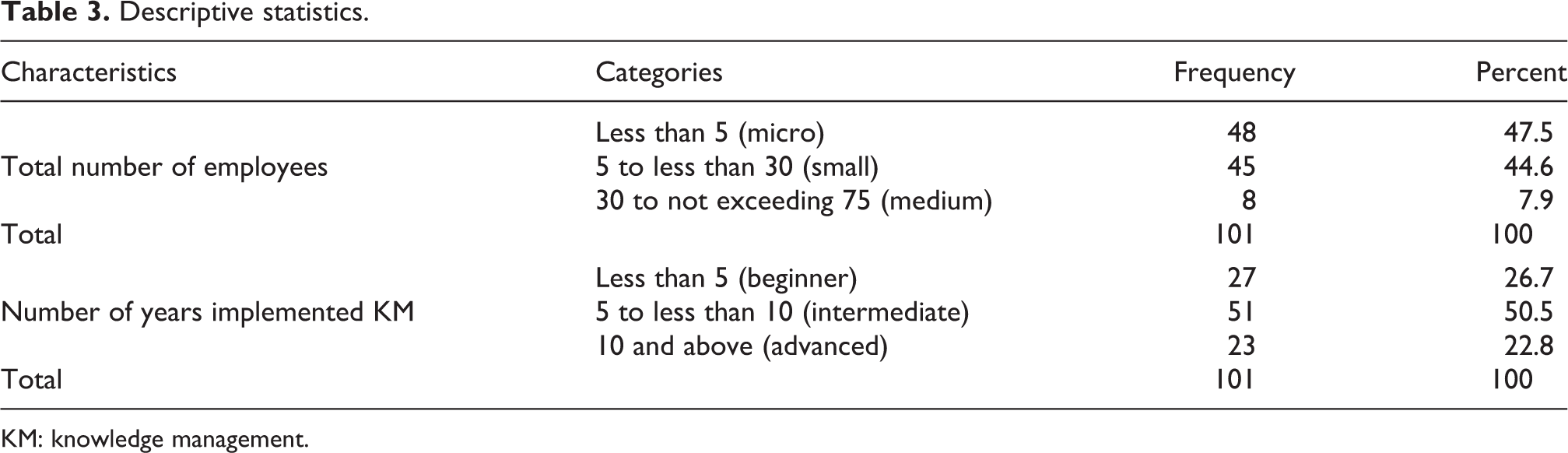
KM: knowledge management.
Table A1 shows the three main aspects of KMPM and their respective constructs together with their mean values (see Appendix 1). The mean values range from 3.248 to 4.026, indicating an acceptable degree of applicability of the constructs for KMPM purposes in SMEs.
Two-way analysis of variance (ANOVA) was conducted to study whether the independent variables (company size and KM maturity) and their interaction (Company Size * KM Maturity) have a statistically significant effect on each of the dependent variables (constructs a1 to c6). If the p value is 0.05 or lower, it indicates that there are statistically significant differences between the means of the independent variables tested. Significant differences between the means show that companies with different size (micro, small, and medium) and/or KM maturity (beginner, intermediate, and advanced) perceived the tested constructs differently in KMPM. The results of the analysis are shown in Tables A2, A3, and A4 (see Appendix 1).
Referring to Table A2 in Appendix 1, constructs a1, c3, and c5 show significant differences between the means of micro-, small-, and medium-sized companies. For construct a1 (human capital), the differences might be due to the fact that medium-sized enterprises concentrate more on codification strategies as stated earlier where the value of their physical knowledge repository outweighs the value of their human capital. Micro- and small-sized firms are more dependent on their human capital such as the knowledge of their owner-managers, workers, customers, and suppliers. Therefore, medium-sized companies focus more on the performance of their tangible knowledge asset during KMPM, while micro- and small-sized enterprises emphasize their human capital.
As for construct c3 (organizational infrastructure), the needs for better infrastructure, such as technological tools, meeting rooms, and so on, to carry out KM activities will naturally increase with company size. Through time, the success and benefits of KM will act as an encouragement for companies to bring in more advanced technological tools to improve and upgrade their KM system. SMEs generally pay more attention to the performance of their organizational infrastructure in terms of expenditure and maintenance as their size increases.
Looking at construct c5 (resource), as the company size increases, resource becomes an important factor to be evaluated during KMPM. The term resource in this article includes financial, human, and time (Wong, 2008). SMEs are well known for their resource scarcity (Herrmann et al., 2007), but as their size increases, the amount of financial budget, human resources, and time they can afford to allocate to KM initiatives also follows. Construct c5 can be evaluated based on the allocation of resources according to the capability of a company.
From Table A3 in Appendix 1, constructs a1 and c2 show significant differences between the means of beginner, intermediate, and advanced stages of KM maturity. For construct a1 (human capital), as employees are the key knowledge asset of SMEs, it is logical for these companies to acknowledge the importance and value of their knowledge workers more as they progress in their KM initiatives. In the course of time, they will be more aware of their employees’ knowledge that contributes to the success of their organizations. Hence, the importance of human capital as a key construct that needs to be measured increases progressively as SMEs become more mature in KM.
For construct c2 (management leadership and support), when SMEs are more mature in KM, they are more aware of the importance of measuring the performance of their organizational leadership and support. As leaders set the example for others in a company to follow, they have a direct impact on KM. Without a committed management to stress the importance of KM, employees will assume that it is just another passing fad and most likely they will not take it seriously (DeTienne et al., 2004).
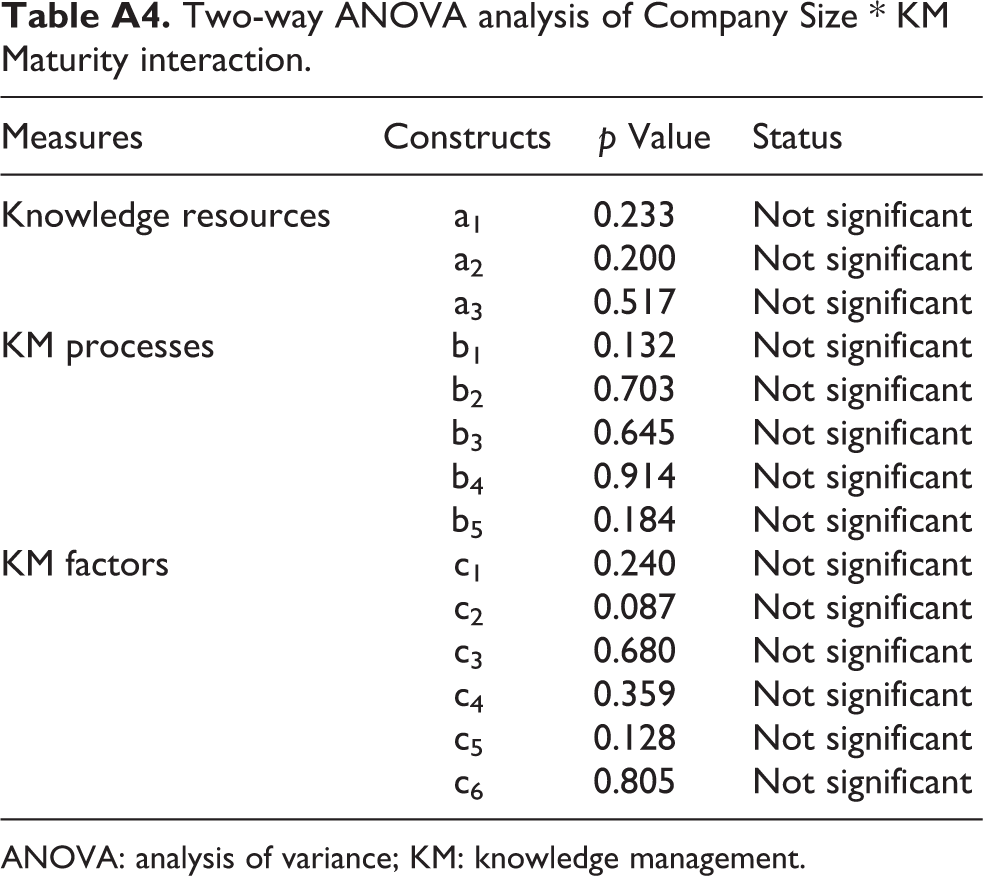
Referring to Table A4 in Appendix 1, there is no statistically significant interaction between the effects of company size and KM maturity on all of the constructs tested. This indicates that company size and KM maturity are independent of one another.
Overall, it can be said that company size among SMEs does affect KMPM. There are some significant differences for knowledge resources and KM factors when comparing the means of micro-, small-, and medium-sized companies, in accordance with the findings of OECD (2003) and Alvarez et al. (2015). The same is true for KM maturity, where the two-way ANOVA analysis shows that there are some significant differences for knowledge resources and KM factors between the beginner, intermediate, and advanced stages.
Benefits of KM
In this section, nine benefits of KM as shown in Table 4 were presented to the respondents, and they were allowed to select more than one choice of which their companies have gained from KM.
Benefits of KM.
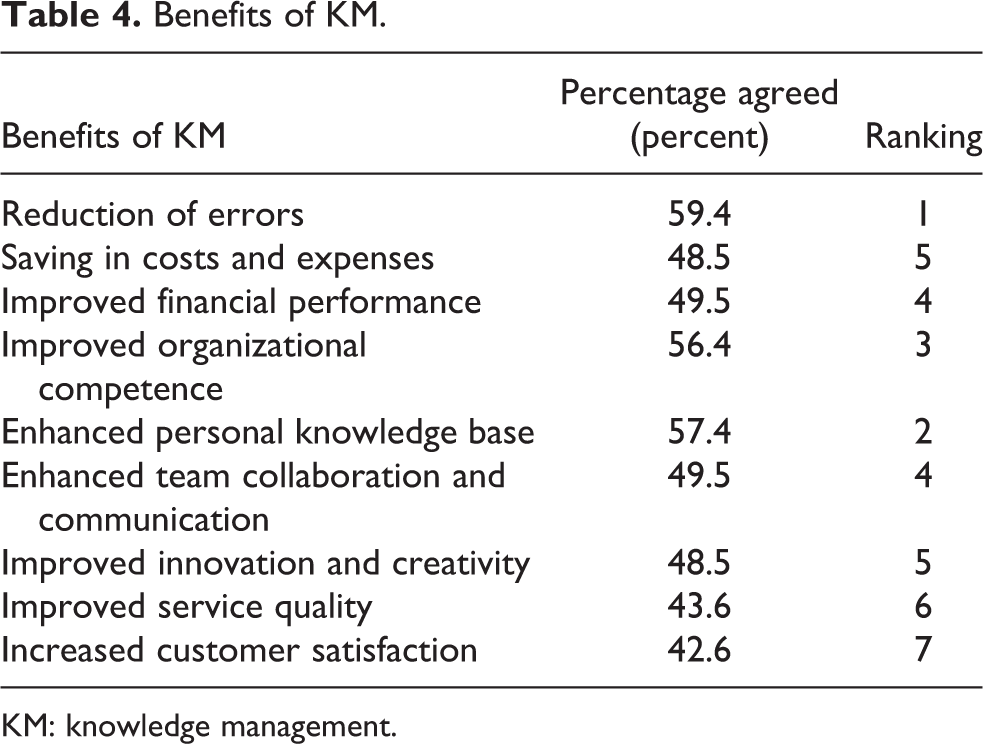
KM: knowledge management.
Most SMEs believed that implementing KM has helped them in reducing errors, followed by enhancing personal knowledge, improving organizational competence, financial performance, team collaboration and communication among employees, and so on.
As SMEs have a high turnover rate (Wickert and Herschel, 2001), valuable knowledge and experience will be lost when key employees depart. Reduction of errors is seen as the main contribution of KM due to the fact that with a knowledge retention process and knowledge repository system in place, duplication of errors and efforts can be avoided (Wong and Aspinwall, 2004). Employees can avoid making the same mistake by referring to the reports or documents that previous employees contributed to the repository. This can help SMEs to prevent costly mistakes that may jeopardize their performance and image.
Second is the enhancement of personal knowledge base. Unlike large organizations, SMEs lack highly educated and experienced employees. However, workers can still enhance their knowledge with the proper KM activities and factors in place to support them. Employee development is the responsibility of human resource management, which is a crucial element in KM. The provision of appropriate professional development training to employees will enhance their personal value (Wong, 2005). Hence, with more knowledgeable employees and less mistakes, a company’s overall performance and competence will also improve.
Third on the list is improvement in organizational competence. When knowledge is properly used and leveraged, it could drive companies to become more innovative and, thus, more competitive (Gourova, 2010). KM improves decision making, knowledge sharing, innovation, and flexibility to change and reduces duplication of work (Alavi and Leidner, 1999; Singh and Garg, 2008). These lead to the creation of new markets and rapid development of new products, giving companies the edge to compete (Nunes et al., 2006).
Improving service quality and customer satisfaction are last on the list, as SMEs usually dwell on short-term strategies such as boosting sales and quick profits. The scenario is different from large organizations where retaining loyal customers is their priority by establishing long-term relationship with them through providing quality products or services.
Barriers of KMPM
Seven barriers of KMPM as shown in Table 5 were presented to the respondents, and they were allowed to select more than one barrier that have hindered them in implementing or carrying out their KMPM activities.
Barriers of KMPM.

KMPM: knowledge management performance measurement.
Most SMEs agreed that time is the main issue when implementing KMPM. With minimal workforce, owner-managers and employees in SMEs usually have to take on multiple responsibilities which limit their free time for KM and its performance measurement activities.
Second on the list is the lack of suitable measurement models or tools for them to carry out evaluation activities. As the spot light is on large organizations, SMEs have received little attention from researchers (Delahaye, 2005; Durst and Edvardsson, 2012; Hutchinson and Quintas, 2008;). KM evaluation systems and tools created are mainly based on the needs and characteristics of large organizations, which may not be suitable to be used in SMEs (Lee and Wong, 2015).
Lack of human resources and expertise is another obstacle for SMEs since they have limited employees. SMEs generally do not have enough resources to establish a department solely for KM and its performance measurement. Unlike large organizations that usually have a knowledge officer or KM department, SMEs usually lack the expertise in handling KMPM.
Even with so many difficulties at hand, it is remarkable that only 4 percent are not interested in KMPM and only 1 percent feels that it is not important. This indicates that almost all of the respondents are interested in KMPM and acknowledge the importance of having a KMPM system in place. This finding serves as a great encouragement for researchers to conduct more studies and propose better models or tools to help SMEs excel in their KMPM ventures.
KMPM in improving organizational performance
In this section, respondents were required to answer to what extent KMPM could help in improving their organizational performance on a five-point Likert scale (l = not at all, 2 = little, 3 = somewhat, 4 = a lot, and 5 = to a great extent).
Referring to Table 6, larger sized SMEs believed more in KMPM in improving their performance. A clear increment in the mean value can be seen as the company size increases from micro to medium. Small- and medium-sized companies may be more open to the concept of KMPM, as they have more resources for such an activity compared to micro firms. With limited resources, smaller firms might concentrate more on the implementation process rather than performance measurement.
KMPM in improving organizational performance.
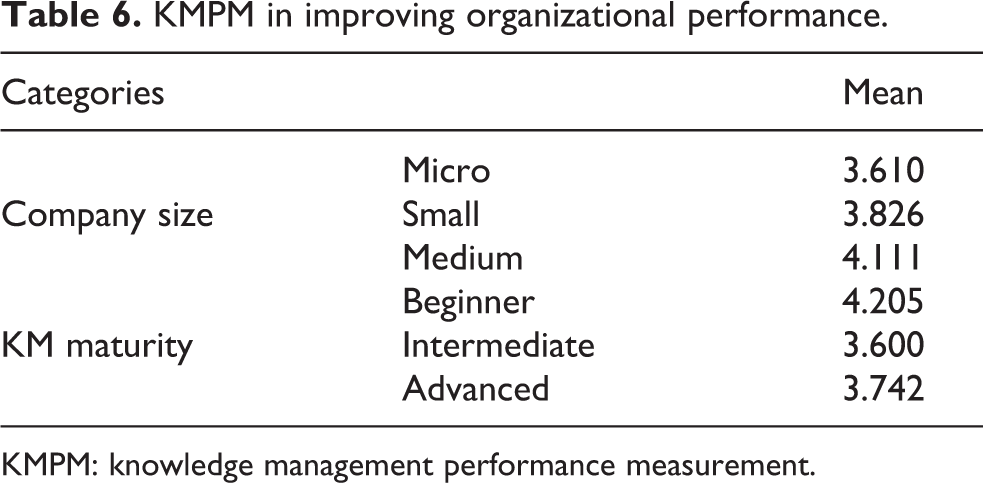
KMPM: knowledge management performance measurement.
As for KM maturity, SMEs that are new to this field have high hope in KMPM, resulting in a higher mean compared to the intermediate and advanced classes. Evaluating the performance of KM is not a simple task (Kluge et al., 2001). Many that have tried shy away from this process as it is not easy to develop the right metrics to evaluate KM performance. Without proper metrics, KMPM tends to be ineffective and a waste of resources which dampen the confidence of most companies.
KMPM is still new for SMEs, as the focus is on large organizations, with the mind-set that SMEs do not need KMPM or they are not ready for it. Yet it is evidential that the findings from this study show otherwise.
Conclusions
The findings from this study indicate that for SMEs, company size and KM maturity do affect KMPM. Even among the groupings in SMEs, when it comes to KMPM, micro-, small-, and medium-sized firms have some different perspectives. Two-way ANOVA shows that for knowledge resources, the mean values of human capital are significantly different among SMEs. As for KM factors, the mean values of organizational infrastructure and resource show significant differences. The same can be said for KM maturity, where the beginner, intermediate, and advanced adopters have a different point of view on KMPM in the aspects of human capital for knowledge resources and management leadership and support for KM factors.
Just because micro enterprises have less employees does not mean they do not need KM. Their focus might differ from small- and medium-sized companies, but they still need it to survive in this knowledge-driven competitive era. From the survey, the respondents believe that KM has helped to improve their organization’s performance in some ways. Almost all of the respondents are interested in KMPM, and they trust that it will further enhance their capability. Hopefully, this will serve as an encouragement for researchers to focus more on SMEs, breaking the mind-set that SMEs do not need KM and KMPM.
As the field of KMPM in SMEs is still underdeveloped, it is hoped that the findings of this study have offered some insights on the effects of company size and KM maturity on KMPM. In terms of managerial implications, it can guide early KMPM initiatives in SMEs and reduce failures. In addition, the results can help to further steer research endeavors in this emerging area in SMEs. Findings from the barriers that they faced in KMPM can be used as a guideline in developing better tools or models to cope with their shortcomings.
With a growing number of SMEs that see KMPM as a vital process in improving their KM system and, consecutively, their organizational performance, there is a need for more definitive and comprehensive studies in this field. Enough with large organizations, SMEs should not be neglected, as they too play a major role in a country’s economic growth.
Footnotes
Appendix 1
Two-way ANOVA analysis of Company Size * KM Maturity interaction.
| Measures | Constructs | p Value | Status |
|---|---|---|---|
| Knowledge resources | a1 | 0.233 | Not significant |
| a2 | 0.200 | Not significant | |
| a3 | 0.517 | Not significant | |
| KM processes | b1 | 0.132 | Not significant |
| b2 | 0.703 | Not significant | |
| b3 | 0.645 | Not significant | |
| b4 | 0.914 | Not significant | |
| b5 | 0.184 | Not significant | |
| KM factors | c1 | 0.240 | Not significant |
| c2 | 0.087 | Not significant | |
| c3 | 0.680 | Not significant | |
| c4 | 0.359 | Not significant | |
| c5 | 0.128 | Not significant | |
| c6 | 0.805 | Not significant |
ANOVA: analysis of variance; KM: knowledge management.
Declaration of conflicting interests
The author(s) declared no potential conflicts of interest with respect to the research, authorship, and/or publication of this article.
Funding
The author(s) would like to thank the Ministry of Higher Education, Malaysia for funding this research.