



Abstract
No longer simply a fad, social media-based technologies are used by organizations to create innovative ideas that can enhance both a firm’s product offerings and the ways in which it conducts its business activities. Despite its many apparent uses and benefits, there are several barriers associated with their use, including legal, security, and privacy risk. Grounded in the technology adoption theory, the purpose of this study is to understand how businesses perceive the benefits of and barriers to social media and its effects on adoption. Employing the partial least squares method, a research model was developed and tested via a survey of 117 senior employees from organizations in South Korea and New Zealand. The results suggest that the benefits due to social media, such as brand affinity, sales opportunities, and customer support, positively affect social business adoption; whereas a lack of social media strategy and security concerns negatively affect social business adoption. The results of the study have important implications for business managers and researchers.
Keywords
Introduction
The use of social media technologies, such as blogs, wikis, social networking sites, social tagging, and microblogging, is proliferating at an incredible pace and as a result of this changing the way businesses function from both strategic and operational perspectives (Koch et al., 2013). Over the latest decade, social networking startups such as Facebook and Twitter have amassed user bases as large as the population of China. 1 In conjunction with this growth has been an increase in its use by business, the likes of which have seen social media move from faddish hype to something that creates real business value (Kiron et al., 2013; Subramaniam et al., 2013).
Despite its many apparent benefits and the value that it creates for business, there are several risks associated with their use, including legal, cyber, security, records management, privacy, and identity risk (Everett, 2010; Jenkins, 2012; VMIA, 2010). In conjunction with these risks is the effect that a lack of managerial understanding of social media usage and improver oversight may have on the organization’s ability to use the tool effectively. If social media isn’t managed appropriately then outcomes that were intended to be prevented may still occur. Social media management requires an effective overall strategy that puts in place measures that among other things develops effective compliance processes and security measures, allocates sufficient levels of resources (people and funding) to implement, and also challenges traditionalists factions within the organization to be more open to and embracing of change (Kiron et al., 2013).
To make the most of social media use by business, it is worth analyzing the factors associated with the risks and benefits of its usage. In this article, we empirically examine the perceived risks and benefits of social media use among businesses and in conjunction with this the strategic managerial elements they face in order to include social media within their operational environments. In order to accomplish this objective, the article consists of five sections including this introduction. In the second section, we provide an overview of social media and social business and the use of social business in the business sector. The third section documents our research model, methodology, and associated hypotheses followed by the fourth section dealing with explanation of the results of the study. Finally, in the fifth section, we present the findings and conclusions and also suggest some ideas for further research.
Theoretical background, research model, and hypotheses
For the purpose of this study, social media is the media we use to be social (Safko, 2012) and can be defined as ‘a group of Internet-based applications that build on the ideological and technological foundations of Web 2.0, and that allow the creation and exchange of user-generated content’ (Kaplan and Haenlein, 2010, p. 61). With regard to social business, we refer it to be the business activities carried out through social media tools and technologies. The concept of social business is relatively new and is expected to grow in importance over the next few years (Kiron et al., 2013). Social business incorporates social media tools (such as blogs, Twitter, LinkedIn, and Facebook), technology-based internally developed social networks (such as the Cisco Learning Network), special purpose social software for enterprise created either by third parties (such as Chatter, Jive or Yammer) or developed in-house, and data derived from social media and technologies (such as crowdsourcing or marketing intelligence). More than just a technological concept, however, social business is also a business culture of collaborative innovation and engagement at all levels of business functions.
To empirically test the benefit of and risks posed by social media to business, this study bases it assumptions in the technology adoption theory which was presented by (Davis, 1989) and extended by several studies (Venkatesh et al., 2011). Grounded in the field of psychology, technology adoption theory attempts to understand the perceived behavioral characteristics (such as usefulness of a technology) that impact the adoption of a technology. In terms of social media and Web-based technology, technology adoption theory has been used to test the effects of certain benefits and risk associated with it and its adoption in an organizational context (Chan and Ngai, 2007; Khan et al., 2014). By using technology adoption as a theoretical base, this study has identified a range of factors that can have an effect on social media adoption, these include brand affinity (Kiron et al., 2013), customer support (Bughin and Chui, 2010; Verhoef and Lemon, 2013), crowd sourcing (Sawhney et al., 2005; Walter and Back, 2011), customer sentiment (Stieglitz and Dang-Xuan, 2013), recruitment (Bohnert and Ross, 2010; François et al., 2014), organizational strategy and understanding (Oestreicher-Singer and Zalmanson, 2013), competing priorities (Buehrer et al., 2005; Frambach and Schillewaert, 2002), business value (Aral et al., 2012), security concerns (Gross and Acquisti, 2005), and organizational culture (Koch et al., 2013). Based on the studies by Kiron et al. (2013), these factors were further categorized into benefits of and barriers to social business as shown in our research model (Figure 1). Below, we define each of the constructs and develop our hypotheses. See Appendix 1 for the stated hypotheses.
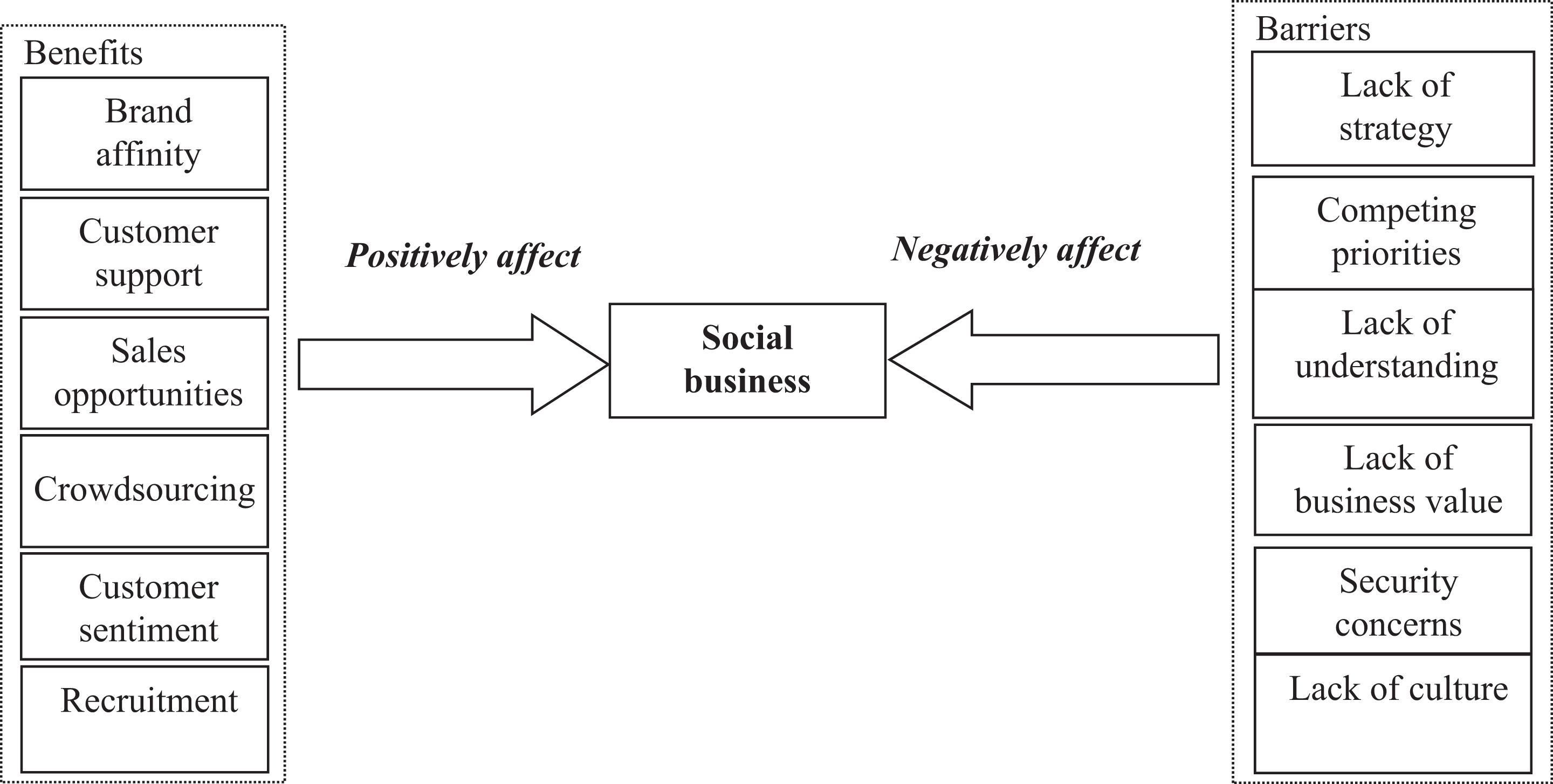
Proposed research model.
Benefits of social business
Brand affinity
In this study, brand affinity is measured as a business’s perception of social media’s ability to generate enhanced brand awareness, brand reputation, and an increase in the level of trust customers have in an organization. Social media platforms can empower businesses to build brands that help to increase the level of brand awareness consumers have about a particular product or service (Castronovo, 2012; Constantinides, 2014). Currently, marketers are using social media as a means of brand promotion, building stronger consumer brand relationships, and enhancing the reputation of a firm’s brand (Chen et al., 2011; Constantinides, 2014). Social communities such as Facebook, Twitter, and LinkedIn are channels of social media that are relationship focused and feature multi-way communication, conversion, and collaboration (Tuten and Solomon, 2012). Brands like Apple, Coca Cola, Starbucks, and McDonalds are actively involved in online social communities as a means of consumer engagement. Given the marketing benefits of social media platforms, and the opportunities that business have to develop strong brand customer relations, enhance brand awareness and the reputation of their brands, this study contests that brand affinity opportunities through social media will positively affect social business adoption by organizations.
Sales opportunities
In this study, sales opportunities are measured as a business’s perception about the opportunities provided by social media to increase its total sales volume, create new sales opportunities, and provide new market opportunities. Social media platforms stimulate sales by allowing salespeople to see what prospects are saying about their brand and competitors and as a result attract new customers (Michaelidou et al., 2011). Several companies are already using social networking sites to support the creation of brand communities which can help to initiate conversations with potential customers. For example, Dell, states that its use of Twitter, a micro blogging social media tool that allows for the sending out of short, text-based posts of 140 characters or less, has generated $1 million in incremental revenue due to sales alerts (Kaplan and Haenlein, 2010). As a result of social media’s ability to generate new sales and marketplace opportunities, this study contests that sales opportunities through social media will positively affect social business adoption by organizations.
Customer support
Customer support can be defined as a range of services offered by business to assist customers in making the best use of the products or services they have purchased. In this study, customer support is measured as a business’ perception of the opportunities provided by social media to provide better overall customer support, more effective means of answering customer queries, and by reducing customer query response times. As the operational environments that firms interact in have become more global and service oriented, many firms have realized that customer support is critical to their competitiveness (Negash et al., 2003) and to avoid adversity and build long-term relationships (Morris and Davis, 1992). Due to social media’s ability to enhance customer service, this study contests that greater customer service offerings will positively affect social business adoption by organizations.
Crowd sourcing
The concept of crowdsourcing (Garcia Martinez and Walton, 2014) is an online idea contest, whereby companies or institutions take an idea or concept-seeking process, once performed by employees, and outsource it to an undefined (and generally large) group of people on the internet (Albors et al., 2008). In this new form of’ ‘electronic marketplace’, ideas (potential innovations) are like goods, which are created by ‘working consumers’ and demanded by ‘solution-seeking companies or institutions’ (Walter and Back, 2011, p. 1). In this study, crowd sourcing is measured as a business perception of the opportunities provided by social media to solicit ideas from a large group of people, brainstorm new ideas, and help gather new information. As a means of gathering crowdsourced ideas, organizations have been actively engaging with large numbers of consumers through social media (Garcia Martinez and Walton, 2014). In doing so, they are able to gain new ideas and valuable feedback which can enhance the capabilities of both existing and future product and/or service offerings. As a result of social media’s ability to effectively crowd source new ideas, this study contests that greater customer service offerings will positively affect social business adoption by organizations.
Customer sentiment
For the purposes of this research, customer sentiment is measured as a business’s perception of the opportunities provided by social media to understand customer sentiments and needs, allowing businesses to get closer to their customers. In recent years, social media has transformed the way businesses manage their marketing and brand management operations and how they interact with customers (Palmer and Koenig-Lewis, 2009). As part of this, businesses are now better placed to understand the needs, sentiments, or opinions that are held or expressed by customers. Social media technologies provide an ideal forum from which a consumer’s sentiments such as their emotion state, judgment or evaluation of a certain person, topic, or product/service offering can be conveyed. These days’ social media channels such as Twitter, YouTube, and Facebook are a live commentary on companies, products, and services. Never before has business enjoyed such instant visibility into consumer opinions and needs. Currently Coca Cola, for example, has more than 88 million likes on its Facebook page while coffee shop giant Starbucks has some 37 million likes. Due to social media’s ability to closer to and better understand the needs of consumers, this study contests that greater customer sentiment offerings will positively affect social business adoption by organizations.
Recruitment
In this study, recruitment is measured as a business’s perception of not only the recruitment of perspective employees, but also finding hard-to-reach and higher quality candidates by using social media. Today, social networking sites such as Facebook and LinkedIn are viewed by many organizations as the most powerful tools available to recruiters. According to Davison et al. (2011), social networking sites serve two purposes. The first is as a marketing tool where jobseekers can use social networking sites (SNSs) to market themselves to potential employers, and vice versa. The second is as a screening mechanism where employers can use information available via SNSs to cheaply and easily gain access to higher quality and more hard-to-reach candidates than more traditional methods of recruitment. Another important aspect of social media recruitment is the question of who they are targeting. The key benefits associated with using social media in recruitment, center largely on cost savings, increasing the pool of applicants reached, and being able to target recruitment at specific groups of potential candidates (Davison et al., 2012). As a result of social media’s ability to not only effectively recruit but also identify more hard-to-reach high-quality candidates, this study contests that recruitment offerings will positively affect social business adoption by organizations.
Barriers to social business
Lack of organizational strategy and understanding
An organizational management strategy refers to a clear definition or directive of how an organization needs to change over time. It specifies the organization’s mission, vision, and objectives; the allocation of resources; and the development of policies and plans, often in terms of projects and programs, to achieve the organization’s objectives (Dess et al., 2005). In this study, a lack of organizational strategy is measured by the perception of lack of organizational social media strategy generally, social media not being part of an operational strategy, or by having a corporate strategy that is unrelated to social media usage. As Kiron et al. (2013) note, a lack of social media strategy and understanding results from an organization’s inability to establish and articulate business value for beginning the social journey, identify a small number of processes and problems that social media can address, develop corporate-wide compliance processes and security measures, allocate enough resources (people and funding) to implement, assign corporate level social business leader, challenge traditionalists to be open to change, and leverage social data in business intelligence and decision making. For organizations that have an unrelated corporate strategy or fail to fully understand and successfully implement social media strategy, this study contests that a lack of organizational strategy and understanding will negatively affect social business adoption by organizations.
Competing priorities
In this study, the issue of competing priorities is measured as a business’s perception of not having enough resources to invest in social media, having priorities that are more important than social media, or by noting that social media is not a priority for the organization. Dealing with competing priorities is an integral part of any business. In recent years, greater emphasis and priority have been given by business to investing in social media tools and technologies. From a marketing perspective, Small and Medium Enterprises (SMEs) have actively embraced the use of social networking systems to promote their business operations (Michaelidou et al., 2011), with a Cone (2008) study showing that 93 percent of social media users believe that companies should have a social media presence. For some organizations, social media technologies do not always relate well to its business structure and relationship priorities. Adoption of an innovation is therefore based on the perceptions of organizations regarding the particular technology, which ultimately determines the time of adoption (Iacovou et al., 1995). This study therefore contests that competing priority (e.g., monetary, time, and technological priorities) will negatively affect social business adoption by organizations.
Lack of proven business value
In this study, a lack of proven business value is measured as a business’s perception of not generating value from social media in terms of customer support, new product developing, and generating customer sales. Tang et al. (2012) found that in the case of the YouTube media platform, as the growth of online social media continues, businesses have been provided with new sources of additional content contributions, ad revenue, investment, and funding (Tang et al., 2012). While studies by Aral et al. (2012) and Wu et al. (2009) have documented a strong correlation between certain social network attributes, superior work performance, and business value. However, despite such findings, companies have often found it difficult to accurately measure the economic impact and return on investment of social media marketing and service programs. At present, there is also a lack of consensus on how to measure the effectiveness of an organization’s social media program. Thus, we posit that a business inability to generate value from social media in terms of customer support, new product developing, and generating customer sales will negatively affect social media adoption.
Security concern
This study measures security concerns as the perception of increased security risk for organizations through social media use, a lack of risk management policy, and the general inadequacy of social media security measures of an organization. Social media are very sensitive to a range of security concerns (Gross and Acquisti, 2005) and a range of risks that impact social media adoption, including legal, cyber, security, records management, privacy, and identity risk (Everett, 2010; Jenkins, 2012). These risks pose a real tangible threat to organizations, with a (Gordon et al., 2011) study showing that cyber-attacks can negatively impact the stock prices of targeted firms, while Symantec in 2010 described the combined average cost due to cyber-attacks of $2 million dollars annually (Shackelford, 2012). Thus, we posit that security concerns related to incorporating social media and the lack of polices to counter it may negatively affect social media adoption.
Lack of organizational culture
Organizational culture is an important factor that contributes to the success of a firm. Organizational cultural is defined by Schein (1986) as a model of norms, values, beliefs, and attitudes that affects employee behavior (Schein, 1986), while Hofstede (2001) views it as being the collective programming of the mind that distinguishes the members of one organization from others (Hofstede, 2001). In this study, organizational culture is measured as a perception of an organizational culture that lacks sharing, openness, collaboration, and participation through social media. The idea of cultural conflict within an organization is a key determinate of whether firms are able to successfully implement social media tools. In short, going social is more than just configuring and incorporating social media tools, it requires an organizational culture of participation, sharing, openness, and collaboration. Thus, we posit that the lack of such a culture can serious jeopardize social media efforts which can negatively affect social media adoption.
Methodology
Instrument development and procedure
To empirically test the proposed research model, a survey instrument consisting of 13 constructs and 42 items was developed. The items used to measure social business use intention were developed based on studies by Gefen and Straub (2000) and Carter and Bélanger (2005). Social media risks and benefit constructs were adopted from the studies by Kiron et al. (2013). However, given the lack of reliable items to measure the constructs in a business context, the items were operationalized based on the definitional properties of the social media benefits risks and benefit constructs.
Since the study was constructed in two different countries; the original English version of the instrument was translated into Korean with the help of a bilingual research assistant who had a fluent command of both languages. Later, an online version of the questionnaire was created using GoogleDocs online survey tool. All the items were measured on a 5-point Likert-type scale, in which 1 was very strongly agree and 5 was very strongly disagree. The subjects of the study were 117 employees of companies in South Korea and New Zealand and were selected through a non-probability convenient sampling method.
Results
Descriptive statistics
An analysis of the demographic component of the study shows us that in our sample 63.2 percent of respondents were male and 36.8 percent were female. Of these, more than half (60.8 percent) were aged between 26 and 38 years of age and 22.2 percent were aged 39 years of age and older, while only 15.4 percent of respondents were aged 25 years or below. The vast majority of those who participated in the sample were well educated with 53.8 percent holding an undergraduate degree and 28.2 percent completed master’s studies, while a further 6 percent had doctorate level qualifications. In terms of their respective fields of employment, the three most dominant areas were education and training (34.2 percent); banking and finance (30 percent); and marketing, communications, and sales (10.3 percent). In terms of work experience, 49.6 percent of respondents had worked for between 1 and 6 years, a further 34.2 percent had between 7 and 12 years’ experience, while only 15.9 percent had more than 13 years of corporate experience. From an organizational social media experience perspective, 47.8 percent of those surveyed had used social media for 4–6 years, 34.1 percent had between 1 and 3 years, while 18.1 percent had more than 7 years’ experience. The most frequently used types of social of media were Facebook (92 percent), Twitter (53 percent), LinkedIn (52 percent), Blogs (37.6 percent), and YouTube (33.3 percent). The usage frequency of these different types of social media saw 57.3 percent of respondent use the tool for up to 1 hour a day, 23.1 percent for 1–2 hours a day, and 17.9 percent for more than 3 hours each day.
Assessment of the structural model
Of the 12 independent variables used in the model, 6 had a significant effect on Social Business Adoption (see Figure 2). Brand Affinity benefits due to social media had a moderately significant positive effect on Social Business Adoption intention with β = 0.14 and significant at the p < 0.05. This supports the hypothesis H1 and implies that as the perception of Brand Affinity attained due to social media increase, the Social Business Adoption intention increases proportionally. As expected, Sales Opportunities due to social media had a significant positive effect on Social Business Adoption intention (β = 0.33, p < 0.001), thus accepting hypothesis H2. In other words, as the perception of sales opportunities due to social media increases, the Social Business Adoption intention increases proportionally. Likewise, Customer Support had a moderately significant positive effect on Social Business Adoption intention (β = 0.24, p < 0.001), supporting hypothesis H3. This simply means that as the perception of customer support opportunities due to social media increases, the level of Social Business Adoption intention increases proportionally. Surprisingly, the perception of Crowdsourcing opportunities due to social media had a moderately significant negative effect on Social Business Adoption intention (β = −0.16, p < 0.01), rejecting hypothesis H4. In terms of barriers to social business adoption, only two variables/constructs had a significant effect on social business adoption: Lack of Strategy and Security Concern. Lack of Strategy had moderately significant negative effect on Social Business Adoption intention (β = −0.18, p < 0.007); thus accepting hypothesis H7. This implies that as the perception of lack of social media strategy increases, the level of Social Business Adoption intention decreases proportionally. Finally, Security Concern had a moderately significant negative effect on Social Business Adoption intention (β = −0.18, p < 0.007). This supports hypothesis H11 and implies that the perception of security concerns associated with social media use by businesses negatively affects social business adoption intentions. Overall, the benefits of and barriers to social business accounted for 31 percent of variance in Social Business Adoption intention. A table detailing the results of the study can be found in Appendix 2 (Table A1).
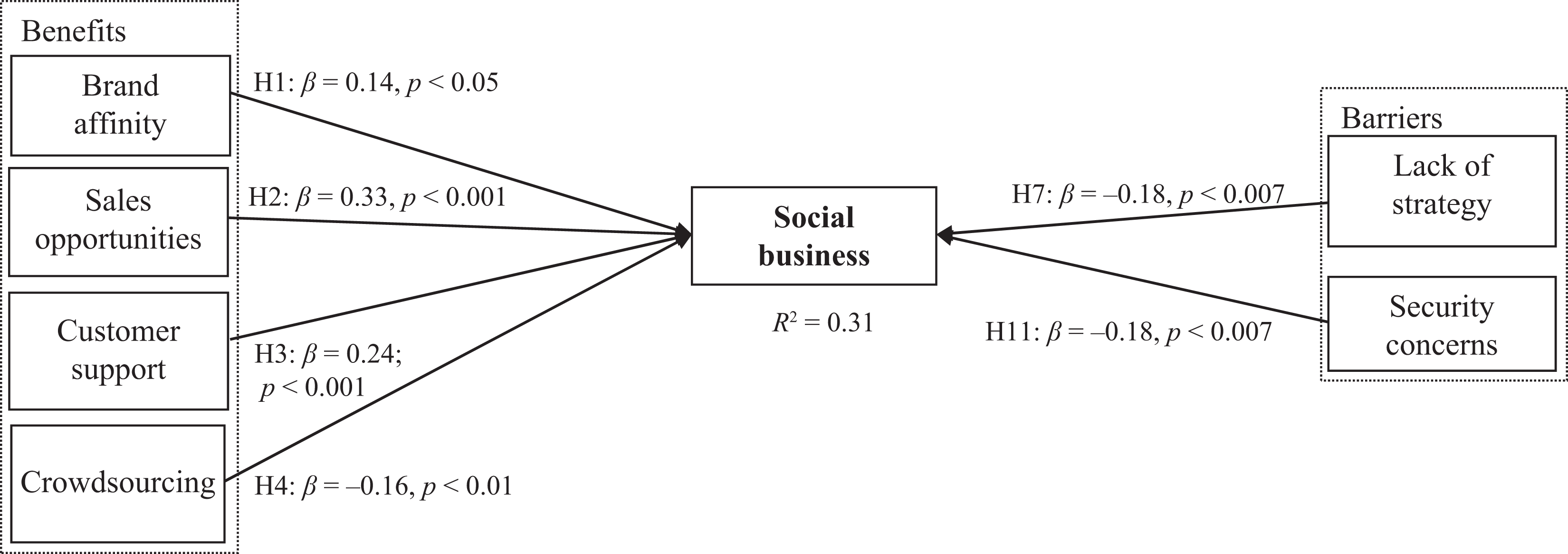
Updated model.
Discussion
In this research, by using technology adoption as a theoretical base, we tried to empirically understand the perceived risks to and benefits of carrying out business activities through social media. In terms of the benefits of social media use, the results suggest brand affinity, sales opportunities, and customer support opportunities provided by social media positively affect social business adoption. These findings are encouraging and add to the research that posits social media as being a valuable forum for brand promotion and building stronger brand affinity with customers (Gabisch and Gwebu, 2011), sales opportunities (Kiron et al., 2013), and customer support (Bughin and Chui, 2010; Verhoef and Lemon, 2013). Today, the relationship-focused social media channels of Facebook, Twitter, and LinkedIn have provided organizations such as Coca Cola and Starbucks with a mechanism that allows them to develop stronger emotional, economic, psychographic relationships between consumers and the brands they are marketing. The multi-way channels of communication, conversation, and collaboration provided by social media have allowed these companies to develop greater more effective levels of brand communication which can both protect and enhance the reputation of an organization’s brand and the confidence and trust that consumers have with it. The results regarding brand affinity reflect the attempt businesses in New Zealand and Korea have made to reach out beyond more traditional means of communication by adopting social media technologies in order to not only forge new relationships but also draw stronger emotional responses in the minds of consumers.
In terms of sales opportunities, this study’s results demonstrate a growing desire by business to use social media tools to tap into alternative revenue streams and new marketplace opportunities. As companies like Dell have shown, social media platforms have helped to stimulate sales by allowing salespeople to see what is being said about their brands and also initiate conversations with potential customers which can lead to a sale (Kaplan and Haenlein, 2010). As a new hybrid element (Mangold and Faulds, 2009) to the marketing mix, social media has not only given consumers greater power over their purchasing decision (Vollmer and Precourt, 2008) but it also provided businesses with competent product offerings the ability to generate greater sales volumes through the production of vast amounts of word-of-mouth and user-generated content and the consumer buzz that is associated with these efforts (Kozinets, 2002).
Another interesting finding of this study is that customer support is positively associated with social media adoption by businesses. In recent years, social media tools have been increasingly used to provide more effective means of customer support, as Bowen et al., (1989) notes, these include a technical aspect (addressed by both information and system quality) and a relationship aspect (addressed by service quality) (Bowen et al., 1989). Social platforms have provided organizations and service support managers in particular with an easier means of guiding customers to relevant web pages and/or video content that addresses customer queries in a more accurate, cost effective, and timely manner than was previously possible. The results regarding customer service reflect contemporary management’s attempts in New Zealand and Korea to redefine the delivery of service to customers and the way in which they think and talk about their respective brands.
While the benefits of social media use are attractive for organizations, there are also several risk factors which negatively influence an organization’s decision to adopt social media. However, as Webber et al. (2012) note most organizations typically focus on the benefits of social media, and while they may be aware of the risks posed, deliberate attempts to mitigate these threats are not always undertaken (Webber et al., 2012). In terms of the risk to social business, we found that a lack of social media strategy and security concerns negatively affect social business adoption. Given that social media are very sensitive to a range of security concerns (Gross and Acquisti, 2005), it is important that managers look to implement risk management measures that mitigate the concerns around privacy (Wondracek et al., 2010), identity theft (Bilge et al., 2009), spam (Balduzzi et al., 2010), and malware (Faghani and Saidi, 2009). In order to manage these security risks and the other risks that social media use pose Webber et al. (2012) suggested a four-step risk management approach: (a) identifying social media risks, (b) assessing and prioritizing those risks against limited resources, (c) mitigating and managing those risks to reduce the impact on the organization, and (d) evaluating emerging risks against mitigation effects. In the context of this research, this risk management approach could be implemented through a social media strategy that clearly establishes and articulates the business value for conducting social business activities, identifies the processes and problems that social media can address, develops corporate-wide compliance and security measures, allocates sufficient resources (people and funding) to implement, challenges traditionalists to be open to change, and leverages social data in business intelligence and decision making.
Surprisingly, crowd sourcing opportunities due to social media had a moderately significant negative effect on social business use intention. This may imply that either the respondents had a negative experience with crowd sourcing over social media or were not fully aware of the potential of crowd sourcing. Crowd sourcing through social media (Garcia Martinez and Walton, 2014) is a complex task and executing it smoothly requires considerable time, resources, and skills. However, if correctly managed, crowd sourcing has provided businesses with an effective tool for soliciting and brainstorming ideas from a large group of people. Crowdsourcing-based ‘mass customization’ systems that offer consumers the opportunity to self-design their own products have been embedded in Facebook pages of Audi and Porsche with great success, while Lego provides toolkits for self-design and consumer post and comment opportunities through its social communities.
The results of the study have important implications for business managers and research in that we now have a better understanding of both the key factors (brand affinity, sales opportunities, and customer support) that drive businesses to adopt social media and those which hinder it (lack of social media strategy and security concerns). This helps business managers to identify areas of strategic concern such as developing effective corporate-wide compliance and security measures and leveraging social data during important decision-making processes. From a research perspective, the model developed in the study provides a good base from which further tests can be conducted and different contexts analyzed.
Limitations of the study
One limitation of study stems from the sampling method employed. The sample was chosen using a non-probability convenience sampling method, thus generalizing the research beyond this study maybe a problem. Second, the sample size was not large enough; however, the SEM tool we employed in the study places less of a demand on sample size and as a result of this one can still achieve significant results. Still, a larger randomly selected sample may produce significantly different results. Nevertheless, we believe that the study makes an important contribution by taking the first step to creating a comprehensive research instrument that is able to measure social business. Future research may further refine and test the instrument in different contexts by employing a more robust sampling method.
Conclusion
By developing and empirically testing a research model, the purpose of the study was to understand benefits of and barriers to social business. The results suggest that the benefits of social media use such as, brand affinity, sales opportunities, and customers support positively affect social business adoption; whereas a lack of social media strategy and security concerns negatively affect social business adoption. Even though, the study has some limitations, we believe that it also has important implications for business managers and researchers interested in the concept of social business.
Footnotes
Appendix 1: Research instrument and stated hypotheses
Appendix 2
Loadings and cross loadings.

| BA | SO | CUS | CS | SA | RT | LOS | CP | LOA | NPV | SC | LOC | SBA | |
|---|---|---|---|---|---|---|---|---|---|---|---|---|---|
| BA1 |
|
0.12 | −0.38 | 0.23 | 0.02 | −0.14 | 0.05 | −0.07 | −0.11 | −0.10 | 0.04 | 0.07 | −0.01 |
| BA2 |
|
−0.16 | 0.11 | −0.11 | 0.12 | 0.01 | −0.05 | 0.00 | 0.08 | 0.14 | −0.05 | 0.02 | 0.05 |
| BA3 |
|
0.03 | 0.33 | −0.15 | −0.14 | 0.16 | 0.00 | 0.08 | 0.04 | −0.03 | 0.02 | −0.11 | −0.04 |
| SO1 | 0.02 |
|
0.03 | −0.03 | −0.12 | 0.12 | −0.10 | 0.01 | 0.08 | 0.01 | 0.02 | −0.05 | −0.09 |
| SO2 | −0.01 |
|
0.09 | −0.13 | 0.14 | −0.11 | −0.01 | 0.14 | −0.07 | −0.02 | 0.01 | −0.03 | 0.01 |
| SO3 | −0.01 |
|
−0.12 | 0.16 | −0.03 | −0.01 | 0.12 | −0.15 | −0.01 | 0.01 | −0.03 | 0.07 | 0.07 |
| CUS1 | −0.04 | 0.13 |
|
−0.02 | 0.04 | −0.14 | −0.06 | 0.08 | −0.06 | 0.03 | −0.05 | 0.03 | 0.00 |
| CUS2 | 0.05 | −0.12 |
|
−0.02 | 0.03 | 0.05 | 0.05 | −0.01 | 0.01 | −0.01 | 0.01 | −0.02 | 0.04 |
| CUS3 | −0.01 | −0.01 |
|
0.04 | −0.07 | 0.09 | 0.01 | −0.07 | 0.06 | −0.02 | 0.04 | 0.00 | −0.05 |
| CS1 | 0.07 | 0.01 | −0.14 |
|
0.14 | −0.16 | −0.03 | −0.02 | 0.11 | 0.03 | −0.06 | −0.12 | 0.02 |
| CS2 | −0.07 | 0.03 | −0.02 |
|
−0.11 | 0.06 | 0.04 | −0.03 | −0.04 | −0.05 | 0.06 | 0.05 | −0.01 |
| CS3 | 0.01 | −0.05 | 0.19 |
|
−0.02 | 0.09 | −0.01 | 0.06 | −0.06 | 0.03 | 0.00 | 0.07 | 0.00 |
| SA1 | −0.06 | 0.12 | 0.03 | −0.12 |
|
0.01 | 0.00 | 0.01 | −0.08 | 0.09 | −0.02 | 0.10 | 0.06 |
| SA2 | 0.05 | −0.29 | 0.23 | 0.10 |
|
−0.09 | 0.08 | −0.11 | 0.02 | 0.08 | −0.03 | −0.03 | −0.14 |
| SA3 | 0.02 | 0.19 | −0.29 | 0.04 |
|
0.08 | −0.09 | 0.11 | 0.07 | −0.19 | 0.05 | −0.09 | 0.09 |
| RT1 | 0.05 | 0.16 | −0.19 | 0.15 | −0.07 |
|
−0.01 | −0.19 | 0.06 | 0.07 | −0.03 | 0.08 | −0.02 |
| RT2 | 0.13 | 0.01 | −0.07 | −0.06 | −0.04 |
|
0.03 | 0.03 | −0.02 | −0.05 | 0.05 | −0.06 | 0.03 |
| RT3 | −0.17 | −0.16 | 0.26 | −0.08 | 0.11 |
|
−0.02 | 0.16 | −0.04 | −0.01 | −0.03 | −0.02 | 0.00 |
| LOS1 | −0.23 | 0.13 | −0.03 | 0.20 | −0.08 | −0.05 |
|
0.10 | 0.05 | −0.13 | 0.11 | −0.02 | 0.04 |
| LOS2 | 0.14 | −0.08 | 0.00 | −0.08 | 0.01 | 0.04 |
|
−0.01 | −0.04 | 0.08 | −0.06 | 0.04 | 0.01 |
| LOS3 | 0.06 | −0.03 | 0.02 | −0.09 | 0.06 | 0.00 |
|
−0.08 | 0.00 | 0.03 | −0.03 | −0.03 | −0.04 |
| CP1 | −0.17 | 0.07 | −0.02 | −0.04 | −0.06 | 0.22 | −0.02 |
|
0.31 | −0.27 | 0.10 | −0.23 | −0.04 |
| CP2 | 0.16 | −0.25 | 0.14 | 0.11 | 0.03 | −0.26 | −0.02 |
|
−0.17 | 0.19 | −0.12 | 0.22 | −0.02 |
| CP3 | 0.03 | 0.15 | −0.11 | −0.06 | 0.03 | 0.00 | 0.03 |
|
−0.17 | 0.12 | 0.00 | 0.04 | 0.06 |
| LOA1 | −0.09 | 0.17 | 0.18 | −0.07 | −0.23 | 0.18 | −0.05 | 0.08 |
|
0.07 | −0.01 | −0.01 | −0.09 |
| LOA2 | −0.03 | −0.10 | −0.07 | 0.09 | 0.13 | −0.11 | 0.00 | 0.06 |
|
−0.08 | 0.00 | 0.00 | 0.06 |
| LOA3 | 0.11 | −0.07 | −0.12 | −0.03 | 0.10 | −0.07 | 0.05 | −0.14 |
|
0.01 | 0.02 | 0.01 | 0.04 |
| NPV1 | 0.07 | 0.08 | −0.35 | −0.11 | 0.20 | 0.02 | −0.13 | −0.10 | 0.25 |
|
−0.06 | 0.02 | 0.03 |
| NPV2 | 0.05 | −0.21 | 0.12 | 0.13 | −0.02 | −0.09 | 0.03 | −0.02 | −0.05 |
|
−0.03 | −0.02 | −0.05 |
| NPV3 | −0.19 | 0.39 | −0.18 | 0.01 | −0.11 | 0.14 | 0.13 | 0.16 | −0.01 |
|
0.09 | −0.02 | 0.09 |
| NPV4 | 0.04 | −0.17 | 0.31 | −0.04 | −0.06 | −0.03 | −0.02 | −0.03 | −0.15 |
|
0.01 | 0.02 | −0.05 |
| SC1 | 0.10 | −0.20 | 0.10 | 0.19 | −0.05 | 0.02 | −0.07 | −0.19 | 0.03 | 0.13 |
|
−0.21 | 0.00 |
| SC2 | 0.01 | −0.01 | 0.16 | 0.18 | −0.18 | −0.18 | −0.07 | −0.09 | −0.19 | 0.06 |
|
0.01 | −0.03 |
| SC3 | −0.19 | 0.08 | 0.04 | −0.30 | 0.14 | 0.17 | 0.03 | 0.42 | 0.17 | −0.15 |
|
−0.05 | 0.03 |
| SC4 | 0.07 | 0.14 | −0.32 | −0.12 | 0.12 | 0.02 | 0.11 | −0.09 | 0.02 | −0.06 |
|
0.25 | 0.01 |
| LOC1 | 0.00 | 0.14 | −0.14 | 0.18 | −0.17 | −0.08 | 0.07 | −0.08 | −0.09 | −0.01 | 0.00 |
|
0.01 |
| LOC2 | −0.07 | 0.12 | −0.01 | 0.15 | −0.24 | 0.09 | −0.06 | 0.00 | 0.03 | 0.03 | 0.00 |
|
−0.01 |
| LOC3 | 0.03 | −0.11 | 0.04 | −0.14 | 0.26 | −0.09 | −0.06 | 0.03 | 0.06 | −0.04 | −0.01 |
|
0.02 |
| LAC4 | 0.05 | −0.17 | 0.12 | −0.22 | 0.17 | 0.10 | 0.05 | 0.06 | 0.00 | 0.02 | 0.00 |
|
−0.02 |
| SBA1 | 0.04 | −0.03 | 0.01 | −0.02 | 0.02 | −0.02 | 0.07 | −0.11 | −0.02 | 0.07 | 0.00 | 0.05 |
|
| SBA2 | −0.01 | −0.01 | 0.01 | −0.04 | 0.02 | 0.04 | −0.03 | 0.06 | 0.06 | −0.03 | 0.00 | −0.07 |
|
| SBA3 | −0.029 | 0.032 | −0.026 | 0.056 | −0.035 | −0.016 | −0.042 | 0.054 | −0.04 | −0.041 | −0.005 | 0.015 |
|
The bold results refer to those results obtained for each construct measured.
Declaration of Conflicting Interests
The author(s) declared no potential conflicts of interest with respect to the research, authorship, and/or publication of this article.
Funding
The author(s) disclosed receipt of the following financial support for the research, authorship, and/or publication of this article: The Research was supported by a 2015 Korea University of Technology and Education Research Fund.