




Abstract
With the growing popularity of knowledge management (KM), many studies concentrating on KM have been carried out by researchers and practitioners. However, little attempts have been made to empirically investigate its status quo in manufacturing organizations. Thus, this article presents the results of an exploratory KM survey conducted in Malaysia’s manufacturing industry. The perception of importance and extent of practice of a set of KM constructs among manufacturing companies were investigated and the important findings obtained from the survey were highlighted. It is hoped that the survey results will give valuable insights to help practitioners in strategizing their KM efforts effectively and serve as a guideline for further research and development.
Introduction
In recent years, the implementation of knowledge management (KM) has proliferated exponentially across various organizations including manufacturing companies around the world. According to Grant (1996), organizations are increasingly implementing a range of KM initiatives to consolidate, expand and reconcile their knowledge assets. This is driven by promises and business benefits such as cost saving, productivity improvement, improved staff morale, customer satisfaction and competitive advantage (Chua and Goh, 2008). Due to the increasing competitive pressure resulting from the globalization of manufacturing activities and markets, manufacturing organizations have also recognized the importance of KM and adopted its practices with a view to increase their efficiency (Tan and Wong, 2015).
Although there are a lot of research articles on KM in selected companies, KM in manufacturing has not received adequate attention from researchers as well as practitioners (Gunasekaran and Ngai, 2007). The perception of importance and extent of practice of KM among manufacturing organizations remain obscure and a scarce number of studies have been performed to investigate these issues. Therefore, more exploratory research is required to examine its status quo in manufacturing organizations. To address the gaps, a survey has been carried out with the aim of gauging how manufacturing companies in Malaysia perceive and practice KM. Hopefully, new insights gained from this survey will be useful to the manufacturing industry by establishing the foundation for the development of a comprehensive KM system.
The organization of the rest of this article is as follows. The next section reviews the literature of KM and further discusses its pertinent constructs. Following this, the methodology used is detailed and the empirical results are presented. The results are then discussed before the article is concluded.
Knowledge management
Over the past several years, one of the most remarkable developments in business has been the quick propagation of knowledge and its management. Knowledge is derived from thinking and is a combination of information, experience and insight (Hu, 2009). Riege (2007) emphasized that knowledge is deemed as a fundamental means for wealth creation and prosperity and also one of the most critical driving forces for business success. In this environment of rapid changes and uncertainties, enterprises have to gain better performance through their knowledge (Hu and Deng, 2008). Organizations need to manage their knowledge efficiently to enhance and improve their performance, payoff, core ability and competitive advantage (Meso and Smith, 2000; Tao, 2008). Generally, knowledge can be classified into two types, namely, explicit and tacit knowledge. The former refers to codified knowledge, such as that found in documents, databases, and so on. Such knowledge is usually shared through KM systems or databases so that it can be easily retrieved by anyone in an organization whenever necessary (Ng, 2008). Tacit knowledge, on the other hand, refers to skill, experience and “know-how” that is embedded in a person and cannot be easily shared or articulated.
The major competitive advantage for an organization depends on its knowledge and therefore KM has become a vital issue. Many scholars research KM from different perspectives. According to Wong (2008), KM is a formalized and active approach to manage knowledge resources in an organization, with the support of information technology. It can be regarded as a set of activities that enables the creation, storage, distribution and application of knowledge (Chow et al., 2005). Similarly, KM is defined as the management of technological, cultural, operational, behavioural and organizational factors that could influence its performance (Wong, 2005). In the past few years, KM measures and constructs are used as indicators or variables for measurement to track whether KM is enabling an organization to achieve its underlying objectives. As stated by Wong et al. (2015), there are three aspects that represent KM, namely, knowledge resources, KM processes and KM factors. The first category denotes the knowledge assets of an organization. The second category represents the processes that facilitate KM in an organization, while the third one signifies the elements that support and drive KM activities. They are used to measure KM and are the main themes that researchers tend to evaluate. So, these KM measures are used in this study and their constructs are elaborated in the following sections.
Knowledge resources
In terms of knowledge resources, human capital is considered as the most valuable knowledge asset, which is inherent in people and cannot be owned by an organization. It is the collective value of employees’ competence. Competence of employees can be judged by their years of experience in the profession and their education level (Pinto, 2013). The number of years in the profession is a simple useful measure of the employees’ skill and experience, whereas education level indicates the quality of their competence and thus the company’s ability to achieve future success (Sveiby, 1997).
Another vital asset of an organization is knowledge and information capital, which signifies the quantity and quality of knowledge owned by a company (Wong et al., 2015). It is often stored in a company’s knowledge repository system in various forms and categories (Choo et al., 2007; Lee and Van den Steen, 2010). It also reflects the competitiveness of a company and supports the development of human capital.
Intellectual property is defined as the intellectual asset possessed by a company and legally protected from outside use or implementation without consent (WIPO, 2004). Besides this, it can be viewed as the product or creation of a company either in the form of technology, service or knowledge that can be used to create wealth (Stewart, 1997). This resource drives competitiveness, provides revenues and encourages research and development activities for generating more quality knowledge and technologies within a company (Tan and Wong, 2014b). Without intellectual property, businesses would not reap the full benefits of their inventions and would focus less on research and development.
KM processes
Regarding KM processes, knowledge acquisition is a process where employees gain, collect and obtain useful knowledge to perform their job activities. Useful knowledge can be attained from training, seminars, workshops, data repositories, Internet or even from suppliers and customers (Fan and Ruan, 2009; Lyles and Schwenk, 1992; von Krogh et al., 1994). By acquiring knowledge from reliable and well-developed sources, it can help employees to deal with the problems at work and enhance their job performance (Tan and Wong, 2014b).
As stated by Morey (2001), knowledge creation and generation is where new ideas, best practices or solutions are generated. Learning is known as the key input element in this process (Ng, 2008), whereby new knowledge is created by employees. An effective learning process requires employees to work in teams and participate in a non-stop process of personal and organizational self-renewal (Nonaka, 1991). Brainstorming perhaps is the most popular knowledge creation and generation method by gathering a list of ideas contributed by the group members (Rollett, 2003). Knowledge creation and generation is a crucial process for KM because it provides a sustainable competitive advantage to organizations.
Next, knowledge utilization and application is to make good use of knowledge (O’Dell and Grayson, 1998). This process means to put knowledge into practice, where employees should adopt best practices in their daily tasks and apply lessons learnt from previous cases, mistakes or experiences (Datta, 2007; O’Dell and Grayson, 1998). In addition, existing organizational knowledge assets should be utilized to increase organizational learning and performance (Kuo, 2011). Essentially, the effective application and utilization of knowledge can assist companies in efficiency improvement and cost reduction (Davenport and Klahr, 1998).
Knowledge storing and updating comprises codifying, storing, classifying, reviewing, updating and refining knowledge in an organization’s repositories (Rollett, 2003; Shannak, 2009). Knowledge is meaningful when it is codified, put in a useful format and stored. This is important for the effective use and reuse of knowledge when needed so that knowledge, especially tacit knowledge, is going to belong to the organization rather than the knower (Nemati, 2002). Accordingly, employees are encouraged to contribute their knowledge to the company’s repositories. As mentioned by Rollett (2003), organizing and classifying knowledge is also needed to set up an appropriate structure and enhance the efficiency and effectiveness of retrieving knowledge. To keep knowledge up to date, it is necessary to revise and update the existing stored knowledge regularly to reduce redundancy, enhance consistent representation and minimize obsolescence (Davenport and Klahr, 1998).
Knowledge sharing and transferring is another key process where tacit and explicit knowledge are disseminated throughout the whole organization (Tan and Wong, 2015). This process can be driven by formal and informal approaches such as meeting, discussion, mentorship, social network, collaboration and interaction. Knowledge sharing and transferring activities are usually supported by technological systems. Through transferring and sharing knowledge, employees can gain significant learning benefits and exploit valuable knowledge created in organizations (Riege, 2007; Roth, 2003; Sveiby, 2001).
Apart from the above processes, knowledge protection is recognized as a process where knowledge is secured from inappropriate, illegal use or from theft and loss with the use of feasible approaches (Tan and Wong, 2014a). It is crucial to safeguard organizational knowledge that is the critical resource that creates and sustains the competitive edge of an organization (Liebeskind, 1996; Nonaka and Takeuchi, 1995). Furthermore, knowledge protection safeguards organizational knowledge by allowing only authorized individuals to access it and promotes innovations in companies by securing proprietary knowledge and prohibiting imitation (Bertino et al., 2006; Xu and Tan, 2010).
KM factors
The first factor, culture, is described as the shared value, belief or perception held by employees within an organization or organizational unit (Edwards, 1988). It determines the type of knowledge that is managed and the value of knowledge in providing a competitive advantage to an organization (Long, 1997). Most of the successful KM initiatives are based on an appropriate organizational culture that is beneficial to the collection and sharing of knowledge among employees (Alavi and Leidner, 2001). So, a culture should embody attributes such as trust, empowerment to explore new ideas, openness to mistakes and experience sharing (Wong, 2005).
Management leadership and support plays an influential role in ensuring the success of almost any initiative within an organization. Top management needs to understand the importance of KM, provide proactive entrepreneurial support to the initiative, act as a role model, provide the necessary funding for knowledge infrastructure and establish the essential conditions for KM (Disterer, 2001; Huysman and de Wit, 2003; Wong and Aspinwall, 2005). In addition, many studies have suggested that incentive given by management also contributes in motivating employees to adopt KM practices (Davenport et al., 1998; Liebowitz, 1999; Massey et al., 2002). In essence, management leadership and support is always a principal factor that cannot be excluded from KM.
Undeniably, organizational infrastructure and technology is another key factor for KM. Without organizational infrastructure and technology, it is difficult to execute KM activities and share information on a large scale. Organizations should provide investment in developing and maintaining an information system as well as provide venues such as meeting rooms for interaction and discussion to facilitate KM (Chong and Choi, 2005). Ease of use and user-friendliness of an information system are also necessary to gain acceptance among employees in using the system (Masterton and Watt, 2000).
It is certainly important to have a clear strategy and objective for effective KM (Zack, 1999). A rational strategy helps to support the purpose or mission of KM and steer the company towards becoming knowledge based (Wong and Aspinwall, 2005; Zack, 1999). While there should be a distinct KM strategy, it must of course be aligned with the company’s strategy and supporting a vital business issue (Zack, 1999). Additionally, the strategy needs to be communicated to all employees so that they are acquainted with the action plan (O’Dell and Grayson, 2004; Storey and Barnett, 2000).
Methodology
The intention of this study is to explore the perceptions and practices of Malaysian manufacturing companies with respect to the KM constructs. Therefore, a survey was employed in this study for gathering empirical data. This survey was conducted simultaneously with the one by Tan and Wong (2015) and merely the first two sections of the questionnaire were applied in this study. Generally, the first part of the questionnaire explored the company’s background. The second part dealt with the investigation of the KM constructs (see Table A1 in Appendix 1). In particular, all the constructs were rated on two aspects, namely ‘perceived importance’ (the degree of importance the companies placed on them) and ‘degree of practice’ (the extent to which the companies practiced them) using a six-point Likert-type scale. For the perceived importance, the rating spanned from 1 = Not important at all to 6 = Very highly important, while for the degree of practice, the rating scale ranged from 1 = Not practiced at all to 6 = Very highly practiced.
Preceding the distribution of the questionnaire, it was pilot tested by 10 experts from the academia and industry to check its appropriateness, readability and comprehensiveness. The sampling source for the companies was the Federation of Malaysian Manufacturers directory and the samples were selected randomly. Finally, the questionnaires together with covering letters explaining the purpose of the survey were posted to 700 randomly selected manufacturing companies in Malaysia. The key person in charge of KM in the company was requested to complete the questionnaire. Of the 700 questionnaires administered, 206 usable ones were returned, yielding an overall response rate of 29.4 per cent. The analyses of the questionnaires using SPSS version 19 will be discussed in the following section.
Findings and results
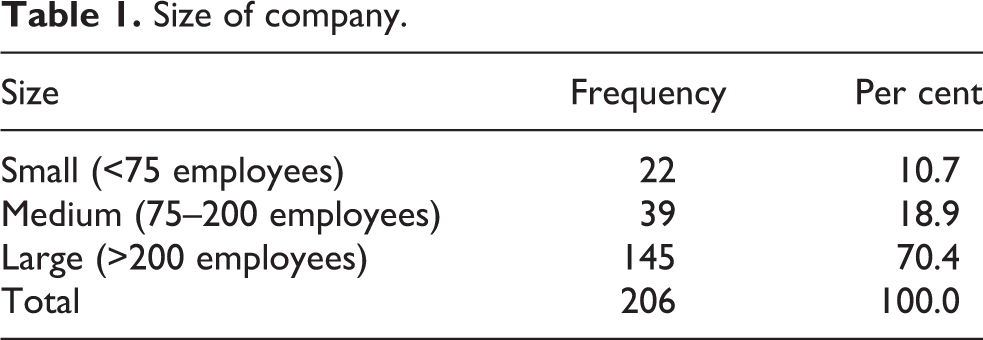
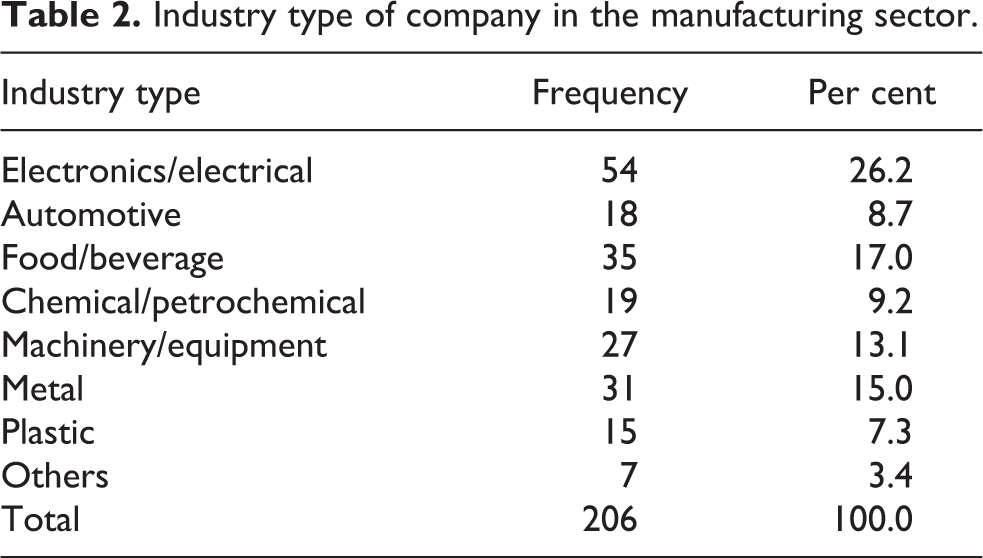
Tables 1 to 4 present the descriptive statistics for the respondent companies with regard to their size, type of industry, the number of years for which they have implemented KM and the department in charge of KM. Referring to Table 1, 70.4 per cent of the respondents were large companies that have more than 200 employees. The classification of the companies’ size was based on the definition approved by the Small and Medium Enterprise Corporation Malaysia. In terms of industry type, Table 2 shows the diversity, with the electronics and electrical industry (26.2 per cent) being the major respondent, followed by food and beverage (17 per cent) and metal (15 per cent). Table 3 displays the number of years that the companies have executed KM. This indicates their experience or maturity in the field. As can be seen in Table 3, the majority of the respondent companies have implemented it for more than 10 years. From Table 4, the results depict that the human resource, training and administration department was the main department in charge of KM.
Size of company.
Industry type of company in the manufacturing sector.
Number of years implemented KM.

KM: knowledge management.
Department in charge of KM in the company.

KM: knowledge management; HR: human resource; IT: information technology.
Before comparing the results for the KM constructs, assessment of reliability and validity was conducted. Reliability is the extent to which items within a scale are homogeneous or correlated (Badri et al., 1995). The analysis was conducted using the Cronbach’s α model, and the α value obtained is regarded as acceptable if it is equal to or greater than 0.7 (Nunnally, 1994). The results are summarized in Table A2 (see Appendix 1), where the α values of all the 13 constructs surpassed the cut-off point of 0.7, thus confirming the reliability of the constructs. With respect to validity, the analyses of convergent validity and discriminant validity were carried out for the constructs. Convergent validity refers to the degree to which items that should be related are in reality related, whereas discriminant validity signifies the degree to which items that should not be related are in fact not related. For convergent validity, the composite reliability value must be more than or equal to 0.7 and the average variance extracted (AVE) value must be greater than or equal to 0.5 (Hair et al., 2010). Clearly, all the constructs have fulfilled these two requirements as shown in Table A2 (see Appendix 1). Discriminant validity is achieved when the square root of AVE for each construct is higher than the correlation coefficients among the constructs (Hair et al., 2010). Referring to Tables A3 and A4 in Appendix 1, this condition has been satisfied.
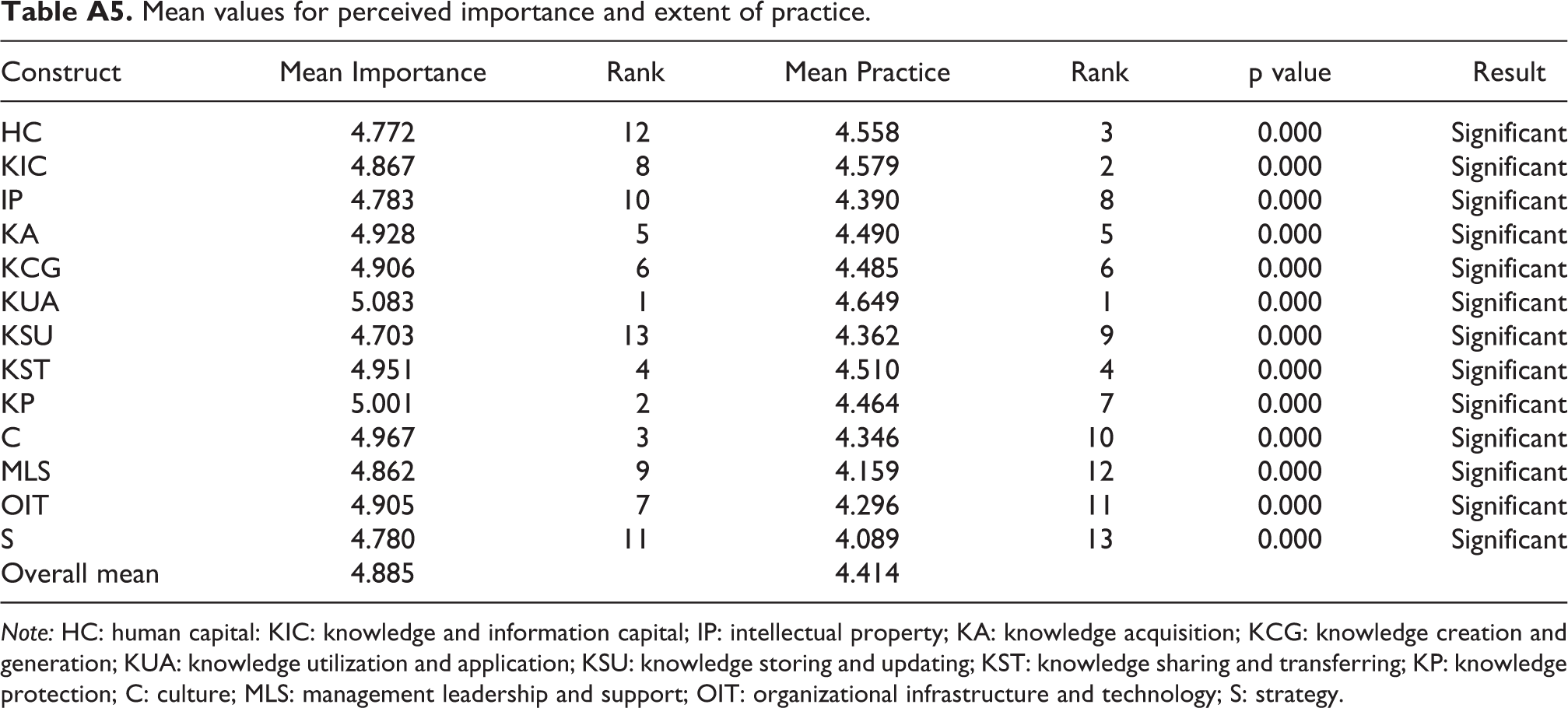
Following this, the findings on the perceived importance and degree of practice for the 13 KM constructs are discussed. In this respect, a mean score for each construct was initially calculated and the results are illustrated in Table A5 (see Appendix 1). In term of the perceived importance level, the mean scores ranged from 4.703 to 5.083, which were between ‘moderately important’ and ‘highly important’. Knowledge utilization and application was perceived as the most crucial one, while knowledge storing and updating was the least important one according to the ranking. Pertaining to the degree of practice, the values ranged from 4.089 to 4.649, which implied the moderate practice of the constructs and the values were generally lower than the mean importance scores. The highest practiced construct was knowledge utilization and application, followed by knowledge and information capital and human capital. The least implemented construct was strategy. Meanwhile, knowledge utilization and application was the most vital construct both in terms of perceived importance and degree of practice.
Despite the similarity, it was evident that the degree of importance placed by the respondents on all the KM constructs differed from the extent to which they were practiced. In order to investigate whether there was any statistical difference between the two sets of mean scores, evaluation was done using paired comparison t tests. The results in Table A5 (see Appendix 1) showed that all the p values were lower than 0.05, indicating that the degree of practice was significantly lower than the perceived importance for each construct. In other words, the respondent companies understood the importance of the 13 constructs for KM, but they did not execute them to any great extent.
Discussion
Having reported the findings in the previous section, it can be apparently noticed that the respondent companies overall placed a high degree of importance on the KM constructs, but the extent to which they practiced these constructs was lower. This essential finding points to the fact that the companies have not equally translated what they perceived as important into practice. Although the concept of KM has been well established, making it as a regular custom in organizations can be challenging. Usually, implementing what is strategically important has been advocated in the literature but what is important may not always be practiced in reality. In this study, the respondent companies have realized the importance of the KM constructs but might still be ignorant or unready to perform them appropriately. Arguably, the focus of these companies on executing their core manufacturing operations has outweighed the gravity of performing KM. Hence, more efforts should be made to increase the practice of KM in order to ensure its success.
Apart from that, the survey also raised some concerns regarding the low practice level of KM factors. As shown in Table A5 (see Appendix 1), all the constructs of KM factors were the four least practiced constructs by the respondent companies. They might consider KM factors as supportive elements only and thus have not performed these factors as an integral part of KM. Yet, KM factors are influential enablers that provide a strong and productive foundation or groundwork for organizations to manage their knowledge (Tan and Wong, 2015). The effectiveness of knowledge resources and KM processes depends on KM factors. Hence, the respondent companies are encouraged to devote more attention to KM factors.
Conclusions
Many organizations including manufacturing companies have realized the importance of KM to sustain their competitive edge. This article has provided important insights into the current status of KM in the Malaysian manufacturing sector. Based on the survey, the findings indicated that the respondent companies generally have not truly practiced the KM constructs that they perceived as important. Although they realized the importance of those constructs, they have not practiced them to the same extent. Hence, there are still plenty of rooms for improvements and more efforts need to be executed to enhance the current situation. Hopefully, the information accumulated from this study will trigger more research to be carried out to help the companies in their implementation of KM. For future directions, researchers and practitioners can concentrate on developing effective measurement approaches by applying those important constructs completely for KM evaluation.
Footnotes
Declaration of Conflicting Interests
The author(s) declared no potential conflicts of interest with respect to the research, authorship, and/or publication of this article.
Funding
The author(s) received no financial support for the research, authorship, and/or publication of this article.
Appendix 1
Mean values for perceived importance and extent of practice.
| Construct | Mean Importance | Rank | Mean Practice | Rank | p value | Result |
|---|---|---|---|---|---|---|
| HC | 4.772 | 12 | 4.558 | 3 | 0.000 | Significant |
| KIC | 4.867 | 8 | 4.579 | 2 | 0.000 | Significant |
| IP | 4.783 | 10 | 4.390 | 8 | 0.000 | Significant |
| KA | 4.928 | 5 | 4.490 | 5 | 0.000 | Significant |
| KCG | 4.906 | 6 | 4.485 | 6 | 0.000 | Significant |
| KUA | 5.083 | 1 | 4.649 | 1 | 0.000 | Significant |
| KSU | 4.703 | 13 | 4.362 | 9 | 0.000 | Significant |
| KST | 4.951 | 4 | 4.510 | 4 | 0.000 | Significant |
| KP | 5.001 | 2 | 4.464 | 7 | 0.000 | Significant |
| C | 4.967 | 3 | 4.346 | 10 | 0.000 | Significant |
| MLS | 4.862 | 9 | 4.159 | 12 | 0.000 | Significant |
| OIT | 4.905 | 7 | 4.296 | 11 | 0.000 | Significant |
| S | 4.780 | 11 | 4.089 | 13 | 0.000 | Significant |
| Overall mean | 4.885 | 4.414 |
Note: HC: human capital: KIC: knowledge and information capital; IP: intellectual property; KA: knowledge acquisition; KCG: knowledge creation and generation; KUA: knowledge utilization and application; KSU: knowledge storing and updating; KST: knowledge sharing and transferring; KP: knowledge protection; C: culture; MLS: management leadership and support; OIT: organizational infrastructure and technology; S: strategy.