



Abstract
This study explored how empirical business research is translated into business information for professional use within online news media reports. A hybrid approach to thematic analysis was utilized to investigate a sample of new media reports (N = 53) on recent business research. The analysis revealed that the news media reports generally (1) contained informational categories pertaining to those typically detailed in social-scientific research and (2) utilized either a negative or positive frame for communicating research results. The results of this study reinforce the conceptualization of news media outlets as an intermediary in knowledge mobilization of business information. Additionally, the results of this study identify communicative strategies utilized in news media reports on business research that may allow business information creators to understand how research may be conveyed to knowledge managers and practitioners.
Keywords
Introduction
‘Knowledge mobilization is on the cutting edge of knowledge management, moving new ideas and shared understanding into the hands of the people at the point of action’ (Bennet et al., 2007: XIII). The Social Sciences and Humanities Research Council (2015: 1) defines knowledge mobilization as, ‘The reciprocal and complementary flow and uptake of research knowledge between researchers, knowledge brokers and knowledge users – both within and beyond academia – in such a way that may benefit users and create positive impacts’. Knowledge mobilization involves the exchange of information between and among several information professionals to include the (1) information provider, (2) intermediaries, and (3) knowledge managers (Bennet et al., 2007; Levin, 2008, 2013; Phipps et al., 2012). Knowledge mobilization often functions to strengthen the relationship between research, policy, and practice (Cooper, 2014).
On phase of knowledge mobilization occurs when the news media acts an intermediary between (a) the publisher of academic research and (b) the user of the information by detailing and publicizing the findings of recently published studies (Fenwick and Ferrell, 2011). Indeed, ‘The mass media report constantly, if not always accurately, on interesting new research findings’ (Levin, 2008: 4). When an intermediary becomes involved in the knowledge mobilization process, that intermediary has the ability to influence the way information is processed, perceived, and later utilized (Cooper, 2012). Therefore, news media reports on research studies in various disciplines have been analyzed to decipher the content and rhetorical strategies utilized to communicate research results to practitioners (Entwistle, 1995; Singer, 1990; Woloshin and Schwartz, 2006). These studies provide insight into the communicative strategies utilized in the knowledge mobilization process.
Some research in the field of knowledge mobilization has found that practitioners can rely on a media outlet’s interpretation of studies to ensure accurate information reporting (e.g. Entwistle, 1995). However, other studies have found that the communicative approaches and interpretations of media outlets interfere with information accuracy (e.g. Fenwick and Farrell, 2011). For example, Woloshin and Schwartz (2006: 567) found that, ‘News stories about scientific meeting research presentations often omit basic study facts and cautions. Consequently, the public may be misled about the validity and relevance of the science presented’. Further, Bauer and Bucchi (2007) explain that, while researchers have preference for information that is novel and accurate, media outlets focus on reporting information that is new and interesting, with accuracy taking a lower priority. Therefore, instead of viewing news media reports as reiteration of research findings, news media reports on academic research should be viewed as interpretative rhetoric that may or may not accurately convey the intent of the researcher or information provider (Levin, 2008; Provencal, 2009).
In addition to concerns about accuracy in the reporting of academic research findings and information, investigation has begun into how modern technologies and audience consumption habits affect knowledge mobilization. For example, Western news agencies have traditionally had a bias and/or preference toward negative news (Bauer and Bucchi, 2007). Preferred framing tactics and ideologies of media outlets have influenced the types of information that become readily available to the public, organizations and knowledge managers (Carvalho, 2007). Recently, the introduction of new and competing media, such as social media and phone technologies, may increase the media’s propensity toward reporting any information that induces strong emotions (Berger and Milkman, 2012). This preference for emotionally laden news may affect the attitudes, frames, and rhetorical approaches that news media outlets utilize to communicate information.
In the field of business and management, knowledge mobilization involves the exchange of information between and among several business information professionals to include (1) the researcher and/or academic research publisher, (2) news media, and (3) the organization or business professional utilizing the business information (Phipps et al., 2012). It is widely accepted that news media outlets, acting as information intermediaries, ‘have a close interaction with [business] practice through their reporting of business news…and play a significant role in the formation of worldviews on business conditions, best practice, leadership, and so forth’ (Sahlin-Andersson and Engwall, 2002: 14). Nonetheless, very little research has been conducted on knowledge mobilization in the fields of business and management. This study aims to fill this gap by exploring how empirical business research is translated into business information for professional use within online news media outlets.
Research questions
To investigate knowledge mobilization of business information, this study seeks to examine the following research questions:
An examination of how online news media outlets report on empirical business research may increase understanding of the knowledge mobilization process of business information. Specifically, published social-scientific research often includes several categories of information to include the (1) background, (2) method, (3) results, and (4) discussion of the study (Babbie, 2013). When utilized as a deductive framework for investigating online news reports of business research, findings can be derived about how information presented in business research compares and contrasts to the news media’s informational focus. Further, by investigating online news media reports for new, communicative variables (e.g. potential communication strategies, potential framing tactics), a foundational understanding of the media’s strategies for presenting business information online may be derived. Overall, answers to the research questions will provide business information publishers, practitioners, knowledge managers, and the news media with information regarding how knowledge mobilization of business information is enacted.
Method
A hybrid approach to thematic analysis, as described by Fereday and Muir-Cochrane (2006), was adopted as the most appropriate methodology for this study. This approach allowed for (1) a rigorous examination of the frequency and distribution of informational categories as presented in the media reports and (2) the identification unique, unforeseen communicative strategies. Additionally, because this context is relatively under-investigated, the methodological approach allowed for a foundational understanding of variables (Joffe and Yardley, 2004) on which future research may build and refine.
Data source
The data were gathered by searching Google News (2017), ‘a computer-generated news site that aggregates headlines from news sources worldwide, groups similar stories together and displays them according to each reader’s personalized interests’ (para. 1). As Google News draws a large, international readership (Chyi et al., 2016), it was utilized as a source for identifying and selecting media reports that would be available to many potential business information audiences. The media report must have included both the words ‘business’ and ‘study’ to be returned by the query and, therefore, be included within this study. The search returned a sample of news media reports (n = 71) as published from January 1, 2009 to January 1, 2017.
Sample
After the primary data source was derived, articles were eliminated from the query results based on several factors to include (1) the article required payment for viewing; (2) the article reported on a potential, upcoming study rather than a previously conducted study; and (3) the article was not related to empirical research. Due to these restrictions, approximately 18 articles were eliminated from the query. This resulted in a sample of news media reports on business research (N = 53) that ranged in length from 111 words to 1910 words. In sum, this was approximately 26,000 words, or 52 pages, of text for analysis. The sample originated from 43 different news sources and no articles reported on the same research results. Therefore, the sample represents every readily accessible media report on empirical business research published from 2009 to 2017 as returned by Google News using the search terms ‘business’ and ‘study.’
While a larger sample size may have provided more information from which to derive conclusions, this sample reflects what many business managers and practitioners would be exposed to when seeking information about empirical research in the field. Therefore, the sample in this study may be the most appropriate for a foundational, exploratory study on the content and communication in relevant business research media reports.
Analysis
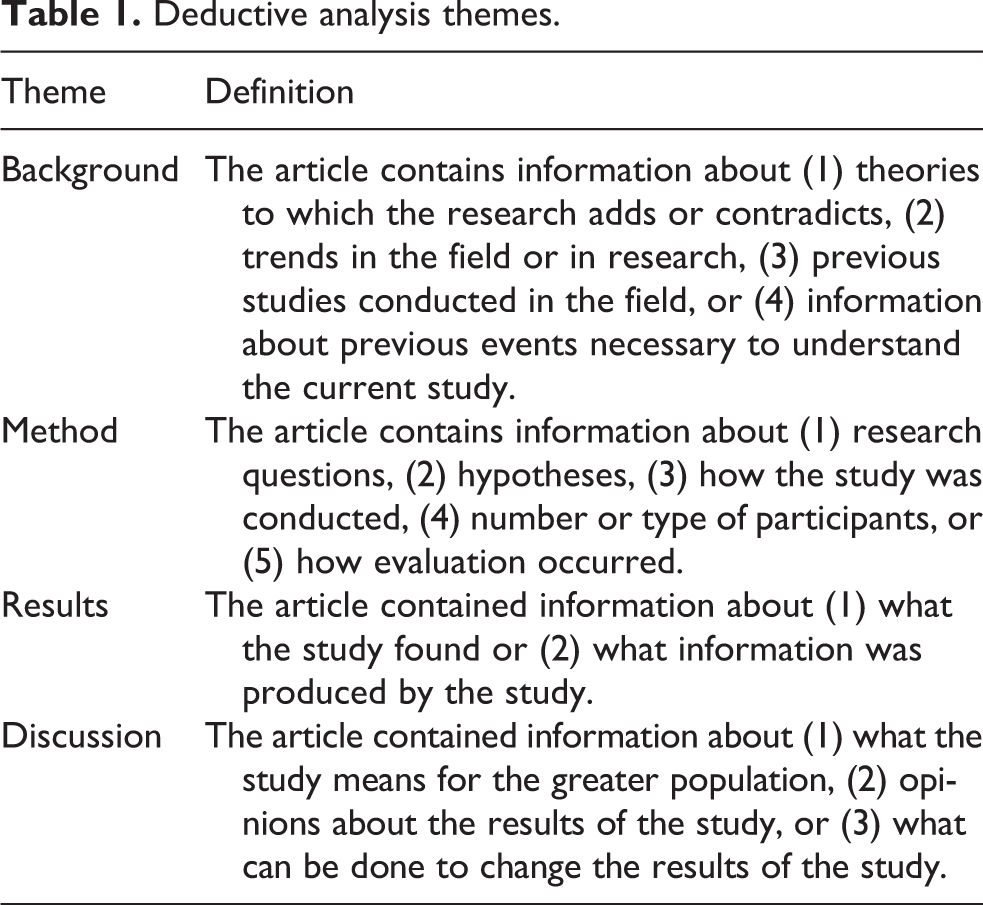
To conduct the analysis, the first step was to develop a code manual a priori to begin the deductive portion of the thematic analysis (Fereday and Muir-Cochrane, 2006). Four original codes (i.e. background, method, results, and discussion) were designed and defined as a deductive thematic schema (see Table 1). Additionally, each news media report was reviewed for relevancy to a primary geographical region of focus (i.e. US or International). As the primary researcher was able to successfully code a small portion of the sample (n = 5) utilizing the deductive thematic schema, the codebook was applied to the sample (N = 53) by the first research coder. After the first coder for this project applied the deductive thematic schema, the sample was presented to a second, independent coder. This second coder, otherwise blind to the results of the first, was trained through a review of the codebook and relevant literature. The second coder then independently applied the codebook to the entire sample (N = 53).
Deductive analysis themes.
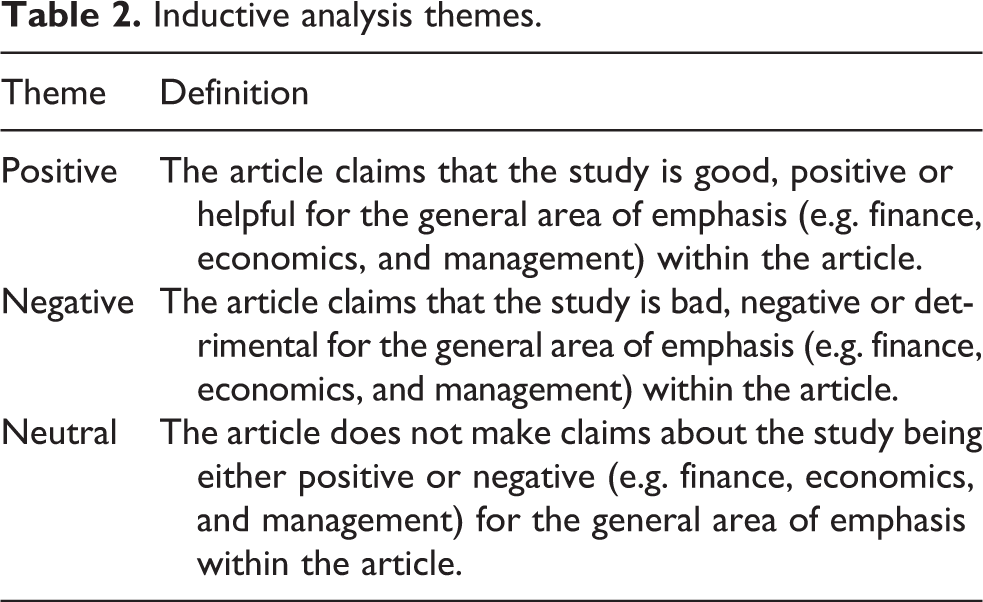
Second, the inductive portion of the thematic analysis was conducted. While the original codes within the deductive portion allowed for a foundational understanding of the informational content of the news media reports, the inductive portion allowed the researchers to capture any additional, relevant communicative characteristics that may have been overlooked when using the template-style approach (Boyatzis, 1998). Therefore, the inductive portion of the analysis was aimed at identifying how the information from each of the four original codes was communicated. This was accomplished by clustering information from the news media reports based on similar communicative framing tactics, or ‘the particular linguistic patterns that emerged’ (Lin et al., 2004: 265). These patterns were eventually refined into three additional codes (see Table 2). Once the themes from the inductive portion of the analysis were developed and defined, the coding process was repeated (Fereday and Muir-Cochrane, 2006).
Inductive analysis themes.
Validity and reliability
Concerns about validity and reliability were addressed through measures taken by the researchers to ensure a rigorous research approach (Krippendorff, 2012). First, if the text of a media report did not pertain to a category from the thematic analysis, the text was not counted toward any theme. This functioned to increase validity and reliability as the text was not forced into the thematic schema (Weber, 1990). Second, inter-coder agreement was calculated to ensure reliability within the coding process. Inter-coder agreement ensures that concepts within the codes are well-defined and interpreted similarly between coders (Fereday and Muir-Cochrane, 2006; Krippendorff, 2012); 93.4 percent inter-coder agreement (N = 212, Scott’s Pi = 0.703) was calculated for all possible agreements within the deductive analysis. 84.9 percent inter-coder agreement (N = 53, Scott’s Pi = 0.763) was calculated for all possible agreements for the inductive analysis. Any discrepancies between coders were discussed until a consensus was reached and 100 percent agreement was achieved to allow for the frequency analysis.
Results
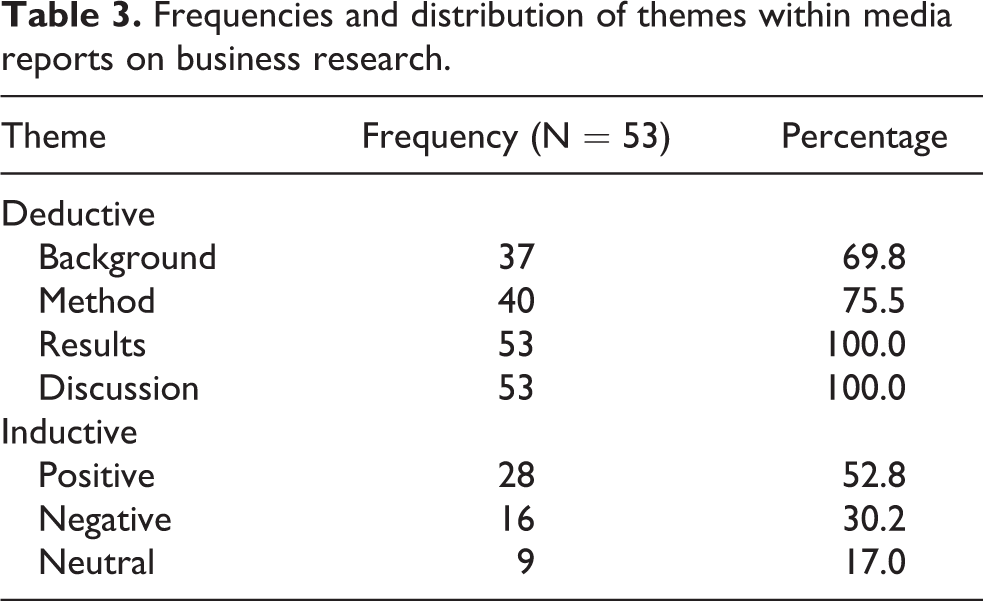
Overall, news media reports on empirical business research generally (1) contained information pertaining to all four categories of information communicated in social-scientific research and (2) utilized either a negative or positive frame for communicating the research results. Additionally, this study developed a frequency analysis of the themes. The frequency analysis does not serve to represent news media studies on business research as a population. Rather, the frequency analysis was conducted to create an internal comparison and allow for a discussion of the results. The frequency analyses from both the deductive and inductive portion of the analysis are summarized in Table 3.
Frequencies and distribution of themes within media reports on business research.
Deductive analysis results
A review of the deductive thematic analysis revealed several key findings about the information communicated through online news media reports on business research. First, news media reports that included background information for the research study comprised approximately 70 percent (n = 37) of the sample. Background was the least frequently represented code from the deductive analysis but was still present within the majority of articles. Background information was often conveyed in the news media reports through several communicative approaches. These included (1) providing an explanation of how the study’s theoretical foundation interacted with the results of a study (e.g. ‘We think this supports an evolutionary theory of self-deception’); (2) explaining trends in the field (e.g. ‘The total number of retail gasoline stations in Canada stands at 11,849 as of December 31, 2013 or 3.4 gas stations for every 10,000 persons; this represents a continuation of a downward trend since 1989, when over 20,000 stations existed’); (3) providing results from similar, previous studies (e.g. ‘The position is an improvement over the previous year’s 118th spot’); and/or (4) detailing previous events leading up to the study which were necessary to understand the current study (e.g. ‘A ban or restriction of cars is being proposed in the College Green area and parts of the Quays during building work on the new Luas cross city line’).
Second, media reports that included information about the research study’s methodology comprised approximately 75 percent of the sample (n = 40). Methodology was communicated in the reports by (1) offering the research questions or hypotheses from the study (e.g. ‘…a full-service Internet marketing agency, posed the following question, which also became the impetus for its research: How much of a risk is there to the bottom line by taking a well-researched stand?’); (2) reporting the number of participants (e.g. ‘For the study, the researchers recruited 72 students’); and/or (3) providing an explanation of how the study results were gathered (e.g. ‘We pulled data for week two and compared it to a benchmark of average mobile weekly search traffic across 8 weeks of pre-April 21 data’).
Finally, all media reports (N = 53) contained information about the results of the study and a discussion/interpretation of those results. Results were reported by describing what the study found in regards to the research questions or aims of the analysis (e.g. ‘Almost half (47 percent) said they found older workers were more willing to go the “extra mile” and over four in 10…said mature workers brought mentoring skills to the workplace’). It should be noted that only 13 percent (n = 7) of the new media reports included a chart or graph to visually represent the empirical research findings.
Discussion/interpretation of these empirical research results was communicated by (1) explaining what the study may mean for the greater population (e.g. ‘…it means creating new value for customers and delivering it sooner, with managers acting as enablers of self-organizing teams…’); (2) offering opinions about the results of the study (e.g. ‘The findings should come as good news for the newly public Groupon, which continues to face criticism around its business model’); and/or (3) examining what can be done to improve the results of the study (e.g. ‘…Bangladesh needs to make progress in areas of innovation, technology, skilled human resource and new market creation, apart from improvement in administration and good governance…’). Pertaining to the discussion/interpretation of empirical research results, it is important to note that approximately 81 percent (n = 43) of the news media reports included a direct quote from the main researcher or sponsor of the business research. For example, one news media report was primarily an interview with the main researcher in which the reporter’s questions and the researcher’s answers were communicated as quotations with little additional text.
Finally, media reports with an international focus comprised approximately 60 percent (n = 32) of sample and those which had an US-based focus comprised approximately 40 percent (n = 21). No significant relationships were found between the informational content of the news media reports and the geographical region of focus of the article (i.e. international vs. US based).
Inductive analysis results
A review of the inductive coding revealed several additional findings about the communicative frame from which the media report addressed the business research. Of the analyzed sample, approximately 55 percent (n = 29) utilized a positive communicative frame. Positive communicative frames were often identifiable as early as the title (e.g. ‘Austin No. 1 for Small Business, Study Shows’) and continued to be represented throughout the text of the article (e.g. ‘…the new ranking speaks to Austin’s continued economic vitality’.). Similarly, a negative communicative frame was utilized within 40 percent (n = 21) of the analyzed sample. Negative communicative frames often included negatively connotative language within the title (i.e. ‘Overconfident Workers Can Be Bad for Business, Study Shows’) as well as in the text of the report (e.g. ‘…if the overconfident people are risky, then the companies are putting themselves in a fix by promoting such employees’). Finally, 17 percent (n = 9) of the analyzed sample utilized a neutral communicative frame. A neutral frame was defined as articles that did not utilize positively or negatively connotative language throughout the title (e.g. ‘Youngest Siblings More Likely to go into Business, Study Finds’) or text (e.g. ‘One implication of our findings is that family business owners need to think hard about how they use birth order to make decisions about family succession’) of the report. No significant relationships were found between the inductive codes and the geographical region of focus in the article (i.e. international vs. US based).
Discussion
The results of the current study revealed that the analyzed media reports on empirical business research often included similar informational categories contained within social-scientific research. Therefore, these news media reports included information that typically aligns with social-scientific standards for the reporting of empirical research in scientific journals (Babbie, 2013). This reinforces the conceptualization of news media outlets as an intermediary for business information knowledge mobilization as the media reports functioned ‘in facilitating research mediation across research producing contexts and research using contexts’ (Cooper, 2012: 2).
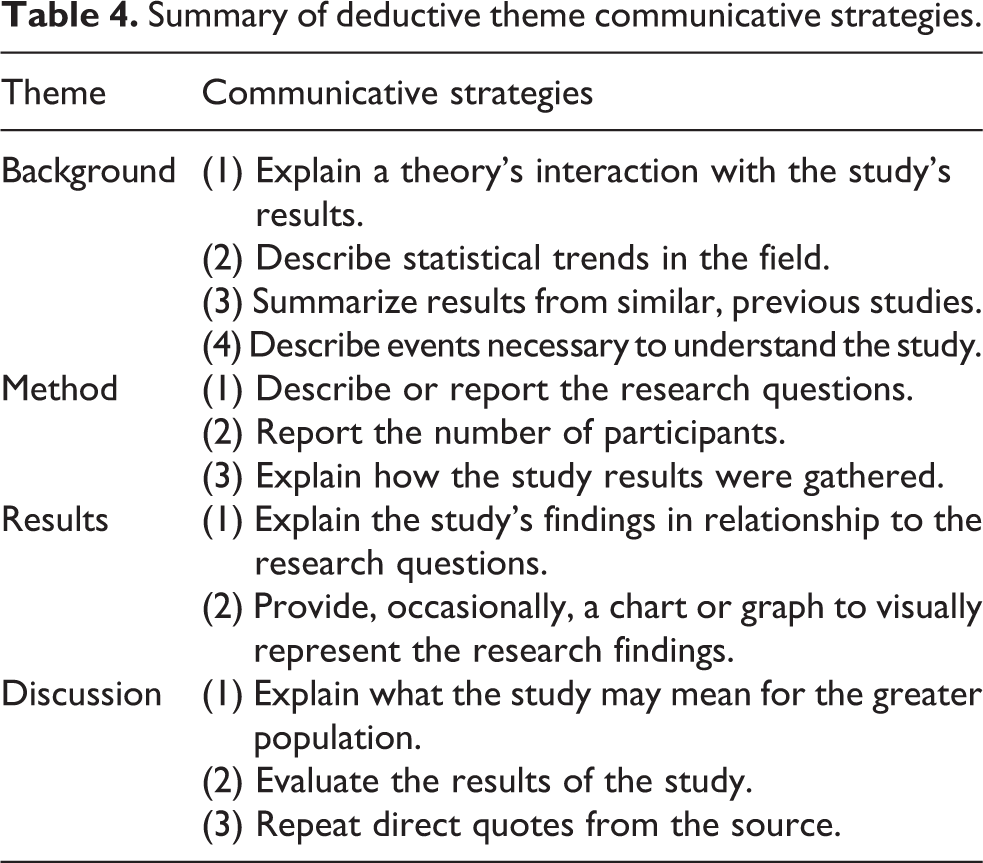
This study sought to better understand how empirical business-research is translated into business information for professional use within online news media outlets. The strategies utilized to communicate the four analyzed information themes are summarized in Table 4. Identifying the ways media reports often communicate the four major categories of information provided in business-research may allow business information creators to understand how their own research may be conveyed to knowledge managers and practitioners (Young et al., 2016).
Summary of deductive theme communicative strategies.
For example, if business researchers and publishers of business research understand that the research questions remain a consistent informational piece in reporting the methodology, results and interpretation of the study, emphasis on making research questions easily identifiable to news media for proper knowledge mobilization may be a consideration. However, as the news media reports rarely included graphics or charts, this may not need a pertinent in the context of business information knowledge mobilization.
Third, the communicative frames utilized to communicate the business information provided from the empirical research should be considered. The use of a positive or negative frame in the majority of the reports suggests that trends in the field of journalism and mass media are interacting with knowledge mobilization of business information.
Future research
Additional studies should be conducted on news media reports of business information and research that focus on the communicative strategies and frames utilized to inform strategic communication behavior. Additionally, future research should provide information about how media outlets may adapt, change, or decode the content of empirical business research to further explore the knowledge mobilization process in this context. These investigations can inform business information professionals about how to better interpret information presented in media reports on empirical business-research as well as how information may be better captured and mobilized for various audiences within media reports.
Limitations
While the findings of this research contribute to a broader understanding of knowledge mobilization of business information, there are limitations which must be considered. First, the researchers only retrieved articles from Google News using standard keyword search strategies. This allowed the researchers to access data which a large readership would likely have been exposed. However, other news databases and keywords may retrieve additional articles that could influence future studies with the same approach. Further, this study analyzed media reports available over an 8-year period. Analyzing differing timeframe may produce information about how media reports changed and/or differed over time. Finally, research is always limited by the interpretations of the researchers. New and evolving perspectives may emerge as additional research is conducted.
Footnotes
Declaration of Conflicting Interests
The author(s) declared no potential conflicts of interest with respect to the research, authorship, and/or publication of this article.
Funding
The author(s) received no financial support for the research, authorship, and/or publication of this article.