



Abstract
This study was conducted to evaluate the contribution of four of the seven e-School dimensions to the success of the pilot phase of the New Partnership for Africa’s Development (NEPAD) e-School project in Kenya. The study employed survey research methodology. All six of the NEPAD e-Schools in Kenya were included and the teachers and students in those schools formed the study population. Of the 5,186 students and teachers, a representative sample of 1,508 was selected using probabilistic techniques. Data was collected using observations and a survey questionnaire. It was established that all six of the e-Schools had installed the basic computing facilities required for integrating information and communication technologies (ICT) in teaching and learning; all the e-Schools were observed to have the Very Small Aperture Terminal (VSAT) for Internet access in computer laboratories where a variable number of computers were installed. The ICT infrastructure provided modest communication capabilities. But while teachers received technical (ICT) training, they did not receive training on pedagogies for ICT integration in teaching and learning. We conducted hypothesis testing and confirmed that the four dimensions of E-School Success Model, investigated in the current study, positively contribute towards the success of the e-School. We therefore concluded that ICT infrastructure quality, content and communication quality, training effectiveness and use make considerable contributions to the success of the pilot phase of the NEPAD e-School project in Kenya. We recommend that stakeholders should continue investing in the NEPAD e-School project. Further studies on the impact of the other three dimensions of the e-Schools are recommended.
The NEPAD e-School project in Kenya has high potentials of success, and stakeholders should continue investing in the project, despite the high costs of deploying e-Schools at national level.
Introduction
The New Partnership for Africa’s Development e-Africa Commission is piloting the NEPAD e-School project in 17 African countries, namely Algeria, Burkina Faso, Cameroon, Democratic Republic of Congo, Egypt, Gabon, Ghana, Kenya, Lesotho, Mali, Mauritius, Mozambique, Nigeria, Rwanda, Senegal, South Africa and Uganda (New Partnership for Africa’s Development, 2005). The initiative provides a framework for (and a systematic approach to) ICT integration in education on the African continent. The e-School initiative’s specific objectives are to: impart ICT skills to students in order to enable them to participate in the knowledge society; enhance teachers’ capacities through the use of ICT in teaching; and improve school management and increase access to education (NEPAD E-Africa Commission, 2009). In the next sections, we highlight the study problem and purpose, provide a short literature review, highlight the study method, present and discuss the results and finally highlight the conclusions and recommendations.
Problem and purpose of the study
The main research problem was to determine the contribution of four e-School dimensions, i.e. ICT infrastructure quality, content and communication quality, training effectiveness and use, to the success of the pilot phase of NEPAD’s e-Schools in Kenya. The New Partnership for Africa’s Development (2004) estimated that by the end of 2008, each youth graduating from an African high school would be ICT-literate, and by the end of 2013, each child graduating from an African primary school would be ICT-literate through the e-School initiative. This projection was made at the launch of the pilot phase in 2003. Project piloting was to last only one year to give way to full scale implementation, which is now behind schedule. It is not clear what caused the project to fall behind schedule. Farrell (2006) reported, in the initial interim report of NEPAD’s pilot e-Schools’ evaluation, that the project had encountered serious challenges, some arising from the e-Africa Commission’s failure to meet its leadership responsibilities. One of the critical benchmarks in the project was to empower teachers with ICT skills. The trained teachers would in turn train their colleagues in a cascading model and also induct students in the use of ICT systems. Training teachers and students required installation of suitable ICT infrastructure in the e-Schools. Teachers and students are expected to extensively use the e-School infrastructure in teaching, learning. In this paper we address the following research questions: What is the ICT infrastructure’s quality, accessibility and suitability for enhancing teaching and learning? How suitable is content and communication for the teaching and learning? How effective is the training imparted to teachers and students? How and to what extent is e-School infrastructure used for teaching and learning?
Literature review
The modernization of technology is progressing very rapidly and calls for progressive skills development for a society to benefit from the interaction between technology and human capital for sustainable economic growth (De Feranti et al., 2003). The ideal environment for accelerating skills development is the school; the greater population of a nation undergoes some formal education in schools. Many economies have made concerted experimentation with e-Schools in the last two decades (see for example Simpson, Payne and Condie, 2005; Ya’Acob, Nor and Azman, 2005; Condie and Livingston, 2007; El-Halawany and Huwail, 2008). The common ideological framework for deployment of ICT in education is to increase productivity in schools (Machin, McNally and Silva, 2007, in Draca, Sadun and Van Reenen, 2006), impart teamwork skills and lifelong learning habits among learners (Ya’Acob, Nor and Azman, 2005; Condie and Livingston, 2007) and deal with the dual task of both increasing access to school and improving quality of teaching (Evoh, 2007).
The starting point in ICT deployment in schools is the development of quality infrastructure. Invariably, economies deploy e-Schools which over-rely on computer laboratories as access points to ICT infrastructure (Hinostroza, Labbé, Brun and Matamala, 2011; Beacham, 2011). The computer laboratories are not only inadequate in number, but also not accessible after class hours. In certain economies, as in Scotland, access to ICT is increased by lending teachers a set of laptops on trolleys (Beacham, 2011). The infrastructure provides sharing of content and communication (Abrami et al., 2006).
Students and teachers of e-Schools attain ICT technical skills from exposure and training (Schibeci et al., 2008). Teachers, however, require more than technical ICT skills for them to effectively integrate ICT in teaching and learning (Cox and Marshall, 2007). ICT pedagogical skills are higher level skills than ICT technical skills (Zao and Cziko, 2001). It requires a teacher to dedicate more time and resources to attain ICT pedagogical skills, in addition to technical skills, that will facilitate effective integration of ICT in teaching and learning.
Studies have reported mixed results on the impact of the integration of ICT in teaching and learning. Some of these studies reveal that teachers are overwhelmed with activities that relate to planning lessons that integrate ICT in education (Banyard, Underwood and Twiner, 2006; Hayes, 2007). Often, when teachers are challenged with the application of ICT in teaching they spend more time adapting ICT into their traditional practices (Hayes, 2007). With this approach, the teachers have not realized any tangible benefits of ICT integration. Success of information systems and e-Schools in particular may be evaluated by establishing the success of each of the system’s dimensions (DeLone and McClean, 2003; Nyagowa, Ocholla and Mutula, 2011). More studies should be conducted to establish how success of integration of ICT in teaching and learning can be enhanced.
Methodology
The study employed survey research methodology. All six of the NEPAD e-Schools in Kenya were included. Chevakali High School, Isiolo Girls Secondary School, Maranda High School, Menengai Secondary School, Mumbi Girls Secondary School and Wajir Girls Secondary School and the teachers and students in those schools formed the study population. Of the 5,186 students and teachers, a representative sample of 1,508 was selected using probabilistic techniques. In the case of students, class lists formed the sample frame. The population of schools, the class level (forms I, II, III and IV), and gender in the case of Menengai Secondary School were used as sub-frame for stratification. After stratification, the class lists and list of teachers were subjected to random sampling. The resulting sample of students is shown in Table 1 while Table 2 shows the sample of teachers.
Sample of students.

Sample of teachers.

The study investigated four dimensions of the e-School system, namely: (i) Infrastructure quality, (ii) Content and communication quality, (iii) Training effectiveness and (iv) Use. Data was collected using observations and a survey questionnaire. Observations were made of the infrastructure installed in the e-Schools with specific attention paid to computer laboratories, computer hardware, networking accessories, and presentation and communication equipment. Self-administered questionnaires were hand-delivered to students and teachers.
The collected data was edited and cleaned. An analysis of quantitative data was done using the Statistical Package for Social Sciences (SPSS) together with Microsoft Excel, while qualitative data was analyzed using content analysis. Descriptive statistics and non-parametric tests assisted with the rejection or acceptance of the hypotheses.
Results and discussions
The paper discusses findings in the study in relation to the four research questions.
Quality of ICT infrastructure installed in the NEPAD e-Schools
The following hypothesis was investigated:
H11: The quality of the installed e-School infrastructure (the IS) determines the level of success of the e-School.
Contribution of installed ICT infrastructure to e-School success
Through observation, it was established that all six of the e-Schools had installed the basic computing facilities required for integrating ICT in teaching and learning. All the e-Schools had VSAT for Internet access in computer laboratories in which various numbers of computers were installed. The computers were networked using structured cabling into a LAN, and the LANs were linked into a WAN through the VSATs. The computer laboratories also had smart televisions, smart boards and LCD projectors. It was revealed that the VSATs were initially linked to RASCOM-QAF1 satellite but this link was disconnected after 3 years of implementation.
The implementation of e-Schools requires enabling infrastructure to support resource development, access, and communication in a variety of channels and media. Ideal infrastructure would include multimedia computers with online access, design software, scanners, printers, digital video projectors, digital TVs, and smart screens, among other components (Leask and Pachler, 1999). Multimedia computers are essential because content for blended learning comes in a variety of forms and the teachers in particular are expected to develop content for sharing. Teachers may be expected to work offline when there is no Internet connection in their homes. The availability of compact discs, for example, would make it possible for teachers to migrate data between their home workstations and the school system. Multimedia resources such as video, animations and simulations have the capacity to better explain dynamic concepts and motivate students (Green and Brown, 2002).
In most of the e-Schools, computers were mainly situated in the computer laboratories without additional points of access in the staff rooms or the principals’ offices. Part of the reason for this inadequate distribution of access points was the star network infrastructure deployed. In a star network, smart monitors are connected directly to servers and the system has limited transmission power of point-to-point links between the central node and the peripheral nodes. This explanation accounts for the hitherto low preference for star topology (Lee, Lee, Song and Yoo, 2005). Peripheral nodes which are located beyond the maximum transmission distance have to be linked through repeaters to boost computing power (Bhatia and Bhatia, 2009). If the location of the computer laboratory is too far from the teacher’s office, fiber optic 10Base-FL (fiber link) and transceivers would be required to complete connections (Mathivanan, 2007). Fiber optic cables are quite costly to implement and their maintenance requires a high level of technical know-how. Within a school compound, wireless networks can be a cost effective and flexible solution for teachers and students with handheld computing devices (Singh and Bukar, 2007).
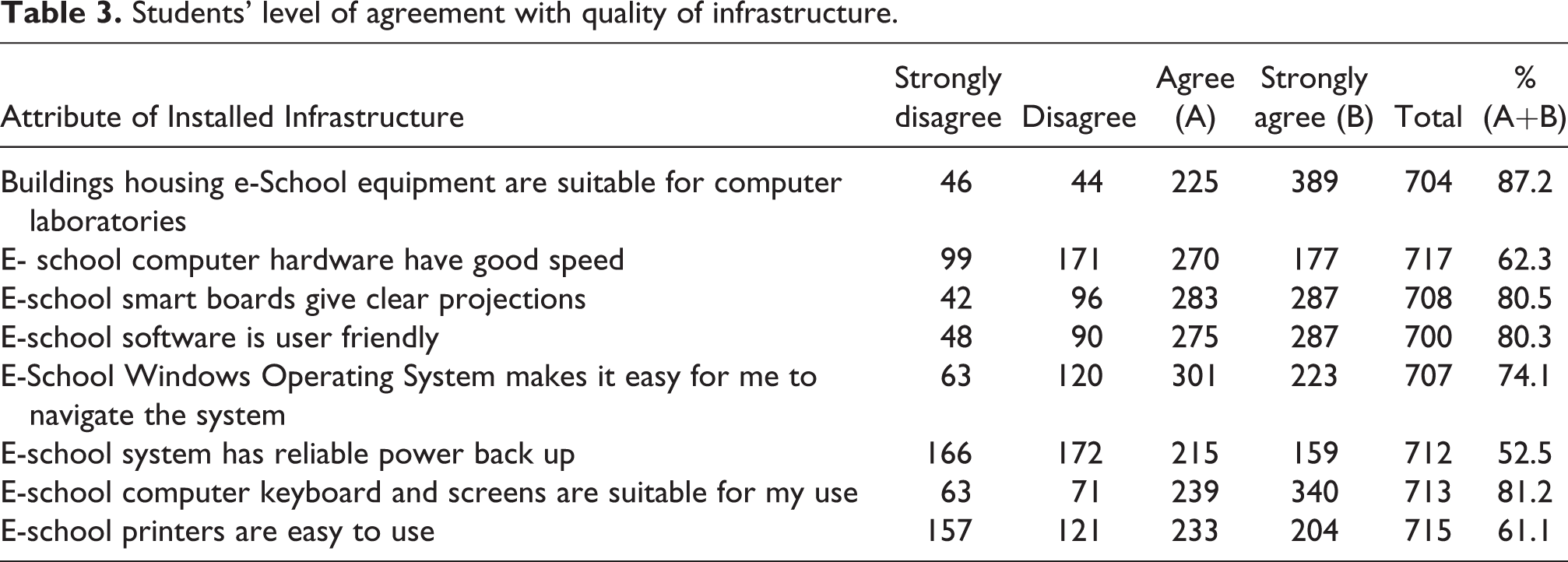
While the infrastructure quality of the NEPAD e-Schools was acceptable to the majority of the respondents in all the schools, it did have its shortcomings. The student to computer ratio was very uneven, and there were only a few computer laboratories (between one and three). This made it difficult for students to adequately access the available technologies. This finding corroborates the results of a study conducted in the Western Cape region in South Africa, where academic staff in higher education institutions complained about limited access to ICTs for teaching due to lack of on-campus facilities, lack of integration between on-campus and off-campus systems, and poor institutional support for e-learning (Czerniewicz and Brown, 2006). The e-School system is aimed at increasing access to education and improving the quality of teaching and learning (Evoh, 2007). Access to infrastructure and its suitability would naturally determine the success of the e-School. Access to the e-School should be open to students during class and after class hours. After class hours, students should be encouraged to undertake independent learning and also be coached by their teachers online and at individual level.
Some studies (Barrett, Rainer and Marczyk, 2006) found that students who place more emphasis on independent learning and also engage in online sessions perform better in formal examinations (Graff, 2006). Consequently, the opportunity to develop independent learners is lost in the e-Schools because computer laboratories may not be easily accessed. Despite the shortfalls, students’ and teachers’ expressed a high level of agreement with the quality of infrastructure, as shown in Tables 3 and 4.
Students’ level of agreement with quality of infrastructure.
Teachers’ level of agreement with quality of infrastructure.
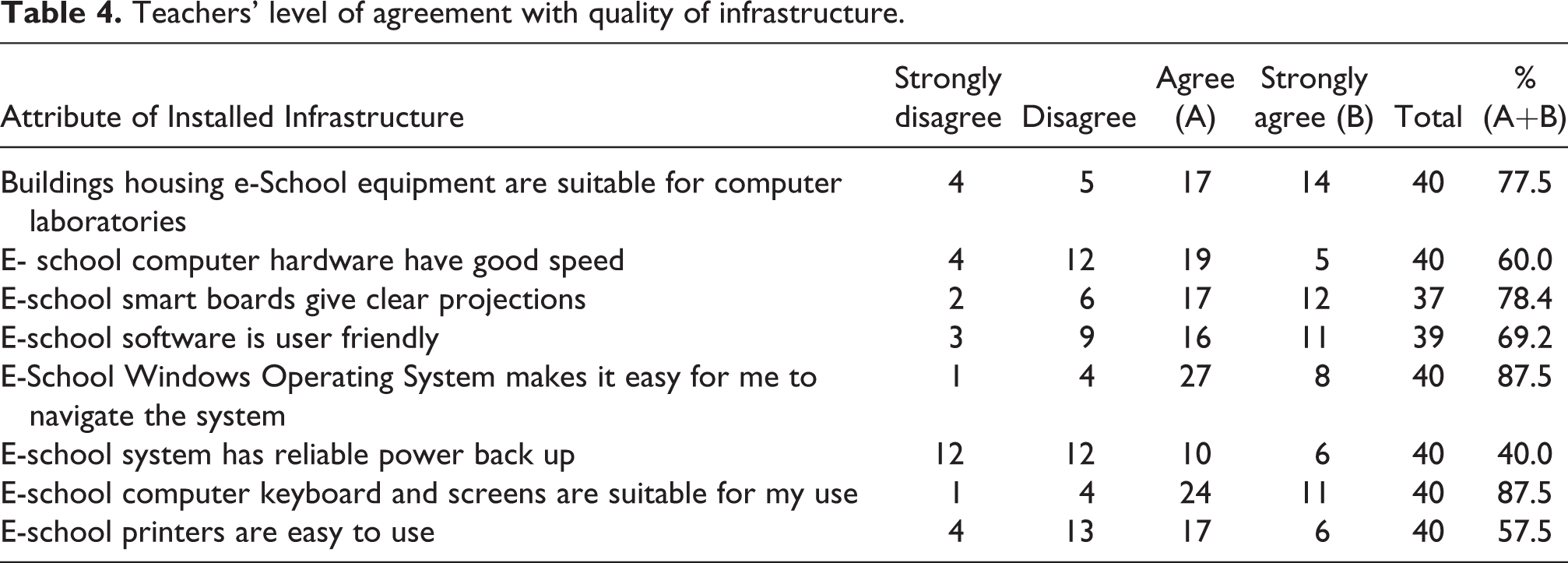
The chi-squares of observed values for all the items in the test were above the minimum expected value of 5 with a significance level of 0.000, which is less than the set p value of 0.05 as shown in Table 5.
Chi-square test statistics for satisfaction with the quality of infrastructure.

These results support the rejection of the null hypothesis, confirming that the quality of the installed infrastructure is suitable and is positively contributing to e-School success.
Contribution of content and communication quality to e-School success
The following hypothesis was investigated
H21: The quality of information content and communication contributes to the level of success of the e-School.
Students’ perception of quality of content and communication.

Teachers’ perception of e-School content and communication quality.
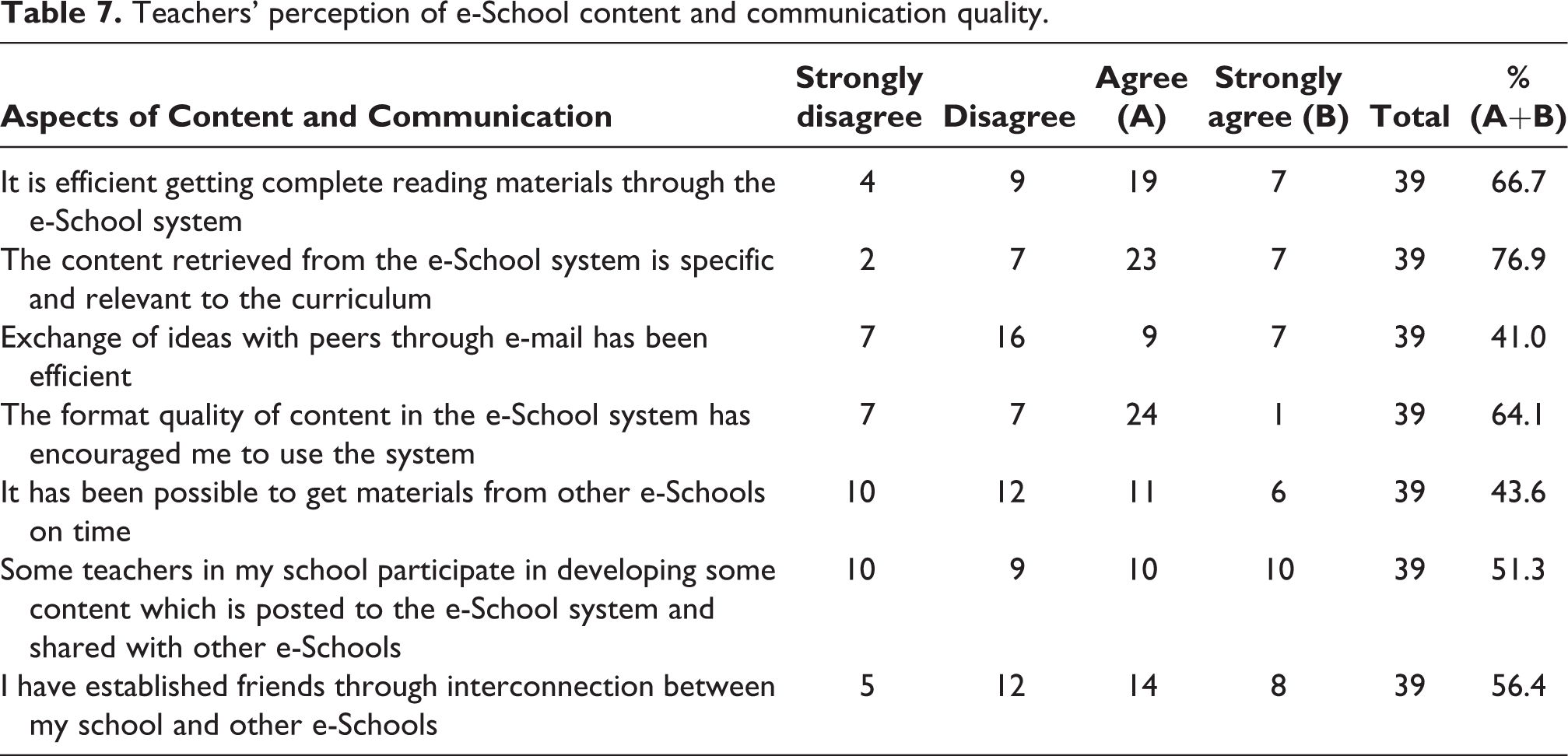
A chi-square test of the means of the study population’s perceptions of e-School content and communication quality revealed that all the means were statistically different from the expected means. This suggests that the perceptions are in agreement with the evaluative questions. Overall, the quality of content of the NEPAD e-School system positively contributes to its success. This is corroborated in the findings of a study in the United States on adult learners’ perceptions of instructional quality, in which 86 percent of the respondents indicated that the most important aspect of instructional quality of online courses was content and instructional material that is relevant to the course (Kidd and Song, 2007). NEPAD’s inclusion of the Internet connection through VSAT was deliberate, to facilitate connectivity between the e-Schools and access to external resources. The unacceptable quality of communication is a source of frustration and caused students to limit the frequency of use of the system. This is supported by an evaluation of online learning in Australia, where Finger (2007) found that students strongly favoured the use of telephone teaching over HF radio because telephone communication was much clearer and students could hear all the things said by their teachers.
Poor communication in NEPAD’s e-Schools means that the major goals of the e-School, including teamwork and lifelong learning (Ya’Acob, Nor and Azman, 2005; Condie and Livingston, 2007), may not be realized in the current setup of the programme. The VSATs satellite link was disconnected soon after the consortia, who were tasked with the design and implementation of e-School infrastructure, handed over the project to the Ministry of Education. The explanation offered for the disconnection was the inability of the Ministry of Education to afford the costs of connection. The e-Schools have, however, made arrangements to access the Internet through dial-up connections using modems connected to the servers. The principals of the schools noted that this mode of Internet access is too costly as it is charged according to download bandwidth. According to Ashcroft and Watts (2005), the cost of Internet access in developing countries is generally high. Organizations try to reduce access costs by pooling resources. For example, Kenyan universities’ access to ICT has been greatly facilitated by the Kenya Educational Network Trust (KENET) (Adam, 2003). The Kenya Educational Network Trust is a non-profit organization that provides Internet access to tertiary institutions in Kenya. NEPAD’s e-Africa Commission negotiated access to the Internet through the Regional African Satellite Communication Organization (RASCOM). RASCOM provides state-of-the-art facilities which allow users to pay for minutes to use telephony services and the Internet in a variety of ways, including the use of random registered numbers concealed behind a thin layer of carbon (scratch cards). It would be in the interest of NEPAD e-Schools’ success for the Ministry of Education in Kenya to purchase, as a bundle, satellite access time from RASCOM in order to re-distribute it to the e-Schools.
The reported mean respondents’ perceptions of content and communication quality was 2.53 on a scale ranging from 1 to 4 (1– Strongly disagree, 2– Disagree, 3– Agree, and 4– Strongly agree). The test Chi-square statistics revealed that all the observed frequencies were above the expected minimum and all the items had a p value of 0.000, which is less than the set value of 0.05, resulting in the rejection of null hypothesis. This therefore means that information content and communication quality is positively contributing to e-School success despite the challenges that have been identified.
Effectiveness of the training imparted to teachers and students
The following hypothesis was tested to estimate the effectiveness of the training imparted to teachers and students on the success of the e-School:
H31: Effective training method and approach contributes to the success of the e-School.
Contribution of the effectiveness of the training of teachers and learners to e-School success
All the end-users of e-Schools in educational institutions (lecturers, students and support staff) require effective training as a way to increase their intention to use the information system (Amaoko-Gyampah and Salam, 2004), shape user attitudes, and influence the acceptance of the e-School system. A study by Adeyinka (2009) on the course content management system at the University of Botswana underscored the contribution of training or its lack thereof to IS success. Similarly, training of teachers and students was identified by the e-Africa Commission as one of the critical objectives of the pilot of NEPAD’s e-Schools. In this study, training effectiveness was viewed as important for the success of the e-School as it motivates use. The results reveal that training quality was found to be effective, with 51.5 percent of the teachers and students agreeing on the variety of methods applied. A large proportion of users (79.8 percent) confirmed that they attained hands-on experience through training. The responses of students and teachers on the attainment of hands-on experience are shown in Table 8.
Distribution of responses among students and teachers.

An action study conducted in the USA designed to increase women engineering students’ belief in their academic abilities revealed that hands-on experience increased the women students’ computer self-efficacy (Shull and Weiner, 2002). The action research exposed the students to repeated demonstrations and reinforcement of proficiency in computer-related tasks. In the present study, a large majority (88 percent) of the respondents expressed the need for additional training. A higher proportion of teachers (91.6 percent) required more training than students (87.8 percent). Teachers’ training for ICT integration in teaching and learning has two components: ICT technical skills, and appropriate pedagogies for blended learning. By and large, teachers in the e-Schools did not incorporate the use of ICTs in the classroom. The inability of teachers to use ICTs in the classroom is partly the result of limited computing resources and partly lack of pedagogical skills for ICT integration in teaching and learning. This confirms observations in other studies that teachers concentrate on the development of ICT technical skills (see Tondeur, Van Braak and Valcke, 2007) but fail to use or improve the use of available infrastructure in the classroom (Ward, 2003). In order for teachers to productively use ICTs in the classroom, the availability of infrastructure, teachers’ technical competence, and pedagogical skills must first be addressed.
Many of the teachers and students (62.2 percent) complained that the training period was inadequate. As a way to improve training, teachers and students suggested that: the fast Internet connection should be restored; those who did not benefit from initial training should be given additional training opportunities during school holidays; improvements should be made to teaching methods; and more time should be set aside for users to practice. According to Bhattacherjee and Premkumar (2004), there is often interplay between changes in attitude and users’ level of satisfaction with the IS. Those users who have positive experiences with computer-based training (CBT) increase their positive attitudes towards the IS, while those who have negative experiences with CBT appear to develop more negative attitudes towards the IS (Bhattacherjee and Premkumar, 2004:246). Beas and Salanova (2006:1054) suggest that training does not influence the user’s attitude towards computers directly. It is likely that the influence is dependent on the number of training hours of a specified target group. For example training of ICT professionals increases their self-confidence in the profession. This is true for those who already have a positive attitude towards training at the beginning of such training. It is therefore beneficial to expose trainees to more hours of computer use to increase the success of the IS. The chi-square value for the effectiveness of training showed a significant level of confidence and therefore the null hypothesis was rejected, confirming that training effectiveness positively contributes to e-School success.
Extent of use of e-School infrastructure for teaching and learning
The following hypothesis was tested on this aspect of the study:
H41: High and exploitative usage of the e-School system contributes towards the success of the e-School.
Contribution of e-School use to its success
Actual use of an information system has been found to be closely tied to its success. Devaraj and Kohli (2003) evaluated the impact of the use of a hospital system on revenue collection and measured actual use from computer time longitudinally, and established that high utilization corresponded with increased hospital revenue. Most studies, as in the current study, rely on users’ reported use of IS due to the difficulties associated with observing and measuring actual use. Observations in the computer laboratories confirmed that the NEPAD e-School system was in use at the time of the study. Some 79.6 percent of the respondents found the system easy to use, but only 58.6 percent of the respondents used the system frequently. The e-School system is being used to support curriculum delivery; 59.4 percent of the students and teachers confirmed that they used it to get additional material. The system was also being used for independent learning by 53.3 percent of the teachers and students surveyed.
Most of the teachers and students (61.8 percent) disagreed with the statement that teachers incorporate ICTs in their teaching in the classroom. The level of disagreement was slightly lower in Chavakali Boys High School where a few computers were installed in some classrooms. The disagreement level in different e-Schools is shown in Table 9.
Perception that teachers incorporate the use of the e-School system in classroom teaching.

From observation, it was established that in most e-Schools, computer hardware was installed in computer laboratories. Many classes could not access laboratories for most of the teaching. There was concurrence among e-School principals that priority of access to computing facilities is given to students taking ICT as an examinable subject. The integration of ICT in the curriculum becomes effective when ICT infrastructure is widely accessible, particularly in classrooms. This would enable the teachers to use the facilities for teaching and to give students assignments that may be marked online. Furthermore, it is only when facilities are widely distributed that students get the opportunity to use them effectively. Limitations in the distribution of ICT facilities were in part attributed to inadequate funding (Özdemir and Kılıç, 2007; Jhurree, 2007). Insufficient funding was cited by the e-School principals as one of the main problems affecting the successful implementation of the e-School project.
The current study’s findings confirm the results of a study carried out on the integration of ICT in secondary schools in New Zealand by Ward (2003), which established that despite the wide availability of ICT infrastructure in the classrooms and the training imparted to teachers, ICT was rarely used in classroom teaching. In the study by Ward (2003), the mean frequency of use was 2.01 on a scale of 1–‘minimum’ to 4 – ‘maximum’, which is almost replicated in this study, where the mean frequency of use was 2.2 on a scale of 1 – ‘highly disagree’ to 4 – ‘highly agree’. In the schools in New Zealand, the use of ICTs for sharing ideas and information scored a mean of 2.49, which compares favourably with the mean of 2.4 in NEPAD’s pilot e-Schools; learning to work collaboratively scored a mean of 2.1 in New Zealand but a relatively high mean of 3.0 in NEPAD’s e-Schools. The critical issue in the differences is that the availability of infrastructure and training is not a sufficient condition for the integration of ICT in curriculum delivery. Integration of ICT requires teachers to receive more training in multi-media uses, publishing on the web, and pedagogies that relate to student-centered teaching/inquiry-based learning. The success of integrative use also demands a reasonable level of user support (service quality) and motivation for lifelong learning.
Pedagogical approaches to ICT integration in curricula are known to have wide-ranging effects (Yuen, Law and Wong, 2003). Such pedagogies are different from the usual pedagogical practices that traditional teachers use (Ya’Acob, Nor and Azman, 2005). The integration of ICT in curricula requires a pedagogy of student-centered teaching, inquiry-based learning and reflective assessment, which have been found to improve students’ meta-cognitive thinking strategies (So and Kim, 2009). Teachers in the sampled e-Schools had not been exposed to pedagogical skills for ICT integration, and a large majority (88 percent) who required additional training should have pedagogy introduced as part of their training.
As a predictor of e-School success, the use of the NEPAD e-Schools suggests that they are succeeding. The chi-square values for all the variables had acceptable significance levels below the set p value of 0.05. The null hypothesis was rejected, implying that e-School use positively contributes to the e-School’s success. The e-School’s implementers should, however, take heed of the concerns of users and increase access, impart additional skills to teachers, and identify effective methods of motivating teachers so that they can appreciate the intrinsic value of frequently integrating ICT in classroom teaching.
Conclusion and recommendations
The study established that all six of the e-Schools had installed the basic computing facilities required for integrating ICT in teaching and learning. All the e-Schools had VSAT for Internet access via satellite in computer laboratories where a variable number of computers were installed. The computers were networked using structured cabling into a LAN, and the LANs were linked into a WAN through the VSATs. The computer laboratories also had smart televisions, smart boards and LCD projectors. It was further revealed that students and teachers were trained in the use of e-School infrastructure and they were using the ICT infrastructure for teaching and learning.
By testing hypotheses, the study revealed that the four dimensions of the e-School Success Model (Nyagowa, Ocholla, and Mutula, 2011) investigated in the present study contribute towards the success of the e-School. The current study empirically evaluated the contribution of ICT infrastructure and training effectiveness to the success of e-School pilot in Kenya. The study focused more attention on the original NEPAD e-School objectives to establish the level at which the four dimensions of e-Schools were contributing to the success of the project. This approach is believed to be more focused, detailed and academic-oriented than the monitoring and evaluations hitherto undertaken by the Commonwealth of Learning (COL),thereby adding value to the monitoring and evaluation inbuilt in the pilot phase of the NEPAD e-School initiative. The results of this study should inform the e-Africa Commission on the suitability of e-School infrastructure; content and communication quality, training effectiveness and extent of system use for the NEPAD e-School vision. The study will also be useful to those looking for expert opinion on e-School systems (NEPAD, 2005). Theoretically, the study contributes to discussions and debates surrounding IS success evaluations.
We conclude that the success of the NEPAD e-School project in Kenya gets considerable contribution from the investigated dimensions. As a whole the project has high potentials of success. Having identified the aspects limiting the contributions of each dimension to the success of the project, it was recommended that stakeholders should continue investing in the NEPAD e-School project as the gaps highlighted in the study are addressed. The costs of deploying e-Schools at national level are very high (Enlaces, 2011). However, with the knowledge of the potential of e-Schools established in the current study, governments, particularly the Kenyan government, should consider taking on the challenge and expanding the programme to more schools in a phased approach. This could be achieved by introducing at least one e-School in each county (new description of administrative regions in Kenya) every year as well as inviting the public and private sectors to participate in the expansion of ICT infrastructure for the more rapid uptake of e-Schools. The government could also develop policies that ensure that the desired skills are incorporated in teacher in-service training as in the Chilean case (Kozma, 2008), or teacher education curricula as in the UK. The government could also encourage teachers to attend training by providing the teachers with incentives. Further studies on the impact of the other three dimensions of e-Schools were recommended.