




Abstract
Information diffusion through social network sites is a new and important context that has received scant attention in extant research. This study developed a Facebook application to uncover the influence of network density and transmitter activity on the information diffusion process. The results showed that network density is positively related to transmitter activity on social network sites. In addition, transmitter activity partially mediated the effect of network density on the extent of information viewed and retransmitted. That is, transmitter activity can affect the information diffusion process, and the activity effect is plausible and should become stronger as social networks become denser. The findings of this study provide useful implications, not only for theory in the social network, but also useful references and suggestions to marketing practitioners.
Researchers need to rethink the factors that motivate people to disseminate information on social network sites.
Introduction
In recent years, social network sites (SNS) have emerged as a major channel for broadcasting information, demonstrating preferences, connecting and interacting with others (Katona, Zubcsek, and Sarvary, 2011). SNS allow user to receive and share information in their personal networks, which become more trustworthy and efficient at disseminating information and recommendations than other online platform (Bakshy, Hofman, Mason et al., 2011; Zhao, Grasmuck, and Martin, 2008). SNS also complement the network of offline relationships by providing a platform for active communication between friends and more passive observation through aggregated streams of social news (Jahan and Ahmed, 2012; Stephen, Dover, and Goldenberg, 2010). However, information diffusion through SNS is a new and important context that has received little attention. Marketers have also become increasingly interested in manipulating the factors that influence information diffusion on SNS. This phenomenon should be examined by network density and transmitter activity, and is the motivation for this study.
Network density is one of the most critical factors in personal networks (Katona et al., 2011; Yoganarasimhan, 2012). A high network density implies numerous connections, and nodes in such networks have an increased possibility of being interconnected (Centola, 2010; Katona et al., 2011). Certainly, an increase in interconnectedness may influence the levels of familiarity and intimacy, allowing interaction and information diffusion to be influential and frequent (Katona et al., 2011; Luarn, Yang, and Chiu, 2014). Regarding SNS, the platform allows users to view friends in common with new connections, and to easily increase their familiarity with those new connections (Kim and Lee, 2011). At this time, the relationship between network density and information diffusion on SNS is warranted.
According to previous studies, the role of SNS users has already changed from passively receiving information to actively producing information (Heinonen, 2011; Stewart and Pavlou, 2002). At this time, transmitter activity is a crucial factor that may influence the efficiency of information diffusion (Harvey, Stewart, and Ewing, 2011). Transmitter activity refers to the frequency with which users post information or share content with their friends (Heinonen, 2011; Stephen et al., 2010). Consider the following example: suppose that a Facebook user follows two people, one who exhibits a high activity and tweets frequently (e.g., a few times a day on average), and one who exhibits a low activity and tweets infrequently (e.g., once every other week). Based on the activity of a user, receivers may infer how much information this user has to give, and people who frequently post information may presumably be doing it because they have something new to say. In other words, people may use the activity of a user as a heuristic device for judging and deciding whether to view and retransmit the information posted by that user (Heinonen, 2011; Toubia and Stephen, 2013). Therefore, to understand the efficiency of information diffusion on SNS, the effects of transmitter activity could be investigated. In addition, transmitter activity may also be influenced by the network density of SNS, because dense networks also imply a high degree of familiarity within them, which facilitates frequent interactions (Katona et al., 2011). Hence, the influence of network density on transmitter activity, and whether transmitter activity mediates the effects of network density on the extent of information diffusion on SNS, should be investigated.
The appearance of SNS not only makes information increasingly available, creates structured networks, and provides a path for information diffusion, but also allows obtaining objective and realistic data to calculate the network density and transmitter characteristics. In addition, Facebook Graph API provides access to Facebook social graph via a uniform representation of the objects and the connections. Therefore, for purposes of this study, we developed an application for collecting personal data and information diffusion process. These data are contributed to examine the influence of network density and transmitter activity on information diffusion. The findings of this study shed light on the relatively new phenomenon of information diffusion on SNS, and useful implications for how SNS are used as social interaction channels.
Literature review
Social network sites
Social network sites (SNS) are online platforms for interacting, collaborating, and sharing of various types of digital content (Chen, Shen, and Ma, 2012). These platforms provide users with a profile space, facilities for uploading content, messaging in various forms and the ability to make connections to other people (Wise, Alhabash, and Park, 2010). SNS have changed the way people communicate online by enabling them to present information about themselves online and connect with others (Boyd and Ellison, 2007). According to previous studies, connections on SNS can be divided into two-way connections (friends) and one-way connections (fans and followers) (Liang, Ho, Li et al., 2011). These connections do not require considerable effort, and connected people do not need to know each other in the real world (Hinson, 2011; Kim and Lee, 2011). Therefore, SNS influence the way people socialize and disseminate information, and have transformed interactions between consumers and companies (Haythornthwaite, 2002; Lewis, Kaufman, Gonzalez et al., 2008; Zhao et al., 2008).
Facebook, the largest SNS, offers individuals a digital asynchronous medium for self-presentation and reflects information regarding the activities of users and their social networks (Harvey et al., 2011; Katona et al., 2011). The communication and information diffusion on Facebook is principally made possible by Newsfeed, which appears on every user’s homepage and surfaces recent friend activity such as: posts general messages, clicks likes, adds comments, and even participates in groups and events. These activities enable users to directly or indirectly influence other people in their networks, who might further view and share that information (Heinrichs, Lim, and Lim, 2011; Wilson, Fornasier and White, 2010). Therefore, if other people are interested in this information and share it, people in their personal network can also see this information. Hence, viral diffusion of information is conducted through personal networks more easily and quickly on Facebook (Balthrop, Forrest, Newman et al., 2004; Eubank, Guclu, Kumar et al., 2004).
Information diffusion process on SNS
According to Watts and Strogatz (1998) and Toubia and Stephen (2013), the initial transmitter (i = 1) may bring particular information into a network from outside and transmit it over their social network (e.g., posting a link on Facebook or tweeting it through Twitter) at time t = 0. Accordingly, this node i is a population of size N exposed to the content. Each of the ni friends independently decided to view the content (e.g., by clicking the link to read the article) and retransmit the content (e.g., sharing the link on Newsfeed) with a probability q = P (view|exposure). For example, a piece of content such as a website link or a photo will only spread to others if users exposed to it deliberately share it with their friends on Facebook.
This study expected that an initial i was activated to transmit a piece of information on the personal network (State 1). The information spread among i’s friends (State 2), and then continue spreading among i’s friends of friends in a chain reaction, generating a sequence of activations (State 3), which we have termed a cascade (Watts, 2002). For content to spread, users must be inclined to actively retransmit it. This study observed people who viewed and then shared information on Facebook (State 2); these people were regard as ‘retransmitters’.
The application built in this study recorded the personal data of retransmitters and the timing of their diffusion, enabling us to visualize the spread paths of information and observe the quantity and level of diffusion by each retransmitter. Information diffusion ended when information receivers had no desire to retransmit the information. This study then examined the influence of network density and transmitter activity on information diffusion.
Relationship between network density and transmitter activity
Network density is defined as the degree of connection among individuals in a network, which reflects the overall proportion/strength of connections between individuals (Girvan and Newman, 2002; Yoganarasimhan, 2012). The dense network implies a large number of nodes, and these nodes have more possibility of being interconnected, while the sparse network is an open or radial network where users hardly know each other (Centola, 2010; Katona et al., 2011). As described in network closure theory, when two individuals connect to the same third individual, they have greater power over that individual than if they were unrelated (Burt, 2005; Coleman, 1989). For simplicity, when A lists B as a friend, B lists C and C lists A as a friend, it may form a closed triangle. At this time, the network becomes more effective at transmitting information, and the affected relationships ultimately become stronger (Burt, 2005). The reason may be that the third individual serves as an extra path to information, and increases trust between the original two individuals.
Because relationships facilitated by Facebook are not difficult to maintain, users can easily increase the number and range of their connections (Kim and Lee, 2011). SNS also allow people to view friends in common with new connections, increasing their familiarity with those new connections. In addition, users are able to determine whether others know each other; therefore, Facebook tends to be denser than traditional forms of social network (Katona et al., 2011). Based on previous research, a denser network also implies a higher level of intimacy and familiarity within that network (Centola, 2010; Girvan and Newman, 2002). This intimacy and familiarity may further facilitate frequent interaction and information diffusion on SNS (Katona et al., 2011). When users perceive that their network is highly dense, they tend to increase their frequency of posting messages or sharing content with their friends. This study thus hypothesized that network density may influence transmitter activity on SNS, as stated in H1: H1: Network density is positively related to transmitter activity on SNS.
Mediating effects of transmitter activity
According to previous studies, activity refers to the frequency with which users post information or share content with their friends (Heinonen, 2011; Stephen et al., 2010). For example, the number of URLs and messages that Twitter users post and tweet can be regarded as their activity. The activity of a Facebook user can be counted by combining the total number of message and photo posts added by that user (Sun, Rosenn, Marlow et al., 2009). Greater activity by a transmitter is more likely to result in the receivers perceiving the transmitted content as fresh and being amenable to view the information (Burke, Marlow, and Lento, 2010; Harvey et al., 2011). This is because receivers may infer how much information a user has to give based on the activity of that user; thus, people who frequently post or pump out information may be presumed to be doing it because they have something new to say. Therefore, receivers may use transmitter activity as a heuristic device for judging the freshness of the information coming from the transmitter, to decide whether or not to retransmit it (Heinonen, 2011; Toubia and Stephen, 2013).
Based on the results from previous studies, when receivers perceive the information to be fresh, they become willing to consume or view the information, and decide whether to retransmit it (Stephen et al., 2010). Therefore, this study suggests that when a transmitter exhibits a high level of activity, other network participants would tend to believe that the information is fresh, which would in turn increase the probability of their consuming or viewing the information and retransmitting it on SNS. In addition, according to the previous discussion, when users perceive their network to be highly dense, they tend to increase their frequency of posting messages or sharing content with their friends in the network. Therefore, this study argues that network density enhances transmitter activity, which exerts a mediating effect on the extent to which information is viewed and retransmitted on SNS, as stated in H2a and H2b: H2a: Transmitter activity mediates the effects of network density on the extent of information viewed on SNS. H2b: Transmitter activity mediates the effects of network density on the extent of information retransmitted on SNS.
Methodology
Study design
On Facebook, the structure of the underlying network is visible and information diffusion can be tracked from one individual to another. The Facebook Graph API also provides access to the Facebook social graph via a uniform representation of the objects in the graph (e.g., people and pages) and the connections between them (e.g., friend and content). Therefore, to track the information diffusion process and verify the hypotheses, this study created information (an item of technology news) within the Facebook application to reveal the information diffusion on Facebook, and recorded the actual interaction and personal data of multiple social connections.
This study recruited 10 heavy Facebook users as initial transmitters (Stage 1) to spread the information within the Facebook application; these users have more than 1,000 friends/followers, used Facebook for at least 3 hourrs per day, and posted at least 10 times per day. All of their friends were presented with the choice to click on a link to open the application. Nevertheless, the initial transmitter was not the subject of this study. People who received information from the initial transmitter, and decided to view and retransmit it on their own Facebook walls were the subjects of this study (Stage 2). Because these retransmitters were unaware that this was an experiment, they were expected to receive and retransmit the information normally. Once people granted permission, the application provided specific information to the participants. After receiving the information, people could use the share button to retransmit it on their Facebook walls. Because people who took the quiz but did not retransmit this information may not have any receiver, this study excluded data from these people.
This application was available for 7 days in 2013. At the end of the information diffusion process, this study observed the extent of diffusion as the number of nodes in the network that had viewed and retransmitted the information. The personal data and time stamps of the information received were collected by the application. These data were analyzed to determine the information diffusion paths, calculate network density, and clarify the influence of network density and transmitter activity on information diffusion.
Development tool
The application operated on Microsoft Windows Server 2008 R2 Standard, Apache 2.2.4 and MySQL 5.0.45 provided by the AppServ 2.5.9 installer package. We used PHP and JavaScript as programming language. For accessing social network data on Facebook, the application used Facebook SDK and the Facebook Query Language (FQL) object to connect to participants’ Facebook accounts and access their personal and interaction records.
Data acquisition
The application asked retransmitters (Stage 2) to grant their permission to use their personal data for study purposes, and automatically recorded data relating to the retransmitter and receiver. The terms of service of Facebook allow application designers to obtain anonymous interaction and personal data for research purposes. Therefore, this study is free from privacy controversies or experimental ethics problems. There were several steps to collect the data. First, this study collected every ID of retransmitter and receiver to ensure that no user was recorded twice. Secondly, the total number of participant posting records in the past 3 months was collected to measure their transmitter activity. Thirdly, the total number of Facebook friends and total number of mutual friends between each connection were collected to examine their network density. To avoid data bias arising from changes in the numbers of friends and mutual friends in the course of the experiment, all data were collected at the end of experiment. Finally, the time stamps showing when individuals read and retransmitted the information were also recorded.
Measures
Network density
Network density (Di ) measured the extent to which a set of members were interconnected (Watts and Strogatz, 1998; Whitacre, Sarker, and Pham, 2011). The extent of interconnections in the retransmitters’ network was calculated as the ratio between ‘the real number of connections among k neighbors’ (ei ) and ‘the maximum possible number of connections among these neighbors’ (Watts and Strogatz, 1998; Whitacre et al., 2011). First, the ei was calculated by dividing the number of mutual friends between retransmitters and each of their friends, and then dividing the result by 2 to avoid recalculating the mutual relationship between i and n1 or i and n2 in the data collected by the application. Thus, ei was formally defined using the adjacency matrix J, as shown in Equation (1).

In addition, the maximum possible number of connections was expressed as ki (ki -1)/2. The variable ki was the total number of i‘s friends and followers on Facebook. Therefore, the network density was the average Di value, as shown in Eq. (2).

Transmitter activity
Transmitter activity (Ai ) refers to the frequency with which people post information and share content with their friends (Stephen et al., 2010), and was recorded automatically in this study after users granted their permission. Therefore, this study measured the number of times that retransmitters (Stage 2) posted information on their Facebook walls during one month before the experiment as their activity.
The extent of information viewed and retransmitted
The extent of information viewed was measured according to the number of people who viewed the information shared by the retransmitters (Stage 2). The extent of information retransmitted was measured using the number of people who viewed the information and then retransmitted it on their Facebook walls.
Participants
In this study, a total of 245 Facebook users (100 males and 145 females) (State 2) granted the application to record their personal data and interaction behavior, and then read and retransmit the information on their Facebook wall. These retransmitters were on average 25.13 years old (SD = 6.23), ranging from 18 to 36. The average Facebook usage experience is 5.74 years (SD = 2.37). The frequency of posting is 3.58 times/day (SD = 1.47), and the frequency of comment is 3.51 times/day (SD = 2.21).
Results
Descriptive statistics
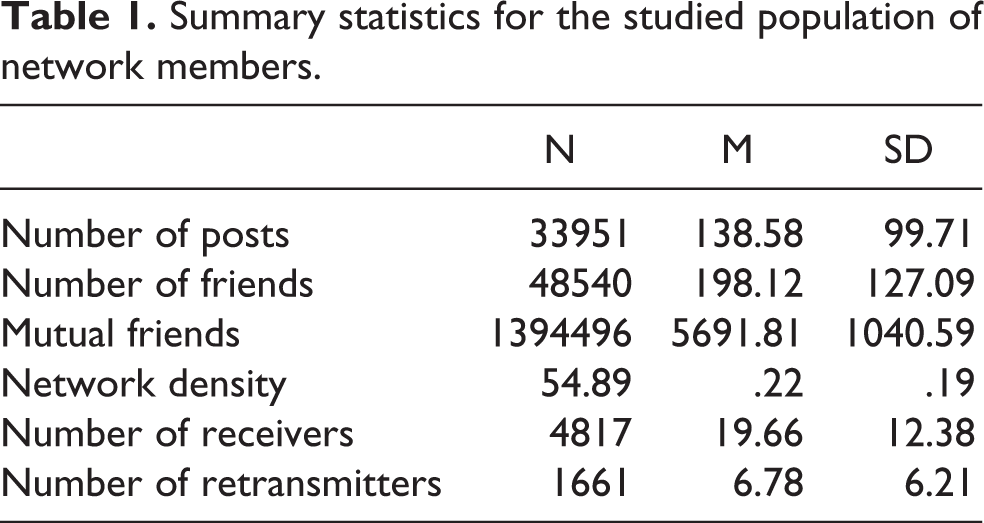
The results revealed that 245 Facebook users (Stage 2) retransmitted the information on their Facebook walls, and the posting mean of these participants was 138.58 (SD = 99.71). After a 7-day experimental period, a total of 4,817 users (M = 19.66, SD = 12.38) received this information from Stage-2 retransmitters, but only 1,661 users (M = 6.78, SD = 6.21) retransmitted this information on Facebook.
Before calculating the network density of each retransmitter (Stage 2), we recorded the number of friends and mutual friends in the network of each retransmitter. The results revealed that the mean number of friends was 198.12 (SD = 127.09), and the mean number of mutual friends was 5691.81 (SD = 1040.59). The mean network density of the retransmitters was 6.78 (SD = 6.21; see Table 1).
Summary statistics for the studied population of network members.
Hypothesis tests
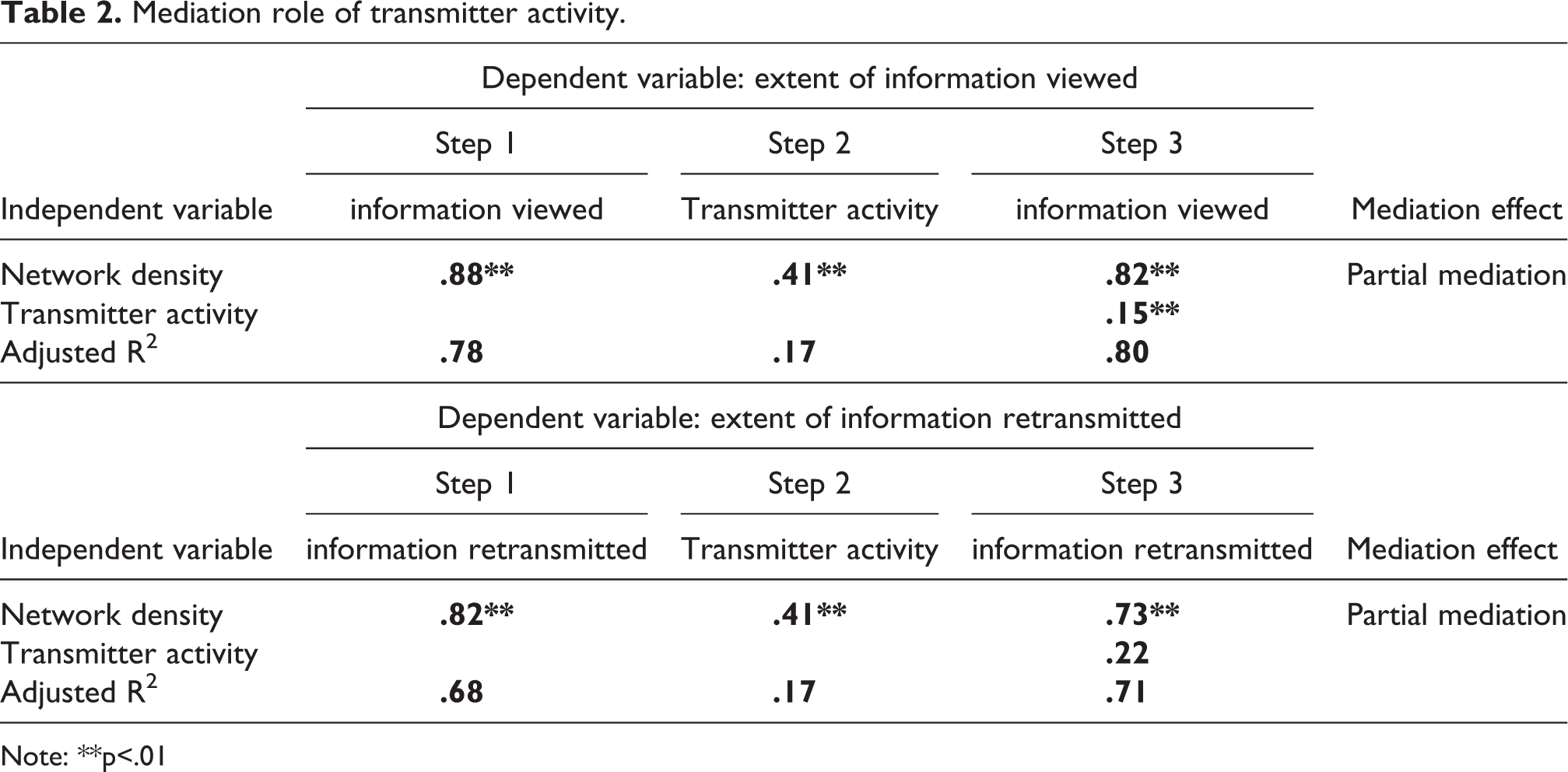
To test the mediating effect of transmitter activity, this study adopted three steps in the multiple regression analysis (Baron and Kenny, 1986). In the first step, the direct relationship between the independent variable (network density) and dependent variable (the extent of information viewed and retransmitted) was calculated. In the second step, the relationship between the independent variable (network density) and the mediator (transmitter activity) was evaluated. After confirming that all of the coefficients in these two steps were significant, we advanced to the final step, in which the relationship among the independent variable, mediator, and dependent variable was computed simultaneously. Subsequently, we compared the coefficients of the third step with those of the first and second steps. If the coefficients between the independent variable and dependent variable in the third step were not significant, a complete mediation occurred and no direct effect existed between the independent and dependent variable. By contrast, if the coefficients between the independent variable and dependent variable in the third step were also significant and smaller than those in the first step, the mediating effect was a partial mediation. This means that direct effects and indirect effects were exerted between the independent and dependent variable through the mediator.
According to the second step of the multiple regression analysis, the result revealed that network density was positively related to transmitter activity (β = .41, p < .001), supporting H1. The results presented in Table 2 proved that transmitter activity partially mediated the effect of network density on the extent of information viewed (Step 1: β = .82, p < .001, Step 3: β = .73, p < .001) and retransmitted (Step 1: β = .82, p < .001, Step 3: β = .73, p < .001; Table 2) on Facebook. This study determined that transmitter activity exerted a mediating effect between network density and the extent of information viewed and information retransmitted. According to the results obtained, H2a and H2b were strongly supported.
Mediation role of transmitter activity.
Note: **p<.01
Conclusion
Discussion
The main objective of this study was to examine whether network density enhances transmitter activity, and how transmitter activity mediates the effects of network density on the extent of information viewed and information retransmitted on SNS. This study designed information within Facebook application to collect data on the information diffusion process, and adopted the regression analysis approach to test the mediating effect of transmitter activity. This study yielded several results. First, the empirical results revealed that network density was positively related to transmitter activity on Facebook. Consistent with previous studies (Centola, 2010; Girvan and Newman, 2002), a denser network indicated a higher degree of familiarity within that network, and more interactions among users. Hence, when users perceived their network to be highly dense, they tended to increase their frequency of posting messages or sharing content with their friends. Secondly, this study extended the relationship between network density and transmitter activity, and further discussed their influence on information diffusion behavior. These results were not only consistent with Katona et al. (2011), Luarn et al. (2014) and Stephen et al. (2010) studies, but also determined that transmitter activity partially mediated the effects of network density on the extent of information viewed and retransmitted. In other words, transmitter activity can affect information diffusion on SNS, and the activity effect is plausible, and should become stronger as the social network becomes denser. Hence, network density and transmitter activity play a critical role to influence the extent of information diffusion on Facebook. In conclusion, these results would not only encourage researchers to rethink the factors that motivate people to disseminate information on SNS, but also offer insights to Internet marketers and companies for providing an efficient way to disseminate information.
Theoretical and Practical Implications
The results of this study have several theoretical implications. First, the way information is shared and diffused through SNS differs from that of previous social networks, because explicit retransmission behaviors are necessary for diffusion in the SNS context. Therefore, this study examined the influence of transmitter activity, and showed that transmitter activity appeared to be crucial for affecting the likelihood of something being shared on SNS, agreeing with Stephen et al. (2010). Secondly, previous studies have focused on the relationship between transmitter activity and information diffusion (e.g., Heinonen (2011); Stephen et al. (2010)) and on the relationship between network density and information diffusion (e.g., Katona et al. (2011)). This study examined the relationship among these three variables simultaneously, and revealed that transmitter activity partially mediated the effects of network density on the extent of information viewed and retransmitted on SNS. Thirdly, previous studies about social networks examined the concept of network density by self-report (Kim and Lee, 2011; Sohn, 2009). However, the appearance of SNS overcomes the difficulty of the availability of information on network density and transmitter activity. Therefore, in contrast with previous research, this study developed a Facebook application and performed an experiment to automatically obtain user data, after being granted permission to do so in the SNS environment. The method used in this study allowed obtaining objective and realistic data to calculate the network density and transmitter activity of each retransmitter (which is rare in related literature), and could be used in future research.
This study has several practical implications. First, marketers need to examine the disseminators’ network density to find out who are likely to trigger a higher rate of retransmissions among their friends than the average consumer, before selecting the set of disseminators. The results in this study show that they can do so by using their social network data to measure the extent to which a set of members are interconnected. The second implication is that SNS platforms can provide additional services to increase the possibility of being interconnected. According to the results of this study, network density is positively related to transmitter activity. If SNS platforms can increase interconnectedness among friends, they may also increase their frequency of interaction and communication, and thus increase the stickiness of the platform. Thirdly, because activity is a manageable characteristic that people mostly control themselves (i.e., they decide how often to post) and network density is often a function of the behavior and intention of others (i.e., people cannot decide who follows them, and who are interconnected), marketers could motivate their customers to become increasingly active. For example, incentives or other forms of explicit encouragement could be used to increase transmitter activity. Once a transmitter exhibits high activity, his friends would tend to believe that the information is fresh, which would in turn increase their probability to consume or view the information, and retransmit it on SNS.
Limitations and directions for future studies
Although this study provided satisfactory results, it still has several limitations. First, although this study determined that network density and transmitter activity played the roles in driving the diffusion of information, a full exploration of additional boundary conditions and other potential moderators is necessary. For example, the effects may be different with different purposes. Secondly, this study did not consider factors such as the dynamics of the activity of a given user, or feedback effects from prior diffusion outcomes on transmitter activity or network density. Understanding the dynamics of user behavior on SNS is a vital question that requires further investigation. Thirdly, exposure to the information was limited by the specific social norms that dictate interaction and influence on Facebook. Our finding may also hinge on the nature of the Facebook algorithm that determines which activity and information should surface, and for how long it is exposed to the user. Thus, the future exploration of contextual differences among various forms of online information diffusion is warranted. Fourthly, this study adopted the concept of network density and transmitter activity to examine information diffusion behavior, but the influence of the content is still unclear, and needs to be elucidated. For example, the information generators (consumers sharing information about their own experience) versus information transmitters (consumers passing on information about experiences they heard occurred to others) may affect different behavioral responses to information diffusion process. Therefore, it would be worthwhile to replicate our study to clarify whether information generation and information transmission would moderate the influence of network density and transmitter activity on information diffusion.