




Abstract
The current study seeks to explore the nature of collaboration among different organizations for conducting training workshops to enhance the skills of library and information science (LIS) professionals in Pakistan. This study covered training activities conducted from 1st January 2009 to 31st December 2013. Content analysis was used for this study. The data for the study was collected through an overview and perusal of messages shared on online Yahoo! groups of LIS professionals in Pakistan including PakLAG and LIBCOOP. The study found that universities, research and development institutes or academies, library associations and some business organizations have participated in the promotion of the skills of librarians in Pakistan. International cooperation seems lacking, as only five initiatives have attracted the cooperation of only three international organizations. The University of Punjab, Pakistan Librarians Welfare Association and the Institute of Research Promotion have played the leading role in their respective categories in enhancing the skills of LIS professionals in Pakistan.
Introduction
The rapid emergence and convergence of information and communication technologies has affected the library environment immensely and enhanced the need for cultivating collaborative efforts for the professional development of LIS professionals to enable them to meet the needs of library users more efficiently. Different factors such as acquiring and providing access to electronic or digitized resources, use of research software, automation of library activities with the growth of proprietary and open source software, emergence of cloud computing and usage of social media tools have increased the need for more training activities for LIS professionals. Different factors such as “increase in users’ expectations, application of modern technologies, digital revolution, and different format of material” (Rehman, 2012: 1) have precipitated the demand for collaboration among different organizations to adapt to environmental conditions imposed by emerging information technologies (Augustine and Rosevear, 1998). All these developments have changed the role of academic librarians and other library professionals working in different capacities (Hope et al., 2001).
This emerging trend of adoption of technology in libraries is also witnessed in Pakistan. Ameen (2011) asserted that “libraries in Pakistan are embracing digital technologies to provide online access to in-house and remote collections, create web sites and web OPACS, internet lab, and different public services”(p.172). Cordial relationships and better cooperation among different organizations which are conducting training activities is necessary because partnerships offer material, financial and social support and are “facilitated through an inter-connected web, or network, of associations” or organizations (Hands, 2010).
Sharing of knowledge is very important for its dissemination as “it is said that knowledge is a power, yet this is of little value if it is not shared” (Noonan, 2008: 51). Collaboration can be defined in different ways. It can be defined as the process in which individuals or organizations cooperate with one another in matters that can be solved more efficiently by collective efforts as compared to individual efforts. Collaboration can also be considered as a “working practice whereby individuals work together to a common purpose to achieve business benefit” (Global Community of Information Professionals, 2014). Collaboration is a viable connection that can be forged by sharing work practices, skills, and resources with the help of different collaborative tools such as emailing groups, social networking sites and online meetings, etc. Collaboration among two or more organizations may be an avenue through which cooperative training activities may be organized by sharing funds, exchanging experts (trainers) working in those organizations, and making available physical facilities for the participants of training workshops.
Ocholla (2008) contended that “the type of collaboration is defined by its nature and level, such as collaboration between individuals; among groups; among departments, within departments, inter-departmental; within institutions, inter-institutional; within sectors, inter-sectoral; countries – national/international; or regional/inter-regional” (p.469). Collaboration can be achieved in various forms such as individuals working with an organization with which they are not connected (individual and organization); organizations cooperating with one another to achieve common goals (among organizations); and individuals working with one another for achieving a common agenda (among individuals). Collaboration can also be categorized into capability-based collaboration, in which partner organizations share their skills, and proposition-based collaboration, which enables organizations to share their resources (Cardell, 2002). Collaboration is the result of “inter-organisational strategy that, regardless of the form taken on implementation, e.g. agreement, consortium, alliance, associated management” was seen in the past as an opportunity, but in the present environment is deemed necessary for working together to solve problems (Sorrentino and Simonetta, 2011).
Organizing training activities requires a significant investment of finances, time and resources, so this might best be shared among several organizations contributing a portion of their resources for the common purpose. Collaboration among organizations provides a pool of skillful trainers having a variety of previous experiences of conducting training programs. Partnership offers many benefits, such as sharing and transferring skills, knowledge and techniques, increases the visibility of efforts and helps in problem solving (Ocholla, 2008). Different organizations have expertise in different subject areas and no single organization can fulfill the entire training needs of LIS professionals in Pakistan, so collaboration among different knowledge agencies in Pakistan is essential for “pooling of expertise and exploitation of available resources and technologies in ways that maximize learning opportunities” (Pham and Tanner, 2014: 16).
Literature review
The importance of and need for collaboration among different organizations for the development of professionals is well established in the field of library science.
The growth of information technology in the health care environment has increased the need for redefining approaches for the training of health care professionals, and collaboration between the Medical Library Association of the United States and universities for offering certified programs in key areas of technology needs to be strengthened (Homan et al., 2002).
Partnerships and collaboration may be either prescriptive, enacted by a piece of legislation, or organic, that evolves from the interaction of likeminded organizations. Informal collaborations are more quick and efficient than formal collaborations. Effective collaboration and networking can be achieved by conforming to shared purposes, devising a framework for taking risks and ensuring ways to involve and trust partners. Partnerships among different organizations provide rich environments for learning and development of individuals. True reflection on factors such as high degree of communication, understanding of targets and sharing responsibility at each stage of collaboration is deemed necessary for the success of collaboration (Armistead and Pettigrew, 2004).
Training Centre Network initiative, a network of national centers, has created opportunities for professional development of library and information workers in different countries of Central and Eastern Europe and Central Asia in collaboration with the Open Society Initiative (OSI), which provided the entire funding for this initiative. This is an excellent example of international collaboration (Robinson and Glosiene, 2007) initiated for developing information workers.
Ocholla (2008) investigated the current challenges of LIS education and training in Africa and found that collaboration among LIS schools in the region is weak and largely informal. There is hardly any research collaboration amongst LIS schools in Africa.
Participants in a workshop on e-library services organized by the Librarian’s Registration Council of Nigeria (LRCN) in collaboration with the United States Mission in Nigeria, expressed that such collaborative workshops should be organized twice in a year to upgrade skills of librarians about e-library services in Nigeria (Baro et al., 2013).
Proulx et al. (2014) asserted that organizations innovate through collaboration with one another to secure resources and achieve their goals and objectives. The “most common variety of inter-organizational collaboration is when nonprofit organizations collaborate with each other, creating a dense web of information and resource sharing across the sector” (p.747). They reviewed existing research on motivation for collaboration and found that acquisition and security of resources, sharing of organizational expertise and ideas, improving the quality of training and changes in knowledge technology are important motivations for collaboration among nonprofit organizations. They further recommended that different factors such as mutual trust, clear domain consensus, shared vision and goals, social relationships and organizational leadership and meeting the needs of member organizations are helpful to achieve effective collaboration.
Pham and Tanner (2014: 19) have asserted that there is a “broad agreement across the disciplines on features of interdependence, mutuality and commitment to working together to achieve common goals, shared effort, shared responsibility and accountability, shared resources and outcomes, voluntary participation and values such as fairness and caring for others” for developing viable collaboration among different organizations.
Mahmood (1998) conducted a study of training events conducted in Pakistan and suggested that universities, library associations and departments of library sciences should develop partnerships and assume responsibility for the training of library professionals in Pakistan.
Social networking tools such as mailing groups, mailing lists etc. were started in the 1990s, but in Pakistan, online mailing groups of library professionals were launched in the 2000s. Training initiatives selected for this study were identified from messages posted on Pakistan Library Automation Group (PakLAG) and Pakistan Library Cooperation Group (LIBCOOP), online groups of library and information professionals in Pakistan. PakLAG was established on 19 December 2000 as an important forum for sharing information about library trends, library automation and information technology (Siddique and Mahmood, 2009) while LIBCOOP was created on 20 August 2004 for sharing information and experiences about library projects. Both these groups offer opportunities to library and information science (LIS) professionals to disseminate and share information with their members about library related activities and practices. Important information and issues are shared by LIS professionals on these online mailing groups with members of other groups. Training initiatives are shared with professionals for maximizing their participation in training activities. Reports of training initiatives are also shared with professionals after the conduct of trainings if these trainings are intended only for particular groups of librarians.
Ullah et al. (2010) recommended that formal training programs should be initiated for medical librarians in Pakistan through collaboration between the Medical Library Association of Pakistan (MELAP), College of Physician and Surgeons Pakistan (CPSP) and the library schools of different universities. They recommended increasing “awareness among medical librarians regarding the latest developments in the field, seminars, conferences, and workshops should be conducted by MELAP, CPSP, library schools and medical institutions”.
Objectives of study
The main objectives of this study are: To explore the nature of collaboration among different organizations for conducting training activities for LIS professionals. To measure the cooperation and participation of resource persons’ participation in implementing these training initiatives. To identify the participation of different individual organizations such as research and development institutions, centers and academies, universities and associations which are providing training opportunities to library and information professionals in Pakistan for their professional development.
Methodology
Content analysis was used for this study. The data for the study was initially collected through an overview and perusal of messages shared on online Yahoo! groups of LIS professionals in Pakistan. PakLAG and LIBCOOP were used for retrieving messages posted on these groups about training initiatives. Data for this study was collected in two stages. In the first stage, the messages from these groups from 1st January 2009 to 31st December 2013 were searched on a yearly basis and all relevant messages were recorded. In the second stage, these messages were rechecked for duplication and content analysis. Quantitative data from the messages was analyzed with the help of simple statistical techniques.
Significance and limitations of the study
This paper investigated the level of participation of local, regional, national and international organizations in the conduct of training initiatives to improve the skills of LIS professionals in Pakistan. It also determined the scope of collaboration and participation level of resource persons in the completion of these initiatives.
The justification for this paper is manifold. This effort will make the concerned organizations aware of the value of collaboration among them for conducting a broad range of training activities for LIS professionals in Pakistan. It will also determine the role played by different organizations by mapping their participation in the training initiatives in the last 5 years. The identification of organizations offering training opportunities will be helpful for measuring the trends of collaboration among them for the strengthening of library profession in Pakistan.
The study is limited to the training initiatives communicated via Yahoo! mailing groups of LIS professionals in Pakistan; it excludes all training initiatives undertaken before 2009 and after 2013. It is believed that most of the trainings conducted in Pakistan are shared on these groups, but there is still a possibility that some initiatives were not reported on these groups, or that some training workshops were announced but not conducted due to one reason or another.
Data analysis
Collaboration among different organizations
Table 1 shows that 41 trainings were organized by a single organization without collaboration with other organizations. Universities and university libraries conducted a total of 20 workshops, followed by research and development institutes, centers or academies and their libraries with 16 workshops. Only 5 workshops were conducted by public libraries, and library associations did not conduct any workshop independently without the collaboration of other organizations.
Collaboration among organizations.
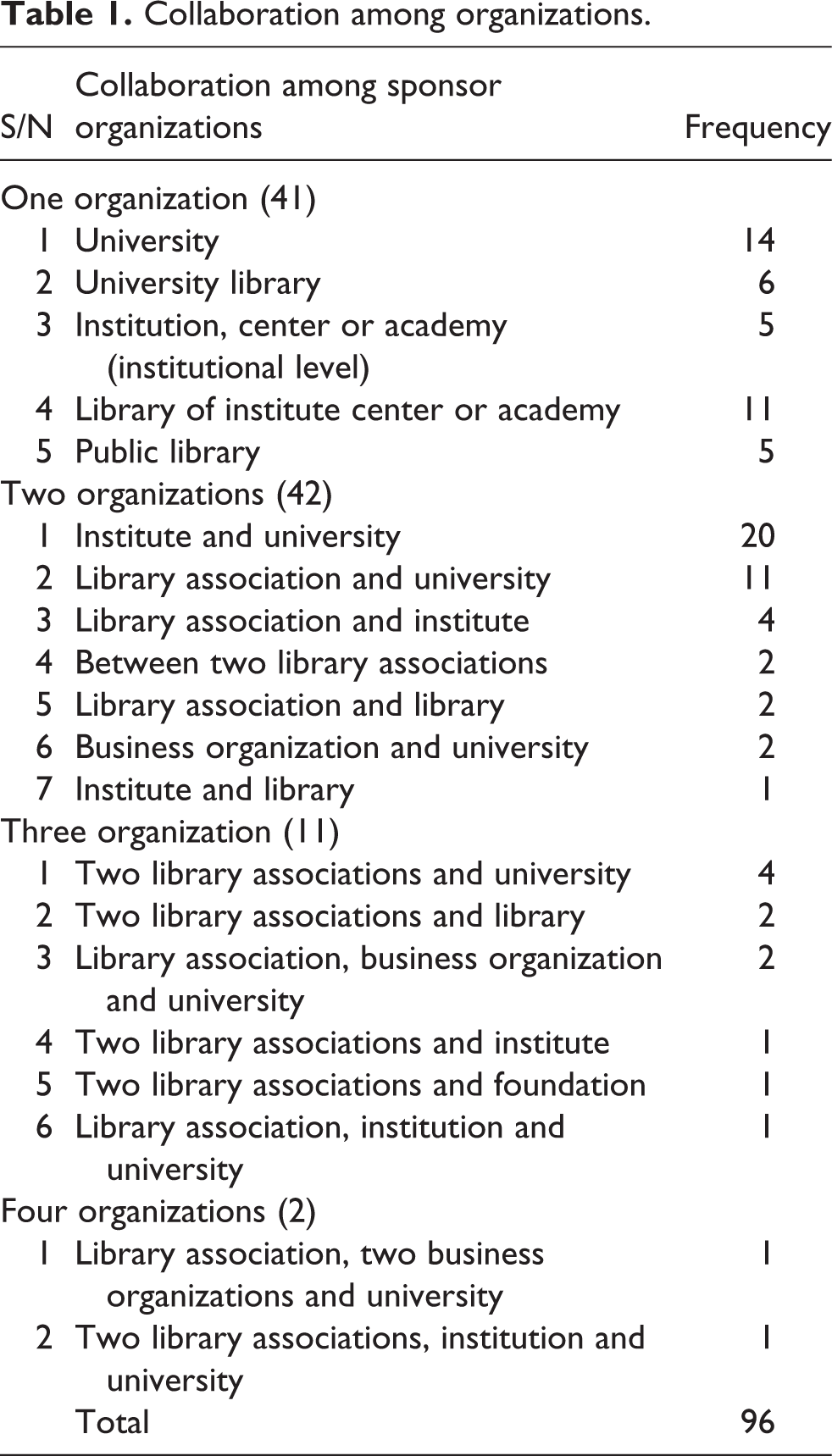
Table 1 also shows that a total of 55 training initiatives were conducted by different organizations through some sort of collaborative activity. Forty-two of these initiatives involved collaboration between two organizations, 11 involved collaboration between three organizations, while two initiatives were organized by collaboration between four organizations. Close cooperation may be traced among library associations and other organizations from Table 1. Universities and institutions have also collaborated in managing 20 training workshops. Library associations were an integral part of all the efforts in which training workshops were collaborated by three or four organizations.
Scope of collaboration
Table 2 indicates the scope of training initiatives undertaken in Pakistan at national (74), local level (13) and international level (9). Local level means that professionals of a particular geographic area or sector could participate in a particular workshop. For example, professionals of Sargodha region were able to participate in training conducted in the University of Sargodha. International level means that the workshop was conducted with the cooperation of international organizations or resource persons having an international background. Two international workshops were conducted with the collaboration of the Special Libraries Association of USA (Table 4) and the Digital Library Network of South Asia (Table 7) and one was conducted with the collaboration of the University of Waikato, New Zealand (Table 5).
Scope of collaboration.

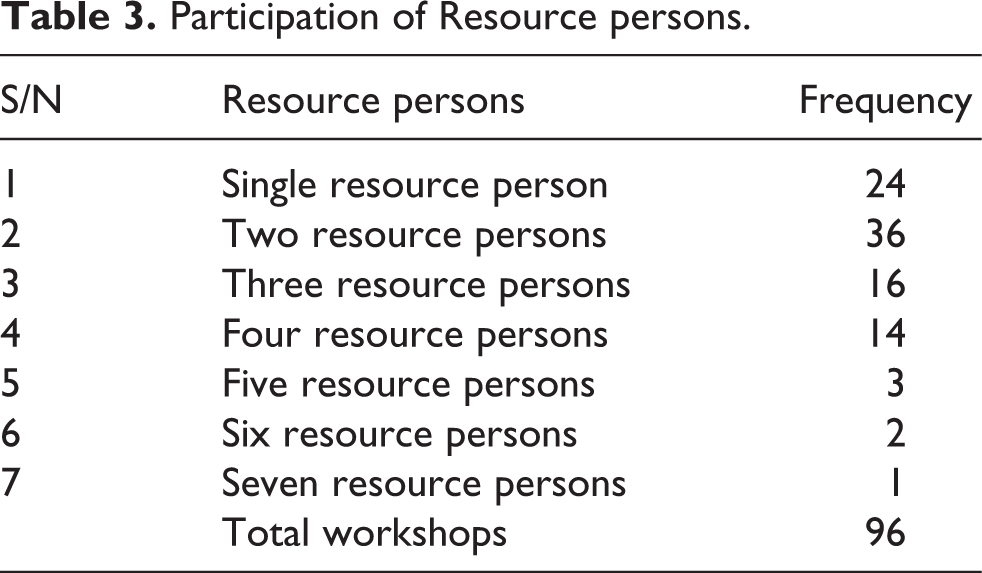
Participation of Resource persons.
Participation of library associations.

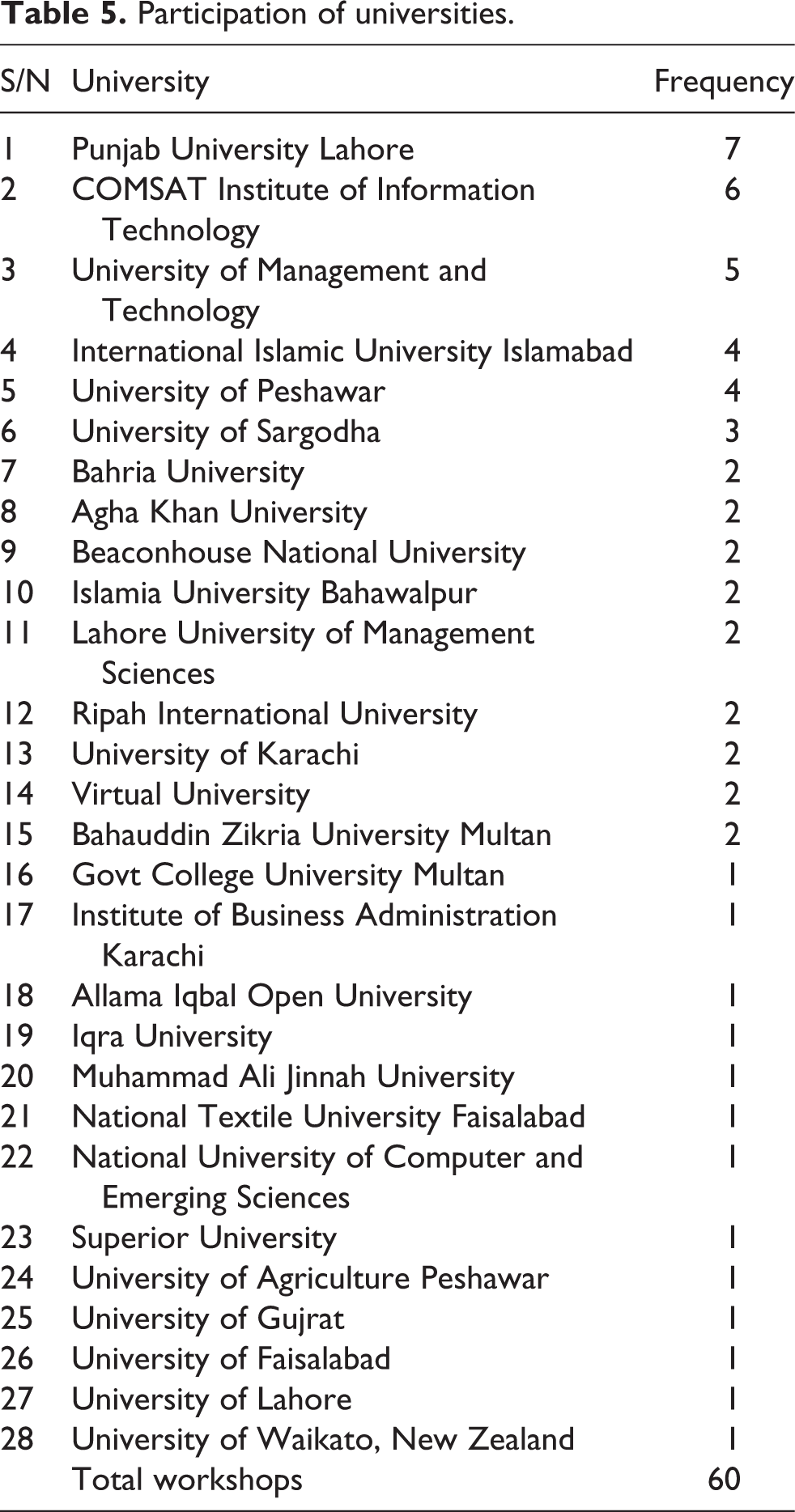
Participation of universities.
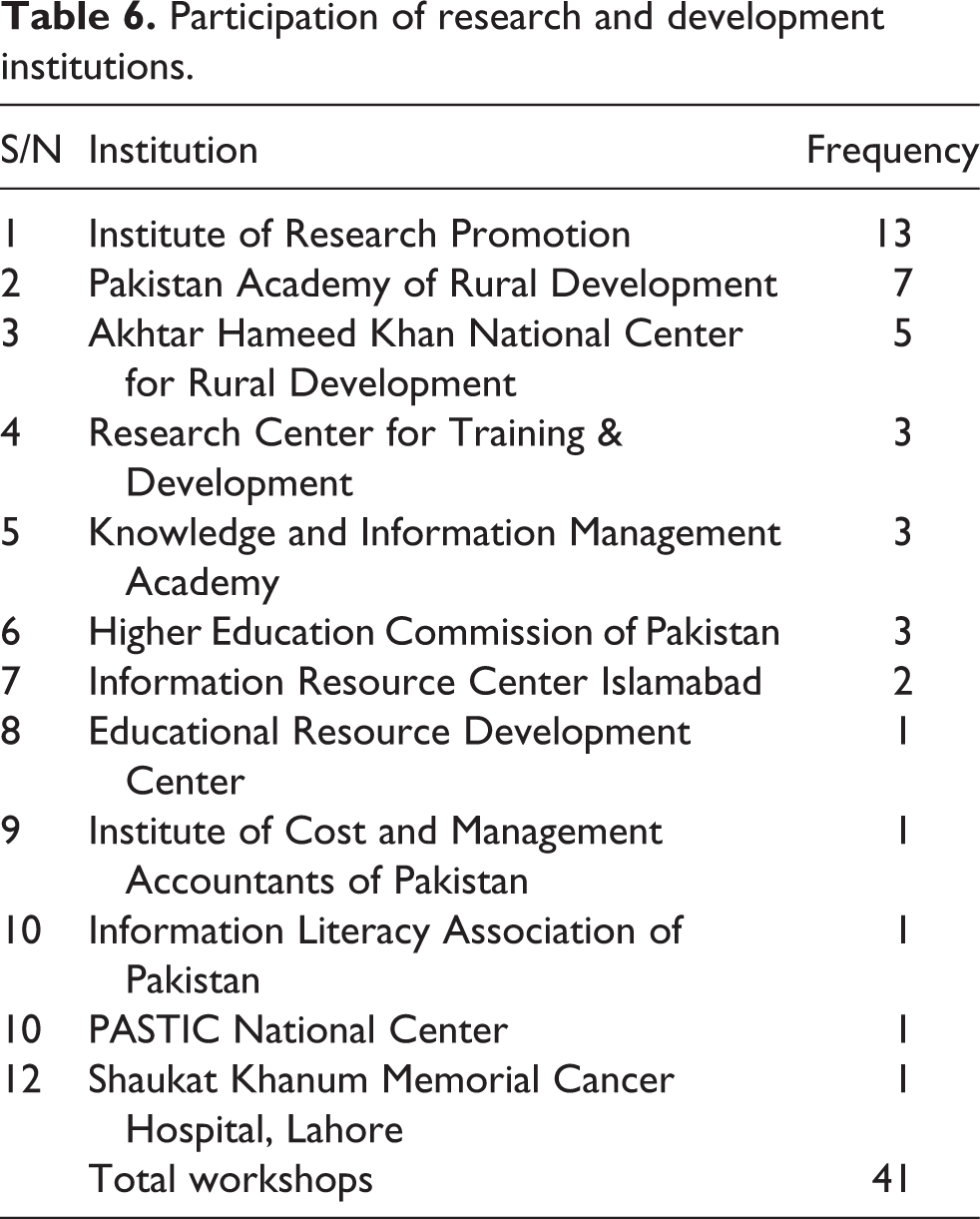
Participation of research and development institutions.
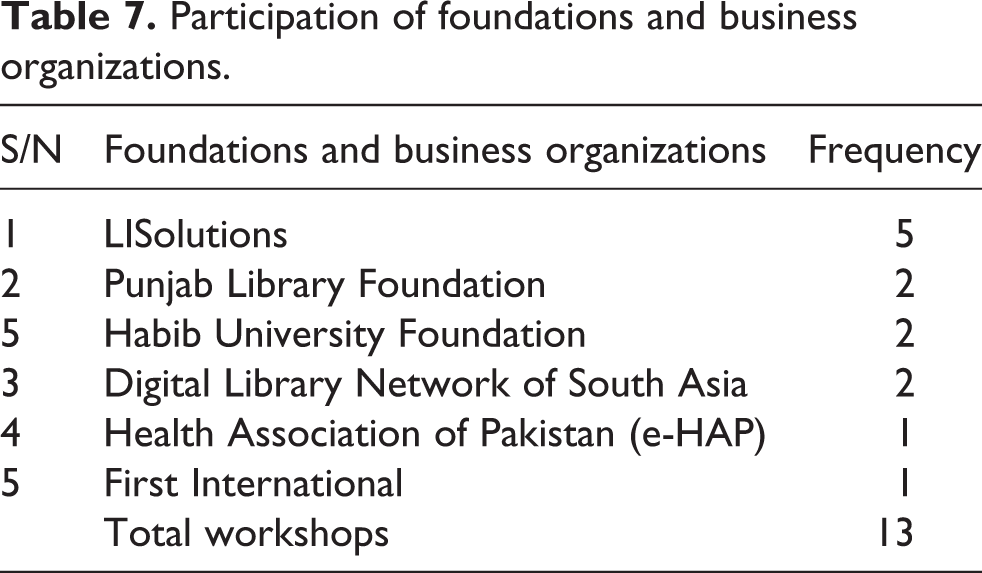
Participation of foundations and business organizations.
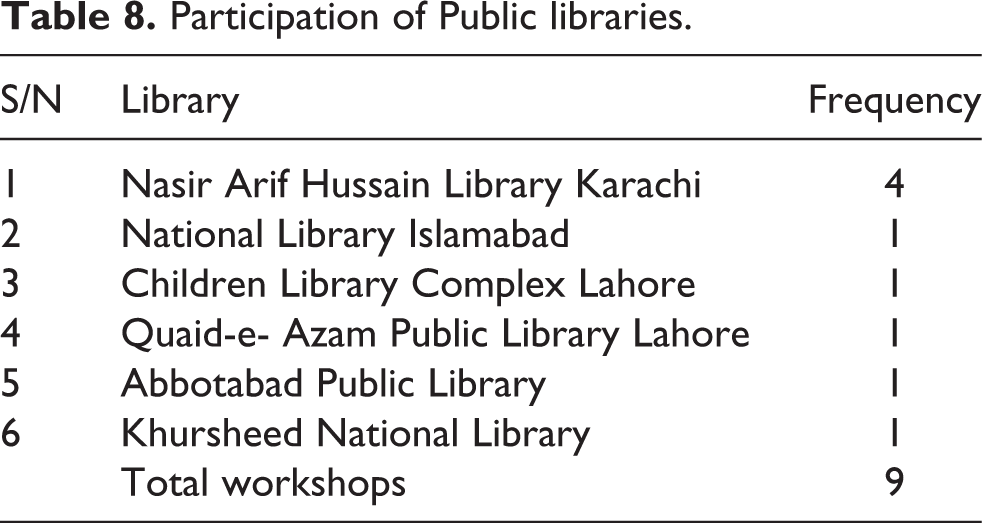
Participation of Public libraries.
Participation of resource persons
A quarter of the training workshops were conducted by a single resource person, but the majority of initiatives were conducted by two, three or four resource persons.
Participation of library associations (42 workshops)
The Pakistan Librarians Welfare Association has played a positive role in enhancing the skills of library professionals. This association participated in the conduct of 12 training workshops, followed by the Pakistan Library Association, that participated in nine training initiatives. The Special Libraries Association, USA, collaborated in two workshops.
Participation of universities (60 workshops)
Twenty-eight universities have participated in the conduct of 60 training workshops for library professionals in Pakistan, led by the University of Punjab with seven workshops. Only one international university, the University of Waikato, New Zealand, has cooperated in one training workshop. Five public sector universities have cooperated in the conduct of more than two workshops each. Private sector universities are led by the University of Management of Technology, Lahore that has collaborated in the conduct of five workshops. Public sector universities have played a more dynamic role than private sector universities for professional development of LIS professionals by participating in more workshops.
Participation of research and development institutions (41 workshops)
The Institute of Research Promotion has participated in conducting 13 workshops, all of which related to qualitative and quantitative analysis software. The Pakistan Academy of Rural Development (7 workshops) and the Akhtar Hameed Khan National Center for Rural Development (5 workshops) have offered training courses in ICT and library automation software. The Higher Education Commission (HEC) of Pakistan, an important national institution responsible for promotion of higher education in Pakistan, has played a role in only three training initiatives conducted for library professionals.
Participation of foundations and business organizations (13 workshops)
LISolution has contributed in the conduct of five workshops. The Punjab Library Foundation, the Habib University Foundation and the Digital library Network of South Asia each of them has participated in two workshops. Two other business organizations have cooperated in each workshop.
Participation of public libraries (9 workshops)
Nasir Arif Hussain Public Library, Karachi, cooperated in four training workshops; five other public libraries each contributed to one workshop.
Findings
Forty-one of the training workshops were organized by a single organization without the collaboration of other organizations, while 55 training initiatives were conducted by different organizations by engaging in some kind of collaboration. More collaboration between two organizations is seen, with 42 initiatives, followed by collaboration among three organizations (11 workshops) and four organizations (2 workshops). Library associations collaborated with other organizations in all workshops involving three or four organizations.
The major motivations behind this study were to identify the type of organizations collaborating in training of library professionals and also to explore the nature of collaboration among these organizations. This study found that organizations like universities, research and development institutes, library associations and business organizations have participated in promoting the skills of librarians in Pakistan. International cooperation in training initiatives seems to be lacking, as few initiatives benefited from the cooperation of international organizations. Three international organizations, the Special Libraries Association of USA, the Digital Library Network of South Asia and the University of Waikato New Zealand contributed to the conduct of a total of five training activities. Resource persons having international backgrounds participated in four workshops.
Only 27 national universities and one foreign university participated in training workshops for library professionals in Pakistan. The University of Punjab remained the leader, cooperating in seven workshops. Among library associations, the Pakistan Librarians Welfare Association played the leading role by taking part in 12 training initiatives. The Institute of Research Promotion played a dominant role in training initiatives on qualitative and quantitative research.
Conclusion and recommendations
Collaboration among different organizations is an important tool for raising the standards of professional competence of staff working in different libraries. For better training of library professionals, it is necessary to bring the existing talent together and this can be achieved only through collaboration among different organizations. The knowledge dissemination organizations must work together to forge collaboration and partnerships for developing a suite of training programs to enable librarians to cope with the challenges of information age. International cooperation is necessary for raising the standard of library professionals in Pakistan to the international level. The benefits and outcomes of collaborative networks are more powerful than those produced by single organizations (Augustine and Rosevear, 1998).
The following recommendations are made to make collaboration among different organizations more effective and useful: Organizations and institutions should come forward to impart training in their area of expertise. For example the Institute for Research Promotion has expertise in the area of research management software, so institutes like this one should collaborate with other organizations to execute their training packages with minimal financial burden. Professional development should be the top priority of the government and funds should be earmarked for promoting partnerships to enhance the competence of library professionals. Government should collaborate with library associations for capacity building of training agencies and trainers in Pakistan (Khan and Rafiq, 2013). The Higher Education Commission of Pakistan should spearhead collaborative efforts for the development of strong partnership programs by allocating generous financial resources for the training of professionals. HEC and other bodies should make efforts to get the support of international organizations to train library professionals according to international standards. One encouraging sign is the active role of library associations in developing competence among their members. Library associations, which possess huge social capital in the form of library professionals, should conduct training programs in a way that will maximize the participation of library professionals across all library sectors.
Collaborative efforts play an important role in the sharing and dissemination of knowledge and skills. Individuals and organizations associated with knowledge dissemination must come forward and play their due role in sharing know-how, technical experience and best practices and spread it across library sectors in Pakistan. Knowledge dissemination organizations, including universities, libraries and research institutions, need to play a vibrant role in making library professionals more innovative and service-oriented. To fulfill the professional development needs of librarians in Pakistan, all these organizations need to develop mutually beneficial collaboration to achieve their organizational goals and objectives.