



Abstract
Globally, crime is a major societal problem. To control crime effectively, police forces require new systems for analysis and monitoring. Crime analysis and monitoring integrates data from different government agencies. Many types of data are collected from multiple heterogeneous sources in different formats and from different platforms. In this study, the problems and requirements of the police in crime analysis and monitoring are summarized and solutions are presented. The primary objective of this study is to propose the design and implementation of a mobile crime analysis and monitoring system based on service-oriented architecture (SOA) that can support data exchange and model sharing from heterogeneous systems. To develop this system, the SOA-based structure is used as the foundation to design and implement the system. The system architecture, business process, and methodologies for locating the nearest police are constructed based on SOA. The developed system is evaluated to measure its efficiency and effectiveness. Time is used for measuring the efficiency and the accuracy of the reported cases is used for measuring the effectiveness of the developed system. The evaluation results confirm that the developed system increases the efficiency of police operations by approximately 60% with an effectiveness increase of 84%.
Keywords
Introduction
Globally, crime is a major societal problem. It can affect anyone, at anytime, anywhere. Nowadays, many countries address crime prevention more vigorously because crime has a significant impact on society and the economy. To combat crime more effectively, crime analysis and monitoring are important functions for all law enforcement agencies. The police sometimes confront operational problems analyzing and monitoring crime information and are constantly attempting to implement new methods to improve their efficiency. Common difficulties that they encounter are in crime control, crime investigation, and providing crime information to the public to encourage them to protect themselves (Boondao, 2006). Policing would be more efficient and easier if more effective tools were available to assist the police in crime analysis and monitoring. An example is a tool to issue crime-warning messages via mobile devices when they must physically move through a high-risk area/environment or when they are serving an arrest warrant. The benefits for ordinary citizens would be in the form of warning messages if they enter a high-risk area and the ability to report crimes via their mobile device directly to the police. This system could also be used to access criminal information from multiple sources in different formats such as text (criminal data, property data, gang information, case information, demographic information), graphics (photographs of criminals, pictures of crime scenes), multimedia (video clips), and geographic information (crime locations, details of the area, facilities). This system could permit information exchange and real-time data links to and from any database on any platform among the law enforcement and government infrastructure. Examples of this type of information exchange are the retrieval of information from the Department of Local Administration or vehicle registration and driving license information from the Department of Land Transport.
Based on the situations described above, it can be seen that a crime analysis and monitoring framework requires a mechanism that supports the universal sharing, receiving, and release of information. A possible solution to achieving these objectives is service-oriented architecture (SOA). SOA is a methodology to design and structure information systems to support data exchange, model sharing, receiving information, information release, and interoperability among heterogeneous systems through a standard protocol (Fang et al., 2009; Foerster et al., 2009; Samadzadegan et al., 2008; Steinberger et al., 2009; Stollberg and Zipf, 2008. Furthermore, a crime analysis and monitoring framework must facilitate mobile spatial information services that include information technology, mobile contact technology, Internet technology, and several other technologies combined to exchange, receive, share, and release information based on location to mobile users, anytime and anywhere (Jun-fang et al., 2009).
Previous studies
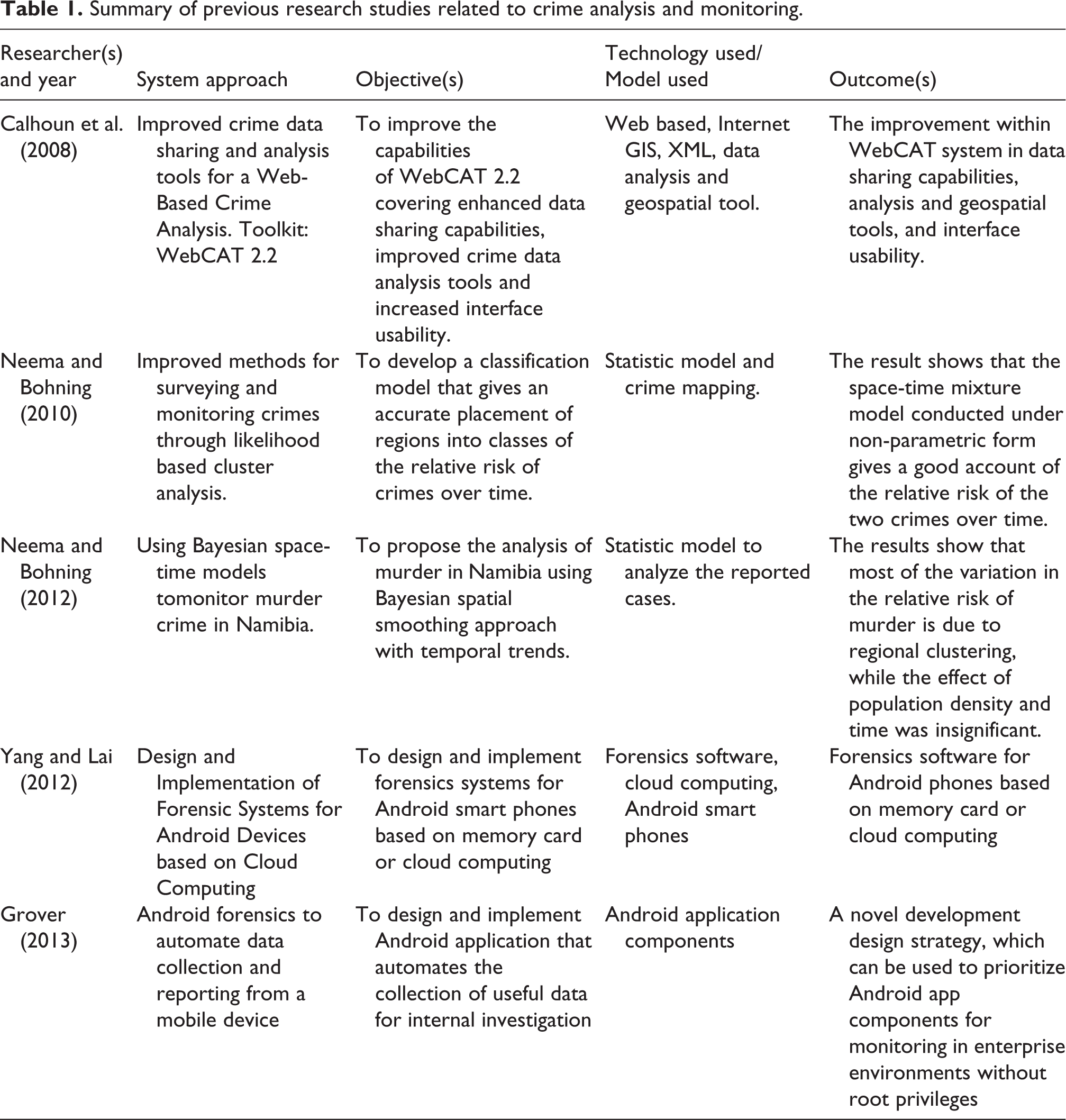
Crime analysis and monitoring play an important role in assisting police operations such as crime apprehension, crime and disorder reduction, crime prevention, and crime evaluation. Therefore, crime analysis and monitoring have received a lot of attention from several researchers, for example, previous studies in crime analysis and monitoring that focused on the analytical method, visualization crime mapping with various tools (Neema and Bohning, 2010, 2012), a study that tried to improve crime data sharing and analysis tools for web based crime analysis (Calhoun et al., 2008), a study that developed forensics software for Android smart phones based on memory card or cloud computing (Yang and Lai, 2012), and a study that designed and implemented an Android application that automates the collection of useful data for internal investigation (Grover, 2013). However, none of the research focuses on the use of data exchange and model sharing from multiple data sources in crime analysis, crime monitoring, and the dissemination of crime data to the police and the public with regards to location awareness. This study fills in the gaps in the literature by providing a novel approach to develop a mobile crime analysis and monitoring system that can support data exchange and model sharing from heterogeneous systems, utilizing service-oriented architecture (SOA) and illustrated through the design and implementation of one mobile crime analysis and monitored system. A summary of previous research studies related to crime analysis and monitoring is shown in Table 1.
Summary of previous research studies related to crime analysis and monitoring.
Current crime analysis and monitoring system
The current state of crime analysis and monitoring was investigated to determine the problem of crime analysis and monitoring in Thailand. These investigations were carried out by conducting interviews and observations of work processes within the emergency call center in the Metropolitan Police Bureau and the Police Provincial Division, which belong to the prevention and suppression section within the Royal Thai Police. The Royal Thai Police have six main sections with regard to the roles covering administration, special operations, prevention and suppression, supporting prevention and suppression, training and services.
These investigation results were collected and summarized into the following four problem areas (Boba, 2005; Khemprasit and Esichaikul, 2011, 2014; Zhao, et al., 2006):
Data exchange
Current situation
Investigative case officers and detectives are frequently required to search through information regarding suspects, victims, and crimes from various data sources in different formats. For example, when detectives are attempting to discover/apprehend a suspect/offender, they are required to obtain information about the case and victim, in addition to the suspect and offender. Therefore, they must search at least four different systems, i.e. criminal database, civil registration, arrest warrant database, and gun registration, from different sources. Moreover, the police must always exchange data with the Ministry of Justice, e.g. stolen car and crime information.
Problems
Data from multiple sources are in different formats and from different platforms. Consequently, it would be easier for the police if they had data exchange tools to assist in their crime investigation.
Model sharing
Current situation
When patrol officers receive commands from the emergency call center, they must sometimes request additional information from the call center, e.g. the location of the event, best route to the event, and nearest actual event. This information can be processed using the suggested model, e.g. finding the route model and finding the nearest place model.
Problems
Because of high call volumes, the emergency call center has a demanding workload. The police always use the same model, e.g. finding the best path to a specific destination, locating a risk area, or determining the nearest neighbor, using a different dataset of different environments. Therefore, the workload of the emergency call center would decrease if the police had access to a tool to allow them to share these models; hence, they would have no need to make further requests to the call center.
Information access, anytime and anywhere
Current situation
When patrol officers or detectives work in a given area, they often require access to arrest warrant information or lost/stolen car information. For example, while patrolling they may locate a suspect or a stolen vehicle and require immediate access to detailed information related to the suspect or the stolen vehicle.
Problems
The police use radio communication to access detailed information that is occasionally not reliable or understood fully because of radio interference in the communication between the senders and the patrol officers. There is also the problem of using paper-based information that may not be current.
Information dissemination
Current situation
When police move through an area, they must know if the area has any open arrest warrants or a high crime rate.
Problems
None of the currently available tools can provide information (arrest warrants, crime risk) to the police when they are physically moving through a high-risk area/environment or when they are serving an arrest warrant.
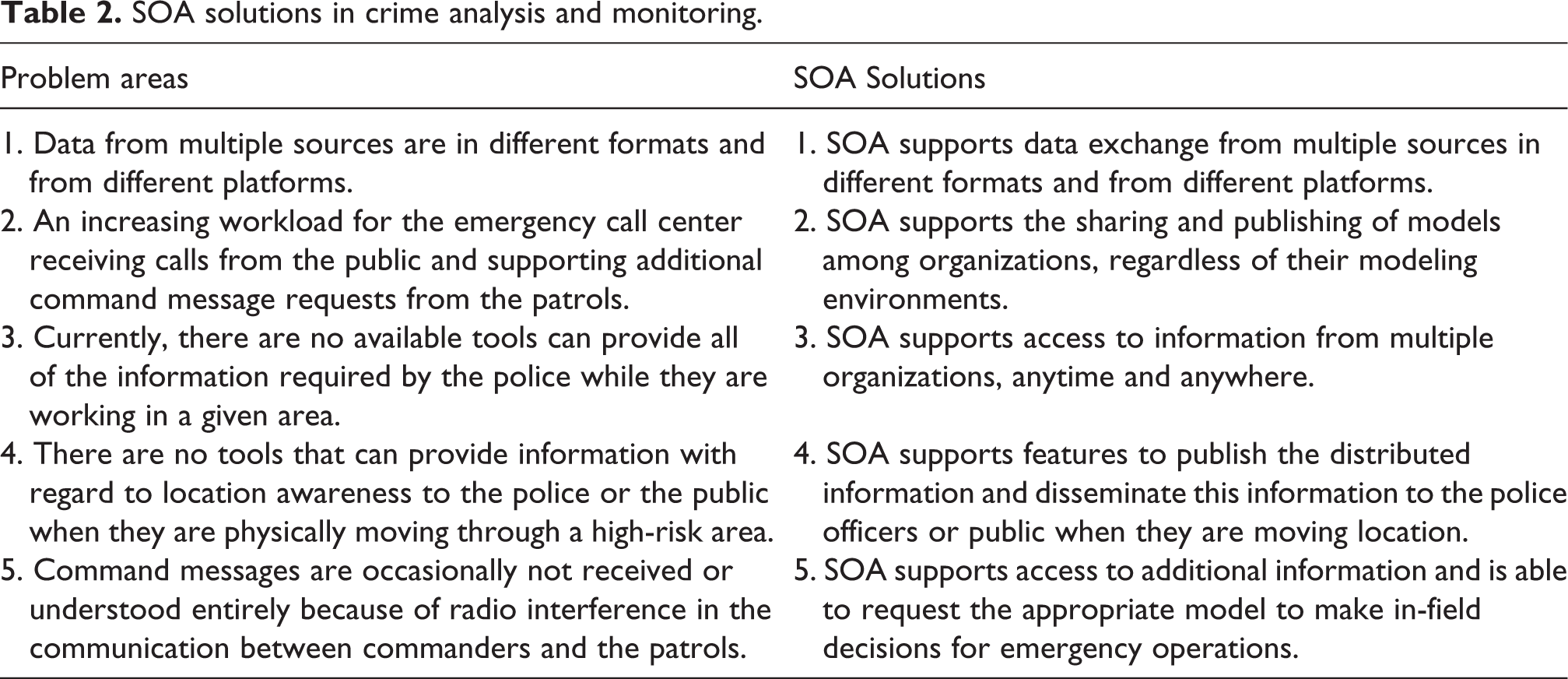
The current state of crime analysis and monitoring requires a mechanism that can support data exchange, model sharing, information access, and information dissemination. SOA appears to be an appropriate solution to achieve the needs of crime analysis and monitoring. The SOA solutions in crime analysis and monitoring are described in Table 2.
SOA solutions in crime analysis and monitoring.
Because of its characteristics, SOA was selected as the appropriate solution to address the deficiency of features in the current system. The SOA-based structure of the mobile application for crime analysis and monitoring is presented in Figure 1 and the details of this SOA-based structure can be seen in (Khemprasit and Esichaikul, 2011).
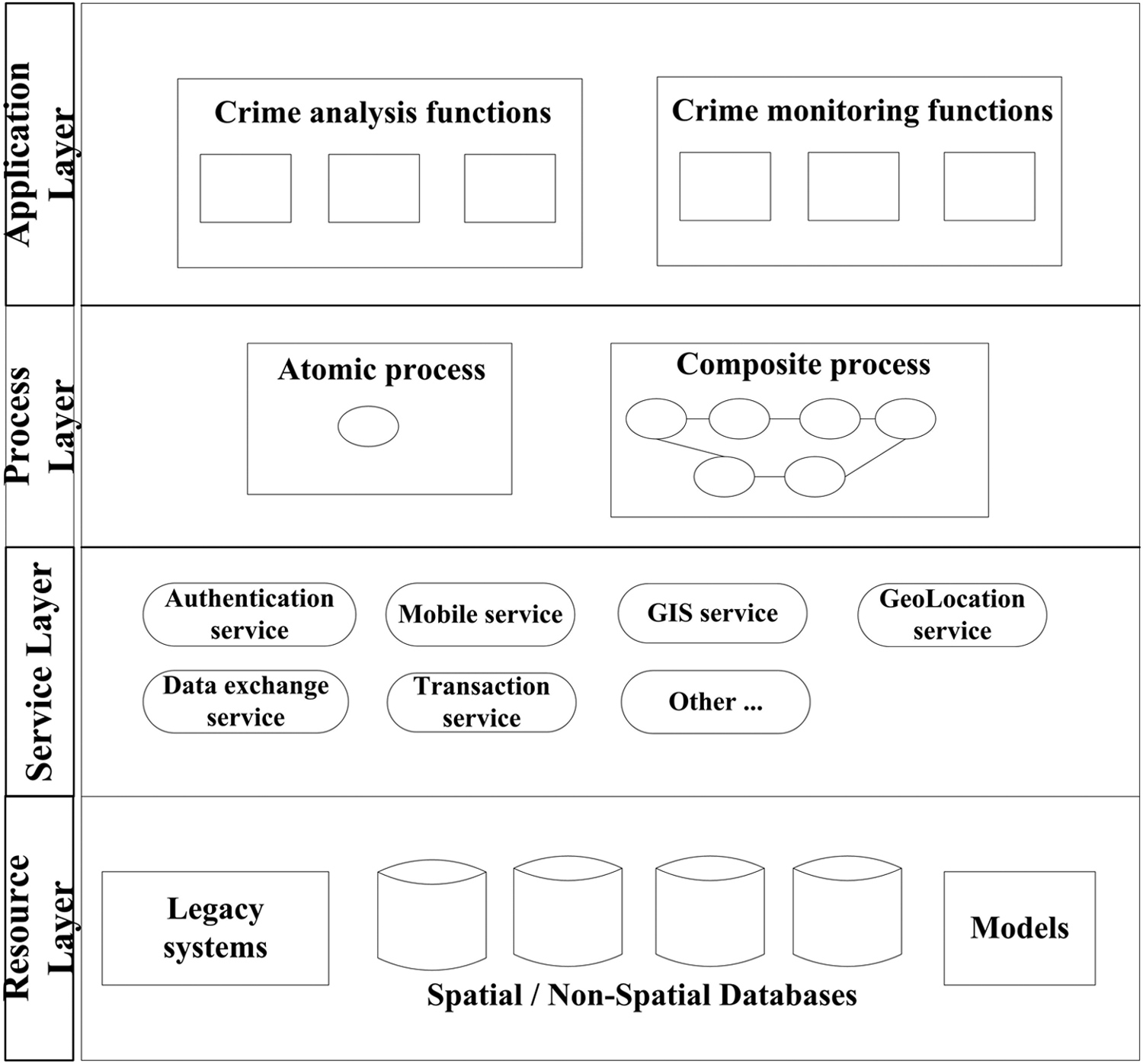
SOA-based structure.
Proposed mobile crime analysis and monitoring framework
Upon establishing the requirements of a crime analysis and monitoring system for police operations and determining the appropriate solution to achieve this functionality, the mobile crime analysis and monitoring framework was derived based on the process of crime analysis and monitoring as depicted in Figure 2.
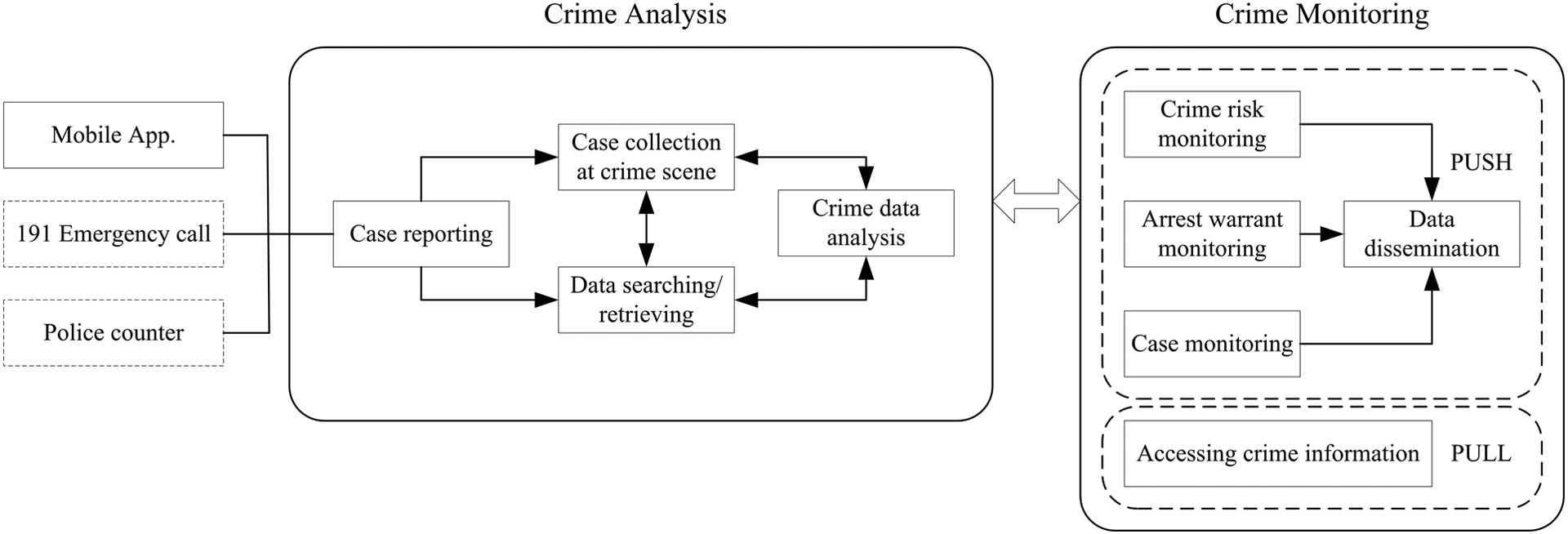
Proposed mobile crime analysis and monitoring framework.
The proposed framework can be divided into two principal processes, crime analysis and crime monitoring. In terms of workflow, the crime-analysis process can be further divided into the following four sub-processes (Abdous and He, 2008; Khemprasit and Esichaikul, 2014; Mahmoodzadeh et al., 2009; Soiraya et al., 2007).
Case reporting
There are three methods to report a case to the police depending on the urgency of the situation, i.e. calling an emergency number with a telephone, using a mobile application, or going to the police station. This study focuses on case reporting using mobile applications. The details of each method are described as follows:
Calling an emergency call center (191) with a telephone
People can call the emergency call system (191) when there is an emergency case that requires an immediate police response. Subsequently, the call center will send the case to the patrol officers via radio communication. The patrol officers will proceed to the crime scene immediately.
Mobile application
When there is a non-emergency situation that requires a police response such as locating of a suspected stolen car or the identification of a suspected offender, people can use mobile phones to report crimes/suspects directly to police officers who are working near the incident or in a given area. When the patrol officers receive the informant’s message, they can access additional information such as determining the exact location of the incident or calculating an intercept route or the route to the crime scene without further interaction with the call center. The patrol officers can then record the results using the mobile application. Case reporting using a mobile application provides a convenient method for the people to assist the police in crime prevention.
Police station
The ability to report a case in a police station is provided to facilitate the reporting of non-urgent crimes or incident where the crime/incident is no longer in progress and does not require an urgent police response. People can go in to a police station and converse with the police officer at the front counter.
Case data collection at the crime scene
The police can use mobile phones to collect data at the crime scene that can then be uploaded to the database. Mobile devices can also provide the exact location (latitude, longitude) of an event. Consequently, the updated data can be used to immediately support subsequent police operations.
Data searching/retrieving
The police can use mobile phones to search/retrieve updated data from multiple sources, in different formats, and from different platforms for crime analysis and monitoring, anytime and anywhere. For example, police officers can search car theft information from the Department of Land Transport using the license plate number, the owner’s name, or the car-theft case information from the police car theft center.
Crime-data analysis
To perform crime-data analysis, crime data and crime-related data were collected from multiple sources that included internal and external units. The results from the data analysis can be used to develop a preventive plan and for monitoring crime. For example, the frequency of crimes was analyzed by time, crime type, and geographic location. The results of this analysis can enable the police to construct preventive plans for a high-risk area during any given time period or specifically during a high-risk timeframe. The results can also be used to monitor crime incidents.
These four stages are commonly conducted in sequence. In some circumstances, these sub-processes may be interwoven and conducted in an iterative manner. For instance, the crime-data analysis sub-process may relate to gang information, thus, the detective or investigating case officer may be obliged to return to the sub-process to search for additional information or may sometimes be required to collect new information at a crime scene.
The crime-monitoring process follows the crime-analysis process. Its aim is to disseminate information to the police and the people. The crime-monitoring process involves two types of information dissemination, PUSH and PULL. PUSH information is warning messages that the police server chooses to transmit to a police officer’s mobile phone, without the officer initiating a request for the information. For example, when the police physically move through a high-risk area/environment or when they are serving an arrest warrant, a PUSH message can be sent on their registered mobiles.
The PULL information is initiated by the police officer using a mobile phone to request crime information from the police server. An example of PULL information could be an officer finding a suspect or a stolen car, who then uses a mobile phone to access information from the police server relating to the current situation.
Design and implementation of a mobile crime analysis and monitoring system
The design and implementation of a mobile crime analysis and monitoring system was based on the structure of SOA. The following sections present the system architecture. Then, a business-process model based on SOA for the scenario of reporting a car theft by the public and the receipt of a reported car theft case by the patrolling officers is discussed. Methods for identifying the patrol officers (schedule-based and location-based) are then described. Finally, the methods for disseminating data to the police officers (PUSH) and accessing data with regard to the location of the police officers (PULL) are described.
System architecture
The SOA-based architecture for a mobile crime analysis and monitoring system is illustrated in Figure 3. This architecture has three main sites, i.e. the client, server, and database sites.
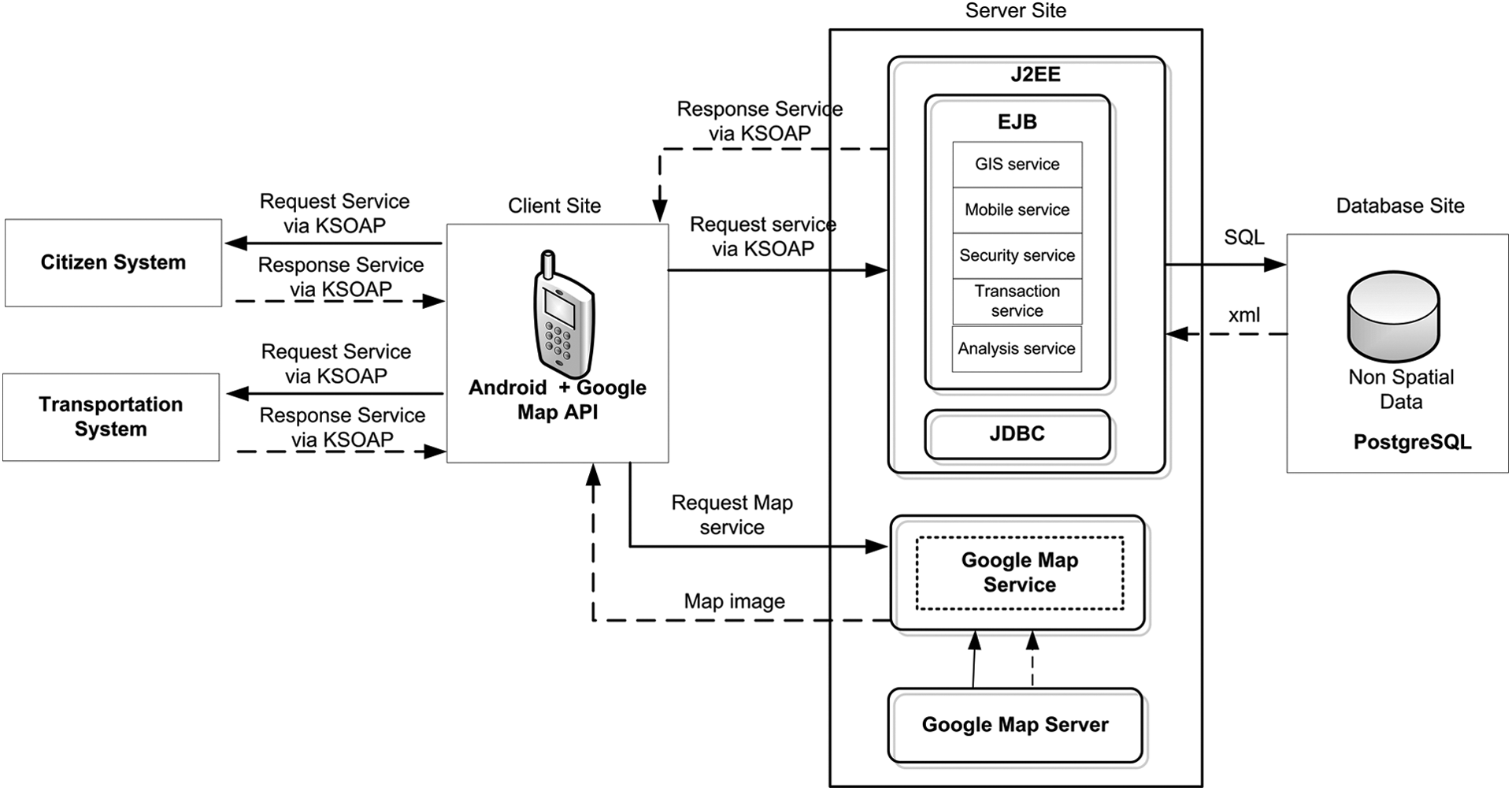
System architecture of mobile crime analysis and monitoring.
The client site
The client site includes applications based on mobile devices to interact with services at the server site. These applications are developed using Android software. KSOAP-Android is used as a library to exchange SOAP messages between the Android applications and web services at the server site. Moreover, the Google Map application-programming interface (API) is included at the client site as an API to embed the robust functionality and usefulness of Google Maps into the applications and allow the data to be overlaid on them.
The server site
The server site consists of two primary parts based on function, i.e. J2EE Server and Google Map Server. J2EE is the web service server employed to develop, build, and deploy the web services as business logic in the crime analysis and monitoring system. The business logic includes GIS services, mobile services, security services, transaction services, and analysis services. The Google Map Server provides a wide array of APIs that can be embedded in applications, such as Maps JavaScript API, Map Image API, Web services, Place API, Google API, and Maps for Business.
The database site
A PostgreSQL database server is employed to manage the attribute data. PostgreSQL is an open source relational database management system that provides support for essentially the entire range of SQL constructs. The database consists of the tables that retain the non-spatial data (attributes) and spatial data.
The detailed processes of calling web services from the server are described as follows: Step 1: The client site requests the desired service from the server through the SOAP protocol by sending a request message to the server. Step 2: After the server receives the request message, the server invokes the service according to the request. For non-spatial data, the service sends the query requests to the non-spatial database through JDBC. The requests are processed by the database server and the results are sent to the web service server in XML format. Step 3: For spatial data, the client site sends the request to the Google Map Server through the Google Map API or Google Map services to process the request on the spatial database. The result is returned to the client in map image format. Step 4: The server sends a service response to the client. The response can be XML or a map image. Step 5: The server site can request information from external systems (Citizen System, Transportation System) by sending a SOAP request to an external system through the web service.
Business-process model based on SOA for the case of reporting a car theft
The business-process model describes the business-process function sequence and business interaction among the layers in the SOA-based structure. The business-process model for the case of reporting a car theft by the public is demonstrated in Figure 4. The business-process model of receiving the reported case by the police officers is demonstrated in Figure 5.
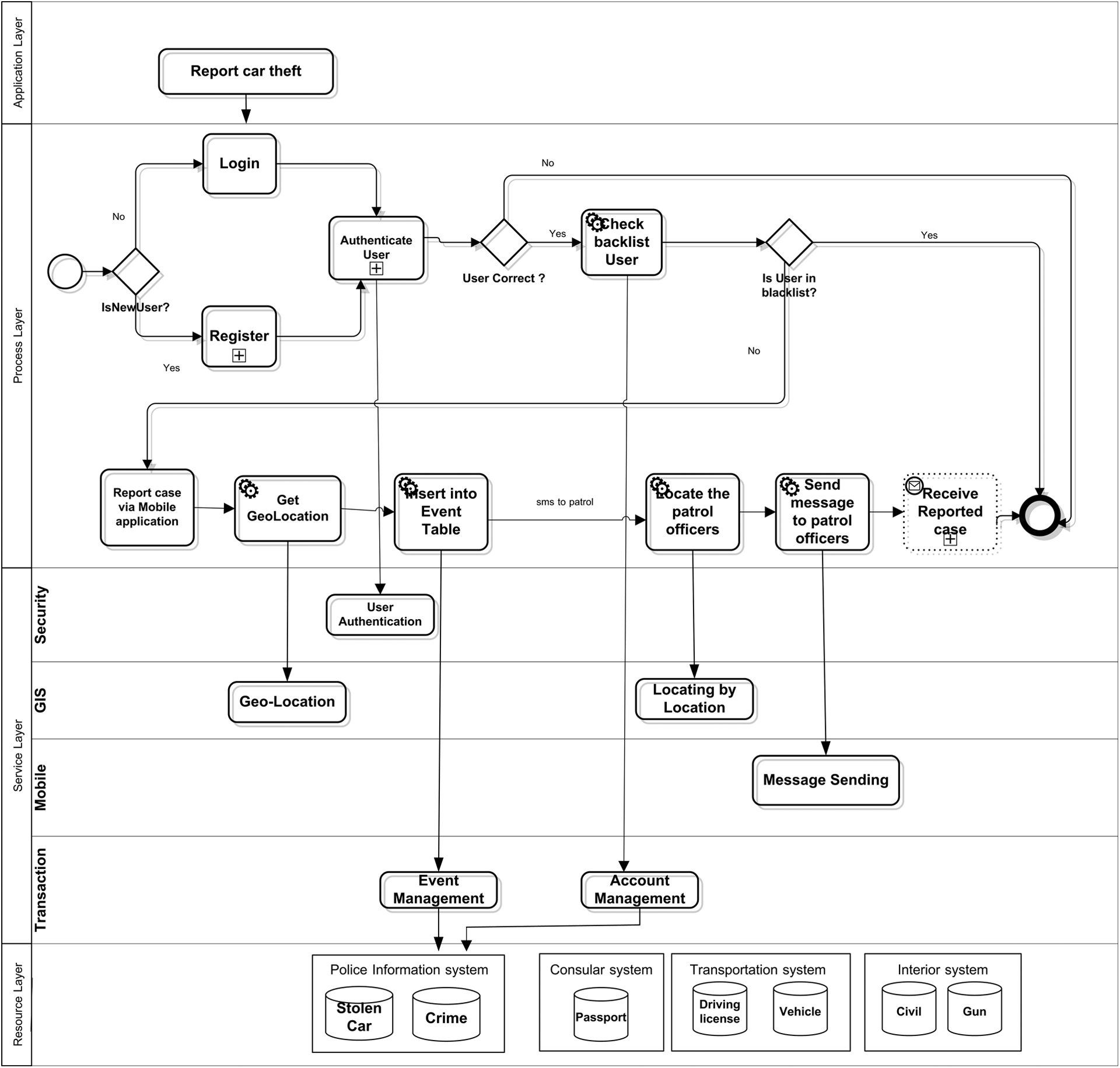
Business process based on SOA for the case reporting process.
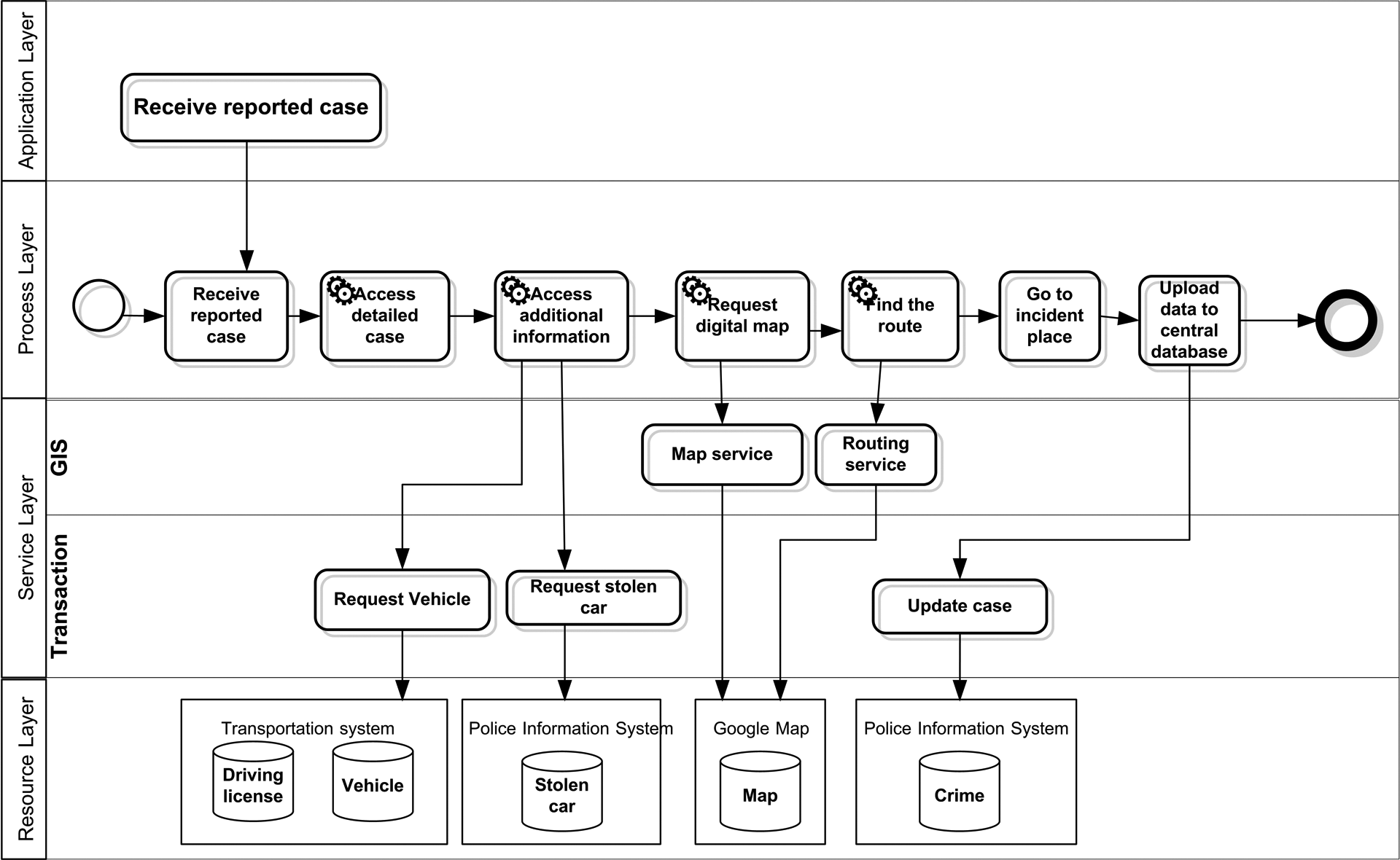
Business process based on SOA for the receiving reported case.
Method for locating patrol officers
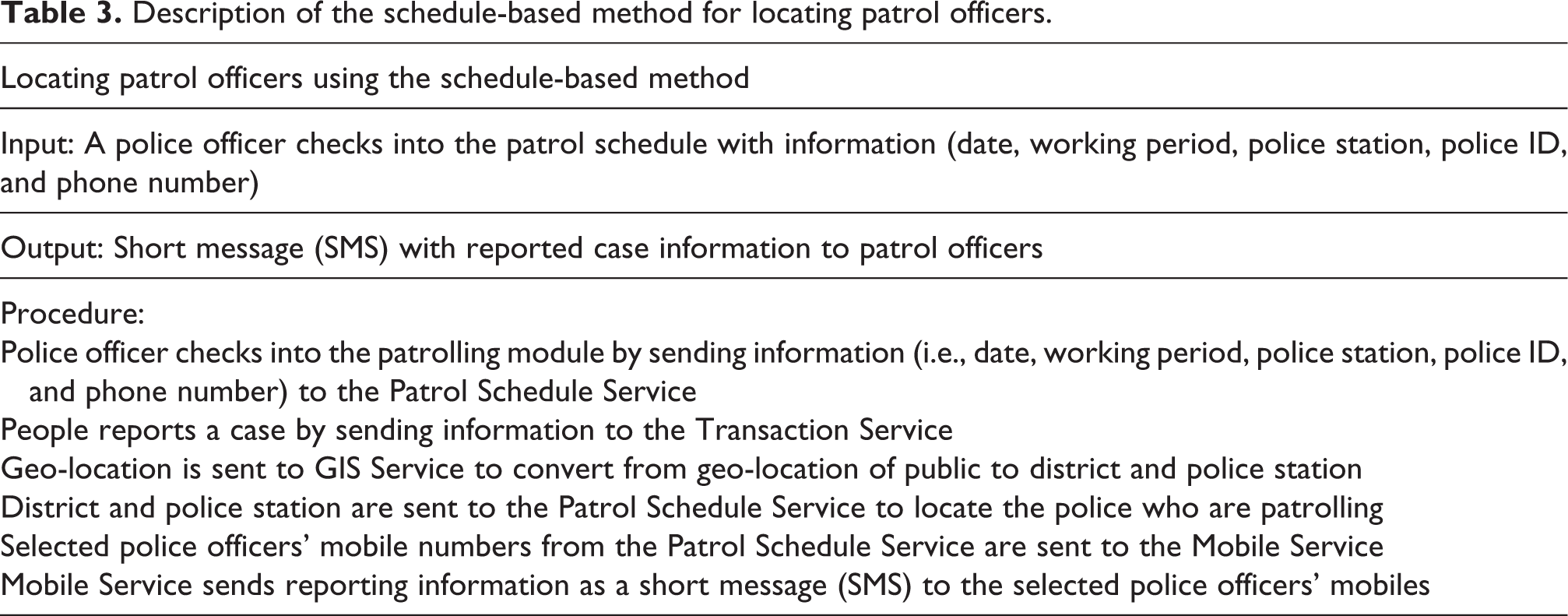
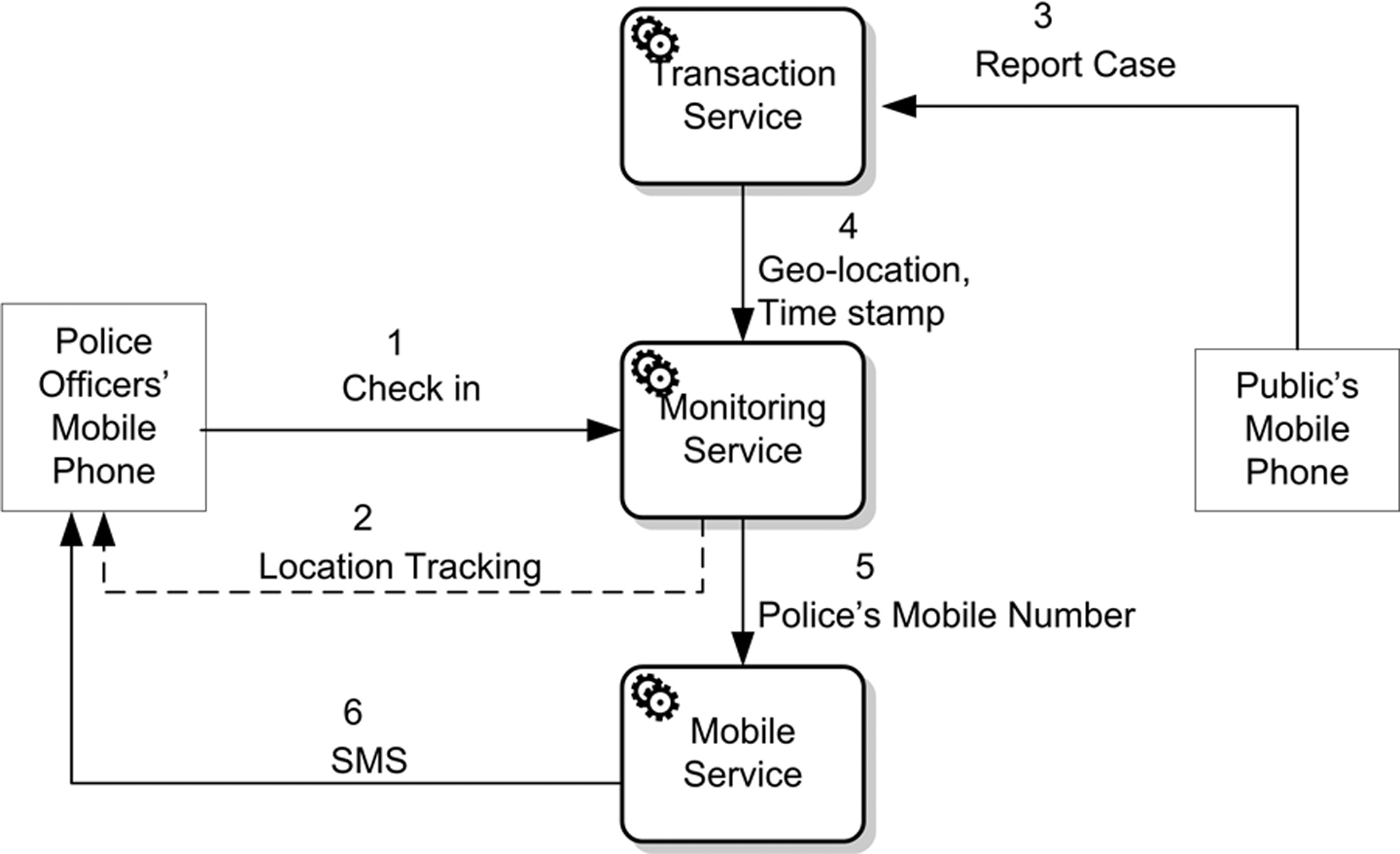
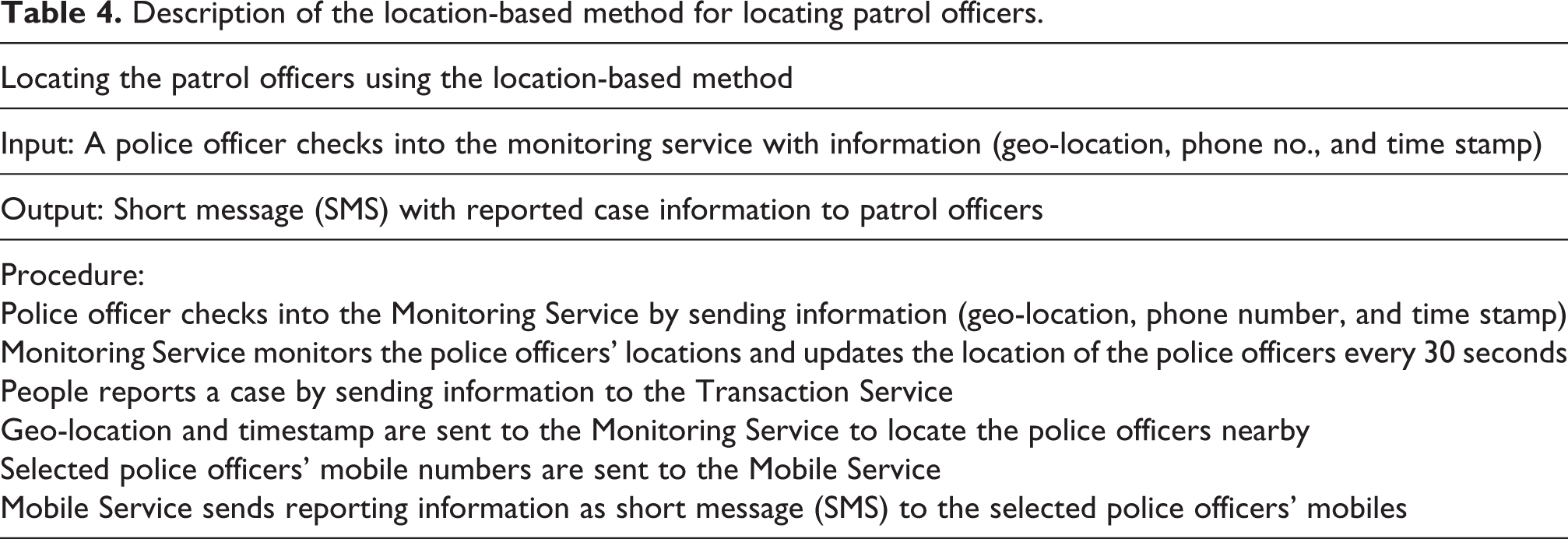
In the reporting case, there are two methods for sending messages to patrol officers, i.e. schedule-based and location-based methods. The schedule-based method retrieves the police officers’ mobile numbers from the patrol schedule regardless of the officers’ location. The location-based method retrieves the police officers’ mobile numbers from the location of the police nearby regardless of the patrol schedule. The details of the two methods are described in the following subsections.
Locating police officers using the schedule-based method
The schedule-based method for locating patrol officers is demonstrated in Figure 6 and the description of the method is presented in Table 3.
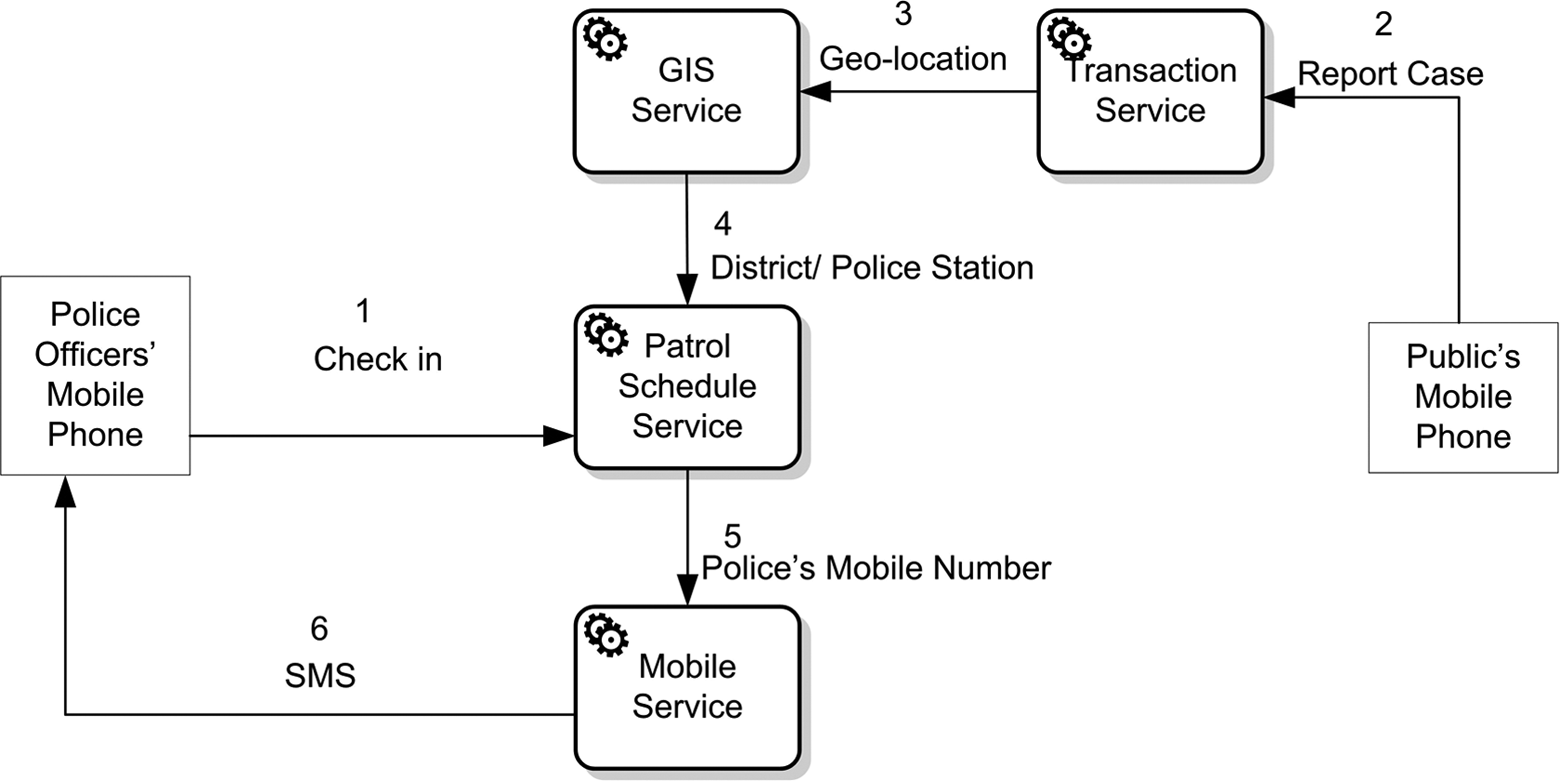
Schedule-based method for locating patrol officers.
Description of the schedule-based method for locating patrol officers.
Locating police officers using the location-based method
The location-based method for locating patrol officers is demonstrated in Figure 7 and the description of the method is presented in Table 4.
Location-based method for locating patrol officers.
Description of the location-based method for locating patrol officers.
Method for disseminating data to the police (PUSH)
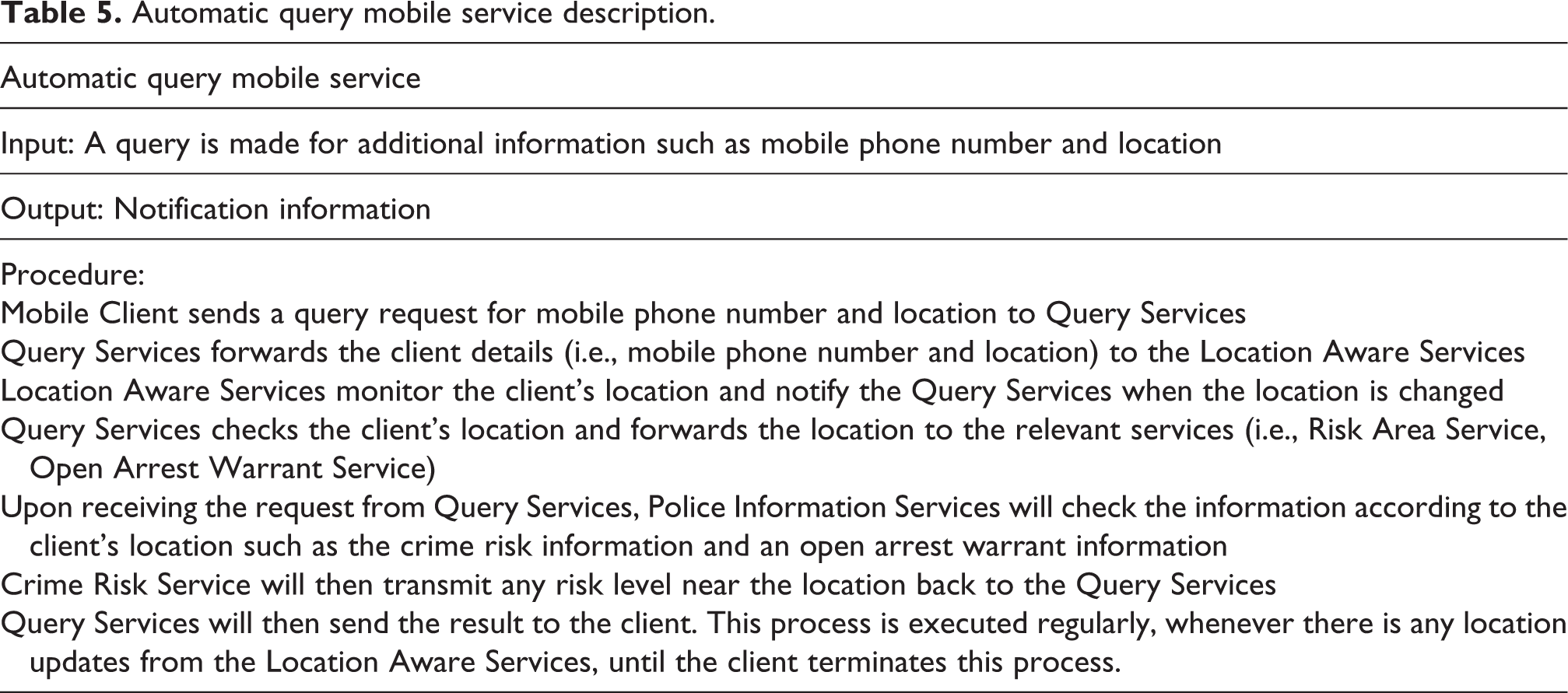
The dissemination of data with location awareness to police officers is a function of the crime-monitoring process. The disseminated data, called PUSH data, is information that the police-information-service server chooses to send to a police officers’ mobile phone, without the police initiating a request for the information. For example, when the police physically move through a high-risk area/environment or when they are serving an arrest warrant, a PUSH message will be sent on their registered client mobiles. The procedure to disseminate data is called automatic continuous query and is developed based on the concept of the continuous query mobile services of Waluyo et al. (2009) as shown in Figure 8. The description of the automatic query mobile service procedure is described in Table 5.
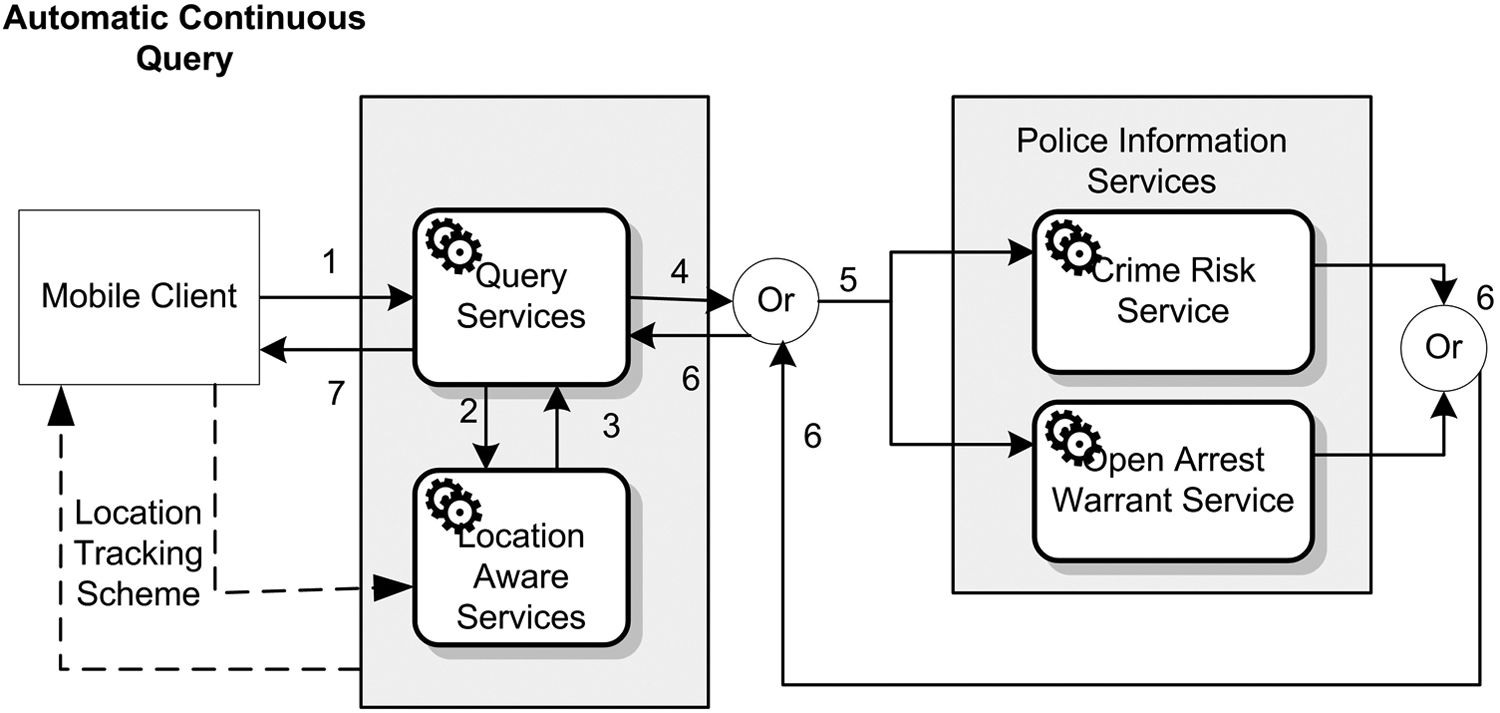
Automatic query mobile services procedure.
Automatic query mobile service description.
Method for accessing data by police officer (PULL)
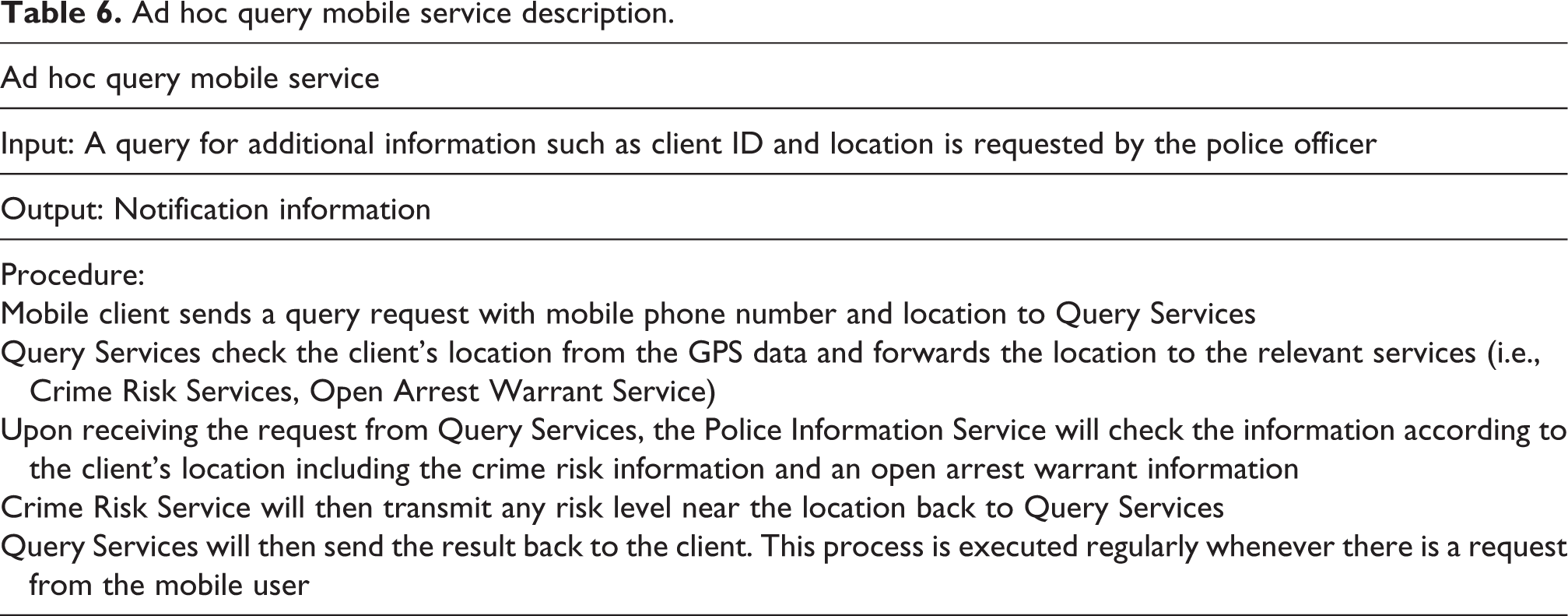
Data access by a police officer is a function of the crime-monitoring process. The accessed data, called PULL data, is information that is requested by the police officer using a mobile phone for crime information from the police information service server. For example, while the police are patrolling they may want to know the level of crime risk in the surrounding area. They can use their mobile phone for accessing this information from the police server. The procedure to access data is called ad hoc query mobile service as presented in Figure 9. The description of the ad hoc query mobile service procedure is presented in Table 6.
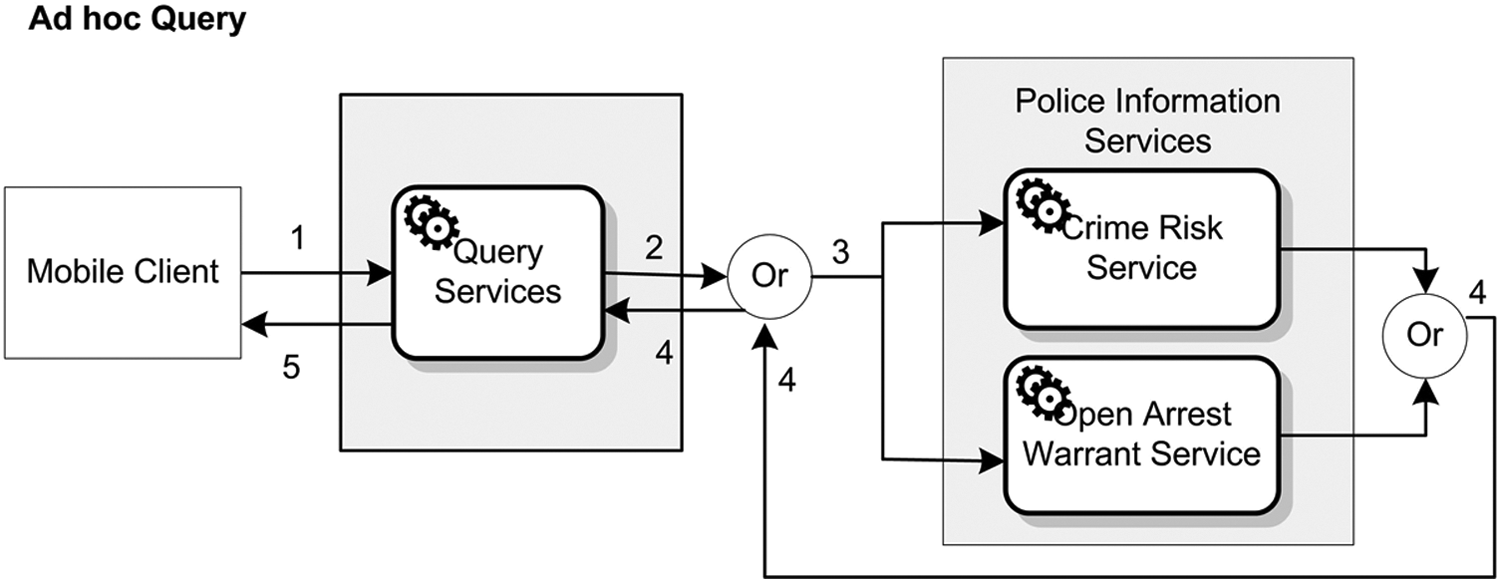
Ad hoc query mobile service procedure.
Ad hoc query mobile service description.
Prototype of a mobile crime analysis and monitoring system
The purpose of the prototype is to demonstrate the functionality of a mobile crime analysis and monitoring system (MCAM). The prototype exhibits the MCAM interface that includes all the features including registration, sign-in, reporting cases, receiving cases, retrieving case details, acquiring digital maps, finding routes, searching data from heterogeneous sources, and updating case information and job status to the operation center. Furthermore, the prototype has been used to expose design issues that must be considered for statewide implementation. To demonstrate the implementation of the prototype, a car theft reporting scenario by citizens and a monitoring case scenario by the police were selected to highlight the applicability of the proposed system.
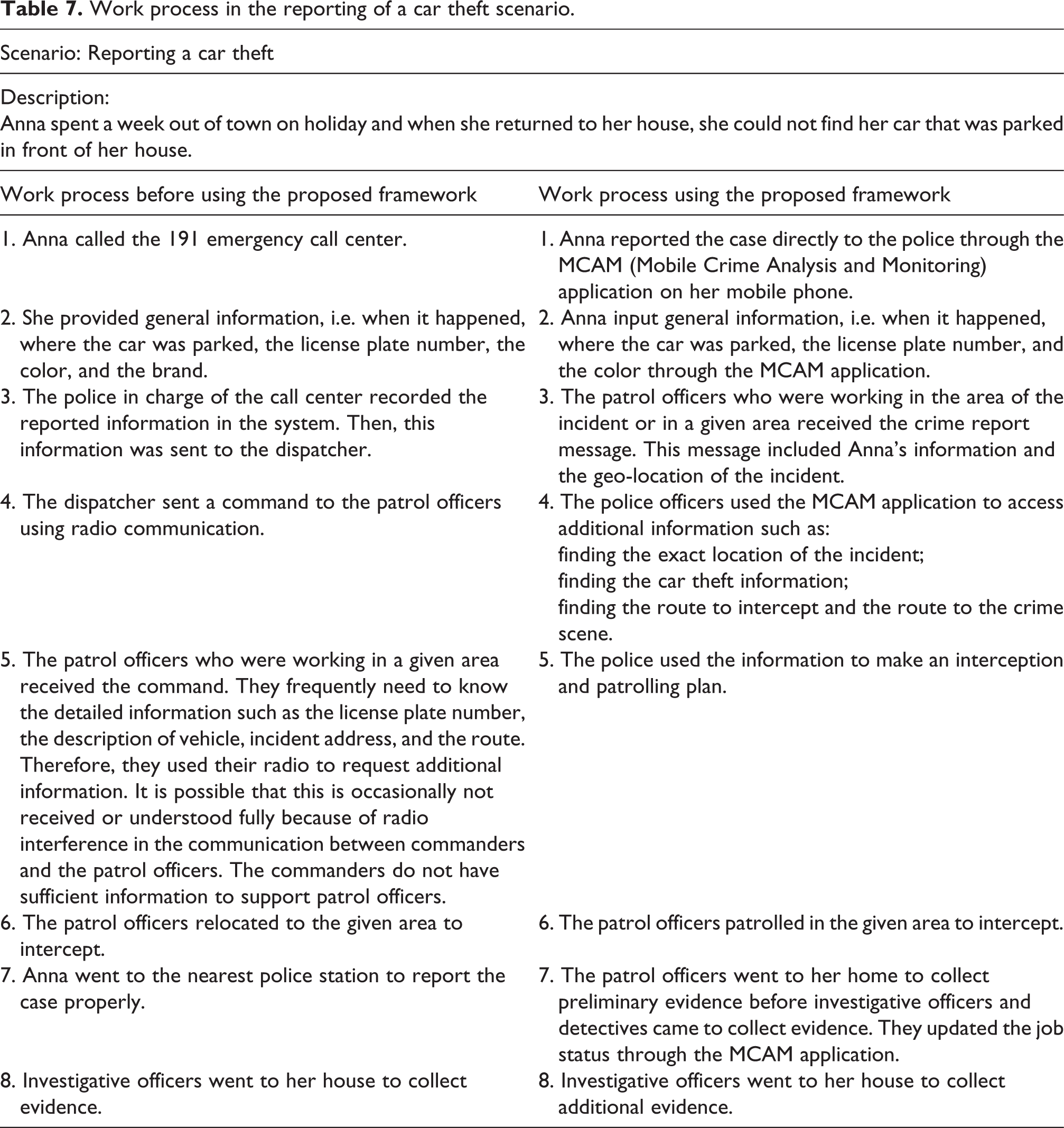
The reporting of a car theft scenario is initiated when citizens want to report a car theft to the police and request assistance from the police who are patrolling in the area of the incident. The process of reporting a car theft is described in Table 7. A comparison is made between the situation before and after using the proposed system.
Work process in the reporting of a car theft scenario.
To illustrate the workflow process of reporting a car theft, screenshots of the scenario are shown in Figure 10.
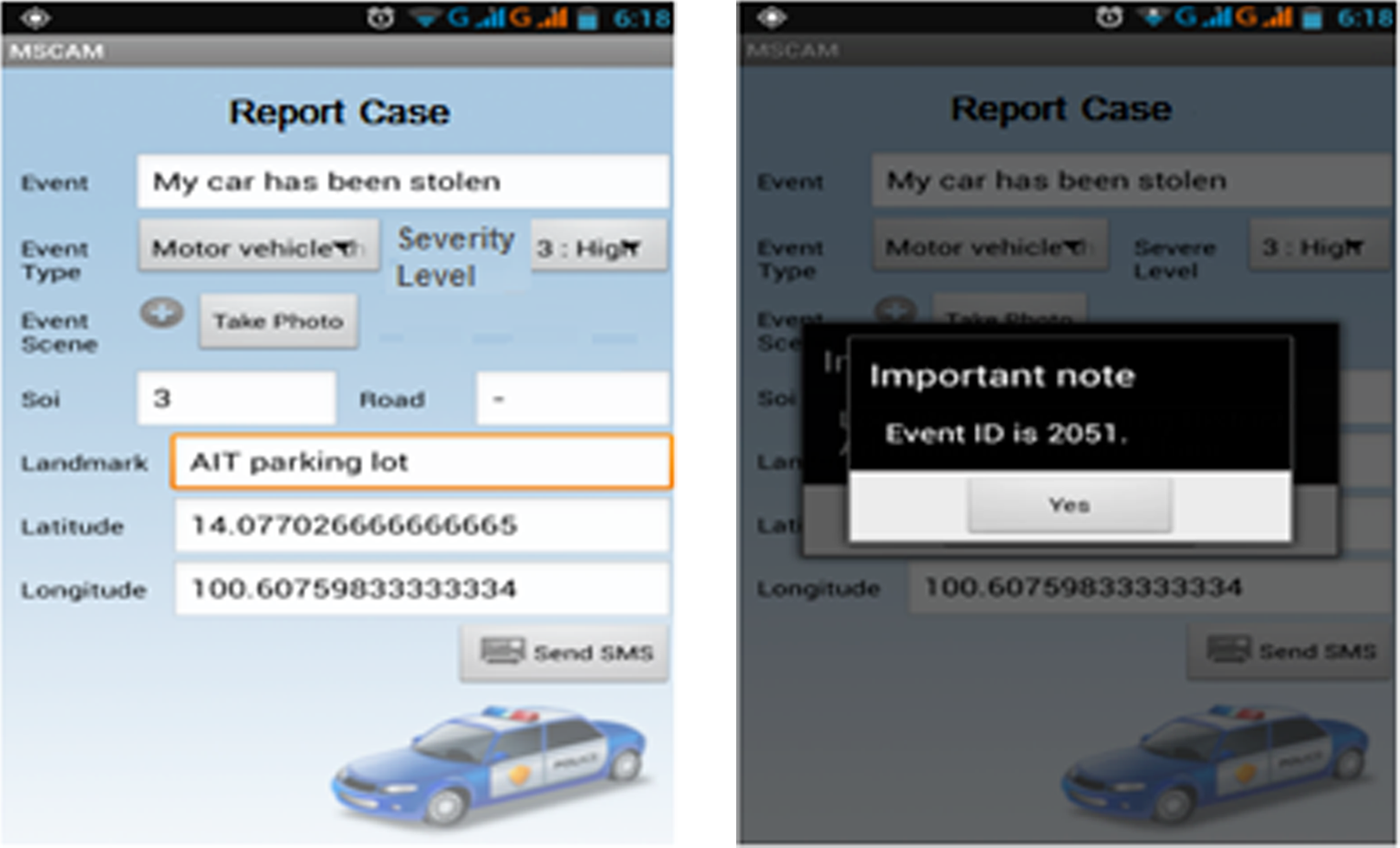
Screenshots of a reporting a car theft scenario.
The monitoring case scenario describes the method the patrol officers follow while they are working in a given area. This scenario involves two types of receiving crime information, PUSH and PULL. PUSH information is the dissemination of information with location awareness to police officers without the officer initiating a request for the information. For example, when the police are patrolling they receive the reported case from people in their vicinity. PULL information is the accessing of information with regard to the location of the police. This information request is initiated by the police, using a mobile phone to obtain the crime information from the police information service server. For example, while the police are patrolling, they would like to know the frequency of car theft cases in their surrounding area. They use a mobile phone for accessing this information from the police server. The process of monitoring a case is described in Table 8, comparing the situation before and after using the proposed system.
Work process in the monitoring case scenario.
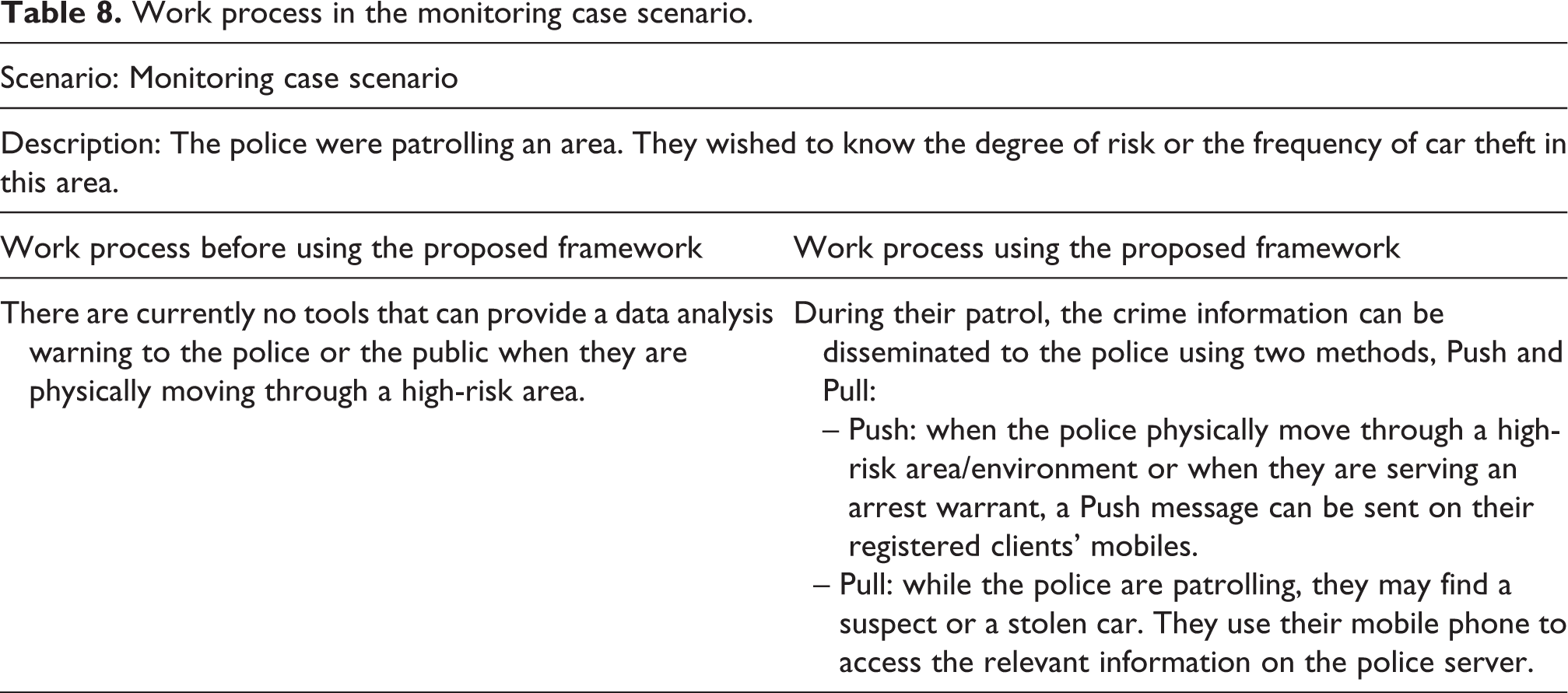
To illustrate the workflow process of the monitoring case scenario, screenshots of the scenario are shown in Figure 11.
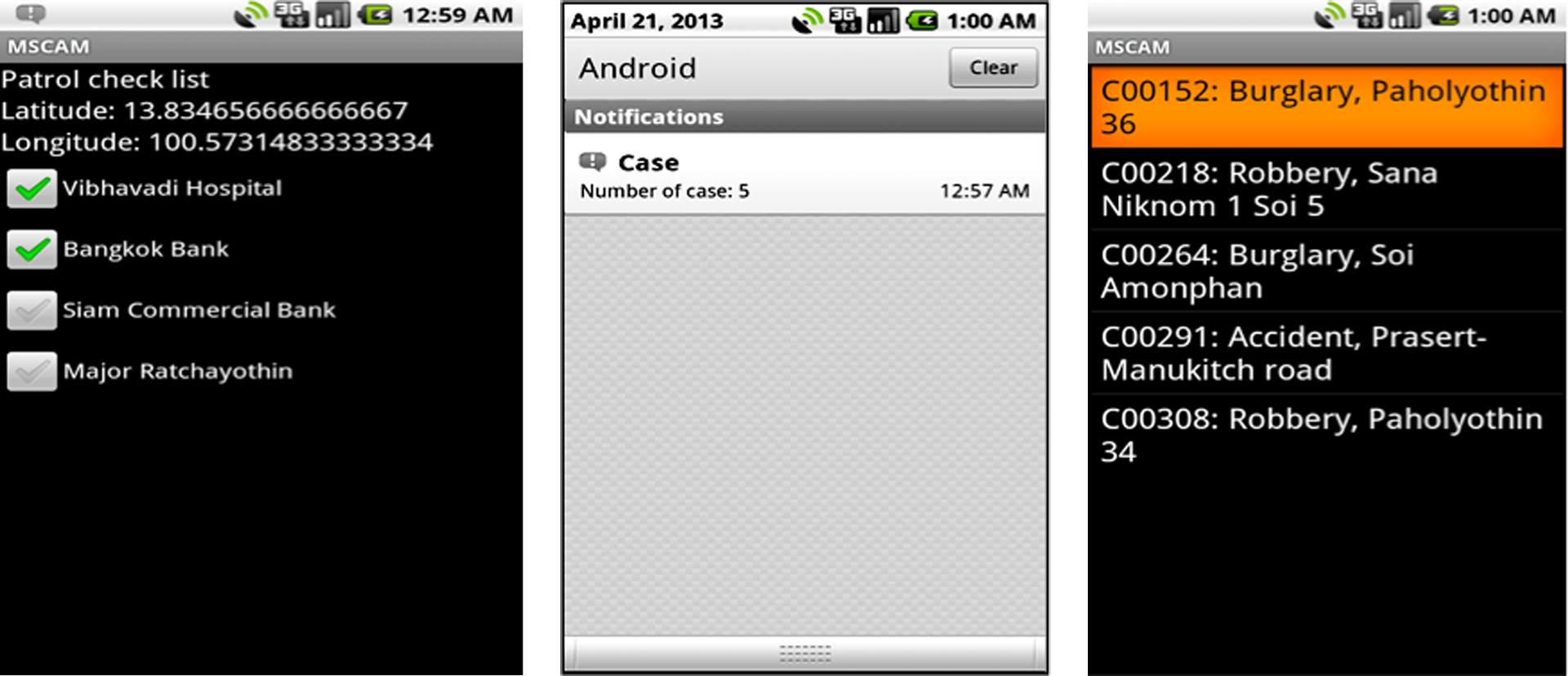
Screenshots of a monitoring case scenario.
Evaluation and results
The evaluation was designed to measure the efficiency of the developed system in terms of time used and to measure the effectiveness in terms of the accuracy of the reported cases compared to the stated objectives. The evaluation was conducted in Bangkok, the capital of Thailand. Bangkok is subdivided into 50 districts (khet, approximately equivalent to amphoe in the other provinces). These are further subdivided into 169 khwaeng, similar to tambon in the other provinces. Fifty case scenarios in different situations were reported employing the developed system, e.g. report a car theft at the public park, report a suspected offender at the shopping mall, and report a suspected stolen car in the village. Then, the times used in reporting the cases were collected to measure the efficiency of the developed system as described in the next section. Finally, the numbers of reported cases and the numbers of received cases were collected to measure the accuracy of the developed system as described below. This evaluation was conducted based on the condition that after receiving the reported case, the patrol officers would go to the incident location immediately.
Efficiency measurement
In the reporting case scenario, time is used to measure the efficiency of the proposed system. There are three time variables related to the reporting case scenario:
Reporting time
The time it takes from when people begin reporting a case until the patrol officers receive the case.
Police response time
The time it takes from when the police receive a case until they reach the incident location.
Total reporting time
The total reporting time it takes from when people make a request until the patrol officers reach the incident location.
Time used in reporting case scenario is presented in Figure 12.

Time used in reporting case scenario.
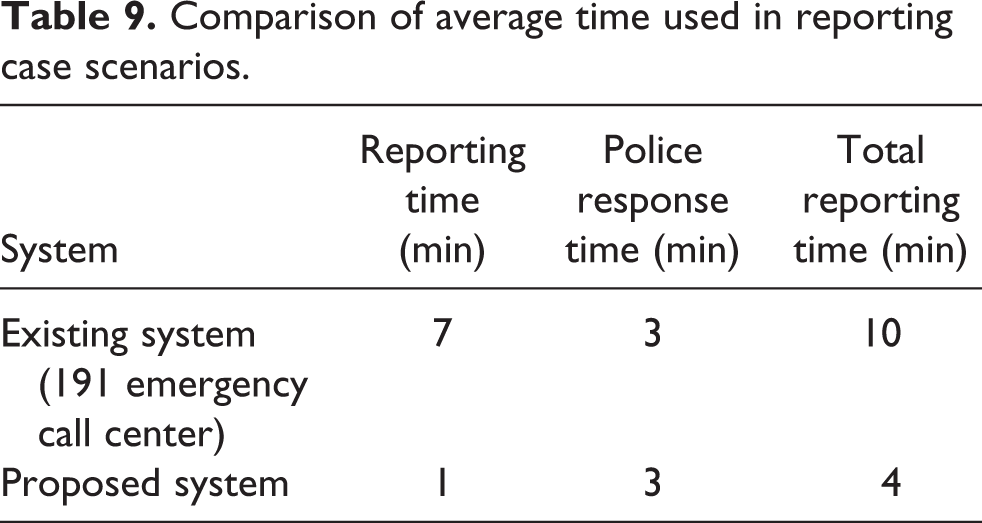
To measure the efficiency of the developed system, the times used in the reporting cases were measured to compare with the time using the existing system (191 emergency call center). The results are presented in Table 9. The time used in the reporting cases of the existing system was summarized by the 191 emergency call center that belongs to the Royal Thai Police. The average of the reporting time was calculated using the following equation:
Comparison of average time used in reporting case scenarios.

RT = Reporting Time (minutes). n = Number of Reporting Case
The evaluation results in Table 9 presents a comparison of the time used in reporting case scenarios by the existing system and the proposed system. The data confirms that the proposed system can reduce the reporting time by approximately 85%. The police response time of the proposed system equals the existing system. Consequently, it can be concluded that the proposed system can reduce the total reporting time by approximately 60%.
Based on these results, the main benefits of the proposed system are: The proposed system can reduce the reporting time and decrease the communication line usage. In the case of non-emergency situations, reporting a case through the proposed system can reduce the number of calls placed to the emergency call center. This should be used for emergencies only. The proposed system increases the communication channels for the public in sending information to support police operations. The proposed system cannot reduce the police response time because it depends on the experience and the familiarity with the responsible area and the familiarity with the user interface of the mobile application. With the proposed system, patrol officers receive clear information from the public, directly, removing the necessity to make further requests to the call center. The proposed system can reduce the workload of the police in the emergency call center because the public are able to report a case to the patrol officers directly.
Effectiveness measurement
The effectiveness of the mobile crime analysis and monitoring system is measured using the accuracy of the reporting case. Based on the reporting case scenarios, the cases were sent to the police who were patrolling. If the reported cases were sent to the correct area, the patrol officers who were patrolling received the cases and proceeded immediately to the incident location. Thus, the accuracy of the reported cases was used to measure the effectiveness of the proposed system. The accuracy of reported case can be calculated using the following equation:
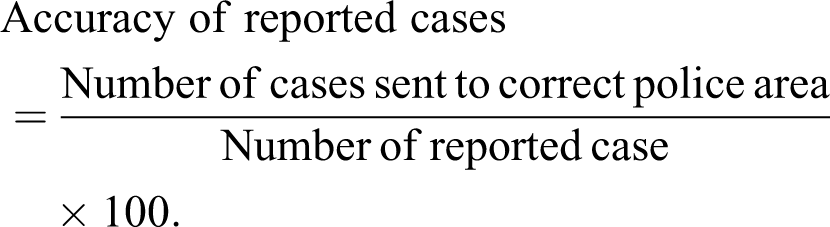
The fifty case scenarios, covering thirty districts, were reported to the patrol officers. The evaluation results for the effectiveness measurement are shown in Table 10.
Evaluation results for effectiveness measurement from the reporting case scenario.
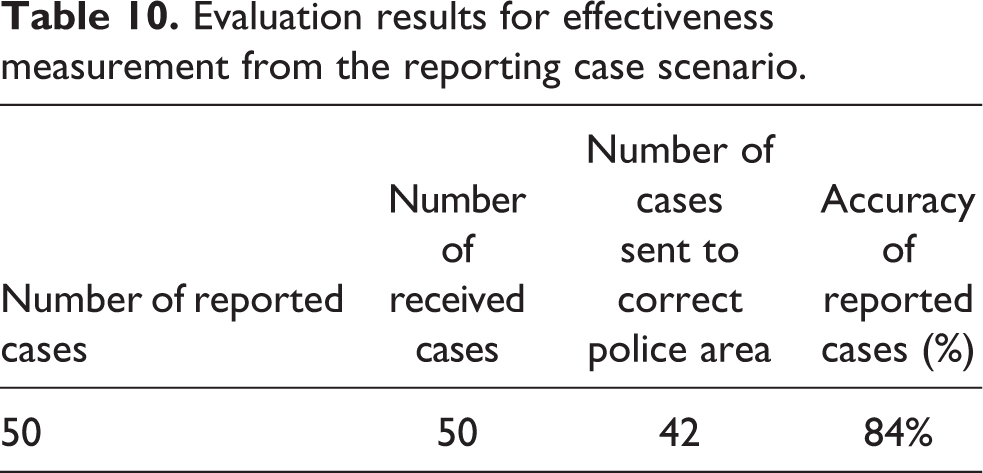
The evaluation results in Table 10 indicate that 42 cases out of 50 reported cases were sent to the correct police area. Consequently, the accuracy of reported cases is 84%. The proposed system uses the location of the informer that is detected from the GPS of the informer’s mobile to locate the nearest police. Therefore, the accuracy of the GPS can affect the accuracy of the reporting case.
Conclusion and future research
For a crime analysis and monitoring system, a design was proposed and then a system was implemented to alleviate the problems of current police operation situations and to satisfy the requirements of improved police operations for crime control. The current situations in crime analysis and monitoring were investigated by collecting data from primary (interviews, observations) and secondary sources (literature review, police document review). The investigation results found that there are four problem areas in crime analysis and monitoring, i.e. data exchange, model sharing, information access anytime and anywhere, and information dissemination. SOA was used as an appropriate solution to achieve the needs of the crime analysis and monitoring because SOA supports data exchange, model sharing, receiving information, information release, location awareness, and interoperability with the legacy system from heterogeneous systems.
Upon the establishment of the requirements of crime analysis and monitoring in police operations and determining the appropriate solutions to achieve these requirements, the mobile crime analysis and monitoring framework was designed based on the concept of SOA. The proposed framework can be divided into two main processes, i.e. crime analysis and crime monitoring. In terms of workflow, the crime-analysis process can be divided into four sub-processes, i.e. case reporting, case collection at the crime scene, crime-data analysis, and data searching/retrieving. The crime-monitoring process is used to disseminate information to the police and the people including PUSH and PULL information. PUSH information is warning messages that the server sends to the police without the police initiating a request. PULL information is initiated by a police request. The analysis and design of the system was based on the SOA-based structure that is composed of four layers, from the top, application, process, service, and resource.
Then the developed system was evaluated by end users, including the police and the people, from two aspects, i.e. efficiency and effectiveness. Time used for reporting case was considered to measure the efficiency of the system and the accuracy of the reported cases was used to measure the effectiveness of the system. The evaluation results from the efficiency measurement found that the developed system could enhance the efficiency of police operations in the reporting case by approximately 60%. The evaluation results from the effectiveness measurement found that the developed system delivered an accuracy of 84%.
As for contributions, on the academic side, this study provides a SOA-based development approach for mobile crime analysis and monitoring system that can support data exchange, model sharing and disseminating information from heterogeneous systems through mobile devices. On the practical side, this SOA-based mobile crime analysis and monitoring system is extremely helpful for the public in reporting case directly to the patrol and increasing the communication channel for the public in sending crime information to the police and also reducing the reporting time. The police can use the developed system in access information from heterogeneous sources anytime and anywhere. Furthermore, the police can receive crime information with regard to location awareness when they are physically moving through an area and these crime information can be used not only the management level but it can be disseminated to the police or the public to help them protect themselves or to support their work.
However, this study has some limitations. Firstly, a limitation regarding the reporting case situation; this study is not for emergency situations because normally, for emergency cases, the informer will call 191 emergency call center for immediate help. Secondly, the system is developed on the Android operating system which is a mobile phone operating system based on a Linux kernel. Consequently, the developed system can be used only with Android smartphones. Lastly, the developed system uses the location of informer, which detects from the GPS of informer’s mobile to find the nearest police and the GPS has high accuracy when a mobile user is outdoors but decreases in accuracy when a mobile user is indoors or even when there is a poor view of the sky. Therefore, the accuracy of GPS can affect the effectiveness of the developed system.
The future research should be considered in three main areas, i.e. system enhancement, development/technologies enhancement, and evaluation enhancement. Firstly, future development of the mobile crime analysis and monitoring system should be considered to integrate with the existing systems. Secondly, the technologies for development should concentrate on cross-platform compatibility of mobile operating systems. Cross-platform mobile development refers to a technique of writing a single codebase for applications that will be eventually used on different operating systems. Cross-platform frameworks such as RhoMobile, PhoneGap, Appcelerator, MoSync and WidgetPad will allow the development of native applications on a wide range of smartphone devices and operating systems. Thirdly, the research will look at evaluating the proposed mobile crime analysis and monitoring framework in the real working environment. The efficiency measurement (the response time of police after receiving informed case, investigation time, etc.) and the effectiveness measurement (the number of calls to the emergency call center, crime rates per population and arrest rates) will be used to measure the efficiency and the effectiveness of the proposed framework.
Footnotes
Declaration of Conflicting Interests
The author(s) declared no potential conflicts of interest with respect to the research, authorship, and/or publication of this article.
Funding
The author(s) received no financial support for the research, authorship, and/or publication of this article.