



Abstract
The importance of disaster management plans for library staff rests on their effective and efficient utilization to confront library-related disasters. This study seeks to evaluate the preparedness of Ghanaian polytechnic libraries towards disasters, with respect to measures put in place. Based largely on a qualitative approach, the study interviewed five head librarians and 25 other staff members of selected polytechnics, who were chosen using purposive and convenience sampling techniques. Data was analysed using interpretative techniques. The results showed general absence of security policies and disaster plans. Polytechnic libraries were found to be ill-prepared with respect to disasters. Therefore, it is recommended that libraries develop policies for disaster management, organise training programs for staff in order to increase their awareness about disasters and be involved in cooperative networks.
Polytechnic libraries in Ghana are inadequately prepared to prevent or survive any form of disaster.
Introduction
A disaster is, “any incident which threatens human safety and/or damages, or threatens to damage [or destroy], a library’s buildings, collections, contents, facilities or services” (Matthews and Eden, 1996: 4). Disasters are occurrences that often are inevitable and usually unpredictable. Their severity, however, varies depending on the type and most often the location where they occur. Disasters, when allowed to occur, have untold consequences on the security of both collections and staff. With dwindling funding for libraries and their consequent inability to meet demand, it is essential that the collections available to patrons are protected from destruction in any form (Ajegbomogun, 2004; Osei-Boadu and Ahenkorah-Marfo, 2013). Disasters in libraries come in two main forms, namely, natural and man-made. Natural disasters include floods, fires, earthquakes, storms and hurricanes, while man-made disasters include wars, rioting, malicious damage to materials, negligence, power surge/failure, armed conflict and terrorism. In the words of Hasenay and Krtalic (2010), technology-dependent times bring new possible disasters. This could be in the form of using computers to hack into secure library automated databases to distort or destroy valuable information.
According to Trishanjit (2009), disasters have rendered many libraries incapable of delivering services to patrons in the past, and their impacts have been severe due to the unprepared nature of libraries. Therefore, it is imperative that adequate measures are established to mitigate the occurrence of potential disasters. In line with this, Aziagba and Edet (2008) have advocated the development of a disaster management plan for libraries as part of their strategic development plan. The presence of a plan would at least alleviate the loss rate and aid in a quick recovery process thus granting access for academic work within the shortest possible time. An adequate disaster plan reduces the impact on libraries and prevents disruption of services to clients.
Earlier studies in other parts of the world have shown how insufficient and unprepared academic libraries have been for managing disasters and their aftermath (Trishanjit, 2009; Ngulube, Modisane and Mnkeni-Saurombe, 2011; Aziagba and Edet, 2008). For instance, Matthews (2005) reports on the loss of thousands of literary materials in the fire that engulfed the Ramsgate public library in the United Kingdom. In most libraries in Africa, it has not been possible to provide multiple copies of resources (Abifarin, 1997). Thus in the event of a disaster, the impact is catastrophic because lost material cannot be replaced, primarily due to lack of funds.
Preservation and physical control measures must be deployed for the protection of library and archival collections (Dizard, 1998; Ndenje-Sichalwe, Ngulube and Stilwell, 2011). A critical look at most libraries of higher institutions of learning in Ghana indicates the non-existence of disaster management plans (Akussah and Fosu, 2001; Ahenkorah-Marfo and Borteye, 2010). Just like any other library, polytechnic libraries in Ghana are also susceptible to similar natural and man-made disasters. The objective of this study is to ascertain the state of disaster preparedness of five polytechnic libraries in Ghana (Accra, Bolgatanga, Kumasi, Tamale and Wa). This is essential in that the extant literature has prescribed several approaches on how to avert disasters in academic libraries. The libraries under study are relatively young in terms of when they were established and so should have learnt from the experiences of older institutions. Apart from man-made disasters that could affect any of these libraries, their locations make them susceptible to natural disasters. Three of the libraries (Bolgatanga, Tamale and Wa) are located in areas prone to wind storms, dry season fires and biological agents, while the other two (Accra and Kumasi) are susceptible to perennial floods.
Literature review
The disaster management policy of a library is made up of a compilation of smaller plans that must be crafted with the support of library staff, school management and external stakeholders. It should contain clear, short and precise instructions and be readily available to all employees, especially the disaster management team (Lyall, 1995). “Every institution must develop their own plan. The geographical location, the size and nature of the collection and the building all have their influence on the plan and are unique for each institution” (Teygeler et al., 2001: 116). The design of any disaster management plan must consider four cardinal components namely: Prevention, Preparedness, Response and Recovery (Buchanan, 1991; Mathews and Eden, 1996).
A study conducted by Ngulube, Modisane and Mnkeni-Saurombe (2011) on the archives of South Africa revealed that none had any form of written disaster management policy though they had invested considerable sums in establishing huge repositories. The authors expressed their fear for the loss of the national cultural heritage of the country in the event of a catastrophic disaster. A few institutions had taken steps to develop such plans but did not implement them (Ngoepe, 2014). Akussah and Fosu (2001) also discovered, in their study of university libraries in Ghana that only one had a disaster plan in place. They advised that the sooner the rest developed a disaster policy, the better for the safeguarding of information resources. Similarly, Matthews and Eden (1996) encouraged management to make it a duty to ensure that libraries had a written disaster management policy. In another study in KwaZulu Natal, South Africa, Ngulube (2006) revealed that libraries did not have disaster management plans and were thus not adequately prepared for disasters. Mathews (2005) maintains that, as a result of resource constraints, it is prudent to engage in cooperative activities and networks so that libraries can pull resources together collectively to help prevent or mitigate the effects of disaster. This could be achieved through “joint training programmes, the purchase and storage of emergency equipment and supplies, and making staff with appropriate expertise available” (p. 64).
It is not uncommon to find that libraries cannot account for all their collections after disasters because they did not make a conscious effort at documenting all their possessions (Fox News, 2013). Akintunde (1993) contends that loose materials and relevant documents should be properly organised to make for easy retrieval in disaster conditions. As Lyall (1995) explains, not all disasters can be prevented, “but the effect of some can be mitigated by implementing appropriate preventive procedures […] Preparedness plans are usually the most important in coping with disasters”. She was of the opinion that preparedness includes insuring collections, creating and periodically updating contingency plans, assembling emergency supplies, identifying important parts of the collections, allocating salvage priorities, identifying alternative storage sites, providing adequate fire protection, and providing opportunities for staff to be aware of what is expected of them in the event of disaster.
Destruction of information resources dates back to ancient times. In most cases, destruction and looting follow in the aftermath of wars, riots, armed conflict and terrorism. The famous destruction of the Alexandria Library is a classic example (Van der Hoeven and van Albada, 1996). Knuth (2006) also recounts the destruction and looting of the cultural and literary heritage of conquered states by the Roman Empire. The generals of such conquests carried their loot home as trophies of war. In other instances, the literary collections of conquered states were set on fire with the aim of annihilating entire cultures (Knuth, 2006). Similarly, the invasion of Iraq by the allied forces in 2003 and the subsequent looting of its libraries and museums illustrate the destructive nature of such disasters (Johnson, 2005; Rayward and Jenkins, 2006). The aftermath of the attacks of September 11th and of Hurricane Katrina and its ensuing floods in the United States prompted the Heritage Preservation and the Institute of Museum and Library Services to reassess libraries and heritage institutions (Heritage Preservation, 2005). The reassessment revealed that 78% of libraries in the United States (U.S.) and U.S. territories did not have an emergency plan or the staff trained to carry it out, thus putting 53% of collections at risk (Heritage Preservation, 2005: p.61). In Africa, Alegbeleye (1999) reports that during the Sierra Leone war, the Records Office in Bo was destroyed by aggrieved citizens who saw it as government property and thus representing the enemy. Following the Egyptian revolution in 2011, the historic Egyptian Scientific Institute was set on fire (Egypt Independent, 2011). This library held the richest and the rarest manuscripts in Egypt (more than 200,000 volumes). Similarly, Islamist militia burned down the famous Timbuktu Library in Mali, which contained over 20,000 manuscripts (Walker, 2013). Esievo (2007), citing Fadola (1990), reports fire incidents that gutted the media libraries of the Ghana Broadcasting Corporation (GBC) and Lagos State Television, destroying invaluable materials.
Ogden (2004) put forward the following as best practices to be adopted to prevent or minimise fire damage to collections: “1) minimize exposure to arson which are accountable for nearly a third of all library fires; 2) use compartmentation to limit the spread of fire; and 3) employ fire detection and water-based fire suppression systems for collection protection” (p. 3). He opined that the installation of water-based firefighting equipment is better than hitherto assumed because it is easier to restore water damaged collections than those destroyed by fire.
The training of library staff to anticipate and see warning signs is a vital step in mitigating disasters. An important mechanism or tool to use to train staff includes mock disaster drills and simulations. Matthews (2007: p.6) maintains, “One aspect that fewer institutions in the UK had undertaken were simulations and exercises. These are seen as very useful but they are resource intensive. Collaboration is seen as a possible cost-effective way forward”. Ahenkorah-Marfo and Borteye (2010) identified from their study of the Kwame Nkrumah University of Science and Technology (KNUST) library that inadequate training of members of library staff hampered their ability to prevent, fight or manage disasters. They therefore proposed the training of personnel, provision of directional aids and notices showing how members of staff should react and where to go in the event of a disaster.
“All library collections represent a large investment of library funds. Consequently, all library building projects should optimize their design to protect the collections against earthquake, fire, water, and theft” (Ogden, 2004: 1). Only when libraries make a concerted effort at protecting their collections through the design and implementation of disaster policies, can they begin to fight the occurrence of disasters (Ayoung et al., 2014). Disaster plans should fit into the general library security policy so as to make it a holistic endeavour.
Research problem
The Polytechnic Law 1992 (PNDC Law 321) mandated that each of the 10 administrative regions of Ghana establish a polytechnic. Existing technical institutes in Accra, Kumasi and Tamale were upgraded to polytechnics, while the Bolgatanga and Wa Polytechnics were established immediately following the enactment of the law in 1992. The overall vision of polytechnics is to provide the middle-level manpower needs of Ghana, focusing on practice-oriented and hands-on education. Achieving this depends on the availability of well-stocked and well-protected libraries, which are the repositories of knowledge in all academic institutions.
Most library collections in Ghanaian polytechnics are not stored electronically, and it appears there are no disaster management policies and practices. This can have dire consequences in the event of a catastrophe. Losses of institutional or academic information in the face of disasters are likely to be enormous for these polytechnics. To prevent this, it is imperative that disaster prevention measures are enforced to forestall the occurrence or effects of future disasters. However, studies to ascertain the state of disaster preparedness for polytechnic libraries in Ghana are hardly available in the literature. Within this context, the study seeks to explore the disaster preparedness of selected Ghanaian polytechnics.
Methodology
The study adopted a qualitative case study design to investigate the preparedness of polytechnic libraries in the event of disasters. Yin (2009) indicates that case study design can either be single or multiple. In this research, we adopted a multiple-case approach. Case study research enables the opportunity to guarantee the validity of responses due to the nature of in-depth interviews and experience of interviewers. Qualitative methods are gaining relative prominence over quantitative studies in the field of contemporary library research (Powell, 1991; Featherstone, Lyon and Ruffin, 2008; Brewster, 2014; Raju, 2014; Mohamed, 2014). Qualitative research strives for a subjective understanding of phenomena from the point of view of actors directly involved in their use and management (Carlin, 2008). This method is appropriate for collecting detailed views of participants when the informants are very few and the information hardly quantifiable (Creswell, 2012), as was the case in this study.
The study adopted a mix of qualitative tools to collect and analyse both primary and secondary data. The primary data was collected through the use of separate in-depth interview schedules that were administered via telephone to subjects in five selected polytechnics in Ghana (see Table 1). A mix of simple random, purposive and convenience sampling techniques was adopted. In the first instance, simple random was applied in selecting five polytechnics (out of a total of ten (10) polytechnics) in Ghana. In stage two, purposive sampling was employed in selecting five polytechnic head librarians, who were expected to have profound knowledge regarding disaster preparedness policies and practical steps initiated in their libraries. Another 25 library staff members who were suggested by the head librarians and who agreed to participate were interviewed. One security guard was also purposively selected and interviewed. Furthermore, unobtrusive observation (Bryant et al., 2009; Aabø and Audunson, 2012; Mandel, 2013) was instrumental in the data gathering process to ascertain the presence or otherwise of disaster preparedness measures. This process was also employed to corroborate some of the statements by participants, especially with regards to fixtures in the facilities. The use of interviews and observations enabled the corroboration of different data sources, thereby enhancing the validity of responses.
Number of informants.
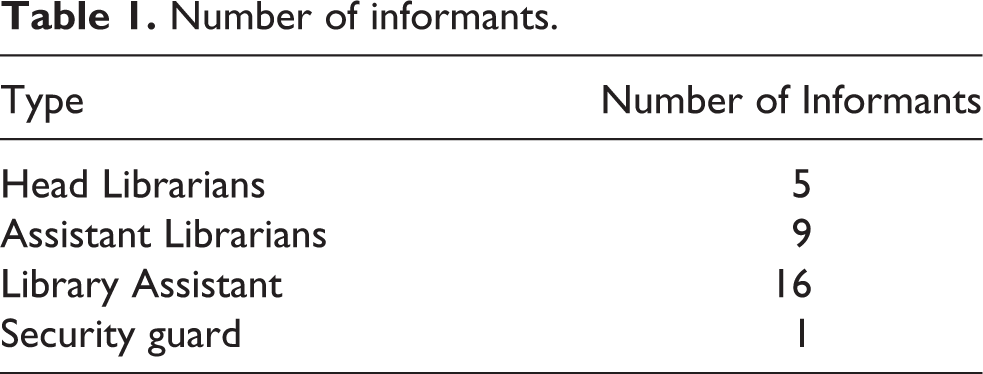
Qualitative data obtained through in-depth interviews was analysed using an interpretative approach. Interviews were transcribed and uploaded to Nvivo (version 20) for coding and analysis. The emerging themes formed the basis for our findings, analysis and discussions.
Findings
Security Policy
None of the libraries included in the survey had either a disaster plan or written security policy, an insurance policy on the building and its collections. Only two librarians indicated an intention to insure the library and its collections. The other respondents were not sure whether their parent institution would consider insuring their libraries.
Even though no library had a disaster management plan, one head librarian claimed to have taken the initiative to train staff to anticipate and deal with disasters. However, they could not explicitly state the measures their respective institutions or libraries had put in place, though two of the librarians had organised health and safety workshops for a section of their staff. Junior library staff interviewed, however, indicated that such workshops were held mostly for senior library staff and expressed concern that since they (junior staff) were meant to be ‘first responders’ to any emergency, they should also benefit from such programmes. None of the interviewees were first aid certified, neither did they have any plans to become certified.
Power Supply
As a result of frequent power outages, two polytechnic libraries had backup power supply to complement the supply from the national grid. The remaining three Head Librarians stated that they had informed management of the need to provide automatic power backup to their facilities because frequent power outages pose a health and safety risk, especially at night. One Head Librarian stated: “We started extended hour’s services upon request from students and so we now close the library at 10 pm. Sometimes when we get unannounced power outages, we have to keep everybody in until we can switch on the rechargeable lamps, then we let them out one by one to safeguard our collection.”
Institutions that did not have backup generators resorted to the use of rechargeable lamps strategically located in the library, but according to staff interviewed, this was inadequate. A lasting solution is the provision of a dedicated standby generator for libraries.
Fire/disaster drills
To be able to mitigate disaster situations adequately, it is often better to simulate disaster situations to see the response of staff and students in the facility (The Joint Commission, 2005). These simulations, in the form of fire or emergency drills, should always be periodic so as to get everyone prepared. The respondents indicated that none of the five libraries had ever conducted such drills. Some of the interviewees did not even seem to know what a fire drill was. One interviewee said, “It is a waste of time to do such things. By the grace of God, nothing will happen. It is not good to think of such misfortunes”.
Physical Security Presence
Security guards form an important part of a disaster plan implementation, especially in the study context where libraries do not have electronic security systems. Inadequate or non-availability of security staff is, therefore, problematic. For instance, only one polytechnic had a security guard assigned specifically to the library. In the words of one Head Librarian, “I have requested for at least one permanent guard for the library, but management complains that they don’t have enough guards. This is frustrating considering that security here is also important, and some students can be very problematic”.
Firefighting Apparatus
The most probable disaster to occur in any of the institutions under study would be fire. Librarians were therefore asked to indicate the level of preparedness of their libraries to detect and mitigate an occurrence. Two libraries had fitted smoke detectors, and two had fire alarms installed. All libraries indicated that they had fire extinguishers placed in prominent positions. However, none had fire blankets or water sprinklers installed. Those who had equipment installed did not know when it was last serviced. Some libraries did not have clearly marked emergency exits or designated assembly points outside the premises.
Cooperative Networks
Librarians also indicated that they did not participate in any cooperative networks or partnerships related to disaster management. None of the libraries had any close collaboration with the Ghana National Fire Service or the National Ambulance Service nor did they display emergency numbers of contact persons for users in the event of emergencies or disasters. Librarians could not give a reason for this situation.
Funding
A dominant theme emerging out of the analysis was the issue of financing. Head Librarians reiterated that most of the measures were not in place because of the lack of funds and inadequate support from management. Head Librarians indicated that most of these activities were predicated on the availability of adequate funds. A Head Librarian said: “Funding to the library is dwindling every year. We do not have enough money to purchase the required textbooks let alone to think of some of these issues we are discussing”.
Discussion
There was non-existence of security management policies and disaster plans for the polytechnic libraries included in the study. This is consistent with the findings of previous studies (Akussah and Fosu, 2001; Ngulube, 2006; Ngulube, Modisane and Mnkeni-Saurombe, 2011; Ngoepe, 2014). This means that in the event of a disaster, ad hoc and uncoordinated measures will be taken to try to mitigate the situation. It also implies that in the absence of security policies and disaster plans, Disaster Management Teams (DMT) were not put in place. Polytechnic libraries were unable to develop such plans because they could not meet the cost involved in developing and implementing such policies and plans. It was revealed that funds for the running of polytechnic libraries were dwindling. Therefore, the inadequate funds were channelled to more urgent needs such as the provision of much-needed books.
The study also showed that the libraries did not also insure their buildings and its content against disasters. Based on a similar finding, Payton and Shields (2008) indicated that it is only after disasters that librarians begin to think about insurance. Notwithstanding the case of dwindling funding for polytechnic libraries, it is prudent that concerted efforts are made to protect stock of reading materials through insurance against disasters. Transferring this risk to a third party (insurer) is essential to the survival of libraries since insurers will replace destroyed stock. However, only two of the polytechnics had intentions to insure their facilities while the rest faced challenges relating to institutional managers’ unwillingness to support initiatives to insure library facilities and inadequate funds. This suggests that institutional heads had other priorities in dispensing available financial resources.
The lack of training for and the absence of skilled staff to manage potential disasters is a cause for concern in these institutions. It is vital that staff be fully aware of how, when and what to do in disaster situations. It is only under such circumstances that libraries have chances of surviving disasters. Muir and Shenton (2002) stress that it is important to involve staff in designing such plans and for them to, “be trained to prepare for the worst” (p. 117). Users should also be adequately prepared for any eventuality. It is worrying that none of the libraries had ever conducted mock disaster drills/simulation. We stress that it does not take substantial amounts of resources to organise effective mock fire drills/simulations. Though they might be disruptive in nature, the priority of human safety is paramount. Library patrons understanding how to act in the event of a disaster is more important than the momentary disruption they may face during disaster simulations. The frequency of drills should, therefore, be adequate so as not to induce fatigue.
To adequately fight the occurrence and spread of fires, it is required that tools such as smoke detectors, sprinklers, fire alarms, fire blankets and fire extinguishers be installed in libraries. However, findings indicate that these were largely absent in the majority of libraries studied. For instance, none of the libraries investigated had a water sprinkler system installed or fire blanket in place. These are prerequisites for any given building. The non-existence of these essential equipments poses a risk not only to stock but to lives. Institutions that had some tools such as fire alarms, fire extinguishers and smoke detectors mentioned that they were never serviced while some institutions were unaware whether they were maintained at all. Again, this is a ‘recipe for disaster’. Librarians should show some initiative by ensuring that they inspect firefighting apparatus instead of waiting on the maintenance department as was the case in this study. The fact that the majority of interviewees did not know whether the apparatus were serviced or not shows their indifferent attitude towards their personal safety, that of clients and library collections.
Mansell (2003) and Matthews (2005) are of the opinion that cooperative networks amongst libraries to deal with disasters are critical, especially so that less endowed institutions can share in the resources of others, and cites an example of its successful use in Australia. It is obvious that the libraries under study are underfunded. Therefore pooling resources together will enhance their chances of averting disasters.
Seeking external support to fund programmes is a viable alternative for libraries in financial distress such as those in this study. Building a robust collection development regime where proposal writing (to funding agencies) forms an integral part is more reliable at supplementing financing deficits. It is possible to write proposals with the support of members of staff with the expertise to external organisations for support. Librarians have to be proactive in making up for the shortfall in budgetary allocation. For example, apart from Accra and Kumasi polytechnic libraries which had access to e-resources to supplement hard copy materials, the other three libraries did not. It was not immediately clear why they could not make use of such resources since they were mainly free subscriptions. It is obvious that funding cuts have come to stay in the face of austerity measures in government subventions to academic institutions and consequently, libraries.
From the findings and discussion, Figure 1 presents a simplistic description of a possible plan of action that can be utilised to avert security risks and avert the likelihood of disasters in this context. It consists of five constructs that together prevent the occurrence of disasters and consequently, disruption of services.

Simplified Framework for Disaster Prevention and Control.
The central construct involves a carefully thought out design and documentation of a complete disaster management plan. It is important to note that such a plan forms part of a broader library security policy, which should necessarily be a precursor to the disaster plan. For this plan to be functional, the security and detection protocol must be initiated to ensure that possible security risks are quickly identified and dealt with before they escalate to overwhelming proportions. Continuous monitoring and evaluation of wear and tear and other hazards are paramount in averting disasters. For instance, it is important to ensure that firefighting equipment is frequently serviced or that electrical wires are not unduly exposed. Also, risks should be periodically re-evaluated so as to be adequately informed of risk levels and which areas need immediate attention. It is advisable that mock drills and simulations of disaster situations be conducted at regular intervals to keep patrons and staff informed of how to anticipate and act in the unlikely event of a disaster. Lastly, libraries should plan well in advance to recover fully to deliver their mandate to clients should any disaster occur. For instance, are there temporary plans in place for services and accommodation? These constructs do not work in isolation or a particular sequence but feed into each other to collectively achieve their goal, disaster prevention.
Conclusions
This study set out to ascertain the disaster preparedness status of selected polytechnic libraries in Ghana. Polytechnic libraries were inadequately prepared to prevent or survive any form of disaster as fundamental and mandatory measures such as the provision of sprinklers, fire alarms, smoke detectors and emergency assembly points were absent. Secondly institutional managers appeared unsupportive of disaster preparedness proposals from librarians. Furthermore, some staff participants did not see the need for disaster plans or mock drills. On the basis of these conclusions, we suggest that:
As a matter of urgency, firefighting equipment such as water sprinklers, smoke detectors, fire blankets and fire alarms should be installed in these libraries. Furthermore, it is imperative to organise training programmes for staff on disaster control planning. The formation of cooperative networks amongst libraries and service agencies should be encouraged. All these are possible if institutions adequately support and provide sufficient funds to libraries.
There should be clearly marked alternate or emergency exits to allow for a quick exit of staff and patrons in disaster situations. Directional aids should be labelled clearly, visible and positioned appropriately in the library to guide patrons. It is imperative that librarians take an interest in ensuring that their facilities are secure. It is not enough to sit aloof and expect that funding be provided for activities to be carried out. We agree that funding is paramount in achieving most of the enumerated problems above, although it is not an end in itself. For instance, librarians could use their ingenuity to develop and mount directional aids with minimal resources (paper, clips, glue and felt pens) at their disposal. Although posters might not look professional, they will still serve the purpose (pointing clients in the right direction). Signage on an A4 paper displaying ‘EXIT’ or ‘FIRE EXIT’ will serve the same purpose as professionally designed aids. Similarly, it does not take many resources to designate an open space outside the library premises as Fire Assembly Point.
It is important to note that irrespective of the amount of preparation, disasters are in some cases inevitable. The only viable option is to put in place adequate measures to reduce its impact and to quickly recover to fulfil the mandate of the library. This is only possible if a concerted effort is made by both management of the library and the institution to make the necessary arrangement to forestall any calamity. The question that still lingers is why these libraries that have the benefit of learning from other institutions have fallen into the same chasm. Further research is, therefore, necessary to critically investigate this phenomenon.