



Abstract
This study examines the current status of 21 virtual university libraries in Korea and explores the possibilities of establishing a national-level central digital library through which these libraries could share resources. Interviews were conducted with 16 virtual university administrators to investigate their opinions and requirements of a central digital library. It was found that many virtual university libraries do not provide sufficient library resources and services due to a lack of qualified librarians and necessary funds. The interviewed administrators were willing to participate in a central digital library initiative to benefit from joint acquisition of databases and resource sharing, but they wanted to ensure local autonomy and control in managing their digital library sites. Therefore, the present study proposes a hosting model in which shared applications and resources reside on a central server and users from different universities access them remotely through the interfaces of individual library sites.
Introduction
Over the past decade, online education has significantly grown in popularity in higher education in Korea. Since the first virtual university was launched in 2001, the number of virtual universities in Korea has increased to 21 as of 2013, enrolling more than 120,000 students (Ministry of Education, 2013a). In this study, a virtual university is defined as a single-mode university that provides completely online courses for distance students through the assistance of various technologies. Virtual universities in Korea are distinguished from traditional universities in that they offer only online degree programs and have “cyber” or “digital” in their names. The legal status of virtual universities was heightened when the 2008 Higher Education Act officially decreed that virtual universities were a part of the higher education system (Kwon et al., 2012). Prior to that, virtual universities were regulated by the Lifelong Learning Act and not regarded as higher education institutions.
One of the primary responsibilities of virtual universities as higher education institutions is to provide quality library services to distance students for their academic studies. The accreditation standards set by the Korean Ministry of Education posit that virtual universities need to be equipped with their own digital libraries providing appropriate resources and services directly to distance students (Ministry of Education, 2013b). Alternatively, virtual universities without their own digital libraries may have formal agreements in place for the provision of resources and services by other universities. In this case, distance students must have equivalent access to resources and services as on-campus students. However, concerns recently arose among virtual university administrators that library services for distance students were underdeveloped or not equivalent to those provided to on-campus students. During a meeting of the Korean Consortium of Open Universities (KCOU) held in 2012, a group of virtual university administrators discussed these concerns and attributed insufficient library services for distance students to budget shortages in their universities. According to the data provided on 10 virtual universities’ websites, virtual universities’ library budget per capita for materials is below US$5, and this is merely 4% of that of traditional universities 1 . As a way to reduce the high financial burden of acquiring digital collections, as well as to provide quality services collaboratively, the administrators came up with the idea of forming a consortium of virtual university libraries and creating a national-level centralized digital library that virtual universities could share. However, they were unsure of the technological and organizational feasibility of a centralized digital library concept, let alone whether or not other virtual universities would care to join such a collaborative initiative.
In this context, the present study explores the possibilities of establishing a national-level centralized digital library for virtual universities in Korea. More specifically, the objectives of the study are: 1) to examine the current status of 21 virtual university libraries, 2) to investigate the opinions and requirements of university administrators on a centralized digital library initiative, and 3) finally, to propose a digital library model that will satisfy the needs of virtual university libraries. The present study offers practical insights that can be useful for the development of a digital library system for institutions of distance learning in Korea and other countries where virtual university library system requires improvement.
Literature review
The Association of College & Research Libraries (ACRL) Standards for Distance Learning Library Services set forth the Access Entitlement Principle, which states that access to adequate library services and resources is essential to all students, whether they are on campus or at a distance (Association of College & Research Libraries, 2008). In practice, distance students need a digital library more than on-campus students who can visit the on-campus library and obtain the full range of information resources and assistance from librarians. In a distance learning environment, a digital library can be defined as “a federation of library collections and services that function together to create a digital learning community.” (Sharifabadi, 2006) The range of supported materials or functions includes hyperlinks to e-courses, databases and e-journals, digital reference services via email or chat, interlibrary loan services and document delivery, information literacy instruction materials, and powerful search tools (Cassner and Adam, 1999; Sharifabadi, 2006; Taha 2007; Sujatha, 2008; Abdelrahman, 2012). As library services are crucial for distance students, lack of adequate library services may negatively affect them. In a study of library services for distance students in a Tanzanian university, deficient library and information services were indicated as one of the reasons that led many students to withdraw from their studies (Msuya and Maro, 2002).
Despite the widely recognized benefits of a digital library in a distance learning environment, Korean academia has paid little attention to this issue, possibly due to the short history of virtual universities as higher education institutions. Only a few studies are available on the role or status of virtual university libraries in Korea (Lee, 1999; Choi, 2002; Lee, 2005). Although they have successfully raised awareness of the role of libraries for distance students and suggested necessary library resources and services, these studies are limited in two important ways. First, they were written before virtual universities became a part of higher education institutions through the 2008 Higher Education Act; thus, they do not reflect the current, changed circumstances. Second, their suggestions are either limited to the areas of policies and regulations or too general to work well in specific contexts. Therefore, the present study, based on the opinions and requirements of virtual university administrators, proposes a digital library model as a concrete solution to improve the current status of virtual university libraries in Korea.
Various digital library initiatives undertaken in other countries provide hints on the potential digital library model for Korean virtual universities. As an example of collaborative digital library initiatives, the Florida State University System’s Distance Learning Library Initiative was a state-wide effort to serve distance learners in Florida. The initiative provided common-purpose instructional materials such as tutorials and videos for Florida’s universities, community colleges, and public libraries. This centralized approach was selected considering the difficulty of finding staff at each participating site who would undertake the task (Jones, 1998: p.19). Another component of the distance learning effort in Florida was the statewide Reference Referral Center (RRC), which served every student enrolled in distance learning programs offered in Florida’s schools (Jones, 1998: p.19). As another example, the University of Texas System created the UT TeleCampus (currently, UT Online Consortium), a support center for distance learning in 1999 (Chapman and Bosque, 2013). To serve distance learners enrolled in UT Telecampus courses, the UT Telecampus Digital Library provided an online collection of materials and library services (Chapman and Bosque, 2013). Likewise, Maryland, Georgia, and many other states in the US implemented state-level digital libraries to serve students and faculty members regardless of geographic location and mode of instructional delivery - traditional, off-campus or distance learning. In these digital library projects, participating libraries usually formed a library consortium to share resources and manpower. As a result, the projects were particularly useful in helping small-sized institutions bridge the digital divide by lowering the cost of providing online materials and library services.
In many developing or underdeveloped countries, digital library initiatives for distance learning are still in nascent stages. The major problems and challenges distance learning institutions face in those countries include a shortage of necessary funds to develop and manage digital libraries, and a lack of technical infrastructure, qualified library professionals, and library services specifically designed for distance learners (Abdelrahman, 2012; Nudka, 2013). As a way to tackle such problems, some researchers have proposed nation-wide digital library projects. Simamora and Gunawan (2001) described a plan for building an integrated digital library where the member institutions of the IDLN (Indonesia Distance Learning Network) could share learning resources for distance students. Similarly, Sujatha (2008) proposed a national-level digital library for distance learning in India. She suggested the formation of a consortium of Open and Distance Learning (ODL) institutions, which would plan, coordinate and implement a digital library for distance students. The essence of the projects is to minimize the duplication of materials, time, and effort by sharing resources and manpower through the national-level digital library system.
Research methods
The present study consists of two parts. In the first part, a survey was conducted with the staff responsible for library services in the 21 virtual universities to identify the extent to which resources and services were available to distance students of the universities. Telephone calls identified a list of 21 potential participants (one from each university) and an email survey questionnaire was sent out to them, 18 of whom responded (response rate: 85.7%). The survey questions concerned the following: 1) the availability and type of a digital library, 2) presence of a designated librarian, 3) available digital resources (e.g., Web database, e-journals, and e-books), 4) available library services (e.g., interlibrary loan, course reserves) and 5) difficulties in providing library services. Questions 1 through 4 were closed-ended with suggested answer choices for each question while question 5 was an open-ended question. For the three universities which did not respond to the survey, the researchers analyzed the websites of their libraries and universities to supplement the survey results. The responses and the supplementary data were gathered and the results were manually compiled using raw numbers and percentages in order to give an overall picture of the current status of the digital libraries.
In the second part, interviews were conducted with 16 virtual university administrators to elicit their ideas, concerns, and expectations for a national-level centralized library initiative. An interview solicitation email was sent out to senior university officials who plan for and manage all academic matters, including library services in the surveyed universities. For the 16 officials who indicated that they would participate, a meeting was set up at the official’s university or a phone interview was arranged. The interviews addressed two major questions: 1) if they were willing to participate in a centralized digital library initiative, and 2) ideas, concerns, expectations, and requirements for a centralized digital library initiative. The interviews usually took 15-20 minutes and the results were grouped and analyzed qualitatively. The survey and interviews were performed from August to September 2013.
Findings
Survey results
The libraries of 21 virtual universities were categorized into four types in terms of the availability of their own libraries or partner libraries (Table 1). Ten out of 21 virtual universities (47.6%) had their own digital libraries and also provided access to the physical and digital libraries of other universities under the same parent foundations (Type A). Four universities (19%) had their own digital libraries and also had agreements with other universities to enable students to access the physical libraries of the partner universities (Type B). Six universities (28.6%) had their own digital libraries with no partnership with other libraries (Type C). One university (4.8%) did not have its own library, but had agreements with other universities to provide students direct access to the digital libraries of the partner universities (Type D). No virtual university had its own physical library.
Types of virtual university libraries.

No virtual university had a dedicated librarian who was responsible for handling library resources and services. This is in contrast to 10.7 full-time librarians on average working in general four-year traditional universities in Korea 2 . A majority of respondents (66.7%) reported working in a student service department and were in charge of providing library services as part of their job without a librarian certificate. In seven universities (33.3%), there was no single person responsible for the library. Library users were often referred to librarians working in other universities with which the virtual universities had agreements.
Regarding available digital resources, all virtual university libraries held e-book packages themselves or provided access to them in other libraries (Table 2). On average, each university subscribed to 2.3 e-book packages, which is much fewer compared to 17 e-book packages available in four-year traditional universities in Korea 3 . Also, the subscription overlap rate was high, as the universities kept separate subscriptions to the same packages. The Kyobo e-book package was the most popular, followed by Bookcube, and Booktopia. Only one library had a federated searching system that allowed users to search across multiple e-book packages to which the library subscribed. In other libraries, users had to search multiple e-book packages one by one using different interfaces. Databases, electronic journals, and resources other than e-books were seldom available in Type B, C, and D libraries. This is because Type A libraries tended to have partnerships with large-scale research universities under the same parent foundations, and the partner libraries subscribed to assorted databases and electronic journals for their on-campus students. In Type B, C, and D libraries, on the other hand, e-books were the main or only available resources.
Digital resources available in virtual university libraries.

Type A libraries tended to provide a wide range of library services from email reference services to subject-specialized services, by themselves or through partner libraries under the same foundations (Table 3). However, some of the partner libraries did not give virtual university students the same privileges in the use of library services; distance students were not allowed to borrow print materials, request interlibrary loan services or participate in user education programs, while on-campus students could. The students of the Type D library were also unable to receive any library services from the partner libraries, although they could use the partner libraries’ physical resources and facilities. These findings reveal that there is a gap in library services rendered to distance students when compared to on-campus students. It should be noted that this gap is a betrayal of the accreditation standard set by the Ministry of Education, which demands equal rights for both distance students and on-campus students.
Library services available in virtual university libraries.
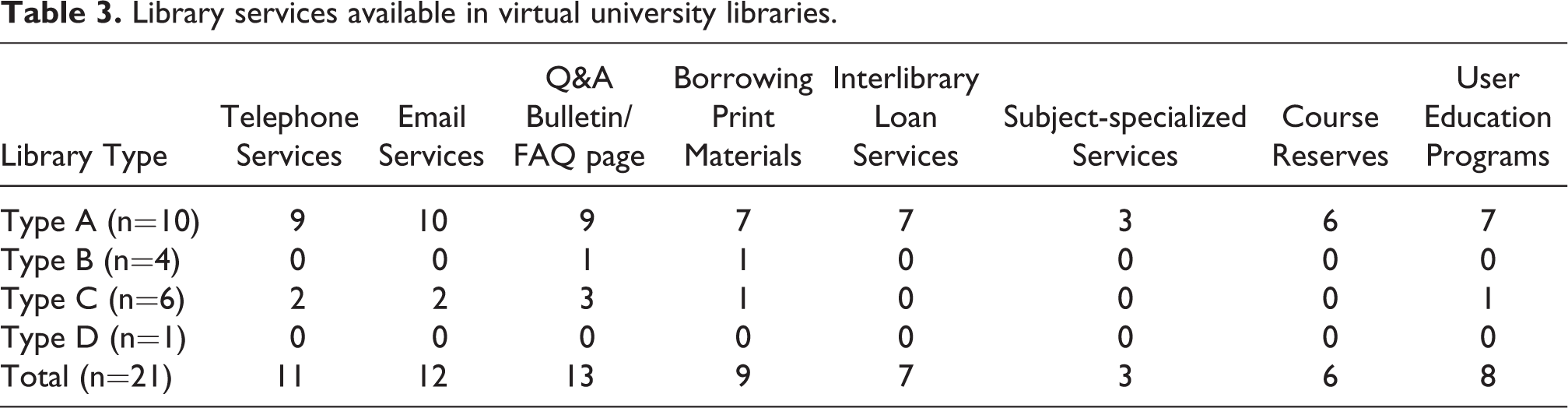
Lack of access to appropriate and necessary library services was severe, particularly in Type B and C libraries. Even email reference services were often unavailable in these libraries. No library in those categories provided interlibrary loan services, course reserves, or subject-specialized services.
Regarding difficulties in providing library services, the surveyed staff reported their inability to process certain library services due to a shortage of expertise in library operations. One staff member reported particular difficulties when handling interlibrary loan requests, because interlibrary loan was not a frequently requested service in his library and he had little experience with it. The surveyed staff members also commonly encountered a lack of funds necessary to acquire appropriate resources. One staff member had requested funds to subscribe to a database, but his university rejected his request. Another staff member lamented the low usage of library resources. He argued that the low awareness of library resources among students contributed to the low level of usage. To facilitate the use of the library, he suggested that instructors should design courses and assignments so that students were prompted to utilize library resources.
To summarize the results of the survey, the virtual university libraries with no partner libraries under the same parent foundation were extremely limited in the scope of digital resources and services. In many libraries, e-book packages are the only available resources and library services are rarely available due to a lack of qualified library professionals and funds. Universities that provide access to large research universities under the same parent foundations tend to provide a broad array of resources and services, but distance students do not always have the same privileges as their on-campus counterparts in the use of a library.
Interview results
This section reports virtual university administrators’ opinions and expectations for a central library initiative. When asked if they were willing to participate in a centralized digital library initiative, a majority of the senior officers responded positively, including all the respondents from type B, C, and D universities (Table 4). However, the respondents from type A universities showed divergent opinions: Four respondents did not feel a need to participate in such an initiative because they already fulfilled the required accreditation standards by having agreements with other libraries under the same foundations. Another four respondents were willing to participate because their partner libraries did not have a satisfactory level of facilities and resources or did not provide the same resources and services to distance students, so a centralized digital library was needed to complement the existing resources and services. Two respondents thought it was too early to jump on the bandwagon and wanted to see how things progressed.
Willingness to participate in a centralized digital library initiative.
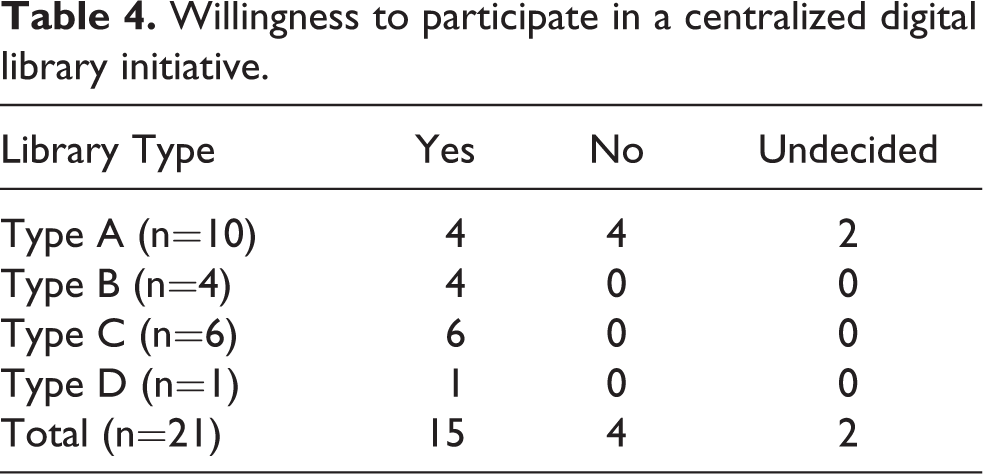
The main motivation for joining a centralized digital library initiative was the benefit of lower prices to access more resources. A centralized digital library was expected to minimize duplication of e-book subscriptions and reduce subscription costs for expensive databases through group purchase and resource sharing. To accomplish this, the formation of a consortium among the libraries was deemed a prerequisite. The respondents voiced their opinion that the Korean Consortium of Open Universities (KCOU) should be a central organization entity for coordinating a library consortium and implementing a digital library on behalf of participating virtual universities. While a large percentage of respondents agreed with the necessity of a centralized digital library, they voiced different opinions, concerns, and requirements. Specifically, comments made by the respondents centered on six issues: 1) accreditation standards, 2) diversity, 3) funding, 4) resources, 5) services, and 6) technology.
The first issue addressed by the respondents was the revision of accreditation standards. According to the current standards, virtual universities have two options regarding digital libraries: 1) building their own digital libraries, or 2) having agreements with other university libraries. The respondents stated that the standards must be revised to permit a third option – participating in a centralized digital library. Otherwise, they felt that there was no point to discussing the feasibility of the initiative. One respondent also argued that the standards should be more rigorous, permitting the first and the third options only because some universities having agreements with other universities did not provide equivalent resources and services to distance students as on-campus students. He believed that not allowing the second option would force those virtual universities with partnerships with other institutions to join the central digital library initiative, which could result in further economies of scale.
The second issue was related to the wide diversity in the requirements of each university library. The respondents expressed the fear that joining a centralized digital library initiative may adversely affect local autonomy and control and may not meet the needs of individual universities. Since every university has its own needs, policies, and practices with different student bases, they wanted to have the freedom to tailor some features of a digital library to suit their needs. It became clear at this point that although the administrators advocated joint acquisition of databases and resource sharing through a library consortium, a single, centralized digital library model might not satisfy the varying needs of different institutions. Instead, they envisioned that an ideal digital library would be able to be customized for each university and support local autonomy.
The third issue that emerged from the respondents’ comments was funding. The respondents were worried that it would take too long to build a digital library and acquire needed resources without external financial help. They unanimously maintained that the Ministry of Education should provide financial support, at least for start-up costs such as computer equipment and staffing costs to implement a digital library system. The respondents agreed that after a digital library system was set up, the operating and subscription costs for commercial databases should be shared among member universities, but they did not agree on the way the costs should be distributed. Some respondents insisted that the costs should be shared equally among universities. Others, especially those from small universities, saw this as unfair, suggesting differential costs according to the total number of full time equivalent (FTE) faculty and students, the projected local use levels, or budget scale of each university. One respondent mentioned that securing initial and subsequent financing may be the most difficult obstacle to hurdle in the process of implementing and maintaining a digital library.
The fourth issue involved collection development. The respondents had diverse opinions on collaborative collection development procedures such as who, what, and how to acquire digital resources. All respondents showed high interest in the group purchase of e-books and the creation of a “book-bank” with contents available to users across universities, as e-books are major resources for universities. One respondent suggested forming a task-force team to select e-books to be used as textbooks in individual universities. Several respondents were particularly interested in purchasing expensive foreign databases. The respondents voiced that since the individual universities were strong in different fields and had different educational goals, they would need a different set of library resources. Therefore, a long discussion would be necessary before reaching a consensus on what resources to purchase.
The fifth issue addressed by many respondents involved library services and librarians. The respondents were aware that the lack of trained librarians leads to poor library services in their universities. One respondent suggested the idea that the KCOU hire one or more librarians to work in a centralized digital library for all member virtual universities as a way to reduce employment costs. Another respondent, however, argued that a centralized librarian would not be able to deal with the wide range of information needs of users in different universities. In addition, the respondents urged that appropriate library services be offered to distance students. Most of all, information literacy instruction was regarded as important to instill in students to ensure independent and effective information literacy skills. A special emphasis was placed on disabled students and older students over those of conventional college age because they are typically less digitally literate. One respondent stated that as traditional libraries transform from a collection repository to a center for communication and collaboration, a digital library for virtual universities should become a space that actively enables and fosters connections between people and sharing of ideas. In order to accomplish this, various online tools and services to facilitate communication should be adopted.
The sixth issue involved technological challenges associated with implementing a digital library. One respondent emphasized the use of mobile computing technologies as his library had witnessed a 2,600% increase in visitors over a one-month period after creating a mobile library site. He insisted that a central digital library for virtual universities should be accessible through PCs, smart phones, and other mobile devices to enhance its reachability. Another respondent expressed concerns about privacy and security breaches in a centralized digital library because a group of universities would share user information. He urged that privacy-enhancing technologies be employed to protect the privacy of university members. Yet another suggestion was to make the central digital library available to the public so that virtual university students and the general public could utilize existing resources in the virtual universities. He asserted that this way, virtual universities could truly serve as lifelong learning institutions. Moreover, one respondent mentioned that there is a need to consider incorporating cloud computing, Web 2.0, and other state-of-the-art technologies in a digital library to improve library services and meet library clients’ expectations.
Proposed digital library model
There are two approaches to the development of a digital library for a group of virtual universities. The first approach is to build a centralized digital library system in which a set of library resources and technologies are shared by a consortium of participating universities. This centralized approach meets pragmatic needs for minimizing system-operating costs, but it was not considered a viable option in the present study for two reasons: 1) virtual university libraries currently hold different sets of digital resources and 2) as the surveyed administrators stressed, it is important to satisfy the diverse requirements and expectations of each virtual university. The second approach is for virtual universities to develop a digital library together (e.g., library applications and services), but manage their own digital library sites with their own resources. This approach ensures the diversity of individual libraries. However, those universities with tight budgets and lack of skilled staff are likely to have difficulties in maintaining their own sites. Having considered the pros and cons of possible options, we suggest a hosting model, which is a mix of the first and the second approaches. The hosting model enjoys the benefits of a centralized digital library approach by sharing applications and resources on a central server which users can access remotely. At the same time, certain functions of the digital library system would be customizable to the unique requirements of each university and local autonomy would be granted in system operation and content management within each library.
Figure 1 shows the process of a super administrator creating and maintaining digital library sites for individual universities. In this process, individual universities request creation of their own digital library sites equipped with common library functions (e.g., searching e-books) in a design of their choice. According to the requests, a hosting system administrator (super administrator) creates a digital library site for each university, which resides in a central server. In addition, a super administrator performs system operation and management tasks such as hardware maintenance. A system administrator working in a virtual university, if available, could override the central configuration set by the super administrator and add new resources or functions (e.g., a database available only in a specific university) to the site as needed. In the absence of a system administrator in a specific university, the super administrator could operate the digital library site on behalf of the university.
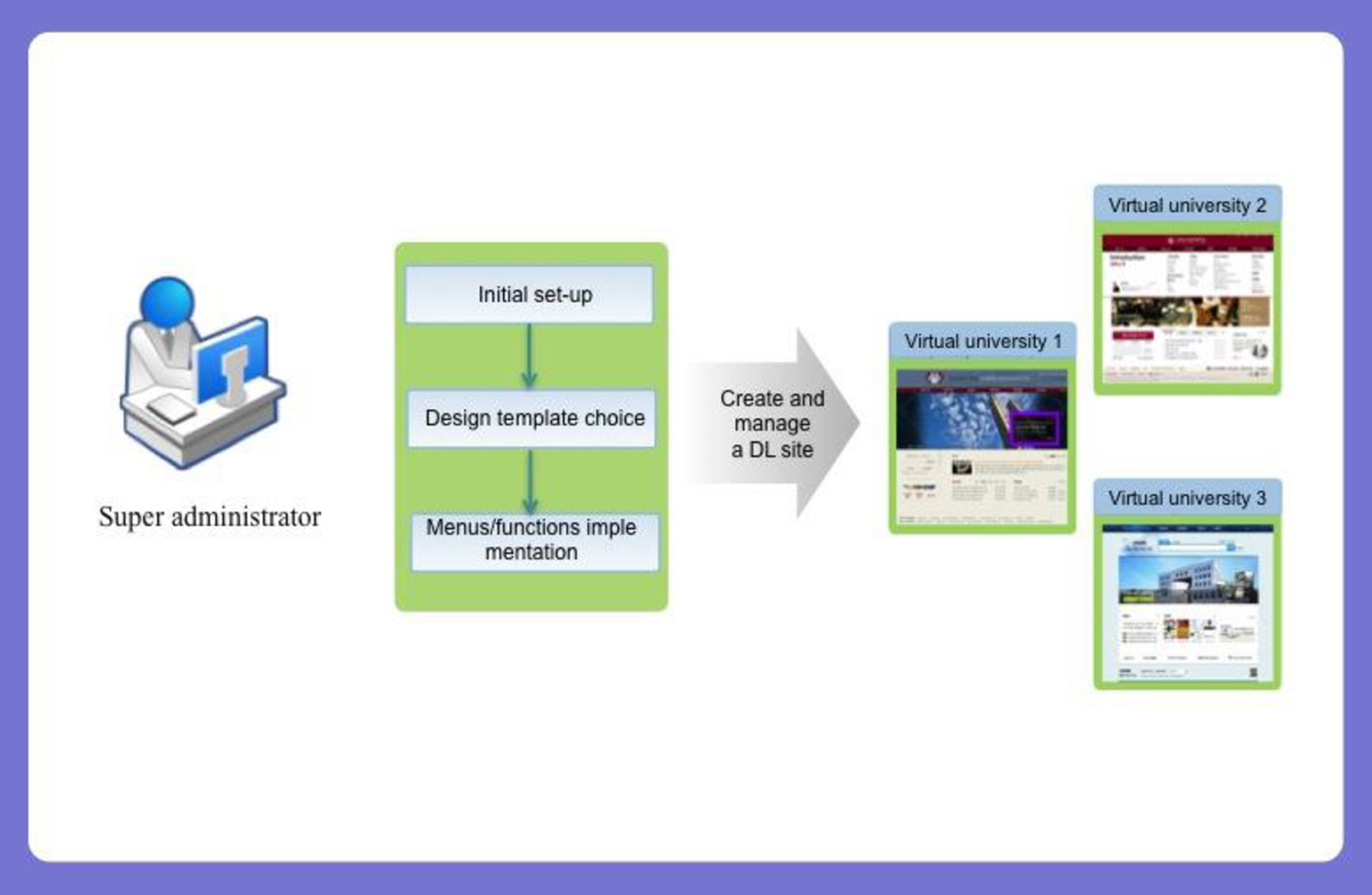
Process of creating a digital library site.
In the section that follows, the components and functions of the proposed digital library system are explained in greater detail.
System architecture
The system architecture of the digital library system is shown in Figure 2. The digital library system functionally comprises two principal subsystems: an administrative system and a user system. The administrative system supports two functions: 1) a super administrator creates digital library sites for individual universities and monitors their usage, 2) a super administrator or a system administrator in a specific university operates the digital library site of the university (e.g., uploading announcements and subject guides to the site). The user system enables users to access a variety of electronic resources and library services. In addition, the digital library system has a data area, which stores university information, instructional materials, announcements, subject guides, and other university-generated contents.
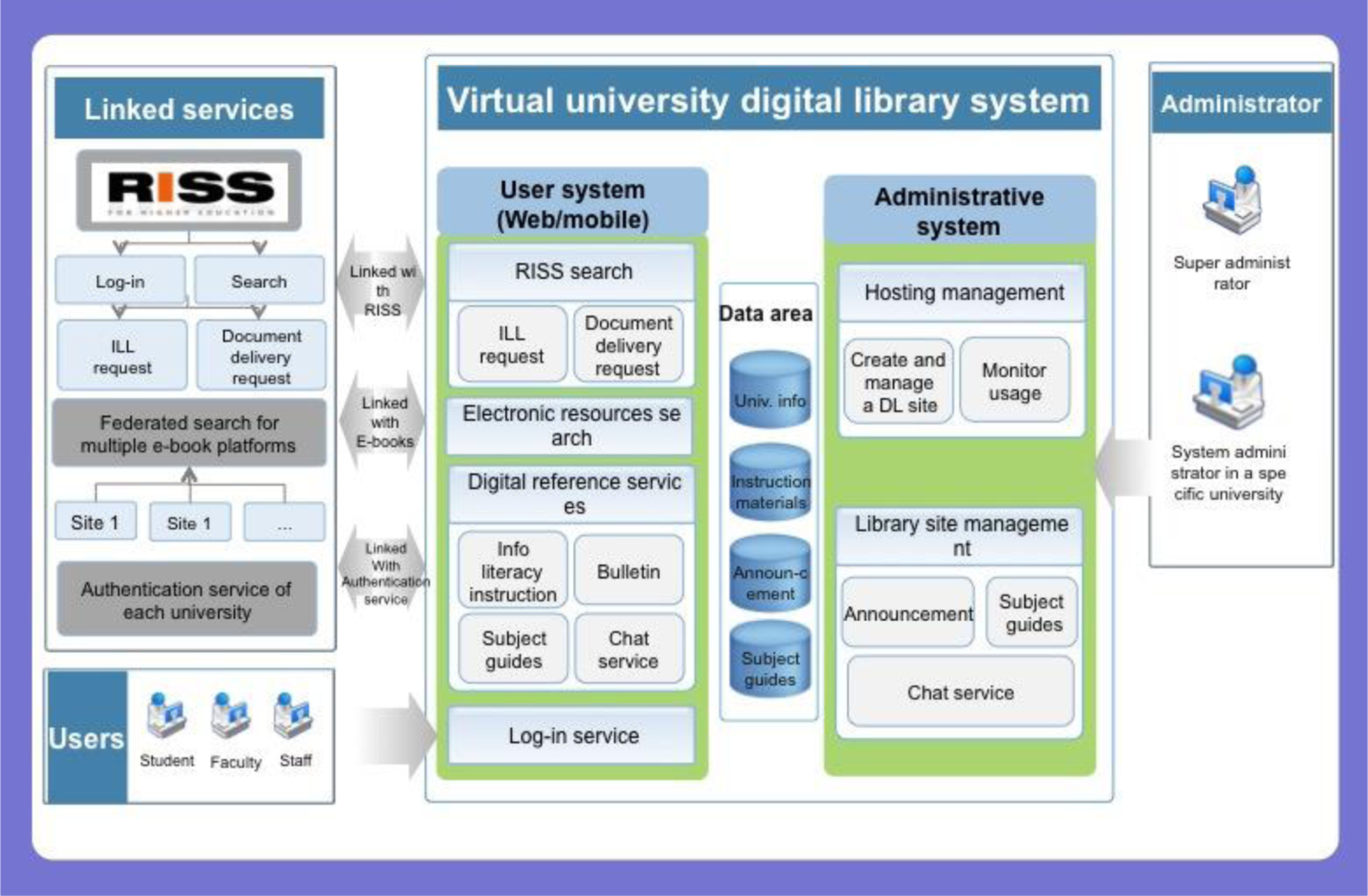
Digital library system architecture.
The user system allows users to access three types of resources: 1) resources freely offered by the Korea Education and Research Information Service (KERIS), 2) resources being subscribed to through a library consortium, and 3) resources purchased by or produced in a specific university. KERIS is a government agency that aims to improve national research competitiveness in higher education through the distribution of academic content based on the Research Information Sharing Service (RISS) (Korea Education and Research Information Service, 2013). The RISS offers a significant amount of national and international scholarly resources (e.g., journal articles, dissertations, and open learning materials) with an efficient search system, and operates interlibrary loan services and document delivery services among member universities. Since any RISS member university can utilize the above-mentioned scholarly resources and services for free, all four-year traditional universities in Korea are RISS members, while many virtual universities are not. Therefore, we propose that virtual universities become RISS members, and then the digital library system for virtual universities embed the RISS retrieval system using open application programming interface (open API). By accessing a variety of freely available resources through RISS, virtual universities can widen the scope of their collection beyond e-book packages. Moreover, for efficient access to resources, the digital library system should provide substantial capabilities to support searching. For example, the system should provide the ability to search across multiple e-book platforms regardless of different formats. If the member universities share online catalogues, learning materials, or other resources produced in each university, a federated searching system should be available for discovering these shared resources.
The user system also allows users to access library services such as information literacy instruction (e.g., online tutorials), subject guides, bulletin, and chat services, etc. as shown under ‘Digital reference services’ in Figure 2. A librarian working in each university would be responsible for content management and service provision. If one or more librarians are employed to work for all virtual universities, they should be able to provide services globally (e.g., operating chat services for users from all participating universities). The user system should be linked with the authentication service provided by a virtual university’s management system which holds university member information. When a user logs into a digital library site, the system issues an authentication request to the central authentication service of the university in which the user is enrolled. After the system confirms that the entered username and password are valid, it transfers user information to the digital library system. The digital library system stores only the minimum amount of user information in a digital library user information database. Figure 3 depicts the authentication process between the proposed digital library system and a virtual university’s management system.
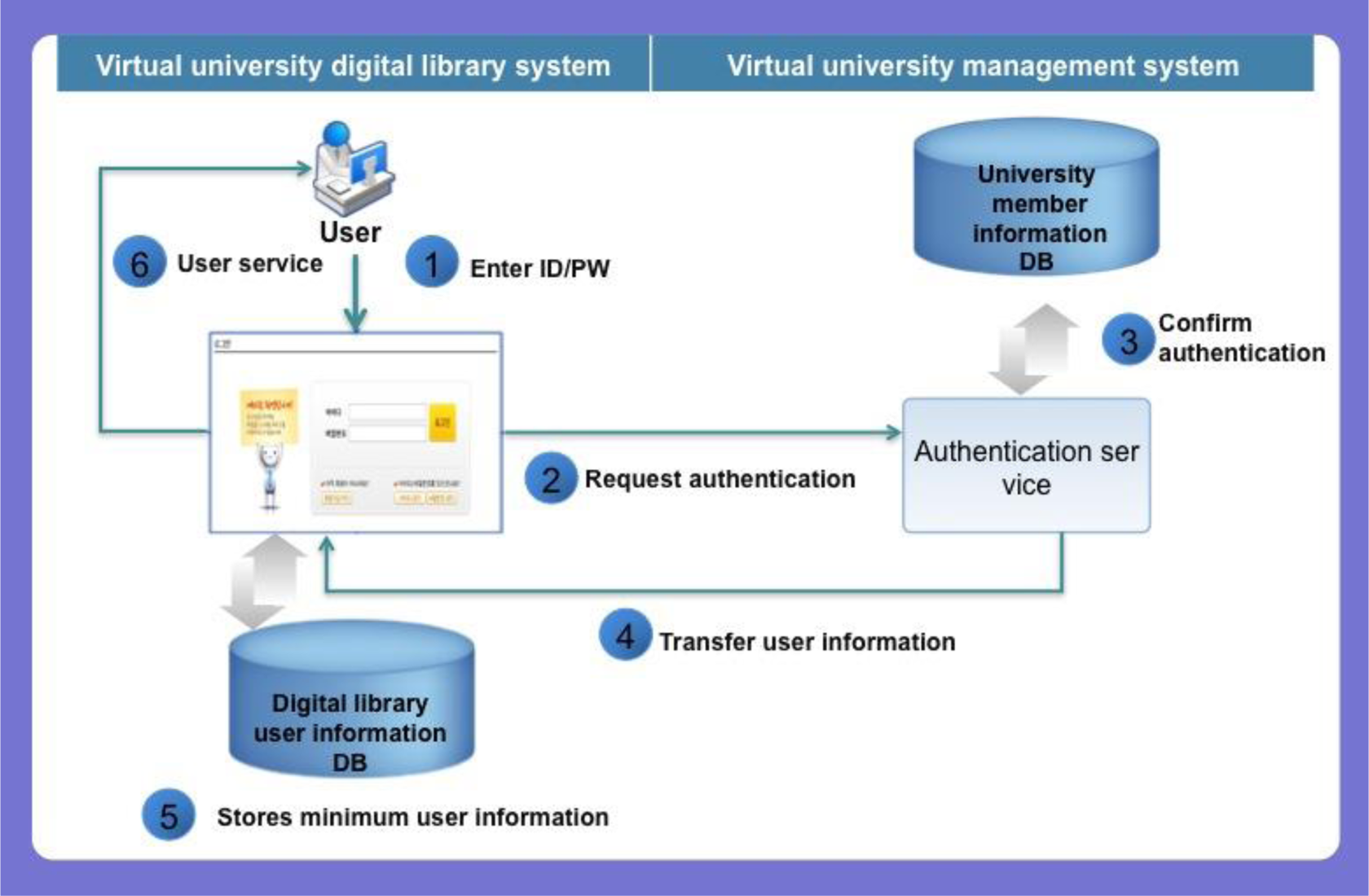
Authentication process.
Figure 4 is a snapshot of an interface prototype for a user system. The interface has four main menus on the top: 1) RISS Search, 2) Electronic Resources Search, 3) Information Services, and 4) My Library. In the middle are recent announcements and new arrivals.
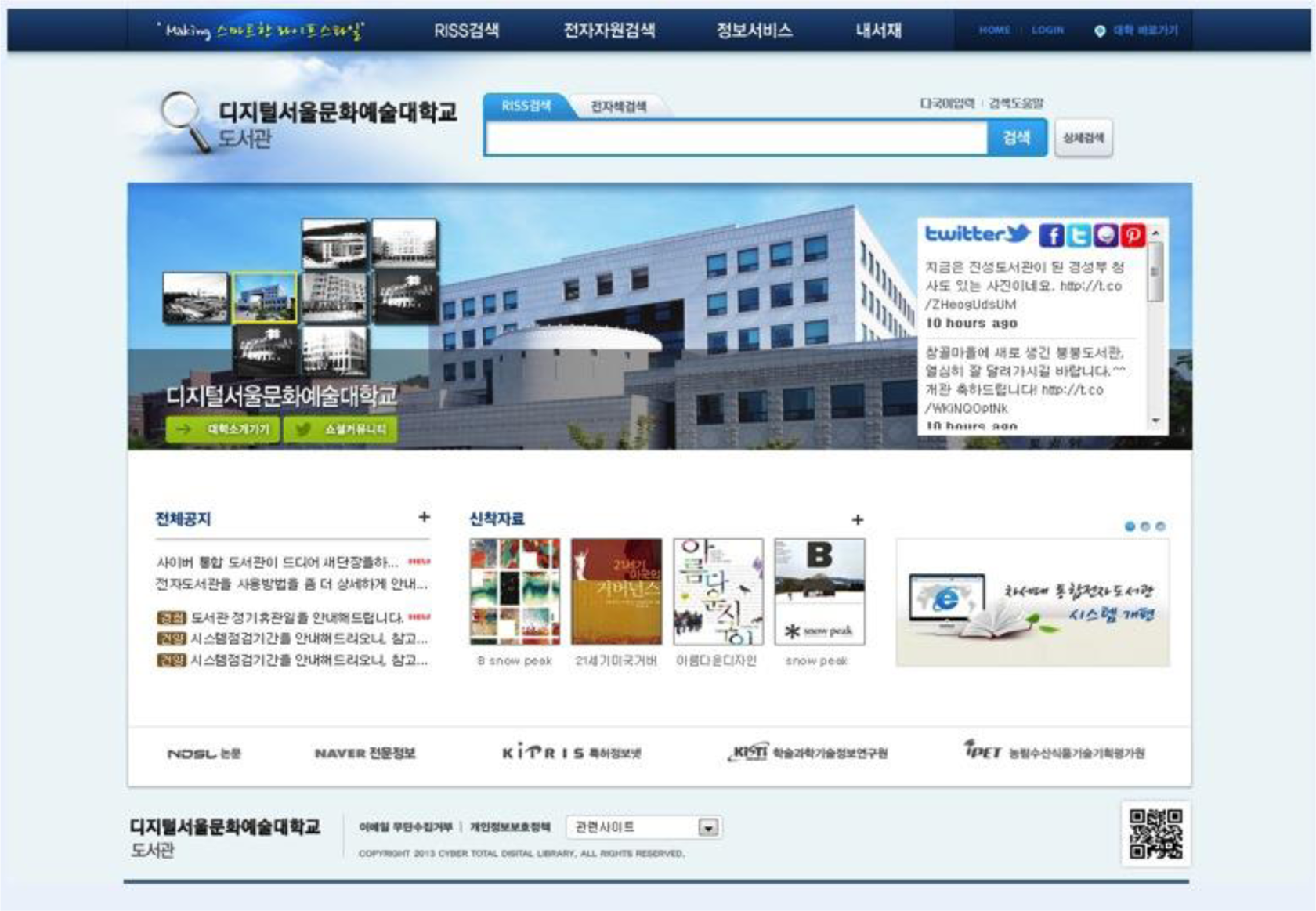
User system interface prototype.
The proposed digital library model offers a high level of flexibility for virtual university libraries. A digital library site of a specific university could be controlled centrally by a super administrator or be decentralized according to each university’s needs. The strength of a hosting model is that it can cater to the varying needs of the different university libraries by granting autonomy to a system administrator and a librarian in each university. The model can also reduce operating costs by enabling a super administrator to perform operation and management tasks on behalf of member libraries. Moreover, the potentially most valuable benefit of the digital library is the ability to share library services and resources over a network. In the digital library system, shared applications and resources are mounted on a central server and users from different universities access them remotely. As previous research shows, a collaborative approach in the development of a digital library can bridge the digital divide between resource rich and resource deficient libraries (Jones, 1998). If the surveyed virtual universities form a library consortium to purchase and share digital collections, the proposed digital library system can provide resource deficient libraries (e.g., the virtual university libraries with no partner libraries under the same parent foundation) access not only to their own resources, but resources in other universities in a flexible, cost-effective way. After all, a national-level central digital library model can guard against duplicate materials and manpower (Simamora and Gunawan, 2001; Sujatha, 2008), and thus, it would be particularly useful for a country where individual distance learning institutions suffer from lack of funds and human resources.
There are still many important organizational and policy-related issues to be discussed and agreed upon before designing and implementing a hosting-based digital library system. Most of all, funding is a key issue in the implementation and maintenance of the digital library model recommended. As the administrators maintain, it will be desirable for the Ministry of Education to provide initial funds to implement a digital library system while the member universities share the operating and subscription costs after the system is set up. The administrators also suggest that the Korean Consortium of Open Universities (KCOU) should be a central body to coordinate a consortium and implement a digital library system, but further discussion would be necessary about how the digital library system would be managed jointly by participating universities.
Conclusions
The development of Internet-based technologies and digital libraries has opened up new opportunities for distance learning and the benefits of digital libraries for distance students have been widely recognized. However, many virtual university libraries in Korea currently do not provide sufficient resources and services because of a lack of qualified librarians and necessary funds. Therefore, the present study explores the possibilities of building up a national-level central digital library for virtual university libraries in Korea through the interviews with 16 virtual university administrators. The most notable requirement for a central digital library is to have access to more resources at lower costs. Based on the requirement, the present study proposes a hosting-based digital library system that can support resource sharing among participating universities while reducing operating costs. Findings from the present study have practical implications for virtual universities in Korea and other countries planning to build an appropriate digital library system in a distance education environment. Theoretically, this study proposes a new approach for developing a digital library system to meet the varying needs of individual libraries. It also brings attention to the usefulness of library consortia in developing countries like Korea.
Footnotes
Acknowledgment
This work was supported by research grants from the Catholic University of Daegu in 2014.