



Abstract
As a killer application of the mobile Internet, location-based services (LBS) have been popular among users. However, due to the collection and utilization of users’ location information, LBS have raised users’ privacy concern, which may negatively affect their usage. From the perspective of perceived justice, this research examined LBS users’ privacy concern and continuance usage. Perceived justice includes three dimensions: distributive justice, procedural justice and interactional justice. The results indicated that perceived justice has significant effects on privacy concern, satisfaction and flow. These three factors determine continuance usage. The results imply that service providers need to improve users’ perceived justice in order to mitigate their privacy concern and facilitate their continuance usage of LBS.
Service providers need to improve users’ perceived justice in order to mitigate their privacy concern and promote their continuance.
Introduction
Mobile Internet has been developing rapidly in the world. According to a recent report issued by China Internet Network Information Center (CNNIC), the number of mobile Internet users in China has exceeded 594 million, accounting for 88.9% of its Internet population (668 million) (China Internet Network Information Center, 2015). Faced with the great market potential, service providers have released a variety of mobile services, such as mobile instant messaging, mobile search, location-based services (LBS) and mobile payment. They expect users to widely adopt and use these services. Then they can achieve competitive advantage and make profits. Nevertheless, acquiring users and promoting their initial adoption may not be enough for service providers. They have invested great effort and resources on releasing these mobile services. If they cannot retain users and facilitate users’ continuance usage, they may not recover these costs and achieve success. Extant research has noted that the cost of acquiring a new user is five times that of retaining an existing user (Reichheld and Schefter, 2000). In addition, the switching costs are low for users. They can easily switch from a service provider to an alternative one. This also highlights the need to retain users and facilitate their post-adoption usage.
Among various mobile services, LBS are deemed the killer application of mobile business (Junglas and Watson, 2008). Typical LBS include location-based advertisements, location tracking, location check-in and emergency evacuation. LBS can acquire a user’s location information and push the contextual information and services to the user based on his or her current location. This may improver user experience and facilitate usage behavior. For example, when users are tourists, service providers can recommend the nearby tourism scenes to users based on their location. This may reduce user effort spent on information search and improve their experience. Nevertheless, due to the collection and utilization of users’ location information, LBS may arouse users’ privacy concern, which may further negatively affect their usage. A report indicates that about 35% of adult users have turned off location tracking features because of privacy concern (PewResearchCenter, 2013). Users may worry whether service providers can appropriately collect, store and use their personal information. If users have high concern on information privacy, they may perceive great risk and discontinue their usage of LBS.
Previous studies have drawn on information technology theories such as the technology acceptance model (TAM) (Zhu et al., 2014) and the Unified Theory of Acceptance and Use of Technology (UTAUT) (Zhou, 2012) to examine user adoption of LBS. Factors such as perceived usefulness and task technology fit are found to affect user behavior. They have also identified that privacy concern is a significant determinant of LBS user adoption (Zhao et al., 2012; Yun et al., 2013). However, the factors affecting privacy concern have seldom been examined. This may hinder our understanding of privacy concern mitigation and LBS user behaviour. The purpose of this research is to draw on the perceived justice theory to examine privacy concern and LBS users’ continuance usage. Perceived justice, which reflects a set of fairness perceptions (Colquitt et al., 2001), has been found to affect user behavior in the contexts of online services (Turel et al., 2008) and e-tailing (Wang et al., 2011). Perceived justice includes three factors: distributive justice, procedural justice and interactional justice. Among them, distributive justice reflects outcome fairness, whereas procedural justice reflects process fairness. Interactional justice reflects the perceived fairness of interpersonal treatment. Perceived justice theory provides a useful lens for examining privacy concern. When users perceive outcome or process fairness from interacting with service providers, they may have less concern on information privacy. By using perceived justice as the theoretical base, we expect to uncover LBS users’ privacy concern mitigation mechanisms and provide managerial implications for service providers.
The rest of this paper is organized as follows. We develop the research model and hypotheses in the next section. Then we describe instrument development and data collection in section three. Section four reports results and section five discusses these results. We present the implications and limitations in section six.
Research model and hypotheses
LBS user adoption
As an emerging service, LBS user adoption has received attention from information systems researchers. Theories such as TAM, UTAUT and information systems continuance model are used as the theoretical bases. Zhou (2012) suggested that four factors of UTAUT, which include performance expectancy, effort expectancy, social influence and facilitating conditions, have effects on user adoption of LBS. Zhu et al. (2014) applied TAM to find that perceived usefulness, perceived control, and perceived institutional assurance affect user adoption of location-based recommendation agents. Lin et al. (2014) proposed that perceived usefulness affects user satisfaction with Facebook check-in services. In addition to information technology theories, perceived value theory is also used to examine user adoption of location-based social networking services (Yu et al., 2013). Luarn et al. (2015) found that social conditions such as subjective norms and social support have a strong effect on social network site users’ check-in behaviour.
Extant research has also identified the effect of privacy concern on LBS user adoption. Xu et al. (2012) noted that three mechanisms, which include individual self-protection, industry self-regulation and government regulation, affect perceived control, which in turn affects privacy concern. Zhao et al. (2012) stated that privacy concern affects user intention to use location-based social network services. Yun et al. (2013) examined the moderation effect of privacy concern on the relationship between performance expectancy and LBS usage. Fodor and Brem (2015) noted that privacy concern affects user adoption of LBS.
As evidenced by these studies, although they have found the effect of privacy concern on LBS user behaviour, they have seldom examined the factors affecting privacy concern and disclosed privacy concern mitigation mechanisms. In other words, how to effectively control LBS users’ privacy concern remains a question. This research tries to fill the gap and examines whether a user’s perceived justice, which includes outcome, process and interpersonal treatment fairness, affects his or her privacy concern and continuance behavior.
Perceived justice
Perceived justice reflects a set of fairness perceptions (Colquitt et al., 2001) and it is crucial for social exchange relationships. When users feel that they have received a fair treatment related to information privacy from service providers, they may be willing to use LBS and disclose their personal information. Perceived justice has been used to examine user behavior in information systems research. Turel et al. (2008) noted that perceived justice has effects on a user’s trust and intention to reuse e-services. Perceived justice includes four factors: distributive, procedural, informational and interpersonal justice. Both informational and interpersonal justice can be incorporated into interactional justice. Son and Kim (2008) proposed that perceived justice affects Internet users’ information provision, which includes refusal and misrepresentation. Wang et al. (2011) suggested that perceived justice affects customer loyalty toward e-tailing.
Perceived justice includes three factors: distributive justice, procedural justice and interactional justice (Colquitt et al., 2001; Turel et al., 2008). Distributive justice reflects the perceived fairness of outcomes users receive from service providers in return for personal information disclosure (Son and Kim, 2008). Users may conduct a cost-benefit analysis or privacy calculus when determining to release their information. On one hand, LBS can offer personalized information and services to users based on their location. This may bring benefits to users (Xu et al., 2009). On the other hand, LBS may also incur privacy risk and uncertainty to users. For example, users may doubt whether service providers sell their personal information to other parties. If the benefits or rewards are equal to or larger than the costs, they may perceive outcome fairness and have less concern on information privacy. This outcome fairness may also increase users’ satisfaction as they have obtained expected outcomes from service providers. Thus, we suggest,
Privacy concern, satisfaction and flow
Privacy concern reflects a user’s concern on information disclosure. Users may doubt whether service providers use their information for other purposes or even sell their information to other parties. Privacy concern includes four aspects: collection, errors, improper access and unauthorized secondary use (Smith et al., 1996). In the Internet context, information privacy may also include user control and awareness (Malhotra et al., 2004). Information systems researchers have identified the effect of privacy concern on user behavior in a variety of contexts, such as electronic health records (Angst and Agarwal, 2009), instant messaging (Lowry et al., 2011), social network sites (Xu et al., 2013), online purchase (Slyke et al., 2006), blogs (Chai et al., 2011), and firewalls (Kumar et al., 2008). Recently, it has also been examined in the mobile services context (Xu and Gupta, 2009; Zhao et al., 2012).
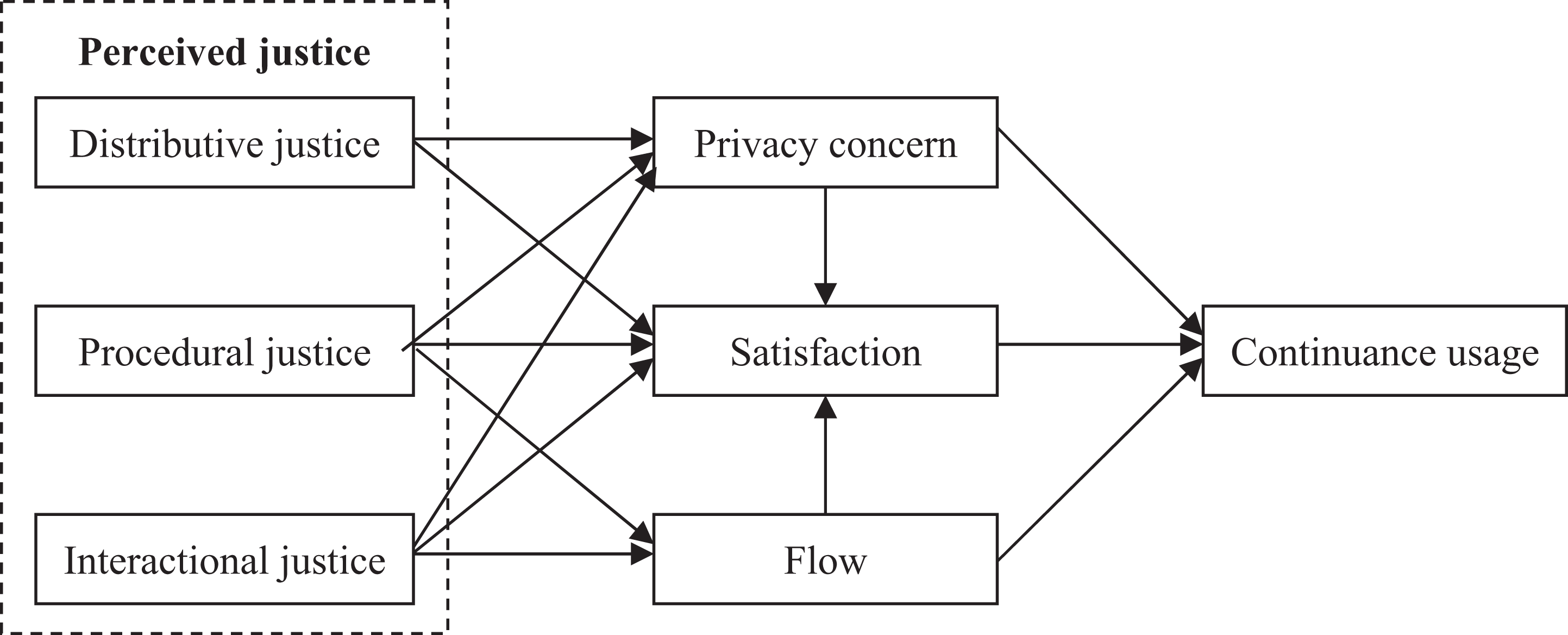
Presents the research model.
Satisfaction reflects cumulative feelings developed among multiple interactions with service providers. When perceived performance outweighs expectation, users may feel satisfied. Privacy concern may affect user satisfaction and continuance usage. When users have great concern on information privacy, they may worry about the potential uncertainty and risk derived from information disclosure. This may undermine their satisfaction and continuance intention. The expectation confirmation model also suggests that satisfaction is a significant determinant of continuance usage (Bhattacherjee, 2001). Thus,
Flow may affect satisfaction. When users obtain flow, they feel great enjoyment and time elapses rapidly for them. This optimal experience may meet users’ expectations and increase their satisfaction. In addition, users may expect to obtain flow again in the future. Thus, flow may facilitate continuance usage. Previous studies have reported the effect of flow on users’ return to virtual worlds (Goel et al., 2013) and repeat purchase (Hausman and Siekpe, 2009). Consistent with these studies, we suggest,
Method
The research model includes seven factors. Each factor was measured with multiple items. All items were adapted from extant literature to improve the content validity (Straub et al., 2004). These items were first translated into Chinese by a researcher. Then another researcher translated them back into English to ensure consistency. When the instrument was developed, it was tested among five users that had LBS usage experience. Then according to their comments, we revised some items to improve the clarity and understandability. The final items and their sources are listed in the Appendix.
Items of three factors of perceived justice were adapted from Son and Kim (2008). Items of distributive justice reflect that users acquire values, service level and benefits in return for information disclosure. Items of procedural justice reflect the procedures adopted by service providers to ensure information privacy, such as acquiring user permission before information collection and preventing unauthorized access. Items of interactional justice reflect service providers’ trustworthiness and integrity with handling users’ personal information. Items of privacy concern were adapted from Dinev and Hart (2006) to reflect a user’s concern on information misuse and leakage. Items of flow were adapted from Lee et al. (2007) to reflect perceived enjoyment, concentration and perceived control. Items of satisfaction and continuance usage were adapted from Bhattacherjee (2001). Items of satisfaction reflect a user’s contentment and pleasure with using LBS. Items of continuance usage reflect user intention to continue using LBS.
Data were collected at the service outlets of China Mobile and China Unicom, which represent two leading mobile operators in China. These service outlets are located in an eastern China city, where mobile Internet is relatively more developed than in other regions. Users go to these service outlets to apply for new services, pay fees and print invoices. Due to the large number of users, they often need to wait for a few minutes before they are served by the representatives. This allows us to interview them and conduct data collection. We contacted users and inquired whether they had LBS usage experience. Then we asked those with positive answers to fill the questionnaire based on their usage experience. We scrutinized all responses and dropped those with too many missing values. As a result, we obtained 275 valid responses. Among them, 54.5% were male and 45.5% were female. A majority of them (73.1%) were between 20 and 29 years old. The frequently used LBS include mobile social networks, mobile maps and mobile advertisements.
We conducted two tests to examine the common method variance. First, we conducted a Harman’s single-factor test (Podsakoff and Organ, 1986). The results indicated that the largest variance explained by an individual factor is 13.09%. Thus, none of the factors can explain the majority of the variance. Second, we modeled all items as the indicators of a factor representing the method effect, and re-estimated the model (Malhotra et al., 2006). The results indicated a poor fitness. For example, the goodness of fit index (GFI) is 0.609 (<0.90). The root mean square error of approximation (RMSEA) is 0.123 (>0.08). The results of both tests indicated that common method variance is not a significant problem in our research.
Results
Following the two-step approach recommended by Anderson and Gerbing (1988), we first examined the measurement model to test reliability and validity. Then we examined the structural model to test research hypotheses and model fitness.
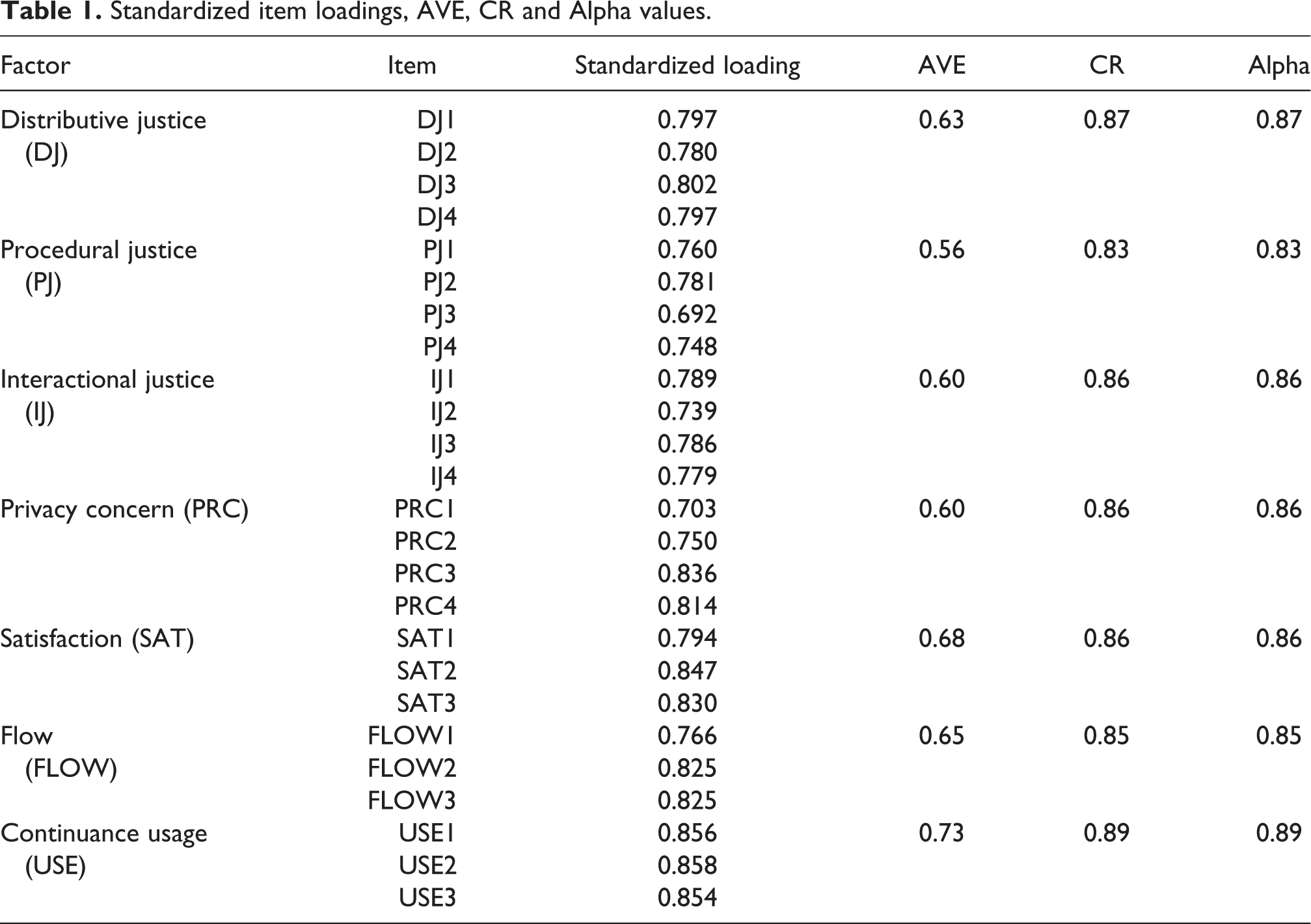
First, we conducted a confirmatory factor analysis to examine the validity. Validity includes convergent validity and discriminant validity. Convergent validity measures whether items can effectively reflect their corresponding factor, whereas discriminant validity measures whether two factors are statistically different. Table 1 lists the standardized item loadings, the average variance extracted (AVE), the composite reliability (CR) and Cronbach Alpha values. As listed in the table, most item loadings are larger than 0.7. The T values indicate that all loadings are significant at 0.001. Each AVE exceeds 0.5 and CR exceeds 0.7. This indicates good convergent validity (Gefen et al., 2000). In addition, all Alpha values are larger than 0.7, suggesting good reliability (Nunnally, 1978).
Standardized item loadings, AVE, CR and Alpha values.
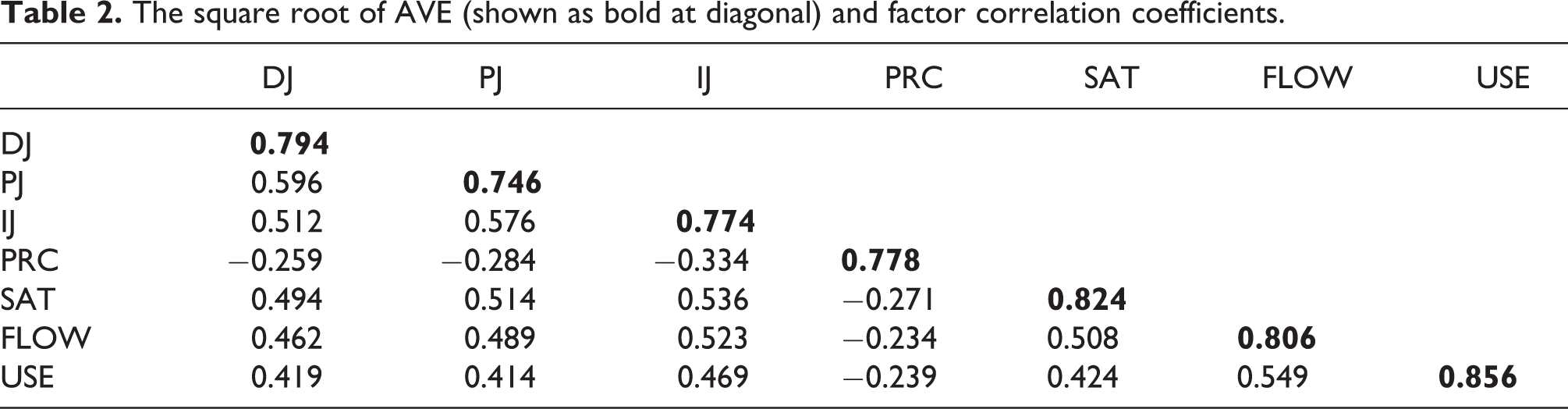
To examine the discriminant validity, we compared the square root of AVE and factor correlation coefficients. As listed in Table 2, for each factor, the square root of AVE is significantly larger than its correlation coefficients with other factors. This suggests good discriminant validity (Gefen et al., 2000).
The square root of AVE (shown as bold at diagonal) and factor correlation coefficients.
Second, we adopted structural equation modeling software LISREL to estimate the model. Figure 2 shows the results. Table 3 lists the recommended and actual values of some fit indices. Except GFI, other fit indices have better actual values than the recommended values. This indicates a good fitness of the model (Gefen et al., 2000). The explained variance of privacy concern, satisfaction, flow and continuance usage is 35.5%, 76.6%, 72.5% and 74.5%, respectively.
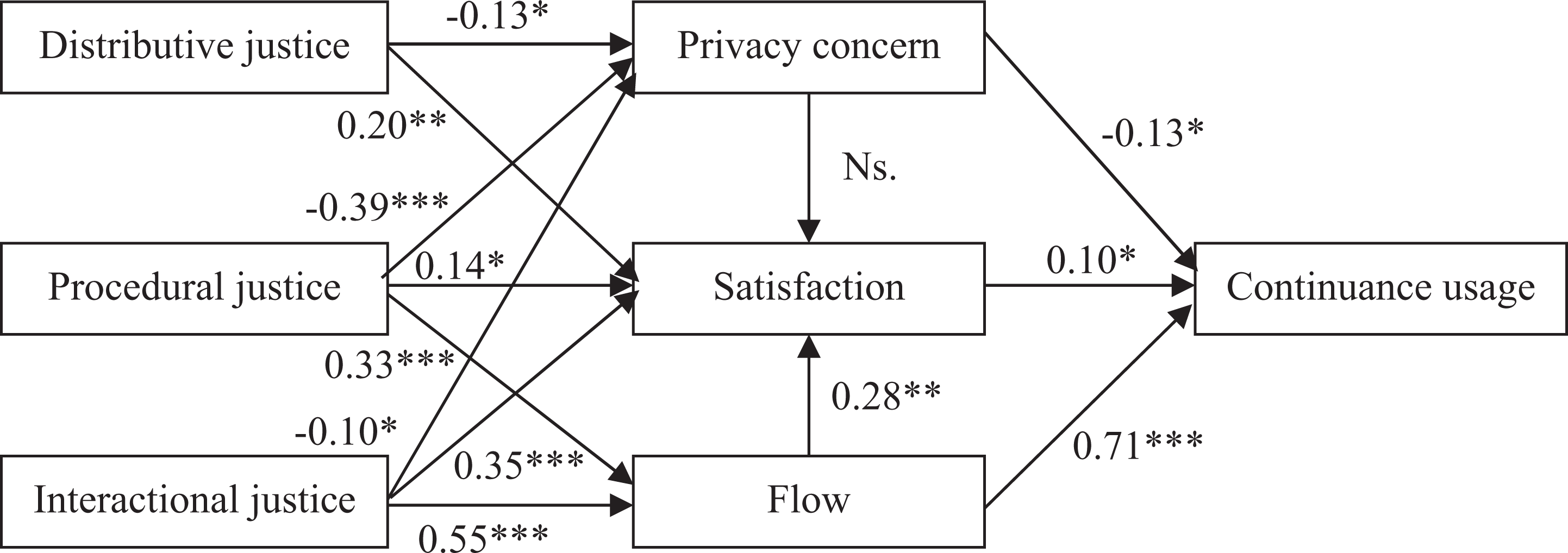
The results estimated by LISREL.
The recommended and actual values of fit indices.
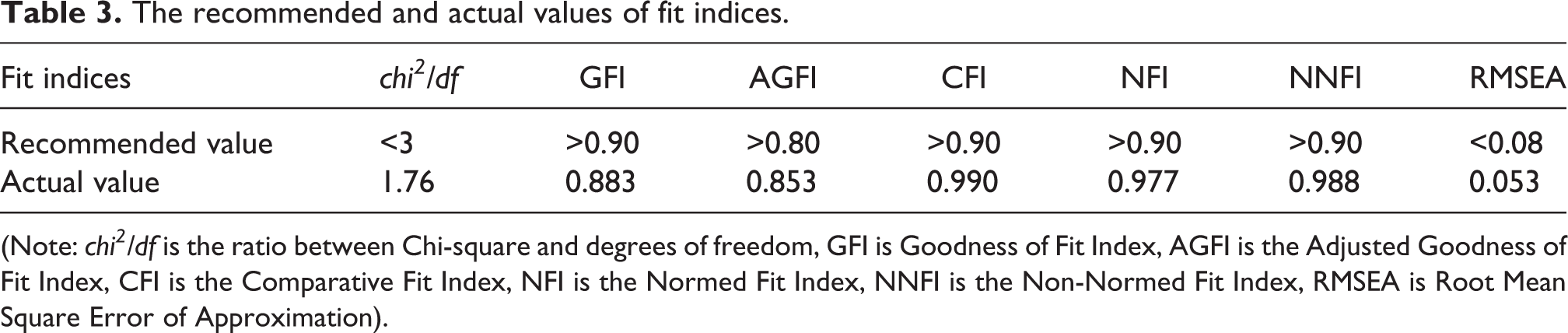
(Note: chi2/df is the ratio between Chi-square and degrees of freedom, GFI is Goodness of Fit Index, AGFI is the Adjusted Goodness of Fit Index, CFI is the Comparative Fit Index, NFI is the Normed Fit Index, NNFI is the Non-Normed Fit Index, RMSEA is Root Mean Square Error of Approximation).
Discussion
As shown in Figure 2, except H9, other hypotheses are supported. Three factors of perceived justice have significant effects on privacy concern, satisfaction and flow, which in turn determine continuance usage.
Distributive justice has significant effects on privacy concern and satisfaction. This suggests that when users perceive fair outcomes received from service providers, they may have less concern on information privacy and become satisfied. As users may conduct a privacy-calculus when determining information disclosure (Li, 2012), they may perceive a fair outcome if service providers can offer more values and benefits to them. A main benefit of LBS is that they can provide personalized information and services to users based on their locations (Zhao et al., 2012). If users often receive inaccurate or irrelevant information from service providers, they may perceive the low utility of LBS. Besides offering personalized services, service providers can offer financial compensation and incentives to improve users’ perceived benefits (Xu et al., 2009). For example, service providers can offer coupons and discounts to users releasing their information. These incentives and compensation may improve users’ perceived fairness of outcomes in return for information disclosure.
Procedural justice has a strong effect (γ = -0.39) on privacy concern. Procedural justice reflects the fairness of the procedures and processes used to ensure information privacy. These procedures and structures may help mitigate users’ privacy concern and improve their satisfaction and experience. Service providers can post privacy policies to state what information is collected, where this information is stored and what purposes this information is used for. These polices may inform users about the privacy practices of service providers and ease their privacy concern (Xu et al., 2011). Service providers can also display privacy seals such as TRUSTe issued by the third-party organizations. These privacy seals reflect industry self-regulation, which can increase users’ perceived control and reduce their privacy concern (Xu et al., 2012). In addition, when service providers plan to push contextual information to users, they may need to acquire users’ permission in advance. Otherwise, users’ privacy concern may be aroused and their privacy risk be increased. The results indicate that procedural justice also affects flow. This indicates that the procedures provide assurances to users and increase their perceived control, which may improve their experience (Moon et al., 2014).
Interactional justice significantly affects privacy concern, satisfaction and flow. Interactional justice reflects the interpersonal treatment users received from service providers, such as trust and respect. This suggests that users are not only concerned with the benefits in return for information disclosure (distributive justice) and the procedures used to ensure information privacy (procedural justice), but also concerned with service providers’ practices of implementing these procedures (interactional justice). Service providers need to keep their promises of ensuring information privacy and build users’ trust. Built on mobile networks and devices, the mobile Internet is vulnerable to information interception and hacker attack. This increases users’ concern on whether their information is securely transmitted and stored. Service providers can use encryption technologies to ease users’ concern. They can also post other users’ positive reviews and comments to build users’ trust in their practices of information collection, storage and usage.
Flow has a significant effect on satisfaction. However, we did not find the effect of privacy concern on satisfaction. This suggests that users attach more importance on usage experience when forming their satisfaction with LBS. Privacy concern, satisfaction and flow determine continuance usage. Among them, flow has the largest effect (β = 0.71). Privacy concern increases users’ perceived uncertainty and risk (Hong and Thong, 2013), which may decrease their continuance of using LBS. On the other hand, flow as an optimal experience can help improver user satisfaction and facilitate his or her continuance usage. This result is consistent with previous findings (O’Cass and Carlson, 2010).
Implications and limitations
From a theoretical perspective, this research examined the effect of perceived justice on LBS users’ privacy concern and continuance usage. As noted earlier, although previous research has found the effect of privacy concern on LBS user behaviour, it has seldom examined the determinants of privacy concern. This research tries to fill the gap and found that perceived justice, which includes three factors of distributive, procedural and interactional justice, has significant effects on privacy concern, satisfaction and flow, which in turn determine continuance usage. The results advance our understanding of privacy concern mitigation mechanisms and LBS user behavior. Second, besides privacy concern, we also included satisfaction and flow in the model. Among them, privacy concern represents an inhibitor of continuance usage, whereas satisfaction and flow represent enablers. By integrating both enablers and inhibitors, this research provides a complete understanding of LBS user continuance. Third, perceived justice theory has been examined in the contexts of e-services and e-tailing. This research generalizes it to the context of an emerging service: LBS. The results also enrich the research on perceived justice.
From a managerial perspective, the results imply that service providers need to improve users’ perceived justice in order to mitigate their privacy concern and promote their continuance. As perceived justice includes three factors of distributive, procedural and interactional justice, they need to aim at these factors when adopting relevant measures. They can offer financial compensation and incentives to improve outcome fairness. To increase procedural justice, they can post privacy polices and privacy seals that indicate that their privacy practices are certified and monitored by the third-party organizations. They also need to build users’ trust by keeping promises on information collection and usage. This may help improve users’ perceptions of interactional justice.
This research has the following limitations. First, we conducted this research in China, where the mobile Internet is developing rapidly but is still in its early state. In addition, China features a typical oriental culture. This may affect a user’s perceived justice such as interactional justice (trust). Thus, our results need to be generalized to western countries that have developed the mobile Internet. Second, we mainly examined the effect of perceived justice on privacy concern. Future research can test the possible effects of individual characteristics such as personality traits and self-efficacy on privacy concern. For example, it may examine whether five personality traits, which include extraversion, openness to experience, agreeableness, conscientiousness and neuroticism, have effects on privacy concern. Third, we mainly conducted a cross-sectional study. However, user behavior is dynamic. Thus, a longitudinal research may provide more insights into user behavior development.
Footnotes
Appendix: Measurement scale and items
Acknowledgement
This work was supported by a grant from the National Natural Science Foundation of China (71371004), and a grant from the Research Center of Information Technology & Economic and Social Development in Zhejiang Province.