



Abstract
In the age of the information revolution, the Internet can be used to involve citizens in political processes and leads to the emergence of the new version of political empowerment. This article analyses the possible effects of the Internet on the political empowerment of citizens. We interviewed 29 citizens of Tehran to learn how the Internet affects their political involvement, and to determine whether it results in their political empowerment. We analysed the interview transcripts using Strauss and Corbin’s open-coding scheme, revealing 44 constructs. These were refined and categorised into two aspects: ‘political awareness’ and ‘political participation’. This taxonomy can be employed to evaluate the use of the Internet for political empowerment and to develop the ways to empower citizens. Six main findings on the effect of factors which contribute to the political empowerment of citizens were developed. The question of which factors are essential for citizen empowerment is likely to be context-specific and is recommended as the topic of future research.
Citizens using the Internet are more politically engaged and have more confidence that they can make decisions and influence the political system
Introduction: democracy and political empowerment
Citizen empowerment has received the attention of many nations, and increasing numbers of citizens are involved in decision-making (Cerovac, 2014; Pettifer and Nazarko, 2007; Svard, 2016). As such, citizen involvement is becoming more important to the political system (Gitonga, 1987). Although democracy is a long-standing concept in political science and has a valuable history extending from the 5th century BC, serious criticisms have been directed against it since the beginning (Clark, 1998). One of the more severe criticisms concerns the limited political empowerment and ability to participate in practice (Ploger, 2001; Pirannejad, 2011; Warren, 2002). Proponents of this argument claim that ordinary people should be involved in making decisions that affect society as they are the basis of it, whereas opponents argue that most ordinary citizens do not have sufficient social, political or economic ability or talent to make efficient and effective decisions for their society (Canovan, 1999; Carr, 1991; Taylor, 2007).
To overcome the potential lack of citizen participation, the notion of political empowerment was introduced. According to the United Nations Development Programme (UNDP), political empowerment refers to the “equitable representation of citizens in decision-making structures, both formal and informal, and their voice in the formulation of policies affecting their societies” (United Nations Development Programme, 2009: 25). Political empowerment is a concept that emphasises the goals of social action and social change (Angelique et al., 2002). It is a fundamental concept in any democracy, aiming to promote the effectiveness of public participation and attempting to transfer power between groups in society (Fagan, 1979; Kahn and Bender, 1985; Longres and McLeod, 1980; Wolff, 2012).
In the age of the information society, information and communication technologies (ICTs) have penetrated all levels of society and have catalysed the process of democratisation and political development (Castells, 2013). ICTs can overcome differences in time and place and can be used to support the empowerment of citizens. The digital interface can facilitate the process of sharing information and knowledge (Albrecht, 2006; Dahlgren, 2005; Dasuki et al., 2014; Sasaki, 2016; Tolbert et al., 2003). In this way, the public can be empowered to be involved in decision-making. Nevertheless, there is still a digital divide and some citizens might be better able to participate than others using digital means (Chen et al., 2006; Dolnicar et al., 2014; Kurniawan and Rye, 2014).
In the new era, the Internet has become an essential part of everyone’s life, affecting the social, political and economic activities of every individual. While there are several studies which have investigated the effects of ICT, especially the Internet, on the political dimension of society (e.g. Boehlert, 2009; Chadwick, 2006; Coleman and Blumler, 2009; Farrell, 2012; Rash, 1997; Oates et al., 2006), few studies have explored the effects on political empowerment. For example, Thrane et al. (2005) stated that: “Our technologically-driven society opens doors to engage more fully in e-democracy. As the Internet offers engagement in a medium that fits comfortably with the mode of life, it may facilitate more meaningful involvement in the political system for all citizens” (p. 33). Amichai-Hamburger et al. (2008) claimed that ICT, especially the Internet, facilitates the process of sharing information and knowledge, and could lead to the political empowerment of citizens by helping them to monitor and influence government decisions. Woo-Young (2005) concluded that: “[cyber] space can function as a new centre of public opinion and lead to an empowerment of citizens through the ‘bottom-up setting of the agenda’ and the ‘formulation and dissemination of public opinion’” (p. 927).
This research explores the possible effects of the Internet on political empowerment from the citizens’ perspective, aiming to answer the question: ‘How might the Internet affect the political empowerment of citizens?’ To answer this question, a taxonomy of the effects is developed.
The article is structured as follows. In Section 2, we present the literature background. Subsequently, Section 3 explains the methodological choices and describes the data and sample used in the study. Section 4 describes the process of data analysis and includes the key findings of the study. Section 5 discusses how the Internet may affect the political empowerment of citizens and, based on our findings, introduce the Internet-based effects which influence the political participation of citizens. In section 6 we present our conclusions.
Literature review
Political empowerment
Empowerment is a complex concept consisting of many interrelated aspects and entailing the involvement of many stakeholders and interactions (Conger and Kanungo, 1988). Although there is no consensus about all its characteristics, in general, ‘empowerment’ refers to the ability of people to influence the world (Staples, 1990). Empowerment should strengthen human competences and provide people with capabilities to influence society (Amichai-Hamburger et al., 2008; Luttrell et al., 2009; Rappaport, 1984). According to the Swiss Agency for Development and Cooperation (SDC) (2004), empowerment is a process in which citizens are provided the means to access resources and exercise their rights to actively participate in the process of shaping their society and making sociopolitical decisions. Some scholars view empowerment as an interactive process, whereby it is accrued through interaction between individuals and their environment (e.g. Lord and Hutchison, 2009; Luttrell et al., 2009; Perkins and Zimmerman, 1995; Pettit, 2012). In this view, empowerment has two aspects. The first is related to the process, which concerns people’s view of themselves as worthy citizens and also as assertive citizens with sociopolitical abilities. The second is related to outcomes, which concerns citizens’ abilities – which are obtained above all through action (Kieffer, 1984). As Parsons et al. (1988) argued: Empowerment is a process of internal and external change. The internal process is the person’s sense or belief in her ability to make decisions and to solve her own problems. The external change finds expression in the ability to act and to implement the practical knowledge, the information, the skills, the capabilities and the other new resources acquired in the course of the process (p. 6).
A few studies have looked at empowerment from the perspective of political capital (Anderson, 2000; Inglis, 1997; Sørensen and Torfing, 2003; Williams, 2004). Sørensen and Torfing (2003) explored the effect of networking in the political field, including political capital and political decision-making among the citizens of Skanderborg, a small city in Denmark. They introduced the concept of political capital, arguing that it entails three factors related to citizens’ ability to engage in political decision-making. The first factor is ‘endowment’, which refers to the level of access that citizens have to decision-making processes. The second factor is ‘empowerment’, which concerns citizens’ ability to make a difference to these processes. Finally, the third factor is ‘political identity’, which refers to citizens’ perception of themselves as political actors.
In operationalising the concept, some scholars have discussed three kinds of empowerment: economic, social and political (Eyben et al., 2008; Luttrell et al., 2009). ‘Economic empowerment’ seeks to ensure that people have sustainable and secure incomes and livelihoods, through suitable capabilities, skills and resources (Buvinić and Furst-Nichols, 2016; Vyas and Watts, 2009). ‘Social empowerment’ refers to the process that fosters power in people and also develops their social skills and ability to regulate the quality of life in their community (Rappaport, 1984). ‘Political empowerment’ includes citizens’ capacity to analyse the sociopolitical issues (at the local, national and international levels), and to organise and mobilise the community to shape society and make decisions (Luttrell et al., 2009; Sadan, 1997).
According to the literature, the process of political empowerment is complex and dynamic and includes two components: ‘process-oriented actions and skill development’ and ‘goal-oriented efficacy’, which is regarded as an outcome of political empowerment (Zimmerman, 1989). Other scholars have identified three sub-components of political empowerment related to the process-oriented action component: firstly, ‘political commitment’ refers to a lifelong commitment to working for social, economic and political equality for all (Angelique et al., 2002; Keiffer, 1984); secondly, ‘political action’ includes activities such as voting, participating in boycotts or attending a political rally (Stewart et al., 1998; Zimmerman, 1989); and thirdly, ‘community involvement’ refers to the engagement of and communication between citizens in social organisations and various communities (Perkins et al., 1996; Zimmerman, 1990).
Other studies have emphasised the goal-oriented element of political empowerment and identified ‘political efficiency’ as a critical factor in political empowerment, which refers to a belief that one has the skills necessary to influence the political system (Cole et al., 1998; Craig and Maggiotto, 1982).
The Internet and empowerment
None of the studies reviewed in the previous subsection provides an overview of the effect of the Internet on political empowerment. However, there is research on the effect of the Internet on empowerment in general. The process of empowerment through the Internet refers to how digital platforms such as weblogs, digital forums, and virtual social networks allow people to do things more easily, more quickly and at a lower cost than without them (Amichai-Hamburger, 2008; Boerl, 2013; Sasaki, 2016; Vromen, 2011).
Amichai-Hamburger et al. (2008) explored the effect of the Internet as a tool of empowerment. Their model, shown in Table 1, divides the empowering effects of the Internet into four levels.
The levels of empowering by the Internet (Amichai-Hamburger et al., 2008).
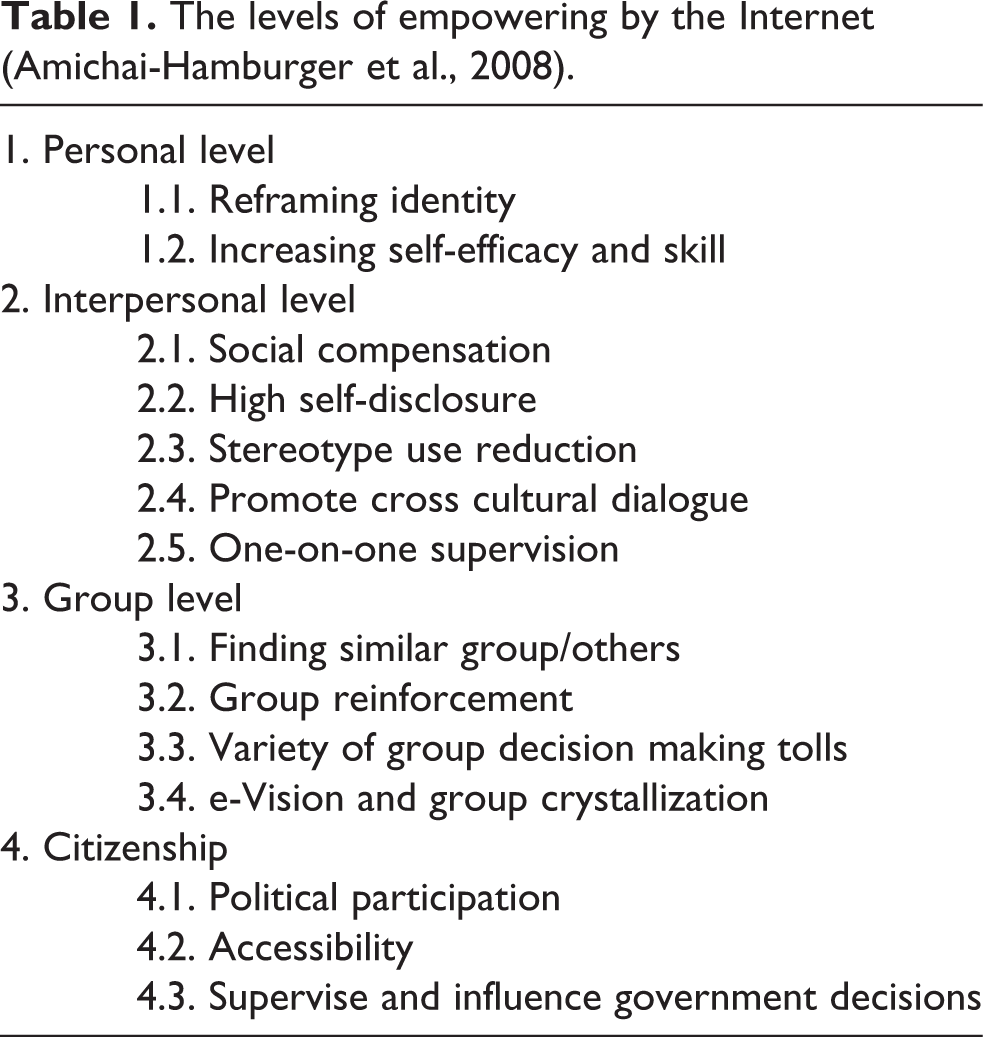
The first is the ‘personal level’, which refers to the effect of the Internet on reframing an individual’s identity and also on developing their abilities and skills. Amichai-Hamburger et al. (2008) claim that online interactions such as gaming, virtual forums and blogs can serve as ‘identity workshops’ in which the users are able to develop and test their social skills (Bruckman, 1992). In addition to the issue of identity, the effect of using the Internet on an individual’s self-efficacy in social networks – such as coping strategies of others, social persuasion, and numerous opportunities – also belongs to this level.
The second level of empowerment is ‘interpersonal’, which concerns the effect of the Internet on people’s ability to communicate. In other words, the Internet allows individuals to have significantly more control over their communications in the virtual world – by choosing what, when and how far to disclose personal information – in comparison with face-to-face communications. In addition, digital resources allow the development of cross-cultural dialogue and also reduce geographical distance and help overcome stereotypes by promoting interpersonal communications.
The third level is the ‘group’, which concerns the effect of the Internet on group communications by fostering the sharing of common interests, strengthening group norms and facilitating brain-storming.
The final level is ‘citizenship’. At this level, the model focuses on the notion of e-government as a facilitator of interaction between government and citizens. Additionally, they argue that the provision of certain digital capacities such as e-voting promotes the ability of citizens to monitor and influence government.
Some roots of the notion of empowerment lie in feminist theory and the notion of popular education theory (Luttrell et al., 2009). Based on this viewpoint, some studies have focused on the critical role of the Internet in the process of empowering women, minorities, and marginalised and disabled citizens (Barak and Sadovsky 2008; Fox et al., 2005; Madge and O’Connor, 2006; Mehra, Merkel and Bishop, 2004; Samoocha et al., 2010; Siddiquee and Kagan, 2006; Sharf, 1997; Theofanos and Mulligan, 2014; Pitts, 2004; Zhao et al., 2008). For example, Pitts (2004) argued that the use of the Internet by women with breast cancer – such as reading and writing about the illness, and in doing so negotiating identity and definitions of the situation in a disembodied space – had a significantly positive effect, allowing them to transgress gender roles, invent themselves and create new forms of knowledge. In another study, Siddiquee and Kagan (2006) considered the use of the Internet and the empowerment of refugee women in the United Kingdom. The study demonstrated that the women successfully used technological engagement to develop their identity and resolve conflicts between their past and present status. In addition, using the Internet was shown to foster the women’s psychological empowerment in terms of actively facilitating their resettlement and integration by developing their social identity, community narratives, and collective consciousness-raising. Barak and Sadovsky (2008) found that the use of the Internet by hearing-impaired adolescents had a significant effect on their well-being and personal empowerment, helping them gain confidence and assurance, and lowering levels of depression, anxiety, and feelings of loneliness. In other words, using the Internet protected them from psychological unease and stress related to fearing and being defensive about stereotypical responses.
Research approach
This study explores how the Internet might affect political empowerment. While there are a few studies which focus on the effect of ICT penetration on political development, to our knowledge no published study has thus far examined how the Internet could affect the political empowerment of citizens. As there is no existing integrated or comprehensive theory of Internet-based political empowerment of citizens, it was necessary to employ qualitative research methods to develop a taxonomy for providing an in-depth understanding of the role of the Internet in political empowerment.
Twenty-nine ordinary citizens 1 of Tehran who had experience in using the Internet in relation to political issues participated in the study. The number of interviewees is consistent with suggestions by Casey (1995). The interviews were unstructured and were conducted and analysed using a narrative research method (Casey, 1995; Riessman, 1993). Narrative inquiry is an approach that aims to understand the way people create meaning in their lives through narratives. According to Clandinin and Connelly (2000), “narrative inquiry is an umbrella term that captures personal and human dimensions of experience over time” (p. 20). The narrative analysis allows participants flexibility and space to answer open-ended questions, rather than relying on a fixed set of interview questions. Observation and a description of the participants’ narratives about their use of the Internet in their daily lives formed the basis of an analysis which aimed to determine how the Internet played a role in their political empowerment.
The interviews began with a ‘grand tour’ question and took an informal approach, while based on a predefined interview protocol. This allowed the participants to narrate their story in their own words, with no or very few interruptions by the researcher (Casey, 1995, Riessman, 1993). A typical question consisted of a broad overview of the study, followed by an open-ended question (e.g. “We are studying the relationship between the Internet and political empowerment. Can you tell me the story of your life?”). The researchers discussed and shared insights immediately after each interview, and generated codes after reading the transcripts. This allowed us to develop a taxonomy which began emerging from the narratives.
The study used the purposeful sampling method, as described by Patton (1990), to select the participants and gave priority to potentially information-rich cases for in-depth studies. The main assumption of narrative inquiry is to use different groups of people. Based on this assumption, ordinary citizens who had experience of using the Internet, especially in relation to political issues, were selected according to their varied contextual backgrounds, such as age, gender, education level and income (see Table 2).
The different contextual backgrounds of ordinary citizens.

This study was conducted in Iran, as representative of developing countries in the Middle East. According to the World Bank (2010), Middle Eastern countries had the highest growth in Internet use in the world during the period 2000 to 2009, with the international growth rate at 1825.3% and the Iranian growth rate at more than 4466% for the same period (World Bank, 2010). Based on these figures, which confirm the considerable growth of IT use in Iran, this country was selected as a good representative of developing countries. The pool of potential participants consisted of all ordinary citizens of Tehran, which has the highest IT penetration ranking and also the highest number of Internet users among the cities in Iran.
Data analysis
All interviews were transcribed into a word processing document by two transcription specialists to ensure accuracy and the maximum level of confidence and connectivity between the citizen responses and the data analysis. The narratives were then coded by using open, axial and selective coding processes. The data was coded by grouping participants’ responses into categories which represented similar ideas, concepts and themes that arose in the interviews (Rubin and Rubin, 1995; Merriam, 2002). Of the 29 interviewees, 21 permitted the use of an audio recorder. All transcripts were converted using the NVivo 9.0 qualitative analysis software package to make the management, analysis, and coding of the data more effective (QSR International, 2008). This program is designed to facilitate the efficient organisation of datasets, eliminate repetitious statements and identify the essential statements. The program reduced the number of coding errors and empowered the researchers to bring the underlying conceptual structure of the texts to the surface using the concepts of ‘nodes’ and ‘cases’. The concepts which were identified in the text were labelled as nodes. Each node could be related to other nodes in three ways: hierarchical, associative or sequential. Each node could represent a sentence, a paragraph or a whole document.
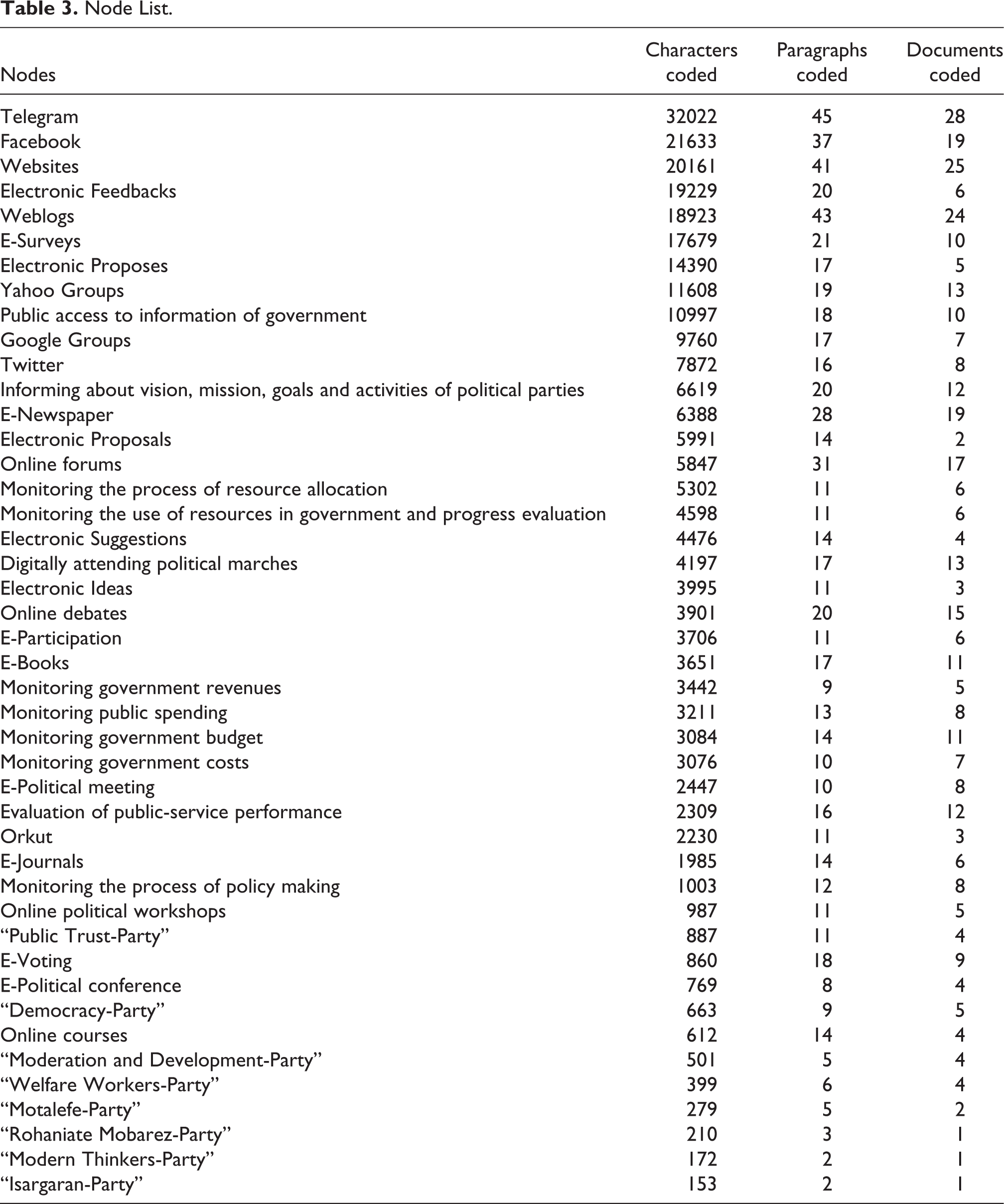
Three researchers carefully reviewed the transcripts and produced three separate lists of nodes. Ultimately, the three lists were merged into one through comparison and a thorough discussion. Finally, a list containing 43 different nodes was developed and agreed upon (see Table 3).
Node List.
Findings: Taxonomy of Internet-based political empowerment
All 29 interviewees emphasised the critical role of the Internet in providing political information to citizens. They stated that some digital platforms and resources such as online forums, online debates, online political workshops, weblogs, e-books, and e-journals improve access to political information and the levels of knowledge of citizens. In 20 interviews, virtual social networks – such as Telegram, Facebook, Twitter, Orkut, and the virtual groups of Yahoo and Google – were mentioned. These participants stated that using the networks improved their access to political information and awareness. Fifteen participants emphasised that Internet use increased their ability to monitor the political system closely. They implied that the Internet empowered citizens to control the process of resource allocation, the government budget and public spending, and also to evaluate the performance of the government and the political system. In 14 interviews, the participants implied that the provision of some digital resources improves the activities of political parties and better informs people about their efforts. Eleven participants pointed out that their Internet use provided several opportunities for them to make political decisions directly using digital resources. Six participants emphasised that the provision of some digital capacities improves the interaction between citizens and their political system and also better informs government officials and the political systems about citizen opinions, suggestions, ideas and criticism.
Careful review of the nodes listed in Table 3 revealed that they were not homogenous in terms of scope and representativeness. Some related to political awareness (e.g. digital information) while others concerned political participation (e.g. political decision-making). As suggested by Strauss and Corbin (2008), these nodes were grouped into subcategories and super-categories, revealing an underlying structure (Table 4). Based on the interviews, two general conceptual categories emerged: political awareness and political participation.
Categorization of nodes.
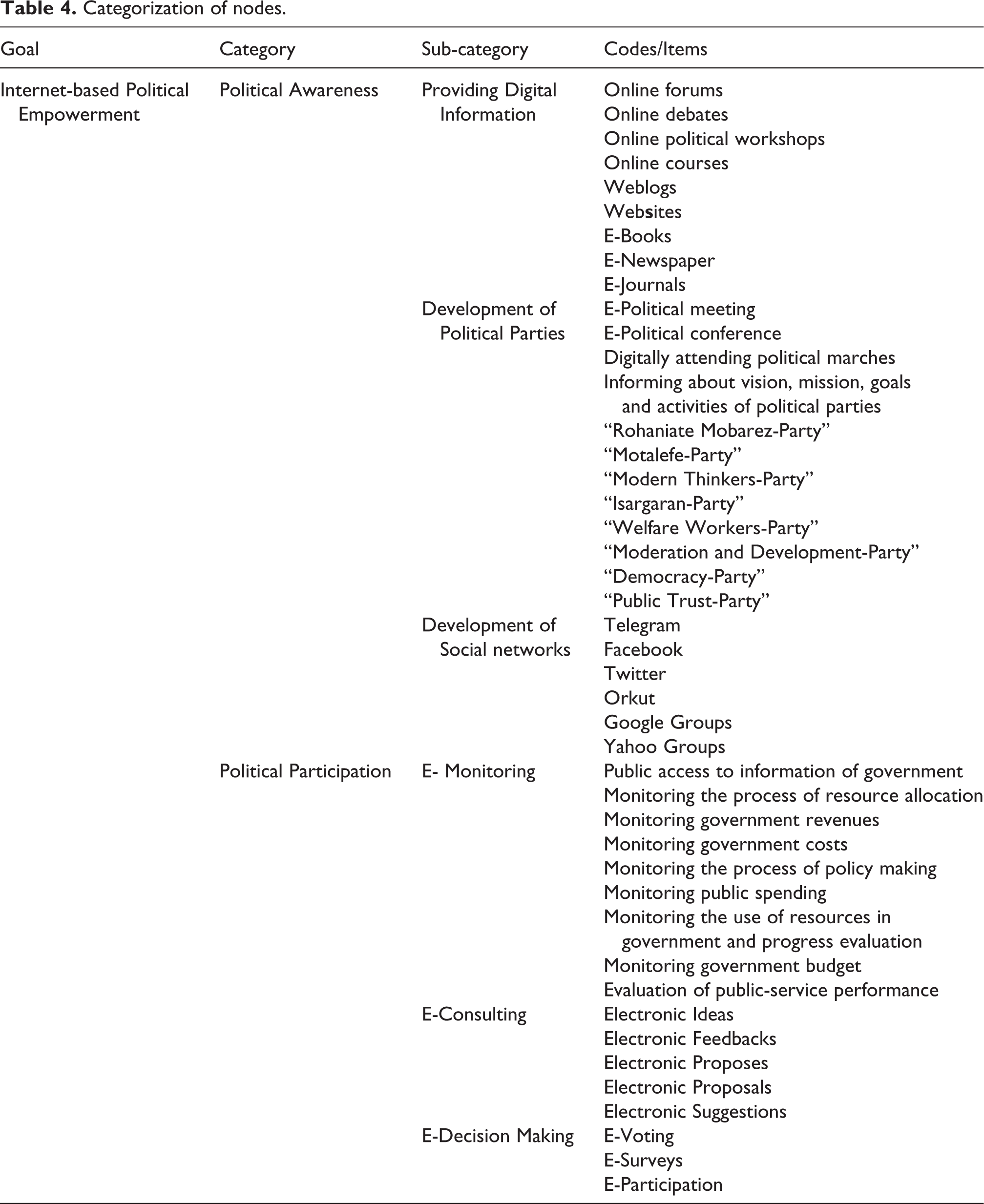
Political awareness is classified into three general areas: ‘digital information’, which refers to the gathering and distribution of a large volume of political information through digital technologies such as the Internet; ‘political parties’, which refers to the development of the activities of political parties using digital technologies; and ‘social networks’, which refers to the development of communication using social networks.
The second general category, political participation, has three sub-categories: ‘e-public monitoring’ refers to an increase in the ability of citizens to monitor the government and political system closely; ‘e-consulting’ refers to the development of interaction between citizens and the political system using digital technologies; and ‘e-decision-making’ refers to direct political decision-making of citizens using digital resources.
The analysis of the interviews resulted in six findings, which illustrate how the Internet can affect the political empowerment of citizens through several ways (Figure 1). Each of the effects might not operate in isolation. The influences of the use of one effect might be dependent on another effect and can also be positive or negative. Furthermore, the combination of effects can strengthen the resulting higher political empowerment. Each finding, their effects and their interdependence should be tested in further research.
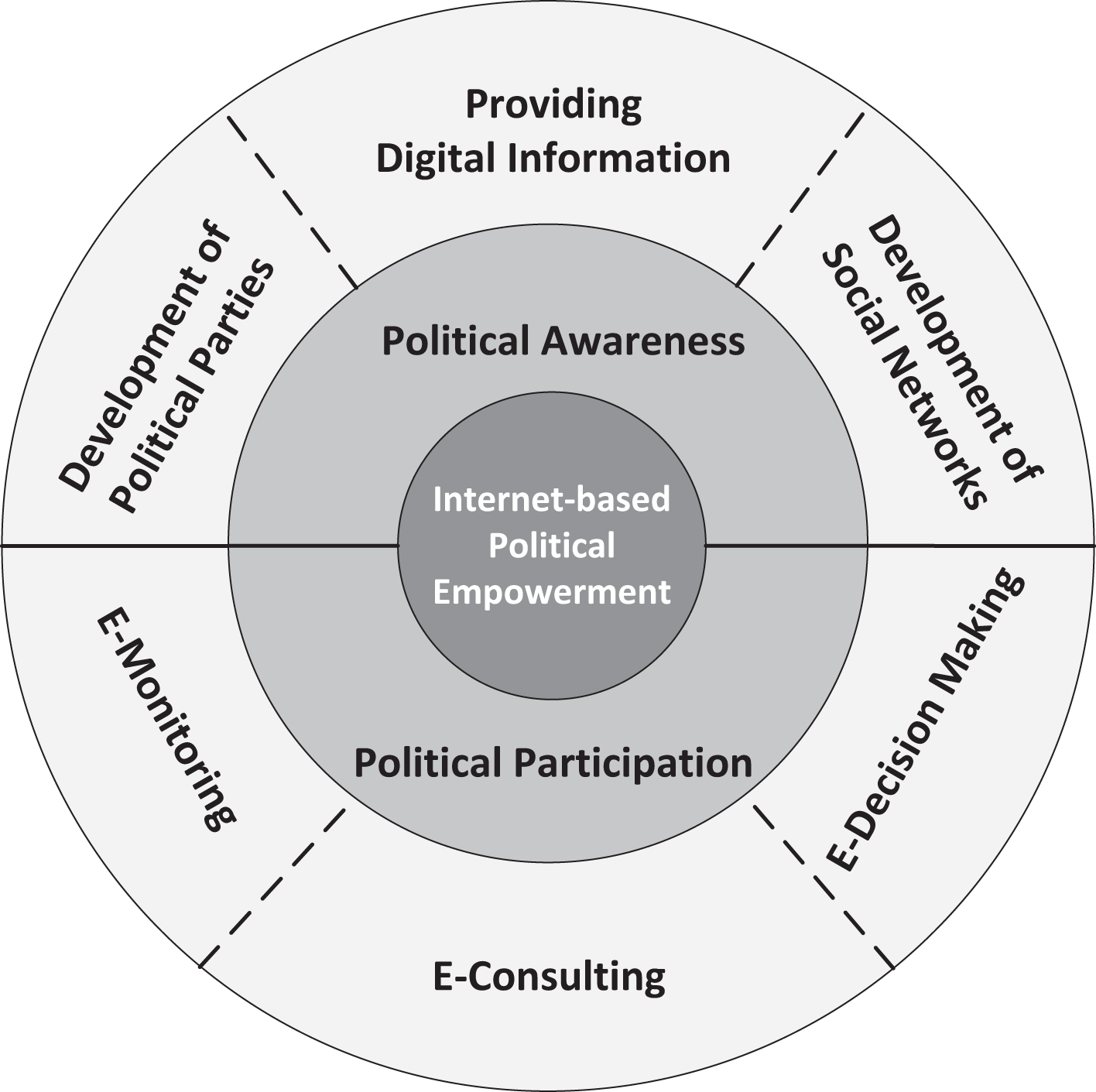
The taxonomy of internet-based political empowerment.
Finding 1: Providing political information digitally affects the political awareness of citizens
The citizens who participated in the study emphasised the critical role of the Internet in gathering and distributing a large volume of political information rapidly and at low cost. They believed that using the Internet affected the political awareness of citizens through several ways. Firstly, they suggested that the Internet helps develop communication between citizens, providing cyber space platforms, such as online forums which allow debate, where they may express their political ideas. They indicated that by informing citizens about other people’s ideas on political issues, these digital platforms helped citizens recognise the different aspects associated with the political issues, developed their intellectual framework and improved their political awareness. Secondly, the participants stated that some digital capacities provided by the Internet, such as online political workshops and courses provided by NGOs and academic institutions, improved the process of political learning and developed the political knowledge of citizens.
According to the interviews, by providing a large volume of digital information to citizens, the Internet improves both their political knowledge and their political skills and abilities. By providing digital capacities, such as online political workshops, online political forums and debates, online books and online journals, the Internet increases citizens’ skills to influence their political system and improve its political efficiency. According to Luttrell et al. (2009), this is a form of psychological empowerment. Luttrell et al. concluded that citizens’ sense of, or belief in, their ability to make decisions and to solve their own problems is a critical part of the empowerment process.
These findings are consistent with previous research and imply that web technologies and online courses and workshops increase the levels of communication, develop political debate, and improve people’s knowledge and awareness (Albrecht, 2006; Bimber, 2003; Carvalho and Ferreira, 2001; Dahlgren, 2005; Sasaki, 2016; Tolbert et al., 2003), However, other studies show the possible dark side of the Internet’s effects on political awareness of citizens. For example, the credibility of digital sources of political information can affect the political awareness of citizens in a negative manner. The credibility of many sources on the Internet is not clear and information can be used to manipulate (‘fake news’) and direct the political awareness of the citizens in specific directions.
The other concern related to the dark side of the effect is Internet censorship, which refers to strict control over cyberspace through the state-owned telecommunications monopoly in some countries. As there is no freedom of information, governments can provide only biased information and make citizens aware only of matters of limited and specific interest, which serves governments’ own interests.
Although most of the citizens who participated in the study focused on the positive side of the Internet’s effects on citizens’ political awareness, the Internet can also play a negative role in this respect. The Internet as a new technology is not a neutral phenomenon and its effects on political awareness are highly dependent on the social, political, and economy context.
Finding 2: Developing the digital activities of political parties affects the political awareness of citizens
The interviewees suggested that some services provided via the Internet – such as digital meeting places, digital campaigns, digital conferences and digital newsletters – influence the activities of political parties. The participants emphasised that they received more information about the activities of the parties through the Internet, and were also better informed about the vision, mission, goals, and activities of these political parties. Most of the participants believed that the Internet can become a platform for dialogue for political parties. Online activities of political parties can influence and change the political attitudes of citizens.
According to the literature, political parties have an important role in developing the political awareness of people and also in improving the political skills and abilities of citizens by arranging political meetings and discussions (Dalton, 1996; Rose and Urwin, 1969). As Hague and Loader (1999) stated: ‘The political parties aggregate values from people into the political systems, and also have the possibility to adopt their own, existing, policy and programs to meet those value-based requirements of the electorate, expressing public interest and prioritizing prospective public policy action’”(p. 137). Dalton and Wattenberg (2002) discussed the ability of the Internet to create more targeted debates. They found that digital campaigns can change the focus of citizens’ attention from local issues to national and international matters.
In other words, in a society which has active political parties, citizens believe that they can influence their political system and also put pressure on the political system to be more efficient. In addition, by motivating citizens to take part in political activities and making citizens believe that they have a decisive role in political issues, political parties increase citizens’ political commitment, encourage them to be more involved in their communities and more politically active in their society.
Although developing the use of digital technologies could prepare more communication channels between the political parties and citizens at low cost without any time and place limitations, the effects on citizens’ political awareness of developing the activities of political parties are highly related to the political, financial, and media power of the parties. It means that parties with greater power in a society are likely to have more effects on developing or directing the political awareness of citizens.
Finding 3: Developing the social communication through social networks affects the political awareness of citizens
The participants in the study suggested that virtual social networks such as Telegram, Facebook, and Twitter develop the levels of social communication in society. They stated that before the emergence of these social networks, they could only communicate with each other in limited ways, such as face-to-face or by telephone, but in recent years, the Internet and digital technologies can be used to improve social communication. The interviewees emphasised that using the virtual social networks increased their access to political information, thus making them better informed about the latest political events. Additionally, they suggested that the social networks helped them gain more information about political demonstrations, which increased the rate of attendance and participation in such events. In other words, by developing social communication and informing citizens about political demonstrations, social networks can increase the involvement of citizens in their community and their political activities, which are two important factors in the political empowerment of citizens.
According to McLeod and Scheufele (1999), participation in civic forums and social networks increases the levels of interpersonal discussion and improves the political awareness of citizens. In addition, Passy (2001) found that the longer the duration of citizens being active on social networks and the greater their level of activity on social networks, the stronger their political awareness. Furthermore, social media – in particular, Facebook and Twitter – can encourage citizens to act as social or political activists (Gil de Zúñiga et al., 2009).
Despite several evidences for supporting the role of social networks in developing the citizens’ political awareness (cf. Levy, 2008; Marzouki et al., 2012; Reuter and Szakonyi, 2015), some researches have emphasized the other side of the coin. Although developing the digital social networks could increase the quantity of citizens’ ideas, the diversity of citizens’ opinions on social, political, and economy issues might be reduced (Johnson and Huckfeldt, 2001; Loukis et al., 2014; Zuckerman, 2005), since the ideas are based on each other and citizens are merely repeating each other’s ideas. Accordingly, in analyzing the impact of virtual social networks on citizens’ political awareness, the negative aspects should be taken into account.
Finding 4: Developing public monitoring through digital facilities affects the citizens’ political participation
The participants in the study emphasised that the Internet increased their ability to monitor the government. They suggested, for example, that dashboards can be generated and open data portals can provide insight into the functioning of the government, such as how much of the budget is spent on what. According to the interviewees, the most important expectations and desires of citizens relate to the ability to monitor the processes of resource allocation, revenues, costs, policymaking and other functions of the government and the political system, in order to ensure that they are performing their duties and fulfilling their responsibilities satisfactorily. In other words, facilitating the process of public monitoring mostly affects the psychological roots of the citizens’ participation. When citizens recognise that they have been able to influence the political system and force it to be more efficient, their willingness and commitment to participate as active citizens in public sphere can increase.
Research in the field of public administration has emphasised the need for public control over government (Adserà et al., 2003; Hartley and Russett, 1992). Some scholars have noted that when citizens have more control over their government and the political system, public trust in the government and the political participation of citizens in their society may increase (Lee, 2004; Oberg, 2002). Other studies (Bartle and Vass, 2007; Hofmann, 2015; Shulman et al., 2003; Ranson, 2003) have emphasised that public control improves transparency and accountability and that this may increase the political participation of citizens. These studies concluded that when citizens have more control over government activities, public organisations have to be more transparent and accountable. For this reason, citizens are encouraged to participate as active members of the social and political realms.
Finding 5: Developing the consultant role of citizens through digital facilities affects their political participation
The participants in this study believed that citizens stand in the first line of encounter with the social, political and economic problems of society. Because they face the problems in practice, they have many ideas, proposals and criticisms which may help governments and public organisations solve the problems appropriately and in a timely manner, and also improve the process of policymaking. The participants emphasised that in the age of the information revolution new technologies such as the Internet – and the digital resources it provides – improve interaction between citizens and government, and also inform governments about the ideas and criticisms of citizens. According to the literature, and as our participants emphasised, increasing use of the Internet improves the communication channels between citizens and government, which affects the levels of public trust (Parent et al., 2005; Welch and Hinnant, 2003) and strengthens the belief of citizens that their ideas and criticisms are being addressed. Finally, this, in turn, may improve the efficiency of the political system. As stated by Yang and Lan (2010), by encouraging citizen/expert collaboration and reducing resource differences between citizens and policy experts, the Internet positively affects expert/citizen interaction in the process of policymaking. In this situation, when citizens realise that they can influence the political system, their political commitment increases. This further develops the levels of interaction with government and public organisations, which finally leads to more political participation.
Finding 6: Involving citizens in the process of public decision-making affects their political participation
The citizens who participated in the research implied that gathering people in one place to make political decisions was impossible before the Internet was used. Digital facilities provides over the Internet can be used for political actions such as online voting, referendum, and campaigns. This provides an opportunity to directly influence public decision-making.
Another obstacle to participation is related to the ability, skills, and knowledge of citizens. Do they have sufficient information and knowledge about the social, political and economic aspects of their society to be able to make a difference? While the Internet lowers the threshold of direct participation, there is still a digital divide. Most democratic nations rely on representative democracy, where ordinary people elect others as their representatives and indirectly participate in the process of decision-making in their society.
As Nixon (1999) argued, only people can solve problems that people create. Several scholars have thus emphasised the importance of public participation, especially direct participation, for society. They also believe that in the age of information technology, a new form of democracy, called ‘e-democracy’ should be introduced, through which people can engage in political activities, such as agenda-setting, decision-making, and policy formulation directly using digital resources. Taveesin and Brown (2006) provide evidence that online information-seeking has been linked to the increased online interaction which supplements interpersonal relations, and ultimately result in higher levels of group membership, community involvement, and political activity. In this situation, when citizens realise that they can engage in decision-making and influence the political system, their political commitment can increase (Alvarez and Hall, 2008; Ainsworth et al., 2005; Chadwick, 2003; Mahrer and Krimmer, 2005; Macintosh, 2004; Amichai-Hamburger et al., 2008).
Conclusions and future research
This study used a narrative inquiry approach to developing a taxonomy to explore how the Internet influences the political empowerment of citizens. Two main categories and six subcategories were identified.
The first main category was political awareness, which includes three sub-categories that contribute to influences the political awareness of citizens.
The first subcategory was ‘providing digital information’. The results of the study indicated that the provision of digital resources over the Internet – such as online political workshops, online political forums and debates, online books and online journals – can influence political efficiency, which is a critical factor in the process of citizens’ political empowerment. The results clarified that developing the process of political learning and improving the political knowledge of citizens and social communication, digital technologies, especially the Internet, empower citizens and help them to realise that they have the skills to influence the political system.
The second subcategory was ‘development of political parties’. The study found that by encouraging the activities of political parties, the Internet influences the political awareness of citizens and also affects levels of political commitment, political efficiency, political action and community involvement, which are critical factors in the political empowerment of citizens. We found that some digital services – such as digital meeting places, digital conferences and digital newsletters – allow the development of the activities of political parties and increase their membership. When a society has active and powerful political parties, and citizens recognise that they can affect the political system to improve the political efficiency of these parties, the political commitment of citizens increases.
The third subcategory was ‘development of social networks’. The results of the study suggest that by providing social networks, the Internet influences the political awareness of citizens and also affects their levels of political action and community involvement, which are two important factors in the political empowerment of citizens. The results of the interviews, summarized in Finding 3, indicate that Internet usage by citizens improves social communication, informs people about the latest political events and also increases their involvement in their communities and their political activity in society.
The second main category which affects the political empowerment of citizens through the Internet concerned the political participation of citizens and also included three sub-categories.
The first was ‘electronic monitoring’, which refers to the monitoring of the political system by citizens through digital platforms provided by the Internet. The results of the study implied that by facilitating the process of monitoring the political system by citizens, the Internet influences their levels of political participation and affects their political action and political commitment, which are two critical factors in the political empowerment of citizens. The findings result implied that using the resources provided by the Internet to monitor the political system makes citizens believe that they can influence their political system and also put pressure on the political system to make it more efficient.
The second subcategory was ‘electronic consulting’. Our findings suggest that Internet usage by citizens increases the degree of interaction between citizens and the political system, which influences the levels of political participation of citizens and affects their political efficiency and political commitment, which are two important factors in the political empowerment of citizens. The results of the study, which related to Finding 5, suggest that by providing digital resources, the Internet allows citizens to become consultants within the political system. This situation improves the political commitment of citizens and also informs the political system about the ideas, proposals, and criticisms of citizens, which help governments and public organisations to be more efficient.
The third subcategory was ‘electronic decision-making’. The results of the study show that by facilitating the process of decision-making by citizens, the Internet affects political commitment, political efficacy, and political action, which are three critical factors in the political empowerment of citizens. According to Finding 6, our citizens using the Internet are more politically engaged and have more confidence that they can make decisions and influence the political system. In this situation, their political participation and their political commitment can increase.
The taxonomy developed in this paper can be used by organisations and governments to empower the public. At global level international organisations such as the United Nations and the World Bank, or at national level the governments, can guide their support and development plans in the light of the dimensions discovered in this study in order to empower citizens as a key factor in the process of human society development.
As the notion of Internet-based political empowerment had not been studied previously, we used narrative inquiry to identify the key dimensions of the construct. Future research might further explore the causal relationships between the dimensions in a broad context. Furthermore, the effectiveness of each of the findings might also be evaluated and tested.
A sample of ordinary citizens who had experience using the Internet, especially in relation to political issues, was selected by purposeful sampling to explore the effect of the Internet on their sense of political empowerment. Future research might select different categories of citizens based on gender, age, education level and incomes. Future research might also explore the effects based on the viewpoints of socio-political experts, IT experts, and politicians, which would help to understand their perspectives on the effects. Finally, this study was conducted in Iran as a developing country which has the highest usage and growth in Internet usage among Middle Eastern countries. Future research might explore the effect of the Internet on political empowerment in other kinds of countries, such as those that are less developed, in order to explore the extent to which we can generalise about the effects identified in this study.