




Abstract
This study explored the difficulties faced by novice LIS researchers while formulating a topic. Qualitative research design was used to conduct this inquiry. Three focus-groups were conducted with research students enrolled in postgraduate programs at three LIS schools in the public-sector universities of Pakistan. The results indicated that lack of conceptual clarity, poor time management, and lacks of research culture were the major difficulties faced by the participants. These participants relied mainly on previously produced theses, research articles and their supervisors’ help for conducting and producing their own work. The areas highlighted for improvement were primarily about the supervisors’ role and the enhancement of the students’ knowledge, training and practice during the course work. It is hoped that these results would not only be beneficial to the faculty involved in both supervision and teaching the research courses but also can play an instrumental role in streamlining topic formulation instructions in the curriculum. Despite being a case study of information professionals, the findings are most likely to be of wider interest for other subjects.
Keywords
Introduction
Formulating a research topic lies at the foundation stage of a research project that has a major impact and effect on the subsequent stages and outcomes of a research project. Therefore, the formulation of an appropriate topic is of immense importance to both a researcher and the field of study. It establishes the researcher’s ability to conduct an independent research that is intended to add a significant sum of knowledge to a field of research. Formulation of a good research topic requires development of certain cognitive skills by a novice researcher, otherwise they tend to become anxious and uncomfortable during developing their research proposals as a part of their degree requirement. Montuori (2013) and Loulanski (2009) identified it as one of the frequent problems that doctoral students face when they have to write a research proposal.
The principal researcher for this study has more than 10 years’ experience as an instructor and a thesis supervisor. After a decade’s observation of the behavior of the researching students, experience, supervision and discussions with colleagues has established that novice researchers find it highly challenging to formulate a significant problem or area to investigate. It takes immense time, effort and anxiety for both supervisors and researchers. It is with this backdrop that the current study has been designed. The purpose is to explore the nature of difficulties faced with regards to the formulation of a topic.
An extensive review of the literature indicated a dearth of research exploring and focusing on the phenomenon in general, and the issues that novice researchers face while formulating their research topic. Only a few studies have addressed some aspects of the phenomenon. For instance, the studies of Erfanmanesh et al. (2012) and Naveed and Ameen (2017a) reported barriers among postgraduate students regarding topic selection, exploration, focus formulation, and gathering relevant information on the research theme in question. However, subsequent studies by Erfanmanesh et al., (2014a, 2014b) have found ‘barriers associated with topic identification’ as least prevalent among postgraduate students in Malaysia. On the contrary, topic related anxiety was the most prevalent among postgraduate students in Pakistan (Naveed, 2015; 2017; Naveed and Ameen, 2017b). In another qualitative study, Naveed (2016) discovered students’ anxiety regarding their research topic and reported that students considered topic formulations problematic and too time-consuming, causing unknown psychological stress among them, which was named as thematic anxiety.
Some studies were found on the factors influencing students’ choices regarding topic selection (Barr, 1984; Issac et al., 1989; Olalere et al., 2014; Xia, 2013) while others have examined published materials for writing thesis and dissertations (Paltridge, 2002) and psychological factors and barriers in dissertation completion (Green, 1997). Barr (1984) and Xia, (2013) have investigated the factors influencing students’ choices regarding topic selection. I’Anson and Smith (2004) have explored issues of topic selection, access and data collection amongst tourism management students while writing undergraduate research projects and dissertations. They revealed that students’ personal interest, career aspirations, and perception about easy access to primary data or relevant literature were the primary factors while choosing a research topic. Isaac, Koenigsknecht et al. (1989) discovered that advisor’s preferences, field trends, likelihood to be published, and projected career benefits were the major factors influencing doctoral students’ selection of topics for dissertation. The study of Olalere et al. (2014), while examining the factors affecting doctoral student’s choice about dissertation topics, revealed that students’ topic choices were influenced by departmental research agenda, core courses, and both personal and professional experiences.
A perusal of published research indicated that not much has been investigated directly about the difficulties novice researchers face while formulating a research topic. Therefore, a need was felt to address this phenomenon using qualitative research design to obtain pragmatic insights and to identify the difficulties. It was assumed that the findings would guide all stake holders about the improvements in cognitive learning and pedagogical practices needed to be better able to formulate a viable topic instead of facing undue anxiety. Moreover, though the study has been conducted in the Pakistani context, it is assumed that the findings might be applicable in other developing countries generally and South Asians particularly with similar academic traditions.
Research questions
The following research questions were broadly initiated to meet the aim of this qualitative study: What strategies do novice researchers adopt for finding a viable research topic? What type of difficulties novice researchers face while formulating a research topic? What do novice researchers suggest for addressing those difficulties?
Research methods
The qualitative research design was chosen following the phenomenological approach described by Creswell (2013). It was decided to explore the phenomenon to better understand their problems in this regard using focus-group as the data collection technique.
Population and sampling
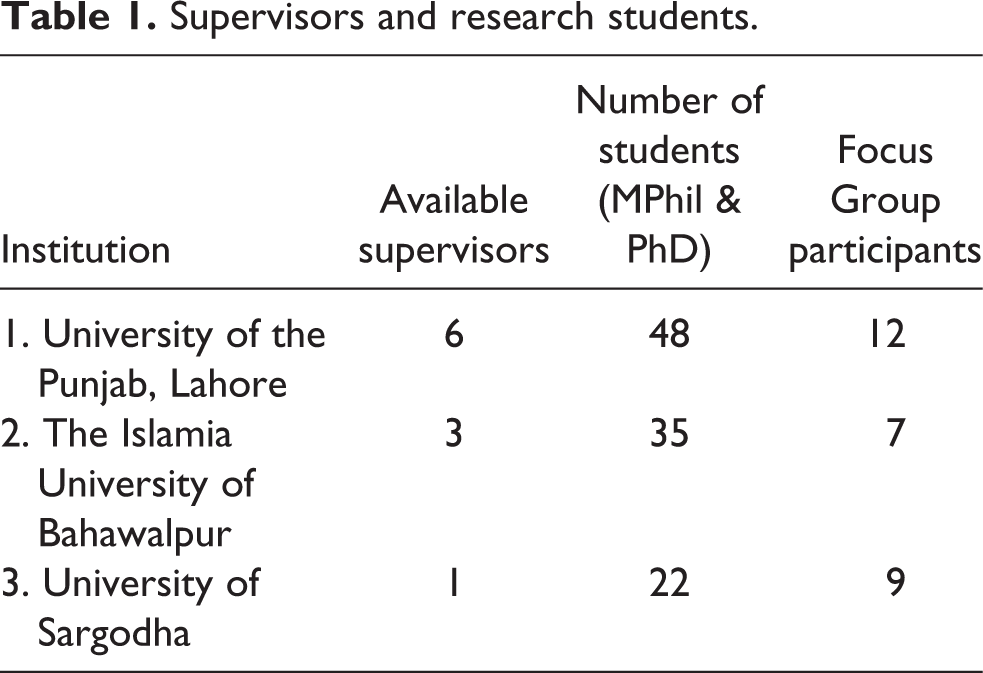
All the postgraduate students enrolled at three LIS departments of public-sector universities, namely, University of the Punjab, The Islamia University of Bahawalpur, and University of Sargodha, from Punjab province, were considered as population for this study. The selection of these departments was made because of the availability of regular coursework and thesis-based MPhil and PhD programs according to HEC (Higher Education Commission) guidelines. Each department had a different number of MPhil and PhD students at various stages of the programs and faculty members available for their supervision. This study purposively selected only those students who had completed their course work and were at the stage of topic formulation, synopsis or thesis writing, with the help of a research supervisor at each department (Table 1). Participants were expected to provide valuable information regarding proposed research questions which could not be obtained from random or any other selection criteria.
Supervisors and research students.
Data collection and analysis
A total of three focus groups were conducted for data collection by visiting the selected departments; they were tape recorded and transcribed carefully for accuracy and reliability of data. The transcribed data were analyzed using thematic analysis to help select specific data carefully, analyze it, and report findings. The study used this technique to identify meaningful experiences of novice researchers during the stage of topic formulation. The initial codes emerged while reading data carefully and repeatedly. Then NVivo 11 was used to organize and manage it. Using a data driven approach, broader implications of data (themes) emerged after first and second level coding. Finally, five themes emerged as follows: helpful information sources factors behind selecting a research problem students’ cognitive skills and attitudes factors causing anxiety and problems suggested areas for improvement
The participants talked more on factors causing anxiety and problem areas, which was followed by helpful information sources in formulating research topic.
Trustworthiness and ethical considerations
Each focusgroup was conducted by visiting the universities after getting written permission from the departmental head, followed by the students’ consent for participation. An orientation was given to the participants about the research purpose and value of their participation in focus group. They were assured of confidentiality and anonymity to make them comfortable in expressing their views. Each focus group was taken forward after establishing a rapport with the participants. The duration for each focus group was different, ranging approximately between one to two hours. The participants of each focus group were debriefed at the end for data substantiation and authentication. The selected statements of the participants have been given using their codes to hide identification.
Results
This section presents the findings adopting ‘realistic’ style of reporting (Gorman and Clayton, 2005: 237) according to the emerged five themes. Since the aim was to understand the phenomenon overall, the findings about each group have not been presented separately.
Helpful information sources
In response to the first question about the strategies they adopt to formulate a research topic, the participants talked about the information sources they found helpful in this regard. Figure 1 shows that they found previous theses, research articles and their supervisors most helpful in this regard. They also considered that their discussion with seniors and coursework completed helped them to some extent in problem selection. They were of the view that senior fellows’ knowledge also helped them in avoiding duplication in research topics. For example, one researcher mentioned: “We discuss with colleagues and many topics are rejected due to repetition (R4)”
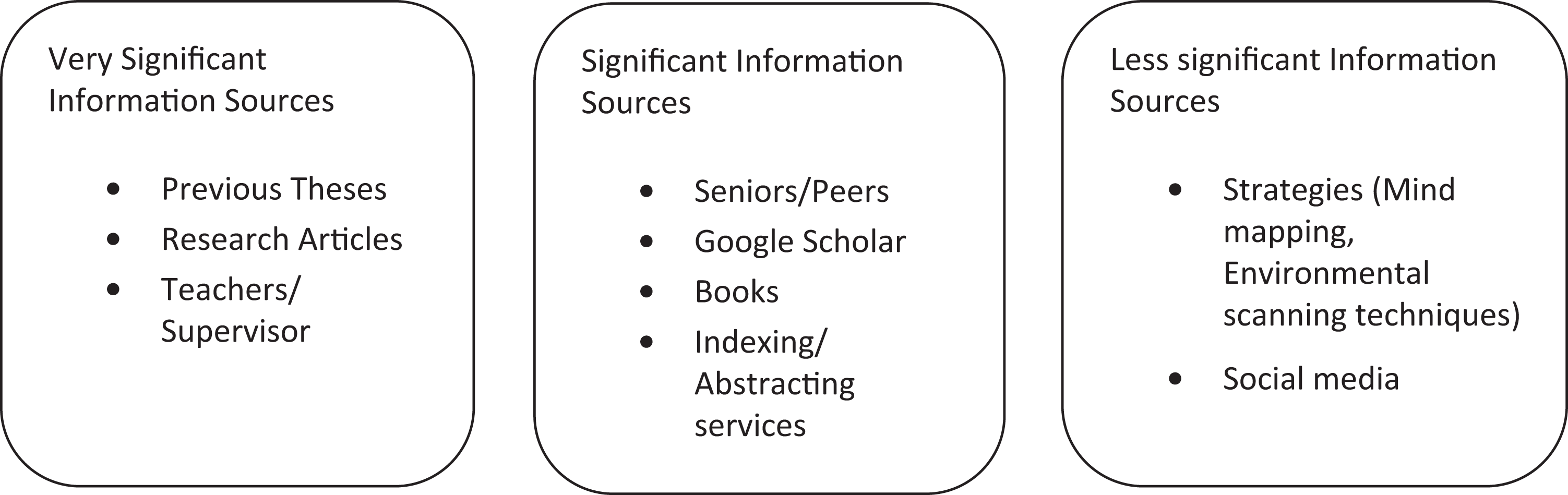
Participants’ Useful Information Sources in Selecting Research Problem.
Only a few participants mentioned that some online sources such as Google Scholar, books, indexing and abstracting services were also helpful for this purpose. The analysis shows that a few participants talked about the strategies such as ‘mind mapping’ and ‘environmental scanning’ as helpful in looking at different aspects of the proposed research problem. The participants also used social media sites (Research Gate and Academia) to find out research problems, however, only a few found these sources supportive.
Factors behind selecting a research problem
In response to the subsequent question about the factors that motivated the participants for the selected research topic, they mentioned several. It shows that the respondents selected their research topics following generally two approaches: (i) by getting ideas from previous studies, and (ii) their preference for a research design: qualitative or quantitative. A few participants said that they selected those topics in which their preferred research design, method and data collection technique could be applied. It is interesting to note that instead of choosing research topic first and then choosing a research methodology accordingly, they would decide on methodologies first and fix research problem accordingly. One of the interesting finding a few participants shared was that their supervisors advised them on selecting specific research methods instead of formulating a research problem. One participant (7) expressed as: “Instructor advised to apply experimental research”. Many of the participants mentioned that it all depends on supervisor’s expertise and research interests. They were of the view that they considered those areas which the faculty had already worked or were experts at. Only a few participants would select research problems in the context of practical issues in real situations.
Regarding choice of research design, respondents would select those research topics which could be addressed using a quantitative approach based on the survey method. It was the most popular method among the respondents. They perceived that execution of the survey research method is easier than other research methods. When respondents were inquired about their criteria for selection of a research topic, they stated that they usually selected those topics (for research) for which survey research method could be applicable, because of its common use in the local scenario. One extracted statement support this fact: I select[ed] that topic in which there is convenience in applying the research method [Survey] (P12)
Cognitive skills and attitude
The respondents talked about improvement in their various related skills during the coursework and topic selection process. Most of them mentioned that their searching skills improved by learning new information retrieval techniques. One interviewee expressed that her technical reading skill improved as she could comprehend the content of a research article without a thorough reading. Overall, findings show that only a few participants had developed efficient and effective searching and reading skills during course work.
As for participants’ learning of topic development skills, varied results were obtained. Only a few claimed to be confident enough to formulate a research problem while the majority of them needed more guidance. The students explained that they all were at different levels of understanding. The results establish that their cognitive development needed much improvement even after successfully completing 6-9 credits courses on various research methodologies to be able to formulate an appropriate research topic.
Factors causing anxiety and problem areas
The discussion around the second research question about types of difficulties novice researchers face at the stage of topic formulation culminated in themes about factors related to anxiety and the problems in this regard. The main hindrance in the selection of a research topic was their ‘lack of conceptual clarity’ and lack of access to literature (the participants were unable to access or find local and international published and unpublished literature).
Lack of conceptual clarity
One of the major factors affecting them was lack of conceptual clarity about the relevant learning. The participants mentioned that while selecting research problems they lacked critical thinking skills, skills in applying theory in practice and experienced failure in defining the parameters of a research problem. They also had problems in selecting appropriate research design, method and data collection techniques. The respondents believed that they could conceive research topic ideas from international literature; however, due to lack of conceptual clarity they were unable to use those precisely in the local context. They also mentioned that sometimes international studies’ research ideas are interesting but those studies used different research methods (e.g., Delphi, Content-analysis) other than survey; therefore, they find it difficult to research such topics. Some respondents explained: Difficult to apply international studies [research methodology] approach into local context. (P8)
Difficulty in using research methods (e.g. Delphi, content-analysis) [other than survey research], this caused anxiety. (P3)
Difficult to develop research objectives and questions for not [already] researched topics [in local context]. (P8)
Literature accessibility issues
The other big issue was literature accessibility and availability while selecting research topics. They highlighted the fact that international literature was not helpful in selection of a topic and local literature availability was very limited. They showed concern about non-availability of updated lists of Pakistani theses and talked about their ignorance of research published by other library schools in the country. These respondents mentioned that: We could not find relevant and local literature, limited literature availability caused anxiety. (R5)
Foreign trends are not applicable in local scenario. (R2)
Lack of supportive literature and trainings
Inappropriate guidance and training about selection of a research problem during course work also caused anxiety among participants, as several discussed that the relevant literature on the subject and practical assignments on problem selection were not part of the course work. However, only a few pointed out non-availability of their instructors and supervisors after class. One respondent expressed, We need to make proposal at the coursework stage, there should be such assignment or course. (R1) We searched on our interested topic, there is already work done, sometimes even we cannot change population. (R3)
While selecting research problems, duplication of research topics caused anxiety. (R6)
Non-supportive infrastructure
Another problem highlighted was non-supportive information and library infrastructure as the target of investigation for research. They believed that foreign research trends could not be replicated or studied in the local context due to less advanced infrastructure and data accessibility issues. After conceiving research ideas from international literature review, the participants would find them not applicable to addressing the local context.
Personal issues
The respondents also talked about their personal issues as a barrier such as the lack of time due to their jobs and family engagements. They admitted that they could not give proper time to the problem formulation process due to burden of other work and family related responsibilities. Returning to post-graduate formal education after quite a long gap was also a barrier in effective learning outcomes (most of them joined research degree programs with a gap of few years after graduation).
Discouragements from supervisors and peers
They complained about facing discouragement sometimes from their peers, supervisors or instructors. A lack of moral support was mentioned as an issue by the participants. They explained that at the early stages of problem selection, they needed more emotional support by supervisors: At early stages of research, we felt lonely without guidance. (R12)
Language barriers
Another major barrier causing anxiety among some students was the lack of strong English language writing skills. They could conceive a research problem but would not be able to write eloquently in academic writing. The weak learning of English as a second language from early education to higher level was a big barrier while composing and writing ideas.
Suggested areas for improvement
In response to the last question seeking their suggestions about the improvements in the state of affairs, the participants talked about multiple aspects. Figure 2 shows that mainly they wanted change in instruction strategy during the coursework. They were of the view that they should be guided more on research methodology and reviewing literature. Instruction should be evidence-based focusing on practical assignments.
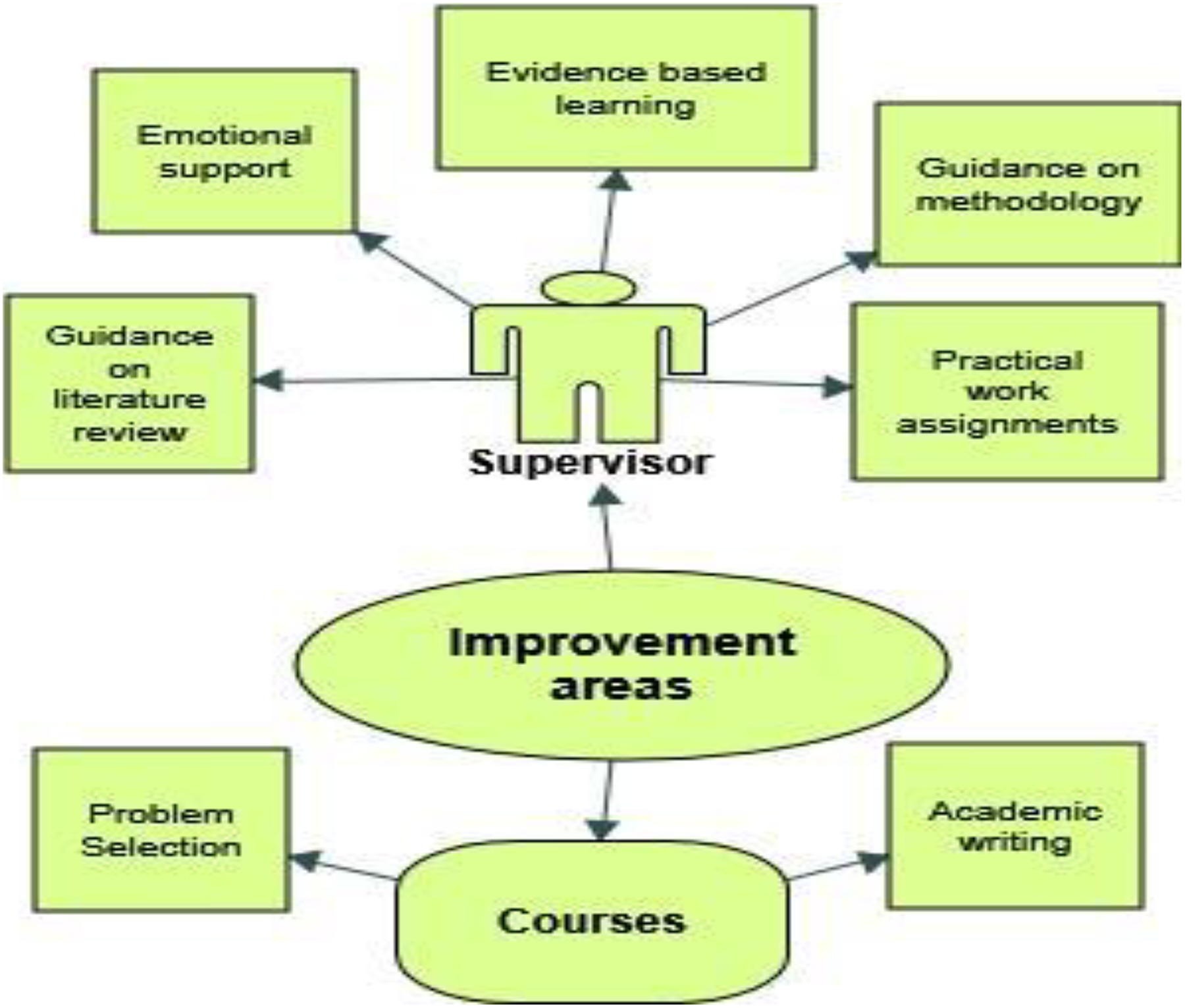
Suggested areas for improvement
Secondly, respondents highlighted that their coursework is more of a theoretical nature. Courses on academic writing skills and research problems selection strategies should be incorporated. They also admitted that they themselves should consult quality print sources instead of relying merely on conveniently available online information sources.
Participants urged more supervisor’s and instructor’s availability, guidance and emotional support.
Discussion
The results reveal the real issues novice researchers face at the verge of their research proposal formulation. It is evident that they would face many issues during this stage, and addressing them should lessen the ‘thematic anxiety’ among novice researchers. It would enhance future researchers’ productivity with better pedagogical and cognitive development strategies.
The findings of the present study regarding problems of accessibility are consistent with the study by I’Anson and Smith (2004) which established that students were concerned about better accessibility of literature which would support them in selecting research problems. The present study informants mentioned specifically a lack of access to the local literature as a hindrance in topic identification.
Some findings about factors behind topic selection are different from previous studies. For example, Olalere et al. (2014) reported that as far as topic formulation was concerned, the participants were influenced by faculty members’ research projects, advisor’s preference, new trends in the field, core courses offered by department and their own professional and personal experiences. The present study shows that participants selected topics mainly based on convenient research methodology and inspiration from previous studies. It appears that the motivators behind topic selection for the present study participants were getting ideas from literature, supervisors’ advice and choosing topics in which they can employ simple research methodologies. According to Belcher and Hirvela (2005) students’ topic selection involves intrinsic (derived from one’s pleasure and interest) and extrinsic (research approaches or designs, etc.) factors. These authors reported that students motivated to intrinsic factors are more successful as determination and curiosity for learning are the determinants of success. The present study shows that the majority of the participants were influenced by extrinsic motivators (research approach, methods, previous studies etc.) than intrinsic factors (personal interest, curiosity etc.).
The respondents of the present study highlighted their weak English language skill as a barrier in their research productivity and critical thinking and putting their knowledge on paper. Previous local studies of information professionals also indicated that there was a positive relation between research productivity and English language skill (Tariq et al., 2016). The study of Naveed (2016) also reported English language anxiety among Pakistani research students. Previously, Ameen (2006) argued that poor communication and language skills were barriers in the professional growth of library and informational professionals. Hence, a 3-credit hour course on academic writing skill was included in the curriculum of the Department of Information Management at MPhil level. Yet, due to inappropriate language instruction strategies at school and college levels, students are hardly able to reach the desired level of writing skills after completing the semester.
The suggestions are mainly about instruction pedagogy, curriculum and more support and time by the supervisors at that stage. The non-availability of a sufficient number of supervisors in two universities appears to be the cause of their lesser availability to the students, particularly at the University of Sargodha (Table 1).
It is worth noting that the findings are quite similar to a previous quantitative study by this principal author about barriers in producing quality research in Pakistan (Ameen, 2013), which reported lack of critical thinking, a poor research culture, lack of encouragement of research, and inadequate imparting of research skills as the most significant barriers. The present one identifies almost the same aspects related to difficulties in formulating a topic.
Conclusion
The authors have tried to bring to light the hindrances commonly faced by the young researchers at the research proposal formulation stage. The points raised by the participants in this regard and the suggestions they gave need the attention of program heads, coordinators, supervisors, instructors and future researchers. The initiation of research programs by the universities without having the needed faculty is one of the reasons for the lack of attention by the supervisors. In one department, particularly, the ratio of faculty to the number of MPhil students was very alarming. The research students also need to learn better time management and emotional intelligence skills to deal with personal level problems. The instruction methodology needs to be revisited to train novice researchers in accepting challenges for independent learning and critical thinking. The completed and ongoing research projects must be shared nationally. The lack of national bibliographic control and hesitation in knowledge sharing in this regard should be addressed mutually by both the schools and the research students.
The aim of learning research skills is to contribute in the development of a knowledge domain and its practices. It is possible only when young researchers learn to think independently and critically, and can design, execute, write and present it following research ethics. Otherwise, the degree will just add into their profile and refrain them from significant, independent research output.
The present study should serve as a baseline work worthy of extensive investigation in other developing countries particularly. Addressing the issue may enhance the amount of original and significant contribution in the global body of knowledge by the developing countries. There is a need to further explore the phenomenon and the factors identified in the present study. Both qualitative and quantitative methods should be used to investigate it by national and international scholars, not only from information and library management areas, but other disciplines also.
Footnotes
Acknowledgement
The authors would like to acknowledge the funding provided by the University of the Punjab, Lahore.