




Abstract
The rapid proliferation of information and communication technologies (ICTs) has resulted in universities becoming avid users of digital devices. However, extant research shows that paralleling this trend has been an alarming rate of unethical behavior amongst users of ICTs. The University of Botswana (UB) hosted the second international conference of the newly formed African Network on Information Ethics (ANIE) in 2010, and has been represented virtually in all four conferences held thus far. While UB has played a key part in ANIE activities, the extent to which information ethics has been incorporated into its curriculum has not been assessed. The objective of this study is to assess the extent to which information ethics have been incorporated into the curriculum. Following both the World Summit on the Information Society (WSIS) and ANIE models, a content analysis of the University of Botswana courses was undertaken. Seven of the eight faculties had a total of 56 courses with information ethics, but only 9 (16.1%) of the 56 courses were graduate level. A large proportion of the courses were optional and they are bereft of WSIS and ANIE contents. Recommendations are made for incorporating these information ethics contents into the University of Botswana curricula.
Keywords
Introduction
Advances in technologies and innovations are helping to transform the world and shape the future. Information and communications technologies (ICTs) have created a momentous impact on the modern way of doing things. A comparison of Internet usage across Africa from Internet World Stats (2017) revealed discernable differences amongst the countries insofar as Internet penetration is concerned. From Eritrea, Niger and Democratic Republic of Congo among others, which take the rear, to South Africa, Kenya and Nigeria, which seem to enjoy the highest number of Internet users, the rate of usage appears to have been dictated by the economy, politics, population and other problems in various countries. It is of interest that there is a steady increase in penetration of Internet usage from year to year. In Botswana, for instance, Internet users stood at 15,000 in December 2000, had increased to 323,368 in April 2014, and further increased to 690,000 in March 2017, representing 29.4 percent penetration rate of the population.
John (2012) observes that, since the advent of globalization, the Internet and the new media have become vital tools of interaction and networking in private and public organizations. In Botswana, growing mobile Internet penetration creates an enabling environment for the University of Botswana to easily reach out to its stakeholders. A significant portion of the programmes and activities of the institution are electronic- or computer-driven. As there is a cable network, the prevalence of wireless and WiFi technology makes easy access to information possible. The corollary is that a number of courses are conducted electronically in what is generally referred to as e-learning. The students not only use devices such as smart (cell) phones, laptops, tablets, iPods, etc. for education and training, but also chat on social networking platforms.
But as the information and communication technologies are used for profitable ventures, there is also irresponsible, unethical and criminal use of electronic devices that creates problems for the innocent. Innocent and unsuspecting individuals can be ripped off, swindled or harmed by criminals in cyber-crime.
In order to address the intrinsic threats and opportunities associated with the use of ICTs, the World Summit on the Information Society (WSIS), a unique two-phase United Nations (UN) summit, took place in Geneva (Switzerland) in 2003, and Tunis (Tunisia) in 2005. In 2015, a UN General Assembly called for close alignment between the WSIS process and the 2030 Agenda for Sustainable Development, highlighting the cross-cutting contribution of ICTs to the Sustainable Development Goals (SDGs) and stressing that access to information and communication technologies has become a development indicator and an aspiration in itself.
Building on the pioneering work by WSIS, the African Network on Information Ethics (ANIE) was established in 2007 to address the ethical challenges of the information society on the African continent. With the dominance of institutions of higher learning in its composition, ANIE had its first African conference on information ethics in Pretoria in February 2007 on the theme ‘The Joy of Sharing Knowledge’. The second conference took place at the University of Botswana in September 2010 on under the theme ‘Teaching Information Ethics in Africa – Current Status, Opportunities and Challenges’. The third conference, with the theme: ‘The Cheetah Generation’s Fast Track towards Social Media and Information Ethics in Africa’, took place in Pretoria in September 2012 and the fourth conference, under the theme “Cross-Cutting Themes for Managing Your Digital Life”, took place in July 2014 in Kampala. Between the conferences, ANIE organized a number of international research workshops to raise awareness on information ethics among users of digital technology, policy makers and teachers, established a website dedicated to this topic, developed an introductory workbook on information ethics, compiled a number of readers containing selected conference papers on information ethics in Africa, and initiated the development of an information ethics curriculum for Africa (Malan and Bester, 2014). In 2017, the fifth ANIE International Conference on Information Ethics took place in Pretoria on the theme ‘Celebrating a Decade of Promoting Information Ethics in Africa”.
The African Centre of Excellence for Information Ethics (ACEIE) (2017), noted that the many issues and challenges regarding information ethics in Africa discussed in Pretoria included: Accessibility and use of information; Climate change (flooding, etc.); Democracy (e.g. election-related violence); Digital and information divides; Health issues (e.g. epidemics such as Ebola); High unemployment rates; Human rights violations; Inequality in access to social amenities; Poor governance and corruption; Poor/obsolete/lack of legislation and policies for various sectors; and Poverty: why are many people in the African continent among the poorest in the world? The fifth conference marking the 10th year “ANIEversary” of African Network on Information Ethics (ANIE) also noted that UNESCO’s (2001) Information for All Programme could also contribute to African information ethics.
As a founding and active member of ANIE for the more than 10 years of its existence, and as an institution involved in training youth and young adults, the University of Botswana should practically demonstrate that it subscribes to the tenets of ethics in line with the vision of WSIS and ANIE. This paper intends to explore how much information ethics content has been incorporated into the curricula of various courses at the University of Botswana.
For purposes of a working definition, this study joins other experts (Britz, 2013; Fallis, 2007; Reitz, 2004; Capurro, 2000) in viewing information ethics as applied ethics that focuses on the relationship between the creation, gathering, organization, dissemination, retrieval and use of information and the ethical and moral codes governing human conduct in society. An anecdotal survey of courses and programmes at the University of Botswana suggested that not a lot of effort had been made to incorporate into the curricula at various levels so many ethical issues arising from the life cycle of information, which have also been enjoined at various ANIE fora . It was therefore considered appropriate to undertake a careful examination of the extent of incorporation of information ethics in the curricula at the University of Botswana.
The context: the University of Botswana
Established by an Act of Parliament in July 1982, the University of Botswana (UB) is a globally recognized and premier institution of higher learning in Botswana. A broad-based public institution, the university’s main campus in Gaborone, the capital city, with branch campuses in Francistown, 430 kilometres north, and the Okavango Research Institute (ORI) in Maun, 915 kilometres north-west of Gaborone. With a total student population of 18,176, comprising 15,671 full-time and 2,505 part-time students including distance learners, the university has 8 faculties, which incorporate a total of 45 departments/schools and similar or related disciplines, and include the faculties of Business, Education, Engineering and Technology, Health Sciences, Humanities, Medicine, Science, and Social Sciences. Altogether there are 2,417 staff, comprising 914 academic staff and 1,503 support staff (University of Botswana, 2015). Regarding ICTs infrastructure, the university enjoys a WiFi campus with 2,400 PCs for staff, 2,600 PCs for students and 350 PCs accessible 24 hours.
As the second ANIE international conference on ‘Teaching Information Ethics in Africa’ was taking place in Gaborone, the University of Botswana (2010) in a release argued that information ethics is considered as providing a critical framework for considering moral issues on such subjects as: intercultural information ethics; moral traditions; information privacy; moral agency (whether artificial agency may be moral); new environmental issues (i.e. how agents should behave in the info sphere); problems arising from the lifecycle (creation, collection, recording, distribution, processing, etc.) of information (with regard to ownership and copyright, information poverty, digital inclusion/exclusion, etc.); access to knowledge; open government and information transparency; children's information ethics; moral values; intercultural/trans-cultural analysis; ethics theories; ethical constraints in establishing global electronic classrooms; uniqueness of Africa’s information ethics; African moralities; development of an information ethics toolkit for African universities; children/youth, Internet and information ethics in Africa; the need for information ethics in Africa; IT perspective of information ethics; corporate social responsibility; leadership in Africa; risk and compliance, etc.
The University of Botswana needs no other evidence to demonstrate its commitment to and endorsement of what ANIE stands for. As an institution whose vision is ‘to be a leading academic centre of excellence in Africa and the world’, the University of Botswana should not only be a member of this African network, but also be a model in terms of the teaching and learning information ethics.
Statement of the problem
Over the past two decades or so, there has been a surge of scholarly and professional interest in information ethics (IE) as society moves into the digital environment. Rogers (1994) posits that IE has been a subject of concern appearing on agendas of social institutions in the United States of America (USA) and Australia. IE is concerned with moral dilemmas and ethical conflicts that arise from interactions between human beings and information systems in the creation, organization, dissemination and use of information (Capuro, 2010; Carbo and Smith, 2002). According to Babik (2012), it concerns all human activity related to how people generate, process and distribute information in the form of new technologies and innovations. Driven by the influx of contemporary information communication technologies, IE has not only become increasingly important but also integrated into the library and information science (LIS) curriculum. In the USA, the inclusion of information ethics in the LIS curriculum has been supported by a position paper by library educators and monitored by the accreditation of graduate programmes (Rogers, 1994), while the teaching of IE has also been emphasized by other LIS organizations such as the Association for Information Science and Technology and the American Library Association.
In Africa, IE training was spearheaded by the World Summit on the Information Society (WSIS, 2003) and the African Network on Information Ethics (ANIE) in 2007. The Tshwane declaration on information ethics resolved that policies and practices regarding the generation, dissemination and utilization of information in Africa should be grounded in ethics based on human values, human rights and social justice. Recently, and following the ANIE declaration, a curriculum framework for African Universities has been developed (Malan and Bester, 2014).
Although the domain of IE has been intensely examined for over twenty years, extant research reveals two salient limitations. First, much of the research on information ethics is dominated by studies that were conducted in developed nations, such as the United States of America, the United Kingdom, Canada and Australia. To date, few studies have covered the subject in a developing country context. However considerable relevant research from related disciplines reveals that the two contexts differ fundamentally from each other (Fubara, 1985; Elenkov 1997).
Secondly, the sparse literature that examines IE incorporation into the curriculum tends to focus on the incorporation of IE within a given disciplinary curriculum. For example; in LIS, studies by Woodward (1989), Ocholla (2009) and Maina (2016) are aptly illustrative while in Engineering, Management Information Systems, Medical Education and Computer Science, studies by Alenkis (2003), Lee, Dark and Chen (2005), Rameshkumar (2009) and Ben-Jacob (2015) respectively provide exemplars of discipline-specific research on IE incorporation.
Consequently, it seems the understanding of how IE has been incorporated across university curricula remains limited and largely shaped by studies from outside Africa. Considering that in today’s digital era, information ethics impacts on students across disciplinary boundaries, it is critical to fully understand how higher education students are equipped with information ethics education to enable them to successfully deal with pervasive ethical issues. Therefore this study assesses the extent to which IE have been incorporated into the curriculum at the University of Botswana.
Objective of the study
The main objective of the study was to assess the extent to which information ethics has been incorporated into the curricula of various courses and programmes at the University of Botswana. Specifically, the study sought to: determine the incidence of courses with ethics and, or moral(ity) related issues in each faculty and department examine the distribution of courses with ethics and, or moral(ity) contents across the departments investigate the years of study in which the ethics/moral(ity) related courses are taught in the university establish the contents of courses having ethics and/or moral(ity) content at the University of Botswana.
Linking ethics and information ethics to the curriculum
Ethics generally is seen as a code of moral behavior that draws a distinction between what is ‘good’ and what is ‘bad’. Neuman (2006) declares that ethics draws a line between what is lawful and what is not. This has been corroborated by Velasquez, Andre, Shanks and Meyer (2010), who assert that ethics refers to well-founded standards of right and wrong that prescribe what humans ought to do, usually in terms of rights, obligations, benefits to society, fairness, or specific virtues. Whilst ethics has been an age-long concept, information ethics seems to be a young academic field in Africa and generally appears relatively new in the literature. Mutula (2013) suggests that information ethics gained prominence in Africa after the WSIS in 2003 and 2005.
Combining information with ethics, Malan and Bester (2014) perceive information ethics (IE) as a field of study which focuses specifically on the use and misuse of information as a moral/ethical issue. Malan and Bester further state that information ethics issues are the behavior occurrences that reflect the misuse or abuse of information and information communications technology.
The root of information ethics has been traced to a number of sources. Froehlich (2004), whilst giving a brief history of information ethics, believes that the subject can be seen as a confluence of the ethical concerns of media, journalism, library and information science, computer ethics (including cyber ethics), management information systems, business and the Internet. Capurro (2013a) traced it to library and information science, as well as computer science. While carrying out an examination of the need for information ethics, Capurro (2013b) asserts that the economic, political and ecological activities of modern societies rely heavily on digital communication networks. He declares that ICTs are widely used for political participation and grass-roots protest groups, as well as by liberation and peace movements. Relating information ethics to fundamental human rights, Capurro (2013b) affirms that some of the rights stated in the United Nations Universal Declaration of Human Rights of 1948, such as the right to freedom of thought, conscience and religion (Art. 18), the right to freedom of opinion and expression (Art. 19), and the right to peaceful assembly and association (Art. 20), need to be explicitly interpreted and defined, taking the new and unique affordances of Internetworked digital media into consideration. Looking at the general trend it can be said that information ethics cuts across almost all areas of human endeavour. Thus apart from training its students in virtually all areas mentioned above, the University of Botswana, as a training ground for youth and young adults, is also very active in promoting the use of ICTs and e-learning programmes among its staff and students.
Oladokun (2013) observes that any university, in its training programmes, should be able to significantly contribute to or shape the behavioural patterns and perspective of youth and young adults about life. Looking at the university as a learning site that should give priority to basic standards of ethical behaviour, it should by design mandatorily contribute to the well-being of society by teaching the youth that pass through it to be responsible citizens and adults.
This study draws inspiration from the WSIS (2003) Line C10 model, which states that the Information Society should be subject to universally held values and promote the common good, and prevent abusive uses of ICTs. The model holds that the Information Society should take steps to promote respect for peace and to uphold the fundamental values of freedom, equality, solidarity, tolerance, shared responsibility, and respect for nature. It notes that all stakeholders should increase their awareness of the ethical dimension of their use of ICTs. It holds that actors in the Information Society should promote the common good, protect privacy and personal data and take appropriate actions and preventive measures, as determined by law, against abusive uses of ICTs for illegal and other acts, such as: racism; racial discrimination; xenophobia and related intolerance; hatred; violence; all forms of child abuse, including paedophilia and child pornography; and trafficking in, and exploitation of human beings (WSIS, 2003). Also considered appropriate to this study is Action Line C8 of the WSIS Action Plan, which, according to Mutula (2013), focuses on cultural diversity and identity, linguistic diversity, local content, traditions and religions. Action Line C8 further advocates for policies that support the respect, preservation, promotion and enhancement of cultural heritage as well as diverse forms of digital and traditional media by local authorities.
Methodology
Driven by the WSIS model, which ANIE also leans on, this study applies content analysis in the examination of the curricula of courses offered in each of the 41 Departments and 4 schools that cut across the eight faculties at the University of Botswana. The academic calendar of the University of Botswana contains detailed information on all the courses offered in each Department including the course codes, the course titles and synopses of course contents. Using both the 2018 online Undergraduate and the online School of Graduate Studies calendars, all courses with ethics or morality content were carefully examined. The calendars for the undergraduate and graduate (postgraduate) classes were painstakingly gone through from one department and faculty to the other. The study assumes that courses that feature ethics/moral(ity) contents have incorporated some form of information ethics in the curriculum.
Findings
Courses with ethics and/or morality related issues in each faculty and department
The first objective of the study was to determine the incidence of courses with ethics and/or morality related issues in each faculty and department. After scrutinizing the contents of the curriculum in each department/faculty, the results are presented below.
Faculty of Business
In the Faculty of Business, a total of five courses with ethics and, or morality component exist. The Department of Accounting and Finance had only one course taught at undergraduate level. This represents 1.8 percent of the total courses with ethics in the University. The Department of Management and Marketing posted two courses each representing 3.6 percent apiece of the total courses with ethics components in the University of Botswana. All the five courses represent 8.9 percent of the total courses with ethics content. No related courses were found in the Department of Tourism and Hospitality Management.
Faculty of Education
With a total of 10 courses having ethics and/or moral component, only 3 of the 8 departments in the Faculty of Education are seen as having such courses. The Department of Languages and Social Sciences had the highest number with 5 courses representing 8.9 percent. This was followed by the Department of Educational Foundations with 4 courses representing 7.1 percent and the Department of Physical Education, Health and Recreation having only one course (offered at the graduate level) representing 1.8 percent of the total of number of courses with ethics in the University. Altogether, the 10 courses with ethics/morality component represent 17.9 percent of the total courses with ethics at the University of Botswana. No courses on ethics could be identified at any level from the Departments of Adult Education, Educational Technology, Family and Consumer Sciences, Mathematics and Science Education and Primary Education.
Faculty of Engineering & Technology
In the five Departments that make up the Faculty of Engineering and Technology, 7 courses with ethics contents could be seen, all at undergraduate level. The Departments of Architecture and Planning and Civil Engineering posted the highest number of 4 courses representing 7.1 percent of the total number of courses with ethics at the University. The Departments of Civil Engineering and Mechanical Engineering had 2 courses and 1 course representing 3.6 percent and 1.8 percent respectively of the total number of courses with ethics at the University of Botswana. The remaining two Departments of Electrical and Electronic Engineering and Industrial Design and Technology did not have any courses with ethics/morality contents.
Faculty of Health Sciences and Faculty of Medicine
In the Faculty of Health Sciences, only the School of Pharmacy posted one course with ethics content. This represents 1.8 percent of the total number of courses with ethics in the University. It is however important to note that the School of Nursing in the Faculty also indicated one core course in ethics and law in health care for the students in the School. However, this course is offered in the Department of Law. Similarly, the Faculty of Medicine offered one course (1.8 percent of the overall total) of its own and another core course with ethics content titled Ethics and Law in Health Care which is taught in the Department of Law.
Faculty of Humanities
Faculty of Humanities appears to have the largest concentration of courses with ethics/morality contents with four of the 9 Departments in the Faculty sharing 26 courses, representing 46.4 percent. A total of 23 of the courses are taught at undergraduate level and 3 at graduate level. With 12 courses, the Department of Theology and Religious Studies (TRS) had the largest number of the courses with ethics or morality component, representing 21.4 percent of the total number of courses with ethics in the university. A total of 9 of the courses are offered at undergraduate level and 3 at graduate level. The Department of Library and Information Studies followed TRS with 9 courses representing 16.1 percent – all taught at undergraduate level. The Department of Media Studies came a distant third with only two courses representing 3.6 percent. The two Departments of African Languages and Literature and Visual and Performing Arts took the rear with only one course each, representing 1.8 percent apiece taught at undergraduate level. The remaining five Departments did not have any courses with ethics contents.
Faculty of Science
In the Faculty of Science, with seven Departments, the result revealed there was not a single Department with a course with ethics/morality component. Most surprisingly, the Department of Computer Science also did not have any course with direct bearing to ethics and/or morality.
Faculty of Social Sciences
Six courses were found to have ethics or morality content in the Faculty of Social Sciences. The Department of Political and Administrative Studies seems to have the edge with four courses (two taught at undergraduate level and two at graduate level) representing 7.1 percent of the total number of courses with ethics at the University. The Department of Law had two courses representing 3.6 percent. The Departments of Economics, Population Studies, Psychology, Social Work, Sociology and Statistics did not have any course with ethics/morality component.
Distribution of Courses with Ethics and/or Morality content across Faculties
The second objective of the study was to do an examination of the distribution of courses with ethics or morality component across the Faculties and Departments in the University. The finding is as detailed in Table 1.
Distribution of Courses across Faculties/Departments.
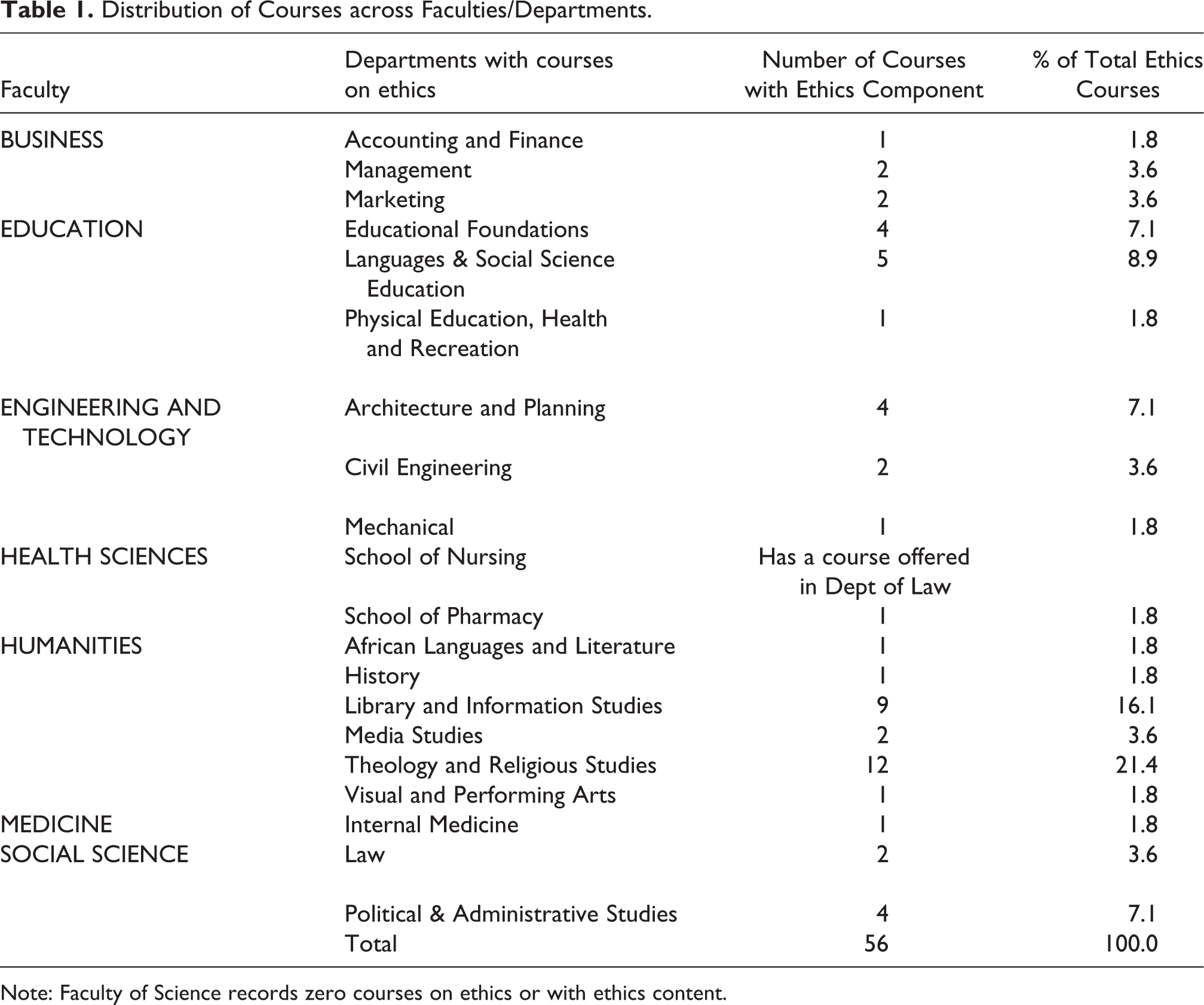
Note: Faculty of Science records zero courses on ethics or with ethics content.
The findings revealed that a total of 56 courses had ethics and/or morality component in all the eight Faculties of the University of Botswana. Whilst the undergraduate courses amount to 47, the retrieved graduate courses with ethics or morality contents were only 9. Thus courses with ethics or moral components are mostly being taught at undergraduate level and not at graduate level.
The 9 courses at graduate level include one from the Faculty of Business (Department of Marketing), two from the Faculty of Education (one each from the Departments of Educational Foundations and Physical Education, Health and Recreation), three from Faculty of Humanities (mainly from the Department of Theology and Religious Studies), and three courses were retrieved from the Faculty of Social Sciences. Of the 56 courses that have ethics or moral component in the University of Botswana, the Faculty of Humanities had the highest number with 26 courses, representing 46.4 percent of the total courses with ethics elements. The Faculty of Education had 10 courses or 17.9 percent with ethics elements, while the Faculty of Engineering and Technology had 7 (12.5 percent) courses. The Faculties of Social Sciences and Business had a total of 6 courses and 5 courses with ethics elements representing 10.7 percent and 8.9 percent respectively; while the Faculties of Health Sciences and Medicine had one course each.
The findings revealed that three of the four Departments in the Faculty of Business offered at least one course with ethics and/or moral component, whereas in the Faculty of Education only three of the eight Departments outlined offered courses in the area. No courses with ethics/morality component could be retrieved from five Departments. Out of the five major disciplines or areas of specialization in the Faculty of Engineering and Technology, three Departments had some courses on ethics/morality, two did not. In the Faculty of Health Sciences only one of the three schools offered a course with ethics and or morality. In addition, another core course with an ethics element, ‘Ethics and Law in Health Care’, is taught to all the students in the Faculties of Health Sciences and Medicine by the Department of Law. Coupled with this, the Faculty of Medicine had another course with ethics/morality component for all its students. Out of the nine Departments in the Faculty of Humanities, four offered one or more courses in ethics/morality, five did not. The Faculty of Science, with seven Departments, recorded zero courses with ethics/morality in any of the Departments. Of eight Departments in the Faculty of Social Sciences, two offered some courses with ethics/moral component, while six did not. It is useful however to state that although some of the Departments did not offer any courses with ethics elements, there is the possibility for the students to go outside their departments and even their faculties to register for any courses of their choice either as optional or elective courses.
Levels or year of study at which ethics and, or moral related courses are taught
The third objective of the study was to examine the level or year of study at which the ethics and/or moral related courses are taught in the University of Botswana.
The teaching of courses with ethics and/or moral(ity) is done at both undergraduate and graduate levels in the University of Botswana. The undergraduate level had a total of 47 of the courses or 83.9 percent of courses with ethics, whilst the graduate level offered 9 courses or 16.1 percent. Such courses were hard to find in the first year of undergraduate level, save in the Theology and Religious Studies Department and Library and Information Studies, that had two courses apiece. Most of the courses were spread over the second, third and fourth years of study. At the graduate level, most of the courses were taught in the first and second years of study. The core courses are pre-requisites for the award of the degree in the departments where they feature. Virtually all the courses at graduate level are optional, except GME 601, which was not only a core course, but also a pre-requisite for Bachelor of Medicine and Bachelor of Surgery (MBBS) degrees. In other words, GME 601 is a course that provides the students with the fundamentals necessary to grasp and apply subsequent content in the field, hence it is considered essential. Further details on the Faculties and Departments where the courses feature as well as the years of study in which the courses are taught are incorporated in the findings under Contents of courses having ethics/morality component below.
Contents of courses having ethics and/or morality component
The fourth objective of the study was to establish the contents of courses having ethics and moral(ity) component at the University of Botswana. The courses are listed and arranged below by Faculty and Department. The year the courses are taught are also indicated. The code in front of each course signifies the year the course is taught. The first digit of the number in the alphanumeric symbol signifies the year of study in which the course is taught. For instance where a number shows 201 after the three alphabets, the first digit i.e. ‘2’ is considered to mean the course is taught in year 2 or second year. There is however an instance where the first digit number is ‘0’ i.e. REC 014. It is also a course taught in the first year of study. Courses with initial digit number 6 or 7 are usually graduate courses
FACULTY OF BUSINESS
ACC202] Ethics in Accounting: examines the general principles, such as honesty, integrity, morals, and the code of professional conduct
MGT204] Business Ethics: enables the students to appreciate the need to apply ethics in business management
MGT301] Organisational Behaviour: examines the behaviour of people in their respective roles in organization for effective business operation
MKT406] Marketing Ethics: deals with ethical issues in product and brand marketing, retail management, services marketing, contemporary issues in social marketing, strategic marketing
MKT770] Business Ethics: examines moral principles and guidelines of conducting marketing business [taught at graduate level]
FACULTY OF EDUCATION
EFH202] Theories and Techniques of Counselling: examines the multicultural aspects of counseling as well as ethical and other issues relating to the therapeutic process
EFH204] Ethical and Legal Issues in Counselling examines ethical and legal issues in the professional practice of counseling, codes of ethics, standards and legislations in counseling
ECD300] Professionalism and Ethics in ECD: introduces students to professional behaviour and ethical conduct in early childhood development and education
ELR702] Ethics: examines the concept, moral philosophy, types and ethical theories
ELM290] Theory of Moral Education: examines the concern to inculcate moral virtues like honesty, responsibility, respect for others and authority in children; moral formation and moral inquiry - directive and nondirective
ELM401] Practice of Moral Education: examines moral and ethical thinking, moral consciousness and initiation, infringement and behavioural requirements, Aristotle and other philosophers' reflections
ELM402] Curriculum Design in Moral Education: considers the structure, organization, implementation and evaluation of curriculum
ELM492] Evaluation of Moral Education: exposes the students to the evaluation of moral education curriculum in Botswana secondary schools against the standard practice
ELM493] Contemporary Moral Issues in Moral Education: considers socio-political ethics, environmental ethics; issues of right and wrong, ethics in human conduct, human and societal values and other pertinent issues including HIV/AIDS, teenage pregnancies, abortion etc.
PHR731] Ethics and Controversy in Leisure, Travel and Tourism: examines ethical issues in leisure and recreation as it relates to travel and tourism
FACULTY OF ENGINEERING AND TECHNOLOGY
RES411] Business and Professional Ethics: enables the students to appreciate the need to apply ethical behaviour in the conduct of the real estate business and possess skills and insights into professional practices including ways of approaching people and problems
URP320] Planning Practice deals with quality urban planning and project management: what works, what doesn’t? Understanding the entrepreneurial ethics and processes
URP427] Planning Ethics: guides students on ethical conduct and values in planning – standards of behaviour in professional practice
URP508] Administrative and Policy Planning: examines Public Bureaucracy in Theory and Practice, Policy Formation and Administrative Governances and the Challenge of Policy Implementation, Ethics in Administrative Governance
IMB 523] Professional ethics and practice: examines engineering ethics, engineering as social experimentation, engineer’s responsibility for safety, responsibilities and rights
CBB529] Engineering Ethics and Professional Conduct covers issues of professional ethics for engineers and their practice; ethical and immoral practices in the profession and ethical theories in the application to engineering issues
MMB533] Engineering and Project Management provides an introduction on ethics in project management and case studies
FACULTY OF HEALTH SCIENCES
Ethics and Law in Health Care [offered in the Department of Law in the Faculty of Social Sciences]
PHA325] Pharmacy Law, Ethics and Regulatory Practice: introduces students to legal concept and regulatory practices, pharmacy ethics, moral issues, theories and principles of ethics and dilemmas in health care
FACULTY OF HUMANITIES
ALL336] Field Research Preparation and Proposal Writing: includes techniques of fieldwork, data collection as well as archival research, resource planning, ethical issues and how to write a research proposal
ARC301] Archaeological Heritage Management: examines key concepts in archaeological theory and practice, and policy in archaeological heritage management. It also includes the history of heritage management and how it evolved to address issues of values, ethics and practices employed by heritage practitioners and archaeologists
REC 014] Search Room Operations examines search room design, layout, and procedures: outreach programmes: exhibitions, educational kits, and archival ethics.
ISS102] Information System (IS) Foundations 2: introduces fundamental concepts of IS. Topics covered include: building information systems and managing projects, securing information systems, ethical and social issues in information system, etc.
LIS230] Legal Issues of Information: covers various legal issues of information, including intellectual property laws, copyright, trans-border information flows, privacy of information, etc.
ARM302] Orality and Indigenous Knowledge Systems: introduces students to oral traditions and indigenous knowledge systems, ethical considerations in fieldwork, and problems associated with oral traditions
LIM 303] Health Information Systems: designed to prepare information management students for health care IT related roles e.g. as users, managers, designers and evaluators of Health Information Systems. It considers Life Cycle Phases of Health Information Systems and Professional Code of Ethics
LIM304] Information and Society: covers the technical, moral, ethical, and legal challenges of information access and use. Who is afraid of the Internet, privacy and security, WSIS, Digital Solidarity Fund, AISI, ICT infrastructure development in Africa
ISS334] Information Security introduces students to legal and ethical considerations, and security in information sensitive environments, among others
ISS442] Information Systems & Society: introduces the theories of information systems and societal change; uses, access and skills; participatory processes; the future of information systems and society; ethical, legal and social issues of information
LIM402] Legal, Ethical and Policy Issues in Information Management exposes students to some of the legal, ethical and policy issues in information management and covers: Definition of Concepts, Ethics, Legislation, Policy, Overview of Ethical Theories and how they inform agency policies and practices
BMS 226] Media ethics: deals with an analysis of theoretical issues concerning media ethics and their practical application in various case studies of media within Botswana and beyond
BMS426] Economics & Social Issues in PR & Advertising: provides the impact of economic and social issues on public relations and advertising campaigns including issues of ethics and corporate responsibility
PST104] Hospital Ministry: introduces students to pastoral work and how to work with doctors, nurses etc. How give counseling to patients and conduct prayers for the sick and staff. Students are exposed to some elements of medical ethics in order to know how to deal with patients with confidence and confidentiality
TRS106] Ethics: classical theories - offers an introduction to moral philosophy, particularly by exploring the origins of ethical reflection among the classical Greek philosophers, including the Sophists, Socrates, Plato and Aristotle.
PST204] Pastoral Care and Counselling: an introductory course into the skills, techniques and practice of pastoral counseling leading to specific types of counseling. It also examines the psychological mental conditions of clients, the biblical, theological and ethical bases of pastoral counseling and methods of pastoral counseling
PST308] Prophetic Ministry in Contemporary Society examines the prophetic ministry of the Church; the Church’s role as the voice of the voiceless and advocacy for social justice and human rights especially of minority, issues of corruption and other moral ills in society
TRS310] Professional Ethics: examines the question of whether professional morality is independent of and separate from ordinary morality. The course looks at business, medicine, law and political ethics [Professional Ethics with TRS636 also taught at graduate level]
TRS314] Christian Moral Theology examines the moral implications of being a Christian in a secular society in the context of the teachings of the Christian church
TRS319] Philosophy of Religion: is a study of some fundamental issues connected with the human activity called “religion”. It examines the validity of the argument from miracles, moral argument, and religious experience as proofs of God’s existence.
PST408] Media and Pastoral Studies: examines the role of media in the life and work of the church and modern technology in disseminating the word of God, so also the impact of ethical issues on the freedom of speech of the media.
TRS427] Applied Ethics: treats the concept, nature and origin of human rights, and some specific contemporary ethical issues that arise from the question of human rights, such as abortion, infanticide and others
TRS609] Christian Ethics and Social Issues: looks at social issues like health, poverty, corruption, and other behavioural issues in socio-economic and political platforms and Christian ethics issues
TRS619] Moral Theologies and Pluralism: examines moral and religious pluralism - diversity of religious beliefs, practices, and traditions in contemporary world
TRS626] Ethics of Religion: examines moral principles and ethical components guiding religions
BFA313
FACULTY OF MEDICINE
Ethics and Law in Health Care: [offered in the Department of Law, Faculty of Social Sciences]
GME601] Communication, Ethics and Professionalism: examines the ethical issues involved in exchange of information in medical profession
FACULTY OF SOCIAL SCIENCES
LAW441] Ethics and Law in Health Care: examines risks, moral and value systems and other issues in healthcare practice
LAW651
POL208] Ethics and Accountability in the Military: examines military conduct and accountability, standards/code of conduct and ethics
PAD406] Ethics & Public Administration: examines ethical issues, accountability, integrity, corruption etc. in public administration
MRP606] Ethics in Research and Public Policy: examines ethical considerations in research and policy formulation
MPA718] Ethics and Accountability in Public Administration: examines ethics, integrity and accountability in governance
Discussion of results
The results revealed that the teaching of courses with ethics and morality persuasion at the University of Botswana cuts across various departments and faculties both at undergraduate and graduate levels. Some of the courses are core, others are optional. It is surprising that the Faculty of Science, did not have any course with ethics and/or morality component. Also noteworthy is the absence of ethics-related courses in the Department of Computer Science. In a similar study conducted at the University of KwaZulu Natal, Mmakola and Mutula (2012) also observed that the Schools of Life Sciences, Mathematics, Statistics, and Computer Science did not have any courses with information ethics contents.
Closely related to the Faculty of Science are the Faculties of Health Sciences and Medicine. In the Faculty of Health Sciences, two courses with ethics and morality contents were posted, one taught in the School of Pharmacy, Faculty (of Health Sciences), another, titled “Ethics and Law in Health Care”, is taught by the Department of Law for all the Health Sciences and Medical Science students. In addition, the Faculty of Medicine posted another ethics element course titled Communication, Ethics and Professionalism taught to all the medical students.
Two of the eight Departments in the Faculty of Social Sciences posted courses in ethics. The Departments include Law, and Political and Administrative Studies. The Department of Law had two courses and the Department of Political and Administrative Studies had four, two apiece taught at the undergraduate level and graduate level.
In the Faculty of Humanities (FoH), the Department of Theology and Religious Studies boasts more courses (12 in total) on ethics or moral component than any other Department in the University. The courses are offered as core, optional or electives to other Departments. The Department of Library and Information Studies came second with 9 courses having an ethics component, while Media Studies could claim two and African Languages and Literature and Visual and Performing Arts one apiece. Of all the faculties in the University, the Faculty of Humanities (FoH) has the highest number of courses in ethics/morality. The Faculty of Education comes after the Faculty of Humanities in terms of the number of courses on offering in ethics/morality, having a total of 10. There is a total of 5 courses with ethics or morality content in the Faculty of Business.
While the Faculty of Science recorded zero in ethics and morality courses, the Faculty of Engineering and Technology has seven courses to offer. Against the background of courses having an ethics/moral(ity) component at the University of Botswana as outlined under “Contents of Courses having Ethics and, or Morality Component above, there appears a gap when the contents of courses are juxtaposed with the WSIS or (ANIE) framework. ANIE’s thematic framework, which is seen as an extension of the WSIS Action Line 10 model, has several streams, including global intercultural information ethics (IE), bio-ethics, IE and development of knowledge societies, information ethics and development goals, needs of children, African IE, diversity of cultural traditions, IE and character formation of children, cultural literacy, local content and language and brain drain/brain rain. Others include: respect for human dignity, cultural diversity, trust, attitudes and behaviours, intellectual freedom, censorship, fair representation, public accountability and cultural policies. The variation in the contents of ethic/morality courses at the University of Botswana when compared with the WSIS and ANIE models could be as a result of the late arrival of ANIE and WSIS Action Line 10. As already indicated, there are faculties and departments that do not have even a single course with an ethics element. Even though students are encouraged to take optional or elective courses outside their Departments and Faculties, it is quite possible for students to graduate from the University of Botswana without undertaking a single course with an ethics element. Even though some of the topics would appear to be already incorporated into some of the courses taught in the university, some specially designed, compulsory and ANIE flavoured course is advocated for all students of the university. Though not cast in stone, the ANIE IE framework recommended for inclusion into the curriculum of the University includes:
Defining IE – Ethics, information and information ethics as concepts. Information types and sources (Internet, print media, statistics, oral, research findings, social media etc.) Evolution and value of IE as a field of study
IE Issues – Impact of converging technologies on human conditions, value systems and behavior (computers, Internet, cell phones, social and news media). Misuse of information and information communications technology (in a variety of spheres). Principles for responsible information management (accuracy, transparency and accountability)
Ethical reasoning – IE as a moral imperative, philosophical perspectives on morality; ethical decision-making (moral dilemma discussions for example)
Information in context - Contextual application of IE (personal, social, academic, work), IE, globalization & the development of information and knowledge societies, IE and the law
Philosophy and IE – The impact of technology on human behavior and value systems; violations in the use of information and/or information technology as ethical issues (e-waste, hacking, identity theft, pornography etc.); the evolution of IE as a practice and field of study; moral principles and IE (honesty, integrity, accuracy, trust responsibility, social justice, etc.
IE and human rights – Human rights declarations (bill of rights, access, human dignity, privacy, intellectual property); information and media laws (national & international)
IE, philosophy and the law – Correlation and conflict in legal and philosophical positions on information-related matters
Information and knowledge societies – features/characteristics of information and knowledge societies (attitudes, systems, use of converging technologies); evolution and purposes served by information and knowledge societies in the 21st century; current status of Africa as a whole and of African countries individually as information and knowledge societies
IE in Africa – Use and misuse of information networks and technologies in Africa (personal, social, educational, business spheres, governance and cloud computing). Responsible use of information and ICT
Conclusion and recommendation
This study has attempted to examine the incorporation of information ethics or morality into the curriculum at the University of Botswana (UB). Ethics and, or morality courses are available in several departments at both undergraduate and graduate levels in UB, but quite a number of departments did not run any courses on the subject. Of the total of 56 courses that enjoy ethics and, or moral content, 9 were offered at graduate levels and 47 at undergraduate level. Unless the students in the Departments that do not offer such courses have the opportunity of going outside to other departments and registering for the courses as electives, they stand the chance of not registering for courses on ethics throughout their period of study at the university. We may note, however, that every UB undergraduate is expected to register for a General Education Course (GEC), with computing and information literacy skills and an ethics component. Most of the courses with ethics/morality component at the UB are not new. They predate the inception of ANIE in 2007 and the WSIS in 2003. It is therefore no wonder that the contents are not tailored towards the ANIE and WSIS frameworks. Neither the WSIS nor ANIE core contents on information ethics are evident in the synopses of most courses, even though some reviews of the curricula have taken place over the years. It is becoming obvious more than ever before that Africa has peculiar needs in the field of information ethics/morality. It is for this reason that a group of academics across the globe met to establish the ANIE.
Having been an active participant in various ANIE fora since its establishment in 2007, the University of Botswana should be seen to be active among other institutions in Africa in addressing the uniquely African needs in the field of information ethics. It is in this respect that this study offers the following recommendations. The Department of Library and Information Studies (DLIS) as it restructures its programmes should ensure that more information ethics (IE) courses and indeed ANIE’s suggested contents should be embedded and incorporated in its course menu. Some stand-alone ethics courses should be floated. When done, the Department of Library and Information Studies should open its doors for students from other Departments and Faculties to register for its courses on IE. Further, the University of Botswana, as one of the notable international institutions in Africa training young adults and adults, should offer university wide IE courses similar to other courses on offer via the General Education Courses (GEC) at the institution. Finally, while the curricula of the existing IE courses are reviewed, efforts should be made to strengthen some of the compulsory or core GEC courses with ANIE information ethics contents.
