




Abstract
This study investigated the behavioral adoption of electronic commerce (EC) among small and medium enterprises (SMEs) in China. This was undertaken by integrating the Technological, Organizational, and Environmental (TOE) framework into the Unified Theory of Acceptance and Use of Technology (UTAUT). The data generated from 349 SMEs were analyzed with SPSS and SmartPLs 3.0 via the utilization of the structural equation modeling (SEM) procedure. The results reveal that while the environmental factor was a positive predictor of the performance expectancy of EC among SMEs, it does not, however, encourage the adoption of EC. Again, while the knowledge factor was not significant in driving the performance expectancy of EC, it was a significant determinant of the adoption of EC among SMEs. Also, the study found that organizational factor was a positive predictor of both performance expectancy and the adoption of EC by SMEs. The technological factor was not a significant predictor of the intention to use EC but was significant in determining the performance expectancy of EC. Finally, the study demonstrated that the performance expectancy of EC was a significant predictor of the behavioral adoption of EC. The managerial and research implications of these findings are deliberated.
Introduction
Electronic commerce (EC) is the use of innovative Internet and mobile communication technologies to redesign business operations to make them more competitive in areas such as getting consumer orders, delivery and payments processing, offering consumer services, gathering market statistics, marketing and promotional programs (Fouskas et al., 2020; Goyal et al., 2019). The availability of e-commerce technologies has empowered traditional and modern businesses to harness the advantages inherent in e-commerce technologies to transform industry operations. The growth of e-commerce is based on the rapid growth, adoption, and penetration of information technology systems (internet) and mobile communication technologies which have brought new directions on business strategy and competition worldwide (Behl et al., 2020; Goyal et al., 2019).
One major sector that e-commerce continues to transform is that of small and medium enterprises (SMEs). Due to the peculiar nature of SMEs as compared to the larger organizations, e-commerce technologies have become the backbone for SMEs to overcome some of the obstacles they face. E-commerce can propel SMEs’ success and thus diminish the higher disappointment level of most SMEs around the world. The demarcation of SMEs differs from nation to nation. SMEs in China are categorized depending on the total of workers (less than 500 workers). SME groupings in China are complex which are centered on certain characteristics like industry category, a sum of personnel, yearly revenue, and total asset. SMEs are the bedrock of the Chinese economy and it is estimated that there are about 5 million new SMEs in China every year, which accounts for 10% year-over-year growth rates of SMEs in China (Statista, 2021). In the year 2019, it was estimated that about 98 million SMEs are in China with Beijing (the capital of China) having an estimated 3100 industry SMEs with 2.8 billion US dollars as revenue generated annually (Statista, 2021).
SMEs play an essential part in China's socio-economic development and thus account for 90% of the enterprise by contributing 60% of GDP, over 70% of patents, and employing about 90% of jobs nationally (Statista, 2021). Despite the promising development of SMEs in China, they are confronted with many challenges such as increasing costs, difficulty in securing finance, lack of or imited capacity in innovation, and institution-based obstacles (Statista, 2021; Zhu et al., 2012). Some of the institution-based difficulties to innovation experienced by SMEs in China include competition fairness, funding support, laws and procedures, tax problems, and system support (Zhu et al., 2012). The SMEs in China have developed and sharpened their e-commerce development/system to leverage the ever-expanding Chinese e-commerce industry/economy to increase their revenue capacity (Statista, 2021). It has been estimated that the revenue generated by B2B e-commerce systems of SMEs in 2020 is 45.3 billion yuan (Statista, 2021; Yihan, 2020).
This study set out to determine the elements inducing SMEs in China to embrace e-commerce. The study was conducted among SMEs in the city of Ganzhou, Jiangxi Province, China. Understanding of the basis for SMEs’ use of e-commerce is important as it provides policymakers and government institutions with the impetus to design an adequate policy regulatory framework to guide the implementation of e-commerce technologies. The study integrated technological, organizational, and environmental (TOE) conceptual framework into the unified theory of acceptance and use of technology (UTAUT), out of which a research model was designed to achieve the motivations of this study.
The integration contributes to the e-commerce adoption literature by demonstrating the extent to which TOE factors including knowledge factors influence the performance expectancy of e-commerce and the adoption of e-commerce among Chinese SMEs. As compared to other studies that used the TOE framework (Ocloo et al., 2020; Religia et al., 2020; Stjepić et al., 2021), this study is among the novel research that has integrated the TOE with UTAUT especially in the context of e-commerce adoption literature.
The remainder of the research is outlined as ordered: the review of literature, research conceptual background, and hypotheses development, research methodology, results, and discussion with implications, conclusion, and limitation of the study.
Literature review
E-commerce
The innovations heralded by information and communication technology have transformed and continue to change social and economic parameters influencing mobility, accessibility, and spatial structures (Lin et al., 2019; Visser and Lanzendorf, 2004). One of the major transformations in improving trading, economic and social structures is electronic commerce (EC) innovation. E-commerce is defined as the use of information technologies, especially Internet systems, to promote and enhance the exchange of goods, products, orders, payment, and shipping information to enable the completion of a business transaction (Babenko et al., 2019; Visser and Lanzendorf, 2004). The business transactions in the e-commerce environment can be grouped based on the kind of buyer and supplier: Business-to-Business (B2B), Business-to-Consumers (B2C), Consumer-to-Business (C2B), and Consumer-to-Consumer (C2C) (Goyal et al., 2019). E-commerce since its inception has witnessed significant growth and acceptance worldwide (Goyal et al., 2019).
The utilization of EC technologies relates to areas such as inter-structural schemes, electronic payment schemes, financial systems, vending, publishing virtually, intra-organizational EC, sales, educational training, promotion, and publicizing (Ngai and Wat, 2002). The overview of EC technology applications is shown in Table 1.
Ec application dimensions.

In addition to the EC technology applications presented in Table 1, there are two other very important dimensions of EC technology that need attention. These are the technological issues and the support and implementation dimensions. The technological issues consist of six segments such as security, technological components, network structure, system maintenance, algorithm approach, and decision technology (Ngai and Wat, 2002). On the other hand, the support and implementation dimension has two sub-divisions: public policy and corporate strategy (Ngai and Wat, 2002). The public policy aspects include taxation, legal issues, privacy, fraud, and trust (Ngai and Wat, 2002). The corporate strategy has to do with the use of EC strategies/processes to create and implement a successful EC technology (Ngai and Wat, 2002).
Small and medium enterprises (SMEs)
Small and medium-sized enterprises are considered self-regulating businesses that engage a certain number of workers below a particular threshold (about 250, but varying depending on different countries’ standards) and are considered the backbone of the economy (Eggers, 2020). SMEs are vital to the economy in that they transform the GDP by increasing national exports and are also critical to maintaining the social-political tranquility of a nation as well as the manufacturing industry (Mittal et al., 2018). SMEs engage and create a competitive environment to better satisfy the needs of the consumer and most often they depend on the innovation process in terms of technology and management (Corrocher and Solito, 2017). Digitalization through the use of the right technologies not only improves or better shapes the economy but importantly can be beneficial to SMEs. The digital environment/technologies provide novel opportunities for start-ups and SMEs to fully engage and participate in the world economy, tap into skills and talents, access different financing instruments, innovate, and develop. Despite the enormous potential that digital technologies bring to SMEs, the adoption of these technologies is sometimes uneven, with most SMEs unable to implement digital technologies, especially productivity-improving digital tools and applications (Rocheska et al., 2017).
According to Consoli (2012), SMEs are not taking full benefit of the prospective of ICT as compared to bigger corporations. This can be linked to their limited resources. Some of the obstacles for SMEs that do not promote investment in ICT are financial, infrastructure, organizational, and technological (Consoli, 2012). The financial aspect relates to the need for a high preliminary investment and challenges in having a credit facility, while the infrastructure challenges concern the lack of authority, bandwidth, and Internet connection reliability (Consoli, 2012). The organizational obstacle relates to lack of skilled employees and well-designed strategy, while the technical aspect concerns the inability to deal with the fast pace of evolution of technology and inabiity to adapt to modern trends (Consoli, 2012). To encourage SMEs’ investment in ICT, the government must develop public regulations and programs to reduce the digital gap, and give unrestricted hotspots or Internet-system with adequate bandwidth and technical support (Consoli, 2012).
The drivers for SMEs to adopt ICT/digital technologies are individual, organizational, environmental, technological, and economic (Consoli, 2012; Skoko et al., 2007). These drivers are shown in Table 2.
Drivers of technology adoption by SMEs.
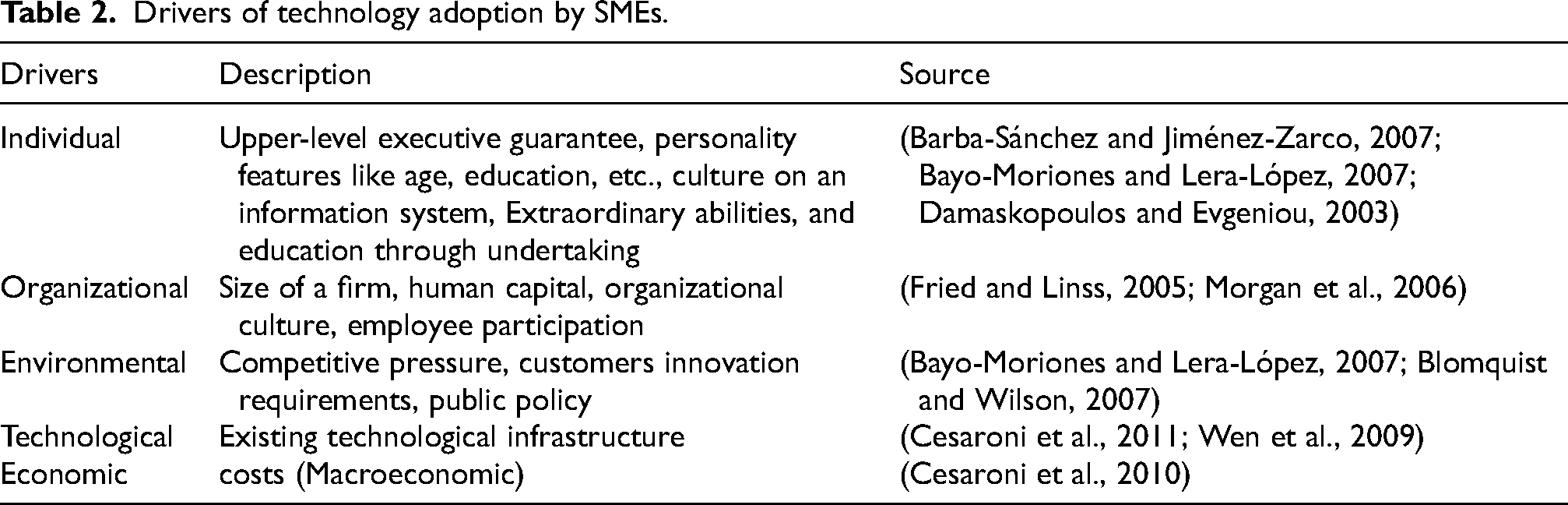
The adoption of ICT technologies by SMEs enables the internal re-engineering of systems, personal retraining, and realignment of suppliers-customers interaction (Consoli, 2012). The impact of digital/IT technologies on SMEs can be classified into areas such as performance, growth, expansion, and new products (Consoli, 2012). These impact factors are shown in Figure 1.

Impact of digital/IT technologies on SMEs.
Research questions
The research questions for interrogation are:
what are the factors influencing Chinese SMEs to adopt e-commerce? To what extent do the TOE dimensions along with knowledge factors impact the performance expectancy and the adoption of EC among Chinese SMEs?
Research conceptual setting and hypotheses formation
Technology-Organizational-Environmental (TOE) framework
The technology, organizational and environmental framework was proposed by Tornatzky et al. (1990). It was developed to provide a comprehensive understanding concerning the company/firm-level adoption of information systems (IS) or information technology (IT) programs and applications/services (Cruz-Jesus et al., 2019; Tornatzky et al., 1990). It has continued to enjoy lots of commendation and acceptance among IT/IS researchers and practitioners, since the integration of TOE factors seems to be a better alternative to existing technology adoption models, especially in respect of researching into the adoption of technology, use, and creation of value from an innovation perspective (Awa et al., 2017; Effendi et al., 2020). The TOE further is articulated to be capable of projecting the broader and holistic dimension of behavioral usage of technology, development, and implementation, and anticipates potential difficulties, post diffusion issues, and the improvement of firms competencies in the application of technology within the business innovation setting (Dhewanto et al., 2020; Kumar and Krishnamoorthy, 2020).
The three components of the TOE framework are briefly discussed below:
Technological dimension
The technological dimension of the TOE framework depicts all the vital technologies that are within the firm's reach, including those already in the market (Amini and Bakri, 2015; Baker, 2012). The level of current technologies employed by companies/firms is instrumental in determining the usage since it provides the scope and nature of technological innovations that the firm can implement (Hameed et al., 2012). The nature of innovation at the disposal of the firm which is not in use has the potential to drive the innovation process, since it demonstrates to the firm which technological system they can adopt as they seek to grow (Baker, 2012). Three levels of innovations can be said to exist outside the domain of the firm, which are: incremental, synthetic, and discontinuous changes (Oliveira and Martins, 2011; Tushman and Nadler, 1986).
The innovations that encourage incremental changes they produce new characteristics/versions of technologies already in use, but represent the least amount of risk and change for the firm adopting them (Baker, 2012). The innovations that produce synthetic change depict a slight change where existing technological ideas are integrated in a special way (Baker, 2012; Hwang et al., 2016). Discontinuous change innovations are considered as radical innovations in which firms completely depart from existing technology (Baker, 2012; Hwang et al., 2016). When implementing discontinuous change innovation, the company ponders if these technologies will be “competency-enriching” or “competency-terminating” (Baker, 2012).
Organizational dimension Environmental dimension
The organizational dimension of the TOE framework has to do with the firms’ characteristics and resources, such as communication systems within the firm, integration of structures among workers, the size of the firm, and the human and financial resources (Baker, 2012; Zhang et al., 2020). The organization dimension has the possibility of influencing the technology implementation and adoption resolutions of the firm (Zhang et al., 2020). For instance, the nature of internal organizational subunits or organs can encourage innovation within the firm. Also, organic and decentralized organizational settings promote teamwork, a higher level of employee responsibilities and cross-communication in the firm (Baker, 2012). The communication process within the organization can encourage or hinder innovation (Baker, 2012). A better fostering of innovation can be obtained when management builds and creates an organizational environment that appreciates and drives change, and supports innovations that are in line with a firm's main vision and mission (Pateli et al., 2020). The actions of top management that can drive innovations are: illustrating vividly the role innovation can play in the firm's strategy, highlighting the vital importance of innovations to subordinates, providing rewards for innovation (formally and informally), stressing the evolution of innovation in the firm, and training and empowering higher-level managers to drive the strategic vision of the firm's prospects (Cruz-Jesus et al., 2019).
The environmental dimension of the TOE framework illustrates the characteristics and structure of the industry, the existence or nonexistence of technology service suppliers, and the policy regulatory environment (Baker, 2012; Bosch-Rekveldt et al., 2011). The level of intense competition that characterizes a firm's environment can drive and stimulate the extent of innovation adoption (Awa et al., 2016). In addition, principal or leading companies in terms of the value chain process, can drive the way innovation is carried out by competing value chain business associates (Pateli et al., 2020). It has been indicated that companies that are competing in a swiftly changing and tough business environment appear to undertake innovation frequently (Baker, 2012). Some companies use the decline of certain businesses or industries as a basis to drive their innovation agenda (Cruz-Jesus et al., 2019).
Adequate availability of infrastructure for technology can also drive the firms’ innovation (Alkhalil et al., 2017; Baker, 2012). Industries or companies that give higher levels of salary can attract highly skilled labor, which can contribute to innovation development in the firm (Bosch-Rekveldt et al., 2011). Government policy regulations and programs have the potential to affect positively or negatively the firm's ability to innovate (Baker, 2012; Bosch-Rekveldt et al., 2011). For instance, the imposition of new regulatory constraints on an industry producing pollution-control devices for energy companies can encourage firms to innovate (Baker, 2012).
Unified Theory of Acceptance and Use of Technology (UTAUT)
In the arena of information system adoption, numerous concepts have been offered to illuminate user behavior towards the adoption of technological systems. One such major theory is the unified theory of acceptance and use of technology (UTAUT), proposed and validated by Venkatesh et al. (2003). This theory was put forward as a better alternative to the Technology Acceptance Model (TAM) developed by Davis (1989). The proponents of UTAUT have indicated the major elements that can better illustrate the behavioral acceptance of any novel information technology, which are: performance expectancy, effort expectancy, social influence, and facilitating conditions. These four key indicators are moderated by gender, age, experience, and voluntariness (Venkatesh et al., 2003).
Performance expectancy is the perception of the consumer that the use of a technology system will enhance his or her work performance, while effort expectancy is the prospect that consuming a specific technology will be less difficult to operationalize (Venkatesh et al., 2003). These two factors are similar to the perceived usefulness and perceived ease of use in the Technology Acceptance Model (Venkatesh et al., 2003). Social influence is the extent to which users understands that others close to them may encourage them to consume a specific IT system (application) (Venkatesh et al., 2003). In terms of facilitating conditions, it is the individual's perception that the required infrastructure, technical and managerial support to encourage the adoption of a technological system are available (Venkatesh et al., 2003).
This theory was chosen due to its worldwide acceptance, application, and integrative possibility with many other constructs (Attuquayefio and Addo, 2014). Since the UTAUT is a combination of other theories/models it is considered superior to other models especially in the predictive acceptance and use of new technology (Attuquayefio and Addo, 2014). Scholars have indicated that the UTAUT model is well tested, robust and attractive in mandatory and voluntary settings (Abdulwahab and Dahalin, 2010). Even though the UTAUT is favored by most researchers, Attuquayefio and Addo (2014) have advised that the application (extension) of this model should be based on proper integration of the correct constructs and techniques of data analysis to obtain better research outcomes.
Hypotheses development
Environmental factors
SMEs are often influenced by external forces to adapt to a particular business system or culture. These are the environmental factors which relate to markets, government policies, and regulations, competitive demand, suppliers, and customers (Kim et al., 2021; Wymer and Regan, 2005). Environmental factors are the external pressure emanating from consumers, merchants, and rivals to encourage SMEs to accept EC (Rahayu and Day, 2015; Ullah et al., 2021). It has been illustrated that consumers and suppliers can influence SMEs to acquire and use a technological system such as e-commerce (Rahayu and Day, 2015; Stjepić et al., 2021). This pressure enables these SMEs to have superior competitive advantage (Duan et al., 2012; Stjepić et al., 2021). Pressure from government agencies and IT merchants also drives SMEs to adopt e-commerce (Chatterjee et al., 2021; Rahayu and Day, 2015; Zhu and Kraemer, 2005). The regulations and policies from the government to provide incentives and protect and regulate business transactions on an e-commerce platform can encourage the acceptance of EC technologies by SMEs (Chatterjee et al., 2021; Rahayu and Day, 2015). Empirical studies have validated that environmental elements have a direct significant impact on the acceptance of EC by SMEs (Dwivedi et al., 2009; Ocloo et al., 2020; Rahayu and Day, 2015). The environmental factors not only impact the use of EC but also the performance expectancy of EC. Accordingly, H1 and H2 were proposed.
Knowledge factors
Knowledge factors are the information that SMEs have about the use of EC. Knowledge factors have to do with managers’ degree of knowledge exposure and experience, the expertise of workers, identification of benefits and experiences with information systems, and management transformation that comes with the use of EC by SMEs (Setiyani and Rostiani, 2021; Wymer and Regan, 2005). To achieve the expected changes enabled by e-commerce technologies, managers/directors should have a good knowledge of the changes that the technology presents and how they can take advantage of it to improve business operations (Ngah et al., 2021; Wymer and Regan, 2005). It has been acknowledged that knowledge barriers related to projects, applications, and technology inhibit companies/SMEs from employing e-commerce technologies (Stjepić et al., 2021; Venkatesan, 2003; Wymer and Regan, 2005). Others have indicated that the absence of strategic perceptive, deficiency of appreciation of the abilities and drawbacks of EC, unfamiliarity with Internet technologies, and absence of awareness on how to kick start the use of e-commerce technologies (Diochon and Wright, 2003; Knol and Stroeken, 2001; Pedersen and Mulbery, 2003) prevent SMEs from taking full advantage of e-commerce technologies. Studies have shown that knowledge factors positively influence the acceptance of EC (Al-Tit, 2020; Rawash, 2021; Wymer and Regan, 2005). They can likewise drive the performance expectancy of EC by SMEs. Consequently, H3 and H4 were proposed.
Organizational factors
Organizational factors have to do with internal forces in the organization of SMEs that push them to adopt innovative technologies; that is, the harnessing of the internal resources of an organization to empower its operations and transformation. Organizational factors include types of products and services, the size of the organization, financial and human capital, efficiency, and expertise (Huang et al., 2004; Rawash, 2021; Wymer and Regan, 2005). These factors, in addition to top management support, technological readiness, and employee attitudes, are key organizational factors that impact the acceptance of EC by SMEs (Dahbi and Benmoussa, 2019; Dwivedi et al., 2009; Rahayu and Day, 2015; Sabherwal et al., 2006). Researches have shown that organizational factors are instrumental in influencing SMEs’ adoption of EC (Hamad et al., 2018; Ocloo et al., 2018; Rahayu and Day, 2015). They can also impact the performance expectation of e-commerce for SMEs. Accordingly, H5 and H6 were proposed.
Technological factors
Technological factors are the understanding of SMEs that the acceptance of EC technologies can transform their business operations in terms of cost and compatibility. These factors are the availability of technology, security, cost, reliability and capabilities, cost of building and maintaining, external expertise, kind and quality of software, merchant support, and IT solutions available to the company (Dahbi and Benmoussa, 2019; Rahayu and Day, 2015, 2017). Appreciation of the massive advantages of e-commerce adoption will empower SMEs to commit the required financial, technological, and managerial resources to enable the successful adoption of e-commerce (Qalati et al., 2021; Rahayu and Day, 2015). The application of EC technologies must be well-suited with the business's culture, beliefs, technology infrastructure, and internal work manneri (Qalati et al., 2021; Rahayu and Day, 2015). The availability of the technological factors has the probability to influence the performance expectancy of e-commerce, especially towards enhancing SMEs’ business dealings and interaction. It has the potential to also influence the adoption of EC, since the technological factors serve as a projecting platform for SMEs to achieve better business outcomes. Prior studies have indicated that technological factors drive the SMEs’ acceptance of EC (D Al-Tayyar et al., 2021; Hamad et al., 2018; Kabanda and Brown, 2017). Based on this, H7 and H8 were proposed.
Performance expectancy
Performance expectancy is the extent to which the adoption of a particular technology will enable users to achieve better outcomes in terms of their work performance (Puriwat and Tripopsakul, 2021; Venkatesh et al., 2003). E-commerce performance expectation is the perceived understanding of SMEs that the application and implementation of e-commerce technologies will contribute to improving their business operations and thus can empower them to compete. The performance expectancy of e-commerce may include efficient and increased distribution outlets, better communication systems, enhanced technical competency over competitors, and efficient allocation of scarce resources (Ahmad et al., 2015; Lim and Trakulmaykee, 2018; Puriwat and Tripopsakul, 2021). Comprehension of the improvement and transformation that e-commerce technologies hold for businesses will ultimately encourage SMEs to adopt e-commerce. According H9 was proposed.
H9: Performance expectancy has a significant relationship with the behavioral adoption of EC by Chinese SMEs.
Research model
The model for this paper is shown in Figure 2. The model integrates the TOE framework, such as the technological, organizational, and environmental factors, along with knowledge factors, into the UTAUT model.

Research model.
Research methodology
This study used the research questionnaire approach to collect the required data to enable the validation of the research hypothesis and model of the study. This approach was used due to its superiority and the advantages of being easier to use, cheaper in terms of cost, efficiency, faster, and better as compared to other methods of data gathering. The context of the questionnaire was crafted through a comprehensive literature review. The items were selected from the following sources but were amended to reflect the content and goals of the present work. Performance expectancy and behavioral adoption (Venkatesh et al., 2003), environmental factors (Dwivedi et al., 2009; Rahayu and Day, 2015), knowledge factors (Wymer and Regan, 2005), organizational factors (Dwivedi et al., 2009; Rahayu and Day, 2015; Wymer and Regan, 2005) and technical factors (Wymer and Regan, 2005).
The population of the study was Chinese Small and Medium Enterprise (SME) owners and managers within the city of Ganzhou, the second biggest city in Jiangxi Province, China. Specifically, the small and medium enterprises are located at the Ganzhou Gangfa Cultural and Entrepreneurship Development Park and its environs. The questionnaire was designed and hosted online and then shared through social media such as WeChat groups for the SMEs and personal contacts. The variables were computed on five Likert scale points which range from 1 = Strongly Disagree to 5 = Strongly Agree. The questions was translated from English into the Chinese language and back-translated to ensure that the intended meaning was not lost during the translation process. Data collection lasted for about 2 months (October to mid-December 2020). A total of 339 valid responses were received and thus were utilized for the data analysis.
Before the central data gathering, a pre-testing and piloting of the research questionnaire were undertaken. This was done to ensure that any ambiguity in the proposed questions was reduced to the barest minimum possible to facilitate maximum comprehension. In addition to providing clarity, this could eliminate some measurement errors in terms of complex sentences, use of vocabulary, and inability to respond due to lack of understanding (Collins, 2003; Lenzner et al., 2016). For social science scholars the pre-testing and piloting are intended to ensure that results are valid, dependable, sensitive, unbiased, and complete (Collins, 2003). The feedback received was instrumental in revising portions of the questionnaire and thus contributed to improving the content of the research questionnaire.
Structural equation modeling (SEM) was used as a data analysis technique with the help of SmartPLS 3.0 and SPSS. The SEM was used because it is considered the major statistical approach since it factors in the multiple variables simultaneously and can also eliminate the measurement errors with constructs (Awang et al., 2016; Hair et al., 2017). Importantly, it can ensure that the data used is compatible with the theories/models examined (Henseler et al., 2016).
Common method bias (CMB)
Scholars have raised concerns about the possibility of common method bias on their research outcomes (Lance et al., 2010; Williams et al., 2010; Zikmund and Babin, 2006). Common method bias (CMB) happens when the researcher utilizes a common research scaling method/measures obtained from one single source of data (Fuller et al., 2016; Wingate et al., 2018). It has the likelihood of affecting the validity and confidence of results if not addressed (Zikmund and Babin, 2006). Harman's single-factor analysis (Podsakoff et al., 2003) was used to determine the extent of the CMB in our data. The analysis showed that no common method bias issues existed in our data since no single factor explained the majority of variance (one factor accounted for 31.2% of the variance which is below the 50% threshold recommended by Harman's single factor analysis) and hence CMB was not a challenge in our study.
Results and data analysis
Demographic statistics
The characteristics of the respondents in the research is displayed in Table 3. In terms of gender, 54.3% of the respondents were female. The age distributions show that a large number of the respondents were between the ages of 18–30 years (32.7%). The educational level information indicates that larger numbers of the participants are undergraduate leavers (43.1%). In terms of years of experience in the use of EC, the result has shown that the majority have been using e-commerce for about 4–5 (30.4%) years.
Statistics of respondents.

Descriptive statistics
Descriptive statistics are considered an important component of data analysis and good research practice since they provide the basis for comparing constructs (Andrews et al., 2020; Sarka, 2021). The use of appropriate descriptive statistics in a systematic approach can prevent the wrong interpretation of research outcomes (Mishra et al., 2019; Sufahani et al., 2017). Descriptive statistics such as mean, standard deviation (SD), skewness, and kurtosis of the six (6) variables used in this study are shown in Table 4. The mean statistics are an indication that the respondents provided positive ratings for all the variables used in the study. The highest rating of 3.8024 was for Knowledge Factors (KF) and the lowest rating of 3.6600 was for Technology Factors (TF). In terms of skewness, all the statistics were negative but were within the 0 to −0.50 ranges. This means that all the six variables/distribution can be said to be approximately symmetric (Procheş, 2016; Wickham and Grolemund, 2016). Finally, for kurtosis, all the data statistics were within the acceptable ±1.96 limit which is an indication that any departure from normality was insignificant.
Descriptive statistics.

Measurement model
The goodness of fit index
The goodness of fit of the measurement model using confirmatory factor analysis is illustrated in Table 5. The goodness of fit indices are: chi-square, degrees of freedom, normed chi-square, goodness-of-fit index, adjusted goodness-of-fit index, comparative fit index, normed fit index, and root mean square error of approximation. The results as indicated in Table 5 show that the measurement model demonstrated goodness of fit with the data and thus meet the required criterion cutoff point recommended by (Hair et al., 2016; Henseler and Sarstedt, 2013).
Goodness of Fit (GoF) indices.

χ²(Chi-Square), df (Degrees of Freedom), χ²/df (Normed Chi-Square), GFI (Goodness-of-Fit Index), AGFI (Adjust Goodness-of-Fit Index), CFI (Comparative Fit Index), NFI (Normed Fit Index), RMSEA(Root Mean Square Error Of Approximation).
The output of the measurement model is indicated in Table 6 which consists of validity standards such as factor loadings, Cronbach's alpha, composite reliability, and average variance extracted (AVE). Convergent validity was determined by the use of factor loadings, AVE, and the reliability of constructs. Factor loadings, Cronbach's alpha and composite reliability are recommended to have values above 0.70 (Hair et al., 2010; Hair et al., 2012) while AVE is recommended to have values not less than 0.50. The values reported in Table 6 for all these show that the results of the measurement model meet the suggested quality standards and thus it can be concluded that the instrument used is reliable and internally consistent. This provides a strong indication that the outcomes of the structural model can be trustworthy.
Measurement model.

The work also computed the discriminate validity of the constructs used. The discriminant validity was done by applying the Fornell-Larcker (Fornell and Larcker, 1981) standards. Per these quality standards, a variable is said to have discriminant validity if the square root of AVE (bold, in Table 7) is bigger than the paired inter-correlations between the latent constructs. As indicated in Table 6, this criterion has been achieved and hence provides evidence of the discriminant validity of our scale.
Discriminant validity.

Note: Bold indicates (diagonal) square root of AVE. Environmental Factors (EF), Knowledge Factors (KF), Organizational factors (OF), Technology Factors (TF), Performance Expectancy of E-Commerce (EE), E-Commerce Adoption (IA).
Structural model
The outcomes of the structural model conducted are presented in Table 8 and demonstrated in Figure 3. The result show that environmental factors (β = 0.282, p < 0.05) and organizational factors (β = 0.302, p < 0.05) have direct significant impact on performance expectancy of e-commerce. Hence H1 and H5 were supported.
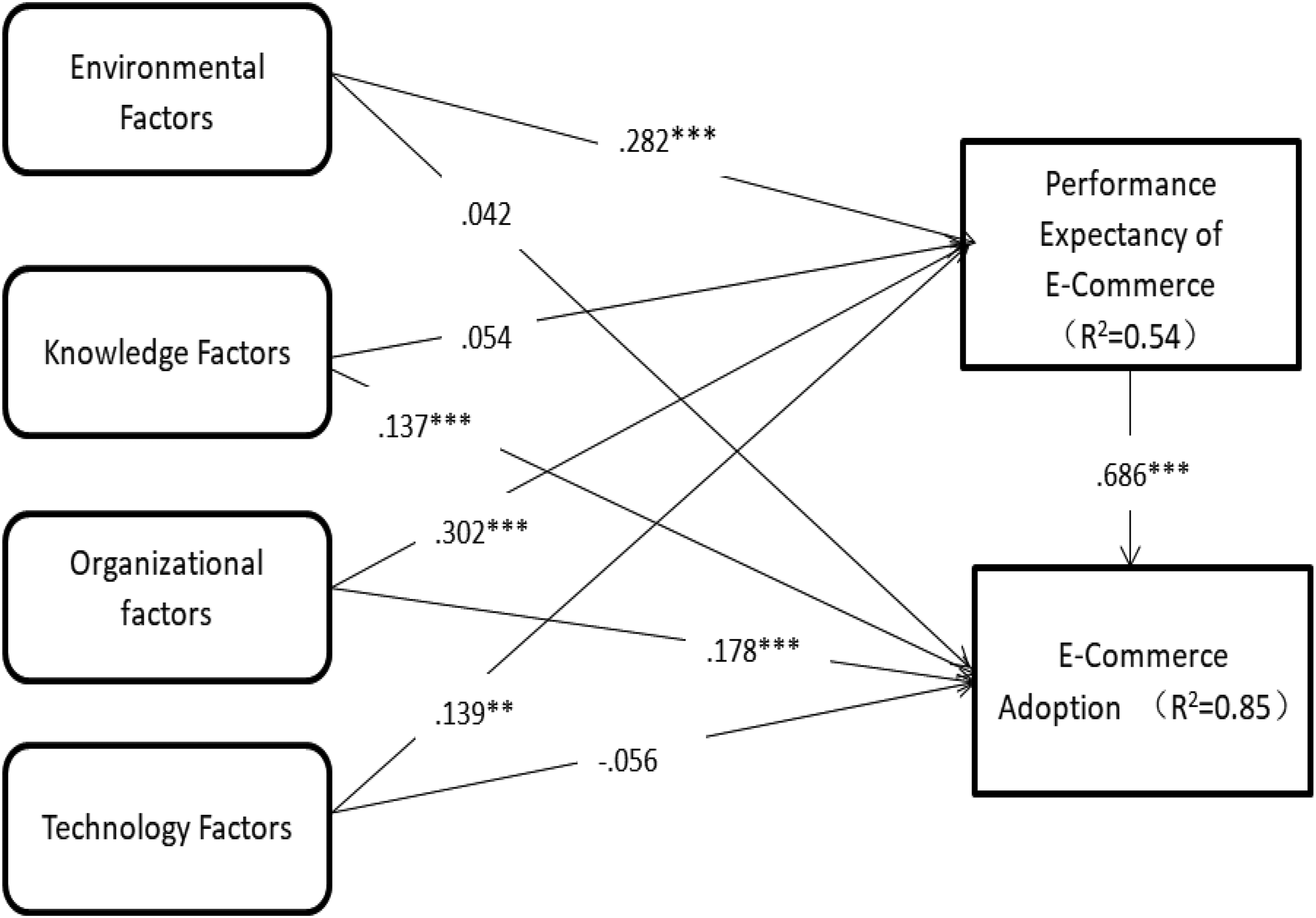
Validated-model.
Hypothesis.
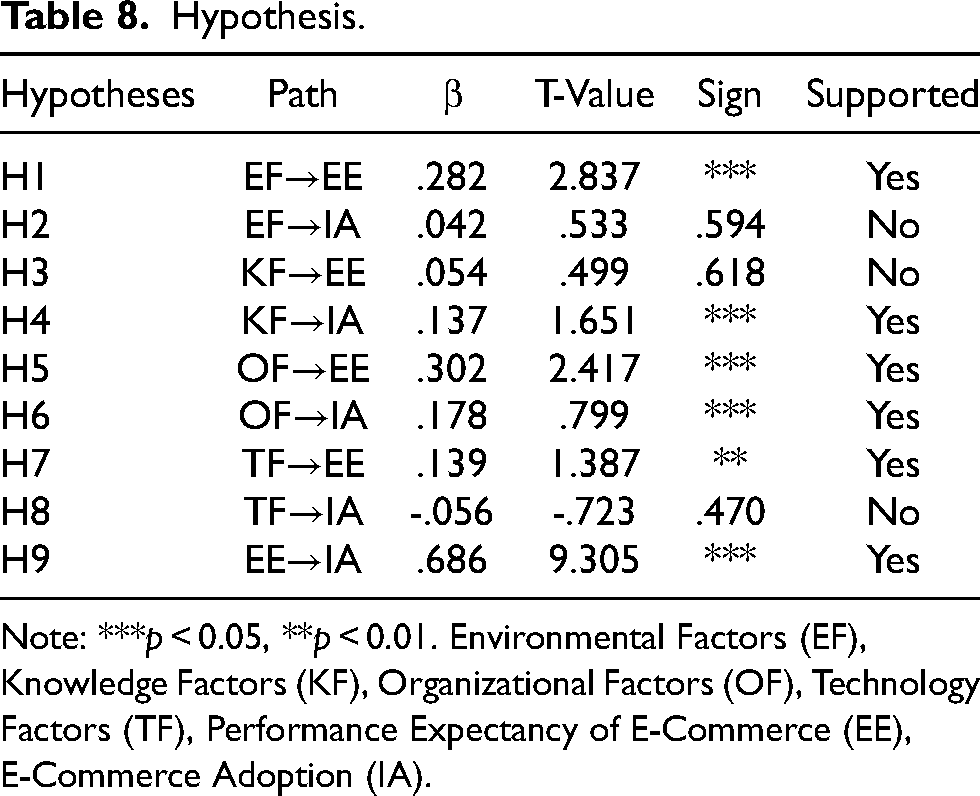
Note: ***p < 0.05, **p < 0.01. Environmental Factors (EF), Knowledge Factors (KF), Organizational Factors (OF), Technology Factors (TF), Performance Expectancy of E-Commerce (EE), E-Commerce Adoption (IA).
While knowledge factors were not significant in predicting performance expectancy of e-commerce (β = 0.054, p > 0.05), the technology factors, were a significant determinant of the performance expectancy of e-commerce (β = 0.302, p < 0.05). Accordingly, H3 was not supported but H7 was supported.
We discovered that environmental factors (β = 0.042, p > 0.05) and technology factors (β = −0.056, p > 0.05) have no significant impact on EC adoption. So, H2 and H8 were not supported. But knowledge factors (β = 0.0.137, p < 0.05) and organizational factors (β = 0.178, p < 0.05) were significant determinants of the e-commerce adoption. Hence H4 and H6 were supported. Expectancy of e-commerce (β = 0.686, p < 0.05) were significant determinant of the e-commerce adoption. Consequently, H9 was supported.
Discussion
This study set out to determine the factors driving the Chinese small and medium enterprises (SMEs) to adopt electronic commerce. Specifically, the study examined the impact of factors such as environmental, knowledge factors, organizational, and technological factors on the adoption and performance expectancy of electronic commerce. EC is now the fundamental tool propelling the development and innovations in SMEs and thus understanding the predictors for the adoption of EC among SMEs can enable the development of favorable policies and programs to boost the acceptance of EC by SMEs for their sustainable development. The results of the data analysis have indicated mixed findings.
The results have demonstrated that the environmental factor (EF) was significant in determining the performance expectancy of EC among SMEs but was not significant in influencing the adoption of EC by SMEs. The positive impact of environmental factors on the adoption of EC by SMEs is corroborated by previous research findings that have also indicated that environmental factors are instrumental in driving the adoption of EC by SMEs (Kurnia et al., 2015; Siew et al., 2020). The significant impact of environmental factors on performance expectancy of EC is a strong indication that issues that from the environment in which SMEs operate, such as the development of consumer-driven e-commerce, adequate government regulations, and policies, the finding of correct business partners/vendors, and preparedness of suppliers to engage in electronic commerce, are essential in advancing the understanding of SMEs about the expected benefits and comparative advantages that EC can bring to their businesses. In particular, the factor of government regulations and policies is central since the fundamentals for the success of any business policy are dependent on government involvement through the promulgation of appropriate laws to encourage the acceptance of EC by SMEs.
Knowledge factors (KF) were not a significant predictor of the performance expectancy of EC but were significant in driving the acceptance of EC among SMEs. The positive direct impact of knowledge factors on the adoption of EC among SMEs implies that the familiarization of SMEs with EC technologies and applications can to some extent influence the use of EC for their business transactions. The ability of SMEs to acquire knowledge in the use of PCs and Internet systems, the readiness to adopt new systems and change, the preparedness of employees to adapt to change, trust in EC technologies, and learning from other successful SMEs in the use of EC are can influence the adoption of EC among SMEs.
Organizational factors (OF) were established to be positively significant in influencing both the performance expectancy and the adoption of EC among SMEs. The impact of organizational factors acceptance of EC by SMEs is consistent with other researches that have shown that organizational factors drive the adoption of EC (Abed, 2020; Alsaad et al., 2017; Kurnia et al., 2015; Sila, 2013). The influence of organizational factors on the use of EC by SMEs is indicative that the organizational preparedness of SMEs in areas of technological, financial, and human resources can provide enormous chances for SMEs to grow and develop through EC technology. For instance, access to capital for SMEs, readiness to reduce the number of employees; dealing with other competing interests due to limited resources, and organizational technical expertise are important organizational ingredients that influence the SMEs to adopt EC. As indicated by Siew et al. (2020), top management commitment, firm size, and workers’ IT competency are crucial components of organizational settings that drive the adoption of EC.
Interestingly, while technological factors were revealed to have a direct significant effect on the performance expectancy of EC, they were not significant in driving SMEs to adopt EC. The non-significant impact of technological factors on EC adoption contradicts previous findings that have demonstrated that technological factors influence the adoption of EC (Abed, 2020; Sila, 2013). The conceivable motive for the non-significant influence of this factor on the adoption of EC may the over-familiarization of SMEs with new technological systems such as the Internet, and thus they may underestimate its potential and capabilities.
Finally, the results demonstrated that performance expectancy of EC among SMEs was a significant predictor of EC adoption by SMEs. The positive significant impact of performance expectancy on EC adoption supports preceding researches that have likewise confirmed this relationship (Patil et al., 2020; Saprikis et al., 2021). This result is an indication that the more that SMEs are convinced about the expected benefits that can accrue from the use of EC in their businesses; the more it will ultimately encourage them to adopt EC technologies.
Theoretical implications
This contributes theoretically to the EC adoption literature by the integration of TOE fundamentals with the UTAUT factors to comprehend EC acceptance among SMEs in China. The first theoretical implication is that the key concepts of TOE, such as technological, organizational, and environmental along with knowledge factors, were found to account for 54% of the variance towards the performance expectancy of EC among SMEs. Secondly, though some studies (Abed, 2020; Masbuqin et al., 2020), have examined the TOE in the context of EC, this is among the first research that has tested the direct impact of the TOE framework on performance expectancy of EC within the context of the UTAUT model. Thirdly, the TOE factors, including knowledge factors, explained 85% of the factors accounting for the behavioral acceptance of EC among SMEs in China. The higher variance of 85% is a further demonstration of the powerful nature of the TOE framework in driving the adoption of EC among Chinese SMEs.
Practical implications
The first managerial implication of the effect of environmental factors on the performance expectancy of EC on the adoption of EC by SMEs is that SMEs’ positive attitude and response to forces surrounding their business operation (markets, competitive pressure, suppliers, merchants, and government policy and regulations) can drive the expected benefits from e-commerce implementation. One major environmental force that can influence the advantages and benefit that SMEs can derive from EC implementation and adoption is the role of government public policy, rules, and regulation. The government must ensure the passage of the right public policy and regulations to guide the SMEs’ adoption of EC as the backbone to propel smooth implementation. Regulations are needed to protect the actors in the EC environment from being duped, defrauded, and scammed by unscrupulous individuals. Also, the government can provide incentives to SMEs through policy regulations, especially for disadvantaged SMEs in deprived regions, to empower them to apply EC technologies to their start-up businesses.
Secondly, the positive influence of knowledge factors on EC adoption by SMEs is a validation that when SMEs are empowered by good exposure, experience, employee expertise and knowledge acquisition in the development and application of EC technologies, this can encourage the uptake of e-commerce among SMEs. Managers of SMEs thus must invest a lot in the acquisition of practical awareness in the consumption of novel technologies and importantly the readiness to change and understand the transformations that EC technologies can bring to their SMEs’ growth. Also, managers of SMEs must possess knowledge in project management and technology applications which will enable them to develop a strategic understanding of alternative products, market and customer approaches in the EC space, and a comprehensive appreciation of the capabilities and limitations of EC technologies.
The third implication is that the significant influence of organizational factors on both the performance expectancy and the SMEs’ adoption of EC is a call for SMEs to pay much attention to developing a strong organizational environment that can propel the adoption of EC. The development of resilient SME organizations can ensure that they make good use of available internal resources to achieve their business goals, which may include the implementation of EC technologies for business profitability. Some internal organizational dimensions that SMEs can use to propel EC adoption are the size of the SMEs, kinds of services and products, capital, human resources, expertise, and efficiency. Also, strong organizational structure with clear top organizational backing is instrumental in driving the success of EC innovations implementation and diffusion.
The technological factor's significant impact on the performance expectancy of EC among SMEs is an indication that the availability of innovative technological systems is essential in enhancing SMEs’ understanding of the benefits and growth opportunities that EC offers to their businesses. The technologies dimensions relating to technology availability, reliability, cost, capabilities, compatibility, and security are important for SMEs to consider while implementation EC technologies for their businesses. These dimensions can influence the change, transformation, and growth expectations from EC implementation in SMEs.
Finally, the positive influence of the performance expectancy of EC on the adoption of EC by SMEs is a strong indication that when SMEs are aware of the transformations that EC technologies can offer to their businesses it will drive their interest to adopt it. SMEs should endeavor to constantly find out ways in which EC technologies can add value to their business engagements and once that is done, it will encourage the development of strategies to use EC.
Conclusion
This paper examined the driving forces of SMEs in China to utilize/adopt EC. The outcomes have shown that environmental factors influence the performance expectancy of EC among SMEs and also that knowledge factors predicted the intention of SMEs to adopt EC. Organizational factors were found to significantly predict both the performance expectancy and the behavioral acceptance of SMEs to adopt EC. Technological factors were revealed to determine positively the performance expectancy of EC among SMEs, while performance expectancy of EC swayed the acceptance of EC by SMEs. The findings of this research have provided an empirical basis for the development of EC technologies to encourage the greater adoption of EC among SMEs for positive transformation and growth. This will ensure that through the enabling environment of EC, SMEs can better serve their purpose.
Based on this the following policy implications are projected for the consideration of governments and policymakers:
Measures to adequately develop and expand information and communication technology (ICT) infrastructure should be a top priority since ICT is the most basic requirement (pre-requisite) for the operationalization of EC. Measures to adequately monitor the telecommunication industry and pricing mechanism/policy to promote fair competition and good pricing and services to ensure that the prices telecom companies charge do not become a barrier to access effectiveness, efficiency, opportunities, and affordability of e-commerce. Measures to adequately regulate and integrate banking and financial infrastructure into the EC ecosystem. The infrastructure can be in the form of a) linking local and national businesses with global banking networks to permit efficient domestic and international B2B operations and b) to empower consumers, and small businesses to have access to financial resources and services to enable active participation in EC effectively. Measures to adequately implement tight security and privacy of data/information transmission policy to ensure that e-commerce systems are robust to prevent illegal transactions that may be detrimental to consumer interests and privacy, public safety, law enforcement, and businesses. Measures to adequately regulate digital signatures and electronic contracts to enable the recognition of protocols, systems for identifying digital forgery, and standards for verifying the times of communication and integrity of data documents be easily changed, manipulated, and deleted without a trace.
Limitation and future work
First, the population of SMEs examined is restricted to China and the sample used may not be representative. Thus, the explanation and generalization of the results ought not to be overdramatized. Secondly, the study methods and processes examined in this could be applied to other research situations but will not essentially yield results that will conform to our findings. Thirdly, the factors driving the EC adoption by SMEs are not fully exhausted in this paper and thus future studies will attempt to integrate moderating factors (perceived value, co-creation, and utilitarian values) into the research model to expand the knowledge on EC adoption among SMEs. In addition, the indirect effect of technological, environmental, knowledge, and organizational factors on the adoption of e-commerce through the mediation of the role of performance expectancy of e-commerce will be explored as a future study.
Footnotes
Declaration of Conflicting Interests
The author(s) declared no potential conflicts of interest with respect to the research, authorship, and/or publication of this article.
Funding
The author(s) received no financial support for the research, authorship and/or publication of this article.

About the authors
Appendix
Questionnaire items used are mentioned below: