




Abstract
Limited studies exist on the safety challenges that journalists face in reporting conflict related issues within their localities. This study extends literature in this direction by providing a model that explains the safety challenges that journalists faced in reporting the 2020 END SARS protests in Nigeria. The study is a survey of 470 journalists with questionnaire as the instrument for data collection. Results were analysed using Structural Equation Modeling (SEM). It was found that legal limitations, lack of training on safety and absence of safety motivational measures constitute the safety challenges that journalists faced in reporting the ENDS SARS protests. This information could be beneficial for policy formulation and advocacy within the context of safety of journalists.
Introduction
Human rights explains those rights which everybody must enjoy unhindered. A human being is entitled to certain rights irrespective of his or her gender, income level, location, level of education, race, ethnicity, political affiliation, language (United Nations, 2013). The Universal Declaration of Human Right (United Nations, 1949) in making a case for the importance of human rights notes thus: “All human beings are born free and equal in dignity and rights. They are endowed with reason and conscience and should act towards one another in a spirit of brotherhood.” The implication here is that people of different demographical and psychographic variables are entitled to the same rights. People have the rights to protest and journalists who report such protests also have a right to be protected from harassment and other risks factors associated with such jobs.
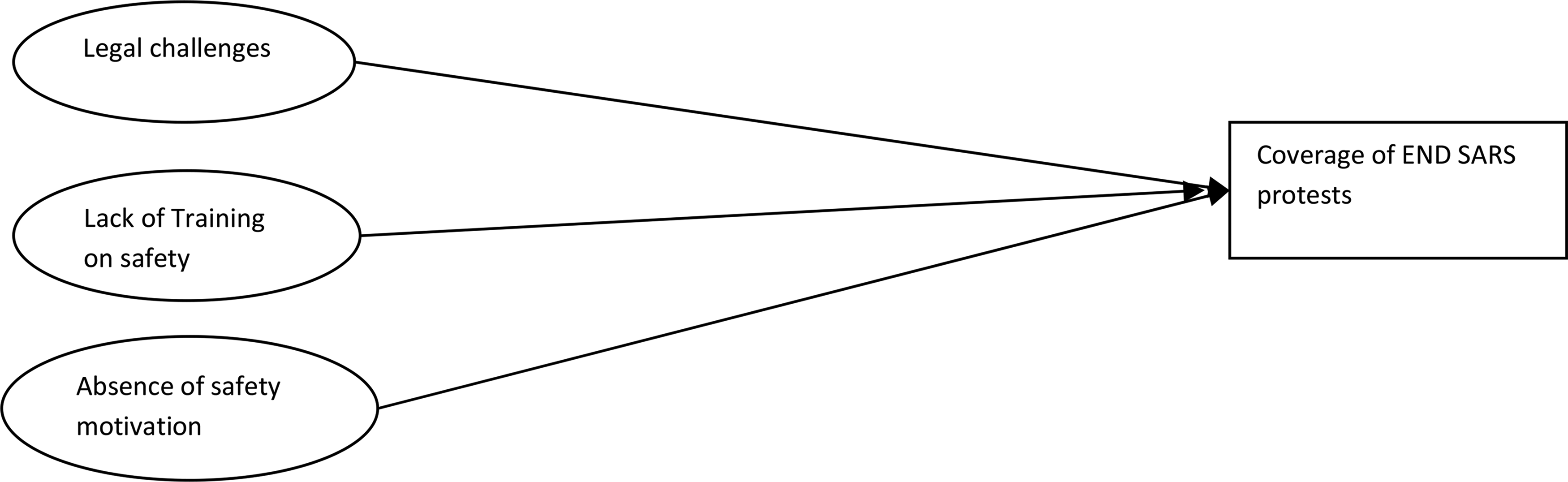
A model for understanding challenges to journalists' safety in their coverage of the ENDSARS protests in Nigeria.
Nigeria has a long history of human rights abuses. The military who have a responsibility to defend the masses have on different occasions exhibited acts of rights abuses. For example, in 1999, the Nigerian military invaded Udi in Bayelsa State where many innocent persons were killed. Also, in 2001, the Nigerian military again invaded Zaki Biam in Benue State and many lives were lost in the process. According to the New York Times (2001) the Zaki Biam invasion resulted to the date of 100 civilians. Again in 2017, the Nigerian Army invaded a local government in Benue State called Naka, where many civilians were killed with many houses burnt. It is a sad reality that human rights abuses have continued to take place in Nigeria. Adeakin (2016) regrets that since the start of civilian administration in Nigeria on 29 May 1999, Nigeria has continued to experience instances of human rights abuse.
The Amnesty International has repeatedly expressed displeasure over cases of human rights abuses usually carried out by men in uniform in Nigeria. According to Amnesty International (2015) on 12 and 14 of December, 2015, the Nigerian Army illegally killed more than 350 defenseless Nigerians including women and children, who were in supporting the Islamic Movement in Nigeria (IMN), known as Shi’ite Muslim. The Shi’ite Muslim is a minority religious sect that carries its activities primarily in Zaria Kaduna State North West Furthermore, in 2016 up to 168 persons were killed in Giwa Barracks which is a military detention facility located in Maiduguri, Borno State, North East Nigeria (Amnesty International, 2016a, 2016b). Human Rights Watch (2021) in its world report regrets that the Nigerian military has consistently arrested detained and used excessive force against citizens who are engaging in peaceful protests. Amnesty International in its 2020/2021 report notes that security operatives in Nigeria usually use excessive force against citizens. The increasing instances of human rights abuses makes the environment unsafe for the citizens.
Safety is one of the important needs of man. Every man needs to feel safe and be actually safe. Safety is very important such that it could impact on people's performance. Maslow (1943) acknowledged safety needs in his hierarchy of needs. He categorized safety as the second layer on people's needs. Safety need borders on the environment and they manifest in different places like home, places of work, school, among others. Burleson and Thoron (2017: 2) in stressing the importance of safety notes: ‘If a child has a bad home life (fighting parents, addicted parents, absent parents, etc.) or lives in an unsafe neighborhood, the child will have trouble focusing on learning when he/she does not feel secure.” With those words, Burleson and Thoron paint a brief picture of the role of safety in human behaviour. Therefore, within the framework of Maslow's theory of human motivation, it can be inferred that journalists’ safety is an important motivational need that could impact on their job performance.
Journalists, just like other humans, need to feel safe. They need to be sure that their lives and those of their family members are not under threat. They need to be sure that their place of work is not a death trap. They need to be convinced that a particular beat does not equal uncertainty about their safety. Murthy (2018) notes that journalists require safety as an important need to enable them do their job effectively. Evidence in literature (Chhakchhuak, 2005; Dhillon, Reporters Sans Frontiers, 2011) show that journalists often call for the removal of limitations to their safety to enable them discharge their duties but such calls are usually ignored by the authorities.
As the watchdog of the society, journalists were at the forefront, trying to provide up-to-date information on the protests. In the process of doing this, they (journalists) were exposed to risks of varying degrees. For example, The Lagos Chapter of International Press Centre, reported that officers of the Nigeria police attacked Francis Ogbonna, a cameraman with Arise Television, on Sunday, October 11, 2020 in Abuja while he was interviewing protesters on an #EndSARS rally in Abuja (IPC, 2020). According to The Committee to Protect Journalists (CPJ) during to the ENDS SARS protests, 12 journalists and five media outlets were attacked (Onyeji, 2020). Also, on 11 October 2020, police officers attacked a journalist who was a staff of Premium Times while covering the #EndSARS protest in Abuja (Article, 19, 2020). In addition to physical attacks, media houses were also heavily fined regarding their coverage of the END SARS protests. For example, On 26 October, the National Broadcasting Commission announced N3 million fines each for three television stations, viz Arise Television, Channels Television and Africa Independent Television, for what the government regarded as “unprofessional coverage” of the END SARS protests (Article, 19, 2020). Based on this above background, the objective of this was to provide a model that explains the safety challenges that Nigerian journalists faced in reporting the 2020 END SARS protests.
Literature Review
Reporting protest is an aspect of conflict reporting. This is because protest itself is sign of conflict. When people protest, it is because they have grievances that have not been resolved. The aim of protesting is to draw attention to such unresolved grievances with a view to having them addressed. Within this context, protests can be considered as communication tool through which people with similar goals express themselves. Klandermans et al. (2014) affirm that protests serve as channels through which people express their ideas and beliefs. They add that through the instrumentality of protest, people reach out to the authorities, the media, as well as influence public opinion about issues. Adi and Moloney (2012) conducted a study to determine the utilization of protest as a communication tool and found that protests serve as important strategic communication tool. Generally, researchers
Suffice it to say that protest is an instrument of public communication, it then follows logically that people who engaged in protest should be allowed to do so within the ambit of the law. The International Covenant on Civil and Political Rights in its articles 19 and 21 made it clear that involvement in peaceful protests is an essential demonstration of the rights to freedom of peaceful assembly and freedom of expression. Additionally, general comment No. 34 (2011) of the Human Rights Committee, notes that freedom of opinion and freedom of expression are critical requirements needed for the complete development of the persons and are equally essential for the advancement of democratic norms (United Nations, 2013). What this means is that journalists covering protests need to be guaranteed of their safety because they are playing roles in amplifying the expression of human rights.
Journalists have a responsibility to protect human rights. They can discharge this responsibility by reporting cases of human rights abuses or amplifying the expression of human rights. According to Okeibunor and Edafienene (2021) journalists have an obligation of ensuring the enforcement of the rights of people. Mitchell (2012) avers that journalists who focus on the promotion of human rights are human rights defenders. Mitchell adds that violent usually take place when reporting activities that have the possibility of exposing the ills of authorities. The ENDS SARS protest qualifies as one of such events because the protests were indictment to the government for not doing enough in the protection of civilians against the excessive use of force among police officers.
END SARS protests and Nigeria's burden of human rights abuse
The END SARs protest in Nigeria provides a good context for understanding the safety challenges journalists facing in reporting conflict. This is because apart from the fact that it took place in Africa's most populated country, the impact of the protest was huge. The protest was one of the most destructive uprisings in recent memory witnessed in Nigeria. Citizens occupied the streets to protest cases of police brutality perpetuated by the now disbanded Special Anti Robbery Squad (SARS). Major cities like Lagos, Port Harcourt, Abuja, among others, witnessed unprecedented destructions. Properties worth billions of naira were destroyed; people sustained varying degrees of injuries while others lost their lives in the process. The Guardian newspaper did a feature story where it examined the losses of the protests. The report revealed that the economic value loss experienced due to the protests was up to N700bn. Concerning human lives, the report notes that 73. Additionally, Nigeria's national assets were negatively impacted as result of the conflict. In particular, 205 important national security assets were damaged, corporate facilities and private property were destroyed while an estimated 71 public warehouses and 248 private stores were also looted in 13 states of the federation. Media houses were not exempted as TVC, a private television station owned by the former government governor of Lagos State Bola Ahmed Tinubu was burnt down. It is equally important to note here that Channels Television in Lagos was compelled to suspend its broadcasts for some hours as staff were on the run for the fear of unwarranted attacks.
The Nigerian police have been reported in the media to have displayed act of disregard for human rights. For example, The Premium Times of December 3 2019 carried story with the headline: “Policeman shoots truck driver dead because of N50 bribe.” In the story, it was explained that the truck driver was stopped at the police checkpoint and requested to pay bribe of N50 by a police officer his refusal resulted to an argument between him and the police officer, leading to the former being shoot dead by the latter. Also, the Daily Post of December 10, 2020 carried a story with the headline: “Policeman shoots Keke driver over refusal to pay N100 bribe in Rivers.” Just like the case of the truck driver, the tricycle operator popularly called keke NAPEP was shot dead because he refused to pay bribe to the police officer. The case of the driver operator was even worse because the story revealed further that the officers rushed to the scene and shot sporadically and carried out mass arrest of passers-by. The sporadic shooting resulted to the death of two other persons.
Media Coverage of protests
Media coverage of protests has been examined in literature with a view to understanding the contribution of the media during protests. Okpanachi (2015) carried out a study to examine how newspapers in Nigeria reported the ‘bring back our girls’ protests in Nigeria and reported that the media examined did not give satisfactory coverage to the protest because the frequency of stories on the subject was low, the prominence accorded to the issue was low while the direction was found to be favourable.
Boykoff (2006) carried out a study to examined media coverage of global justice movement such as The world Trade Organization protests of 1999 and the World Bank/IMF protests in Washington D.C of 2000. The result of the study showed that the protesters were portrayed as violent.
Kilgo and Harlow (2019) examined media coverage of protests in the United States of America and reported that media coverage paid greater attention to issues related to racial discrimination. Smith et al. (2001) in a study of newspaper coverage of protest in Washington DC reported that although media coverage was able to create awareness on the protests, the agenda of the protests was usually not properly highlighted in such reports. McLeod (2009) carried out a study to test the effect of media coverage of protest on public perception of the protesters as well as the police. The study was an experiment involving 266 respondents. The result showed that the media indeed contributes in subjects’ perception of police as well as the protesters.
When protests start, the fundamental aim is to draw the attention, of not only the authorities but also, the general public. Andrews and Biggs (2006) in a study reported that the media serve as critical players for creating awareness about protests. Additionally, Vliegenthart et al. (2016) and Vliegenthart and Walgrave (2012) investigated the impact of protests on institutional agendas and reported that the frequency of media coverage of protests significantly predict the adoption of such protest issues as important agandas by concerned authorities. The implication here is that media coverage of the END SARS protests in Nigeria was needed to assist in drawing the attention of the Nigerian government regarding the prevailing issue of human rights abuse in the country.
Hypotheses development
Generally, researchers (e.g. Earl et al., 2004; Maney and Oliver, 2001; McCarthy et al., 1996; Smith et al., 2001) agree that a significant relationship exist between the occurrence of protests and media attention, however, little is known regarding the safety challenges of journalists reporting protests. Additionally, evidence in literature (Gaby and Caren, 2016; Seguin, 2016) show that reporting a particular protest is typically temporal in nature because as soon as the protest subsides, the report on it cease. In the current study, the aim is to add a new perspective for interrogating media coverage of protests by looking at the safety challenges that journalists who report protests face.
Although there is evidence (Committee to Protect Journalists, 2019) that journalists on dangerous assignments such as war, politics, corruption, conflict and other human rights issues face threats of varying degrees, very little has been done concerning local journalists who are reporting conflict in their home countries. Nigeria provides a very good context to fill this gap because of its numerous local security challenges such as Boko Haram, insurgency, herders/ farmers conflict, ethno religious conflict, militant attacks, social movements, among others (Asogwa et al., 2020; Gever, 2019; Gever and Coleman, 2018; Kwaghtser, 2019; Obi-Ani and Obi-Ani, 2019; Ogbonne, 2019).
There are many issues that are likely to impact on the safety of journalists reporting a conflict situation. Researchers (Chen et al., 2018; Høiby and Ottosen, 2015; Høiby and Ottosen, 2016, 2019a, 2019b) have found that even improvements in technology with its attendant globalisation, as well as the growing acceptance of new media have seriously constituted a threat to the safety of journalist This is because through globalisation powered by new technologies, the division between local and distant assignments is blurred. This implies that reporting can take place without the journalists physically being at the scene. When this occurs, risks and threats in one location transits to another in which journalists may not have physically appeared previously. Tsui and Lee (2019) conducted a study to ascertain journalists’ views on how new technologies impact on their practice. Their result showed that journalists reported that new technologies also impact significantly on their safety. Reich (2013) after a study reported that new technologies have impact substantially in journalism practice, including reportage. This means that new technologies will likely impact on journalists’ reportage of protests. Therefore, based on the above, the researchers hypothesized:
In addition to the issue of globalization is the problem of legal limitations. When covering conflict, journalists will need to be guided by legal previsions, else law enforcement agencies can capitalize on it to threaten their safety. Høiby and Garrido (2020) argue legal risk, though often neglected in literature on the safety of journalists, is an important consideration in discussions related to the safety of journalists. According to Garrido (2017a, 2017b). knowledge of the legal terrain is essential for journalists’ safety. This implies that stiff legal requirements could be a safety challenge for journalists reporting dangerous assignments. Consequently, the researchers hypothesized:
Another important safety challenge to consider is the training of journalists. According to Wogu (2020), journalists operate in a very sensitive environment and it is essential to pay close attention to their training so as to equip them on how to manage safety difficulties. Wogu in his study concluded that lack training on safety is a fundamental limitation for journalist to operate in a troubled area. In the view of Bonanno and Gupta (2012), safety challenge is important for journalists to effectively report dangerous incidences. Maxson (2000) avers that training journalists to manage safety challenges is very important. The researcher interviewed 41 graduates students of journalism and found that they were of the view that training them for safety was required to make them successful on the job. Høiby and Garrido (2020) carried out a study with particular attention to countries like Nigeria, Uganda, Nepal, Tunisia Venezuela, Nicaragua, the Philippines, and Norway to determine the inclusion of safety in journalism training manuals and reported that the safety of journalists was not captured in such training manual. Høiby and Garrido add further that training is an important consideration in journalism safety discourse. Therefore, the following hypothesis is suggested:
Theoretical Framework
This study found expression on Abraham Maslow's theory of needs. The theory was suggested in 1943. In an article entitled ‘A theory of human motivation’ which was published in Psychological Review, Maslow postulated that human beings are motivated by five broad needs namely physiological needs, safety needs, love and belonging needs, esteem and prestige needs and self-actualization needs. In the views of Maslow, these needs are organized in order of importance such that as soon as one need is met, it paves the way for another. The first three needs, namely, physiological needs, safety needs, as well as love and belonging needs are regarded as basic needs while the last two are considered as advanced needs. Within the context of this broad classification, safety need of journalists is a basic need. It is the second in order of hierarchy and essential for journalism practice.
Since the postulation of Maslow's theory, it has been subjected to different scholarly tests vis-à-vis performance and job satisfaction. Akinyele (2007) carried out a study to ascertain the association between need attainment, job satisfaction and performance and reported that when employees’ needs are met, they are likely to perform more than when such need are not met. Other scholars (e.g. Arthur, 1994; Benkhoff, 1997) are even categorical that inability to meet employees’ need negatively affects their commitment to duty. Muala (2017) studied journalists in Jordan to ascertain, among others, job insecurity, job demands and stress of journalists and found that job demands play an essential role in job stress. Such job demands may also include coverage of protest under a very volatile circumstance. Gever (2019) in a study reported that safety influences journalists’ coverage of elections and election processes. Based on this theory, the researchers postulate:
Materials and methods
Survey research design was applied to examine the safety challenges that journalists faced in the coverage of END SARS protests in Nigeria. Survey was considered appropriate because of its capacity to generate large amount of data. The researchers carried out a priori power applying G*power programme to ascertain the adequacy of the study sample (Faul et al., 2007). The researchers checked the parameters with power (1 − β) at 0.90, 0.30 effect size f, and α = .05. The outcome revealed that a sample size of 470 participants was needed to determine statistical disparities at .05 level of significance. Therefore, the sample size for this study was 470 journalists who reported the END SARS protests in Nigeria. The sampling technique for the study was respondent-driven sampling (RDS) chain referrals (Johnston et al., 2008). Usually, the RDS begins by sampling earlier participants called “seeds.” The ‘seeds’ are required to possess attributes of interest The earlier journalists were selected through announcements notices that were sent to the national secretariat of Nigerian Union of Journalists (NUJ). Interested persons were requested to contact the research team. It should be noted that the seeds were required to be journalists who took part in the coverage of the END SARS protests. The recruited seeds were further requested to recruit persons from their already existing network for participation to take part in the study. Questionnaire was used as the instrument for data collection. The instrument was self-developed aimed at testing the hypotheses. The response format was a four-point scale that ranged from strongly agree to strongly disagree. There was an introductory question that sought to determine if the respondents actually covered the protests. Only journalists who responded in the affirmative were allowed to respond to the questionnaire. The instrument was also validated by three research experts with particular attention to relevance, clarity and logicality. Comments of the experts were useful in preparing a final version of the instrument.
Model Measurement
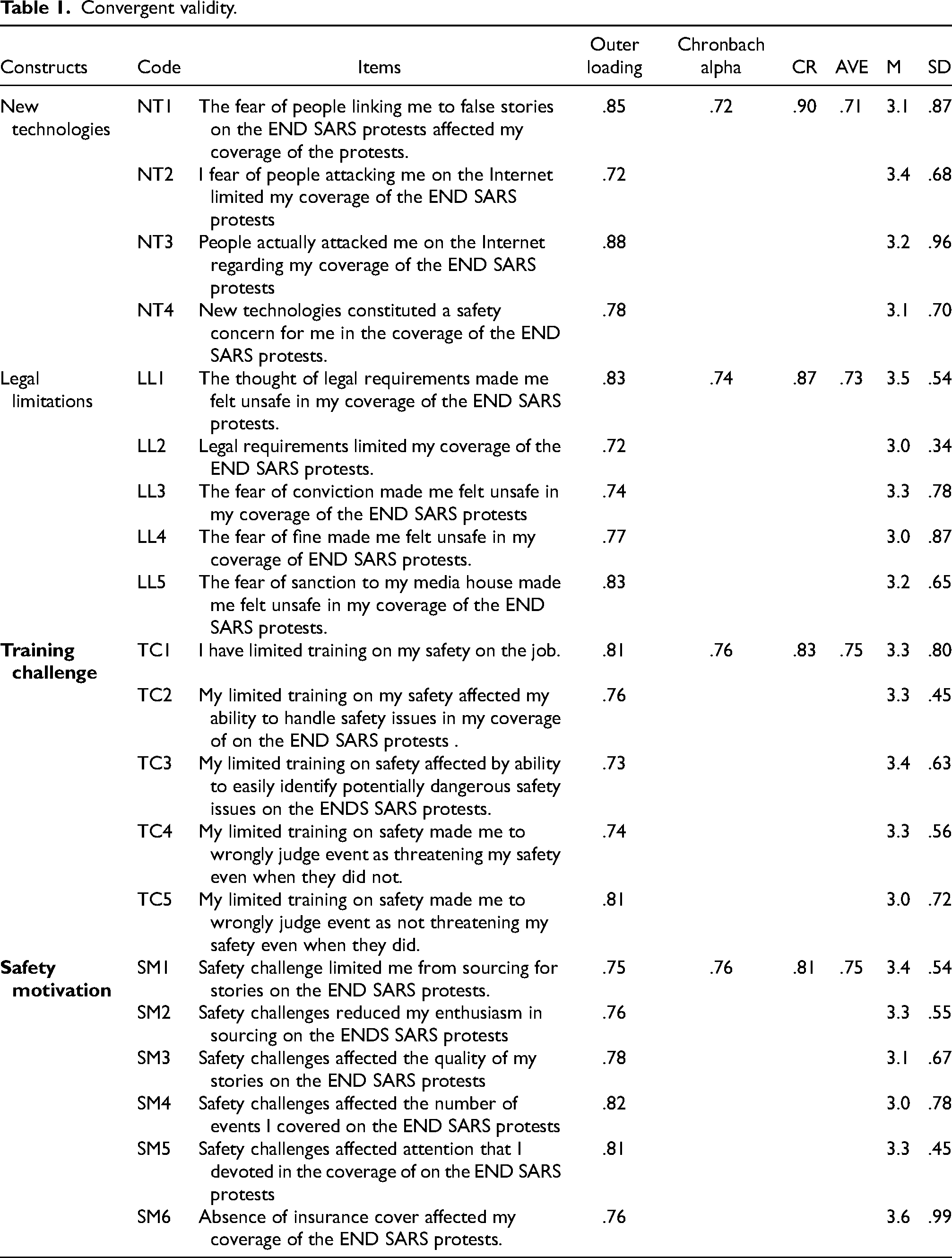
To test the psychometric components of the study model, the researchers paid attention to convergent validity as well as discriminat validity. With regards to convergent validity, the researchers assessed the indicator loading and the outcomes showed that the loadings were more than the baseline of 0.7 (Hair et al., 2019). Furthermore, the researchers ensured that the average variance extracted (AVE) were above 0.5. Additionally, the Composite Reliability (CR) values were all more than 0.7 benchmark (Hair et al., 2017). In addition, our Cronbach's alpha values were more than the recommended benchmark of 0.7 (Hair et al., 2017). Therefore, our convergent validity was okay (see table 1 below). The researchers ascertained the discriminat validity (Hair & Sarstedt, 2019) and the results revealed that each construct AVE's square roots were above their correlations with other constructs (Fornell and Larcker, 1981). What this means is that discriminant validity was acceptable. Overall, the psychometric properties of our model were excellent.
Convergent validity.
Data Analysis
The researchers combined descriptive and inferential statistics to analyse data for the study. Therefore, simple percentages, means and standard deviation were utilized among descriptive statistics. Also, the researchers utilized of Structural Equation Modeling (SEM) among the inferential statistics. In doing so, the Partial Least Squares (Smart PLS 3.3.2) was used. To determine the path of the study model, the researchers used Bootstrap re-sampling involving 5000 samples. The level of significance for hypotheses testing was 0.05.
Results
A total of 470 participants responded to the questionnaire instrument. The high response rate may not be unconnected to the fact the instrument was delivered through online platform. The sample for the study was made up of 61% male and 33% female. The mean age of the respondents was 33% while the mean number of years of journalism practice was ten years. The result of the structural model is presented in table 2 below:
Structural model results.
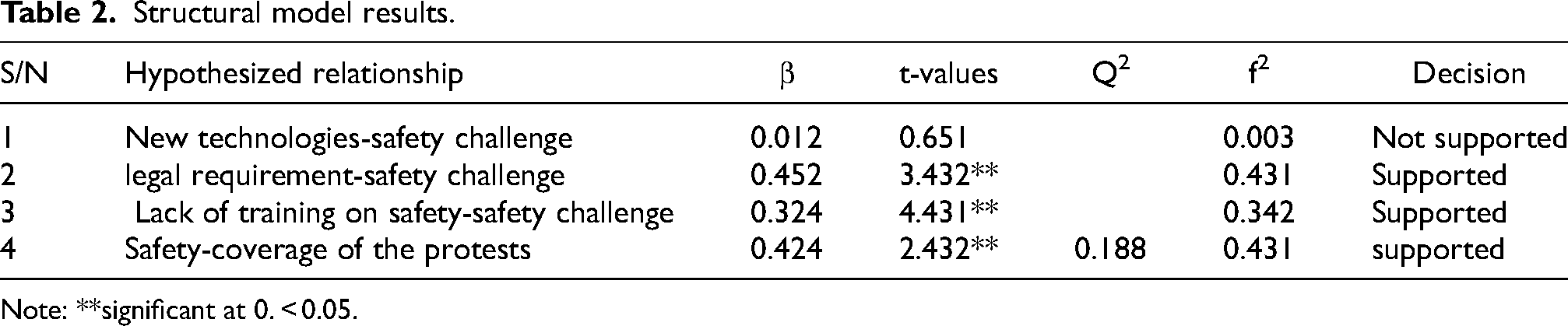
Note: **significant at 0. < 0.05.
Based on the result of the table above, the model for predicting the safety challenge of journalists who reported the END SARS protests is presented below:
Discussion of Findings
The objective of this study was to determine the challenges to the safety of journalists who reported the 2020 END SARS protests in Nigeria faced. The study tested four hypotheses among which three were confirmed while one was rejected. Consequently, the limitations to the safety of journalists who covered the END SARS protests faced included legal limitation, lack of training on safety as well as lack of motivational on safety such as insurance scheme. The result of the study showed that new technologies did not significantly impact on the safety of journalists who reported the END SARS protests in Nigeria.
The aspect of our findings suggesting that new technologies did not negatively impact on the safety of journalists is contrary to previous studies such as Chen et al. (2018) Høiby and Ottosen (2016) and Høiby (2019) which revealed that improvements in technologies also come with its baggage because it impact negatively on the safety of journalists. Our findings may not be unconnected to the fact that we examined a local issue and how journalists who are on ground report such an issue. In such a case, the utilization of new technologies for sourcing information will be limited. Besides, we also focused more on street protests and not online. This again means that journalists who reported such protests needed to be at the venues of such protests to get first hand information.
The result of the current study regarding the importance of training on safety is consistent with that of Wogu (2020); Maxson (2000) and Høiby and Garrido (2020) who reported that the training of journalists on safety is an important step towards ensuring their safety. Høiby and Garrido add that unfortunately, countries like Nigeria do not include safety in their training manual. This result shows that such an omission negatively impacts on journalists’ safety in their coverage of protests such as was the case with the END SARS protests.
Although laws are good to ensure order in any civilized society, at some point, some laws could constitute safety challenges to journalists. This aspect of our results is similar to the postulations of Garrido (2017a, 2017b) who noted that the legal terrain plays an important role in determining the safety of journalists in their reportage. Garrido argues that knowledge of extant laws on reporting is essential for journalists to avoid falling short of legal requirements. It can be argued here that at some point, knowledge of these legal requirements is capable of injecting fear into journalists, thus making them feel unsafe. One of the items of our instrument as seen in Tale 1 confirmed this.
Finally, the results point to the fact that safety challenges impact negatively on their coverage of the protests. That is to say that when journalists faced safety limitations, they are de-motivated, hence it affects their performance. This result has confirmed previous studies (Akinyele, 2007; Arthur, 1994; Benkhoff, 1997) that have examined the role of motivation on performance of personnel. Safety motivation is an important requirement for journalists in their coverage because that it is a sure way to make them put their best on the job. An editor can order a reporter to visit the scene of an event but if that reporter is not sure of his or her safety, it will affect the quality of report that the editor will receive.
Implications of the results
These results have practical, scholarly and theoretical implications. In practical terms, the results highlight the need for training of journalists on safety to enable them better handle safety challenges that come with the job. This information could be useful to policy makers, curriculum developers and journalism teachers. Additionally, the results make a case for the motivation of journalists regarding their safety. One of such steps is insurance coverage. This information will be beneficial to media owners. Additionally, it is expected that the result of this study will provide a practical guide on how to protect journalists who are reporting protests. This is important because in contemporary society, protests serve as critical ways through which people communicate their feelings to authority. From this perspective, therefore, protests serve as channels of information dissemination. Therefore, there is the need to come up with practical ways of protecting journalists who are reporting protests.
This study also has scholarly implications. The study has extended arguments regarding media coverage of protests in three ways. First, the study has gone beyond determining whether journalists experienced safety challenges or not. Rather, it examined challenges to the safety of journalists. In the second place, the study has also investigated journalists’ safety from the perspective of journalists who are reporting local events. This is an under investigated aspect. Thirdly, the study attempted to link safety challenges with media coverage. These additions will propel future debates in the area of journalists’ safety. This addition is important in literature because the growing population together with competition for scarce resources among people, there is higher possibility of protests taking place. Additionally, mobilizing people for mass protests is made easier than before as a result of social media and other Internet based channels of information dissemination. Therefore, more studies are needed to understand the challenges that journalists faced in their bid to amplify public voices. It is hoped that the current study will serve as springboard for more of such studies.
Finally, the results of this study have implications on Abraham Maslow's hierarchy of need. This is because our result showed that journalists consider safety as an important need that can assist them in the performance of their duties. Therefore, this study has validated the theory of motivation as advanced by Maslow. It is hoped that other researchers will find this aspect of our finding as a springboard in the application of this theory to other aspects of journalism research. This is cardinal because the job of information gathering is volatile circumstances such as protests is challenging. Therefore, adopting the theory motivation to examine this issue has shown that media workers, just as other human beings will need to be adequately motivated to assist them perform up to expectations. Future researchers who may wish to theorize challenges to media coverage of protests may find the result of this study useful.
Conclusion
Based on the result of this study, the conclusion is that media coverage of the END SARS protests was faced with different challenges that range from legal, lack of training on safety, and the absence of safety motivation. Although this study has been able to provide empirical evidence for understanding the challenges that journalists faced in their coverage of protest, the study did not provide empirical evidence regarding how journalists responded to these challenges. The study also did not provide information on the moderating role of gender on the safety challenges that journalists faced. The moderating effect of ownership has was also not covered in the current study.
Therefore, it is suggested that future studies should be conducted to examine the moderating role of gender and ownership on the safety challenges that journalists faced. It is also suggested that further researchers should examine how journalists respond to safety challenges in their coverage of protests.
Footnotes
Declaration of conflicting interests
The author(s) declared no potential conflicts of interest with respect to the research, authorship, and/or publication of this article.
Funding
The author(s) received no financial support for the research, authorship and/or publication of this article.
