




Abstract
The present study investigated the knowledge-sharing behavior of library and information management researchers, using the lens of the theory of planned behavior. The study is quantitative and adopted a survey questionnaire as a data collection technique. The snowball sampling technique was considered suitable to recruit respondents to the study. Data were analyzed with the help of SPSS (20.0) and the ADANCO (2.0.1). The research findings confirm that subjective norms and perceived behavioral control have a significant impact on intentions to share knowledge, whereas knowledge sharing intentions have a statistically significant positive impact on knowledge sharing behavior through SNS among postgraduate students. Attitude towards knowledge sharing directly triggers knowledge sharing practices through social media networking sites. Intentions to share knowledge do not mediate the relationship of attitude and knowledge sharing behavior. The theory of planned behavior has widely been used to measure knowledge-sharing behavior in different sectors. However, the relationship between attitude, subjective norms, perceived behavior control, intentions to share knowledge within the domain of social media is explored first time in this study, particularly in the context of the library and information science post-graduate students.
Keywords
Introduction
In today's world, knowledge is considered an important strategic asset in achieving sustainable development. Knowledge not only maintains and develops organizations but also helps individuals to cope up effectively in their routine matters and deal with challenging situations (Gaál et al., 2015). It emerges within individual minds, working teams, through social interaction and communication (Nonaka and Konno, 1998). Knowledge sharing in different domains has different meanings (Hassandoust et al., 2012). It is an important aspect of knowledge management and is considered an asset in improving decision-making, productivity, and quality of work. Information and communication technology have long been used for knowledge-sharing activities. However, people think that sharing tacit knowledge through ICT is not possible as it requires interaction among knowledge holders (Marwick, 2001). But social media emerged as a solution to this problem.
Social media captivated the communication industry due to its ease of use along with cost and time effectiveness. It has become a powerful tool for not only keeping in touch with a vast community, but people also use it to share their knowledge, expertise, and skills with others. In this way, they collaborate to generate new ideas and make innovations in the existing ones (Panahi et al., 2016). Consequently, social networking sites join millions of people across the globe and the fact about their influence on persons using it cannot be denied. It also offers an opportunity to share both tacit and explicit knowledge cost-effectively.
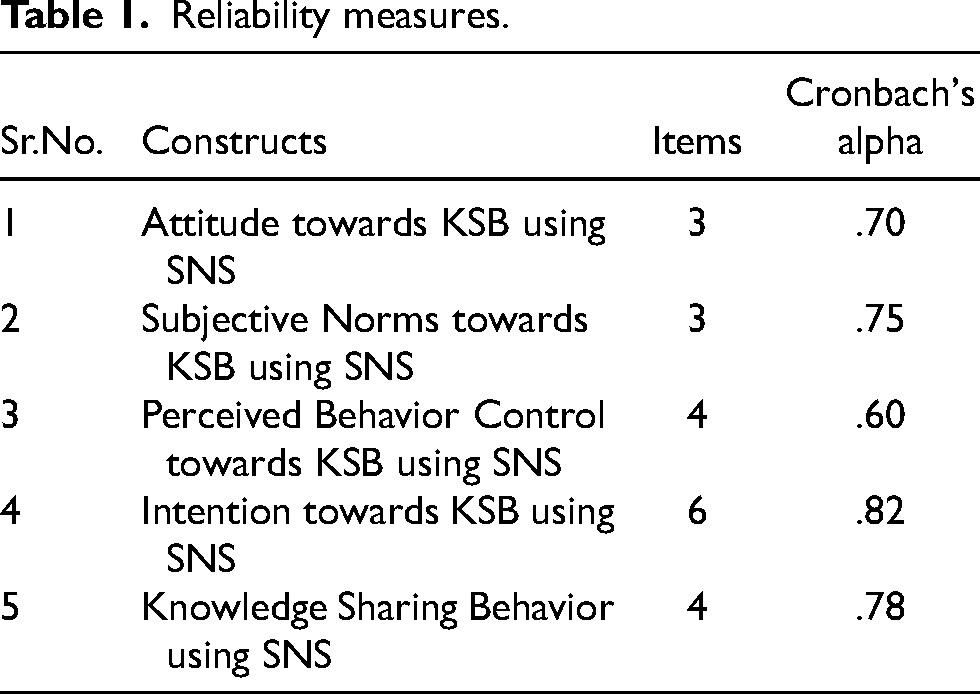
Reliability measures.
As knowledge sharing is a voluntary effort so, it relies upon several motivational, social, and environmental factors (Ryu et al., 2003). These factors in combination with economic and ICT support shape out individual's behavior. For instance, individuals feel a sense of competition with competitors and fear for the loss of status which makes them reluctant to share their expertise and knowledge (Nguyen et al., 2019). Also, knowledge-sharing behavior is strongly influenced by the level of education. A person pursuing a higher degree can easily share what he knows (Amin et al., 2009). Digital divide is another factor considered by previous researchers to shape individuals’ knowledge sharing behavior through social networking sites (Gamji et al., 2021). Digital divide may belong to individuals’ buying power (Gamji et al., 2021), access to ICTs infrastructure (Bo and Changxian, 2010), experience with using digital devices and social media (Hargittai, 2008) and the age (Delello and McWhorter, 2017). Each of these factors may affect the knowledge sharing attitude and behavior of individuals.
Estimated .Number of enrolled students in a research degree in LIS in Pakistan.

The changing nature of human behavior and influencing factors regarding the use of social media for knowledge sharing is an ongoing debate and attracted the interest of many researchers from different fields of study (Amidi et al., 2015; Chai and Kim, 2010; Choo et al., 2015; Eid and Al-Jabri, 2016; Gaál et al., 2015; Hassandoust et al., 2011; Kadir et al., 2017; Sharabati, 2018). Particularly, knowledge sharing behavior among students results in collaborative learning where each student shares their tacit and explicit knowledge with their fellows (Majid and Panchapakesan, 2015).
Demographic characteristics of respondents.

The theory of planned behavior (TPB) has widely been used to measure knowledge-sharing behavior in different sectors (Lin, 2007; Shah and Mahmood, 2013). Keeping the theory of planned behavior under consideration, a person's behavior is shaped by social pressures, good or bad intentions about that particular behavior, and perceived ease or difficulty of performing that behavior (Ajzen, 1991). Researchers found the impact of attitude, subjective norms, and perceived behavior control over intention and knowledge sharing behavior (Hassan et al., 2016). However, the use of social media for knowledge sharing underpinning the TPB remained unexplored locally and internationally. And since the students are high users of social media, therefore, the current study is designed to get a comprehensive understanding of the knowledge-sharing behavior of postgraduate students through social media. Since there was a lack of any research in this domain internationally as well as nationally, this paper can provide a theoretical basis for future research as well as practical implications for information managers and academia.
Theoretical framework
The current study investigates the researcher's knowledge-sharing behavior using the theory of planned behavior (TPB). The theory conceptualizes that behavioral believes, normative beliefs and control belief leads to behavioral intention. When people have sufficient control over behavior they are expected to perform as opportunities arise (Ajzen, 2013). The theory of planned behavior conceptualizes intention as the central factor to perform a certain behavior, but it is influenced by some motivational factors which affect behavior (Ajzen, 1991). These motivational factors indicate an individual's willingness and efforts to try certain behavior.
The theory of planned behavior provides conceptual grounds to study the complexities of human behavior in diverse situations (Ajzen, 1991). The applicability of this model in different situations has been indicated by past research (Chatzoglou and Vraimaki, 2009; Hassandoust et al., 2012; Ranasinghe and Dharmadasa, 2013; Shah and Mahmood, 2013). Theory measures human behavior through attitude, subjective norms, perceived behavior control, and intentions to perform. TPB stated that attitudes and social pressures positively correlate with the intention to perform any behavior. PBC is also an important factor that impacts not only intention but also directly influences behavior. It is the perceived ease or difficulty of performing a certain behavior.
Literature review and hypotheses development
Knowledge sharing is an activity by which knowledge (i.e. information, skills, or expertise) is exchanged among individuals, friends, colleagues, families, communities, or organizations (Williams and Bukowitz, 1999). Knowledge sharing (KS) is also defined as the transmission of knowledge from a source in a manner that it is gained and used by the receiver (Argote et al., 2000; Ko et al., 2005)
The studies explained that motivation, attitudes, intention (Gagné, 2009; Javaid et al., 2019; Kolekofski Jr and Heminger, 2003), intrinsic rewards (Blau, 1964), self-satisfaction, and getting feedback from peers (Wei et al., 2012) are the underlying factors determining the knowledge sharing attitude. Social interaction ties are strong predictors of knowledge sharing behavior (Chang et al., 2018).
Knowledge sharing is an important behavior for students’ learning and professional development (Majid and Panchapakesan, 2015). But the motivational factors may be different for students than professionals working in an organizational setting (Isika et al., 2013). Measuring knowledge sharing behavior of students has remained the topic of interest of many researchers as Yuen and Majid (2007) reported a positive attitude of knowledge sharing by the undergraduate students of Singapore. Chong et al. (2014) investigated the impact of different personality traits, classroom environment, and ICT factors on the knowledge-sharing attitude of students. The use of social networking sites by students has been increased resulted in easier communication whether we talk about professional, academic, or personal communication through social networks. It has made possible the knowledge sharing and receiving with peers and other experts (Cross and Cummings, 2004). Social media has a lot of potential and its many facets related to knowledge sharing behavior yet needs to be explored. The present study is an effort to explore the knowledge-sharing behavior on social media of library and information science postgraduate researchers through the lens of the theory of planned behavior.
Attitude
Attitudes positively influence behavioral intentions to perform a certain task (Ajzen and Fishbein (1980). This relationship is supported by substantial empirical support. A favorable attitude towards certain particular action leads to a positive intention to perform a behavior (Bock et al., 2005). Similarly, Rahab and Wahyuni (2013) surveyed 242 lecturers from public and private universities to measure their knowledge-sharing behavior. They confirmed that attitude towards knowledge sharing has a strong effect on the behavioral intention of knowledge sharing. The study suggested that a positive attitudinal disposition leads towards favorable knowledge sharing intention. Attitudes are the positive determinants of intentions to perform certain behavior (Ranasinghe and Dharmadasa, 2013; Sihombing, 2011).
The attitude of a person is influenced by certain internal and external factors which give direction to his/her behavior. Economic, psychological, and social factors shape favorable and unfavorable attitudes towards performing knowledge-sharing behavior (Bock et al., 2005). Besides, students think that knowledge sharing may result in loss of competition among peers (Yaghi et al., 2011), extrinsic rewards also hinder the positive attitude towards knowledge sharing (Lin, 2007).
This leads to the formulation of our following hypotheses.
Subjective norms
Subjective norms as explained by the theory of planned behavior are the social pressures that compel or hinders someone from performing a certain behavior. One may feel these social pressures from experts in the field, significant authorities, elders, or peer pressure. Subjective norms have shown a significant relationship intention to share knowledge in the number of other studies (Rahab and Sun and Scott, 2005; Venkatesh and Davis, 2000; Wahyuni, 2013). Subjective norms affect attitudes and intentions to share knowledge.
According to Ajzen (1991) certain salient beliefs help to formulate a person's attitude which correlates with other factors to shape the behavior. The relationship between attitude, SN, and PBC vary across behaviors, situations, and cultures. A study conducted in Indonesia on plate-cutting workers of ships examined the correlation between the three variables and found no relationship between attitude, SN, and intentions. In another study, a negative relationship was found between PBC, attitude, and SN while a positive correlation between attitude and SN was seen (Smith, 2015). This leads to the formulation of the following hypotheses.
Perceived behavioral control
Perceived behavioral control is an important aspect of the theory of planned behavior. It is referred to the people's perception of how easy or difficult is certain behavior to perform. This ease and difficulty are influenced by the personal ability and confidence needed to perform certain behavior (Ajzen, 1991). Perceived behavioral control is an important factor in determining the knowledge sharing intention (Jeon et al., 2011), and has a positive influence on attitude. The same is predicted about employees in the oil industry (Tohidinia and Mosakhani, 2010), physicians (Ryu et al., 2003), and workers of construction teams (Zhang and Ng, 2012). This led to the following hypotheses.
According to the theory of planned behavior, perceived behavior control has a direct effect on actual behavior. The ability of a person to have the confidence to perform certain behavior and the availability of resources both motivates a person to indulge in a specific behavior (Ajzen, 1991). Several empirical studies are proving the direct significant relationship between perceived behavioral control and actual behavior (Doll and Ajzen, 1992; Ryn and Vinokur, 1992). This leads to our fourth hypothesis.
Intentions
According to the theory of planned behavior, intentions are the predictors of people's behavior that how willingly they are eager to perform a certain task. Intentions capture those motivational factors that influence someone to perform a certain behavior. How hardly they are captivated by certain tasks and planning to exert efforts in the accomplishment of these tasks (Ajzen, 1991). There is a positive relationship between intention and behavior of knowledge sharing (Sihombing, 2011).
According to Momayyezi et al. (2019) the strongest correlation existed between intention and knowledge sharing behavior measured in postgraduate students. Intention turned out to be a
significant predictor of knowledge-sharing behavior. Alongside another study predicted a weak positive effect but with significant relational value among dairy workers intention and behavior of knowledge sharing (Shah and Mahmood, 2013). This led to the formulation of our following hypothesis which is:
Based on the developed hypotheses a model was proposed to test statistically (Figure 1).
Methodology
The study is quantitative in nature and the survey method is used to collect data. The instrument of the survey was a questionnaire that was adapted from two studies after taking proper permission from the authors (Appendix A). The questionnaire was comprised of 20 statements covering five constructs as determined by the theory of planned behavior (Ajzen, 1991). Attitude towards knowledge sharing behavior through social networking sites, the role of subjective norms in knowledge sharing using social networking sites (SNS), perceived behavior control to knowledge sharing on SNS, and intention towards knowledge sharing behavior. Each aspect was measured on a five-point Likert type scale ranging from “strongly disagree to strongly agree”. Participants were asked to mark their responses as 1 = Strongly disagree, 2 = Disagree, 3 = Neutral, 4 = Agree, 5 = Strongly agree. As the scale was adapted using two different questionnaires, therefore, the reliability of each aspect was also calculated.
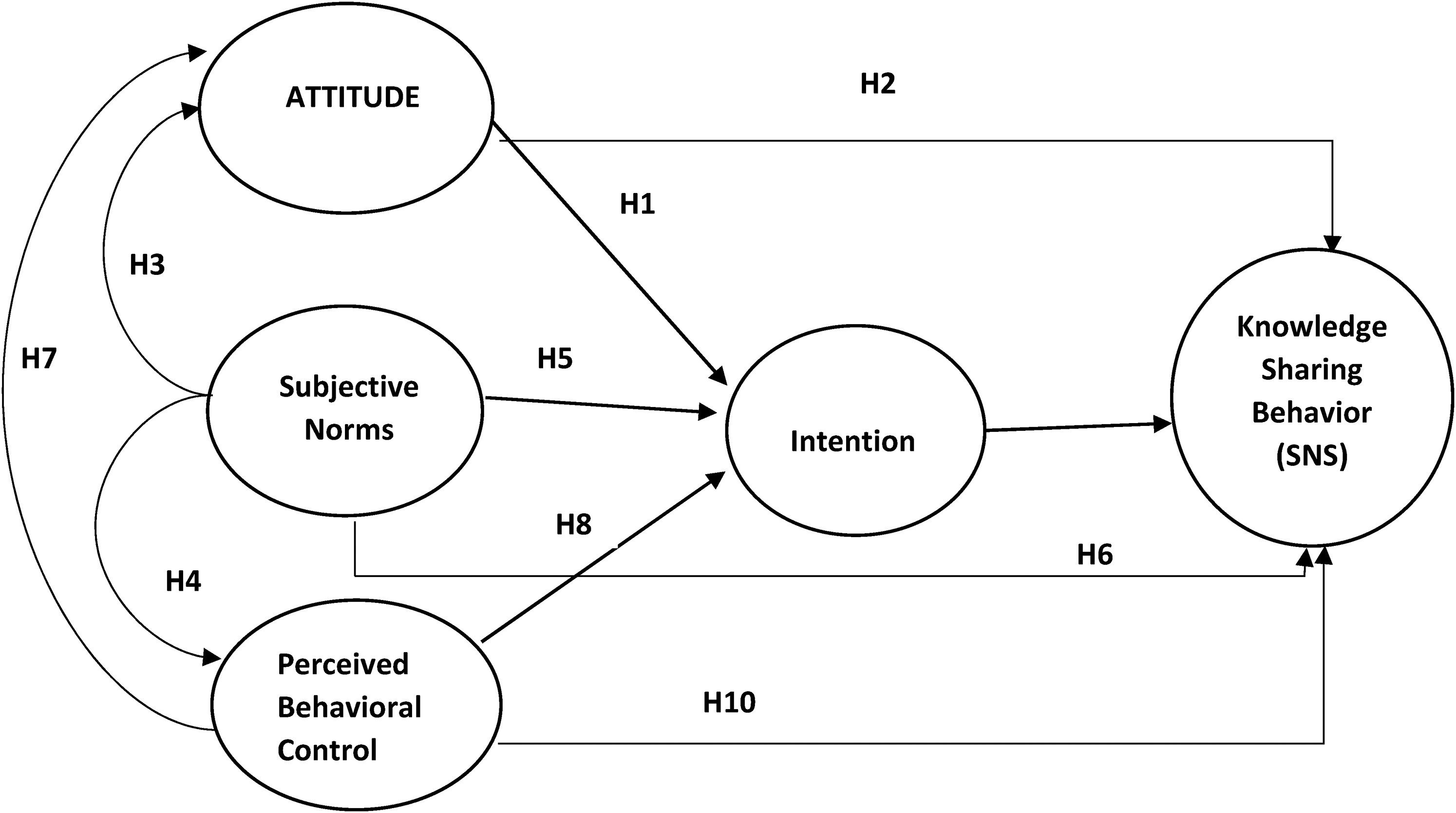
Proposed model.
The population of the study comprised of M.Phil. and PhD students of Library and Information science (LIS) faculty from all the universities of Pakistan. Currently, there are eight public sectors and two private sector universities are offering MPhil and PhD programs in the domain of LIS. Initially, the researcher used the purposive sampling technique aiming to collect data from all of the population. But, due to the pandemic Covid-19 lockdown, it was impossible to get official lists of enrolled students from universities. So, the snowball sampling technique was used to collect data from the participants.
The researcher contacted faculty members teaching MPhil and PhD programs and the head of the departments for taking contact details of students. They provided some students’ WhatsApp numbers and from whom, further contact details were collected. They have provided the estimated number of their students, as everyone was restricted from their workplace due to the pandemic of Covid-19. Due to lockdown, it was not possible to get official records from university offices.
Following is the list of universities with an estimated number of currently enrolled students.
The questionnaire was sent to 208 participants responses received were 126 and the response rate was 60.5%. Data were analyzed using SPSS (20.0) and the ADANCO (2.0.1).
Results
Descriptive statistics for demographic variables showed that 63.5% of the respondents were male and 36.5% were female respondents. Age was also an important factor in determining the behavior of respondents. Age was divided into six groups as 25–30 years, 31–35 years, and 36 −40 years, 41–45 years, 46–50 years, and above 50 years. Data revealed that 67% of students belong to age groups 25- 35 and according to social media usage stats largest number of users also belong to this group. Statistics also showed that three fourth of the population is working along with studying.
Measurement model
Data analysis was completed in two phases, first reliability analysis was performed using SPSS (20.0), later the ADANCO version 2.1.0 was utilized to apply Partial Least Squares (PLS) and Structural Equation Modelling (SEM) and to test the interrelationships between proposed latent variables.
Since all the constructs were reflective in nature, therefore, the ADANCO model A was considered suitable. For, reliability of reflective constructs having various indicators, the ADANCO 2.0.1 provides three reliability coefficients i.e., Dijkstra-Henseler's rho (PA (Dijkstra and Henseler, 2015)), Composite reliability (PC (Werts et al., 1978), and Cronbach's alpha (Cronbach, 1951)). Values of composite reliability (CR) and Cronbach's alpha are considered satisfactory if those are greater than 0.7 (Chin, 2010; Hair et al., 2017), similarly, rho A coefficient requires values greater than 0.6 (Dijkstra and Henseler, 2015; Schuberth et al., 2018). Data presented in Table 4 confirm that CA, CR, and rho A are above 0.7, therefore the results were considered satisfactory.
Measurement model.

Note: Figures were rounded.
To measure the validity, convergent validity through Average Variance Extracted (AVE) and discriminant validity through HTMT0.85 is carried out. Convergent validity measures unidimensionality, and values above 0.5 are considered acceptable (Fornell and Larcker, 1981). Discriminant validity is measured through HTMT0.85, it is used to verify that two conceptually different constructs are also statistically different. Data in the Table 5 reveals that AVE values were above 0.5 and within an acceptable range. Similarly, the values presented in the Table 5 depict that all values meet the HTMT0.85 criterion and remained below .85. Thus, all the constructs were not only reliable but valid too.
HTMT 0.85.
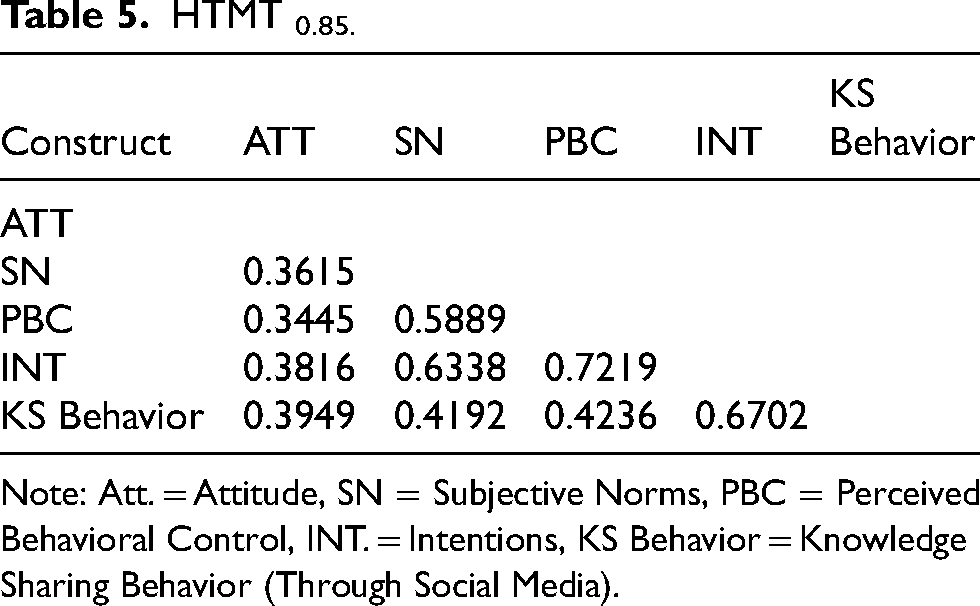
Note: Att. = Attitude, SN = Subjective Norms, PBC = Perceived Behavioral Control, INT. = Intentions, KS Behavior = Knowledge Sharing Behavior (Through Social Media).
Structural equation modeling and hypotheses testing
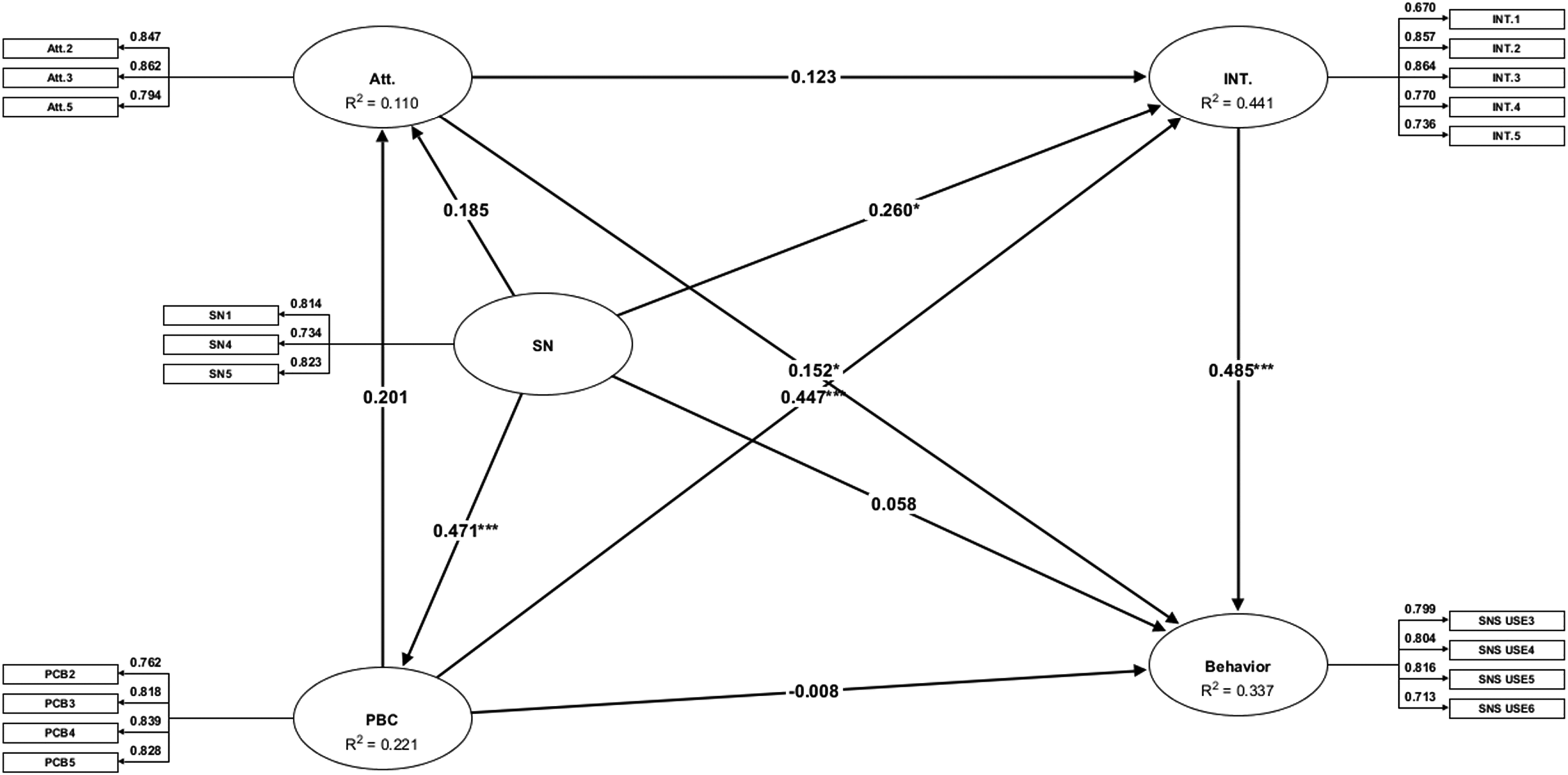
The hypothesized model was tested, and path analysis presented in Figure 2 and Table 6 confirms that five out of ten hypotheses were accepted. The results in Table 6 shows that H1 is rejected explaining that knowledge sharing attitude has no significant impact on intention to share knowledge among LIS postgraduate students (β = 0.12, t = 1.21). Whereas, it has a significant positive impact on knowledge sharing behavior/practices directly (β = 0.15, t = 1.99). Thus, H2 is accepted at p < .05. Although, subjective norms have no significant impact on the attitude towards knowledge sharing (β = 0.18, t = 1.58) rejecting H3 at p > .05. However, subjective norms have a significant positive impact on perceived behavioral control (β = 0.47, t = 4.84) and intentions to share knowledge (β = 0.26, t = 2.44). Thus, H4 and H5 are accepted at p < .05.
P
Path analysis.

Interestingly, subjective norms (H6) do not have a significant direct impact on knowledge-sharing behavior (β = 0.06, t = .45). Perceived behavioral control is a significant predictor of positive knowledge sharing attitude (β = 0.20, t = 1.61) and intentions (β = 0.45, t = 3.82). Thus, H7 and H8 were accepted at p < .05. Perceived behavioral control has no significant impact on knowledge sharing behavior (β = 0.46, t = 0.00) rejecting H9. Finally, H10 was accepted confirming the significant positive impact of knowledge sharing intentions on knowledge sharing practices (β = 0.48, t = 3.98).
It can be concluded that subjective norms impact perceived behavioral control positively. Similarly, perceived behavioral control impacts attitude whereas, a positive attitude towards knowledge sharing leads to knowledge sharing practices. However, all three relationships are confirmed with weak effect size i.e., f
Conclusions and discussion
The present study was conducted to measure the knowledge-sharing behavior of library science postgraduate researchers on social networking sites. It is the application of the Theory of planned behavior that is widely being used in the domain of knowledge sharing. Knowledge sharing is an important part of active learning. In contrast to organizational knowledge sharing practices, KS among students lacks any extrinsic or intrinsic motivational reward rather based on voluntarily sharing of knowledge. As of previous studies (Hassan et al., 2016; Sial et al., 2014), the current research findings confirm that subjective norms and perceived behavioral control have a significant impact on intentions to share knowledge. However, a study conducted in the Pakistani dairy sector reported no impact of subjective norms and perceived behavioral control on intentions to share knowledge (Shah and Mahmood, 2013). As the subjective norm is the social pressure that compels an individual to perform a certain behavior, and in Pakistani culture, individuals respect social norms. Therefore, in the current study too subjective norms were found significantly and positively impacting knowledge sharing behavior predictors i.e. self-efficacy (PBC) and intentions to share knowledge. However, subjective norms were not a direct reason for “knowledge sharing behavior” confirming the mediating role of perceived behavioral control and intentions.
The present study found that knowledge sharing intention has a statistically significant positive impact on knowledge sharing behavior through SNS among postgraduate students. Previously, Ellahi and Mushtaq (2011) found that intentions to share knowledge positively leads to knowledge sharing behavior. Whereas attitude towards knowledge sharing directly triggers knowledge sharing practices (through social media networking sites). Similarly, previous studies conducted on Pakistani students (Haq and Haque, 2018) business teachers (Hassan et al., 2016), employees (Sial et al., 2014) found a strong correlation between attitude towards knowledge sharing and knowledge sharing practices. However, the current study confirmed that attitude has no significant impact on intentions to share knowledge-sharing behavior.
Results of the study showed that most participants were also working in different sectors along with pursuing a post-graduate degree. This may also a factor that their intention to share knowledge on SNS is significant. They also feel pressure from colleagues and are more prone to use technology easily. These factors in relation to each other have a positive impact on knowledge-sharing behavior.
Research implications
Theoretically, the study strengthens the literature available from the developing countries and Asian context particularly. Whereas, practically, there are several research implications. For example, it is proved that a positive attitude towards knowledge sharing will trigger knowledge sharing practices, therefore, it is direly needed to convey the potential benefits of knowledge sharing to the postgraduate students. As a result, they might develop a positive attitude leading to knowledge sharing practices. Similarly, Pakistani postgraduate students were found influenced by their peers, family, friends, and colleagues that positively boost individuals’ confidence in their abilities to complete knowledge-sharing tasks and, on their intentions, to share knowledge in near future. Thus, it is direly required to develop a knowledge-sharing culture within organizations and among society. As if individuals will find others to practice knowledge sharing, they will also intend to practice this positive behavior. Furthermore, perceived behavioral control is a positive predictor of knowledge sharing intentions, if the students are trained to share the knowledge using social media, it will develop a sense of confidence among them that they can share knowledge using SNS, and this confidence may develop KS intentions and ultimately KS culture may flourish.
Limitations and future research directions
The study has a limitation, as the data were collected during the COVID-19 pandemic, therefore, the study implied snowball sampling technique and response rate remained low, which may hinder generalization of the results. After a detailed review of the available literature, it is found that TPB has been widely used to study knowledge sharing behavior, however mostly mediation analysis has been carried out. It is therefore suggested, a future study should be conducted to identify the impact of any moderator i.e., age, technostress, information overload, etc. on the knowledge sharing practices. Since there must be rich and poor among the nation's states and individual users of the SNS, therefore, it is suggested to explore this phenomenon considering digital divide
Footnotes
Declaration of Conflicting Interests
The author(s) declared no potential conflicts of interest with respect to the research, authorship, and/or publication of this article.
Funding
The author(s) received no financial support for the research, authorship and/or publication of this article.
