



Abstract
During the last two decades, Internet use has increased in all parts of the world. Although, the trend of actively using the Internet for seeking health-related information was already on the rise, it accelerated soon after the COVID-19 pandemic. Along with the increased use of the Internet for health decisions, serious concerns have been raised due to fake or misinformation. This study aims to determine the impact of Internet use for gathering health-related information on the disease management behavior of patients and to identify the mediating role of perceived credibility of online information. The study surveyed 200 chronic disease patients with diabetes and hypertension from the Pakistan Institute of Medical Sciences (PIMS), Islamabad, Pakistan. It is concluded that overall health-related Internet use has a positive impact on the disease management behavior of chronic disease patients. The study further confirms the mediating role of the perceived credibility of online information. Patients who are frequent users of the Internet for health information, who perceive online information more credible, reported better disease management behavior as compared to the less frequent users and those who perceive online information less credible.
Keywords
Introduction
The Internet has an important and pervasive impact on the lives of people throughout the world, with an increasing trend of actively managing their health concerns (Nazir & Soroya, 2021; Rains & Karmikel, 2009; Soroya et al., 2021; Takahashi et al., 2011). Almost 4.5% of Internet searches are done for health-related information (Mo, 2012). People are more willing to search information for health-related decision-making and show interest in maintaining a healthy lifestyle, losing weight, dieting, and keeping good health. Internet and health-related websites are often used to search for information on specific diseases and/or to interact with community groups, patients with a specific disease, researchers, and health providers as well (National Research Council, 2000).
Online searches are mostly related to finding users who might have similar symptoms of a particular disease, diagnose a specific disease, to consult online reviews of the medicine and treatment of any disease (Eysenbach, 2003; Mo, 2012). Internet use for taking help regarding diet, weight, and physical activity (DWPA) is popular in the United States (McCully, Don, & Updegraff, 2013). Similarly, in Canada, the Internet was used by more than two-thirds (69%) to search for health information and by one-quarter (25%) to track fitness and health (Statistics Canada, 2020). Lately, the Internet remained the primary health information channel among the public (93.5%) during the initial stage of the COVID-19 epidemic (Wang et al., 2020; Vismara et al., 2021).
Access to online reliable disease information helps to reduce anxiety and build confidence in a person's abilities (Ybarra & Suman, 2006). Thus, health-related information on the Internet can easily influence the attitudes and behavior of healthcare seekers. Literature confirms that Internet use for health-related activities led to positive health and self-care management among individuals. Due to associated benefits, the practices of online health information seeking increased all over the world (Silver, 2015). However, there are quality concerns regarding health information that is sought and acquired online (Tonsaker, Bartlett, & Trpkov, 2014). Lack of technical knowledge to evaluate the credibility of health information is considered one of the reasons for quality concerns.
Patient engagement with health information online, along with quality concerns is one fact, while a growing number of chronic patients is another. Even though chronic diseases do not kill humans, they adversely affect their quality of life. Non-communicable diseases (NCDs) also known as chronic diseases, do not spread from person to person and tend to become more common with age. In general, chronic diseases progress slowly, last a long time, and require medical treatment. Most chronic diseases can worsen a patient's overall health by limiting their ability to live, function normally, and be productive (Megari, 2013).
Chronic disease patients are more inclined towards the Internet for health information seeking (Nazir & Soroya; 2021; Zhang, 2014) and there is a positive relationship between Internet use and disease management behavior among chronic patients (Miller & Bell, 2012; Lemire et al., 2008; Stinson et al., 2008; Wu & Li, 2016). The credibility of online information is an important concern for Internet users, and it becomes more sensitive when information is related to health. Health information consumers consider information more beneficial if they find it reliable (Shang et al., 2020). Health information credibility triggers health-related decisions for example vaccinations (Jennings & Russell, 2019) and infant care decisions (Moon et al., 2019). To avoid the negative consequences of false, fake, or unreliable health information, there is a need to develop reliable health information sources (Chang et al., 2021). COVID-19 accelerated the use of the Internet and social media for health-related information seeking (Thappa et al., 2021; Soroya et al., 2021) and thus has increased the need to explore the role of information quality for health-related decision-making. Based on the above-mentioned literature, it may be predicted that there is a positive relationship between Internet use for health-related information seeking, perceptions about online information sources’ credibility, and the disease management behavior of patients.
The number of chronic disease patients is increasing globally. Approximately 45% of people in the U.S. suffer from at least one chronic condition and the number is growing day by day (AARP, 2018; Raghupathi & Raghupathi, 2018). In Pakistan we also see the rise of chronic diseases, accounting for 42% of all deaths. It is reported that 50% of Pakistani people face at least one chronic disease (Bacha & Munir, 2022). In 2005, the World Health Organization (WHO) projected that in Pakistan, over the next 10 years, chronic disease will be a reason for the death of 6 million people. In 2011 the WHO reported 12.9 million people with diabetes (10% of the total population) from Pakistan, among them 9.4 million were diagnosed, 3.5 million were undiagnosed and 38 million people had pre-diabetes. It is estimated that Pakistan has become the 7th largest country in terms of population with diabetes and it will be the 4th largest by 2030. It is also estimated that hypertension affects approximately 40% of adults globally. In Pakistan, 50% of adults are affected by this disease (The News, May 2018).
In addition, data from 2012 to 2019 show that in Pakistan the percentage of health expenditures remained between 2.34 to 3.38 percent of the Gross Domestic Product, which is quite insufficient for health-related projects (See Figure 1).
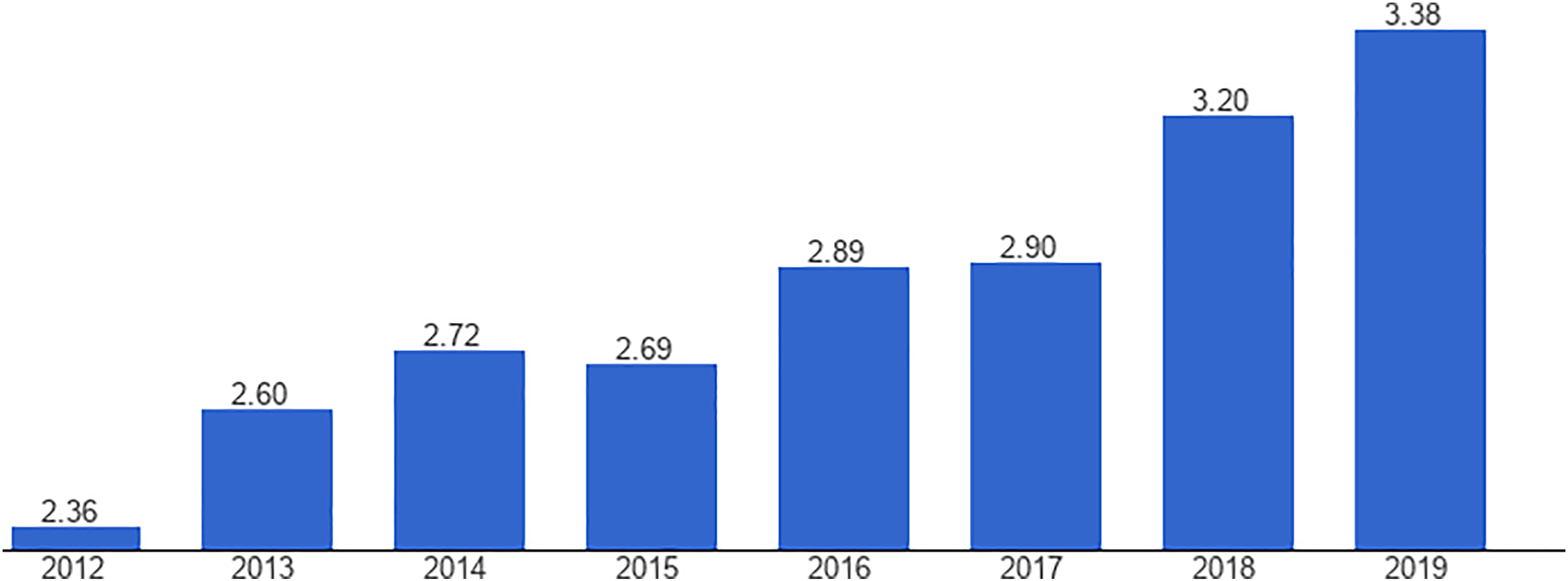
Health spending as percent of GDP (2012–2019). Reproduced from The Global Economy.com, The World Bank. (https://www.theglobaleconomy.com/Pakistan/health_spending_as_percent_of_gdp/).
However, the use of the Internet is increasing day by day in Pakistan. According to Pakistan Telecommunication Authority (PTA) annual report 2021, in 2020−2021 broadband subscribers reached 110 million from 76.3 million (2018−2019). Similarly, the trend of using cellular mobile is increasing, mobile broadband penetration increased from 36.18% in 2018−2019 to 49.9% in 2020−2021. Mobile data usage was 4510 petabytes in 2018−2019 and reached 6855 petabytes in 2020−2021.
In this situation, where the number of chronic disease patients is increasing and the government has made minimal investments in health-related projects, the increased Internet connectivity of the public could be taken as an opportunity. The Internet can also play an important role to create awareness among patients and families in supporting their disease management with credible information.
Globally, a handful of studies have been carried out to explore the use and impact of the Internet for health-related information on disease management among different groups including chronic disease patients. In Pakistan, however, despite the growing number of chronic disease patients and increased use of the Internet, no studies have appeared that identify the use of the Internet by chronic disease patients for disease management, i.e., in considering health information quality as a moderator of health information adoption. According to our review, a limited number of researchers have similarly explored either use of the Internet by chronic patients (Nazir & Soroya; 2021; Soroya et al., 2020) or) by medical students and health professionals for their academic learning or to attain health information in Pakistan (Hashim et al., 2016; Jadoon et al., 2011).
As such, this is the first study from Pakistan which determines health-related Internet use and its impact on the disease management behavior of chronic patients through the mediating role of information credibility. The research hypotheses include:
Design and method
The research design of the study is a correlational quantitative research design. Diabetic and Hypertension patients were surveyed. Patients from the Diabetes and Cardiac Centre of Pakistan Institute of Medical Sciences (PIMS), Islamabad were the participants of the study. The participants were selected based on purposive convenience sampling. The 200 patient respondents were selected purposively, patients who were Internet users and were available at the hospital were requested to fill out the questionnaires. Participation took place in the hospital from Monday to Saturday during a regular check-up. The data were collected in the first quarter of 2019 with an equal proportion of both types of diseases.
The survey instrument was developed and pilot-tested after expert scrutiny. The panel of experts included one professor from information management, one medical librarian, one professor from statistics, and one associate professor from medicine. The result of the pretest Cronbach's alpha for the construct of ‘disease management behavior’ was 0.822 and for the ‘perceived credibility of online information’ was 0.73, which are reasonably acceptable. After pilot testing, the final instrument was prepared, and it included closed-ended questions designed to gather the frequency of health-related Internet use, perceived credibility of information sources, and disease management behavior of the participants. A self-administered questionnaire was used for data collection. The total time spent filling out one questionnaire was 10–15 min. The analysis was performed using the Social Science Statistics Package (SPSS) version 20.0 and PROCESS v3.3 by Hayes.
Results
Participants' demographic information
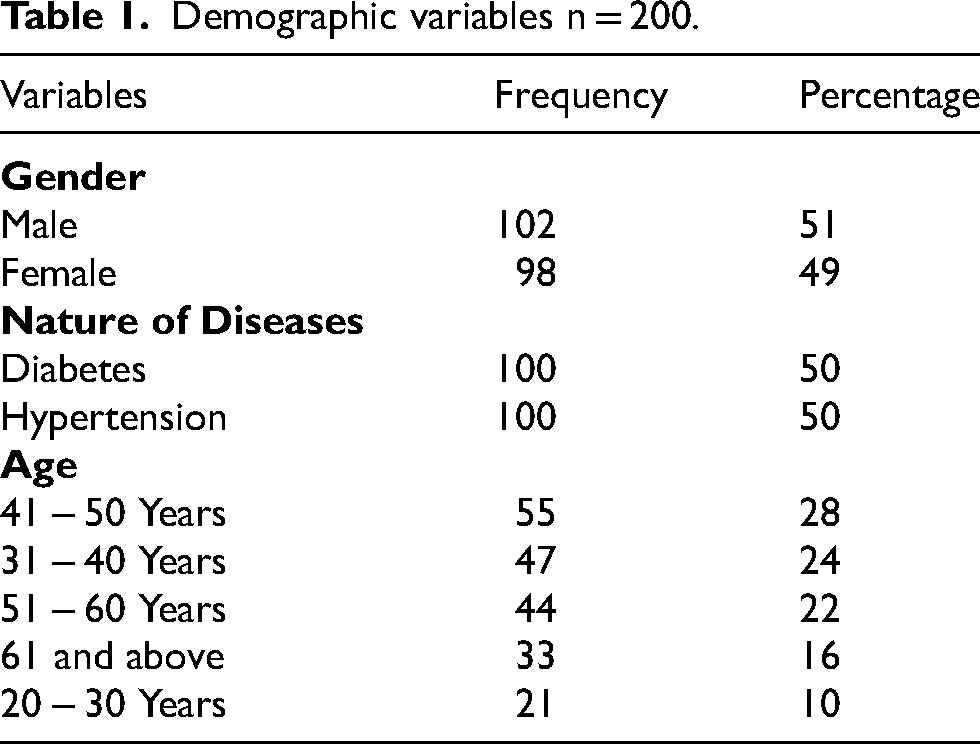
Table 1 reveals that 102 (51%) out of the 200 participants were male and 98 (49%) were female. The proportion of patients from both diseases was purposively decided to take equally. Thus, the data was taken from patients 100 diabetic patients (50%) and 100 hypertension patients (50%). Almost, one-fourth of the participants were from each of three age groups e.g., 41−50 (28%), 31−40 (24%), and 51−60 (22%), respectively. Comparatively, fewer respondents represented the age group of 60 years and above 20–30 years.
Demographic variables n = 200.
Frequency of internet use for health information seeking
There were two independent variables i.e., Internet use for health-related information seeking, and perceived credibility of online information, and one dependent variable i.e., disease management behavior. All the variables were estimated on a five-point continuous scale. The frequency of health-related Internet use was measured through a scale with five points i.e., Rarely, Monthly, Weekly, Daily, and Several times a day. Figure 2 indicates that about half of the patients 89 (45%) use the Internet for health information seeking daily. Almost one-third of the 57 (29%) used the Internet for health information weekly. Whereas Internet use for health information seeking each month 14 (7%) and several times a day 14 (7%) was minimal and the same. The results revealed that Internet use for gathering health information is frequent on a daily and weekly basis Figure 2.

Frequency of internet use for health information seeking.

Tested Conceptual and Statistical Model based on PROCESS Model 4 by Hayes (2012).
The second independent variable i.e., perceived credibility of health-related information available on the Internet, was calculated using a five-point continuous scale. The mean score in Table 2 describes that a majority of the participants believe that the available information is “informative” (M = 4.20, SD = .87). They believed that information they found on the Internet is often “current” (M = 3.84, SD = 1.11) and “concerned with community well-being” (M = 3.84; SD = 1.24). Most of the participants considered that information on the Internet is more often reliable (M = 3.63, SD = 1.05) than factual (M = 3.35, SD = 1.12). They sometimes find information misleading (M = 2.85, SD = 1.00). Overall perceived credibility of patients forgetting health-related information from the Internet is quite good. For the purpose to measure the construct and calculating Cronbach's alpha values, the scores for two statements i.e., “Misleading” and “False” were reversed. The Cronbach's alpha for the construct was 0.73.
Perceived credibility of health-related information available on the internet.

Note: Never = 1, Rarely = 2, Sometimes = 3, Often = 4, Always = 5
The study aimed to explore the impact of Internet use on disease management of patients in terms of knowledge, attitudes, and activities. Participants were asked about their disease management behavior. A total of 12 statements were prepared to estimate the disease management behavior with the help of literature and experts’ opinions. The Cronbach's alpha for the construct “Disease Management Behavior’ was 0.82.
The mean score in Table 3 indicates that most of the patients (M = 4.49, SD = .99) reported they always followed the doctor's instructions properly. The results reveal that among patients there was a tendency of maintaining a proper diet, including the necessary nutrition to manage health conditions (M = 4.38, SD = 1.00). They also easily communicated disease-related problems to their doctors (M = 4.37, SD = 1.00). Conversely, the mean score for performing daily exercises for managing health conditions (M = 4.01, SD = 1.27) and regularly reading about the disease to update knowledge was comparatively low (M = 3.58, SD = 1.01). Whereas the least frequent behavior was keeping themselves up to date through the use of disease awareness programs, e.g., online workshops and seminars (M = 2.53, SD = 1.11).
Disease management behavior.
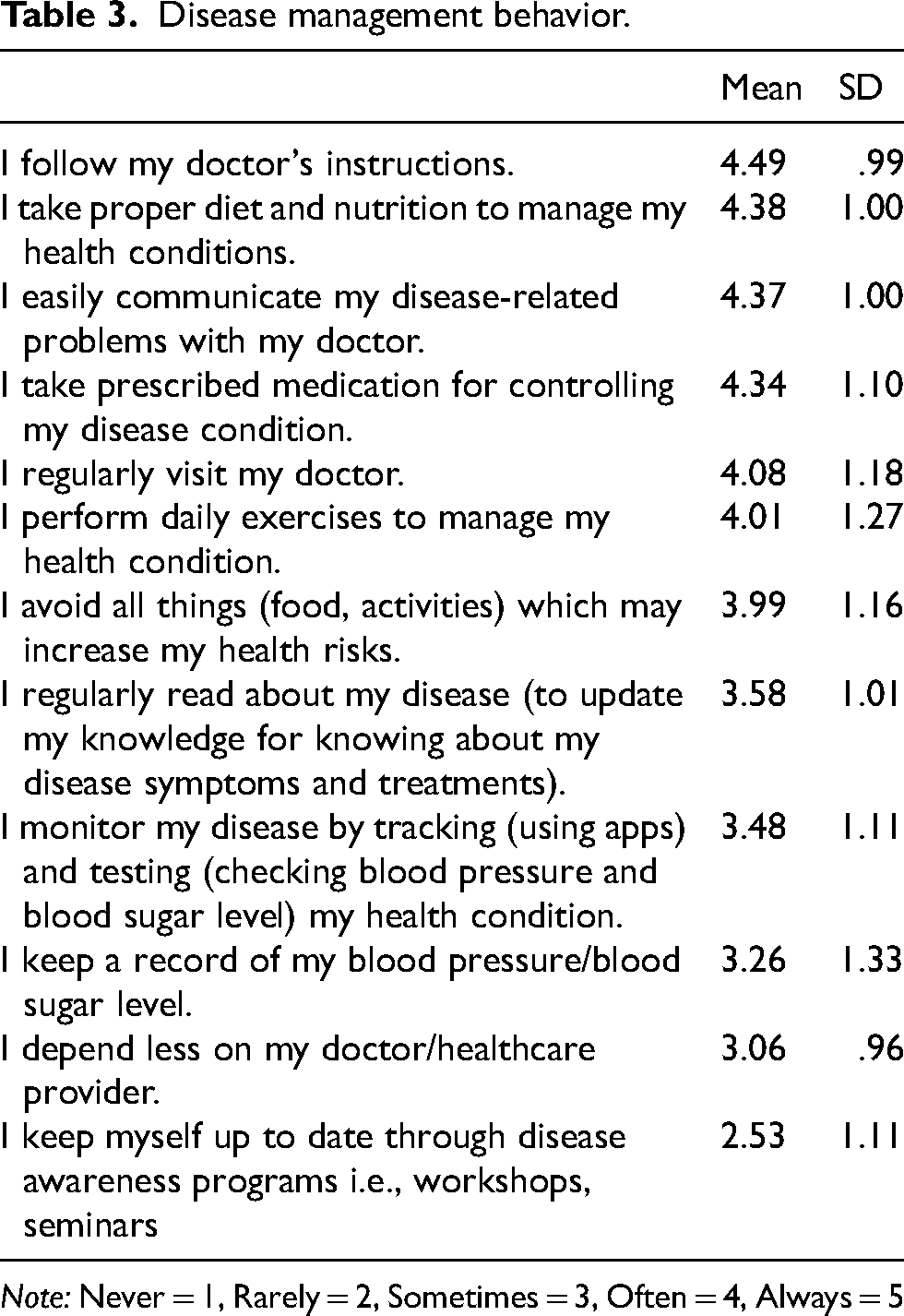
Note: Never = 1, Rarely = 2, Sometimes = 3, Often = 4, Always = 5
Hypotheses testing
The first hypothesis (H1) was developed to uncover the direct impact of health-related Internet use on disease management behavior. For this purpose, linear regression analysis was used. Whereas H2 suggested an indirect effect and for this purpose, a mediation test was run with the help of a SPSS PROCESS macro to generate the bootstrapped Confidence Interval (CI) (Hayes, 2012; Preacher & Hayes, 2004). As a test of mediation, bootstrap methods are considered superior to other methods, such as the Sobel test (Hayes, 2012).
The linear regression analysis showed that patients’ health-related Internet use (b = .24) statistically significant impacts disease management behavior p < 0.001 (Table 4). Thus, H1 is confirmed at p < 0.001.
Regression analysis.
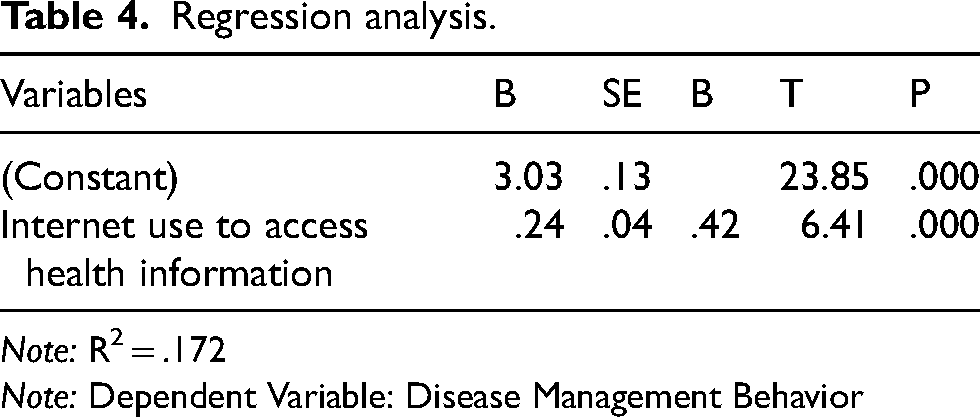
Note: R2 = .172
Note: Dependent Variable: Disease Management Behavior
Using a simple mediation model, X (Independent Variable) is modeled to directly influence Y (Dependent Variable), as well as indirectly through a single intermediary or mediator variable M (Mediator) causally located between X and Y (Baron & Kenny, 1986; Judd & Kenny, 1981; MacKinnon, Fairchild & Fritz, 2007; Preacher & Hayes, 2004, Hayes, 2012). Hayes (2012) described the simple mediation model, arguing that the direct effect of X on Y is estimated with c’1.
There are several methods for testing indirect effects including multiple regression analysis, the Sobel test (Sobel, 1982), the Monte Carlo Method (MacKinnon, Fritz & WIlliams, 2007), the distribution of the product method (MacKinnon, Fritz et al., 2007), and the bootstrapping method (Preacher & Hayes, 2004, 2008; Shrout & Bolger, 2002). Hayes and Scharkow (2013) suggest that in comparison to the Sobel test, the Monte Carlo Method, and the distribution of the production method, a bias-corrected bootstrap confidence interval method is the best test when power is a concern for the researchers. Therefore, the study adopted a bias-corrected bootstrap confidence interval method for testing the second hypothesis.
There are two types of effects calculated for mediation analysis, the first is a direct effect of X (independent variable) on Y (dependent variable), and the second is an indirect effect of X on Y through M (mediator). Hayes (2012) mentioned that “the direct and indirect effects of X on Y sum yields a total effect of X on Y. The total effect is estimated as c1. Given that c1 = c’1 + a1b1, simple algebra shows that the indirect effect of X on Y through M is equal to the difference between the total and direct effects of X. That is, a1b1 = c1 – c’1. Thus, inference about the indirect effect is therefore also an inference about the difference between the total and direct effects of X.” If the indirect effect of X on Y through M is significantly high than the direct effect of X on Y, it can be inferred that the mediator is significantly playing its role.
For purposes of testing H2, SPSS (20.0) with the PROCESS (v 3.3) ads-on were used, Hayes (2018) suggested that Model 4 fits the situation of the study. Thus, a test was run using model 4 (Output file attached as Annexure 1). The results outlined in Table 5 show that online health-related information seeking (X) significantly impacts Patients’ perceptions about online information source credibility (M), and their perceptions significantly impact disease management behavior (Y).
Model coefficients for the study.
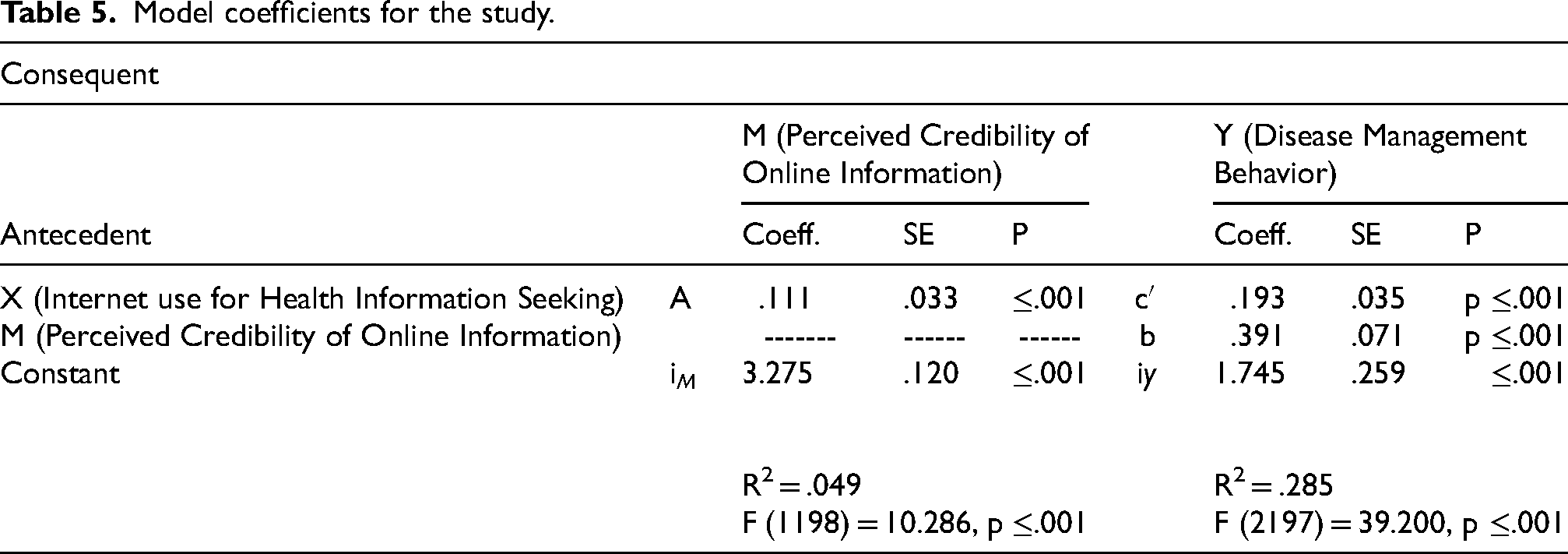
On a separate note, X also directly impacts Y significantly. The results, however, confirm that the total effect c1 (.2364, p ≤.001) is significantly higher than the direct effect c′1 (.1928, p ≤.001), which means that the mediator (M) considerably mediates the relationship of X and Y. The results can be interpreted in this way, that patients showed more positive perceptions regarding the credibility of online information when they use the Internet more frequently for health information seeking, and disease management behavior was stronger among those who consider online information more credible. The indirect effect of X on Y is positive and statistically different from zero, as evidenced by a 95% bias-corrected bootstrap confidence interval that is entirely above zero (0.0122 to 0.0784).
The statistical path analysis confirmed H2 and proved that the credibility of online information significantly (p ≤.001) mediates the impact of Internet use on the disease management behavior of chronic patients
Conclusions and discussion
The findings of the study make it clear that Pakistani chronic patients are daily users of Internet for health-related information seeking. Studies conducted in various contexts are also aligned with the current findings (Asibey et al., 2017; Tan & Goonawardene, 2017; Vismara et al., 2021; Wang et al., 2020).
The disease management behavior of patients was overall positive as they were involved in taking the proper diet and nutrition and followed the doctors’ instructions. But the preference to perform daily exercises to manage their disease and keep them up to date was quite low. It is noteworthy that they were consuming less reading material or attending awareness programs like seminars less frequently to gathering the latest information for managing their disease conditions. These findings appear to be aligned with the previous studies reporting chronic patients as frequent Internet and social media users for gathering health-related information to manage their diseases (Lemire et al., 2008; Merolli et al., 2013; Miller & Bell, 2012; Nazir & Soroya, 2021; Wu & Li, 2016).
Both hypotheses of the study were confirmed by the results (Figure 3). That is, Internet use to seek health information has a positive impact on the disease management behavior of chronic patients. Patients who use the Internet more frequently to gather health information have better disease management behavior than those who use the Internet less frequently. The findings are also aligned with previously published literature (Silver, 2015; Stinson et al., 2008). The results further confirm that patients’ perceptions of the source credibility mediate the relationship between Internet use and disease management behavior. Similar findings were reported by Flanagin and Metzger (2000) about U.S. populations, that familiarity with the resources breeds trust and more experienced users were more likely to view the Internet as a credible source of information. The reason for these findings might be that their frequent online exposure helps them to choose trustworthy sources and avoid fake or misinformation. In the literature, the mediating role of information sources’ credibility has been rarely investigated. Thus, this study opened a new dimension of inquiry and further suggests a new conceptual model that Internet use and trust in information sources ultimately help chronic patients to manage their disease.
Research implications
This study has theoretical and practical implications. Being the first study of its kind, the findings strengthen the existing literature in the health management area particularly from a developing country perspective. In Pakistan, where the increasing number of chronic patients and a small percentage of the total GDP for health-related projects is a challenge. At the same time, the increased connectivity of the Pakistani public with the Internet through cellular or broadband could be taken as an opportunity. The Internet can play an important role to create awareness among patients and helping them in their disease management with credible information. As the WHO (2005) claimed that chronic diseases affect families, communities, and countries negatively. Patients, through disease management, can improve their quality of life and may positively influence the national economy.
The Pakistan Telecommunication Authority confirmed that the use of the Internet is increasing in Pakistan each year. In 2020−2021 broadband subscribers reached 110 million from 76.3 million in 2018−2019. Similarly, the trend of using cellular mobile phones is increasing, broadband penetration increased from 36.18% in 2018−2019 to 49.9% in 2020−2021. Mobile data usage was 4510 petabytes in 2018−2019 and reached 6855 petabytes in 2020−2021. Based on the increasing use of mobile phones and access to the Internet, the Pakistani public's use of this technology in rural communities can be taken as an opportunity to advance their quality of life.
Furthermore, it is established from the results of the current study that in a local Pakistani context, Internet use directly/indirectly and positively influences the patient's disease management behavior. There is, however, a dire need to train this population, particularly patients, to make informed decisions using online health-related information for their disease management. In so doing, the life of chronic patients may improve, thereby allowing them to play a more active and positive role in society. This effort can be done by information centers, libraries, health practitioners, and health-related organizations. Proper training may be organized by public libraries, particularly for patients from remote areas as they have less access to the doctors.
Research hypothesis two confirmed that people use information for disease management if they consider it reliable. In this regard, information literacy particularly health information literacy training, can help patients to identify credible information sources. And if they become frequent Internet users, and they are also able to identify credible information sources, the proposed model can help to predict their ability to manage the diseases in a much better way.
In conclusion, understanding the mechanisms behind health-related Internet use and health outcomes can help health communicators and practitioners better design their health promotion initiatives using interactive media, while also more effectively contributing to improved health outcomes in this digital age.
Moreover, the theoretical framework of this study adds significantly to the communication of health informatics. The tested model invites researchers to verify its premise in various cultural contexts. Hence, the study also opens new directions with additional variables (moderator/mediator/controlled) that can further extend this simple mediation model. For example, these findings may also be helpful for other developing countries also. Being the very first study of this magnitude from Pakistan, the authors propose an open debate on this topic and encourage other researchers to explore other dimensions of the topic as well.
Limitations and future directions
Our study had several limitations. First, the convenience sampling strategy was adopted, which limits the generalization of the findings. Second, our hypotheses examined only two pathways connecting Internet use to disease management, whereas other confounding factors could be in play as well. Third, the study only measured the frequency of health-related Internet use. Whereas it must be acknowledged that Internet use is a multi-dimensional concept, i.e., there are other conceptual aspects, such as information literacy skills, experiences with other technologies (e.g., smartphones), language skills, etc. For future studies, these factors may be considered.
Forthcoming studies might also be conducted to determine how normal and regular awareness campaigns and disease management training may affect the disease management behavior of patients.
