



Abstract
Commercial social media (social commerce in emerging market) have increasingly been used in many emerging markets as an evolutionary form of ecommerce. While this trend has recently been examined from an e-vender's perspective, little is known about how customers, specifically female millennials, perceive of their shopping experiences with commercial social media in relation to ecommerce. Thus, this study explores the underlying motivations for using one e-retailing type over the other. We consider the social constructs of trust, customer service quality and web design in the study. Drawing data from 20 in-depth interviews with young Omani women, the study revealed that ecommerce is most preferred to commercial social media. It highlights the role of unethical marketing practices; unsystematic delivery costs; unprofessional customer service quality; underdeveloped local market and uneasiness of commercial social media in influencing the decision-making of the customers to shift to ecommerce. The study further points to the intersection between product's price, quality and information in building trust; the role of professionalism, responsiveness and empathy in enhancing customer service quality; the importance of product quality and variety in the local market; and the easy navigation and online payment of e-retailing platforms. The study bears implications on enhancing the features and services of commercial social media. It also calls for transforming the local market to meet the customers’ needs.
Keywords
Introduction
The rapid widespread of the internet across the world has led to the emergence of electronic commerce or ecommerce (e.g. Amazon, Alibaba) which revolutionized the retailing landscape by transforming brick-and-mortar shops into online stores (Chen and Tan, 2004; Haji Ahmed et al., 2020). In using ecommerce, a user can directly access the global market, quickly find desired products, compare their prices, review other customers’ comments and make an online purchase (Khan, 2016). This marked shift is enhanced with the advent of Web 2.0, which allows the user to actively interact, collaborate, collect and share information; communicate simultaneously; and reproduce content (Constantinides and Fountain, 2008; Mata and Quesada, 2014). Subsequently, it lays the groundwork for social commerce (e.g. Starbucks Facebook, Marks and Spencer Twitter) to surface and to be considered a sub-category and an extension of ecommerce (Hajli et al., 2014; Kim and Park, 2013; Liang and Turban, 2011; Stephen and Toubia, 2010). By using social commerce, customers not only communicate with other customers, but also rate, review, recommend and share their opinions on products (Wang and Hajli, 2015).
Realizing the significance of interaction with customers, and the link of networking to social and economic rewards, many ecommerce sites have embarked on creating their own pages on social media sites to interact with their customers and to engage with their feedback on products and services (Albert et al., 2009; Hajli, 2015). For example, Amazon interacts with the online community by utilizing multiple social media platforms (i.e. Facebook, Twitter, Instagram, and Snapchat) (Giraffe Social Media, 2016). When customers post their comments about certain products on Amazon's Facebook page, for instance, Amazon quickly responds to their comments at a personal level. It also dedicates a staffer whose job is to politely reply to the customers’ posts by addressing their names and to sign off their posts with their first name (Etail, 2020).
Most recently, a new version of social commerce, named ‘social commerce in emerging markets’ (Gibreel et al., 2018), which this article explores in relation to ecommerce, has been gaining popularity and is spreading quickly in many Middle Eastern and Southeast Asian countries. In this social commerce variant, an e-vender uses a social media platform such as Instagram to directly sell products to online customers. The buyer does not search for products using referral systems such as web search engines (e.g. Google, Yahoo), social media (e.g. YouTube) and social networks (e.g. Facebook, Twitter), nor do they have to interact with an intermediatory as in the ecommerce site itself to facilitate the buying process. Examples of this latest trend is noted in many emerging markets, including the Arab countries of Gulf Cooperation Council (GCC): in Oman (Said, 2017) in the UAE (Wally and Koshy, 2014), in Saudi Arabia (Alkhowaiter, 2016; Almashabi and Nereim, 2016) and in Kuwait (Greenfield, 2013; Ziegler, 2013). This social commerce strain has recently been examined in some emerging markets from the e-vender's perspective (Alghaith, 2016; Alkhowaiter, 2016; Garifova, 2016; Jose, 2018; Wally and Koshy, 2014), but it remains vastly underexplored in the literature, specifically from the customers’ standpoint (Gibreel et al., 2015, 2018).
While the available literature offered an understanding of the customers’ perception of ecommerce in terms of trust (e.g. Al-maghrabi et al., 2011; Bylok, 2022; Chen et al., 2002; Ha and Stoel, 2009; Lestari, 2019; McCloskey, 2006; Zhang et al., 2020); familiarity (e.g. Gefen, 2000; Luhmann, 1989); service quality (e.g. Chen and Tan, 2004; Gajewska et al., 2020; Zhang and Prybutok, 2003) and enjoyment (Al-maghrabi et al., 2011; Driediger and Bhatiasevi, 2019; Ha and Stoel, 2009; Lee et al., 2012), these studies largely employed a deductive approach. They focus on developing or testing already established models rather than delving deep into the customers’ actual thoughts and experiences. A recent study emphasized the need to use an inductive approach in ecommerce studies by conducting in-depth interviews to generate a more comprehensive understanding about the online consumption phenomenon in a buyer-seller context (Zhu et al., 2020). In addition, many day-to-day issues encountered by e-commerce users have not been captured thoroughly in any single scientific research that deeply investigate these issues from a qualitative research perspective. For these reasons, a research study with an inductive focus could be useful in yielding a fresh and nuanced outlook on the inner thoughts of the customers cemented by their real-life experiences. Moreover, no research study has thus far made an inquiry into the use of ‘social commerce in emerging markets’ by female customers and compared their experiences with those of ecommerce sites. Therefore, this research paper bridges the gap in the literature by exploring the experiences of Omani female millennials in using commercial social media platforms and ecommerce sites as they shop online.
The paper answers the following three main research questions: What e-retailing variant (i.e. ecommerce or social commerce in emerging markets) do Omani female millennials choose to use for online shopping? Why do Omani female millennials choose to use one e-retailing variant over the other? How do Omani female millennials assess their personal experiences in using both e-retailing variants?
The paper is structured as follows. Section 1 reviews the literature. It explains the interaction differences of ‘ecommerce’, ‘social commerce’ and ‘social commerce in emerging markets.’ Then, it discusses the status of ecommerce and social media in the Oman context. This discussion is followed by the social constructs used in previous studies. Section 2 provides a detailed description of the research methods and data collection. Section 3 describes and discusses the research findings. Finally, section 4 presents the study's conclusion, implications, limitations and future directions.
Literature review
Dynamics of interaction in ‘ecommerce’, ‘social commerce’ and ‘social commerce in emerging markets’
This section explains the interaction differences between the three internet-mediated marketplaces: ecommerce (Figure 1), social commerce (Figure 2) and social commerce in emerging markets (Figure 3). It is thought that it would be useful to establish a clear understanding of the key terms used in the current study and to avoid an unsought overlap in meaning. As explained in the work by Gibreel et al. (2018: 154), in ecommerce, referral tools (e.g. Google, Bing, Yahoo) and digital advertising work as intermediaries that allow the buyer to search for product information and costs before contacting the seller in the ecommerce site to make an online purchase (Cho and Tansuhaj, 2011; Laudon and Traver, 2009). The buyer also has the option to directly access ecommerce sites.
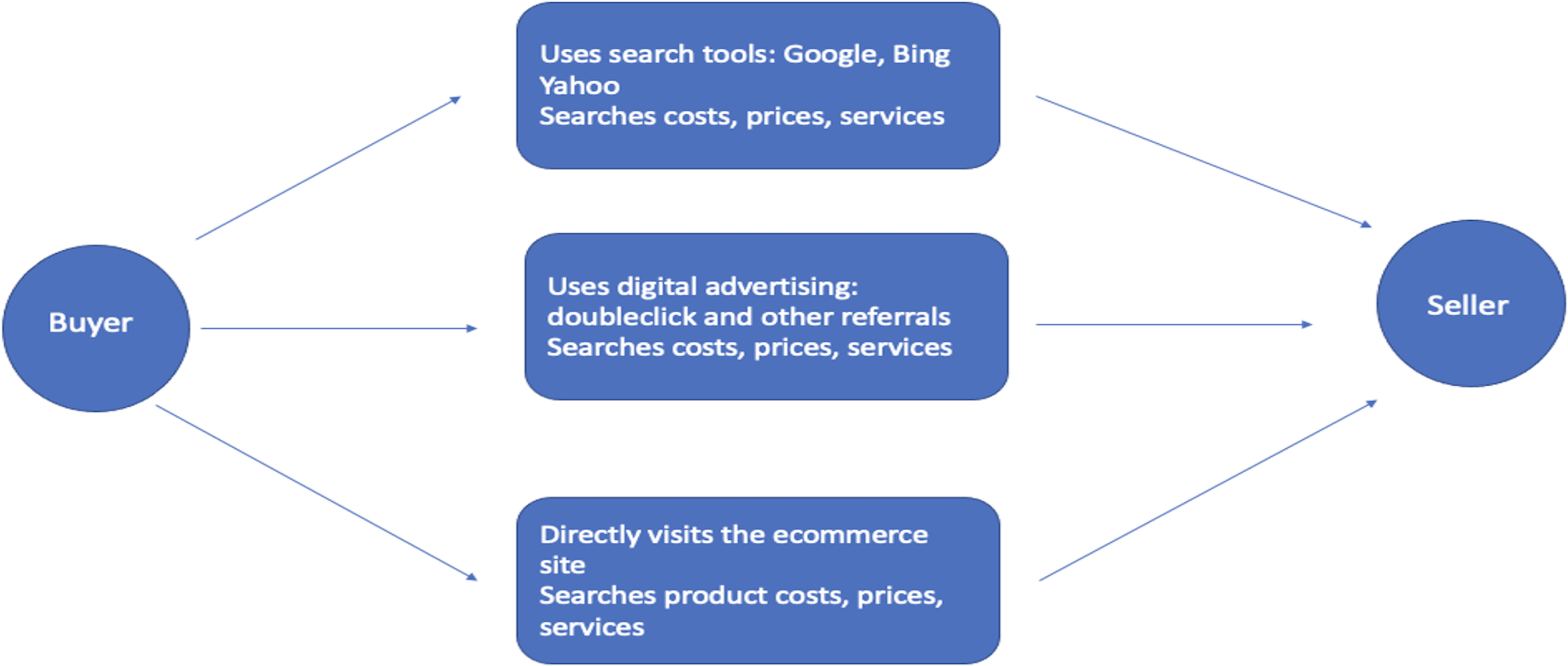
Ecommerce dynamics of interaction.
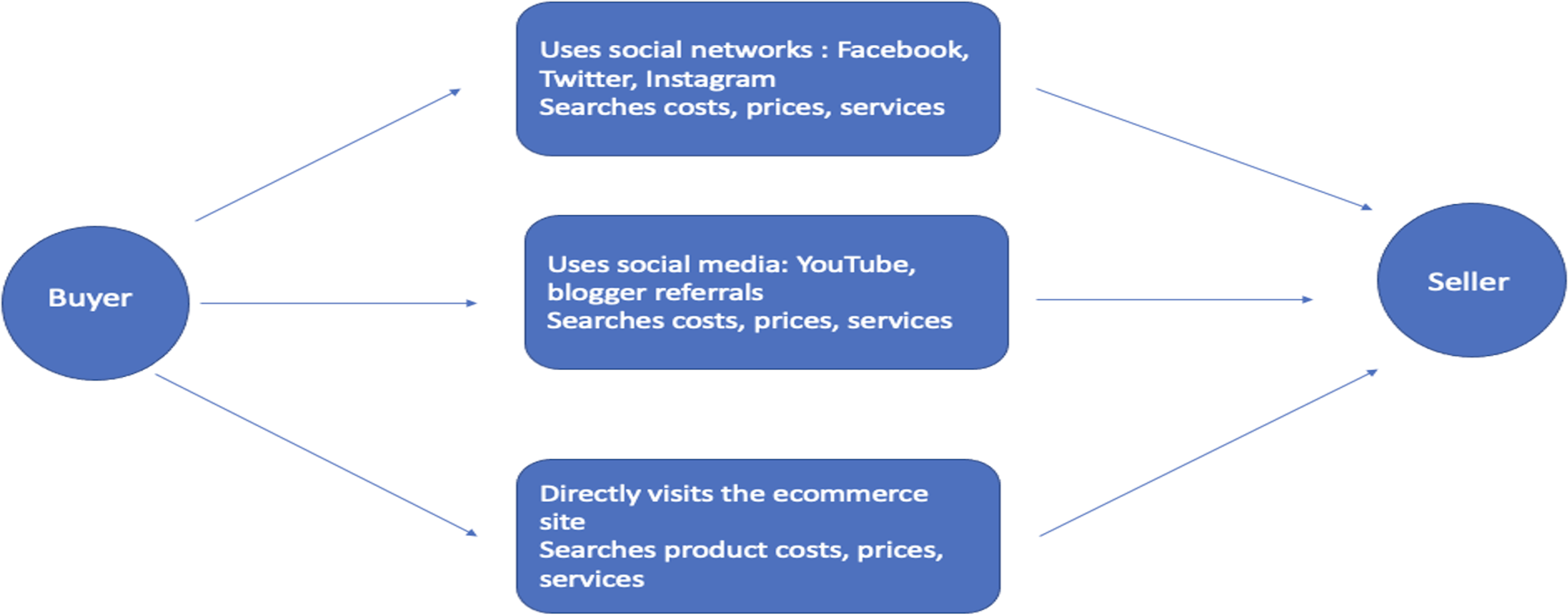
Social media dynamics of interaction.

Social media in emerging markets dynamics of interaction.
In social commerce, social media sites (e.g. YouTube) or social networks (e.g. Facebook, Instagram) (Hajli, 2014) are initially used as referral tools to look for product information and costs. Then, the buyer can approach the desired ecommerce site to make an online purchase from the seller. Similarity to ecommerce sites, the buyer can directly buy from the ecommerce site.
However, the buyer in ‘social commerce in emerging market’ does not need a referral tool that eventually leads to making an online transaction. The buyer searches for product information and price on the social network itself, and directly contacts the e-vendor to make an online purchase. Thus, the execution of all the buying stages is performed simultaneously by the buyer without the aid of an intermediatory. The following figures clearly illustrate the interaction dynamics in each internet-mediated marketplace.
Ecommerce and social media in Oman
As this study considers Oman as a case study of an emerging market, this section presents an overview of the status of ecommerce and social media in Oman. It would be crucial for the study to initially identify: the commonly used ecommerce and social media platforms, the types of products purchased and the general motivations for using them. As a handful of research studies have been conducted with regards to the Omani context, this study seeks to offer a fresh and complex perspective on the driving factors that make Omani millennials choose a certain e-retailing platform.
Oman's ranking is among the top 100 countries on B2C ecommerce index, taking the 59th position (UNCTAD, 2019). The available literature in this area of inquiry shows that Omanis commonly pay for clothing, airline and hotel booking, groceries, cosmetics when they use ecommerce (MasterCard, 2014; Mordor Intelligence, 2019; US Department of Commerce, 2017). Among the reasons for using ecommerce are its perceived ease of use, good customer services and affordability of the products, while issues such as security concerns, having an impersonated shopping experience and failure to touch or see the products with the naked eye are among the factors that affect their buying patterns (Mordor Intelligence, 2019). Popular ecommerce websites used by Omanis are Amazon, eBay, AliExpress and Namshi (Akbar, 2019; Export.gov, 2018; US Department of Commerce, 2017). Among the main considerations when making online purchasing decisions are products’ pricing, exchange policies and online review. Creating user-friendly ecommerce websites, positive comments from other online shoppers and elimination of additional charges are the main suggestions as to how to improve online shopping (MasterCard, 2014). Moreover, Omanis tend to prefer offline shopping to online shopping. They think that offline shopping is ‘more secure’ while online shopping is ‘equally safe’ (Export.gov, 2018).
Oman has 2.5 million active social media users, which represents 51% of the total population (Hootsuite, 2019). According to the most recent survey conducted by The National Center for Statistics and Information (2019), 94% of the Omanis aged 18 and above actively use social media platforms, including Instagram, WhatsApp and YouTube. It has been found that the Omanis who have higher education degrees spend a quadruple amount of time (eight hours a day) in comparison with only two hours spent by those who have a high school certificate and below. In terms of gender, women spend more time than men do, averaging seven hours a day as compared to five hours a day spent by males. While the users adopt social media for a variety of purposes, a third of the population (32%) in this survey use social media exclusively for searching and buying products and services. Among the social media platforms that are extensively used for searching for online products and shopping are Instagram (63%). This finding is similar to the results of a recent survey on six Arab countries, in which Qataris, who are also citizens of the GCC, rely on Instagram and Snapchat (60% and 55%, respectively) than any other social media platform (Dennis et al., 2016).
Trust
In online shopping, trust is conceived as ‘a social lubricant’ enabling consumers to make transactions with retailers detached from their immediate network (Jarvenpaa et al., 1999). It is also considered as a ‘catalyst’ for increased commercial transactions between the consumer and the seller since it leads to heightened expectations of satisfaction with the consumers, and thus the adoption of ecommerce sites (Ha and Stoel, 2009; Pavlou, 2003). Trust is a stimulator in mitigating consumers’ perceived risks, and the successful marketing of e-commerce (Bylok, 2022; Connolly and Bannister, 2007; Soleimani, 2022; Zeinab, 2006). E-vendors are expected to abstain from behaving opportunistically in their transactional dealings with the customers (Reichheld and Schefter, 2000). Practices such as unfair pricing, offering inaccurate information, breaching the customer's privacy and an unauthorized use of credit card information are key reasons to make the customers avoid dealing with the ecommerce sites practicing these behaviors (Gefen et al., 2003; Jarvenpaa and Todd, 1996).
Trust is also shown as a key factor for an increased intention to shop online (Bylok, 2022; Farrah Almira et al., 2021; Gefen, 2000; Gefen et al., 2003; Ha and Stoel, 2009; Kim et al., 2009; Pavlou, 2003; Zhang et al., 2020) and for increasing the customers’ intention to purchase online. Pavlou (2003) found that trust directly influences the intention of the customer to make a transaction. Gefen (2000) unveiled that trust and familiarity with eBooks’ sites have an enormous effect on the customers’ intention to purchase books. Zhang et al. (2020) showed that trust is important in alleviating behavioral uncertainty with the e-vender, which leads to an increased sense of control over online transactions and ultimately to have a positive effect in making an online purchase. In another study, Gefen et al. (2003) indicated that trust plays a significant part in making customers return to shop with the e-vendor they purchase their online product from. Corbitt et al. (2003) indicated that trust of ecommerce site is largely impacted by the propensity of buying from a highly perceived trustworthy ecommerce site, the website reputation, and the level of experience in using the ecommerce site. Moreover, the customer's trust with the ecommerce vendor is positively associated with their attitudes towards the vendor, and the positive attitude is strongly linked to the willingness of the customer to make a purchase (Teo and Liu, 2007). Saleem et al. (2017) showed that trust supersedes all other predictors employed in the study and it is a driving force for increasing the intention to purchase airline tickets. In a most recent study, trust is shown to be influenced by the promises of the online shopping platform to deliver good product and service quality, and by the customized products made specifically to meet the customers’ needs (Bylok, 2022).
Service quality
The success and failure of ecommerce is largely dependent on the service quality in online environment (Yang, 2001). Many studies indicated that service quality exemplified in customer support services profoundly influences customers’ attitudes, their purchase decisions and ultimately their satisfaction (Holloway and Beatty, 2008; Jusoh and Ling, 2012; McCloskey, 2004; Rodríguez et al., 2020; Shergill and Chen, 2005; Sheu and Chang, 2022; Wattoo and Iqbal, 2022). However, some other studies yielded different findings. Tsao et al. (2016) examined the influences of ecommerce sites quality on the customers and their loyalty based on their online shopping experiences. It was revealed that e-service quality has a significant positive impact on the perceived value of the relationship between the customer and the seller, which in turn positively affect their online loyalty. Gajewska et al. (2020) predicted that the customers’ higher expectations of the services in e-commerce can potentially increase the trust with the reliability of the services offered by e-commerce sites. The findings by Camilleri (2022) showed that both the electronic services and the quality exhibited in the e-commerce site not only offered good value, but also led to loyal behaviors and satisfaction. Gounaris et al. (2010) found that e-service quality has a direct and indirect positive impact on three behavioral intentions of online shoppers: WoM (i.e. Word of Mouth), site revisit and purchase intention. Saleem et al. (2017) revealed that the relationship between service quality and purchase intention, and customer satisfaction and brand image are positively intertwined. Furthermore, Blut (2016) showed that service quality is not a significant component of e-service quality, and superior service quality is built through website design, security/privacy and fulfilment.
Web design
Web design is vital for judging and predicting quality of the online shopping website (Wolfinbarger and Gilly, 2003). It encompasses all the components necessary for enhancing the customer experience about the website, including information quality, aesthetic aspects of the website, buying process, website convenience, product selection, price listings, navigation, information search, order processing, appropriate customization and system availability (Rita et al., 2019; Wolfinbarger and Gilly, 2003).
Web design can work as a predictive measure for the customer's intent to purchase. According to Ranganathan and Grandon (2002), e-retailers should continuously update the information provided in their online websites as it enormously influences their online sales. They found that high use of multimedia can potentially lead to long download times, which consequently affect online sales. Factors such as the navigation structure, the help section or the site indices are found to have a statistical significance, and thus affecting online sales. Rita et al. (2019) found for their Indonesian participants, web design along with web security/privacy and fulfillment are important in enhancing the quality of services of an online shopping site. Driediger and Bhatiasevi (2019) also demonstrated that when the consumers think of online grocery sites as easy to use, or believe that they are skilled at using it, they tend to think that they are useful. Moreover, Dedeke (2016) showed that web design has a significant influence on purchase intention as well as perceived product quality and perceived information task fit.
Methods
The data for this study was drawn from in-depth interviews with twenty female university students aged from 20–25, representing different regions and cities of Oman as this is a qualitative study that seeks to gain in-depth insights into the students’ online shopping experiences. This age group was targeted as the students belong to the demographic cohort generation Y (also called millennials), which represents those who were born between 1980 and 2000 (Ladhari et al., 2019). Members of the group are known for their powerful purchasing spending (Cui et al., 2003; Ladhari et al., 2019; Martin and Turley, 2004; Parment, 2013). They are characterized as individualistic, well-educated, tech-savvy, sophisticated and mature (Valentine and Powers, 2013). They are also born with computer devices, and they use social media extensively, and have a high level of appreciation of the brands they choose to buy (Bolton et al., 2013; Butcher et al., 2017). Importantly, they are generally gravitated towards mobiles and online shopping, including ecommerce shopping, than any other generation (Statista, 2018). As the participants of this study involves university students, they are expected form a large segment that will enter the workforce, thereby their earning capacity will enable them to become a powerful customer group (Taylor and Cosenza, 2002; Valentine and Powers, 2013).
We chose female students, in particular, as the focus of the study since it has been found that female consumer spending worldwide is projected to reach around 40 trillion U.S. dollars, which represents an increase of over 70% than it was in 2013 (Statista Research Department, 2019). Moreover, it has been found that the vast majority of women (98%) aged between 15–35 spend more than one hour a day shopping online (Forbes, 2019).
It was confirmed in the interviews that the female students have been actively using both ecommerce and social media platforms for online shopping from two to five years, and they make at least one online purchase every month. This is important to ensure that the participants have adequate knowledge, skills and familiarity with the use of ecommerce sites and social media platforms, thus generating as much reliable information as possible for the study. The ecommerce sites they frequently use to make an online purchase are: AliExpress, Namshi, Fordeal, Shein, Jollychic and Amazon, while their most frequently used social media platform is Instagram. They sometimes use Snapchat and WhatsApp as aiding tools (i.e. Snapchat to view the adverts and promotions by celebrities, and WhatsApp to contact the merchants running commercial Instagram accounts).
Snowball sampling was employed to recruit the female students. It was useful when a study seeks to conduct interviews with a population with specific characteristics which can be identified by other participants (Cohen and Arieli, 2011). It can also serve as an effective tool for exploratory, qualitative and descriptive studies when the sampling population is limited, and when a high degree of trust is needed for the researcher to approach the population (Baltar and Brunet, 2012). For this study, the female respondents were available and had a long of level of experience and familiarity with online shopping. That is, the university students were more inclined to using online shopping as they had no time to go outside and waste their time. Additionally, in Oman, the size of the cities varies and the availability of malls with a variety of shops differs from the capital Muscat. To administer the study, the female students’ peers initially approached the participants as they knew them well enough for their regular purchases from ecommerce sites and commercial social media accounts for a relatively long time. Then, we contacted the suggested students and confirmed their participation in the study before they were finally interviewed.
The students were interviewed for almost an hour. We asked the interviewees open and closed questions about the benefits and disadvantages of using ecommerce sites and social media account (i.e. social commerce in emerging markets), and whether they are convenient for them. To gain deep understanding of the underlaying reasons about their attitudes to opt for one type e-retailing variant over the other. We asked students questions taking into considerations the constructs used in this study. We also extended the questions by asking encouraging the participants to express their honest opinions and to reflect on their personal experiences by telling real-life daily stories of the issues and challenges they often face when they use e-commerce and social commerce sites, which is highly important to gain a comprehensive understanding of their experiences.
The interview data were first transcribed in Arabic, and then were translated to English. Pseudonyms were assigned to the participants’ names so as not to reveal their identities and to protect their confidentiality. Following this, we processed the interview data using NVivo, whereby the qualitative data were coded, and the most commonly emerging themes or concepts were listed. Thus, the study applied thematic analysis to the coded data as it provided detailed description of the overall qualitative interview data, which in turn was vital for examining unexplored areas of the study. It also clarified the interviewees’ experiences by creating meanings in relation to the social context of the stories told (Braun and Clarke, 2006). The stories that had no or little relevancy to the study's objectives were omitted, whereas the relevant stories that offered deep insights into the study were taken and clustered around their appropriate themes. We conducted the interviewees again with some students when we found their stories were partially told or offered with no adequate context. After that, major themes were revised separately to check if there were any inconsistencies in the examples and stories belonging to the themes. Then, they were regrouped in their relevant themes. We also ensured that irrelevant data were omitted or relocated to their themes.
The analysis of this study is particularly focused on the stories and experiences reflected by five female students as they were rather detailed, insightful, and comprehensive accounts of the motivations for adopting one mode of online shopping than the other. Although the interview data revealed similar opinions voiced by some other female participants, their stories were not discussed in the study as they were fragmented or largely undetailed.
Findings and discussions
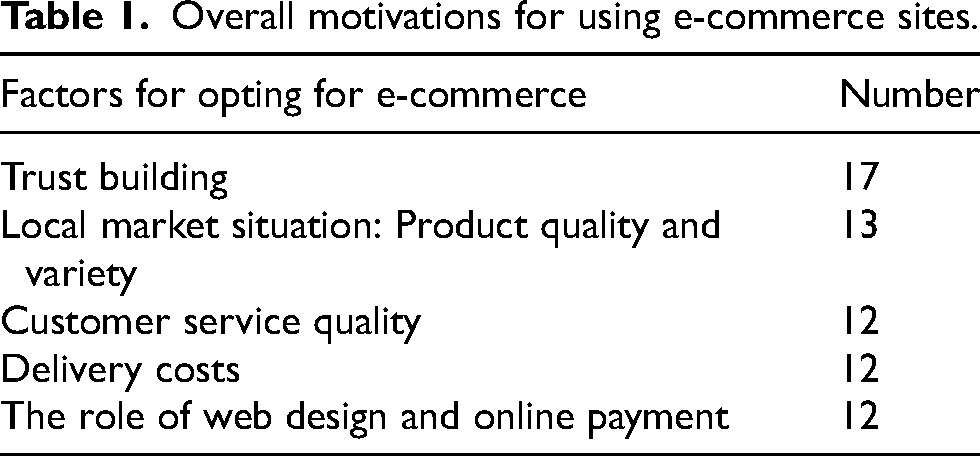
The following table shows the overall number of female participants who expressed the motivating factors for favouring the use of e-commerce sites to social commercial sites as they shop online (Table 1):
Building trust: Interplay between product's price, quality and information
The findings show that female students are generally unsatisfied with their past experiences in using commercial social media accounts. On the other hand, they positively think of ecommerce sites. From the twenty students interviewed, the vast majority, seventeen students, expressed strong preference to buy from ecommerce sites than from social media accounts. They primarily attributed their inclination to ecommerce sites to the exaggerated prices of unexpansive and poor-quality products provided by social media accounts. This opinion was exemplified in the narration by Sara about the misfortunate experience of her friend:
My friend once ordered a purse from an Instagram account, and the picture seemed to show that the purse was replica grade 1. When the purse arrived, the quality of the purse was below my expectations – the threads were loose and protruded. I thought this could have been the worst duplication grade ever! My friend spent a lot of money for the purse (52 U.S. dollars). I believed that the price of that purse could never go beyond 26 U.S. dollars. I do not trust Instagram accounts at all!
Another interesting finding is the mismatch between the product information displayed on commercial social media accounts and how the product appears. The example below illustrates the frustration and resentment of one student at discovering that the products purported to be original by social media accounts’ owners were in fact duplicate and were sold at much cheaper prices than what would be found on ecommerce sites:
One of my friends bought an expensive watch, a Rolex replica. She bought it from a local female seller on Instagram account who priced it at 250 U.S. dollars. The seller claimed that the watch was original. When I went back home, I checked it out on one of the ecommerce websites. I was flabbergasted to know that the watch was priced at less than 125 U.S. dollars. I cannot trust female sellers after this incident! She had the gut to lie to her costumers, and to confidently give them false information. – Shahad, Business Administration
Moreover, the female interviewees underlined that the failure of commercial social media accounts to sell products to meet their expectations was a main reason for their preference to move to ecommerce sites instead. They were surprised at seeing social media accounts sell poor quality products for exorbitant prices while the same products can easily be found on ecommerce sites with reasonable prices. The next opinion echoes this frustration:
I do not think that social media commercial accounts are good for us as buyers. The female sellers who run social media accounts sell the products at a high cost while the same products can also be found on ecommerce sites. You can easily find the same bag on any Chinese ecommerce site. The female sellers exaggerate in raising the price tag of their products. Oftentimes, the prices are three times higher what is displayed on ecommerce sites…they sell cheap items they buy from some ecommerce websites for double or triple the original costs, which is insane! As a buyer you would be surprised to see that the bag was not of good quality duplication. I would expect a good quality product for what I pay. – Sara, Mass Communication
These stories clearly show that female students’ distrust of the commercial social media accounts comes as an outcome of unethical marketing practices: offering false information about products and promoting low quality products for unreasonably expensive prices. These led to feelings of frustration and resentment on the customer's part, and hence amounting to dissatisfaction and distrust of the social media accounts, and ultimately an inclination to shift to ecommerce sites. It is noteworthy that this finding is consistent with the literature on trust, in which it is vital for the e-retailers to avoid acting opportunistically by placing unfair pricing of their unexpensive products and offering wrong product information (Bromiley and Cummings, 1995; Chang et al., 2013; Hoffman et al., 1999; Lee and Turban, 2001). In this way, customer satisfaction level is improved (Ha and Stoel, 2009; Pavlou, 2003), trust can be built and the adoption of an e-retailing platform for online purchase is ensued (Chang et al., 2013; Hoffman et al., 1999; Lee and Turban, 2001). It is interesting to point that this finding runs contrary to the work by Gibreel et al. (2018), where product price did not influence the level of trust.
Delivery costs
An emerging finding from the interviews is that the delivery costs of purchased products on commercial social media accounts defy the customers’ expectations. While the female students assumed that they would pay less money on delivery costs for products sold on social media accounts, e-sellers asked them to pay a high price for delivery costs. The following story elucidates this finding:
I once ordered some books from Saudi Arabia through a commercial Instagram account. The product price was not as expensive as shipping costs. I only paid 8 U.S. dollars for the product, while I paid an extra charge of 31 U.S. dollars for shipment. I thought it should had been the other way around. To add salt to injury, when the local seller managing the Instagram account asked me to pay an extra amount of 10 U.S. dollars to an agent to get my order, I was totally shocked…That was unbelievable! If I were using ecommerce sites for this purchase, that incident would never have happened. In Jollychic, for example, shipping is sometimes free of charge, depending on how many items you buy. Discounts and promotions are available too while I did not see any of those on social media accounts. – Maisa, Business Administration
An interesting discovery from the interviews is that the mechanisms for determining the delivery costs of products on social media accounts seem to disregard the geographical closeness of the customer location in relation to that of the e-seller. In other words, reliance on a transport company to deliver products to far-fetched places guarantees fair reasonable delivery pricing, whereas dependence on local agents appears to result in increased delivery costs. The following excerpt illustrates this:
If I would like to buy a product from a commercial Instagram account from Muscat, 1200 Km away from where I live, I would only need to pay 3 U.S. dollars for the shipping company. However, if I wanted to buy a product from a local Instagram account within my city, I would need to pay 6 U.S. dollars. That is ridiculous! It should be the opposite. Unfortunately, this is the situation here. The logic is that you pay 3 U.S. dollars as the product is delivered by a transportation company, which takes some time to arrive, while you pay 6 U.S. dollars as the product will arrive quickly by a local agent, who does not accept low payment for offering his service. People are certainly unsatisfied with this. The female merchants are fooling us! – Nada, Mass Communication
From these stories, customers’ dissatisfaction of social media accounts, and their propensity to use ecommerce sites stems from the illogical and double-standard approach employed by social media commercial accounts in determining the delivery costs. The logic goes like this: as the local agent would quickly deliver the purchased items in close areas, an expensive commission fee would be required. On the other hand, if products were ordered from a distant city, the commission fee would not be needed as the transport company in that city would deliver the ordered products. For customers, the delivery costs would be cheaper with the transport company than is the case with the agent's delivery costs. However, the order would take some time to arrive.
Customer service quality
In exploring the extent to which the services offered by ecommerce sites and commercial social media accounts are satisfactory, we asked the students how satisfied they were with the quality of the services offered to them. Most of the interviewees, twelve participants, were impressed by the quality of the services given to them by ecommerce sites. Their stories underscored the responsiveness of ecommerce sites in addressing customers’ messages, and their professionalism and in handling customers’ complaints. On the contrary, social media accounts did not seem to offer adequate quality services to the customers. This interesting finding is clearly reflected in the following stories: One day, I bought a purse from AliExpress, and according to the description, the size was supposed to be large. I went through the commentary section, and most of the comments from the customers were largely positive. When the purse arrived, I found that the size was a bit smaller than what I had expected. When I sent a message to the customer care service to report on the problem, I received a response to my enquiry on the same day – It was very fast! The customer care service staffer first thanked me for purchasing the purse from the store. Then, he explained that the seller accidently misplaced my order with another customer in Oman. The customer service staff asked me to consider the purse as a gift from their part, and he insisted that I keep it with me even if I did not like it – they seemed to care for me, and did not want me to pay twice… In just a week, they refunded me with the full amount, and they apologized for the second time! From this experience, I felt they were truly concerned with the costumers, and above all, they admitted their mistake and apologized for making it, which I felt really good and satisfied about.
Before I travelled abroad this year, I ordered an Abaya (traditional Arab Black cloak) from a famous Instagram account. As I wanted the Abaya to be get ready quickly, I got the Abaya on time. The female seller gave me the Abaya with a completely different attire. I was shocked to see that I got something different from what I ordered. I had no choice but to accept the Abaya in its form. When I returned from my travel, I contacted the seller by WhatsApp, but she never responded. She just read the messages without sending me any answer. She was extremely impolite! She got the money and that the end of the story! She never cared about my feeling or whether I was satisfied as a customer – Nada, Mass Communication
It is evident from the narrated stories that the service quality of ecommerce sites received by the female students were of high standards in comparison to that given by commercial social media accounts. From these recounts, the staff exhibited professionalism in their dealings with the customers. They instantly address the customers’ massages and concerns. They also seemed well-trained as they demonstrated empathy. That is, they formally thanked the customers for raising their concerns, apologized for any potential faulty on their part, engaged emotionally with their customers and worked hard to maintain their satisfaction of the purchased products and services. This finding is also in line with (Holloway and Beatty, 2008; Jusoh and Ling, 2012; McCloskey, 2004; Shergill and Chen, 2005). Furthermore, they would sometimes reimburse their customers and give away the wrongly delivered products as gifts. Thus, they guaranteed customer loyalty with their ecommerce sites and the intention to buy from them again. This is congruent with the finding by Tsao et al. (2016); Gounaris et al. (2010); Saleem et al. (2017). It is important to highlight that high quality service is a key reason for the Omani female millennials’ shift to ecommerce, which corroborates the findings of a recent survey on Omanis by Mordor Intelligence (2019). However, the opposite is true with social media accounts, where the e-seller seemed to lack training and professionalism in handling the customers’ concerns of their purchased products. They do not appear to respond on a timely manner, and oftentimes do not respond at all. This led to the assumption that e-sellers were unprofessional and somewhat apathetic.
Local market situation: Product quality and variety
In testing out if the female students’ adoption of ecommerce sites contributed to fulfilling their needs, we discovered that incompetitiveness of the local market in providing the students with a wide-ranging variety of products of high quality appeared to be a real problem. The following examples elucidate this point:
In terms of quality, ecommerce websites provide the customers with high quality products, which is not always guaranteed on social media accounts. In my city, we do not have many shops offering a wide-ranging variety of clothes and shoes for women. Even when it comes to the make-up, which is essential for every woman, we do not have good shops that can cater to our needs. We cannot afford to travel abroad to buy what we want. The local market is too scarce of college-related needs such as book bags. Though we have some shops, they are still limited in number. We just have two main big shops and nothing else! If I want to buy males’ clothes from my brothers locally, it still cannot provide us with all I need… On ecommerce websites, everything and even the home accessories are available. – Reem, Mass Communication
Ecommerce sites provide us with many options. Here in my hometown and other cities in Oman, we as customers have very limited options. In fact, shops are not that many. We don't have Adidas or Nike, maybe they are available in the capital city, but not all international brands are available. If you would like to buy banded products, ecommerce sites are definitely the only solution. The local market is already deteriorated unless it is changed and developed soon. No one buys things except the necessary items for living like food, drinks. – Nada, Mass Communication
The previous excepts point to the under-developed local market in Oman. The female students seemed dissatisfied and unhappy about lack of product variety that meet their needs, and the unavailability of genuine and branded products in the local market. Their opinions underscored ecommerce sites’ competence to meet women needs. That is, they provided the female students with wide-ranging products that are commonly unavailable and locally inaccessible. This apparently was a driving force for their departure from commercial social media and embracement of ecommerce. From this result, it is inferred that the local market in Oman needs further improvement to provide female millennials with an extensive range of products and to make international brands available.
The role of web design and online payment
In examining the interviewees’ views on the easiness of looking for products using either ecommerce sites or commercial social media accounts, it appears that the design of ecommerce sites overrides that of social media accounts. The female students were impressed by the layout and the filtration feature embedded in the ecommerce sites, which led to quickening their online transactions and shortening the shopping time. On commercial social media accounts, however, it was reported that products were disorganized, and product search and selection process seemed time-consuming and tedious. Reem and Sara expressed their experiences in detail:
Ecommerce websites are well-organized: they divide products department-wise, and on the basis of offering discount deals. You can see that shoes are put in one section. The same applies to clothes and makeups. Under shoe section, for example, there will see different types of shoes put there. You do not have to spend much time searching for an item. If you were after a particular color, you could filter out the color you wanted, and you could find many options. This is very good. The same thing applies to clothes, summer clothes, etc.…On the other hand, everything is lumped together when it comes to social media accounts – no distinct categorization. They do not have a filtration feature if you were after a particular color or size. On Namshi, for example, you can find three products with different sizes. – Reem, Mass Communication
It will take much time when you make an order via social media accounts. As for commercial Instagram accounts, you first need to copy the contact number of the seller from the bio of the seller's account. Then, you need to take a picture of the product. After that, you communicate with the seller by texting her via WhatsApp. I always need to inform the merchant of my name, contact information, bank account, etc. They simply do not have a storing system, and things are done at random. On the other hand, things are a lot easier on ecommerce sites. With a click of a button on the search items, let's say, a shirt, you will be given many different colors and sizes to choose. If my name was registered, then it is saved on the site, thus I do not need to re-enter my contact information and my bank account each time I log in…They are much more comfortable, time-free and eye-friendly. – Sara, Mass Communication
Another interesting finding is that easiness of payment method determines the preferences of the female students to use ecommerce sites over commercial social media accounts as they buy online. They underlined the efficient payment system found in ecommerce sites, which made the payment process effortless. The following quote by this student illustrates this:
You can select your preferred payment options you like. You can pay by your credit card or choose cash on delivery. When you do not have cash or money, you can still make an order online or you can make cash payment. This can be done, especially when the customers do not wish to keep their credit bank details saved onto the ecommerce websites. The options are varied, and they are very easy! When you shop via social media accounts, you need to offer a guarantee to the seller by depositing a certain amount first, and then s/he can send you the ordered product. This is a complicated process, and it does take a long time because the seller will place your order using any of ecommerce websites where the product is sold. It is funny that the seller will act like a mediator. When the products arrive, s/he will send the product, and you will need to pay for the delivery costs. – Nada, Mass Communication
The reported stories underlined the role of e-retailing design and online payment method in making the purchasing experiences of the female students via ecommerce sites effortless in comparison to their experiences with commercial social media accounts. This result is consistent with the work by Kim et al. (2009); Al Zubaidi and Al-Alnsari (2010); Mordor Intelligence (2019). It appears that the web layout of the ecommerce sites and the search tools employed were well-developed and appealing to the students. As each product was placed in a designated section, the students were able to save their time by using the filtration option. This made their shopping experience easy and rewarding. On the other hand, the commercial social media accounts seemed primitive and unprofessionally organized as the students struggled by manually looking for wanted products, which often took a prolonged time. In short, this made them feel satisfied with their use of ecommerce sites (Cho and Park, 2001; Cyr, 2008; Lee and Lin, 2005) but displeased about their use of commercial social media accounts (Hasan, 2016). For payment, the students were given easy payment options, either by credit card or by cash on delivery. Moreover, ecommerce sites offered them a payment guide to instruct them as how to pay online. In doing so, the students saved their bank accounts’ information onto the ecommerce system where their personal and bank account information was protected by a four-digit password. Furthermore, the ecommerce sites would send an email in case of noticing suspicious payment activity. This finding is congruent with (McCloskey, 2004), where she found that payment is one of the main attribute of ease of use when placing an online order. The examples also signal out the influence of ease of use in making the Omani female students to move to ecommerce, which is parallel to the results by Mordor Intelligence (2019) on Omanis. However, these findings contradict the work by Gibreel et al. (2018), where they found that the customer purchase intention from a social marketplace is not affected by the perceived ease of use.
Conceptualizing customer's decision-making to adopt an e-retailing platform
Based on the in-depth analysis of the interviews, three key themes or independent variables (i.e. trust, and product-related and service-related factors) are identified as having a direct influence on the decision-making of the customers to choose to use an e-retailing platform (dependent variable). Product factors include Product Quality (PQ), Product Information (PI), Product Price (PP), Product Variety (PV) and Product Delivery (PD). However, Professionalism (PRO), Empathy (EM), Responsiveness (RES) Marketing (MKT) and User-Friendly Design (UFD) are part of service-related factors. Product quality (PQ), information (PI), prices (PP) provided by an e-retailing platform have a direct bearing on the level of Trust (TRT) with the adoption of the e-retailing platform, which in turn drives the customers’ decision to opt for or decline to use the e-retailing platform. This is clearly summarized in this following model (Figure 4).
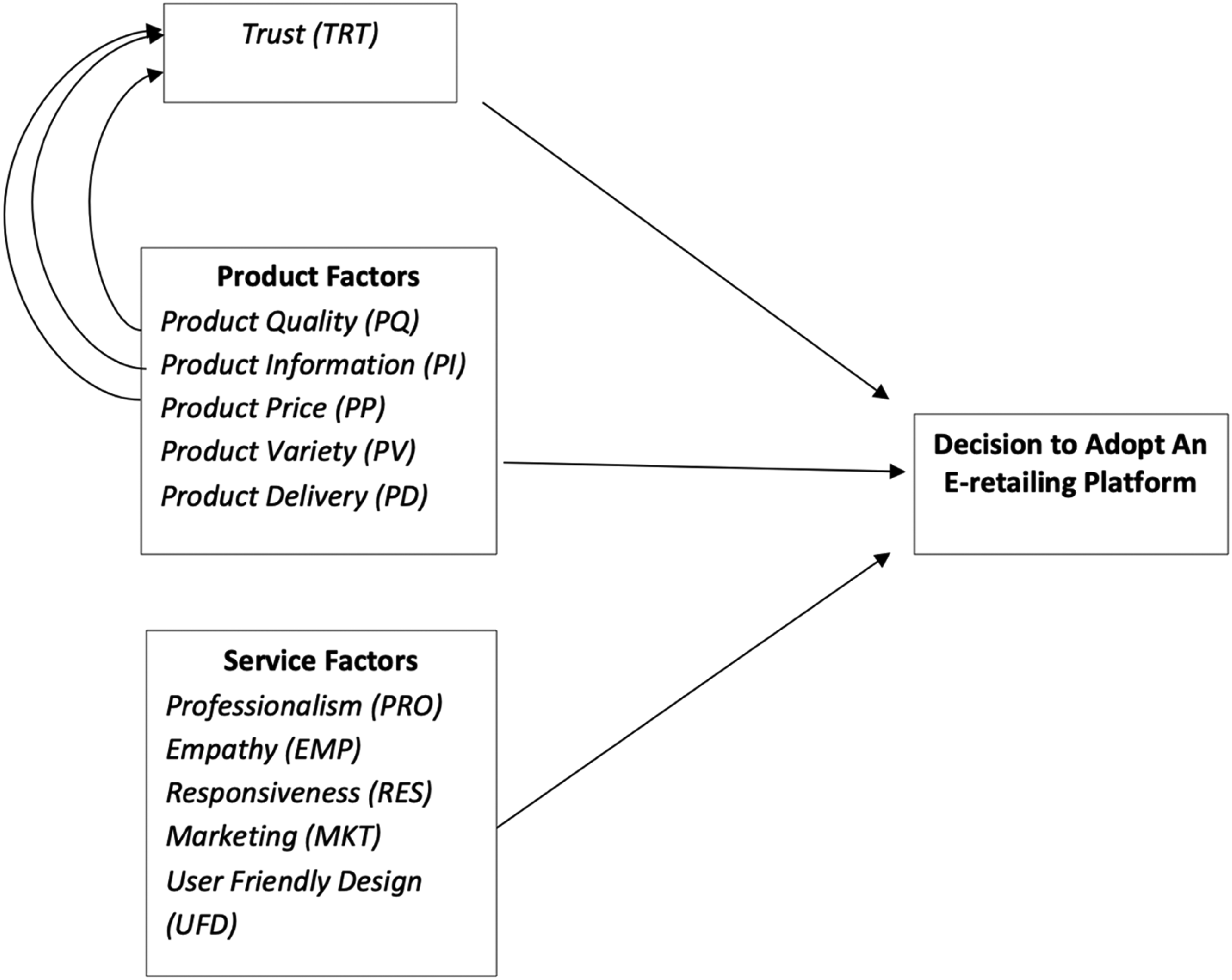
Customer's decision-making to adopt an e-retailing platform.
Conclusion
This study is perhaps the first empirical exploration into the Omani female millennials’ use of social commerce in emerging markets and compared their experiences with those of ecommerce. It showed that ecommerce is the most preferred e-retailing variant in comparison to social commerce in emerging markets due to product- and service-related factors. It revealed that product quality, product delivery costs, product variety, marketing practices, customer service and website user-friendly are the driving factors for adopting ecommerce, which largely justified the customers’ preference to choose ecommerce over social media.
The study emphasized the intersectional role of product's price, quality, and information in building the female millennials’ trust in ecommerce and distrust in commercial social media accounts. It also underlined the unfair mechanism applied by commercial social media accounts in determining product delivery cost, which consequently led to an abstention to use commercial social media accounts and an inclination to embrace ecommerce sites. Moreover, the study showed that professionalism, responsiveness, and empathy amounted to an enhanced service quality in ecommerce sites, and thereby increased customer satisfaction. Additionally, simplicity of e-retailing design and the multiplicity of online payment methods offered by ecommerce sites are shown to be vital. Furthermore, the paper pointed to product variety and quality as important factors which made Omani female millennials quit using commercial social media accounts and adopt ecommerce sites instead.
Implications
The study extends the literature in understanding the driving motivations for female millennials to use ecommerce sites and commercial social media platforms, and the bases that guide their e-retailing selection, which is pointed in Gibreel et al. (2018). Thus, it offers a more comprehensive personal account of women's real-life experiences of their predilection for shopping using a particular online shopping form.
The findings also add an academic contribution to the field of the intention to adopt an e-retailing platform. That is, trust, product factors (i.e. product quality, product information, product price, product variety and product delivery) and service factors (i.e. professionalism, empathy, responsiveness, marketing, user-friendly design) are shown to be highly influential in the decision-making of the female millennials to choose one form of online platform over the other. It also demonstrates that trust is increased depending on the product quality, information and price, which subsequently determine the millennials’ choice.
The study makes significant managerial and entrepreneurial implications. It underlines adverse business practices employed by entrepreneurs in managing their commercial social media accounts, which lead to customers’ reticence to adopt a certain an online shopping platform. Trust should be cultivated among entrepreneurs and customers. In other words, entrepreneurs should offer genuine information about their products and sell them for reasonable prices which match with customers’ expectations. In addition, entrepreneurs should apply a fair and unified approach when measuring delivery costs, taking into consideration geographical closeness. Moreover, service quality in commercial social media accounts should be elevated by offering entrepreneurs adequate training to professionally deal with customers. They should exhibit a high level of professionalism and empathy as they respond to customers’ messages and complaints. Furthermore, the study calls on entrepreneurs to make customers’ buying experience effortless and rewarding.
The findings shed light on the under-developed situation of the local market which appears to fail to provide customers with rich supply of various products, and to make high quality brands readily available. This shortcoming has direct bearing on the customers’ choice to opt for a particular e-retailing type. It is, therefore, important that the local market realizes this limitation, and works towards devising practical strategies to address customers’ needs and to trust the local market. This can be achieved by organizing the products displayed on commercial social media platforms around categories, and by offering the customers multiple easy payment options. All of these are of paramount importance to avoid reputational or financial loss, and thus to maintain customer base and increase profits.
Limitations and future directions
This study acknowledges its limitations and offers recommendations for future research. As the study probed into the personal experiences of the Omani female millennials, a small sampling size was used. Thus, the findings of this study cannot be overgeneralized. Future research may recruit ‘a larger’ to population to extrapolate the findings to other emerging countries. Second, the study is focused on female millennials. It is also worth exploring male millennials’ perspectives to see whether if the social constructs still play a prominent role as they have seen with the female millennials.
Overall motivations for using e-commerce sites.
Footnotes
Acknowledgements
We pay a special thanks to Dr Ilhem Allagui for her sincere efforts to proofread the paper and to elevate its quality.
