



Abstract
The efficiency and durability of gas turbines, jet engines, and other high-temperature machinery are critically affected by hot corrosion. In this study, nanostructured thermal barrier coatings (TBCs) with a chromium/cobalt–aluminium–yttrium (Cr/CoAlY) bond coat and an 8 weight percent (wt.%) zirconia–yttria (ZrO2–Y2O3) ceramic top layer were deposited on Superni-718 substrates at 100 °C, 150 °C, and 200 °C using magnetron sputtering. Hot-corrosion tests were conducted for 100 cycles at 1173 K. The coatings’ microstructural features and elemental composition before and after corrosion were characterized by field emission scanning electron microscopy (FESEM) and energy-dispersive spectroscopy (EDS), while phase evolution and oxide formation during cyclic exposure were analysed using X-ray diffraction (XRD). Results confirmed that all coated specimens exhibited improved corrosion resistance compared to the substrate. Among them, the coating deposited at 200 °C showed the lowest parabolic rate constant (kp = 0.96313 × 10⁻¹⁰ g2 cm−4 s−1), indicating the best performance.
This is a visual representation of the abstract.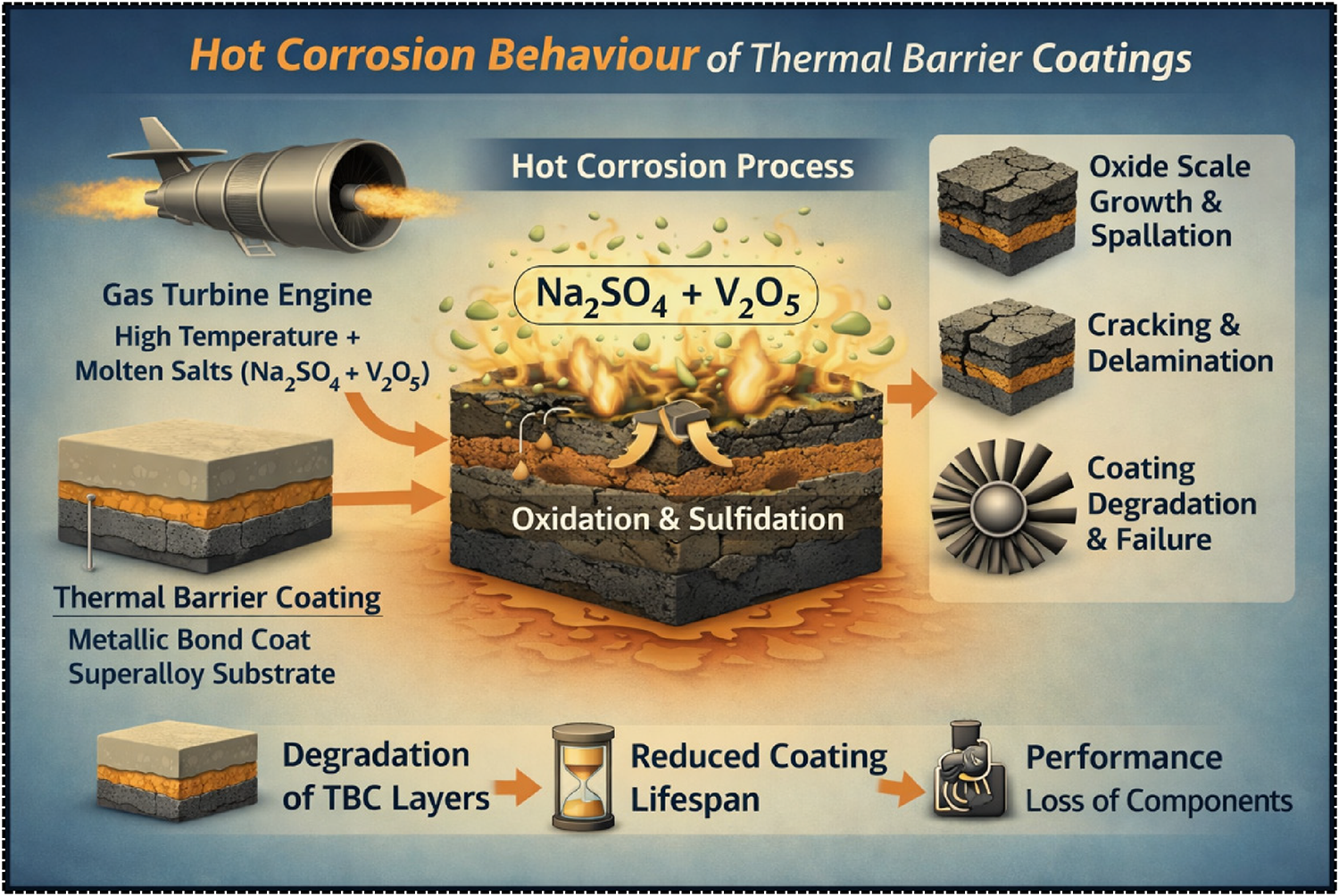
Get full access to this article
View all access options for this article.