




Abstract
Combining sentiment analysis and discursive network analysis, this article looks to answer which sentiments characterize YouTube comments discourse, with a specific focus on how-to videos. What are the differences between comments to various types of videos, and which discursive contexts seem to promote positive sentiment and a participatory climate? Furthermore, the aim is to map out a variety of existing user strategies in terms of their degree of participation. What various modes of taking part and/or giving support are made discursively possible, and what degrees of detachment or engagement are expressed through these identified strategies?
A working hypothesis for this study has been that the degree of affinity will expectedly be higher in relation to user-created video content. This is based on previous work on participatory culture (Jenkins, 2006b), smart mobs (Rheingold, 2002) and peer-production (Benkler, 2006). All of these perspectives suggest that there is a large potential for collective problem-solving, community-building and mutual support in social media contexts where users create things by themselves (Gauntlett, 2011).
But the analytical division between user-created and other content on YouTube, and elsewhere on the net, is increasingly understood to be diffuse. Lange (2009: 83) writes that:
Analyses of YouTube videos often orient around a broad-scale division between amateur or so-called ‘user-created’ versus professional content. While useful for many types of scholarship, these labels also tend to generate a cascading binary of assumptions about a video’s attentional merit.
While Lange certainly has a point, this article will still cling to this rather general distinction. The idea with this is to make a systematic empirical study of whether comments discourse relating to user-created material – in this case: how-to videos – is in fact characterized by openness and support, as is often assumed.
The discursive space of YouTube comments
YouTube is at the centre of the explosive expansion of social media activity and user-driven cultural transformations taking place today throughout large portions of the world. Established in 2005, YouTube is sometimes labelled the most successful internet site. As of 2010 it exceeds 2 billion video views per day, and 24 hours of content is uploaded every minute. Hundreds of millions of videos are watched monthly on mobile devices only, and 46.2 years of video is watched daily via Facebook alone. 1
YouTube is surely a social media site, rather than a mere video repository. The site has a number of social networking features (Ellison and Boyd, 2007) by which it enables various forms of interaction, including possibilities to comment and rate videos, as well as commenting and rating the comments themselves. It also supports likes, friending and subscription. YouTube can be seen as ‘a social networking site, with the added feature of hosting video content’ (Paolillo, 2008). As Rotman and Preece (2010: 330) state, YouTube is a more like a community than a broadcasting platform:
The immense scale of a site such as YouTube may be seen as an obstacle to the establishment of an intimate community. However, . . . subgroups of smaller communities are created within the larger scope of the larger site, enabling users to find kinship and cultivate close relationships. (Rotman and Preece, 2010: 330)
Comprising somewhere around 20% of all http traffic, and almost 10% of all internet traffic (Cheng et al., 2008), YouTube is definitely at the centre of the social media revolution. The comments to videos are an interesting data source that can be mined in order to generate information about the interaction between users and the cultural and linguistic codes governing this social space.
The understanding of the social arena of YouTube comment is double-sided, based on coexisting notions of ‘socialized’ versus ‘alienated cyberculture’ (Fuchs, 2008: 327–334). In current literature on participatory culture, networked publics and collective intelligence (Jenkins, 2006a; Lévy, 1999; Varnelis, 2008) it is often claimed that digital arenas such as YouTube are marked by high levels of engagement in the creations of others, of strong peer support and of the passing along of knowledge from the experienced to the newcomers. Others, however, claim that traditional and elitist conceptions of authorship, publicness and aesthetics work as a sort of conservative power among users of YouTube (Müller, 2009). Jones and Schieffelin (2009: 1062) summarize this duality:
While some view this internet forum as having the potential to provide a positive multimedia participatory environment, others claim that YouTube’s comment forums are the most “loud” and “dumb” corner of the Internet. For those who must read the comments, but are offended by the form that they take, a Firefox extension called the YouTube Comment Snob has been created to eliminate comments that exhibit nonstandard forms. The application of this extension would eliminate most of the . . . comments . . . leaving us with little textual material to consider.
This article is set in the force-field between images of YouTube as, on the one hand, a platform for open exchange, peer support and creativity, and, on the other, as a disciplinary space of symbolic violence (Bourdieu, 1991) or of deception and disruption (Donath, 1999). Clearly, the discourse of YouTube comment threads does not have the same cultural weight as many other media outlets but it is nonetheless interesting in its own right. Jones and Schieffelin (2009: 1062–1063) write:
Much like bathroom graffiti . . ., the potential for anonymity that YouTube affords opens the commenting forums to a wide array of voices, but participants carefully scrutinize the style of their own comments and each other’s. Unlike graffiti, YouTube comments tend to retain a high degree of topical coherence, if not a cumulative progression or structure of responsive turntaking.
The point here is that the relatively disinhibited climate in the threads allows for extreme discourse but that regardless of this, the negotiation of social rules as well as the formation of coherent discursive patterns still take place.
Media circuits and affinity spaces
Alexander and Levine (2008) claim that YouTube user comments are illustrative of the emergence of new narrative domains on the internet. One prominent feature of these new linguistic spaces is ‘microcontent’. This concept refers to user-created bits of content that are much smaller than websites, and that are circulated and reused in multiple ways and places: tweets, status updates, blog posts, wiki edits, YouTube comments, etc.
Even though this article does not focus on the narrative structure of YouTube comments, but rather on sentiments and discursive formations, Alexander and Levine’s idea is still crucial as a starting point for the study. New technologies give rise to new communicative patterns and strategies, and to understand the character and development of digital written culture, assessments of various forms of microcontent are instrumental.
According to Lange (2008), the activity of posting text comments to videos can be seen as an enactment of the concept of ‘media circuits’. As something – an event, an experience, a video blog narrative, etc. – is encoded in video, displayed online and commented upon by members of a global audience, media circuits are established. These circuits may help maintain social networks that already exist, or help create new connections and relationships. In Lange’s study, interviewees reported that if they get a positive comment to their video, this usually prompts them to look up the work of the commenter. This, in turn, may lead to social connections being made and networks getting formed. Based on the case of one specific user (MadV), Lange (2008: 375–376) writes:
By placing a comment of affinity to MadV’s work, a supporter can write him- or herself into a social network in which MadV is the center by showing how MadV is relevant to them. This research suggests that for many participants, profile linkages are not the only or even the primary way of supporting a social network through YouTube. . . . Media circuits are useful for understanding how social networks are created, maintained, and negotiated in public arenas such as on YouTube.
Lange builds her discussion of ‘media circuits’ on Rouse’s writings about Mexican immigrants (1991). While the research of Rouse belongs in the field of migration, it points to several key ideas that might be translated to studies of how a sense of community can be established in the online context. In a world marked by the dissolution of ‘the comforting modern imagery’ of coherent social units and communities there is a crisis, Rouse argues, in spatial representation. A new cartography is emerging where previous notions of community and of centre versus periphery are called into question. Lange implies that there are similarities between the spatial strategies of the migrants in Rouse’s study and virtual groups established in the digital. Both are forging spatial arrangements that transcend physical space in the sense that ‘important kin and friends are as likely to be living hundreds or thousands of miles away as immediately around them’.
What is most important here is that these distance relationships are, according to Rouse, maintained to the same degree as – or even more than – connections to local friends and acquaintances. Using the same concept as Jones (1997), Rouse terms these mediatized relations ‘settlements’. Furthermore, these settlements tend to become so closely knit together that they come to constitute one single community, even though spread across a variety of physical places. This terminology can be employed to describe how the places of communities increasingly are becoming nothing but sites where flows of communication intersect with each other and with physically situated practices. This article, then, examines media circuits relating to how-to videos on YouTube in order to understand the social dynamics among the people who use and produce these clips.
One way of understanding how the spatially fragmented media circuits can be held together socially is from the perspective of Gee’s writings on ‘affinity spaces’. Rather than ‘communities’ to which people ‘belong’ or of which they are ‘members’, Gee (2005) suggests that we talk of spaces of affinity to capture current forms of social affiliation.
Talking about spaces instead of communities, one can then go on and ask whether people who interact in a given space form a community or not. The answer will differ from one case, or one person, to another. To Gee, affinity spaces are an especially common form in today’s high-tech world. In these spaces, people come together because of common endeavours or interest, rather than of race, class, gender, disability, etc. Newcomers and masters all share the same space, and the creation, exchange and distribution of knowledge is an important part of the common activities.
While communication in online media circuits and affinity spaces clearly seems to have this social potential, other scholars warn that there are patterns in online communication that reflect a ‘broader trend towards diminished concern with how we present ourselves to others’ and that there is a ‘growing acceptance of whatever other people say or think’ (Baron, 2005: 21).
This notion is clearly formulated in Suler’s (2004) text about the online disinhibition effect. Suler starts from the insight that people tend to say and do things online that they would not do face-to-face. While one consequence of this may be unusual generosity and kindness, or forms of openness that bring people closer to each other, there are also negative forms of disinhibition:
We witness rude language, harsh criticisms, anger, hatred, even threats. Or people visit the dark underworld of the Internet – places of pornography, crime, and violence – territory they would never explore in the real world. (Suler, 2004: 321)
The disinhibition is a consequence of a number of factors. First, even though system operators, tech savvy people and motivated users can always find out things about others, the internet is a place of relative invisibility and anonymity which may lead to dissociation and less responsible behaviours. Second, the asynchronicity of much online communication can mean that users do not have to deal with people’s immediate reactions. Third, psychological processes of solipsistic introjection (‘it’s all in my head’) and dissociative imagination (‘the online is another, fictional, world’) also increase disinhibition, according to Suler. In practice, the degree of disinhibition of various individuals will of course vary, as the discussed factors may make some people insecure and thereby very cautious and hesitant in online interaction.
Applying these ideas specifically to YouTube comments, many of Lange’s (2008) interviewees felt that so-called hating was a major problem on the site. Haters are users who post negative and provocative comments without giving any criticism or helpful remarks. These comments are often completely disconnected from the actual content of a video, and differ in this respect from constructive criticism and sincere assistance in helping the author better his or her technique. This type of hating is in fact a form of ‘trolling’. Trolling, carried out by individuals labelled ‘trolls’, refers to actions with the purpose of disrupting online discussion spaces and luring participants into fruitless arguments (Donath, 1999; Herring et al., 2002). Troll postings may be of varying character: apparently foolish contradictions of common knowledge, deliberately offensive insults, or pointless requests (Bond, 1999).
This article investigates YouTube comments discourse in the light of the duality between discourses of affinity and discourses of disruption. The extent to which these two discourses are employed will be measured through sentiment analysis.
Data and method
The first results section of this article aims to answer the question of which sentiments characterize YouTube comments discourse, and also how positive and negative sentiments interact semantically in the comments. To do this, a dataset of 24,000 comments was collected using the Web Info Extractor software. 2 The selection was guided by the categorization of YouTube videos presented by Sharma and Elidrisi (2008). Among the 12 existing pre-defined genre classifications available at the time of their study, six were identified as the most prominent in an analysis of tagging practices. These genres are How-to, Blogs, Travel, News, Entertainment and Gaming.
YouTube’s search function was used to identify the most commented videos in each genre. Out of these, one from each genre was strategically selected, based on the intensity of comments, for the case study with the aim of including videos representing content symptomatic of the respective genres. The videos analysed are presented in Table 1.
Dataset including comments to videos from six popular genres.
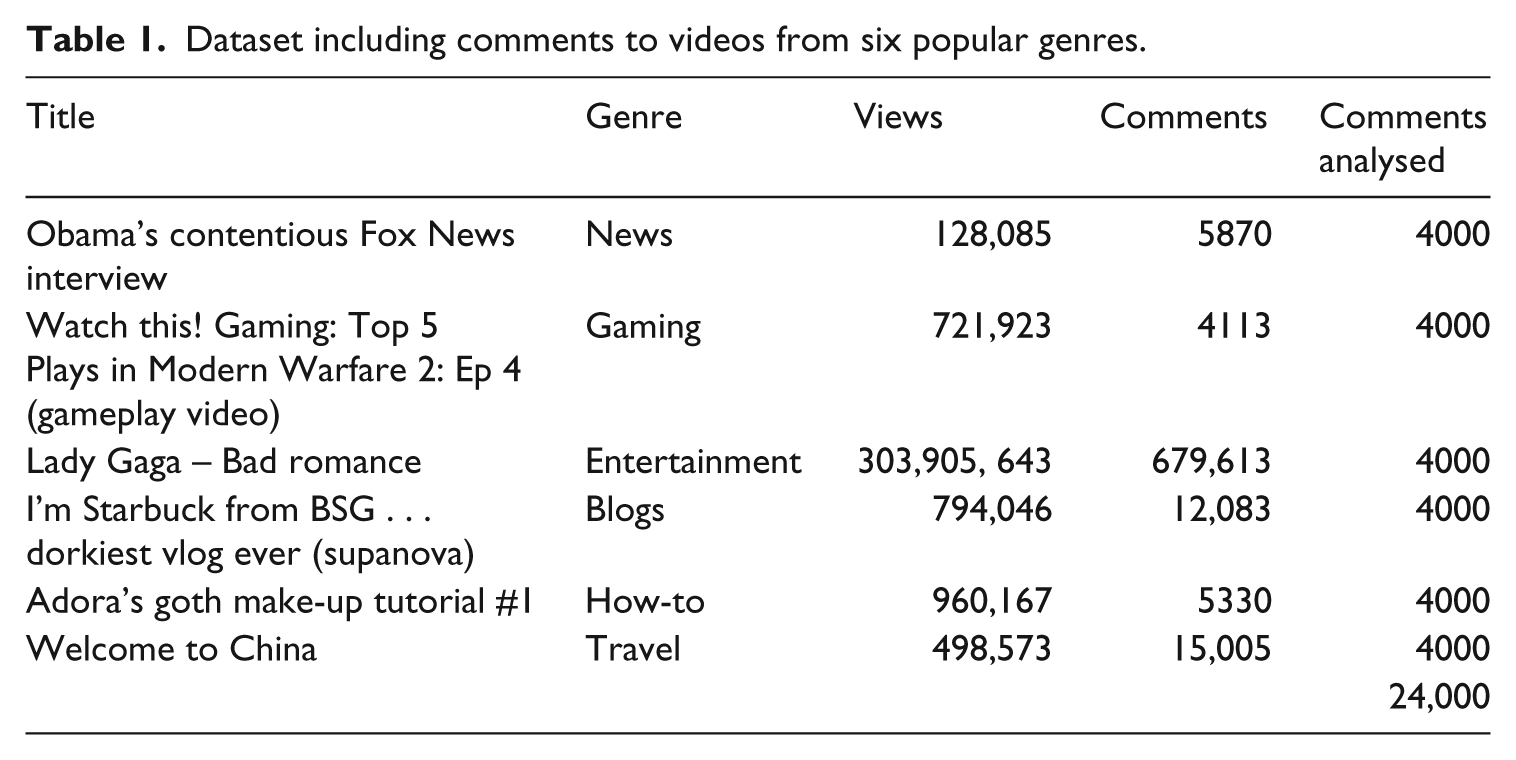
To get a picture of the sentiments, positive and negative, expressed in the comments analysed, a method for sentiment strength detection in short informal text was used (Thelwall et al., 2010). The SentiStrength opinion mining algorithm is designed to extract positive and negative emotion from sentences, and was specifically developed with the grammar and spelling styles of online communication in mind. When cross-validated with human-classified comments, it has proven to be around 70% accurate, which is significantly better than alternatives based on machine learning, and especially in relation to the amounts of data used.
The second results section takes a closer look at comments discourse relating specifically to the how-to genre of videos. This is because this type of video generated the most positive comments. It is important to note, as will be obvious from the examples presented later, that the how-to genre is very wide. It represents a variety of different how-to videos related to a multitude of user-groups and activities. For the purpose of this article however, we will look at the phenomenon of how-to videos in general.
Ten how-to videos were strategically selected based on their popularity, and in order to include a variety of different sorts of clips within the wider genre. As a point of comparison, similar material consisting of comments to popular news videos was also collected. News videos were defined as videos that are released on YouTube channels of corporate media outlets, or user videos that are simply extracts or copies of such material. The first 1000 comments posted to each of these videos were analysed (Table 2).
Dataset including comments to 10 how-to videos and 10 news videos.
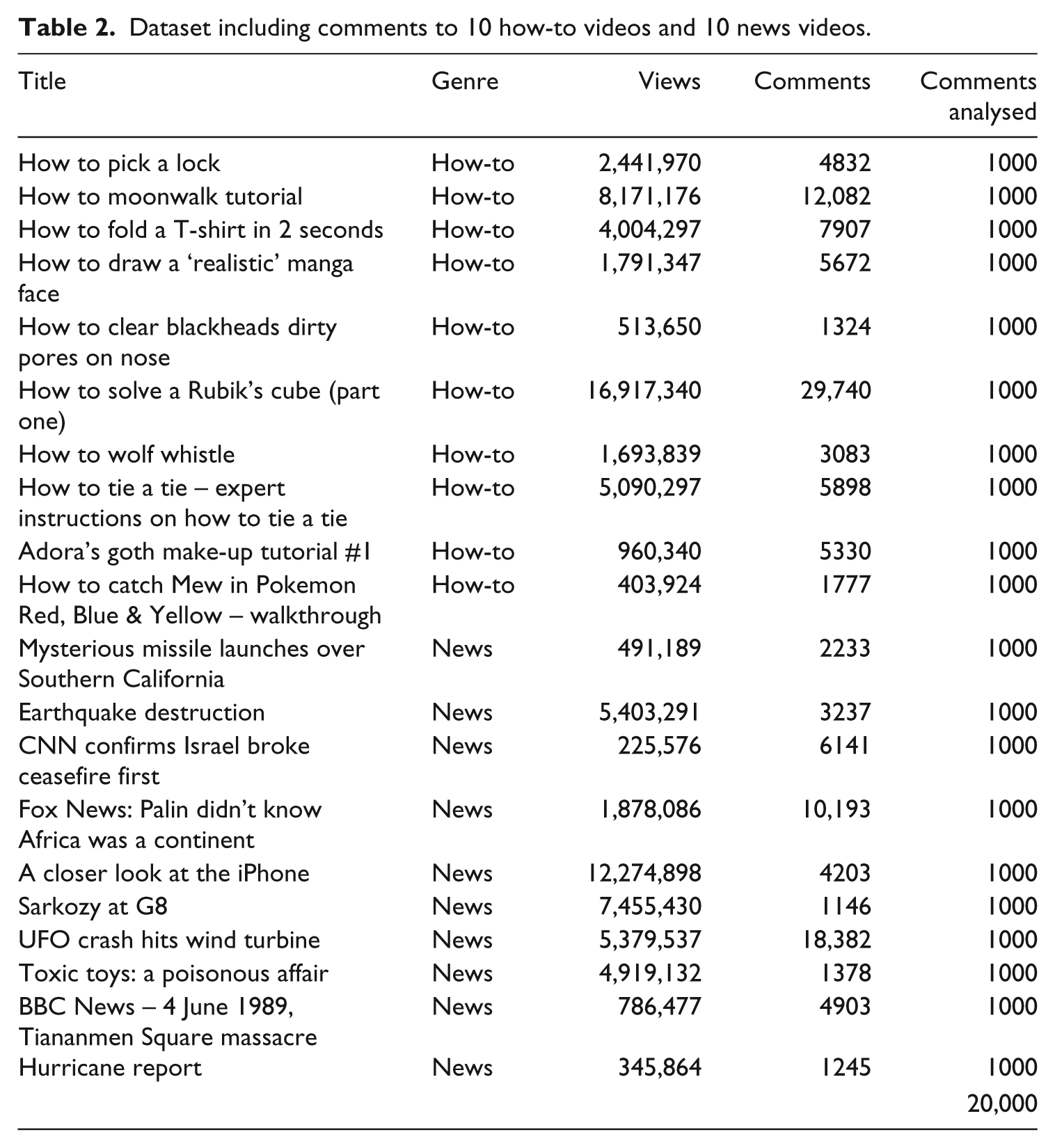
Focusing finally on the 10,000 comments relating to the 10 how-to videos, a discursive network analysis was carried out (Lindgren and Lundström, 2009). The method used for this part of the analysis combines the use of software tools for bibliometrics (BibExcel) and social network analysis (Pajek). 3 Bibliometrics (Osareh, 1996) and social network analysis (Wasserman and Faust, 1994) combined can be used to analyse co-occurrences of concepts and present them graphically as discursive networks.
Sentiment analysis
We turn first to the question of which sentiments characterize the YouTube comments discourse. Based on the analysis of 24,000 comments spread over six popular genres, the first result is that positive and negative sentiments interact throughout. Utterances and formulations that include positive as well as negative evaluations, often within one and the same sentence, are quite common. SentiStrength gives every sentence two scores: one for positive sentiment (1 to 5) and one for negative sentiment (–1 to –5). A sentence with a score of 5/–1 is to be interpreted as strongly marked by positive sentiment, and one yielding 2/–4 is primarily negative as regards emotional content. It was very common for sentences in the analysed dataset to be quite ambiguous and hard to place unequivocally on either side of this continuum. The three following excerpts are all examples of this:
you’re obviously pretty and your hair is pretty badass, but your eyebrows are fucked and all that extra stuff is just too much. (Comment to the goth make-up video; score 3/–3) Nat, I thought you were a loser before, but I really had no idea. I love you so much more now. (Comment to the blog video; score 3/–3) such great oratory skills. i just hope our generation can master the art. its sad because our generation our losing the passion for eloquence and speech and we need people like abraham lincoln, pres, Obama and Caesar. (Comment to the Obama video; score 2/–4).
But looking at the full dataset, only 0.5% of the comments were maximum positive (score 5/–1) – ‘Awesome, girl, fucking awesome!’; ‘that vid is soo amazing. it’s fucking awesome dude. i love it it’. At the other end of the spectrum, none of the comments scored (1/–5) but merely 1.5% of the comments were maximum negative (1/–4) – ‘God will rape the lesbians and kill the gays’; ‘you are such a mother fuckin asshole racist’. The absolute majority (83%) of the comments were in the span of 1 to 3 positive and –1 to –2 negative.
There were however some interesting differences between the score patterns when broken down by video genre. Figure 1 is a visualization of the average sentiment scores for the 4000 comments analysed, for each of the six videos. To the far left of the figure, the video that got the most positive response in this dataset was the how-to video on applying goth make-up. It averaged just below 2.5 on the positive scale, and a little more than –1 on the negative side. Comments to the gameplay walkthrough video, as well as to the videoblog, followed a similar pattern but with slightly more moderate scores on both sides. At the other end, the music video together with the news and travel clips yielded more neutral results at around 1.5/–1.5. It must be underlined that the differences are not large by any means, especially not around the middle of the spectrum. Still, when looking at the general pattern from the left to the right in the figure, the three user-created videos to the left are commented with a higher degree of positive affirmation while the three traditionally produced clips to the right are met with more neutral to negative comments. Even though this analysis is based on no fewer than 24,000 comments, it must be remembered that the genre comparison relies on the strategic selection of these six particular clips.
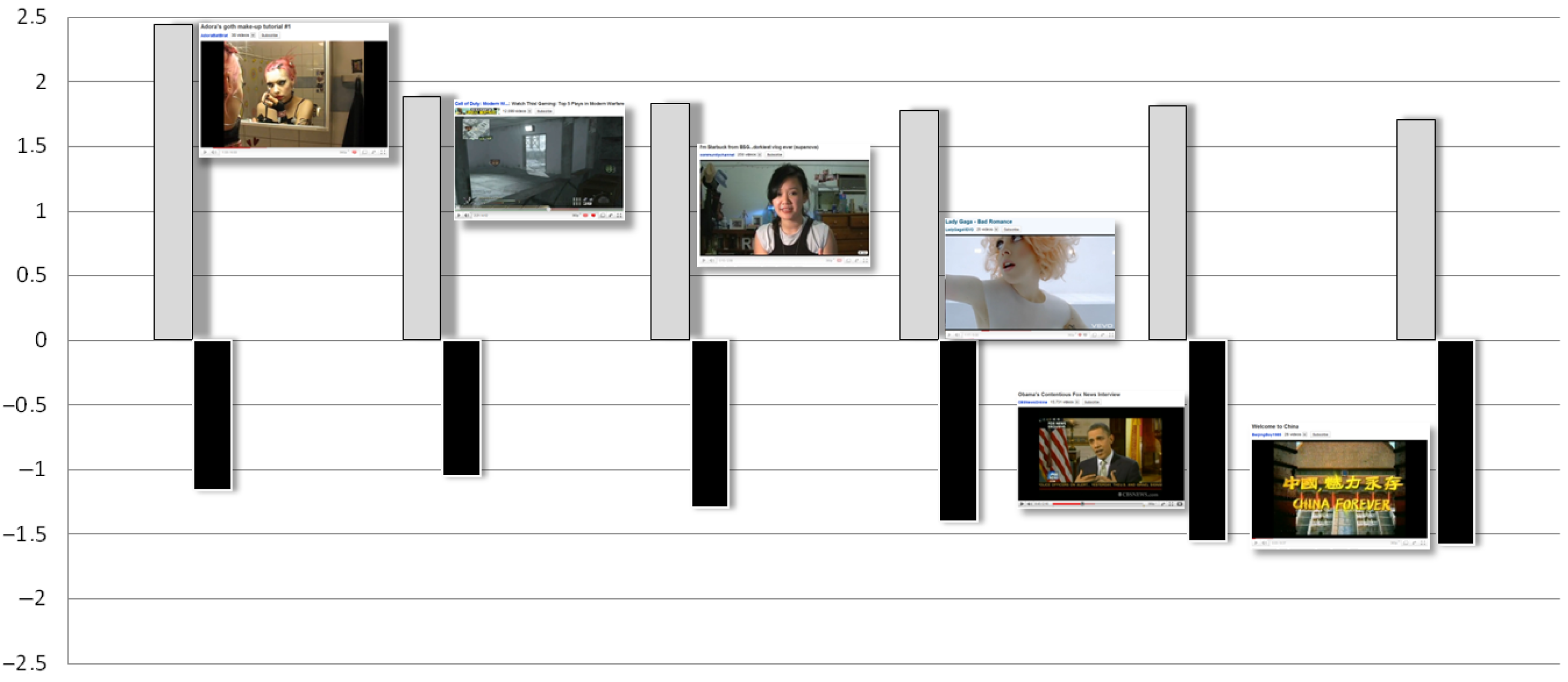
Sentiment analysis of comments to videos representing different genres.
To further investigate this pattern, and to try to validate the preliminary conclusion that user-created videos are met with more positive responses than other types of videos on YouTube, a sentiment analysis was also made of 10,000 comments to 10 different how-to videos. For the sake of comparison, 10,000 comments to 10 news videos were also collected. The visualization of the sentiment analysis of these videos in Figure 2 further underlines the results discussed above. Most comments fall within the zone of circa 1/–1, which is once again indicative of the fact that comments discourse in general is not very affective. The majority of comments yield balanced sentiment scores, painting a picture of the discursive climate as generally non-polemic (values close to 0) and nuanced (similar patterns on both sides of the 0 level).
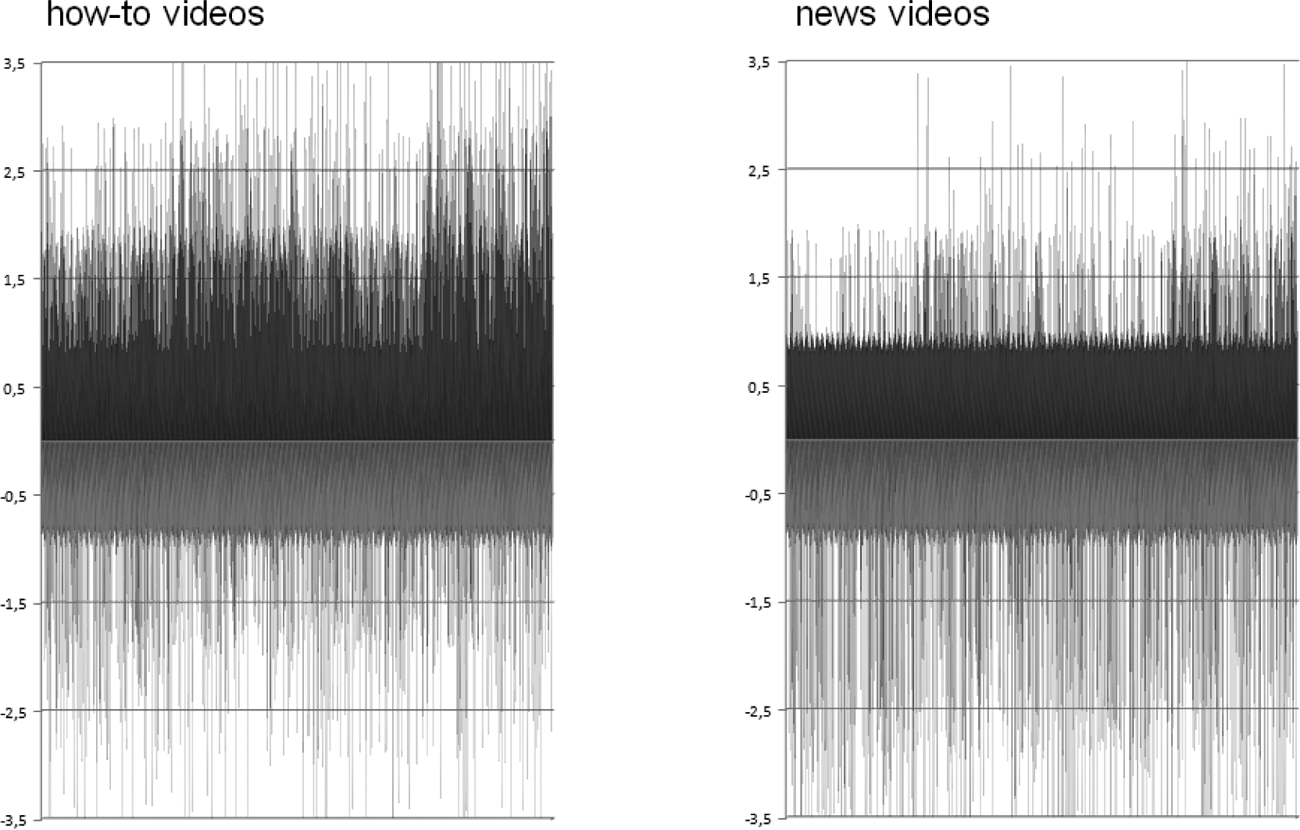
Positive and negative sentiments in comments to how-to and news videos.
But if one turns to the relatively extreme zones (1.5 and up/–1.5 and below) in the figure, it is clear that the more positive sentiments have a higher intensity in the graph of how-to videos. Quite symmetrically, the intensity is higher on the negative side in the news videos graph.
Discursive network analysis
In the light of these indications that user-created how-to videos meet with a more positive response than much other content on YouTube, it is of interest to look more closely at the inner workings of the specific space constituted by comments in this genre. Therefore, a discursive network analysis was carried out using the same 10,000 how-to video comments. The aim of this was to get a picture of how various moments are relationally positioned within this discursive formation, and furthermore to uncover the underlying structures of meaning governing the individual acts of commentary.
Figure 3 is a visualization of the analysed discursive formation. It consists of four clusters, out of which two are closely connected to each other. The sizes of the square icons representing content themes indicate the frequency by which words, concepts or formulations occur. The width of the connecting lines indicates the strength of the connections between themes, in terms of co-occurrences. The more often a conceptual pair occurs together in one and the same comment, the thicker the line. In Figure 3, lines representing fewer than five co-occurrences have been filtered out. Furthermore, an operation keeping just the one strongest relationship upheld by any given concept was performed prior to visualizing the network.

The discursive space of YouTube comments to how-to videos.
The first prominent cluster in this discursive formation (in light grey) is centred around the verb of ‘like’ and positive exclamations typical of internet language such as LOL and LMAO. This cluster also includes references to finding, and knowing ‘stuff’, and to posing questions. Second, the white cluster constitutes discourse about ‘doing’ things ‘yourself’, getting them to ‘work’. Finally, the two large paired clusters (the black and the dark grey conceptual categories) are organized around the key concepts of ‘video(s)’ and ‘thanks’. Together, they constitute the most nodal part of the analysed discursive space as a whole, comprising a composite of positive exclamations (‘cool’, ‘nice’, ‘wow’, ‘love’, ‘perfect’, etc.) and the exchange of knowledge (‘please’, ‘need’, ‘want’; ‘help’ → ‘method’, ‘show’, ‘instructions’, ‘tutorial’, ‘teach’ → ‘solved’, ‘understand’, ‘thanks’). In the following section we qualitatively analyse this discourse of helpfulness and knowledge transfer closer.
Reading the affinity space
A look at the actual content of comments to the how-to videos gives the impression that, in spite of the quite fluid and sometimes seemingly random character of communication on YouTube, there are indeed social forces keeping the discursive spaces of the comment threads together. This is quite striking given the immensity of the site. Grusin (2009) writes of its infinitude in terms of ‘the YouTube sublime’:
Browsing YouTube produces something like the experience of what I would characterize as the YouTube sublime. The number of videos on YouTube is almost too large to comprehend. Especially in print, televisual and networked news media, this sublimity is expressed in various permutations of the following sentence: ‘The video of X attracted more than Y million views on YouTube’. When I googled . . . ‘[m]ore than,’ ‘views’ and ‘YouTube’ [it] gave me 159,000,000 hits. The rhetorical force of such numbers is to produce something like the feeling of what Kant characterized as the ‘mathematical sublime’. Experiencing the YouTube sublime, the mind is unable to conceive the immensity of the YouTube universe even while it is empowered by the experience of an affective awe in the face of such immensity. (Grusin, 2009: 60–61)
Seeing this, one wonders about the character of the social space constituted through the discourse of the comments. Can one speak of the communicative contexts surrounding the how-to videos in terms of any form of community, commitment or engagement?
While there may not be evidence in the data for the existence of community in terms of close-knit personal ties among participants, there are certainly indications that this is a virtual space adhering to specific social rules and customs. They can be conceived of as an affinity space (Gee, 2005). By focusing on the dimensions of space and place, instead of on community, attention is directed away from the idea of a coherent and reasonably stable group of participants. Rather than getting stuck in questions about boundaries – about who is in, and who is out – the notion of affinity spaces allows us to focus on the studied context as a space for structured activity, no matter the number or heterogeneity of the actors:
oh my god this thing is so helpful i can do it now thanks thanks thanks for the help! the demonstrations were very helpful! it took me about half an hour but i did it! i dont like the way people bitched about you’re amazing intelligence. if they didn’t like it, they didnt need to continue watching. can you make more vids plz? n you hav a really pretty smile by the way by the way Nice vid. i think im gonna try it out now now. Thanks for posting it.
Comments like these illustrate that the how-to videos are met with thankfulness and encouragement fed back to the author of the video. In addition to this, it is also common that commentators support the authors when they get malevolent responses from some users. Fuchs (2008: 327–334) has written about how the tension between cooperation and socialization on the one hand, and competition and fragmentation on the other, is the main antagonism in cyberculture. There is a constant struggle between forces that encourage sharing and the building of relationships, and forces that create borders and separate people. Depending on the context, either of these sides may become dominant. It seems as if the affinity spaces constituted through comments discourse relating to how-to videos on YouTube are largely based on the socialized forms. The comments quoted above are examples of how thankfulness for the instructive demonstrations is strongly expressed, and many users also express that they are going to try doing these things themselves after watching the videos:
I have always wanted to learn how to do this, and I’m looking forward to trying this out! No, not for anything illegal! I have 3 children and money is tight. I don’t have money for a locksmith if myself, my husband or even one of our children lose the keys. =) Thanks for the lesson! (Comment to the lockpicking tutorial) This is sweet cuz my step mom hates how I fold my T-shirts. I shall learn this new skill and use it to slay dragons. or not. (Comment to the T-shirt folding tutorial)
Even though these spaces are not by any means marked by long-term commitments, it is still interesting to note that not only are many positive responses given, but it also happens that users provide the authors of the videos with balanced, polite and constructive criticism:
No offence to uploader, but this is a very bad guide for begginers. to explain to begginers, you must explain the logic behind every move. not simply ask them to learn algorithms. i learnt how to solve the rubicks cube, and im proud to say that i did so without the use of any algorithms. once you understand the logic behind what your doing, you can find shortcuts and make up your own unique algorithms. the understanding is the key rather than blindly memorizing someone else’s understanding of it. (Comment to the Rubik’s cube tutorial)
Furthermore, many users come back to the thread to give reports of their attempts to follow the tutorials. From the perspective of fragmented cyberculture one might have imagined that people wanting to know how to master a specific skill would simply search out the video, use it and move out and on with their lives. But quite to the contrary, not only do many take the time to post a ‘thanks’ to the author, but a substantial group of commentators also come back to the thread for a debriefing:
Holy Shit! It Works!! thanks a bunch! i learned how to moonwalk from this vid. some of my friends say its kinda cheesy learning off of utube but hey its a way! laugh out loud this video is perfect if you want to know how to do the moonwalk. (Comment to the moonwalking tutorial) Lol, i unlocked my brothers room today using a bobby pin. hahaha. (Comment to the lockpicking tutorial) this helped the most out of all the things i’ve seen in the last year. Your an amazing drawer. (Comment to the manga drawing tutorial) Wow! Amazing, i tried it and now i cant see a single blackhead on my nose ! Thanks Thanks. (Comment to the blackhead removal tutorial)
The above extracts are illustrations of how people making use of the videos return to the comment threads to communicate their experiences back into the affinity space. Furthermore, many of these acts of feedback communication lead to more long-lived dialogues or group discussions. This confirms the view of Burgess and Green (2009: 63) that, in spite of YouTube having an architecture that is not primarily built to support collective participation or collaboration, a lot of ‘community-oriented activities’ are taking place on the site. As the following comments illustrate, the how-to videos lead to group activity and interaction:
Do more eyes and lips too. Love your videos, make the whole body please! (Comment to the manga drawing tutorial) Holy shit who sings this song? someone send me a message telling me please! please watch my moonwalk /watch?v=R_iFu5PdHgI check out the rubiks cube pattern video on my channel please! dang, it works, and if you accidently kill him, you can redo the glitch from the start where you get seen by the trainer and then teleport away. (Comment to gaming walkthrough video)
The first of the above quotes is an example of how users ask for further help from the authors on related topics, and the second illustrates how questions generated by the background music used in one of the videos lead to additional questions being posed in the same space. The third and fourth quotes are examples of people uploading new videos as a result of viewing the tutorials, and the final quote shows how a user has developed additional strategies and shares them back as well.
Discussion and conclusions
Through a combination of sentiment analysis and discursive network analysis, this article has presented an assessment of YouTube user comments to investigate which sentiments characterize this discursive space, and for which genres of videos positive sentiment is more common. The analysis of 24,000 comments to six strategically selected videos, representing different popular genres on YouTube showed small differences between the reactions to the clips. The differences that did exist were however quite striking as the user-created videos were all met with more positive sentiment than the other videos.
In light of previous writings on the potential for peer-support and mutual encouragement through this type of microcontent, this preliminary overview indicated that further analyses of this pattern were warranted. In the second analytical step – a discursive network analysis of a dataset of 20,000 comments distributed evenly over 10 how-to videos and 10 news corporation clips – it was found once again that the user-created videos got a more positive response than the news videos. Focusing, in the final step, on mapping the discursive formation constituted by the 10,000 comments to the how-to videos, four thematic clusters came forth. The first one was about posing questions and to ‘finding’ and ‘knowing’ things. The second was about do-it-yourself culture, the third and fourth about help and the exchange of knowledge.
Through the microcontent (Alexander and Levine, 2008) of YouTube comments, media circuits (Lange, 2008; Rouse, 1991) can be established. This might be through viewers establishing more or less long-standing contacts with each other based on common interests, through viewers giving constructive criticism to authors, through viewers refining techniques presented in a previous video and posting their own videos. The fact that significant parts of this audience are producer-consumers (Maia et al., 2008: 4–5) further enhances the mutuality of these forms of knowledge production and exchange.
The media circuit created through the analysed discourse is marked by politeness, helpfulness and constructivity. Readings of parts of the material that were made in order to validate this result confirmed this conclusion. While the vastness and fluidity of ‘the YouTube sublime’ (Grusin, 2009) makes it quite problematic to speak of these patterns in terms of community-building, they can rather be seen as evidence for the existence of affinity spaces (Gee, 2005). The YouTube comment threads offer a space for interaction where certain forms of linguistic capital (Bourdieu, 1977) are valid, no matter who participates, and where, at any given moment.
When it comes to online disinhibition, trolling, hating or other forms of content that may disrupt the media circuit, the overall impression is that the comments discourse is quite neutral. According to the SentiStrength algorithm, as many as 83% of the comments analysed were between 1 to 3 positive and –1 to –2 negative. Only 1.5% of the comments were maximum negative, and closer qualitative reviews of the material show that this is the level you need to go to in order to find the purely malevolent comments. A reservation needs to be made, however, in regard to the fact that the quite straightforward sentiment algorithm is not optimal for spotting more subtle forms of disruption based on in-jokes, etc.
Looking at the results of the analyses, Gee’s theory of affinity spaces (2005) appears to be a suitable tool for understanding what is going on in the how-to comment threads. Affinity spaces are interactive sites – online or offline – where people come together through common goals, interests or activities. Affinity spaces often emerge within various forms of fan cultures, as websites, forums and other platforms featuring information and resources linked to a specific area of interest become interlinked through social patterns of usage and produsage (Bruns, 2008). The analysed comment threads to how-to videos exemplify the notion of affinity spaces in several ways. The common endeavour (folding a T-shirt, picking a lock, removing blackheads, etc.) is at the centre, not the homogeneity of the group or the identity of participating individuals.
In sum, the comments discourse in relation to how-to videos generates an affinity space which is characterized by interactivity, thankfulness, encouragement and support. It must however be kept in mind that what has been done here is an analysis of a selection of comments to a video genre that generally tends to generate more dialogue and have a more helpful climate in the commentary threads than other genres. Nonetheless, this case study helps sketch out an image of the participatory possibilities of YouTube media circuits. Figure 4 has been distilled from the analysis of the comments and it represents a set of ideal types for user strategies ranked by degree of participation. Depending on the context, and depending on which strategies users employ, and what strategies are made discursively possible, YouTube comments can express anything from total passivity and detachment, to deep engagement.

Ideal types for user strategies ranked by degree of participation.
This article has taken a multifaceted look at the specific empirical case of YouTube comment postings, and shown that comments to user-created how-to videos are more supportive and affirming than comments to videos in several other examined genres. Further comparisons and readings of the material confirmed this result and gave a more detailed image of how this encouraging and participatory discourse functions. As discussed, this case study serves as an illustration of how interactions that at first glance may seem pointless and semi-random, may reveal themselves upon closer inspection as illustrative of key social processes in the ongoing transformation of the public sphere through digital culture.
No matter if they solved Rubik’s cube several times, or just started trying, users all share the same common space where knowledge is shared, negotiated, modified and shared once again. While the quite commonplace and recreational activities such as applying make-up, learning how to wolf whistle or solving the cube may not in themselves be world-altering, all of these discursive processes taken together illustrate that increasingly larger groups of people are today taking part in cultures of knowledge far removed from formal educational settings. Jenkins writes:
Right now, we are mostly using this collective power through our recreational life, but soon we will be deploying those skills for more ‘serious’ purposes. (Jenkins, 2006b: 4)
Jenkins et al. (2009) argue that the emerging affinity spaces and the participatory cultures inhabiting them are important environments for acquiring media literacies that will be essential in the future. They also claim that while traditional, formal education and one-to-many communications are often conservative, the collective problem-solving and peer-to-peer learning processes within the pop culture domain of sites like YouTube are more experimental, innovative and stimulating. Furthermore, the participant in a networked public can stay on the move, opting in and out of communities and spaces should they fail to meet their needs. Even though evidence for this can be found in the analyses presented in this article, further critical research is still needed that looks closer at the limits of participation. Who can participate, and who is shut out? And how, more concretely, can these types of everyday participation be translated into the more ‘serious’ forms?
Footnotes
This research was funded by the Knowledge Foundation, Sweden.