




Abstract
Most contemporary work on public spheres tends to adopt, either explicitly or implicitly, Habermas’s idea of a deliberative public sphere as a normative model. There are, however, a number of other normative models available that are rarely the subject of empirical scrutiny: republican, liberal and multicultural. This article poses the empirical question of whether actually existing public spheres more closely resemble one model rather than another. To answer this question, the authors develop ways to measure public spheres, at both national and transnational level. They ground this attempt to move comparative media analysis forward conceptually and empirically via a case study comparing media content about the EU Constitution in six countries.
Introduction
Hallin and Mancini (2004) have made headway in the field of comparative media, developing an empirically informed analysis of media systems and journalistic models for Western Europe and North America. Their identification of three ideal types of media system – the liberal, the democratic corporatist and the polarized pluralist – has found considerable acceptance. However, progress in developing measurements of comparative media has been strictly limited.
This article takes a different approach to that of Hallin and Mancini by developing the relatively overlooked work of Ferree et al. (2002a) on comparing public spheres. We argue that public sphere theory is an excellent way of categorizing, understanding and explaining the differences between public spheres within and across states and over time. However, and crucially for the development of the field of comparative media analysis, this needs to be matched by developing better ways to measure public spheres. By focusing on the measurement of media content, we show that it is problematic to speak of national media systems and/or public spheres and reveal the similarities of public spheres across national boundaries. We demonstrate the usefulness of these general conceptual, empirical and methodological claims via a case study concerning press reporting of the European Constitution in six countries: Germany, France, Slovenia, Switzerland, the UK and the USA. The overarching intention is to develop concepts and tools that are useful in comparative media analysis across time and space.
A deliberative public sphere?
Despite the ubiquity of the concept of public sphere in the field of communication and media research surprisingly little attention has been paid to the different varieties of actual and normative public spheres that have developed out of contrasting political philosophical traditions and historical circumstances. This may be explained by the dominance of Habermas’s thinking (Habermas, 1989). However, a number of different conceptualizations for the ideal public sphere exist (Ferree et al., 2002a). For the purposes of the present article we briefly outline just three types of public sphere: the liberal, the republican and the deliberative (that correspond more or less to Hallin and Mancini’s liberal, polarized pluralist and democratic corporatist types of media systems respectively).
Liberal representative (liberal elite) public sphere
Essentially this tradition is democratic in the sense that it believes that ‘the public’ or ‘the people’ should ultimately rule or express their will through electing representatives but that the day-to-day business of politics should be left in the hands of a political and/or technocratic elite who argue between themselves as to what best to do and make decisions accordingly.
The characteristics of the liberal representative public sphere, according to Ferree et al., are that debate should be conducted by and for elites against a background of a shared political culture based on tolerance of differences of opinion and habit. The media presence of competing elites should roughly reflect the support that elites can draw on from the public as shown through elections or public opinion polls (‘proportionality’). Media institutions should promote transparency and provide the electorate with information, suitably simplified, on which to base their judgements of the competing parties. Debates should be conducted in a dispassionate and civil manner. Liberal elite public spheres are the embodiment of a ‘marketplace of ideas’ where media institutions compete in free markets to satisfy the needs of consumers and citizens. Participation in public debate about important issues is largely confined to the bourgeoisie and to the professional classes.
Participatory liberal (republican) public sphere
In contrast to the liberal representative public sphere where the public are preferably neither seen nor heard beyond the occasional election, the participatory liberal public sphere sees the public’s active engagement in debate and decision-making as paramount. Ferree et al. mention Rousseau, who stands tall in the republican tradition of thought. If the liberal representative model can be seen as a reaction to the excesses of the French Revolution, the participatory liberal or republican model was a progenitor of it. The public should be involved in all decision-making.
Media institutions in a participatory or republican public sphere should promote the inclusion of citizens. Citizens must not only be the recipients of public debate through consuming media but also participants in the debate through producing opinions and arguments. Public debate should not be reserved for elites and experts but should reflect the diversity of opinion of all citizens. The poor and the weak should not be spoken for but should be themselves speakers in the debate and present in making decisions.
Discursive (deliberative) public sphere
The ideal of a deliberative public sphere is closely associated with the thought of Jürgen Habermas, one of the most influential European philosophers and public intellectuals of the last 50 years. His work on the public sphere starting in the 1950s has been so influential that many still labour under the misapprehension that his ideal of the deliberative public sphere is the only game in town. Although it took considerable time for Habermas’s book to be translated from German into English, by the 1990s the ideal of the public sphere had been taken up by critical intellectuals as a way in which to point out the democratic deficits of contemporary liberal capitalist societies. The ideal was used as a benchmark against which to judge actually existing societies. As the concept has become more widespread, however, it is not clear that it is always now being used in this critical normative sense but also as an affirmative acritical description of a supposedly existing state of affairs. Calling something a ‘public sphere’ logically means that there is also ‘the public’, however emaciated and marginal they may actually be to the business of government. This is why it is important to distinguish between actually existing public spheres.
The ideal of the deliberative public sphere shares some characteristics of both the liberal elite and the republican model. Habermas emphasizes popular inclusion and civility. Everyone should be able to participate in debate and decision-making. In contrast to the republican model, participants should put aside individual interests and attempt to argue from the perspective of the universal. The only force that is admissible in the deliberative public sphere is the force of the better argument and this necessarily requires that all participants treat others with respect and civility. Opponents are legitimately defeated only through the presentation of better arguments which they themselves come to accept. The aim of deliberation is to produce a consensus of equals that leads to decisions being made in the common good.
A national public sphere?
When we speak of the national mode of the public sphere, we acknowledge that public spheres are often nationally bounded, but at the same time discursive spaces at the national level are by no means homogeneous. Even though national media systems enabled the construction of a common national imagined community (Anderson, 1983), it is far from obvious that this suffices for the development of common national deliberation. Habermas shows that, historically, the public sphere was not a sphere of citizens but a sphere of bourgeois discourse mediated through newspapers (Habermas, 1992: 443). Variations of his theory were consequently repeatedly criticized for glossing over the fact that the public sphere was dominated by white, property-owning males, and that the participation of certain groups – typically working-class, women, ethnic or racial minorities and immigrants – was thus limited. For instance, Oskar Negt and Alexander Kluge (1993 [1977)]) criticized Habermas for his neglect of plebeian and proletarian public spheres, while Nancy Fraser (1997: 69–120) has raised the issue of the gender bias of the bourgeois public sphere and Jacobs (2000) has pointed to the various public spaces and communicative institutions established among free African-Americans in the 1700s and the 1800s. Most recently, several authors have pointed to the proliferation of sub- and transnational public spheres arising along ethnic/national divisions, exemplified in sub-national minority public sphericules and transnational diasporic public spheres (Husband, 1994; Karim, 2003).
Rather than limiting the analysis to nationally and territorially bounded public spheres, it is thus more productive to hold open theoretically the possibility of a multiplicity of variously sized public spheres, sometimes overlapping but also conflicting (cf. Fraser, 1989 on counter-publics). Drawing on the approach developed and tested elsewhere (Mihelj et al., 2008), we examine and compare the nature of public spheres not only at national level, but also at class level. To that end, we distinguish between two main types of class-based public spheres: bourgeois public spheres and working-class public spheres.
Measuring mass media public spheres
We identify five familiar criteria against which public spheres can be assessed (for an overview see Table 1). The first is the degree of political parallelism. This dimension refers to the degree to which media institutions are tied to political actors, that is, conceive of themselves as particularistic (of giving priority to one group of political actors over others). The second is external pluralism. This is the degree to which a diversity of political position is present in the mass media as a whole. We would expect states with more republican public spheres to display greater external pluralism than states with liberal public spheres. The reverse is true for internal pluralism because mass media in public spheres that approximate the liberal model are inclined to see themselves as universalistic platforms, allowing a wide variety of different views. In order to fulfil this ideal, journalists in such media systems tend to follow objectivity rituals (Tuchman, 1972), which result in the presentation of more than one viewpoint in the same news story. Democratic corporatist countries lie between these two poles: they tend to exhibit a lower degree of political parallelism than the polarized pluralist countries, but at the same time they usually do exhibit a certain political ideology.
Characteristics of different types of public sphere.
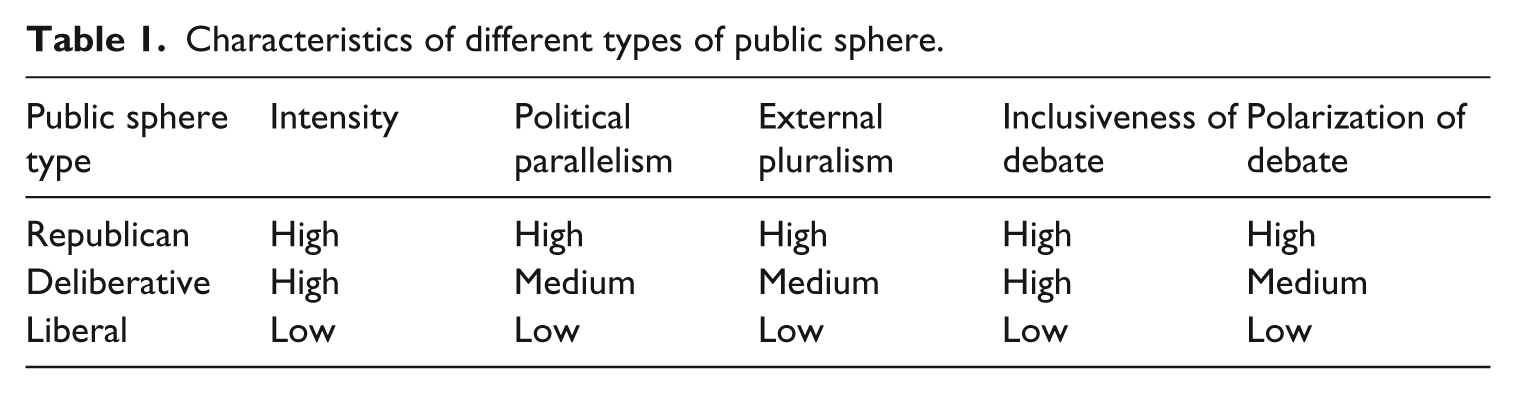
Journalistic cultures can also be characterized in terms of polarization. In polarized pluralist countries, we expect conflicts to be displayed in a more controversial, highly polarized manner, while corporatism lends itself to a more centrist debate. Liberal media cultures due to their majoritarian structures rarely present more than two viewpoints (Hallin and Mancini, 2004: 131), and also lend themselves more to centrist debates.
The fourth criterion is the intensity of the debate: both deliberative and republican styles demand extensive, open-ended discussions with no premature closure (Ferree et al., 2002b). The intensity of the discourse is measured by the frequency of the contributions and can cover a range of debate from closed (very low intensity) to open (very high intensity). The final criterion is the inclusiveness of the debate, with the deliberative and republican models stressing the importance of the participation of a wide range of opinions.
Data
The data for our study were taken from digitized versions of newspapers. In the US, German, French, British and Swiss cases we relied mainly on the LexisNexis database, except for Bild, which was harvested through Google site searches from Bild’s online paper, which unfortunately does not replicate the print version in its entirety. In the Slovenian case, we harvested the data from the online archive of the five sampled dailies. 1 With the exception of the United States, where, due to the foreign nature of the issue we only sampled the three quasi-national broadsheets, we aimed to replicate the structures of the press markets. In the UK, the market is highly nationalized, we thus sampled all nationwide broadsheets, mid-markets and tabloids, which cover 61% of the total dailies market. 2 Slovenia’s small market is strongly regionalized. 3 That means that we collected data for five papers combined for a 90% market share in terms of circulation figures (Bašić-Hravatin and Milosavljević, 2001: 17). Such almost universal coverage of the market was not possible in either Germany or France. Both countries have a number of regional papers that are market leaders within their respective regions. In addition, Switzerland is almost entirely regionalized (Hallin and Mancini, 2004: 25). Because of the regional proliferation of these markets, it was not feasible to cover papers that would combine to similar market share figures in each country. Instead, we aimed to include all papers that are (according to Adam et al., 2003: 99–101) quality papers, several leading papers from different regions in these countries and the most important tabloids. This way we covered over 30% (Germany), 16% (Switzerland) and 12% (France) of the combined market share. 4 Notable gaps in our data are the French quality daily Le Monde, the French tabloid France Soir, the German financial broadsheet Handelsblatt and the Swiss tabloid Blick. While the sample is not perfectly representative of the newspaper markets, it still roughly replicates the newspaper media structures in the countries in question because we have sampled national broadsheet and popular titles as well as regional newspapers. This sample is far more representative of the national market than is often presented in ‘national’ comparative research. To take an example, French broadsheet newspapers where circulation is concentrated in Paris and environs can hardly be taken to represent the national market. The sample included all articles published in the major dailies in each of the six countries, in the period between 1 May and 31 December 2006.
Measurement
Drawing on claims-making analysis (Koopmans and Statham, 1999) we decided to map the discourse looking at the voices quoted in the articles in our sample. Claims-making analysis is a relatively little known yet straightforward method to adopt. Its simplicity, we argue, is an advantage in undertaking comparative media research that often risks getting mired in national specificities. Such a method could reliably be adopted by cross-national projects and researchers. We chose to include the top 30 individuals in terms of frequency of quotation in each country we surveyed. This gave a total figure of 119 voices, since a number of the voices appeared in the top 30 in several countries. Of the 119, 117 were party politicians, the two remaining people being the French attac president Jaques Nikonoff, quoted in just under 0.5% of all articles, and Pope Benedict XIV, who appeared in just over 0.5% of all articles. This indicates the marginal role that representatives of ‘peripheral publics’ play in the mass media institutions of the public spheres in all states in our sample (at least in this case). Since our topic was the debate on an issue that concerned the EU, we excluded non-EU citizens from the analysis as these were usually not considered to be agents in the debate. The two by far most frequently quoted politicians were France’s President Jacques Chirac (in 36% of articles) and Britain’s Prime Minister Tony Blair (34%). The French Secretary of the Interior, Nicholas Sarkozy (11.3%), German Chancellor Gerhard Schröder (10.8%) and his successor Angela Merkel (9.7%) and the British Chancellor Gordon Brown (10.6%) were the next most prominent actors. The most prominent actor that was not based in any of the surveyed countries was Luxembourg’s Prime Minister Jean-Claude Juncker (9.1%). Politicians from the national polities were vastly overrepresented in all four member states, prima facie evidence for the existence of national public spheres.
Intensity of debate
The most straightforward measurement of (print) media discourses is the sheer frequency of certain topics or protagonists. In order to measure the prevalence of the issue of the EU Constitutional Treaty, we therefore merely had to count the number of articles dedicated to the topic that had been published over our sampling period. While this is a fairly standard measurement (Downey and König, 2006; Risse and Van de Steeg, 2003; Trenz, 2004), it contains a serious shortcoming: the total number of articles published by a newspaper varies systematically with the type of the paper, with ‘quality’ newspapers publishing many more political articles than ‘popular’ ones. What is more, each paper has a specific average number of articles per issue, which due to the lack of systematic data is unfortunately unknown. To get at least an approximate weighting that reflects the prominence of the debate, we counted the total number of published articles in each newspaper on one day (18 April 2006) and divided the article count by this number. 5
Political parallelism and external pluralism
The a priori assessment of the political standing of the newspapers in our sample draws both on Hallin and Mancini’s typology and our own secondary sources on the newspapers in our sample. Our assessment of the papers rests on a two-dimensional categorization of the papers (see Table 2). On the one hand, most papers can be sorted roughly on the conventional left–right continuum of politics (Hallin and Mancini, 2004: 27), on the other, they either might follow the ideals of ‘objectivity’ put forth in American journalism, namely to represent the two major sides of the story (Gans, 1980; Tuchman, 1972) or engage in advocacy journalism. With respect to the latter dimension we depart to some extent from Hallin and Mancini, in that we expect most of the British newspapers, which usually have a clearly distinct political standing (Hallin and Mancini, 2004: 211ff.), to be in the category of advocacy papers.
Political categorization of the newspaper sample.
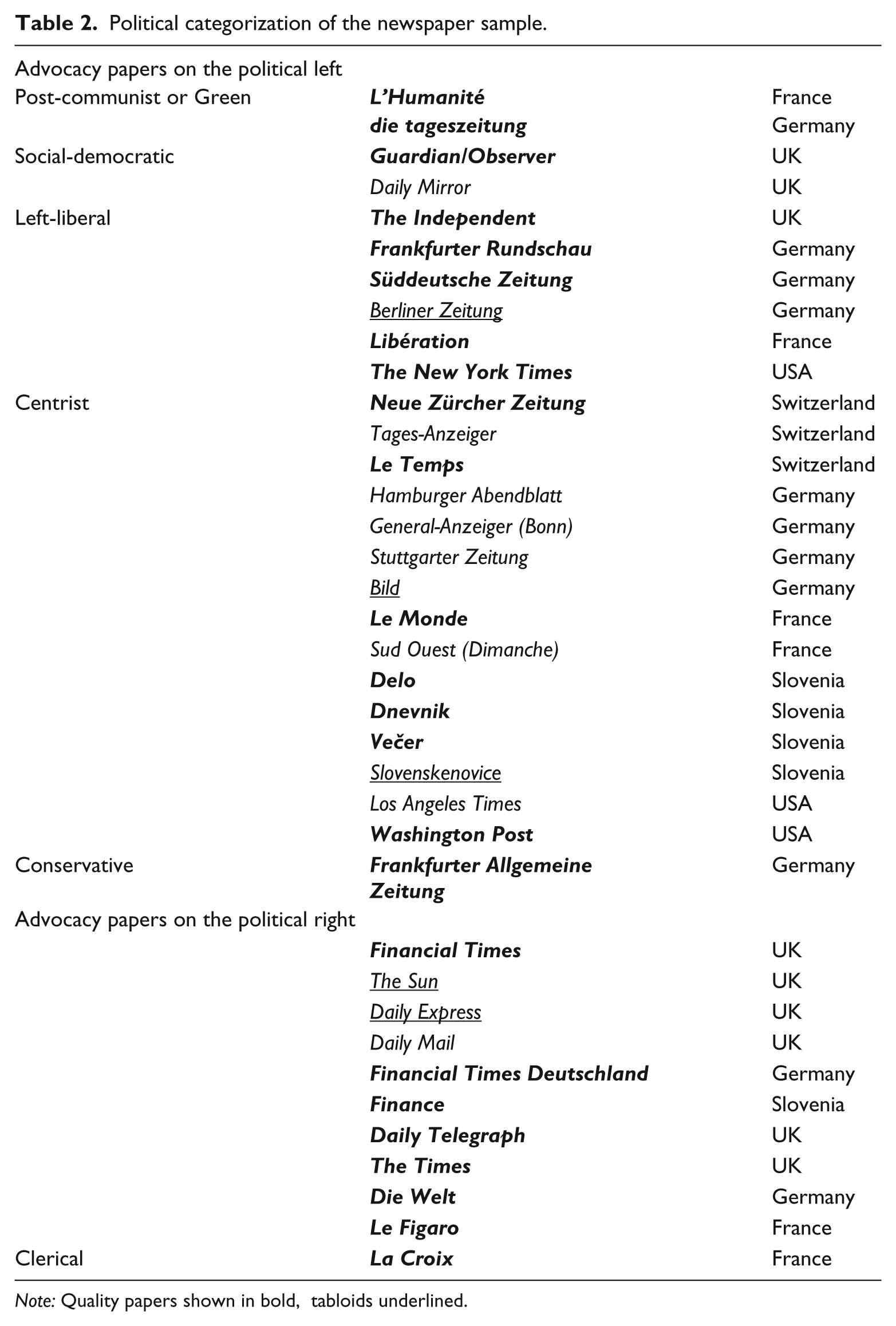
Note: Quality papers shown in bold, tabloids underlined.
Although numerous studies on the alleged political bias of newspapers exist, there is no standard quantitative measure for the political standpoint of a newspaper in cross-national samples. We based our measure on the assumption that most articles will quote those politicians who stand closer to the political viewpoint of the author. While it is certainly true that those politicians in higher power positions will be more frequently mentioned across the board, the relative frequency of the appearance of a politician when compared to other papers will give an indication of the preference of the paper. We will also find negatively tainted coverage, but as this will be true for all voices and we assume these measurement errors to cancel each other over larger samples. We computed the political leaning of articles using the formula,

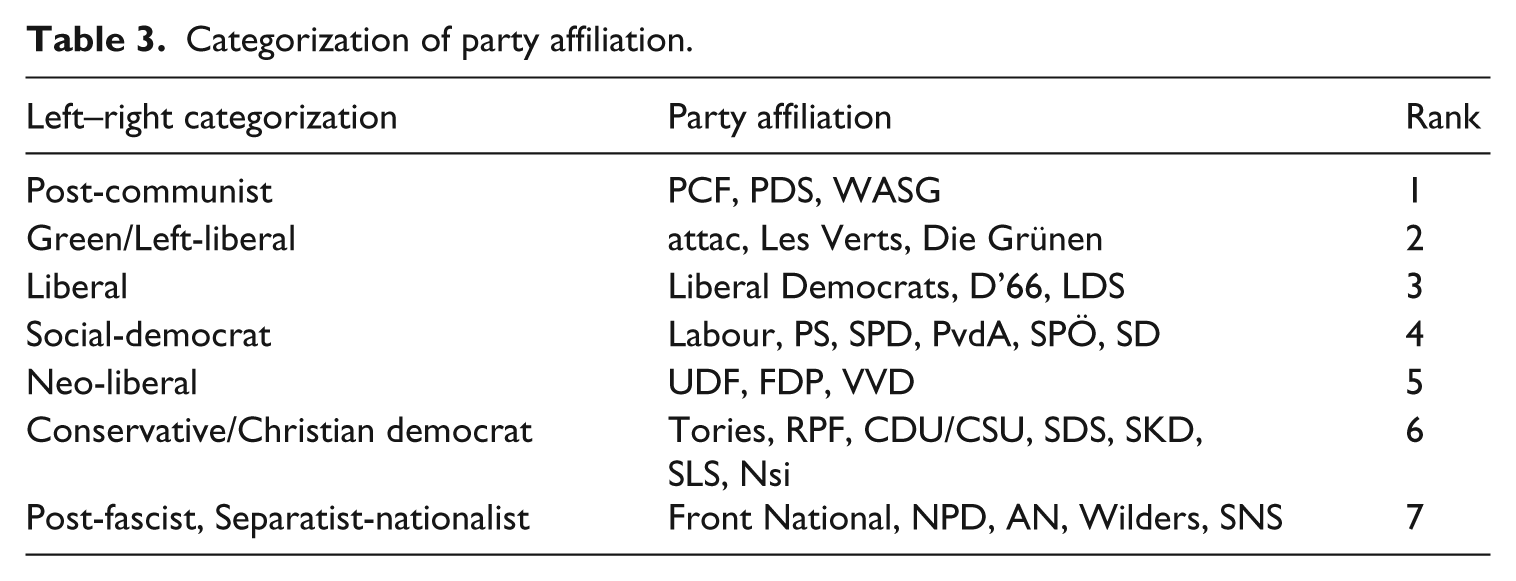
where a i is the number of actors of a certain political leaning i, the seven steps in our political leaning scale according to party affiliation denotes, and m the number of total actors quoted in the article. Thus, the greater the percentage of actors that come from a certain political party, the closer will the index number be to 1. The quotation of persons from both extremes of the political spectrum would lead to an overall more centrist categorization of the corresponding article. We categorized each actor along the left–right scale displayed in Table 3. While the different parties obviously contain national differences, the fact that they actually are in alliance with each other on the European level, shows that our categorization is not entirely arbitrary.
Categorization of party affiliation.
Inclusiveness
As with the political valency of articles, there is no standard way to measure the diversity of opinions expressed in a newspaper. We constructed, therefore, a series of four indices to measure this. By using four indices in parallel, we minimized the danger that our results would merely be an artefact of our methods. The indices use the following notation:
a
i
: the number of actors of political persuasion i mentioned in the article x
i
: the binary variable, if an actor of political persuasion i mentioned in the article m: the total number of actors in the article
were calculated as follows:

This index posits that an ideally balanced discourse would voice the opinions of all relevant political positions – the more positions are quoted the more pluralism exists. It increases with every additional point of view being voiced, regardless of its framing.

The second index starts with the assumption that opinions can be categorized along a one-dimensional left–right scale and favours those articles that contain positions further apart from each other. The more actors are mentioned, the larger the sum will be as there will be fewer summands x i x j that will be zero, but the expression (j–i) ensures that views that are further apart from each other are weighted more heavily, as they often allow for intermediate views to be implicitly present.

However, since index (2) heavily favours the mention of positions on the political extremes, we decided to correct the linear impact of distances between positions by discounting the distances using a function with a highly negative second derivative, in this case the cubic root function. Index (3) thus contains the same assumptions as index (1) but tests for the robustness of that index.

Finally index (4) takes into account the relative strength of the number of actors of a certain political persuasion, arguing that not only the range of views expressed contributes to internal pluralism, but also the even-handedness. It expands on index (2) by introducing a quantitative approximate measure of how elaborately certain voices are presented in the article when compared to others.
Polarization
Hallin and Mancini hypothesize that the polarized pluralist media system will exhibit debates tending to emphasize the extremes. Again unfortunately, there is no standard measure for the polarization of a debate. We developed, therefore, an index to measure polarization by simply adding the proportion of actors from parties and associations that are ideologically critical of majority beliefs and values – post-communists, Greens, post-fascists and nationalist separatists – that are mentioned in the article:

These parties may, of course, take part in coalition governments (for example, the Green/SPD coalition in Germany at the time of this sample) and so this is a measure of ideological difference rather than of political exclusion. The idea behind this index is that most newspaper articles will usually set out the positions of the two main political parties, which suits the generic journalistic conflict frame. Any further positions are often perceived to complicate the story unduly, which frequently leads to the omission of minor views from the story (usually views from the political extremes). On the other hand, parties around the centre of the political spectrum tend to compete for voters of the other mainstream party or parties, which moderates their voice as they do not wish to repel voters with centrist views. Based on this assumption, this index counts the voices from the two extreme ends of the political spectrum in proportion to all actors that are quoted in an article. It is designed as a proxy measure for both the extent to which the debate has been polarized in the different countries and by association, the tone of the debate. Admittedly, whether polarized debates lead to a more confrontational style of debate is open to question, but the instances we checked confirmed this to be the case.
Results
Intensity of the debate
Table 4 shows that the debate about the EU Constitution received uneven attention across Europe. The results do not confirm the expected differences in intensity arising from different public sphere types that we imagined France (republican public sphere and polarized pluralist media system), Germany (deliberative public sphere and democratic corporatist media system) and the UK (liberal elite public sphere and liberal media system) to represent. Instead, the intensity was primarily dependent on the presence/absence of elite cleavages (elite dissensus) in a particular country. Although the figures need to be treated with caution due to the French referendum and the British EU presidency during our sampling period, we can see that the intensity was lowest in Germany, Slovenia and Switzerland – countries where the EU Constitution provoked hardly any elite cleavages. In the UK, the issue of the extension of EU powers vis-a-vis the nation-state is one that has divided the two largest parties and often divided the parties internally. We witness an intense debate even in a liberal public sphere. The US, in turn, being not only outside the EU, but also outside Europe, unsurprisingly managed not even one-tenth of the interest present in the European countries.
Average frequency of articles. a
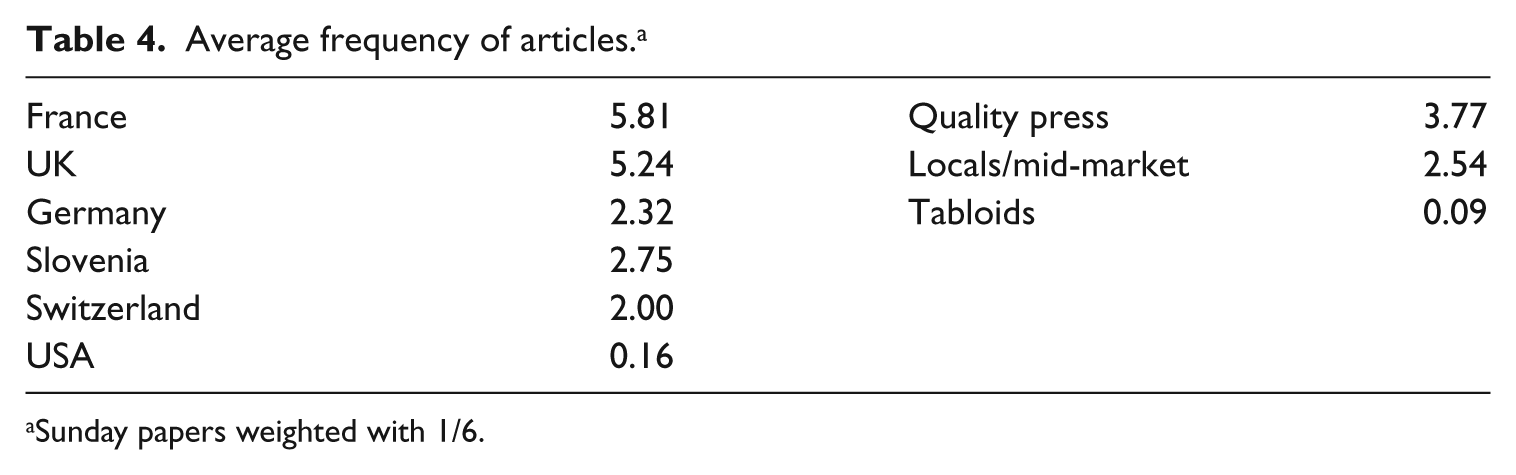
Sunday papers weighted with 1/6.
Party politicians were the dominant actors in all of the public spheres surveyed. This should give cause for reflection before allocating countries to separate types of public sphere as they all resemble the idea of a liberal public sphere where there is a staged conflict between competing elites before citizens who are essentially spectators of the debate. Given the dominance of elite political actors and the importance of elite dissensus for generating greater intensity of debate, we may conclude that all of the public spheres surveyed fit best with a liberal elite model of the public sphere at least for this sample and when using this criterion (although we suspect that this holds generally).
While there are international differences in terms of debate intensity, these pale in comparison to the intra-national differences. While the quality papers and regional as well as mid-market papers are not too far apart from each other, the index figure for the five German and British tabloids, which have a circulation roughly double 6 that of the respective broadsheet market, produce an intensity index of 0.09, not even half the figure for the US papers, which trail the British papers by about 20 times. Bourgeois public spheres very clearly have more in common in terms of intensity of debate with each other than with ‘their’ co-national working-class public sphere. This indicates the existence of different public spheres and different habituses for the bourgeoisie and working class (Bourdieu, 1979).
Political parallelism and external pluralism
Taking only those papers that had at minimum 50 articles in the sample to avoid irregularities that might arise from random errors, Table 5 shows that our index mirrors, with the exception of Sud Ouest and Berliner Zeitung, the hypothesized political leaning extraordinarily well (confirming what we already know but also suggesting that this measurement at least is robust). The advocacy papers line up on the two ends of the spectrum, even though the diversity might not be as strong as some might have expected, as Financial Times and tageszeitung (taz) are a mere standard deviation away from each other (p < .001). When coding the predicted paper’s standpoint on a ordinal scale from 1 to 14, with 1 being the socialist partisan papers and 14 the conservative partisan papers, both Pearson’s r = .08 and Kendall’s τ b = .16 show significant (p < .001) positive correlations.
Left–right position of papers according to actors cited.
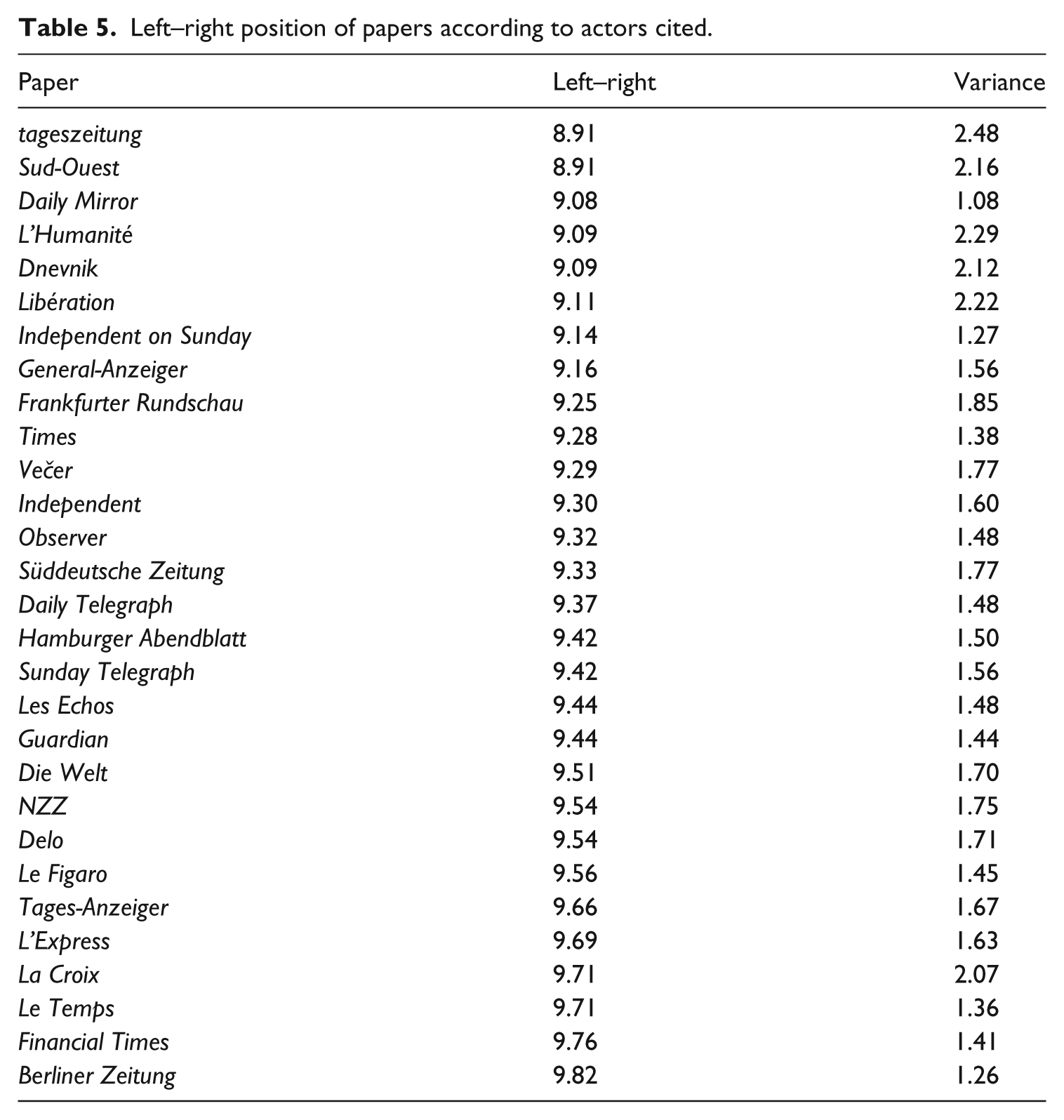
We also get a glimpse of the diversity of opinions presented in the different countries. While the German and French papers are spread throughout the entire spectrum, the British papers, with the exception of the Daily Mirror, cluster around the centre. The Slovenian dailies cover a wide range of territory, which would have been even greater, had we not excluded Finance (with an index value of 9.82) because it had too few articles to be included in our sample. Finally, the Swiss papers show a remarkably uniform right-wing bias, all scoring at the right of the political spectrum.
Inclusiveness
Most democratic theories consider inclusiveness of citizenry participation to be an integral element for the functioning of democracy. Inclusiveness can be meant in two ways: actual participation of the citizens or inclusion of as many viewpoints as possible in the debate. As we have seen there are very few voices of representatives of peripheral publics (for example, non-governmental organizations) in our sample. From these data we could conclude that each public sphere is equally exclusive. An alternative, complementary way of assessing the degree of inclusiveness is to measure the extent to which different ideological positions are present. The UK with its majoritarian system and its corresponding liberal conception of the public sphere does display a more limited degree of inclusiveness according to this measure. Two sides of the argument may be represented in the ‘quality’ press but the distance between the sides is comparatively small. It is not the corporatist countries that have the politically widest coverage of the Constitution issue, but ‘republican’ France – a result that may challenge the idea that deliberative public spheres are best.
Table 6 displays the mean value of the inclusiveness index as it has been computed in (3), which we consider the most adequate measurement for inclusiveness. However, the results using the three remaining indices (and by implication any other potential indices that would lie in the function space between (1) and (4) resulted in substantively the same results, all of which having F-values for the analysis of variance that are below p < .0001).
Internal pluralism index by country and newspaper type.
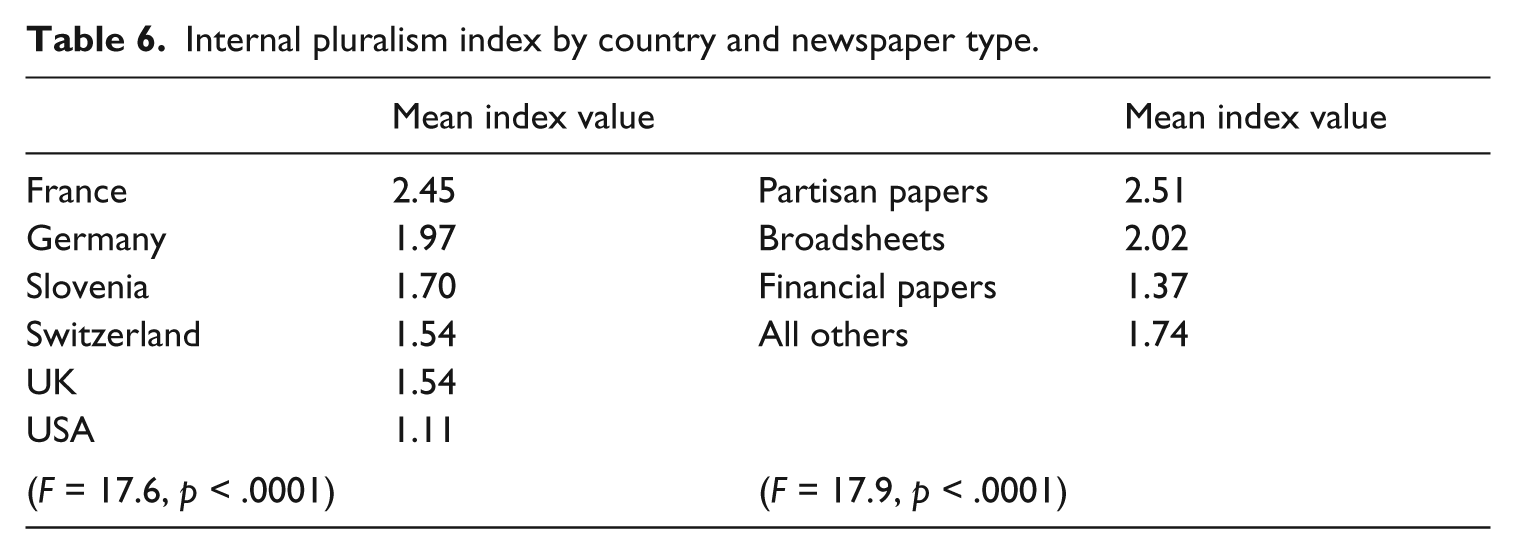
The relative exclusivity of the UK could, especially when taken in conjunction with the fact that the US displayed similar levels of exclusivity, be read as a structural feature of the debate in countries with majoritarian party systems.
Given the widespread assumption that national public spheres exist we were surprised to find that intra-national differences are larger than those across countries. When considered separately, the British tabloids achieve an index value of only 0.9. The financial papers across nation-states were also predominantly single-sourced. It seems reasonable to conclude that different class-based public spheres are a more accurate description of actually existing public spheres than a single national public sphere.
Polarization
The same pattern also emerges with respect to the polarization of the discourse. We take polarization as a proxy for both the civility as well as the degree to which Hallin and Mancini’s (2004) idea of polarized pluralism is implemented in the different media systems. This time, our data almost perfectly fit the expectations, with the debate in France being the most polarized and in the Anglo-Saxon countries the least polarized (see Table 7). Partly, this is of course an effect of the different print media configurations across the different countries: partisan papers, which are common-place only in France, maintain the most controversial debating style citing both sources from the political standpoint of the paper and those farthest away from them to emphasize the collective identity of its readership. Consequently, this type of paper demonstrates the strongest polarization index values. Tabloid papers are on the lower end of the polarization index, on the other hand. While having a clear political preference, they strive to report one of the mainstream views. Public spheres where this type of paper is prevalent, specifically Britain, consequently tend to favour a debate that focuses on centrist policy options only. Interestingly, not only partisan papers tend towards a more polarized debate, but also the financial broadsheets tend to give more voice to those at the fringes of the political spectrum. Together with their political positioning, this might indicate that these papers are indeed partisan, favouring neoliberal policies.
Measures of polarization of the debate.
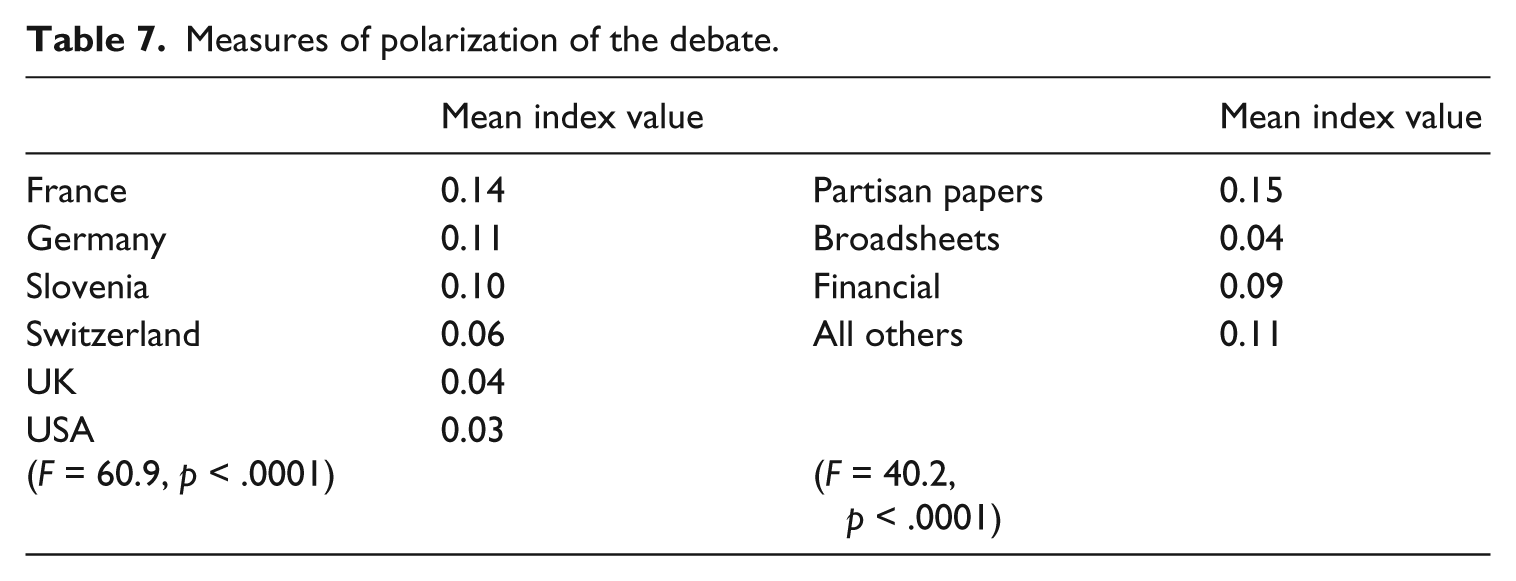
Usually at this point in the article readers are presented with a table comparing the results country by country. These results most often refer to data from only ‘quality’ newspapers in the respective states that are taken to represent national public spheres. Our research makes such a presentation problematic. While there are shared characteristics across quality, regional and popular titles within states (for example, referring predominantly to national actors) there are substantial differences (intensity, inclusiveness) that preclude us from speaking of national public spheres. Instead we can speak of nationally bounded (readership and reference to actors) class-based public spheres. We are convinced that had we looked at ethnic minority press, an even more complicated picture of multiple publics would have emerged.
While it is relatively easy to compare bourgeois public spheres across Europe through reference primarily to similar types of newspapers, this task is far more difficult for working-class public spheres because of the contrasting histories and present-day circumstances of the popular press across countries. As Hallin and Mancini point out, countries with high illiteracy rates in the 18th and 19th centuries did not develop a popular press and it is largely television that presently caters for popular taste in these countries. If we wish to compare working-class public spheres therefore we need to go beyond newspapers and consider television. While this poses more problems in terms of data collection than newspapers, the methods that we have developed here could easily be applied to, for example, television news. (They could also be used to compare the output of public service and commercial television stations.)
Conclusion
In this article we have sought to offer an alternative to Hallin and Mancini’s comparative analysis, based on a more comprehensive understanding of public sphere theory than that conventionally offered. Following the work of Ferree et al., we identify different and competing philosophical and historical trajectories of public spheres. We also offer a variety of ways to test this theoretical understanding through developing ways to measure the characters of public spheres. In principle, public sphere theories and the methods of measurement outlined here can be applied across time and space, across the range of subjects of public debate and across media. No doubt there will be disagreements about what should be measured, which measurements to use, and how they should be operationalized. We would be happy to provoke such methodological discussion as it would in itself signal the growing maturity of comparative media as a field of analysis.
Our survey of a broader cross-section of newspapers than is commonly offered revealed the existence of profound class differences within national boundaries. To speak of homogeneous national public spheres, therefore, is wrong. There are rather class-based more or less nationally bounded public spheres. Bourgeois public spheres resemble each other more closely than their working-class co-national public spheres. In addition, although there are differences between countries, we were struck by the similarities, in particular the central importance of national party political elites as actors and the importance of national elite dissensus as a progenitor of media debate. While the French and German bourgeois public spheres may be more pluralistic and inclusive than in the UK, they also share characteristics of a liberal elite public sphere. The results highlight the gap between republican and deliberative normative conceptions of the public sphere and actually existing public spheres that are dominated by political elites. This, in turn, highlights the importance of specifying more precisely what it is that we refer to when we use the concept of public sphere to denote an actually existing state of affairs.
Footnotes
Funding
This research received no specific grant from any funding agency in the public, commercial or not-for-profit sectors.