



Abstract
Audience aesthetics and responses to popular culture genres which were once considered low brow have now long occupied the interests of the academy. This is a point to be taken seriously especially within children’s literature circles, where reading and reception is often generalised about under the theoretical umbrella of ‘the reader’ and ‘the spectator’ who is ‘drawn’ into a range of largely unproven pathways by the text. This article explores youthful perceptions of real-life, close relationships, the projection of these relationships onto those seen in the media text and the resulting mediation of relationship ideals, desires and wishes. Analysing data from fieldwork with teen audiences of the Harry Potter series, this article argues that there is more to the mediation of relationships than the undoubtedly rich discussions of the media bringing people together at the moment of reception/use, whether online or offline. The findings presented in the article reveal the intricate and often perplexing ways in which children continue to introspect long after the act of reception, drawing parallels between relationships in their own lives and those they read about or view. The article draws attention to the introspective depth with which children use screen/text relationships as raw material to ponder emotional questions, ones, for instance, on love, hate, detachment, attachment and friendship, and the many ways the media mediate real-life relationships not by setting unreachable ideals to emulate but by offering interpretive pathways.
Introduction
In this article, I pay attention to introspective themes in children’s discussions of close relationships as they talk about the Harry Potter series. I ask in what ways the relationships portrayed in the series offer interpretive pathways for children to project their own relationships onto the text and explore their introspections about the nature of personal, intimate relationships. Two related questions guide this enquiry. First, I ask if children read elements out of fantasy that have very little to do with demons and goblins but more to do with the everyday. And second, as a way of framing this more specifically, I focus on their talk about relationships, asking how they use textual relationships and personal relationships to feed into each other.
Audience aesthetics and responses to popular culture genres which were once considered low brow, have now, for a long time, occupied the interests of the academy. Media scholars have rescued the image of fans from being cultural dopes to active and critical viewers, whose ‘active sensibility’ (Grossberg, 1992) is of conceptual and empirical significance. The ‘interpretive acrobatics’ of readers and texts, grasped in Jenkins’s early work on fandom (1992), continued through later work in the field – consider Baym’s work with the soap fan community (Baym, 2000), Hills (2002, 2005), Sandvoss (2005), or Jenkins (2006) where he traces fandom through the world of the online. And, as Hills notes, there has perhaps been, or needs to be, a shift in focus from whether fandom is good or bad, towards, instead, a productive account of the cultural meanings of fandom (Hills, 2002). There must be an ongoing exploration of pleasure and resistance in what Bennett very aptly terms a ‘temporary interpretive community’ (Bennett, 2011) whose interpretive work however is far more persistent and far less transitory than work done at the moment of reception (see Hills [2005] on the ‘aleatory object’). So, today the starting point does not have to be an attempt to rescue the image of the popular culture enthusiast, for there are shoulders to stand on.
As Neumann (2006) correctly points out in his discussion of the Harry Potter phenomenon in popular culture, academics have a responsibility to analyse why something becomes a phenomenon and why it makes sense. Similar in some ways perhaps to the 1980s and 1990s revival of interest in the reading of soap operas and romance genres, which led to findings along the lines of identity politics and resistance, responses to other genres, for instance fantasy, including fantasy that appeals to adults as well as children, have now started being addressed by media scholars (for an excellent overview of this see Barker [2009] where he summarises the range of discourses surrounding fantasy from everyday talk to academic theorisations). As far as children are concerned, there has been an interest in real children’s real responses to genres meant for them, especially relevant in the wider context of research with children’s responses to media (note for instance David Buckingham’s history of work from children’s responses to EastEnders [Buckingham, 1987, 2008]). This is a point to be taken seriously especially within children’s literature circles where reading and reception is often widely generalised under the theoretical umbrella of ‘the reader’ and ‘the spectator’ who is ‘drawn’ into a range of largely unproven pathways by the text.
This has started being rectified. Note the attempt in recent years by Martin Barker’s multi-country team of researchers who identified a range of ‘semantic patterns’ in audience responses to Lord of the Rings (see Barker and Mathijs, 2008). Note too Henry Jenkins’s work with fans, both in his early work (1992) or more recently (2006), where he explores why fantasy, vampire fiction and so on mean what they do. Another is Davies’s (2004) exploration of children seeking verisimilitude in media representations when he researched their responses to Mr Gumpy. Responses to Buffy the Vampire Slayer are another case in point (see findings from Bloustien’s [2002] ethnography). It is in this context that I locate my attempt to understand children’s responses to Harry Potter, an undeniable cultural phenomenon which has, until recently, at least within media studies been little researched empirically.
The New York Times called the Potter series ‘near mythology’. 1 A 17-year-old told me in the course of fieldwork – ‘In a century or two centuries, it will be the new Odyssey.’ A handbook on myths is titled From Homer to Harry Potter (Dickerson and O’Hara, 2007). Hundreds of thousands of children and adults queued up for book releases, events, camps and film premieres, collected memorabilia, joined forums, created videos, wrote fan-fiction, dressed up as characters, listened with bated breath to JK Rowling’s book reading sessions, dozed off to sleep with Stephen Fry’s voice on audio-book tapes. The Potter phenomenon became an important and perhaps even shaping experience in the lives of countless around the world. Some grew up with the books, some came of age as the actors in the films came of age, some found a ready world to enter adolescence with, some knew the Lego sets and the memorabilia handed down from older siblings much before they ever read the first book. Harry Potter – the orphan hero; Voldemort – evil incarnate; Dumbledore – the ideal mentor; Ron and Hermione – wonderful friends; Hogwarts – the perfect boarding school; and countless characters and relationships drawn out of the everyday lives of ordinary people merged into a world of flight, fantasy and adventure.
The Potter phenomenon and the (missing?) empirical pursuit of interpretation
Magic, wand-waving and the world of goblins are but one part of the Potter text. The text presents an array of interpersonal rapports, all of which seem to go through realistic and credible highs and lows, there is the coming together and parting of ways, estrangement and union, many a time. Friendship is a common theme, especially that between the lead trio of Harry (the orphan, gifted hero), Ron (the ‘sidekick’ of a loyal friend) and Hermione (the brilliant lead female character). A powerfully depicted mentoring relationship between Harry and Dumbledore, the wise, magnanimous, sage-like teacher, a long history of suffering due to unreciprocated love in an otherwise dark character – Snape – this history revealed only at the very end, and various other relationships of love and trust feature throughout the series and indeed return time and again in the conversations I had with these children.
With a few exceptions (see, for example, Schmid and Klimmt, 2011), much of the discussion about the Potter phenomenon has followed textual analysis of gender roles, motifs and representations. A selection of essays on the Potter series (Anatol, 2003b) for example brings together reflections on textual themes. Historical backdrops to the series (see Carey, 2003) and explorations of political themes around class, race, gender and ethnicity (see Anatol, 2003a; Gallardo and Jason-Smith, 2003; Ostry, 2003) provide rich analyses of the content of the texts. Within education studies, the texts have been used and discussed as a teaching device in the classroom situation (see Butler [2003] for an engaging account) and there are discussions of using the Potter series for educational purposes. So, for instance, ‘teachers, counsellors, and parents can use Harry Potter and the Sorcerer’s Stone as a springboard into discussion of identity issues with adolescents, helping them to understand and successfully negotiate the challenges of this phase of life’ (Frank, 2003; see also Gibson, 2007 for a similar usage; also see Perry, 2003). The philosophy of the series has been addressed likewise (see Baggett and Klein, 2004) where courage (Morris, 2004), friendship (Thorsrud, 2004) and discrimination (Patterson, 2004) among other issues have been analysed.
The richness of this material – albeit sourced from literature, philosophy, religious studies and most notably perhaps, education studies – draws a marked line under the fact that audience interpretations of all this have been strikingly underresearched academically, not only in these fields concerned (although note Borah, 2002; Whitney, 2005), but also within media studies, though Henry Jenkins provides a much-needed and engaging analysis of encounters with various pop culture phenomena including Potter fans (2006; see also his recent reflections on Pottermore, the social network for Potter fans [Jenkins, 2011]). It remains intriguing as to why the empirical pursuit of all this has not drawn as much attention as the textual material itself. Perhaps there is, as Bennett (2002) notes, a danger of rejecting accounts of reading to foreground theoretically inflected, and doubtless, rich, textual analyses. Note Kidd (2007) where the desired empirical nature of our investigation is unstated but clearly evident:
Formal conversations, organized by bookstores and libraries, and informal conversations at the cafeteria table are likely to be filled with Potter-mania. In these conversations, readers work together to produce the meaning of the novels. They become an ‘interpretive community,’ just as the readers of romance novels form an interpretive community in Janice Radway’s study ‘Interpretive Communities and Variable Literacies’. (Kidd, 2007: 84)
Such indications of the empirical nature of all this are present in a lot of academic writing. Indeed, spectators and audiences are the most easily generalised, assumed and implied within research that is unwilling to actually speak to real spectators. We have learnt by now of the philosophical underpinnings of Rowling’s motifs – the narrative of hope (see Griesinger, 2002), the mirror of Erised, the unforgivable curses, the magic of love, the forbidden forest, the great lake, the motif of the basilisk (see McCarron, 2006), the concept of the Horcrux where a soul is divided as an act of dark magic. But empirical investigations of reception can prove equally fascinating – see for instance Black’s account of Carry, a depressed student for whom ‘the shifting corridors and miraculous dining rooms of Hogwarts are good places to begin the healing process’ (Black, 2003). See also Burn’s exciting account of ‘Potterliteracy’ in schoolrooms (Burn, 2004). But these remain rare, rather than plentiful, and perhaps they link with a larger problem – that of the ‘status’ of these works, especially within literature, and what counts as ‘real literature’, as Barker draws attention to in his review of discourses about fantasy:
Apart from the lack of interest in actual audiences, there is a persistent will to separate ‘the fantastic’ (approved) from ‘Fantasy’ (dismissable). Partly, surely, because of the embattled status of the study of fantasy within traditionally conservative literature departments, there has been a need to circumscribe a domain of worthy writing. (Barker, 2009: 292)
Interpretive pathways and thoughtful readers
The findings presented in this article reveal the often perplexing ways in which children continue to introspect long after the act of reception, drawing parallels between relationships in their own lives and those they read about or view. Of particular use, I find, is a concept from literary reception theory – Wolfgang Iser’s (1978) notion of filling gaps (Leerstellen) in the text – used sometimes within audience reception studies empirically, but conceptualised largely as a theoretical tool. While the broader concept of gap-filling refers to any space in the text left for the user to fill up, it also brings us closer to the complexities in the text, which in order to be made sense of must have these gaps ‘filled’ by the reader. Iser associates gaps in the text with indeterminacy, where the text leaves purposes uncertain, and meanings unclear. The task in interpretation is to bring one’s repertoire to the interface and to bring indeterminacy down to one’s range of personal experiences and resolve the problem by making it mean something at the individual level. These tools, notwithstanding criticisms of being purely theoretical tools developed in non-empirical settings such as a department of literature, provide us very fine-tuned entries into the act of reading – the specific focus of this article. This ‘micro perspective’, as Sandvoss (2005) terms some of these Iserian concepts, is useful to explore the interplay of textual and extra-textual relationships in teen introspections about emotions. The gap-filling theory then asks, what do they do in approaching the text with such a repertoire? In reading, these resources are activated to fill ‘gaps’ (opportunities as well as inconsistencies) in the text. This helps us look at interpretation holistically – from resources to processes. In using these concepts to make sense of children’s contemplations about relationships I do not intend to provide a repetitive account of endless interpretive diversity, or even, a selection of the most fascinating anecdotes. Rather, I seek to bring together themes where children’s talk about relationships has been mediated by relationships in the text.
Methodology
Fieldwork for this project consisted of hour-long interviews with 20 children in families spread across 13 boroughs in Greater London. I had the opportunity also of interacting with their families and engaging with at least one parent in most cases. The families belonged to a range of socioeconomic categories (as reflected in Table 1) and came from urban, suburban as well as rural locations. The children, aged between 11 and 18, were interviewed by me, at their homes, usually in their bedrooms, and in a few cases in their living rooms, with a parent present or drifting in and out. Most children were white but a few came from black or mixed ethnicities and some snowballing happened in participant selection, although this was the exception rather than the norm. All identified as being ardent readers of the Potter books and viewers of the films and many identified as game players (board, card and interactive) and fan fiction writers. The column for parent’s occupation in Table 1 refers to the occupation of the lead earner in the household. 2
Profile of participants.
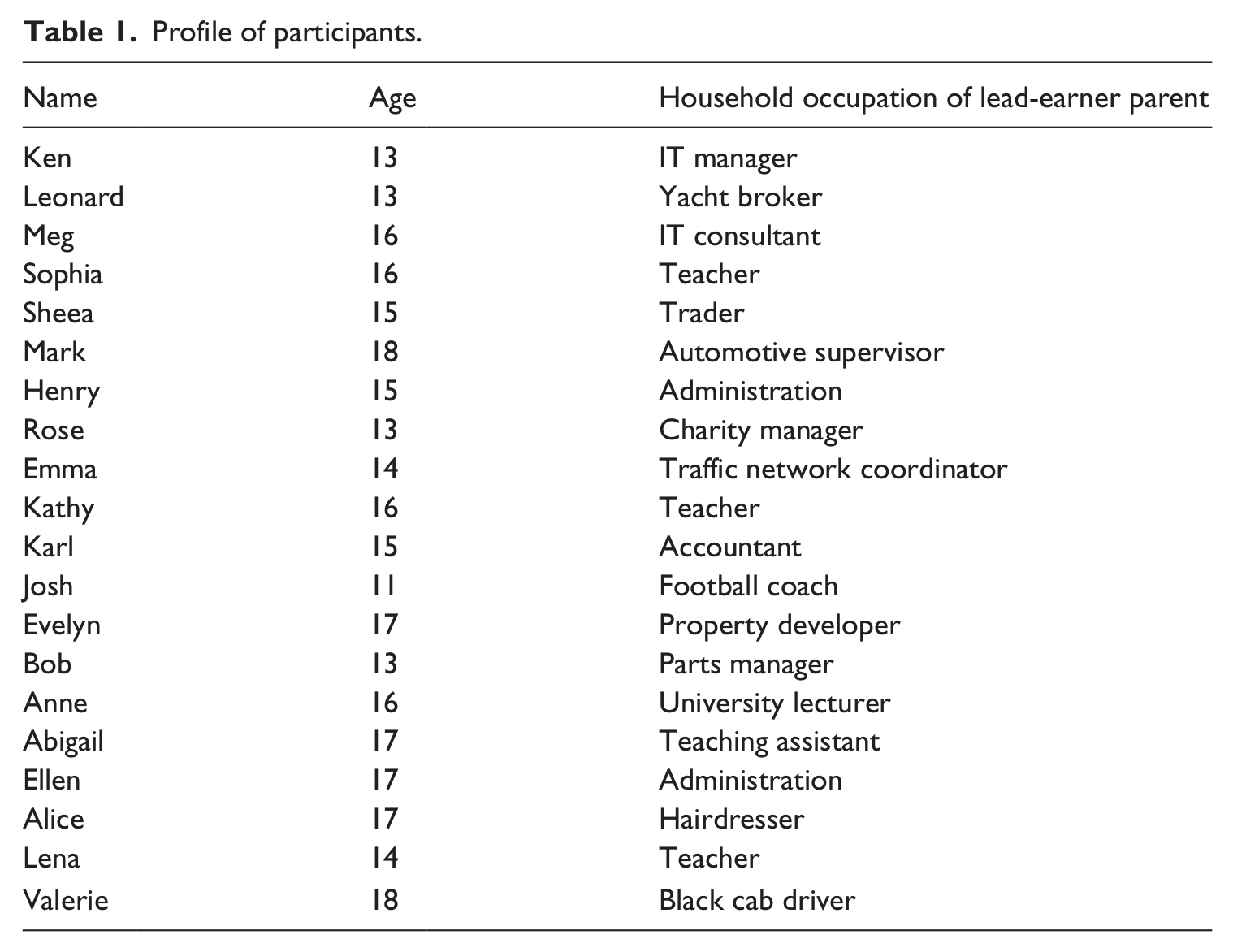
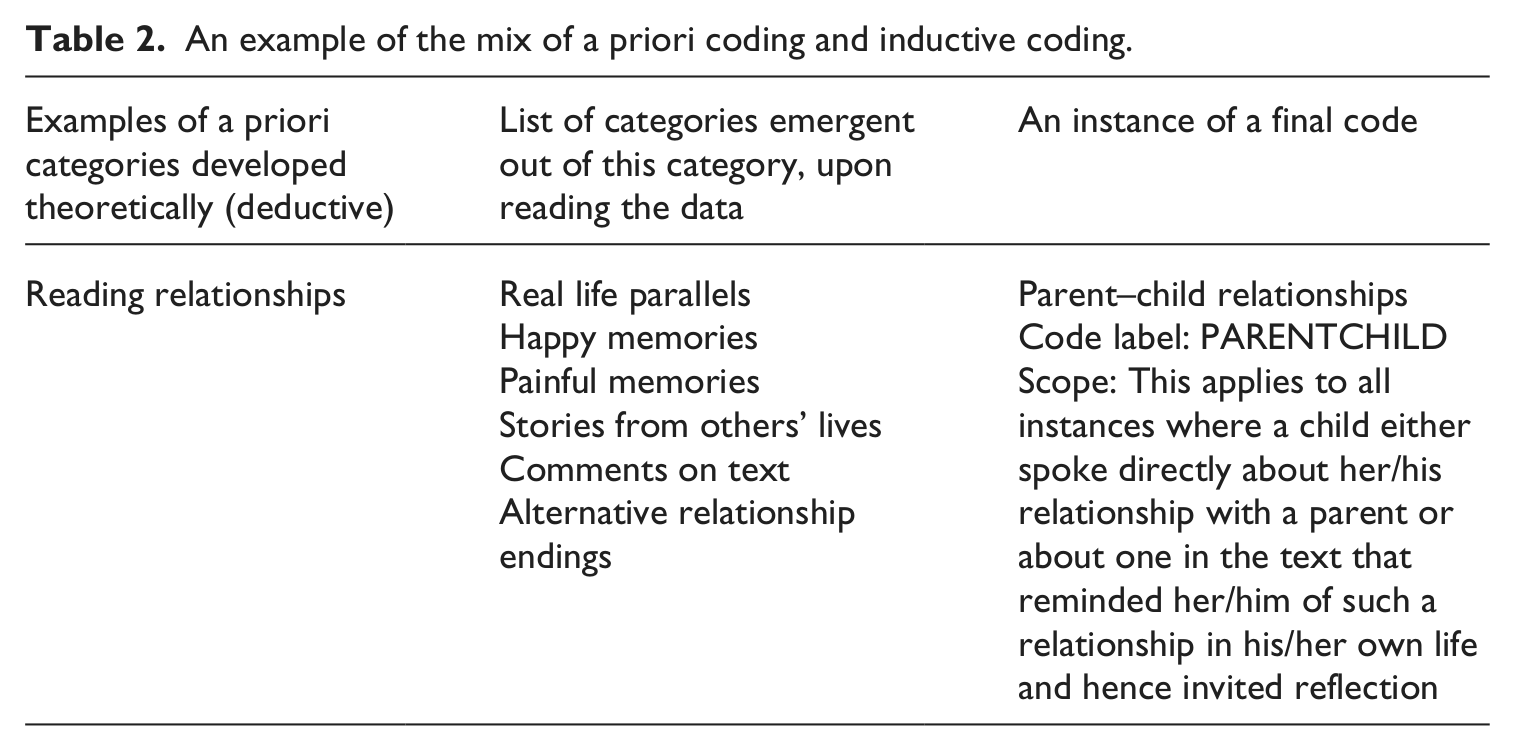
The interview schedule was built around three ‘sensitizing concepts’ (Blumler, 1954): (1) (the mediation of) real-world relationships, (2) empathy and compassion and (3) the interaction of realism and fantasy in reading. The interviews were semi-structured, with children showing me games, artwork, videos they had created and contributing to rich, free conversations. For analysis, the interviews were transcribed, combined with field notes and coded with the Atlas TI software. A combination of a priori coding (with a preset theoretical orientation) and emergent coding (more emergent from the data per se) using the ‘in between’ models of Lofland (1971) and Bogdan and Biklen (1992) as outlined in Miles and Huberman (1994) was used to assist in coding (see example in Table 2). The three priorities which sustained the interview guide were again used to assist coding as they provided the best framework to make sense of the data.
An example of the mix of a priori coding and inductive coding.
Seeking real-life parallels
Iser (1993) maintains that the more texts lose their determinacy, the more the reader is pushed into the range of possible interpretations they can make. Gaps that are opened up with increasing indeterminacy permit the reader to build their own bridges and make their own connections. In this section, I set this ‘bridge-building’ in an empirical context – with what are these bridges built? I look at how children often made segues from talking about relationships in the text to ones in their lives, not only ones they are a part of, but also ones they observe. These ‘real’ relationships provide bridge-building material – friendships and intimate relationships (of self and others) inform their interpretations of ones in the text in a range of ways. In discussing someone she knows who she says is ‘like Dumbledore’, Abigail tells me:
My mum, definitely my mum. Like, she, um, she pushes me as if to say, um, pushes me to work hard but when I get knocked down because I don’t get the grade or I don’t want to, she doesn’t put me down. She always says, well, they just happen, now it’s time to move on. And it’s just like Dumbledore; she guides me. She doesn’t mollycoddle me, as if to like baby me, whatever, but she gives me like comfort but enough to be free as well, like, yeah, which is my mum. … she wants me to go out and explore the world, where I might be in my room [Abigail tells me later she feels shy and often withdraws] but she definitely, like she encourages me to go out and try, explore new things.
For 17-year-old Abigail, who is being raised by a single mum in a crowded housing estate, her real-life relationship with her mother flows into her perception of Harry’s relationship with his mentor. For, like Dumbledore and Harry’s relationship, she spots in her rapport with her mother, the same elements of encouragement, kindness and confidence in abilities that Abigail herself initially had little faith in. It’s similar to Valerie’s (18) parallel with her grandparents:
And it’s like kind of, I like … you know he always helps Harry with some kind of story or something in his past, that’s how my grandparents … they have like, they can always relate something that’s happened to me to something that’s happened to them and then just, you know, they just know.
The interpretive pathway of the same Dumbledore–Harry relationship is pursued differently by Emma, age 14:
Dumbledore and Harry. I wasn’t as obsessed as I am now. But I just used to sit there at the front and I wouldn’t … like someone would try and talk to me, but I would just watch him like, yes, yes, I know exactly what to do. And I’m like I’ve got this … well, for the first few weeks, whenever I had an English lesson, I’d think about him and be like, oh, I want Mr Smith to be back. And sometimes I was at the front and he’d always sit like that and I was doing that [a pose of the arms] and I was like, Mr Smith used to do this [that particular arm pose].
Emma’s parallel is not with a nurturing, enabling, resourcing elder but with a young English teacher she admires in a way almost akin to a fan admiring a celebrity, or even close to attraction. Indeed, she describes herself as (previously) ‘obsessed’ and that her friend called her a ‘freak’. Unlike Abigail, for 14-year-old Emma, her admiration of her English teacher (an emergent crush?) which blurs boundaries between adulation, romantic inclinations and sometimes even a child-like respect for an adult is another, entirely different parallel to the mentor–mentee relationship between Harry and Dumbledore. Note, though, that the parallels are different, for the horizons from which they approach the text are different and the utility of observing this does not lie in the appeal of endless, rich, qualitative anecdotes, but in seeing how a textual pathway mediates one’s real, lived relationships:
Dumbledore and Harry … You know? It’s that, kind of … it’s that, um, it’s that depth again. She’s made them very three dimensional. Um. I think I always felt very estranged from … estranged from my own father for quite a while. Um, so that kind of … that searching for someone to look up to … um, was an important part of my life.
Evelyn’s parallel to the same mentor–mentee relationship, as strong as the parallel is, derives from a non-existing real-life relationship – an aspired one, wistfully longed for. In her words, the Harry–Dumbledore relationship represents for her a search for someone. And in her case, this ‘someone’ is an absent father.
The Potter series features a dark character, Snape, known for his visible animosity towards the hero – Harry. It is only towards the end, on Snape’s death, that it is revealed that Snape felt unreciprocated love for Harry’s mother, which leads him actually to protect Harry all these years, while using evident (false) dislike to convince the villain’s camp that he despises Harry.
I think it’s wonderful, because I think there are people like that, like sort of like, like I sort of know people that are a lot older than me and they sort of like fell like in love with someone like when they were younger and then just carried on like not being able to be happy with anyone and then, for example, um, my uncle, I always have like this little like hunch that he fell in love with his current girlfriend when he was like in high school. And he’s like 45 now I think. But he’s never been with her and like never really … I’ve never really seen him with a woman before. But now they’re together and really happy.
Bridges needed to fill textual gaps, as Iser calls them, do not always emerge from one’s own relationships, but from one’s understanding of the relationships others participate in, accumulated over the years of growing up from childhood to the end of adolescence. So in 17-year-old Alice’s reaction above to this ‘twist’ in the tale, she focuses on the pain of unreciprocated emotions but parallels this with a story with a happy ending; she uses a story of pain to make sense of a relationship of pain that ends in happiness and is optimistic about things such as these.
What happened with Snape and Lily … actually one of my really close friends, um, she never liked this guy, just was a friend, that was it. But since like we were 11 this guy loved her, like it [was] completely his life. … She didn’t even know. And then he changed schools in Year 11, and he never once told her because he was just like this really shy, really quiet guy.
The relationship which provides a positive talking point for Alice and a positive association with a happy, real-life relationship, is in fact, a story of pain in the text. The same textual relationship reminds Valerie of a similar relationship she observed at close quarters in secondary school, which did not, at least, not yet, have a picture-perfect ending, as Alice’s had.
These memories from the recent and distant past, of relationships they have seen gone wrong, or have participated in their going wrong, come up in reference to an unrequited attachment in the text. These parallel relationships, mirroring (inexactly and diversely) the same sets of relationships in the text, take us close to the question of where interpretive authority lies in making meaning. As Fish reminds us in reference to Iser’s work:
What is the source of interpretative authority, the text or the reader – Iser answers ‘both.’ He does not, however, conceive of the relationship between them as a partnership in which each brings a portion of the meaning which is then added to the portion brought by the other; for in his theory meaning is something neither of them has (it is not an embodied object); rather it is something that is produced or built up or assembled by a process of interaction in which the two parties play quite different, but interdependent, roles. (Fish, 1981: 1)
Leonard, a quiet and thoughtful 13-year-old living just outside London, ‘adds’ (as above) to the relationship between Harry, Ron and Hermione in his account of a situation where there was choice between embracing danger or abandoning a friend:
You know when, like, Harry’s going to go find out where the Horcrux is, and he told them [his friends], don’t come with me. It, it’s dangerous. They still go with him. And, like, that’s the same, like, um, when one of my friends hurt themselves on their bike, people were, like, all with him all the time. Like, he fell off his bike head first, and, like, he got, like, a stick in his, like, right …
Oh my gosh.
Um, and we were with him the whole time. And, like, so, we, like, we never really, um, until someone, like, like, someone who could actually help, like, um, we were with him the whole time, so we were, like, comforting him, saying it’s, oh, it’s going to be all right. Um, and, like, he was a bit squeamish, so, like, one of us I think took, like, a bit of, um, like, they had, like, a jacket, and they, like, cut a bit out to stop it bleeding and everything, so …
Leonard finds strong parallels for this friendship in his own life and what happens in the world of fear and flight amid magical hexes and curses, actually finding meaning in ways far more ‘real’ than magical hexes and curses. Even if these spaces for interpretive work are not quite ‘gaps’ in the text, as Iser (1978) meant them, they require extension and filling for they are pathways that one can walk on in different ways, and less banally perhaps, they are pathways that mediate children’s understanding of their social worlds.
Reading emotions
In reading emotions, children’s creative work (filling gaps) is resourced and indeed even shaped by textual boundaries – genre boundaries and genre knowledge for example. But in so doing, the very boundaries of the text are limitlessly extended in interpretation. Valerie, 18, indicates that the Potter narrative is about more than witches flying on broomsticks. She says ‘the kind of the thing that makes it separate from other stories and other books and other films and things is yeah like the magic and the fantasy and how … it is different to a lot of kind of fiction. But once you get past that the thing that makes people stick with [it] I think it is the relationships.’ What follow below are accounts of contemplation often removed from direct textual references, and months after the series ended:
I think they’re really lovely. It’s like, friendship for how long? Ten years, right? So they’ve been friends … It’s kind of a beautiful thing to have so, especially as they’ve had friendships inside the films and outside of it as well. I’m sure I see them in magazines like with each other. I think it’s cool …
Sometimes there is a longing for bonds of the kind shown in the text, for instance when Abigail speaks of friendships. She has previously told me how important her friends are to her, but has also spoken of the transient and fragile nature of some of these important rapports. Following her accounts of dear friendships she lost and the pain that caused her, she speaks of the Potter friendships as relationships she would only see in magazines. In Iser’s words, this final product – the made meaning – constitutes the ‘work’, quite different from the ‘text’, for the work represents a multiplicity of connections which are absent in the text but are formed in reading. 3
Draco. You know? It’s, it’s that brother, it’s that sibling you’ve always wanted to help, and Draco isn’t a bad person; he’s just … It’s his socialisation, his primary and secondary socialisation has taught him to be, um … has given him these qualities.
Evelyn’s thoughts on friendship are mixed with sibling feelings. She considers the intense and long-term enmity between Harry and his arch adversary Draco Malfoy. The text never shows much sympathy for Draco’s character as such. But Evelyn, who longs for a bond with her estranged father, looks up to her mother, is looking after a disabled grandfather alongside her own long-term illness, reads into this enmity a potential for a filial feeling. She tells me how she is studying psychology and literature to help her understand human lives which will inform her first novel. It is this which resources her language of ‘socialisation’ when she speaks of Draco.
I think Rowling doesn’t write about human love, I think she writes about some love on a different level … I mean, the fact no relationships last these days, most parents don’t stay together. I think she has an ideal in her mind of sort of endless love that her characters fulfil, and maybe she thinks people can feel it in the role, or maybe she doesn’t. But I think she writes about it how if someone’s in love with someone they will not stop being in love with them … I think that’s what J.K. Rowling writes about, you know, that sort of unattached views. You know, I think in her books everyone finds their soul mate.
Ellen, age 17, takes Evelyn’s focus on optimistically unearthing something deeper in difficult relationships, or Abigail’s faith in something eternal in otherwise transient relationships to a musing on love on ‘a different level’. She has spoken to me, previously, of the challenges of loving competitive siblings, the challenges of loving someone with a major disability and of loving people who one has left behind or has had difficulties with.
I don’t know too much about her [Rowling’s] life, but she had a husband and they had a child, and he left her, and she was left alone with this child. But she has never ever wrote about him in a horrible way. She’s barely wrote about him himself, but she’s never wrote about him in a horrible way, she’s only ever put, you know, put the things online, she said I was in love with him, and we had a great time together, and he left.
Ellen’s words speak of a mix of disbelief in or admiration and longing for undying, eternal love, even despite what she notices in real life, ‘the fact no relationships last these days, most parents don’t stay together’. And thoughtfully, she grounds her faith in the author’s own life when she draws attention to how Rowling has apparently spoken highly of a former partner who she might have chosen to disparage.
Sophia, age 16, who is preparing to be a professional actor, tells me that the ‘drama’ of the text comes from love. She says ‘It’s about love. There is a lot of love in the book.’ Evelyn echoes these feelings, when, remaining true to her literary, poetic self, she reminds me ‘magic isn’t so alien to any of us. You know, the greatest magic that all of us know is love … And that’s a spell that all of us can cast on another person … and that all of us get cast upon [us], you know …’
And I think the whole point is, the reason why there’s no spell that can, um, make someone fall in love truly, is because that’s a power that belongs to everyone. That’s a magic that belongs to everyone, muggles 4 alike. And obviously that’s one of the reasons why Voldemort [the dark villain eventually defeated by Harry] is incapable of love, is because he was created through a love potion, which is fake love.
Strikingly, Evelyn makes use of one of the Potter text’s ‘magic’ moments – a love potion (the magical power of which creates temporary infatuation) – to make a point about the eternal, non-transient and pure nature that she perceives ‘real’ love has (in contrast to ‘fake’ love). For, in even the simplest story, Iser reminds us, there are unavoidable omissions, twists and turns, and thus, ‘whenever the flow in interrupted [in the text] and we are led off in unexpected directions, the opportunity is given to us to bring into play our own faculty for establishing connections – for filling in the gaps left by the text itself’ (Iser, 1978: 280).
Let me persist with the example of Evelyn for a while. She is writing a book, the subject of which she cannot divulge, she says. She is studying literature and comes across as an expressive, emotive and sensitive person who wells up with tears when she speaks of touching moments in the text, who works hard in reading into negative characters and problematic relationships, filling in their backdrops with events and relationships from her own life.
Snape you know, he, he … his intensity, his depression, his melancholy. They’re all things that I think anyone of any, any age can relate to. It is understandable. Um, even his, you know, his, his love and, and his hate. It’s so deep. You’ve got Harry’s love and you’ve got Harry’s mother’s love, which is understandable. You’ve got Voldemort’s hate … which is understandable. But Snape’s emotions just seem to travel so much deeper … especially that scene that they, they added, you know, when he’s rocking Lily’s body in his arms. Heart, heart-wrenching.
Notice above how she reads degrees of emotions in the text and puts them together to show the interweave of emotions that the text might have to offer, and notice how she understands both love and hate, with maturity, as she repeats after each, ‘it is understandable’.
Later, Valerie, age 18, speaks to me of the ‘lost child’. Previously Evelyn had spoken to me of an estranged father. And Alice had spoken of a Dad who was always away and unavailable and how Harry Potter DVD weekends with her Dad were treats she waited with bated breath for. Valerie sums these feelings up when she reads Harry as the ‘lost child’. She says:
And I think every child feels that. You know, they’ll be playing a football game or something, and they’ll look over to see if their parents are watching, and they’re too busy talking to another parent. And you’re, like, but I just scored a goal. Why weren’t you looking? There’s that, there’s that frustration to be number one in someone’s eyes.
Harry Potter and the mediation of relationships
While the Potter series has been enjoyed by both children and adults alike, and children who have since the publication of the first book grown into adults, it remains popular with children in ways which are quite distinct – the comfortable commuting between everyday life as teenagers and the (magical) everyday lives of these ‘other’ teenagers is one of the features for instance. For adult readers, this connects to remembering and nostalgia – an interesting and different question.
One might now ask what role, if any, does the fantastic nature of the series play with regard to the discussion presented in this article. Does it make a difference that children learn to fly on broomsticks in the series instead of learning how to drive? What emerged from my conversations was that the fantasy in Potter had struck that right mix between broomsticks and flying on the one hand and the regularities of non-magical lives on the other. The goblins and dragons built up an excitement that drove Leonard, for instance, to sketch magical mer-people and underwater creatures for his art class and yet reflect on the bike accident incident with his friends to think on how accessible the friendships in the text were. The fantasy in Potter is relatable precisely because it signposts itself with bright red London buses, references to Tottenham Court Road, Kings Cross or familiar-sounding pub names and it is dotted with the regularities of ‘normal’ life – prefects, head-girls, head-boys, school-days (see Steege [2002] for a comparison with Tom Brown’s School Days). And yet, this workaday, commonplace life has been tantalisingly placed just out of reach – platform 9¾ at Kings Cross will never be found, Diagon Alley will forever remain hidden and the Hogwarts School of Witchcraft and Wizardry will forever look like a run-down shack to non-magic people. Everyday life, as we know it, with its entangling and absorbing interpersonal equations and events – something used to the full in soap operas for instance – has now been shrouded in a layer of unreachable, enthralling fantasy.
Clearly, the children sought in the textual relationships inspirations for shaping and giving a parallel to real-life ones; all drew inspiration from their daily lives to read ‘into’ relationships portrayed in the text; all the quotes demonstrated the mediation of relationships. But this mediation of relationships in teenage lives is resourced differently depending not only on individual idiosyncrasies. The Potter text does not merely stun and allure with its wand-waving and magical gibberish. It triggers different, lived experiences in the domestic and social world where readers and audiences transform between being audiences and being estranged daughters, caring cousins, sensitive citizens who understand fellow human beings and their plights. The ‘talk’ produced by the mediation of relationships bears textures of all of these roles, one’s own performances in these roles and the perception of others in similar roles. The interpretive pathway of relationships in the text – fixed in the pages of the book or on moments on the screen – mediate children’s perceptions of relationships in which they participate.
The media have historically brought people together. Offline, at the moment of watching a programme together, parents and children have bonded. Indeed, in all my interviews, we began with accounts of mum or dad reading aloud a book at bedtime, as Henry, Sophia or Leonard recalled. In all the interviews there were moments of converging around the text – to discuss things over IMs (instant messaging), as Alice or Rose did, to dress up as characters as Kathy and Emma did or, like Sophia and Meg, to have Potter marathons where magical recipes would be hunted out online, food cooked and films watched back to back. In a recent report reviewing the role of the media within the European family, written for a consortium of family sociologists, we pointed out ways in which the media and the family interact (Livingstone and Das, 2010), almost all of which have to do with coming together around the media, and in all these cases, relationships are mediated.
In this article, however, I have shifted the focus from the moment of viewing to moments of contemplation and discovered the intricate interweave between real-life relationships and those in the text where the link between the two is not a simple or causal one. Relationships in the text don’t trigger relationship behaviour in real-life as such, but provide interpretive pathways which children fill (Iser, 1978) to make sense of their own relationships. These relationships, in varying degrees of intimacy, in turn, stimulate contemplation and discussion about wider emotional matters, within which the produced ‘text’ extends into ongoing semiosis, context and relevance.
I suggest that this article’s focus on children’s introspections about relationships in discussing the Potter series is useful for three reasons. First, at a broad level, it makes an empirical contribution to our knowledge of children’s reception of children’s literature – a theme often underexplored in media studies, and more so, in literature. In speaking from media and cultural studies to scholars of literature, this project challenges a taken-for-granted assumption in literature about the ‘boundedness’ of the text, for the text continues in reception, the boundaries of the produced text becoming merely ‘punctuations’ in a process of endless semiosis (Kress, 2001; see also Sandvoss, 2005). Second, it contributes to a shift of focus from (solely) children’s agency and activity towards a more nuanced understanding of the involvement of emotions in reading fantasy. Finally, it contributes to audience reception studies in general, bringing to the fore in particular, questions of relationships and emotions in exploring ‘textual boundaries at the point of consumption’ (Sandvoss, 2005: 827).
Footnotes
Funding
This research was funded by Leuphana, University of Luneburg, Germany.