




Abstract
Research on international news flows has mostly aimed to explain why certain countries and regions are more reported on than others. There are few studies, however, on the reasons why some media outlets cover foreign affairs more intensively than others. This article thus extends our current knowledge by mapping different degrees of cosmopolitan coverage and identifying key conditions that help to explain these differences. Analysing foreign reporting and transnational debate in 12 newspapers from six European countries the study then employs FsQCA as the method for identifying the best ‘recipes’ – defined as the most relevant constellations of conditions for explaining cosmopolitan coverage. These causal recipes combine conditions at the level of the media outlet and conditions related to the country where the respective outlet is situated.
Keywords
Introduction
Foreign news is a relevant topic for study because we assume that it has an impact on how media users relate to the world beyond their own country. If media coverage contributes to ‘the capacity and willingness to put oneself in the position of the other’, this might be coined ‘mediated cosmopolitanism’ (Robertson, 2010: 148). While this kind of media effect will certainly depend on a number of factors, we focus on three basic preconditions for mediated cosmopolitanism to occur: media need to (1) cover foreign countries, (2) provide insights into the perspectives of speakers beyond one’s nation and (3) integrate topics and speakers from a diversity of countries. We argue that these three indicators are fundamental elements of cosmopolitan coverage. Since we know from prior research that different media outlets differ widely in the degree of their foreign coverage, we expect differences also concerning our more specific concept of cosmopolitan coverage. There is a broad gap in research, however, with regard to explaining the differences in patterns of coverage. This study thus contributes to prior research by first conceptualizing cosmopolitan coverage, then by mapping different degrees of cosmopolitan coverage in different newspapers and finally by identifying relevant combinations of conditions that can help to explain why some media outlets offer more cosmopolitan coverage than others. Analysing news and commentary in 12 newspapers from six European countries the study then employs FsQCA as an innovative method for identifying the best ‘recipes’, i.e. the most relevant constellations of conditions explaining cosmopolitan coverage.
Conceptualizing and explaining cosmopolitan coverage
Going back to Greek stoism and Kant and his idea of a ‘Weltbürgerrecht … ius cosmopoliticum’ (Kant, 2005 [1795]: 11) cosmopolitanism can be broadly defined as a sense of belonging to a global community (Kyriakidou, 2009: 487; Mihelj et al., 2011: 615; Norris and Inglehart, 2009: 8; for a discussion of the different connotations of the term, see Vertovec and Cohen, 2002). Thus, cosmopolitanism (at the individual level) is a state of mind (Hannerz, 1990) and a collective orientation (Delanty, 2009) that goes beyond being affected by the process of globalization (‘latent cosmopolitanization’; Beck, 2006: 19). Cosmopolitanism comprises awareness of global interconnectedness, appreciation of cultural diversity (Hannerz, 1990) and openness to engage with the culturally different Other in an open transnational dialogue (Delanty, 2009; Mihelj et al., 2011).
Cosmopolitanism is a ‘quest for universalism’ (Chernilo, 2007) that does not deny particularities but proactively engages with difference. Consequently, today’s conceptualizations do not follow Merton (1957) in distinguishing cosmopolitanism from localism. The distinction is rather between an orientation that reconciles different layers of identification (local, transnational, global) and parochialism which rejects identification beyond the local or national realm. Research on collective identity shows that hybrid identifications with local, regional, national and transnational collectives are indeed quite common and not mutually exclusive (Citrin and Sides, 2004; Risse, 2001, 2010). In media content, the local, the national and the transnational also coexist as international news is domesticated (Clausen, 2004). Consequently, the opposite of cosmopolitanism is parochialism: ignoring and rejecting other cultures and rejecting the idea of belonging to communities beyond one’s own nation.
Media coverage may contribute to cosmopolitanism but it does not necessarily do so. In this study, we take a closer look at three fundamentals of cosmopolitan coverage, which we consider as crucial prerequisites of mediated cosmopolitanism. First, there needs to be a substantial amount of coverage of other countries, i.e. cosmopolitan monitoring. Furthermore, cosmopolitan coverage should encompass cosmopolitan debating, i.e. including voices from other countries in the coverage in order to promote transnational discursive exchange and thus understanding. People who are quoted directly become less of a distant other and more of a potential partner in a transnational dialogue. And this may be seen as a defining feature of cosmopolitanism. Foreign voices (in this study) also include speakers of foreign origin that are not actually situated abroad. Third, following the concept developed above, an attachment to the diversity of cultures is a basic characteristic of a cosmopolitan outlook. This means that media should not only cover the most powerful or neighbouring countries but extend the scope of their coverage to a much broader, possibly global, arena. With regard to measuring transnational diversity in media coverage, one has nevertheless to be cautious not to set the bar too high. It would be unrealistic and, even for a cosmopolitan minded news editor, hardly justifiable that his or her paper should, for example, cover Liechtenstein to the same degree as the US. For the purposes of our analysis, cosmopolitan coverage is therefore conceived as high levels of monitoring and debating across national borders weighted by a moderate measurement of transnational diversity. Parochial coverage occurs if the transnational dimension of local and national politics is completely ignored.
The indicators of cosmopolitan coverage developed above do not aspire to fully grasp the scope of cosmopolitanism as a collective identification with a global community of citizens. They do not, for example, measure how foreign countries are depicted in the news, whether foreign voices are valued as part of national debates, or what kinds of identifications are constructed. This has been done in qualitative case studies (see e.g. Robertson, 2010) and needs to be further pursued in future studies. Rather, the main focus of this article is to explain the different levels of cosmopolitan coverage. For this purpose we need to map crucial differences in patterns of coverage for a larger number of newspapers from different countries, which limits the depth of the content analysis. We thus focus on indicators which capture basic, but crucial ingredients of cosmopolitan coverage. If media do not cover other countries, do not quote foreign speakers and do not include a certain diversity of countries, then it is unlikely that their audiences develop a particularly cosmopolitan outlook.
Prior research that tries to explain why certain news outlets provide more international coverage than others is scarce. Instead, there is extensive research on the reasons why certain countries are covered more intensively than others drawing on news value theory as well as studies in the news flow tradition following the 1970s UNESCO debates on inequalities in the global media system. Wu (2000) shows that the volume of trade (economic proximity) and logistic factors (availability of news material provided through news agencies on the spot) are the most powerful predictors of coverage of certain countries.
These factors situated at the country level are complemented by organizational variables such as the circulation of the respective newspaper, the number of correspondents, number of editors of the international section, audience characteristics, ownership and market environment (Johnson, 1997; Kim, 2003; Lacy et al., 1989; Nguyen Vu, 2010). Even though Galtung and Ruge (1965) had already assumed that cultural influences play a role in news selection, research has mostly focused on the structural factors mentioned above, probably because they are easier to measure (such as the value of trade between two countries rather than their cultural ties). At the organizational level, at least one cultural factor was taken into account: the role of newsroom policy or editorial mission has been researched as an important factor influencing the level of European coverage (Brüggemann and Kleinen-von Königslöw, 2009).
We complement prior research by (1) focusing on the question of why certain news outlets provide more cosmopolitan coverage than other outlets and by (2) including cultural as well as structural explanatory factors at the organizational and national level.
The model presented in Figure 1 systematizes the following expectations concerning important conditions of cosmopolitan coverage drawn from the literature:
The most straightforward hypothesis is situated at the level of organizational culture. The importance of editorial policies is well known since the pioneering study by Breed (1955). We assume that newsroom policies also apply to the question of how much time and resources are invested in foreign coverage. A cosmopolitan editorial mission would place foreign coverage and explaining globalization at the heart of the journalistic enterprise of a paper. We assume that media with a cosmopolitan editorial mission provide more cosmopolitan coverage.
Media with many correspondents provide more cosmopolitan coverage than media without correspondents. This is in line with many studies mentioned above and with the assumption that logistics available can explain coverage (Wu, 2003). This hypothesis is of course related to the first hypothesis, but not all newspapers with a cosmopolitan mission are able to afford large numbers of correspondents and in turn the potential contributions of existing foreign correspondents might be hindered by a disinterested home office.
Media in small countries provide more cosmopolitan coverage than media in countries with a large population. This has been argued and demonstrated for the more specific case of Europeanization (Brüggemann and Kleinen-von Königslöw, 2009), but it can also be plausibly applied to cosmopolitan coverage. Smaller countries are more dependent on their bigger neighbours than vice versa. In the European context, the smaller countries are often the most globalized countries with strong economic and cultural ties to other countries. Therefore, cosmopolitan coverage might not only be the result of a cosmopolitan mindset of the editors. It might also reflect strong political and economic interdependence which is particularly salient within relatively small countries.
Media coverage follows editors’ perceptions of their readers’ interests. For example, a study by Chang and Lee (1992) shows that anticipated readers’ interest influences foreign news making . Thus we assume that media will cover foreign affairs more actively in countries where the national media audience identifies to some degree with communities beyond the national realm. People who identify e.g. with Europe or with being a world citizen are likely to ask for more cosmopolitan coverage than people who exclusively identify with their nation and are less aware of global connectivity.

Explaining cosmopolitan coverage.
These factors are plausible pieces of an explanation of cosmopolitan coverage, but we do not expect them to be independent variables. Rather, they should be seen as interacting parts of a complex causal constellation: a mixture of structural and cultural factors that are situated at the national level as well as at the organizational level.
This assumption is in line with multi-level models of influences on journalistic practices (Reese, 2001; Shoemaker and Reese, 1996). Empirical research has also provided hints of complex interactions between different variables. Concerning coverage of the EU and other EU countries, we know that there are distinct levels of foreign coverage in different countries (e.g. Pfetsch et al., 2010) and different levels of coverage among different media types (de Vreese et al., 2006). The logic of the analysis should hence aim at identifying combinations of factors that explain the outcome.
The advantages of fuzzy set analysis for comparative media research
Methodologically we face a challenge that is fairly common in comparative research. We try to answer a research question that asks for a design that is able to handle:
Causal complexity. This means that causation may be conjunctural (combinations of factors interact to explain an outcome), equifinal (different paths lead to an outcome) and asymmetric (different factor combinations may determine the presence and the absence of an outcome) (Wagemann and Schneider, 2010).
Small (to medium) n. In cross-national comparative research each empirical study can only cover a limited number of cases in terms of countries and media outlets.
Qualitative comparative analysis (QCA) is well equipped to deal with both challenges (Ragin, 2008). It has gained some standing in the field of comparative political sociology but it has only rarely been applied in media studies (for exceptions see Downey and Stanyer, 2010; Nguyen Vu, 2010). Therefore, we briefly elaborate some of its basic principles. QCA systematizes comparative case studies using Boolean algebra and logical principles such as necessary and sufficient conditions to explore the relationships between different conditions and an outcome. It looks at configurations of conditions, not at ‘independent’ variables. 1 QCA allows us to consider different causal recipes, each of which applies only to subsets of the sample. Unlike correlations, the set-theoretic connections of a QCA can be asymmetrical. We can make the theoretic argument that newspapers with many foreign correspondents have a lot of foreign coverage. But this argument is not undermined by the fact that there are also newspapers with a lot of foreign coverage which do not have many foreign correspondents (which would result in a distortion of the correlation between the two variables).
The fuzzy set QCA (fsQCA) used in this study in contrast to (crisp set) QCA also allows partial membership. Newspapers can have partial membership in the set of papers with cosmopolitan coverage rather than dividing the newspaper world into those that are cosmopolitan and those that are parochial.
In the following, we test whether (1) any of the explanatory factors identified above (editorial mission, foreign correspondents, country size, identifications of the audience) or (2) combinations of these factors constitute necessary or sufficient conditions for explaining cosmopolitan and parochial coverage.
The outcome: Mapping cosmopolitan coverage
The data were collected as part of a large-scale quantitative content analysis of newspaper debates in six European countries (Austria, Denmark, France, Germany, Great Britain and Poland) for two selected weeks in 2008. In line with our theoretical reasoning, the sample included newspapers from both small and large European countries, as well as countries with a greater or lesser openness towards identifying with a transnational collective entity. To reflect a range in newspaper missions and resources, the leading quality and the leading tabloid paper were included for each country. 2 The total numbers of articles coded was 4587.
For the first dimension of cosmopolitan coverage (monitoring) all countries mentioned in headline and first paragraph of an article were coded. Then the share of articles mentioning any foreign country in headline and first paragraph is weighted by a diversity index that shows the highest values for newspapers discussing a large number of foreign countries rather than focusing on the same few countries. 3 For the second dimension (debating) the origin of all speakers cited directly or indirectly in the newspapers was coded and weighted by a diversity measure constructed following the same logic. This operationalization did not require an article to be either national or foreign coverage: in line with our conceptualization of cosmopolitanism, hybrid coverage is possible. For example, foreign countries may be discussed in an article that also relates to national politics. Furthermore, foreign voices were coded in discussions of foreign and national issues. Coding was conducted by five student coders, a reliability test on a random sample of 100 articles resulted in satisfactory values for Krippendorff’s alpha (geographical focus = .79, speaker origin = .75). 4
To provide an overview of the performance of the 12 newspapers we mapped the index values for cosmopolitan monitoring and debating in a two-dimensional space (see Figure 2; and Appendix Table A1 for details).
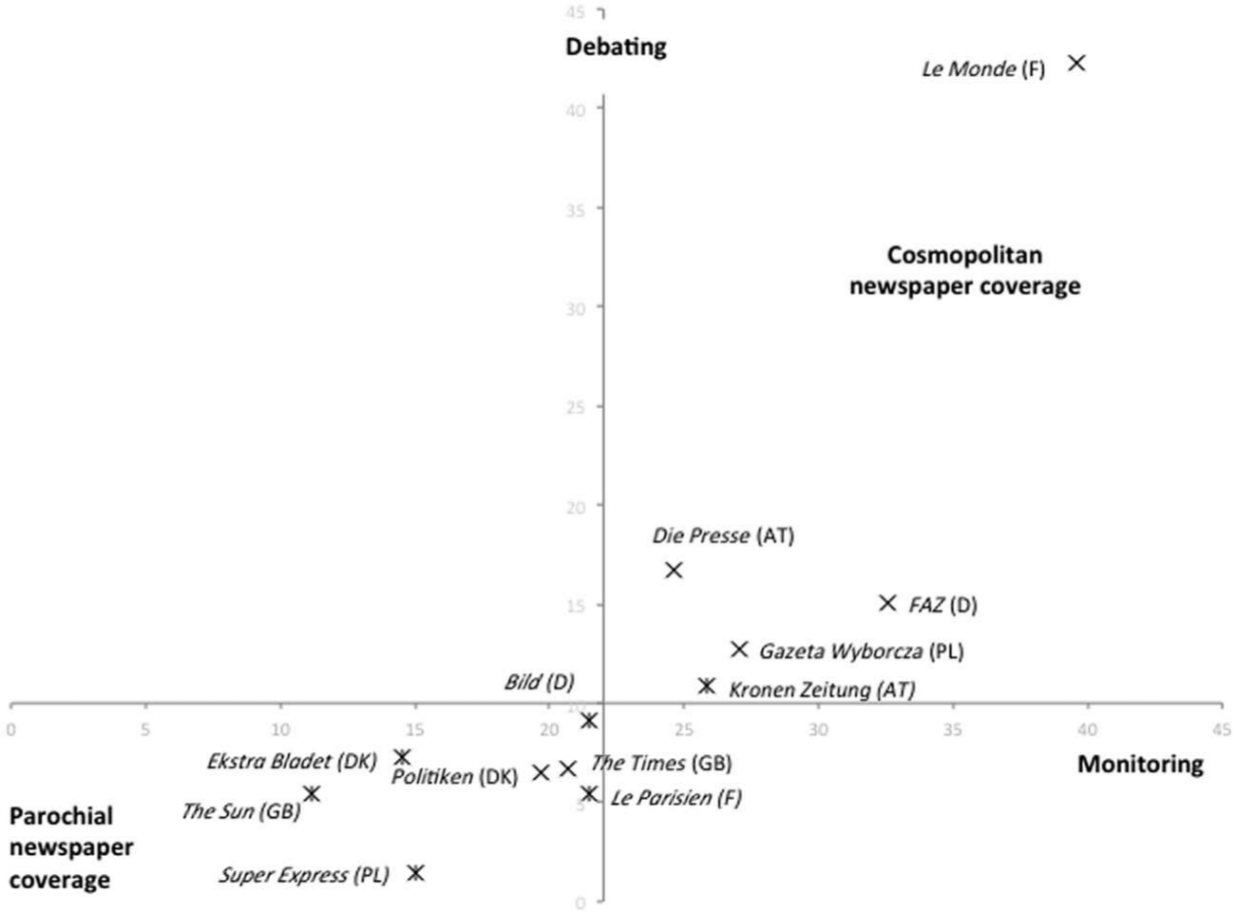
Cosmopolitan monitoring and cosmopolitan debating.
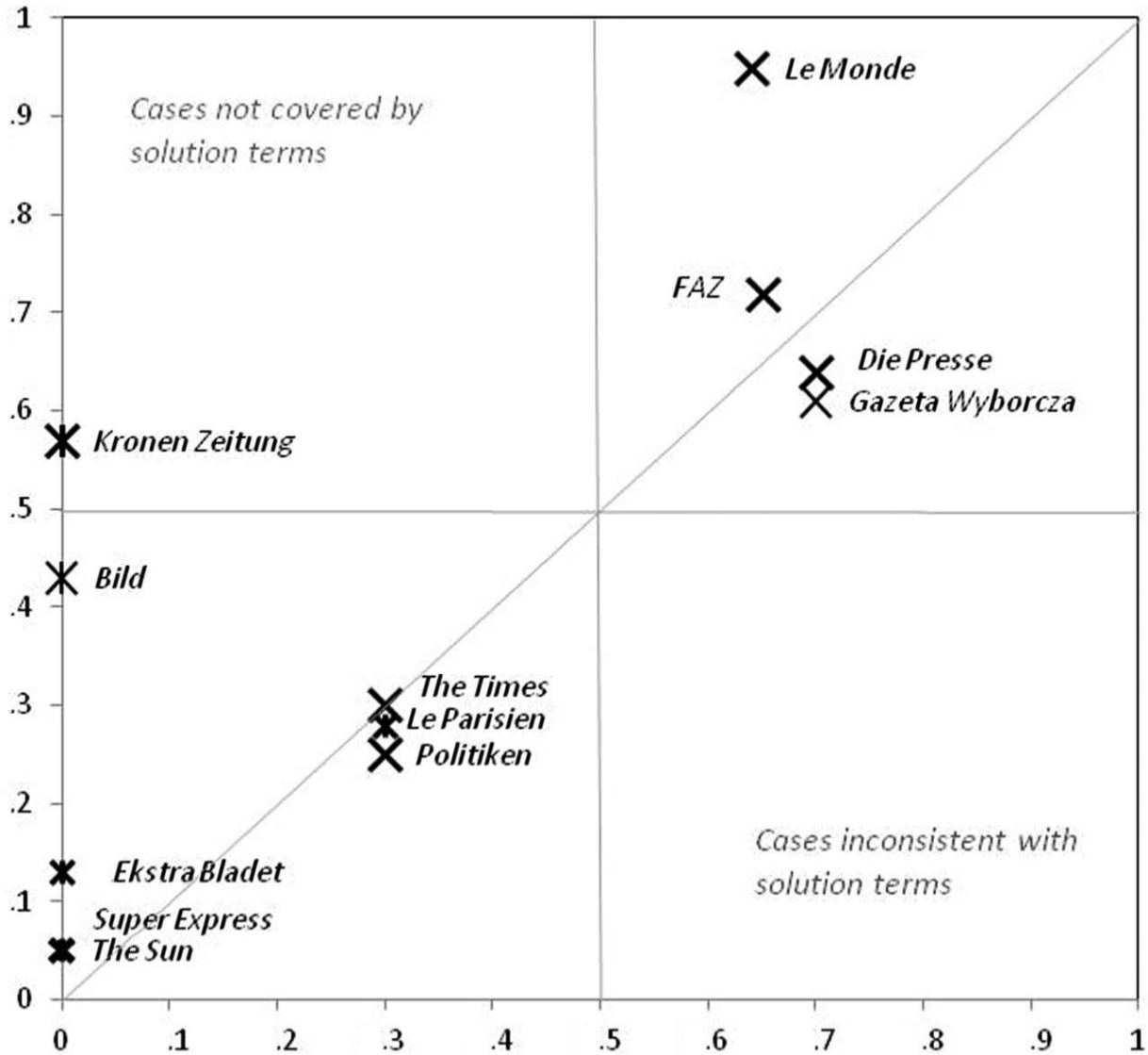
X–Y plot of causal recipes for cosmopolitan coverage.
The champion of cosmopolitan coverage is Le Monde. It shows high shares of articles on foreign affairs and a high percentage of foreign speakers being quoted. Also, Le Monde’s coverage is characterized by an unusually strong diversity, the top five countries make up only a third (or even less) of all countries mentioned. By contrast, in the Austrian Die Presse the share of foreigner quotes is also comparatively high, but not very varied in origin, at least a third of the speakers are Germans leading to a lower diversity measure. In a similar manner the most parochial paper in the debating dimension, the Polish tabloid Super Express, displays not only the lowest share of foreign speakers (12.2%), but also the least variety in speakers with 88% coming from the same five countries.
Two important conclusions can be drawn from this visualization. First, the classic distinction between tabloid and quality newspaper is not sufficient to explain differences in cosmopolitan news coverage. Even though more quality newspapers display high levels of cosmopolitan monitoring and debating, some tabloids such as the German Die Bild and in particular the Austrian Kronen Zeitung are also comparatively cosmopolitan in their outlook. At the same time the British and Danish quality papers (The Times and Politiken) perform on a similar (low) level on cosmopolitan debating as their tabloid compatriots (The Sun and Ekstra Bladet).
Second, the two dimensions are closely related, i.e. a high level of cosmopolitan monitoring is associated with a high level of cosmopolitan debating. The relationship is not strictly linear, but a correlation analysis yields a highly significant Pearson’s r of .85 (p < .01). It seems therefore reasonable to consider cosmopolitan monitoring and cosmopolitan debating as two dimensions of the same phenomenon, i.e. of cosmopolitan coverage. As the outcome to be explained by our QCA analysis we thus calculate a cosmopolitan coverage index based on the newspaper scores for the two dimensions.
The calibration of the data took into account the full range of possible values and our theoretical and empirical knowledge of our cases. For example, The Sun is considered our benchmark for a parochial, non-cosmopolitan paper, while Le Monde is taken as a model of cosmopolitan coverage. The crossover value was set at 16 as this value denotes the clearest break between the different newspapers in the continuum of cosmopolitan coverage. The calibration algorithm provided by Ragin (2008) and included in the software FSQCA 2.0 was used to determine the concrete translation of data into calibrated values. 5
The causal conditions: Structural and cultural factors explaining cosmopolitan coverage
Table A2 (see Appendix) presents the data collected for the explanatory conditions under analysis. Based on population data (and in line with alternative measures on economic and political power), the countries were assigned to the fuzzy sets for the causal condition ‘small country’ (SMALLCOUNTR). We considered Austria and Denmark as ‘fully in’ the set of small countries, while Poland is considered ‘more in than out’, especially as compared to the UK and France (‘more out than in’) and Germany (‘fully out’). The ‘cosmopolitan identification’ (COSMIDENT) of the national media audience was gauged on the basis of Eurobarometer data referring to questions of strong identification as a ‘citizen of Europe’ or a ‘citizen of the world’. The greatest share of people identifying as citizens of Europe/the world is found in Poland (33%). The minimal attachment can be found in the UK with 15%. 6
The data on the organizational level were obtained through qualitative interviews with editors-in-chief and foreign editors. 7 In 2008, the German quality paper FAZ employed by far the highest number of foreign correspondents (40). All tabloid newspapers, on the other hand, had no or only one foreign correspondent.
Newspapers whose journalists agreed in their interviews that international coverage was as important as national coverage if not even more important, were ‘fully in’ the set of newspapers with a cosmopolitan mission (COSMISSION). For example the editor-in-chief of Le Monde said: ‘We want to tell the story of a globalized world. … It is in this context of global developments that we report on France’ (Alain Frachon, Chefredakteur, Le Monde, our translation). This statement clearly illustrates how the global dimension is part of national coverage in newspapers with a cosmopolitan mission. In some papers foreign reporting is pursued even if the readers do not reward it: editors of the FAZ proclaim that international news needs to be reported extensively – even if the readers are not always interested. By contrast it is a strong indicator of parochialism to see national and foreign (or global) news as mutually exclusive and national coverage as the clear priority. We hence considered newspapers whose journalists displayed this attitude to be ‘fully out’ of the set of newspapers with a cosmopolitan mission (Bild, The Sun, Super Express, Kronen Zeitung).
Identifying necessary and sufficient conditions of cosmopolitan coverage
The importance of each condition (or set of conditions) in explaining the outcome was evaluated based on two parameters: consistency and coverage. Consistency is a measure of the degree to which cases belonging to the causal condition or sharing the specified combination of causal conditions actually display the outcome (Ragin, 2008: 44). The coverage values relate to the scope of the solution (which may consist of several solution terms each specifying one condition or a set of conditions). What proportion of cases displaying the relevant outcome can be explained by this solution?
In a first step we tested whether any of our causal conditions are necessary conditions for the outcome cosmopolitan coverage, e.g. whether cosmopolitan coverage only occurs in small countries.
In order to identify a causal condition as necessary, Schneider and Wagemann (2007: 213) propose a consistency threshold of .9 or higher. As can be seen in Table 1, while COSMISSION displays by far the highest consistency with the outcome cosmopolitan coverage (.75), none of our causal conditions qualifies as necessary conditions.
Analysis of necessary conditions.
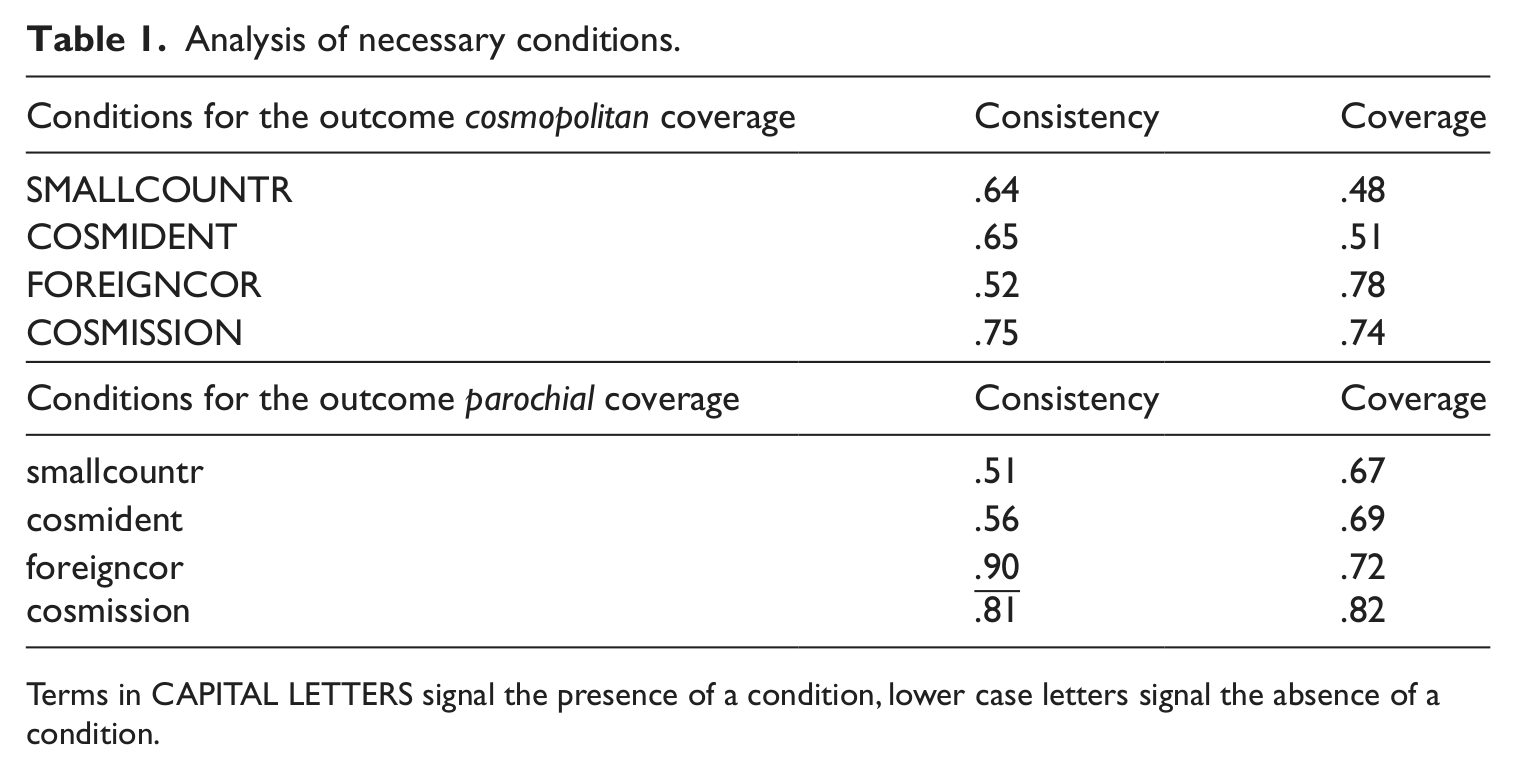
Terms in CAPITAL LETTERS signal the presence of a condition, lower case letters signal the absence of a condition.
In contrast if we take a look at the negative outcome (parochialism), we can identify one causal condition as necessary to the outcome of parochial news coverage: the absence of foreign correspondents. It appears that parochial news coverage can only be found in newspapers without foreign correspondents. This does not signify, however, that we can assume that the lack of foreign correspondents alone also constitutes a sufficient condition of parochialism, i.e. that all newspapers without foreign correspondents display parochial news coverage.
Solution formulas for explaining cosmopolitan news coverage
In order to explore possible sufficient conditions and thus identify the causal recipes that best explain cosmopolitan news debate the data are entered in a so-called truth table. The truth table lists every possible combination of all causal conditions, and then notes how strongly each of the empirical cases is part of these combinations of conditions and of the outcome. In a next step this list of combinations is reduced by excluding combinations of conditions that turn out to be irrelevant to produce the outcome. There are different approaches to simplifying the solution terms. Due to space limitations, we are only able to discuss the intermediate solutions below. They provide the recipes based on a conservative use of counterfactual reasoning and are recommended as the most useful approach (Ragin, 2008: 175).
The analysis provides us with two alternative paths to cosmopolitan news coverage. Central to both solution formulas is the cosmopolitan mission of the newspaper. In small countries this editorial policy committed to international coverage is sufficient to ensure that newspapers provide a lot of cosmopolitan news and debate (SMALLCOUNTR*COSMISSION). Alternatively and irrespectively of the size of the country the newspaper is situated in, a cosmopolitan mission can combine with a large number of foreign correspondents and an openness of the general public towards transnational identification to generate cosmopolitan coverage (COSMIDENT* FOREIGNCOR*COSMISSION). In our sample, the Austrian Die Presse and the Polish Gazeta Wyborcza show a good fit with the first solution term, while Le Monde and FAZ are examples of the second term. The terms should be viewed as ideal-typical models and real-world cases represent them only to a certain degree. The fit of the respective case with the term and the solution is shown in Table 2. ‘Le Monde (.65, .95)’ indicates that the newspaper is not a perfect member of the set of newspapers displaying the conditions (COSMIDENT*FOREIGNCOR*COSMISSION), but an almost full member of the set of newspapers sharing the outcome cosmopolitan news coverage.
Causal recipes for cosmopolitan coverage.
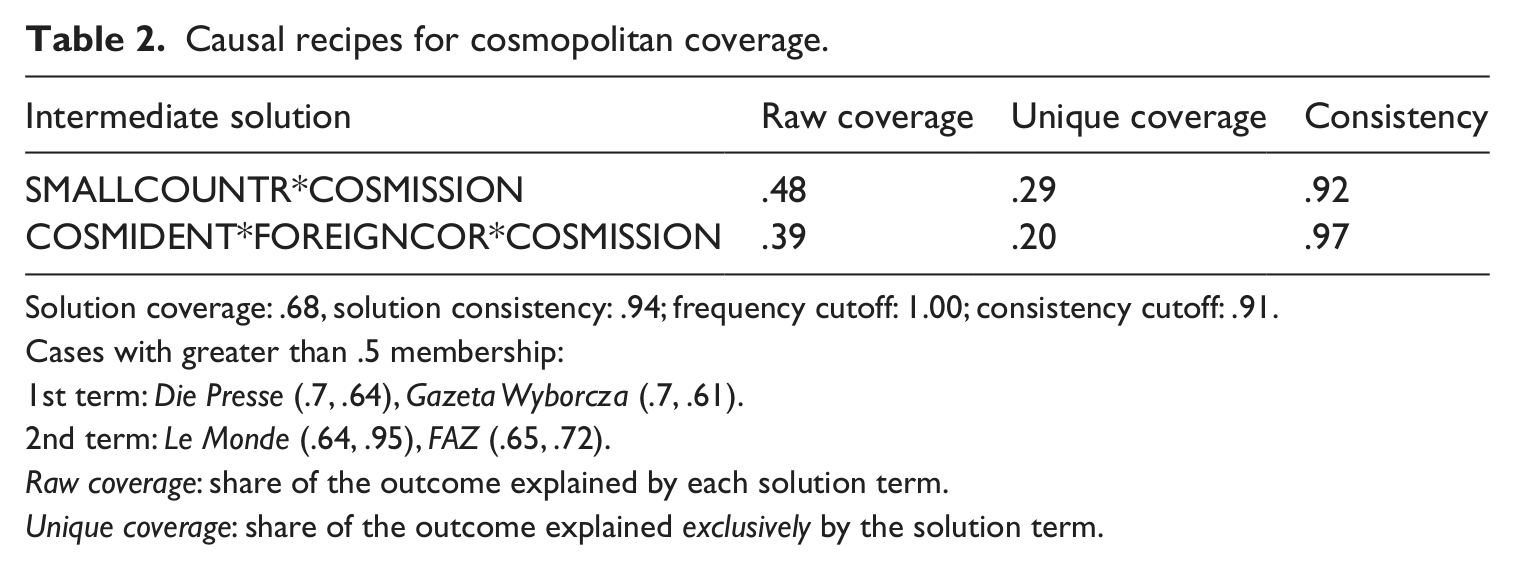
Solution coverage: .68, solution consistency: .94; frequency cutoff: 1.00; consistency cutoff: .91.
Cases with greater than .5 membership:
1st term: Die Presse (.7, .64), Gazeta Wyborcza (.7, .61).
2nd term: Le Monde (.64, .95), FAZ (.65, .72).
Raw coverage: share of the outcome explained by each solution term.
Unique coverage: share of the outcome explained exclusively by the solution term.
Both recipes are characterized by very high consistency values (.94 and .91, the recommended cutoff point is .85). The overall solution coverage of our two recipes is at 68% and thus displays substantial explanatory power.
As mentioned earlier, QCA allows for asymmetrical set relations. We cannot automatically assume that for the opposite outcome (parochial coverage) to occur, the causal conditions described by our solution terms simply need to be absent. A separate analysis for the negative outcome is needed in order to specify whether the discovered set relations are in fact symmetrical or not (Ragin, 2008). The solution terms for parochial coverage in Table 3 underscore the importance of a newspaper’s editorial mission and of the number of foreign correspondents, as their absence features in both solution terms. Above, we had identified a low number of correspondents as a necessary condition for parochial coverage. However, the absence of correspondents alone cannot explain parochialism. Even without correspondents a newspaper may generate a somewhat cosmopolitan coverage (see e.g. Kronen Zeitung and Bild). Only the combination of a lack of cosmopolitan mission and correspondents is a sufficient condition of parochial coverage
Causal recipes for parochial coverage.
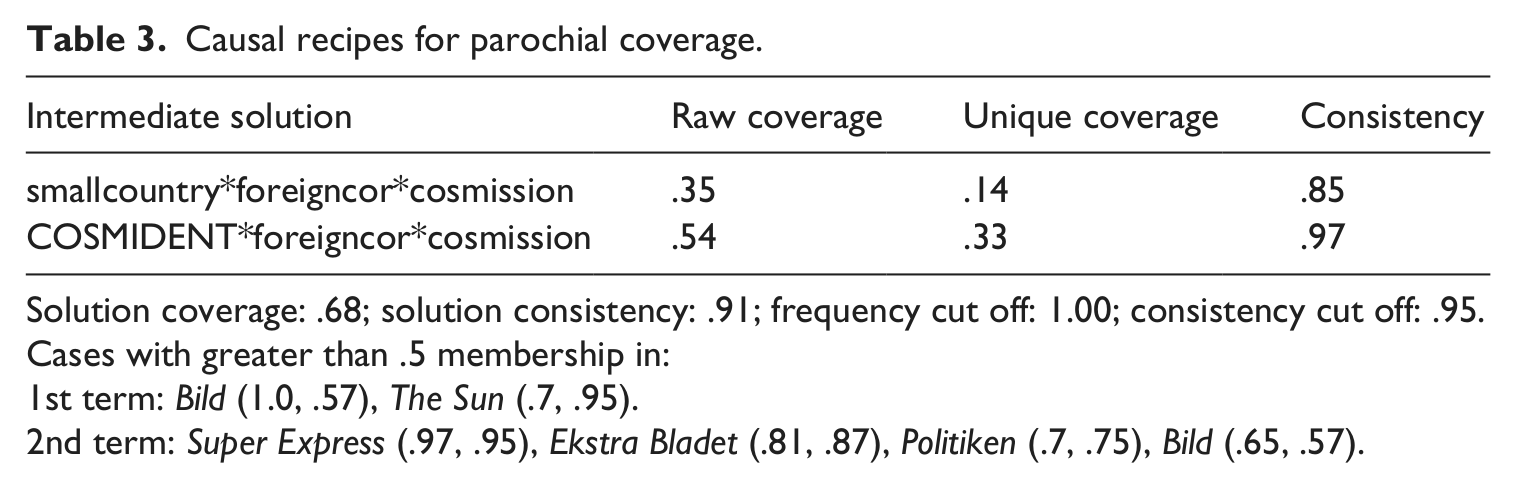
Solution coverage: .68; solution consistency: .91; frequency cut off: 1.00; consistency cut off: .95.
Cases with greater than .5 membership in:
1st term: Bild (1.0, .57), The Sun (.7, .95).
2nd term: Super Express (.97, .95), Ekstra Bladet (.81, .87), Politiken (.7, .75), Bild (.65, .57).
In line with our theoretical argument, there tends to be more parochialism in bigger countries. In conflict with our hypotheses, having a population with a relatively cosmopolitan mindset does not necessarily coincide with cosmopolitan coverage; to the contrary, in our sample cosmopolitan general audiences coexist with parochial media coverage. A clear-cut case of this is the Polish tabloid Super Express, which displays parochial coverage in a country where the general public shows high identification with transnational collectives. The same is true for both Danish papers in the sample. Hence, we can conclude that the willingness of the audience to identify with transnational collectives beyond the nation is not a reliable predictor of cosmopolitan coverage.
In order to further evaluate the solution terms and to better understand the position of the different newspapers with regard to the solution terms, maps all our cases on two dimensions (on the x-axis the degree to which they are part of the identified causal recipes and on the y-axis the degree to which they are part of the outcome). Most cases are located close to the diagonal, which shows that the most cosmopolitan cases also have the highest membership scores in our explanatory recipes. Furthermore, there are no cases that would contradict the solution terms for sufficiency. These would be situated in the lower right corner of the plot as they would correspond with the solution recipes but not display the outcome.
In addition we can identify the Austrian tabloid Kronen Zeitung as an outlier: even though it is part of the outcome, it is not part of the proposed solution terms. It covers foreign countries quite extensively although, according to our interviews, it employs no foreign correspondents and its editors do not subscribe to a cosmopolitan editorial mission.
Discussion
To everyone hoping for the growth of mediated cosmopolitanism, our results offer a mixed picture: newspapers differ a lot in their degree of cosmopolitan coverage. Usually, readers do have a choice between newspapers with a more or less cosmopolitan mission leading to more or less intense coverage of other countries. It is worrying, however, that in some countries (GB, DK) the public is (comparatively) badly informed in both the tabloid and the elite newspaper under analysis. 8 Here, leading papers fail to reflect the deep impact that globalization has on our daily lives. How can we account for these differences in cosmopolitan coverage?
Our analysis has been able to provide valid explanations for the levels of cosmopolitanism and parochialism in newspapers. The cosmopolitan editorial mission turns out to be the single most important condition for producing cosmopolitan coverage and its absence is also part of the solution terms for parochial coverage. However, a cosmopolitan mission alone is neither a necessary, nor a sufficient condition for producing cosmopolitan and parochial coverage. We do find that for explaining cosmopolitan coverage, the respective editorial mission either combines with being situated in a relatively small country or with having many foreign correspondents. Parochialism is well explained by looking for the absence of a cosmopolitan mission combined with the absence of foreign correspondents.
The role of identification of the general public with transnational collectives has a less consistent overlap with the outcome cosmopolitan coverage. There are newspapers in the sample (Ekstra Bladet, Politiken, Super Express) that are situated in countries with a public that is ready to identify with collectives beyond the national realm (European and world citizenship) but, nevertheless, they provide relatively parochial coverage. There are also newspapers from countries with weak public support for cosmopolitan collectives but high levels of cosmopolitan coverage (Die Presse, Kronen Zeitung). Broader identification of the audience does not seem to directly translate into a certain type of news. In the end, newspaper coverage seems less determined by audience interests than some journalists proclaim.
At the country level, cosmopolitan coverage as we have conceptualized it appears to be more closely associated with structural rather than cultural factors, reflecting probably more an imbalance in power than cosmopolitan values. Country size as the more consistent causal factor might even explain the case of the Kronen Zeitung which produces (in the absence of correspondents and cosmopolitan mission) a relatively cosmopolitan coverage. The case of the Kronen Zeitung also stresses the need to delve deeper into the concept of cosmopolitanism in future studies. Underlying our rather basic indicators of cosmopolitan coverage, there might be a parochial bias in the way the populist Kronen Zeitung covers foreign affairs that can better be uncovered by going beyond quantitative content analysis.
Like multiple regression analysis, our FsQCA analysis has yielded results on the relative importance of variables such as the role of the editorial mission and foreign correspondents. At the same time the results illustrate that these variables alone do not produce an outcome. It is also not plausible to model editorial mission and the deployment of correspondents as variables that should be regarded as being independent. Instead, there are recursive relationships between the two: papers with a cosmopolitan editorial mission will set aside money for deploying foreign correspondents. These correspondents might through their interactions with the home editors reinforce the cosmopolitan mission of the paper. This might set off a dynamic that creates cases like Le Monde with an exceptionally cosmopolitan coverage. This also shows how structural and cultural variables as well as organizational and country-specific conditions interact to produce more or less cosmopolitan coverage. The explanatory model developed in this article seems thus a valid approach to explain cosmopolitan coverage. Cultural factors at the organizational level (editorial mission) go hand in hand with structural factors at the organizational and at the country level (foreign correspondents, country size). Future comparative studies that seek to explain patterns of media content need to take into account this degree of causal complexity.
Footnotes
Appendix
Causal conditions: Raw and calibrated data.
| Raw data and fuzzy values | Conditions | ||||||
|---|---|---|---|---|---|---|---|
| Condition (level) | Country-level |
Organizational-level |
|||||
| Condition (name) | SMALLCOUNTR |
COSMIDENT |
FOREIGNCOR |
COSMISSION |
|||
| Indicator | Population size/Gross domestic product
a
|
Feeling as citizen of world/Europe
b
|
Foreign corres-pondents
c
|
Cosmopoli-tan mission
c
|
|||
| Size in mio./GDP in bnEUR | Cal. data | ‘to a great extent’ in % | Cal. data | No. | Cal. data | Cal. data | |
| Kronen Zeitung | 8/282 | 1.0 | 18.0 | .07 | 0 | .0 | .0 |
| Die Presse | 8/282 | 1.0 | 18.0 | .07 | 3 | .3 | .7 |
| Ekstra Bladet | 6/235 | 1.0 | 27.9 | .81 | 0 | .0 | .0 |
| Politiken | 6/235 | 1.0 | 27.9 | .81 | 8 | .3 | .3 |
| Le Parisien/Auj. | 65/1933 | .3 | 25.5 | .64 | 0 | .0 | .7 |
| Le Monde | 65/1933 | .3 | 25.5 | .64 | 20 | .7 | 1.0 |
| Bild | 82/2473 | .0 | 25.6 | .65 | 0 | .0 | .0 |
| Frankf. Allg. Ztg. | 82/2473 | .0 | 25.6 | .65 | 40 | 1.0 | 1.0 |
| The Sun | 62/1800 | .3 | 15.3 | .02 | 1 | .0 | .0 |
| The Times | 62/1800 | .3 | 15.3 | .02 | 16 | .7 | .7 |
| Super Express | 38/363 | .7 | 33.0 | .97 | 0 | .0 | .0 |
| Gazeta Wyborcza | 38/363 | .7 | 33.0 | .97 | 4 | .3 | .7 |

Sources:
Eurostat.
Eurobarometer survey EB 69.2, index based on mean share of respondents saying ‘to a great extent’ in response to the questions ‘To what extent do you personally feel you are a citizen of the world/Europe?’
Interviews with foreign editors and editors-in-chief (autumn 2008).
Calibration values (fully in, crossover, fully out): COSMIDENT: 32, 24, 17. For the other indicators metric data were not available or a rougher scale seemed more adequate: ‘0’ indicating ‘fully out’; ‘0.3’ indicating ‘more out than in’; ‘0.7’ indicating ‘more in than out’ and ‘1’ indicating ‘fully in’.
Acknowledgements
This article is based on data from the research project ‘The Transnationalization of Public Spheres in Europe’ currently directed by Andreas Hepp at the German Research Foundation’s Collaborative Research Centre ‘Transformations of the State’ at the University of Bremen and the Jacobs University Bremen. We are greatly indebted also to former project heads Hartmut Wessler and Bernhard Peters, as well as our former colleagues Swantje Lingenberg and Johanna Möller, and a number of student coders for their contribution to the data. We wish to thank Florin Büchel and Edda Humprecht for their sound advise in conducting the fsQCA and the reviewers of this paper for helpful comments!