



Abstract
The article summarizes three consecutive studies (2001, 2006, 2011) in which national Israeli press reporters detailed how they obtained random samples of their recently published items (N = 1003): first, in order to explore the public interest in whether the standards of news production are deteriorating, improving or staying put; second, to indicate whether journalists adjust to the transforming news ecosystem; and third, to resolve the theoretical dilemma regarding the openness of news practices to change. While showing a general trend of conservatism, data indicate some statistically significant changes across time, not always in the expected directions. Reporters rely more often on ordinary citizens (who remain a marginal source), and public relations practitioners intervene more broadly in their items. They not only question their sources’ credibility more often, but also rely on slightly more sources per item and more cross-checking, mainly thanks to older contacts rather than to new voices.
Introduction
Typically in their opening paragraph, most academic works published in the recent years, the current one included, address the transformative changes the field of journalism is undergoing. The transformative winds fill the sails of most academic vessels, including many dedicated conferences, books, reports and special issues devoted to topics such as the ‘Future of Journalism’, ‘Postindustrial journalism’, ‘Changing journalism’, ‘Changing faces of journalism’, ‘Rethinking journalism’ and ‘The reconstruction of American journalism’ (cf. Anderson et al., 2012; Downie and Schudson, 2009; Franklin, 2012; Lee-Wright et al., 2012; Peters and Broersma, 2012; Zelizer, 2009).
There is plentiful evidence to suggest that news environments are radically changing, including the working conditions, resources, tools, time-frames and institutional atmosphere of news production (as well as later stages of news presentation, distribution, consumption, audience metrics and comment) (Anderson, 2011; Anderson et al., 2012; Fenton, 2010; Lee-Wright, 2012; Lee-Wright et al., 2012; Nygren, 2008; Phillips, 2012; Singer et al., 2011; Witschge, 2012; Zelizer, 2009). However, the extent to which these changes resonate at the level of core journalistic activity – in the practices and routines in which news information is obtained from different human and technological news sources – is much less clear. Exploring whether news practices are indeed changing is of consequence for three major reasons:
First, the public interest: mapping whether practices such as the reliance on diverse news sources, the use of cross-checking or the use of public relations (PR) subsidies are changing across time is of vital public interest, exposing the standards under which the public news diet is being shaped. This is especially true if these standards show signs of deterioration, as the dominant pessimism among journalists and scholars suggests these days, following the economic crisis of media markets.
Second, exploring the journalistic routines and practices across time may be indicative of the extent to which journalists and news organizations show any tendencies to adjust and survive in a rapidly changing news ecosystem.
A third reason, to explore news practices and routines is the as yet inconclusive research findings. The potential changes in news practices and routines have attracted much research attention in recent years. Yet, considering the diversity and complexity of these changes and the methodological challenges to detect them across time, news cultures and types of journalism, findings are mostly inconclusive. While certain scholars detect signs of change in news routines and practices (Anderson, 2011; Boczkowski, 2004; Broersma and Graham, 2012; Couldry, 2010; Davis, 2010; Deuze, 2009; Domingo, 2008; Fenton, 2010; Lee-Wright, 2012; Lee-Wright et al., 2012; Phillips, 2010, 2012; Russell, 2011; Witschge, 2012; Zelizer, 2009), others suggest that news practices and routines remain astoundingly stable (Bourdieu, 1998; Cook, 1998; Gans, 2004; O’Sullivan and Heinonen, 2008; Quandt, 2008; Reich, 2013; Ryfe, 2006, 2012a, 2012b; Schultz, 2007). According to Ryfe (2012b), this stability is ‘one of the most compelling puzzles facing sociologists of news today’.
The purpose of this article is to try and obtain more conclusive data, by following a variety of measurable journalistic routines and practices across time. It summarizes three consecutive studies conducted in Israel across 10 years, with 5-year intervals in between (2001, 2006, 2011). Data are based on a series of Face-to-Face Reconstruction Interviews, in which reporters from three leading national dailies 1 in a mix of news beats detailed how and from which types of sources they obtained the raw information for their recently published sample of items (N = 1003), each of which entailed its own ‘microinterview’. To maximize reliability, the database builds on the ‘nano level’ of the single reporter-source contact. On the other hand, in order to portray a meaningful picture, data are aggregated into the levels of the news phase, the individual item and the entire sample of items.
Literature review and conceptual framework
Expecting change in news practices and routines across time is congruent not only with the axiom panta rhei (everything flows) of the pre-Socratic philosopher Heraclitus, it also concurs with the series of transformative economic, technological and cultural changes in the news ecosystem that has been occurring in recent years (Anderson et al., 2012; Downie and Schudson, 2009; Lee-Wright et al., 2012; Witschge, 2012; Zelizer, 2009). Expecting stability, despite the mounting pressures in which fewer and fewer news people must do ‘more with less’ under shorter deadlines (Davis, 2010; Fenton, 2010; Lee-Wright, 2012; Phillips, 2010, 2012; Witschge, 2012), is inconsistent with not only basic reason and arithmetic but also the physical limits of journalistic energy, time, attention and other resources. How can journalists preserve their old practices under these mounting new pressures?
However, news practices and routines are easily susceptible to change across time if we perceive their role as merely instrumental, making it possible to supply ‘the most acceptable product to the consumer in the most efficient manner’ (Shoemaker and Reese, 1996: 104). If routines and practices are only means to an end, when ends change, or become less achievable, or more achievable using new means, nothing inhibits the adoption of new means. On the other hand, perceiving these routines and practices as filling more complex societal and cultural functions renders them less susceptible to change.
News practices can be defined as customary actions and methods that regulate ‘how to gather, present and disseminate the news’. According to Zelizer (2005), they have both ‘practical and symbolic dimensions’ (p. 42).
Several scholars suggest that cultural practices in general (Swidler, 2001) and news practices in particular (Anderson et al., 2012; Bordieu, 1998; Ryfe, 2006, 2012a, 2012b; Schultz, 2007) are less susceptible to change, since they fulfil the following five roles:
Habitual. News practices and routines embody the habitual, naturalized and tacit rules of journalism, part of their habitus or professional doxa (Bourdieu, 1990; Cook, 1998; Ryfe, 2006; Schultz, 2007). According to Ryfe (2012b), ‘Journalists have been socialized to adopt particular practices, and to perceive these practices as natural and inevitable’. According to Cook (1998) ‘Uncertainty about news reinforces consistency over time as well as across space’ (p. 81).
Institutional. News practices entail not only the rules of journalism, but also the resources to implement them. Hence, ‘change may be inhibited not because journalists are unreflective, but because they make strategic calculations about the costs and benefits of reordering these investments’ (Ryfe, 2012b). According to Anderson et al. (2012: 70), the force that blocks organizational change is ‘the institutional paradox’: ‘The traits that make organizations successful during times of relative social stability can be the very traits that leave them unable to adapt to a rapidly changing organizational reality’.
Constitutive. News practices ‘enact a basic understanding of what counts as an instance of journalism […] setting boundaries beyond which it becomes difficult to recognize activities as journalism’ (Ryfe, 2012b). Hence, it is not possible to change these practices without radically changing the essence and nature of journalism.
Interactional. In their role as ‘interactional experts’ (Collins and Evans, 2007; Reich, 2012) journalists adhere to human sources even when technological alternatives are becoming available (cf. Anderson et al., 2012; Berkowitz, 2009; Dimitrova and Strömbäck, 2009; Manning, 2001; Phillips, 2012; Reich, 2009; Sigal, 1973). Their reliance on ‘humint’ can be seen as a ‘meta practice’, ‘that anchor(s), control(s), or organize(s)’ other practices (Swidler, 2001: 88). According to Swidler, cultural practices in general resist change when they serve as an ‘infrastructure of repeated “interactional” patterns […] the need to engage one another forces people to return to common structures’ (p. 94).
Epistemic. News practices reflect the ‘epistemic norms’ (Pritchard, 2006: 51) of journalism, regulating not only what counts as true knowledge and as publishable information, but also what counts as acceptable journalistic measures, that – if necessary – merit professional, ethical, organizational and legal defences. The leeway of journalists to compromise these norms is curbed by the exposure of their items to immediate and extensive public scrutiny, and by the constant risks of denials, retractions, lawsuits and threats thereof (Bennett, 2003; Donsbach, 2004), that may end up not only in a loss of face, reputation and status, but also in the loss of their job.
Considering this interplay between complex forces of stability and change, and the difficulties of measuring their impact across time, most scholars tend to avoid clear-cut positions, according to which news routines and practices are radically changing or stay intact against all odds. The only exception that comes to mind here is a thin layer of scholars that includes, on the one hand, technophile and technologically deterministic approaches, that basically ignore the social and cultural aspects of news work (cf. Garrison, 2004; Middleberg and Ross, 2000), and on the other hand, a small group of ‘new institutionalists’ who maintain that news practices are homogenous across organizations, space and time (Cook, 1998; Ryfe, 2006, 2012a, 2012b).
Based on a 5-year qualitative study of three US newsrooms, Ryfe (2012b) concludes that news practices and routines remain ‘stubbornly unchanged’, thus making ‘one of the most compelling puzzles facing sociologists of news today’.
Another scholar who focused on the potential change in news practices, Tamara Witschge, does not agree, suggesting that
Journalists today handle more parts of the production, deal with more technical tools, and the emphasis has moved from ‘research’ and ‘content’ towards production and form – from ‘input’ to ‘output’. So-called multi-skilled journalists have to produce much more, with less time to do the basic work of research and verification. (Witschge, 2012: 162)
The complexity of determining whether practices are changing is exemplified in the report of Anderson et al. (2012), who, on the one hand, urge journalists and news organizations to innovate, restructure and reinvent themselves, using new tools, methods, partnerships and professional states of mind, in order to survive and find new relevance for their audiences. On the other hand, they openly state their disillusioned position according to which ‘traditional news organizations have tended to conserve both working methods and hierarchy, even as the old business models are collapsing, and even when new opportunities do not fit in those old patterns’ (p. 2).
Expecting changes in news routines and practices raises a conceptual and methodological hurdle: change compared to what? Considering the scarcity of longitudinal research (as detailed in the methodology section) and lacking reliable and comparable records regarding routines and practices in the past, the way is open to criticism according to which the ostensible change is juxtaposed against a dim, unspecified, idealized period of ‘the past’, during which journalists were ostensibly free of current constraints, such as time pressure, workload, competition, plagiarism, shortage of resources and ‘deskbound’ work style.
Furthermore, while changes in the news ecosystem are tectonic (Anderson et al., 2012: 103) and pressures for change are undeniable, one must leave at least some space for trade-off mechanisms such as the capacity of new technology to counterbalance at least some of the new constraints, enabling quicker and more efficient news gathering.
Against the backdrop of this complexity of forces that encourage and inhibit change concomitantly, this study wishes to suggest a longitudinal perspective, focusing on practices and routines that satisfy the following criteria: concern the ways in which and the sources from which reporters obtained the raw information for their routine sample of items (hence making the lion’s share of news), are measurable, and are changing across time according to the literature. The variables that are undergoing change according to the literature are organized here in the following three clusters.
Diversity and source mix
Under the growing working pressures and their shrinking time for original news gathering, across time journalists are going to rely on fewer news sources (Phillips, 2010, 2012; Witschge, 2012), more fixed sources (Lee-Wright, 2012) and more PR (Dinan and Miller, 2009; Lee-Wright, 2012; Lewis et al., 2008; Phillips, 2010, 2012; Witschge, 2012). Reporters will also rely more often on ordinary citizens, who are equipped, motivated and invited to contribute to the news for the first time (Anderson et al., 2012; Domingo, 2008; Gillmor, 2006; Rosen, 2005; Russell, 2011; Singer et al., 2011). The case is less clear regarding their formerly favourite human agents – senior sources. On the one hand, the traditional lure of ‘Chiefs’ over ‘Indians’ (Cohen, 1963 see also Becker, 1970; McShane, 1995) may further increase their news share. On the other hand, while other sources are becoming unprecedentedly accessible thanks to new technology (Phillips, 2010, 2012; Witschge, 2012), senior sources’ accessibility is not only a matter of technology, because they are overburdened with their businesses and insulated by a human belt of secretaries, assistants, PR practitioners and so on. Thus, despite their traditional lure, senior sources may lose some of their grip on the news in favour of other news sources, since their accessibility lags behind that of other sources.
News work
Under the aforementioned pressures, reporters are going to invest less reportorial input into their items: less initiative-taking and less ‘legwork’ (Fenton, 2010; Lee-Wright, 2012; Lewis et al., 2008; Phillips, 2010, 2012; Witschge, 2012). Considering the accelerating news cycles and the mounting trends of plagiarism, ‘pack journalism’ and cross-monitoring (Boczkowski, 2009; Davis, 2010; Lee-Wright, 2012; Phillips, 2010, 2012), the percentage of their exclusive stories will decline over the years. The accelerating news cycle will also put more pressures on news processes, causing the formerly distinct news phases of news discovery (during which the reporter hears about a new potential item for the first time) and news gathering (during which the reporter obtains the building blocks for the story) (McManus, 1994; Reich, 2009) to growingly converge; thus, the first source supplies not only the lead but also some of the published content.
Trust and relationship
Reporters will assign lower credibility to their sources following the ‘amplifying spiral of mistrust’ between journalists and their sources, mainly in the political field, and the general erosion of trust in political institutions among US and European citizens (Brants, 2012: 16; see also Bardoel, 1996; Cappella and Jamieson, 1997; Koch, 1991; Manning, 2001). However, according to the literature, contrary to their perceived scepticism, their practical scepticism, that is, the extent to which they actually cross-check their sources, is going to decline following the accelerating time pressures (Fenton, 2010; Lee-Wright, 2012; Phillips, 2012; Witschge, 2012). The case of leaks is less clear. On the one hand, leaks are expected to rise with the emergence of new channels that enable faster and easier accessing, copying and leaking of information (Hess, 1996; Lynch, 2010; Russell, 2011). On the other hand, following the extravagant WikiLeaks and the cyber utopianism that surrounded them, governments learned to improve their tools and methods for tracing, censoring, controlling, manipulating, sanctioning and deterring potential leakers (Morozov, 2011; Schechter, 2013). Furthermore, busier reporters have less time to establish mutual rapport with sources, which is essential for enabling leaks (Reich, 2009).
Based on this review, the current study uses one major research question:
RQ: Are news practices improving, deteriorating or stay intact across time?
The question is accompanied by 11 hypotheses, arranged here in three clusters as follows.
Diversity and source mix
Across time, reporters are going to rely on the following:
H1: fewer news sources per item,
H2: more fixed sources,
H3: more PR practitioners and spokespersons,
H4: more ordinary citizens,
H5: fewer or more senior sources.
News work
Across time reporters are going to
H6: invest less initiative and less legwork in their items,
H7: obtain fewer exclusive items,
H8: manage a less structured news process – with the first contact supplying not only the lead for the story, but also some of its building blocks as well.
Trust and relationship
Across time reporters are going to
H9: perceive their sources as less credible,
H10: cross-check their versions less frequently,
H11: rely on leaks more or less frequently.
Methodology
As already mentioned, the puzzle as to whether journalistic routines and practices are changing is growing partially due to the scarcity of conclusive data – especially quantitative data – due to the growing methodological challenge in measuring news practices. Three types of constraints impede such a study.
The first is ethical: journalists’ concerns over infringements of source confidentiality turn news practices inaccessible for systematic research. The second hurdle is physical: exchanges of information between reporters and sources are becoming growingly fluid, unobservable and fragmented, the more they flow over an increasing number of platforms, inside and outside newsrooms. The third is methodological: longitudinal studies tend to be not only scarce in journalism, but also to use content analysis that bears only partial, indirect, speculative and sometimes misleading traces of news processes (Hallin et al., 1993; Manning, 2001; Sigal, 1973). Other quantitative accounts regarding political actors are based on surveys that are not very reliable for the measurement of news process-oriented phenomena.
Following these hurdles, this study used Face-To-Face Reconstruction Interviews – a method that displayed its viability in exploring different aspects of news processes (Albæk, 2011; Brolin and Johansson, 2009; Brueggemann, 2011; Phillips, 2012; Reich, 2009). In this method, a sample of reporters from a mix of news beats were interviewed face-to-face, recreating – contact by contact – the ‘biographies’ of random samples of their fresh stories.
The interviews were preceded by three steps: The first one was a random selection of beats and reporters. A full list of newsbeat reporters at each of the leading Israeli national dailies during the three studied periods was prepared after 2 months of by-line monitoring. The list covered three clusters of beats: politics (e.g. diplomatic and parliamentary affairs), domestic affairs (e.g. police, environment and education) and business affairs (e.g. banking, treasury, finance and real estate). Two reporters in 2001, nine in 2006 and five in 2011 were replaced with others from the same beat cluster after refusing to participate or having published fewer than 10 items per month.
The second step was identification of all published items of these reporters. The sampling period extended over 4 weeks – long enough to supply a rich mix of stories but not long enough to cause participants any memory problems.
The third step was a random sampling of news items. As shown in Table 1, the number of items sampled per reporter was lowered across the decade to accommodate the longer questionnaire (covering aspects that are part of the larger research project). In 2006 and 2011, the number of items per reporter was reduced after 1 week of interviews to limit interview duration to 60–75 minutes per reporter. In addition, the number of reporters was increased to 11 per organization in 2011.
The sampling scheme.
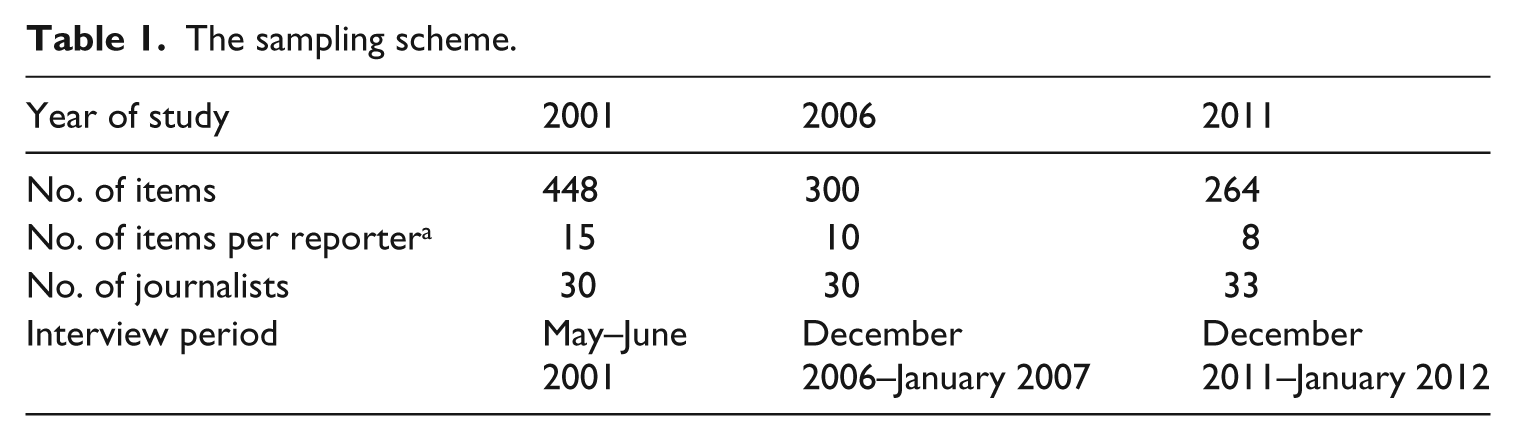
Another measure to control the interview length was limiting the news-gathering contacts, which could theoretically include dozens of sources per item, to three per item in 2001 and four in the later periods (unlike the news discovery, which has no more than a single source, since a reporter can only be introduced to a potential new item once). This could bear only a negligible effect on the final results, if any, as in all periods at least 90% of the total gathering contacts were covered.
Three measures were undertaken to preserve source confidentiality – special seating arrangements: The reporter (with a pile of sampled stories) and interviewer (with a pile of questionnaires) sat on opposite sides of a table with a screen placed between them to give the reporter privacy each time she or he chose an item from the sample pile. Item anonymity: the interviewer was unaware of the identity of the news item being described at any given time, and impersonal interview language (e.g. senior official, PR practitioner). Reporters’ oral replies were assigned to categories in a closed quantitative questionnaire. 2
To test the significance of the findings, changes between the three studied periods were tested for source mix using multivariate analysis of variance (MANOVA) and for all other variables using analysis of variance (ANOVA). The year served as the independent variable with Tukey post hoc comparisons.
Following McManus (1994) and Reich (2009), the study differentiated between two news phases: the news discovery phase, during which reporters learn for the first time about a potential new story, and the news-gathering phase, during which he/ she obtains the actual building blocks of the story. The shares of different sources displayed below relate to the news-gathering phase, which represents the final news item, except when there is a specific interest to explore the discovery stage as well.
Measurements
Variables that are not self-evident are briefly introduced here:
Fixed sources: Percentage of sources that are contacted on a daily or weekly basis;
Senior sources: Percentage of contacts with heads of agencies and corporations such as the CEO, director, president and deputies; chairmen of Parliamentary Committees; party and faction leaders; high-ranking army officers (colonel and above) and police officers (deputy commissioner and above); and mayors and their deputies;
Ordinary citizens: People who were interviewed as individuals – not by virtue of their position, professional background or affiliation with a particular institution;
PR practitioners: Including spokespersons, ‘strategic’ advisors and so on;
Initiative: Average percentage of contacts initiated by the reporter (according to technology used); 3
Legwork: Percentage of contacts in which the reporter was physically present at news scenes or at face-to-face interviews;
Exclusive items: Items that were not published anywhere, entirely or partially, when the respective item was published;
‘Pure’ news discovery contacts: Indicate the extent to which the entire news process is structured (with the first contact used only to kick-off the story, while its building blocks were obtained from following contacts) or hasty (with the first contact supplying some of the building blocks as well);
Perceived credibility: Percentage of sources ranked by the reporter as reliable, highly reliable and extremely highly reliable;
Cross-checking: Percentage of items in which the reporter referred to a news source/s to support or refute a previous source version;
Leaks: Percentage of items that involved unauthorized disclosure of substantial information.
Findings
Findings present the extent to which the sources from which and the practices by which journalists obtain the published news are indeed changing across time, based on three consecutive studies (2001, 2006, 2011), using the same method and research tool, focusing on the work of leading national Israeli daily news reporters, in a mix of news beats.
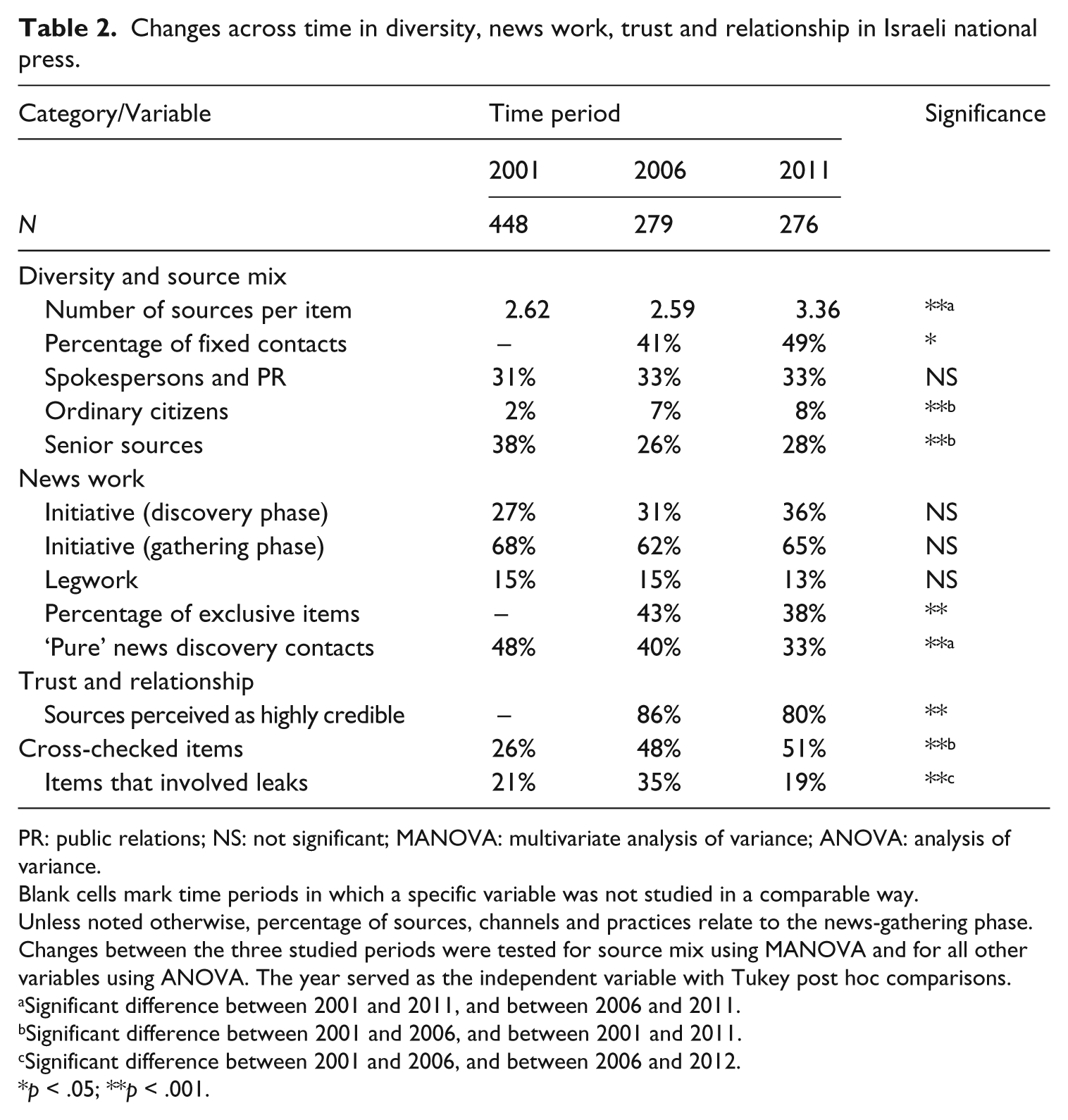
Before introducing the findings, it is important to contextualize them by indicating whether the average workload on the single reporter is changing. Findings show that at least according to number of items per reporter published during the sampled months in the main newspaper, reporters’ outputs are declining, contrary to the accepted wisdom in the literature (Davis, 2010; Phillips, 2010, 2012; Witschge, 2012) from 46 items per month per reporter in 2001, to 41 in 2006 and 37 in 2011. Obviously, these figures overlook items published in other news outlets (in two of the three organizations, reporters were double-jobbed to write for the news site as well – across the three periods). And yet, these figures supply some context for the findings presented in Table 2, arranged in three clusters of variables.
Changes across time in diversity, news work, trust and relationship in Israeli national press.
PR: public relations; NS: not significant; MANOVA: multivariate analysis of variance; ANOVA: analysis of variance.
Blank cells mark time periods in which a specific variable was not studied in a comparable way.
Unless noted otherwise, percentage of sources, channels and practices relate to the news-gathering phase.
Changes between the three studied periods were tested for source mix using MANOVA and for all other variables using ANOVA. The year served as the independent variable with Tukey post hoc comparisons.
Significant difference between 2001 and 2011, and between 2006 and 2011.
Significant difference between 2001 and 2006, and between 2001 and 2011.
Significant difference between 2001 and 2006, and between 2006 and 2012.
p < .05; **p < .001.
Diversity and source mix
Statistically significant changes are indicated across time regarding all five hypotheses, however not always in the expected direction. Contrary to the first hypothesis, the number of sources per item increased substantially – a trend that is discussed below, along with other findings, showing that this was not a simple increase of source diversity.
In accordance with the second and the fourth hypotheses, reliance on fixed sources (i.e. contacted at least once a week) and ordinary citizens is growing substantially, though the entire share of citizens as sources remains very modest. On the other hand, reliance on senior sources (H5) is declining substantially.
The third hypothesis seemed unconfirmed at first glance, showing stability in the reliance on PR and spokespersons. Somewhat suspicious regarding this result, we went to check further the news discovery stage; however, the trend was similar, with PR contributing 40–42% of the story leads across the three periods. Only when we checked the general involvement of PR practitioners in both news discovery and news gathering (including every action that made a contribution to the content of the published item, such as supplying a response) did the change over time emerge clearly: whereas during 2001, PR practitioners were involved in 60% of the items, in 2006 and 2011, the total percentage of their involvement increased to 68% of the items (χ22 = 6.362; p = 0.042).
These findings invite further elaboration. The rise in the number of sources seems surprising at first glance, contradicting not only some of the literature, but also the basic logic: How could news practices ‘improve’ in an era of mounting pressures? However, rather than increasing source diversity, as we see below, these results indicate less trust in sources, and broader reliance on older connections. While reliance on new voices increased only 12% between 2006 and 2011, reliance on fixed sources grew by no less than 55%, and was the main driving force behind the increased number of sources, as suggested by Lee-Wright (2012).
Findings indicate that the segment of PR-free items is dwindling, though the direct impact of PR on their share of news and kicked-off items is somewhat restrained. The restraining force is the persistent tendency of reporters to invest some independent news-gathering efforts in most items that involve PR. In addition, a certain proportion of stories involve sources that either have no PR, or whose PR were bypassed. However, if broadening intervention is their strategy to increase their impact on the news, then one cannot rule out that even broader PR contributions will be found in the recycle bins of the reporters and their editors as well as in the seemingly PR-free items, in which practitioners could have pulled strings behind the scenes.
The modest rise in reliance on citizen sources indicates that despite their growing news access, thanks to new technologies, platforms for publishing their input and greater attentiveness to their say (De Keyser and Raeymaeckers, 2012; Gillmor, 2006; Russell, 2011; Singer et al., 2011; Witschge, 2012), citizens are still perceived as disqualified news sources, probably scoring low in attributes that make ordinary sources attractive, that is, being authoritative, official, accredited and prolific enough and in a position to know (Berkowitz, 2009; Cook, 1998; Ericson et al., 1989; Gans, 2004; Hall et al., 1978; Lewis et al., 2008).
The declining reliance on senior sources may suggest that beyond their top position in the ‘hierarchy of credibility’ (Becker, 1970), these sources score low on other hierarchies, probably with the hierarchy of accessibility, being the only source whose accessibility remains restricted despite new technology, insulated by a human belt of secretaries, assistants, less senior staff and PR practitioners.
News work
Only two of the three hypotheses regarding news work are confirmed. No substantial decline in initiative and legwork was detected across the years (H6); however, as hypothesized, reporters publish less exclusive items (H7) and manage a substantially less-structured news process, in which initial contacts growingly supply some of the building blocks for their stories (H8).
Contrary to the efforts of relying on an additional source, which becomes a matter of button pushing, legwork and initiative are highly time- and energy-consuming practices. Hence, attending an event or initiating an item (contrary to initiating news-gathering contacts) could persist across time mainly, thanks to their rare implementation already a decade ago, and probably even earlier (Christopher, 1998), under circumstances whose frequency does not necessarily change in 10 years. The case of initiative has a further constraint, since the reactive pattern (in which journalists take the initiative following an event or a source lead) is a strategic ritual, protecting them from accusations of constructing a ‘superficial’ agenda of their own or ‘creating’ events (Molotch and Lester, 1974; Reich, 2009; Ryfe, 2012b).
Trust and relationship
Only two out of three hypotheses regarding trust and relationship are confirmed. Reporters do perceive their sources as substantially less credible (H9) and cross-check their versions much more frequently (H10). It is important to indicate that cross-checking and number of sources are not identical, though they are obviously interdependent. The correlation between the two across the studied period was 0.347 (p = 0.00).
Altogether, more sources and cross-checking and their interdependence, as well as the growing reliance on fixed sources, indicate that across the studied period, reporters did not become more meticulous, but rather more suspicious, partly an indication of the deteriorating trust between the parties. In other words, what we see here are changing epistemic needs: in order to feel that their items are publishable, reporters either require a few more news sources to gather and triangulate information, or need them even earlier, but now they can reach them quicker and easier thanks to new technology. This may suggest that in an information-saturated news environment (Davis, 2010; Phillips, 2010, 2012; Ryfe, 2012b), the cost of additional sources is shrinking, shifting the scarce journalistic resource from merely new information to trustworthy or certified information that is safe for publication. Declining source credibility corresponds to the growing journalistic tendency to rely on regular contacts, as well as the narrower reliance on senior sources who tend to be perceived as highly credible (Becker, 1970; McShane, 1995).
The percentage of items that involved leaks remained constant at the beginning and the end of the studied period, with a strange leap in the intermediate period. Further analysis indicates that this leap is associated with temporal conditions related to police news. 4 Although leaks depend on local political, technological and regulatory dispositions, their perpetuating levels may suggest that despite the ‘technologization’ that made leaks easier (Hess, 1996; Lynch, 2010; Russell, 2011), these unauthorized disclosures remain basically a political phenomenon, constrained by updated regimes of secrecy, accreditation, restricted access and sanctions (Morozov, 2011; Schechter, 2013), that brought leaks back under renewed control.
Discussion
While statistically significant, the changes found are too selective, modest and not always in the expected directions to be considered as a transformation of news routines and practices. Hence, rather than dramatizing them, it is more important to acknowledge the general trend of stability in news practices.
Although one cannot rule out the notion that the Israeli news scene has certain peculiarities, as detailed below, rigidity of news practices has been indicated by some US and European scholars (Anderson et al., 2012; O’sullivan and Heinonen, 2008; Quandt, 2008; Ryfe, 2012a), though not based on longitudinal and quantitative data. One of the few who relied on longitudinal qualitative research of regional newsrooms in the United States suggested that news practices remain ‘stubbornly unchanged’ (Ryfe, 2012b):
Journalists still rely on the same sources, especially government agencies, as principal sources of news. Their definitions of news and newsworthiness […] remain essentially in place. Their role conceptions still revolve around longstanding values like objectivity, facticity, balance, and neutrality.
According to Anderson et al. (2012: 47), ‘most news institutions try to routinize disruption with as little change to their work processes and ideological self-image as possible’. They suggest that
too many reporters remain locked into a mindset where a relatively limited list of sources is still relied on to gather evidence for most important stories, with the occasional rewritten press release or direct observation thrown in. This insider centric idea of original reporting excludes […] new strategies of information gathering […]. (Anderson et al., 2012: 23)
Some minimal background regarding the studied case: According to Tsfati and Meyers (2012), Israel is similar to other Western capitalist media systems, in which the press is suffering a commercial crisis and loss of advertising revenues and the growing circulation of the new free daily Israel Hayom. Despite series of cutbacks and layoffs, that have taken place especially since 2009 (and more so in 2012), the papers studied managed to preserve most of their reporting staff in the hard news beats studied here, including Maariv, which was suffering from management and profitability problems much earlier on (Kershner, 2012). Over the last two decades, the Israeli journalistic workforce has undergone growing polarization between a small elite of stars and a wide editorial proletariat of freelance and portfolio journalists employed through personal contracts rather than unionized labour, that made them easier to lay off (Caspi, 2007; Davidson, 2012; Tsfati and Meyers, 2012). They tend to spend fewer years on their beats and in journalism in general. The Israeli daily press is privately owned and highly competitive, though facing no competition of local and regional dailies. It is also highly concentrated, serving a population of 8 million citizens, from a narrow district in Tel Aviv. Israel represents a polarized, pluralistic political system (Sartori, 1976), with national security high on its agenda, yet it is not clear how, if at all, these factors affect news practices.
In recent decades, Israeli media have gradually shifted from co-optation and intimate relations with the political and military authorities, and virtually automatic obedience to the interests of the Israeli Defense Forces, to more independent, critical and sometimes even adversarial relations; from a collective voice that was committed to nation building and social integration to more individualized, segmented, globalized, ‘Americanized’, virtually pluralized, neo-liberal orientation (Caspi, 2011; Caspi and Limor, 1999; Soffer, 2011); from technological laggards to early adopters. Israeli journalists are technologically up to date, just as their audiences are compared with their counterparts in other Organisation for Economic Co-operation and Development (OECD) countries 5 and online news is characterized as a ‘phenomenal success’ (Caspi, 2011: 358).
Despite the certain support from some US and European studies, as mentioned, these findings require cautious generalizations and full awareness of the limitations of the research design. Routines and news practices and findings based on face-to-face reconstruction interviews are not necessarily synonyms. Based on journalists’ self-reports, the study cannot rule out social desirability biases, though this type of bias should also not be overstated. First, this is because interviewees widely reported the use of non-flattering practices such as single-source items or reliance on PR. Second, even if some of the reporters’ accounts were idealized, they may still establish a longitudinal trend – at least as long as the bias itself does not change substantially across time. Third, despite its imperfections, reconstruction interviews are probably the only method of analysing news processes quantitatively, and – as confirmed by a Danish study – the match between reporters’ and sources’ accounts is close to perfect (Albæk, 2011). Fourth, one can take for granted that the actual standards of journalism are in no way higher than reported. And fifth, the weaknesses of self-reports were at least somewhat mitigated by anchoring reporters’ testimonies in a specific sample of items.
Conclusion
Summarizing three studies, conducted across 10 years (2001, 2006, 2011), in which journalists detailed in Face-to-Face Reconstruction Interviews how they obtained a sample of their recently published items, this article found that the studied news practices hardly changed, preserving the same journalistic paradigm and a similar media logic.
The lesson may be that the associations between changes in the news environment and changes in the regimes of news production do exist; however, they are less direct, immediate, comprehensive and ’common-sensical’ than suggested by some scholars. Furthermore, news practices and routines should be perceived less as instrumental means to an end and more as customary actions and methods that fulfil social and cultural functions which make them more change-resistant.
The general trend of stability detected here bears mixed news. The good news is that at least according to studied findings, no signs of systematic deterioration in the standards of news production were detected. And yet, stability can be seen as actual deterioration of journalistic standards, compared to the affordances of new technologies to improve journalistic performance. The bad news is that journalists may have difficulty surviving in a rapidly changing news ecosystem if they continue to adhere so rigidly to traditional practices.
However, stability does not mean that nothing changes. A series of statistically significant changes were detected across time, not always as expected by the literature. As expected, ordinary citizens play a significantly growing (though still a modest) role as news sources, and PR practitioners intervene in significantly more news items (though, according to the journalists, they fail to exchange their growing intervention into a greater share of news or more kicked-off stories). Furthermore, across the studied decade, reporters published fewer exclusive items and conducted a more hasty news process, in which the first sources supply more than story leads.
Reporters not only trust their sources less, they also rely on more news sources per item and more cross-checking – contrary to expectations in the literature – giving precedence to old contacts. This cluster of epistemic-oriented variables is impressive, as it is not only statistically significant, but also consistent, multifaceted, encompassing both evaluative and practical measures, with congruence between the levels of trust in sources and the levels of their cross-checking.
These findings bring us back to ‘one of the most compelling puzzles facing sociologists of news today’ (Ryfe, 2012b): How did reporters manage to perpetuate many of their practices, despite the mounting pressures in and around their news environment? More than pretending to solve this puzzle, this article wishes to provide evidence that it indeed exists and invites solution. Since no journalistic alchemy is involved here, this article suggests that the trend of stability and the changes detected within it were made possible – despite the mounting working pressures in the news environment – thanks to the technological trade-off, that made it possible to address the growing epistemic needs of journalists, offering quicker and easier access to information and news sources (Phillips, 2010, 2012; Witschge, 2012); second, thanks to the efficiency of journalistic practices which, similar to other occupational practices, were highly efficient (Abbott, 1988; Friedson, 2001), while time-consuming and labour-intensive practices such as face-to-face interviews, first-hand witnessing and initiative-taking during the discovery phase were rarely used in the first place. Lower journalistic standards that are mentioned in the literature as recent phenomena such as a ‘deskbound workstyle’, workload pressures and scarcity of time to cross-check information were documented in the United States and the United Kingdom as early as the 1990s (Christopher, 1998; Manning, 2001; Russell, 2011; Zelizer, 1990). Third, national-level mainstream news organizations such as the ones studied may be less susceptible to change, especially in the hard news beats studied. Fourth, as suggested by Bourdieu, ‘[a] newspaper can remain absolutely the same […] and yet be profoundly altered because its relative importance in the field has changed’ (Bourdieu, 1998: 42). In a similar vein, one cannot rule out the notion that journalists adjusted to the growing pressures of the news environment by changing practices that are either less measurable or that take place outside the realm of the present study (e.g. in the suitability of news sources, the standards of their content and style, deteriorating journalistic expertise or their less adversarial role perception). Fifth, one cannot rule out that journalists are currently experiencing unprecedented levels of occupational pressures (Phillips, 2012), being squeezed between the mounting constraints of the news environment and their inability to even imagine alternative sets of practices. Finally, 10 years, turbulent as they were, may be too short a period for new news practices to emerge. Hence, more conclusive evidence regarding change and stability in news routines and practices may need further replication.
Obviously, the persistence of routines and practices may change between news cultures and types of journalism. Hence, further studies may focus on specific types of news, modes of journalism, news cultures and news organizations that are more prone to change, such as soft news, freelance, general assignment, part time and portfolio journalists. Other candidates in this category are news organizations which lost a substantial part of their reporting workforce, alternative and citizen media, and more experimental news endeavours. Scholars who have already explored the topic in the past are encouraged to replicate their studies. Others may use participant observations to triangulate the current findings, focusing on the impact of growing pressures on less measurable news practices and news output.
Footnotes
Acknowledgements
The author would like to thank Dr. C.J. (Chris) Peters of Groningen University for his illuminating and constructive comments on an earlier version of this article, as well as his present and past graduate students who assisted in compiling the data, especially Inbal Avraham-Klein, Sharon Ben-David, Oz Carmel, Yigal Godler, Yifat Naim and Alex Nierenberg. The author would also like to thank Tali Avishay-Arbel for her committed, decade-long, statistical advice.
Funding
The 2011 research was supported by The Israel Science Foundation (grant No. 1104/11) and the 2001 and 2005 researches – by the Israel Foundations Trustees.