



Abstract
Many claim that populism in the Netherlands has grown over the last 10 years; that it spreads among mainstream parties; that its success has to do with the media, who pay more and more attention to populist parties and immigration issues; but that it is difficult to distinguish between political populism intended for the media and populism by the media. In a longitudinal content analysis of newspapers, television news, talk shows and party political broadcasts, covering seven elections in nearly 20 years, these claims are put to the test. The picture that emerges is far more ambiguous than publicized opinion suggests, with no clear trend but a downward one in 2012.
Introduction
There was a time when, in international scholarly literature, the description and vocabulary of political communication in the Netherlands was dominated by one word: pillarization. During the first 60 years of the 20th century, Dutch society was portrayed as organized along the lines of religious and ideological cleavages, with people living alongside, more or less apart, in a sphere of consensus, tolerance and, some argued, utter dullness (Lijphart, 1968). These days the scholarly interest focuses on the flipside of consensus, on contestation and loudly voiced populism, which can be observed in other European countries too. In the Netherlands, however, this phenomenon manifested itself with a ferocity and versatility that surprised many. And it all happened so quickly. At the beginning of May 2002, The Economist had still congratulated the Netherlands on its economic success, which it ascribed to stable and consensual politics, good government and solid governance. A week later, Pim Fortuyn was killed. A new kid on the political block, he had dominated the election campaign that year, criticizing an ‘autistic’ government, the ‘in-crowd’ character of the political elite, multicultural society with its ‘backward’ Islamic culture and the loss of national identity because of ‘Europe’ (Lucardie and Voerman, 2012: 102ff).
His outspoken naming and blaming, the blunt language he used, the anti-establishment sentiments he professed in his debates with other vested politicians (and with the media, for that matter, which he blamed for siding with the establishment) and his alignment with the assumed plight of ordinary people, had made him an instant though controversial success. His funeral was accompanied by a national outpouring of grief, reminiscent of the death of Princess Diana. Nine days later, in the parliamentary elections, his LPF (List Pim Fortuyn) – now void of its leader – in one giant step became the second party in the land with 26 seats (13.3%). Dead man talking. The populist message and style had clearly struck a chord in the hearts and minds of substantial parts of the electorate.
After the elections, the LPF joined the coalition government, but right from the word go it was marred by internal struggle. Before a year had passed, the government fell and new elections had to be held. Now, MPs and newcomers claimed to be the true heirs of Fortuyn’s ideas and several small parties, angrily waving his proverbial will, participated in the 2003 elections. None was very successful and the LPF, too, lost most of its electoral support. Fortuyn had, however, given legitimacy to an outspoken anti-immigration discourse, emphasizing the LPF as a ‘normal’ party and, by that, contributing to its success (Bos and Van der Brug, 2010; Van der Brug et al., 2005).
The coming of the LPF, and their claim to have lifted the ‘veil of political correctness’ surrounding the issue of multiculturalism, particularly affected the liberal VVD (People’s Party for Freedom and Democracy (Volkspartij voor Vrijheid en Democratie)). Two of its most popular MPs challenged the social-liberal party line and, after internal debate and fighting, left the party: first Geert Wilders and then Rita Verdonk. The latter had been minister of immigration but propagated a tougher line and a similar approach against the party political establishment. After narrowly losing the contest over the party leadership, she set up her own party – Trots op Nederland (ToN, Proud of the Netherlands) – opening up a website where, as in a wiki-cracy, everyone could participate in drawing up the party manifesto. After financial problems, waning support and a disastrous 2010 elections (0.6%), she retreated from the political scene.
Geert Wilders and his PVV (Party for Freedom (Partij voor de Vrijheid)) are a more successful story (Lucardie and Voerman, 2012: 151ff). His blunt anti-establishment style, rough and often insulting language (calling the prime minister ‘loony’), virulent anti-Islam message (demanding the prohibition of the Koran) and his tough stand on immigration (no head scarves, criminal immigrants out) and on Europe (against the euro and Turkish membership of the European Union (EU)) made him a popular politician, also with political journalists, who awarded him the prize of best politician of 2007. Since Wilders had left the VVD in 2004, his PVV increased its electoral performance. In 2006, they gained 6% of the vote, in the 2009 European elections 17% and in 2010 15.5%. At the 2012 elections, however, they lost out to VVD and PvdA Labour (Partij van de Arbeid), dropping again to 10%.
The acclaimed success of populist parties and politicians in the Netherlands has been accompanied by a range of sombre claims and wild assumptions – usually to be found in the media or the pub – that only partly have been substantiated by empirical evidence. First, it is assumed that populism is on the rise, both in the rhetoric of politicians and in their media portrayal, and that this can be explained by increasing anti-immigration sentiment among substantial parts of the electorate (Kriesi et al., 2008). Second, the success of populist parties and rhetoric is said to have spread like flu to other parties and politicians, also of the mainstream (e.g. Mudde, 2004). Results in this regard are conflicting. Rooduijn et al. (2014), in a content analysis of party manifestos in five Western European countries, including the Netherlands, did not find that the programmes of mainstream parties have become more populist in recent years. On the other hand, Van Heerden et al. (2014) have witnessed a limited increase in the salience of the (right-wing populist) immigration issue, and a more monoculturalist stance in Dutch party manifestos since 1994. Third, the media are said to have responded to the anxiety that part of the electorate hold about the open society with more news about immigration issues (Adriaansen and Van Praag, 2010; Boomgaarden, 2007; Schafraad et al., 2009) and more populist debate (Rooduijn, 2013). Mazzoleni (2003), looking at the Italian case, expected this especially to be so with the anti-elitist tabloid press and Brants (2012) assumed the same for Dutch reality, talk and chat shows that have opened their doors to the vox populi. Researches by Akkerman (2011), Bos et al. (2010) and Rooduijn (2013), however, did not find confirmation of the tabloid hypothesis for the Netherlands (and nor for the United Kingdom, France, Germany and even Italy).
With such conflicting evidence, we treat these claims as empirical questions that we try to answer through a longitudinal – covering seven election campaigns in the Netherlands in nearly 20 years and starting before the Fortuyn revolt – theoretical and more-encompassing study of the rhetoric, style and issues of politicians, expressed in their controlled publicity of party political broadcasts (PPBs) and their portrayal in the free publicity of newspapers and television. We begin, however, with a theoretical and conceptual expose of the somewhat ambiguous concept of populism. This should help us in operationalizing and answering the empirical questions raised.
Populism as a concept
The 19th century peasant uprising by the Russian Narodniki (narod = people) has been called the first ‘populist’ movement, but giving the idea its name is usually attributed to the supporters of the People’s Party. Established in the United States in 1893, its aim was to return political power to the people, the common man, through direct legislation in referenda and popular initiatives. The People’s Party’s political programme indicates that, ideologically, the origin of populism has a liberal and socialist undertone, different from the right-wing nationalistic rhetoric that we usually associate with it now. In fact, populism today can represent different (partial) ideologies, which can be found in different regions. Populism in South American countries like Venezuela and Bolivia tends to refer to a socialist ‘mindset’; in Scandinavian countries, it is usually linked with liberalism; while a nationalistic and conservative Weltanschauung is more to be found in middle and eastern Europe (Lucardie and Voerman, 2012: 12). It could well be argued that all three appear in the Netherlands: the socialist variant with the SP (The Socialist Party (Socialistische Partij)), the liberal with Rita Verdonk and, up to a point, Pim Fortuyn, and nationalist and conservative populism with Geert Wilders (Lucardie and Voerman, 2012).
While this very brief overview says something about the origin and ideological directions of populism, it does not yet define it conceptually. Here we are confronted with a slightly ambiguous picture, not uncommon with contested concepts. Taggart (2000), for instance, gives populism six characteristics: populist parties or actors as hostile towards representative politics, referring to a heartland, lacking core values, perceiving a crisis, and self-limiting and chameleonic. Mudde (2004), on the other hand, emphasizes two aspects – the distinction between elite and masses and the idea of a volonté général of the people – while Albertazzi and McDonnell (2008) define populism as involving a triple relationship: between elites, the people (the former trying to dis-empower the latter) and ‘dangerous’ others. Ruzza and Fella (2011) also distinguish three, but different and more useful, dimensions: ideas, styles and policies.
With regard to ideas, some see populism as an ideology that antagonistically distinguishes between ‘the people’, on the one hand, and the established political power structure, sometimes referred to as ‘the corrupt elite’, on the other (Mudde, 2004: 543). In this view, populism is an anti-establishment and anti-political vision, where the elite is said to ignore the homeland and the ‘pureness’ and anxieties of the people. Others describe populism as a more strategic rhetoric ‘designed to tap feelings of ressentiment and exploit them politically’ (Betz, 2002: 198) in order ‘to challenge the legitimacy of the current political establishment’ (Abts and Rummens, 2007: 407). Populists often see themselves ‘as true democrats, voicing popular grievances and opinions systematically ignored by governments, mainstream political parties and media’ (Canovan, 1999: 2).
Characteristic of a populist style is the use of ‘highly emotional, slogan-based, tabloid-style language’ (Mazzoleni, 2003: 5), exaggerations and ‘verbal radicalism’ (Betz and Immerfall, 1998: 2). Although populists are reluctantly political, with the country considered in dire straits they emphasize a sense of critical political urgency. Their style is straightforward, emphasizing decisiveness and criticizing others for their so-called smugness. Their message is characterized by its hostility to the established order and its identification with the common folk, whose language they employ to eschew the elitist complex language of representative politics (Canovan, 1999; Mudde, 2007; Taggart, 2000).
The policies Ruzza and Fella (2011) refer to are linked to right-wing ideologies and associated with policies that are extremely (ethno-)nationalistic, anti-European integration, often authoritarian, xenophobic and usually aimed at the visible exponents of globalization, notably immigrants (Kitschelt, 1997; Rydgren, 2005). Such policies ‘symbolise and justify dynamics of inclusion and exclusion’ and are intended to target the ‘social welfare system and multicultural drifts in society’ (Betz and Immerfall, 1998: 4). Certain groups, immigration and (failed) integration are attacked, as are their proponents.
As the label ‘populist’ is often used in a pejorative sense and rarely recognized or appreciated by those thus named, the problem with populism is that to locate it in political parties or the political communication of populist leaders, one is usually dependent – both in observing and in researching it – on their expression in the media. It is difficult, however, to distinguish between political populism intended for the media and populism by the media and the question is whether the media echo populism intended by politicians or a journalistic interpretation of it. Mazzoleni (2008) refers to the latter as ‘media populism’, as different degrees of responsiveness of media to popular tastes and demands of certain audiences, which he sees as a ‘formidable pre-condition’ for the diffusion of ‘popular-populist’ sentiments within society.
As this very much overlaps with the concept of market-driven journalism, we distinguish here between two guises of media populism: the media being receptive to populism and journalists being populist themselves. In the first case, media populism is the more or less unintended consequence of the production of news and changes in the media market. The tone, style and self-proclaimed deviance of populist leaders, their negativity and unambiguity all fit professional news-values (cf. Adriaansen and Van Praag, 2010). The focus on ‘popular-populist’ sentiments, on the personality traits of political actors and on the entertainment value of sensationalism, has been strengthened by the increasing demand-orientation of journalists to take the public into account in a competitive media market. This news-value populism is probably not very media-specific.
In the second case, media populism is the more intended consequence of populist attitudes to be found among journalists, particularly those working in the tabloid media, including talk-back radio, tabloid newspapers and infotainment genres like talk shows. More than elite media – that are usually aligned with the status quo and aim to be un-biased – they are more likely to express publicly anti-party, anti-establishment, anti-corruption and anti-immigration sentiments. This is the reason why Dutch political reporter Pieter Van Os (2013), of the elite newspaper NRC Handelsblad, referred to them as cynical champagne-populists. As they cynically mistrust authority – including experts, except those whose expertise is based on experience – they provide sympathetic coverage of populist movements. Both news-value populism and tabloid populism still have to stand the test of empirical research.
Populism as a research object
Step by step we will try to empirically dissect the popular claims about populism in the Netherlands: its growth and spread, possible differences between the three dimensions and between different parties, and the prominence and difference of populism in different media genres. As the claims are about change, our approach is longitudinal, analysing the content of newspapers and television programmes over a period of almost two decades. We looked at 4 weeks 1 prior to the election campaigns of 1994, 1998, 2002, 2003, 2006, 2010 and 2012.
The content analysis focuses first on the ‘free publicity’ of media outlets: one broadsheet newspaper, NRC Handelsblad; one more tabloid-style newspaper, de Telegraaf; one public TV-news programme, NOS Journaal; and one commercial news programme, RTL Nieuws. With political communication in the Netherlands more and more found in infotainment-style programmes (Brants, 2012), we also included five talk shows: Het Elfde Uur, de Grote Vier, Barend & van Dorp, Pauw & Witteman and Knevel & van den Brink. Second, distinguishing it from the different guises of media populism, we also looked at PPBs, the ‘controlled publicity’ and propaganda of parties themselves, as a proxy of purposefully expressed political populism.
For the newspaper articles, we conducted a search in Lexis Nexis, the online newspaper database, 2 using keywords related to the election campaign. Newspaper articles, news items and talk shows were only coded when party leaders were mentioned or interviewed. We included party leaders of the four most important right-wing parties dubbed populist by their opponents and in the media – LPF, PVV, ToN and EenNL – and, to compare, the four largest Dutch mainstream political parties over the last 20 years – Christian CDA (The Christian Democratic Appeal (Christen-Democratisch Appèl)), liberal-conservative VVD, social democratic PvdA and socialist SP, often referred to as left-wing populist.
For each campaign item, up to five different party leaders could be coded. 3 In the analyses below, we produced a stacked data matrix in which the party leader–item combination is the unit of analysis. This leaves us with 2043 cases: 1338 party leaders in newspaper articles, 643 party leaders in TV news items and 55 party leaders in talk show items. We included all 37 main PPBs of the seven election campaigns. 4 Several teams of Dutch native speakers were used as coders. 5 The coding unit was the individual news item, characterized by a distinct overall issue focus. In the case of the party spots, the coding unit was the broadcast itself.
Whenever party leaders were coded as actors in items, we also coded whether they took a position on some topic. In these cases, we coded indicators of populism, based on Bos et al. (2010). For PPBs, we also included these populism indicators directed at the voice-over of the campaign spot. The three dimensions of populism were formulated as statements and measured on dichotomous response scales (0 = No, 1 = Yes). To operationalize the ideas of populism, we measured whether a certain party leader (or voice-over in a campaign spot) criticizes the established political order (free publicity: M = 0.03, SD = 0.17/controlled publicity: M = 0.22, SD = 0.42) and mentions the ‘common man’ (M = 0.03, SD = 0.18/M = 0.43, SD = 0.50). The style dimension was measured by statements about the party leader as a problem solver (M = 0.07, SD = 0.25/M = 0.51, SD = 0.51), as decisive (M = 0.15, SD = 0.36/M = 0.49, SD = 0.51), using intensifying language (M = 0.36, SD = 0.48/M = 0.41, SD = 0.50) and depicting the situation as critical (M = 0.03, SD = 0.16/M = 0.27, SD = 0.45). Policies, finally, were measured by speaking negatively about certain groups (M = 0.03, SD = 0.18/M = 0.11, SD = 0.31) and by talking about immigration (M = 0.13, SD = 0.34/M = 0.32, SD = 0.47).
To see whether the different statements are connected and show cohesion in their expression of populism, we investigated the extent to which they constitute scales. Because the items are dichotomous, we used Mokken-scaling, a probabilistic version of the better-known Guttmann scale (Mokken, 1971). As it turns out, our concept of populism is multi-dimensional (see Table 1). The two policy characteristics do indeed form a very strong (exclusion) scale. The idea characteristics do not form a scale, except a weak one with right-wing leaders (see for a similar result, Bos et al., 2010). The style characteristics do not form a single, but two scales: Items 3 and 4 form a medium (leadership) scale, while Items 5 and 6 a strong (crisis) scale. For all practical purposes, we have taken these two scales together, and do the same with the two idea items.
Populism scales.
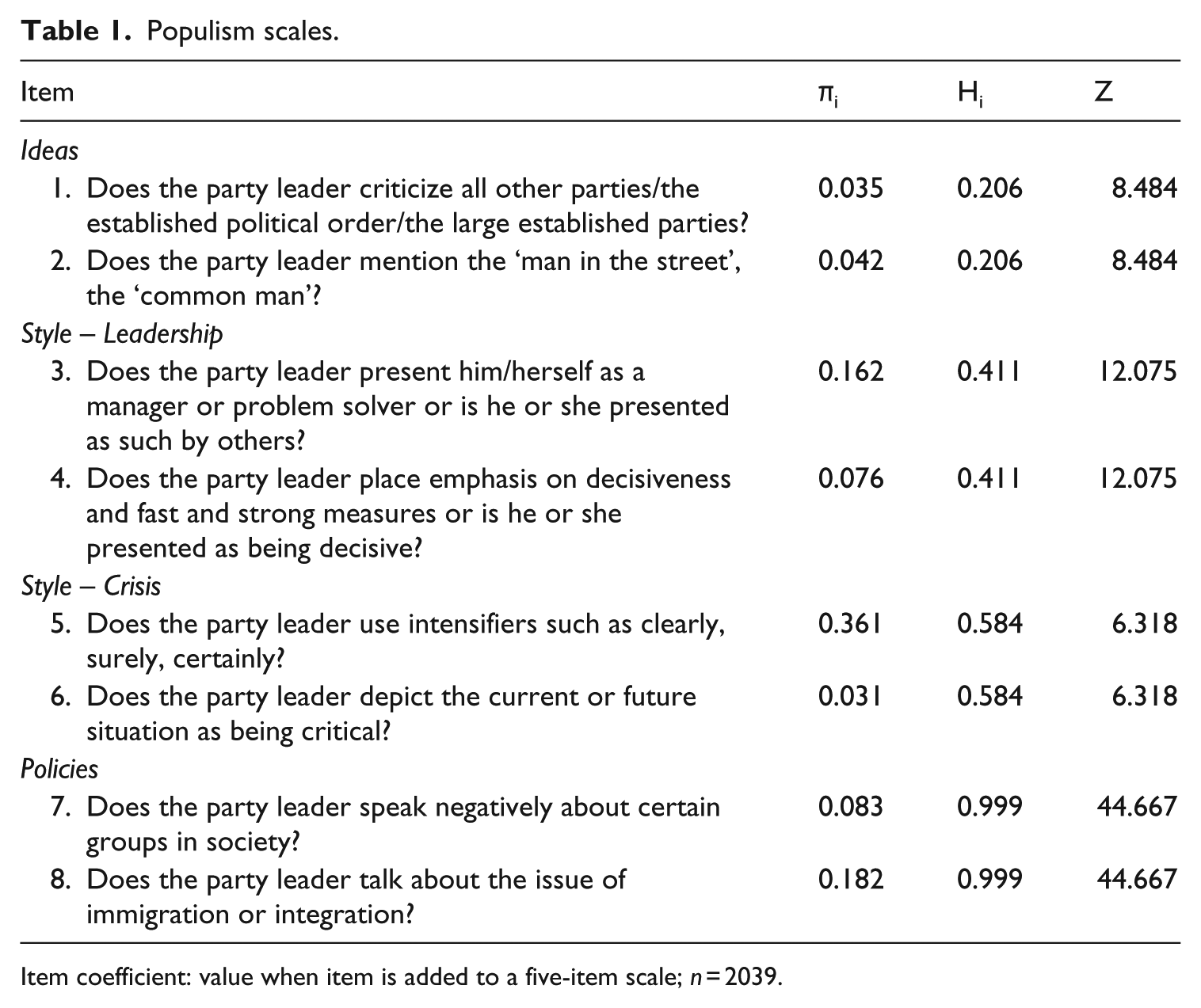
Item coefficient: value when item is added to a five-item scale; n = 2039.
On the basis of the popular assumptions and the conflicting empirical evidence we described above, we look at the general question of whether populism has increased, both in political and in media communication. In the first place, we researched the controlled publicity of PPBs to see whether – as an indication of a party’s intentions – populism by political leaders has risen, especially since the 2002 Fortuyn revolt. In the second place, we analysed whether, since 1994, populism in free publicity (newspapers, TV news and talk shows) has also increased, expecting this to be the case, but only since 2002. Subsequently, we compared controlled and free publicity, political populism and media populism, to see and make sense of where they differ or are the same. And finally, we make comparisons between parties and outlets to see whether the results differ.
Populism as reality
In analysing the content data, we first look at the development and levels of populism that the different party leaders have purveyed over the years in the ideas, style and policies they express in their PPBs. We illustrate this with typical examples of the persuasive rhetoric used.
The picture that emerges is one of fluctuation (see Figure 1). There is no clear increase or decrease over time, but there are some unexpected blips and bleeps. The use of populism by the leaders of the eight parties we researched is surprisingly at its highest in a period when the word was reserved for developments in other countries; not in 2002, when Fortuyn appeared on the stage, but in 1998, particularly in its style characteristic. Mainstream CDA and VVD leaders constantly emphasized their decisiveness, in particular, that year (‘We say what we mean and we do what we say’), while SP’s Marijnissen played the crisis card, referring to government policies as ‘shameful’. After 1998, these populist style elements steadily wither, all the way to 2012.

Political populism in party-controlled broadcasts.
Apart from 1998, there is another rise in overall populism in 2006 – the year LPF and EenNL were joined by Wilders’ PVV – followed by an even more significant drop. Both rise and drop are particularly the result of anti-establishment ideas that the parties express. The considerable increase of such ideas in their party broadcasts also helps in the upward turn of populism in the last election of 2012. But in his party spot that year, Wilders also warns the public ‘not to be fooled’ by ‘falsified statistics’ that cannot hide ‘the plane loads of immigrants that arrive at Amsterdam airport’. And, he added, ‘there is already too much Islam in the Netherlands. Enough is enough’. Policies of exclusion are gradually mentioned more in the PPBs after 1998, peaking in 2006, but, in spite of Wilders’ presence, dropping again 4 years later.
The small n makes it difficult to compare the different parties. Yet, F-tests show significant differences between party types in the overall amount of attention for the different populist dimensions (not looking at differences between years). Right-wing populist parties make more use of a populist style than mainstream parties (F = 8.262, df = 2, p = .001), but there is a high peak with the latter in 2002. Both right-wing and left-wing populist parties refer more to populist ideas than do mainstream parties (F = 8.163, df = 2, p = .001) and right-wing populist parties refer more to populist policies than both other party types (F = 13.896, df = 2, p = .000).
The SP has not displayed as much populist style and idea characteristics in its political broadcasts as it did in the 1990s, even though in popular parlance the label was not applied to any party in the Netherlands. As for right-wing populist parties, there is no clear trend, as populist style, ideas and policies fluctuate over time. Mainstream parties show a different picture: their PPB’s show an increase in populist style and policies over time that ends in 2006, after which it decreases. A similar picture emerges for populist ideas: it is quite constant until 2006, but then drops to disappearance in 2012.
The picture that emerges from media populism – the specific journalistic portrayal of party leaders in newspapers, TV news and talk shows – is both similar to PPBs and different (see Figure 2). There is, equally, no evidence of a clear trend going in one direction or another only that, after 2006, there is an overall drop of populism, the complete opposite from party ‘spots’ (political broadcasts). Also, the attention to the different populist characteristics differs significantly over the years. If we look at the sum of the populist dimensions, we see a rise in 2002 and, after a drop in 2003, a rise in 2006, after which populism reaches an all-time low in 2012.
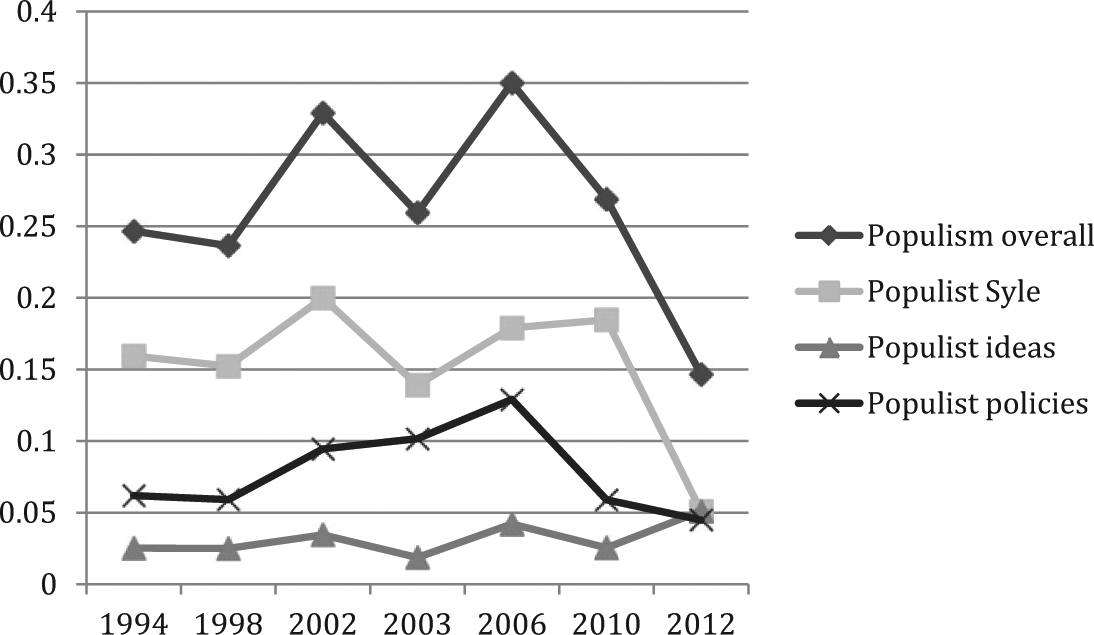
Media portrayal of populism.
A closer look reveals that there is a drop in populist style in 2003, after a small rise in 2002, and after a blip in 2006, style is at an all-time low in 2012. The amount of attention for populist ideas is relatively low and varies over the years, but there are no significant differences. Probably the most striking findings relate to populist policies. Whereas the figure shows an increase in the attention for anti-immigration populist topics, it is not until 2006, as compared to 1994 and 1998, that we find a significant difference in the amount of attention for exclusion policies. After that, the attention drops again.
Fluctuation is equally strong and sometimes confusing when we focus in on the different party types. Populist policies present the clearest picture. Anti-immigration and anti-Islam are exclusively right-wing phenomena with which these parties are connected in the media, with headlines like ‘New right finds everyone in fear of Islam’ (‘Nieuw rechts vindt elkaar in angst voor islam’, NRC Handelsblad, 17 November 2006, p. 2), ‘Haider di Rotterdam’ (‘Haider di Rotterdam poetst imago op’, NRC Handelsblad, 8 April 2002, p. 3) on the late Pim Fortuyn and ‘Fighting for our culture’ (‘Knokken voor onze cultuur’, de Telegraaf, 15 November 2006, p. 5). There seems to be hardly any spill-over to other parties and, if there is, the liberal VVD is the usual suspect. Moreover, for right-wing populist parties, there is a significant increase in 2006 compared to the years of the Fortuyn revolt, 2002 and 2003, when after his killing the LPF was joined by other, more peripheral parties (notably EenNL) competing for his will. After 2006, with Wilders and later Rita Verdonk joining the populist family, linking right-wing populist parties in the media with policies of exclusion declined.
When media cover right-wing populist parties, compared to their left-wing and mainstream counterparts, they are portrayed more as using a populist style, especially between 2002 and 2006. However, the VVD leader, in the election campaign of 2003, and his Christian Democratic colleague three years later receive substantial media coverage when they repeatedly blame their social democratic opponent of ‘lying’ and ‘prevaricating’ – an accusation until then an anathema in the consensual Dutch political culture, but clearly inspired by Pim Fortuyn’s anti-establishment discourse and rough style in 2002. Results also show that, contrary to the party broadcasts, in free publicity in the 1990s party leaders of VVD, PvdA and CDA are reported in more populist terms than the leader of the left-wing party at the time. This is the more surprising, because in the media and by his mainstream opponents, the savvy and popular SP-leader at the time, Jan Marijnissen, was often labelled as the prime proof that populism is not an exclusively right-wing phenomenon. His successor, Emile Roemer, a somewhat shyly-smiling school teacher, scored considerably lower in the 2012 elections, both qua expected seats and qua populist style. The three mainstream party leaders show in that same year a significant decrease in populist style.
As for populist ideas, both left- and right-wing party leaders are reported more in connection with such ideas than mainstream party leaders. In the 1990s, Jan Marijnissen was portrayed as more populist in his ideas than his mainstream colleagues. In 1998, Marijnissen, for instance, claimed that the protected world of universities, of which parliamentarians are a product, influences their experience, which is why they do not understand the problems of common people (NRC Handelsblad, 9 April 1998, section ‘Profiel’, p. 2). However, the media-focus on the SP’s anti-establishment and pro-populace ideas declined in 2002. After a peak again in 2010, 6 the SP’s populist portrayal was at an all-time low in 2012. If we look at the representation of populist ideas by mainstream leaders in the media, the results show a slight increase over the years. The peak in 2006 can mainly be attributed to EenNL, an insignificant and single-issue offspring of Fortuyn’s LPF. Its leader, Marco Pastors, argues in a radio spot and described in NRC Handelsblad that politicians do not want to see the danger of Islamization, which creates neighbourhoods where nobody wants to live. Overall, our expectation that populism in free publicity has increased is not confirmed.
Free and controlled publicity compared
The picture that emerges from the comparison of free and controlled publicity is that, first and foremost, the populism the political parties express themselves in their political broadcasts is on average considerably higher than the publicity the party leaders get from newspapers, TV news and talk shows. Otherwise, no clear and unidirectional pattern can be distinguished. With the exception of 2006, the amount of populism in the media does not seem to follow that of the party spots: The peak of the latter in 1998 is not reflected in the media and the reverse goes for 2002. Looking more closely, however, at the different media genres, that clear picture gets more and more blurred with extreme and unexpected outliers (Figure 3).
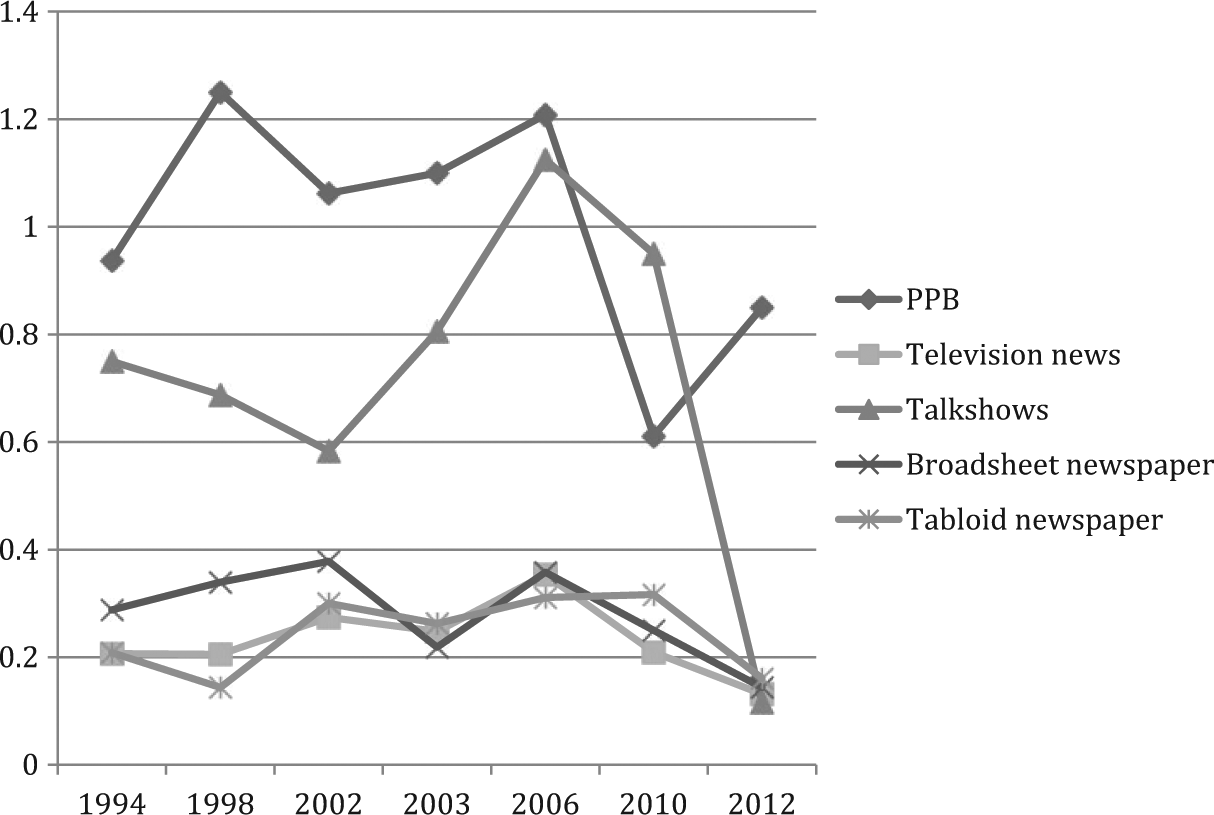
Populism overall in different media genres.
Figure 3 not only shows that until 2006 PPBs were the most populist overall, but also that talk shows are a good second and overtake the political spots after 2006. ‘Highly emotional’ style and ‘verbal radicalism’ seem obvious elements of these types of shows, which often focus on personal conflict and loud disagreement between guests. In light of the media popularity of Pim Fortuyn, 2002 looks an outlier but from other research, we know that he paid far less attention to this TV genre in the election campaign and focused on the more established outlets (Brants, 2004). The other outlets score considerably lower, while differences between them are small.
Change over time
To understand what affects the amount of attention for the populist dimension in the free publicity of the media, we conducted ordinary least squares (OLS) regressions to estimate to what extent the degree of populism differs over time, and whether these differences between parties and outlets change over time.
The results on the whole confirm what the graphs hinted at. Table 2 shows that populist style decreases over time. Yet, it is higher in the post-Fortuyn era. Moreover, we see that, keeping all other factors constant, the amount of populist style in talk shows decreases over time, while the opposite is true for the tabloid newspaper. Finally, differences are also found in the degree of populist style linked to mainstream party leaders: contrary to other (recent) findings, we find that mainstream party leaders are increasingly covered using a populist style, as time progresses.
OLS regression analysis predicting populist style in free media.

Entries are unstandardized regression coefficients. Standard errors between brackets; *p < .05; **p < .01; ***p < .001; n = 2003.
In Table 3, populist ideas is regressed on the explanatory variables. In this case, we see no clear trend over time: Keeping all factors constant, the degree of populist ideas does not increase or decrease over time. Focusing on differences over time, we see no increase or decrease in the amount of populist ideas in the various outlets over time. In fact, the only increase over time can be attributed to the coverage of mainstream party leaders in the different media outlets.
OLS regression analysis predicting populist ideas in free media.
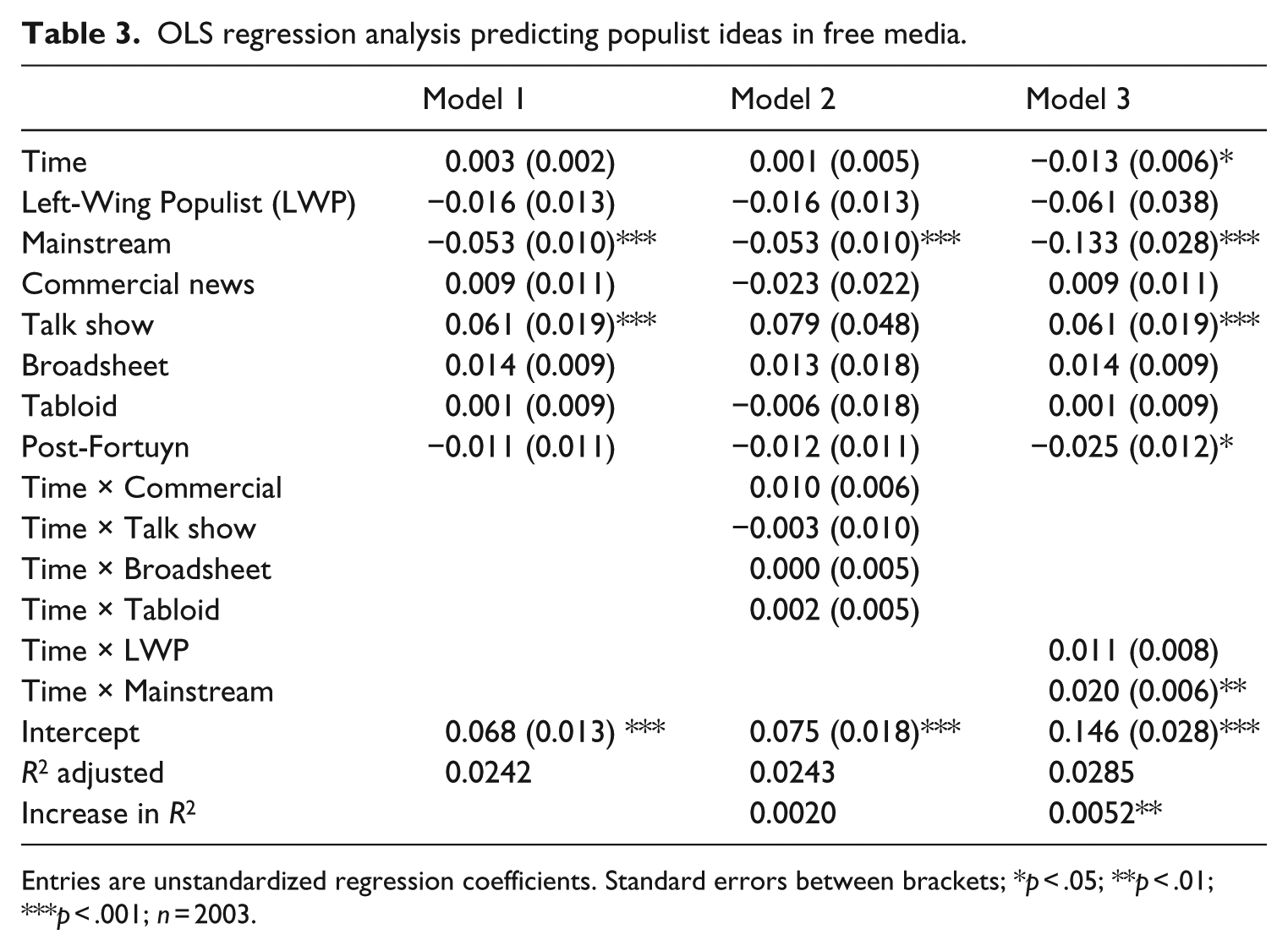
Entries are unstandardized regression coefficients. Standard errors between brackets; *p < .05; **p < .01; ***p < .001; n = 2003.
In Table 4, the same analyses are conducted for populist policies. Model 1 shows that there is a decrease in the amount of attention for populist policies over time, even though the intercept in the post-Fortuyn era is higher than in the pre-Fortuyn era. Even though the degree of populist policies is highest in talk shows, this front-runner role does disappear over time. Finally, even though we find a significant coefficient for the interaction effect testing whether the coverage of mainstream and left-wing populist-party leaders becomes more populist over time, the insignificant increase in the explained variance forces us to ignore this finding.
OLS regression analysis predicting populist policy in free media.
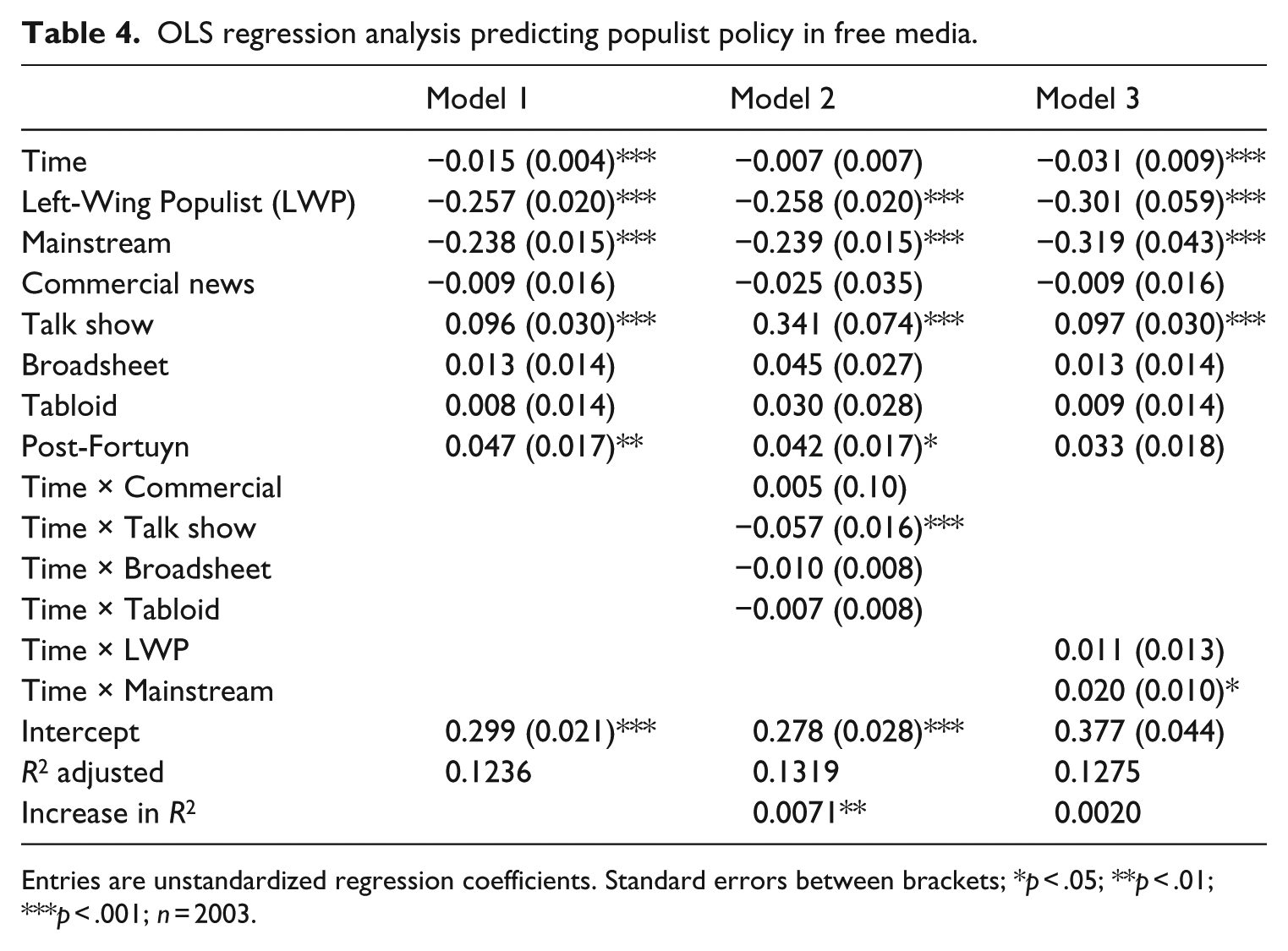
Entries are unstandardized regression coefficients. Standard errors between brackets; *p < .05; **p < .01; ***p < .001; n = 2003.
A closer look at the interaction terms tested in these regression analyses reveals a clear turning point. For populist style as well as populist ideas, the data only show a significant increase in the degree of populism in the media’s portrayal of mainstream party leaders up until 2006, vanishing afterwards.
Conclusions
The electoral developments since the rise and death of Pim Fortuyn, the sudden appearance and sometimes equally quick disappearance of a range of anti-establishment and anti-immigration parties and their popular party leaders have created a sombre picture of populism in the Netherlands. The publicized opinions of elite pundits from the left and the right, the public sphere of online and pub talk, all contributed to an image of doom and gloom. In spite of sometimes-contradictory empirical evidence, it was said that populism is on the rise and that it spreads to other parties, including the mainstream. Its outspoken style becomes a common feature in party propaganda, the core message is anti-establishment and so is its discourse of exclusion. The assumed rise is said to be reflected in the media, especially of the tabloid and talk-show kind, attracted by the outspoken style and the anti-status-quo policies.
The picture that emerges from our content analysis of TV news, talk shows, newspapers and PPBs, over a period of almost 20 years, is at best ambiguous and often looks more like a mirror image of what is claimed. In our research, we did not find a rise in populism, either by the party leaders in their political spots or by the media in their populist portrayal of those leaders. In fact, the media image over time of populist parties becomes less populist, a finding we also see from Rooduijn et al. (2014). It seems to point to a paradox of populist success: Those parties win because of their anti-establishment ideas but their electoral success means they have joined the establishment, which they can then hardly credibly criticize anymore. We also found in the media portrayal of other parties a slight decline after 2006 with regard to populist style and policies.
If a year of change should be mentioned, it is not 2002, the year of Fortuyn, but 2012, when Geert Wilders, after years of success, drops in the elections and populism disappears almost completely from the media, except for the PPBs. In fact, that year, populism in the media appears at an all-time low, as if journalists (and politicians) were alarmed by the gloomy picture that they had partly painted themselves. This result differs from the findings of Boomgaarden (2007), Adriaansen and Van Praag (2010) and Schafraad et al. (2009), who noticed that, since Fortuyn, news about immigration issues and populism in the Netherlands is on the rise. The difference may lie in the fact that they looked at all news about such issues – and thus more at general news-value media populism – where we focused on politicians in elections and whether media in their campaign reporting linked those politicians with immigration issues or reported that they spoke negatively about certain groups in society. Moreover, their focus is on the change up until 2006, whereas our data reveal a striking decrease after the elections of that year.
We also found a mixed picture regarding the spread of populism to other parties. With regard to the media portrayal, we did not find a general, significant spread of populism to other political parties after 2006. The outspoken style and anti-immigration rhetoric are (still) more characteristic of right-wing parties, although in the media representation anti-establishment ideas are also to be found in the populist-labelled SP, and mainstream parties have gradually copied some of the populist style. We did find, however, that populism is not only more prevalent in the controlled expressions of politicians than in the media portrayal but, over time, we see that mainstream parties increasingly follow the populist rhetoric in their party broadcasts, both in their style and ideas, and both until around 2006, but not with populist policies.
In their analysis of party manifestos in five European countries (including the Netherlands) over the period 1990–2010, Rooduijn et al. (2014) found no evidence of mainstream parties copying the populist example. They limited their analysis, however, to populist ideas where we included style and policies. Our results are more in line with those of Van Heerden et al. (2014), but the party manifestos they looked at are usually a more sedate expression of the programmatic issues the party stands for, while the PPBs we analysed are more propagandistic expressions of campaign communication and image-building.
The idea that populism is more a media phenomenon and, as such, typical of tabloid newspapers, we found to be not applicable to the Netherlands. There is even a slight decline in media populism, which seems to indicate a general tiredness of its style and rhetoric and ambivalence towards anti-immigration policies within some parties. In fact, populism in party propaganda scored higher than in the media’s portrayal, and also relatively little in the tabloid newspaper. Mazzoleni (2003) has argued that, contrary to the elite media that usually align with the status quo, tabloid media in their siding with the public and against the ‘corrupt elite’ are more likely to express anti-political and anti-immigration sentiments. In our research, de Telegraaf did not show much of this tabloid populism, a finding corroborated by evidence forwarded by Akkerman (2011), Bos et al. (2010) and Rooduijn (2013).
On the other hand, in line with Brants’ (2012) assumption, the most outspoken populist genre, and comparable to the party broadcasts, is the Dutch talk show, of which the public channels have many. A question still to be answered here is whether, with media populism declining overall, they are so anti-everything as an expression of cynical tabloid or champagne populism, or that they combine news-value populism – the tone, style and self-proclaimed deviance of populist leaders certainly fit such news-values – with the personalization and popularization so attractive in infotainment. In 2012, there was not much left of this talk-show populism, again maybe pointing to a short-lived phenomenon.
The sombre tone we began this article with – referring to the assumption that, since Pim Fortuyn, the Netherlands has become ferociously populist – needs re-tuning. The results of our research point at a much more varied and even ambiguous picture, in which populist styles, ideas and policies are far less prevalent in media and political parties than often claimed. The sharp decline we found for 2012 may be a glaring sun ray, but, as with all undulatory movements, one should be careful not to be fooled by a temporary low.
Footnotes
Funding
This research received no specific grant from any funding agency in the public, commercial or not-for-profit sectors.