




Abstract
Research on political speeches is commonly undertaken in countries where the president has a powerful position, typically in the United States. In the Czech Republic, too, political speeches are an important instrument for influencing public opinion. Meanwhile, few politicians are so known for their fiercely held opinions on the European Union as former President of the Czech Republic Václav Klaus; his speeches about the European Union are the subject of this article. Our research is based on quantitative and qualitative content analyses of the speeches posted on the former president’s website (http://www.klaus.cz) from 1995 until the end of his presidency in March 2013. Our goal was to identify the changes over time in how he spoke about the European Union, and whether and in what way his positions and vocabulary on the subject evolved.
Introduction
In recent years, the attention of scholars in political communication has turned to social networks, blogs and e-mails. But this type of political communication nevertheless represents only a fragment in a larger mosaic. For many decades now, speeches and communication in general have enjoyed relative pride of place in research across several disciplines. The new focus of researchers on political communication in new media has meant that research on speeches is growing very rapidly, and becoming ever more diverse. For now, however, we will discuss speeches as distinguished from written, visual or otherwise conveyed rhetoric (Beasley, 2012). 1
Rhetoric and public speaking have their roots in ancient times, when they were regarded as an important part of democracy. The art of public speaking maintained a privileged status, especially in the United States, with Keith (2007) even defining democracy as ‘governance through talk’ (p. 2). Within this discourse, speech is seen as an integral part of the public sphere contributing to the quality of democracy; therefore, efforts should be made to develop the art of rhetoric, which ‘can be characterized as the practical science and art of effective or efficient speaking and writing in public’ (Reisigl, 2008:96).
In this article, we will examine the speeches of the former President of the Czech Republic (CR), Václav Klaus (n.d.). What in particular makes the Czech president a subject of interest? In the United Sates, an entire branch of presidential studies has gradually come into being that makes special use of speech analysis. To a large extent, this is due to the prominence of the president’s position within the US system. According to Windt (1986), the president has at his disposal three main areas of power. The first is the power accorded to the president by the Constitution under law, the second is the weight he has as head of his party and the third is the power of public opinion. He writes that the situation in the United Sates differs in a number of respects from that in the CR, where the president is supposed to remain relatively above partisanship. Here, as in the United Sates, attention has been focused primarily on the first two (and particularly the first) of these areas of power. But the greatest power inherent in the office of president lies in the power of rhetoric, in the president’s capacity to influence the other elements of power and public opinion, thus propelling public discourse. Neustadt’s (1964) work sparked great research interest in presidential rhetoric and public speeches, which quickly became a part of the discipline of presidential studies. Interest in political speeches climaxed in the 1980s during the so-called rhetorical renaissance (Medhurst, 2008). Windt (1986) was the first to clearly define the field of presidential rhetoric, identifying four categories for research. The most frequent type examines individual speeches by the head of state, such as inauguration or other ceremonial speeches, or speeches made at moments of crisis (e.g. Ivie and Giner, 2011; Reisigl, 2008). The second type is ‘movement studies’, which follow specific events and developments in light of the historic or political context (e.g. Jamieson and Birdsell, 1988; Lim, 2002). Genre studies emphasize what various presidents have said on different occasions on similar themes to various audiences, while the final area consists of ‘miscellaneous research’ examining textual precision or the preparation of speeches.
Our research will be related to the second type: We are interested in how Klaus’ speeches and his criticism of the European Union (EU) evolved over time, and how he endeavoured to influence his audience. We suppose that Klaus, as strong political actor and president, should influence not just Czech public opinion but also partly create the picture of the CR and its position to the EU more widely.
The strong position of Klaus in the Czech political system is as a result of his long political career and his role in the post-communist transformation of the CR. As chairman of the Civic Forum in 1990, he was the driving force behind the founding of the ODS (Civic Democratic Party), which grew into the strongest party on the right, and of which he remained chairman until 2002. He served as premier in 1992–1997, but then encountered a number of problems related to the financing of the party, with the affairs touching Klaus himself. He soon faced a great deal of internal pressure within the party, and at the end of November 1997 submitted his resignation as premier. Though Klaus never returned to the office of premier, he remained one of the most prominent figures in the Czech political scene. After his defeat in the 2002 elections, he decided not to run for the post of party chairman again but instead announced his intention to seek the presidency. He was elected in January 2003 and re-elected in 2008, than he served as president until the end of his term in March 2013.
2003 was a watershed year for Klaus. In his new function, he was expected to take a position on current issues, especially the referendum on EU membership. But Klaus had already been regarded as a eurosceptic in his career to that point. His position on European integration falls into the ‘soft’ eurosceptic category characterized by Taggart and Szczerbiak (2002: 7) as qualified opposition to the EU based on hostility to certain policies or negative assessments of the overall costs and benefits of joining. He also remains a ‘eurosceptic’ in Kopecký and Mudde’s (2002) two-dimensional typology, 2 in that he rejects the existing forms of integration, rather than integration per se. Nevertheless, even using such broad comparative typology, it is clear that Klaus’ and the ODS’ revised post-1997 position was more radically eurosceptical than before (Hanley, 2004b). Our aim is to map the ways in which Klaus delivered speeches concerning the EU and to map the trajectory of change in his speeches.
Research questions
The chief question in research into presidential rhetoric is usually: ‘How does the president influence public opinion?’ Likewise, we ask what the president said on the topic of European integration and the EU, and how he tried to persuade his audience. Therefore, our main research question is ‘How did Klaus speak about the EU to his audience, and how did that change over time?’ Windt and Farrell (1992), in their work on presidential speeches, identified four qualitatively different rhetorical stages within the term of office of the American president. Because the Czech electoral system and the length of the president’s term in office differ from those in the United Sates, for analytical purposes we distinguish only three basic periods: 3 pre-presidential (when he served as chairman of the ODS, chairman of the Chamber of Deputies, Parliament CR and as premier), and his first and second terms as president. Dividing the two terms as head of state gives us an opportunity to compare any differences during these two 5-year terms, for we expect that the public statements of Klaus would change in relation to the fact that a president is limited to two consecutive terms in office. 4
In research on presidential speeches from 1789 to 2000, Lim (2002: 328) identified trends in the transformation of presidential rhetoric. According to his computer analysis, today’s presidential rhetoric is less formal and intellectual; it is more abstract, more assertive and activist. Our related questions are: Can we detect a certain bias on the topic of the EU (in comparison with other topics)? How assertive was the former president on this topic? We are interested in how his speeches about the EU were different from his other speeches, how assertive in relation to his audience the president was and how his activism manifested itself in his speeches.
According to Lim, today’s presidential speeches are more democratic – focused on the public and less exclusionary. Speakers use their speeches to try and get closer to the people; to do so, they may make use of particular rhetorical techniques. Typical of these are various metaphors, analogies, phrases and typical collocations. Very typical of Klaus, for example, was his frequent use of neologisms; therefore, we looked at how Klaus used language over the course of time and what other common aspects of his speeches related to the EU theme.
Method and data
For a long time, the analysis of political rhetoric has merely been carried out as a side job, both on the part of political scientists interested in issues of language, and on the part of linguists or rhetoricians interested in political issues. (Reisigl, 2008: 96)
This circumstance is also reflected in the way we approach research into these speeches.
The first main approach to examining speech content is that of discourse analysis. Some of these analyses are based more on the linguistic side (Emrich et al., 2001), with some being examples of the so-called critical discourse analysis (CDA), as presented for example by Wodak and Reisigl (2001) or Van Dijk (1997, 2006). 5
Instead of discourse analysis, the second approach uses content analysis (CA) of political speeches or written texts, often done with the help of sophisticated software (Laver et al., 2003; Yager and Schonhardt-Bailey, 2007 and others). But unfortunately such analyses made by software do not capture all the nuances of speech and are not suited to the Czech language.
For our purposes, the best suited method is CA, which is used in many areas of research into political communication (Benoit, 2012; Grabe and Bucy, 2012). (Quantitative) CA uses statistical methods but often fails to transcend the descriptive level, since it analyses messages in terms of their sources (politicians, parties), contexts, channels and the recipients of communications (the voters).
Our own analysis combines qualitative and quantitative CA. It begins with the qualitative CA (done on 20% of the total research sample, with speeches chosen from different periods). The analysis is based upon the similarity of patterns across speeches, speech construction, tonality, typical phrases and contextualization of speeches and argumentation, and served for the inductive development of categories (with the exception of some deductive categories tested in the first step). Reduction to simple categories was done in order to allow changes over time (or in themes) to be captured in a fine-grained manner. But the reduction is, of course, limited. The basic quantitative analysis is intended to be fundamental and serve to illustrate harder-to-grasp qualitative text interpretation procedures. The main analysis is thus based on qualitative data from the speech sample, with subsequent quantitative CA to capture major trends.
The qualitative analysis was undertaken by two researchers, the quantitative portion by a single coder (one, so as to avoid misinterpretation and ensure better validity and reliability). The quantitative analysis was performed using SPSS. 6 As with the majority of similarly constructed CA procedures, this analysis takes place on the descriptive level, using straightforward univariate and bivariate analysis.
The cases analysed come from a website to which Klaus posted his speeches. Because the site was set up in 2000, speeches prior to that year were posted retroactively. This probably impacted in our model in terms of the number of speeches in the categories. 7 The beginning of the data collection is set at the date of the first posted speech (3/1995); the last speech included in the analysis was also his last speech in the office of president (3/2013).
Variables in the quantitative CA
As we mentioned above, the first variable of importance is time, which we followed on the basis of the assumption that speeches and their messages were likely to have changed depending on the office Klaus held during the period.
The speeches themselves were divided into individual thematic units. In all, 470 analysed speeches yielded a total of 719 thematic units. 8 The ‘topic’ variable comprised up to 10 basic values, the most frequently appearing topic being the EU, which will be the subject of our study. The thematic units were those parts of the speech (or the entire speech) that were clearly thematically and logically framed.
A number of other variables were related to these thematic units. We were interested to discover whether the EU topic would reveal a bias vis-à-vis other topics and whether it changed over time. First off, we differentiate between value-based positions on the topic, either clearly positive or clearly negative in the speech, and noncritical positions (non-evaluative/non-judgmental). The noncritical approach comprises cases in which the overall message on the topic was strictly neutral. Within the critical (judgmental) approach, we identified three values: positive, negative and ambivalent. In the latter, neither a negative nor positive position predominated; instead the speaker spoke of the benefits and disadvantages of a given state of affairs.
Because we are interested in his assertiveness and activism (by which we intend an inclination to include personal elements in an obvious way, on the one hand, and to incorporate views into the speech, on the other), we examined Klaus’ projections in individual speeches. By ‘projection’, we mean the way in which the former president projected his own personality in speeches on the topic. Using qualitative analysis, we distinguished several typical types of speeches for him.
The first consists of cases in which Klaus, in remarking on a topic, emphasizes his personal contribution. 9 This factor was flagged whenever Klaus clearly spoke in a particular speech of his personal influence on the situation being spoken about. The second type, close to the first, comprised instances in which he emphasized his own experience and knowledge as related to the theme at hand. Unlike the first type, these were expressions of general erudition on the given topic that might lend weight to his opinion. Another distinct type of self-projection was identified as lecturing or ‘moralizing’. This was identified on the basis of two characteristics. The first was strong emotional colouring of the statement; the other was an attempt to lecture or educate the public on the topic. This type of projection would typically appear in situations when the former president was speaking about the situation in society.
The final type of projection, close to activism, involved Klaus presenting his opinion on how to solve a particular problem. These types of statements tended not to have such a strong emotional charge as the previous type. For our analytical purposes, we broke this category down further according to how ‘strongly’ the proposed solution was formulated. Solutions rated ‘mild’ were those which took the form of recommendations, indicated by the use of the conditional (‘we should/shouldn’t’, etc.). ‘Strong’ solutions and opinions were those using words such as ‘must’ or ‘mustn’t’, expressing greater urgency to take or refrain from a particular step.
In addition to these variables, the qualitative analysis of individual speeches focused on their construction; Klaus’ use of language in terms of word choice, repetition, favoured metaphors and so on; phrases and neologisms connected to particular events or periods and their contextualization and argumentation emphasizing the context of current events.
The EU in Klaus’ speeches
Our first point of interest in carrying out the analysis was how prominently the EU, a topic with which Klaus is still widely associated, figured in his agenda. For the initial period, the archive contains a total of 114 speeches, in 25 of which Klaus touches on the EU. In the two subsequent (presidential) periods, there are 181 and 175 speeches, with 51 of the former and 60 of the latter mentioning the EU. Altogether, Klaus spoke about the EU in 136 analysed speeches (Figure 1). Evident here is the previously noted increase in the number of speeches during the two presidential periods versus the preceding period, especially the steep rise in the number of speeches after taking office as president, something also reflected in the number of Klaus’ speeches which discuss the EU. This increase may not have occurred only because of Klaus’ newly assumed role as president; it probably also reflected the CR’s new membership in the EU as of 1 May 2004.
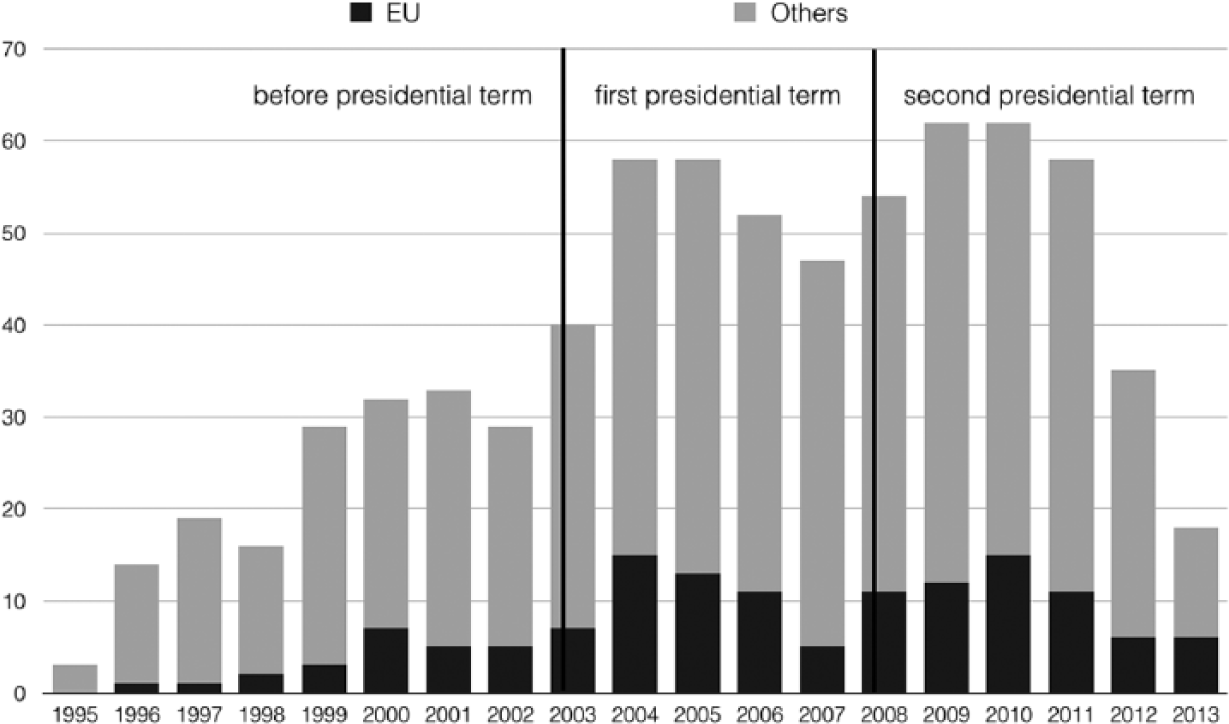
Number of Klaus speeches for individual periods.
For Klaus, the EU was a special topic not only in terms of the number of speeches he delivered which mentioned it, but also as regards the importance of these speeches and the things he had to say. He is known as one of the EU’s most vocal critics. Although there was a marked gap between the rhetoric and the reality of Klaus’ neo-liberal policies as premier, his espoused belief in the merits of the market spilled over into his view of European integration (Haughton, 2009: 1383). Although there is a certain consistency of content in the speeches, we will show below that the bias in the case of these speeches became ever more pronounced, and his criticism more intense in comparison to speeches on other topics. 10
In almost two thirds of cases (62%), the attitude expressed in the speech towards the EU was negative, while for other topics, a negative attitude was expressed only 23% of the time. Klaus referred to the EU in positive terms in only 3% of his speeches (versus 38% on other topics). He spoke in neutral terms of the EU in 8% of speeches and ambivalently in 27%, expressing opinions containing both positive and critical passages.
This criticism of the EU was based on some of the axioms of economic liberalism, to which he made frequent reference. For Klaus, the EU’s high degree of centralization is an obstacle, especially economically, reinforcing ‘the socialization of Europe’ instead of liberalization. Klaus’ euroscepticism is rooted in both the Anglo-Saxon economic critique of the EU as an inefficient, over-regulated and ‘socialist’ structure dominated by self-seeking bureaucratic elites, as well as a ‘national critique’ of the EU as a threat to Czech national sovereignty (Haughton, 2009: 1383).
As Figure 1 shows, there were three points – around the years 2000, 2004 and 2010 − when the former president paid especial attention to the EU. On the other hand, there are much fewer references to the topic of the EU in 2007, that is, just before he began his re-election campaign.
First period
The first period of analysis, from 1995 until he took the oath of office as president on 7 March 2003, was marked by a number of important events that were reflected in Klaus’ speeches as well. Klaus spoke of the EU in 14% of the speeches analysed, often in the context of continuing preparation talks with the CR. The EU was most often referred to negatively in the speeches; this was the case for a full half of the cases, while only 4% of the speeches were positively toned.
In the 1990s, Klaus’ criticism had to do especially with the direction of EU integration. According to Klaus, the problem had begun with the signature of the Maastricht Treaty in 1993 (which he called the ‘Maastricht Stew’). Since that time, he said, the EU has suffered from an excess of pointless unification threatening the national identity of its members:
Today’s degree and manner of European integration already has strongly negative effects, to the point that the positive effects are drowned out. (Klaus, 2009: 185)
In a 2000 speech, he adds that the trend towards European unification must be examined without resorting to cheap political rhetoric. We observe that although he criticizes the processes of integration beginning in the mid-1990s, he is initially not as emotional. As premier and then as chairman of the Chamber of Deputies, he backed membership of the EU for two reasons in particular: the economic advantages of integration and the majority opinion that EU membership is a sign of a standard, developed country (Bugge, 2003: 191). The fact that he spoke critically of the EU stands out in comparison with his remarks on other topics, with Klaus speaking negatively or positively on this or that issue in precisely a third of the speeches.
While Klaus’ critical attitude towards the present direction of the EU is well known, his own ideas about European integration are less so. In other words, his negative positions overshadow his own opinions on alternative forms for European integration, though he has indeed tried to argue them to the public. As for assertiveness on the topic of the EU, it was characteristic of these speeches that Klaus often (68%) presented his own opinion. In 41% of the cases, he did so using the imperative phrasing with the verbs ‘we must’ or ‘we must not’ (‘do’ or ‘allow’), which represents an urgent appeal to his audience:
The Czech Republic must not allow itself to dissolve in Europe like a sugar cube in a teacup. (Klaus, 21 December 1998)
Besides criticism of the overall direction of the EU, Klaus also addresses the (potential) status of the CR within the framework of the EU. In 1998, he emphasized that Europe was definitely attractive but asked from what position this was true. He laid out two possible scenarios: Either Europe is a ‘neighbourhood’ to which the CR must adapt, or it is an entity that the country can help to shape as a player. He answered himself by saying that the CR is too weak to impact the shape of Europe, not because of its size but because of its internal divisions. Klaus has objected to the country’s loss of sovereignty to the EU ever since the early 1990s.
Klaus’ speeches at the turn of the century make it clear that his criticism is mounting and becoming more emotional. At the 1999 ODS party congress, for example, he rejected attempts to fetishize the EU as an unquestioned, unquestionable model for seeking solutions to contemporary problems within the CR.
From 1999 to 2002, the number of speeches published was almost double that of preceding years. The proportion of speeches in which he spoke about the EU also rose. The most frequent target of criticism during these years was the European Monetary Union and the common euro currency. In a December 2001 speech, Klaus argued that monetary union could not function without a political union, but took an emphatic stance against greater integration. For this he reaped criticism from the Czech political community, and was later forced to defend his comments on the floor of the Chamber of Deputies.
As noted, we also examined other typical Klausian expressions of assertiveness. During the first period of study, not all had been expressed. Considering the frequency of these elements (lecturing and moralizing) in later years, this may be surprising. But it should be recognized that at this time, Klaus had a determining influence on the formation and shaping of Czech politics, including steps taken to join the EU.
Klaus generally liked to use emotionally tinged expressions, phrases and adjectives to enhance the message’s impact (he was deeply touched; he was very dissatisfied, etc.). Connected to the EU as a topic, one also encounters: locations such as ‘creeping Europeanization’ (or bureaucracy), ‘planetary (or pan-continental, supra-national) ambitions’, ‘extraordinary insensitivity’ and ‘fatal error’. His style was frequently and easily parodied. But even controversy helped to raise his visibility (Pehe, 2010: 279). By that time, Klaus’ vocabulary had begun to show more frequent use of the terms and emotive collocations that he would use for the next 10 years.
Second period
Klaus held on to his typical rhetorical style as head of state without serious consequence. As he took presidential office, the number of archived speeches in which he talked about the EU jumped sharply, both in absolute numbers and in proportion to other topics. While before he had talked about the EU in roughly one of six speeches, as president he mentioned it in every fourth. The number of speeches devoted to the EU may be a function of the president’s position as co-shaper of foreign policy: He became president in 2003, just before the CR became an EU member.
The first major opportunity for Klaus to express himself as president on the topic of the EU was the CR’s referendum on EU membership. He publicly criticized the ‘Yes’ campaign for trivializing accession, for failing to conduct any serious debate and for wasting public money. More significantly, Klaus declined
to publicly advocate a ‘Yes’ vote – or to say how he would be voting in the referendum, justifying his stance as necessary to underline the political neutrality of his office and confining himself simply to an appeal to citizens to vote in the referendum. (Hanley, 2004a: 704)
Klaus was the only head of an acceding state not to recommend a ‘Yes’ vote.
We observe a major increase in the number of speeches about the EU in 2004, with the CR becoming a member on 1 May. In his speech that day, he warned against unreasonable expectations which might lead to disillusionment. He dampened the enthusiasm of some politicians by saying that joining the EU is no free ride to paradise and questioned whether EU membership was really what Czechs wanted. Klaus saw membership of the EU as ‘a marriage of convenience’ (Klaus 30 April 2004) and the deepening problems of the EU reaffirmed Klaus’ critical attitude towards the existing shape and direction of the EU.
In politics, certain phrases or slogans are telling and easily remembered, and become well established; these often carry some kind of emotional or value judgment. In Czech politics, for example, there are the phrases ‘Sarajevo Assassination’, ‘bad mood’ and ‘belt-tightening packages’. The first of these is the work of Klaus, and refers to the 1997 crisis in the ODS and calls for Klaus’ resignation by party opponents. Klaus was at Sarajevo at that time, a location linked to Ferdinand d’Este’s assassination there in 1914. Klaus liked to work with such neologisms, and we find some of them in this second period in the EU context. The most typical of these is undoubtedly the term ‘Europeanism’, an ideology of uncritical faith in ever-deepening European integration and the vision of a European nation. Klaus began to use the term around 2004 and battled it for the entirety of the ensuing decade. This span of time covers both his earlier criticism of what he saw as the rushed, ‘rah-rah’ nature of accession to the EU and blind faith in European institutions. Klaus criticized the EU’s democratic deficit, and the drawing away of decision-making power from its citizens. Klaus saw this as the main threat faced by the EU countries:
No European political nation exists; and therefore the role of the national parliaments as safeguards of democracy is irreplaceable. (Klaus, 28 September 2004)
Another important theme was the CR’s referendum on the Treaty for a European Constitution, and the ‘No’ votes on similar referenda in France and the Netherlands. These ‘No’ votes led him to devote major attention to the EU in his New Year’s speech in 2006. By custom, the New Year’s speech is more or less a summary of the previous year’s events, along with a few inspiring words for people for the upcoming year. But Klaus nevertheless took the opportunity to sharpen his criticism of the EU. More often his speeches featured terms such as ‘European super-state’ and criticism of the EU for pursuing social democratic economic policies.
With the approach of the end of his first term in office, the frequency of his mentions of the EU decreases and there is less vehemence present. This ‘toning down’ may have been due to a lull in events on the European scene, or that the CR was in a post-election situation. Klaus is a pragmatist, however; so it may even have been a calculated step on his part. In January 2008, he sought re-election by the deputies and senators of the Parliament of the CR. Klaus was well aware that his opinions and positions on the EU were poorly received by many of the other politicians, and this topic could have weakened him during the election. Although the number of speeches he devoted to other topics remained the same as in previous years, he spoke much less often of the EU. His emphasis on these opinions and the vehemence of criticism tailed off near the end of the term, as well.
For these reasons, his assertiveness was not appreciably stronger than it had been in the previous period. The tendency to push forward his own argument was, in comparison with the previous period, actually somewhat less: 55% of cases. What was new was a degree of lecturing and moralizing that had previously been absent in his discussions of the EU. This may have been the result of the change in his position as he assumed the office of president. During his first term, 18% of his speeches dealt with the EU. His critique targeted the ‘ruling states’ and their power tendencies. Klaus criticized European politicians and intellectuals for trying to strengthen Europe against the ‘rest of the world’. According to him, this demonstrates a naïve faith that ‘big’ is better. But this is fatal error because Europe is and for a long time will remain a conglomerate of separate countries; there is no such thing as an ‘authentic European people’ (Klaus 22 June 2004).
The case of the EU shows most clearly that Klaus saw the office of president not merely as an instrument for influencing Czech citizens. He also saw the EU as not just a foreign-policy issue but a crucial matter for the entire CR. This was also reflected in Klaus’ efforts to present himself as the defender of national interests.
Third period
During this period (that of his second presidential term, 7 March 2008 to 8 March 2013), too, the EU was Klaus’ most frequent topic, and as we indicated above, he was more critical and emphatic than he had ever been before. He argued his own opinion in three quarters of these cases, with a like rise in the proportion of speeches during which Klaus spoke negatively of the EU (78%). This represented a major increase over the previous analytical period. These critical speeches particularly concerned the economic crisis and the euro-constitution, later the Treaty of Lisbon. Klaus referred to the Treaty of Lisbon, which dominated the agenda from 2007, as a tragic mistake. As with the euro-constitution, he offered a differing vision of integration featuring a return to bilateralism and to the rule of unanimity in deciding key matters. According to Klaus, Europe should move from union to community, not the other way around. The fight against the Treaty of Lisbon became the most important and most visible issue of Klaus’ second presidential term. The figure below shows a major increase in negatively laden speeches on the EU during the third period of the study. These stand out especially in comparison to the significantly lower proportion of negative messages in his speeches on other topics (Figure 2).
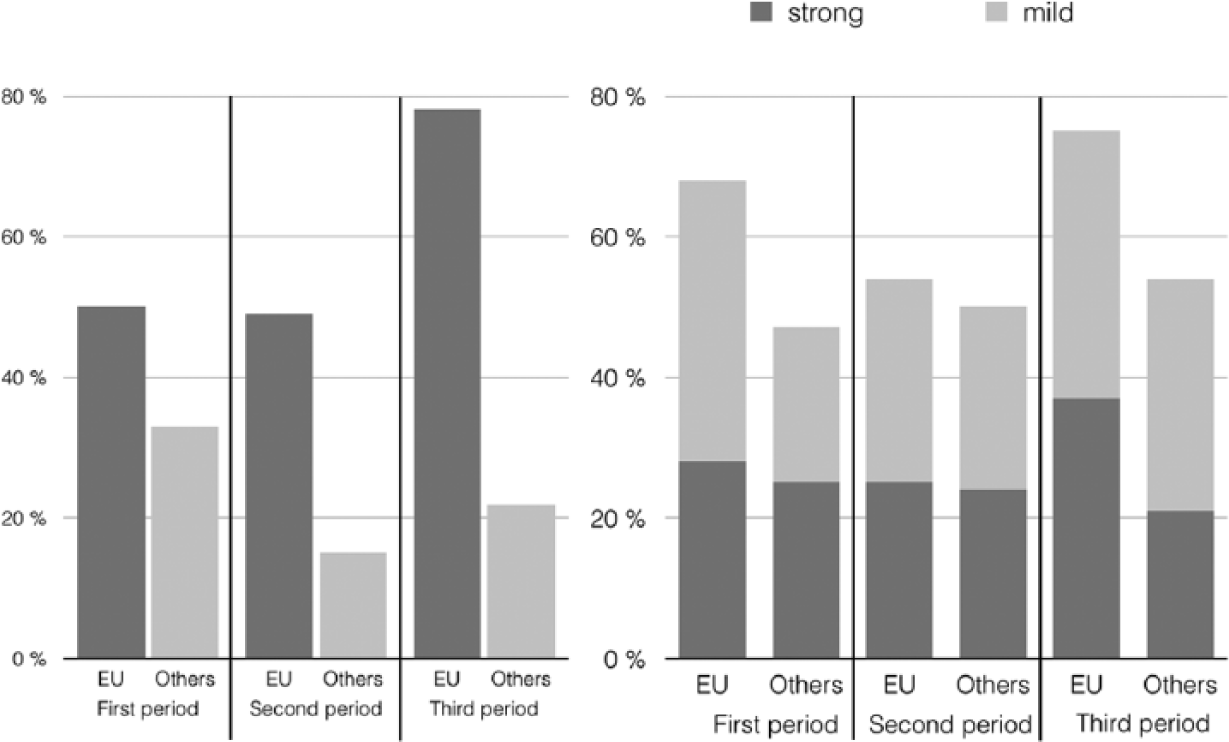
Negative position, and advancement of own opinion. The graph on the left shows the percentage of negative speeches on the topic for individual periods analysed. The graph on the right shows the percentage of cases where Klaus presented his own opinion in speeches devoted to the European Union and a comparison with other speeches analysed.
It was his dissenting view on the Treaty of Lisbon that accelerated the split between Klaus and ODS, the party he founded, at the ODS congress in 2008. Klaus called the Irish referendum that had rejected the Treaty of Lisbon the ‘victory of freedom and good sense over artificial, elitist projects and the European bureaucracy’ (Klaus, 13 August 2008). At the ODS congress Klaus also declared that the treaty fundamentally changes the constitutional order of the CR. This speech brought on a sharp exchange of opinions between Klaus and then-premier and ODS party chairman Mirek Topolánek. The CR ratified the Treaty of Lisbon in 2009, but Klaus’ criticism of the treaty continued unabated. Klaus never had far to go for strong words, and referring to Munich 1938 11 and August 1968 12 described the ratification vote by the senators as yet another failure on the part of an important segment of the Czech elite (Kopeček, 2012: 235).
A major increase in critical and negative speeches about the EU enhanced perhaps by the fact that Klaus no longer had to worry about re-election, resulted in deteriorating relations with many of Europe’s political elites during the Czech EU presidency. Very evident in his speeches was an increased degree of activism, not only in stressing his own experience (17%) or personal contribution (10%), but especially the element of lecturing and moralizing. While during the first period under study these elements did not appear in any speech, during the third period they appeared in more than a third (37%) of his EU-related speeches.
Further escalation of tension between premier Topolánek and president Klaus occurred during the CR’s EU presidency in the first half of 2009. Not only for the premier, but for every politician in the government, this was a prestigious event of enormous significance. Klaus, however, saw the EU presidency as an organizational matter with little political importance. He had no intention of subordinating his stance to the prevailing notion of the Czech elite: that during the EU presidency it would be best to ‘swim with the main European tide’. A small country, he argued, has no chance to make a significant impact anyway, as the EU is run by the larger countries (Kopeček, 2012: 226). On the floor of the European Parliament, he argued that although there is no alternative to Czech membership in the EU, European integration can take a number of possible and legitimate methods and forms. The EU itself he labelled a revolutionary experiment, and its institutional structure as irrational. Attempts to speed up and deepen integration, said Klaus, could threaten all the positive things that had been achieved in Europe over the last half-century (Klaus, 19 February 2009). As an economic liberal, Klaus criticized the EU’s economic system and its ever-more-powerful central economic planning, which suppresses the free market (Klaus, 19 February 2009).
It was no surprise, then, that Klaus opposed Czech participation in the fiscal union when it began to emerge in practice in 2011 and 2012. Unlike the Treaty of Lisbon, however, his view of the matter corresponded with that of the centre-right government of (ODS Chairman) Nečas. Thus, the CR, along with Great Britain, refused to participate during the initial stages of this step towards further integration.
Summary
As the analysis of speeches presented here has shown, Klaus’ positions and opinions on the EU have been remarkably consistent. Starting at the time he served as premier of the government that began negotiations for the accession of the CR to the EU, he was openly critical of the integration process and other aspects of the EU he saw as negative. Since that time, there has been a palpable increase in the intensity and urgency of his critique.
Although Klaus has often been accused of negativism in his critique of the EU and the direction it is taking, on many occasions he has defended his position with strong arguments and proffered alternative solutions. These have often come in the form of proposals that were, however, unacceptable to his critics, for whom they represented a step backwards on the road to European integration.
During the final study period, there was an increasing sense of urgency in Klaus’ speeches on the EU. The topic began to come up even on occasions at which it seemed out of place (including diplomatic visits by non-European countries). All this, combined with an increased tendency to insert his own opinions in his speeches and his use of strong adjectives and normatively tinged neologisms, forms a unique mosaic which has made Klaus’s position on the EU known far beyond the borders of the CR.
Footnotes
Funding
This article was created as a part of the special project Elections, Political Parties, and Interest Representation II (code MUNI/A/0846/2013).