



Abstract
This article compares the visual representations of the female headscarf in Islamic and secular newspapers in Turkey during the 10-year rule of the Justice and Development Party (Adalet ve Kalkınma Partisi (AKP)). This study is based on a content analysis of all visuals from three election periods (November 2002, July 2007 and June 2011) and two neutral time frames outside of the elections (August 2002 and August 2012). It also includes a qualitative analysis of the news articles that showed pictures of successful women wearing headscarves. The results show that the number of women wearing headscarves increased in both Islamic and secular newspapers between 2002 and 2012. The increase is not only more prominent in Islamic newspapers but the valence attached to headscarves and to the women wearing them is also qualitatively different. This article argues that the Islamic newspapers have created an image of a new ideal conservative woman that ignores the worsening conditions for women in general and AKP’s increasingly restrictive gender politics specifically.
In January 2008, Turkey’s Islamic-rooted Justice and Development Party (Adalet ve Kalkınma Partisi (AKP)) proposed amendments to the constitution that allowed women to wear the headscarf in Turkish universities. During debate over the proposal, some members of the parliament even suggested that images of acceptable style of headscarves accompany the new policy (Cemil Çiçek, NTVMSNBC, 2008). The proposed amendments were rejected, but debate has continued, and the university ban on headscarves has since been gradually lifted. Turkish secularism was based on the exclusion of Islamic symbols from the public sphere, and the female headscarf has been an iconic and multilayered symbol of the struggle between the secularists and Islamists (both patriarchal in different ways) over Turkey’s democratization and whether the headscarf is a symbol of religious freedom or the oppression of women. AKP’s rise to power with majority of seats in the parliament in 2002 and its consolidation of power in the ensuing elections of 2007 and 2011 – with 47% and 50% of the vote, respectively – brought the visual representation of gender to the fore in public discourse.
This article looks at how this foregrounding has been mirrored in the Turkish press. What does the rule of AKP, which is the first ever Islamist party in power in Turkey, mean for the representations of headscarf in the Turkish media? Are there any major changes or emerging themes in the visual representations of headscarf in both the secular and Islamic press between 2002 and 2012, during 10 years of AKP rule? I aim to provide answers to these questions and discuss their implications for gender politics in Turkey. I explore the images of the female headscarf in four Islamic and secular newspapers by taking three national elections as landmarks (November 2002, July 2007 and June 2011) and two neutral time periods between August 2002 and August 2012. My overarching purpose is to contribute to feminist scholarship on women in Muslim majority societies from the perspective of visual communication.
My analysis shows that during the AKP rule women with the headscarf have become more visible in both the secular and Islamic newspapers, with a more noticeable increase in the latter although with qualitative differences from the former. Islamic newspapers carry images of successful women wearing headscarves; this emphasis challenges the secularist cultural myths about the headscarf and helps construct an image of the ‘ideal’ woman for conservative middle and upper classes. While this emphasis on successful women who wear the headscarf may have opened up spaces for women wearing it, it also has an adverse effect: a blindness to discrimination against women on multiple fronts, particularly by AKP’s policies and the deeply entrenched patriarchal structures in conservative religious circles. The results also show that female columnists in Islamic newspapers have moved from margin to centre, yet, as a formerly oppressed group, they have actively become part of the conservative hegemony established by AKP, bringing new challenges for the feminist movement in Turkey.
Background: AKP, Turkish press and the headscarf debate in Turkey
AKP was described by some as a ‘Muslim democrat’ party (Çayır, 2007) and by others as a ‘conservative democrat’ (Heper, 2006) or ‘moderate Islamist’ (Onar, 2007) contingent. AKP has been increasingly authoritarian in its third term, which started in 2011, and has overtly committed itself to a programme of Islamization, thus replacing authoritarian secularism with authoritarian religious conservatism, which includes a conservative, religious gender politics. AKP’s authoritarian policies eventually led to massive protests throughout the country in May 2013 and subsequent months. 1
Since AKP’s rise to power, the headscarf ban has remained a sensitive issue for the party, which has tested the waters several times to ascertain the limits of its power in the face of secular establishment. AKP eventually won the battle. By October 2014, the headscarf ban was removed not only in universities but also in all schools from fifth grade onwards, allowing girls as young as 10 years to take it up. 2 Extending the removal of the ban to schoolgirls made this ‘right’ questionable. While lifting the headscarf ban seems to be an important expansion of the freedoms and rights for adult women who are wearing it and were previously prevented from fully participating in public life (e.g. they could not get university education, hired at public institutions or become members of the parliament), AKP’s gender policies did not actually lead to a real expansion of freedoms and rights: instead, they have revealed deeply entrenched patriarchal structures in the party cadres, rendering the removal of the ban almost redundant for women’s rights. AKP’s patriarchal policies on ‘the family’ actively encourage women to stay home as mothers, caretakers and homemakers. Since 2012, the AKP administration significantly restricted women’s access to abortions and caesarean sections, put pressures on unmarried couples and coed dormitories. The party also gradually removed all the major institutionalized structures of the government that were built to fight gender inequality. 3
The press is one of the most significant carriers of the headscarf debates and an arena in which images of women, Islamic and secular, represent competing values within a highly polarized political landscape. The Turkish press is usually characterized as comprising Islamic and secular newspapers (Bayram, 2009; Dursun, 2006; Gül and Gül, 2000; Hortaçsu and Ertürk, 2003; Marshall, 2010). The secular press has been one of the leading actors and supporters of modernization since the establishment of modern Turkey in 1923, while the Islamic press gained momentum after the 1980s with the liberalization and privatization of the media and the rise of political Islam. According to Göle (1997), the political environment opened up a space for a ‘counter-elite’ out of the leading Islamist authors of the 1990s. Following this view, the Islamic newspapers could be seen as ‘counter-publics’ 4 that challenged the hegemony of the mainstream secular press.
Under AKP rule, the power balance between the Islamic and the secular media shifted. While the Islamic newspapers received considerable support from the government, the critical secular newspapers have been marginalized, co-opted and silenced through ‘fines over taxes’, ‘judicial suppression’ and ‘accreditation discrimination’ (Akser and Baybars-Hawks, 2012). Media ownership structures have also changed: television channels and newspapers once owned by secular groups were bought up by pro-government and pro-Islamic groups. Although Turkey had never been a heaven for journalists, government pressure on the media, combined with commercial pressure and self-censorship (Yesil, 2014), has reached unprecedented levels. As Akser and Baybars-Hawks (2012) put it, ‘never in the history of media in Turkey were the redistribution of media power and the silencing of journalistic expression this paramount to political debate’ (p. 305).
The prominence of the headscarf debate parallels the rise of Islamic media from 1980s onwards. The first scholars who studied the headscarf debate focused on its visibility in the public sphere. Using a Habermasian framework (Habermas, 1962), Göle (1996) argued that representing women without the veil or headscarf constituted the backbone of Kemalist ideology and the formation of the public sphere in Turkey, signifying the transition from the Islamic Ottoman Empire to the secular Turkish Republic. 5 Çınar (2008) has suggested that the public sphere acts ‘not only as a disembodied voice but also as a regime of visibility produced through the media and the state-mediated discourses’ (p. 894). The founders of the Turkish Republic, together with the mainstream secular media, created a system of visibility that excluded the headscarf as traditional and backward, drawing the contours of what can be legitimately represented in the mainstream media. Today, as the results of this study show, the Islamic newspapers actively challenge this system of visibility and the secular narrative on the headscarf by creating a new ideal image of the conservative woman who moved from victimhood to success, from margin to centre. Secular newspapers have responded to this transformation by providing counter-narratives on the headscarf. Yet, unlike in the past, their narratives avoid confrontation and retort to the modernist narrative.
Islamic and secular newspapers do not inhabit totally different universes. There are similarities and crossover between them. First, they are both part of a patriarchal system. Studies show that the female body is treated as an ideological battleground in both Islamic and secular newspapers (Çetin, 2010) and male discourse dominates the news about the headscarf in both (Mengü et al., 2009). Both types of newspapers depict women in passive roles; this tendency is more pronounced in Islamic newspapers, except when women make demands for the right to wear headscarf (Hortaçsu and Ertürk, 2003: 2034). Islamic newspapers contain more references to the female headscarf (Hortaçsu and Ertürk, 2003). Yet, women with headscarves were not on the front pages of Islamic newspapers even when the headscarf ban had become a national debate (Mediz – Women’s Media Watch Group, 2008: 86). Women are mainly imaged without the headscarf in both Islamic and secular newspapers. According to a study based on a sample of Islamic and secular newspapers in 2005 (Özcan, 2009), 84% of women in the newspapers did not have headscarves although the percentage of women not wearing headscarves in the population was 36.5% (Çarkoğlu and Toprak, 2007: 63). According to Bayram (2009), the only consistent difference between the two types of newspaper was ‘the word choices in referring to the banned dress: anti-ban discourses consistently used the word headscarf, and pro-ban discourses consistently used the word turban’ (p. 533), the distinction being part of a rhetorical struggle between the two opposing camps to legitimize or delegitimize the garment by linking it to different cultural and political connotations. 6
As a powerful icon in Turkish politics and culture, the headscarf has been analysed from various disciplinary perspectives in an ever-growing body of literature. However, despite the growing body of literature on the subject, there is conspicuously little attention paid to the visual aspect of the media representations of the headscarf. There is, thus, a strong case to make for visual analysis. When women are in the news, they appear with accompanying pictures more often than men (Global Media Monitoring Project, 2005: 52; İmamoğlu et al., 1990: 61) and the way the visuals are used is gendered (Global Media Monitoring Project, 2010: 17). For Stuart Hall (1982), the newspaper ‘translates the legitimations of social order into faces, expressions, subjects, settings and legends’ (p. 234). News photographs are not just illustrations; they work as ‘very effective tools for framing and articulating ideological messages’ (Messaris and Abraham, 2001: 220). Goodnow (2005: 360–361) argues that the news photograph is positioned in the greater cultural myth and ‘have the power to challenge, affirm, or reconfirm that larger narrative’. Similarly, the images of headscarves play an active role in the struggle between the competing discourses by underpinning the cultural myths about the headscarf in both Islamic and secular newspapers.
Furthermore, in textual content analysis, researchers often use keywords to retrieve articles, and the keyword search produces results solely based on the ban – where the headscarf is framed as a problem. This approach has a limiting effect: the images of women with headscarf are tied to the headscarf ban only in rare instances. Therefore, an analysis of these images and accompanying news items give a better idea about the symbolic uses of the headscarf, as well as how different newspapers employ such images. On this basis, I aim to answer the following research questions:
Has there been an increase in the images of women with headscarves between 2002 and 2012?
If so, what changes have been taking place in Islamic and secular newspapers?
In what ways are the women with headscarves represented in stories where they are the primary focus? What are the differences between the Islamic and secular newspapers?
I will then discuss the implications of the findings for women with and without the headscarf and the wider gender politics in Turkey.
Method
To answer these questions, I used a qualitative variation of content analysis (Schreier, 2012) to look at the number of women with headscarves in newspapers between 2002 and 2012 in an exploratory design. I followed Mendes’ (2012) approach and used content analysis as a ‘springboard’ (p. 558) for a qualitative discussion. As Smith and Price (2005: 154) argue, content analysis is useful not only for hypothesis testing but also for addressing research questions in exploratory designs. Using this approach, I did content analysis to gain familiarity with various types of headscarf images in the newspapers to see in what ways they are used and whether there is an increase in the number of such images over time. Then, in an in-depth qualitative analysis, I focused on the stories where the women in the pictures were the primary focus.
The largest newspaper archive in Turkey is in Atatürk Library in Istanbul. Because of the feasibility issues in their retrieval system, I decided to sample four newspapers around three significant election periods using consecutive day sampling: 3 November 2002, 22 July 2007 and 12 June 2011 (elections all won by the Justice and Development Party). I collected all the images of headscarves on the election day as well as the weeks before and after the election days (i.e. 15 days of coverage during the peak of each election). I then selected 2 weeks outside of the election period: 1 week in August 2002 and another week in August 2012. 7 The result was a sample of a total of 236 newspaper issues over a 10-year time frame.
I selected two mainstream secular (Hürriyet and Sabah) and two mainstream Islamic newspapers (Yeni Şafak and Zaman; see Table 1) which had been on the market at least for the previous 10 years. Hürriyet is one of the oldest Turkish newspapers. Sabah, the main competitor to Hürriyet since the 1980s, changed hands in 2008 to a pro-government company. Since the purchase, the paper consistently presents the news from the government’s perspective. Sabah stopped publishing pictures of scantily clad women in December 2011, following the third election.
Sampled newspapers according to religious orientation and circulation.
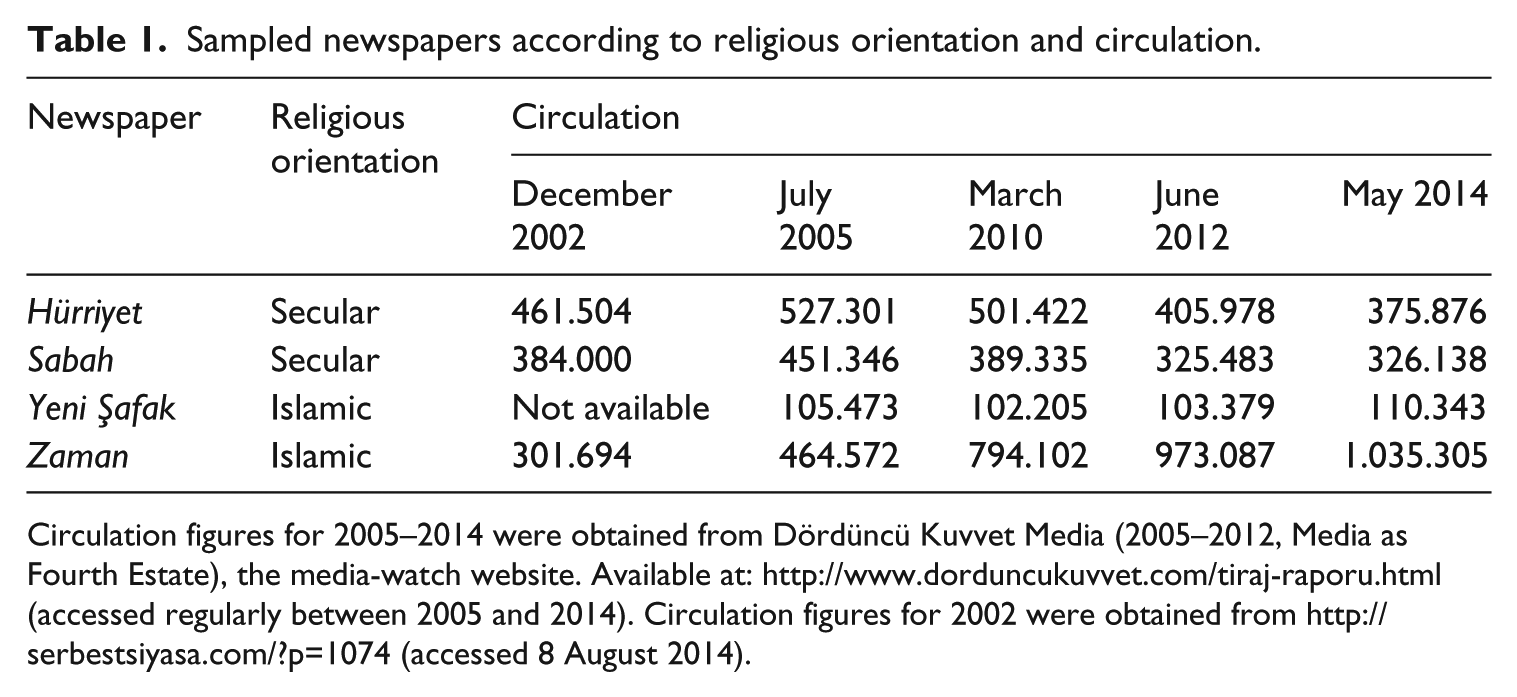
Circulation figures for 2005–2014 were obtained from Dördüncü Kuvvet Media (2005–2012, Media as Fourth Estate), the media-watch website. Available at: http://www.dorduncukuvvet.com/tiraj-raporu.html (accessed regularly between 2005 and 2014). Circulation figures for 2002 were obtained from http://serbestsiyasa.com/?p=1074 (accessed 8 August 2014).
The Islamic newspaper Yeni Şafak’s owners (who also bought Sabah in 2008) have had very close relationships with AKP’s leader Recep Tayyip Erdoğan throughout his political career, even before the establishment of AKP in 2001, and the owners are in-laws of Erdoğan since 2004. Gurcan (2013) characterized Yeni Şafak as an ‘ultra pro-government’ (p. 354) newspaper. Zaman is the newspaper of the Fethullah Gülen’s Islamic movement, which has substantial influence within and beyond Turkish borders. It is the most widely sold newspaper in Turkey, yet its circulation figures have been a source of controversy in the Turkish press due to the community support behind the newspaper. 8 As a result of the internal power struggle between the Gülen Movement and the AKP, Zaman has changed its pro-AKP position and become more critical of the government since December 2013.
The unit of coding in the study is the image. An image that included more than one woman wearing a headscarf was still counted as one image. I coded the images both in the main newspaper sections and in any available supplements. The coding scheme included the categories listed in Table 2, developed for the first time for this study.
Coding categories for content analysis.
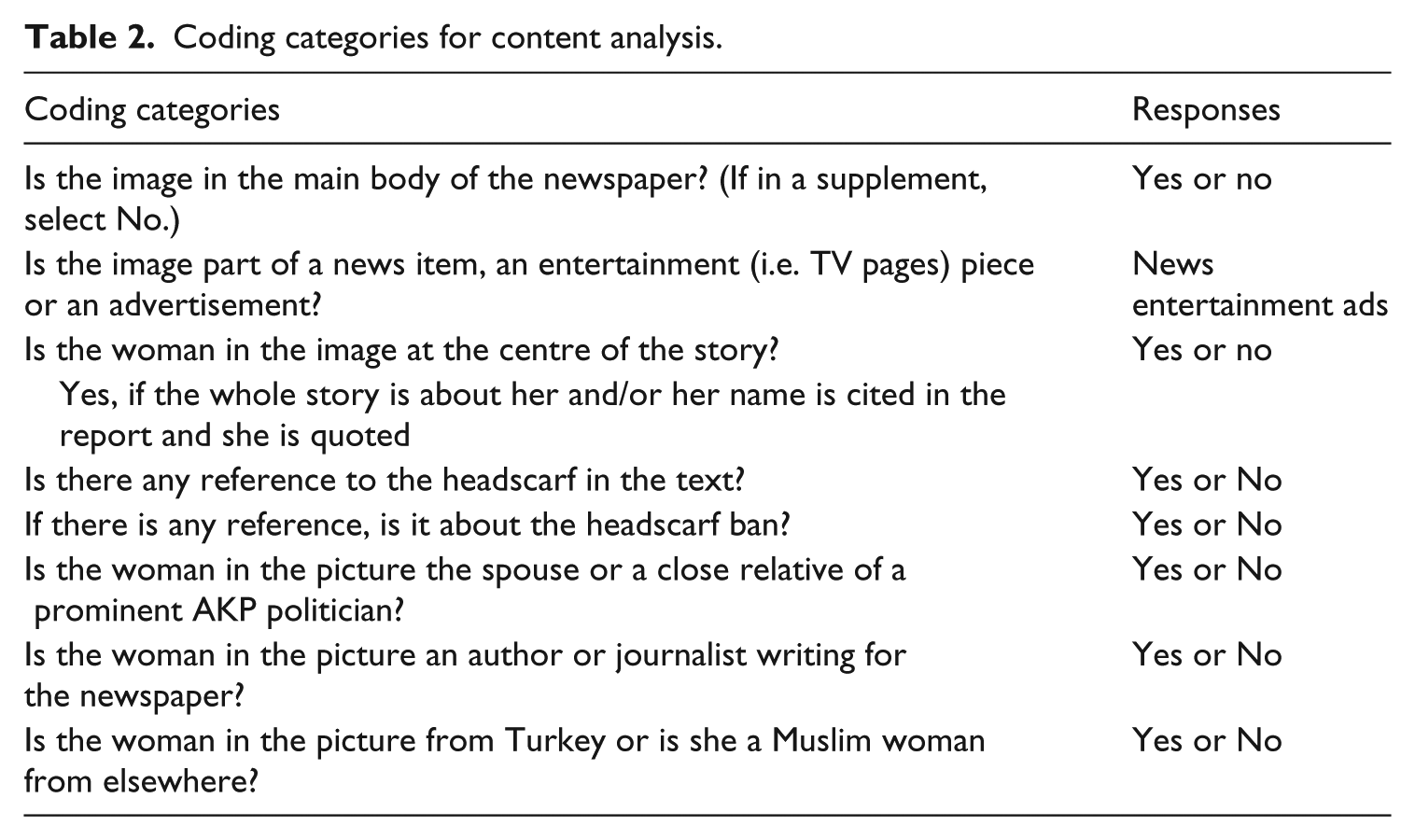
For qualitative analysis, I paid specific attention to the articles that placed ordinary women from Turkey wearing headscarves at the centre of the stories. I chose only those stories where the women were the primary focus (RQ3). I did a close reading of these stories to map out the major themes, including health and medicine, loss and grief, poverty, intimate partner violence, disability and success. Among all these themes, success emerged as the most recurrent in 30 stories in 4 newspapers. I read these 30 stories of success, closely looking at how the images are used; what the relationships between the text and the images are and how the images are connected to larger narratives.
Findings
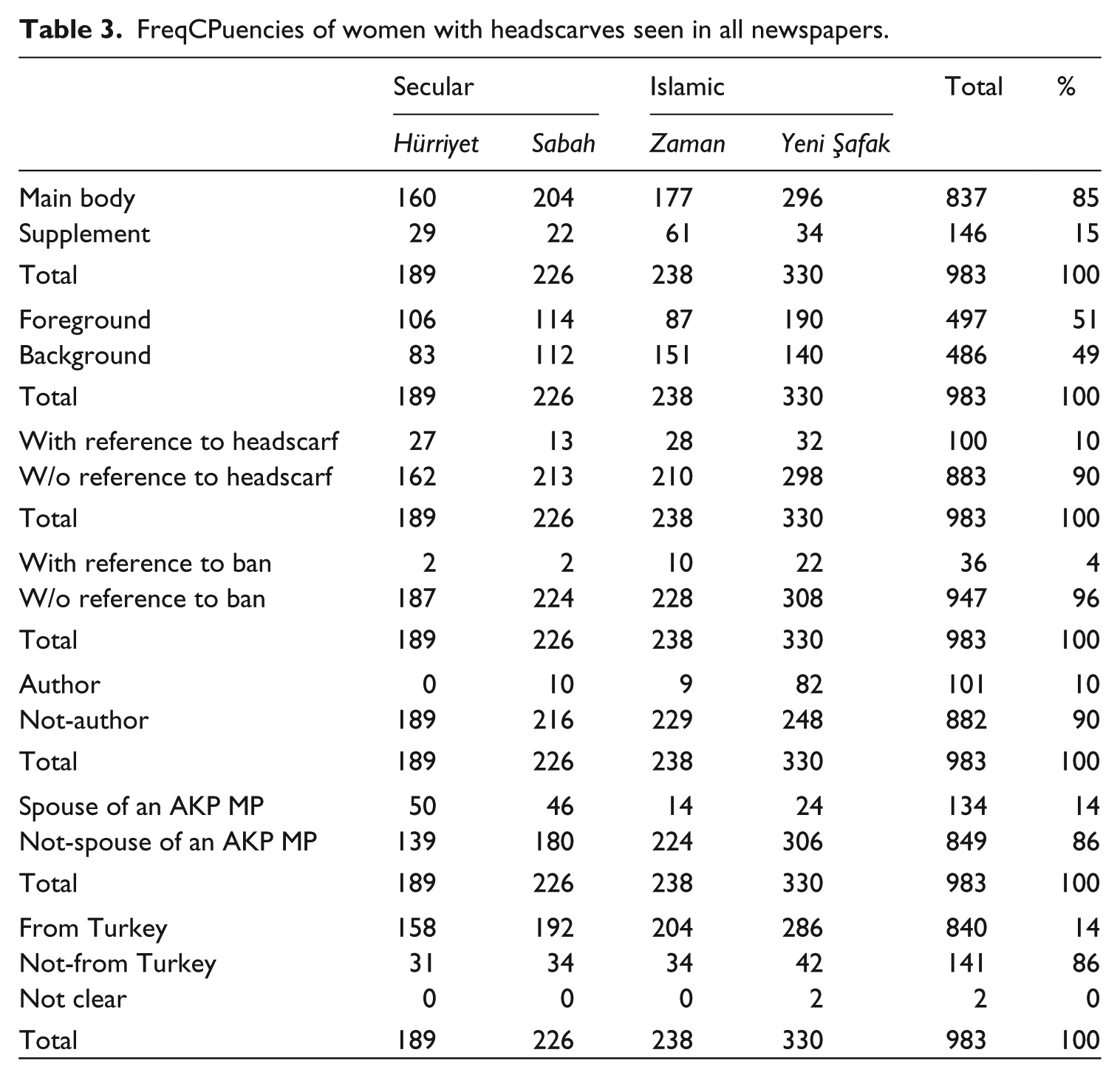
I coded 983 images in total. On average, a newspaper issue contained four images of women with headscarves. Ten per cent of the images are photographs of female columnists wearing headscarves – overwhelmingly in Islamic newspapers. Fourteen per cent are pictures of the wives and close relatives of AKP leaders and MPs, and another 14% are the pictures of non-Turkish Muslim women from around the world (Table 3). The remaining 62% cover all types of images of headscarf. Only 10% of the images included reference to the headscarf in the story, and out of those images 36% included reference to the headscarf ban. Overall, 4% of images made reference to the ban, and 90% of these references were in Islamic newspapers.
RQ1. Has there been an increase in the images of women with headscarves between 2002 and 2012?
FreqCPuencies of women with headscarves seen in all newspapers.
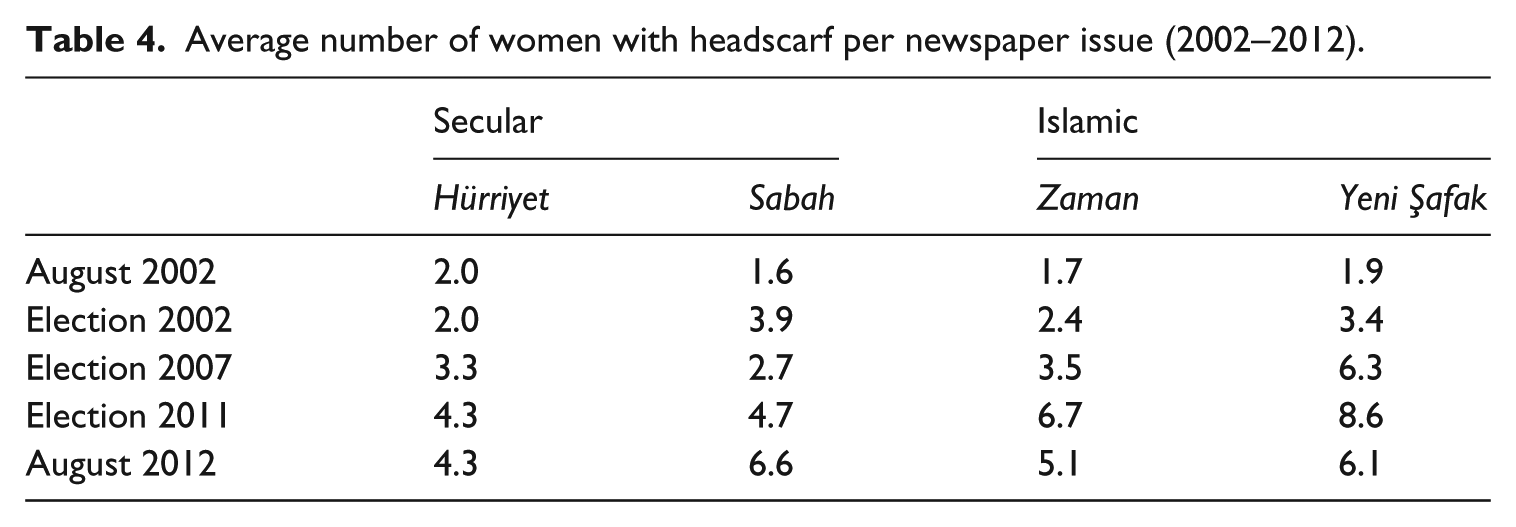
As Table 4 illustrates, the number of women with the headscarf has increased over time in all newspapers with some periodic fluctuations. In 2002, all the newspapers, secular or Islamic, had about the same number of images of women with headscarf. By 2012, the numbers had increased in all newspapers. Unlike all the other newspapers, the numbers of images in Sabah fluctuate, which may be partially explained by the change of ownership.
RQ2. What changes have been taking place in Islamic and secular newspapers?
Average number of women with headscarf per newspaper issue (2002–2012).
The most significant change in Islamic newspapers is the rise of the female columnists with headscarves, around nine times more in pro-AKP Yeni Şafak than in Zaman (RQ2). In 2002, the female columnists not only in Yeni Şafak in particular, but also in Zaman, were writing on the inner and back pages, sometimes next to television schedules: their articles appeared once in a week, and some of them did not have pictures. By 2011, they started to write regular columns and had their images next to their bylines. They became central figures not only in newspapers but also on television, and the newspapers allocated a lot of space to advertisements for their television shows, which were run by the parent media companies that also owned the newspapers. In a way, they paved the way for the first anchorwoman with headscarf, who appeared on state television, TRT Türk, in November 2013.
The Islamic newspapers did not have supplements in August 2002. The first issue of Zaman’s supplement Turkuaz, published in November 2002, did not include any pictures of women with the headscarf. But in time both newspapers featured headscarved women more frequently and as primary actors in their supplements. Interestingly, the images of female authors as well as women in advertisements (Yeni Şafak included far more ads with headscarved women than did Zaman) conformed to the standard ideal of beauty: thin, able, young and conventionally good looking.
The change in secular newspapers is not as prominent as in the Islamic papers. Secular newspapers paid far more attention to the first lady, Emine Erdoğan, than did the Islamic newspapers. Her fashion choices became the focus of two-page spreads and interviews. For the most part, secular newspapers did not picture permanent authors with headscarves. The exception was Sabah’s Emine Beder, who has been writing regular columns on food: her headscarf conformed neither to Islamic nor to folkloric/traditional style. Finally, secular newspapers included more stories about women from other Muslim-majority societies (more stories in Hürriyet than Sabah) than the Islamic newspapers, a point that I will discuss in the final section.
RQ3. In what ways are the women with headscarves represented in stories where they are the primary focus? What are the differences between the Islamic and secular newspapers?
Among the news articles where the women wearing headscarves were the primary focus, stories that centre on the accomplishments of one woman or a group of women stood out, with 30 stories. Both Islamic and secular newspapers emphasized education in their stories of success. The majority of success stories appeared in the Islamic newspapers, where the headscarf is an indispensable part of the identity of a woman, whereas this was not the case for the secular newspapers, where the headscarf was something that easily could be taken off when conditions required (e.g. at universities). In the secular newspapers, success is often part of a larger narrative on modernization and urbanization, which means upward social mobility. 9
Success is often combined with stories on victimhood in both newspapers, but there is a fundamental difference here between the secular and Islamic papers. A typical story in secular newspapers would involve the victim of a child marriage who overcame the odds and would promote the education of girls and denounce child marriages (Sabah, 8 June 2011: 1). In Islamic newspapers, the headscarf ban is depicted as the main cause of victimhood and success. A typical success story would involve women who had to go abroad to get their college degrees because of the headscarf ban at Turkish universities (e.g. Yeni Şafak, 24 August 2002: 1; Zaman Pazar (Zaman’s Sunday supplement), 29 July 2007: 5). These stories would describe how Turkey lost these young women (mostly) to Western countries, where they found an environment of religious freedom and tolerance. In these stories, Austria and Britain were described as idyllic places of freedom in spite of the reports on increasing Islamophobia there.
Two types of success stories appeared in Islamic newspapers: One group directly referred to the headscarf or the headscarf ban – the number of these stories decreased after 2010. The other group presented successful role models wearing headscarves, but without making any reference to the headscarf: lifecycle-event organizers, fashion designers, painters, writers, artists and housewives who organized charity benefit events were the main characters in the stories. It is important to note that these are occupations that do not require women to work together with men – jobs that are mostly done individually. In a two-page article, Zaman proposed a route for happiness to women: working in a home office (Zaman Pazar, 12 June 2011: 11). The article included stories of women both with and without the headscarf and explained how they switched to home offices and found fulfilment by balancing motherhood and work at home. Instead of pointing to the structural conditions at work and home that burdened the women with a double shift, the article offered a solution within the boundaries of the traditional gender roles. Also, men’s responsibility for parenting was never mentioned. When there is any mention of women’s absence in particular fields – for example, women theologians (Yeni Şafak, 14 June 2011: 19) – the cause of such absence is not mentioned at all.
When success stories are compared to stories on women and poverty, an interesting difference becomes visible. In 2002, almost all the images of women with the headscarf in Yeni Şafak were poor women, and they appeared in stories about poverty. Women farmers, women working in the fields, women textile workers appeared in the news; women protesting the headscarf ban appeared, too, but not as often. By 2011, the relationship between poverty and the headscarf had almost totally disappeared. Instead of poor women, an elite group of women wearing headscarves – columnists, writers, painters, fashion designers who were mostly young, thin and beautiful – started to appear in that Islamic newspaper.
Discussion
Women who are not AKP supporters in Turkey today feel that they are living in an increasingly misogynistic environment as AKP cadres define women’s roles only in relation to family and motherhood. It has become commonplace to hear sexist comments from the president, ministers and the state television (TRT). In a November 2014 meeting organized by a conservative women’s association, President Erdoğan advocated once again that women cannot be equal to men and emphasized motherhood as their utmost priority. As a public outcry erupted over his comments, Ayşe Böhürler (2014), a famous female columnist from Yeni Şafak as well as one of the founders of AKP once celebrated for establishing bridges between the seculars and the Islamists, defended Erdoğan and his speech (Yeni Şafak, 29 November 2014). While increasing misogyny is a concern for feminists, Kurdish women and Kemalist women, Erdoğan received 55% of women’s vote (Tremblay, 2014) despite his sexism. In that sense, AKP rule created a complex picture for women. At the same time, press freedom and freedom of speech have been controlled and restricted by the government to an unprecedented extent. According to the Committee to Protect Journalists’ (2013) report, ‘Turkey, Iran and China accounted for more than half of all journalists imprisoned around the world in 2013’. Not only journalists but also students (even under 18 years), directors, artists and academics have been arrested, allegedly for criticising Erdoğan.
The results of this study should be interpreted against this background of gender and media politics. Taking the broader developments into light, the results of this study point towards the creation of an ideal image of conservative woman as part of AKP’s ideology. The founders of the republic created an image of the modern, Westernized woman in the 1920s and 1930s. Today, AKP has created a new hegemony accompanied by its image of the ideal woman. The image of the new conservative women in Islamic newspapers represents the desired characteristics of acceptable womanhood under the AKP hegemony. This image is created at the expense of secular, non-religious, Kemalist, leftist, feminist, Alevite, Kurdish and lower- or working-class women, whether or not they wear the headscarf.
The profile of the female columnist and the successful woman role model hint at the desired characteristics of this new ideal woman: she wears a headscarf, remains modest, prefers jobs that are considered traditionally fit for women (e.g. charity or lifecycle-event organizers) and jobs that can be done individually from home or online (writing, painting) over jobs that require mixed-gender settings. She accepts patriarchy as the norm and does not question the role of men in structural inequalities (e.g. in not giving access to women to train as theologians). She is Sunni and ethnically Turkish. She is incorporated into neoliberal capitalism through fashion and has typical middle- or upper-middle-class tastes. She is not poor.
The change in the gendered visuals of poverty in Islamic newspapers within 10 years indicates a significant shift in AKP’s discourse in relation to wealth and class: in 2002, AKP was represented as the guardian of poor women, and by 2012 poor women were disappearing from the picture and replaced by women from the wealthy Islamic middle class. It is tempting to say that images of poor women have been instrumentalized to delegitimate the previous governments and were later abandoned. As AKP has consolidated its power and marginalized the old establishment, there is no need to recourse to those images as they can also challenge AKP’s ‘success story’ in transforming Turkey, represented by the prominence of elite women with the headscarf in the news. There is also an important divide between poor women and educated, middle-class professional women with headscarf. As Jelen (2011) notes, educated professional woman with the headscarf ‘seemed mostly insensitive or at best silent, regarding the structural (educational, material, social) limitations faced by working-class Turkish women’ (p. 317). This insensitivity both at the level of representation and among professional middle-class women with headscarves indicates the potential for fractures within AKP’s constituency in the future.
Cindoğlu and Zencirci (2008) discussed the counter-hegemonic potential of the headscarf in their article on the transformation of Islamist women from agents as university students or politicians to AKP parliamentarians’ wives. They argued that ‘through this transformation, the headscarf issue lost its counter-hegemonic potential and capacity to form bridging identities with other feminists’ (Cindoğlu and Zencirci, 2008: 804). In light of this study, I would instead argue that, far from losing their agency, women with the headscarf today have become even more important agents with more access to media power than they used to have, particularly as rising journalists and columnists supporting AKP. The headscarf has lost its counter-hegemonic potential not just because women have turned from agents into wives, but also because as agents women wearing the headscarf have been fully incorporated into a new hegemonic conservative power structure. The female headscarved columnists writing in Islamist newspapers are now the elites of the new hegemony, and they actively support it either explicitly, as Böhürler from Yeni Şafak does, or implicitly, by what Turam (2008) called ‘pious non-resistance’. This also marginalizes what have been called the ‘Islamic feminist’ voices among the women columnists who wear the headscarf.
The full incorporation of the headscarf into a new hegemony leads to the breakdown of the relations between women wearing headscarves and other groups of women – feminists, intellectuals and liberal democrats – who opposed the headscarf ban for the sake of women’s rights and for an inclusive democracy, not for a new authoritarian hegemony. As the removal of the headscarf ban parallels the narrowing of choices for women in general, the feminist movement in Turkey, once in dialogue with the women in Islamist movement as an oppressed group, realigns itself in opposition to religious conservatism and AKP’s gender policies. This environment has potential for unexpected alliances within a new feminist movement in Turkey in the future.
On the other hand, the limits of the role models seen in newspapers show that while the removal of the ban is an important gain for women wearing the headscarf, AKP’s vision does not promise to fulfil the aspirations of a new generation of conservative young women. A new generation of young, headscarved women ambitiously want to enter the job market (Jelen, 2011). Yet, all international indexes indicate a continuous decline in gender equality and women’s labour force participation in Turkey since 2006 (İlkkaracan, 2014: 163–165). In addition to narrowing of the opportunities in the labour market, women who wear the headscarf suffer from discrimination at the workplace, even at the hands of religious, conservative employers (Cindoğlu, 2011). The ideological use of the images in Islamic newspapers renders all these problems invisible; maybe more importantly, they are not even defined as problems. It is not clear how a new generation of young women who wear the headscarf will respond to those challenges in the absence of feminist voices and insider criticism within the Islamist movement and amid the suppression of the media.
Within a climate of media repression and the rise of an authoritarian conservative religious hegemony, secular newspapers are on the defensive. As the headscarf becomes increasingly mainstream, they are not confrontational as they used to be. In response to the creation of the new image of the headscarf in Islamic newspapers, secular newspapers resort to the familiar modernist discourse by circulating counter-images of the headscarf and engage in criticism only indirectly: when they point at women’s oppression on the basis of religion, they refer to women living in other Muslim countries. Also, the shifts in the positions of Sabah and Zaman indicate that the categorizations of newspapers in the Turkish press as ‘secular’ and ‘Islamic’ are becoming problematic, and a categorization on the basis of the newspapers’ relations with the AKP government may be more viable for another analysis of the same period in the future.
Content analysis has certain limitations, including investigator bias and mistaken association of frequency with the significance of content (Kenney, 2009: 8, 240–241). These are definitely some caveats for this study as well. In spite of these limitations, this study extends our understanding of the representations of headscarves by bringing the visual aspect into analysis. This study would benefit from extending the analysis to Islamic and secular television channels. Future studies should focus not only on the division between women wearing and not wearing the headscarf but also on divisions among women who do wear the headscarf, with particular attention to the intersections of religion, class, ethnicity and political affiliation.
Footnotes
Acknowledgements
I am grateful to my colleagues Ferruh Yılmaz and Mauro Porto for their generous comments and feedback on an earlier version of this article.
Declaration of Conflicting Interests
The author(s) declared no potential conflicts of interest with respect to the research, authorship, and/or publication of this article.
Funding
The author(s) received no financial support for the research, authorship, and/or publication of this article.