



Abstract
Croatia internalised the European normative requirements in its legislative system and restructured the media system in the process of the European Union accession completed in 2013. The media restructuration had a double social role: self-adaptation to the new communicative possibilities, both democratic and technological, and assignment of new social roles to actors mediating new values through the rapidly growing production of information and communication and thus influencing the differentiation of the public sphere. This article takes a socio-cultural and socio-historical approach to the development of media policies in Croatia, particularly with regard to recent changes of digitalisation of television broadcasting and online content production. It shows how this complex process led to missed opportunities for the strengthening of the public service broadcaster in the digital sphere. Additionally, it provides analytical explanations to this long-term restructuration process.
Keywords
Some introductory remarks: A context for the (re)creation of the media system
During the post-socialist systemic change in Croatia, the balance between public and private interests has taken specific meanings and pressures due to the generally unstable nature of democratic institutions and political culture. In the 1990s, the media system was heavily influenced by political and ideological interests in what Splichal (2000) and others (e.g. Županov, 2002) called ‘political capitalism’ – a system in which there is no clear differentiation between the state, the market, political parties and civil society. Public debates on key issues were highly rudimentary as it was believed that democratic elections were the only relevant aspects of the democratic process in which the ruling party gains legitimacy in deciding in the name of the public (Zgrabljić, 2003). During that period the Croatian Radiotelevision (HRT) was defined as state television with a monopoly on national television broadcasting. In the early 2000s, the HRT was restructured as a public television serving public interests with a presence of civil society in its governance structure.
The media reforms in Croatia were never a part of an over-arching and holistic media strategy, despite the fact that the media have played an important role in the democratisation process. The media were institutions which helped introduce freedom of speech, pluralism, participation and other democratic values. In this respect their social role was crucial for systemic change (Jakubowicz and Sükösd, 2008), regardless of the fact that these values were not always respected and promoted. Their full acceptance requires not only formal adaptation but also its embeddedness within a specific socio-cultural context, thereby requiring social changes along with formal and normative restructuring of media systems.
The latest restructuring process was closely connected to technological developments and market interests. The promotion of digitalisation and its harmonisation with the digitalisation processes within the European Union (EU) was influenced by the need to finish the EU accession negotiations and further liberalise the market, which created a fertile ground for unintended consequences 1 of the media reforms. Due to the emerging reform pressures and a lack of holistic strategies and media policies at the national level, the protection of public interests was unclear (Švob-Đokić and Bilić, 2014). Taken together, fast liberalisation and digitalisation have narrowed down the possibilities of establishing, organising and governing the media market.
The focus of this article is on the institutional and functional change of the media framed by the locally developed media policies and the internalised EU normative requirements. The position of the public service broadcasters (PSBs) – the Croatian Radiotelevision (HRT) in particular – is analysed as being changed significantly amid privatisation and rapid liberalisation of the television broadcasting market, digitalisation, the expansion of Internet infrastructure and the EU accession process. Such processes were experienced by most new EU member countries. While announcements of liberalisation and digitalisation emphasised more media pluralism and more public voices, the reality showed faster consolidation and vertical integration of existing media companies and market players (Open Society Foundations, 2014). The aim of this article is to analyse and provide possible explanations as to why digitalisation policies in Croatia resulted in missed opportunities for the PSB.
In the first section of this text, we briefly outline the development of the Croatian media system in the context of post-communist restructuration. In the second section, we focus on digital video broadcasting – terrestrial (DVB-T) and attempts at regulating the online media in Croatia. These cases are chosen since they reflect the most recent technological changes that have also occurred under the substantial influence of the EU. The following section deals with analytical explanations of this process through the concepts of path dependence, unintended consequences and power relations. Next, we focus on double hermeneutics and reflexivity of media policies. Finally, we conclude the article by highlighting key processes that shaped the media policy in Croatia.
Restructuring the television market
The change of the status of national television from state to public broadcasting service coincided with the liberalisation of the television broadcasting market. Broadcasting concessions for national commercial television broadcasting were granted in 1999 (Nova TV) and 2003 (RTL television). Although the initial introduction of commercial operators into the national public sphere reduced the possibility of a strong political influence on national television broadcasting, it soon became evident that ownership diversity does not necessarily lead to media pluralism. Instead, the long process of tilting the balance towards commercial and market interests started and pushed the media system into a direction of media concentration (Peruško and Popović, 2008). It was clear that the primary motive of the commercial media is their sustainability in the market enabled by increasing advertising revenue at the expense of journalistic norms and standards. Additionally, only two television broadcasting companies were able to establish sustainable business models since they were owned by transnational companies Bertelsmann RTL Group (RTL Television) and Central European Media Enterprises (Nova TV).
The liberalisation of the television broadcasting market that started some 15 years ago created an unstable dual broadcasting model. The state remained the main driver of media policies. However, its influence on the PSB became more subtle than before and not as direct as in the 1990s, while the general relationship between media and politics became more nuanced. As the public broadcasting services were becoming relatively independent from politics, the private transnational companies were gaining ground, and media concentration increased in parallel with a small market fragmentation. A laissez faire regulatory approach expressed in media privileges (tax reductions, advertising or direct subsidies) gained ground. In spite of such developments the Croatian media might be an example of a rather successful adaptation to European digital standards and technology advances in broadcasting. These did not, however, help to overcome the instability of democratic approaches practised through efforts invested in re-organisation of the public broadcasting service.
Digitalisation and advanced market liberalisation
Television is still the dominant medium in Croatia, as in most EU countries. According to the data from 2014, 83% of the Croatian population uses television, followed by the Internet (52%), radio (50%) and press (29%) (European Commission, 2014). The development of the television market was heavily influenced by EU negotiations. Accession negotiation progress reports for Croatia continually stressed the need to speed up and sustain market liberalisation. For example, in 2010, it stated,
[p]olitical will and technical efforts are needed to sustain liberalisation of all segments of electronic communication markets, to yield tangible results in terms of development of the information society and to promote competition on the broadcasting market and the independence of the public service broadcaster. (European Commission, 2010)
Market liberalisation went hand in hand with technological restructuring. Two EU level requirements were looming: the need to align the PSB with state aid as detailed in Articles 86 and 87 of the European Community (EC) Treaty and pressure to introduce DVB. The digitalisation process was directed by a number of stakeholders, including the Ministry of Culture, Central State Administrative Office for e-Croatia, Ministry of Sea, Transport and Infrastructure; regulatory authorities including the Croatian Post and Electronic Communication Agency, 2 Electronic Media Agency; public and commercial broadcasters, network operators and so on. While this process was highly complex, we focus on its effects and the changing role of the PSB. For this reason the Croatian Radiotelevision Act (2010) is essential since it was restructured in parallel with the digitalisation process (Table 1).
Key documents and legislation.

Digitising television broadcasting
The complete analogue switch-off in Croatia was completed in November 2010, 3 ahead of most countries in Central and Eastern Europe. The Croatian Government created the Analogue to Digital Transfer Strategy in 2008 following closely the European Commission’s Communication on Accelerating the Transition from Analogue to Digital Broadcasting from 2005. The EC Communication emphasised consumer benefits of improved picture quality, better sound, better mobile reception and more TV and radio channels. Reflecting this position, the Croatian strategy declared the transfer a matter of national interest with the basic task of ‘creating conditions for quality improvement, scope of production and broadcasting of new content which will enrich the media space of the Republic of Croatia’. The strategy emphasised that the purpose is not only to extend the existing broadcasters to a digital platform but also to create conditions for the entrance of other broadcasters of public interest content (Table 2).
Deployment and switchover dates in Central and Eastern Europe.
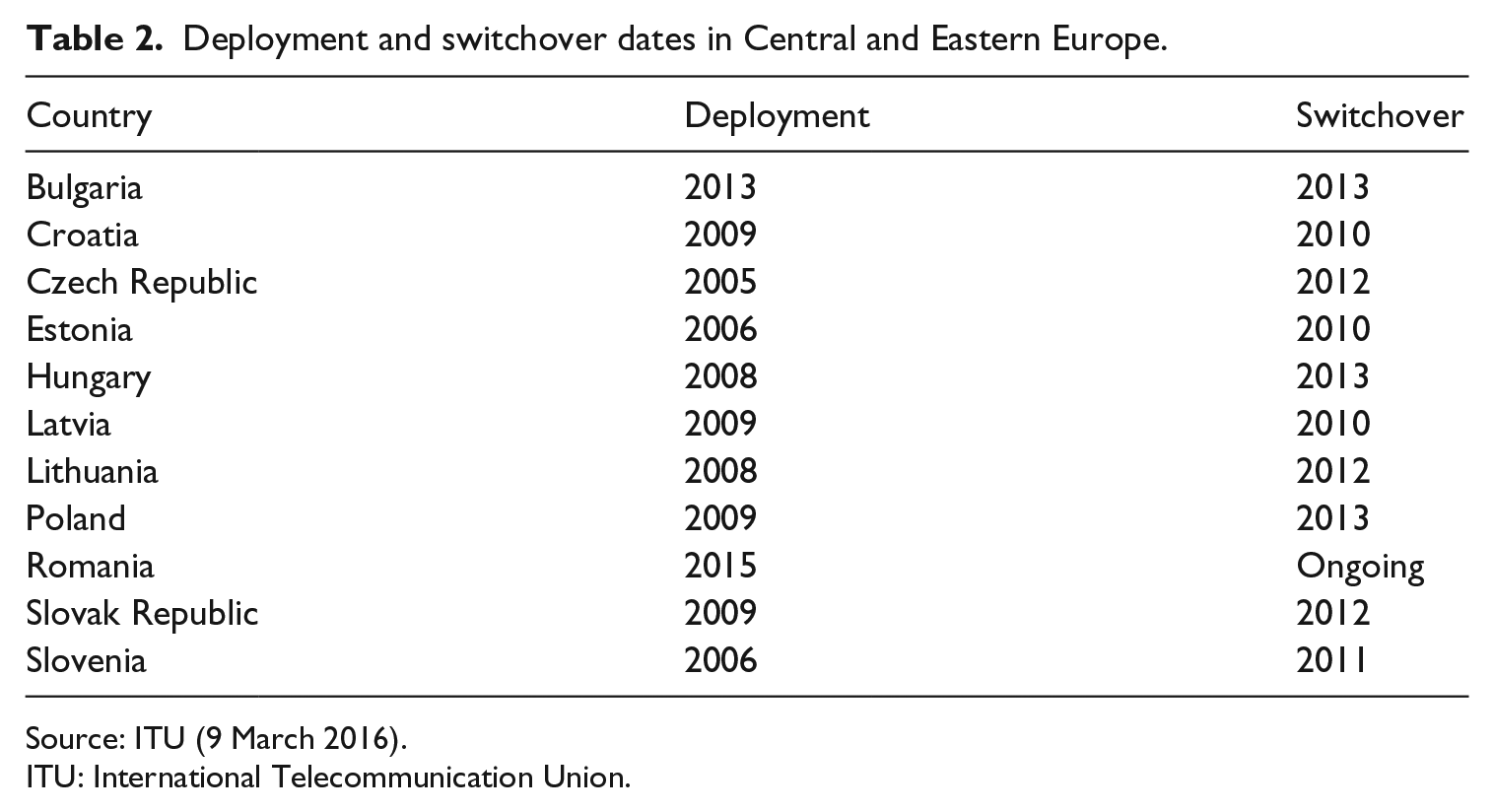
Source: ITU (9 March 2016).
ITU: International Telecommunication Union.
The existing national channels (HTV1, HTV2, RTL and Nova TV) switched to digital broadcasting and the Electronic Media Council (VEM) granted a number of new national concessions for channels specialised in finance, sports and popular music. Commercial broadcasters started broadcasting new consumer content channels (RTL2 and Doma TV) in 2011. One highly positioned individual in the HRT governance structure stated in 2011:
I believe that all these changes with regard to new technologies during the EU accession process are substantial. Croatia partly lags behind technical possibilities, although we finished the digitalisation process remarkably quickly, much sooner than European countries. That is a big step. And now, naturally, you need to fill these platforms with content because platforms themselves are not enough. (Bilić and Primorac, 2012)
The substantial expansion of the possibilities for national television broadcasting in the multi-channel environment was not followed by the PSB, despite declarative strategic positions of ‘the enrichment of the media space in Croatia’ by the Croatian government. The PSB introduced a new channel (HRT 3) only in September 2012, and the new news channel (HRT 4) in December 2012. Reasons for this delay are complex and include both internal and external factors (Table 3).
Television channels with national concessions.

Source: Agency for Electronic Media (9 March 2016).
DTT: Digital Terrestrial Television.
Internally, the instability of the HRT was evident due to the extended period of electing the new Director, negative trends in prime time news reporting that was increasingly tilting towards infotainment (Perišin, 2008) and a sharp audience share drop. According to the Agency for Electronic Media (AEM), the HTV1 channel dropped its audience share from 34.61% in 2006 to 19.6% in 2012; and the HTV2 dropped from 17.74% to 9.35% respectively. In the same time period, Nova TV saw an increase from 15.08% to 24.59% and RTL a decrease from 24.61% to 16.74%. In November 2015, the AEM reports the following audience shares in the total population: Nova TV (24.06%), RTL (16.04%), HTV1 (15.75%) and HTV2 (6.89%). Externally, the financing of the HRT needed to be aligned with rules on aids granted by states in the EC Treaty. According to Article 87 of the EC Treaty,
Save as otherwise provided in the Treaties, any aid granted by a Member State or through State resources in any form whatsoever which distorts or threatens to distort competition by favouring certain undertakings or the production of certain goods shall, in so far as it affects trade between Member States, be incompatible with the internal market.
In other words, according to state aid rules ‘public service broadcasting presents a distortion of the market’ (Bardoel and Vochteloo, 2012: 313). 4 Since the HRT has dual financing from license fee and advertising, a new HRT Act had to be passed in order to align it with EU requirements.
In the build-up to the passing of the HRT Act (2010), 5 an ad hoc coalition of commercial media was formed and was openly and publicly active in expressing the need to limit the advertising time of the HRT. Finally, a new draft of the Act was sent to the national Agency for Market Competition Protection (AZTN) to determine whether it was aligned with state aid rules. The definition of the PSB’s remit being within the purview of each Member State (European Commission, 2009), the HRT Act was passed in 2010 and it included a number of changes. The major changes are as follows: a new financing scheme in which separate accounting was created for license fee revenue and advertising revenue; a reduction in advertising time; new governance structure division between the Supervisory Board, the Programme Council and the Management Board; a 5-year programme contract between the government and the HRT to be monitored by the VEM. Apart from reducing its financing since the advertising time was lowered to 9 minutes within 1 hour (previously it was 12) and 4 minutes in prime time (between 18:00 and 22:00 hours), entirely new contractual obligations for content production created additional strain and posed renewed doubts about the return of the strong political influence on the HRT. This is a sensitive issue due to the long struggle to separate the PSB from political influence in the 1990s. The new governance structure was under heavy critique and was not able to perform its newly delegated duties. The signing of the programme contract was delayed for a year. A number of Programme Council members resigned in this period. After appeals by a coalition of non-governmental organisations (NGOs) to save the HRT, and announcements by the new government and new Minister of Culture following parliamentary elections, amendments were added to the HRT Act in 2012. 6 The governance structure was changed once again and the position of the General Director reintroduced. Remaining jurisdictions were divided between the Programme Council and the Supervisory Board.
The digitalisation process and the alignment with state aid rules were both EU-inspired or directed policies. However, there was no clear connection between these undertakings in the national context which would holistically focus on the restructuring of the television broadcasting market and aim at keeping and/or strengthening the position of the PSB in that restructuring. Because of this gap in strategic planning, the commercial media succeeded in gaining the upper hand in expanding to digital broadcasting and, consequently, in directing the process towards further weakening of the position of the HRT. The process shows how a direct transfer of the European legislation and recommendations, without giving enough thought to local specificities, can lead to neglect of the citizens’ interests that should be clearly institutionalised in public broadcasting (Švob-Đokić and Bilić, 2014). In this case, the national media policy was, for various reasons which we will deal with later, racing ahead of the local capacities of the HRT and the electronic media market to introduce EU level policies. Although the promotion of the public service remit was declared in the digitalisation strategy, the end result was extensive benefit to commercial broadcasters while the HRT was trying to catch up with the restructuring of its governance structure and reduced income. 7
Picking up the digital pieces and not connecting the dots
The level of household Internet access in Croatia went up from 41% in 2007 to over 77% in 2015 but it is still among the lowest in the EU (Eurostat, 2016). Nonetheless, the online communication trends are comparable to EU trends as the spread of basic Internet access was accompanied by the expansion of the existing television broadcasters and print media (e.g. HRT, RTL, Nova TV and Jutarnji list) into online news production; the new news services have been established by Internet service providers (ISPs; e.g. T-Com) and by media organisations focused exclusively on online production (e.g. Net.hr and Index.hr). The influence of these new media on the public sphere is difficult to assess as there is limited and fragmented research on the topic in Croatia, as well as limited national policy intervention in the area. The policy approach, or lack thereof, reflects a global, neoliberal view according to which stronger interventions by the state might affect innovation and free flow of information on the net (Mansell, 2011). The development of this sphere is largely left to market forces. However, a growing number of non-profit media has inspired some policy responses expressed in the amendments to EMA (2013) 8 which aim at the structuring of their position in the market.
Whether the extension of content production of the PSB to the online environment would represent a form of state aid and how it would affect the public service remit is an open question. The issue boils down to what the European Commission would classify as a form of state aid and how the Member States will define the public service remit in the digital age. Both positions are rather unclear in case law (Bardoel and Vochteloo, 2012; Donders and Pauwels, 2008) and the European Commission requires open consultations and test evaluations prior to the introduction of new services under the defined public service remit.
This part of the Croatian media policy is highly undeveloped and most regulations would fall under telecommunications policy, technical issues and infrastructure development within the purview of the Ministry of Maritime Affairs, Transport and Infrastructure. The content requirements regarding democratic and cultural development fall within the purview of the Ministry of Culture. However, while the legal framework is relatively developed for radio and television broadcasting, Internet regulation is largely inexistent, apart from the protection of basic human rights. However, according to the EMA (2009), 9 all electronic media operating in the Republic of Croatia are obligated to enter the register of the electronic media, kept by the Agency for Electronic Media (AEM), and contribute to the operating expenses of the Agency with 0.5% of their annual gross income from providing media services. The definition of electronic media is broad and includes in Article 2 of the EMA a sub-definition of ‘electronic publications’ or websites with editorials. Until 2011 the electronic publications were not requested to enter the register. The calls by the agency in 2011 to all online media to enter the register and report their annual gross income was met with resistance since the criteria for entering were not clearly defined. Electronic publications with a strong financial background such as the news website of the ISP T-Com (a subsidiary of Deutsche Telekom AG) were to be treated equally with online media run by NGOs and non-profit organisations. These actions by the agency were not based on previous research and knowledge of this environment but solely on the outdated definition of electronic publications in the EMA. The EMA amendments in 2013 brought a definition of non-profit electronic publications. The non-profit media were now obligated to turn all of their income into the advancement of media activities and register with the AEM.
This venture into online space by the AEM was not directly connected to the DVB-T process and alignment with state aid rules. Nonetheless, it shows attempts by the state to find a sense of public interest in the burgeoning online sphere. The state decided to exclude online non-profit media from contributing with their annual gross income to the functioning of the AEM. In light of the initiated and completed process of digitising television broadcasting, this offers an indication of the unclear role of the state in dealing with technological changes and developing the public service remit in new digital environments. While, in principle, the protection of online non-profit media is to be commended, media policy failed to realise the possibility of expanding the role of the existing PSB into online space.
Analytical explanations
In the case of digitisation and online regulation, the role of public service media in this process remained unclear. This reflects a European trend of the increasing need to reinvent and redefine public service broadcasting in multi-channel, digital environments in times of increasing pressures from market players and the possibility of rigid interpretations of state aid rules (Bardoel and Vochteloo, 2012; Donders and Pauwels, 2008; Jakubowicz, 2008). The Croatian case was specific due to the long accession process and the scope of policies that were introduced to finish the negotiation process. High expectations of the democratic impact of EU policies were not always fulfilled and were instead circumscribed by commercial interests and effects of complex institutional changes and rapid adaptation to external normative requirements. In other words, fully verifying all of the vested interests in the process is not entirely possible. For this reason, the concept of intentionality is a key to understand complex policy changes. While we focus on the lack of a clear vision for the development and leadership of the PSB in the digital sphere, the concepts of path dependence, unintended consequences and power relations are used as analytical explanations for a broader scope of policy changes, particularly in the EU accession period.
Path dependence
The Croatian EU accession process started in 2001 with the Stabilisation and Association Agreement and ended with formal accession in July 2013. During the long negotiation process, Chapter 10 (Information society and the media) was not highly problematic and was closed already in 2009. However, as stated earlier, progress reports continually monitored the alignment with the acquis and the implementation of new legislation. The constant monitoring created strain on the national regulators’ capacities to act. On the other hand, due to the national political consensus regarding the EU accession, it also increased the legitimacy of their actions when they were declared to be in line with European standards. Formal structures reflected their external environments and did not necessarily target the everyday working activities, efficiency and needs of their institutions (Meyer and Rowan, 1977) – as in the case of the PSB. This process was primarily led by techniques of imitation (Jakubowicz, 2008; Splichal, 2000) of European practices creating a division between normative standards and social realities of a post-communist society (Bilić and Švob-Đokić, 2012; Švob-Đokić and Bilić, 2014). One highly positioned member of the Croatian Society of Independent Producers stated,
Croatia aligned its new legislation with European Commission directives quite literally, not taking into account the fact that directives only prescribe certain minimum standards. They only define starting points and in the sensitive media space a lot is left to local legislation. (Bilić and Primorac, 2012)
Imitative techniques are often a response to insecurity and disorientation in a new symbolic environment. By imitating and copying readymade models, organisations reduce insecurity and maintain their legitimacy (DiMaggio and Powell, 1983). The post-communist restructuring created a fertile ground for the development of imitative techniques. The process of introducing digital television broadcasting was one example of a path-dependent (Pierson, 1996), imitative technique that was not well coordinated with the PSB restructuring in line with state aid rules. The pressure was high to follow the path of the dual broadcasting system developed in most European countries since the 1980s (Van Cuilenburgh and McQuail, 2003). As Bardoel and Vochteloo (2012) explain, ‘the development of state-aid rules for public service broadcasting is not just a legal matter. It highlights steady changes in broadcasting policy in Western Europe’ (p. 303).
Simultaneously with the liberalisation process there were no consensus-based media policies in the country explicitly developed as overall, holistic media strategies (Švob-Đokić and Bilić, 2014). Hence, most media policies were the result of the need to imitate EU developments, or directly align the legislation with the acquis. In other words, the direction of the development of the media system was set externally and the national response was to follow the image of a well-trodden path. As Pollack (2008) explains with regard to path dependence, ‘once a country or region has started down a path, the costs of reversal are very high. There will be other choice points, but the entrenchments of certain institutional arrangements obstruct easy reversal of the initial choice’ (p. 4). The unfortunate consequence of this process is that the formal entrance of Croatia to the EU in 2013 did not necessarily lead to higher institutional stability of the public broadcaster or greater promotion of media pluralism, freedom and independence.
(Un)intended consequences
Any form of policy intervention might be viewed as purposive social action whose intention is to improve the functioning of the social system or one of its components. However, policy actions do not always produce intended outcomes. If it was otherwise, unintended consequences would progressively disappear (Giddens, 1996) and social systems would become increasingly stable and coherent. A possible explanation of this basic conundrum is the fact that policy goals lead to unexpected outcomes due to the number of actors participating in the process, multiple ways of interpreting policies (Cortell and Peterson, 2001) and variable levels of adherence to proclaimed goals. Social change also depends on informal aspects of the social environment which means that policy interventions can be more successful if they support already existing and broader normative standpoints (Cortell and Peterson, 2001).
Privatisation and liberalisation of the television market in Croatia was initially directed towards creating the conditions of media pluralism. The normative ideal of media pluralism entails that more sources of information lead to diverse representations of socially, culturally and politically relevant topics. One of the ways for achieving that goal is to introduce different forms of media ownership which should promote the production of diverse media information and satisfy the public interest for diverse programmes and content. Market liberalisation was certainly one of the key requirements for entering the EU. However, the creation of the dual broadcasting system showed that the primary intention of the commercial media is their sustainability in the market through increasing advertising revenue, often at the expense of news reporting and journalistic standards. The complexity of balancing the reduction of both political and economic influence in the media system was often lost. Improving the tilted balance might prove to be a difficult task, particularly in light of the strong promotion of market principles in state aid rules by the EC.
Unexpected outcomes may also occur as a result of a mistake (Merton, 1936). Even if multiple views and possible outcomes of purposive social action are taken into account, there is always a possibility for mistakes. The reason behind this is the assumption that previous success of certain actions will produce the same outcomes in a different context. In other words, the assumption goes that imitative techniques should produce the same results regardless of the social context. In post-communist restructuring of social institutions, imitative techniques have led to the flourishing of unintended consequences of policy decisions and strategies. The quick introduction of the DVB-T proves this point. The digitalisation process was highly problematic and largely untested in the EU (Iosifidis, 2011), but its introduction increased the institutional legitimacy of certain actors in Croatia by reflecting the external or European environment.
According to Beck et al. (2003), ‘Unintended social consequences are the result of expanding markets, universal laws and technical revolutions, in other words, of a series of economic, political and cultural changes of global capitalism that change its own foundations’ (p. 2). Precisely due to the liberalisation of the media market and the expansion of universal human rights in a relatively short period of time, the nature of the media system in Croatia changed dramatically. Media reforms often followed functional perspectives that assumed that EU-inspired media policies will improve the normative and legal frameworks of the system and ‘fix’ the problems of its functioning, integration and adaptation. However, the nature of the system was equally shaped by other social processes. These included internal organisational issues of media institutions such as the PSB, the possibility of unintended consequences of purposive social actions of media policies, legitimacy issues and so on. The social role of the media in Croatia changed. However, not always with full control and sense of direction as might appear from the formal and normative framework related to the acquis, EU negotiation process and formal membership fulfilment.
Crude power relations
Thinking about unintended consequences from a diachronic perspective may seem like giving certain powerful actors amnesty for driving the political process. Some consequences are quite intended, although not necessarily transparent. Power relations and interests play an extremely important, if not key role in shaping media policies. Due to the embeddedness of communication and media institutions in broader social relations and socio-cultural contexts, the tension between commercial and material issues and social justice and self-government is inevitable (McChesney, 2000). In the policy process, Freedman (2006) claims that ‘It is not the case that lobbyists necessarily operate in secret, nor indeed that they always get their way, but that corporate interests increasingly circumscribe and swamp the policy-making sphere’ (p. 916).
The commercial media have less interest in publishing or broadcasting publicly relevant content. Their main goal is increasing the advertising revenue and promoting consumer culture. In times of the financial crisis, advertising revenues drop, 10 thus sharpening the struggle for revenues at the expense of professional, journalistic standards and democratic values. In the presented cases of recent media policies in Croatia, the influence of commercial broadcasters was particularly emphasised during the alignment with state aid rules and the restructuring of the HRT. The pressure by the ad hoc coalition of commercial media brought reduction of the allowed advertising time for the HRT and reduced its possibility to broadcast prime time sports (e.g. Champions league football). However, none of the actors in this complex process had full control of the debate and each had to deal with a set of responsibilities and pressures. The PSB was under the biggest pressure: it was unstable internally; its operating had to be aligned with EC requirements and its governance structure was changed. The role of the state was ambiguous. It was mostly aligned with a stance that it should not interfere with technological developments and free market competition. The state and the governments in power were under pressure to finish the accession negotiation process and also to keep their political power at the date of formal entry into the EU. During the HRT restructuring, in which parliamentary elections were held, the ruling conservative party was replaced by a coalition led by the social–democratic party. Finally, the commercial media benefited most of the situation. They managed to use state aid rules as a leverage to sustain and expand their business model and reduce the influence of the PSB.
Reflexivity of media policies
The knowledge on any type of social activity is determined by differences in power, social values, unintended consequences and circularity of social knowledge in the process of double hermeneutics (Giddens, 1996: 54). EU policies can be regarded as a form of knowledge about social processes whose intention is to harmonise differences between Member States. However, the introduction of these policies may create specific interpretations within different institutional contexts of Member States. 11 Demands for market liberalisation and normative harmonisation can cause different consequences in small markets and unstable systems such as the Croatian one. Even when thinking in exclusively market terms, it is difficult to expect high levels of competitiveness and media pluralism since small markets inevitably lead to media concentration (Peruško and Popović, 2008; Smilov and Avadani, 2012). Although the adaptation to harmonisation processes may be expected, the unintended consequences and complex power relations point towards the processes of double hermeneutics of social change. Reflexivity does not entail social consensus and integration of social systems, but rather incites their flexibility and change – particularly under the influence of market liberalisation and transnational processes such as European integration.
In the Croatian media system, such reflexive processes can be traced on two levels. First, on the international level where rules, regulations and frameworks set by various institutions of the EU are to be reflected in the local and national contexts of Member States. The manner in which national media policies are to be aligned with European standards depends on various reflexive interpretations. Second, reflexivity is visible within the national system itself, particularly between its institutions and organisations relating to political standpoints, power relations or coordination in implementing specific media policies.
Concluding remarks
The main intention of this text was to present and analyse social drivers of media policies in Croatia. For this purpose we have used two current technological and market-related changes that have prompted different responses in EU Member States: digital television transition and increasing levels of online communication. The policy process has been complex due to these technological changes and transnational policy dimensions. Additionally, the Croatian post-communist heritage has been taken into account since it has created a set of variables that influence the process. Media reforms are not just sectorial and bounded, but a part of a broader process of democratisation, market liberalisation and EU accession. The scope of changes makes it necessary to observe the media policy process as part of a broader socio-historical change. However, while sharing many characteristics with post-communist countries, Croatia is a rather specific case. It entered the EU as the only country in the 2013 expansion, having missed the 2004 and 2007 dates when most post-communist countries finished their accession. The year 2013 was also a period of economic crisis and destabilisation of European institutions. For this reason, many policies which were debated within the EU Member States had a different effect in Croatia due to the prolonged accession period. This led to the change in balance between private and public media in the digitalisation process. The pronounced policy goals of expanding public interest channels resulted in the expansion of commercial channels with a negative impact on media pluralism. Croatia has also faced many problems that are common to the ‘old’ EU Member States and relate to their response to harmonisation pressures by the EC with regard to state aid and digitalisation. So far the state was not able to respond adequately to such pressures and was instead swinging between vaguely understood public interests and market liberalisation. It would, therefore, be justified to wonder whether, in the light of problems related to the basic normative conflict between market competition and public service remit fulfilment, the European Commission might start putting the PSB in front of market demands. This would be in line with the ideal of democratic development promoted by the EU. After periods of the industrial communication policy, PSB monopoly, a convergent media system and dual broadcasting model it would be justified to wonder whether the model of deregulation, privatisation and liberalisation has run its course, and whether a small Croatian media market might be better harmonised with the European surroundings through an increased understanding and tolerance of the local adaptation problems.
Footnotes
Declaration of Conflicting Interests
The author(s) declared no potential conflicts of interest with respect to the research, authorship, and/or publication of this article.
Funding
The author(s) received no financial support for the research, authorship, and/or publication of this article.